On this episode of Intentional AI, Chris and I look at how dictation went from a nine-thousand-dollar tool that needed hours of training to something you can whisper into your watch. We compare cloud and local options, including Wispr Flow, MacWhisper, Superwhisper, and Whisper Memos, along with the privacy tradeoffs that come with each.
We also talk about using your voice to give robots better context, then wrap up with Claude’s new browser and background computer use.
Smokers who want to quit are most likely to succeed when they use nicotine e-cigarettes, according to a new Cochrane review. For someone trying to leave cigarettes behind, the method they choose can make a measurable difference. An updated Cochrane review finds that nicotine e-cigarettes help more people stop smoking than several widely used approaches, [...]
On this episode of Focused, Mike and I work through practical questions about capacity, chronotypes, delegation, accountability, and what to do when a careful plan collapses. We also talk about task overload and the difference between getting human help and handing work to a robot.
In Deep Focus, we look at systems for bad days and why my automated daily note lost to the paper cards sitting on my desk.
Joe Moyer explains how his iPad mini became his go-to reading device. I’ve got an old iPad mini serving the same purpose. Wouldn’t it be nice, however, if I could fit it in my pocket?
Totally unrelated, I’m looking forward to the iPhone event tomorrow.
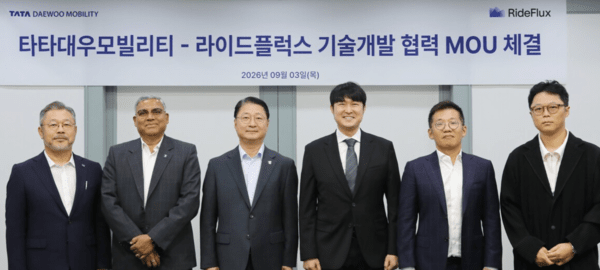
RideFlux and Tata Daewoo Mobility executives pose after signing an MOU to cooperate on Level 2+ driver assistance systems for commercial vehicles and Level 4 autonomous driving. From left: Tata Daewoo R&D chief Lee Yoon-kyu, Tata Daewoo Vice President Anil Sinha, Tata Daewoo President Kim Tae-sung, RideFlux CEO Park Jung-hee, RideFlux CFO Kang Hyuk and RideFlux Strategy Division Head Lim Jong-chul. (Photo: RideFlux)
RideFlux and Tata Daewoo Mobility executives pose after signing an MOU to cooperate on Level 2+ driver assistance systems for commercial vehicles and Level 4 autonomous driving. From left: Tata Daewoo R&D chief Lee Yoon-kyu, Tata Daewoo Vice President Anil Sinha, Tata Daewoo President Kim Tae-sung, RideFlux CEO Park Jung-hee, RideFlux CFO Kang Hyuk and RideFlux Strategy Division Head Lim Jong-chul. (Photo: RideFlux)
Autonomous driving AI company RideFlux has signed a memorandum of understanding (MOU) with commercial vehicle maker Tata Daewoo Mobility to cooperate on Level 2+ (L2+) driver assistance systems for commercial vehicles and Level 4 (L4) autonomous driving.
Under the agreement, RideFlux’s software for five key highway driving functions will be installed on Tata Daewoo Mobility’s XEN and KUXEN heavy-duty truck platforms, with the companies pursuing mass production of L2+ driver assistance systems. Tata Daewoo Mobility will provide the vehicle platforms and vehicle control interfaces, while RideFlux will lead advance development of Driver Control Assistance System (DCAS) software compliant with the UN R171 international standard.
The L2+ driver assistance system integrates longitudinal and lateral vehicle control for functions including lane keeping, lane changing, highway junctions and merging, overtaking and tollgate passage. RideFlux expects to establish a data feedback loop that uses real-world driving data collected from vehicles after mass production to simultaneously improve L2+ performance and validate L4 technology.
The companies have also outlined a roadmap for fully driverless L4 commercialization. Building on what RideFlux said is Korea’s first paid freight transportation service using heavy-duty autonomous trucks, the company plans to develop robotruck conversions before moving to mass production of fully driverless L4 trucks.
The partnership also includes plans to establish a foothold in the global commercial vehicle market by linking the technology with the software-defined vehicle (SDV) architecture of Tata Motors, Tata Daewoo Mobility’s parent company and the largest commercial vehicle maker in India.
RideFlux said that following Korea’s first paid autonomous-truck freight service with Hanjin in July, supplying autonomous driving software to original equipment manufacturer (OEM) Tata Daewoo Mobility gives it a new business-to-business (B2B) revenue stream. The company said the deal also signals that the autonomous driving industry is moving from government-led demonstration projects, or B2G, toward commercialization, providing further momentum for its planned KOSDAQ initial public offering (IPO).
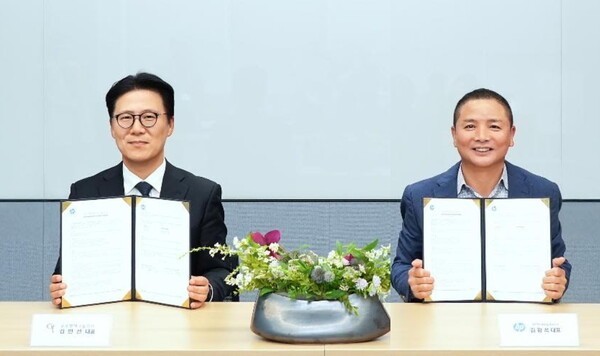
Global Technology CEO Kim Min-sun, left, and HP Printing Korea CEO Kim Kwang-seok sign a memorandum of understanding for technical cooperation in printing systems.
Global Technology CEO Kim Min-sun, left, and HP Printing Korea CEO Kim Kwang-seok sign a memorandum of understanding for technical cooperation in printing systems.
HP Printing Korea said on Sept. 7 that it has selected semiconductor design company Global Technology as its hardware engineering technical support partner for printing systems and signed a strategic partnership agreement. The companies plan to jointly advance electronic component and circuit development as well as artificial intelligence (AI) technologies while strengthening their technological competitiveness.
The two companies will collaborate on the design and development of electronic components and circuits and jointly develop AI-based technologies. Global Technology will also take full responsibility for hardware engineering technical support for HP Printing Korea’s research and development organization.
Global Technology will provide technical support throughout the product development process, including design changes and prototyping for printed circuit assemblies (PCAs). The company said it will operate an integrated technical support system based on its own engineering capabilities and a network of proven Korean partners.
The companies plan to gradually expand the scope of their partnership and jointly develop next-generation main controllers for printing systems, leveraging Global Technology’s system semiconductor and application design capabilities.
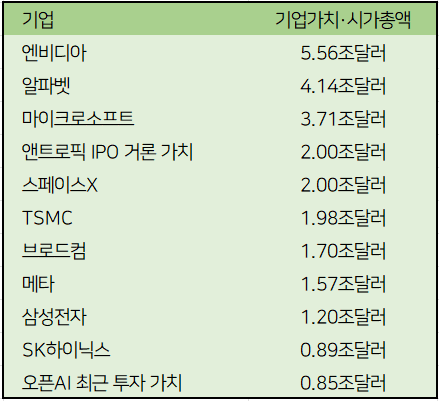
A $2 trillion IPO valuation for Anthropic would be roughly equivalent to the combined market capitalization of Samsung Electronics and SK hynix. (Source: THE ELEC, based on Sept. 4 closing prices)
Leading artificial intelligence (AI) companies in the US and China have begun the process of going public.
Anthropic could launch its initial public offering (IPO) as early as October and list before the US midterm elections in November, Reuters reported. China's Moonshot AI has also reportedly filed confidentially for a Hong Kong IPO this year. The moves put leading frontier AI companies from both countries under direct scrutiny from capital markets.
According to Reuters, Anthropic plans to release its prospectus around late September for an IPO in mid-October. The timetable has been pushed back from an earlier expectation for a prospectus release in early September. IPO marketing is expected to begin in mid-October following the prospectus release.
Anthropic confidentially submitted a draft S-1 registration statement for the IPO to the US Securities and Exchange Commission (SEC) in June. The company said at the time that the number of shares and offering price had yet to be determined and that the listing would depend on market conditions and other factors.
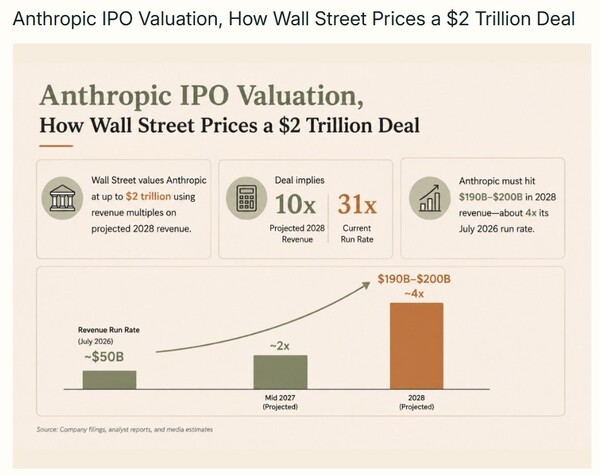
Anthropic could seek a valuation of as much as $2 trillion in the IPO. That would be more than double the $965 billion valuation it received in its most recent funding round.
A $2 trillion valuation would put Anthropic's IPO close to the $2 trillion market capitalization of SpaceX, which went public in the first half of this year. It would effectively make the offering one of the world's largest IPOs. As of the Sept. 4 close, TSMC was valued at $1.98 trillion and SpaceX at $2 trillion.
A $2 trillion IPO valuation for Anthropic would be roughly equivalent to the combined market capitalization of Samsung Electronics and SK hynix. (Source: THE ELEC, based on Sept. 4 closing prices)
Anthropic's potential $2 trillion valuation reflects its rapid growth, including its first quarterly profit in the second quarter and annual recurring revenue (ARR) of about $65 billion in July.
When Anthropic raised $30 billion in a Series G round in February at a $380 billion valuation, ARR stood at $14 billion. By its $65 billion Series H round in May, its valuation had reached $965 billion and ARR had surpassed $47 billion. ARR surged from $14 billion in February to $47 billion in May and $65 billion in July, driving up its revenue multiple.
The market expects Anthropic's ARR to reach about $100 billion to $120 billion by the end of this year. Reuters said the $2 trillion valuation is based to a significant degree on projections for revenue of $190 billion to $200 billion in 2028.
That pace of growth is widening the valuation gap with OpenAI, which is valued at $1 trillion. OpenAI had also considered going public this year but is pushing its IPO to 2027 or later so it can list when it can command a $1 trillion valuation, according to Bloomberg and the New York Times.
OpenAI is valued below Anthropic because its ARR cited in recent reports is about $40 billion. According to the Financial Times, Reuters and other reports, OpenAI's ARR stood at $21.4 billion at the end of last year, more than $25 billion at the end of February and about $40 billion in August. The market currently assigns greater potential to Anthropic's revenue scale and future growth prospects.
Basis for Anthropic's potential $2 trillion IPO valuation. (Source: GraniteShares)
Anthropic is also preparing a $15 billion revolving credit facility ahead of the IPO. Morgan Stanley, Goldman Sachs, JPMorgan and Citi are among the banks involved, according to Reuters. Anthropic is seeking a financial structure that combines equity raised through the IPO with a large credit line to support continued investment in computing infrastructure.
Anthropic's governance structure could also become a factor in the IPO. The company has a special body called the Long-Term Benefit Trust (LTBT), which has authority to appoint four of the seven members of its board. The structure is intended to prioritize AI safety and long-term public benefit over short-term profits.
Once Anthropic becomes a public company, shareholders are likely to demand higher valuations and improved profitability, potentially creating tension with the LTBT's focus on long-term safety and public benefit. The IPO will also test whether a governance structure designed around AI safety can be maintained at a publicly traded company valued in the trillions of dollars.
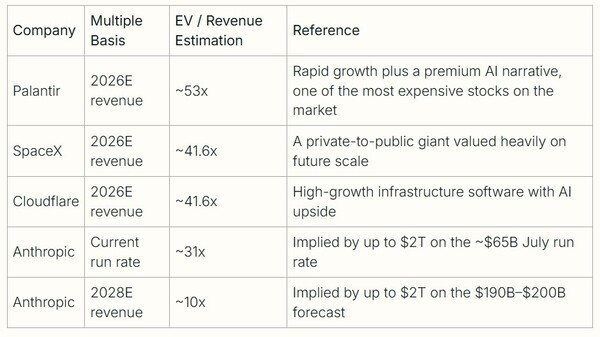
An IPO valuation depends on the multiple applied to expected revenue. Anthropic's multiple would be relatively low compared with Palantir or SpaceX. (Source: GraniteShares)
In China, which is competing with the US for AI leadership, Moonshot AI, developer of Kimi K3, is reportedly preparing to enter Hong Kong's capital market.
According to Reuters, Moonshot AI confidentially filed for an IPO with the Hong Kong Stock Exchange on Sept. 3, targeting about $3 billion and potentially as much as $5 billion in proceeds. About three years after its founding, Moonshot is valued at roughly $50 billion. The timing of the IPO will depend on regulatory approval in China and market conditions. Moonshot has raised more than $5.5 billion from investors including Alibaba, Tencent, Meituan, China Mobile, IDG Capital and HSG.
◇Moonshot AI, Developer of Kimi K3, Expected to Pursue Hong Kong IPO This Year
The most important technological asset in Moonshot AI's IPO is Kimi K3, unveiled in July. K3 is an open-weight model with 2.8 trillion parameters, making it one of the largest open-weight models. It combines performance competitive with US frontier models with an open-weight strategy.
While frontier AI companies such as Anthropic and OpenAI primarily use closed models to generate revenue from application programming interfaces (APIs) and enterprise services, Moonshot AI releases its model weights to expand its ecosystem and generates hosting and service revenue on top of it. K3 has also helped challenge the perception of Chinese AI models as lower-performance, low-cost alternatives.
Moonshot AI has recently been in talks with US cloud service providers (CSPs) over Kimi K3 services, potentially helping it address computing capacity constraints while strengthening its position as a global platform.
Within 48 hours of Kimi K3's launch, user traffic and API requests exceeded expectations, prompting Moonshot AI to temporarily suspend new paid subscriptions for individual users to maintain service stability for existing subscribers. The 2.8-trillion-parameter model rapidly strained GPU clusters and inference capacity, resulting in delayed API access and queues.
According to foreign media reports, Moonshot AI is negotiating with Microsoft, Amazon and Google over cloud hosting and revenue sharing for Kimi K3. Moonshot AI is reportedly seeking as much as 30% of revenue from K3-related services.
The talks are still at an early stage and no outcome has been finalized, but an agreement could bolster Moonshot AI's Hong Kong listing. Rather than spending heavily to build its own global cloud infrastructure, the company could secure sustainable recurring revenue and a stable overseas cash cow by sharing revenue with US CSPs.
The negotiations are also reportedly subject to an annual commercial threshold of $20 million. Under the structure, companies or partners operating a Model-as-a-Service (MaaS) business that generate more than $20 million in annual revenue using K3 would be required to enter into a separate commercial agreement and formal revenue-sharing negotiations with Moonshot AI.
The arrangement would also carry broader significance for the AI industry. It would create a structure in which major US cloud providers host a frontier model developed by a Chinese AI company and share the resulting service revenue with that company.
Meanwhile, the Hong Kong Stock Exchange is attracting Chinese AI companies seeking access to a broader pool of investment capital. With US restrictions on China and geopolitical uncertainty increasing, Hong Kong has emerged as a major alternative for raising global capital.
Foreign investors face strict restrictions on access to mainland Chinese stock markets in Shanghai and Beijing, while Hong Kong allows global institutional investors and international funds to participate more freely. The Hong Kong Stock Exchange's global liquidity pool is particularly attractive to AI companies that require large amounts of overseas capital.
Hong Kong's adherence to internationally recognized accounting and disclosure standards also provides overseas partners and investors with a more familiar governance structure. That is encouraging Chinese companies such as Moonshot AI, which is pursuing revenue-sharing agreements with US CSPs and expansion of its global ecosystem, to seek Hong Kong listings.
Chinese AI companies including Z.AI and MiniMax have listed on the Hong Kong Stock Exchange this year. According to London Stock Exchange Group (LSEG) data, Hong Kong IPOs raised $41.2 billion through mid-August, up 142% from a year earlier. Reuters said Chinese technology companies have led the surge and that Moonshot AI restructured from an offshore entity into a mainland Chinese entity as part of preparations for its Hong Kong IPO.
This week, my friends at Rogue Amoeba are back to sponsor MacSparky. On September 30, they’ll be marking 24 years of making great audio tools for the Mac. To celebrate, MacSparky readers can save 24% off anything in the Rogue Amoeba lineup. Use discount code SPARKY24in their online store through the end of September.
Rogue Amoeba has a full suite of audio tools for the Mac. Audio Hijack is their flagship recording tool.
Audio Hijack records audio from anything on your Mac: your web browser, a Zoom or Teams call, a microphone, a hardware interface, or your entire system audio. It’s easy to build your sessions, using a visual block-based canvas. Drop in your audio sources, add any effects you want, and hook up recording and monitoring. Audio Hijack makes sure it all connects automatically, and you get exactly the audio you expect.
They just released Audio Hijack 4.6, with refinements to their fantastic Transcribe block. Drop it into a session, and Audio Hijack turns audio into text locally on your Mac. Nothing gets uploaded, nothing goes to a server, and there are no accounts required. If you’ve been looking for a way to get transcripts of your calls and recordings without handing the audio to somebody else, Audio Hijack is your answer.
There’s a fully functional free trial, so you can put Audio Hijack through its paces before you spend anything. Download it today from Rogue Amoeba’s website. And don’t worry – Audio Hijack is already updated for compatibility with macOS 27 (Golden Gate).
My thanks to Rogue Amoeba for supporting MacSparky, and for keeping Mac audio in such good hands for 24 years. Check out Audio Hijack, and the rest of their lineup, and don’t forget discount code SPARKY24 to save 24% off everything this month.
The Relay for St. Jude 2026 fundraiser is underway. Hooray! Since 2019, the Relay community has raised more than $4.8 million for St. Jude. This year, we’re within reach of the $5 million mark.
The case is simple. You give money and they use it to take care of kids with cancer. Families never receive a bill from St. Jude for treatment, travel, housing, or food. The hospital has also helped push the U.S. childhood cancer survival rate from 20% when St. Jude opened in 1962 to more than 80% today. Donors make that work possible. I plan on helping. You can too. Even five dollars helps.
Hazel turns twenty this weekend. I’m a fan. People ask if I’m still using Hazel in the age of AI, and the answer is absolutely yes. Hazel still does a lot of great file management on your device without burning tokens or sacrificing your privacy. There’s definitely space for it on my hard drive still.
To mark the occasion, everything in the Noodlesoft store is 35% off through Monday night. No code required, the sale price is already showing:
Hazel 6: $42 → $27.30
Family Pack, up to five Macs in one household: $65 → $42.25
Upgrade from an earlier version: $20 → $13.00
For giggles, I’ve also marked the Hazel Field Guide 50% off for the week. Code: HAZELIS20
Teddy Svoronos returns to the Mac Power Users. Teddy explains how he uses tech to teach at Harvard’s Kennedy School of Government and the challenges of teaching in the age of A.I.
Growing up and watching Star Trek, one thing that made it feel futuristic to me was the interaction with the “computer.” You didn’t see Captain Picard updating software or managing user interfaces. Instead, he just said something out into the air, and then the computer responded politely and efficiently, giving him whatever he needed.
At the time, that made total sense to me as something that would be natural in a few hundred years, but it never occurred to me that we would get there in my lifetime. And yet, we are rapidly approaching the Star Trek moment.
Through a variety of technologies – flawless text-to-speech dictation, modern processors, and artificial intelligence – we are getting to that point where you can just yell something into the air and digital problems get solved. Heck, if you’re willing to go out on the end of the spear, we are already there.
In essence, this lets you separate the user from the software. It’s putting another level of abstraction between you and the work. This doesn’t mean we’re replacing the software, at least for the time being, but it does mean you can step away from it. Rather than being an operator of your software and systems, you become more of a director of it.
Smart productivity app developers are already seeing that, and that’s why you’re seeing so many of them release MCPs and other techniques for their software to work with artificial intelligence. They are, in effect, adding their software to your voice-controlled stack.
I expect that to only accelerate. We’ll be getting Siri AI very shortly, and you’ll see how Apple is doing the same thing within the confines of their own operating system and, of course, under their terms.
We are spending a lot of time talking about these technologies in the MacSparky Labs and the Robot Assistant Field Guide. Over time, what this will achieve is to make all of us power users provided we can get comfortable with the additional abstraction and use our imaginations. What I’m here to tell you is that normal folks in the not-so-distant future are going to work very similarly to Jean-Luc Picard.
This week in the labs, we covered the usual assortment of geeky topics and we’re all looking forward to the iPhone event next week.
Below you’ll find the week’s new videos and podcasts, a few of the conversations happening in the member community, and what’s coming next week. Most of those links lead straight into the Labs community on Circle, so they’ll only open if you’re a member. If you’re a Labs member who hasn’t set up your Circle access yet, send me a note and I’ll get you in. For members, this is your week at a glance. If you’re not one yet, it’s a peek at what you’re missing.
The Week’s Releases
This Month in the Labs – August 2026
Roundup · August 31 · all tiers
The August wrap-up went up in all three tiers on Monday. Every video, podcast, and live session from the month, collected in one place.
MindNode just added MCP support, so you can now hook your AI right into your mind maps. I gave it one dictated prompt and watched it build a full map of my MacSparky content pipeline, channels, platforms, and all.
Every USB-C cable looks the same and they are not the same. WhatCable is a free utility that identifies what a cable can actually carry, and I walk through it.
Last week Apple updated the Magic Keyboard, replacing text key labels with glyphs, which is kind of nice. I have a similar keyboard on my laptop, and I like it.
However, I was hoping they would fix a different injustice that’s been around for a while. Specifically, you can buy the extended keyboard with black or white keycaps, but the standard Magic Keyboard only comes with white keycaps. I find this baffling.
There are plenty of us picky users who want an Apple keyboard on our desk (with Touch ID) that is not 16 inches wide. And yet, still no dice.
I wear a bracelet with a Latin phrase on it, which is exactly as insufferable as it sounds. Materiam Superabat Opus. This phrase is so important to me that I had a box of pencils made with it etched on the side so I see it every time I write something down. I also laser engraved it on the inside of my belt so I think about it when I put my pants on in the morning and take them off at night. Today, I want to explain.
Ovid, in Metamorphoses, at the very beginning of Book 2, describes the doors of the Sun God’s palace. The god of the forge, Mulciber (Vulcan), carved the whole world onto them. They held the sea, the land, the rivers, the sky, and all their gods and people. The doors were made of precious silver, and yet, Ovid explains, the workmanship surpassed them. Materiam Superabat Opus means “the work was better than the material.”
The first time I read this phrase, it flattened me.
I like to think of myself as a craftsman. I make things, both with my words and with my hands. Being a craftsman is a core part of my identity. When I’m entrusted with a piece of material (whether it’s an idea or a slab of walnut), my goal is to leave it better than I found it.
But for me, Materiam Superabat Opus runs much deeper. I think about it in terms of my life. Specifically, I don’t think I am a particularly smart or clever person. As I was growing up, there was always somebody smarter, faster, wittier, and certainly better looking than me.
From an early age, I realized that if I was going to make my way in this world, I had to make the best of what I had. I had to cobble together what skills and talent I did have to make the best version of myself. I think it explains why I’ve always been so interested in automation and optimization, a pursuit that pre-dates my first run-in with a computer.
If there is anything that I’ve got going for me, it’s my willingness to do what it takes to make the best out of what I have. My sincere desire is that the sum total of my life exceeds the toolkit I was given. In the end, I want them to say, “With modest material he did good work.”
We got a lot of news from Apple this week, and I shipped a lot in the labs. Busy week.
Below you’ll find the week’s new videos and podcasts, a few of the conversations happening in the member community, and what’s coming next week. Most of those links lead straight into the Labs community on Circle, so they’ll only open if you’re a member. If you’re a Labs member who hasn’t set up your Circle access yet, send me a note and I’ll get you in. For members, this is your week at a glance. If you’re not one yet, it’s a peek at what you’re missing.
The Week’s Releases
August Deep Dive – Sparky’s Analog Stack
Deep Dive · August 25 · Pathfinder
The recording from this month’s Deep Dive is up: why paper still handles the last mile in an otherwise digital workflow, the daily list scratched onto a Field Notes page or an Ugmonk card, why a wildfire evacuation didn’t change how I think about backup, and the room’s own rabbit holes on Lochby covers, Rhodia paper, and pencil sharpeners.
Design a Cohesive Stream Deck Icon Set with ChatGPT
Video · August 26 · Pathfinder & Insider
A lot of you saw the Stream Deck tour and asked how I make the buttons. This one walks through it. I use a ChatGPT project with a design prompt saved as a resource file, which gets me icons that all look like they belong together, and I show how to pair two of them on a multi-action switch so one button toggles my recording light.
Apple Weather gets close, but it has never been quite right for my backyard. So I solved it with money and put an Eve Weather sensor outside the window. Here’s the setup, what it looks like in Apple Home, and the automations I’m building on top of it.
Apple shipped new desktop Macs two weeks before the iPhone event. The M6 Mac mini is Apple’s first 2nm chip, the M5 Ultra Mac Studio is its first quad-die design, and both ship September 22 running macOS 27 Golden Gate.
When I first saw the headline, however, I was hoping it meant a more global agreement with the European Union. I talk to European Apple enthusiasts every day in the MacSparky Labs, and they are all incredibly frustrated that Apple fails to release features in the EU that are available elsewhere.
I’m not going to pretend to know who’s to blame, but European citizens and Apple customers are the ones paying the price.
Back in my days as a lawyer, I was a party to enough ongoing negotiations to know that the people outside the negotiations have no clue what’s actually going on. But I can hope this is merely a first step and that my European Apple-using friends can get access to Siri AI sooner rather than later.

 Login