AI companies have been talking about superintelligent AI like it’s inevitable, but recent safety incidents like OpenAI’s Hugging Face breach are demonstrating the potential dangers of deploying AI systems that are more capable than humans. So what happens when we can’t reliably control what these systems do? On this episode of TechCrunch’s Equity podcast, Rebecca Bellan is joined by Connor Leahy, an AI researcher, entrepreneur, and now the U.S. Executive Director of […]
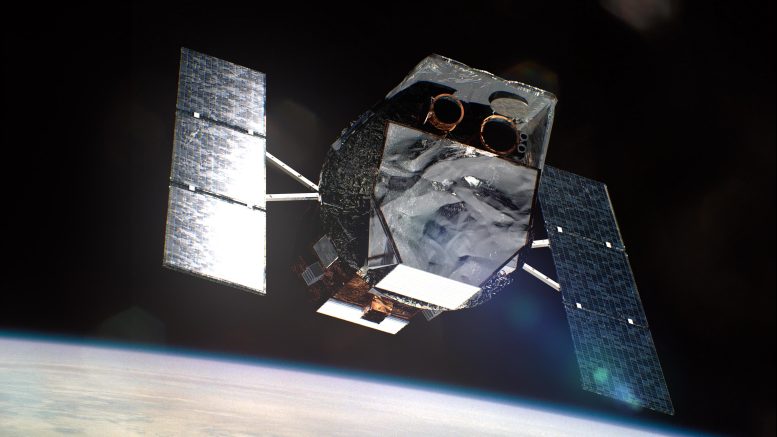
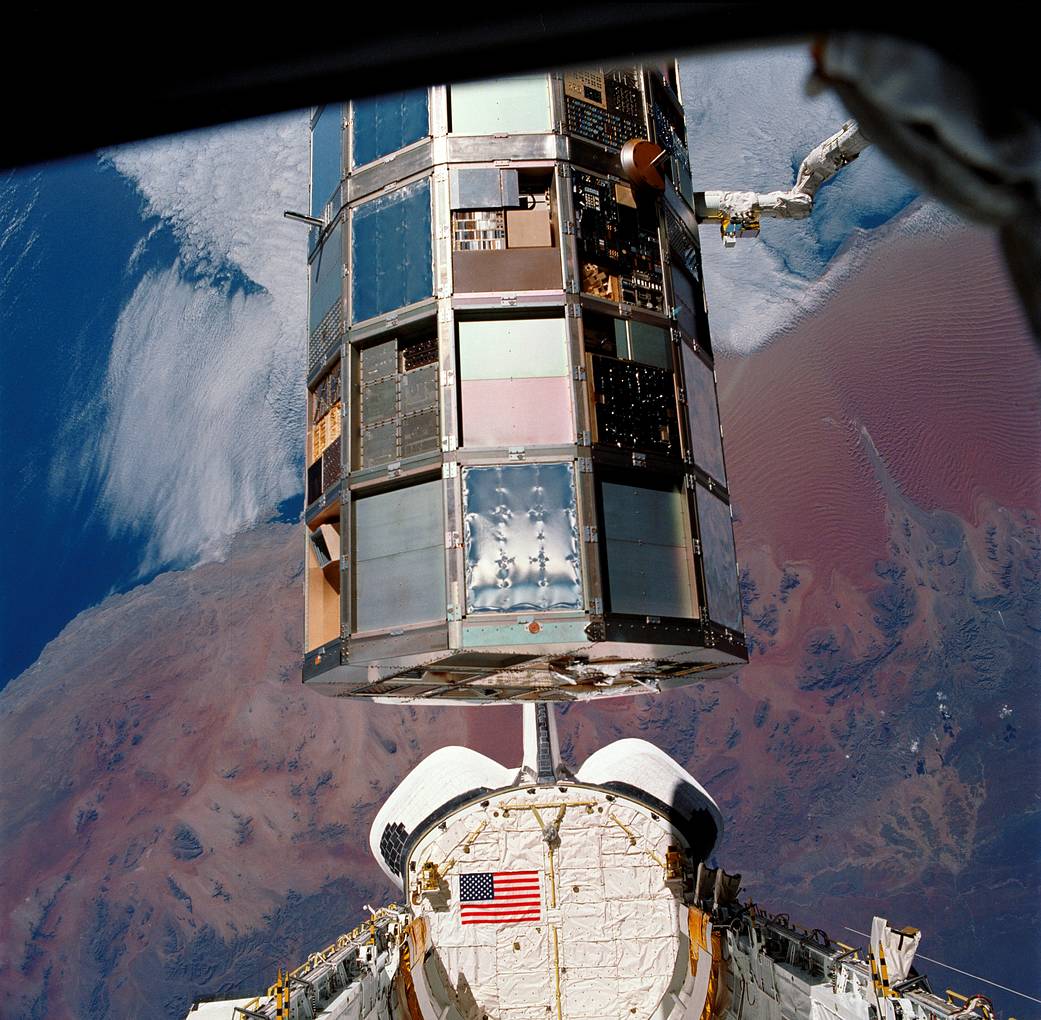
When NASA deployed the Long Duration Exposure Facility in April 1984, its experiments were supposed to spend about ten months in orbit before returning to Earth. Instead, scheduling changes and the aftermath of the Challenger accident extended the flight to 69 months. Columbia finally collected the facility in January 1990 and carried it home in its payload bay.
The satellite held 57 experiments. Its name, usually shortened to LDEF, described the job: expose materials and equipment to space, then bring them back for examination. The unexpectedly long stay made recovery more urgent while also providing an unusually extensive record of what the orbital environment could do.
A laboratory whose exterior was part of the experiment
LDEF was an uncrewed structure built to travel to and from orbit inside a space shuttle. A NASA mission profile describes a facility roughly nine metres long and 4.3 metres across, passively stabilised so its surfaces retained a consistent orientation relative to its direction of travel.
That orientation was scientifically useful. Materials facing into the direction of motion did not receive the same exposure as those facing away. A sample’s location was therefore part of the experiment, alongside its composition and the length of time it spent outside.
The structure carried test specimens in trays. Some investigations concerned the space environment itself; others asked how materials, components or systems would respond to prolonged exposure. The facility did not need a crew working inside it to function as a laboratory.
Its surfaces were recording the journey.
Returning those surfaces allowed scientists to study changes that could not be fully understood from a photograph alone. They could examine the actual material, compare exposed and protected areas, and connect physical damage with where each specimen had flown.
A retrieval delayed more than once
NASA’s history of the STS-32 recovery mission traces the postponements. Retrieval was originally assigned to a flight in February 1985. Shuttle scheduling delays pushed it to September 1986, and the Challenger accident brought another, much longer interruption.
By the time Columbia was preparing to collect LDEF, its orbit was decaying. NASA’s retrospective says trajectory specialists expected atmospheric re-entry by March 1990, making a timely recovery important. An object designed to be returned for analysis could otherwise lose both its hardware and much of its scientific value.
The long delay should not be mistaken for a planned six-year exposure campaign. It changed the experiment’s conditions after launch. More exposure could reveal long-term effects, but it also meant investigators had to interpret results against a mission history different from the one they had prepared for.
Nor did every instrument necessarily record continuously for the entire stay. The physical exposure of a specimen and the recording lifetime of an active instrument are separate things.
Columbia brought back the whole facility
On 12 January 1990, Columbia’s crew retrieved LDEF. Bonnie Dunbar operated the shuttle’s robotic arm, and the astronauts carried out a photographic survey before securing the facility in the cargo bay. Columbia landed at Edwards Air Force Base on 20 January.
A post-flight technical report records 32,422 orbits during the extended mission. Once the facility was back on Earth, work shifted from catching a satellite to systematically documenting and removing its experiments.
That transition was essential. Recovery was the route to the measurements, not the end of them. Trays had to be identified and examined in relation to their positions on the structure, while investigators distinguished environmental effects from other possible changes.
A spacecraft that returns as cargo offers a different scientific opportunity from one that transmits readings and stays aloft. The sample itself remains available for instruments, techniques and questions that may go beyond the original flight equipment.
Weathering in space has several causes
NASA’s overview of LDEF lists micrometeoroids, orbital debris, energetic particles, atomic oxygen and solar radiation among the exposures the experiments encountered. Calling the surfaces weathered is useful shorthand, but this was not terrestrial weather acting on an abandoned machine.
Atomic oxygen is one particularly important part of low Earth orbit. NASA’s materials research explanation describes how these reactive oxygen atoms can erode polymers on spacecraft surfaces. Their cumulative effects matter when engineers choose materials intended to remain outside for years.
Research from LDEF experiment A0114 included measurements of oxidation and polymer erosion, using the returned samples to investigate how surfaces interacted with fast oxygen atoms. Such measurements turned visible wear into evidence about rates and mechanisms.
The damage was part of the data.
Different materials could respond differently, and a surface’s appearance could not by itself identify every process involved. The value lay in combining inspection with measurements and the known exposure history.
The extended stay left an engineering reference
A 1994 overview of LDEF results describes more than 10,000 test specimens and the work of investigators studying the returned hardware and recorded data. The findings helped refine models of radiation, debris, meteoroids and atomic oxygen in low Earth orbit.
That is the broader importance of the mission. A laboratory test on Earth can isolate a particular effect, but an orbiting specimen encounters several influences together. Returned hardware allows researchers to compare their predictions with the combined result.
LDEF’s unusually long stay was an operational complication that became a source of scientific evidence. Columbia did more than retrieve an overdue satellite: it delivered years of exposure back to the laboratories equipped to examine it, with the marks of that history still on the surfaces.
Solar system simulations starting from varied initial conditions suggest that Earth-like planets can emerge naturally from planet formation. Computer simulations of planetary systems can now begin from thousands of different starting conditions, allowing researchers to explore how worlds might emerge without assuming the final outcome. Over the past three decades, these models have advanced from [...]
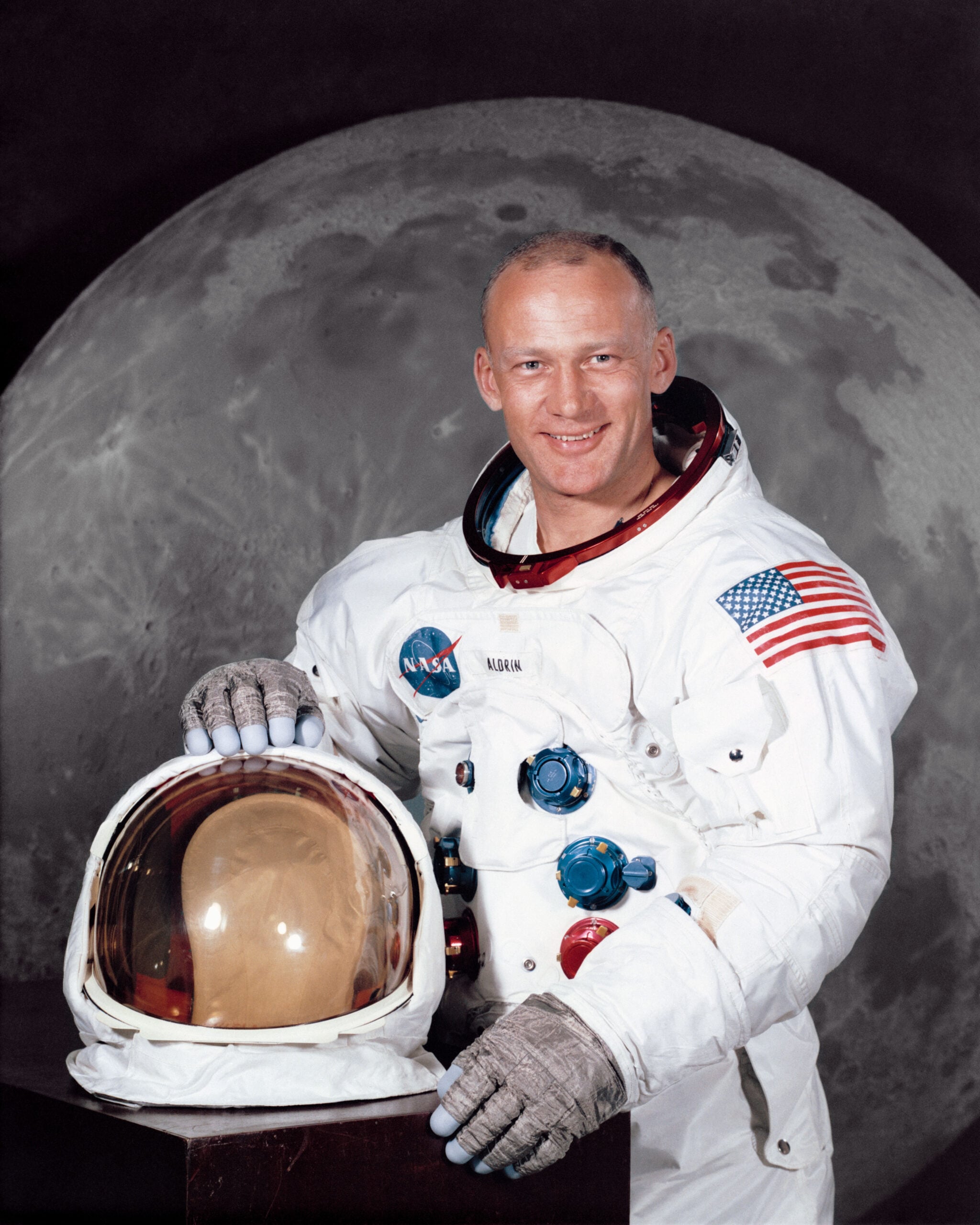
The Apollo 11 mission cost NASA more than twenty billion dollars in 1969 money, or somewhere north of one hundred and fifty billion dollars in modern terms. It was one of the most expensive single scientific undertakings in human history, involving roughly four hundred thousand people across NASA and its contractor network. Everything about it was unprecedented. The Saturn V rocket had never been flown with a crew on a full lunar trajectory before. The Lunar Module had never been landed on a celestial body. The re-entry profile at the return end of the trip had never been survived. Buzz Aldrin flew on the mission as the second of three crew members and walked on the lunar surface on 20 July 1969. He returned home four days later. And when he got back to Houston he filed a routine federal government travel expense claim like any other public employee returning from a work trip. It was for thirty-three dollars and thirty-one cents.
What the voucher actually itemises
Aldrin posted a photograph of the original voucher on Twitter on 30 July 2015 to mark the forty-sixth anniversary of the moon landing. According to CBS News reporting the following day by science journalist Amanda Schupak, the voucher covers the period from 7 July 1969 through to 27 July 1969, which is a week and a half before the launch through to three days after the splashdown. What follows is probably the strangest business trip itinerary in the history of American federal expense accounting. The listed points of travel are Houston, Texas to Cape Kennedy, Florida on 7 July, then Cape Kennedy to Moon on 16 July, then Moon to Pacific Ocean on 24 July, then Pacific Ocean to Hawaii the same day, and finally Hawaii back to Houston on 27 July. The mode of transport listed for each leg is equally striking. Government Air for the two flights inside the continental United States. Government Spacecraft for the leg between Cape Kennedy and the Moon. USS Hornet, which is the aircraft carrier that recovered the crew, for the leg between the Pacific Ocean and Hawaii. And a US Air Force plane for the return to Houston.
The life of an astronaut is truly fascinating – check out the video we made on what every astronaut sees in the mirror:
The federal expense reimbursement system in 1969 did not distinguish between astronauts and any other government employee. If you were travelling on official business you filled out the same form, listed the same route, claimed the same mileage rate for personal vehicle use, and provided the same receipts for any out-of-pocket costs. Aldrin’s voucher was processed by a routine NASA finance office alongside vouchers from technicians attending conferences and administrators travelling to Washington. Nobody appears to have thought the situation odd enough to route it through any special channel. The reimbursement was paid in the normal course of business a few weeks later.
Why the amount was so small
The reason the total came to only thirty-three dollars and thirty-one cents rather than something more substantial is spelled out on the voucher itself. According to BBC Science Focus Magazine’s August 2015 write-up by Rachel Baxter, the document states in plain text that government meals and quarters were furnished for all the dates in question. That covered his food and lodging at the pre-launch quarantine facility at Cape Kennedy, aboard the Saturn V and the Apollo capsule, on the lunar surface itself, aboard the USS Hornet during the post-splashdown recovery, and inside the mobile quarantine facility where he and Neil Armstrong and Michael Collins were confined for twenty-one days after their return in case they had brought back any unknown lunar pathogens. The federal government had covered every one of those things directly, so Aldrin had nothing to claim against any of them.
What the thirty-three dollars and thirty-one cents actually covered was almost certainly the mileage rate for driving his own personal vehicle from his home in Houston to Ellington Air Force Base and back at each end of the trip. Government employees in 1969 were entitled to claim a per-mile rate when using their own car for official business. Aldrin did what everybody at NASA did. He drove to the airfield, got on the government plane, and came home the same way at the end. He submitted his mileage on the standard form. He got his check for thirty-three dollars and thirty-one cents in the mail a few weeks later.
The voucher was not the only piece of Apollo 11 bureaucratic paperwork Aldrin dug out and shared publicly in 2015. He also posted the US Customs declaration that he and Armstrong and Collins had signed on landing in Honolulu after the recovery. The declaration listed their country of departure as Moon and their flight number as Apollo 11. The cargo section listed moon rock and moon dust samples. The question about whether any crew member had been in contact with an infectious disease during the trip was answered by Aldrin in the space provided as “moon disease TBD.” A Honolulu customs inspector had counter-signed the form and accepted it as filed. The crew had cleared customs.
What the whole set of documents represents is one of the more revealing curiosities of the entire Apollo programme. NASA had achieved something in July 1969 that no human institution had ever previously come close to achieving, and the federal bureaucracy processing the paperwork for the people who had done it treated them exactly like every other federal employee returning from a work trip. That was partly because the routine forms were the only ones available. But it was also because the people at NASA didn’t consider themselves exempt from the ordinary paperwork obligations of federal employment. Aldrin filled out his expense form. He submitted his customs declaration. He collected his thirty-three dollars and thirty-one cents. And forty-six years later he still had the voucher in a drawer.
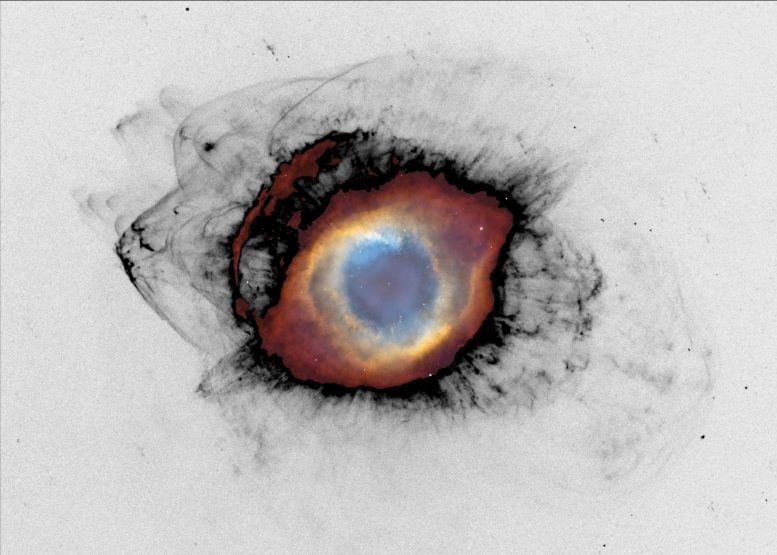
A new image of the Helix Nebula reveals how dying stars return material to the galaxy. The Helix Nebula offers a rare look at what happens after a dying star releases its outer layers into space. New observations show fragments of that material colliding with surrounding gas, breaking apart, and beginning their return to the [...]
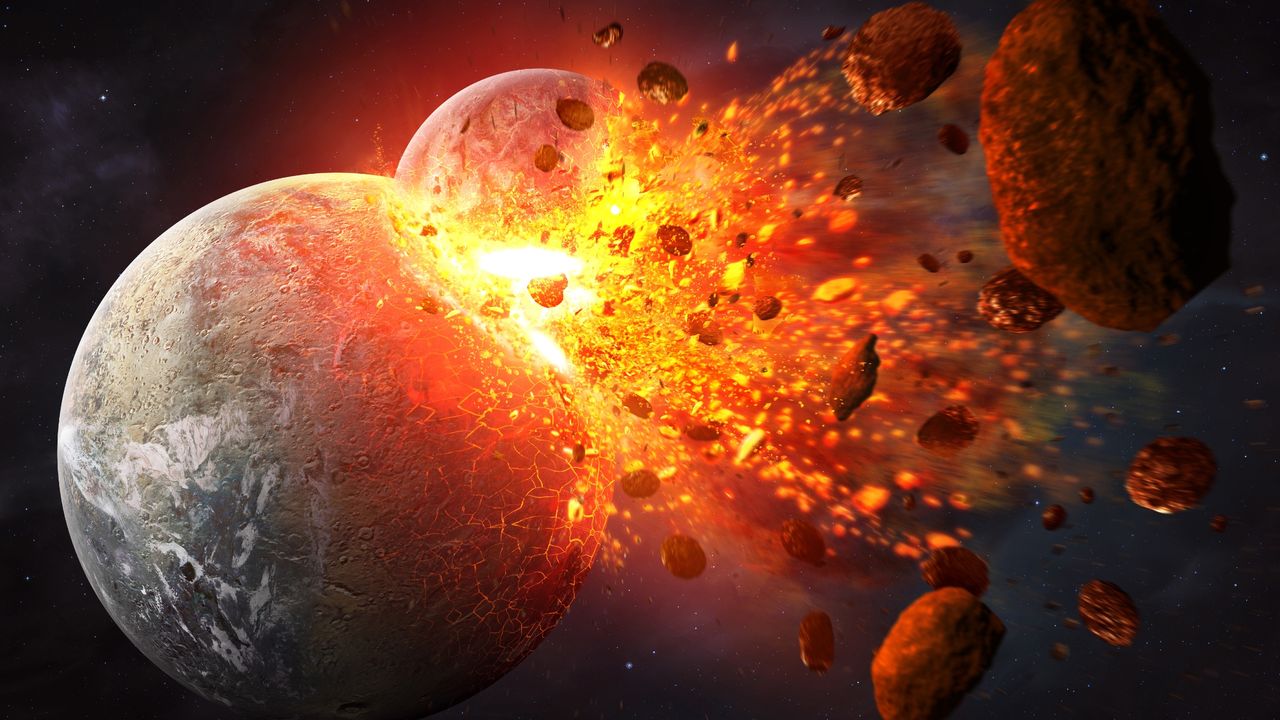
The moon may have formed in as few as five hours after the cataclysmic collision between Earth and a long-lost protoplanet, new simulations suggest. The surprising findings could help shed light on other historic impacts throughout our cosmic neighborhood and beyond.
Lunar rocks collected during NASA's Apollo missions have provided evidence to support this theory, dubbed the giant impact hypothesis. These samples also tell us that the moon is around 4.5 billion years old, meaning the collision occurred roughly 100 million years after the sun was born. But although scientists have previously simulated the impact event, it has been tricky to ascertain exactly how the moon formed and how long it took to emerge after the Earth-Theia collision.
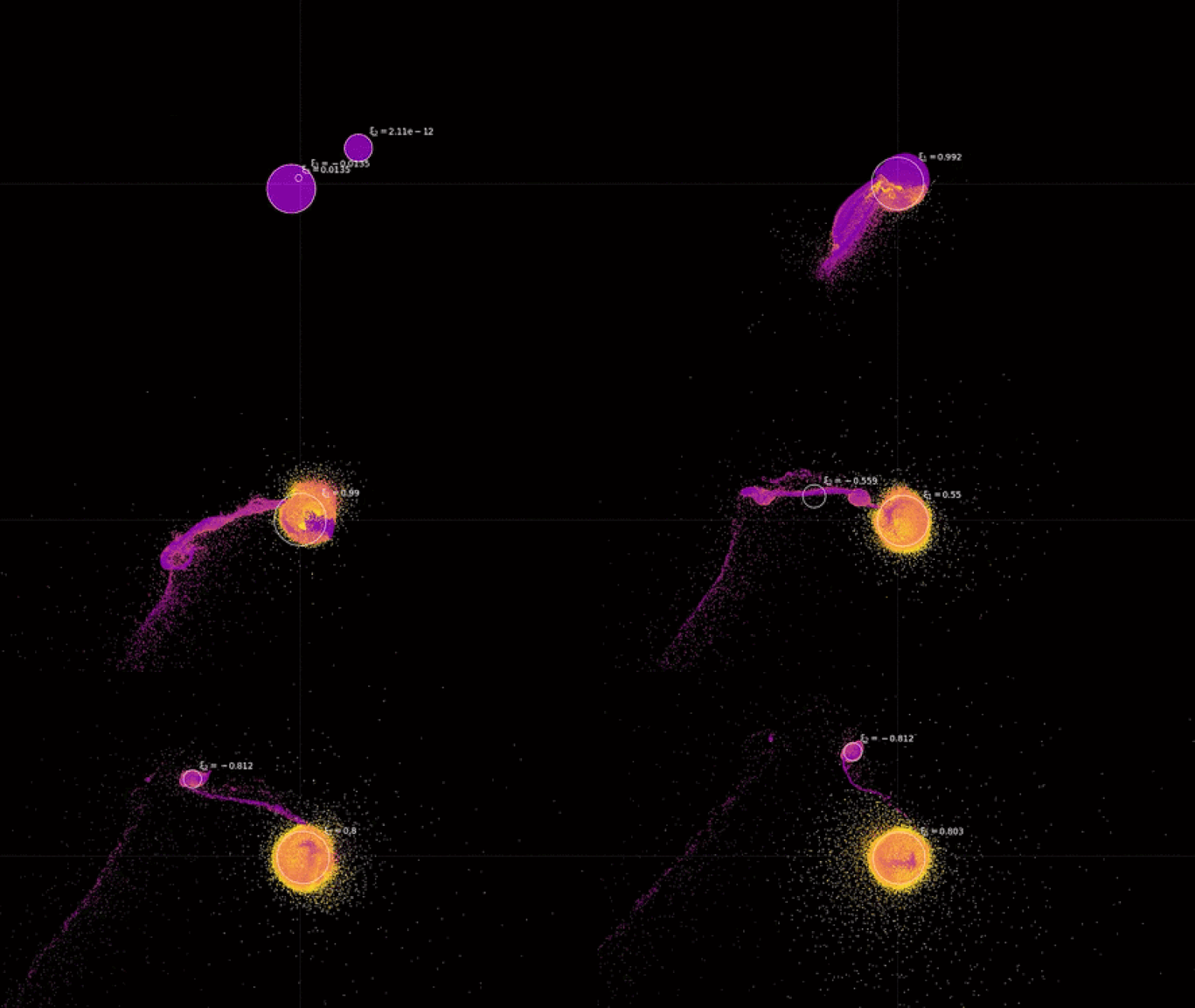
In the new study, published Sept. 1 in The Astrophysical Journal Letters, researchers conducted a series of simulations focusing on the varying potential geological properties of both Earth and Theia prior to their collision. This factor has been relatively understudied until now.
"When you simulate the Earth and the moon as colliding bodies with [different] geologic properties, it changes how the moon forms out of that impact — that's something we considered unnecessary before," study first author Adeene Denton, a geologist and planetary scientist at the Southwest Research Institute in Boulder, Colorado, said in a statement.
Researchers simulated the ancient collision between Earth and Theia using a range of different geological properties and found that, with the right conditions, the moon could take shape in a matter of hours. (Image credit: Courtesy of SwRI)
Until now, simulations of the Earth-Theia impact have focused mainly on the masses of the colliding neighbors. But in the new study, the researchers were most interested in the material strength of the two bodies, particularly the hardness of their exteriors.
"Models have evolved to include material strength, something that's really important when you're studying collisions between smaller bodies like asteroids," Denton said. "We weren't sure if it would matter for the moon or not. When we did the simulations, we found it actually matters quite a bit."
The main factor in the strength of colliding bodies is temperature. Both Earth and Theia were very young when they smashed together, so they were still hot and had soft or molten surfaces. These properties would have cushioned the collision, allowing the debris to stay largely intact and enabling the moon to form more quickly. But when the giant impact hypothesis was first proposed (in 2001), researchers initially thought the collision occurred much later, meaning that the bodies would have cooled and become more brittle. In this case, their collision would have created a larger field of rocky debris that would have taken longer to coalesce.
Researchers simulated the collision using a range of potential temperatures and found that under the most extreme scenario — where the pair were at their hottest — the moon could have formed in just five hours. However, this is just one potential outcome, and there is no way of knowing exactly how hot — and, therefore, how strong — Earth and Theia really were when they smashed together.
When the moon took shape, it was initially covered with a magma ocean that took hundreds of millions of years to solidify. Even then, its increased proximity to Earth meant that it was likely a volcanic hellscape. However, over time, it moved away from our planet, cooling further, and it is now assumed to be geologically dead. (The moon is continuing to slowly move away from us and could eventually escape our planet's gravity entirely, if the dying sun doesn’t destroy it and us first in around 5 billion years.)
Additionally, the findings could have implications in the search for exomoons — the hypothetical moons of distant exoplanets, which have so far remained elusive, according to Live Science's sister site Space.com. Until now, one of the main ways astronomers have been hunting for these alien satellites is by looking for debris fields around exoplanets. However, if the moon is anything to go by, these debris fields could be very short-lived and difficult to identify.
Eclipse Space has unveiled three satellite platforms designed to let nations and companies build and operate their own space-based constellations, rather than leasing capacity from someone else’s network. The Redmond, Washington-based company was founded by engineers who previously built and scaled SpaceX’s Starlink system. It announced the platforms alongside a new power systems partnership with France’s Gama, ahead of World Space Business Week in Paris.
Eclipse designs and integrates everything a customer needs to run an independent constellation, including satellites, payloads, ground infrastructure, launch, and ongoing operations. CEO Derek Huerta said the company built its business around a different model than typical satellite operators. It gives customers complete infrastructure they can operate themselves, rather than infrastructure Eclipse continues to control.
Three platforms, one architecture
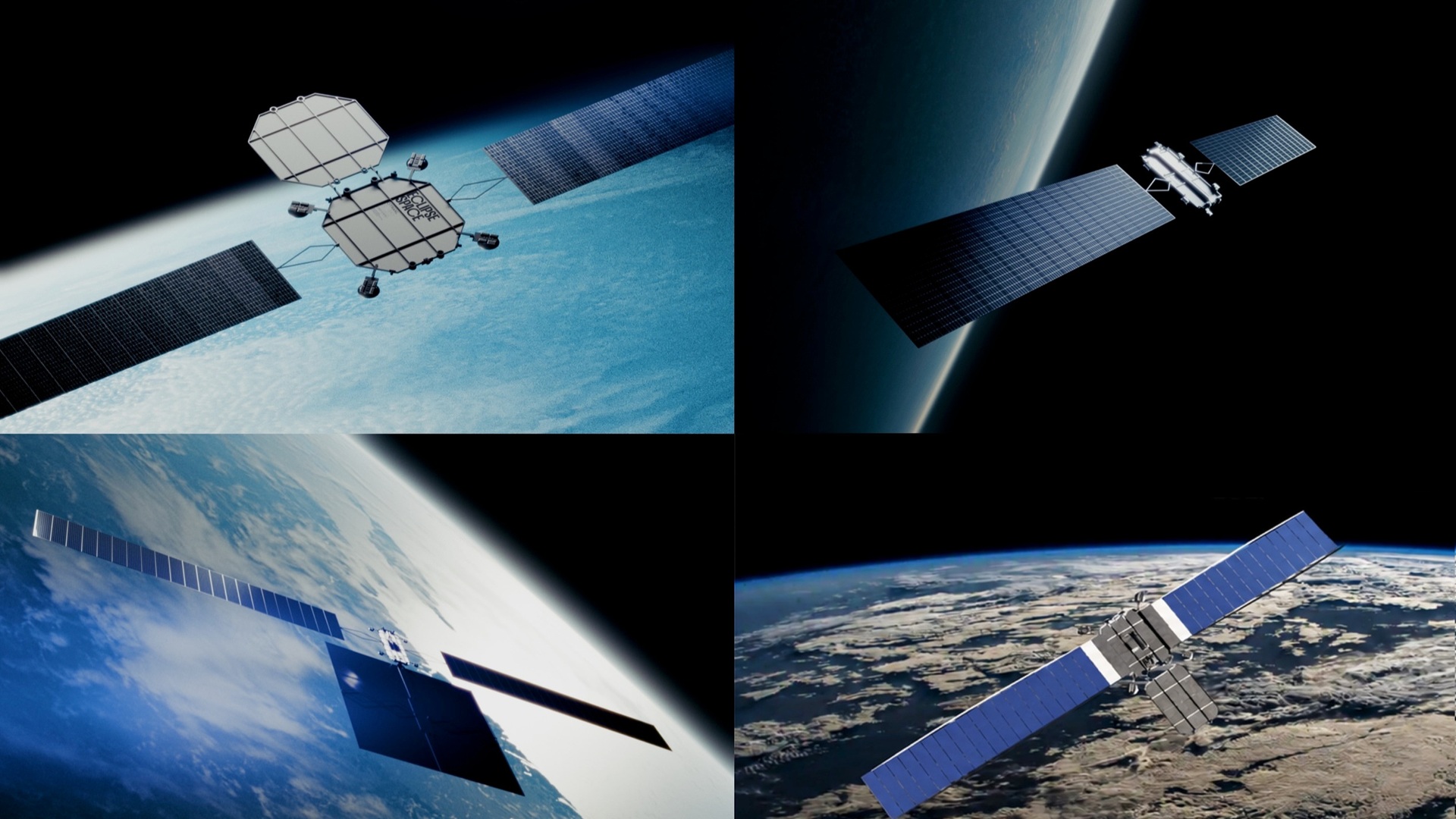
CitraSat, the first of the three platforms, handles direct-to-device communications, connecting standard mobile phones without requiring a dedicated dish or terminal. Its flat-panel design integrates a 3.5-meter S-band phased array, multi-gigabit E-band backhaul for ground connectivity, and V-band links for communicating between satellites in the same constellation.
The flat-stack design maximizes how many satellites fit on a single launch, and each unit carries an operational life of more than five years.
SliceSat targets high-throughput broadband instead, delivering high-speed connectivity directly from orbit without relying on terrestrial fiber networks. It packs four Ku-band phased arrays alongside multi-gigabit V/E-band feeder links and the same V-band inter-satellite connectivity found on CitraSat. The design aims at building resilient, low-latency broadband networks at regional or global scale.
SurgeSat extends the platform into an entirely new mission category: high-performance computing and data storage conducted directly in orbit. Designed for 100-kilowatt-class power output, SurgeSat is built to process and store data for large-scale AI and computing workloads. It does so without routing that data through third-party systems, keeping both the data and the infrastructure processing it fully under customer control. It shares its core architecture, inter-satellite networking, and manufacturing approach with the two communications platforms.
Power built to scale
Powering SurgeSat’s computing ambitions, along with Eclipse’s broader plans for high-capacity constellations, drove the company’s new partnership. That partnership is with Gama, a Paris-based developer of large deployable space structures and power systems. The two companies plan to combine Gama’s deployable solar array expertise with Eclipse’s spacecraft power systems. They’re targeting scalability up to more than 100 kilowatts and a first in-space demonstration in 2028.
Andrew Nutter, Gama’s CEO, said both companies share an engineering culture built around high-volume production, since many of the same engineers previously worked together scaling hardware for Starlink. Eclipse described the arrangement as an example of its broader fabless approach. The company owns system architecture, design, and software, while relying on specialized partners for individual subsystems rather than manufacturing every component in-house.
From stealth to platforms
Eclipse emerged from stealth in June 2026. The company was founded roughly a year earlier by CEO Derek Huerta, a former SpaceX satellite payload engineering manager, alongside other SpaceX alumni. The company has said it targets a minimum production rate of five satellites per day, with an integrated demonstration spacecraft planned for 2027. This week’s platform announcements mark the company’s first detailed public look at the spacecraft hardware underpinning that broader ambition.
Researchers developed a model showing how lava-covered planets close to their stars can hold onto their atmospheres, which could help guide the search for life beyond our solar system. Some planets orbit so close to their stars that intense radiation should strip away their atmospheres. Yet several of these scorching, lava-covered worlds still retain thick [...]
A telescope with no moving parts, stationed in the mountains of British Columbia, has produced the largest single accounting of fast radio bursts ever assembled. The Canadian Hydrogen Intensity Mapping Experiment (CHIME) and its FRB collaboration have released a second catalog logging 4,539 fast radio bursts from 3,641 distinct sources, drawn from more than five years of continuous sky-watching between July 25, 2018, and September 15, 2023.
The result, posted to arXiv in January 2026 and published in The Astrophysical Journal Supplement Series, supersedes the collaboration’s first catalog, which covered a single year of observations ending in mid-2019 and recorded 536 bursts. The new release spans roughly five times the observing period and delivers more than eight times as many detected events, cementing CHIME’s role as the dominant instrument for cataloging these millisecond-long flashes of radio energy.
A telescope that cannot look anywhere else
CHIME’s design is unusual for an instrument that has become the world’s leading fast radio burst detector. Located at the Dominion Radio Astrophysical Observatory near Penticton, British Columbia, it consists of four stationary half-pipe reflectors, each 100 meters long and 20 meters wide, laid side by side and oriented north-south. ICHIME has no moving parts at all — unlike dishes that swivel to track a target. Each cylinder’s focal line is strung with 256 dual-polarization antennas, for 1,024 across the array, feeding a digital signal-processing system that forms 1,024 beams electronically rather than through any physical steering.
That fixed geometry means CHIME cannot be aimed at a particular patch of sky the way a conventional radio dish can. Instead, it watches a roughly 200-square-degree strip of sky directly overhead and lets Earth’s rotation carry the rest of the northern sky through its field of view over the course of a day. The technique, known as transit observing, trades the ability to target specific objects on demand for near-continuous coverage of a wide swath of sky, night and day — precisely the kind of monitoring that catching rare, unpredictable millisecond bursts requires.
What changed since the first catalog
The collaboration’s first catalog, released in 2021, logged just over 500 bursts from a single year of data. That release established CHIME as a serious FRB survey instrument and provided the first large, uniformly selected sample for statistical study. The new catalog is a different scale of effort entirely: it folds in more than four additional years of observing time, past the original one-year window, and pushes the source count past 3,600 — a population increase that lets researchers move from spotting a phenomenon to characterizing it as a class.
Fast radio bursts are intense pulses of radio waves lasting typically a few milliseconds, first identified in archival data in 2007 and confirmed as an astrophysical population in the years since. Most detected bursts appear to flash once and never repeat from the same location, but a minority repeat, sometimes many times, from sources that can be pinpointed to host galaxies. Among the 4,539 bursts in the new catalog, 981 come from 83 known repeating sources, while the remainder appear as one-off events, at least within the observing window. That repeater fraction, drawn from a sample nearly nine times larger than before, gives researchers a substantially firmer basis for comparing the properties of repeating and apparently non-repeating bursts, including their durations, frequency structure, and the dispersion imposed on the signal as it crosses intervening plasma on its way to Earth.
Why the larger sample matters
The physical origin of fast radio bursts remains only partly settled. Magnetars — neutron stars with extraordinarily strong magnetic fields — are the leading candidate source for at least some bursts, following the 2020 detection of a burst from a magnetar inside the Milky Way. But the diversity of burst durations, brightness, and repetition behavior recorded across thousands of events suggests more than one physical mechanism, or more than one class of source, may be responsible. Larger, more uniform catalogs let researchers test that diversity statistically rather than relying on a handful of well-studied individual sources.
Because each burst’s radio signal is dispersed — delayed by different amounts at different frequencies as it passes through free electrons in space — the catalog also functions as a probe of matter distributed between galaxies. That diffuse, low-density gas is difficult to detect by any other means, and a sample of thousands of bursts at known or estimated distances allows astronomers to map its distribution across large volumes of the universe, an application sometimes described as using fast radio bursts to weigh the cosmos.
The catalog paper reports each burst’s arrival time, dispersion measure, scattering timescale, and flux density, along with a dynamic spectrum across the 400–800 megahertz band CHIME observes, at just under a millisecond time resolution. That level of detail, applied uniformly across thousands of bursts rather than compiled from disparate instruments and detection methods, is what distinguishes a catalog release from a series of individual discovery announcements.
What comes next
CHIME/FRB’s outrigger stations — companion antenna arrays built at separate sites across North America — extend the core telescope’s ability to localize individual bursts to their host galaxies with far greater precision than CHIME alone can achieve, a capability that has already been applied to a subset of local-universe bursts drawn from the same multi-year dataset. As those outriggers accumulate their own detections alongside the main array, the size and precision of future catalogs are expected to grow further, sharpening the statistical picture the second catalog has already begun to draw.
Most rocket launches are watched on the way up. Engines ignite, the vehicle climbs through the atmosphere, and its stages separate as it heads toward space.
But for reusable rockets and spacecraft, reaching space is only one part of the mission. They must also find a way back to Earth.
The return is far more complicated than simply falling from the sky. The vehicle has to reduce its speed, survive the heat of re-entry, and remain stable as it descends.
Depending on its design, it may then use engines, parachutes, or wings to complete the landing. That journey begins by establishing a controlled path back toward the planet.
Slowing down to return to Earth
A spacecraft remains in orbit not because it has escaped Earth’s gravity, but because it is moving sideways fast enough to keep falling around the planet. To come home, it must first slow down.
The spacecraft performs a deorbit burn by firing its engines against its direction of travel. This slows it enough to lower its orbit and enter the upper atmosphere, where drag further reduces its speed.
Reusable rocket boosters follow a different path because they usually separate from the vehicle before reaching orbit.
After separation, a booster may perform a boost-back burn to reverse part of its trajectory and head toward land. Alternatively, it can continue downrange toward a landing platform at sea.
The booster then fires its engines again during its descent. These burns help control its speed and position it for the final approach.
Every maneuver must be precisely timed. Even a small error in the vehicle’s angle, speed, or orientation could cause it to miss its landing zone.
Surviving atmospheric re-entry
Entering Earth’s atmosphere at high speed creates extreme heat. As the spacecraft strikes the air, the gas in front of it compresses rapidly and heats up. This can produce a layer of intensely hot plasma around the vehicle.
Spacecraft use heat shields to survive these conditions. Capsules commonly carry ablative shields made from materials designed to char and gradually wear away.
As the outer material is removed, it carries heat away and prevents the extreme temperatures from reaching the cabin.
The angle of entry is also critical. A spacecraft entering too steeply could experience excessive heating and deceleration.
One approaching at an angle that is too shallow could travel beyond its planned landing area or briefly skip back out of the atmosphere.
The vehicle must also remain stable during this phase. Capsules adjust their orientation to produce limited lift and control their path. Reusable boosters use grid fins, which interact with the surrounding airflow to steer the descending rocket toward its target.
Completing the landing
Once atmospheric drag has removed most of the spacecraft’s speed, its landing system takes over. The method used depends on the vehicle’s design and mission.
Crew and cargo capsules generally deploy parachutes during the final stage of descent. The parachutes open in a sequence, gradually reducing the capsule’s speed.
Some capsules splash down in the ocean and are collected by recovery teams, while others return to designated landing areas on land.
Reusable boosters rely on powered landings. Grid fins guide the rocket during descent before one or more engines restart for the final landing burn. This burn rapidly reduces the booster’s speed as its landing legs deploy.
Onboard computers continuously calculate the booster’s altitude, orientation, and velocity. They make rapid adjustments to engine thrust and steering, allowing the rocket to land vertically on a pad or a platform at sea.
Spaceplanes use another method. After re-entry, they glide through the atmosphere using wings and aerodynamic control surfaces before landing horizontally on a runway.
Returning to Earth is therefore not one action but a carefully coordinated sequence. Engines place the vehicle on the correct path, heat shields protect it during re-entry, and guidance systems control the descent.
Parachutes, landing engines, or wings then complete the journey, bringing the spacecraft back to Earth intact and, in some cases, ready to fly again.
Launching a rocket requires enough power to break free from the ground, but returning one demands precise control at every stage. It is this combination of speed, heat management, and split-second navigation that turns a fall from space into a safe landing.
Black Arrow’s successful orbital flight arrived after its future had already been decided. On 28 October 1971, the British rocket launched Prospero from Woomera, Australia. Three months earlier, Parliament had been told that the programme would end once that mission was complete.
The next vehicle, R4, never launched. Its eventual place in the Science Museum gives the story a physical ending: one rocket carried a satellite into orbit, while its successor became an object through which later generations could examine the programme.
The final flight was explicitly allowed
The written parliamentary answer of 29 July 1971 is unusually clear. Responding to a question about the National Space Technology Programme, Frederick Corfield confirmed plans to launch the X3 satellite later that year. He then stated that Black Arrow would be terminated after the launch.
That matters because it distinguishes an authorised final mission from a launch carried out in defiance of cancellation. The decision and the permission appeared in the same answer. The engineers could complete the flight, but a successful result was not accompanied by a promise of further launches.
Corfield’s stated rationale concerned resources and capability. Maintaining a national launcher with comparatively limited capacity, he argued, consumed too much of the available programme while restricting its broader scope. The answer also said satellite technology research would continue, with X4 planned for a NASA Scout launch in 1974.
The launcher was ending; satellite work was continuing.
A British vehicle launched from Australia
ESA’s historical account confirms the date, the Woomera launch site and Prospero’s alternative designation, X3. Black Arrow’s development had begun in 1964 under the Royal Aircraft Establishment. Its achievement was the delivery of a satellite by a British-developed launcher, not a launch from British soil.
That distinction is easy to lose in a compressed account of national space achievements. The origin of a rocket, the origin of its payload and the territory from which it flies are separate facts. Here, the Australian desert was part of the infrastructure that made the British programme possible.
A UK Space Agency retrospective describes the wider effort behind the vehicle: rocket and engine development, assembly and test facilities in Britain, and launch and range facilities at Woomera. Black Arrow drew on earlier Royal Aircraft Establishment research and technologies using high-test peroxide and kerosene.
The agency describes a three-stage rocket about thirteen metres tall, with an eight-chamber engine in the first stage and a solid motor in the third. Those modest dimensions can obscure the range of systems required to produce an orbital flight. A launch vehicle is also a programme of testing, ground support, control and integration.
R4 records the launch that did not happen
The Science Museum Group’s collection record for Black Arrow R4 identifies it as the final vehicle built, with minor assembly and pipework incomplete. Its intended satellite, Miranda, eventually went into orbit on an American Scout rocket in 1974.
R4 is therefore more than a representation of the rocket that flew. It is surviving hardware from the next step that the programme did not take. Its parts preserve engineering decisions even though they never experienced a launch.
The museum records four Black Arrow launches, two successful, including the flight that orbited Prospero. That is a short development history, and it invites competing readings: a capability achieved just as support ended, or a limited programme whose costs had to be weighed against other space priorities.
The records establish the sequence without settling every argument about the decision. A successful flight demonstrates that a particular mission worked. It does not, on its own, calculate the costs, demand or reliability of an extended operational service. Equally, a decision to stop funding that service does not undo the technical achievement.
Becoming an exhibit required another decision
A Science Museum Group Journal study of R4 follows the vehicle’s transition into a museum object. It describes discussions soon after Prospero’s launch, when the departments responsible for Black Arrow were working towards winding up the programme by the end of March 1972.
Acquiring the rocket involved practical arrangements, not simply declaring it historic. The article records an estimated £5,000 to prepare it for transfer, to be met by the Department of Trade and Industry, with the museum responsible for transport from the Isle of Wight to its west London store.
The preservation of a cancelled project is itself work. Large objects need space, handling equipment and decisions about what to retain. Without those choices, the next rocket might have survived only in drawings and photographs.
R4 became evidence that people could stand beside.
Success and continuation were different questions
Black Arrow’s ending is often compelling because the chronology seems reversed: the programme was told to stop, then achieved its orbital goal. But the parliamentary statement shows that both outcomes had already been accommodated. The final flight could proceed while the longer-term launcher commitment ended.
Space Daily’s account of Project West Ford’s orbiting copper needles describes another space experiment whose technical demonstration did not lead to an enduring operational system. The reasons differed, but both histories reward separating what hardware proved from what institutions chose to continue.
Prospero’s launch and R4’s preservation mark those two questions in different places. One was answered above the Australian desert in October 1971. The other left a rocket on Earth, retaining the shape of a next flight that never came.
If you want to manufacture in space—and bring the products back again—there’s a limited set of options: Wait to go to the International Space Station, or partner with a handful of start-ups launching spacecraft that spend time in orbit before they return to Earth. But the vehicle that goes to space and comes back to […]
Although the new simulations focus on orbital adjustments to extend observation times and increase proximity to U.S. satellites, including critical missile warning and other space defense-oriented systems, Chinese scientists also plan to integrate reinforcement learning methods into future space assets to give satellites even more independence from human operators.
Study Includes Accusations of Cold War in Space Activities
In the 20th century, the concept of war in space remained mostly in the realm of science fiction, as depicted in popular films like Star Wars. Today, advances in space access, orbital maneuvering technologies, and weapons systems have made the possibility of a future conflict in space a very real security concern, and several nations engage in espionage using reconnaissance spacecraft to obtain information on valuable defense targets in Earth’s orbit.
According to the authors of the new study, “acquiring multi-aspect payload information of non-cooperative targets to infer their functions and mission statuses is of great significance for space security assessment.”
The study authors highlight a series of relative motion configurations that modern spy satellites employ, including fly-around, hovering, and drifting flight. They also point to real-world “adversarial” U.S missions they suggest were designed to gather intelligence on their GEO defense assets.
“Since 2014, the US GSSAP (United States Geosynchronous Space Situational Awareness Program) satellite has carried out hundreds of maneuvers and has conducted close observation operations on dozens of normally working satellites near GEO orbit,” the Beijing University of Technology scientists write.
The study authors also include a specific July 2021 accusation, where they charge that “the U.S. satellite ‘USA-271’ deliberately approached the operational ‘Practice 20’ satellite in geostationary orbit and flew in close proximity.”
In an email to The Debrief, a U.S. Space Command Spokesperson did not address the specific incident or the accusations of “dozens” of similar operations, but offered some insight into the agency’s thinking.
“USSPACECOM, working with allies and partners, plans, executes, and integrates military spacepower into multi-domain global operations in order to deter aggression, defend national interests, and when necessary, defeat threats,” the spokesperson told The Debrief, adding that “we have nothing additional to add in response to the article.”
Getting Closer to Adversarial Satellites and Extending Observation Time
In a step toward potential dogfights between satellites, the Chinese scientists looked at several challenges faced by current spy satellites.
For example, they explain, since most spacecraft observation cameras are mounted in a fixed position, “frequent large-angle attitude maneuvers are time-consuming and consume substantial fuel.” The researcher also noted that several different angles and approaches could yield different categories of intelligence data.
However, changing angles and orbital planes requires fuel, an extremely limited resource in GEO. Therefore, the researcher accounting for all the variables required to gather intelligence on adversarial spacecraft as efficiently as possible “has become a key bottleneck in enhancing space situational awareness capabilities.”
To find an optimized solution, the team designed what they called a “waypoint trajectory planning scheme” and a “multi-impulse maneuver strategy” using a common game-theory tool called “minimum integral squared control” theory. Unlike previous research aimed at extending spy satellite observation time and fuel efficiency, the Chinese scientists said their use of sequential coalition game theory “is introduced for the first time into the multi-model combined observation problem.”
Next, the researchers designed a “game tree.” A press release said this approach lets the spacecraft select the “optimal combination of initial motion points and close-range operation models at each stage under minimum fuel constraints, thereby generating an optimal observation strategy sequence.”
Finally, the researchers ran simulations to see whether their approach improved sensor observation times and field of view while reducing fuel use.
Successful Simulations and Future Reinforcement Learning Plans
As hoped, the Beijing University of Technology team said their simulations supported the theories. Specifically, the study authors said the simulations showed that their spacecraft efficiency algorithm “can successfully generate a multi-model combined observation strategy sequence under minimum fuel constraints.”
“The effective observation time increases with larger observation distances and field-of-view angles, and reducing the model configuration size also contributes to improved observation performance,” they explained. The study authors also said that the simulation results “demonstrate that the algorithm can successfully generate the optimal combined observation sequence under minimum fuel constraints.”
When discussing next steps, the Chinese scientists said they will explore optimal initial points to further improve maneuver efficiency. They also plan to explore a “reinforcement learning method,” suggesting future spacecraft could learn and adapt to evolving conditions to further enhance their cold war in space information-gathering capabilities.
Study’s War in Space Implications “Extends Beyond any Single Algorithm”
To understand the potential implications of the Chinese study, including its impacts on a potential future war in space, The Debrief reached out to former U.S. Air Force officer Shelli Brunswick, CEO and Founder, SB Global LLC.
According to the author and futurist, the Chinese team’s research matters not just because it proves China has deployed a “new operational surveillance capability.” Instead, Brunswick said that the work is significant because it “illustrates how sophisticated coordination and optimization could make spacecraft observation more efficient, persistent, and strategically useful.”
The Blue Marble Space Visiting Scholar also told The Debrief that the work “should not be interpreted as demonstrating a complete pursuit-and-evasion capability against a spacecraft that is actively responding,” since the work assumes a stationary target without maneuvering capabilities. Still, Brunswick noted, the Chinese framework “shows how game-theoretic planning could help an observing satellite gather information from multiple angles while managing limited resources.”
When discussing the potential implications for the broader U.S.-China space-security competition, including how such enhanced spacecraft could lead to more activities that could be construed as hostile, the space strategist said this area of research “extends beyond any single algorithm.”
“As rendezvous and proximity operations become more sophisticated, the line between inspection, space situational awareness, intelligence gathering, and potentially threatening behavior becomes increasingly difficult to interpret,” she explained.
When suggesting what potential strategic responses the U.S. and its allies might employ in the emerging cold war in space, Brunswick told The Debrief that they should include “more resilient architectures, improved space-domain awareness, clearer expectations for close approaches, stronger communication mechanisms, and deeper coordination with commercial and international partners.”
“The challenge is not simply detecting another spacecraft—it is understanding capability and intent early enough to respond responsibly and effectively,” Brunswick explained.
Christopher Plain has spent the last six years as Associate News Editor and Head Science Reporter at The Debrief. Follow and connect with him on X, learn about his novels at plainfiction.com, or email him at christopher@thedebrief.org.
Dans le Haut-Arctique canadien, des chercheurs ont obtenu des résultats si inattendus qu’ils ont d’abord pensé à une erreur. Pourtant, expérience après expérience, le même phénomène s’est reproduit. Et il pourrait obliger les scientifiques à revoir la manière dont ils comprennent l’évolution des...
Some of the smallest objects ever detected in the outer solar system appear to have preserved evidence of how and where they formed billions of years ago. For the first time, astronomers combined observations from NASA’s Hubble Space Telescope and James Webb Space Telescope to study extremely faint objects beyond Neptune. Known as trans-Neptunian objects, […]
NASA’s Neil Gehrels Swift Observatory is back to studying the universe, even as the aging spacecraft continues to lose altitude and a planned mission to raise its orbit has been scaled back. Two of Swift’s three science instruments are operating again after months of conservation measures designed to reduce atmospheric drag and keep the observatory [...]
The Exploration Company (TEC) has raised $450 million to build reusable spacecraft, in what it describes as “the largest-ever Series C by a European space company.”
Jaden Caradine knew he wanted to be an engineer at eight years old. He just took a winding road to get there.
Before he enrolled at Embry-Riddle Aeronautical University, before he discovered the field that would become his focus, and before he landed a Pathways internship at NASA’s Langley Research Center in Hampton, Virginia, Caradine spent five years as a mechanic in the United States Marine Corps, four of them stationed in Japan. It was a deliberate detour, one that shaped how he approaches everything since.
“I’ve kind of always known I wanted to be an engineer,” he says. “I just had to figure out what kind.”
NASA Pathways intern Jaden Caradine
Credit: NASA
Finding the Overlap
Caradine grew up in the Salt Lake City area, raised by a mother who put him on a snowboard at four and on a rock face not long after. He was the kind of kid who learned to love science not for its own sake, but for what it could do. “Math is an enabling skill,” he says. “It’s not about doing the math. Math has a purpose and it’s useful.”
By the time someone asked young Jaden what he wanted to be, the answer was immediate. “I was building Legos,” he says, “and I just thought — I want to build stuff. I can’t really see myself being anything other than an engineer.”
Right out of high school, Caradine enlisted in the Marines, trained as a mechanic, and shipped out to Japan. During those five years, between the technical work and the distance from home, he started reading books on decision-making, career planning, and long-term thinking. He found a framework he keeps coming back to: ikigai, a Japanese concept that maps the intersection of what you’re good at, what you enjoy, what the world needs, and what you’re paid to do.
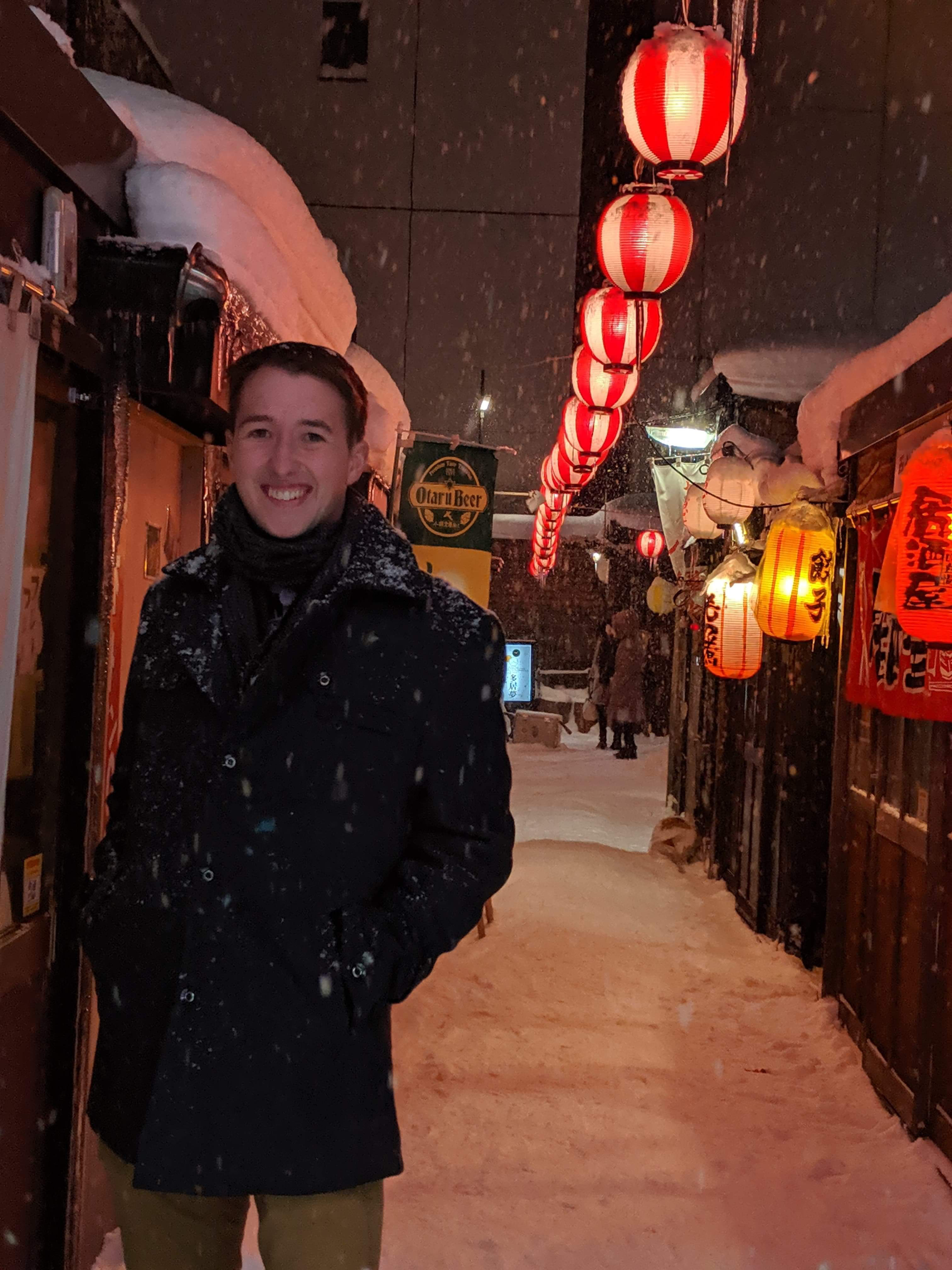
Caradine at the Sapporo Snow Festival in Hokkaido, Japan, while serving as a U.S. Marine Credit: Jaden Caradine
“Your ikigai is the thing where all of those overlap,” he says. Engineering was already in the picture. The question was what kind.
Chasing the Signal
The answer arrived through research and a company Caradine stumbled on while scanning the landscape of emerging aerospace technology. They were using magnets to spin a launch system to 14,000 or 15,000 RPM and release small satellites into orbit, recovering the energy on the way down through the same magnetic system. “I thought that was awesome,” he recalls. “So, I started looking into aerospace engineering, and it was a good fit.”
Once he had the field, the destination wasn’t hard to find. Caradine transferred to Embry-Riddle Aeronautical University’s Daytona Beach campus to study aerospace engineering and immediately started showing up everywhere he could — satellite conferences at Kennedy Space Center, industry events in Orlando, small satellite gatherings back in Salt Lake City. “I went to all the career fairs, even though I wasn’t looking for a job yet,” he says. “I just wanted to learn as much as I could, as fast as I could.”
At every NASA booth, he asked questions. He learned about Pathways, the program that places undergraduate and graduate students at NASA centers with the potential to convert to full-time civil service positions, but he waited a year to apply. “I hadn’t really done the things I wanted to do in order to write a strong application yet,” he says. He wrote the next application with the intention of using it as a practice run. He got in.
His reason for choosing NASA over industry was simple and firm. “NASA doesn’t work for profit,” he says. “We’re here to remove barriers so that industry can eventually do the things they weren’t able to do before.”
“Human beings are far more capable than we give ourselves credit for. A journey of a thousand miles starts with a single step and can only be taken one step at a time.”
Work Worth Doing
At NASA Langley, Caradine is part of the Systems Analysis and Concepts Directorate, where “we help agency leaders figure out why they should make certain decisions, especially those that have lots of moving parts,” he explains. Specifically, he works with the in-space servicing, assembly, and manufacturing (ISAM) team, a group focused on the emerging field of building and maintaining infrastructure in space, rather than simply launching and discarding it.
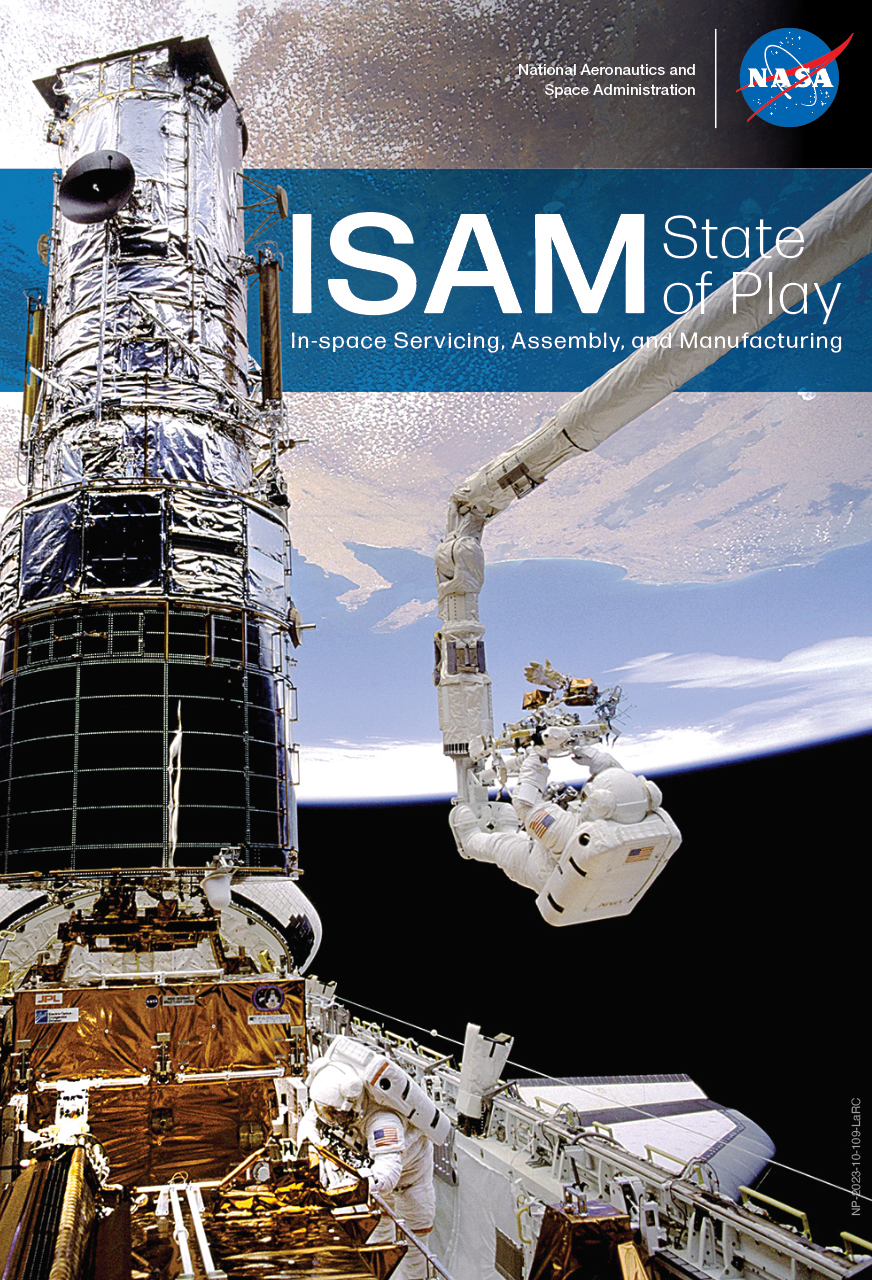
A major part of his summer was curating the State of Play, a comprehensive document that consolidates everything happening in the ISAM sector across government, academia, and industry into a single, navigable resource.
“Jaden joined the team and immediately contributed to this year’s State of Play update,” says Dale Arney, aerospace engineer and Caradine’s mentor. “He also created an automated tool that will help the team create future updates more quickly.”
The ISAM State of Play document is a survey of past, present, and near-future ISAM capabilities across industry, academia, and government agencies.
Credit: NASA
That tool scrapes aerospace news from across the web, compiles relevant updates into organized tables, and produces a readable summary on a regular cadence. “It kind of replaced the need for everyone on the team to spend 30 or 40 minutes every day scrolling through news to keep up,” he says.
“Jaden was constantly looking for ways to improve himself, the team, and our products,” Arney adds. “He was eager to take the lead in trying a number of new processes and ideas to try to make them work for us.”
No Silos
The thing that surprised Caradine most about NASA Langley had nothing to do with the technical work. He had expected some departmental siloing that could develop in large organizations, where people become experts in narrow areas with limited cross-pollination among teams.
“That’s not something I’ve experienced here,” he says. “We all talk to each other, across all teams. We share resources. We collaborate quite extensively.” He describes a culture that expects everyone to engage with the whole problem, not just their corner of it. “Everyone kind of bounces around on different teams to learn the whole aspect of the problem and support each other.”
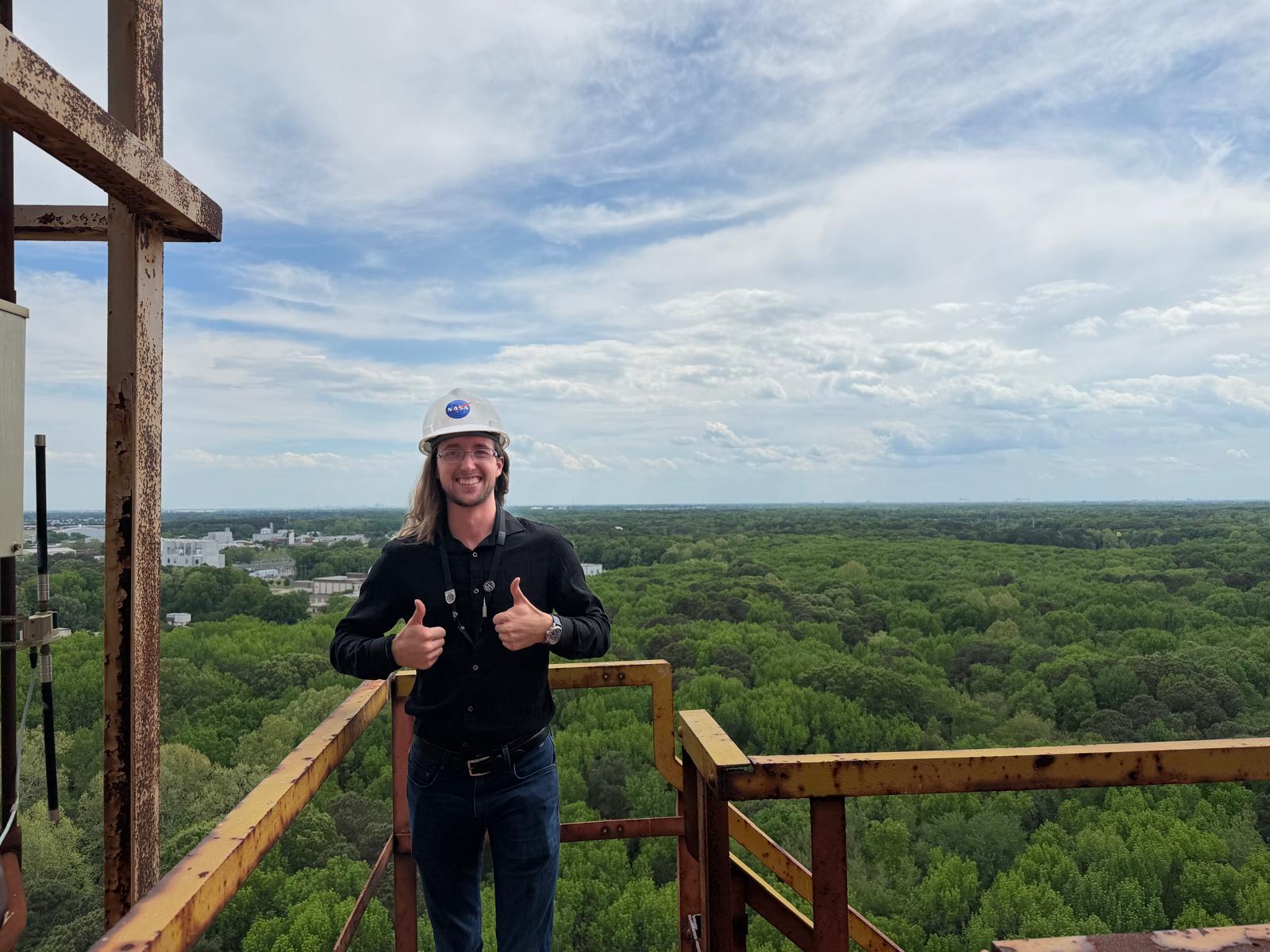
Caradine at NASA Langley’s Impact Dynamics Facility, enjoying the view at the top of the gantry
Credit: NASA
For anyone considering the Pathways program, his advice is direct. “Do it,” he says. “Human beings are far more capable than we give ourselves credit for. If it seems like too much, break it down. A journey of a thousand miles starts with a single step and can only be taken one step at a time.”
Caradine heads back to Embry-Riddle as a junior this fall, with plans to return to Langley next summer. Grad school is on the horizon, and he’s exploring programs that nurture important analysis skills for SMAB, including decision, strategic, and systems analysis.
“Before coming here, I was trying to do everything and cast a wide net,” he says. “Now I know what I need to know how to do. That’ll give me the opportunity to focus my efforts on the high-value skill sets.”
On Caradine’s Sci-Fi Shelf
The Sirens of Titan by Kurt Vonnegut
Dungeon Crawler Carl by Matt Dinniman
Caradine’s instinct runs more toward fantasy than science fiction, but this one, he says, hits something real.
“I enjoy the leveling aspect — constantly improving, constantly getting better. In books it might be physical strength, but in reality, strength takes on many different forms. Constant improvement is quite rewarding in real life, as it is in books.”
The audiobook production, he adds, is its own experience: full sound design, character actors, the works. “It’s like listening to a movie.”
The team also recently convinced him to start Dune, by Frank Herbert. He’s about halfway through.
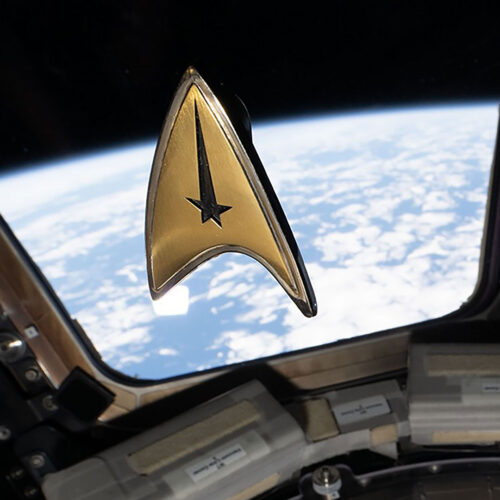
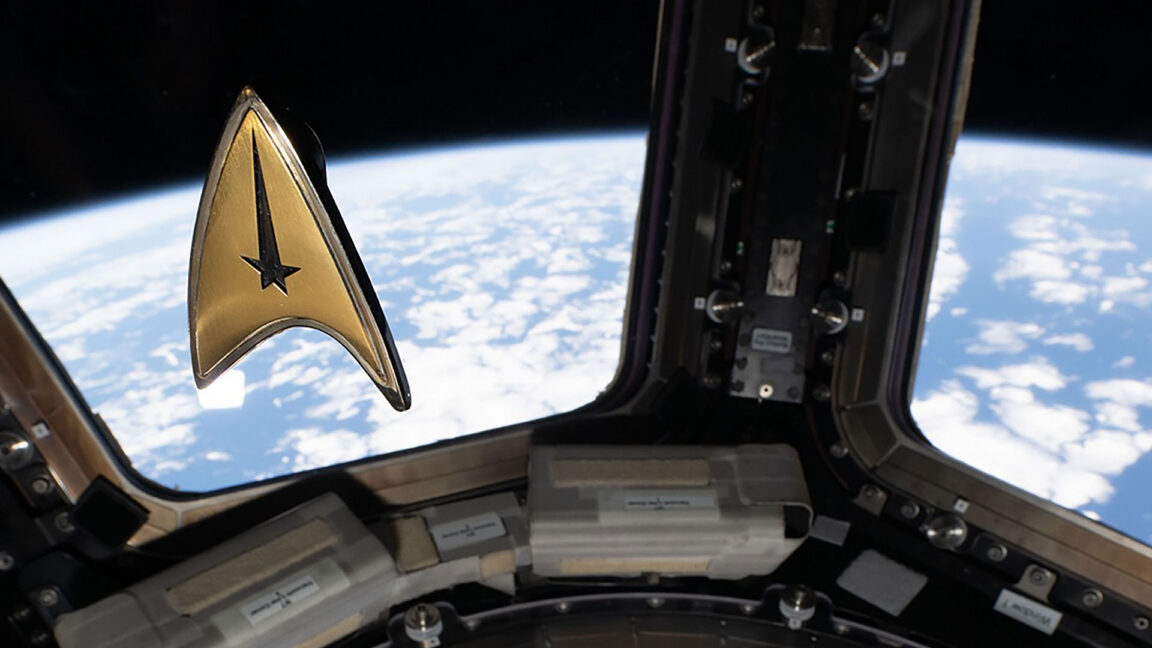
Sixty years after television audiences first tuned in to see the voyages of the Starship Enterprise, an astronaut on board the International Space Station has paid tribute to Star Trek by flying the badge of the franchise's latest fictional captain.
Expedition 75 flight engineer Sophie Adenot with European Space Agency (ESA) donned the Delta badge originally worn by actor Anson Mount for a video recorded from aboard the space station. Mount portrays Christoper Pike in the Paramount+ streaming series Star Trek: Strange New Worlds. Paramount and ESA both released the clip on their Instagram feeds.
"For 60 years, Star Trek has brought us stories of friendship and exploration. I'm wearing Captain Pike's badge aboard the ISS in celebration of continuing the real world work of science and exploration," said Adenot. "For me, exploration and science are about curiosity and cooperation daring to go a little farther together, learning from what we discover and build, and turning that knowledge into a better future for everyone."

 Login






 DRR…DRR…DRR