❌

Reading view

NASA’s PREFIRE Satellites Show How the Poles Trade Heat With Space

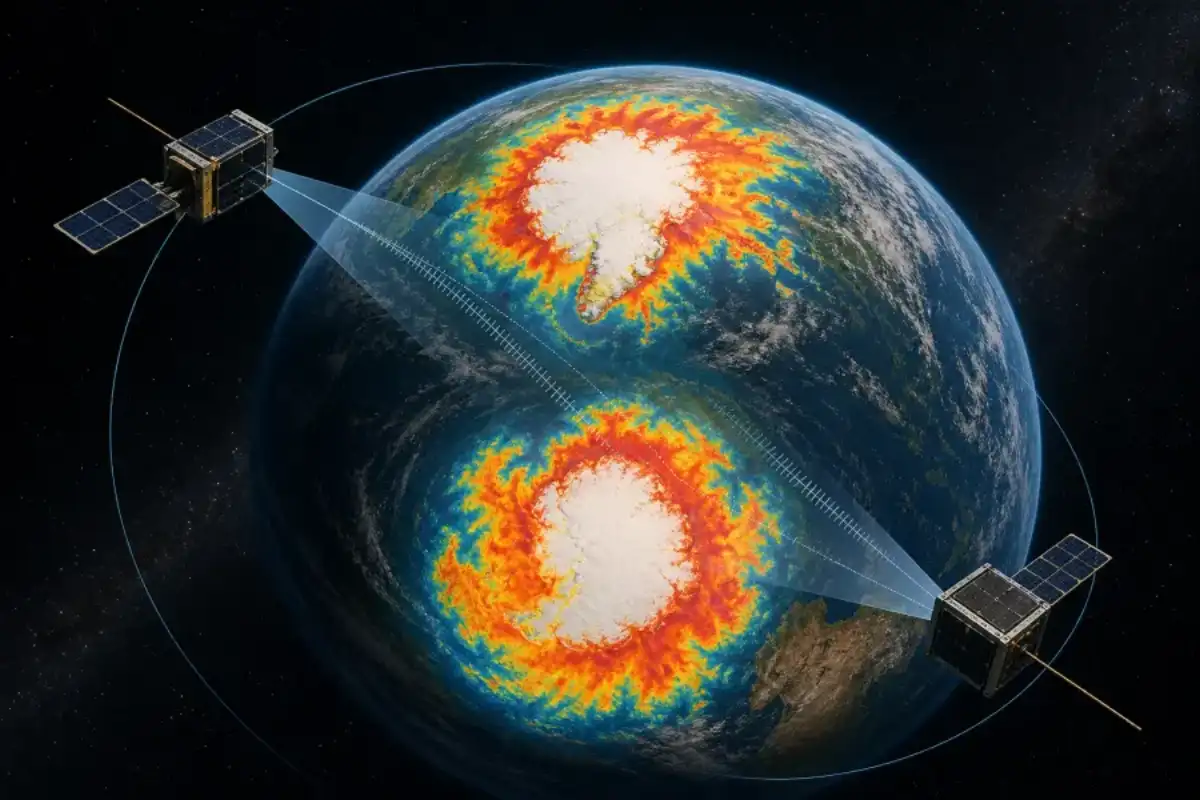
At Earth’s poles, much of the heat leaving the planet is invisible to human eyes. NASA’s two PREFIRE CubeSats are measuring that far-infrared energy directly, and a new animation built from two complete seasonal cycles shows just how differently the Arctic and Antarctic warm and cool. The Polar Radiant Energy in the Far-InfraRed Experiment began […]

The post NASA’s PREFIRE Satellites Show How the Poles Trade Heat With Space appeared first on Curiosmos.

  •  

Researchers devise a full-color night vision goggle

Human eyes don’t register the infrared portion of the light spectrum because infrared photons don't carry enough energy to trigger the signaling pathway inside our light-sensing cells. But we’ve been able to make devices that give us a visual representation of what’s happening in the infrared.

A team at the Beijing Institute of Technology, led by Xin Tang and Ge Mu, has now built a device that lets people see infrared in a new way. Instead of just translating it to visible shades of green as it’s done in standard night-vision goggles, it translates different infrared wavelengths into distinct parts of the visual spectrum, giving the eye something closer to natural vision.

Researchers achieved that by combining mercury telluride colloidal quantum dots, which absorb infrared light, and a dual-layer OLED, which converts that absorbed energy into visible color. Stacked together with the right internal wiring, they make incoming infrared radiation come out the other side as an ordinary-looking, full-color image.

Read full article

Comments

© Dmitri Toms

  •  

Researchers Have Created a 3D Thermal Cloak That Renders Objects Invisible to Heat

A three-dimensional thermal cloak that can conceal objects from heat, while also shielding them from extreme temperatures, has been developed by researchers in a breakthrough with significant potential for quantum electronics and military stealth technologies.

The breakthrough, led by University of Illinois Urbana-Champaign civil and environmental engineering professor Shelly Zhang in collaboration with colleagues at the Technical University of Denmark, differs from past thermal cloaks that only function in two dimensions, or in a single direction.

The team’s new device is capable of guiding heat around an object, regardless of the origin point of the heat source. When used with an infrared camera, the cloaked object effectively disappears, while the temperature inside the protected region remains stable.

The team’s achievement was detailed in a new study published in Nature Communications.

A Novel Approach to 3D Thermal Cloaking

Unlike previous thermal cloaks, which only worked in two dimensions or from a single direction, the new device guides heat around an object regardless of where the heat originates. To an infrared camera, the cloaked object effectively disappears, while the temperature inside the protected region remains stable.

“A real thermal cloak should work no matter where the heat comes from,” Zhang said in a recent statement. “Our device can hide a complex 3D object in an infinite number of directions while keeping the temperature inside stable and protected.”

As opposed to blocking heat, Zhang and her team’s new cloak redirects it around an object, preserving the temperature field in the surrounding area as though nothing were present.

Although the concept has existed theoretically for many years already, researchers have encountered challenges when it comes to practically leveraging such capabilities.

Redirecting Heat Around Hidden Objects

To overcome past hurdles engineers have faced, Zhang and her team designed a novel lattice-based material, which exhibits thermal properties that allow it to be “tuned” with a great degree of precision in three dimensions.

By combining a 3D-printed aluminum lattice, which serves as a good heat conductor, with a molded rubber-like material that functions as a thermal insulator, the team was able to control the flow of heat through different regions of the device. Additional lab testing helped to confirm its functionality as intended.

Placed between hot and cold environments, the cloak redirected heat around hidden objects, producing an external thermal pattern which they say appeared essentially undisturbed. Simultaneously, temperatures within the cloaked region remained largely uniform, despite the surrounding thermal gradient.

As a further demonstration of its capabilities, the researchers then successfully concealed objects with highly complex three-dimensional geometries, which included detailed head-shaped models that they say surpassed the performance of past versions of thermal cloaks.

Defense and Security Applications

Zhang says the technology could have a wide range of potential applications, especially where precise thermal control is a requirement.

“Any field that needs precise control of heat or needs to protect something from being detected thermally could benefit from this work,” Zhang said in a statement, “But we also see it more broadly: it’s about hiding and protecting information that is carried by heat.”

Additionally, the technology could have applications involving the use of similar cloaks to protect sensitive electronics and microchips from damaging heat, improve thermal management in advanced computing systems, and shield equipment from detection using infrared, which may be useful in security and defense technologies.

Going forward, the team plans on exploring more advanced designs capable of concealing objects that generate their own heat, which could pave the way toward more active thermal cloaks in the coming years that could dynamically manipulate heat and still remain effectively invisible to infrared sensors.

The team detailed their research in a recent paper, “Free-form thermal cloaks in three dimensions,” which appeared in Nature Communications.

Micah Hanks is the Editor-in-Chief and Co-Founder of The Debrief. A longtime reporter on science, defense, and technology with a focus on space and astronomy, he can be reached at micah@thedebrief.org. Follow him on X @MicahHanks, and at micahhanks.com.

  •  

How Galaxies Grow Up

JWST unfolded against a black background.

How do galaxies grow? A massive survey from JWST can help astronomers answer that fundamental question about galaxy evolution.

Time Machines

A photograph of thousands of galaxiesin one frame.

An image taken by JWST’s NIRCam instrument, the primary instrument behind the COSMOS-Web survey, of Pandora’s Cluster. Click to enlarge. [NASA, ESA, CSA, Ivo Labbe (Swinburne), Rachel Bezanson (University of Pittsburgh); Image Processing: Alyssa Pagan (STScI)]

When astronomers look into the night, they are greeted by a sky full to bursting with galaxies. But immediately after the Big Bang, none of these grand structures could have existed in our universe: all of the matter was too hot and dense to collapse into the whirlpools and ellipses we see today. We know that it took time for dark matter to collapse into halos, for gas to cool and fall into those halos, and even more time for those halos to merge together and galaxies to form. However, quantifying that story is tricky. How long did it take for the gas to cool and collapse? How often did small galaxies merge? How did the birth and death of stars play into all of this?

One way astronomers could go about answering these deep, fundamental questions in galaxy evolution would be to look at many galaxies spread across different distances. Famously, since the speed of light is fairly slow (cosmically speaking), we can only see distant objects as they appeared in the past. (This is why any aliens looking toward Earth from 65 million light-years away — from within the Virgo Cluster, perhaps — would see our planet as it was when dinosaurs roamed free.) In principle, then, by looking at a progression of galaxies farther and farther away, astronomers could convert these still images into a sort of movie of how typical galaxies look moving further and further back in time.

Seeing Red

There is a complication to this strategy, however. The farther away an object is, the more the light it emits is stretched towards redder wavelengths. As a consequence, any telescope designed to detect visible light won’t see anything; to take pictures of these galaxies, we need to build detectors that are specifically sensitive to stretched-out, near-infrared light.

This is one of the primary reasons that JWST was designed, constructed, and flung into space. It was purpose-built to collect and analyze near-infrared light from distant galaxies, and now after several years of observations and data crunching, astronomers are finally getting some answers to those fundamental questions.

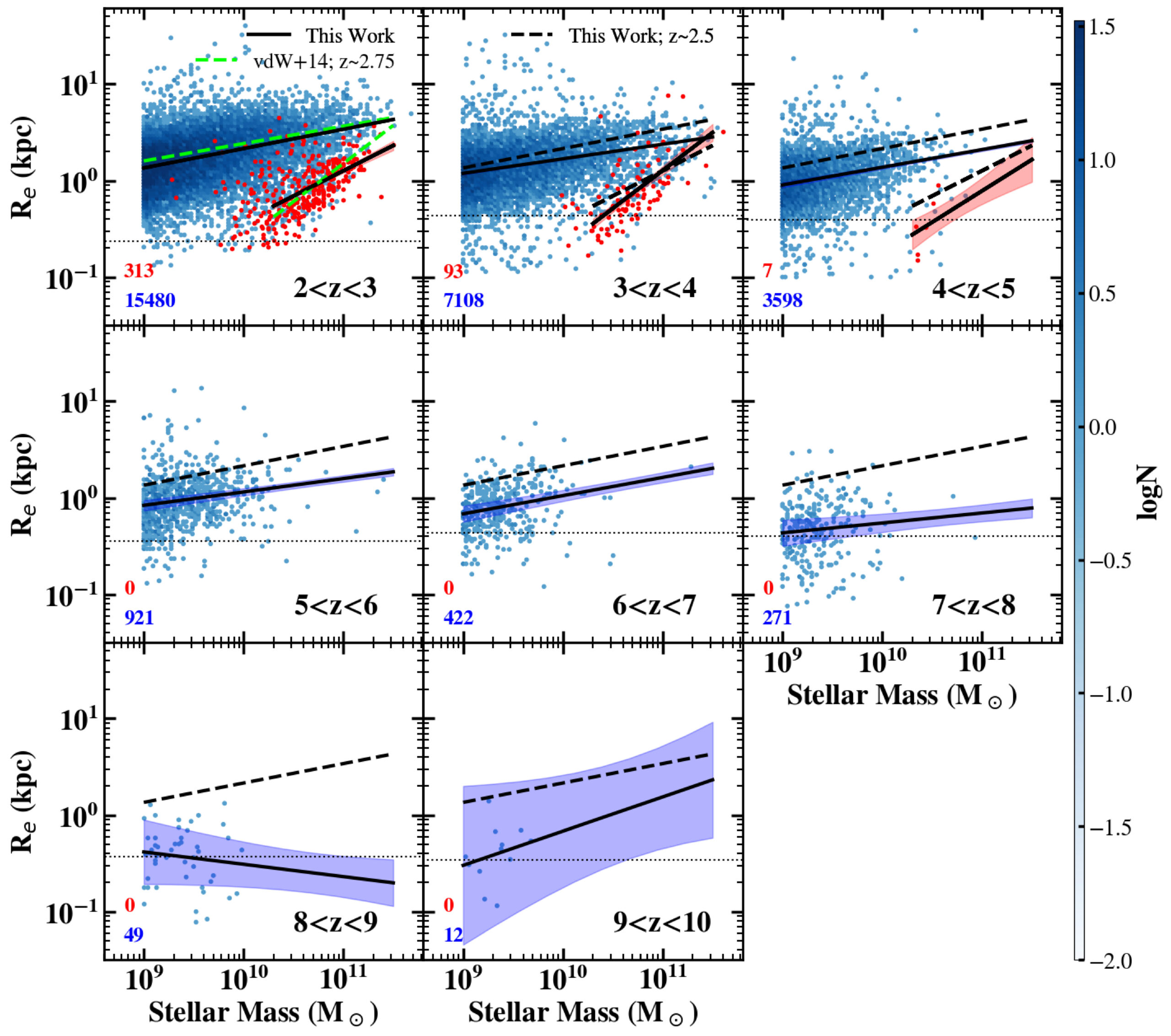
The results of how galaxies’ masses relate to their total size in different redshift bins. Click to enlarge. [Yang et al. 2025]

A Massive Survey

Recently, a team led by Lilan Yang, Rochester Institute of Technology, released their analysis of one of the earliest and largest surveys JWST has undertaken, a program called COSMOS-Web. The researchers mined a patch of sky about the size of the full Moon and extracted more than 30,000 distant galaxies, most of which had never before been seen by human eyes. They measured the brightness and size of each one and grouped them according to their redshift (a proxy for their distance) and whether they were actively forming stars or not.

The team found that, unsurprisingly, galaxies tend to grow over time. Excitingly, however, they also found that for star-forming galaxies, the relationship between a galaxy’s mass and its size is fairly constant for redshifts of z = 2–8. The scaling law between them also nicely matches up with measurements taken by the Hubble Space Telescope at smaller redshifts. Beyond that, though, for redshifts of z = 8–10, it’s possible that the scaling changes, though the authors emphasize that their sample is much smaller in these distant bins.

While more data are needed to confirm whether the youngest of these galaxies grow at a different pace than their later counterparts, we can be comforted that studies like this represent just our very first peek into a whole new era of galactic evolution, and that many more insights are sure to come as JWST keeps snapping images.

Editor’s Note: This article previously contained an error relating to the distance at which aliens would see Earth as it was when inhabited by dinosaurs. This error was corrected on 4 May 2026.

Citation

“COSMOS-Web: Unraveling the Evolution of Galaxy Size and Related Properties at 2 < z < 10,” Lilan Yang et al 2025 ApJS 281 68. doi:10.3847/1538-4365/ae0e1b

The post How Galaxies Grow Up appeared first on AAS Nova.

  •  

Investigating a Polluted White Dwarf

GD 362 and its debris disk

Roughly 25–50% of the white dwarfs in the solar neighborhood are “polluted,” showing signs of accretion of metal-rich planetary material. New JWST observations reveal the contents of the debris disk surrounding one of the most polluted white dwarfs in the solar neighborhood.

Heavy-Metal Pollution

Hubble Space Telescope images of stars and a white dwarf

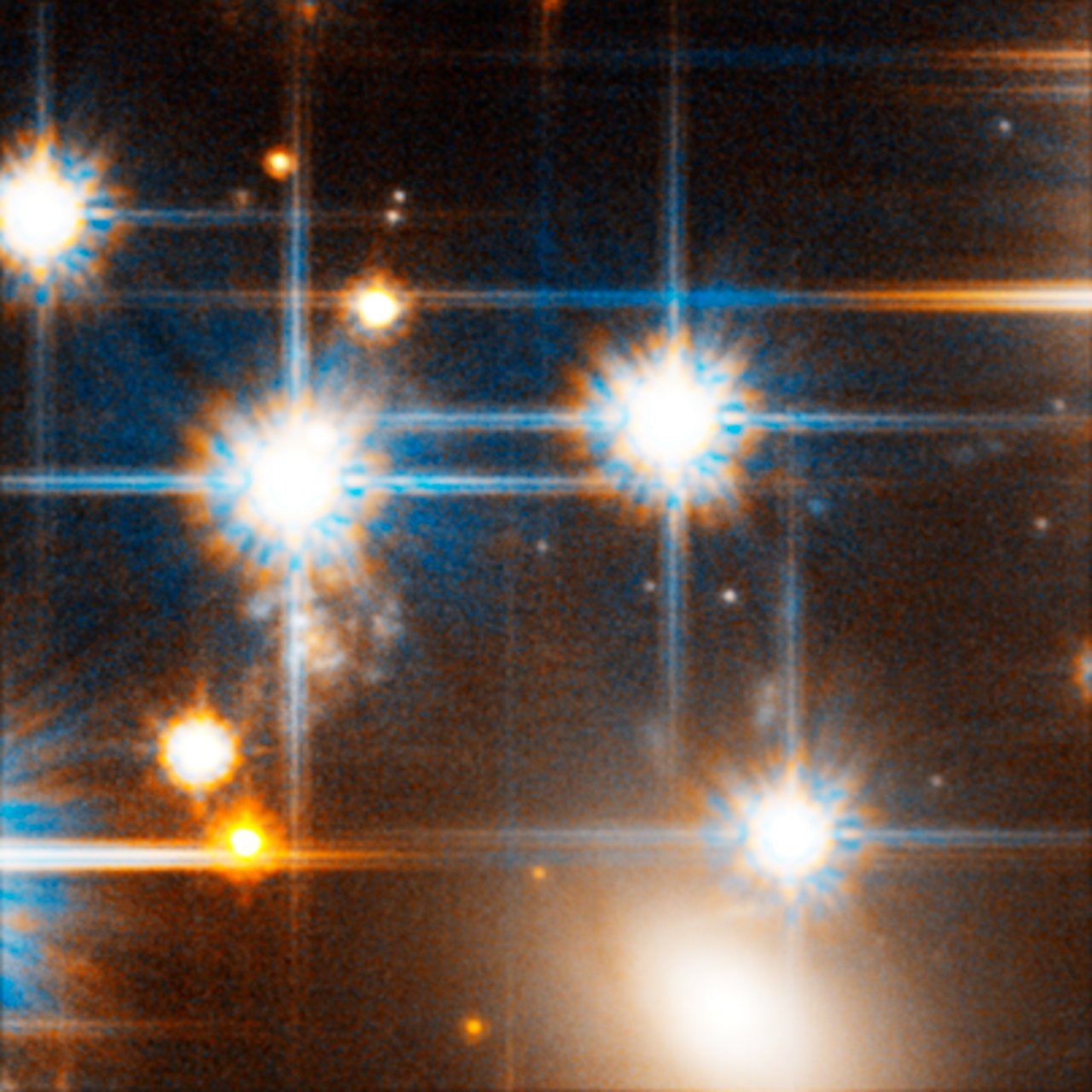
A white dwarf is faintly visible at the center of this Hubble Space Telescope image, tucked between the two brightest stars. [NASA, ESA and H. Richer (University of British Columbia); CC BY 4.0]

White dwarfs are the remnants of low- to intermediate-mass stars that have ceased core fusion and evolved off the main sequence. The presence of metals in white dwarf atmospheres shows that it’s common for white dwarfs to accrete rocky materials from tidally disrupted bodies in their surroundings, allowing for a post-mortem investigation of the composition of rocky worlds in far-off planetary systems.

One of the most impressively metal-polluted white dwarfs known is GD 362, which is surrounded by a dusty debris disk and shows evidence for at least 16 accreted elements. GD 362 is a helium-atmosphere white dwarf, but previous observations have also shown that it has an unusually large amount of hydrogen in its atmosphere — a possible sign that the star has consumed one or more bodies containing water or ice.

Disk Investigation

spectrum of GD 362

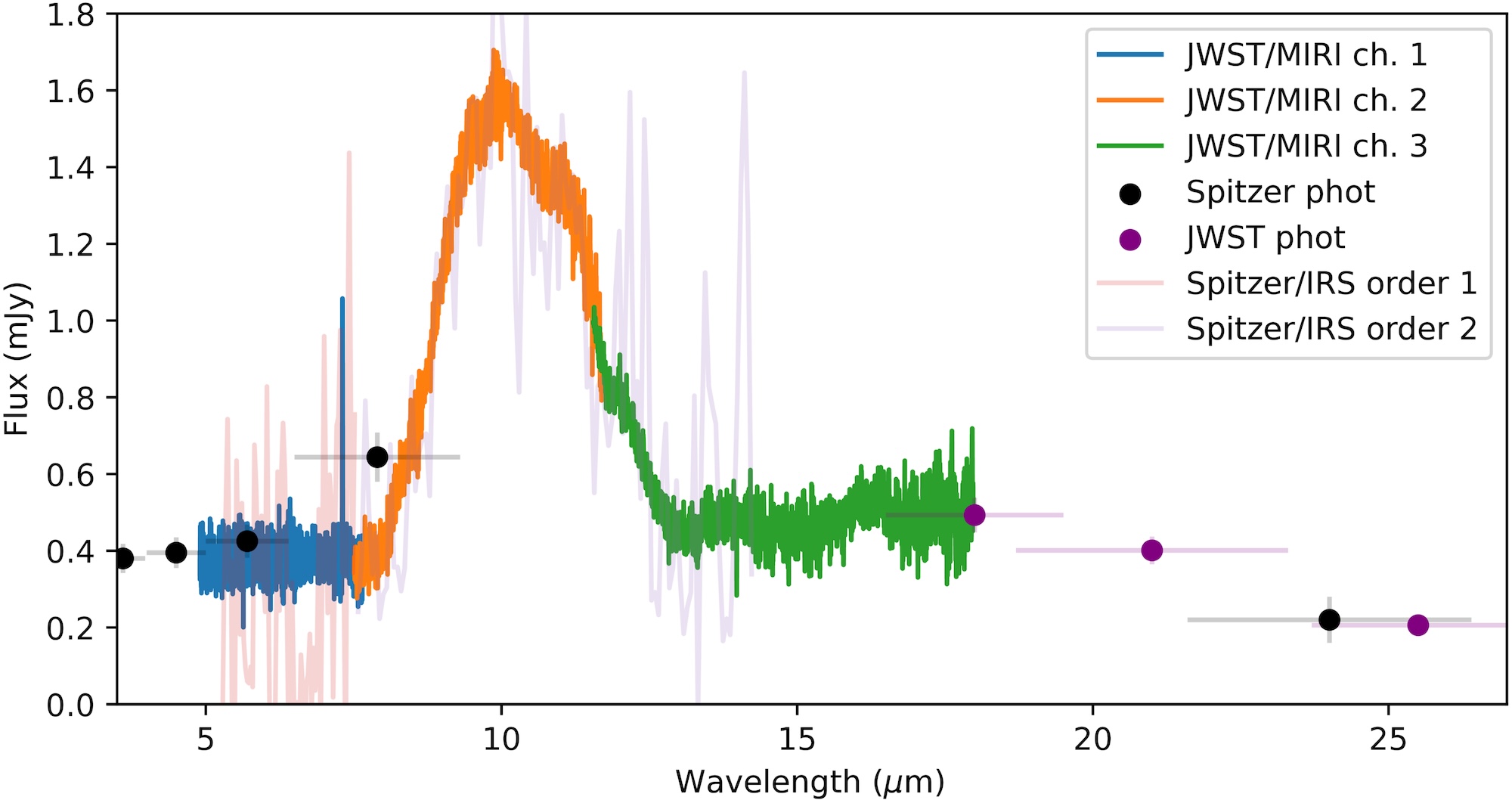
Mid-infrared JWST spectrum and photometry of GD 362, with additional spectral and photometric data from the Spitzer Space Telescope. Click to enlarge. [Reach et al. 2025]

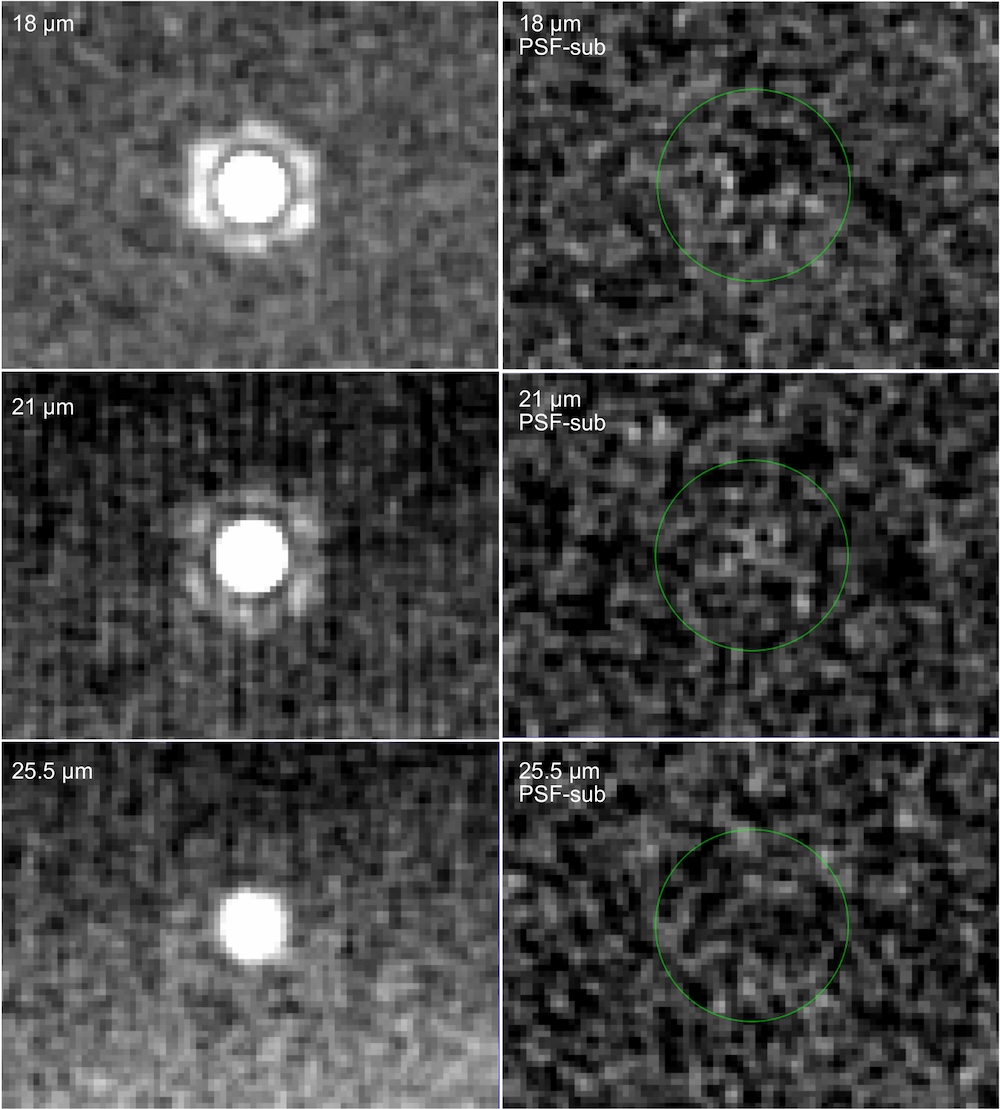
Now, a team led by William Reach (Space Science Institute) has obtained JWST spectra of GD 362 to examine the material in its disk directly. Using both the Near-Infrared Camera (NIRCam) and the Mid-Infrared Instrument (MIRI), the team collected spectra of the white dwarf from 0.6 to 17 microns, with additional photometric measurements at 18, 21, and 25.5 microns. The JWST spectra show bright emission from the white dwarf at wavelengths shorter than 2.5 microns, with a clear signature of disk material at longer wavelengths, including a strong emission feature at 9–11 microns.

Reach’s team modeled the JWST spectra to constrain the mineralogy of the disk and its physical attributes. They found that the disk likely stretches from 140 to 1,400 times the white dwarf’s radius and contains both silicates and carbon, with the prominent emission feature pointing to olivine and pyroxene silicate minerals. The elements seen in the white dwarf’s atmosphere are generally similar to those observed in the disk, strengthening the connection between accretion from the disk and the metals present in the white dwarf’s spectrum.

Hydrogen Mismatch

The new JWST data furthered the investigation of GD 362’s atmospheric hydrogen and the possibility that it’s accreting water- or ice-rich material. Though water molecules have spectral features in the range studied, none of these features appeared in the JWST spectra of GD 362. This isn’t necessarily a surprise; the team showed that water molecules in the disk would quickly be split apart by GD 362’s high-energy radiation.

JWST images of GD 362

Left column: Three JWST images of GD 362. Right: The same images with the white dwarf’s point spread function subtracted. [Reach et al. 2025]

Curiously, though, Reach’s team found little evidence for hydrogen-rich material within the disk that could be the source of the white dwarf’s atmospheric hydrogen. Because accreted hydrogen would remain in the star’s atmosphere indefinitely, the presence of atmospheric hydrogen could be evidence that the white dwarf accreted water-rich material from its debris disk in the past, though the materials currently present in the disk are dry.

In addition to investigating GD 362’s disk, Reach and collaborators searched for planets orbiting the white dwarf. Though they found none, they were able to rule out the presence of companions with masses greater than 25 times the mass of Jupiter.

Citation

“Composition of Planetary Debris Around the White Dwarf GD 362,” William T. Reach et al 2025 ApJ 994 195. doi:10.3847/1538-4357/ae11a9

The post Investigating a Polluted White Dwarf appeared first on AAS Nova.

  •  

Selections from 2025: The Formation of Massive Stars

star-forming region AFGL 5180

Editor’s Note: For the remainder of 2025, we’ll be looking at a few selections that we haven’t yet discussed on AAS Nova from among the most-downloaded articles published in AAS journals this year. The usual posting schedule will resume January 2nd.

The SOFIA Massive (SOMA) Star Formation Survey. V. Clustered Protostars

Published June 2025

Main takeaway:

A team led by Zoie Telkamp (University of Virginia) used the Stratospheric Observatory for Infrared Astronomy, SOFIA, to study massive protostars and test theories of high-mass star formation. Contrary to the predictions of some star-formation models, the team found no evidence that massive protostars require a certain surface mass density to form. Formation in a cluster environment, however, may limit the formation of the most massive protostars.

Why it’s interesting:

Massive stars are rare, short-lived, and luminous. They influence their environments across a vast range of spatial and temporal scales, from advancing the epoch of reionization in the early universe to impacting the formation of individual planetary systems in the present-day universe. The fundamental question of how high-mass stars form is still unsettled. Theories of high-mass star formation range from scaled-up versions of low-mass star formation to scenarios involving collisions between protostars.

More about this massive-star study and the potential impact of a cluster environment:

infrared images of massive protostars

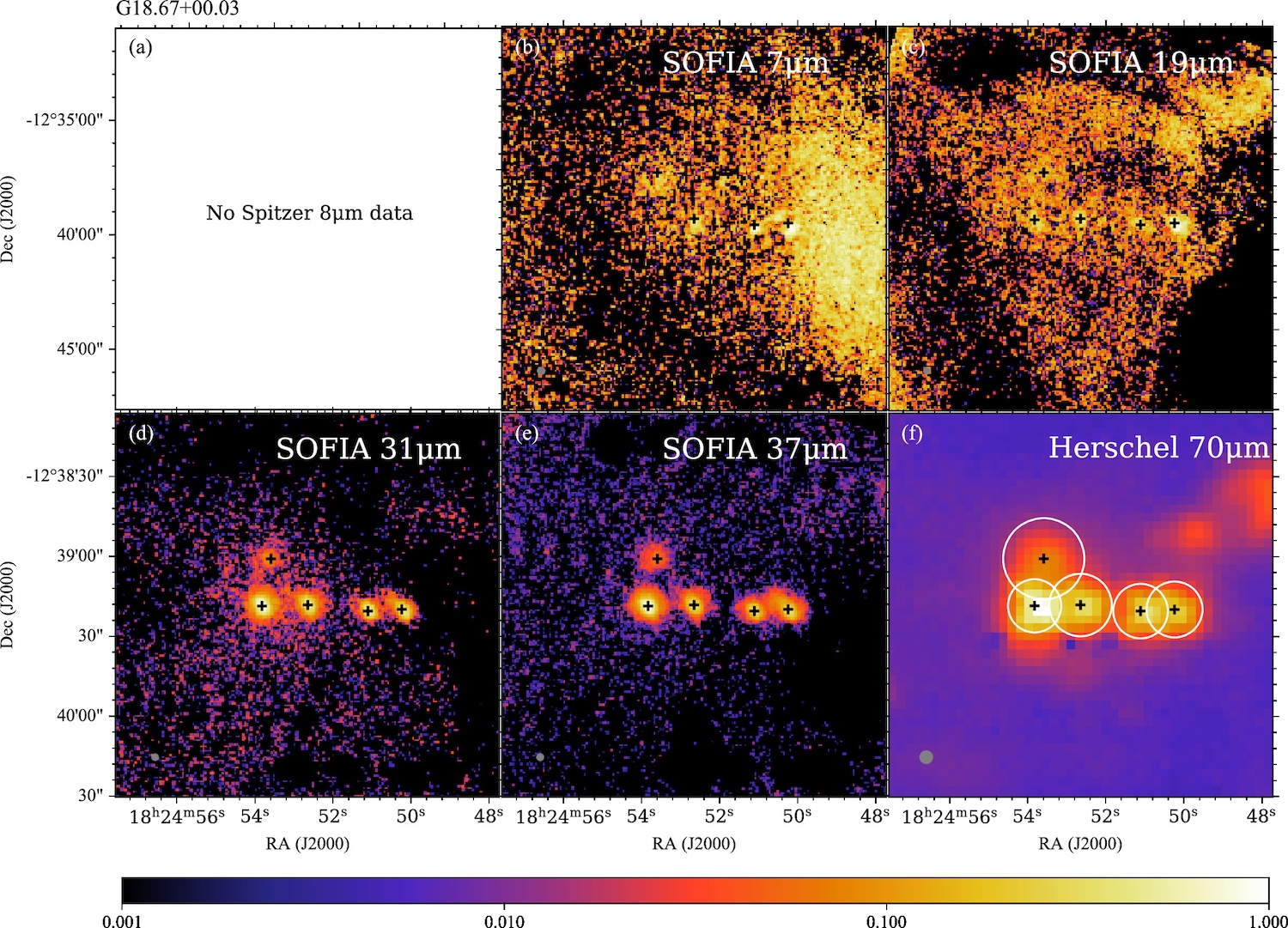
SOFIA FORCAST and Herschel Space Observatory images of protostars in the G18.67+0.03 star-forming region. Click to enlarge. [Telkamp et al. 2025]

Researchers developed the SOFIA Massive Star Formation Survey to investigate the origins of massive stars, targeting roughly 50 high-mass and intermediate-mass protostars in a wide variety of environments in our galaxy. This particular work, the fifth in a series of articles reporting the survey’s findings, described the team’s study of massive protostars forming in cluster environments. Using the Faint Object infraRed CAmera for the SOFIA Telescope (FORCAST), Telkamp and collaborators identified 34 protostars in seven star-forming regions and estimated their masses and other physical properties. The team noted a lack of protostars above 30 solar masses in these cluster regions, which might be evidence that competition for gas in dense environments can prevent the formation of more massive protostars. More work is needed to confirm this finding.

Citation

Zoie Telkamp et al 2025 ApJ 986 15. doi:10.3847/1538-4357/adcd79

The post Selections from 2025: The Formation of Massive Stars appeared first on AAS Nova.

  •  
❌