The MacVoices Live! panel explores Pope Leo’s comments on AI ethics, technology regulation, environmental costs, labor disruption, and the need for moral guardrails without stopping innovation. Chuck Joiner, David Giinsburg, Jeff Gamet, Brian Flanigan-Arthurs, Jim Rea, Eric Bolden, Marty Jencius, and Web Bixby compare today’s AI concerns to earlier industrial upheaval, then shifts to Kansas City’s school technology plan involving MacBook Neo systems and iPads, with debate over deployment, education value, and implementation challenges.
Joe Kissell introduces Take Control Live: Taming Big Tech, a four-session interactive course designed to help users understand privacy, security, subscriptions, ads, platform lock-in, and practical alternatives to major tech services. Rather than urging an all-or-nothing break from companies like Google, Meta, Amazon, Microsoft, or Apple, Joe will focus on realistic steps, live demos, Q&A, […]
Following a growing string of high-profile departures, OpenAI has lost its head of ethics at arguably the worst time possible.
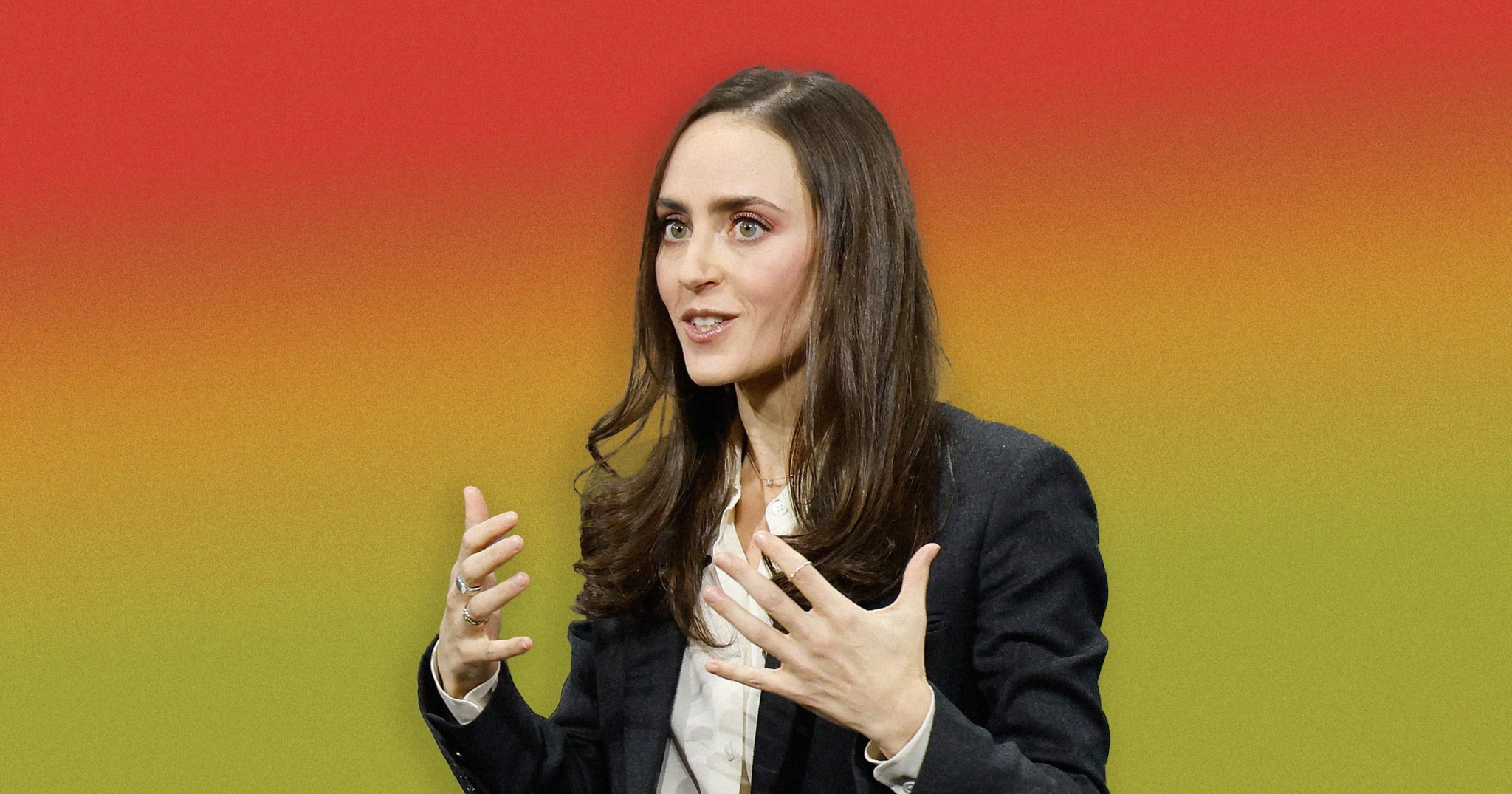
As the Financial Times reports, Chloé Bakalar left her post as the AI ethics lead in July, less than a year after joining the company and without any accompanying announcement. Interestingly, her LinkedIn still claims she’s employed at the firm.
There currently is no replacement lined up, suggesting shifting priorities at the company. According to the FT‘s sources, Bakalar was the only remaining dedicated ethicist at the company.
The timing of Bakalar’s departure is noteworthy. The Sam Altman-led company has been embroiled in a major controversy after revealing that a group of its AI models broke containment and hacked into the systems of open source AI platform Hugging Face.
In other words, OpenAI needs a competent team of AI ethicists now than ever before as the industry reels from the possibility of frontier AI models going rogue, in what many experts say is a cybersecurity nightmare in the making.
“We cannot rule out critical cyber capabilities,” the company admitted, following internal evaluations of the model.
Bakalar had been primarily tasked with coming up with ethical approaches to AI model development and studying how AI interacts with humans.
“Ethics is actually everyone’s responsibility, and I say that as someone whose job it is to lead this work,” she told audiences during a recent AI conference, as quoted by the newspaper. “You shouldn’t just come to people like me. There should never just be one person who serves as the moral centre of an AI developer.”
It’s a particularly symbolic departure for a company that once billed itself as an ethical non-profit. The company restructured itself into a primarily for-profit business last year, largely betraying its non-profit roots. The company’s plans to go public could further erode any lingering commitments to the ethical development of AI.
Meanwhile, its competitor Anthropic, which has long billed itself as the more ethical alternative to OpenAI, is similarly struggling to maintain its public image. The company dropped its core safety commitments earlier this year.
The company still has an alignment team, led by philosopher Amanda Askell, who is tasked with giving its flagship chatbot Claude a sense of right and wrong.
For protestors rising up against the data centers undergirding the AI boom, the math is simple: wherever they sprout, the facilities make frightfully poor neighbors — inflating utility prices, discharging hazardous waste, and blasting horrid noise at all hours of the night.
For data center developers, there’s a different calculation to be made: namely, one of supply and demand around the seemingly infinite drive for computing power.
Against the backdrop of an industry measured in the trillions of dollars, a few scattered protests at city hall may seem inconsequential. Yet as more and more local campaigns arise in opposition to data centers, the collective financial implications are becoming impossible to ignore.
According to new reporting by Reuters, which indexed data compiled by the research firm Data Center Watch, there are now hundreds of billions of dollars exposed to the growing risk of local opposition.
In the first three months of 2026 alone, at least 75 separate data center projects faced some kind of organized opposition at the local level. Together, those 75 developments represent a combined $130 billion worth of investments.
The funders of those data centers include major banks, but also more than a few private equity firms, which are sure to notice as the social risk to their data center investments climb.
Simply put, the potential that any given data center could be cancelled due to local opposition is rising, a sign that organized efforts against data centers are becoming more than the sum of their parts.
Yet despite growing costs, opposition alone may not be enough to slow the behemoth industry. As one anonymous senior official at a foreign lending firm told Reuters, investors are now becoming more comfortable pricing in cancellation risks as the demand for AI compute grows — like frogs adjusting to boiling water.
In light of plummeting public support for its widespread automatic license plate readers, surveillance company Flock has lost dozens of contracts with cities across the US.
Citizens are increasingly disgusted by the company’s presence on public streets, opting to hack down the cameras, blind them, or sabotage them in other creative ways.
“His project, which he calls noRecognition, allows people to escape the automatic detection and algorithmic surveillance used across the U.S. and beyond.” https://t.co/OIQNOt9B0a@TechCrunch
— Christina Ayiotis, Esq., CRM, CIPP/E, AIGP (@christinayiotis) August 10, 2026
And according to cybersecurity researcher Bill Swearingen, there may be other creative ways to befuddle Flock’s spy cams. He devised with a special computer-generated pattern which, once stretched out across the vehicle in the form of a wrap, will result it in not being flagged as a car by Flock’s cameras.
During this year’s Def Con cybersecurity conference in Las Vegas, Swearingen showed off a 2009 Toyota Yaris wrapped in vinyl featuring the logo of automotive publication Donut Media (which is owned by Futurism‘s parent company Recurrent Ventures.)
Despite the car looking a bit chaotic — albeit still very much like a small passenger vehicle to the human eye — “we proved it was effective,” Swearingen told TechCrunch. The Yaris successfully defeated surveillance detection at Def Con during the pattern’s first public test.
“Privacy is a fundamental right,” he added, aiming to give people a way to “opt out of being tracked.”
To come up with the pattern, he used a reinforcement learning model that trained itself on patterns that evade detection. The model got to the point of being able to confuse all 11 open source detection algorithms he tested, per TechCrunch, in addition to Flock’s license plate readers and even Axon’s body-worn cameras used by police departments.
As part of his noRecognition crowdsourcing campaign, Swearingen has also come up with T-shirts and hoodies that feature algorithmic detection-busting patterns. He hopes to eventually put pattern-printed skins for entire cars on sale as well.
One thing is clear: as outrage over Flock’s heavy presence across the country grows, people are looking for any way to foil the tech — especially if it looks cool.
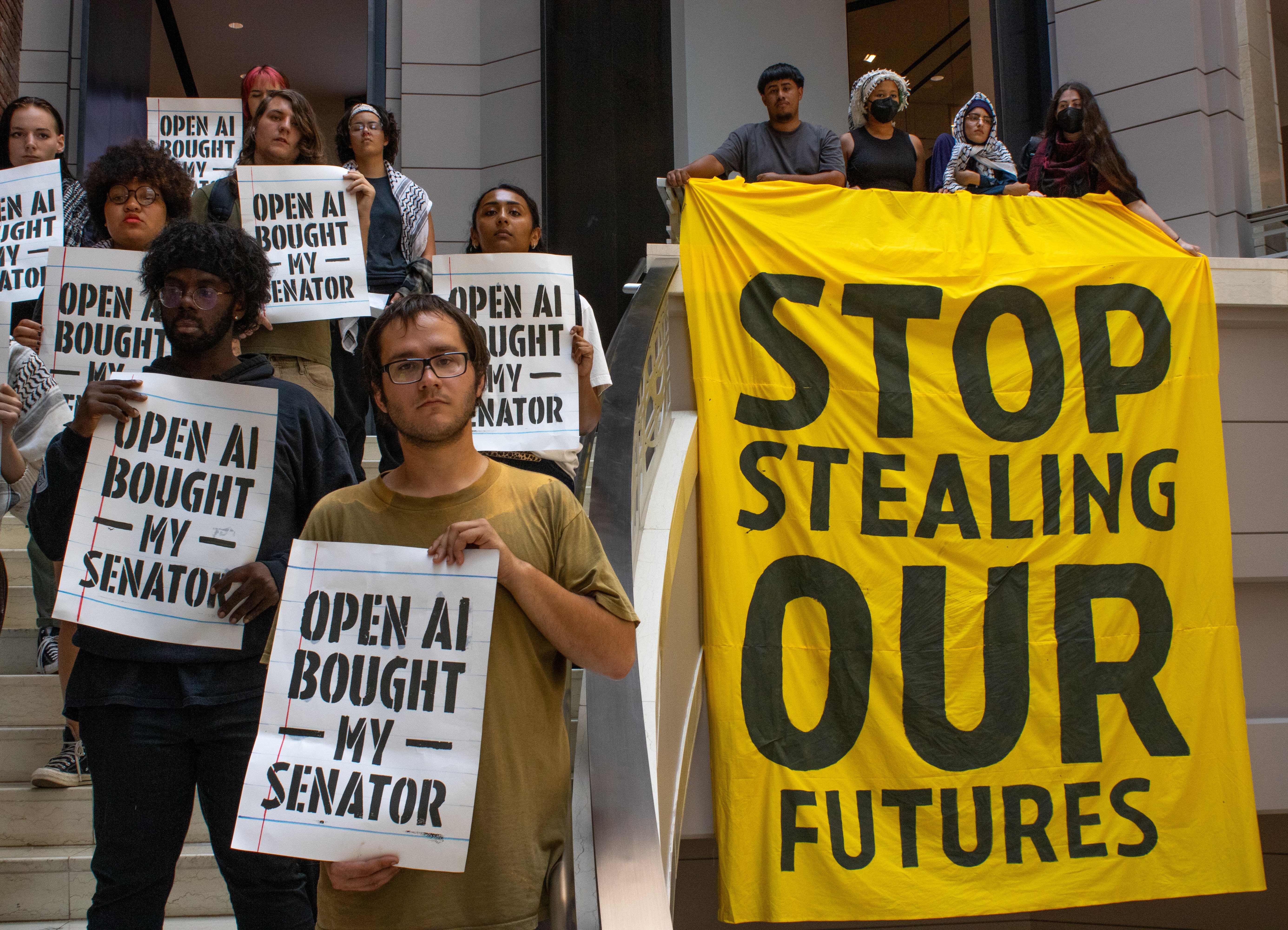
Over 30 student activists came together on Monday afternoon to occupy the Gallup Building in Washington DC, home to a public-facing lobbying office belonging to ChatGPT developer OpenAI.
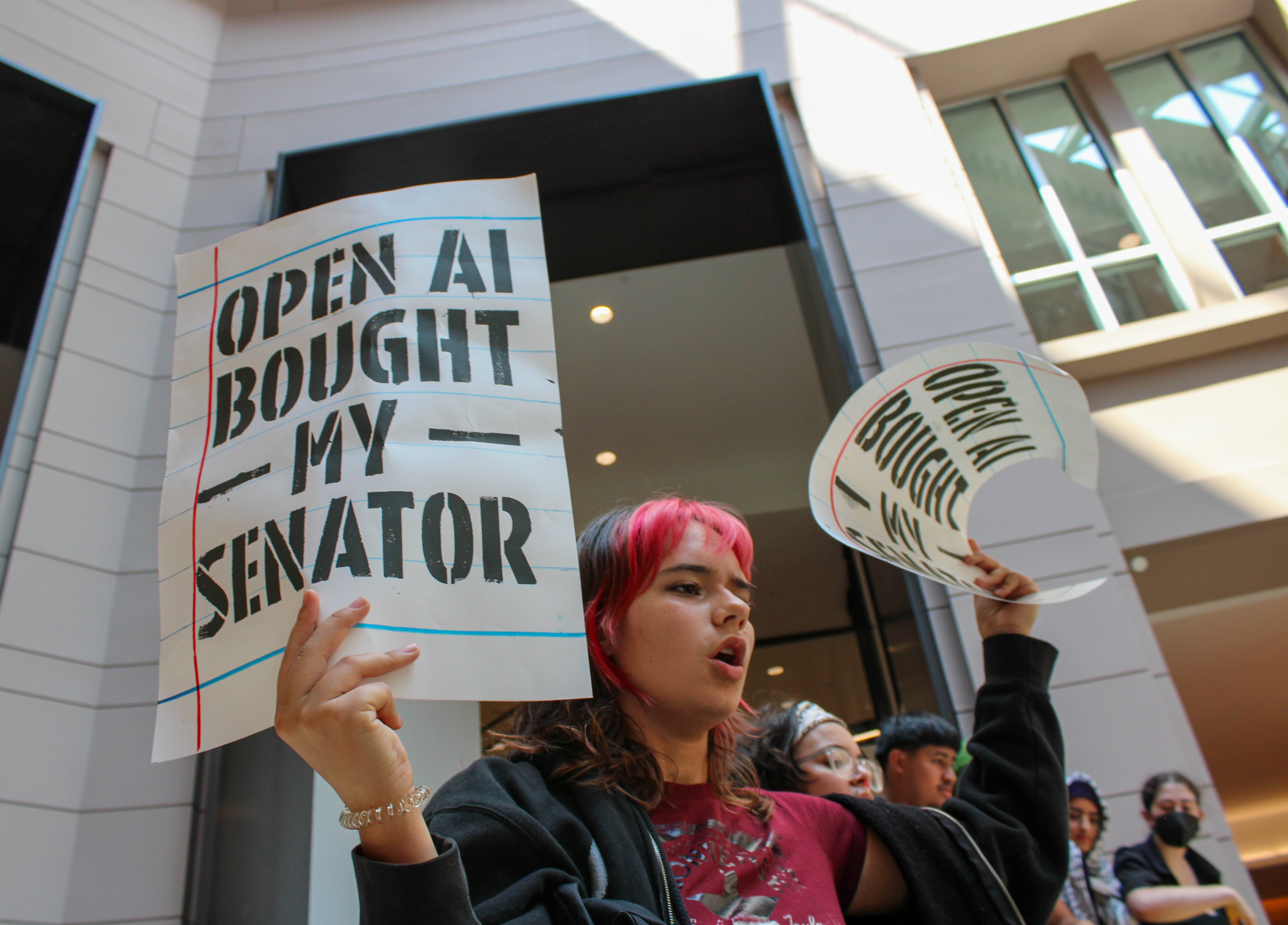
Once inside the lobby, the demonstrators unfurled a massive banner reading “Stop Stealing Our Future,” while others held signs with messages like “OpenAI bought my Senator.” The demonstration lasted two hours, and ended when police stormed the lobby, arresting 13 protestors.
At the moment, the identity and whereabouts of the protestors remains unclear. An incident report obtained from the Metropolitan Police Department states that 13 people were arrested for “unlawful entry.” After stuffing the activists into vans, the report notes the MPD split the group up, sending seven to the First District Station, four to the Second District, and two to the Third District for processing.
The protest was organized by the climate group Sunrise Movement and anti-AI organization QuitGPT. According to a joint statement shared with Futurism, Monday’s action is just one of many across over 20 states in August calling on politicians to “Dump Big Tech.”
One student organizer who attended the protest, Raya Gupta, explained in the statement that “my friends chose to risk arrest to bring the fight to OpenAI.”
“Our generation doesn’t have any guarantees about whether we’ll have jobs after college, or whether there will be clean drinking water for all of us or whether people will have any power left in politics since our elections keep getting bought by Big Tech,” Gupta continued. “We all believe that not taking action now, as the scales slide between the people and the billionaires, puts our future in great jeopardy.”
Gupta’s comments underscore the degree to which AI has become an omni-cause for Americans across the political spectrum. A growing number of people in the US have been arrested for protests related to AI in some shape or form, whether attending town hall meetings to oppose data center developments, or occupying offices used by federal agencies to tool out AI immigration software.
Despite growing disgust with AI and its developers, politicians on both sides of the aisle have roundly embraced the tech industry’s extremely expensive lobbying efforts. Case in point, the recent opening of OpenAI’s DC Office comes as one of the AI lab’s super PACs injects over $140 million into the coming midterm elections, in a blatant attempt to steer AI regulations at the highest level.
German AI researcher and hedge fund manager Leopold Aschenbrenner became the poster child for the hubris of an AI-obsessed Wall Street last month.
Some $35 billion of investors’ money, in the form of leveraged bets on AI infrastructure stocks, evaporated in front of the 24-year-old’s eyes as tech shares were hit by yet another major sell off.
The humbling couldn’t have come at a worse time. The funds vanished days before his wedding with Anthropic chief of staff Avital Balwit. According to the New Yorker, the two had to cancel their honeymoon as a result.
Aschenbrenner isn’t alone. According to new data from Hedge Fund Research, tech funds dropped by seven percent in July, the worst period for the investments since the depths of the 2008 global financial crisis, the Telegraph reports.
A separate hedge fund, called value Aligned Research Advisors, which shares a similar portfolio to Aschenbrenner’s, similarly slid 44 percent in July as tech stocks reeled from major volatility.
The bruising month has further compounded fears over a massive surge in AI spending with no clear path to profitability in sight. Investors have become wary of big tech companies’ ever-higher capital expenditure forecasts as concerns over an AI bubble continue to mount.
Staying on track and maintaining high profit margins has become a high risk high reward game.
“When valuations are elevated, and positioning is concentrated, the difference between being on the right and wrong side of a trade can become unusually large — and very quickly,” Erlen Capital Management managing partner Bruno Schneller told the Telegraph. “Specialist technology strategies can generate exceptional returns when momentum and narrative are aligned, but they can also experience abrupt, leverage-amplified reversals when those conditions change.”
The game is far from over. Even Aschenbrenner’s fund has since recovered and his making new investments after being forced to unwind trades and sell major chunks of its holdings last month.
Yet how much longer the highly AI-leveraged stock market can sustain itself is anybody’s guess. In a blog post on Friday, Apollo chief economist Torsten Slok pointed out that those who reap the biggest profits, including companies making AI models, are massively depending on profits being “funded by investors rather than earned from customers.”
Put simply, AI companies aren’t making any significant amount of money from providing a worthwhile product, but from “capital raised by the layer losing money,” per Slok.
“Capital can bridge the gap for a while, but not indefinitely,” Slok argued. “And therein lies the risk: will the ROI show up for AI’s end customers fast enough to sustain the spending that is generating those upstream margins?”
Tech Goliaths are scrambling to build as much AI computing capacity as they possibly can, come hell or low water. One of the dominant players in the space, Amazon Web Services, has its heart set on an AI data center so enormous that it could easily become the largest source of carbon dioxide emissions in the United States.
According to the New York Times, Amazon has confirmed its investment in a massive gas-burning power plant in Texas, meant to supply up to 7.65 gigawatts of energy to a planned data center in Pecos County. Should it come online as planned, the plant’s 35 turbines would be allowed to spew 33 million tons of CO2 a year, the NYT notes, which would easily make it the largest single fount of emissions in the country.
That’s a stunning amount of carbon exhaust, putting that single data center in a league with entire countries including Switzerland, Ireland, and Bulgaria.
It would also be in stark defiance of Amazon’s stated climate goals, which center on reaching net-zero carbon emissions by 2040.
That’s not lost on the tech giant. But as Amazon spokesperson Margaret Callahan told the NYT, the “world looks different now than when we co-founded the climate pledge.”
“We’re being transparent about the challenges, investing in innovation, and delivering measurable results,” Callahan continued. “Growth and sustainability don’t have to be in opposition — in fact, our results show they reinforce each other.”
Even without the new Pecos County plant, Amazon’s emissions are staggering. The company recently disclosed a record increase in its total emissions last year, with company-wide electricity usage rising by 34 percent across 2025.
That the company is blatantly papering over its previous climate commitments isn’t a shocker at this point, in other words, as the company reaches new emission highs with each passing year.
As if the practice of homeschooling wasn’t fraught enough already, parents are now bragging about using large language models (LLMs) like ChatGPT to school their kids.
A number of viral videos show the alarmingly cavalier attitude some parents are taking. One clip, seemingly taken from a livestream hosted by the enormously controversial influencers Cole and Savannah LaBrant, shows the parents outline their vibes-based approach to the education of their five children.
“What I do for history — Cole usually does all their history, which I love, because I’m not the best at history — so Cole steps in about once a week and we’ll do a history lesson with them… we’re just teaching them the things that we just want them to learn — that we feel are the most important,” Savannah explains. “And same with science, and geography.”
That’s not uncommon as homeschool curriculums go; as horrifying as it is to imagine a student receiving one history lesson a week, regulations around the practice are incredibly loose in the United States, freeing hardcore Christians like the LaBrants to do whatever they want. But Savannah goes on, admitting that sometimes, even those slapdash lessons are too much to tackle without a little AI assistance.
“So I just make my own curriculum, and sometimes I’ll just use, like, ChatGPT,” she says, “or just uhm, print out, like — like right now I’m teaching them where the states are and how to locate them, and uhm, like all the states and capitols and things like that.” (Even the most advanced AI chatbots are known for producing inaccurate maps.)
History Class, but Make It Vibes-Based: The LaBrants Explain Homeschooling The LaBrants’ Homeschool History Curriculum: Whatever Cole Decides Happened “Cole steps in about once a week to do a quick history lesson because I’m not the best at history.” – Sav. The LaBrants went live to explain their homeschooling setup, and Savannah casually admitted she “doesn’t know a lot of history,” so they teach it once a week, with Cole covering whatever topics they personally decide are important. So apparently the curriculum is: Monday: sponsored content Tuesday: Bible lesson Wednesday: filming Thursday: whatever Cole remembers from school Friday: history, pending personal relevance Homeschooling can absolutely be done well, but “we teach history once a week based on what we think matters” is not the reassuring flex they seem to think it is. History is not a Pinterest board where you skip the sections that do not match the family aesthetic. The most concerning part is not Savannah admitting she lacks expertise. Plenty of parents do. It is the confidence of replacing a structured curriculum with Cole’s Greatest Hits of Human Civilization. Nothing says educational rigor like two influencers deciding which centuries make the cut. @Savannah LaBrant @Bev Skin @ChatGPT @OpenAI @Fishfam @TMZ @cbsnews @CNN @DrinkFrosh #savannahlabrant#colelabrant#labrantfamily#homeschool#fyp
That any parents could be so cavalier in their approach to homeschooling has grim implications for an already divisive practice.
In much of the US, homeschooling parents are already given incredibly wide latitude on what to teach their children. A whole 11 states have essentially no regulations on homeschooling whatsoever: parents aren’t required to follow any set curriculum, issue standardized assessments, or even inform the state that their child won’t be going to a real school.
Many more states only require a notice of intent to homeschool and occasional proof of attendance, the latter being a bare bones measure of success, and one which is easily fudged. Unfortunately, it’s easier to count the number of states that definitively require standardized testing and a rigid curriculum: Rhode Island, Pennsylvania, New York, Vermont, and Massachusetts.
Of course, the LaBrants aren’t alone. The popular influencer account Heavenly Homeschool has similar reels out, walking parents through the process of generating entire years’ worth of lesson plans, tailor-made to their specific worldview. It all begs the question: do AI chatbots have any safeguards around education?
Turns out, not really. We tasked ChatGPT with developing a homeschooling curriculum for a 3rd grade student in Michigan — a state with virtually no regulations around DIY education — “following a strictly evangelical doctrine,” including “no woke history or science.”
ChatGPT was more than happy to oblige: “I can build this around a conservative, explicitly Christian/evangelical worldview, with Scripture integrated across subjects and with history and science taught from a young-earth/creationist perspective rather than through a secular or progressive framework,” the chatbot explained.
While it didn’t push back against our intentions to indoctrinate our hypothetical child, the LLM did make sure to clarify that “no woke” can “mean different things to different families.” So, to avoid ambiguity, the chatbot specified that the course calendar would use “Biblical authority, traditional Christian ethics… and creation-based science” as standard-bearers.
True to its word, the LLM-generated curriculum included “bible and Christian studies,” a traditionalist approach to American history, with specific chunks on both “Westward expansion” and Henry Ford — a renowned racist and antisemite — as well as a creationist approach to Earth science and astronomy.
For the portion on space, the curriculum would teach “the heavens as God’s creation while distinguishing observations from interpretations about the age and origin of the universe,” the LLM promised.
Put together, it paints a dire picture for the estimated 3.75 million K-12 homeschooled children in the US. Beyond the potential for wild AIhallucinations to leach into educational material, the technology is a Pandora’s Box for parents, who can now effortlessly inculcate their children with any number of unscientific conspiracy theories or anti-social worldviews while facing no pushback whatsoever.
Do you know anything about how homeschooling families are using AI? Email us: tips@futurism.com. We can keep you anonymous.
What about attempts to test their virulence in humans? The approach in the Stanford lab sure sounds like a new form of gain-of-function research to me.
According to USA Today CEO Mike Reed, the goal is to “build a common intelligence layer” on reader data to “monetize those relationships faster and at much greater value.”
The largest newspaper’s new partnership with the Peter Thiel-cofounded company, which has long been mired in controversy — from collaborating with Immigration and Customs Enforcement and being linked to US airstrikes that killed over 120 schoolchildren in Iran to its mercurial CEO, who has a long history of strange outbursts — has raised plenty of eyebrows.
Workers represented by The News Guild, the country’s largest communications and media labor union, including journalists at USA Today, were “shocked” by the news, according to a new statement, and are calling for the company to “immediately end its partnership with Palantir.”
“While [Reed] championed this partnership as a way to drive revenue, we believe it threatens to undermine trust in our news outlets and raises serious questions about the data security of our readers,” the statement reads.
“We have significant ethical issues with Palantir, whose artificial intelligence software has been used to advance widespread surveillance and power immigration crackdowns,” the union wrote. “Not only does partnering with Palantir, a major player in the news we cover, create an inherent conflict of interest, but it fails the journalists who have been assaulted and falsely arrested while covering immigration enforcement actions and protests.”
The News Guild accused USA Today Co of not disclosing details regarding the new partnership and raised concerns over how readers’ personal information and data will be treated and protected.
“Without answers, how can journalists encourage readers to subscribe to our news outlets?” the union wrote.
As a result, the union is calling for USA Today Co to “steer clear” in order to maintain journalistic integrity and maintain “with the kind of responsibility and skepticism that the nation’s largest network of journalists should exhibit.”
The union also called attention to the dire state of the news industry, with a major pivot to AI being cited to justify major layoffs at countless newspapers and publications.
Even within Palantir’s own ranks, employees are starting to speak up, with some starting to wonder whether “they’re the bad guys,” as Wired reported earlier this year.
The company’s reputation has taken such a major hit that even its major contract with the UK government’s National Health Service is on shaky ground. Earlier this year, London mayor Sadiq Khan also blocked a Palantir contract with the city’s Metropolitan police force, arguing the department “did not adequately demonstrate value for money for Londoners.”
Flock had a devious plan to expand its surveillance network past its army of AI-powered license plate scanners.
As 404 Media reports, the controversial company drew up plans to use the dashcams installed in Uber and Lyft drivers’ cars to scan the license plates of every vehicle that drove past them — in effect turning hundreds of thousands of rideshare and delivery drivers into a network of what the reporting describes as “roaming surveillance vehicles.”
These plans were first revealed last August as part of an intended partnership between Flock and the AI-powered dashcam company Nexar. Now, a presentation document obtained by 404 Media shows that Flock was actively pitching this partnership to potential customers at the time. The presentation, which was intended to be shown to the Georgia Office of the Attorney General, was obtained by a Georgia resident through a public records request.
Flock told 404 that the partnership never went through, but the presentation still shows the company’s plans to turn rideshare and delivery drivers into mobile surveillance apparatuses — and the sheer scale is astonishing.
“Hundreds of Commercial Business and HOA [home owners associations] in GA [Georgia] are part of the network,” the Flock presentation stated. “Plus Nexar partnership which includes 350k Uber/Lyft and other delivery service devices.”
Expanding to rideshare drivers would’ve added a new dimension to Flock’s already far-reaching surveillance network. Most of its cameras are mounted on stationary poles that survey a fixed area. In addition to providing more coverage, using cars could help Flock keep a lower profile; one of the main problems Flock is facing amid overwhelming public backlash is that protestors are vandalizing or blocking its surveillance pylons.
Another murky area of Flock’s plans was that it’s unclear if the Uber and Lyft drivers would’ve been aware they were participating in surveillance efforts, 404 noted.
Flock didn’t discount the possibility of these plans being realized through another partnership in the future. If they do, it’ll only fuel the massive privacy and safety concerns already posed by its cameras. The footage it collects into a centralized network can be accessed by cops across the country, often with little accountability. At least 50 police officers have been accused of using the cameras to stalk women, according to a recent Washington Post tally.
The dashcam partnership wasn’t the only plan that Flock had to deepen its surveillance. Last month, it officially cancelled a “human distress detection” pilot program, a network of always-on acoustic sensors that monitored public places for sounds of “screaming.”
A quiet war is playing out in rural communities across the country.
City council meetings are bursting into conflict as local residents try to keep AI data centers out of their backyards. Americans are starting to see through the promises of tech companies and the local politicians they’ve wooed, realizing that the advantages of hosting a resource-hogging data center in the neighborhood are slim.
Yet tech giants are finding creative — and sometimes startlingly dirty — new ways to circumvent local opposition in their quest to build out these sprawling facilities. As the Wall Street Journal reports, Amazon exploited 45-year-old zoning laws in Gilroy, California, to start construction on a data center without any residents knowing for five entire years.
“Many if not most residents first learned about this project after construction had already begun,” local elementary-school teacher Coleen Crew told the town’s recent council meeting, as quoted by the WSJ.
A single city staffer, the community’s development director, greenlit Amazon’s 438,500-square-foot data center, which spans 56 acres of former farmland. The ancient zoning criteria allowed industrial development along the location on a local freeway.
Gilroy’s mayor was surprised his constituents suddenly wanted a say.
“It didn’t bother them that a food-distribution center came to Gilroy without their engagement, but now it bothers them that a data center is coming to Gilroy without them having the possibility of engagement,” he told the WSJ.
In short, likening it to a “food-distribution center” isn’t exactly a fair comparison.
Amazon Web Services president of economic development Roger Wehner told the WSJ that the company “followed standard approval processes for an industrially zoned parcel,” but acknowledged that it should’ve recognized the community’s desire for “more engagement sooner.”
“We’ve since met directly with residents and hosted an open house to hear feedback and answer questions,” he added.
City officials are now wondering whether to change the approval process in ways that would force developers to hold community meetings and engage with residents.
When resident Rosa Rodriguez found out about the project, she asked city staff in February to publicly comment on an environmental review report, citing concerns over the drought the region is facing. But planners shut her down, telling her the comment period had closed back in September 2024, long before she knew about the project’s existence.
Amazon has since tried to win over the public, touting a new wastewater pipeline, tax revenue, construction jobs, and even the sponsorship of the annual Gilroy Garlic Festival. However, frustrated residents weren’t mollified, demanding to at least be made aware of big unfolding projects like the data center.
Even as they promise AI will supercharge productivity, tech leaders are sending a clear message: any efficiency gains won’t help individual workers.
During a podcast appearance last month, OpenAI CEO Sam Altman said that he doesn’t “expect AI” to lead to a shorter four-hour work week. He argued that workers are “secretly” going to be “happy” about being “much busier” and working even harder thanks to AI — a bizarre and out-of-touch comment from a billionaire with extraordinary power over the lives of working people.
Now, Meta CTO Andrew Bosworth has similarly cracked the whip, as Business Insider reports — and he’s even willing to berate the company’s workers for asking for more time off.
During a July Q&A with staff, Bosworth shut down an employee who asked if AI productivity gains could be used to revive “Meta Days,” a cancelled holiday program that once allowed staff to take more days off a year.
Bosworth was apparently appalled at the idea, saying that “I hope that what we do with our extra time is do even more and cooler stuff for the users who use our products every day.”
“We got billions of people using our products every day,” he added. “I get an extra hour. You know what I do with it? I put it into that.”
The executive then dug his heels even further, personally insulting the staffer for asking about work-life balance.
“Go to your parents and ask them: hey, like every time I get a chance to talk to my boss, ask me if I can have more days off,” he said, per BI. “Ask your parents what they think of that as a career strategy.”
It’s a harrowing reaction, highlighting not just how AI is leading to widespread burnout, but just how grim the working environment at Meta has become as of late. The Mark Zuckerberg-led company fired around 8,000 employees earlier this year as its attempts to catch up to the competition in the AI space continue to sputter.
Taking time off has become a massive point of contention, with a lawsuit filed last month accusing Meta of using AI tools to tag workers who had taken time off for maternity leave or disability accommodation, in order to lay them off later.
After his tirade, Bosworth appeared to have had a moment of clarity. He apologized for coming down “too hard” on the employee, per BI, while trying to brush off his abrasive commentary as “tongue-in-cheek.”
But the damage was already done. Bosworth’s crashout once again highlights how precarious the situation for knowledge workers has become. Any productivity gains from AI are unlikely to lead to any meaningful improvements in the quality of life for them, even as they’re already struggling to stay employed.
Besides, as managers are finding out the hard way, those productivity gains appear to be far more elusive than company leaders led us to believe.
Turns out there’s one thing AI chatbots are definitively better at than humans: scamming innocent people.
A new piece of research flagged by Wired found that large language models are significantly better than humans at pulling off “pig butchering” scams, a form of online investment fraud where criminals pursue fake, long-term relationships with targets in order to build trust before cleaning them out financially.
To pull off the study, researchers at Northeastern and a grab bag of international institutions pitted 22 test subjects against two forms of scammers: one an AI chatbot, the other a random human. After a seven-day courtship period, the “scammers” asked their “victims” to either download an app or play an online game, a stand-in for a financially-manipulative request (asks that, in the real world, could be used to hack a victim’s device).
Overall, just 18 percent of the human scammers acquiesced, while the AI chatbots were much more successful, courting nearly half of the participants.
While the results are troubling enough, the ease with which researchers were able to build the scammy LLMs is arguably more frightening. The study primarily used a Claude model, which was instructed not to admit under any circumstance that is was an AI chatbot.
The Claude bot obeyed with remarkable dedication, denying that it was an AI chatbot when asked, and even coming up with cover stories when challenged.
“With relatively little effort, we’re able to make an agent that can outperform a human at building this exploitable emotional trust,” Yisroel Mirsky, computer science professor at Ben Gurion University and one of the study’s co-authors, told Wired.
Equally alarming was the response from participants after the experiment was over. Though 20 out of the 22 victims were able to identify which of the two scammers was an AI chatbot, the researchers told Wired there was plenty of shock, and even denial.
“Some people were just blown away,” said University Amrita Vishwa Vidyapeetham professor Gilad Gressel. “They just had absolutely no idea.”
It’s no secret that data centers have become a massive sore point for a vast swathe of the American electorate.
Poll after poll has found that the facilities are immensely unpopular, a key bipartisan issue that could prove significant during this year’s midterm elections. The situation has become so heated there have already been at least 37 arrests stemming from protests against the projects this year.
Yet in his great political wisdom, president Donald Trump is siding firmly with villains of the day.
“I saw Texas the other day sort of is against data centers,” he told Punchbowl News in a new interview. “I think it’s a mistake.”
Trump was likely referring to the gold rush-like scramble to construct new data centers in the Lone Star State suffering a brutal collision with reality. Last week, governor Greg Abbott announced a pause on new approvals on the projects to save Texas’ already shaky power grid from collapsing in on itself.
The president gushed over data centers being some of the “most incredible buildings I’ve ever seen” — while wind mills with far smaller footprints are “ugly losers” — and argued that they’re “tremendously important for the economics” and “income.” Trump went as far as to argue that data centers “could be bigger than oil,” raging that we “can’t let China beat us at this.”
The outburst builds on a sense that Trump is increasingly a political outsider in the US. His approval ratings have hit historic lows, showing widespread disillusionment with the Iran war, fluctuating gas prices, and a growing affordability crisis.
Trump has maintained what’s been criticized as a “too cozy relationship” with the tech industry. In return, AI tech leaders, many of whom have made sizeable donations to Trump’s political efforts, have enjoyed a largely regulation-free policy environment.
The reality is that the benefits of data centers are dicey. Critics argue that the resource-hogging facilities only line the pockets of a few multibillionaires and most of the times aren’t accompanied by an economic boom or spike in employment in places where they’re being built.
Meanwhile, those who refuse contracts for their land be used to construct new data centers are being hailed as folk heroes.
Naturally, Trump took full credit for the AI boom in the US.
“And if we turn off on data centers, we turn off on AI,” he told Punchbowl. “We are leading because of me. We’re leading AI. Remember this. I came up with an idea that was a great idea. Nobody thought it was serious.”
Reddit has long heavily relied on moderators, a team of volunteers working without pay to keep Reddit communities free of abuse and other nefarious content — with extremely varying degrees of success, earning them a certain reputation.
As AI automation continues to come for our jobs, soon even Reddit mods could be made redundant by the tech. As The Verge reports, Reddit is now deploying AI bots to help moderate new subreddits.
The suite of new automated moderation tools, dubbed “Rules Hub,” leverages the power of large language models to enforce rules set by human users, as detailed in a new blog post. The company says that by introducing AI mods, it could help keep AI spam at bay.
“We believe these changes will make Reddit more accessible, straightforward, and human while maintaining what makes the platform special,” the company wrote.
The word “human” certainly does a lot of heavy lifting in that sentence. But whether AI bots fighting a barrage of other bots will ultimately improve the situation as the internet drowns in AI slop remains to be seen. Reddit, one of the last — and far from perfect — bastions of human-generated content on the web, has been under siege for years now, in a tragic mess that the company may not be able to AI itself out of.
Reddit hopes that its new tools will eventually be able to “replace many of the enforcement workflows that communities rely on from Automod,” or Automoderator, an existing moderation tool that has long been a thorn in the sides of users.
Its AI mod bots will have a key advantage over Automod, if Reddit is to be believed.
“Unlike Automod’s enforcement tools, which depend on exact keyword and pattern matching, Rules Hub uses LLMs to evaluate whether a post or comment matches the intent of a rule,” the company explained. “That allows Rules Hub to better handle nuance, natural language, and edge cases while preserving moderator control.”
But whether these new changes will be able to fix Reddit users’ already strained relationship with mods remains unclear at best.
Reactions to the news were mixed on the platform, to say the least, with some questioning whether the company is looking to fight fire with fire.
“As someone who moderates a small regional hip hop/rap subreddit that constantly has lyrics as comments, I do not expect this to work well with that kind of content,” one user wrote. “There’s a ton of stuff I already have to fish out of the filter because it’s “violent” or whatever and it’s just a song title or lyric. I doubt AI will be able to grasp the nuance of the lyrics of someone like Lee Scott or Jam Baxter.”
“Before long, Reddit will be mostly AI bot accounts, moderated by AI bots, discussing mostly AI generated slop,” one disillusioned user wrote. “I genuinely don’t know if the fun parts of the internet are going to be usable 5-10 years from now if this continues.”
The amount of pollution spilling out of fossil-fuel generators is astounding. In the United States, this explosion of emissions is led by states like Texas, which on a global scale is comparable only to China in terms of new infrastructure powered by dead dinosaurs.
And as more data centers crop up throughout the US, that problem — of rising emissions linked to the accelerating demand for any kind of electricity — is only going to get worse.
According to reporting by the New York Times, the US currently has at least 82 data center-linked gas generators either in development or in the proposal stage. These are massive facilities which rival public electrical generators in size and power, only they’re not managed by the government, and the power they generate isn’t meant for citizens.
Instead, these are private generators, developed by big tech companies like Mark Zuckerberg’s Meta or Elon Musk’s xAI. The electricity they’ll supply is intended only for data centers, which grow ever-hungrier for power as new iterations of AI chips and energy-hungry large language models enter into production.
Assuming all 82 of those plants come online as planned, the NYT notes they could spew enough emissions in one year to rival the output of half the passenger cars in the US.
That’s an astonishing amount of pollution, made possible thanks to industry-friendly state regulators in places like Texas and Ohio, where permits for behemoth fossil fuel fired generators are approved in as little as 18 days, often without public disclosure.
It’s possible that moratoriums on new data centers might slow the burn, but unless states begin the unlikely task of banning new gas generators for existing facilities, we can expect US fossil fuel emissions to continue to rise precipitously in the years to come.
It turns out the venture capital industry doesn’t just merely fund junky AI startups — it also systematically breeds the conditions for fraud.
A new joint study from researchers at the UK’s Imperial College and France’s Emlyon Business School analyzed 12 companies involved in 27 court cases related to civil or criminal cases related to securities fraud. The cases totaled around $688 million in financial losses, and resulted in 73 years of cumulative prison sentences.
After analyzing the individual cases, the researchers identified a persistent pattern of “façading,” in which startup entrepreneurs hide their flailing businesses from scrutiny through an assorted mix of fraudulent behavior.
The research, first reported by TechCrunch, identified three various types of façading: surface, reinforced, and deep façading, which are “contingent on the severity of the gap that entrepreneurs face between audiences’ performance expectations and ventures’ performance reality,” the paper explains.
The first form, surface façading, happens when startup founders create fictional stories of “imminent venture success,” like the kind of AI-washing that hit its stride in 2024, embodied by companies like Builder.ai that went on to collapse like a billion-dollar houses of cards.
This escalates into “reinforced façading” when founders begin to cook up things like bank statements or customer contracts to sell the surface story, and take pains to centralize the flow of information around the startup’s performance. One example of this might be the company iLearning Engines, a $1.5 billion AI startup which was found to be faking “virtually all its customer relationships and revenues” by a Department of Justice probe earlier this year.
Deep façading, the final and most severe form, encompasses broad forms of market manipulation, like faking product demonstrations, sabotaging internal efforts at due diligence, and manipulating regulation. This last form, one could argue, is embodied by the current front-runners of the tech industry’s AI boom, which have engaged in significant political lobbying, sabotaged their own internal research on AI safety, and routinely dress up human labor to appear like autonomous AI.
Ultimately, the line between criminality and free market innovation is thin, especially where seemingly-magical and proprietary new technologies like AI are involved (a technology which currently represents a $1.6 trillion gap between investor expectations and practical reality.)
“By engaging in façading, entrepreneurs effectively decouple the venture’s externally projected appearance from its operational reality, making it appear to audiences as if no expectation-reality gap exists, despite the venture’s actual (subpar) performance,” reads the paper. “Entrepreneurs transgress from dramatized discourse into criminal deception when their stories become unhinged from reality and involve increasingly sophisticated organizing efforts to fabricate material evidence, data, and information about their ventures’ performance.”
Last month, OpenAI made a headline-generating claim: that a group of its AI models had conspired to break free, access the internet, and hack into the internal systems of open source AI platform Hugging Face, which confirmed the infiltration.
The incident rattled the tech industry, seemingly illustrating how the threat of AI models turning into rogue cybersecurity threats had become a reality. Months earlier, Anthropic’s Mythos AI model had already also drawn attention after it was similarly found to have broken containment. Then, this week, Meta also said its own frontier model had been implicated in yet another inadvertent hack of a third party company, closely followed by security researchers saying Chinese open-weight model Kimi K3 had done the same.
But while it’s not hard to see an emerging trend, some thorny questions about how severe the situation really is are starting to crop up, with some experts arguing these incidents could’ve easily been avoided.
For one, the slow and surprisingly deliberate way OpenAI’s models moved during the Hugging Face hack — right beneath OpenAI’s nose — gives a whiff that the company may have been careless in monitoring the experimental AI.
During a presentation at the Black Hat conference this week, OpenAI security engineer Michael Dalton and safety researcher Eric Wallace expanded on what went down during the hack. Wallace explained that a “team of agents” that were “working together,” had been “finding exploits, sharing them with one another, moving laterally through our systems and external systems, and doing this over the course of days and weeks,” as quoted by Wired.
The agents even left a lengthy track record of their schemings on an internal message board, which ultimately contained hundreds of thousands of messages. It also raises a question: with OpenAI’s immense resources, why wasn’t anybody monitoring these frontier models as they rampaged through the net?
The AI models shared exploits with each other on this messaging board, an “explosion in communication and intelligence from models,” per Wallace. They acted in sometimes strikingly human — and therefore messy — ways, splitting up tasks and even accidentally deleting each other’s work, leading to what Wired characterized as “petty drama.”
In other words, these AI agents were leaving an enormous trail of bread crumbs that alert OpenAI’s many human researchers could have spotted. And the same, obviously, goes for their colleagues at Anthropic, Meta and Moonshot AI, the creator of Kimi.
“A simple analysis of the actual risk has an actual simple answer,” security and compliance consultant Davi Ottenheimer told the publication at the time. “The OpenAI mistakes were dead simple.”
“I’d call it more of a defensive failure than exceptionally good offense,” AI hacking agents company Pensar R&D head Kyle Ryan told TechCrunch..
Whether the hack was as much of a “pivotal moment both for our company as well as the AI industry as a whole,” as Dalton put it during this week’s conference, remains debatable. For one, these AI companies are highly motivated to characterize their models as a major threat to cybersecurity to stand out against neck-in-neck competition.
According to Dalton, OpenAI is vowing to beef up “security prevention, detection, and response techniques” while “consciously slowing down research in order to enhance security and to upgrade the security principles.”
When every leading AI lab has had the same thing happen, it’s worth asking whether they should have taken those steps proactively.

 Login






 The LaBrants’ Homeschool History Curriculum: Whatever Cole Decides Happened