❌

Reading view

Apple to Build Universal Clipboard for Windows

Juli Clover:

Apple is working on a new feature that will support cross-device copy and paste between iOS devices and Windows PCs.

Microsoft asked for the feature using Apple’s EU interoperability request system for developers, which Apple implemented to comply with the Digital Markets Act. Apple began evaluating the request in March, and on June 26, proposed a project plan.

[…]

Apple proposed a solution that would let an iPhone share and import items from the pasteboard to a paired accessory, like a Windows PC. Apple plans to use a solution similar to the Accessory Notifications option it added for third-party wearables in the EU in iOS 26.5. Users would need to give a paired device one-time permission to paste content from an iPhone.

[…]

Apple says introducing cross-device copy and paste is a significant engineering effort, with work expected to be complete by fall 2027.

I wonder whether Apple will restrict this to the EU.

Previously:

  •  

Apple acquires Czech materials science firm PlasmaSolve

Apple logo

Apple has agreed to acquire PlasmaSolve, a Czech materials science company specializing in plasma simulation software, according to a regulatory notice published today on the European Commission’s website, as spotted by MacRumors

Earlier this year, Apple informed the European Union that it would acquire the entire issued share capital of PlasmaSolve s.r.o. through a subsidiary and hire certain employees from the firm. PlasmaSolve develops solutions, including plasma simulation software, to design and optimize plasma-based manufacturing processes.

Founded in 2016, the company has focused on creating simulation tools to help manufacturers work with various plasma-related technologies. Its website remains active and details grant funding it has received for its research over the years.

PlasmaSolve’s primary product is MatSight, a suite of applications designed to help manufacturers simulate the results of vapor deposition processes for metals. Apple has used this technology for years across multiple products, including various iPhone models, to apply a durable thin film to casings that helps minimize scratching and other damage.

No financial terms or further details about the deal’s timeline were disclosed in the regulatory filing.

MacDailyNews Take: The acquisition underscores Apple’s continued investment in advanced materials and manufacturing processes that improve the durability and quality of its devices.


‎
Please help support MacDailyNews — and enjoy subscriber-only articles, comments, chat, and more — by subscribing to our Substack: macdailynews.substack.com. Thank you!

Support MacDailyNews at no extra cost to you by using this link to shop at Amazon.

The post Apple acquires Czech materials science firm PlasmaSolve appeared first on MacDailyNews.

  •  

AI labels to be compulsory on authentic-looking content under EU rules

Companies must ensure people know when they are interacting with artificially generated images, audio and text designed to look real

From apparently conspiring to steal elections to abusing staff or performing embarrassing dance moves, the last few years have seen plenty of fake content made about politicians intended to malign its targets and mislead the public.

Now EU rules aim to stem the flood of this deceptive content: starting from Sunday, artificially generated images, audio and text designed to look authentic must be labelled.

Continue reading...

© Illustration: web

© Illustration: web

© Illustration: web

  •  

The Guardian Journalist Who Targeted the Free Speech Union is a “Senior Tarbell Fellow”. What Does That Mean?

The Guardian journalist who targeted the Free Speech Union with a story stuffed with misinformation, Aisha Down, is a "Senior Tarbell Fellow". Charlotte Gill investigates what that means.

The post The Guardian Journalist Who Targeted the Free Speech Union is a “Senior Tarbell Fellow”. What Does That Mean? appeared first on The Daily Sceptic.

  •  

Trump Vows to Reverse EU Fines Against Apple and Other Tech Companies, Threatens Tariffs

U.S. President Donald Trump today said on Truth Social that his administration plans to launch an investigation into fines the European Union has levied against tech companies like Apple, Google, and Meta for violating antitrust and Digital Markets Act rules.


Trump called the European Union's conduct "illegal and highly unethical," vowing to get the penalties reversed and planning to institute a "substantial tariff."
The European Union is at it again and, as usual, taking direct aim at GREAT American Companies! After having fined Apple, for no reason at all, 15 Billion Dollars, Meta, 3 Billion Dollars, Amazon 2.5 Billion Dollars, and many others, we have just been informed that Google, a truly advanced and amazing group, has been fined yet another 1 Billion Dollars, without explanation. This brings the Google total to over 18 Billion Dollars! This illegal and highly discriminatory practice started at these high levels during the first year of the Sleepy Joe Biden Administration, but it's not going to continue during the Trump Administration. The United States of America is not a "PIGGYBANK" for Europe, nor will we allow it to be! Please let this TRUTH serve to represent that we will immediately initiate a 301 Investigation into the practice of "ROBBING" American Companies and, in turn, the American Taxpayer. The European Union will pay a very big price for this illegal and highly unethical conduct, which I have consistently warned them about. The penalties will be entirely reversed and, we anticipate, a substantial TARIFF to be placed on them at the earliest possible moment.

Apple was fined $570 million in 2025, ‌Meta‌ was fined $840 million in 2024 and $200 million in 2025, and Google was fined $1 billion this week after a $4.5 billion Android fine was upheld earlier this month.

Trump previously threatened European tariffs if the EU did not stop targeting U.S. companies, and the Office of the United States Trade Representative has also threatened to implement fees and restrictions on European services and companies.

Trump has focused heavily on tariffs during his second term, affecting U.S. companies and consumers. A 10 percent blanket tariff Trump enacted earlier this year expired today. The Trump administration implemented new tariffs to replace them, accusing 60 countries of failing to "impose and effectively enforce a prohibition on the importation of goods produced with forced labor." The tariffs will affect goods from the UK, China, and the European Union, among others.
This article, "Trump Vows to Reverse EU Fines Against Apple and Other Tech Companies, Threatens Tariffs" first appeared on MacRumors.com

Discuss this article in our forums

  •  

Jacob Tsimerman Lives in Number Theory

Dr. Tsimerman won one of four Fields Medals, an award for top mathematicians under 40, for his work on the André-Oort conjecture, but is now changing his focus to artificial intelligence.
  •  

EU Antitrust Fines for Google Search and Play Store

Tim Hardwick (Wired):

Google was today fined €890 million ($1 billion) by the European Union for breaching antitrust rules with regard to its search and Google Play store services.

The European Commission found that Google had broken the Digital Markets Act (DMA) by using its dominant position in the search market to favour its own services, like shopping and hotel deals, over those of rivals.

The Commission also said that the company had abused its position by preventing developers from directing users to cheaper ways to buy apps and app subscriptions on websites and alternative app stores.

Sergiu Gatlan:

The Commission noted that Google has begun testing changes to how its own services are placed in search results and rolled out changes to its steering terms, which the EU’s main executive body described as substantial progress towards compliance.

“Google has fallen short of effective compliance with the Digital Markets Act, and today we have taken decisive yet balanced enforcement action sanctioning these breaches,” said Teresa Ribera, Executive Vice-President for Clean, Just and Competitive Transition.

“The best products should succeed because they’re better, not because they’re owned by the company running the search engine. And European consumers have a right to be told by app developers where to sign up to the best offers, even when the app store owner does not get a cut.”

John Gruber (Mastodon):

With search, Google is required to share with competitors — search engines and AI chatbots alike — a massive amount of user data from Google Search user interactions. What terms people search for, what they click on in results, what languages and devices they use. It’s all ostensibly anonymized but that’s tricky when it comes to search terms. A lot of the terms people type into web search fields are to some degree personally identifying. The EC seems to be saying it’s Google’s problem to filter out things like passwords and usernames and omit them from the shared datasets. Google can charge money for this access, but only under “fair, reasonable, and non-discriminatory (FRAND)” prices, based on a Commission-defined methodology.

Previously:

Update (2026-07-27): John Gruber:

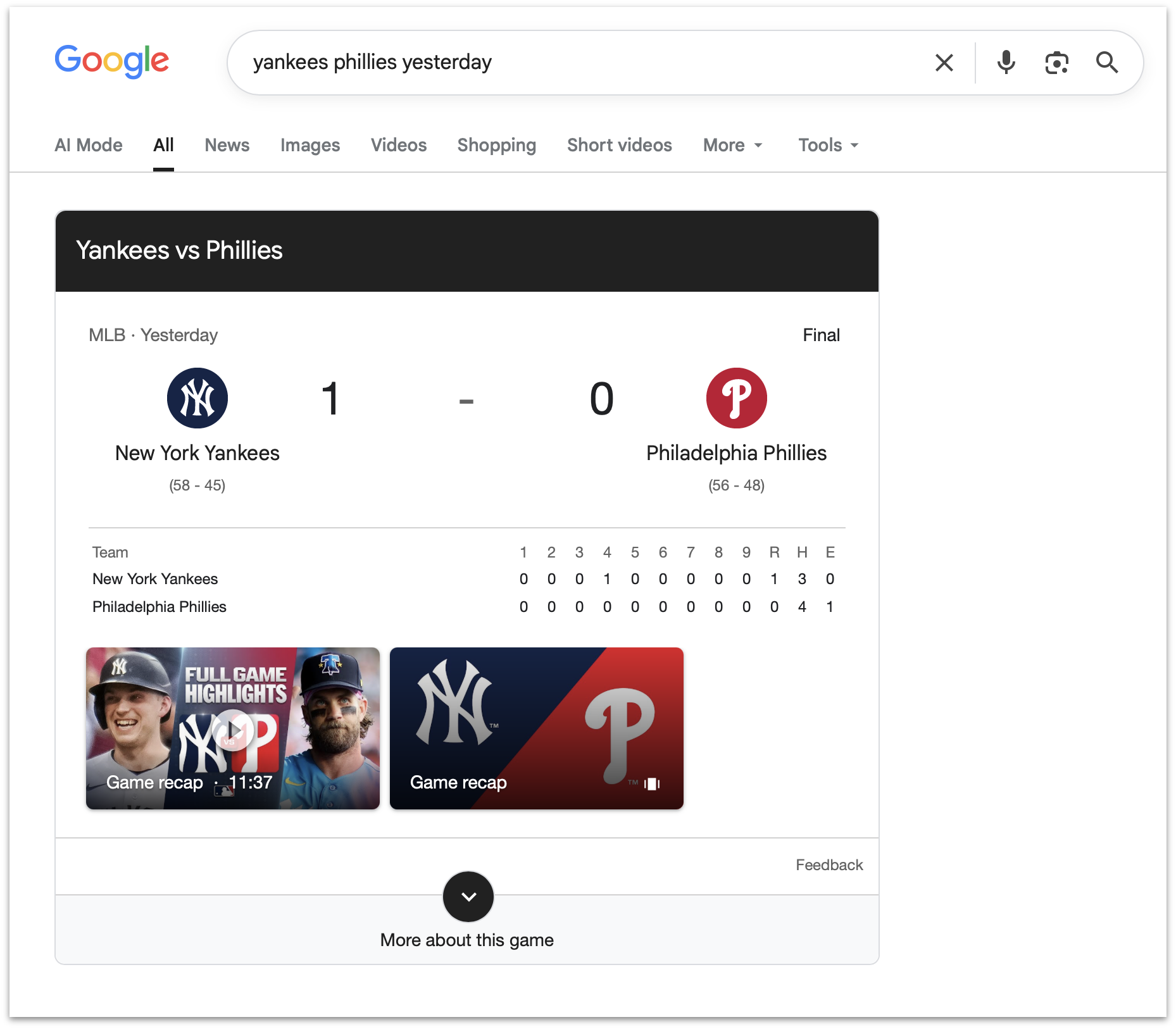
So if you search for the score of a sporting event, it’s illegal in the EU for Google to show you the score, like this search I just tried. What the EC is saying is that because Google Search is so popular, it’s no longer allowed to improve.

plantain:

It drives me insane when in Europe the link between Google Search and Google Maps is broken and I often have to copy paste an address between the two. Thanks EU, what if I like Google’s integrations?

phiresky:

They could have simply added a selector when a user first clicks on the maps preview in the search result, and then remembered it on device or across that user’s account.

But of course, then the user could choose a competitor’s product and Google would have to honor it. That would be horrible, so instead they just made the user experience worse for everyone and elegantly made people blame the EU.

See also: Hacker News.

  •  

Google Loses Final EU Antitrust Appeal

Ryan Whitwam (PDF, Reddit):

Back in 2018, Google was handed a record-setting 4.34 billion-euro ($4.9 billion) fine in Europe for abusing its monopoly on Android. The company has spent the intervening years challenging that decision, but the continent’s highest court has put a stop to that. The Court of Justice of the European Union has affirmed the penalty, meaning Google is out of options.

[…]

The EU took issue with Google search and Chrome being the default options on Android. Even devices made by other companies, such as Samsung and Xiaomi, include Google apps as the default per the Android licensing agreement, giving Google an unfair advantage, according to European antitrust regulators. This is not to be confused with a 2.95 billion euro ($3.45 billion) fine against Google’s advertising monopoly issued by the European Union last year.

Arjun Kharpal:

In 2022, a lower EU court reduced the fine to the current 4.1 billion euros from 4.34 billion euros previously.

Google has argued that the Android operating system provides choice for users and supports developers and businesses across Europe.

Via John Gruber:

Google last year booked $132 billion in profit; this fine is about 3 percent of that..

[…]

There’s never a reason not to string the appeal process out, but it’s especially true when your profits are growing at an exceptional rate. By growing their profits around 5×, they’ve reduced the relative sting of this fine by 5×

Previously:

  •  

EU fines Google €890m for competition breaches over search and apps

Firm told to treat third-party services that appear in its results in ‘fair and non-discriminatory manner’

Google has been fined a total of €890m (£760m) by the EU for breaches of online competition laws by its search and app store services.

The European Commission, the EU’s executive arm, said Google had broken the Digital Markets Act by giving priority to its own services, such as shopping and hotel deals, in search results over those of its rivals.

Continue reading...

© Photograph: Steve Marcus/Reuters

© Photograph: Steve Marcus/Reuters

© Photograph: Steve Marcus/Reuters

  •  

U.S. lawmakers urge President Trump to strike back against EU tech regulation with trade probes

President Donald Trump holds a signed executive order on tariffs, in the Rose Garden at the White House in Washington, D.C., April 2, 2025.

A group of 25 U.S. lawmakers has sent a letter to President Trump calling on his administration to confront the European Union’s digital regulations, which they describe as discriminatory policies aimed at American technology giants.

In the letter, obtained by Reuters, the Republican lawmakers – including key members of the House trade subcommittee – urged the president to consider launching Section 301 investigations under U.S. trade law. Such probes could pave the way for tariffs or other retaliatory measures against the EU if talks fail to resolve the issues.

The central target of the complaint is the EU’s Digital Markets Act (DMA), which designates major U.S. companies – including Amazon, Apple, Google, Meta, Microsoft, and Booking Holdings – as “gatekeepers” subject to strict behavioral rules. Lawmakers argue the rules unfairly burden American firms while sparing European and Chinese competitors.

Key concerns raised in the letter:

• Cloud services: The likely inclusion of Amazon Web Services and Microsoft’s cloud business under DMA oversight would impose “unprecedented regulatory burdens” not faced by European or Chinese rivals.

• Google fines: An expected European Commission fine against Google this week for alleged DMA violations ignores the company’s significant changes to its search services.

• Inconsistent enforcement: Apple, Meta, and Amazon have been labeled gatekeepers based on user numbers in Europe, while Chinese platforms like Temu and AliExpress have been excluded.

“We write to bring to your attention the many ways the EU continues to pursue anti-competitive acts, policies, and practices as a tool of economic extraction and regulatory coercion against American firms,” the letter states. It warns that EU access to the U.S. market “is not guaranteed” if the discriminatory practices continue.

The pressure on the issue predates Trump’s return to the White House. In October 2024, even before the election, Apple CEO Tim Cook personally called then-candidate Trump to voice concerns over EU fines and regulations affecting the company, including the Digital Markets Act and a major tax ruling. Trump later publicly referenced the call, signaling his willingness to push back against what he viewed as unfair European penalties on U.S. firms.

The European Commission has not yet responded to the letter. It maintains that its rules apply neutrally to promote fair competition and do not single out any country.

This latest congressional push aligns with President Trump’s long-standing criticism of EU digital policies and could signal a more aggressive U.S. trade posture toward Brussels in the coming months. Lawmakers emphasized that dialogue should be attempted first, but “all available tools” – including tariffs – remain on the table if needed.

The move highlights ongoing transatlantic tensions over technology regulation, data privacy, and market access that have persisted for years and are now poised to test the new Trump administration’s approach to international trade.

MacDailyNews Take: Good. The DMA does far more harm than good.

The European Union arose because the Europeans couldn’t compete on their own with the rest of the world, so they each lined up to surrender their national sovereignty, unique cultures, and dignity for an undemocratic, opaque, wasteful, bloated, bureaucratic quasi-governmental blob – and, even with the EU’s thumbs all over the scale, they still can’t compete. – MacDailyNews, March 4, 2024


‎
Please help support MacDailyNews — and enjoy subscriber-only articles, comments, chat, and more — by subscribing to our Substack: macdailynews.substack.com. Thank you!

Support MacDailyNews at no extra cost to you by using this link to shop at Amazon.

The post U.S. lawmakers urge President Trump to strike back against EU tech regulation with trade probes appeared first on MacDailyNews.

  •  

EU Exempts Apple Watch and AirPods From Battery Removal Requirement

Hartley Charlton:

The European Commission yesterday adopted new exemptions to its Batteries Regulation that free the Apple Watch and AirPods from having to offer user-removable and replaceable batteries.

[…]

The reasoning largely mirrors why devices like electric toothbrushes were already exempt: Opening a compact, sealed enclosure and failing to reseal it properly could let water in and create a safety risk. Products can also qualify for exemption if their construction makes battery removal inherently dangerous, or if there is no realistic way to build in user access given current manufacturing methods.

[…]

The iPhone was already exempt from the removability rule under the original regulation, thanks to its battery cycle life and water resistance rating.

Marcus Mendes:

Although the Commission has adopted the exemption, it must still undergo scrutiny by the European Parliament and the Council of the EU.

[…]

To read the European Commission’s full delegated act, follow this link.

Previously:

Update (2026-07-20): See also: Hacker News.

Update (2026-07-30): Rui Carmo:

This is one of those exceedingly rare cases where EU legislation has produced an unambiguously good outcome: from February 2027, Logitech’s European wireless devices will ship with hard-pack, user-replaceable batteries, and Logitech will sell certified replacements.

  •  

Apple Still Designated a Gatekeeper

Tim Hardwick:

Apple’s challenge against the EU’s designation of its App Stores and iOS platform as “gatekeepers” was dismissed by Europe’s top court on Wednesday, reports Reuters.

[…]

The company also disputed the classification of iMessage as a number-independent interpersonal communications service, or NIICS, which would subject the app to EU telecoms rules. But the General Court said Apple’s actions regarding the iMessage service are inadmissible.

William Gallagher:

Back in 2023, Apple acknowledged that it qualified under the then-new definition of being what the EU called a gatekeeper service. But key to that is the size of the operation, and since 2024, Apple has been claiming it runs five smaller App Stores rather than one large one.

[…]

“Irrespective of the devices in question,” ruled the judges, “those stores have the same purpose, namely to connect app developers with end users in order to facilitate the distribution of software applications.”

Steve Dent:

Apple disagreed with the decision but didn’t say yet if it would appeal. “We firmly believe the DMA’s mandate goes beyond what is lawful and proportionate, threatening to erode decades of privacy and security protections we’ve built and leaving our users vulnerable to new risks,” an Apple spokesperson said in a statement to multiple outlets. “We will continue advocating for the innovation and privacy our European customers deserve.”

Apple still has two cases pending with EU courts. The first is a challenge to the EU Commission’s decision last year forcing Apple to open iOS to third-party developers, and the second is an appeal against the €500 million fine imposed in April last year for anti-steering violations.

Previously:

  •  

Android AI Violates DMA

Ryan Whitham:

The issue before the commission currently is the built-in advantage for Gemini on Android. When you turn on any Google-powered Android phone, Gemini is already there and gets special treatment at the system level. The European Commission is taking aim at the lack of features available to third-party AI services. The commission believes that there are too many experiences on Android that only work with Google’s Gemini AI, and as a gatekeeper, Google must change that.

[…]

European regulators are proposing several broad changes to the way AI tools operate on Android phones. Some of this is straightforward, like allowing third-party AI tools to be invoked system-wide via hot words or button presses. This might also include allowing AI tools to view screen context when the user opens them.

[…]

Many of the Gemini AI features in Android, including Magic Cue, rely on running local models, and Google has been slow to allow third parties the system access to make that work effectively. So the EU is also suggesting a mandate that would ensure developers have the necessary hardware access to run local models “with high levels of performance, availability and responsiveness.”

Via John Gruber:

The difference between Google and Apple on this front is that Google just blazed ahead and shipped Gemini integrated into Android in the EU, and is now facing compliance problems after shipping. (Ask forgiveness.) Apple isn’t shipping Siri AI in the EU in iOS 27, knowing that it’s going to be deemed non-compliant. (Ask permission.)

Previously:

Update (2026-07-17): Juli Clover:

The European Commission today formally ordered Google to give third-party AI services the same access to Android device features that Gemini has.

[…]

The European Commission is giving Google a full year to implement changes that will meet the Digital Markets Act requirements, and that's before any legal appeals Google might make.

Google (via Ben Schoon):

This Android ruling threatens device security by granting external apps sensitive and powerful device permissions without these safeguards.

Update (2026-07-23): John Gruber (Mastodon):

They provide separate “Q&A” overviews of the guidance for Android AI interoperability and web search sharing, and the full guidance documents are PDFs (Case DMA.100220 for Android AI, Case DMA.100209 for web search).

[…]

The EC is demanding that Google create APIs that allow third-party AI assistants to do everything Google Gemini does now[…]

[…]

Also, in my reading, the EC is demanding that Google make available to third-party AI assistants all information in Google’s own apps (Gmail, Google Calendar, Google Docs, Google Maps, etc.) that Gemini has access to.

[…]

Apple unfortunately hasn’t shared any technical details describing its proposal for a “Trusted System Agent” that it shared with the EC last year. But whatever Apple’s vision for the Trusted System Agent is, I don’t see how the EC would deem it compliant with the DMA if they want from Apple anything close to what they are now demanding from Google.

I don’t know what will come of this, but I’m pleased to see it in the sense that it is logically coherent. The TSA seems like a way to give the appearance of doing something without actually solving the problem. Like Gruber, I don’t really see why Google would want to comply with this rather than taking their Gemini ball and going home. Unlike Gruber, I don’t find it scary to let users opt into sharing their data and background time with apps of their choosing. I don’t like software design by government committee, but it seems less bad than further entrenching an unfettered monopoly. Maybe this could have been avoided if Google had developed its own reasonable solution instead of shipping something that was obviously not compliant.

  •  

No Siri AI in EU

Apple (MacRumors):

Unfortunately, due to the Digital Markets Act (DMA), Apple will not be able to ship Siri AI in the European Union with the release of iOS 27 and iPadOS 27. Over the past several months, EU regulators did not accept any of Apple’s proposed solutions to bring Siri AI to the EU while safely supporting other virtual assistants.

[…]

EU users will be able to access Siri AI on macOS 27 and visionOS 27. Developers located in the EU will not be able to test or use the new Siri AI features for their apps on iOS 27, iPadOS 27, and watchOS 27.

[…]

According to EU regulators, the DMA requires Apple to give any AI system nearly unlimited access to a user’s device, as well as the ability to act on that access autonomously without a user’s ongoing visibility and control.

[…]

Apple designed a solution called Trusted System Agent — an intermediary that would allow virtual assistants to safely access the same features and capabilities as Siri AI for devices in the EU. Apple also shared a plan to launch Siri AI in the EU while gradually rolling out this new solution over an 18-month period. The European Commission said no. In fact, the European Commission did not agree to any of Apple’s proposals.

This phrasing is not very clear, perhaps intentionally so. Apple is trying to give the impression that it did all this extra work to meet the DMA’s requirements, and yet the EC rejected its proposals, so it’s their fault Siri AI isn’t shipping in the EU. But it looks like the crux is that the Trusted System Agent is currently vaporware. What the EC rejected is that Apple wanted to be able to ship Siri AI now on the promise of future openness. The TSA would actually be built during this 18-month window of exclusivity. It’s not surprising that the EU would reject that proposal. The App Store doesn’t approve apps that flout the guidelines but promise to comply later. It doesn’t even entertain proposals of the form, “If I built this would it be approved?”

European Commission (via Steve Troughton-Smith, Update: John Gruber, Mastodon):

So first, the decision not to roll out Siri AI in the EU is Apple’s and Apple’s only.

Because absolutely nothing in the DMA prohibits Apple from introducing new products in the EU.

What Apple is however not allowed to do, just like any other gatekeeper, is to close the market.

[…]

Apple simply made a request to the European Commission to be exempted from their interoperability obligations under the DA.

And this for at least 18 months on top of it. Guess what? That’s not an option.

Reuters (Hacker News):

Apple said it detailed its plans for Siri AI to EU regulators six months ago, along with a technical proposal to allow secure ​third-party access to that data.

“In essence, a commission that’s asking us to conduct a very risky experiment on many, ​many, many tens of millions of users,” Greg Joswiak, Apple’s marketing chief, told reporters, “and we only want to ship these capabilities when we can do so safely.”

The EU said not to ship it without the TSA, yet Joswiak spins this as the EU asking Apple to be reckless? And if Apple wanted to ship them safely, why did it stop working on them?

William Gallagher:

Apple spoke of having spent hundreds of thousands of engineering hours on changes to comply with the EU. In the new report, though, Apple now says that it no longer knows what to work on.

So currently none of its engineers are working on adapting Siri AI to meet the EU’s demands.

It seems like Apple isn’t taking this very seriously. They’re more interested in trying to score PR points by blaming the delay on the EC rather than on building something compliant. So I guess the EC was prescient not to grant an exemption based on the promise that they’d follow through with the TSA.

Kyle Howells:

However, do I think Apple should be made to open up that level of system access?

Honestly yes. They are worried about protecting my data. But it’s MINE. Me, the user.

Stick a big privacy prompt, maybe a system settings screen and reboot, but I want access to my data!

We can look to BrowserEngineKit to see how well it works out to introduce a trusted intermediate layer that Apple doesn’t itself rely on. And this seems like a much harder problem.

Kyle Howells:

Yeah, that privacy layer is a stupid [non] starter. “Find the place my friend said we should go swimming and give me directions”

The only way that query can work with an intermediary layer is if the AI asks that layer to do the searching for them and only gets the response back.

Except that basically kills the advantage of LLM agents & instead delegate all the ‘smart’ parts to some dumb on device model Apple makes.

Previously:

Update (2026-06-11): Amy Worrall:

I keep seeing people (usually Americans) confused by where the EU is coming from with Apple and the DMA, eg “how can they care about privacy but also demand AI companies can access your data?”

My read is, the EU’s starting point is that a gatekeeper cannot treat itself as inherently more trustworthy than any other company. So if anyone’s AI can access your data, including Apple’s, it’s not up to the gatekeeper to say “we trust ourselves but don’t trust other companies” and force that on users.

The users should get to choose who they trust. And I think Apple is trying to draw a different line than it says. It worries that AI could be hijacked to steal your passwords and photos. But you can already install apps that manage and access that data. You can also install apps that access your calendar and mail data, and these apps can incorporate AI. Such apps actually get more access than what the EC wants because they must communicate with your servers directly. I would rather let an AI search my downloaded e-mails than read/write to my IMAP server, but Apple is blocking that option. The actual line it’s drawing isn’t that AI can’t access your data but that (aside from iMessage) it can only access it via additional engineering work and additional hoops for users to enter credentials. It seems like what Apple really wants is to make it hard for anyone to compete with Siri.

Update (2026-06-12): Cory Birdsong:

I’m skeptical that Siri AI is even capable of being meaningfully private or secure. As far as I know there is no mitigation for prompt injection, as Matthew Green describes here.

If it has access to private information, is exposed to external input and can access the Internet then how can they meaningfully claim it’s private or secure?

John Gruber:

There’s a lot to unpack here, including more background information — and on-the-record statements — from a briefing Apple held Tuesday that I was invited to at Apple Park.

It’s frustrating that Apple has said so little on the record. They want to communicate that their “offers for compromise have been rejected,” but what exactly did they offer? Personally, I don’t think the TSA would be a very good solution because it would lock in both the limitations of Apple’s technology and their role as a gatekeeper. But Apple did not even say that the EC rejected the idea of the TSA, only that it rejected their proposal to violate the law for 18 months while building it.

But the bottom line is that Apple’s public statements regarding the DMA and the European Commission have never been this strident before.

[…]

Now, they’re a bit more on war footing. There’s a massive gulf between what Apple is willing to do with Siri AI in the EU and what the Commission is demanding from Apple for DMA compliance.

Steve Troughton-Smith:

The European Commission isn’t demanding anything, the law is demanding it. The laws have been in place for several years now, Apple is currently in default of the law on several fronts, and is fighting its existing fines.

When the Chinese government wanted access to user data, Apple complied, but when the EU parliament voted for their citizens to be able to choose how to share their own data, that put Apple on a “war footing.”

David Deller (Reddit):

There is some kind of irony in how Apple isn’t allowing Europe access to the new AI stuff; and meanwhile for the US, Apple is removing the setting for us to opt-out of it, effectively forcing it on us.

That’s how it is these days, huh? Either a government or a giant corporation makes our technology choices for us. We don’t get to choose for ourselves.

Previously:

Update (2026-06-17): John Gruber:

What exactly is the motivation for Apple and Google to engineer entirely separate systems for the EU to bring new features into compliance with the Commission’s broad interpretation of the DMA? Because if Apple doesn’t engineer a DMA-compliant version of Siri AI, iOS users in the EU will ... switch to Android, whose system-level AI was deemed noncompliant by the Commission a few months ago?

I briefly hoped that the DMA would lead to a sort of California effect for software, where products are designed for the stricter (more open, in this case) jurisdiction, and everyone else reaps the benefits, too, because that’s easier for companies than making separate versions of their products. But it turns out that Apple finds it well worth it to feature flag away the EU features it doesn’t want us to have, as well as the ones it doesn’t want to adapt for the DMA.

This doesn’t directly hurt Apple. It doesn’t force Apple to design, engineer, and ship a compliant EU-exclusive version of Siri AI that supports plug-and-play LLM back ends. It only hurts iPhone users who live in the EU, who are stuck with the old dumb version of Siri for the foreseeable future.

This demonstrates a market failure or legislative failure, depending on how you look at it. Both halves of the duopoly are in conflict with the law of the second largest economy in the word. Users will get a worse Siri, but this doesn’t bother Apple enough to do anything about it. Maybe the customers in the EU can be used as a bargaining chip. Neither Apple nor Google is worried that a competitor will come along with a compliant phone to challenge their dominance.

John Gruber:

Here we are two years later and I think the answer is more clear than ever which side of the continental divide is more fun.

Simon B. Støvring:

Gotta admit that as an EU citizen, I feel handicapped when it comes to brainstorming ideas to utilize Foundation Models.

Like, if I were to build a new app around them, it’s difficult to gauge if this is something Siri AI does out of the box when it isn’t available to me.

And unlike Apple, I intend to build software for the entire world.

Jack Wellborn:

Apple is acting out of greed and spite (see their hairbrained fee structures for alternative marketplaces as an example), but also yes, the DMA and enforcement thereof seems like a particularly difficult and capricious regulatory dynamic.

[…]

Those arguing that Apple is acting purely out of spite seem to suggest there is some obvious solution for iPhone Mirroring that would satisfy the interoperability mandate, but they never go into what that obvious solution is because they don’t know. They don’t know because I would guess no one does, not even Apple and certainly not the European Commission.

As far as I can tell, the European Commission doesn’t see it as their responsibility to help gatekeepers design features ahead of time in a way that should be compliant with the DMA. What they want instead is to decide whether or not a given feature runs afoul of the DMA after its released in the EU and presumably after they’ve gotten feedback from third parties.

Wojtek Pietrusiewicz:

If a developer emails Apple and asks if an app idea they have will be approved, they will get told to build it, submit it to the App Store, and see. The EU is the App Store here, and Siri AI is the app. I guess Apple don’t like their own policies.

I sympathize, even though Apple is in a better position than the developer, because it has more resources, because it would only potentially be blocked from shipping in one market, and because it can still sell its product in the EU, just with certain features disabled. Building something that might not be accepted is risky, but if you don’t submit anything that you think would be complaint with the rules, you don’t seem very serious. It’s still unclear to me exactly what Apple’s plan is. Its press release says it “will continue working” on bringing the features to the EU, but its SVP of marketing said in an interview that “none of its engineers are currently working on solutions.” Perhaps this implies that it’s banking on a legal or political solution rather than a technical one.

Update (2026-06-25): Jack Wellborn:

While the relationship between the European Commission and Google tells us nothing about playing ball, it tells us exactly how inconsequential support for alternative marketplaces is when it comes to regulatory scrutiny of integrated features. Apple hasn’t played ball with alternative marketplaces and now its new AI-based features are being withheld from the EU lest they get scrutinized for fines by the European Commission. Google hasn’t had to play ball with alternative marketplaces and now its new AI-based features are either being scrutinized for fines by the European Commission or being withheld lest they also get scrutinized. The European Commission is, rightly so in my opinion, regulating both operating systems equally and regardless of their support for alternative marketplaces.

Manton Reece:

It struck me today what a contrast this is with the rest of the AI world, increasingly connected via MCP. Imagine if Gmail was only accessible to AI on Android phones. If Teams was only accessible from a Windows Surface laptop. That is the kind of environment Apple’s policies create, with data locked into silos and monopolies free to leverage their existing strengths into dominance of new technologies too.

No thanks. Just as I should be able to sideload an app onto my own phone, I should be able to choose whether ChatGPT can access my iMessage history. The world is not going to come crashing down by giving users control of their own data.

Update (2026-07-02): Tim Hardwick:

Apple CEO Tim Cook held “constructive” talks with EU tech chief Henna Virkkunen on Tuesday about releasing Siri AI in the bloc while complying with the bloc’s digital rules, reports the Financial Times ($).

[…]

As for Apple’s proposed Trusted System Agent, a Commission official told the publication its contact with Apple on the idea was limited, and that it lacked a concrete proposal or details on how such an agent would work beyond the general concept. The official claimed Apple “focused on obtaining a green light to delay compliance.”

Update (2026-07-03): Nick Heer:

The DMA has been in effect for nearly four years and there is no reason why either party should be having so much difficulty with this proposal stage. Either the Commission is mischaracterizing Apple’s engagement, or Apple’s representatives need to be far better prepared.

It seems like Apple’s strategy is to encourage its customers to pressure the EU into changing the rules.

Previously:

  •  
❌