❌

Reading view

“Pluto Never Stops Surprising Us”: SwRI Scientists Find Evidence of Liquid Nitrogen on Pluto

A Southwest Research Institute (SwRI)-led research team has discovered evidence of liquid nitrogen rising to the surface of Pluto through cracks in the dwarf planet’s heart-shaped glacier, Sputnik Planitia.

According to the researchers behind the detection, the liquid nitrogen evidence captured by NASA’s New Horizons Spacecraft is the first evidence of any liquid flowing on Pluto. They also suggest that the discovery could help scientists better understand other solar system features such as the geysers on Neptune’s moon Triton.

New Horizons Mission Gave First Hint of Liquid Nitrogen on Pluto

When New Horizons captured images of Pluto’s surface between 2015 and 2016, it gathered extensive imagery of a massive surface feature called Sputnik Planitia. Larger than Texas and Oklahoma combined, the frozen nitrogen lake has long fascinated planetary scientists.

When examining the spacecraft’s photos, researchers spotted thin, dark, linear features separating the city-sized geologic convection cells on Sputnik Planitia’s northernmost portions. Critically, the thinner, separating features were more diffuse than the larger ones. Although some previous studies suggested that Pluto may have a liquid water ocean beneath its frozen outer shell, the surface temperatures would prevent any of that water from flowing on the surface long enough to cause the features.

Some theories proposed a liquid nitrogen explanation for the thinner features, even though the research team behind the discovery said that Pluto’s atmospheric and thermal conditions make liquid rain physically impossible. Still, the team notes, the surface patterns on Pluto’s northern Sputnik Planitia “have been darkened in ways that resemble glacial features on Earth that have been wetted by water rain or the subsurface emergence of liquids to the surface.”

To better understand the data, SwRI Associate Vice President and principal investigator on the New Horizons mission, Dr. Alan Stern, reexamined the data, focusing on similar features on Earth.

Sputnik Planitia Evidence “Very Similar” to Greenland Ice Sheet Features

To start, Dr. Stern and colleagues compared the New Horizons images with Earth imagery collected by NASA’s Landsat 9. The researchers focused on the Greenland Ice Sheet, since similar surface features caused by liquid water separating ice and snow have been previously observed.

When focusing on topography, the team said the two regions appeared “very similar.” This similarity suggested that subsurface liquids in the form of nitrogen were rising to the surface and wetting areas of Sputnik Planitia’s nitrogen ice.

liquid nitrogen on Pluto
Pluto’s northern Sputnik Planitia glacier (in the western or left side of Pluto’s brightheart) is shown here in a color mosaic made from New Horizons imagery. The direction of north is shown on the image. The image is ~ 700 x 350 kilometers across. The red box has been added to show most of the region containing dark features attributed to the wetting of the glacier by liquid nitrogen sourced from a “basal melting” process beneath the glacier. (2026). Image Credit: NASA/John Hopkins APL/Southwest Research Institute.

SwRI Principal Scientist Dr. Kelsi Singer, one of the study’s co-authors, said Sputnik Planitia’s surface is “quite young” in geological terms, with most estimates placing it at less than one million years. As a result, the dark, thin surface features must have formed during that short window of time.

“Pluto has many unique terrains seen nowhere else in the solar system, and this area of Sputnik Planitia is one of them,” Dr Singer explained. “Its surface provides a different set of conditions compared to what we are used to on Earth, and exploring that allows us to better understand how materials behave in environments that are difficult to produce on Earth.”

To support the visual evidence of liquid nitrogen on Pluto, Dr. Orkan Umurhan, a senior research scientist at the SETI Institute, oversaw the creation of computer models designed to simulate the dwarf planet’s local environment. According to the study authors, the models “show that nitrogen ice at the base of Pluto’s kilometers-deep Sputnik glacier can melt, forming liquid nitrogen.”

liquid nitrogen on Pluto similar to Greenland ice sheet
Dark, narrow surface features have been identified here in areas in Greenland where liquid water darkens the ice and snow in a manner analogous to what is now believed to perhaps be occurring on northern Sputnik Planitia on Pluto due to present or recent liquid nitrogen there. Image Credit: NASA/Johns Hopkins /Southwest Research Institute.

The same models also revealed that buoyancy and pressure from underneath can cause liquid nitrogen to migrate to Pluto’s surface via a series of small conduits that resemble lava or geyser tubes. Although the dwarf planet’s distance from the Sun makes it an extremely frigid environment, the models also suggested that once liquid nitrogen reaches Pluto’s surface, it can maintain liquid form long enough to flow down the nitrogen glacier slopes and cause the features seen in the images.

“Pluto Never Stops Surprising Us”

When discussing the significance of the findings, Dr. Umurhan pointed to the study’s  “tantalizing picture that it promotes,” including potentially motivating a further examination of solid-state nitrogen physics at very low temperatures.

“Specifically, it’s important to examine the physics taking place in solid nitrogen materials under stress and strain, which can cause them to melt,” the study author explained, adding that these processes “have never been studied in real detail in the laboratory.”

The SwRI-led team also noted that over half of Pluto remains unmapped in high resolution, meaning there is still a lot of room for future discoveries. This includes further mapping of the other Kuiper Belt planets “to determine if similar processes are occurring elsewhere in that region of the solar system.”

Finally, the SwRI-led team said the findings could offer some assistance in explaining other events across the solar system, such as the geysers observed by NASA’s Voyager 2 on Neptune’s moon Triton.

“Pluto never stops surprising us, and this new result certainly does that,” Stern concluded. “In addition to suggesting that liquids have recently expressed themselves on Pluto’s surface, it also suggests a new kind of time-variable feature on Pluto.”

The study “Evidence for possible N2 basal flow beneath Pluto’s northern Sputnik Planitia” was published in The Planetary Science Journal.

Christopher Plain is a Science Fiction and Fantasy novelist and has spent the last six years as Associate News Editor and Head Science Writer at The Debrief. Follow and connect with him on X, learn about his books at plainfiction.com, or email him at christopher@thedebrief.org
  •  

Scientists Add Unlikely New Member to World’s Carnivorous Plants

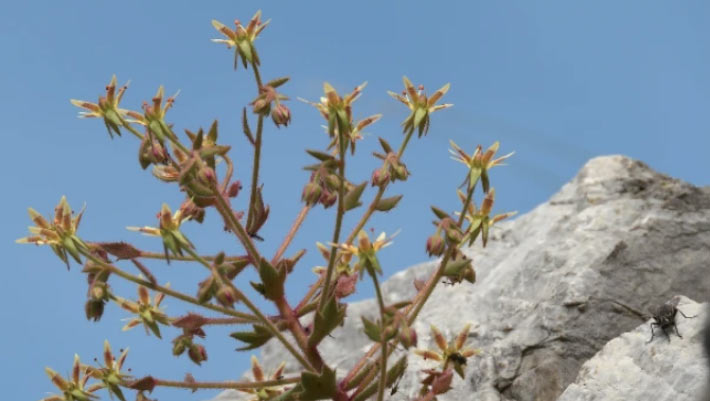
Morphology of Saxifraga candelabrum. Image credit: Zhang et al., doi: 10.1038/s41467-026-75288-y.

More than 150 years after Charles Darwin first wondered whether certain sticky-leaved Saxifraga plants might be secretly carnivorous, Kunming Institute of Botany researcher Tao Deng and colleagues say they have finally confirmed it.

The post Scientists Add Unlikely New Member to World’s Carnivorous Plants appeared first on Sci.News: Breaking Science News.

  •  

Viruses help plants obtain nitrogen

Nitrogen is an essential building block of proteins, amino acids, and DNA. Without nitrogen, cells can’t function or reproduce. Nitrogen is abundant in the atmosphere as dinitrogen gas, but plants and animals can’t access atmospheric nitrogen. Instead, we rely on biologically available forms like ammonia and nitrate. 

Specialized microbes can transform atmospheric nitrogen into ammonia via a process called biological nitrogen fixation. Nitrogen-fixing soil bacteria have a unique protein complex, the nitrogenase complex, that facilitates this nitrogen transformation. The nitrogenase complex is activated by a group of genes known as nif genes. 

Legume plants like peanuts, peas, and beans have nitrogen-fixing bacteria in the soil zone around their roots, called the rhizosphere. The symbiotic relationship between nitrogen-fixing soil bacteria and legume plants supplies most of the biologically available nitrogen to life on Earth.

Bacteria attached to plant roots “feed” nitrogen to plants through the soil, and in turn receive organic acids for energy from plants performing photosynthesis. Source: Wikimedia Commons

Bacteria attached to plant roots “feed” nitrogen to plants through the soil, and in turn receive organic acids for energy from plants performing photosynthesis. Source: Wikimedia Commons

However, one piece of the puzzle remains unexplored: the role of soil viruses in these nitrogen transformations, referred to as the nitrogen cycle. Viruses are microscopic particles made up of genetic material and proteins, but they can’t reproduce without a host cell. Scientists consider viruses to be biological entities that are halfway between living and non-living.

To reproduce, viruses contact a host cell and inject their genetic material into it. The virus’s genetic material takes over the host cell’s genome and forces the cell to produce proteins that assemble into new viruses. As new viruses are created, they can incorporate genes from the host cell into their own genetic material. Genes that are transferred from a host cell to a virus are known as auxiliary metabolic genes (AMGs). Viruses can carry AMGs and pass them to other hosts or use them to increase their own ecological fitness. 

Scientists from China, Spain, and the Czech Republic set out to investigate whether viruses from legume roots could increase local soil nitrogen fixation by expressing nif AMGs or by transferring nif genes to other bacteria. First, they determined the global distribution of viral nitrogen-fixing genes by analyzing about 8.6 million viral genomes from the Integrated Microbial Genomes/Virus database. They looked for the DNA sequences of known nitrogen-fixing genes and the locations where the viruses were sampled. They found that only 0.003% of the viruses in the database had at least 1 nitrogen-fixing gene, but they clustered in the same locations as nitrogen-fixing bacteria. 

The team also found 3 types of viruses that most commonly carried nitrogen-fixing genes: Kyanoviridae, Nudiviridae, and Bronfenbrennervirinae. Kyanoviridae viruses carried a nif gene called nifU. The researchers used a computer program called DRAM-v to confirm that nifU was a fully functional gene and a real tool that viruses could use. 

Next, the team collected soil samples from a cowpea field in Nanjing, China, to test whether the cowpea roots influenced the abundance of viruses using nitrogen-fixing genes. They collected soil from the cowpea rhizospheres and soil away from the plants. They analyzed both viral and bacterial RNA in the soil samples to identify active genes, using a sequencing process called metatranscriptomics. They found that the viral nifU gene was actively expressed in the cowpea rhizosphere samples more than in the non-crop soil. Although about 96% of nifU genes were being expressed by bacteria, viruses contributed about 4%. 

The researchers then assessed whether rhizospheric viruses changed the amount of nitrogen being fixed in these soils. They set up small, enclosed containers of sterile soil and added either bacteria or a mixture of bacteria and viruses extracted from the cowpea rhizospheres. They found that soil with viruses had higher total nitrogen (36 milligrams per kilogram, or mg/kg) than soil without viruses (17 mg/kg). 

Finally, they adjusted the air in each container to have a different form of dinitrogen gas. Atoms of the same element that have different atomic masses are known as isotopes. Nitrogen has 2 stable isotopes: lighter nitrogen-14 and heavier nitrogen-15. Bacteria or viruses that fix nitrogen at natural isotope abundances will take up nitrogen-14. But scientists can track who in the population fixes nitrogen by adding nitrogen-15 to the air, a process called nitrogen-15 stable isotope probing. Nitrogen-fixers will incorporate the heavy nitrogen-15 into their biomass over time and increase their weight, allowing researchers to separate and identify them.

The team grew the bacteria and viruses with nitrogen-15 for 35 days, then used stable isotope probing to separate the nitrogen fixers. They detected viral nifU AMGs among the heavier biomass, confirming that rhizospheric viruses were fixing nitrogen. 

The team concluded that rhizospheric viruses and the viral nifU AMG can increase nitrogen fixation in cowpea soils. The team suggested that although viruses with nitrogen-fixing genes are rare, they can influence the soil nitrogen cycle. They recommended that future researchers further test the contribution of viral nifU genes to plant nitrogen fixation with controlled infection experiments.

The post Viruses help plants obtain nitrogen appeared first on Sciworthy.

  •  

Interstellar Comet 3I/ATLAS Formed Up To 12 Billion Years Ago, New Observations Suggest

Hubble captured this image of 3I/ATLAS on July 21, 2025, when the comet was 446 million km (277 million miles) from Earth. Image credit: NASA / ESA / David Jewitt, UCLA / Joseph DePasquale, STScI.

The interstellar comet 3I/ATLAS carries a chemical fingerprint unlike anything in our Solar System, and it may have formed 10 to 12 billion years ago, before our Sun even existed, according to two papers published in the journal Nature.

The post Interstellar Comet 3I/ATLAS Formed Up To 12 Billion Years Ago, New Observations Suggest appeared first on Sci.News: Breaking Science News.

  •  
❌