The Soviet Luna program, designed for lunar research and mission planning, ran from 1959 to 1976. On Aug. 9, 1976, Luna 24, the final mission of the program, launched from the Baikonur Cosmodrome in present-day Kazakhstan. The probe landed on the Moon’s surface nine days later, in the Mare Crisium (Sea of Crises), a previouslyContinue reading "Aug. 9, 1976: Luna 24 blasts off"
Lasers are no longer required to produce quantum entanglement, physicists say, after achieving the state using sunlight. In a laboratory experiment, an international team of researchers demonstrated that natural sunlight can produce quantum-entangled photon pairs.
The researchers recently published their quantum entanglement study in Optica, showing that lasers aren’t the only game in town. The work could herald a new energy-efficient approach to sustainable quantum technologies, both on Earth and in space.
Quantum Entanglement
Quantum technologies such as computing, communications, and sensing rely on the strange principles of quantum mechanics, which often defy explanations rooted in classical physics. Typically, quantum technologies use lasers to convert photons inside a nonlinear crystal into entangled pairs through a process called spontaneous parametric down-conversion (SPDC).
Prior to this work, using sunlight to produce quantum entanglement in photons was largely considered impractical. Researchers had assumed that SPDC depended heavily on phase-stable electromagnetic fields, requiring the high coherence of laser beams. Scientists also believed that the intense power of lasers was crucial to the nonlinear processes that produce entanglement. By contrast, sunlight’s relative weakness and incoherence left it largely overlooked as a viable source for generating entangled photons.
Reconsidering Coherence
Earlier work may have dismissed sunlight too readily because scientists had not fully considered the different dimensions of coherence. Across different parameters, sunlight can exhibit varying degrees of coherence. This means that while a beam of sunlight may be coherent in a particular property, such as polarization, it can still generate quantum entanglement along that parameter.
“As long as the pump beam is perfectly polarized, its spatial or temporal incoherence should not preclude the generation of polarization entanglement,” said lead author Cheng Li in a statement.
“The trick to harnessing sunlight is to keep different degrees of freedom of light from influencing each other during the process,” Li added. “This means that sunlight is perfectly capable of generating entangled photons, as long as one can concentrate enough sunlight into a nonlinear crystal to induce SPDC.”
Directing Sunlight
In a natural environment, sunlight spreads across a broad area rather than remaining tightly focused like a laser beam. Efficiently directing it through a nonlinear optical crystal, only a few millimeters wide, therefore presents a significant challenge.
To overcome this obstacle, the researchers constructed a sunlight concentration system that collects light across a 1.4-square-meter surface and focuses it down to approximately the width of a human hair. The specialized solar concentrator is conical rather than flat and is constructed from glass. As sunlight reflects repeatedly across the interior surface on its way toward the cone’s tip, it becomes progressively concentrated and intensified before traveling through a single optical fiber to drive the SPDC process that generates quantum entanglement.
Quantum Entanglement Results
In laboratory tests, the researchers found that their sunlight-driven SPDC system produced performance comparable to that of a laser, achieving 94% fidelity. The efficiency of the entanglement process was also similar to that achieved with laser-based systems. Together, these findings challenge previous assumptions that SPDC requires highly coherent laser light to operate effectively.
The approach also eliminates the need to first convert electrical energy into optical energy, potentially reducing system complexity, heat generation, and points of failure.
“Sunlight is an abundant and reliable resource in many environments, especially in space. Being able to generate quantum-entangled photons directly from sunlight could enable simpler and more resilient quantum systems for satellites and future deep-space missions,” said Hanieh Fattahi, the study’s co-author, in a statement.
“We believe this work can inspire much new research in nonlinear and quantum optics,” Fattahi said, adding that this research “may in turn make sunlight-driven quantum technology more practical.”
Ryan Whalen covers science and technology for The Debrief. He holds an MA in History and a Master of Library and Information Science with a certificate in Data Science. He can be contacted at ryan@thedebrief.org.
The iPhone X is a testament to device longevity, and durability. I gave mine to a family member when upgrading to an Xs Max in Late 2018, who held onto it all these years through a few different protective cases. Today I got it back where it’ll remain in my collection, after they upgraded to […]
Scientists from the Beijing Institute of Technology have revealed a colloidal quantum dot (CQD)-based infrared-to-visible upconverter that transforms the infrared spectrum into full color, allowing people to ‘see’ the infrared in the visible light spectrum.
The research team behind the novel invention said their upconverter can be used in eyeglasses to improve human vision and for augmented reality (AR) applications. They also reported a successful implantation of an upconverter in mice, opening the possibility of an implantable photoreceptor to repair or improve vision in human eyes.
Attempts to Convert Infrared to Full Color Face Limitations
In a published study detailing the novel, full-color IR glasses, the human eye is “inherently blind” to infrared radiation. Although IR radiation interacts with the retina, infrared wavelengths lack the energy to trigger the photoisomerization of the retinal chromophore that lets people distinguish colors. As a result, humans don’t have visual access to over half of the solar spectrum.
Still, the researchers write, “harnessing this imperceptible radiation is critical, as infrared perception unlocks a vast reservoir of inaccessible information.” For example, this added visual information enables critical functions in other animals, such as navigation in darkness or detecting predators and prey from their heat. Still, they observe that our natural visual-light spectrum vision is “utterly inadequate” to access this information that so many animals rely upon.
In their study, the researchers highlight recent advances in accessing the IR spectrum, including “ocular injectable photoreceptor-binding upconversion nanoparticles” that convert infrared light into visible emissions. Other studies have also evaluated wearable lenses with nonlinear upconversion projecting infrared-transformed visible light onto the cornea and photovoltaic nanowire networks.
Although these approaches achieved some IR sensitivity, the study authors said they remain “fundamentally constrained” to narrow near-infrared (NIR) spectral response. These prior efforts also relied on high-intensity laser excitation that the team notes is “incompatible with natural infrared radiation.” The result is a “mostly monochromatic output” lacking infrared spectral discrimination in full color.
Subtle IR Wavelength Variations Facilitate Upconversion
For their new approach, the research team investigated a mercury telluride (HgTe) CQD-based infrared-to-visible upconverter. They note that this material combination leverages the material’s “quantized energy level states” in synergy with a separate, dual-emissive-layer organic light-emitting diode (OLED).
Specifically, the engineered layers captured IR photons in strategically engineered hole-trapping barriers. The team explains that this “allows for subtle differentiation of infrared input by tuning the emitted visible color and luminance” based on infrared wavelength and intensity.
Above: The infrared-to-full-color upconverter is applied as (A) the wearable eyeglass and (B) the new-generation retinal photoreceptor (Image credit: Fu, C., Zou, J., Yang, X., Hao, Q., Tang, X., & Mu, G. (2026). Multispectral infrared-to-full-color upconversion expanding human vision).
“This upconversion yields a discrimination sensitivity to subtle infrared variations exceeding two orders of magnitude higher than conventional single-color modes, capitalizing on the human eye’s intrinsic superiority in chromatic differentiation over simple luminance contrast,” they explain.
To test their material’s IR upconversion ability, the researchers designed a pair of lightweight (23 grams) semi-transparent wearable eyeglasses. The team said these tests were a success, achieving “high-resolution infrared imaging” derived from the infrared spectral information. However, instead of monochrome, the research team said that data is displayed as full-color visible patterns directly onto the retina, “enabling intuitive infrared vision without obstructing natural sight.”
Surpassing the Evolutionary Boundaries of Biological Photoreception
Although the current version of the full-color, infrared-capable glasses is still in the development stages, the team said the technology could lead to advancements in visual prosthetics, augmented reality (AR), and “navigation under environmental conditions where normal sight is degraded.”
Following the successful validation in mice, the team said their technology could also serve as the technological basis for an implantable new-generation retinal photoreceptor. In that design, the team said an implanted device could transform infrared light into visible light emissions “that stimulate light-sensitive proteins on retinal neurons to bypass damaged photoreceptor cells and potentially restore visual function across both the visible and infrared spectra.”
“By surpassing the evolutionary boundaries of biological photoreception, this technology paves the way for next-generation visual prosthetics, high-fidelity augmented reality, molecularly sensitive substance identification, and robust navigation in degraded visual environments,” they conclude.
Christopher Plain is a Science Fiction and Fantasy novelist and has spent the last six years as Associate News Editor and Head Science Writer at The Debrief. Follow and connect with him on X, learn about his books at plainfiction.com, or email him at christopher@thedebrief.org
NASA launched its Mars rover Curiosity inside the Mars Science Laboratory (MSL) on Nov. 26, 2011. Complete with 10 science instruments and 17 cameras, the robot can analyze mineral types, search for signs of microbial life, and take color panoramas of the Red Planet’s surface. Curiosity’s landing on Mars was a new process, nicknamed theContinue reading "Aug. 6, 2012: Curiosity lands on Mars"
You heard that right, an entire GPU crammed into a compact PCMCIA card. What looks like an unassuming adapter for PowerBooks and PCs to hook up an external monitor, turns out to have an entire Trident Cyberblade XP2 chip crammed in there. Featuring many supported resolutions including up to 2048 x 1280 @60Hz […]
The speed of laserlight is due for a major upgrade after an international collaboration of scientists has developed a breakthrough nanomaterial. The new metasurface can steer and shape light beams at unprecedented speeds of just 74 quadrillionths of a second.
Scientists at UC Berkeley and Tel Aviv University revealed their new optical surface, developed in a Caltech lab, in a recent paper published in Nature Nanotechnology.
According to the team behind the breakthrough, their work will have ramifications for communications, sensing, imaging, and even quantum technologies, providing a new benchmark for “high-speed” light manipulation.
Light Control
Since the fiber-optic advancements of the 1980s, lasers and light pulses have underpinned some of our most crucial cutting-edge technologies. Advanced computers, communications systems, sensors, and even the elusive quantum systems all rely on controlling light.
While the speed of light is so incredibly fast that physicists consider it a constraint on the maximum speed that matter can travel through the vacuum of space, the speed at which our technology reacts to it is far slower.
The scientists’ breakthrough metasurface contains silicon structures even smaller than the wavelength of light, resulting in an ultra-thin surface. Silicon’s optical properties change upon bombardment with laser pulses, a property that the team strongly enhanced with their nanostructure design. In their design, the properties of the material are modified via light pulses, which alter how the material influences a second beam of light impacting its surface. Notably, their metasurface allows for control of a beam of light without any moving parts, such as mirrors or lenses.
Real World Results
The team conducted laboratory tests in which they manipulated light beams by up to 13 degrees and reshaped them into different patterns.
“The key idea was to create a metasurface whose optical response is not fixed once it is fabricated,” said lead author Dr. Claudio Hail. “By changing the illumination pattern, we can reconfigure how the device steers and shapes light, and do so on an ultrafast timescale.”
“For me, the most exciting aspect is seeing an idea that had been with us for years become an experimental reality,” said co-author Dr. Lior Michaeli. “The ultrafast effect we wanted to use is naturally very weak. We had to design the metasurface so that it would amplify the effect enough not only to measure it, but to use it to steer and shape light.”
While the metasurface produced record-breaking speeds under laboratory observations, exactly how fast it can operate remains uncertain. The researchers note that the switching time and the duration of the laser pulse were extremely close, which indicates that quicker pulses could push the optical surface’s speed even higher.
The Future of Light Technologies
One of the major potential advances that could come from this new metasurface includes systems that carry information primarily with light, end-to-end. Current communications systems use light to transmit messages, but those messages are converted into electrical signals for processing. By increasing the speed at which light can be manipulated, this would reduce the necessity to convert light signals into electrical ones, removing unnecessary actions in computing.
“This work points to a broader opportunity: using engineered structures to strengthen interactions between light and matter and turn them into tools for control, sensing, and information processing,” Dr. Michaeli said. “This is closely connected to research directions we are now pursuing at Tel Aviv University.”
Despite its promise, the work is still in the fundamental phase. Although not yet ready for practical use, the metasurface offers promise in future ultra-fast computing applications, where it may soon help to cut out the middleman of electronic conversion.
Ryan Whalen covers science and technology for The Debrief. He holds an MA in History and a Master of Library and Information Science with a certificate in Data Science. He can be contacted at ryan@thedebrief.org.
Earlier this year Low End Mac covered a brand-new browser for PowerPC Macs called PowerFox, testing it out on a few machines as well as a VM. On July 14th 2026 Jazzzny released a new update for PowerFox, which feels noticeably improved from the last time this browser was covered. PowerFox also gains […]
Se você gosta de acompanhar o mundo da aviação, então vale a pena conferir o app Overflight, o qual oferece uma visualização no estilo radar de todo o céu visível, com o diferencial de exibir com destaque a aeronave que está passando acima de você. É possível deslizar a tela para focar em qualquer outra aeronave e, quando o céu está tranquilo, o app permanece em estado de espera até a próxima ocorrência.
O aplicativo, é claro, também exibe detalhes como informações sobre a companhia aérea, o número do voo e o tipo de aeronave, bem como altitude, velocidade vertical, velocidade em relação ao solo, trajetória, rumo e distância.
Ele ainda pode mostrar, com destaque, o tráfego militar e de interesse especial assim que eles entram no céu. Vale notar, porém, que nem todas as aeronaves transmitem sua posição (alguns voos militares operam sem transmissão).
Na versão Pro, é possível conferir rotas em tempo real (da origem ao destino), ouvir anúncios de tráfego por voz, receber alertas de aproximação de aeronaves e ativar um modo “sempre ligado” para exibição ambiente contínua — ideal para a Apple TV, cuja versão foi recém-lançada.
O Overflight utiliza dados ADS-B gratuitos fornecidos por usuários e não requer a criação de conta ou cadastro. Além disso, sua localização é usada apenas para identificar as aeronaves acima de você.
O app está disponível gratuitamente na App Store para iPhone, iPad e Apple TV. A versão Pro, por sua vez, custa R$25/mês, R$130/ano ou a partir de uma licença vitalícia por R$500.
Thought your older Intel Macs running on Lion all the way up through Mojave could no longer have a modern, functional web browser? Named after the “red leaves of autumn” in Japanese and based off of FireFox 140 ESR from June 2025, it’s quite an upgrade. It is a fork/successor to the FireFox-dynasty […]
A cada atualização anual do macOS, uma escolha da Apple em particular gera quase tanta curiosidade quanto as mudanças e os novos recursos do seu sistema operacional: o nome que acompanhará o update.
Hoje, faremos uma breve recapitulação das principais escolhas da Maçã sobre os nomes de cada versão do sistema operacional dos seus computadores, passando por décadas de codinomes felinos e, mais recentemente, paisagens californianas.
As (várias) mudanças do passado
Antes disso — no período do Mac OS Classic, que abrange os sistemas dos Macintoshes lançados entre 1984 e 2001 —, os nomes dos sistemas da Apple eram usados quase exclusivamente de forma interna. Publicamente, as versões recebiam denominações bastante protocolares, mas, nos bastidores, praticamente todas carregavam codinomes.
O System 6, por exemplo, teve versões conhecidas internamente como Antares (6.04), Big Deal (6.05), SixPack (6.06) e Terminator (6.08). Já o System 7 passou por uma verdadeira coleção de nomes, incluindo Blue, Beta Cheese, Cube-E, I Tripoli, Jirocho, Mozart, Capone, Danook, Thag e Marconi, entre outros. Também houve casos específicos, como Road Warrior, utilizado nos primeiros PowerBooks, além de Unity, Buster, Son of Buster, Harmony e Ides of Buster, empregados em versões posteriores do sistema.
A partir do Mac OS 8, os nomes foram predominantemente relacionados à teoria musical — é o caso do codinome Tempo no Mac OS 8, Allegro no Mac OS 8.5 e Sonata no Mac OS 8.7 (versão de desenvolvimento do que viria a ser o Mac OS 9). As exceções são o Mac OS 8.1 (intitulado Bride of Buster) e o Mac OS 8.6 (Veronica).
Essa só se tornou uma tradição marqueteira a partir do Mac OS X 10.2, quando Steve Jobs apresentou a nova versão do sistema operacional como Mac OS X Jaguar, levando um codinome ao público pela primeira vez — antes do Jaguar, a Apple utilizou os codinomes Kodiak para a versão beta, Cheetah para a 10.0 e Puma para a 10.1 —, inaugurando a era de nomes de grandes felinos.
Os animais ditaram os sistemas dos Macs por cerca de dez anos (de 2002 até 2012): foi o caso do Mac OS X 10.3 Panther, Mac OS X 10.4 Tiger, Mac OS X 10.5 Leopard, Mac OS X 10.6 Snow Leopard, Mac OS X 10.7 Lion e, por fim, OS X Mountain Lion 10.8 — que abandonou (temporariamente) o prefixo “Mac”.
OS X Mavericks 10.9: a alteração de rota rumo à Califórnia
A partir da décima versão do macOS (então OS X), a Apple adotou publicamente nomes com as regiões da Califórnia, tendência que segue em vigor até os dias de hoje.
A troca, aliás, andou em paralelo a uma mudança paradigmática do sistema: foi somente com o OS X Mavericks 10.9 que a Maçã deixou de cobrar pela atualização dos seus sistemas operacionais, permitindo que os seus usuários, a partir do Snow Leopard (na compilação 10.6.8), atualizassem as suas máquinas sem custos adicionais — uma realidade que permanece até os dias de hoje.
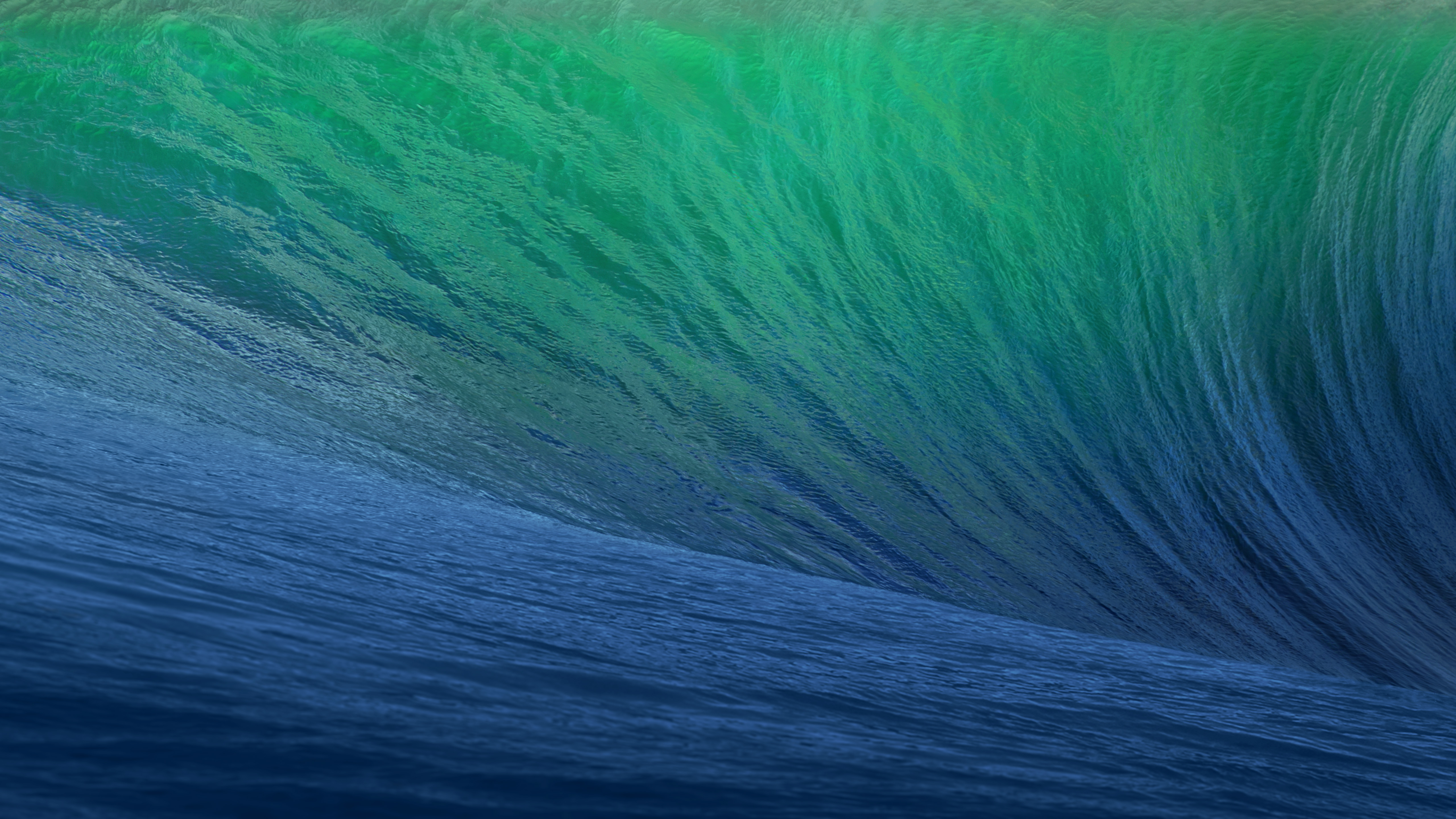
O primeiro destino geográfico escolhido pela Apple remete a uma região litorânea conhecida pelas altas ondas, propícias para a cena local do surfe. O papel de parede do OS X 10.9 dava destaque à curvatura de uma grande onda em tons de azul e turquesa, com clara inspiração na localização que deu nome ao update.
Em matéria de software, o OS X Mavericks ficou marcado pelo aprimoramento na gestão de performance, bateria e memória, aproveitando melhor o hardware dos computadores da Apple. Quanto aos recursos, o sistema trouxe os links compartilhados no Safari, respostas embutidas em notificações, abas e tags no Finder, melhor suporte ao uso de múltiplos monitores, além da introdução de novos aplicativos, como o Mapas e iBooks.
OS X Yosemite 10.10
Pouco mais de quatro horas adiante (ou 314km, para ser mais exato), encontramos o Parque Nacional de Yosemite. A área já era considerada tão importante para a preservação ambiental que Abraham Lincoln autorizou sua proteção e uso público em 1864, anos antes da criação de Yellowstone, reconhecido como o primeiro parque nacional do mundo. Outro grande entusiasta de Yosemite foi Theodore Roosevelt, que ajudou a consolidar a sua importância dentro do sistema de parques americanos.
Um dos maiores símbolos do parque — e também o destaque do wallpaper oficial do sistema — é o Half Dome, um monólito de granito com impressionantes 2.696 metros de altitude. Localizada no coração de Yosemite, a formação foi considerada inescalável por alguns geólogos do século XIX, até que George G. Anderson realizou a façanha em 1875, escalando-a descalço. Muito possivelmente, a foto usada pela Apple foi registrada com uma lente teleobjetiva nas proximidades da Ahwahnee Meadow.
O OS X Yosemite 10.10 foi um marco importante na trajetória do macOS. Muito lembrado pelas mudanças de design na interface — com elementos translúcidos e ícones de formas planas que definiriam a identidade visual do sistema por várias gerações —, ele também deixou como legado a introdução dos recursos de Continuidade (Continuity) entre o OS X e o iOS.
Inicialmente, a novidade englobava apenas o AirDrop, as chamadas telefônicas, o app Mensagens, o Handoff e o Instant Hotspot. Ainda assim, ela inaugurou um nível de interoperabilidade que ajudou a redefinir a forma como o mercado de tecnologia passou a enxergar ecossistemas compostos por diferentes produtos de uma mesma marca.
OS X El Capitan 10.11
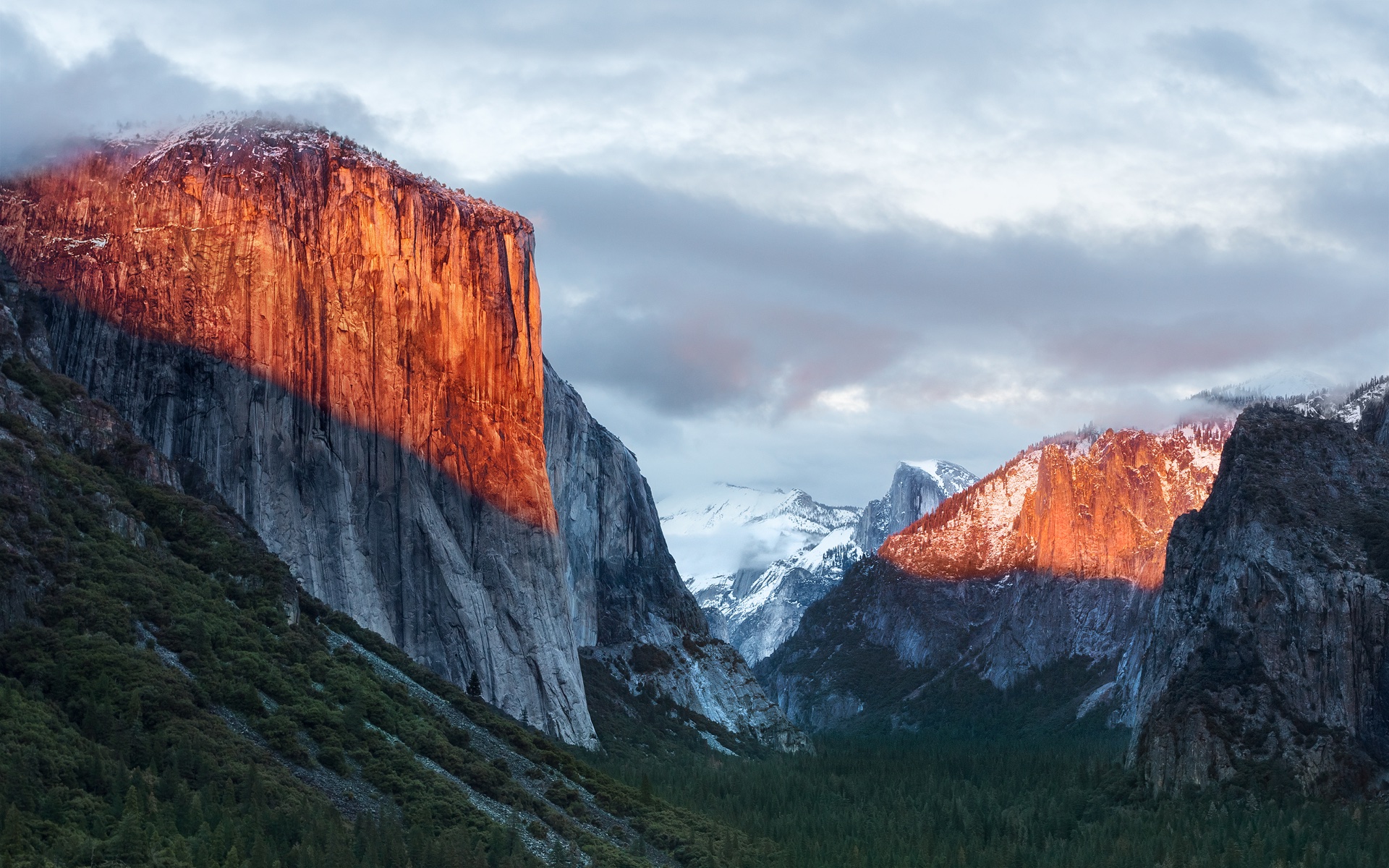
A apenas 20 minutos de distância do Ahwahnee Meadow, a próxima parada do Mac é outra atração turística presente dentro do Parque Nacional de Yosemite: o El Capitan é um monólito de granito de quase 900 metros que se ergue acima do vale do parque.
O papel de parede provavelmente foi fotografado a partir do mirante Tunnel View, de onde é possível avistar o El Capitan à esquerda do vale. Ao fundo, surge o Half Dome — um enquadramento que parece refletir o espírito da atualização. Diferentemente de Yosemite, o OS X El Capitan 10.11 deu menos ênfase à introdução de novos recursos e concentrou seus esforços em correções de bugs, otimizações de desempenho e refinamentos da experiência de uso. Entre as principais novidades, estavam um Spotlight aprimorado, a adição do Split View e diversas melhorias nos aplicativos nativos da Apple.
macOS Sierra 10.12
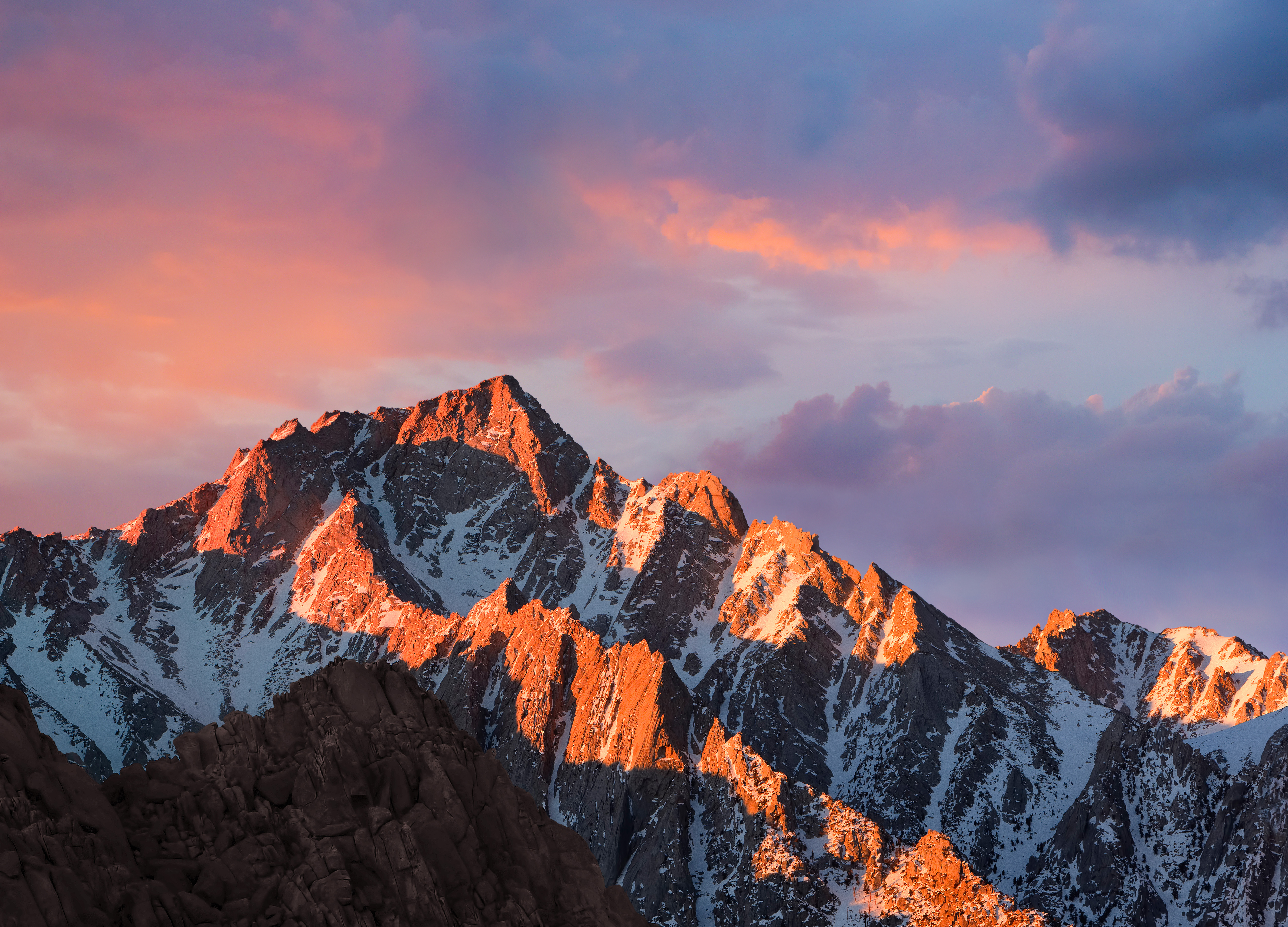
Cerca de 338km depois (aproximadamente quatro horas e meia) de Yosemite, passando pela cordilheira de Sierra Nevada (situada no leste da Califórnia, a oeste do Mount Whitney), temos o Lone Pine Peak, cenário da montanha que aparece no wallpaper do sistema.
Além da mudança de nomenclatura de OS X para macOS (colado e com o “m” minúsculo, como segue até os dias de hoje), a atualização é particularmente lembrada pela inclusão da Siri no Mac, o Desbloqueio Automático (Auto Unlock) com o Apple Watch e a Área de Transferência Universal (Universal Clipboard) entre Macs, iPhones e iPads.
macOS High Sierra 10.13
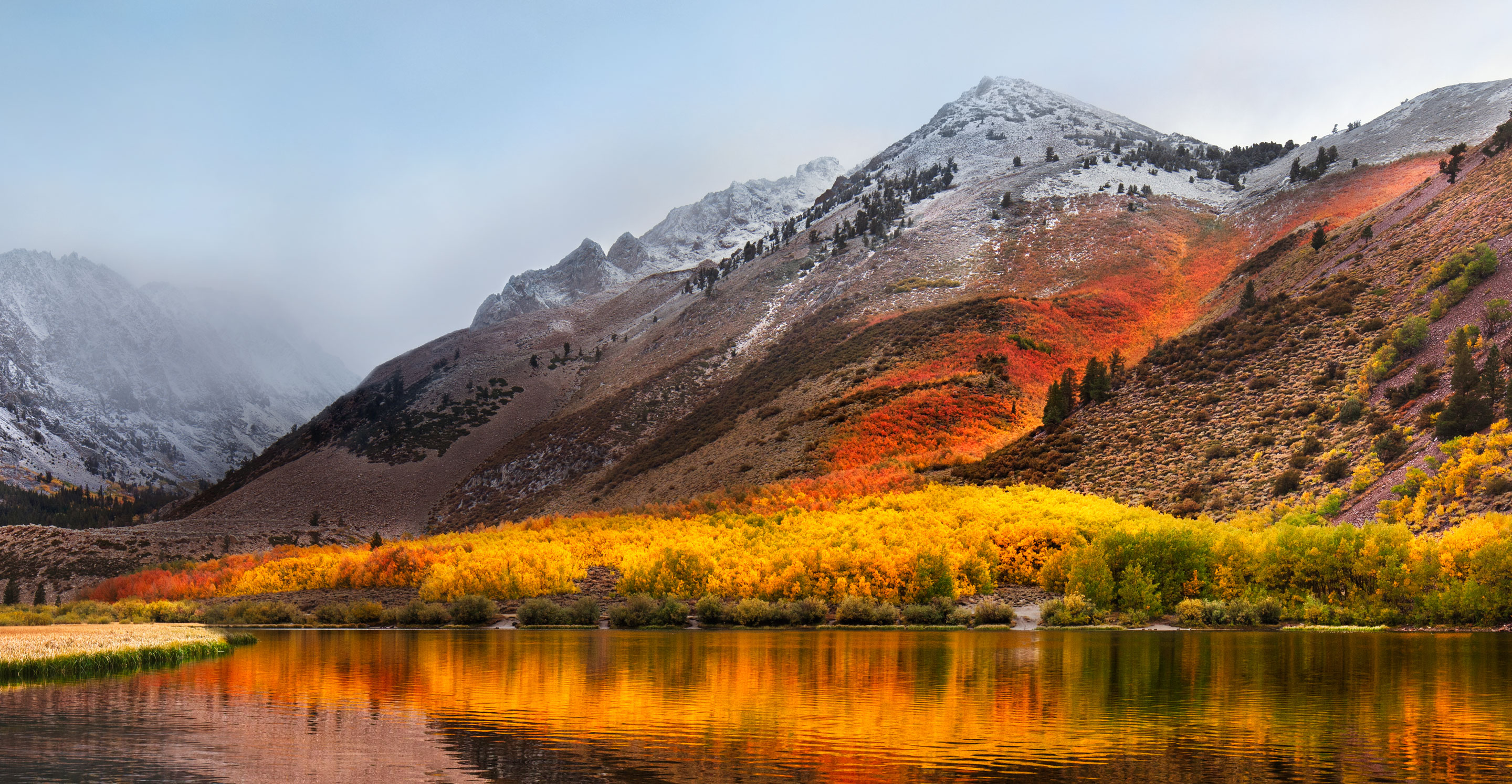
Uma rápida viagem de 80 minutos (129km) é capaz de nos levar ao próximo destino fotografado pela Apple: North Lake, localizada na pequena cidade de Bishop, entre as montanhas da cordilheira de Sierra Nevada. Ali, muito possivelmente em meio ao outono, o registro eternizado no papel de parede do sistema foi feito.
Quando falamos do sistema, aos moldes do próprio El Capitan e do Snow Leopard, o macOS High Sierra 10.13 focou muito mais no aprimoramento interno do macOS do que em novos recursos, mas vale mencionar a inclusão do novo sistema de arquivos da Maçã (o Apple File System, ou APFS), do suporte aos formatos audiovisuais HEVC e HEIF, bem como a chegada da segunda geração da tecnologia de desempenho gráfico Metal.
macOS Mojave 10.14
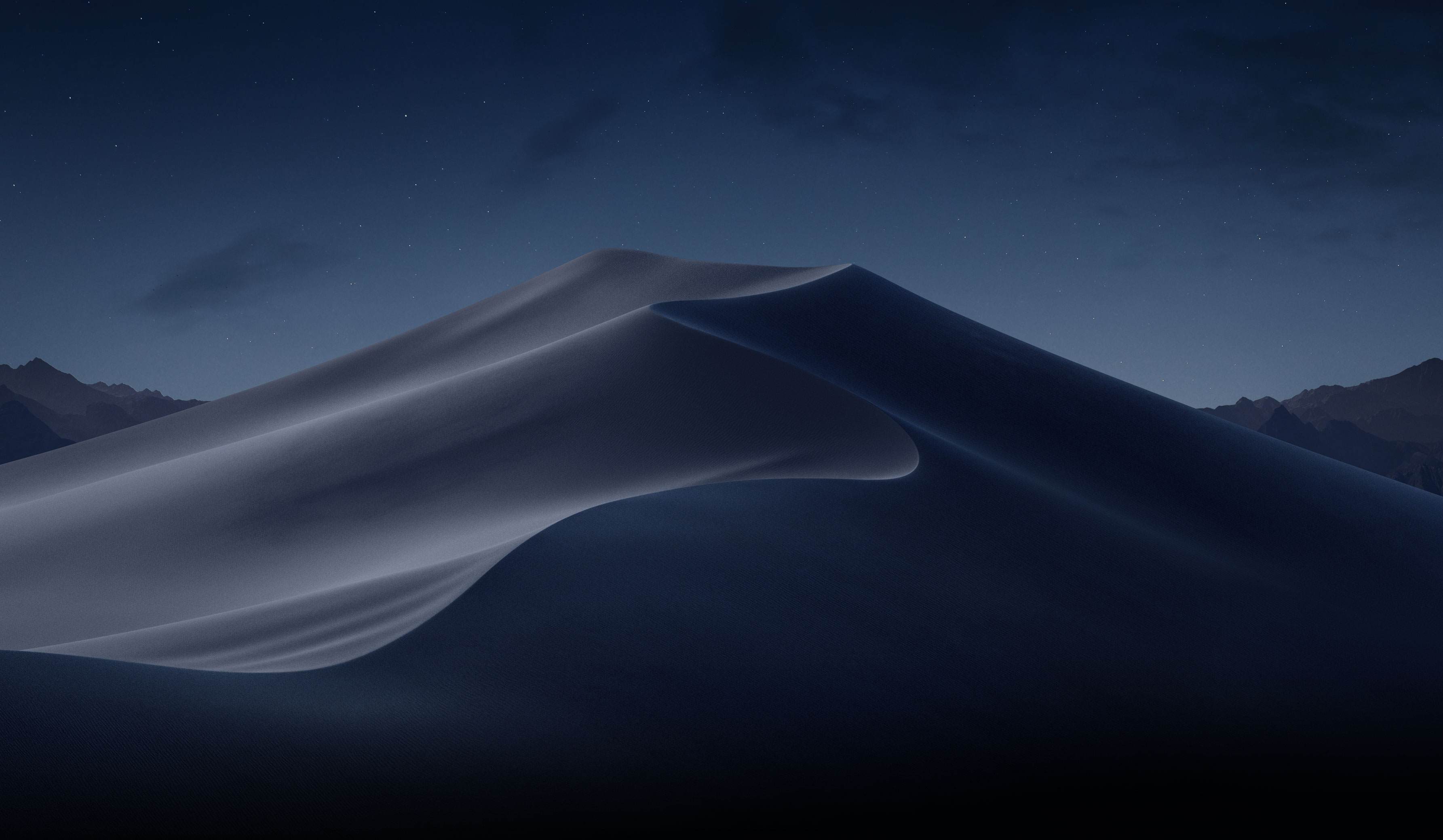
Depois das montanhas, que peculiarmente ficam na margem do wallpaper, vieram as dunas. Com uma distância de 253km (ou três horas de carro), o próximo destino é o Parque Nacional do Vale da Morte, o ponto mais quente do continente americano — onde se registrou a maior temperatura da história (56,7°C) em julho de 1913, e onde a foto do papel de parede do macOS Mojave 10.14 foi feita.
Já sobre as novidades do sistema, essa versão do macOS é particularmente conhecida pela introdução do Modo Escuro, a inclusão dos Conjuntos (Stacks) na Mesa (Desktop), além da estreia de apps já conhecidos dos usuários de iOS, como o Apple News, o Bolsa (Stocks), o Gravador de Voz (Voice Memo) e o Casa (Home).
macOS Catalina 10.15
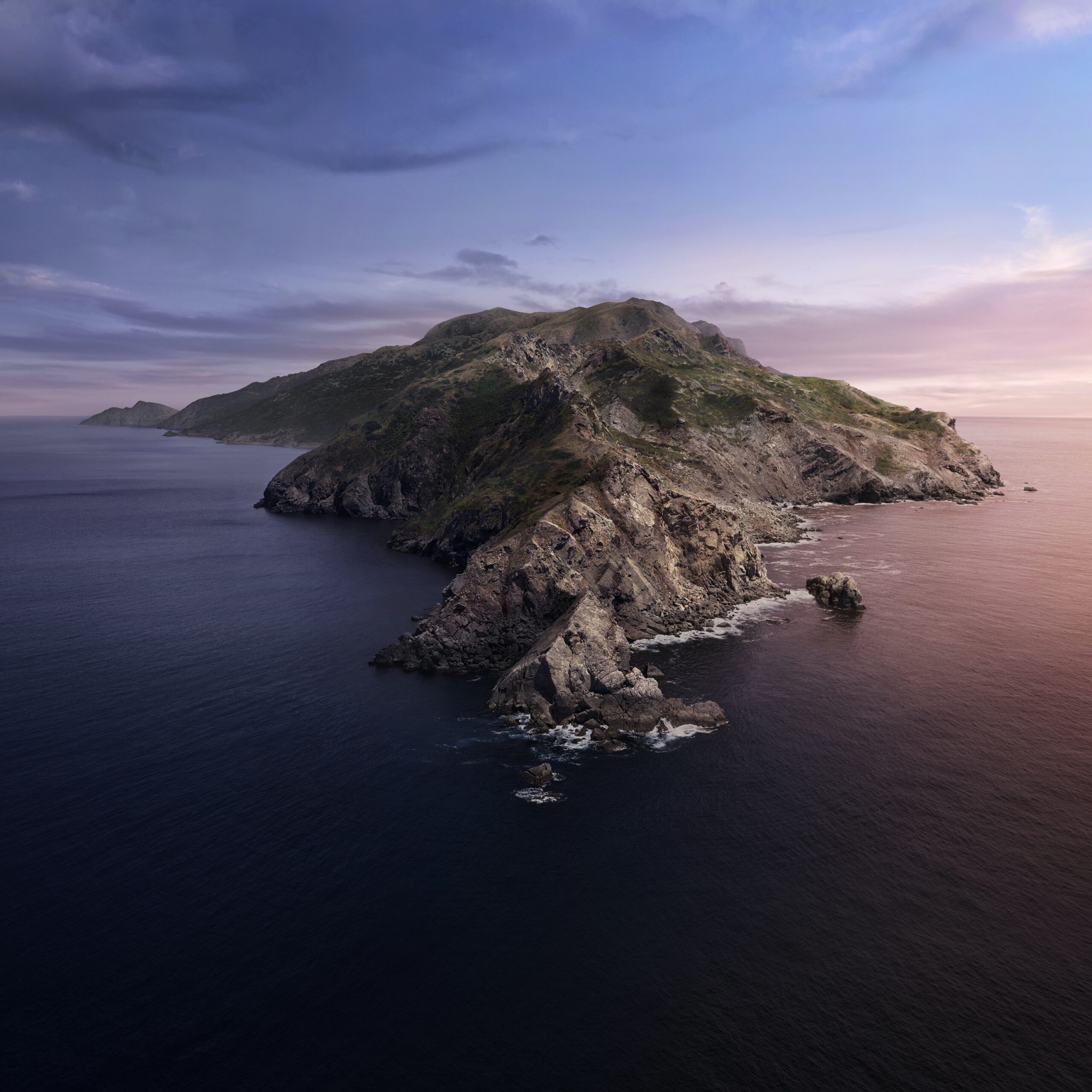
A 428km adiante do Deserto de Mojave (cerca de cinco horas e meia de carro), nós temos a Ilha de Santa Catalina, destino paradisíaco — e remoto — da costa sul da Califórnia que deu nome à versão do macOS lançada em 2019. Pela posição da foto, o que se especula é que o registro oficial da Apple tenha sido feito com o auxílio de um drone ou helicóptero, sobrevoando as águas para capturar Catalina sob diferentes períodos e iluminações para fornecer o tema dinâmico disponível no sistema.
Essa atualização marcou o fim do iTunes, que foi segmentado em um catálogo de aplicativos separados (Apple TV, Música, Apple Podcasts), mas sua adição mais relevante muito possivelmente foi o recurso Sidecar, que possibilita o uso do iPad como um monitor externo do Mac.
macOS Big Sur 11
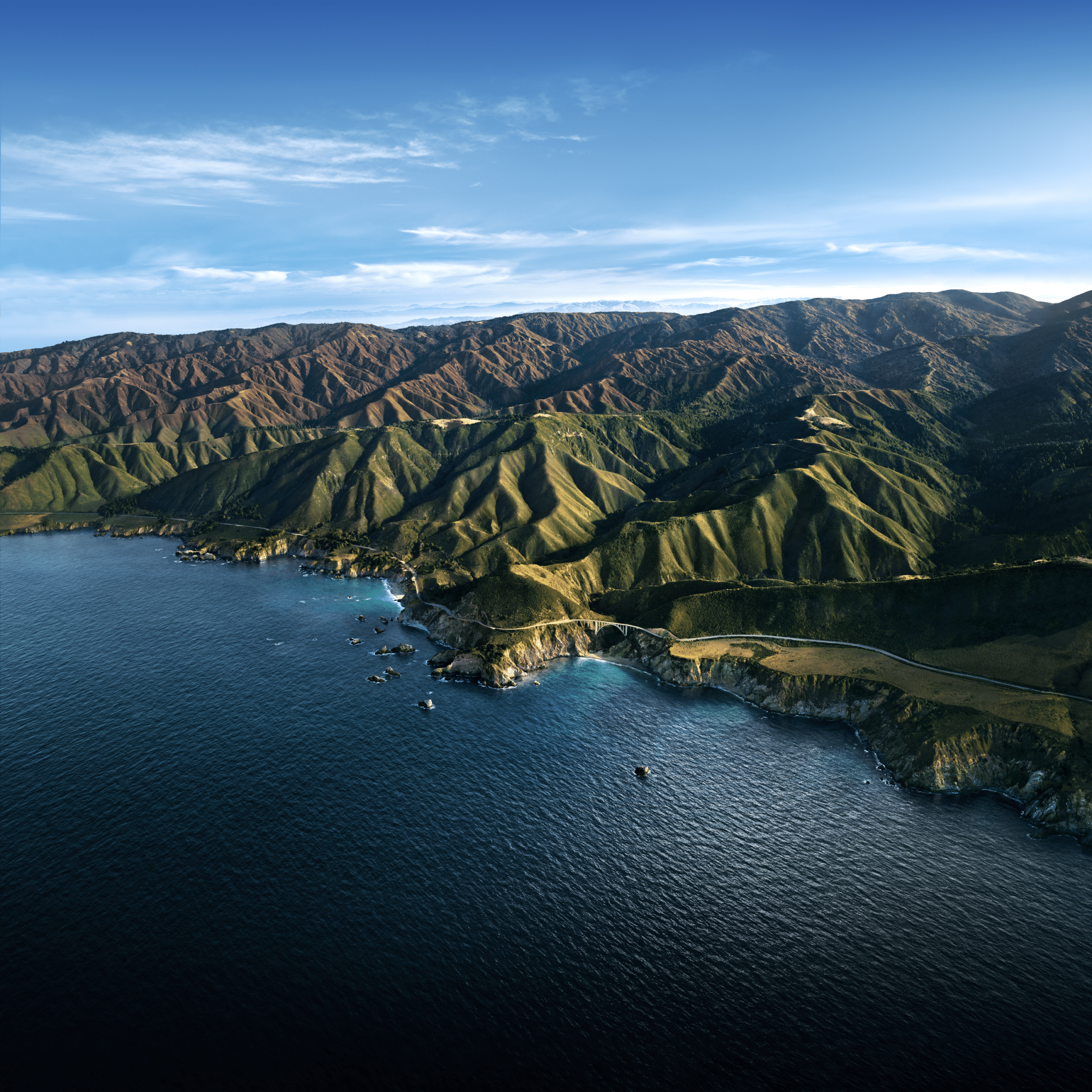
Com uma distância de 524km da Ilha de Catalina, a próxima parada é na Ponte Bixby Creek (inaugurada em 1932 e particularmente conhecida por suas estradas com curvas), localizada na costa central de Big Sur, que dá nome a essa versão do macOS — o papel de parede retrata também a parte litorânea do local.
Sobre o sistema, a versão marcou a transição dos processadores da Intel para o Apple Silicon com o lançamento do M1, trazendo novos ícones, materiais translúcidos, um novo Dock, Central de Controle e de Notificações.
Esta versão também foi um marco para o sistema operacional, pois, pela primeira vez em muitos anos, a Apple abandonou as sub-versões 10.x e passou para o número 11 — o que se manteve nos anos subsequentes.
macOS Monterey 12
Ainda na costa de Big Sur, o macOS Monterey 12 marcou a quebra de uma tradição: pela primeira vez em anos, a Apple optou por não incluir um registro fotográfico como possível papel de parede ou tela de descanso, mantendo apenas temas dinâmicos para ilustrar o sistema dos Macs naquela ocasião.
O Condado de Monterey, que inspirou o nome do sistema, é particularmente lembrado por ter abrigado a primeira capital da Califórnia, quando a região ainda era de domínio dos governos da Espanha e do México.
Em relação ao sistema, o grande destaque foi a introdução do Controle Universal (Universal Control), permitindo que um único conjunto de periféricos (como teclados e mouses) seja utilizado simultaneamente no Mac e no iPad.
macOS Ventura 13
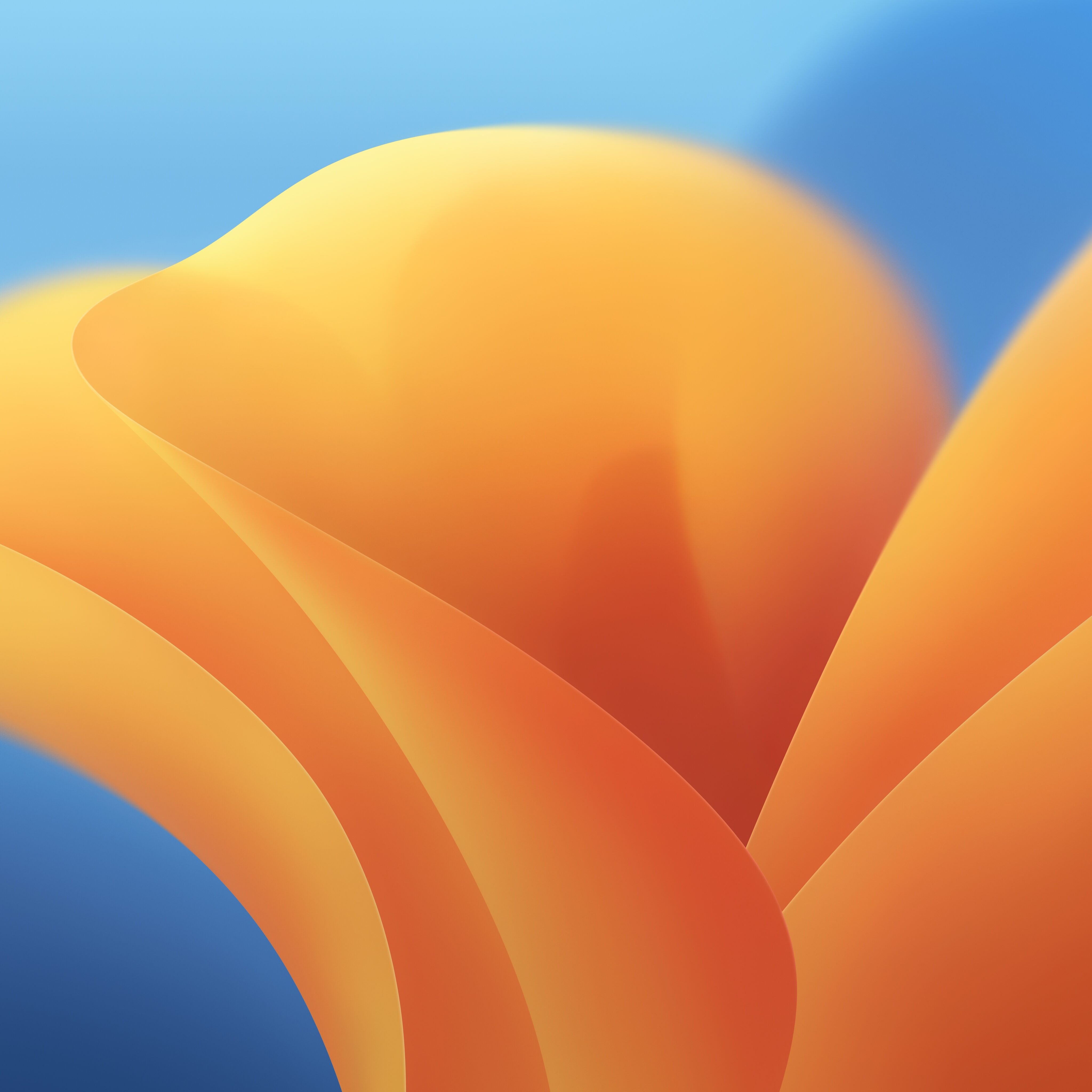
Por volta de 450km de distância (quatro horas e meia de trajeto) depois, temos o Condado de Ventura, que inspirou essa versão do macOS. Emancipado do Condado de Santa Bárbara em 1873, ele abriga o píer mais antigo do estado da Califórnia. Mais uma vez, a Apple optou por não incluir um papel de parede fotográfico.
Quanto aos seus recursos, o macOS Ventura 13 se destacou pela adição do recurso Organizador Visual (Stage Manager) e melhorias no Spotlight, Safari, entre outros aplicativos nativos do sistema que ganharam reformulações.
macOS Sonoma 14
Do Condado de Ventura até Sonoma, são 748km (pouco mais de sete horas de trajeto) até a região norte de San Francisco, conhecida por abrigar centenas de vinícolas. O registro da Apple foi feito na vinícola Mazzocco Sonoma, no rancho de Warm Springs.
Depois de dois anos, a Apple enfim retornou com os papéis de parede fotográficos no macOS, funcionando também como protetores de tela (screensavers) dinâmicos que lentamente se tornam um wallpaper estático após o login.
A maior novidade do sistema foi a implementação dos widgets interativos na Mesa (Desktop), além de reformulações no modo Jogo, na relação do sistema com acessos remotos e no compartilhamento de conteúdos em videochamadas, com novidades também no Safari, na Siri e nos recursos de acessibilidade.
macOS Sequoia 15
Saindo de Sonoma, nosso próximo destino está localizado a quase sete horas de distância (mais ao sul da Califórnia, a exatos 547km de distância); trata-se do Parque Nacional da Sequoia, que abriga algumas das maiores árvores do planeta em termos de volume.
O registro do papel de parede é remoto o suficiente para não termos uma dimensão exata da sua localização geográfica (até porque a Apple nunca divulgou essa informação), mas é seguro afirmar que as imagens foram capturadas em algum dos bosques de sequoias da Sierra Nevada.
Além da estreia controversa dos recursos da Apple Intelligence devido à discrepância entre o que foi apresentado e as funcionalidades entregues, o macOS Sequoia 15 introduziu o Espelhamento do iPhone (iPhone Mirroring), a organização de janelas em mosaico e o aplicativo Senhas (Passwords).
macOS Tahoe 26
Do Parque Nacional de Sequoia, partimos rumo ao norte, até a fronteira entre a Califórnia e o estado do Nevada (uma distância de 330km, ou três horas e meia de trajeto). O próximo destino é o Lago Tahoe, também presente na cordilheira de Sierra Nevada. Ele é particularmente conhecido por ser o maior lago alpino da América do Norte em termos de altitude.
Conhecido por suas águas cristalinas, o lago é um destino frequente para esqui. O papel de parede do macOS Tahoe 26 exibe um ângulo baixo sobre o lago, com as rochas em primeiro plano, enquanto os pinheiros e as montanhas de Sierra Nevada aparecem ao fundo.
Quanto ao sistema, além da unificação da numeração com todo o ecossistema (iOS, iPadOS, watchOS, tvOS e visionOS) da Apple, essa versão foi especialmente marcada pelo redesign de interface com a estreia do Liquid Glass. Outras novidades incluem a adição das Atividades Ao Vivo (Live Activities) ao recurso Continuidade, além de revisões do Spotlight, Central de Controle e os recursos da Apple Intelligence.
macOS Golden Gate 27
E, enfim, chegamos à versão mais recente do macOS! Com uma distância de 330km (trajeto com cerca de três horas e meia), nosso próximo destino é o cartão postal da cidade de San Francisco: a Ponte Golden Gate.
Ela foi, até 1964, a maior ponte suspensa do mundo — caso seus cabos de sustentação fossem esticados, teriam tamanho o suficiente para dar três voltas no planeta.
Enquanto sistema, assim como o Snow Leopard ou o High Sierra, o macOS Golden Gate 27 é marcado por sua abordagem de priorização dos refinamentos, tanto relacionados ao visual Liquid Glass quanto aos recursos da Apple Intelligence e da Siri, que agora se torna Siri AI.
E você aí, usa o macOS desde que versão? Alguma, em especial, lhe marcou? Ou você (ainda) não é usuário de Mac, mas gostou de todas essas curiosidades? 😊
With the Space Race heating up, the Ranger program was developed as an answer to Sputnik: The U.S. would land spacecraft on the Moon. When President John F. Kennedy vowed in 1961 to put a man on the lunar surface, the project evolved. Instead of being purely scientific or exploratory, Ranger spacecraft would also beContinue reading "July 31, 1964: Ranger 7 returns the first close pictures of the Moon"
Impulse Space has unveiled its first electric propulsion system, designed to work in tandem with chemical rocket engines to extend the capabilities of spacecraft during long space missions.
On Tuesday, the California-based company revealed Electra, which complements traditional rocket propulsion, rather than replacing it, providing a new layer of efficiency for spaceflight aided by electric thrusters.
“As launch becomes more accessible, the next frontier is enabling spacecraft to do more once they arrive in orbit,” said Tom Mueller, founder, CEO, and chief technology officer of Impulse, in a statement.
The Future is Electric
While electric propulsion systems produce lower levels of thrust compared to chemical rockets, they also consume far less propellant during spaceflight. Because of this, they are an ideal candidate for certain tasks, such as station keeping—the process where a spacecraft’s assigned orbit is maintained over long periods of months, or even years.
Presently, as much as 50% of a conventional spacecraft’s chemical propellant can be required solely for maintaining its orbit for the duration of a mission. Assigning those duties to an electric propulsion system allows chemical fuel to be reallocated toward higher-value mission operations, which include rapid orbital transfers and time-sensitive maneuvers.
Rapid Pace for Development
Electra was developed entirely in-house and in under a year, the company said in a statement this week. Engineers required less than half that time to advance from initial design stages to completion of a functioning propulsion system.
Almost all major components, which include Electra’s thruster and supporting avionics systems, were designed, manufactured, and tested in-house.
“The best part of building Electra has been the opportunity to move fast and try new things,” said Charlie Kelly, Lead Electric Propulsion Engineer at Impulse.
“We get to turn ideas into plasma in a matter of weeks or months, not years,” Kelly added.
Advancing Future Space Propulsion
Presently, the company is rapidly developing its next-generation designs, and qualification is currently underway for Electra’s integration with Mira, Impulse’s orbital transfer vehicle.
An initial in-space demonstration is expected to take place aboard Impulse’s GEO Express 1 mission next year, as part of the Caravan 1 mission.
For Impulse, the new propulsion system represents another step toward building what it characterizes as a complete in-space mobility architecture—extending beyond launch itself to support satellite servicing, orbital transfers, cargo transportation, and future operations throughout cislunar space and beyond.
With an ever-increasing level of commercial activity in Earth orbit, such technologies will help to propel spacecraft for much longer periods, enabling long-duration space missions that reduce overall costs and fuel requirements.
“Our strategy has always been to develop the mobility technologies needed to support all missions after launch,” Mueller said this week, adding that “electric propulsion is an essential component of that strategy.”
Additional details about the company’s novel propulsion designs can be found at Impulse Space’s website.
Micah Hanks is the Editor-in-Chief and Co-Founder of The Debrief. A longtime reporter on science, defense, and technology with a focus on space and astronomy, he can be reached atmicah@thedebrief.org. Follow him on X @MicahHanks, and at micahhanks.com.
iOS 26.6 and iPadOS 26.6 include security fixes for the iPhone and iPad. The updates also optimize the Spotlight index in preparation for iOS 27 and iPadOS 27.
Yesterday’s iOS update fixed the battery problem that I’ve had for the past couple of months. My iPhone 16 Pro Max would not make it a full day on a single charge.
More light at the day’s end comes at a price: much later winter sunrises across much of the U.S. Scientists have documented consequences for public health and the economy.
A U.S.-Russian crew will return to Earth from the International Space Station early Sunday morning (July 26), and you can watch their homecoming live.
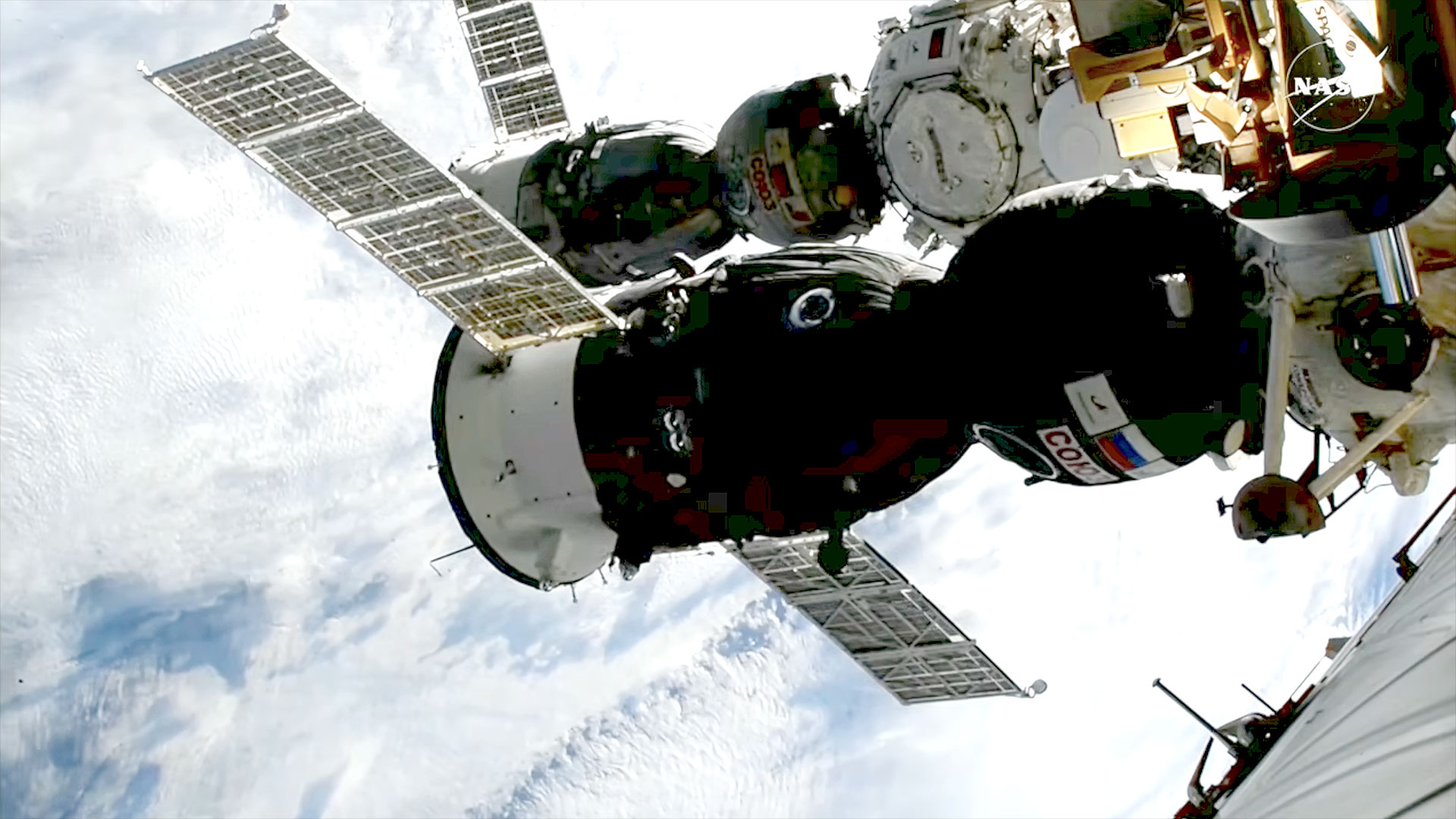
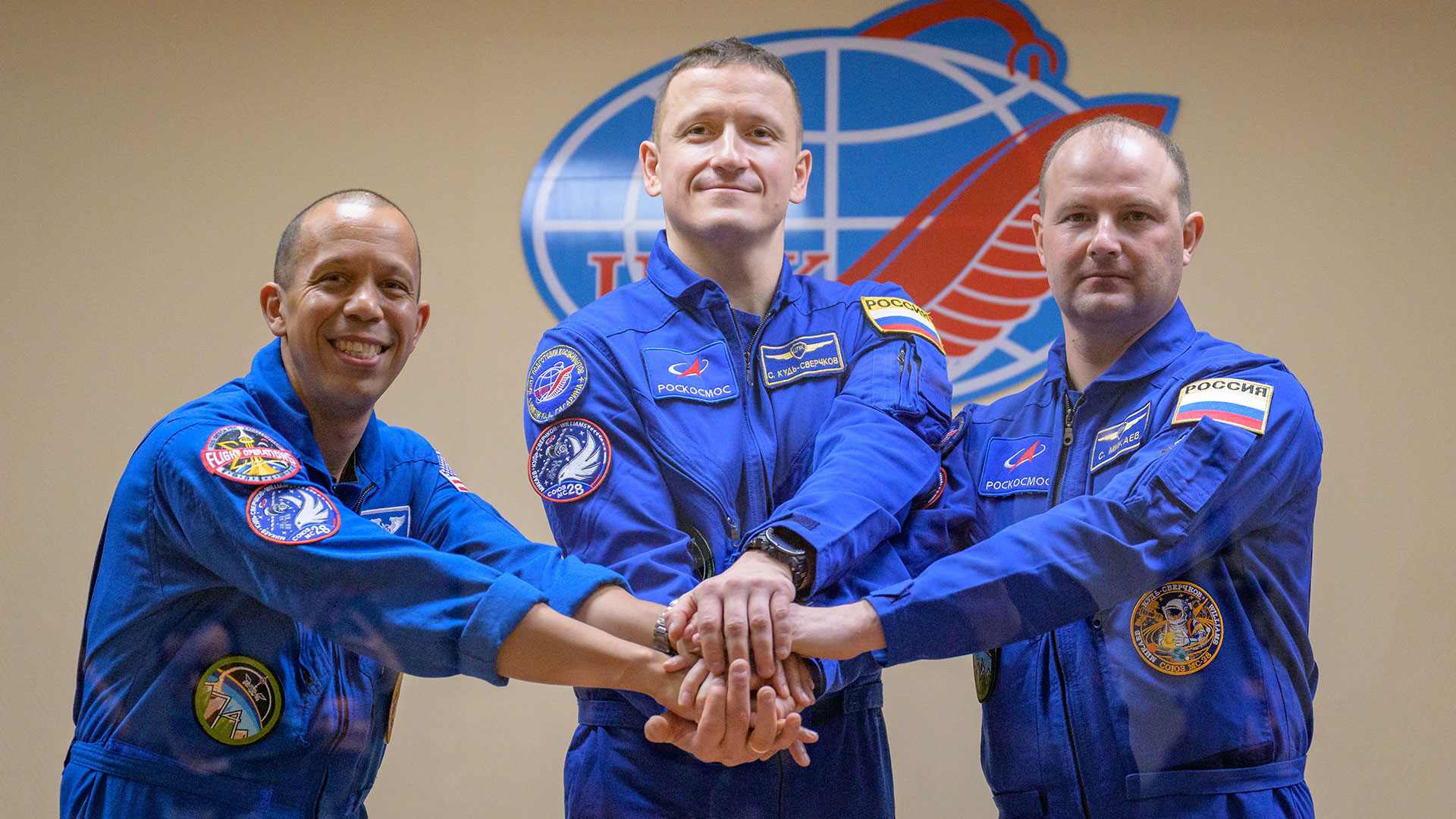
A Soyuz spacecraft carrying NASA astronaut Chris Williams and Sergey Kud-Sverchkov and Sergei Mikaev of the Russian space agency Roscosmos is scheduled to undock from the orbiting lab on Sunday at 3:02 a.m. EDT (0702 GMT).
The Soyuz, known as MS-28, will land on the steppe of Kazakhstan about 3.5 hours later, at 6:26 a.m. EDT (1026 GMT). You can watch these milestones here at Space.com, courtesy of NASA.
Russia's Soyuz MS-28 spacecraft is seen docked to the International Space Station shortly after its arrival on Nov. 27, 2026. (Image credit: NASA)
The coverage starts today (July 25) at 9:40 a.m. EDT (1340 GMT) ahead of a change-of-command ceremony aboard the International Space Station (ISS). Kud‑Sverchkov will hand over the reins of the orbiting lab to NASA astronaut Jessica Meir, part of the transition from ISS Expedition 74 to Expedition 75 (which officially begins when Soyuz MS‑28 undocks). You can watch that live via NASA.
NASA will resume its webcast tonight at 11:10 p.m. EDT (0310 GMT on July 26) to cover crew farewells and the closing of the hatches between the ISS and Soyuz MS-28, which is expected at 11:30 p.m. EDT (0330 GMT).
Undocking coverage begins Sunday at 2:30 a.m. EDT (0630 GMT). The stream will pick up again at 5:15 a.m. EDT (0915 GMT) for deorbit and landing activities. Touchdown will occur southeast of the Kazakh city of Dzhezkazgan, according to NASA.
The Soyuz MS-28 crew pose on Nov. 26, 2025, a day before their launch. From left: Chris Williams of NASA and Roscosmos cosmonauts Sergey Kud-Sverchkov and Sergei Mikaev. (Image credit: NASA/Bill Ingalls)
Soyuz MS-28 launched to the ISS on Nov. 27, which was Thanksgiving Day. That liftoff kicked off the first space mission for Williams and Mikaev and the second for Kud‑Sverchkov.
When it's all said and done, the trio will have spent 241 days in space on their current flight. They will have orbited Earth 3,856 times and traveled a total of more than 102 million miles (164 million kilometers).
After touchdown, the three spaceflyers "will fly by helicopter to Karaganda, Kazakhstan, where recovery teams are based," NASA officials wrote in a media advisory. "Williams then will return to NASA's Johnson Space Center in Houston, while Kud‑Sverchkov and Mikaev head back to their training base in Star City, Russia."

 Login