Tough sell. | Photo: Antonio G. Di Benedetto / The Verge
The HP HyperX Omen 15, which I first saw at CES, replaces the HP Victus 15, a longtime bestselling budget gaming laptop. The Victus cost just $800, or less when on sale, and was a good entry point to decent laptop gaming.
The Omen 15 has nice little upgrades over the Victus. Its RTX 5050 Laptop GPU can play 2026's latest games, albeit on low-ish settings. But it's also got a brighter 16:10 aspect ratio display with higher refresh rate, and a 1080p webcam to make it a little better for non-gaming stuff.
I'd call it a working-class gaming laptop, but thanks to RAMageddon, the Omen 15 starts at $1,200 - a far cry from the $800 that made its …
Team Fortress 2 cases are worth pocket change. There are a few select cases that scale up to a few dollars, and even fewer with a market price in the double digits, but the vast majority of cases are worth a few pennies, no more than a Steam Trading Card. But one player, Vincent Stech, started collecting cases nearly a decade ago, racking up over 1.7 million cases across several Steam accounts. And now, he’s selling the whole collection, with an estimated value of $100,000.
Stech started collecting cases around Team Fortress 2’s last major update, in late 2017, outside of annual Halloween events that persisted through 2022. In order to accumulate so many cases, Stech largely automated the process, noting that he was careful not to upset the string-pullers at Valve as he amassed a stash of seemingly innocuous digital assets.
“That’s always been one of my biggest fears over the past decade, is one day they wake up like ‘hey, we don’t like what this guy’s doing,’” Stech told Tom's Hardware. “Because I know people with accounts with like 50,000 items that won’t load, and Valve won’t delete the items off their account, so they just can’t access Team Fortress 2 inventory ever again on their main account.”
Before understanding Stech’s process, however, we have to start with how Team Fortress 2’s in-game economy works. Like other Valve titles, you’re able to list items you earn in-game on the Steam Community Marketplace, selling them for real dollars or spending real dollars of your own to buy other items. That’s the normal way of doing things, but this in-game economy has grown beyond the bounds of Steam. A lot of transactions happen off the platform.
(Image credit: Backpack)
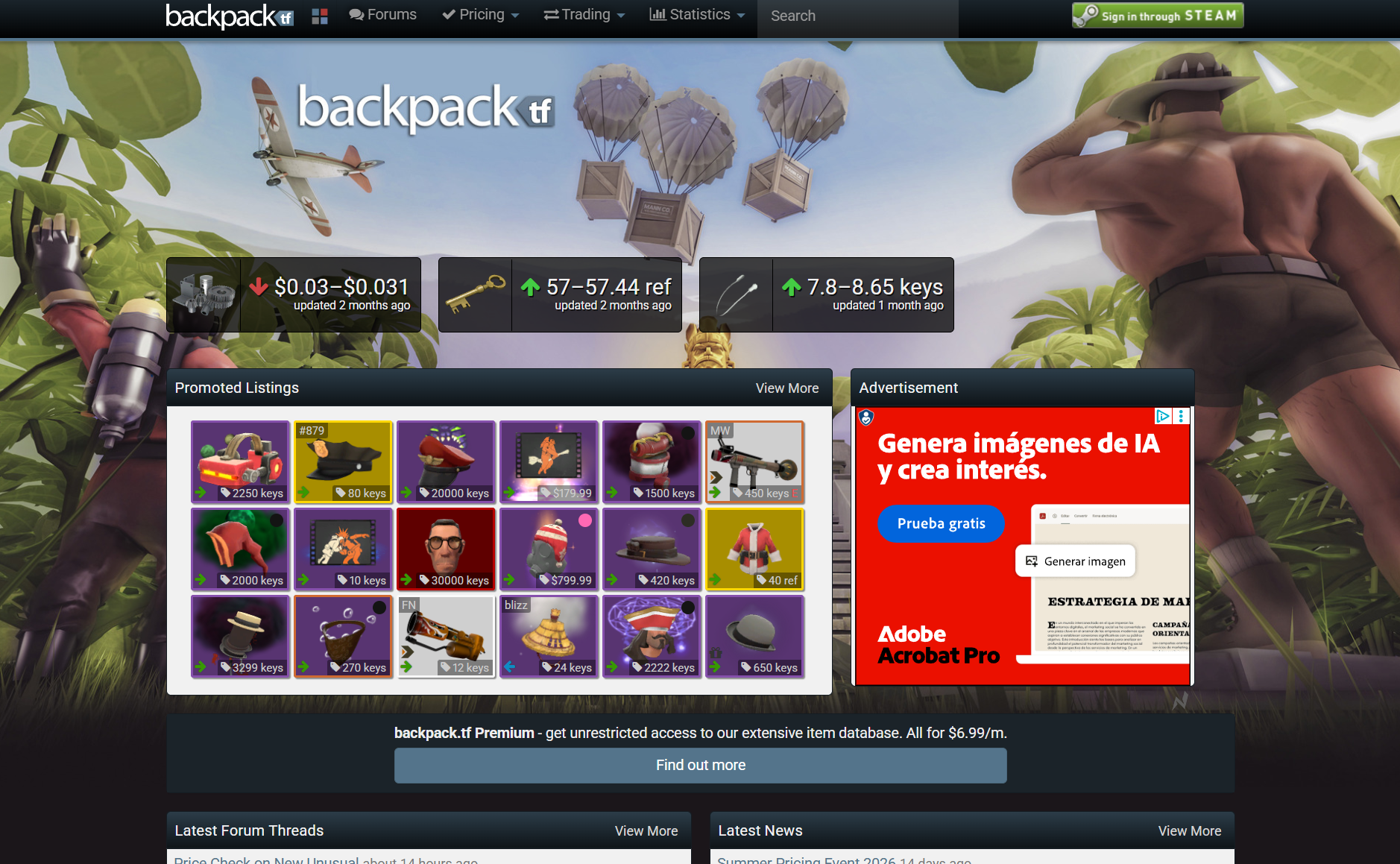
Websites like backpack.tf and stntrading.eu take trading off of Steam, allowing you to use in-game crafting materials (along with keys) to buy and sell items. There are several reasons for these third-party marketplaces to exist, not the least of which is bot automation, which is against Steam’s Terms of Service. This exchange of in-game currency for items happens through trades on Steam, creating a separate marketplace where real money doesn’t change hands.
That’s not where Stech started. “Team Fortress 2 cases, they weren’t worth anything. They were… people were just giving them away because they take inventory spots,” Stech said. “People were deleting things, and so I decided to scoop them up.”
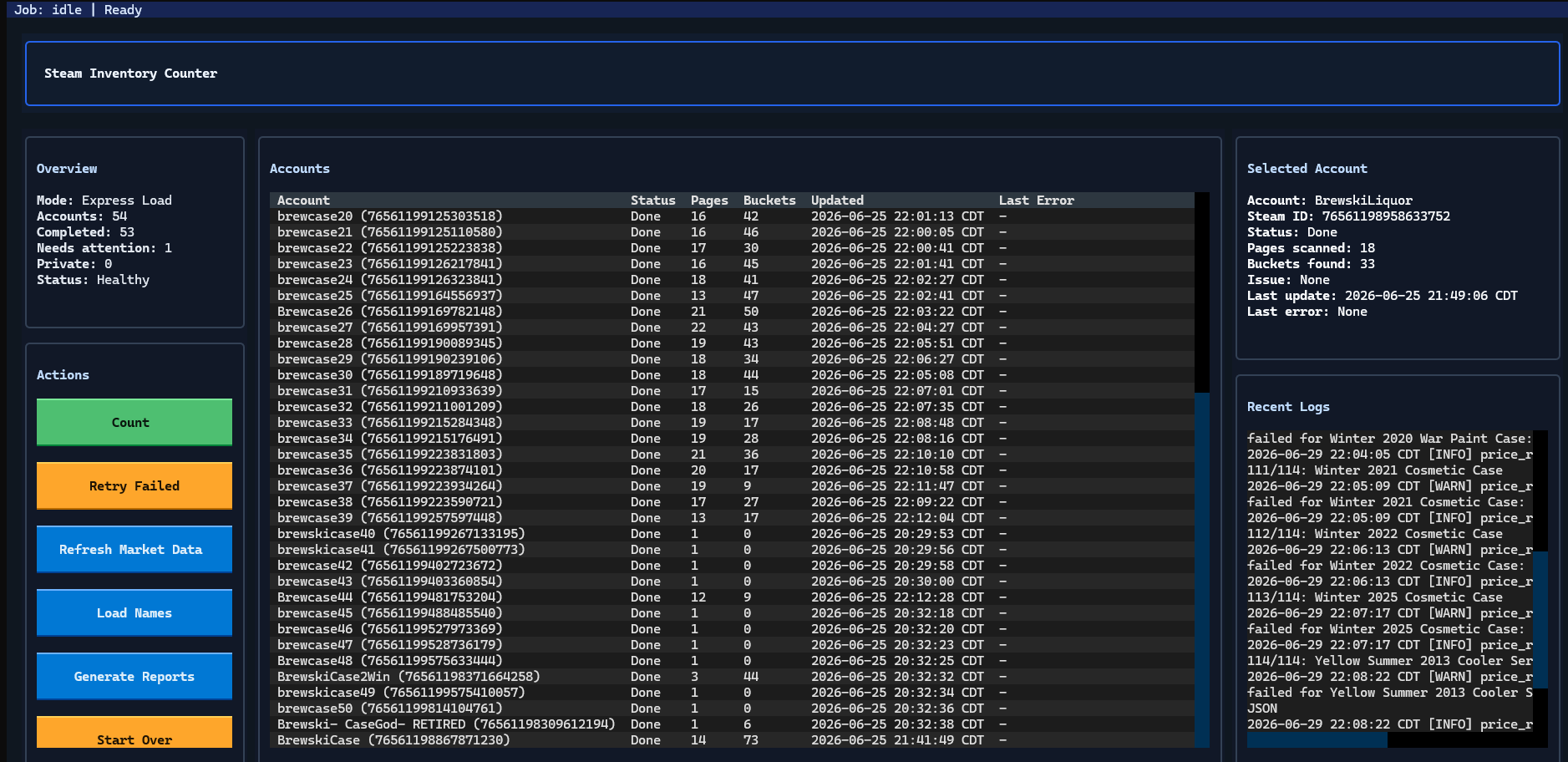
The problem Stech quickly ran into was inventory space. You can only have a few thousand items in your inventory (Stech told me 4,000 for Team Fortress 2, others say it’s around 2,000). Regardless of the number, it’s far too low a limit to amass nearly 2 million items, even with dozens of alternative accounts. Stech bypassed this issue by using the community marketplace. He listed the cases at very high prices where they were unlikely to sell. That’s because you can have tens of thousands of items on the market “before Steam gets really angry at you.” It effectively multiplies inventory space.
(Image credit: Vincent Stech)
As his inventory began to grow, Stech started automating the process of taking inventory and accepting trades, the latter of which was handled through a simple batch file. At first, Stech was just buying cases in bulk at relatively low prices, but the inventory escalated once he started digging into Steam’s local pricing in different regions.
“In Venezuela and, like, Russian [Rubles]... they are very weak currencies compared to the U.S. dollar,” Stech said. “What I found out is the lowest you can sell an item on Steam for us is three cents. For them, it’s a 10th of a penny. So I found this one guy in Venezuela… he would buy almost every case off the Steam Community Market for their extremely low price, and then he would sell it to me, and I would just give him, like, keys. And he was actually a doctor in Venezuela, and they don’t make much at all by comparison to, like, what $50 would be in USD. So a large majority of his income was case money.”
For context, $50 is equivalent to just over 37,000 bolívares (the official currency of Venezuela).
Stech’s first cash-out from Steam was $50 when he was around 16 years old. A few years later, he cashed out $2,500 to buy his first car. Stech stopped collecting cases about three years ago, and now, he’s looking to sell off the entire collection, which he estimates is worth around $100,000.
Selling this collection is no easy feat, however. For starters, Steam can break when trades get too large, necessitating hundreds of trades across dozens of different accounts. Further, Stech controls quite a large portion of known cases. “At one point, I calculated I had, like, 17% of all TF2 cases that are publicly known… I would have an extremely hard time selling it off because I am a large [portion] of the market. It’s like, you know, Elon Musk couldn’t dump a lot of his stock.”
Stech has, apparently, found a buyer that wants the whole collection, however, and the selling process is already underway. “The transaction has kind of started… he has admin privileges on the trade offers he sends to my accounts, so my accounts just automatically accept any trade from him,” Stech said. “An option was for him to just buy the accounts, but we know that is very bannable, so we haven’t done that.”
Stech says he expects to have the process complete around October. Just as he used case money to buy his first car, he says he plans to use the money from the sale as a down payment on a house.
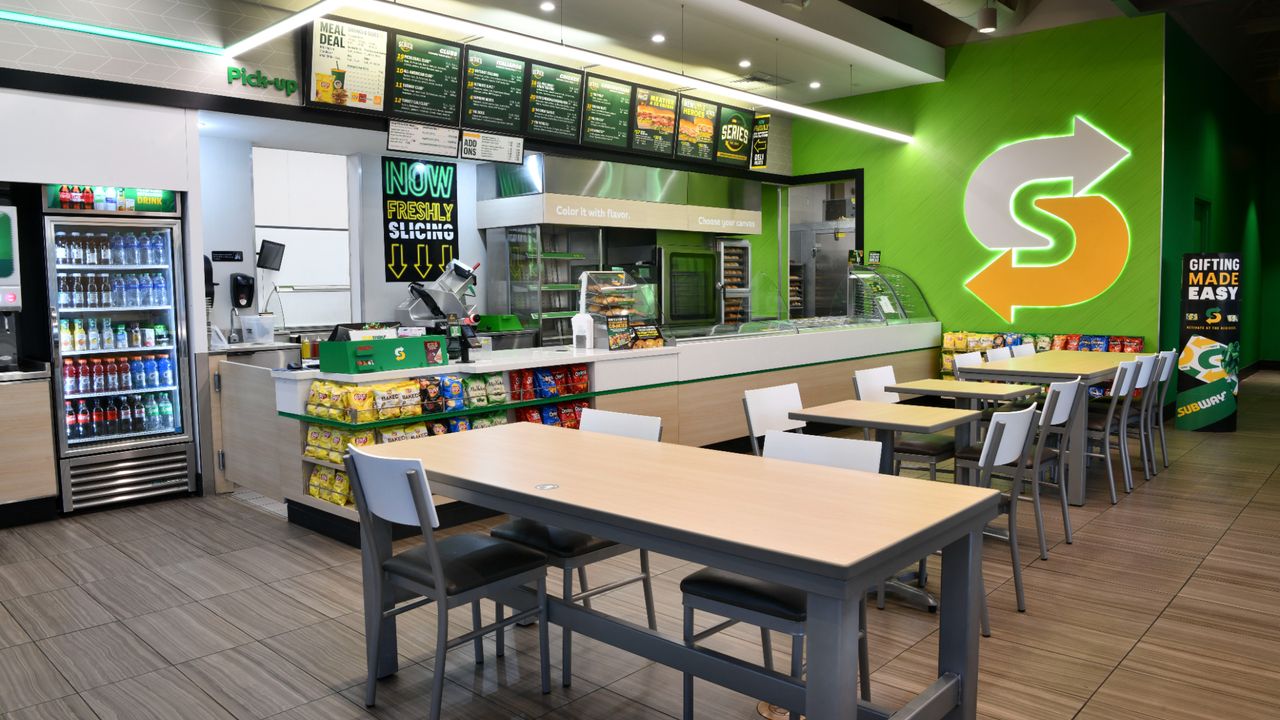
An intrepid TechTuber has tested a trio of passive mini PCs from the Subway sandwich chain to check if they can be repurposed for gaming fun. In a recent video, Garkus indicates that the three Intel Skylake-powered mini PCs that had been displaying sandwich menus above the serving counters for a decade but were saved from scrap/landfill, alongside a matching set of LG digital signage TVs. Spoiler: they are too puny for mainstream AAA gaming in 2026, even after doubling the RAM installed.
Before getting on with the digital signage-to-gaming conversion, Garkus investigated the hardware in hand. Labeling indicated that the three slim mini PCs were all Advantech DS-081 models (official PDF link). Pondering over that data sheet, we see that the variant with the Intel Core i3 6100U, as these were, carries the full designation of DS-081GB-U21A1E.
The processor is now both long in the tooth and low powered, so immediately we know this 2C/4T @ 2.3 GHz CPU, configured to suck between 7.5W and 15W, won’t be ideal for modern AAA titles. Moreover, the iGPU is the Intel HD Graphics 520 with 24 EUs and clocks up to just 1.00 GHz, sharing the DDR4 system RAM.
A DS-081GB-U2A1E is quite expandable for such a small, low-powered set-it-and-forget-it unit. It has twin HDMI 1.4, twin Ethernet, four USB 3, audio in/out, and an RS-232 serial port accessible from the outside. Inside, users can configure the machine via twin DDR4-2133 SODIMM slots (up to 32GB total), a SATA III HDD/SSD, and an mSATA port that looked like it was an M.2 2242 slot in the video. This passive machine is designed to run signage 24/7 in environments with 0 ~ 40° C (32 ~ 104 ° F) ambient temperatures.
These systems were found to actually come with just 4GB of RAM (one slot used) and with a 64GB SATA SSD installed. They booted to Windows and went straight to kiosk mode, displaying the Subway sandwich menu. We saw an extra 4GB DDR4 stick added to bring the test system(s) up to 8GB RAM in total.
After a bit of OS wrangling, Garkus decided to set up the salvaged trio of passive mini PCs as follows. One kept Windows 10, another got Bazzite Linux (because SteamOS balked at the SATA-only storage), then another went Hackintosh with macOS Monterey installed.
Gaming tests began with a very light test. The system ran Peggle, and this 2D puzzler posed no problems. After this modest victory, Garkus ambitiously leapt straight to GTA V. This legendary but now older title could only reach a frame rate of about 15 fps. But it was found to have defaulted to high settings, took ages to get ready to run on Bazzite, then crashed on exit.
Probably not following best benchmarking practice, the tech tinkerer appears to have decided to test Mario Kart Wii emulation performance while GTA V was still compiling shaders… Later, a test run in Minecraft delivered a wildly inconsistent but roughly 25 fps performance. As is now established as the Garkus testing MO, resolution, quality settings, and so on weren’t shared.
To conclude the gaming part of the video, the TechTuber suggests that these ex-kiosk machines are probably best suited to emulating older consoles up to the PS2 and original Xbox era. We think that for PS2 emulation, you will still need to restrict yourself to lighter titles and reduced settings for smooth action.
The Steam Machine is almost here. Valve chose possibly the worst time to announce new PC gaming hardware in late 2025, just as the AI boom sent storage and RAM prices through the roof. The upheaval delayed its new Steam Machine release, but Valve has announced its TV-friendly gaming PC will go on sale June 29 with a reservation-based system and a starting price of $1,049.
The Steam Machine will come in two variations: one with 512GB of storage and a more expensive one with 2TB. They'll retail for $1,049 and $1,349, respectively, and you'll be able to bundle a Steam Controller with either for an additional $79. Buying the 2TB model also gets you a pair of exclusive faceplates with red fabric and walnut finishes. Like the Steam Deck, the machine ships with the Linux-based SteamOS.
Both versions of the Steam Machine will run on a custom six-core AMD Zen 4 CPU with a peak clock speed of 4.8GHz. The integrated AMD RDNA3 GPU will feature 28 compute units and 8GB of dedicated DDR6 VRAM soldered to the board. The system will have its own 16GB allotment of DDR5 on the board. This should provide enough oomph (with upscaling tech) to play moderately demanding PC games on your TV.
Valve has some good news and bad news about Steam Controllers. The good news: If you make a reservation for a Steam Controller, the company will now show you one of three estimates of when you'll be able to actually order your gamepad: by September 2026, by December 2026, or sometime in 2027. The bad news: Any reservations made today "indicate a 2027 date for shipping," Valve says.
"We have no plans to stop making Steam Controller," according to Valve. "But as we look at the current demand compared to how many we know we can make by the end of the year, we want to manage expectations as much as we can with regards to when folks can expect t …
Roblox's vice president of safety product policy, Eliza Jacobs, told NBC News that Roblox is "optimistic" that its new facial age estimation tech will "continue to get better," saying, "Ticking a box to say you're 13 or older, it's not enough anymore." NBC invited a group of kids to try out Roblox's new video selfie age check process, but they weren't able to get around it with a fake mustache. Jacobs claims Roblox's facial age estimates can typically land "within 1.4 years of a child's exact age."
Roblox announced plans in April to begin using its video selfie age estimation tech to sort players into age brackets. Users under 16 and unde …
On June 10th, the German container ship Posen docked in Los Angeles after a two-week voyage from Shanghai. As Valve watcher Brad Lynch notes, it was almost certainly carrying the first mass production shipments of the Steam Frame, Valve's new gaming headset.
Import records show that Valve's distribution partner Ceva offloaded nearly 32 metric tons of "Virtual Reality Devices" on Valve's behalf - or roughly 13 tons of actual product, after you subtract the roughly 3,700 kilogram weight of five 40-foot shipping containers.
After over a decade, Steam will no longer sell physical gift cards in stores. In a support page spotted earlier by Windows Central, Valve says it will no longer restock its gift cards once they run out, citing scammers who "continue to have an impact on Steam customers and other unsuspecting individuals."
In its post, Valve links to a Federal Trade Commission article outlining how gift card scammers attempt to convince victims to buy a gift card at a store and give them the code. Valve says it has responded to these scams by working with law enforcement, adding a warning to gift cards, and limiting their availability in stores, but "scammer …

 Login