Usuários do Telegram notaram ontem que o aplicativo do mensageiro para iOS ficou indisponível na App Store por um breve período, o que deixou muita gente confusa.
Contatada pela Reuters, a Apple explicou que tirou o mensageiro do ar após um usuário ter reportado a presença de “material de abuso sexual infantil” na plataforma, o que obviamente vai contra as regras da sua loja.
Ainda segundo a gigante de Cupertino, a página do Telegram foi restaurada depois que a equipe do mensageiro removeu o conteúdo supracitado e baniu o usuário responsável pela publicação.
Em resposta, o mensageiro disse que possui uma política de “tolerância zero” contra esse tipo de conteúdo, além de ter bloqueado mais de 338.000 grupos e canais com material ilegal ao longo do último ano.
Ainda assim, a equipe do app ironizou a decisão da Apple nas redes sociais, dando a entender que a companhia não aplica o mesmo tratamento a outros apps. Ela também aproveitou a situação para divulgar uma página com dados sobre a moderação de conteúdo na plataforma:
I'm sure this stance will be applied equally to all other apps in the store, in the future right? @Apple
Outra pessoa a ir às redes sociais para comentar esse pequeno imbróglio foi o CEO 1Chief executive officer, ou diretor executivo. da Epic Games, Tim Sweeney, que criticou a falta de transparência na tomada de decisão da Apple, além de classificá-la como “arbitrária”. Em guerra com a fabricante do iPhone há alguns anos por conta das regras da App Store, ele aproveitou a situação para dizer que a loja da Maçã “precisa desesperadamente de concorrência”:
Such arbitrary policy enforcement, by a monopoly gatekeeper, creates a perfect storm of fear and acquiescence by developers who are victims of Apple’s monopoly. Speak up and criticize their gatekeeping and maybe they’ll enforce the rules one way rather than the other way.
A App Store da Apple precisa desesperadamente de concorrência global. A Apple remove arbitrariamente uma ferramenta vital de comunicação e privacidade, tornando-a inacessível a bilhões de usuários, e infelizmente isso é considerado normal.
A Apple declarou que removeu o aplicativo para um bilhão de pessoas porque um usuário do Telegram publicou algo horrível e ilegal. A empresa não explicou como, se esse é o padrão para remoção de aplicativos, qualquer aplicativo de comunicação, incluindo o iMessage, poderia operar em larga escala.
Essa aplicação arbitrária de políticas, por parte de um monopólio, cria a tempestade perfeita de medo e aquiescência por parte dos desenvolvedores, que são vítimas do monopólio da Apple. Manifeste-se e critique essa postura de controle, e talvez eles passem a aplicar as regras de uma forma, em vez de outra.
Questionada sobre os comentários de Sweeney, a Apple preferiu não emitir uma resposta.
Segundo ele, todo esse imbróglio foi provocado por um único usuário mal intencionado, que plantou conteúdo impróprio modificado por inteligência artificial (IA) em um grupo público na plataforma. Para tal, essa pessoa editou uma mensagem antiga na conversa, o que acabou fazendo com que ela passasse despercebida pelos administradores do grupo.
Ainda de acordo com Durov, esse usuário era um extorsionista — ou seja, uma pessoa que usa “contas automatizadas para plantar conteúdo ilegal em grupos públicos e depois denunciá-lo diretamente à Apple, tentando provocar a remoção de comunidades legítimas” cujos donos se recusaram a pagar o resgate.
O executivo também garantiu que a presença de conteúdo desse tipo na plataforma não representa um problema sistêmico e que sua equipe de moderação é efetiva, além de ter criticado a Apple por ter removido o app de sua loja sem contatar o Telegram primeiro. “Se um aplicativo usado por mais de 1 bilhão de pessoas pode ser removido da App Store sem aviso prévio, qualquer aplicativo pode ser”, comentou.
O popular jogo Wolfenstein 3D (um dos primeiros games de tiro em primeira pessoa do mercado) foi reconstruído do zero como parte de um novo projeto para modernizá-lo.
O objetivo dessa empreitada, denominada Wolfenshine, foi superar as limitações técnicas da época em que o jogo foi lançado e que o impediam de ter coisas como sombras, luzes coloridas, neblinas e outros efeitos.
O novo projeto, por sua vez, faz uso dos arquivos de mapas, inimigos, armas, sons e gráficos do jogo original — que não são distribuídos junto do Wolfenshine, mas lidos a partir de uma cópia própria do usuário (seja a versão shareware gratuita ou a completa, com as seis fases) — e acrescenta uma camada de efeitos modernos por cima, levando um pouco da tecnologia atual para o game.
Com isso, salas que teoricamente deveriam ser iluminadas por uma lâmpada passam a realmente contar com iluminação, corredores passam a exibir a luz originada por uma porta aberta, dentre outras coisas bem legais.
A jogabilidade, cabe destacar, continua exatamente a mesma. Como o game usa os mesmos arquivos da versão original, basta apertar F2 no teclado para alternar entre o visual clássico e o do Wolfenshine, num passe de mágica.
O Wolfenshine é um projeto de código aberto. O código-fonte e todos os detalhes técnicos (incluindo o passo a passo para a sua instalação) estão disponíveis no repositório oficial no GitHub, onde ele pode ser baixado em versões para macOS, Windows e Linux.
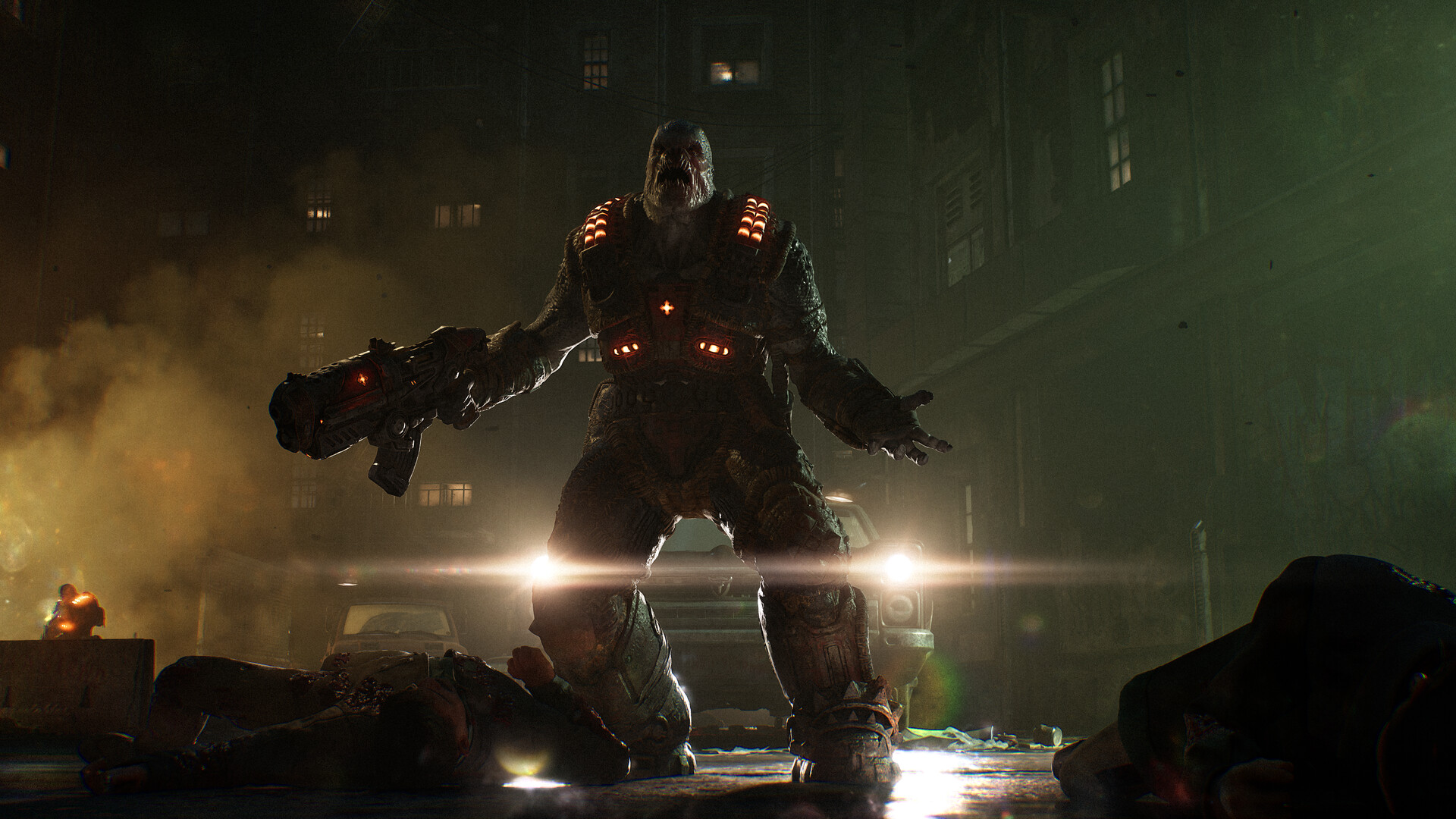
Microsoft and Xbox are currently facing all sorts of troubles (many of their own doing) in the shape of sweeping layoffs, studio cuts, and calls to boycott their products, to name a few. Extremely talented developers (who deserve much better) still put out exciting video games regardless, and with the remake of Halo: Combat Evolved out now, we look to Gears of War: E-Day, the series' first mainline entry since 2019.
While there are plenty of upcoming space games worth keeping tabs on, Gears of War's return feels special for a number of reasons. Although Gears 5 was not a flop – quite the opposite – there was a growing sentiment among the fanbase that Gears of War needed to reevaluate its future by revisiting its past. After a solid remaster of the original game last year, this next chapter is taking us back to where it all started: Emergence Day.
With gameplay systems, mechanics, controls, and visuals fully rebuilt on Unreal Engine 5, The Coalition aims to deliver the ultimate Gears of War experience with E-Day, and at least the atmosphere and tone seem pitch-perfect. But with nostalgia taking so many beloved franchises a few steps back in recent times, we must wonder if there's more to E-Day than reliving the series' glory days? Here's everything you should know about Gears of War: E-Day ahead of its launch.
When is Gears of War: E-Day coming out?
(Image credit: Xbox Game Studios)
Gears of War: E-Day launches on October 6, 2026.
After a gameplay-less reveal in summer 2024, The Coalition went silent to continue work on the prequel. It was finally during the Xbox Games Showcase 2026 that we received confirmation Gears of War: E-Day would arrive before the year's end.
Is Gears of War: E-Day coming to PlayStation 5?
(Image credit: Xbox Game Studios)
No, Gears of War: E-Day won't be releasing on PS5 despite last year's remaster of the first game marking the series' debut on Sony consoles.
Though rumors and leaked materials pointed to Gears of War: E-Day launching on Sony's console alongside Xbox, the full reveal in summer 2026 underlined it was an Xbox Series X/S console exclusive. It will, however, also launch on Windows via the Xbox app and Steam. As usual, Game Pass Ultimate subscribers will also get access to it day one.
Three editions will be available at launch, and you can pre-order them already:
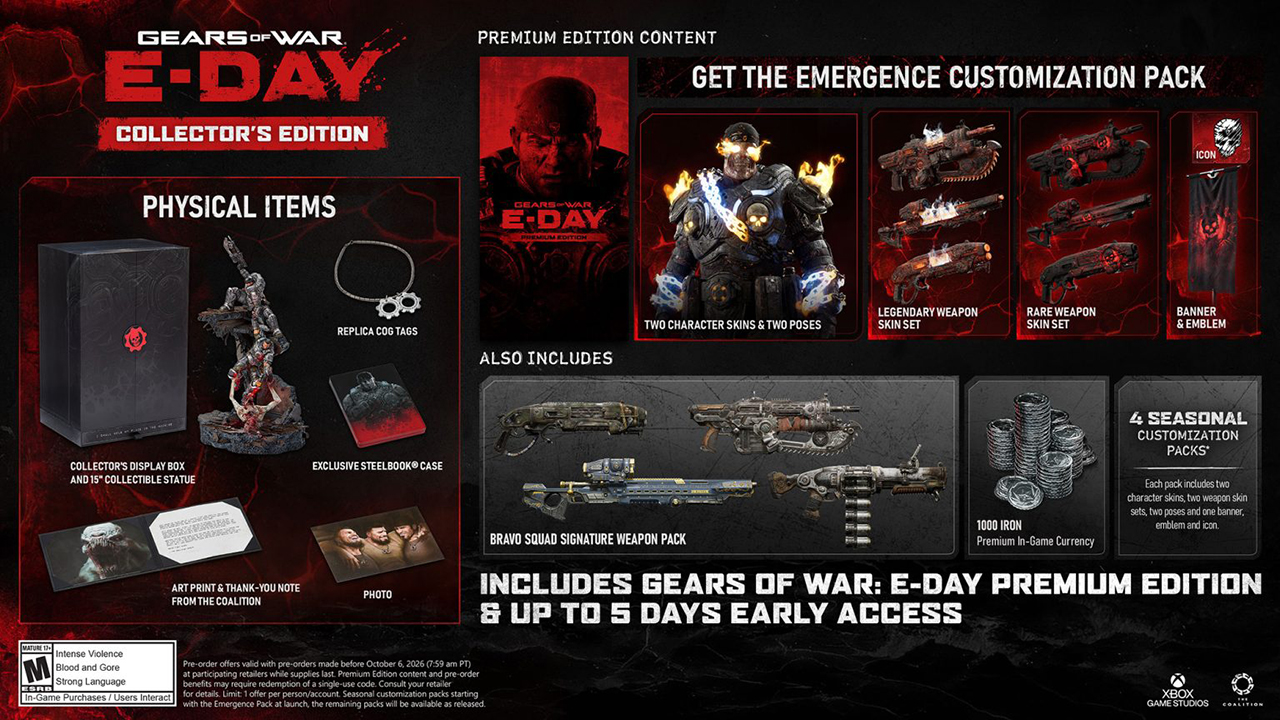
Premium ($99.99 / £89.99 / €99.99) – Base game with up to five days of early access, Bravo Squad Signature Weapon Pack, Emergence Customization Pack, Four Seasonal Customization Packs (released post-launch), and 1,000 iron (the game's premium in-game currency). A separate upgrade for Standard will also be sold.
Collector's ($299.99 / variable regional pricing) – Everything in the Premium Edition plus physical items, including a collector's display box, a 15" statue, replica COG tags, an exclusive steelbook case, an art piece, and an art print & thank-you note from the studio.
All editions also benefit from pre-order bonuses that include open beta early access (on August 6), the Exfil weapon set, and Exfil Dom legendary character skin.
Gears of War: E-Day trailers
Xbox and The Coalition are sharing all sorts of short videos in the lead-up to launch, but if you want to only watch the trailers and gameplay demos, we have them right here:
Is Gears of War: E-Day the first game in the timeline?
(Image credit: Xbox Game Studios)
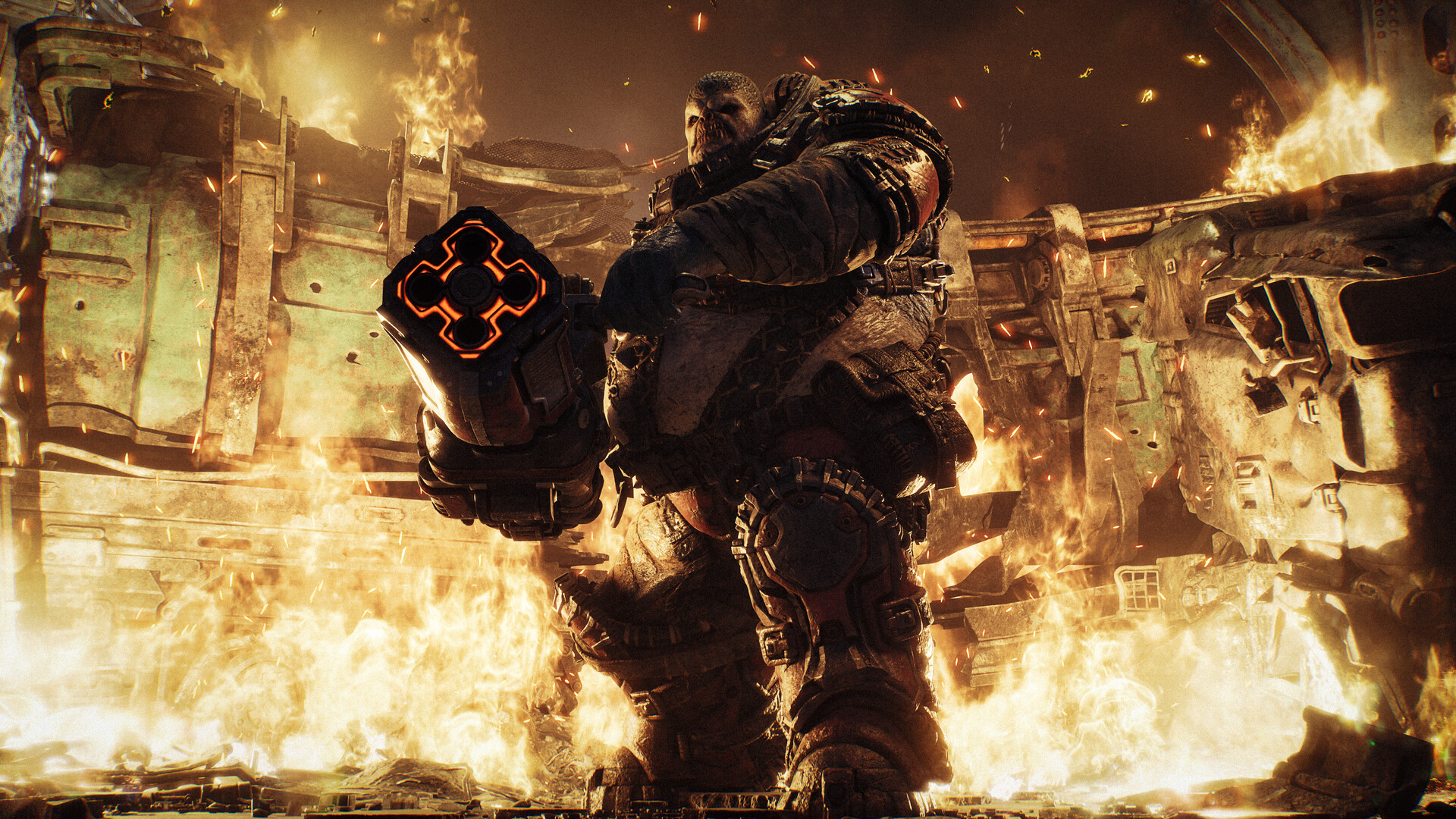
Gears of War: E-Day is the first chapter in the Gears timeline. It tells the story of how the humans on the Earth-like planet of Sera came in contact with the bloodthirsty and relentless Locust Horde on what would later be called Emergence Day.
If you're planning to play the Gears of War games in order, this would be the perfect place to start moving forward. Though the original game and Judgment (a spinoff that was released for Xbox 360) gave us information on what happened during E-Day, we never really had a Rogue One-like prequel similar to Halo: Reach. Now, both veterans and newcomers will be able to experience the struggle humanity faced as a new conflict erupted.
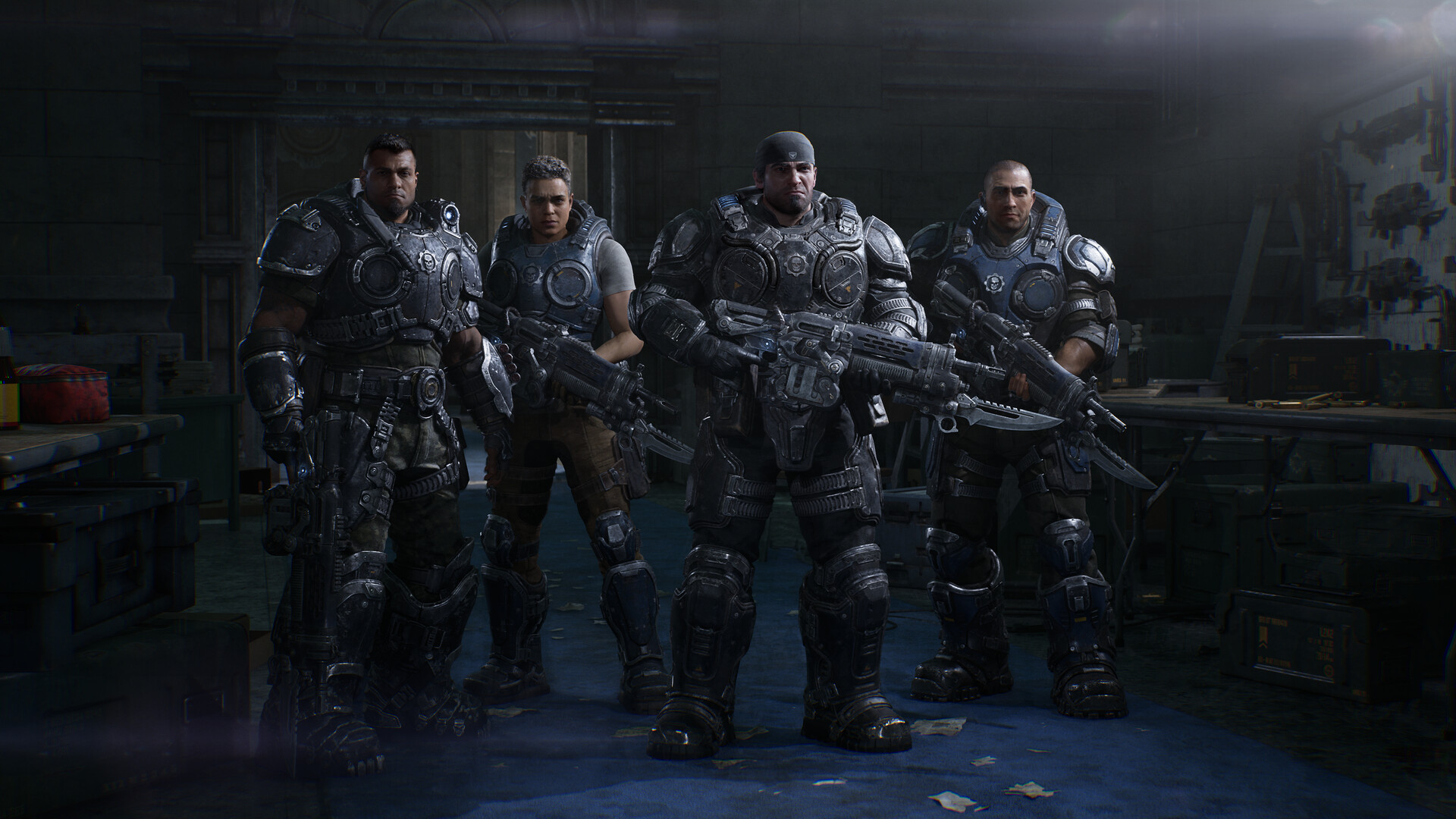
Alongside a supporting cast of new and familiar faces, the story follows original trilogy protagonists Marcus Fenix and Dominic 'Dom' Santiago as they battle through the chaos of E-Day and push back against the subterranean invaders. For additional context, the war against the Locust kicks off only a few weeks after the 79-year conflict between human factions known as the Pendulum Wars, which explains why the COG wasn't in the best of conditions when the monsters attacked.
Will Gears of War: E-Day have co-op and competitive multiplayer?
(Image credit: Xbox Game Studios)
Gears of War: E-Day is a third-person, cover-based shooter in the style of the previous games and, as such, both co-op and competitive multiplayer are back alongside the single-player experience.
The main story campaign can be played in single-player, or with up to four players online or two players locally via split screen. It must be noted the PC version of the game won't feature local co-op. These player counts also apply to the series' famous Horde Siege PvE survival mode, which pits players against waves of enemies as they select different classes and loadouts.
Versus PvP multiplayer for online competition also returns with all-new maps and both Social and Ranked matches. While the post-launch support hasn't been fully detailed, it feels likely more maps will be added in the future at no extra cost.
Is there a Gears of War: E-Day demo?
(Image credit: Xbox Game Studios)
There's no Gears of War: E-Day demo announced at the time of writing. However, players can look forward to a multiplayer open beta happening in the coming weeks. More specifically, those who pre-order or have active Game Pass Ultimate subs can access the test early, from August 6 to 10. The second – and fully open – weekend will happen at a later date, probably the following week.
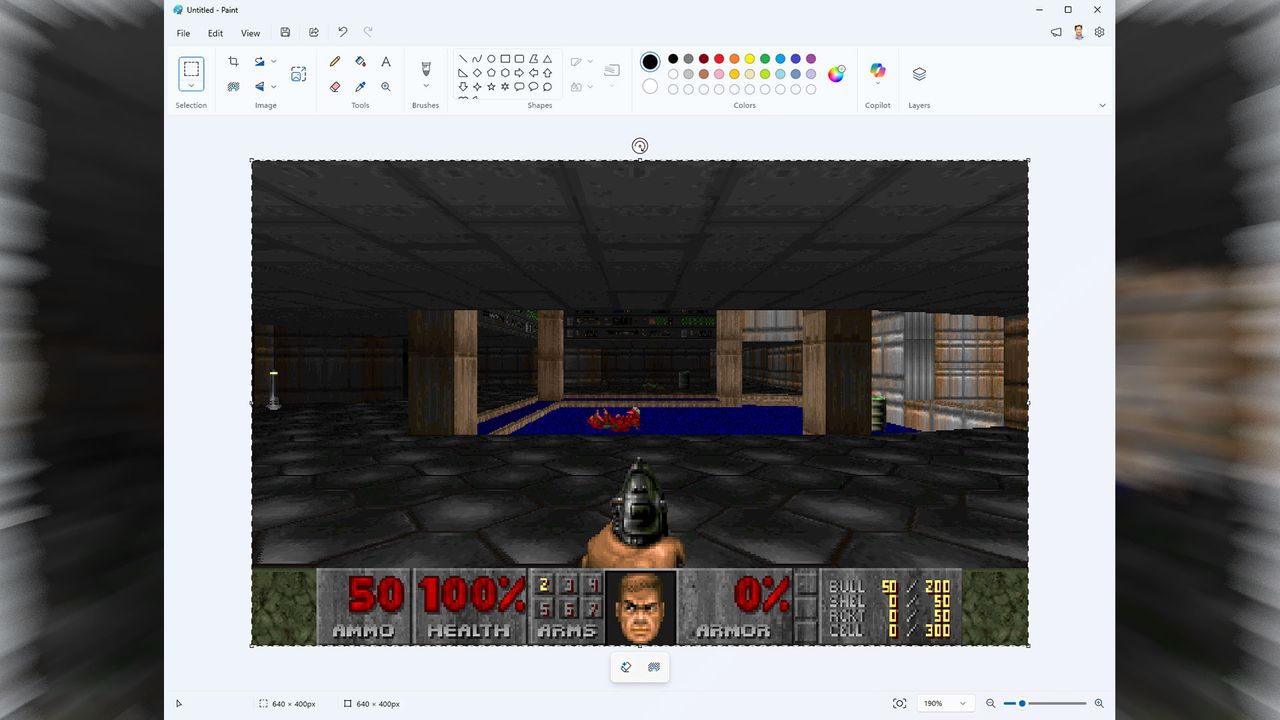
Another day another Doom port, but the new DoomPaint stands out from the crowd for a few reasons. Firstly, it has been developed by Mark Russinovich, the Microsoft Azure CTO. Secondly, DoomPaint runs the actual original shareware Doom release using MS Paint as the monitor or viewport for in-game action. That’s different, and it is remarkable to read that the OLE clipboard hack behind this latest Doom escapade allows the game to run at a fair pace, up to 35 FPS, but might also sometimes be “spreadsheet-tier,” according to the author.
“The actual Doom engine (ViZDoom) runs the real shareware DOOM1.WAD — with the BSD-licensed Freedoom WADs covering the episodes shareware doesn't ship — and renders headlessly,” explains Russinovich on the project GitHub page. “Every frame is placed on the Windows clipboard and pasted into Paint's canvas as a genuine document edit.” The Microsoft CTO adds that the relatively low frame rate “is part of the charm” of DoomPaint, but 35 FPS isn’t bad, if you can make it, especially in 1990s PC gaming terms.
There are files, resources and instructions on how to run DoomPaint on the GitHub site. Depending on your machine you may be able to run this version of Doom at a full 35 FPS at 320 x 200, or even 640 x 400 pixels. It even includes sound and music.
Towards the end of the README file, Russinovich says that “Paint renders the game but does not compute it. Paint computes nothing. Paint has never computed anything. That's the joke.” DoomPaint is distributed under the MIT license.
Russinovich started at Microsoft in 2006, where he’s transformed SysInternals into the backbone of Windows diagnostics. More recently he’s shaped Azure’s architecture, security, and reliability. Over the past year he has, accidentally or by design, become well known as a leading voice behind addressing the many shortcomings of Windows 11.
It's therefore kind of surprising that this busy CTO has time to fiddle with projects like DoomPaint. However, the most dedicated coding and computer enthusiasts will also code and compute in their spare time.
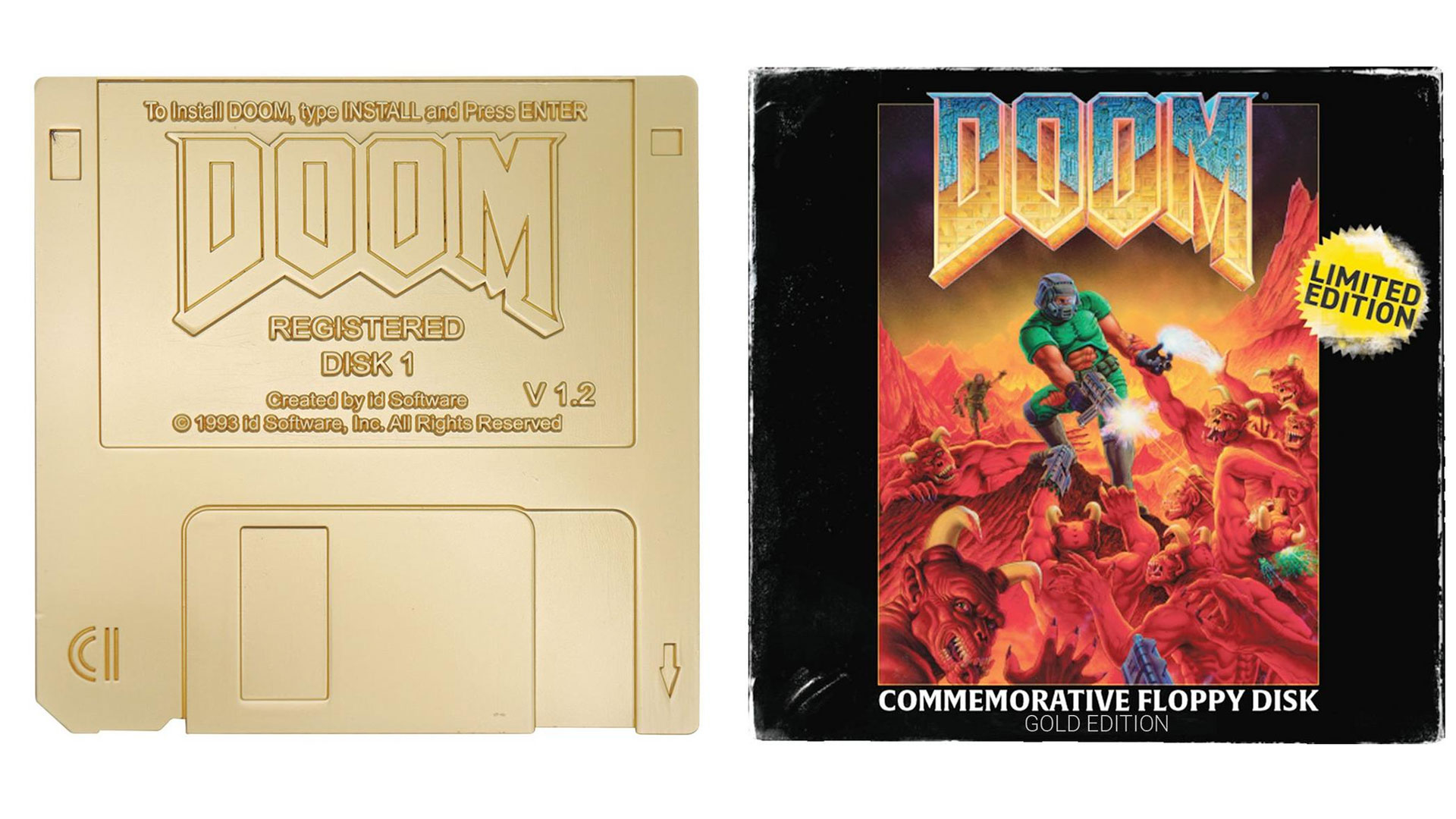
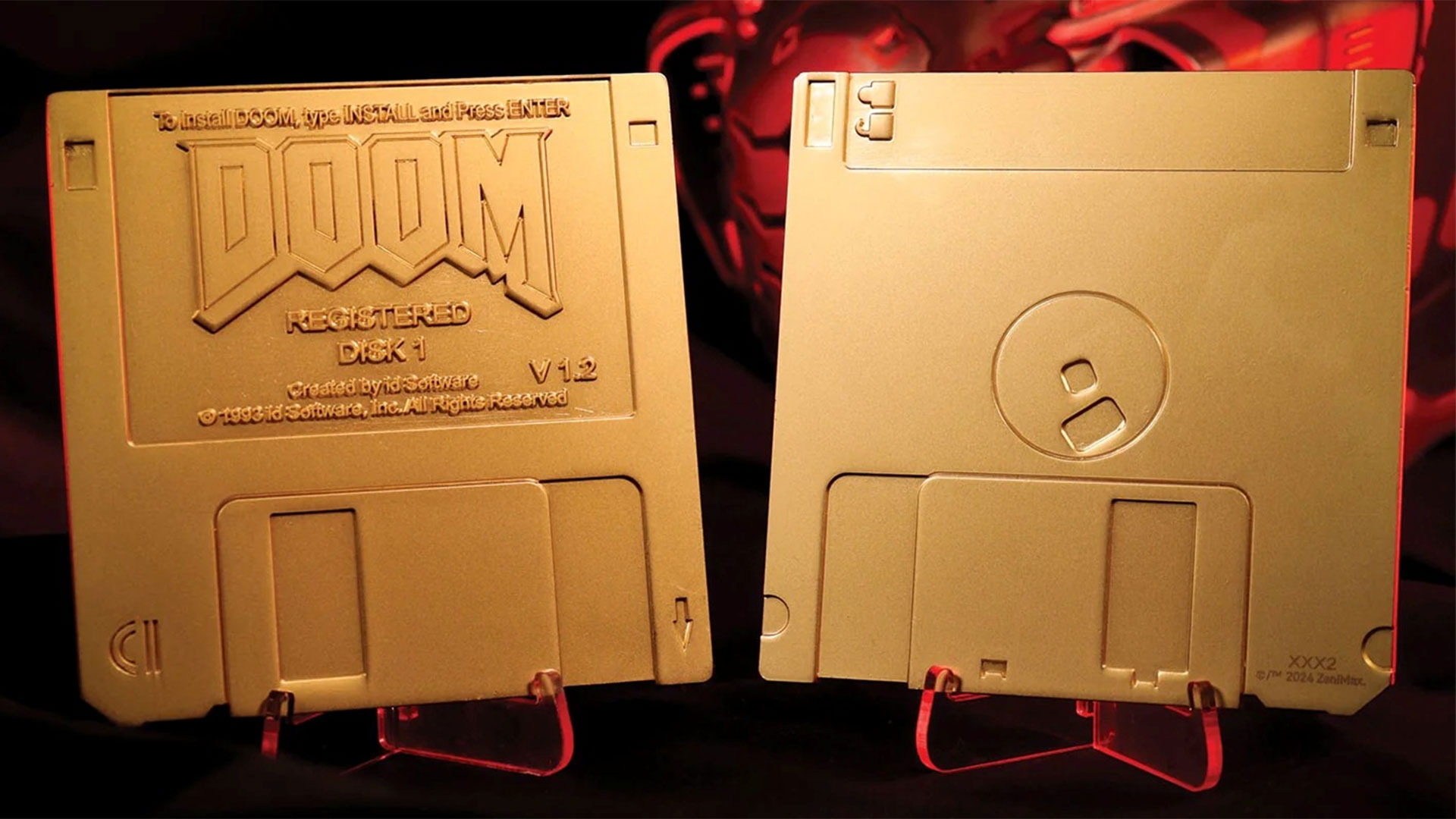
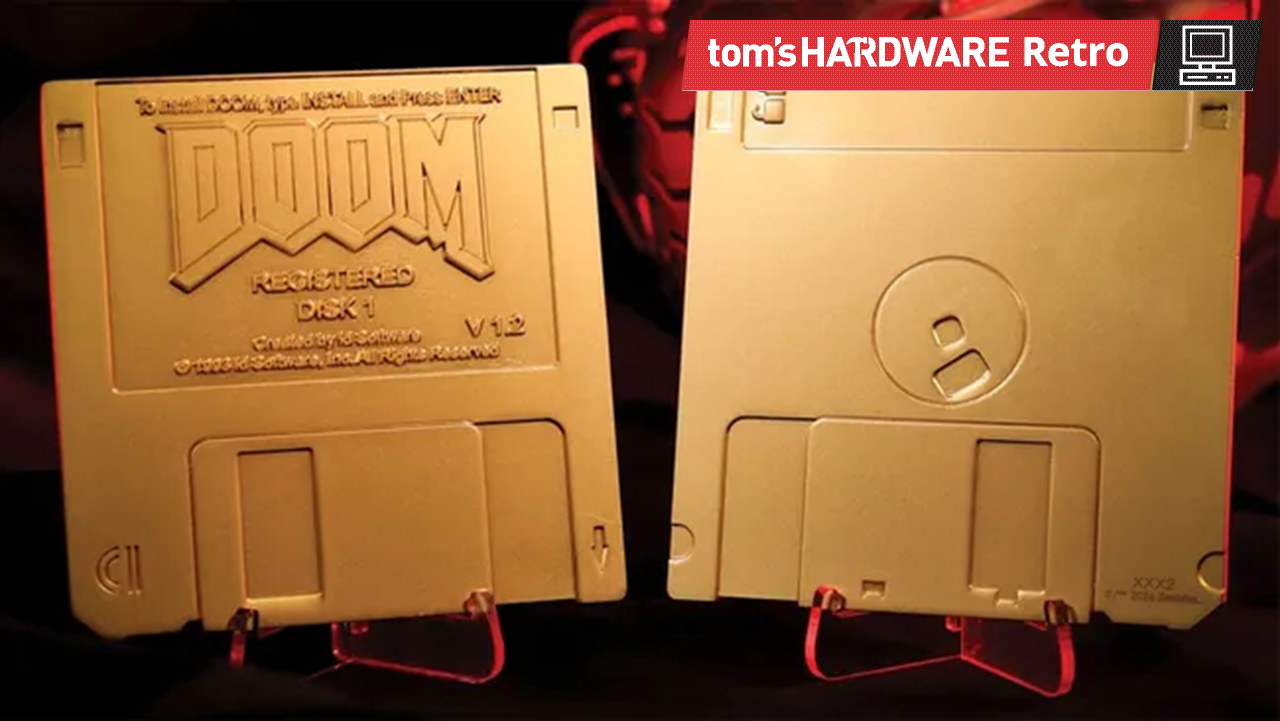
GameStop has listed a Doom Floppy Disk Limited Edition Imitation Gold Plated Replica at $29.99. Let’s unpick that for a moment. These are imitation floppy disks coated in imitation gold, delivered in a commemorative box. There’s a display stand included, too. However, these are non-functioning 'floppy disks' inspired by the Doom v1.2 shareware release and don’t contain any game data. Doom's single-level ‘Knee‑Deep in the Dead’ shareware release is still free to download, though, as it has been for many years.
GameStop and FanattikGameStop and FanattikGameStop and Fanattik
“What's more retro than obsolete technology?” asks Fanattik, the collectibles maker behind this useless physical media. “Celebrating the humble 3½-inch, 1.44 MB floppy disk that the game was originally released on back in 1993, this limited edition Doom Floppy Disk Replica plated with imitation gold comes in a box displaying the original game artwork, has a display stand included, and is individually numbered as one of 5,000 worldwide.” Pre-orders are now open at GameStop in the US for $29.99 or directly from Fanattik in the UK at £19.99.
The 89 x 89 mm dimensions of the golden-but-not-gold and 3.5-inch-but-not-floppies make them at least the correct size. However, if I were buying fake floppies, I think I would appreciate a movable protective sliding mechanism and the write-protect cutout toggle to move, so I could fidget with them from time to time.
Also, in some ways, it is ironic that game media is now being licensed and hawked to fans, at non-trivial prices, without any game data contained on them. This seems to be a growing trend as the games industry moves inexorably to a digital-only future. People still covet the physical media so much that they are now willing to pay for it, even without any game data or download code being associated with it.
The original Doom v1.2 shareware edition was released on two floppy disks in Feb 1994, and it is famous for adding modem support to this seminal game. If you paid and registered Doom v1.2, you would get four floppy disks from id Software containing the full three-episode campaign. The registered release disk set stayed on four floppies until the CD-ROM era.
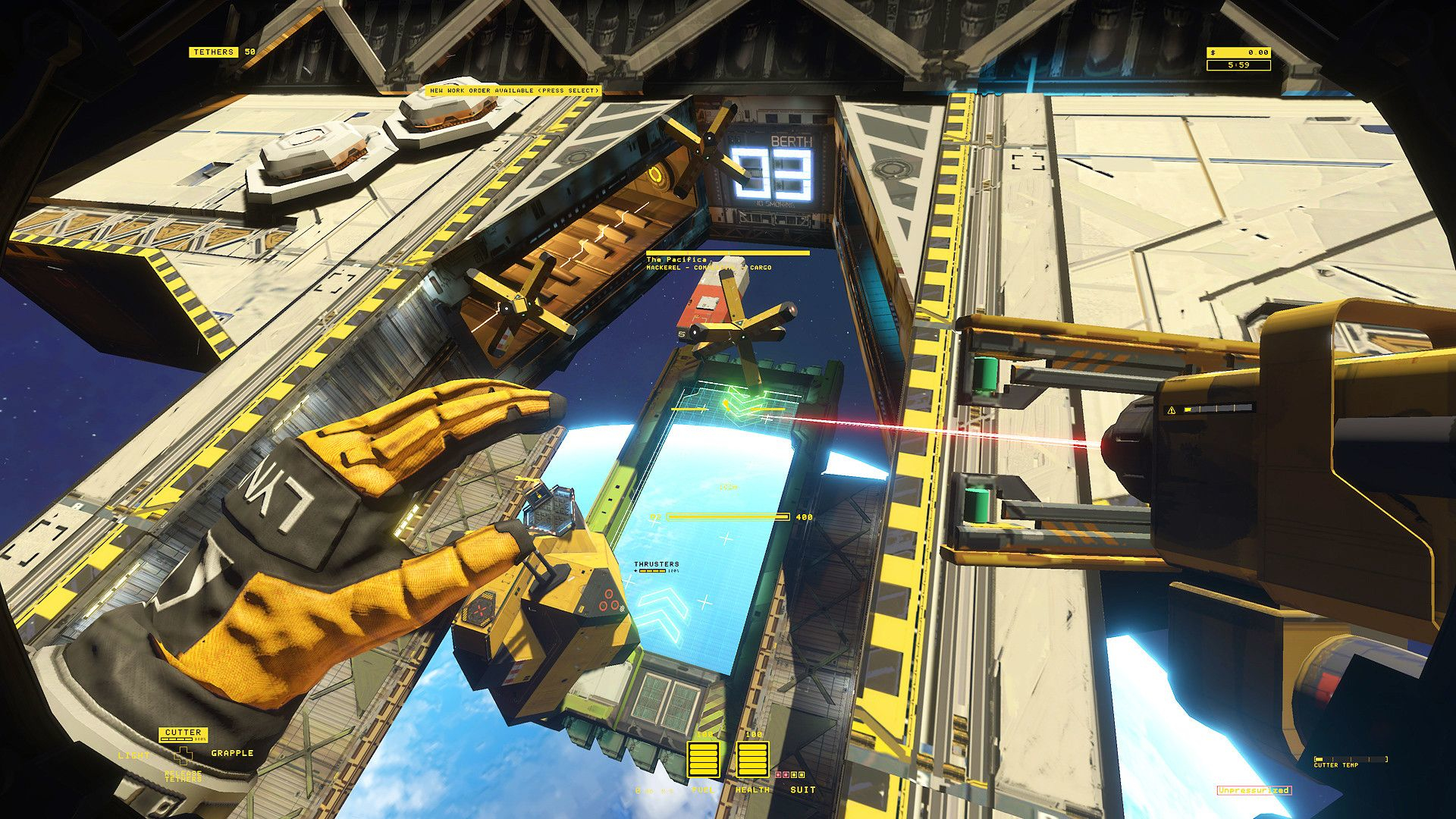
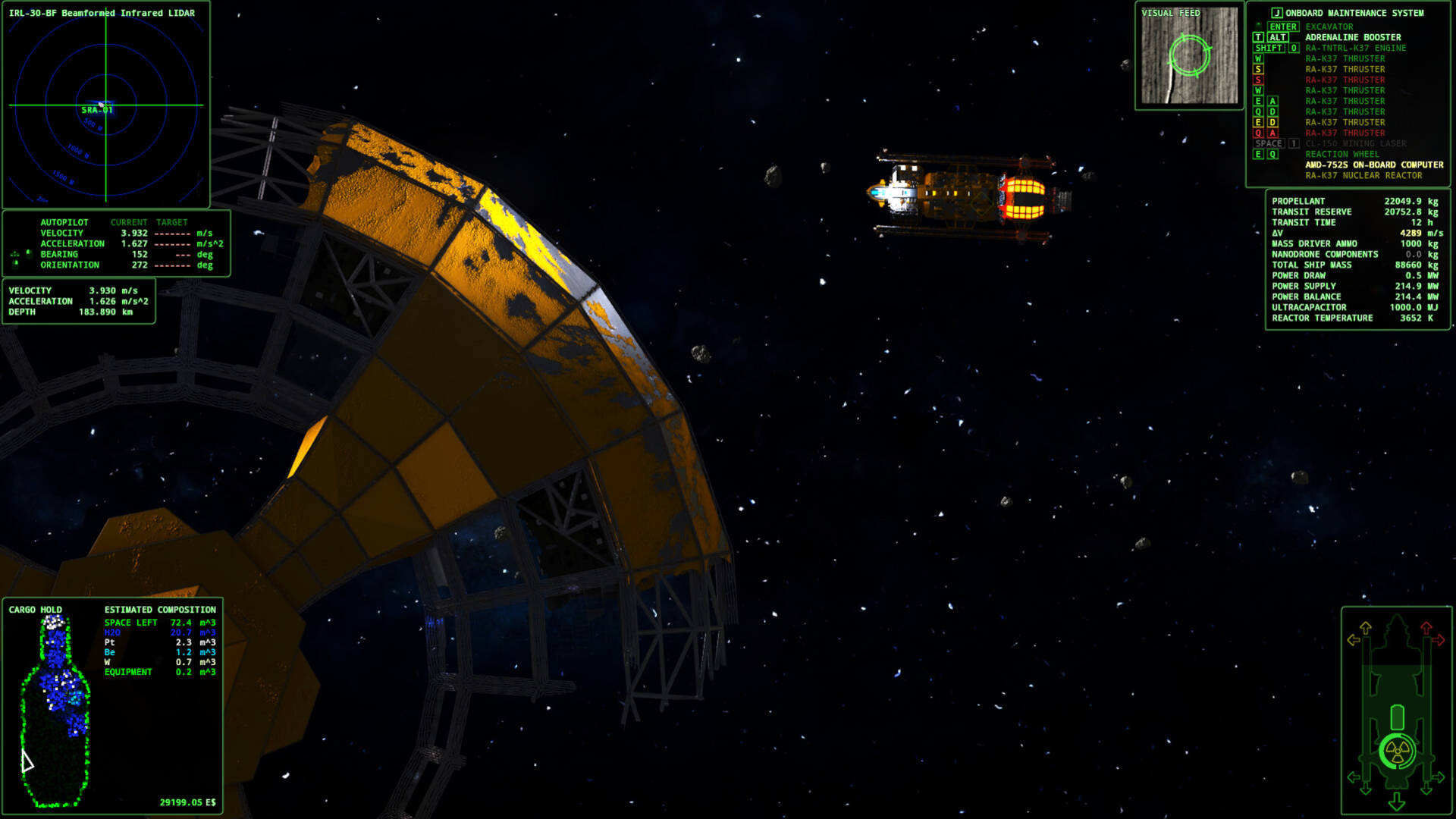
While Hardspace: Shipbreaker does an excellent job of capturing the dystopian perils of unchecked hypercapitalism, the real fun in thisspace game comes from carving up massive capital ships with space lasers and explosives.
Floating in zero gravity, players slice derelict spacecraft into salvageable chunks, while also contending with unruly physics, pressure, and profit margins. It's a compelling fantasy: orbital blue-collar labor, where yesterday's spacecraft become tomorrow's raw materials.
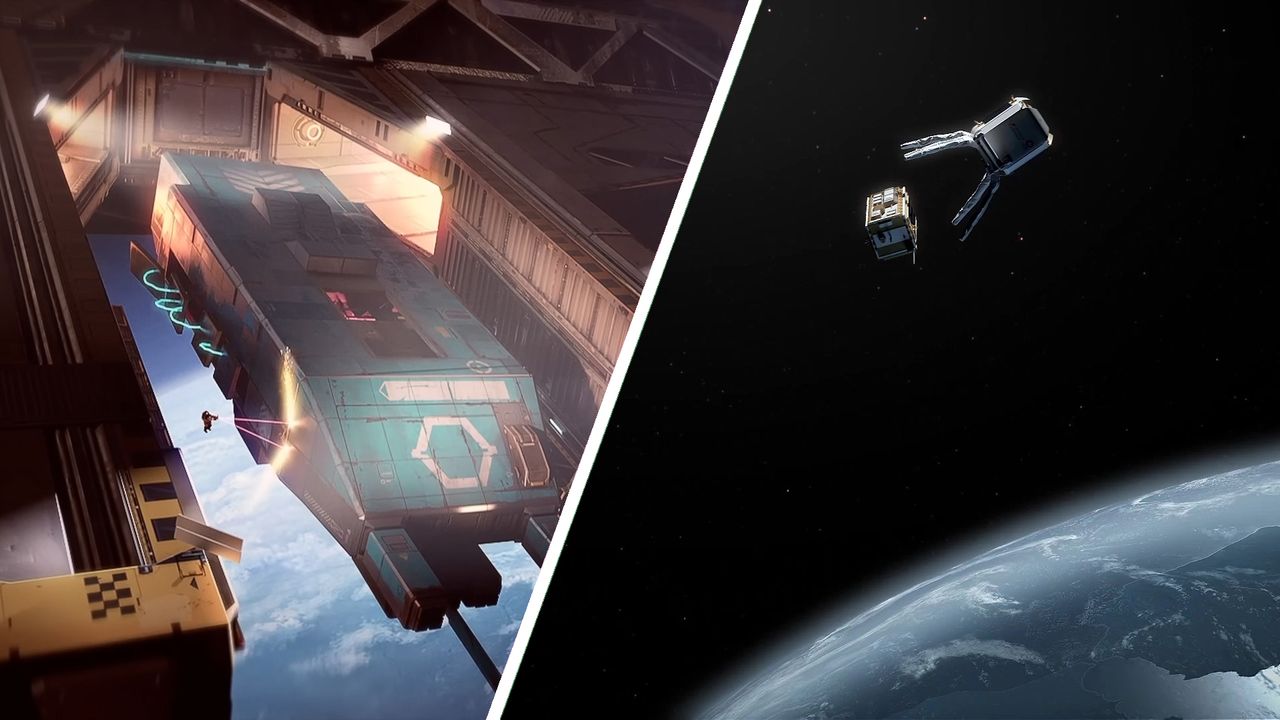
As satisfying as the simulation is, the real-world challenge of space debris removal is both more constrained and more urgent.
(Image credit: Blackbird Interactive)
Christian Steimle is the Project Manager of the European Space Agency's (ESA) ClearSpace-1 mission, the first ever aimed at removing a piece of debris (in this case, a satellite called PROBA-1) from low-Earth orbit.
We spoke to him to get a sense of how actual space junk removal will happen in the future, and how it stacks up to the representations we see in sci-fi games like Shipbreaker.
The fantasy of orbital demolition
(Image credit: Blackbird Interactive)
Games like Hardspace: Shipbreaker, ΔV: Rings of Saturn, and other space cleanup simulators tend to emphasize three core ideas: that debris can be dismantled piece by piece, that tools can safely cut or break apart structures in orbit, and that salvage is economically driven and scalable.
While they may be necessary assumptions to make for engaging gameplay, they diverge pretty significantly from current realities.
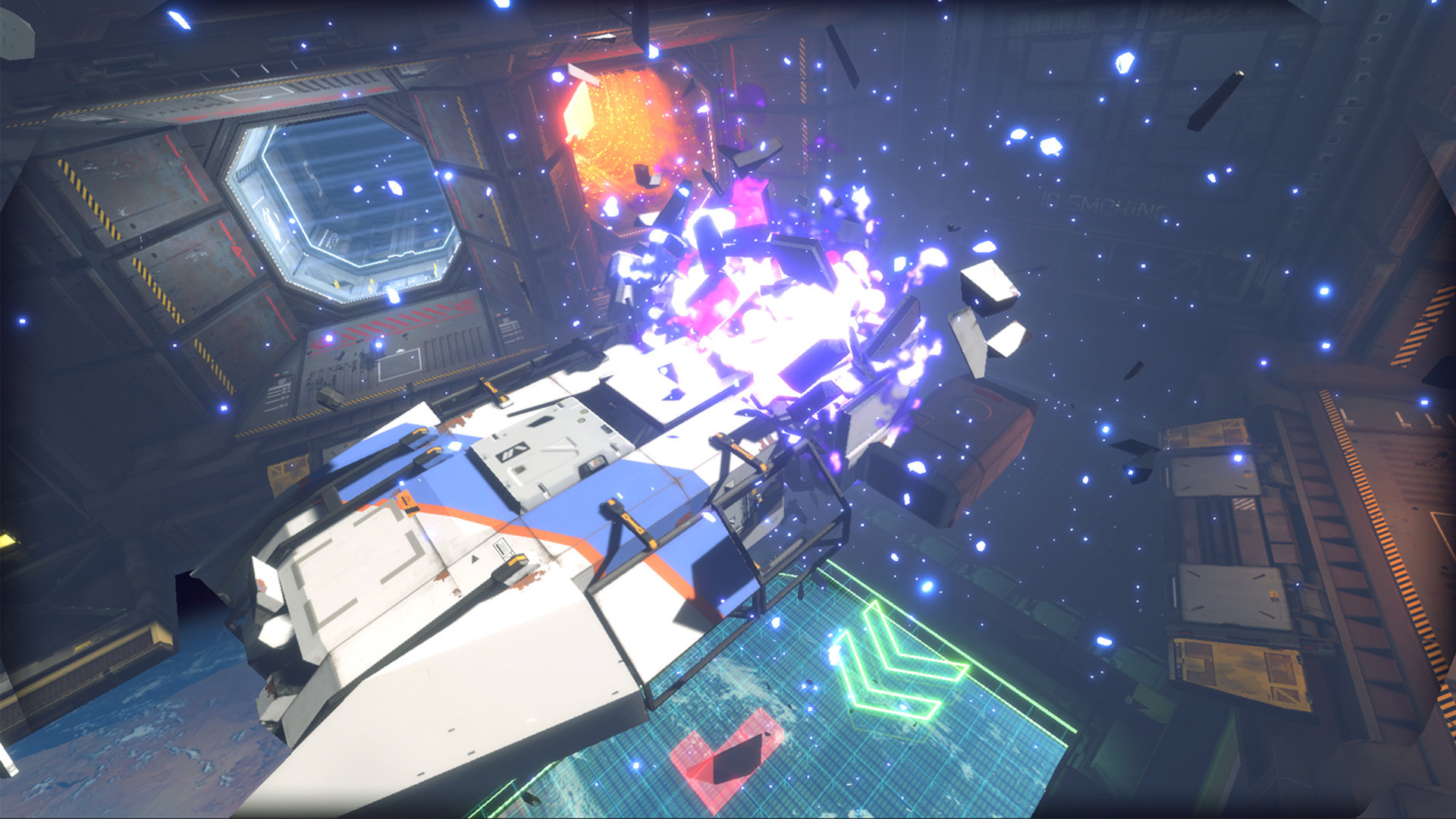
The main issue is fragmentation. Breaking apart a defunct satellite, even under the most carefully controlled and monitored conditions, risks generating thousands of high-velocity fragments. Some of those generated would be too small to feasibly track, yet large enough to destroy operational spacecraft, satellites, or stations. This is the nightmare scenario behind the Kessler syndrome, a cascading chain of collisions that could render entire orbital pathways unusable.
(Image credit: Blackbird Interactive)
As Christian Steimle, Project Manager for the European Space Agency's ClearSpace-1 mission, explains, "The common agreement between all of these missions is that objects to be removed shall not be broken up or damaged… especially to avoid creating smaller debris which is more difficult to track."
That means that the core mechanic of many space salvage games (cutting or exploding things into smaller bits) is precisely what real missions are designed to avoid.
How real debris removal works
(Image credit: Clearspace)
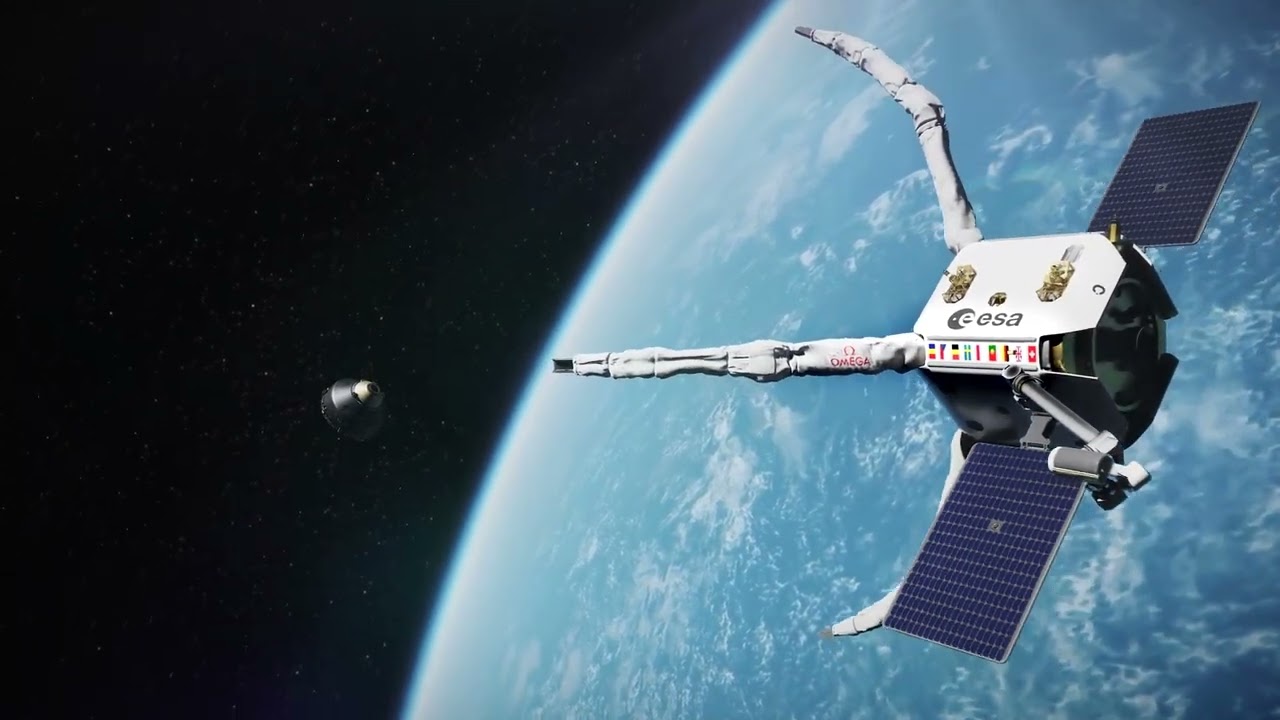
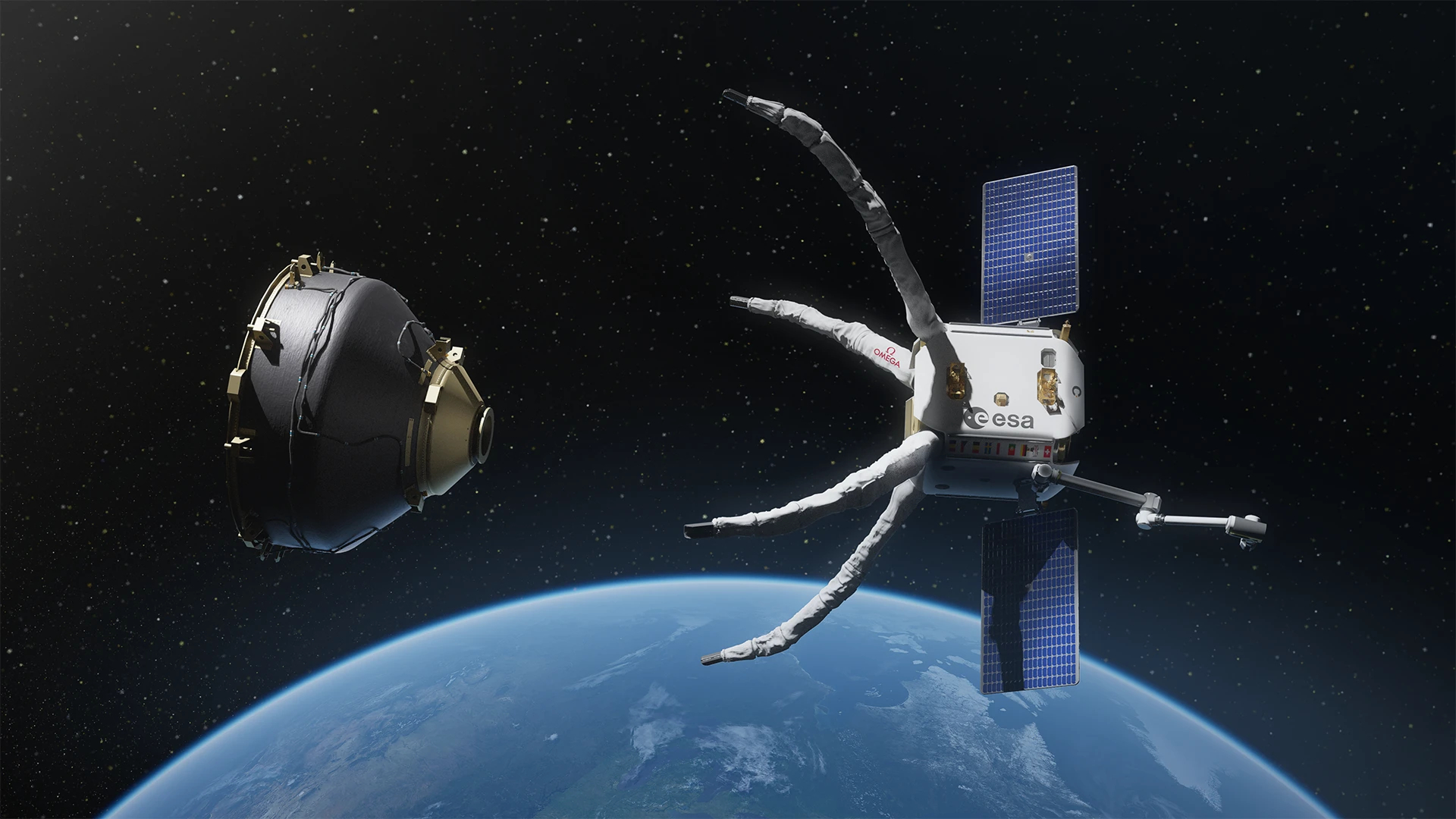
ClearSpace-1 takes a more holistic approach. Instead of dismantling debris, the mission aims to capture PROBA-1 with as little initial damage as possible, then guide it to destruction in Earth's atmosphere.
"ClearSpace-1 will be launched into a position slightly below PROBA-1 by a dedicated launch," Steimle says. "After successful commissioning, the ClearSpace-1 servicer will inspect PROBA-1 in a number of fly-around manoeuvres."
These inspection passes are not just reconnaissance. They validate visual navigation systems and analyze how the target object is tumbling so the capture vehicle can respond appropriately.
The capture itself is a delicate operation. "The ClearSpace-developed capture system will encompass the client satellite, first forming a cage around PROBA-1, then closing the cage carefully to avoid damaging the client," Steimle explains.
Once secured, the combined spacecraft must be stabilized before any orbital change. Only then can the system lower its orbit, ensuring both objects burn up safely during re-entry. "ClearSpace-1 is designed to demise during re-entry, ensuring on-ground safety and disposal at the same time."
The process more closely resembles a surgical extraction of potentially hazardous material than scrapyard demolition.
What games get right
(Image credit: Kodera Software)
Despite their liberties, space cleanup games do hit the mark in a number of areas. One is the importance of orbital mechanics. Many games emphasize inertia, momentum, and the difficulty of stopping or redirecting large masses. Real active debris removal (ADR) missions face similar constraints, where even small velocity mismatches can lead to mission failure or damage to the capture vehicle or target.
The danger of uncontrolled motion is also well represented. Tumbling objects are among the hardest targets in space operations. Synchronizing with them requires precise, multi-axis propulsion and control systems. As Steimle notes, future vehicles must "synchronise [their] motion with a potentially tumbling space object and apply the proper control to detumble." One of the main challenges in games like Shipbreaker is avoiding being clobbered by moving debris, especially after you've detonated some explosives, or matching the speed of a rotating component long enough to cut it apart.
Third, specialization is key. Your toolkit and how you use it in games like Shipbreaker is key, and real missions rely on highly tailored capture systems. Each target may require a different approach, from robotic arms to nets, harpoons, or enclosure systems like ClearSpace's.
Where the simulations fall short
(Image credit: Clearspace)
The biggest gap between games and reality isn't the tech, it's risk tolerance.
In games, mistakes are recoverable. In orbit, a single error can generate long-lived debris fields traveling at roughly 7–8 kilometers per second, turning tiny fragments into deadly kinetic weapons.
Games also tend to assume an eventual salvage economy, where materials are recovered and reused in space. While in-orbit manufacturing and recycling are active areas of research, current debris removal efforts aren't about profit. They're about mitigation.
"The overarching requirement is to preserve the space environment around the Earth for use by future generations," Steimle says. "Removing large objects before first collisions occur is key."
There are also orbital regime differences that games rarely address. In geostationary orbit (GEO), for instance, debris is not deorbited but moved to a higher "graveyard orbit" due to the prohibitive energy cost of re-entry. This kind of orbital zoning has no real analogue in most gameplay systems.
The future of orbital cleanup
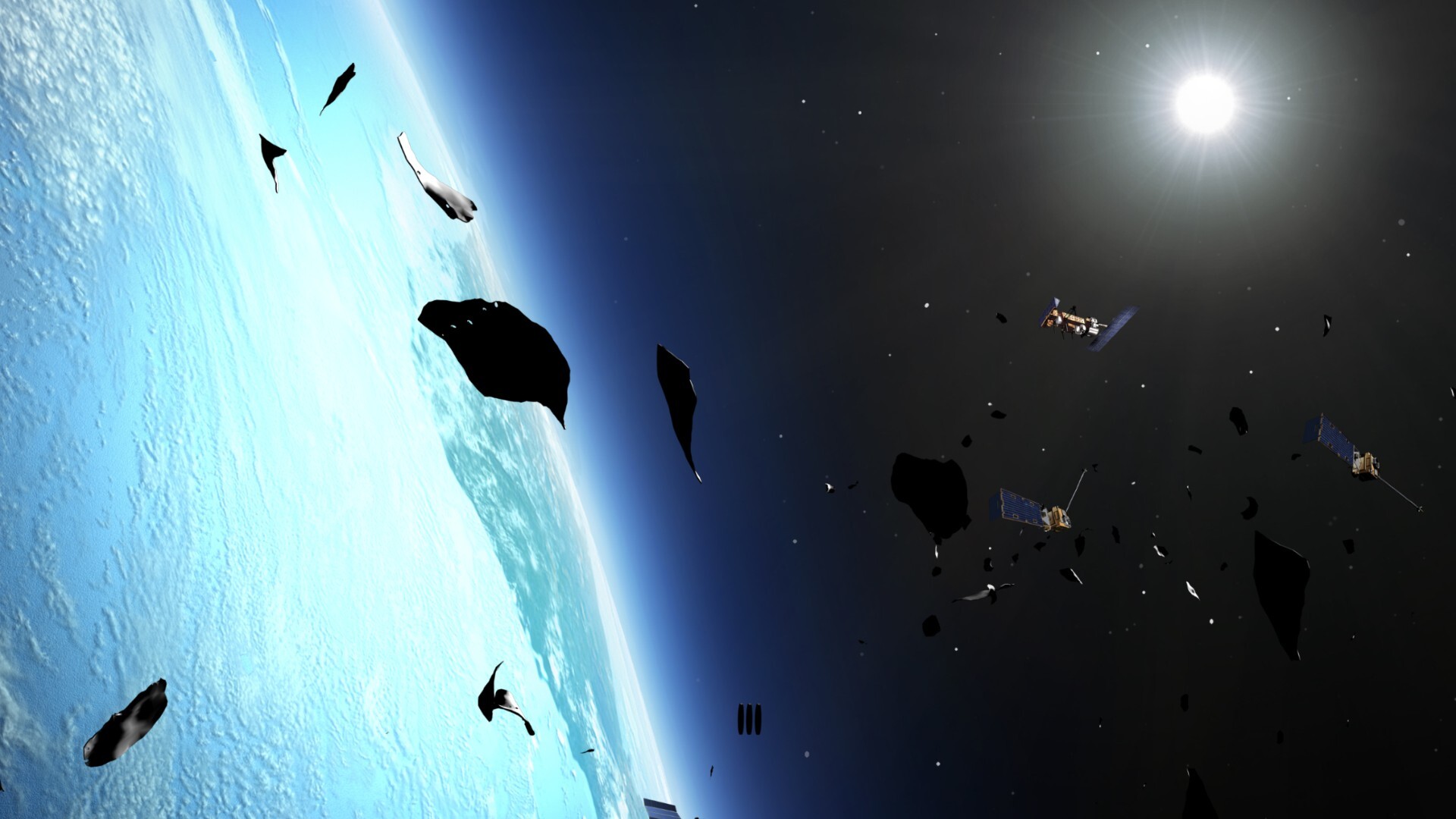
Illustration of space junk around Earth. Space junk consist of debris left in orbit from space missions: abandoned or broken satellites, satellite pieces, tools dropped by astronauts, or even space rocks captured into Earth orbit. (Image credit: Mark Garlick/Science Photo Library/Getty Images)
Looking ahead, the field of in-orbit servicing and debris removal is diversifying rapidly. Steimle says agencies and private companies across Europe, the United States and Japan are developing competing capture technologies and mission architectures.
Low-Earth orbit operations will likely favor agile, highly maneuverable vehicles capable of complex rendezvous and stabilization tasks. GEO missions, by contrast, will involve larger, less dynamic spacecraft performing long-duration servicing and relocation.
What remains consistent is the guiding principle: do no harm to the orbital environment. There's little room for the improvisational cutting and explosive decompression you see in most space salvage games. Instead, the future of orbital cleanup will depend on autonomy, precision guidance, and tightly controlled interactions with fragile, often unpredictable objects.
Fiction vs. necessity
An artist's illustration of space junk orbiting Earth. (Image credit: NASA)
Perhaps tellingly, most space cleanup games focus on the economy of salvage. You're tasked with generating profit, or feeding it into a progression system to purchase new tools or more efficient methods of destruction. In reality, the immediate challenge is more conservative and more urgent: preventing a runaway cascade of collisions that could close off access to space altogether.
If anything, the contrast highlights just how precarious Earth's orbital environment has become. The fantasy is not that we can break things apart in space; it's that we can continue to use space safely without cleaning up the vast constellations of trash we've already left behind.
Team Fortress 2 cases are worth pocket change. There are a few select cases that scale up to a few dollars, and even fewer with a market price in the double digits, but the vast majority of cases are worth a few pennies, no more than a Steam Trading Card. But one player, Vincent Stech, started collecting cases nearly a decade ago, racking up over 1.7 million cases across several Steam accounts. And now, he’s selling the whole collection, with an estimated value of $100,000.
Stech started collecting cases around Team Fortress 2’s last major update, in late 2017, outside of annual Halloween events that persisted through 2022. In order to accumulate so many cases, Stech largely automated the process, noting that he was careful not to upset the string-pullers at Valve as he amassed a stash of seemingly innocuous digital assets.
“That’s always been one of my biggest fears over the past decade, is one day they wake up like ‘hey, we don’t like what this guy’s doing,’” Stech told Tom's Hardware. “Because I know people with accounts with like 50,000 items that won’t load, and Valve won’t delete the items off their account, so they just can’t access Team Fortress 2 inventory ever again on their main account.”
Before understanding Stech’s process, however, we have to start with how Team Fortress 2’s in-game economy works. Like other Valve titles, you’re able to list items you earn in-game on the Steam Community Marketplace, selling them for real dollars or spending real dollars of your own to buy other items. That’s the normal way of doing things, but this in-game economy has grown beyond the bounds of Steam. A lot of transactions happen off the platform.
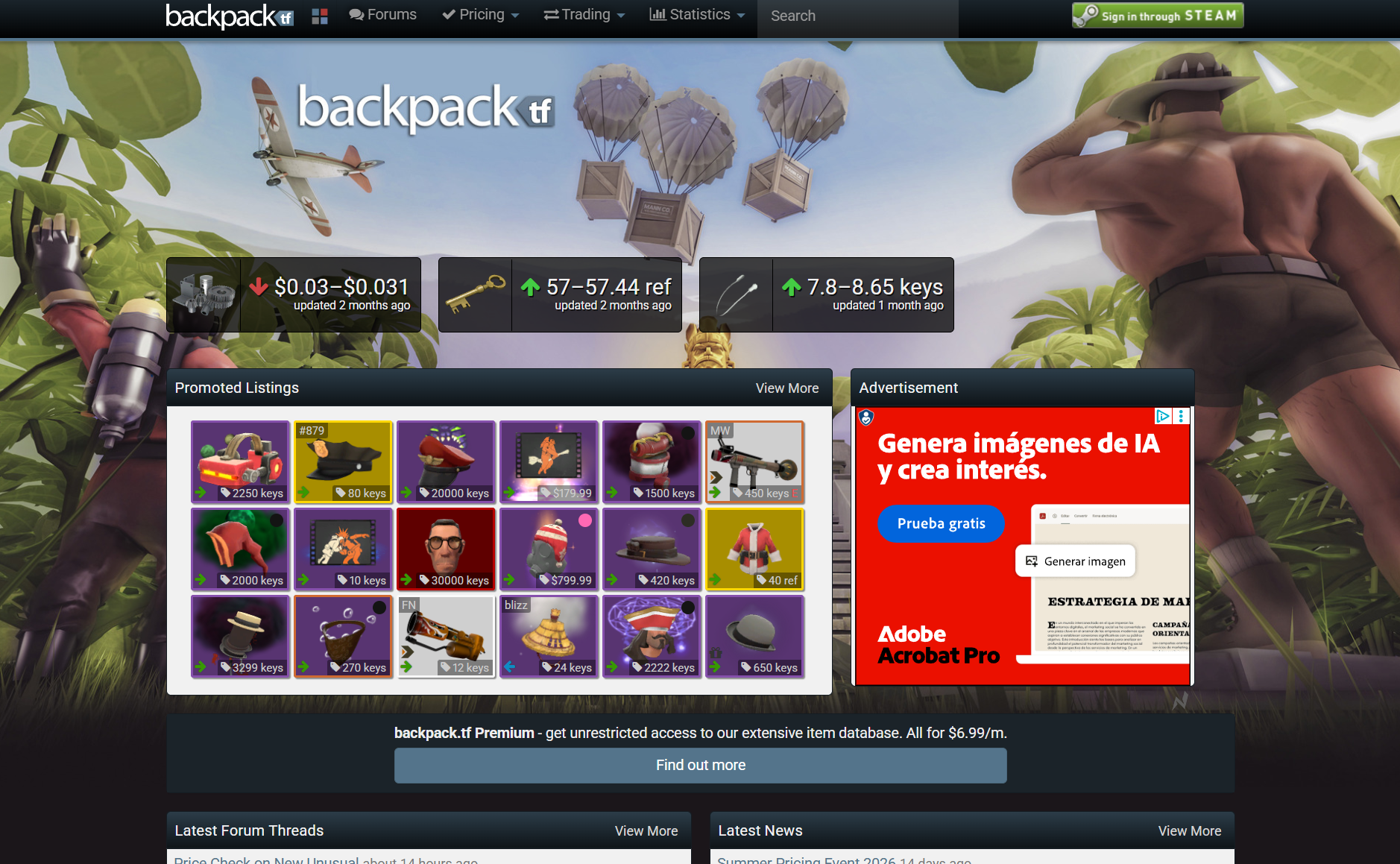
(Image credit: Backpack)
Websites like backpack.tf and stntrading.eu take trading off of Steam, allowing you to use in-game crafting materials (along with keys) to buy and sell items. There are several reasons for these third-party marketplaces to exist, not the least of which is bot automation, which is against Steam’s Terms of Service. This exchange of in-game currency for items happens through trades on Steam, creating a separate marketplace where real money doesn’t change hands.
That’s not where Stech started. “Team Fortress 2 cases, they weren’t worth anything. They were… people were just giving them away because they take inventory spots,” Stech said. “People were deleting things, and so I decided to scoop them up.”
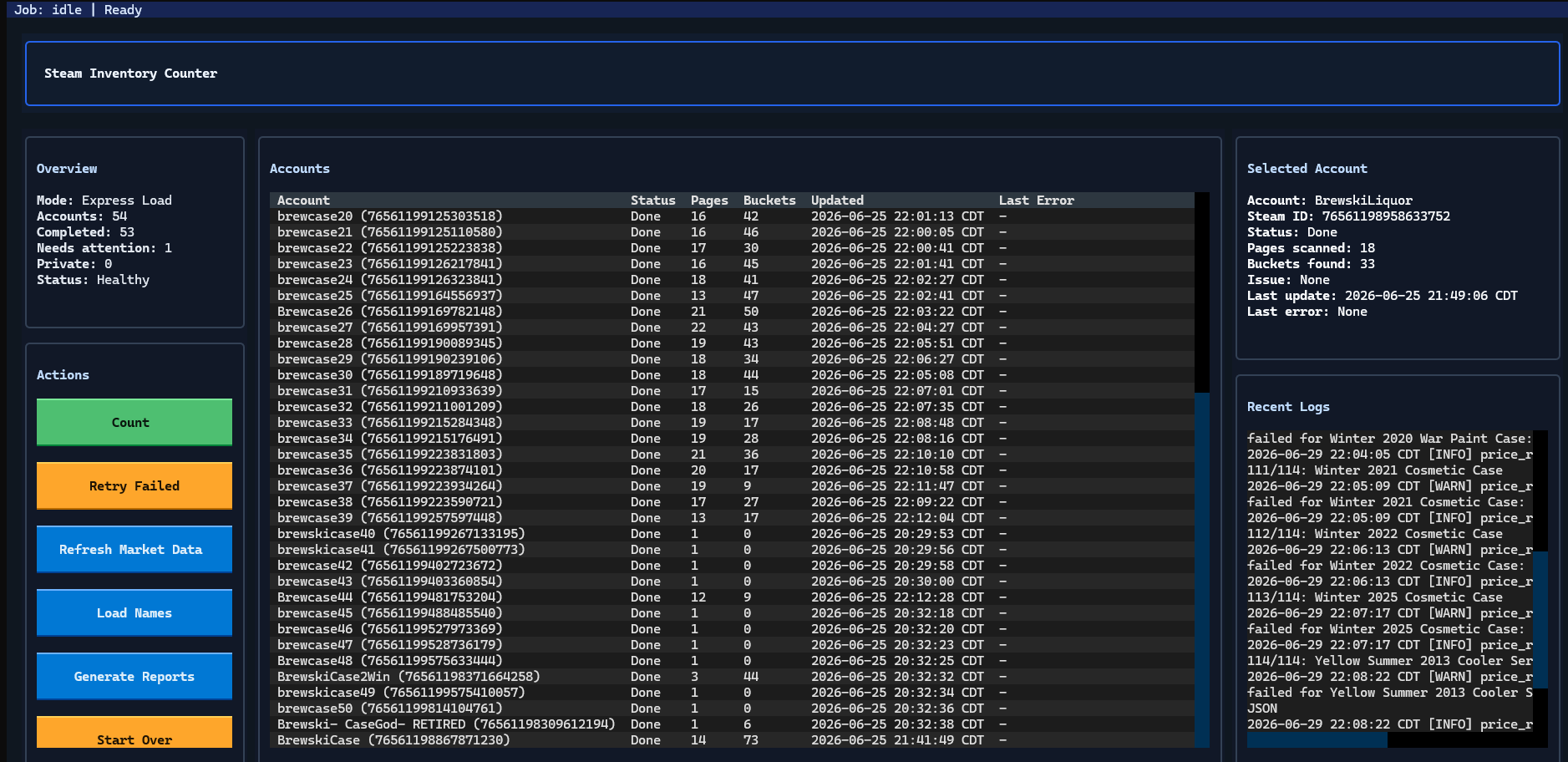
The problem Stech quickly ran into was inventory space. You can only have a few thousand items in your inventory (Stech told me 4,000 for Team Fortress 2, others say it’s around 2,000). Regardless of the number, it’s far too low a limit to amass nearly 2 million items, even with dozens of alternative accounts. Stech bypassed this issue by using the community marketplace. He listed the cases at very high prices where they were unlikely to sell. That’s because you can have tens of thousands of items on the market “before Steam gets really angry at you.” It effectively multiplies inventory space.
(Image credit: Vincent Stech)
As his inventory began to grow, Stech started automating the process of taking inventory and accepting trades, the latter of which was handled through a simple batch file. At first, Stech was just buying cases in bulk at relatively low prices, but the inventory escalated once he started digging into Steam’s local pricing in different regions.
“In Venezuela and, like, Russian [Rubles]... they are very weak currencies compared to the U.S. dollar,” Stech said. “What I found out is the lowest you can sell an item on Steam for us is three cents. For them, it’s a 10th of a penny. So I found this one guy in Venezuela… he would buy almost every case off the Steam Community Market for their extremely low price, and then he would sell it to me, and I would just give him, like, keys. And he was actually a doctor in Venezuela, and they don’t make much at all by comparison to, like, what $50 would be in USD. So a large majority of his income was case money.”
For context, $50 is equivalent to just over 37,000 bolívares (the official currency of Venezuela).
Stech’s first cash-out from Steam was $50 when he was around 16 years old. A few years later, he cashed out $2,500 to buy his first car. Stech stopped collecting cases about three years ago, and now, he’s looking to sell off the entire collection, which he estimates is worth around $100,000.
Selling this collection is no easy feat, however. For starters, Steam can break when trades get too large, necessitating hundreds of trades across dozens of different accounts. Further, Stech controls quite a large portion of known cases. “At one point, I calculated I had, like, 17% of all TF2 cases that are publicly known… I would have an extremely hard time selling it off because I am a large [portion] of the market. It’s like, you know, Elon Musk couldn’t dump a lot of his stock.”
Stech has, apparently, found a buyer that wants the whole collection, however, and the selling process is already underway. “The transaction has kind of started… he has admin privileges on the trade offers he sends to my accounts, so my accounts just automatically accept any trade from him,” Stech said. “An option was for him to just buy the accounts, but we know that is very bannable, so we haven’t done that.”
Stech says he expects to have the process complete around October. Just as he used case money to buy his first car, he says he plans to use the money from the sale as a down payment on a house.
"An itch.io game bundle put together by Necrosoft Games and The United Videogame Workers-CWA union is a new way gamers can show their support for developers who have been let go amidst the ongoing video game industry labor crisis," writes Kotaku.
Launched Thursday, it's already raised $57,859 from 3,984 contributors. (Average contribution size: $14.52)
The bundle is pay-what-you-want with a minimum purchase price of $10, offering DRM-free PC versions of games including A Short Hike, SkateBIRD, and my favorite game in the pack, Arranger: A Role-Puzzling Adventure ... The bundle will be available through August 13.
The gaming blog Rock Paper Shotgun shares more details, starting with this quote from the bundle's page on itch.io:
"Reports say 33% of the industry lost their jobs in the last two years, and the jobs they could fill are disappearing as CEOs try to replace them with AI. It's hard for companies to adjust to the new shape of the game industry, but even harder for the people they should be employing... To address this in some small way, we have created a bundle with almost 150 games. The proceeds of this bundle will go toward a hardship fund for those experiencing layoffs."
Games industry workers currently out of work or under-employed can apply to this fund, which is distributed by the United Videogame Workers, to help out with basic necessities like food and rent. As a note, this is only available to US and Canada-based devs, but there's an FAQ explaining who can apply for the fund.
Despite widespread public backlash,Sony has reaffirmed its plan to transition PlayStation to an all-digital platform during the company's FY26 Q1 earnings call. The company is moving forward with ending theproduction of physical game discs in January 2028. After this date, the company will no longer manufacture physical media for new game releases. This decision gives PlayStation fans and retailers a little over a year and a half to prepare for the change.
When asked about Sony's decision to end production of physical game discs during the Q&A session, Lin Tao, Executive Officer and CFO for Sony, replied that:
"On this point, we announced that January 2028 onwards, we will no longer be manufacturing game discs. One and a half years ahead. We made this announcement at this time. There are various reasons we made this decision."
Tao further explains the rationale behind the digital paradigm shift, a move that was met with negative criticism from PlayStation fans and parts of the industry.
"The biggest being that the digitalization of content overall has been progressing. That’s the big factor. It’s not just for PlayStation, but for all kinds of contents; digitalization is progressing. When we think about the future, we put in a lot of thought and time; we cautiously considered this, we came to this conclusion, we’re going to cautiously move this forward.
To this decision, we have received various opinions; people have strong views. We understand that the community has put forth those views to us.
Games are loved by many people. It’s a form of entertainment that’s loved by people; it’s connected to people’s fond memories in many cases. We understand those emotions. We want to consider that."
According to Sony's financial results for FY26 Q1, which covers the period from April to June, the company raked in $1.2 billion in digital game revenue. In stark contrast, physical game sales brought in only $128 million for Sony, meaning digital revenue was more than 9X higher than physical sales. The growth in digital sales and the disparity with physical sales shows why Sony is eager to go all in on digital.
Sony was asked directly about the impact of discontinuing physical discs. In response, Ishii, a Corporate Communications executive at the company, provided the following statement:
"Well, up until 2028, well, at this point in time, well, we are not seeing any impact on our business as of now. Going forward, about the content sales, I think a large part is already digitized.
Therefore, as a result of the discontinuation of a disc, we don’t see that there will be any negative impact on our business. However, as I already said, the users, the players, have attachments, and we have to think about how to respond to that feedback."
Phasing out game discs will undoubtedly have a significant financial impact on gamers. Physical game discs not only provide ownership, but they also come with the benefit of resale. Gamers can recoup some of what they paid for it once they are finished playing. The extinction of game discs represents the loss of the ability to share physical games with friends and family. The PlayStation platform does not support sharing digital games, unlike services like Valve’s Steam Families or Nintendo’s Virtual Game Cards.
Game discs enable gamers on a tight budget to purchase second-hand copies of games at great prices at their local game stores or online marketplaces. For instance, used copies of The Last of Us Part I, which came out four years ago, go for as little as $25, while the digital version remains priced at around $69.99 on the PlayStation Store. Even during major promotional events like Days of Play or Black Friday, digital discounts have rarely brought prices below $29.99. Second-hand physical copies are simply a more affordable choice for many players.
Without game discs, PlayStation console owners will have to rely more on internal storage, and when that depletes, they will have to expand the storage with thebest PS5 SSDs. The issue is thatSSDs are ludicrously expensive right now due to thestorage shortage, which could last way beyond January 2028.
The discontinuation of physical discs does not just affect consumers but also retailers. However, Sony expects limited business impact in that aspect since the digital transition has somewhat started a long time ago. Tao elaborated, "For the last 30 years, we have been selling PlayStation, and the retail partners have always been important to us. With the completion of the disc production, we communicated this at an early stage so that we have enough time to be able to listen to various partners’ voices.”
Tao continued, “In North America, this has already happened, but without discs. In the package, there’s a code. That’s how they sell in North America. About the retailers, there are regional characteristics. For each regional partner, we try to have thorough dialogues so that we can end up in a win-win situation. Now, the differentiation from PC. We don’t feel that the disc is the factor to differentiate from the PC."
Gamers are actively voicing their opposition to Sony’s move away from physical media. DoesItPlay, a community dedicated to game preservation, has organized a large-scale boycott dubbed#PSBlackout, urging PlayStation users worldwide to turn off their consoles for an entire week, from August 23 to August 30. The X post has amassed over 1.8 million views and 7,500 shares, but it is uncertain how many users will participate. In addition to this digital protest, aChange.org petition with more than 350,000 signatures is asking for Sony to reconsider its decision to end physical game production.
Sony has been winding down itsphysical media production over the years (for example, physical boxes with a download code), so it was just really a matter of time before the PlayStation ecosystem adapted to the changes. Unfortunately, the die is cast, and there are rumors that Sony has already started repurposing its factories for other endeavors. There is little to no hope that Sony will reverse its decision to discontinue physical game discs.
A retro shop owner based in Waukesha, Wisconsin, located some 15 miles west of Milwaukee, discovered that he was holding on to a rare stash of NES carts in his storage room. According to Nintendo Wire, these cartridges were never-before-seen versions of Duck Hunt and Super Mario Bros., which were some of the most popular games on the Nintendo Entertainment System. What’s more important is that these haven’t been opened, and the original owner said that these supposedly came directly from Nintendo of America. Their condition is so pristine that PSA (Professional Sports Authenticator) gave them extremely high grades of no less than 9.6, with five units getting the coveted perfect 10.
Kevin Braun, the owner of the retro shop OneStopWonders, said that a person sold him the cartridges years ago and that they’ve just been sitting untouched in his storage unit. The man said that his grandfather owned a business that recovered precious metals from circuit boards, and that this box was supposedly sold to him for salvaging. It’s unknown how it ended up in storage instead of recycling, but Braun bought it from the seller, thinking he could resell it in his shop for around $10 to $15 each.
Thankfully, he forgot about these cartridges until his friend and EIC of Nintendo Wire, Jason Ganos, got a chance to look at them. When he saw the carts for the first time, Ganos knew that he was looking at something special but didn’t realize how exceptional they were until he shared the find on a high-end gaming Facebook group. Two different people working as directors at different grading companies then reached out to him, telling him that there was something strange about these cartridges. They then asked for more photos of one cartridge and the manual and even told him to disassemble one unit for a deeper inspection.
This is where he discovered that these cartridges were some of the last produced units made during the 40th week of 1993. The manuals weren’t seen before, either, with the back page saying, “maintenance or service,” whereas previous known versions said, “maintenance or repair.” Because of these finds, he proceeded to take a flight to PSA in California early the next morning, where the grading company confirmed its authenticity.
It seems that the cartridges in the box were made as replacements for warranty repairs or refurbished consoles, or as part of a bundle that never saw release. We would never know which is true, though, unless Nintendo of America confirms why they were made. If you’re an avid collector or simply want to get your hands on an original Nintendo game that hasn’t been released, three carts will be auctioned off at Goldin Auctions starting August 12.
It’s unclear how much these carts will go for, but it’s estimated that they’d cost at least four digits, with the perfect 10s possibly hitting five digits. This is possible, given that an ultra-rare NES Gold Nintendo World Championships cartridge auction sat at $77,000 and probably sold for a much higher price. So, if you want to get your hands on this, you’d better have a war chest of at least $100,000 to guarantee that you can get one — just don’t blow on it if you insert it in your NES console and it doesn’t work for the first time.
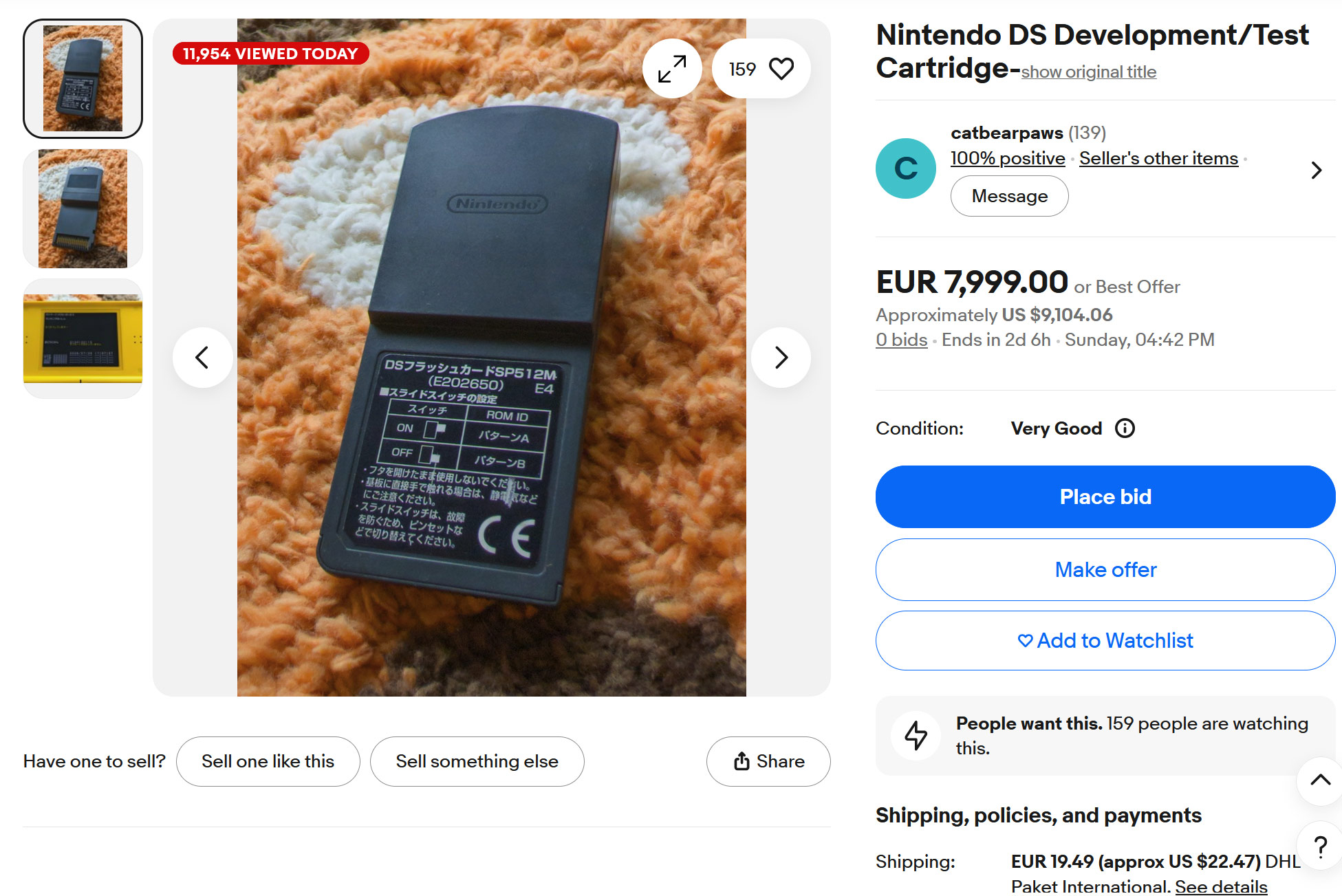
A Nintendo DS game that was classified as ‘lost media’ for nearly two decades is currently within tantalizing reach of video gaming fans and archivists. All the fans need is about $9,100, and no rival bidders on an eBay auction for an ultra-rare, perhaps one-of-a-kind, development cartridge thought to contain the PokePark Fishing Contest DS minigame.
Japanese game archaeology enthusiast Yoshino @ Federation (renpou.com) shared details of the eBay auction and its significance to their tens of thousands of social media followers.
So, what’s the deal with PokePark Fishing Contest DS, and why is it ultra-rare or even classified as ‘lost media?’ This fishing mini-game was lost for several reasons. Firstly, it was a download-only title. Secondly, its distribution was limited to those attending a short-lived Pokémon theme park venue in Japan (PokePark 2005). It also eluded archivists because it would be removed from a DS handheld when it was powered off, or after a 12-hour limit, whichever triggered first.
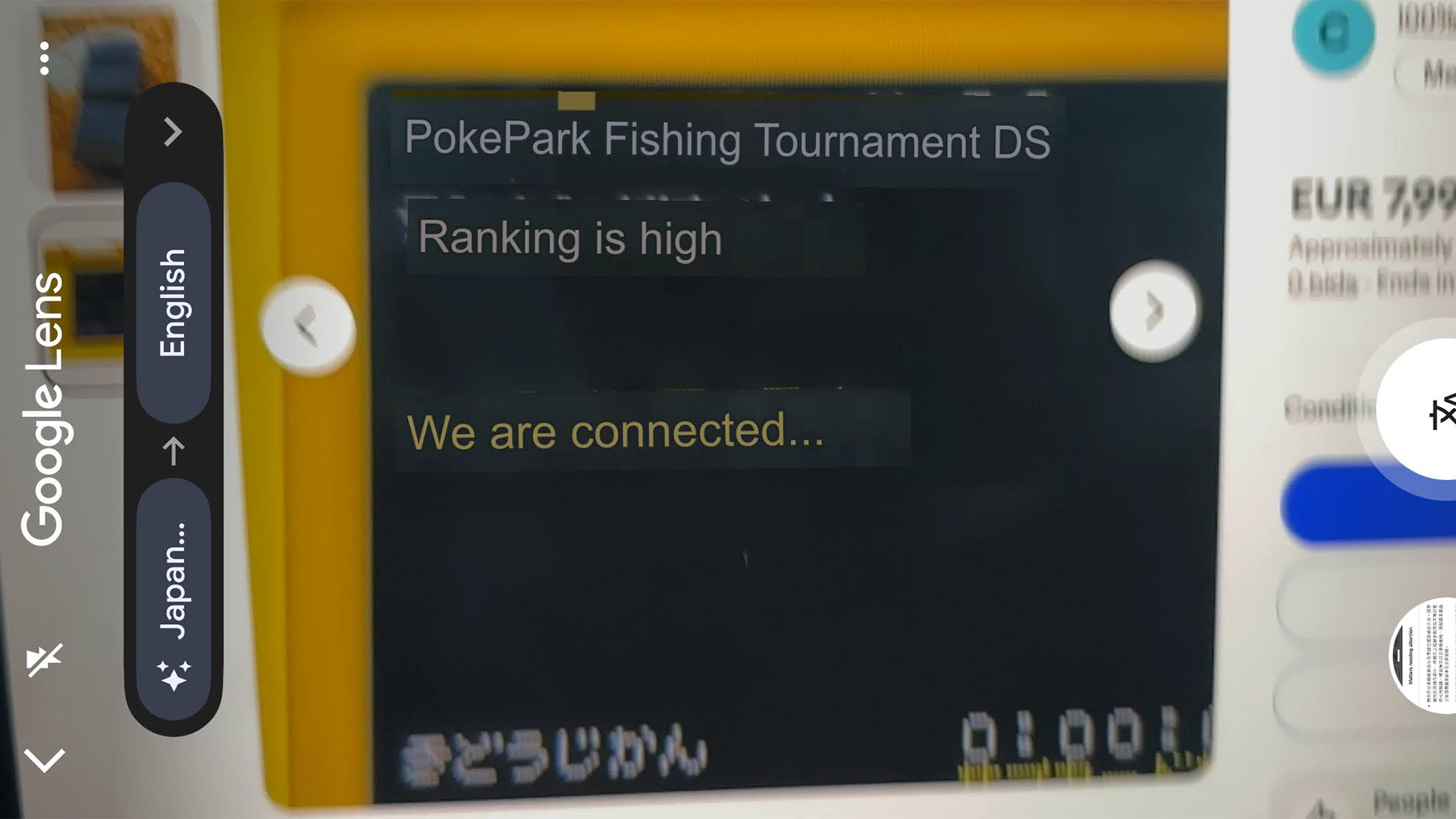
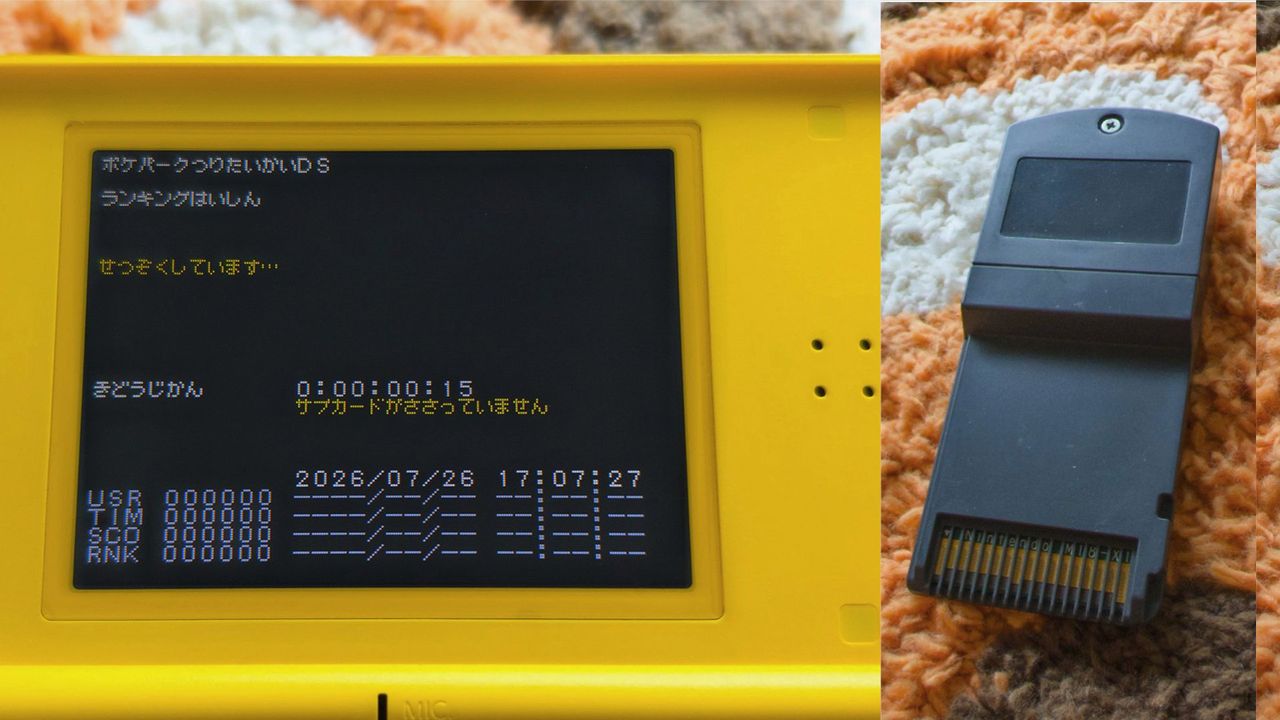
The eBay listing shows a large development and testing cartridge, front and back. There’s also an image showing the cartridge working. However, the on-DS-screen proof of viability is limited to “a Japanese-language screen indicating a high-score ranking communication program.”
The Germany-located seller, catbearpaws, says the cart was acquired as part of a private lot, and is selling the hardware as-is, with no promises regarding functionality, compatibility, or provenance. Catbearpaws has a 100% selling record and is asking for bids starting at €7,999 ($9,100), with less than three days left to run. They also may accept offers via the eBay Make Offer button/process.
Machine translation of eBay listing Nintendo DS screen content (Image credit: eBay)
Our machine-translated version of the eBay listing screen content appears to confirm that this is indeed a dev cart that was used for hosting “PokePark Fishing Contest DS” assets of some kind. Whether a playable version of the game can be downloaded, transmitted, or extracted from this hardware remains to be seen. As mentioned, the seller isn’t guaranteeing anything about this expensive but potentially important retro gaming artifact.
Longtime gamers and fans of retro gaming in general may recall the 1992 classic first person shooter Wolfenstein 3D, which set the standard and blueprint for many the entire genre and gaming in general moving forward. While re-playing Wolfenstein 3D in and of itself can be a fun retro experience, one enterprising developer took it ... Read More
App Store regulatory changes are beginning to affect Apple Services growth as developers gain more ways to avoid Apple’s payment system or pay lower commissions in major markets.
Apple finance chief Kevan Parekh told investors that changes to the App Store business model in some countries had affected its performance during the June quarter. Softer spending on mobile games created additional pressure.
The acknowledgement is significant because regulatory risk has appeared in Apple filings for years without producing a clearly identified effect on Services performance. Apple is now confirming that rule changes have advanced far enough to influence reported results.
The impact does not mean the App Store has stopped growing. Apple described the store as reaching another June-quarter revenue record, while Services expanded by approximately 12% from the previous year.
The emerging issue is the rate of growth. A purchase can still occur inside an iPhone app while generating less revenue for Apple when the customer pays through a developer’s website or uses terms carrying a reduced fee.
App Store Regulatory Changes Affect Several Markets
Apple did not identify one country or policy as solely responsible for the effect.
The company is adapting to a collection of court orders, competition laws and regulatory agreements that differ substantially among the United States, European Union, China, Brazil, Japan, South Korea and other markets.
Some rules concentrate on payment choice. They allow developers to place links or buttons inside apps leading customers to external checkout pages.
Other changes permit alternative app marketplaces or direct distribution outside the App Store. Several regulators are also examining whether Apple can charge developers for transactions completed through another payment provider.
The financial result depends on the model adopted in each country. Apple may receive no commission, a reduced commission or another fee connected with platform technology and distribution.
This creates a more fragmented App Store business. A subscription sold through the same application can produce different revenue for Apple according to the customer’s country, payment route and the developer terms governing that version of the app.
Image Credit: Apple Inc.
The United States Changed External Payment Links
The most direct change in the United States came from the long-running legal dispute between Apple and Epic Games.
A federal court previously ordered Apple to stop preventing developers from directing customers toward outside purchasing options. Apple responded by allowing certain external links while seeking commissions of between 12% and 27% on purchases completed through them.
The company also introduced design restrictions, an approval process and a warning screen displayed when customers left the App Store environment.
In April 2025, the district court found Apple in civil contempt for failing to comply fully with the anti-steering injunction. The ruling prohibited the company from collecting a commission on purchases made through external links and removed several restrictions governing their appearance.
Apple updated its App Review Guidelines in May 2025. Apps distributed through the United States storefront can include buttons, external links and other calls to action leading customers toward another payment method.
The rules no longer require a special external-link entitlement for the U.S. storefront.
That change gives developers a straightforward financial reason to move some transactions to the web. A company can process a payment through another provider instead of giving Apple a percentage of the digital sale.
The customer can return to the iPhone app and use the purchased subscription or content. The app remains distributed through Apple, but the associated transaction no longer produces the same App Store commission.
Enough developers adopting that route can slow Apple Services growth even if total spending on iPhone applications continues increasing.
The European Union Introduced Alternative Distribution
The European Union’s Digital Markets Act requires Apple to permit alternative app marketplaces, outside payment systems and other changes intended to reduce its control over iOS distribution.
Developers can remain under Apple’s conventional App Store terms or adopt business terms designed for the European market.
The alternative structure separates several services that were previously combined inside one commission. Developers can choose different levels of App Store support, use Apple’s payment system, provide another payment option or distribute software through a competing marketplace.
Apple introduced reduced commissions and technology-related fees to preserve compensation for the tools, security systems, distribution infrastructure and platform access it provides.
Those terms have changed several times following regulatory objections. Beginning in 2026, Apple started moving from its earlier Core Technology Fee toward a Core Technology Commission applied to eligible digital transactions under particular conditions.
The structure means outside payments do not always eliminate Apple fees in Europe. They can still reduce the amount Apple collects or shift revenue among different fee categories.
Regulators continue examining whether the terms provide meaningful choice or discourage developers from leaving the standard model.
Apple argues that alternative stores and payment systems create additional privacy, security and fraud risks. The European Commission has focused on whether Apple’s warnings, technical requirements and fees make those options unnecessarily difficult to use.
European developers must calculate more than one commission. They need to consider payment-processing costs, marketplace charges, customer acquisition, reporting obligations and the Apple terms attached to each distribution method.
The result may be lower App Store revenue without an equally large shift toward independent marketplaces. External website payments can change Apple’s economics more quickly because they do not require customers to install another store.
Apple lowered several commission rates in the China mainland storefront beginning March 15, 2026.
Qualifying transactions under the App Store Small Business Program and Mini Apps Partner Program now carry a 12% commission. The same rate applies to eligible auto-renewing subscriptions after the subscriber’s first year.
These transactions previously qualified for a higher 15% rate.
A three-percentage-point reduction may appear small beside demands for completely independent payments. At the scale of China’s app economy, it can remove a meaningful amount of revenue while improving the share retained by developers.
The Mini Apps Partner Program is particularly important in China because large platforms can contain many smaller services inside one host application.
Reducing the commission can encourage those ecosystems to continue using Apple In-App Purchase. It also demonstrates how Apple may respond to pressure by offering more favorable terms before regulators require a more disruptive change.
Lower commissions can support transaction growth over time, but the immediate calculation is straightforward: Apple receives less from each qualifying purchase.
Image Credit: Apple Inc.
Brazil Opens iOS to Outside Stores and Payments
Apple introduced alternative app distribution and payment options in Brazil through an agreement with the country’s competition regulator, CADE.
Beginning with iOS 26.5, developers can distribute apps through alternative marketplaces, operate those marketplaces and process digital payments outside Apple In-App Purchase.
Apps can also present links leading users to an external website where the transaction is completed.
Apple continues applying notarization and other technical requirements to software distributed outside the App Store.
The company maintains that these protections reduce risks but cannot provide the complete safeguards associated with App Review.
Brazil is a major smartphone and digital-services market. Its effect on Apple Services will depend on whether large developers adopt the new options and whether customers are willing to leave the familiar App Store purchasing flow.
An external option existing in software does not guarantee that people will use it. The developer must usually offer a meaningful advantage, such as a lower price, a different subscription package or payment methods better suited to local customers.
Adoption can increase gradually as existing apps release updates. The financial impact may therefore become more visible over several quarters rather than appearing immediately after the regulatory agreement takes effect.
Why Outside Payments Reduce Apple Services Revenue
Apple receives a commission when an eligible digital purchase uses its in-app payment system.
The fee compensates Apple for distribution, payment processing, fraud management, developer tools, customer support and access to the iOS platform, according to the company.
The standard percentage varies. Small developers and long-running subscriptions can qualify for reduced rates, while other eligible digital transactions may carry higher commissions.
When payment moves to a developer’s website, an independent processor handles the financial transaction. The developer pays that provider, manages more of the customer relationship and retains the amount that would otherwise become an App Store fee.
Apple may still provide the operating system, APIs, development tools and App Store distribution without receiving the conventional payment commission.
This separation explains why App Store activity and App Store revenue can move differently. People may download more applications and spend more on digital services while Apple captures a smaller percentage of the commerce.
The same customer could maintain several subscriptions used exclusively on an iPhone without any of their monthly payments passing through Apple.
Apple can collect other revenue from that user through hardware, advertising, iCloud or its own subscriptions. The external transaction nevertheless removes one part of the Services model.
Most App Store Commerce Never Paid Apple a Commission
The size of the App Store economy should not be confused with Apple’s commissionable revenue.
Apple says the global App Store ecosystem facilitated more than $1.4 trillion in developer billings and sales during 2025. More than 90% of that commerce did not produce a commission for the company.
The largest categories involve physical goods and services such as retail purchases, travel, grocery delivery, restaurant orders and transportation.
Apple does not collect a percentage when someone uses an Amazon app to order furniture, books a hotel or pays for a meal delivered through an iPhone.
App Store commissions generally concentrate on digital goods, application features, virtual items and subscriptions sold through Apple In-App Purchase.
Regulatory changes target this smaller but financially important part of the ecosystem.
Digital transactions require no physical inventory or delivery network, allowing payment commissions to carry attractive margins. Losing part of that revenue can therefore affect profitability more than the dollar amount alone suggests.
Apple does not disclose App Store revenue or profit separately. The category remains combined with cloud services, advertising, media subscriptions, AppleCare, payments and other operations inside Services.
Mobile Gaming Weakness Adds Another Pressure
Regulation was not the only factor Apple identified.
Parekh said softer mobile gaming activity also affected the App Store. Games represent an important source of digital transactions because players purchase virtual currency, characters, cosmetic items, subscriptions and access to additional content.
A decline in game spending directly affects the commission Apple receives through In-App Purchase.
Gaming is also one category where developers have pushed aggressively for alternative stores and payments. Epic Games began its legal confrontation with Apple after introducing another payment method inside Fortnite and attempting to bypass App Store commissions.
The simultaneous effects are difficult to separate. A game can generate lower revenue because players are spending less, because payments moved outside Apple’s system or because both changes occurred together.
Apple does not provide enough category detail to calculate the contribution from each factor.
The distinction matters for the outlook. Gaming demand can recover with successful releases and stronger consumer spending. A permanent regulatory change does not reverse when one popular game reaches the top of the charts.
Image Credit: Apple Inc.
Developers Gain Revenue but Assume More Work
Outside payments can improve the amount a developer retains from each purchase.
A company moving from a conventional App Store commission to a lower-cost web payment processor may use the difference to reduce prices, fund development or improve profitability.
The developer also assumes responsibilities previously handled through Apple.
Independent billing requires payment processing, tax management, fraud protection, refunds, account recovery and customer support. Subscription status must synchronize correctly between the website and the iPhone app.
Customers changing devices or reinstalling an app expect their purchases to remain available. The developer needs its own account system capable of verifying ownership without relying entirely on Apple’s purchase history.
Small developers may decide that Apple In-App Purchase remains worth its fee because it removes operational complexity and gives customers a familiar checkout experience.
Large subscription businesses have stronger incentives to build their own systems. They already maintain accounts and payments across websites, televisions, Android devices and other platforms.
The regulatory effect will therefore vary by developer size and business model. One company may remove Apple billing completely, while another continues using it because external infrastructure would cost more than the commission saved.
Customers May Receive Lower Prices
External payments create the possibility of lower subscription prices because developers no longer need to incorporate the complete App Store fee into the amount charged.
Some services already cost more when purchased through an iPhone app than through their websites. The higher price allows the developer to preserve similar revenue after Apple receives its share.
A visible external link makes comparing those prices easier. Customers can leave the app, complete the transaction on the web and return with an active account.
Savings are not guaranteed. A developer can retain the entire difference rather than passing it to subscribers.
Independent billing can also make subscription management less consistent.
Purchases completed through Apple appear in one location:
Settings > Apple Account > Subscriptions
A subscription purchased directly must be canceled through the developer’s website or account system. Customers using many external services may need to remember several billing portals and renewal policies.
Refunds and purchase disputes also move away from Apple. The developer or its payment processor becomes responsible for resolving the transaction.
Choice can reduce prices while increasing complexity. The practical outcome depends on whether developers make external checkout clearly cheaper and easy to manage.
Apple Is Expanding Other App Store Tools
Apple is responding to the changing environment by adding business models and marketing systems that can keep developers using its commerce platform.
Monthly subscriptions with a 12-month commitment allow participating apps to offer lower recurring payments while securing a complete year of revenue.
The Advanced Commerce API supports more complex content catalogs, optional add-ons and subscription structures that were previously difficult to manage through standard In-App Purchase products.
Apple has also expanded tools for custom product pages, promotional offers, application analytics and international distribution.
These additions increase the value attached to App Store billing. A developer may tolerate a commission when Apple provides conversion tools, subscription management and access to promotional placement that would be expensive to reproduce independently.
The company can also adjust rates for particular categories. The Small Business Program, Mini Apps Partner Program and reduced commission for longer-running subscriptions already demonstrate differentiated pricing.
A more competitive payment market may push Apple toward additional service tiers rather than one universal commission.
The UK Could Create the Next Material Change
The United Kingdom’s Competition and Markets Authority is consulting on rules that would allow developers to direct customers outside Apple and Google’s payment systems.
The regulator expects any fee charged for steering to be fair, reasonable and lower than current app-store commissions. It wants the resulting savings passed to customers or reinvested in developer businesses.
The UK proposal is not yet a final requirement. Its eventual structure could determine whether developers receive the broad freedom available in the United States or a fee-based model closer to some European arrangements.
Regulators are also considering app-review fairness, interoperability and access to mobile-platform capabilities.
The outcome will matter beyond British customers. Each major jurisdiction creates another model that regulators elsewhere can examine when designing their own rules.
Apple must decide whether to continue maintaining different commercial systems by country or move toward broader global terms that reduce operational complexity.
Developers face the same choice. Supporting a separate payment route, marketplace package and reporting process for every region can become expensive enough to cancel some of the benefits regulation intended to create.
The next evidence will come from behavior rather than another policy announcement: how many major apps add external payment links, whether they offer lower prices and how quickly customers move away from Apple’s checkout.
The Space Force Association’s National Spacepower Center is building an unclassified environment for demonstrating threats to satellites and their consequences on Earth
Over the past couple of weeks, my immune system has been struggling to fight off a cold. It’s been unpleasant, as all colds are. But throughout this time—in defiance of my plight—I’ve been waging my own war against immune systems, thanks to Pathogenic, a new roguelite twin-stick shooter from developer Aberrant Labs.
As I've downed endless shots of ineffective cough syrup, I’ve done little else with my free time than repeatedly take on the role of a bodily invader. And let me tell you: Being on the enemy’s side is much more fun. Really fun, as it turns out.
Action roguelites are a dime a dozen these days, and it takes something special to stand out. So as quiet Internet whispers turned into widespread cacophonous praise—the little indie game quickly racked up 100,000 sales and an “overwhelmingly positive” review score on Steam—I set aside my default skepticism and gave it a shot.
The state of PlayStation 5 emulation has been rapidly evolving, partially in response to Grand Theft Auto 6's release later this year. The latest milestone is the first 3D games being playable at very respectable framerates of around 30 frames per second.
The two emulators at the forefront of all this are KytyPS5 and SharpEmu, the former of which is intensely focused on expanding compatibility. KytyPS5 was already able to boot 3D titles and go until their loading screens, with at least two smaller games actually rendering graphics. Now, the same emulator can run two 3D games at around 30 FPS, though there are some glitches.
The first game is XIII, the 2020 remake of the 2003 classic, and it's "playable" at up to 30 FPS with real-time gameplay that accepts player input. We put playable in quotation marks because there are very obvious visual glitches that manifest in the environment not rendering correctly. The textures seem to be broken in multiple scenes, though they don't entirely kill the immersion. XIII is a relatively lightweight game but its cell-shaded aesthetic might be adding to emulation complexity.
Another playable title joins the growing list for the Kyty PS5 emulator.XIII is now playable at around 30 FPS.Current status:• Playable• Runs at 30 FPS• Minor graphical issues remainIt's another encouraging step for PS5 emulation, with compatibility continuing to… pic.twitter.com/5rEpvcbvTbJuly 29, 2026
The same person who tested XIII also tested Teenage Mutant Ninja Turtles: Wrath of the Mutants and managed to run it at just under 25 FPS with real-time gameplay. The game crashes on the first launch, but once initialized, it's stable and does not seem to have any bugs or glitches like XIII. The framerate looks visibly choppy but is undeniably impressive, on a technical level. Kyty can run other 3D PS5 games as well, but not nearly at this level of performance.
Kyty PS5 emulator keeps making impressive progress.Teenage Mutant Ninja Turtles: Wrath of the Mutants is now playable at around 22-24 FPS.Current status:• In-game• 22-24 FPS• Crashes on the first launch• Runs without further crashes after restartingI feel it's… pic.twitter.com/pCkHu11cbIJuly 29, 2026
KytyPS5 is advancing at a faster pace than SharpEmu, and that's true for the most part, but not out of stagnation. The team behind SharpEmu is busy tackling a different challenge: accuracy and infrastructure setup rather than game-specific compatibility, per its GitHub repo. In other words, it means fixing low-level issues that are preventing games like Astro Bot from currently reaching the gameplay state.
Both emulators are now part of an unexpected emulation race. With GTA 6 just a few months away and GTA 5 already booting in Kyty, it clearly has the better support for now, and its demos are very promising. SharpEmu's work will undoubtedly help the emulation scene at large, along with RPCSX and other independent developers. The craziest part is that you can try all of this at home for free, and just by doing that you're already contributing to the scene.
Playing as recent arrival Lena, your challenges include learning a new language and uncovering family secrets – its developer hopes it will spread ‘a little more compassion’
The cosy house-sorting sim has become a much-loved staple of the PC indie scene. Titles such as Unpacking, A Little to the Left and Momento charm players with their detailed interiors and quiet narratives of lives lived and shared within the same four walls. For Clean Start, Polish developer Serious Sim has taken a different approach – here you play as domestic cleaner, Lena, an immigrant who has arrived in an unspecified western country with little knowledge of the local language, and a family to support back home.
From here, you’re tasked with cleaning a series of houses and apartments, polishing tables, tidying shelves and scrubbing muddy pawprints from kitchen floors. It seems you’re able to rearrange the rooms, giving them a personal feel, which is after all one of the most pleasing elements of the genre. You can also, we are reassured, pet the dog.
An intrepid TechTuber has tested a trio of passive mini PCs from the Subway sandwich chain to check if they can be repurposed for gaming fun. In a recent video, Garkus indicates that the three Intel Skylake-powered mini PCs that had been displaying sandwich menus above the serving counters for a decade but were saved from scrap/landfill, alongside a matching set of LG digital signage TVs. Spoiler: they are too puny for mainstream AAA gaming in 2026, even after doubling the RAM installed.
Before getting on with the digital signage-to-gaming conversion, Garkus investigated the hardware in hand. Labeling indicated that the three slim mini PCs were all Advantech DS-081 models (official PDF link). Pondering over that data sheet, we see that the variant with the Intel Core i3 6100U, as these were, carries the full designation of DS-081GB-U21A1E.
The processor is now both long in the tooth and low powered, so immediately we know this 2C/4T @ 2.3 GHz CPU, configured to suck between 7.5W and 15W, won’t be ideal for modern AAA titles. Moreover, the iGPU is the Intel HD Graphics 520 with 24 EUs and clocks up to just 1.00 GHz, sharing the DDR4 system RAM.
A DS-081GB-U2A1E is quite expandable for such a small, low-powered set-it-and-forget-it unit. It has twin HDMI 1.4, twin Ethernet, four USB 3, audio in/out, and an RS-232 serial port accessible from the outside. Inside, users can configure the machine via twin DDR4-2133 SODIMM slots (up to 32GB total), a SATA III HDD/SSD, and an mSATA port that looked like it was an M.2 2242 slot in the video. This passive machine is designed to run signage 24/7 in environments with 0 ~ 40° C (32 ~ 104 ° F) ambient temperatures.
These systems were found to actually come with just 4GB of RAM (one slot used) and with a 64GB SATA SSD installed. They booted to Windows and went straight to kiosk mode, displaying the Subway sandwich menu. We saw an extra 4GB DDR4 stick added to bring the test system(s) up to 8GB RAM in total.
After a bit of OS wrangling, Garkus decided to set up the salvaged trio of passive mini PCs as follows. One kept Windows 10, another got Bazzite Linux (because SteamOS balked at the SATA-only storage), then another went Hackintosh with macOS Monterey installed.
Gaming tests began with a very light test. The system ran Peggle, and this 2D puzzler posed no problems. After this modest victory, Garkus ambitiously leapt straight to GTA V. This legendary but now older title could only reach a frame rate of about 15 fps. But it was found to have defaulted to high settings, took ages to get ready to run on Bazzite, then crashed on exit.
Probably not following best benchmarking practice, the tech tinkerer appears to have decided to test Mario Kart Wii emulation performance while GTA V was still compiling shaders… Later, a test run in Minecraft delivered a wildly inconsistent but roughly 25 fps performance. As is now established as the Garkus testing MO, resolution, quality settings, and so on weren’t shared.
To conclude the gaming part of the video, the TechTuber suggests that these ex-kiosk machines are probably best suited to emulating older consoles up to the PS2 and original Xbox era. We think that for PS2 emulation, you will still need to restrict yourself to lighter titles and reduced settings for smooth action.
I wanted our last family games night to be the best fun we’ve ever had. Maybe we should have stuck with Mario Kart …
It is the end of an era for the Diamond family. For 20 years, there have been five of us living together. It has not been easy. Militant vegan daughters, sons who have inherited Scottish tempers, and a youngest child who attracts trouble like an industrial magnet, have meant our house has been conflict-laden at times. Throw in the fact that we are beset with all manner of mental health bobbins and chronic illnesses that resulted in two of our three kids almost dying in hospitals and you get a family that is combustible – but extremely close.
Through it all, we had games. They always brought us back together. Not just us all hunkering over Super Mario Kart like some kind of UN-mandated family therapy, but the conversations that happen when any of us spy another playing something new. Games are a cultural touchstone that helped us crack through the veneer of disagreements and distrust and remind us that we have more things in common than we sometimes feel.

 Login