Many MacBook Air, MacBook Pro, and MacBook Neo owners have noticed something curious; their MacBook battery stops charging at 80% when plugged in. To add to the confusion, even if they leave their MacBook plugged in overnight, the battery seems to be stuck at 80% and will not charge any further. Because this is not ... Read More
Para a estreia das telas OLED1Organic light-emitting diode, ou diodo emissor de luz orgânico. e do suporte ao toque em computadores com o suposto “MacBook Ultra”, a Apple poderá recorrer exclusivamente à Samsung Display como fornecedora dos painéis.
A informação partiu do site sul-coreano The Elec, o qual afirmou que, segundo as suas fontes relacionadas à cadeia de suprimentos, cerca de 250 mil unidades de painéis OLED de 14 e 16 polegadas (8,6ª geração) da Samsung foram encomendadas, com previsão de produção em massa para o mês de agosto.
A Apple não teria cogitado a LG Display e tampouco a BOE para o desenvolvimento dessas telas, devido a questões de rendimento, tornando a Samsung a única fornecedora viável.
De acordo com uma série de leakers, analistas e jornalistas, especulava-se que o “MacBook Ultra” tivesse o seu lançamento entre o final deste ano e o início do ano que vem, mas devido à crise de memória é possível que ele de fato chegue às lojas somente em 2027.
Segundo o jornalista Mark Gurman (da Bloomberg), tal Mac deverá ser equipado com os chips M5 Pro e M5 Max, com o conjunto (design, construção e tela) posicionando-o acima dos MacBooks Pro.
MacBook Pro de 16″
Cores: preto-espacial ou prateado Tela: padrão ou nano-texture Chips: M5 Pro ou M5 Max Memória: 24GB, 36GB, 48GB, 64GB ou 128GB Armazenamento: 1TB, 2TB, 4TB ou 8TB
Cores: preto-espacial ou prateado Tela: padrão ou nano-texture Chips: M5, M5 Pro ou M5 Max Memória: 24GB, 36GB, 48GB, 64GB ou 128GB Armazenamento: 1TB, 2TB, 4TB ou 8TB Adaptador de energia: USB-C de 70W ou 96W
NOTA DE TRANSPARÊNCIA: O MacMagazine recebe uma pequena comissão sobre vendas concluídas por meio de links deste post, mas você, como consumidor, não paga nada mais pelos produtos/serviços usando os nossos links de afiliado.
A Receita Federal disponibilizou mais um edital (0900100/000009/2026) para leilão com produtos apreendidos, nesta ocasião em Curitiba (PR). De um total de 178 lotes disponíveis, pelo menos 13 deles contam com produtos da Apple, como iPhones, MacBooks, iPads e acessórios.
As propostas poderão ser enviadas a partir do dia 17 de agosto, às 8h, com o encerramento previsto para o dia 24/8, às 21h. Aquelas que forem selecionadas serão convidadas a participar do pregão online previsto para o dia 25/8, às 10h.
Relembramos que esses produtos podem vir acompanhados de itens de outras empresas, além de possivelmente não contarem com garantia ou acessórios e de apresentarem estados de conservação dos mais variados.
Vamos aos lotes?
Lote
Produto(s) da Apple
Lance mínimo
2
12x iPad (9ª geração) 8x iPad mini (6ª geração) 3x iPad (11ª geração) 3x iPad (10ª geração) 1x iPad Air (M3) 1x iPad Air (M2) 5x iPad Air (5ª geração) 2x Magic Trackpad (USB-C) 2x Apple Pencil Pro 4x Apple Watch SE (2ª geração) de 40mm 1x Apple Watch Ultra (1ª geração) de 49mm 2x Apple Watch Series 9 de 41mm 1x MacBook Air (modelo não informado) 1x MacBook Air (M2) 1x MacBook (modelo não informado)
R$150.000
3
1x iPad (modelo não especificado) 2x Mac mini (M4) 1x iPad mini (11ª geração) 2x Magic Mouse
R$152.000
5
13x Apple Pencil Pro
R$126.000
6
1x MacBook Air (M3)
R$112.000
16
48x iPhone 17 Pro Max 2x iPhone 17 1x iPhone 16 Pro Max 16x iPhone 16 5x iPhone 15
R$745.000
17
84x iPhone 17 Pro Max 25x iPhone 17 Pro 66x iPhone 17 87x iPhone 16 40x iPhone 15
R$485.000
20
16x iPhone 17 Pro Max 8x iPhone 17 Pro 17x iPhone 17 16x iPhone 16
R$230.000
21
46x iPad (A16) 10x iPad Air (M3) 5x iPad mini (A17 Pro) 30x Apple Watch Series 11 de 42mm 7x Apple Watch Series 11 de 46mm 2x Apple Watch Series 10 de 46mm 2x Apple Watch SE (3ª geração) de 40mm 2x Apple Watch SE (2ª geração) de 44mm 3x Apple Watch SE de 44mm 2x Apple Watch SE de 40mm 4x iPad (modelo não especificado) 1x iPad Air (M3)
R$75.000
24
3x Mac mini (M4) 3x Mac mini (modelo não especificado) 1x Mac mini (M2)
R$27.000
139
2x iPad (A16) 17x iPad (10ª geração) 1x iPad Air (5ª geração) 6x MacBook Air (M1) 4x MacBook Air (M2) 2x MacBook Air (M3) 1x MacBook Air (M4) 6x MacBook Air (modelo não especificado) 1x Apple Watch (modelo não especificado) 1x AirPods Max 1x MacBook de 13” (modelo não especificado) 1x MacBook Pro 14” (modelo não especificado) 1x MacBook Pro 16” (modelo não especificado) 1x MacBook Pro (M4 Pro) 1x AirPods Pro (2ª geração) 17x Apple Watch Series 9 de 45mm 8x iPad (9ª geração) 1x Apple Watch Series 10 de 46mm 1x Apple Watch SE (2ª geração) de 44mm 2x Apple Watch SE (2ª geração, GPS) de 40mm 2x Apple Watch SE (2ª geração, GPS) de 44mm 4x Apple Watch Series 8 de 41mm 5x Apple Watch Series 8 de 45mm 2x Apple Watch SE de 44mm 1x Apple Watch Ultra 2 (GPS + Cellular) de 49mm 1x Apple Watch Ultra 2 de 49mm 1x Apple Watch Ultra de 49mm 2x Magic Mouse 2x MacBook Pro (M3) de 14” 1x MacBook Pro (modelo não especificado) 1x iPad Pro (6ª geração) 1x iPad Air (modelo não especificado) 2x iPad Pro de 11” (modelo não especificado) 1x iPad (modelo não especificado) 2x Apple Pencil (modelo não especificado) 1x Apple Watch Ultra (GPS + Cellular) de 49 mm 2x Mac mini (modelo não especificado) 1x Magic Keyboard para o iPad Pro de 13”
R$80.000
145
2x tela LCD para o MacBook Air (M1)
R$55.000
148
4x AirTags (pacote de 4 unidades) 3x Apple Pencil (USB-C)
R$48.000
175
1x cabo USB
R$135.000
Como participar do leilão?
Se algum desses lotes lhe interessou, para participar é necessário possuir um CPF válido e um certificado digital válido obtido pelo acesso ao Centro Virtual de Atendimento ao Contribuinte (e-CAC).
Os lotes estão disponíveis para lances tanto de pessoas físicas quanto de pessoas jurídicas.
Apple plans to raise the prices of its products as the cost of the memory chips it uses has surged, the technology giant’s boss has said.
Tim Cook, Apple’s outgoing chief executive, told the Wall Street Journal (WSJ) that price increases were “unavoidable” as the situation around memory chips had become “unsustainable”.
During its holiday quarter, Apple’s profit margin on hardware was 40.7%; in its most recent quarter, that dropped to 38.7% — a remarkable figure for physical products. It is these high margins that led to analysts like Ming-Chi Kuo to claim Apple would keep prices more-or-less stable and offset the additional costs through its even higher-margin — 76.7% — services business.
Winkler suggests in his summary that Apple has absorbed the cost increases so far because it has always treated memory and storage upgrades as profit centers. That’s no surprise to the Apple community, which has long chafed at Apple’s premium prices for memory and storage. But now, for instance, the price of standalone internal flash storage is closer to and sometimes even higher than Apple’s upgrade prices.
[…]
Obviously, Apple could absorb such costs and more if it were to accept dramatically lower gross margins. But as high-minded and customer-focused as Apple is, the company is still in business to maximize profit.
I was recently looking to add another SSD and a few hard drives to my setup. Normally, prices go down over time, but currently it SSDs are about double the price I paid last year, and large hard drives are almost triple.
Apple, to my recollection, has never before issued a warning about price increases. Keep in mind that Apple deals with prices in a very different way from its competitors. For Apple, prices are part of a product’s brand, so they don’t fluctuate with component costs.
Apple has raised prices across the board for many of its products today. MacBook Neo now starts at $699 (up from $599), while MacBook Air now starts at $1299 (up from $1099). Other impacted products include MacBook Pro, iPad, iPad Air, and many more.
iPhone, Apple Watch, and AirPods pricing is unchanged.
Earlier this week, I outlined three reasons for agreeing with Mark Gurman that the Apple price increases could be imminent, and that indeed proved to be the case.
iPhones have escaped the increases, but they are otherwise both broad-reaching and pretty dramatic. But perhaps the most surprising thing is that the MacBook Neo has been included …
Apple today increased the starting price of the Mac mini with M4 Pro chip by $200, taking the higher-tier model up to $1,599 on its online store.
[…]
Apple had already raised the Mac mini’s effective starting price in May by discontinuing the $599 configuration with 16GB of RAM and a 256GB SSD, leaving the $799 model with a 512GB SSD as the new entry-level option. Interestingly, the 16GB RAM / 256GB storage option has now been reinstated, but the $799 starting price remains.
Pre-announce it with a small delay, thus giving you a temporary sales boost as people scramble to get their orders in at current prices, and to soften the blow when the increases hit.
I also can’t help but see that “we need to begin raising prices on a number of products, including today’s increases for iPad and Mac,” statement as implying more increases are coming. The iPhone price increase seems inevitable, and my money is on it starting with the new models in September.
Micron CEO, president and chairman Sanjay Mehrotra explained the SCAs in prepared remarks delivered during the company’s Q3 earnings call. He explained that Micron has signed 16 SCAs, most of them covering 2026 to 2030, and that they involve a commitment to buy a certain quantity of product and pay for it in a pricing band that has a floor and a ceiling price. The floor price covers the historically high gross margins mentioned above, and the ceiling price means those who commit to an SCA are insulated if memory prices go even higher.
Micron’s chief business officer has hinted, without calling it out by name, that Apple’s tough supplier negotiations contributed to the conditions behind the global memory shortage.
For years, Apple has been able to dominate and dictate to their suppliers thanks to their scale. But the Asian operations which Tim Cook so famously set up, have been upended, like most everything else, by AI. From TSMC on down, Apple is no longer the customer dictating terms for the entire industry, it’s now the company which has taken over the mantle as the most valuable one in the world: NVIDIA.
Here’s a table with most of the base models whose prices increased[…]
[…]
iPad prices mostly went up 20–25%, but the hardest hit was the no-adjective base model, which rose almost 30%, from $350 to $450. That’s a big increase for a product meant to appeal to buyers for whom price is obviously their biggest concern.
Anyone who purchased a MacBook Neo for $600 (or $500 with education discount) between March and this morning purchased the lowest-price MacBook Apple has ever sold — and perhaps the lowest-price MacBook they ever will sell.
The consumer electronics industry is facing an unprecedented challenge. The rapid expansion of AI data centers has created an extraordinary surge in demand for memory and storage. We have never seen a component price increase this much, this quickly. We have shielded our customers from these increases so far, but we have now reached a point where we need to begin raising prices on a number of products, including today’s increases for iPad and Mac. We know this is not welcome news, and we are working tirelessly to find solutions.
[…]
Apple indicating that it needs to “begin” raising prices suggests that additional price increases might occur later.
“and we are working tirelessly to find solutions.”
I find this to be the most confusing part. Do we believe this to be a genuine effort? Even if so, how would a “solution” actually work? Would they actually lower prices if a solution were to be found?
They also just said they “will continue working” on bringing Siri AI to the EU right before saying in a different venue that they’d stopped working on it.
But even setting aside the prices of competing devices, it just feels wrong to hike prices this much for four-year-old hardware running five-year-old pre-AI silicon. The higher-end model’s price went up 67 percent!
The only way this makes sense is if these prices are really meant for the upcoming new hardware, and those new models are more ambitious home hubs that warrant $200–250 prices.
The Financial Times reports that Apple is seeking clearance from the Trump administration to purchase memory chips from a blacklisted Chinese company. The move would help it meet demand for product manufacturing during the ongoing global memory supply shortage.
Perhaps this is the “working tirelessly” that Apple was referring to.
Apple previously sought permission from the Biden administration to do the same thing back in 2022, and that did not go well – despite promising to use the chips only for iPhones sold in China …
Something happens — outside the company’s control — that causes those essential components to rise in price significantly.
[…]
What you cannot do is hold a philosophically consistent logically coherent view where your answer to how a company should respond in such a scenario is contingent on what the “something happens” is that caused component prices to rise.
Maybe—but that’s only relevant if you accept the premise that it was out of Apple’s control. I don’t know the details of the deals, but there’s an argument that the rising costs to Apple are to some extent Apple’s “fault.” If Tim Cook gets credit for helping suppliers expand capacity and locking in contracts for memory at low prices over the past two decades, doesn’t the same logic apply in reverse? The AI-driven shortages were foreseeable—and publicly discussed years ago. If you believe Micron that Apple chose to prioritize its own past numbers rather than securing its future supply, doesn’t that make today’s situation different from, say, a tsunami that unexpectedly wiped out a bunch of factories? I don’t know exactly how the increased costs should be apportioned, but I think the reasons for the costs are relevant, and I don’t think they’re fully exogenous.
But while tech giants like Apple
and Microsoft, which both announced price hikes this week, have a hefty cash cushion, supply chain leverage and customers numbering in the millions or billions, a much wider swath of businesses face potentially dire straits. Most consumer electronics companies have little margin to spare and can’t confidently raise prices in an economy already grappling with inflationary pressures.
GoPro, the struggling maker of action cameras, warned this month that it might go out of business after memory costs shot up between 80% and 115% at the end of the first quarter. And shares of speaker maker Sonos
are down 23% this year as memory prices pressure margins.
Os próximos meses têm tudo para ser extremamente movimentados quando o assunto são novos Macs, com a Apple preparando uma série de atualizações para os MacBooks Pro e Air, duas novas versões do iMac e até mesmo Macs mini e Studio atualizados, segundo informações da Bloomberg.
De acordo com o veículo, a Apple já encerrou o desenvolvimento de um novo MacBook Pro de 14 polegadas, o qual deverá ser um dos primeiros dispositivos a contar com o chip “M6”. De codinome J804, ele deverá contar com o mesmo design do modelo de entrada atual, que vem equipado com o chip M5.
Outro Mac que já estaria prestes a passar por atualizações é o iMac, que deverá ganhar não só uma, mas duas novas versões, sendo que uma delas ainda receberá uma tela OLED 1Organic light-emitting diode, ou diodo emissor de luz orgânico.. Com os codinomes J833 e J834, eles também serão equipados, é claro, com chips mais recentes — embora o modelo com o display mais avançado demore mais tempo para chegar ao mercado do que o primeiro.
E por falar em telas OLED, também teremos novos MacBooks Pro de 14″ e 16″ que, além de contar com essa tecnologia, também deverão ter painéis sensíveis ao toque, inaugurando esse método de interação entre os Macs. Com os codinomes K114 e K116, respectivamente, eles deverão ser lançados entre o fim deste ano e o início de 2027. No momento, eles estão sendo testados pela Apple com uma versão preliminar do macOS Golden Gate 27.1, cujo lançamento é aguardado para outubro próximo.
Ao contrário do modelo de entrada, no entanto, esses seguirão “presos” na família de chips M5, contando com o M5 Pro e o M5 Max dos MacBooks Pro atuais. Novas versões com os chips “M7 Pro” e “M7 Max”, porém, já estão planejadas para algum momento entre o fim de 2027 e o início de 2028.
Por falar no MacBook Pro de entrada, uma versão do modelo com um design completamente novo — baseado nos modelos com OLED — já estaria sendo desenvolvida pela Apple. Ele deverá vir ainda com o chip “M7” e conta com o codinome K104.
Já os MacBooks Air deverão ganhar novos modelos no início do ano que vem. Com os codinomes J913 (modelo de 13″) e J915 (15″), eles seguirão com o design atual. Vale lembrar, no entanto, que modelos com telas OLED já estão no forno há alguns anos e com lançamento previsto para o início de 2028.
Caçula da família, o MacBook Neo, também já conta com uma nova versão no horizonte, a qual deverá contar com o chip A19 Pro e mais memória integrada — provavelmente 12GB, ante aos 8GB do modelo atual.
Por fim, temos os dois desktops mais tradicionais da Apple: o Mac mini e o Mac Studio. Segundo Mark Gurman, o modelo em testes do primeiro usa os chips M5 Pro e “M6”, enquanto o segundo é empurrado pelos processadores M5 Max e “M5 Ultra”. Não há, no entanto, uma previsão de quando esses computadores chegarão ao mercado — cortesia da atual crise no mercado de memórias.
Haja computador novo, hein?! 😮💨
Mac Studio
Chip: M4 Max ou M3 Ultra Memória: 36GB, 48GB, 64GB, 96GB, 128GB, 256GB ou 512GB Armazenamento: 512GB, 1TB, 2TB, 4TB, 8TB ou 16TB
Cores: preto-espacial ou prateado Tela: padrão ou nano-texture Chips: M5 Pro ou M5 Max Memória: 24GB, 36GB, 48GB, 64GB ou 128GB Armazenamento: 1TB, 2TB, 4TB ou 8TB
Cores: preto-espacial ou prateado Tela: padrão ou nano-texture Chips: M5, M5 Pro ou M5 Max Memória: 24GB, 36GB, 48GB, 64GB ou 128GB Armazenamento: 1TB, 2TB, 4TB ou 8TB Adaptador de energia: USB-C de 70W ou 96W
Cores: azul-céu, prateado, estelar ou meia-noite Chip: M5 Memória: 16GB, 24GB ou 32GB Armazenamento: 512GB, 1TB, 2TB ou 4TB Adaptador de energia: USB‑C de 30W, 35W com duas portas ou 70W
Cores: azul-céu, prateado, estelar ou meia-noite Chip: M5 Memória: 16GB, 24GB ou 32GB Armazenamento: 512GB, 1TB, 2TB ou 4TB Adaptador de energia: USB‑C de 30W, 35W com duas portas ou 70W
NOTA DE TRANSPARÊNCIA: O MacMagazine recebe uma pequena comissão sobre vendas concluídas por meio de links deste post, mas você, como consumidor, não paga nada mais pelos produtos/serviços usando os nossos links de afiliado.
Notas de rodapé
1
Organic light-emitting diode, ou diodo emissor de luz orgânico.
In his latest Power On newsletter, Bloomberg News’ Mark Gurman highlights two notable Apple developments: a new AI tool being tested in retail stores and previously undisclosed plans for the now-defunct Mac Pro.
AI Recording and Transcription for Genius Bar Appointments
Apple is piloting an AI-powered system called Live Notes at select retail stores. The tool allows Genius Bar employees to record conversations with customers using an iPad. AI then transcribes and summarizes the discussion, automatically adding it to the employee’s notes and the official repair session record.
Key details of the pilot include:
• Opt-in only — Both the employee and customer must agree before recording begins.
• Goal — Reduce manual note-taking so staff can focus more on customer service and problem-solving rather than typing during appointments.
• Integration — Transcripts feed directly into Apple’s internal Genius Bar system for better documentation and follow-up.
This initiative reflects Apple’s broader push to integrate AI across its ecosystem, including retail operations, to improve efficiency while maintaining a personal touch in customer interactions. Privacy safeguards via the opt-in requirement appear designed to address potential concerns.
Apple Once had Bigger Plans for the Mac Pro
Apple discontinued the Mac Pro earlier in 2026, but new reporting reveals the company once had far more ambitious plans for the high-end desktop. Gurman notes that Apple developed — but ultimately shelved — “M2 Extreme” and “M3 Extreme” chip variants specifically intended for the Mac Pro.
These ultra-powerful chips were part of an effort to deliver even greater performance for professional users who rely on the modular, expandable workstation. The decision not to release them contributed to the product’s eventual discontinuation, as Apple shifted focus amid changing market demands and the rise of more portable high-performance options like Mac Studio and MacBook Pro configurations.
The revelations underscore the evolving nature of Apple’s Mac lineup, where even flagship products like the Mac Pro face tough strategic trade-offs in an AI-driven computing era.
MacDailyNews Take: Not everything makes it to market. Conditions change. As always, retail and pro desktop innovations continue to shape the company’s customer and professional user experiences.
For the vast majority of professional users (video editors, photographers, 3D artists, developers, and those running AI/ML workloads) the Mac Studio is the superior choice overall. It delivers an excellent balance of performance, price, compact size, and modern features. The Mac Studio covers 90% (or more) of what the Mac Pro once offered, but at a fraction of the cost and with newer silicon, and the promise of regular updates. The discontinued Mac Pro was only preferable, or truly necessary, in the rare cases that demand heavy internal PCIe expansion that cannot be adequately handled externally via Thunderbolt; a very niche market. – MacDailyNews, March 27, 2026
Apple’s Mac Pro is a dead end. Mac Studio is the high-end Mac future now. Bring on the M5 Ultra Mac Studio and rename it “Mac Pro.” – MacDailyNews, November 17, 2025
Please help support MacDailyNews — and enjoy subscriber-only articles, comments, chat, and more — by subscribing to our Substack: macdailynews.substack.com. Thank you!
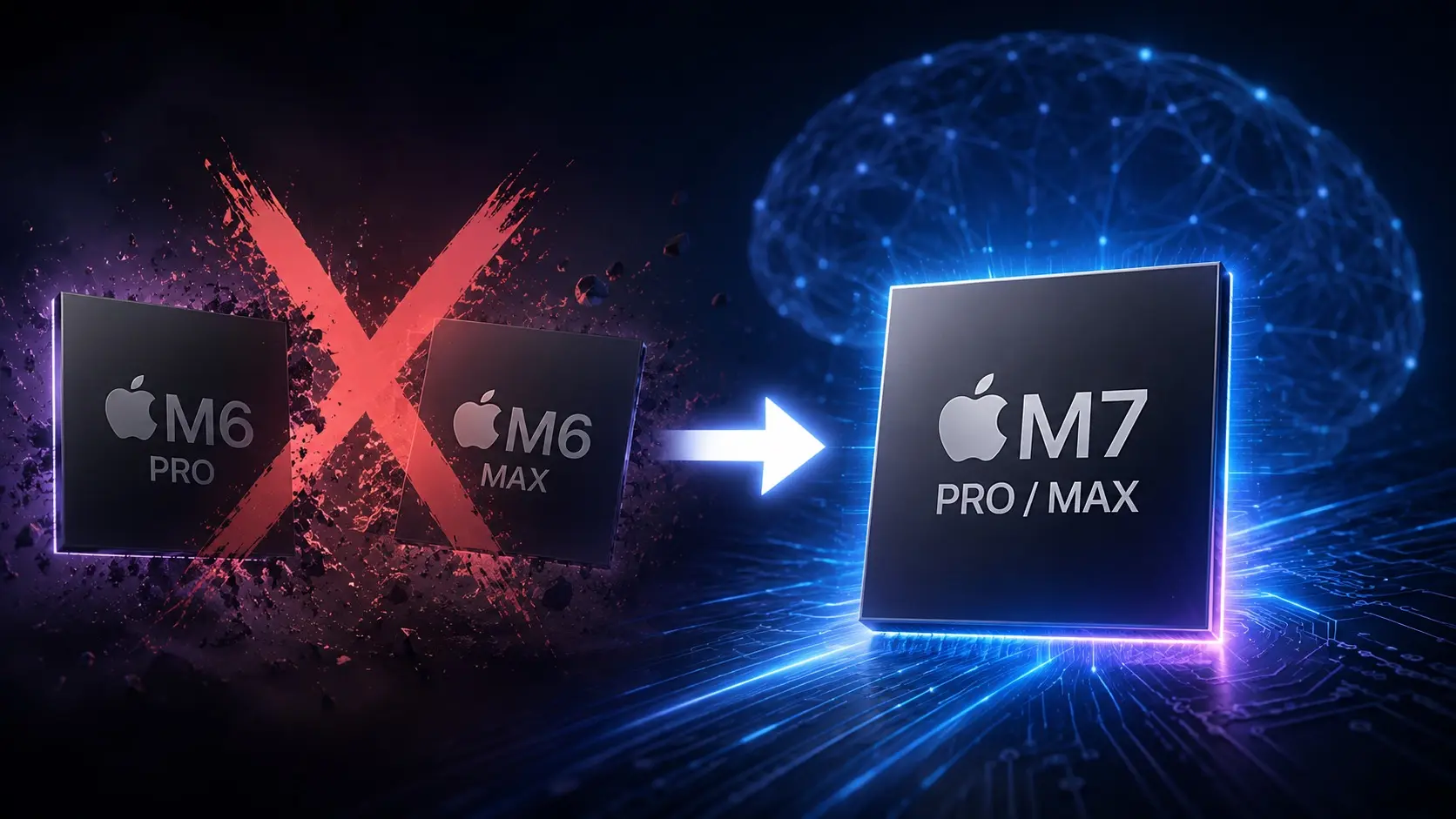
According to Bloomberg News‘ Mark Gurman in his most recent Power On newsletter, Apple is making one of the biggest changes yet to its Apple Silicon roadmap for Macs. The company is prioritizing on-device AI performance and graphics capabilities over its traditional generational cadence, leading to a skipped generation of high-end chips and a faster push toward the M7 family.
Apple’s New Chip Roadmap: M6 (Base Only), Then Straight to M7
Apple plans to release a base M6 chip as early as late 2026 for entry-level Macs. This includes testing in a refreshed 14-inch MacBook Pro (internally codenamed J804). Key improvements expected in the M6 include:
• Memory bandwidth rising to around 200 GB/s (up from 153 GB/s on the M5)
• Enhanced GPU performance with up to 12 cores
• A stronger neural engine for better AI workloads
In a notable departure from past strategy, Apple will skip M6 Pro, M6 Max, and M6 Ultra variants entirely. This marks the first time the company has bypassed higher-end versions of a new chip generation.
Instead, Apple is fast-tracking the M7 series to deliver major advancements in on-device AI processing and graphics performance sooner. According to Gurman’s reporting:
• Base M7 — Expected in the first half of 2027
• M7 Pro and M7 Max — Targeted for late 2027
• M7 Ultra — Slated for 2028 (with support for up to 1.5 TB of memory in high-end configurations)
The M7 lineup (with codenames like Delos for the base and Andros for the higher variants) represents Apple’s effort to meet surging demand for AI features and more graphics-intensive software by accelerating technologies originally planned for later generations.
Gurman also notes that M8 chips are already in active development, with high-end variants expected around 2028 on an advanced manufacturing process.
First-Ever Touch MacBook Pro Coming Soon
Gurman’s newsletter also covers Apple’s long-rumored touchscreen MacBook Pro models (14-inch and 16-inch, codenamed K114 and K116). These represent the biggest hardware overhaul of the high-end MacBook Pro lineup since the transition away from Intel chips.
Key details:
• Expected launch window: Late 2026 or early 2027
• Initial models will use current-generation M5 Pro and M5 Max chips (aligning with the decision to skip high-end M6 variants)
• First MacBooks to feature OLED displays
• Adoption of an iPhone-style Dynamic Island interface (with a hole-punch camera cutout replacing the current notch)
• Touch support designed as a “bonus” feature rather than a primary input method — macOS updates will allow seamless switching between touch and traditional trackpad/keyboard use, with adaptive UI elements
Later follow-up models are expected to transition to the new M7 chips once available. The redesigned laptops are also described as potentially thinner and lighter, with reinforced components to handle touch input without screen bounce.
Why the Change? AI Is Reshaping Apple’s Priorities
Gurman explains that this unusual strategy shift allows Apple to focus engineering resources on the more significant architectural leap in the M7 generation. By skipping incremental high-end M6 chips, the company can deliver stronger on-device AI capabilities and graphics performance to its most powerful Macs faster.
This aligns with broader industry trends and Apple’s ongoing push into AI across its ecosystem (including new Apple Pencil models also mentioned in the newsletter).
MacDailyNews Take: M6, we hardly knew ya!
Please help support MacDailyNews — and enjoy subscriber-only articles, comments, chat, and more — by subscribing to our Substack: macdailynews.substack.com. Thank you!
The long-awaited M5 Pro and M5 Max MacBook Pros have finally arrived, taking Apple Silicon ‘Books to a whole new level. Each takes the already successful aluminum unibody from prior generations, ups the speed a bit, increases core count, as well as doing a bit of a name change for the types of CPU cores. […]
AppleCare+ pricing has gone up for new Mac and iPad customers, adding another small cost increase to the Apple ownership equation. According to Bloomberg, Apple has raised monthly and annual AppleCare+ rates for new Mac and iPad plans, with the change applying to new coverage rather than existing plans already active on customer devices.
The increase is modest on paper. Reports indicate Apple has raised monthly AppleCare+ rates by 50 cents and annual plans by $5 for affected Mac and iPad products. For example, AppleCare+ for the 13-inch MacBook Air is now listed at $7.99 per month or $79.99 per year, up from $7.49 per month and $74.99 per year. The Mac mini now starts at $4.49 per month or $44.99 per year, while the 16-inch MacBook Pro costs $15.99 per month or $159.99 per year.
The numbers are not dramatic alone. The context is harder for buyers. Mac and iPad prices have already been under pressure from component costs, financing changes and longer upgrade cycles. AppleCare+ is optional, but for many customers buying expensive laptops and tablets, it is part of the real purchase price.
AppleCare+ Pricing Adds to the Ownership Cost
AppleCare+ pricing is one of those costs many buyers do not fully consider until checkout. The device price gets attention first. Then come storage upgrades, cellular connectivity, keyboard accessories, Apple Pencil, taxes, financing, software subscriptions and protection coverage.
For a MacBook Air, an extra 50 cents per month may not change the decision. For a MacBook Pro, iPad Pro or a family buying multiple devices, the increases add up over time. Annual plans rising by $5 also signal that Apple is comfortable nudging protection costs higher even when the change is small enough to avoid a major backlash.
AppleCare+ remains valuable for users who carry devices daily or depend on them for work. Macs and iPads are portable, expensive and often used in places where accidents happen: classrooms, coffee shops, airports, offices, studios, kitchens and family rooms. A cracked iPad screen or damaged MacBook display can be expensive without coverage.
Apple’s pitch is convenience as much as insurance. AppleCare+ includes priority support, battery service when capacity drops below Apple’s threshold, and reduced service fees for accidental damage. For iPad, AppleCare+ can also cover Apple-branded keyboard accessories and Apple Pencil damage under service-fee terms.
That makes the plan attractive. It also makes the higher price easier for Apple to defend.
Image Credit: Apple Inc.
New Customers Feel the Change First
The latest increase applies to new Mac and iPad AppleCare+ customers. Existing customers with active plans are not the immediate target of the reported change. That distinction helps Apple avoid angering subscribers who already signed up at previous rates, while still lifting revenue from new device buyers.
This approach fits Apple’s broader shift toward recurring coverage. Apple has been moving AppleCare+ further into monthly and annual subscription-style plans, with AppleCare One offering a bundled option for multiple products. The protection plan is no longer only a one-time add-on at purchase. It is increasingly part of Apple’s services layer.
That matters because Apple’s services business depends on recurring payments. AppleCare+ may not get the same attention as iCloud, Apple Music or Apple TV, but it is another way Apple extends the customer relationship beyond the hardware sale. A Mac or iPad purchase becomes not only a device transaction, but also a support and repair subscription.
The price increase strengthens that pattern. A small rise across a large base of new buyers can support services revenue without changing the product lineup.
Mac Buyers Should Compare Plans
Mac buyers now have more reason to compare AppleCare+ options before adding coverage. Apple’s Mac plans vary by model because repair risk and device cost vary. A Mac mini plan starts lower because the device is stationary and less likely to face drops or screen damage. A 16-inch MacBook Pro costs more because it is a high-value portable machine with expensive components.
For a buyer choosing a MacBook Air, AppleCare+ may be easier to justify if the laptop travels daily. Students, journalists, consultants, photographers, editors and business travelers are more exposed to accidental damage than someone who leaves a Mac mini on a desk.
For MacBook Pro buyers, the decision often depends on work dependency. If the Mac is the primary income tool, AppleCare+ can be less about repair math and more about reducing downtime. Access to Apple support and lower repair costs can be worth the subscription if the device is central to daily work.
Still, users should compare the plan cost with their own risk. A careful desktop Mac user may not need the same coverage as a frequent traveler. AppleCare+ is useful, but it should not be automatic for every buyer.
iPad Buyers Face a Different Calculation
iPad AppleCare+ has its own logic because iPads are more physically exposed than Macs in many homes. They are passed between family members, used by children, carried around the house, taken to school, placed in bags and paired with accessories that raise the total cost of ownership.
For iPad Pro and iPad Air buyers, AppleCare+ can make sense because screen repairs and accessory damage can be costly. Apple’s current AppleCare+ terms for iPad include service fees for screen damage, other accidental damage and covered accessories. That can make the plan appealing for users who buy Magic Keyboard, Apple Pencil Pro or a high-end iPad Pro.
The decision becomes more complicated for entry-level iPad buyers. A lower-cost iPad may not justify years of coverage for every user, especially if it stays mostly at home. Families, however, may see the protection differently. An iPad used by children faces more risk than a laptop used carefully by one adult.
The new pricing does not change the core question. It makes the answer slightly more expensive.
AppleCare Products | Warranty Check
AppleCare One Becomes More Relevant
AppleCare One gives Apple another way to soften individual plan increases. The bundle starts at $19.99 per month for up to three eligible products, with additional devices available for $5.99 per month each. It includes AppleCare+ benefits and adds theft and loss coverage for eligible iPhone, iPad and Apple Watch products.
For users with only one Mac or one iPad, AppleCare One may not be the best fit. For users with multiple devices, it can become more attractive as individual plans rise. A person with an iPhone, iPad and Mac may compare three separate AppleCare+ plans against the bundle and find the monthly difference easier to justify.
That is likely part of the strategy. Apple can raise individual plan prices modestly while giving heavier ecosystem users a bundled option. The company has used similar logic across services with Apple One, where the value increases as users subscribe to more Apple products.
The same principle now applies to protection. The deeper a customer is inside Apple’s hardware ecosystem, the easier it becomes to turn support coverage into a monthly bundle.
Small Increase, Larger Signal
AppleCare+ pricing increases may be small, but they arrive during a period when Apple is asking customers to absorb more costs across the ecosystem. Device prices, component pressure, cellular financing, AI hardware demands and service subscriptions all affect the total ownership picture.
The AppleCare+ change fits that pattern. Apple is not dramatically changing the service. It is raising the price slightly while keeping the value proposition intact: lower repair costs, battery service, accidental damage coverage and Apple support.
For buyers, the best response is not panic. It is math. Compare the plan price with the device cost, repair risk, usage pattern and whether multiple Apple products would make AppleCare One more efficient. Someone buying a MacBook Pro for travel may want the protection. Someone buying a Mac mini for a desk may not. A family iPad may be a stronger candidate than a carefully handled personal tablet.
AppleCare+ remains a useful safety net. It is just a slightly more expensive one for new Mac and iPad buyers, and that makes the real cost of the device a little higher than the number on the product page.

 Login