
❌

Reading view

Giant Rift Valleys Hint Venus is Still Tectonically Active

This hemispheric view of Venus was created using radar observations, including images from NASA’s Magellan spacecraft. Magellan imaged more than 98% of Venus. Gaps in the Magellan coverage were filled with images from the Earth-based Arecibo radar. The composite image was processed to improve contrast and to emphasize small features, and was color-coded to represent elevation. Magellan launched on May 4, 1989, and was deployed from the cargo bay of Space Shuttle Atlantis on May 5, 1989. The spacecraft orbited Venus from August 10, 1990, until October 13, 1994 when the spacecraft was commanded to plunge into the atmosphere of Venus. Image credit: NASA / JPL-Caltech / USGS.

New 3D computer simulations from ETH Zurich show that young rift flanks on Venus stay tall and steep, while older ones flatten out over time.

The post Giant Rift Valleys Hint Venus is Still Tectonically Active appeared first on Sci.News: Breaking Science News.
  •  
  •  

Space Weather May Warp Martian Weather during Dust Storms, Planetary Scientists Suggest

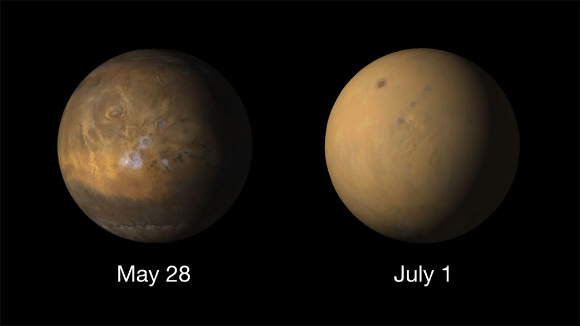
These images from Mars Color Imager (MARCI) aboard NASA’s Mars Reconnaissance Orbiter (MRO) show Mars before (left) and during (right) the June 2018 dust storm. Image credit: NASA / JPL-Caltech / University of Arizona.

Planetary researchers have found the first evidence that bursts of energetic particles from the Sun could warm the lower atmosphere of Mars during massive dust storms, hinting at an unexpected link between space weather and Martian climate.

The post Space Weather May Warp Martian Weather during Dust Storms, Planetary Scientists Suggest appeared first on Sci.News: Breaking Science News.
  •  

Hugs May Be an Ancient Peacekeeping Tool, Ape Study Suggests

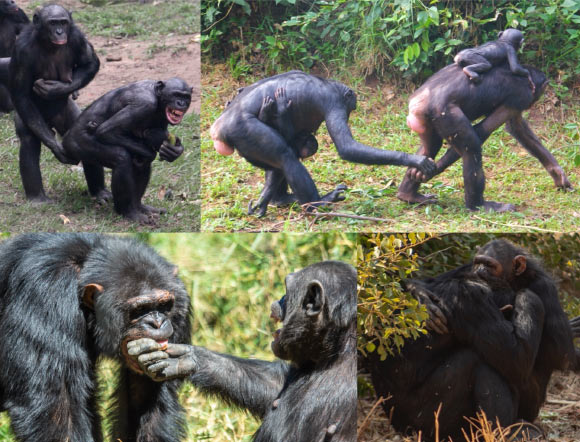
Examples of bonobo and chimpanzee reassurance behaviors. Image credit: Z. Clay / J.S. Brooker.

In a new study of chimpanzees (Pan troglodytes) and bonobos (Pan paniscus), scientists found that embraces, touches and other reassuring gestures before competition for food were linked to more peaceful sharing, suggesting the roots of human social touch stretch back at least six million years.

The post Hugs May Be an Ancient Peacekeeping Tool, Ape Study Suggests appeared first on Sci.News: Breaking Science News.
  •  

Our Milky Way Galaxy Likely Underwent Disk Flip after Ancient Galactic Collision: Study

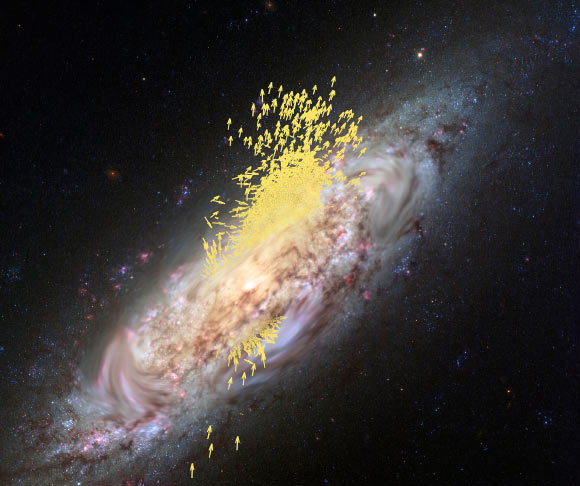
Using supercomputer simulations of galaxies like the Milky Way, Batrakov et al. found that galaxies with slowly rotating stellar haloes are more likely to have experienced a major ‘disk flip,’ where our Galaxy’s disk changed its orientation by more than 90 degrees. Image credit: Batrakov et al.

A head-on collision with another galaxy billions of years ago may have dramatically reoriented the Milky Way’s disk, according to new supercomputer simulations that reveal how violent mergers can leave spiral galaxies looking surprisingly normal today.

The post Our Milky Way Galaxy Likely Underwent Disk Flip after Ancient Galactic Collision: Study appeared first on Sci.News: Breaking Science News.
  •  

Puzzling Near-Earth Asteroid Turns Out to Be Comet with Weak Tail

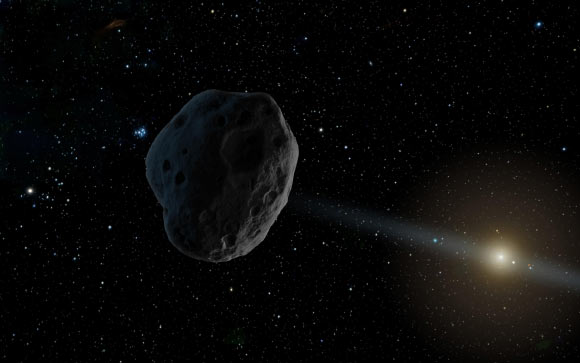
This artist’s concept depicts a near-Earth asteroid with an elongated orbit; a few objects such as these can exhibit significant perturbations in their motion around the Sun and, like 1998 SH2, could turn out to be regular comets with a weak tail and coma. Image credit: NASA / JPL-Caltech.

The near-Earth object (875163) 1998 SH2, which is currently classified as an asteroid, has revealed a hidden identity: it’s actually a comet in disguise, according to a new study published in the journal Nature Astronomy.

The post Puzzling Near-Earth Asteroid Turns Out to Be Comet with Weak Tail appeared first on Sci.News: Breaking Science News.

  •  

CERN Physicists Take New Look at Why Matter Beat Antimatter

Neutral beauty mesons can turn into their own antimatter opposite and back again. Image credit: Ansar Iqbal / CMS.

Using the largest sample yet of particles called beauty mesons, physicists with the CMS Collaboration at CERN’s Large Hadron Collider (LHC) refined a decades-old test of the subtle imbalance that let our Universe exist at all.

The post CERN Physicists Take New Look at Why Matter Beat Antimatter appeared first on Sci.News: Breaking Science News.
  •  

Moderate Coffee and Caffeine Intake Poses Little Heart Risk, and May Even Help

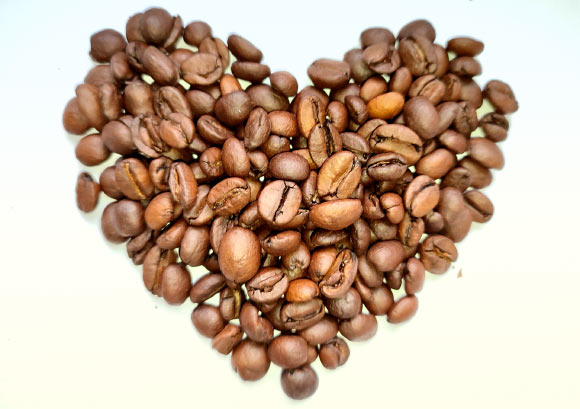
Marcus et al. conclude that moderate caffeine or coffee consumption is safe for most adults and is linked to a lower risk of several cardiovascular conditions, including coronary heart disease, stroke, heart failure and atrial fibrillation, as well as hypertension and type 2 diabetes. Image credit: Sci.News.

In a new review paper, Dr. Gregory Marcus from the University of California, San Francisco and colleagues analyzed decades of research on how caffeine -- most often consumed as coffee -- affects the heart and its risk factors.

The post Moderate Coffee and Caffeine Intake Poses Little Heart Risk, and May Even Help appeared first on Sci.News: Breaking Science News.
  •  

Astronomers Find Omega Centauri’s First Stellar-Mass Black Hole

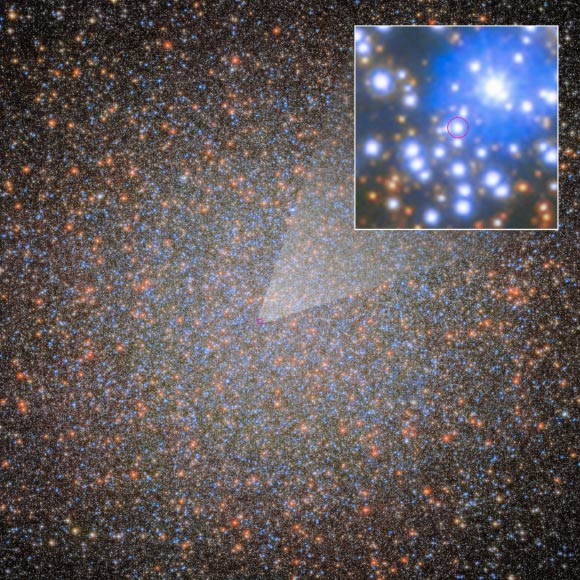
Whitaker et al. found Omega Centauri’s first stellar-mass black hole, which has a visible star companion that is shown in greater detail. Image credit: ESA / NASA / Maximilian Häberle, MPIA / Joseph DePasquale, STScI.

After decades of searching, astronomers have pinpointed the first of an estimated 10,000 stellar-mass black holes thought to lurk in Omega Centauri, the most massive stellar system in the Milky Way found so far, with a stellar mass of 3.6 million solar masses.

The post Astronomers Find Omega Centauri’s First Stellar-Mass Black Hole appeared first on Sci.News: Breaking Science News.

  •  

Barnard’s Star Planetary System May Be Filled with Water-Poor Rocky Worlds

An artist’s illustration of exoplanets orbiting Barnard’s star. Image credit: International Gemini Observatory / NOIRLab / NSF / AURA / P. Marenfeld.

A new analysis suggests the four sub-Earth exoplanets orbiting Barnard’s star -- the Sun’s nearest single-star neighbor -- are likely packed with the deep-Earth mineral periclase, stripped of their atmospheres and far too hostile to support life.

The post Barnard’s Star Planetary System May Be Filled with Water-Poor Rocky Worlds appeared first on Sci.News: Breaking Science News.

  •  

Astronomers Detect Gamma-Ray Burst’s Magnetic Fingerprint

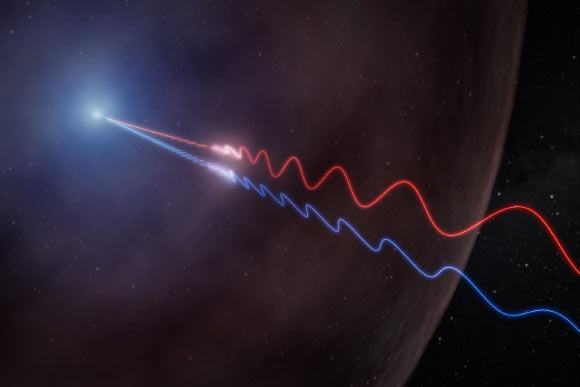
This illustration depicts Faraday rotation in the afterglow of a gamma-ray burst. A powerful jet (upper left) sends polarized radio waves outward through the thin wall of a surrounding bubble of magnetized gas called an HII region. As the light passes through this material, its polarization angle is twisted by the magnetic field. Because the effect is stronger at longer wavelengths, the red and blue waves, which represent different radio wavelengths, exit the bubble oscillating in different directions. By measuring this difference, astronomers were able to map the magnetic environment surrounding GRB 260310A for the first time. Image credit: NSF / AUI / NRAO / M. Weiss

Using NSF’s Very Large Array (VLA), astronomers made the first radio detection of polarized light and Faraday rotation from a gamma-ray burst afterglow, offering an unprecedented glimpse of the magnetic fields surrounding one of the Universe’s most powerful explosions.

The post Astronomers Detect Gamma-Ray Burst’s Magnetic Fingerprint appeared first on Sci.News: Breaking Science News.
  •  

Astronomers Discover and Directly Image Third Planet in Beta Pictoris System

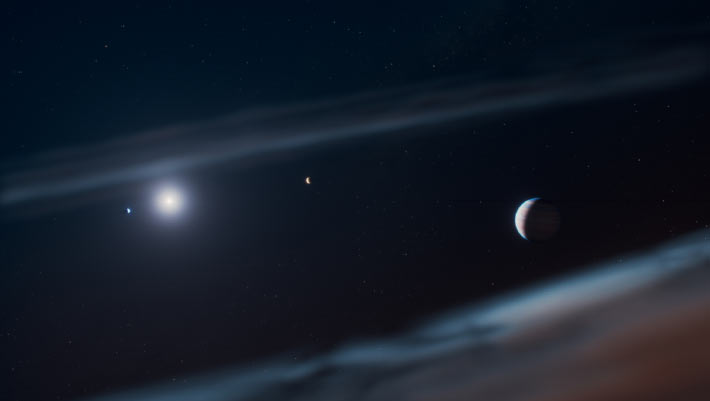
This artist’s concept shows the Beta Pictoris system with the discovered giant exoplanet Beta Pictoris d at the right. Image credit: NASA / ESA / CSA / STScI / Ralf Crawford, STScI.

Named Beta Pictoris d, the newly-discovered world is 100 times fainter than Beta Pictoris b -- the first planet discovered around the A5-type star Beta Pictoris -- and is among the lightest exoplanets ever to be imaged from the ground.

The post Astronomers Discover and Directly Image Third Planet in Beta Pictoris System appeared first on Sci.News: Breaking Science News.
  •  

Pluto’s Moon Charon May Still Be Slowing Its Spin, Study Suggests

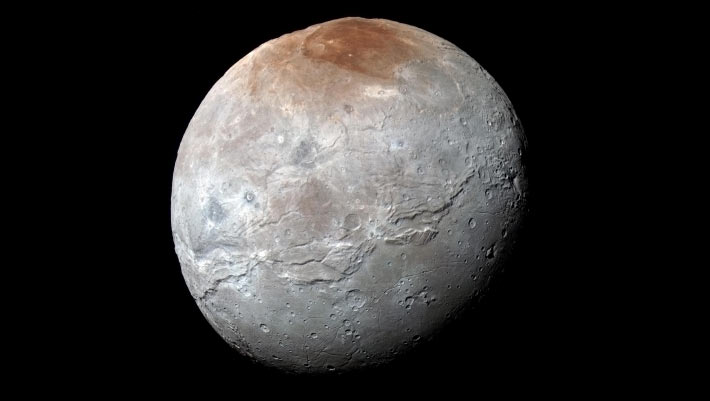
This impressive view of Charon was captured on July 14, 2015. Charon’s color palette is not as diverse as Pluto’s; most striking is the reddish north (top) polar region, informally named Mordor Macula. Image credit: NASA / Johns Hopkins University Applied Physics Laboratory / Southwest Research Institute.

New research indicates that Pluto’s largest moon, Charon, may continue to lose rotational energy despite the pair’s long-standing tidal lock, offering scientists a rare glimpse into the hidden interiors of distant icy worlds.

The post Pluto’s Moon Charon May Still Be Slowing Its Spin, Study Suggests appeared first on Sci.News: Breaking Science News.
  •  

Losing Even 80 Minutes of Sleep a Night Linked to Weight Gain

The study sheds new light on the link between sleep deprivation and obesity. Image credit: Sweet Briar College.

New research from Columbia University found that adults who cut their sleep by about 80 minutes for six weeks packed on a pound (0.45 kg) and moved less during the day.

The post Losing Even 80 Minutes of Sleep a Night Linked to Weight Gain appeared first on Sci.News: Breaking Science News.

  •  

Webb Catches Supermassive Black Hole Feeding from Cosmic Gas Streams

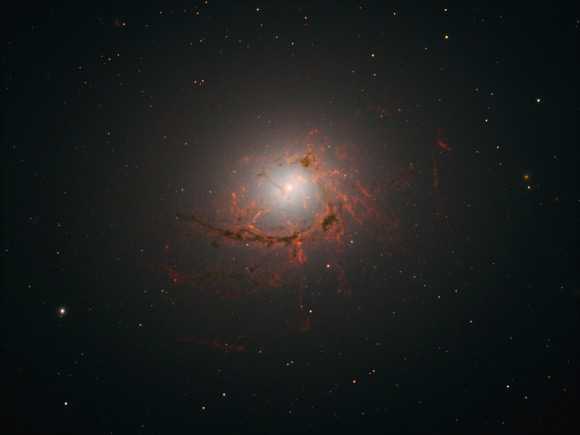
This Hubble image shows the elliptical galaxy NGC 4696. Image credit: NASA / ESA / Hubble / A. Fabian.

New images of the giant elliptical galaxy NGC 4696 from the NASA/ESA/CSA James Webb Space Telescope reveal gas filaments funneling material into a spinning disk around a supermassive black hole 800 light-years across.

The post Webb Catches Supermassive Black Hole Feeding from Cosmic Gas Streams appeared first on Sci.News: Breaking Science News.
  •  

Astronomers Discover Four New White Dwarfs in Solar Neighborhood

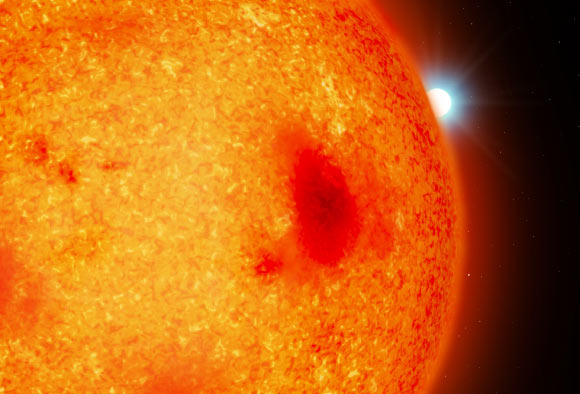
An artist’s impression of a red dwarf with a white dwarf binary companion peeking out from behind. Image credit: Mark A. Garlick / University of Warwick.

Using near-UV spectroscopic data from the Space Telescope Imaging Spectrograph (STIS) on the NASA/ESA Hubble Space Telescope, astronomers discovered four white dwarfs orbiting nearby red dwarf stars.

The post Astronomers Discover Four New White Dwarfs in Solar Neighborhood appeared first on Sci.News: Breaking Science News.
  •  

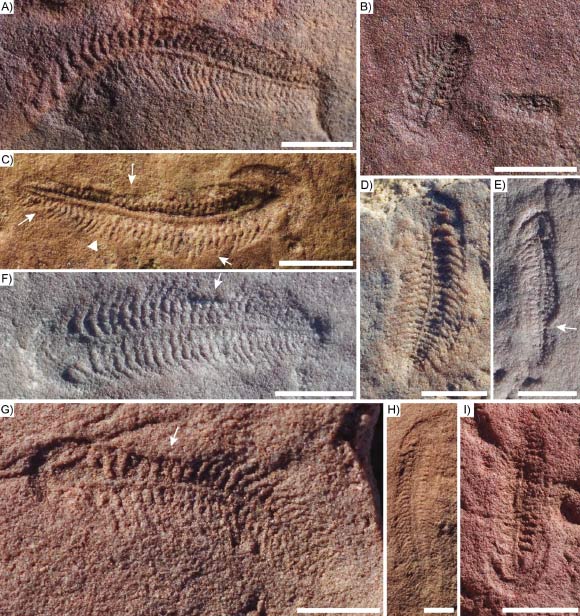
Ediacaran Sea Creature May Hold Earliest Evidence of Right-Handedness

Fossils of Spriggina floundersi from South Australia; white arrows highlight lifted areas, white triangle indicates divergent bend angle of adjacent modules. Scale bars - 10 cm. Image credit: Evans et al., doi: 10.1038/s41598-026-53857-x.

Spriggina floundersi, a marine species that lived during the Ediacaran period 550 million years ago, is one of Earth’s earliest bilaterally symmetrical animals.

The post Ediacaran Sea Creature May Hold Earliest Evidence of Right-Handedness appeared first on Sci.News: Breaking Science News.
  •  

Euclid Discovers Earliest Quasars Ever Seen

This collage shows 15 of the 31 newly discovered quasars by ESA’s Euclid space telescope. EUCL J172902.75+641018.1 and EUCL J125308.55+705432.3 are visible on the first row, the first and second from the left, respectively. Image credit: ESA / Euclid / Euclid Consortium / NASA / Euclid Science Ground Segment / Antoine Basset, CNES.

Astronomers using ESA’s Euclid space telescope have discovered 31 ancient quasars from a time when the Universe was just 670 to 800 million years old. One of these objects, dubbed EUCL J172902.75+641018.1, sets the new record for the most distant quasar ever reported.

The post Euclid Discovers Earliest Quasars Ever Seen appeared first on Sci.News: Breaking Science News.

  •  

Human-Dog Bond is Ancient, Universal and Strikingly the Same Everywhere: Study

Testing situation and hunters with their dogs -- examples from each of the four non-WEIRD societies: (a) pointing test in Mongolia, (b) unsolvable problem test in Vanuatu, (c) showing test in Mongolia, (d) Vanuatu, (e) Mongolia, (f) Madagascar, (g) Peru. Image credit: Bräuer et al., doi: 10.1038/s41598-026-57657-1.

New research spanning five continents and vastly different cultures -- from the steppes of Mongolia to the rainforests of the Pacific -- shows that hunting dogs and their owners cooperate, communicate and rely on each other in nearly identical ways, suggesting the relationship was forged in deep evolutionary time, perhaps 30,000 years ago.

The post Human-Dog Bond is Ancient, Universal and Strikingly the Same Everywhere: Study appeared first on Sci.News: Breaking Science News.

  •  
❌