❌

Reading view

Widespread Tropical Cyclones During the Late Paleozoic Ice Age

A newly published study reports that tropical cyclones were far more common during the Late Paleozoic Ice Age than many climate reconstructions have suggested. Led by Yan, Macarewich, Jiang, and colleagues, the work appears in Nature Communications (2026) and reframes how Earth’s cold interval coexisted with warm-water storm systems.

The researchers investigated geological signatures linked to extreme marine events, combining stratigraphic evidence with climate-model constraints. Their goal was to distinguish ordinary seasonal variability from the kind of widespread, repeated disturbances that characterize tropical cyclone belts.

A key technical advance in the study is the integration of paleoclimate boundary conditions with storm-resolving dynamical reasoning. Instead of treating cyclone activity as a simple function of temperature alone, the team considered large-scale patterns that govern where warm oceans can persist long enough to power rotating storms.

The results point to an expanded region of conditions favorable for cyclogenesis. Even though the planet was globally in an ice-age mode, ocean–atmosphere coupling—driven by uneven heat storage, changing circulation, and shifting storm tracks—likely enabled tropical systems to form across parts of the tropics more frequently than expected.

The authors describe “widespread” activity, implying that cyclone impacts were not limited to rare episodes. This interpretation aligns with the idea that cooling did not fully suppress tropical cyclone energetics; rather, it altered the geography and intensity distribution of storm-prone environments.

Using the preserved sedimentary record, the study connects storm activity to repeated depositional pulses. Those pulses, they argue, reflect basin-scale disturbance rather than local weather anomalies, strengthening the case for frequent tropical cyclone events during this interval.

From a broader perspective, the findings have implications for how we understand resilience and feedbacks in past climates. If cyclones continued to thrive under ice-age background states, then tropical extremes may persist through major global reorganizations.

The study’s viral potential is clear: it challenges an intuitive narrative that “ice ages mean calm tropics,” and replaces it with a more nuanced picture in which warm-water dynamics and circulation shifts can sustain storminess despite global cooling.

Below are the details available from the provided text:

Subject of Research: Tropical cyclone activity during the Late Paleozoic Ice Age.

Article Title: Widespread tropical cyclone activity during the Late Paleozoic Ice Age.

Article References: Yan, Q., Macarewich, S., Jiang, N. et al. Widespread tropical cyclone activity during the Late Paleozoic Ice Age. Nat Commun (2026). https://doi.org/10.1038/s41467-026-75609-1

Image Credits: AI Generated

DOI: 10.1038/s41467-026-75609-1

  •  

Undersea optical fibres detect the motion of silent whales

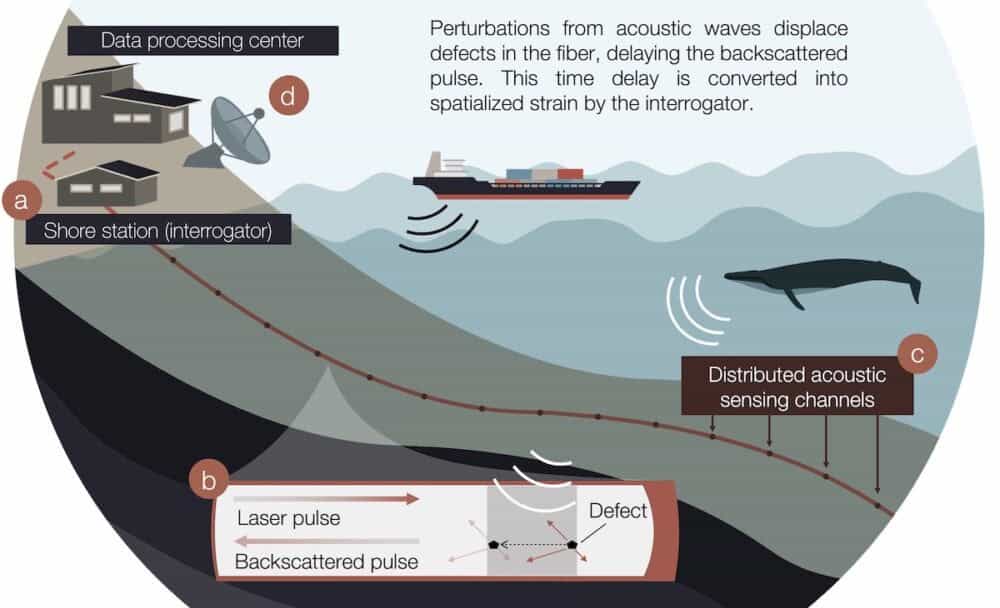
Distributed acoustic sensing system
Detecting whale motion Graphic showing a distributed acoustic sensing system that uses fibre-optic cables to help researchers detect ships and whales in the waters near Svalbard. (Courtesy: Léa Bouffaut)

A technique currently used to track whale vocalizations could be adapted to pick up the hydrodynamic pressure fields created as they swim, researchers in Norway have demonstrated. Through analysis of backscattered light in an undersea optical fibre, Robin Rørstadbotnen and Martin Landrø at the Norwegian University of Science and Technology (NTNU) showed how silent whales can be detected as they swim close to the fibre. The duo hopes the discovery could ultimately provide a valuable new tool for whale conservation.

With the combined disruption of climate change and human activity, whales are rapidly being forced into new habitats and migration patterns. To understand these profound shifts in behaviour, conservationists widely rely on a technique named distributed acoustic sensing (DAS), which detects acoustic waves via the strain they induce on optical fibres.

When coherent laser pulses are passed through a fibre, a small portion of laser light is inevitably scattered back to the source by small fluctuations in the fibre’s structure and density. If the fibre is strained by an acoustic wave, the oscillating pressure field imprints a phase shift on this backscattered light, which varies in proportion to the degree of strain.

So far, this approach has been used to pick up whale vocalizations: the loudest sounds produced by any animal, which can travel for thousands of kilometres through the ocean. By analysing backscattered light across the global network of undersea optical fibres, researchers have gathered valuable information about how the habitats and migration paths of these marine mammals are changing.

“At NTNU, we started activity within distributed acoustic sensing in 2016,” Rørstadbotnen describes. “When the Center for Geophysical Forecasting was launched in 2021, this technology became a key field of interest.”

Despite the value of data that can be gathered through whale vocalizations, the approach leaves conservationists with a significant blind spot for the majority of the time when whales are silent. To address this limitation, Rørstadbotnen and Landrø considered how DAS could be adapted to pick up the hydrodynamic pressure and velocity fields constantly being created by the whales moving through the water, which generates ultralow-frequency signals similar to those created by the movement of ships.

To test this idea, the duo revisited scattering data gathered from a seabed optical fibre off the coast of Svalbard in the Norwegian Arctic. After filtering the data for a selected band of frequencies, they carried out frequency–wavenumber analysis to determine how rapidly the signals varied along the length of the fibre. Just as they hoped, “we found that this new approach could be applied to detect silent whales, given that they are swimming close to the fibre optic cable,” Rørstadbotnen says.

Through this analysis, the researchers were able to identify ships crossing the fibre from depths of up to 413 m, and at a maximum distance of 550 m from the fibre. They also managed to determine the vessel speeds and roughly estimate their sizes. Crucially, they were also able to distinguish the speeds and approximate sizes of silent whales swimming less than 40 m away from the fibre, as well as estimating their depths.

“Since we also recorded the acoustic signals in the frequency range from 5 to 100 Hz, we could identify whales when they were vocalizing closer to the sea surface,” Rørstadbotnen describes. “Thereby, we could use this information as a strong indication that the low-frequency signal observed a bit later in time was most likely generated by the whale moving closer to the fibre.”

Having demonstrated this possibility, Rørstadbotnen and Landrø now hope that their technique could provide researchers with a new tool for tracking whales around the world, even when they aren’t vocalizing. “In addition, this method can potentially detect toothed whales that vocalize in the high-frequency band outside what is normally recorded for distributed acoustic sensing,” Rørstadbotnen adds.

Beyond its potential for whale conservation, the duo is also hopeful that the technique could help researchers build up a more extensive picture of marine mammals more generally, along with other vital elements of fast-changing marine ecosystems.

The research is described in Proceedings of the National Academy of Sciences.

The post Undersea optical fibres detect the motion of silent whales appeared first on Physics World.

  •  

Radar identifies insect species via reflections from wingbeats

Pollinating insects form a vital part of any ecosystem, enabling the biodiversity that we see on Earth today. However, biodiversity is in rapid decline around the world, and monitoring insect species is a difficult task that often requires some insects to be killed. To support the conservation of biodiversity, which is critical to ensure the sustainability of human civilization, more robust monitoring is required. In a study published in PNAS Nexus, researchers have developed a new method to identify and classify individual insects, based on radar imaging and machine learning.

Radar has long been used to study migrating insects that fly at high altitudes and in large numbers, but such systems typically perform wide-area, long-range monitoring. However, thanks to a combination of millimetre-wave radar and machine learning, narrow focused identification is now possible, by detecting changes in the radar reflection of insects caused by the flapping of their wings.

“Having a background in antenna engineering, there was always the question of whether this technology can be used to address some of the environmental challenges that we’re facing,” says co-lead author Adam Narbudowicz from the Technical University of Denmark. “Some five or six years ago, we started talking with [co-author] Ian [Donohue] about those possibilities, and eventually the idea of micro-Doppler emerged, which seemed feasible from an engineering point of view and could provide some useful data on biodiversity.”

The approach taken in this study doesn’t focus on morphological features of the insects, as these are difficult to detect with radar. Instead, it uses the harmonic patterns generated by the micro-Doppler effect of an insect beating its wings as a detection strategy. Millimetre-wave radar can provide insight into biomechanical characteristics not visible with cameras, and these characteristics are encoded in the harmonic patterns of the wingbeat.

The team used machine learning to improve the accuracy of the identification and incorporated a SHAP (SHapley Additive exPlanations) analysis – an explainable AI tool that interprets and explains key outputs and prioritizes key features – to identify which signal features are the most critical for differentiating insect species. The SHAP analysed each insect across the full spectrum of micro-Doppler harmonics, extracting key features including fundamental wingbeat frequency, energy distributions, cepstral coefficients (sound signals) and how quickly an insect’s wing movement change. These data were then used to train the machine learning model.

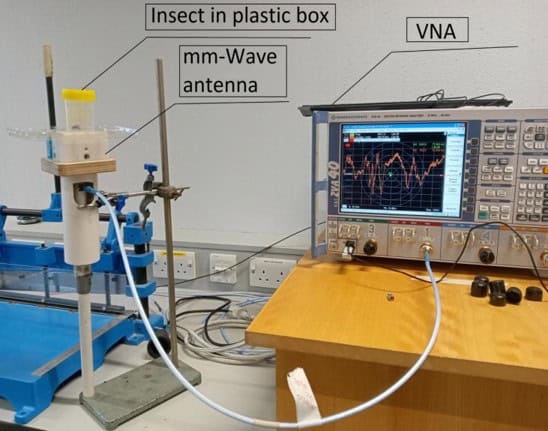
Training the model The radar system used to collect data from insects. (Courtesy: Linta Antony)

The actual process of obtaining this data from the insects involved capturing insects at the Trinity College Dublin campus and placing them in a plastic box on top of a millimetre-wave antenna that recorded their radar signatures. The researchers then released the insects back into the wild. After data capture, the relevant micro-Doppler features were extracted from the data for model training.

The model allowed non-invasive monitoring of different insects and could distinguish between bees and wasps with 96% accuracy. The model also classified five key pollinating insect species – red-tailed bumblebee, buff-tailed bumblebee, moss carder bumblebee, western honeybee and common wasp – with an accuracy of 85%.

“I think the most impressive thing is that we can detect and classify them with such an accuracy. From a biological point of view, it’s impressive how different species beat their wings in different manner, and from an engineering point of view it’s fascinating how different wingbeats affect harmonics of radar micro-Doppler reflections,” says Narbudowicz. “Those differences are of course impossible to see just by looking at spectrograms, but it appears that a sufficiently trained machine learning algorithm can see them.”

Narbudowicz points out that the current study used precise lab-grade transceivers and a relatively controlled set-up, and that the natural next step is to move this technology to outdoor field deployment. “This requires a number of steps,” he explains. “Firstly, the device needs to be miniaturized, and battery operated; the transceiver will be less accurate than the one used in the lab, but a big problem is the ground truth verification, since in the field it can be difficult to verify exactly which species flew over the sensor.”

Despite the greater challenge with deploying the technology in the field today, the researchers suggest that this radar reflection approach could be utilized in the future in a fly-through device, which would make it much easier and cheaper to achieve non-lethal monitoring of insect biodiversity in different environments.

The post Radar identifies insect species via reflections from wingbeats appeared first on Physics World.

  •  

A Tunisian phosphate plant that sickens children so US, Europe can get fertilizer

Dalila grew up in the Tunisian coastal city of Gabès and is accustomed to the heavy, acrid smell from the state-owned phosphate processing plant about a 10-minute walk from her home. On days when noxious fumes fill the air, Dalila rushes to tightly shut the windows and tells her children to hurry indoors. She washes them, believing it lessens harmful effects from chemicals. Emissions can last all day. Residents may get little or no advance warning. But one day in September 2025, children were at school when gases spread. Some students fell to the ground, complaining they had difficulty breathing. Others said they felt like they were suffocating. Dalila’s daughter said she felt like she was choking. Dalila rushed her to a government-run hospital. When she asked about test results or the type of substances that may have caused her difficulty breathing, Dalila said she did not get clear answers. The incident sickening the schoolchildren helped spark mass protests in the streets of Gabès, with people waving banners that read “Stop Pollution” and “Move The Plant.” It is not the first time that residents have protested water and air pollution from the factory. Dalila feels that she and others in Gabès are being ignored. They are far from alone. Fishermen report coastal waters were once abundant with fish, but, now, their nets come up empty. Scientific studies provide evidence that environmental damage poses a danger to the health of those living nearby. People take part in a demonstration against pollution…This article was originally published on Mongabay

  •  

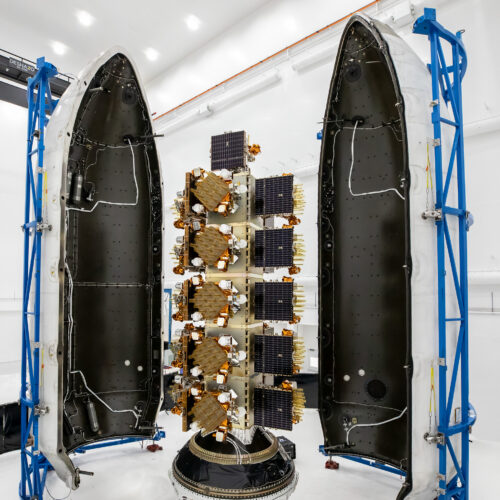
The Pentagon's Space Development Agency hasn't moved as fast as anyone would like

The Space Development Agency was established in 2019 to help speed up the deployment of US military space systems by sidestepping the Pentagon's traditional sluggish bureaucracy.

Seven years later, SDA is finally launching its first batches of operational satellites, just as the Pentagon plans to shutter the semi-autonomous agency and fold it back into the Space Force's procurement pipeline, newly reorganized under several program acquisition executives in a bid to streamline weapons buying.

SDA's fate is not a surprise, and lawmakers in both houses of Congress have backed the agency's closure in drafts of this year's National Defense Authorization Act.

Read full article

Comments

© SpaceX

  •  

Topological Jackiw-Rebbi States in Photonic Van der Waals Heterostructures

A new study is turning an elegant quantum idea into a practical platform for light. In research published in Light: Science & Applications, physicists report “topological Jackiw–Rebbi” states engineered inside photonic van der Waals heterostructures—systems built by stacking atomically thin materials with precisely tailored interfaces. The result is a photonic phenomenon that echoes how particles can be trapped at boundaries where the rules of their governing equations change.

The work builds on the classic Jackiw–Rebbi mechanism, originally proposed for relativistic particles. In those models, a localized mode appears when a mass term flips sign, effectively creating a domain wall. The authors translate this concept into optics by designing photonic structures where an effective “mass” characterizing light propagation changes across an interface.

What makes the platform especially compelling is the van der Waals architecture. Unlike conventional fabrication routes that can introduce disorder, the layered nature of these materials enables sharp, controllable boundaries and tunable photonic band structures. By adjusting the stacking and interlayer optical responses, the researchers create conditions in which topological modes become robust against typical imperfections.

The study emphasizes that these states are not merely conventional guided resonances. Instead, they are tied to topology: the light modes are associated with an invariant property of the band structure. As a consequence, the Jackiw–Rebbi-like photonic states are expected to persist even when the system’s details vary, so long as the relevant symmetry and band configuration remain intact.

Topological protection is more than a slogan. In photonics, it can translate into reduced sensitivity to fabrication tolerances and a pathway toward devices that rely on stable boundary transport. The paper therefore positions these localized states as building blocks for future optical components that route signals along designed interfaces.

The authors demonstrate the concept theoretically and connect it to experimental observables by focusing on how the interface should host modes localized near the domain wall region. Such localization is a hallmark of the Jackiw–Rebbi scenario, now realized in a controllable, designer photonic environment.

Beyond fundamental interest, the approach could influence the design of reconfigurable photonic circuits. Because van der Waals stacks can be combined and adjusted, the same topology-driven logic may be extended to new material systems, wavelengths, and device geometries.

Overall, the report signals a broader trend: using topological field-theory ideas to engineer light–matter behavior in atomically precise platforms, potentially enabling the next generation of robust, interface-based photonic technologies.

Subject of Research: Topological photonic states (Jackiw–Rebbi) in van der Waals heterostructures.

Article Title: Topological Jackiw-Rebbi states in photonic Van der Waals heterostructures.

Article References: Randerson, S.A., Bouteyre, P., Hu, X. et al. Light Sci Appl 15, 323 (2026). https://doi.org/10.1038/s41377-026-02392-5

Image Credits: AI Generated

DOI: 10.1038/s41377-026-02392-5

Keywords:

  •  
  •  

As Natural Disasters Expand, a Disaster-Tracking App Is Booming

Known for tracking California wildfires, Watch Duty is moving beyond that mission. Millions of people are turning to it for help.

© Joel Angel Juarez/Associated Press

An emergency vehicle at the flooding Guadalupe River in Comfort, Texas, on Thursday.
  •  

The Latest Texas Floods Tested Warning Systems. This Time, They Passed.

A lack of sirens and flood forecasting systems made the state’s Hill Country vulnerable to deadly floods last summer. That has changed.

© Brandon Bell/Getty Images

Flood debris blocked a road in Kerrville, Texas, on Thursday.
  •  

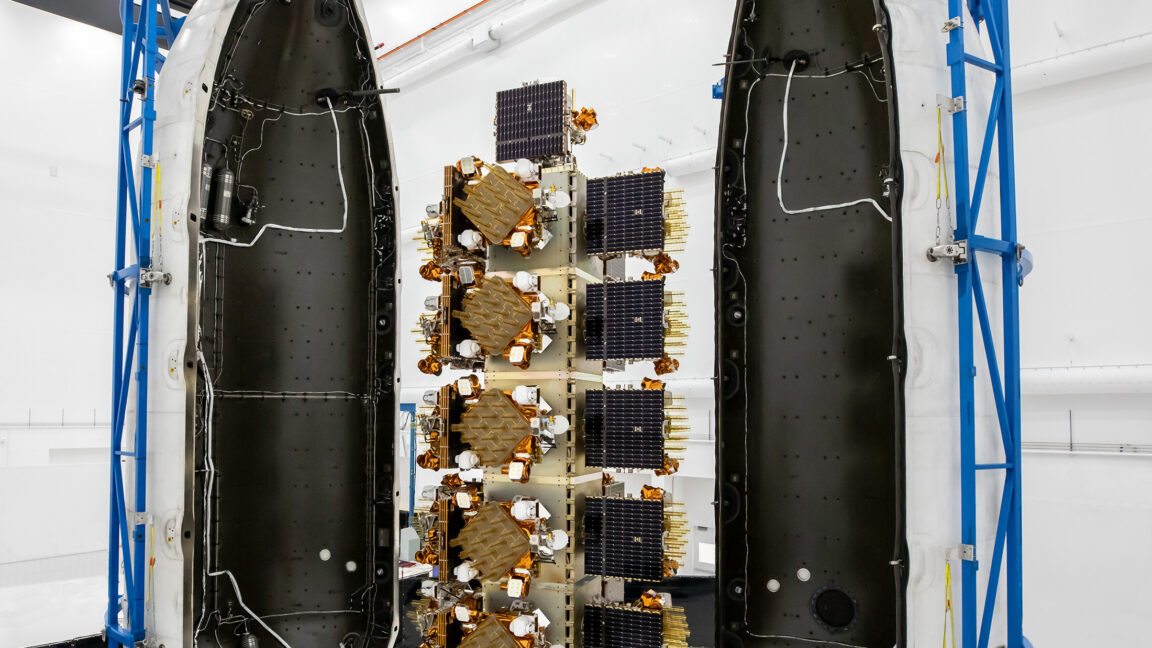
The Pentagon's Space Development Agency hasn't moved as fast as anyone would like

The Space Development Agency was established in 2019 to help speed up the deployment of US military space systems by sidestepping the Pentagon's traditional sluggish bureaucracy.

Seven years later, SDA is finally launching its first batches of operational satellites, just as the Pentagon plans to shutter the semi-autonomous agency and fold it back into the Space Force's procurement pipeline, newly reorganized under several program acquisition executives in a bid to streamline weapons buying.

SDA's fate is not a surprise, and lawmakers in both houses of Congress have backed the agency's closure in drafts of this year's National Defense Authorization Act.

Read full article

Comments

© SpaceX

  •  

Microsoft’s Patch Tuesday updates: Keeping up with the latest fixes

Long before Taco Tuesday became part of the pop-culture vernacular, Tuesdays were synonymous with security — and for anyone in the tech world, they still are.  Patch Tuesday, as you most likely know, refers to the day each month when Microsoft releases security updates and patches for its software products — everything from Windows to Office to SQL Server, developer tools to browsers.

The practice, which happens on the second Tuesday of the month, was initiated to streamline the patch distribution process and make it easier for users and IT system administrators to manage updates.  Like tacos, Patch Tuesday is here to stay.

In a blog post celebrating the 20th anniversary of Patch Tuesday, the Microsoft Security Response Center wrote: “The concept of Patch Tuesday was conceived and implemented in 2003. Before this unified approach, our security updates were sporadic, posing significant challenges for IT professionals and organizations in deploying critical patches in a timely manner.”

Patch Tuesday will continue to be an “important part of our strategy to keep users secure,” Microsoft said, adding that it’s now an important part of the cybersecurity industry.  As a case in point, Adobe, among others, follows a similar patch cadence.

Patch Tuesday coverage has also long been a staple of Computerworld’s commitment to provide critical information to the IT industry. That’s why we’ve gathered together this collection of recent patches, a rolling list we’ll keep updated each month.

In case you missed a recent Patch Tuesday announcement, here are the latest six months of updates.

July’s Patch Tuesday sees an end-of-support collision amidst a massive, record-setting patch wave

Microsoft addressed 722 CVEs this month once the 427 Chromium upstream relays are set aside — roughly three times a normal cycle and one of the largest single months in recent memory. Two vulnerabilities arrive under active exploitation: an elevation of privilege in Active Directory Federation Services (CVE-2026-56155), and an elevation of privilege in SharePoint Server (CVE-2026-56164). A third, a BitLocker security feature bypass (CVE-2026-50661) is publicly disclosed but not yet exploited.

The July 2026 Patch Tuesday earns Patch Now recommendations for Windows, Office, Exchange, and SQL Server. SharePoint has two critical RCEs on top of its exploited zero-day, and Exchange Server returns with a critical on-premises spoofing flaw. Adding to our (dear) administrator’s efforts, SharePoint Server 2016/2019 and SQL Server 2016 all reach end of support today. The Readiness team has provided a handy infographic of the expected risk profile of this month’s Patch Tuesday updates.

More info is available here on Microsoft Security updates for July 2026.

For June, Patch Tuesday means an IT scramble

Microsoft this month released 206 updates affecting Windows, Office, Exchange Server, and its developer tools — including three Windows vulnerabilities already publicly disclosed. That trio includes an elevation of privilege in the Collaborative Translation Framework (CVE-2026-45586), a denial of service in HTTP.sys (CVE-2026-49160), and a BitLocker security feature bypass (CVE-2026-50507). At the moment, none appear to be under active exploitation, but all three are rated “Exploitation More Likely.” 

Even without an exploited zero-day, the June 2026 Patch Tuesday release requires Patch Now recommendations for Windows, Office, and Exchange. The latter is back in the patch picture with a consolidated security update that Microsoft recommends installing “as soon as possible.”

More info is available here on Microsoft Security updates for June 2026.

For May, Patch Tuesday means 139 updates — but no zero-days

Microsoft this month released 139 updates affecting Windows, Office, .NET, and SQL Server (though there were no updates for Microsoft Exchange Server). Despite the absence of zero-days, the May Patch Tuesday update still requires Patch Now recommendations for Windows and Office. 

The combination of three unauthenticated network RCEs (Netlogon, DNS Client, and SSO Plugin for Jira and Confluence), four Word Preview Pane RCEs, the large TCP/IP vulnerability cluster, and the carry-over BitLocker recovery condition (still active on Windows 10 and Windows Server) warrants an accelerated deployment release schedule. 

More info is available here on Microsoft Security updates for May 2026.

Microsoft’s Patch Tuesday release for April is a whopper

Windows admins are going to be busy this month, dealing with the largest Patch Tuesday cycle in memory. The April release involves 165 updates and roughly 340 unique CVEs from Microsoft — including two zero-days, one of which is already being actively exploited in the wild. 

The Readiness team recommends “Patch Now” schedules for nearly every major product family: Windows, Office (with a zero-day), Microsoft Edge (Chromium), SQL Server, and Microsoft Developer Tools (.NET). April also brings Phase 2 of Microsoft’s Kerberos RC4 hardening with full enforcement set for July. There is a lot to cover, so here’s a useful infographic mapping the deployment risk for each platform.

More info is available here on Microsoft Security updates for April 2026.

For March, Patch Tuesday delivers fixes for 83 vulnerabilities

Microsoft’s March Patch Tuesday release addresses 83 vulnerabilities across Windows, Office, SQL Server, Azure, and .NET — with two publicly disclosed zero-days affecting SQL Server and .NET (though neither is being actively exploited in the wild.) Six additional vulnerabilities spanning the Windows Kernel, Graphics Component, SMB Server, Accessibility Infrastructure, and Winlogon are flagged as “Exploitation More Likely.”

The most significant change this month is the introduction of Common Log File System (CLFS) hardening with signature verification, which will affect how Windows handles log files across the operating system. More info on Microsoft Security updates for March 2026.

February’s Patch Tuesday release fixes 59 flaws, including 6 being exploited

The company’s Patch Tuesday release for February addresses 59 CVEs across the company’s product family — roughly half the volume of January’s 159 patches. Six vulnerabilities, affecting Windows Shell, MSHTML, Desktop Window Manager, Remote Desktop, Remote Access, and Microsoft Word, are already being actively exploited. (All five Critical-rated CVEs target Azureservices rather than Windows, however.) 

Both Windows and Office get a “Patch Now” recommendation, with CISA setting a March 3 enforcement deadline for all six exploited vulnerabilities. Two new enforcement timelines also take effect in April: Kerberos RC4 deprecation (CVE-2026-20833) and Windows Deployment Services hardening (CVE-2026-0386). More info on Microsoft Security updates for February 2026.

  •  

July’s Patch Tuesday sees an end-of-support collision amidst a massive, record-setting patch wave

Microsoft addressed 722 CVEs this month once the 427 Chromium upstream relays are set aside — roughly three times a normal cycle and one of the largest single months in recent memory. Two vulnerabilities arrive under active exploitation: an elevation of privilege in Active Directory Federation Services (CVE-2026-56155), and an elevation of privilege in SharePoint Server (CVE-2026-56164). A third, a BitLocker security feature bypass (CVE-2026-50661) is publicly disclosed but not yet exploited.

The July 2026 Patch Tuesday earns Patch Now recommendations for Windows, Office, Exchange, and SQL Server. SharePoint has two critical RCEs on top of its exploited zero-day, and Exchange Server returns with a critical on-premises spoofing flaw. Adding to our (dear) administrator’s efforts, SharePoint Server 2016/2019 and SQL Server 2016 all reach end of support today. The Readiness team has provided a handy infographic of the expected risk profile of this month’s Patch Tuesday updates.

(More information about recent Patch Tuesday releases is available here.)

Known issues

The July release note flags known issues against the following updates:

  • BitLocker recovery prompt on first restart – the PCR7 recovery condition tracked since April remains live on the platforms that did not receive the Boot Manager servicing fix (Windows Server 2022 and Windows 10 22H2). Devices with BitLocker on the OS drive, the Group Policy “Configure TPM platform validation profile for native UEFI firmware configurations” set with PCR7 included, and Secure Boot State PCR7 Binding reported as “Not Possible” may be prompted for the recovery key on the first restart after installing this update. This month’s publicly disclosed BitLocker security feature bypass (CVE-2026-50661) keeps the component in focus.
  • WSUS synchronization error details suppressed (Windows Server 2025 and 2022) – WSUS no longer displays synchronization error details in its error reporting, a deliberate change made to address the Remote Code Execution Vulnerability CVE-2025-59287. Sync still works, but administrators triaging a failed synchronization lose the detail pane and must fall back to the SoftwareDistribution logs.

Windows Update can still replace manually installed graphics drivers with older OEM versions from the catalogue (the four-part Hardware ID ranking issue acknowledged on the Hardware Dev Center). The two-part HWID pilot runs to September 2026.

Major revisions and mitigations

Between the June and July Patch Tuesdays, MSRC Security Update Guide notices updated 651 reported CVEs across six notification dates (15, 19, 26 June and 3, 8, 11 July), 532 of them routine Chromium upstream re-publications. Of the roughly 30 Microsoft revisions, almost all were cross-platform Office catch-up with no bearing on a Windows enterprise estate. No further action required for IT administrators for this Windows update cycle.

Windows lifecycle and enforcement updates

This is the deadline cycle June pointed at. The July end-of-support wave lands today, and it collides with the month’s heaviest patching. SharePoint and SQL Server take some of their most active security updates ever on platforms receiving their last.

  • SharePoint Server 2016 and 2019, Project Server 2016 and 2019, SQL Server 2016 and InfoPath 2013 have all reached end of support. SQL Server 2014 ESU Year 2 reaches end of support today. SharePoint 2016/2019 take an actively exploited zero-day and two RCEs this cycle, and SQL Server 2016 takes a critical RCE, all as their final security update. Now is the time to get moving on updating these platforms.

The 2011 Secure Boot certificate expiries have now passed; devices that never took the Windows UEFI CA 2023 key updates under CVE-2023-24932 can no longer receive updated boot components, with the Windows Production PCA for the boot manager still ahead on 19 October 2026. Kerberos RC4 hardening (CVE-2026-20833) has been in enforcement since April 2026; the July 2026 update removes the RC4DefaultDisablementPhase rollback control that let administrators defer it, making enforcement final.

Microsoft’s July 2026 Patch Tuesday is a security-only release: 180 test-guidance entries, 14 of them high risk (June had one). Printing and graphics are the centre of gravity: win32kfull.sys, the kernel-mode window manager, is the most-patched binary (14 entries), and seven high-risk flags sit alongside it – the Print Spooler, four win32k entries, and two GDI+ metafile entries. NTFS is the second theme, with 10 entries, two high risk. Every entry reports no functional changes – it’s pure regression validation. The packages span Windows 11 26H1 back to Server 2012 ESU.

Printing and graphics (high risk)

The Print Spooler flag centres on shared printers, whose queue status must track jobs accurately; the win32k flags cover 32-bit application printing, font rendering in printed and exported output, on-screen rendering, and window management; the GDI+ flags cover metafiles.

  • Share a printer from a print server, print from a separate client in varied sizes and formats, and cancel a job, confirming the queue reflects every state change
  • Print from your 32-bit applications, and print text-heavy, graphics-heavy, and multi-page documents to physical and virtual (PDF or XPS) printers, repeating after orientation, scaling, and resolution changes
  • Export documents with varied fonts to PDF and confirm fonts and layout survive; render EMF+ files that apply effects to very large images, and convert EMF files to WMF
  • Open and close windows rapidly, drive common dialogs by mouse and keyboard, and close parents with children open – no orphaned windows

Storage and file systems (high risk)

Both NTFS high-risk flags target integrity – extended attributes, and volume recovery after an unexpected shutdown. File History carries its own high-risk flag on clients. A Windows Server 2025-only bundle across boot, BitLocker, and ReFS demands the full Secure Boot/BitLocker matrix. Eight entries hit Server 2025 alone, including WSL, GPU partitioning, and a scripted Windows Server Backup pass repeating recovery after rolling the date 90 days forward.

  • Exercise NTFS extended attributes – older-system EAs, backup workflows that preserve them, concurrent same-file operations where supported – with antivirus, encryption, or storage filters active
  • Simulate an unexpected shutdown during file activity, verify the volume mounts intact, run chkdsk, and confirm indexing, shadow copies, and backup still work
  • Run a full File History pass: back up, modify and back up again, exclude folders, change frequency, move the destination
  • On Server 2025, boot all four Secure Boot/BitLocker combinations, in standard and confidential VMs where supported

Devices, input and networking (high risk)

Three further high-risk flags land here: HID input (hidparse.sys with win32k) – touch, keyboard, mouse, touchpad, through disconnects and restarts; the WinSock bundle (afd.sys plus Bluetooth and multicast drivers); and IrDA. The heaviest ask is not high risk at all: the NetAdapterCx driver (24H2/25H2, Server 2025) wants 500-plus adapter enable-disable cycles under Driver Verifier.

  • Run the connectivity suite: browsing, large downloads, mapped drives, an RDP session idle 30+ minutes, a Teams call, an hour of streaming, and localhost apps such as Docker or WSL
  • Stress Bluetooth: pairing, 10+ minutes of audio, input after idle, and reconnection after sleep
  • Where infrared hardware exists, transfer a file and run at least 100 connect-disconnect cycles
  • Sweep the rest: DNS Server (zone data must stay under its configured database directory), the client resolver (five entries), DHCP Server (five entries), SMB, NFS, Message Queuing (five entries), RRAS administration, client VPN, and WinHTTP/WinINet consumers

Other windows components

Windows Installer itself is patched: testing should include application install, uninstall, repair, and force a rollback. Hyper-V wants virtual-switch traffic as part of its testing exercises with Virtual Filtering Platform policies enforced. Sixteen media-related security entries cover playback, HEVC and MPEG-TS, USB audio, and MIDI 2.0.

Shell hardening and LSA isolation

These two entries are a little different from the rest of the cycle: they ask you to confirm a security behaviour actively works, not just that nothing regressed. A pass here means the protection fired, so treat them as functional checks rather than box-ticking.

  • Shortcut handling (windows.storage.dll; Windows 11 23H2 and earlier, plus Server 2022): drop a shortcut file carrying the Mark of the Web into a folder and confirm the system refuses to extract its icon and leaks no NTLM credential hash – include the zero-click paths, where the icon would otherwise render without you opening anything
  • LSA isolation and KeyGuard (24H2/25H2, Server 2025): run the supplied PowerShell validation script, which turns on Virtualization-based Security if it isn’t already, exercises KeyGuard key operations in both required and best-effort isolation modes, and reports pass or fail – it needs TPM 2.0, UEFI with Secure Boot disabled, and PowerShell 7
  • Run that script on a dedicated test machine, never a shared one: it enables test signing, disables automatic updates, and reboots without asking

Office & SharePoint

July’s Office wave is security-only; everything landed on 14 July, and nothing critical or non-security shipped in the 7 July preview. It’s an MSI-only cycle, so Click-to-Run estates can sit this one out.

  • On MSI Office 2016, apply the client updates – Excel (KB5002886), Word (KB5002890), PowerPoint (KB5002867), and five further Office 2016 security updates (KB5002273, KB5002887, KB5002748, KB5002857, KB5002830) – then exercise macros, external data, embedded objects, and any line-of-business add-ins
  • On SharePoint Server, patch 2016 (KB5002891, plus the KB5002892 language pack) and Subscription Edition (KB5002882), then check browser-based editing; the guidance lists SharePoint 2019 with a baseline but ships no 2019 package, so there is nothing to install there

Mind the rollback rules before you schedule the window: most client updates can be uninstalled, but the server updates cannot and always require a reboot.

Developer tools & databases

The developer estate gets a broad but low-drama sweep this month. Both .NET and SQL Server patch widely, but the ask is representative-application validation rather than anything exotic – install on the matching branch and confirm normal behaviour.

  • .NET: install the SDK updates (8.0.423, 9.0.316, 10.0.302, x64 and x86) and the Framework rollups spanning 3.5 through 4.8.1 – which reach from Windows Server 2012 up to Windows 11 26H1 and Server 2025 – then run a representative set of applications and confirm they function normally
  • SQL Server: the GDR updates span 2016 SP3 through 2025 – install each on its matching branch and test that each removes cleanly
  • Check an encrypted client connection through the separately patched Windows SQL client (dbnetlib.dll), which ships outside the server branches

The Readiness team recommends the following priorities for your larger enterprise deployments:

  • Start with printing and graphics: half the high-risk flags sit in the Print Spooler, win32k, and GDI+, so regress shared printers, 32-bit printing, PDF export, metafiles, and window management before anything else
  • Take NTFS next – extended attributes and crash recovery both touch data integrity – and add a client File History backup-and-restore pass
  • Give Server 2025 its wider matrix – the Secure Boot/BitLocker combinations, WSL, GPU partitioning, and the scripted backup pass – and work through the stress suites
  • Run the scripted KeyGuard validation on any VBS estate, preferably on a dedicated machine.

Each month, we break down the update cycle into product families (as defined by Microsoft) with the following basic groupings:

  • Browsers (Microsoft IE and Edge)
  • Microsoft Windows (both desktop and server)
  • Microsoft Office
  • Microsoft Exchange and SQL Server
  • Microsoft Developer Tools (Visual Studio and .NET)
  • Adobe (if you get this far)

Browsers

Edge has had a busier month than usual. Microsoft addressed 46 Microsoft Edge (Chromium-based) CVEs this cycle. None critical, but heavily weighted to remote code execution (21 entries) and spoofing (13), led by CVE-2026-58289, a remote code execution flaw. A run of further RCEs (CVE-2026-57981, CVE-2026-56645, CVE-2026-57974) follows.

  • Microsoft Edge – the Edge-specific fixes ship in the Edge stable channel (version 150.0.4078.65, released 9 July). The concentration of RCE and spoofing this month is worth a look for managed Edge estates rather than a routine wave-through.
  • Chromium upstream – 427 CVEs relayed through MSRC this cycle, spanning the weekly Chrome release cadence since the June report: use-after-free, out-of-bounds read/write, type confusion, and inappropriate-implementation flaws across V8, Dawn, ANGLE, Skia, and Tint. The same fixes ship in the Chrome Stable channel; see the Chrome releases blog for the upstream notes.

The Chromium volume looks (quite) alarming but is routine plumbing: it flows to Edge through its own auto-update channel. Add these browser (Edge) updates to your standard release schedule for your managed environments.

Microsoft Windows

Windows carries the bulk of this month’s updates: 406 CVEs, 31 rated critical and 374 important. Elevation of privilege dominates by volume (226 entries), followed by remote code execution (70), information disclosure (70), denial of service (23), and a scatter of security-feature-bypass, tampering, and spoofing entries across the following feature groupings:

The Windows Kernel is the most-patched component (28 CVEs, seven “More Likely”), followed by NTFS (21), Windows Runtime (17), Windows Media (14), ReFS (12), and Win32k (15 across its two entries). Add this Windows update to your Patch Now deployment schedule.

Microsoft Office

Microsoft released 96 Office CVEs this month: 19 critical, 76 important. Remote code execution leads (53 entries), ahead of information disclosure (27) and spoofing (10). SharePoint is the centre of gravity: it touches 39 of the 96 CVEs and supplies the family’s one actively exploited flaw.

  • SharePoint Server: has been exploited (who would have guessed) and reaches end of support today. CVE-2026-56164, an elevation of privilege, is under active exploitation. Above it sit two critical remote code execution flaws, both “Exploitation More Likely” (CVE-2026-50522, CVE-2026-58644) and a critical security feature bypass (CVE-2026-55040). SharePoint Server 2016 and 2019 reach end of support on 14 July, so this exploited, critical-heavy set is the final security update those on-premises farms will receive.
  • Office has experienced a long run of critical remote code execution entries across Office, Word, and PowerPoint (among them CVE-2026-55033 and CVE-2026-55127 in Word, CVE-2026-55043 in PowerPoint, and CVE-2026-55018 in Office), topped by CVE-2026-55045.

With an exploited zero-day, two RCEs, and an end-of-support deadline all landing on SharePoint in the same cycle, SharePoint environments are the priority. Add the July Office and SharePoint updates to your Patch Now schedule.

Microsoft Exchange and SQL Server

Both Exchange and SQL Server carry critical-rated security vulnerabilities this month. Exchange Server returns with an on-premises security update for Exchange Server Subscription Edition, the only on-premises release still supported after Exchange Server 2016 and 2019 reached end of support in October 2025; SQL Server takes two critical remote code execution flaws, one of them against SQL Server 2016, which reaches end of support on the same day.

  • Exchange Server (on-premises) – CVE-2026-55008, a spoofing vulnerability rated critical and “Exploitation More Likely,” is the headline. Behind it, a remote code execution entry (CVE-2026-55005) and two elevation-of-privilege flaws (CVE-2026-55006, CVE-2026-55009) round out the on-premises set. A separate Exchange Online elevation of privilege (CVE-2026-54998, critical) is fixed service-side with no customer action.
  • SQL Server – two critical remote code execution flaws: CVE-2026-54117 (SQL Server 2025) and CVE-2026-54118 (which reaches back to SQL Server 2016 SP3), with five further important elevation-of-privilege and information-disclosure entries behind them. The 2016 exposure matters because SQL Server 2016 reaches end of support on 14 July: a critical RCE on a platform taking its final update.

Both belong on the Patch Now schedule this month: the Exchange on-premises update for its critical spoofing flaw, and the SQL Server update for the two critical RCEs.

Microsoft developer tools

Microsoft released 24 CVEs across its developer tooling this month, all rated important. The weighting shifts from last month’s Visual Studio Code concentration toward .NET and ASP.NET Core, where a run of denial-of-service entries dominates the volume:

Add these Microsoft updates to your standard developer update release schedule.

Adobe (and third-party updates)

Outside Microsoft’s own catalogue, July is quiet. Adobe issued no Acrobat or Reader security updates. So, the month belongs to Microsoft, and it is a heavy one: 722 CVEs, roughly three times a normal cycle and one of the largest on record. Worth noting that this lands in the same season Microsoft has been talking up AI-assisted vulnerability management, and the AI stack it is selling as the answer, Copilot and Azure OpenAI among them, sits in the centre of this patch cycle’s own critical-rated updates. The (AI) tooling may be getting smarter, but the patch pile is (definitely) not getting smaller. This may be the beginning of an accelerating curve of ever larger patch cycles. My feeling is that we are in the middle of the beginning of this coming patch surge.

This article is published as part of the Foundry Expert Contributor Network.
Want to join?

  •  

Deep Beneath the Atlantic, an Eerie “Lost City” is Feeding Legions of Lifeforms That Thrive Where Sunlight Never Reaches

For centuries, ancient seafarers have told tales of fabled lost lands. They have been known by many names—Ultima Thule, Hy-Brasil, the Fortunate Isles, and of course, the legendary lost city of Atlantis.

Now, scientists say Earth’s hidden plumbing system may be feeding one of its strangest ecosystems—an area on the Atlantic seafloor that conjures images of such legendary landscapes lost to time and memory.

Known as the Lost City hydrothermal field, this ancient Atlantic oddity is doing more than just broadening our view on how extremophiles thrive in some of our planet’s least hospitable environments: it offers a potential model for how extraterrestrial life may thrive elsewhere in our solar system.

In a recent paper published in Geophysics, Geochemistry, and Geosystems, an international team of researchers finally discovered the system behind these hydrogen- and methane-rich alkaline hot springs that feed the Lost City ecosystem. 

The white carbonate chimneys that emit these gases provide an alternative to sunlight as the Lost City’s primary energy source, allowing life to thrive in a challenging deep ocean environment.

Lost City hydrothermal vent
A view of the Lost City hydrothermal vent, located adjacent to the Mid-Atlantic Ridge (Image Credit: Susan Lang, University of South Carolina/National Science Foundation/ROV Jason 2018 WHOI)

Searching Near The Lost City

Those precious nutrients coming from these vents were created by underground reactions. It turns out that the water feeding the Lost City is likely part of a larger underground system, where extreme processes imbue the liquid with essential nutrients.

The discovery came from nearly a mile below the Atlantis Massif, a large block of Earth’s crust that forms an underwater mountain range. This dome-shaped region stretches for 10 miles and rises 14,000 feet above the ocean floor.

Lost City map
Above, a map shows the location of the Lost City on the Atlantis Massif (Image Credit: NOAA)

Geologists believe this formation originated between 1.5 and 2 million years ago, as tectonic plate movement pulled it out from beneath the Mid-Atlantic Ridge, forming a new feature on the ocean floor.

From aboard the Joint Oceanographic Institutions for Deep Earth Sampling (JOIDES) ship Resolution, scientists drilled their 4,160-foot-deep hole about 2,600 feet north of the Lost City. They were intrigued to find that the water recovered from the hole had a chemical composition extremely similar to that of water emerging from the Lost City vents.

Beneath The Ocean Floor

From their drill site, they pumped water from varying depths up to the surface for examination.

Roughly the first 1,500 feet consisted primarily of seawater and freshwater from the drilling process, yet at lower depths, they found water that had risen from beneath the rock. At the deepest depths, up to 80% of the sample came from these subterranean regions.

Their detailed analyses revealed that the water had reacted with the surrounding minerals to gain calcium while losing magnesium, a reaction that would require prolonged exposure to rocks at a temperature of at least 572°F. Despite this finding, the hole was much cooler when the team took their samples.

Typically, a water-rock reaction with gabbroic and ultramafic rock would produce such results that are high in calcium, yet with no magnesium. Other components, such as lithium, rubidium, cesium, and strontium, were found in the water at both the bore site and Lost City.

Lost City carbonate spire
One of the Lost City’s many carbonate spires is shown in this image from the 2005 Lost City Expedition (Image Credit: IFE, URI-IAO, UW, Lost City Science Party; NOAA/OAR/OER; The Lost City 2005 Expedition)

The findings are consequential for providing the first direct evidence of this extremely hot water circulating beneath the Atlantis Massif through gabbroic and ultramafic rock. In this hidden plumbing system, seawater reaches deep within oceanic plates, providing energy to these deep-sea environments and potentially supporting their microbial life.

Feeding The Lost City

As researchers have now demonstrated that hydrogen-enriched water can naturally form deep within the Earth through rock reactions, researchers say there are major implications for our understanding of the Earth and beyond. 

For one, it adds a new element to Earth’s energy cycles, explaining how life persists under such difficult, dark conditions. Secondly, it offers intriguing new ideas about how life might persist in extraterrestrial environments, as humans continue to search for it elsewhere in the cosmos. The strange conditions of the Lost City ecosystem are thought to be a potential model for how life could persist in the global oceans of ice-covered worlds such as Jupiter’s moon Europa or Saturn’s moon Enceladus.

However, some uncertainty about the samples does remain. Seawater, freshwater, and drilling contaminants were present in the samples, and the exact proportions attributable to gabbro or ultramafic rock are unknown. Also, while this is evidence for an underground connection between the borehole and the Lost City chimneys, it is not conclusive proof that they are connected.

Plans are already underway to return once the borehole has stabilized to collect pristine samples that will allow researchers to answer questions about where and how these reactions occur, as well as the amount of energy they add to the water. From the most inhospitable regions on Earth to the quest for organisms among the stars, the research underway deep within our oceans is providing new answers to how such life persists.

The recent paper, “Borehole Waters From Hole U1601C (Atlantis Massif) Provide Constraints for a Deep-Sourced Formation Water That (Could) Feed the Lost City Hydrothermal Field,” appeared in Geophysics, Geochemistry, and Geosystems on July 12, 2026.

Micah Hanks, Editor in Chief of The Debrief, also contributed to this reporting. 

Ryan Whalen covers science and technology for The Debrief. He holds an MA in History and a Master of Library and Information Science with a certificate in Data Science. He can be contacted at ryan@thedebrief.org, and follow him on Twitter @mdntwvlf.

  •  

Google must open Android to rival AI agents, EU orders

The European Union is stepping up its actions against US tech giants under the Digital Markets Act, which is intended to ensure fair competition between digital platforms. On Thursday, the European Commission issued two rulings to limit Google’s dominance.

The Commission ordered Google to open up the Android operating system to AI assistants other than its own Gemini, ensuring that they had the same access to applications and operating system services. A second ruling ordered Google to share search data that only it is big enough to collect with other search engines.

Google has hit back at the measures, warning that they could create security issues for users. “Today’s decisions risk undermining vital privacy and security guardrails for millions of Europeans. We have repeatedly offered solutions to safeguard users while satisfying the DMA’s goals, but these rulings discount extensive evidence of user harm,” said Kent Walker, Google’s President of Global Affairs, in a company blog post.

The EU move doesn’t just cause problems for Google but for CISOs as well, warned Roman Stanek, CEO of Good Data AI. “Enterprise security has always leaned on a simple assumption, that apps are boxes, and the OS decides what crosses the box. But once multiple agents get equal system-level reach, access to screen context, cross-app actions, background execution, that assumption breaks.

“CISOs need to stop treating ‘AI assistant’ as a single, well-understood permission and start treating it as a category risk, one they have to govern like they govern app stores and MDM policies today. That requires device policies that name which agents can hold system-level permissions, not just which apps are installed. It means DLP and conditional access rules that account for an agent reading and acting on data, not just an app requesting it.,” he said.

  •  

Great Barrier Reef Acropora deaths tied to climate swings and human pressures

A new analysis revisits the Great Barrier Reef’s past losses of Acropora corals, showing that reef decline was not only a modern story of warming oceans. Using historical ecological records alongside climate-linked environmental data, the study links earlier episodes of Acropora mortality to shifting variability in ocean conditions—factors that can amplify heat stress even before today’s extremes fully arrive. The findings suggest that the reef’s vulnerability has deep roots, shaped by how the atmosphere and oceans interact over time.

The researchers focus on Acropora, a genus that forms structurally complex habitats and supports high biodiversity. When these branching corals die, the consequences cascade: shelter and food sources shrink, juvenile recruitment becomes harder, and reef recovery slows. Their approach connects mortality signals across time to measures of climate variability, aiming to distinguish natural swings from persistent human-driven pressures.

Clues come from patterns consistent with stress events driven by warmer-than-usual water, altered temperature dynamics, and changing conditions that influence coral physiology. Importantly, the work frames these stressors as interacting rather than acting alone. Climate variability can raise the frequency and severity of harmful conditions, while human impacts provide chronic background stress that reduces coral resilience.

The study emphasizes that anthropogenic impacts—such as local water-quality degradation and other human pressures—can intensify the damage caused during climate-driven heat or disturbance events. In this view, the reef does not simply “survive” or “collapse” based on temperature alone; it fails when multiple stressors converge, tipping corals past thresholds for survival and regrowth.

This “multi-stressor” model matters for forecasts. If past mortality aligns with periods of heightened climate variability, then future reef risk depends not only on long-term warming trends but also on how variability evolves. That means management strategies must be tuned to both the climate signal and the local pressures that determine how quickly corals can bounce back after shocks.

The authors also highlight that historical mortality patterns can function like a preview of likely future dynamics. Instead of treating recent bleaching as the first chapter, the analysis portrays a longer timeline of stress accumulation. The reef’s trajectory, they argue, reflects a system that has repeatedly been strained and partially recovered—until cumulative impacts made recovery less complete.

With the Great Barrier Reef facing intensifying marine heatwaves, this work adds urgency to climate mitigation and local conservation. It suggests that reducing human pressures can buy time by strengthening coral tolerance, even as global temperatures continue to rise. In viral science terms, the message is clear: the reef’s past predicts its future—and human actions can still change the ending.

Subject of Research: Great Barrier Reef coral (Acropora) mortality
Article Title: Past Acropora mortality on the Great Barrier Reef linked to climate variability and anthropogenic impacts.
Article References: Clark, T.R., Leonard, N.D., Jupiter, S.D. et al. (2026). Commun Earth Environ. https://doi.org/10.1038/s43247-026-03800-9
Image Credits: AI Generated
DOI: 10.1038/s43247-026-03800-9

  •  

Move over, GPS: Navigation satellites in low-Earth orbit are making a comeback

New navigation satellites in low-Earth orbit could provide 100 times stronger signal strength compared to GPS and other global navigation satellite systems operating from higher orbital altitudes—enabling greater location accuracy within dense cities, under thick foliage, and even inside buildings. Such signals would also likely prove more resilient to interference at a time when commercial flights, maritime shipping, and even various smartphone apps face increasingly widespread disruption from GPS jamming.

That vision may start to take shape when the first six production satellites of California-based Xona Space Systems are scheduled to launch in October 2026, with early service starting in 2027. Once the full constellation of 258 Pulsar satellites has been launched in the following years, Xona claims that customers will be able to accurately pinpoint their locations anywhere on Earth to within several centimeters.

“That added power means that we can get into that indoor environment that GPS can't get to today,” Adrien Perkins, co-founder and VP of engineering at Xona Space Systems, told Ars. “Our higher power allows you to get into those jamming environments a lot further than you would with GPS by itself.”

Read full article

Comments

© Xona Space Systems

  •  
❌