❌

Reading view

No Sample-Return Required? Scientists Demonstrate Extraterrestrial Biosignature Detection Method Using the Mars Rover’s Existing Instruments

An international team of researchers has demonstrated a new biosignature detection method for distinguishing between abiotic and biotic apatite mineral samples on Mars using instruments already aboard the Perseverance Rover, rather than returning samples to Earth.

The team said their mineral-based biosignature detection approach was successful in identifying samples with nearly 98% accuracy and allows for “deeper time” searches for signs of life, given the longer-lasting nature of minerals compared to biological materials. They also suggest their approach could broaden the capabilities of upcoming rover and life-hunting missions without adding new tools or sensors.

Advantages of a Mineral-Based Approach for Hunting Biosignatures

In a study detailing the team’s technique, Robert M. Hazen from the Carnegie Institution for Science and colleagues explained that searching for life and biosignatures beyond Earth “is a central objective of astrobiology.” They also note that this research is complemented by studies exploring the origin and early evolution of terrestrial life. Still, they add, although identifying biosignatures remains a key challenge, “robust mineral biosignatures remain limited.”

For example, most proposed biosignature missions focus on organic molecules or searching for fossils preserved in sedimentary environments or aquatic environments, including the subsurface oceans of some of the solar system’s moons. However, there are few, if any, proposed missions searching for signs of life preserved in mineral records, which the team notes “can retain records of biological activity over much longer geological timescales”

On Mars, NASA’s Perseverance rover has meticulously collected soil and rock samples deemed most likely to contain biosignatures. However, efforts to send a future sample-return mission to the red planet to retrieve samples are currently stalled and may never be completed.

According to the study authors, there are flight-ready instruments “already deployed on the “Perseverance” rover and planned for deployment on the “Rosalind Franklin” rover capable of searching for signs of life in place rather than returning the samples to labs on Earth. However, they add, “to fully exploit these mission-limited yet information-rich tools, it is essential to efficiently extract as much diagnostic value as possible from the data they generate.”

To search for mineral-based biosignatures, the team focused its research on Raman spectroscopy.

Using Instruments Already Aboard Mars Rovers to Search for Life

“Raman spectroscopy is particularly attractive because it provides bond-specific information on crystal structure and chemical substitution in a nondestructive manner,” they explain.

The team also notes that the Raman spectra acquired by the rover’s instruments “are highly comparable to those obtained under laboratory conditions,” increasing the robustness of any possible life signal.

“This consistency enables direct translation of laboratory reference datasets to planetary environments,” they write.

However, they add, Raman spectra from natural geological samples are often complex, including “overlapping vibrational modes, heterogeneous backgrounds, and chemistry-dependent band shifts.” Until now, this complexity has made interpreting samples based on individual spectral peaks or qualitative inspection inherently challenging.

“Identifying reliable biosignatures that can be detected by flight-ready instruments, such as Raman spectroscopy, remains a central challenge in astrobiology,” the researchers explain. “Developing robust mineralogical indicators of life therefore represents a critical and complementary approach for planetary exploration.”

Approach Distinguishes Abiotic and Biotic Features

To test their approach, the team focused on the mineral apatite. A ubiquitous phosphate, the team notes that apatite can be found “in terrestrial and extraterrestrial environments.” Although apatite is a major component of biological formations such as teeth and bones, it also forms naturally, providing an opportunity to search for biosignatures over much longer timescales if scientists can differentiate the two.

“Here, we integrate Raman spectroscopy with interpretable machine learning to distinguish biotic from abiotic apatite, a ubiquitous phosphate mineral in terrestrial and extraterrestrial environments,” the researchers write.

First, Hazen and colleagues compiled 331 Raman spectra samples. Critically, they included only specimens with known origin attributes: biogenic, abiogenic, or synthetic.

Next, they used this data to extract 21 “band-resolved features.” This was accomplished by training a random forest classifier to identify the “most diagnostic” features of each sample.

“Determining the origin of a sample involves assessing multiple independently varying features of a Raman spectrum, including band positions, widths, and relative intensities, the type of multivariate analysis well suited to machine learning,” the study authors explain.

After some comparative analysis, the team ultimately determined that a sample’s carbonate band and the width of the dominant phosphate band, “reflecting chemical composition and crystal structure, respectively,” were the strongest indicators of biological, natural, or synthetic origin.

After using their method to check the 311 samples, the team said the model successfully  distinguished biotic from abiotic apatite “with classification accuracy exceeding 96%.” In fact, the team reported that their mineral-based biosignature detection method misidentified only one biotic apatite sample as abiotic and one abiotic sample as biological.

“Here, we show that biologically formed apatite can be distinguished from abiotic counterparts using interpretable machine learning applied to Raman spectra,” the study authors write.

Life Detection Across Diverse Planetary Environments

When discussing the potential implications of their new mineral-based biosignature detection approach, the team noted that their findings establish a “broadly applicable and mission-relevant strategy for deep-time archives and future planetary missions.” More broadly, the researchers note that their findings highlight the “growing importance of combining flight-ready analytical instruments with AI” to fully leverage datasets already captured by Mars rovers and other “in situ” planetary missions.

“As planetary exploration increasingly shifts toward autonomous decision-making and target selection, the integration of interpretable AI with mineralogical biosignatures offers a powerful and extensible framework,” they write.

Beyond mineral-based biosignature detection strategies, the research team notes that future life hunting missions will “increasingly rely on the joint interpretation of mineralogical and organic spectroscopic signatures.” These include on-board py-GC-MS measurements, infrared spectroscopy, luminescence, laser-induced breakdown spectroscopy, X-ray fluorescence, and “other analytic methods.”

Future approaches will increasingly rely on AI to analyze these disparate datasets, which the authors note will allow for biologically mediated patterns to be distinguished from natural or synthetic backgrounds “in a physically and chemically consistent manner.”

“In this context, such an integrative and interpretable framework provides a pathway toward autonomous, mechanism-informed life detection across diverse planetary environments, advancing the broader goals of planetary science in understanding habitability, biosignature preservation, and the coevolution of geology and biology,” the authors conclude.

The study “Mineral biosignature identification from Raman spectroscopy using machine learning” was published in PNAS Nexus. 

Christopher Plain is a Science Fiction and Fantasy novelist and Head Science Writer at The Debrief. Follow and connect with him on X, learn about his books at plainfiction.com, or email him directly at christopher@thedebrief.org.
  •  

NASA’s HiRISE Captures Perseverance Rover Completing a Marathon on Mars

NASA HiRISE Captures Perseverance Rover Mars Milestone AnnotatedA new NASA orbital image captures Perseverance after completing a marathon across the surface of Mars. NASA’s Perseverance rover has completed the equivalent of a full marathon on Mars, reaching 26.2 miles (42.195 kilometers) after five years and four months of driving across the Red Planet. The milestone came on the 1,890th Martian day, or [...]
  •  

Odd “Polygons” on Mars, a Rendezvous with Space Objects, and a Deep Earth Mystery

polygon structures Curiosity rover
(Image Credit: NASA/JPL-Caltech/MSSS)

This week in stories we’re covering at The Debrief… Japan’s Hayabusa2 spacecraft just completed its flyby of the mysterious asteroid Torifune over the weekend, in a celestial rendezvous that nearly coincided with the Chinese Tianwen-2 mission’s successful capturing of new images of Earth’s “quasi-moon”. Equally intriguing are the unusual “polygon” structures NASA’s Curiosity rover just spotted and photographed on the Martian surface; what are they, and what caused them? And finally, bringing things back down to Earth a bit, scientists have revealed new details about an odd “reversal” that occurred deep within the Earth’s molten core, and what new findings suggest that could mean.

In addition to these stories, here’s a look at more of the stories we’re following right now at The Debrief…

  •  

NASA’s Curiosity Rover is Investigating Unusual Polygon Structures That Look Like a “Giant Martian Honeycomb”

An unusual discovery on the Red Planet has revealed an odd-looking series of polygon-shaped structures, documented in new images obtained by NASA’s Curiosity Rover.

The curious features were discovered after Curiosity was dispatched to an area of interest on the Martian terrain initially identified from orbital imagery obtained by the Mars Reconnaissance Orbiter (MRO).

Upon its arrival at the area, which the satellite imagery had conveyed as appearing light in coloration and apparently smooth-surfaced, Curiosity discovered something vastly different.

Curiosity Uncovers a Martian Honeycomb

Writing at NASA’s Curiosity blog, Senior Research Scientist William Farrand of the Space Science Institute described the area in question as being “covered with polygonal structures like the top of a giant Martian honeycomb.”

polygon structures Curiosity rover
Above: Unusual polygon-shaped structures discovered in the unit currently under exploration by NASA’s Curiosity rover (Image Credit: NASA/JPL-Caltech/MSSS)

Polygonal structures are a frequent occurrence in nature, as evidenced by the Curiosity team’s likening them to a “honeycomb” in appearance. Similar polygon-shaped features are often seen in geology, such as the famous Giant’s Causeway on Northern Ireland’s Antrim Coast, which consists of close to 40,000 interlocking basalt columns that bear a similar appearance to the features recently discovered on Mars by Curiosity.

This is also not the first time such features have been observed by Curiosity. Last May, NASA revealed similar discoveries of structural features resembling honeycomb or “waffle” patterns.

As Curiosity proceeded into the unusual area, imagery provided by the rover revealed additional polygonal features, albeit in a more eroded condition than the features it initially spotted.

“Littered about this unit are pebble to cobble-sized dark-toned rocks,” Farrand wrote, adding that among the unresolved questions researchers with the Curiosity team have “is whether these are bits of Mars that ‘floated’ down from higher in the stratigraphy, were ejected from distant impacts outside of Gale crater, or are meteorites from beyond Mars altogether.”

Clues Pointing to Meteorites?

A potential clue arises from the presence of nickel Curiosity detected in some of the darker stones. This may be significant, since nickel is generally rare in Martian rocks.

The same can’t be said for meteorites, though, which often contain an abundance of nickel and other metals. On Earth, meteors that flash in vivid shades of green as they collide with Earth’s atmosphere do so when nickel and magnesium are present within these space rocks.

It remains unclear whether all the darker-colored stones discovered by Curiosity are possible fragments from a meteorite or if their appearance is due to other factors that remain undetermined.

“Further investigations should help in answering this question,” Farrand added.

Ongoing Research by Curiosity

On Monday, June 29, 2026, Curiosity continued its investigations of these unusual features with its APXS and MAHLI instruments, with further plans to conduct additional viewing of an area the Curiosity team has dubbed the Miraflores butte, which features a small knob-like prominence.

Miraflores knob
Recent imagery obtained by Curiosity of the knob at Miraflores butte (Image Credit: NASA/JPL-Caltech/MSSS)

Additional viewing was planned for the nearby Cordillera mesa as well, although much of the rover’s work has remained focused on the unique polygon-shaped structures.

“After driving further towards the upper boundary of the light-toned, polygon-covered unit, the three-sol Friday plan included APXS and MAHLI measurements of another polygon ridge and one of the dark-toned cobbles,” Farrand’s update at the Curiosity blog noted.

This particular cobble, which the Curiosity team has dubbed “Cortadera,” was studied using the rover’s ChemCam instrument, which was also used in observations of the aforementioned features, and others in the nearby Martian terrain.

In the days ahead, Curiosity is expected to traverse another area where dark-colored materials are present based on previous orbital reconnaissance, which may provide additional clues about their origins, and the intriguing features in the area where the rover’s current investigations are focused.

Additional details can be found at NASA’s Curiosity blog.

Micah Hanks is the Editor-in-Chief and Co-Founder of The Debrief. A longtime reporter on science, defense, and technology with a focus on space and astronomy, he can be reached at micah@thedebrief.org. Follow him on X @MicahHanks, and at micahhanks.com.

  •  

Look What NASA’s Mars Reconnaissance Orbiter Just Spotted Lurking in the Red Planet’s Arbot Hills

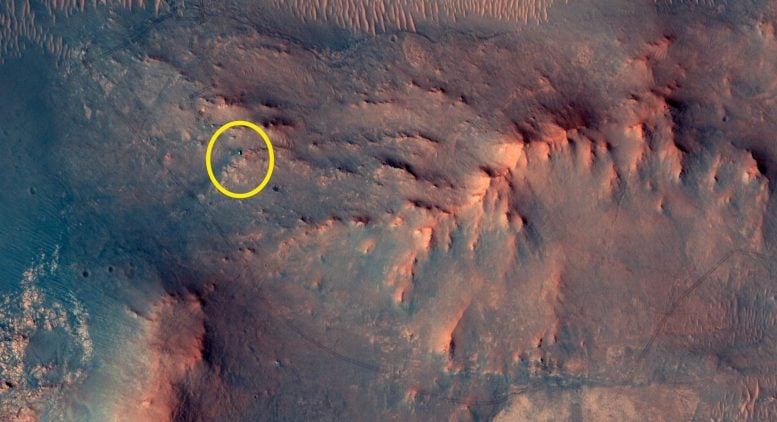
A tiny green dot appearing in an image taken by NASA’s Mars Reconnaissance Orbiter (MRO) captures a historic tale of Red Planet exploration by one of its first Earthling visitors.

That visitor—a robotic rover named Perseverance—has been conducting investigations on Mars since February 18, 2021, and the new aerial images reveal its current location in an area that mission specialists have dubbed “Arbot.”

While Perseverance’s latest appearance reveals little more than a greenish spec on the planet’s rust-colored surface, also visible in the new images are the long path its formidable tires have left in the Martian soil as the robotic explorer has trekked west of its initial landing site.

The new images, captured on June 13, 2026, were taken just one day before Perseverance broke the previous distance record held by a robotic explorer on Mars: NASA’s Opportunity rover.

However, Perseverance completed this phase of its journey in record time compared to its predecessor, which took more than 11 years to traverse a similar distance. Perseverance, by contrast, covered the same distance in less than half that time, with just five years and four months of travel now behind it.

Perseverance Mars Reconnaissance Orbiter
In the image above, NASA’s Perseverance Rover appears in the center of the image as a small, greyish-green reflective spot. Also visible are the impressions left by its all-terrain tires, revealing the robotic rover’s long path over the last several years of Martian exploration (Image Credit: Credits: NASA/JPL-Caltech/University of Arizona)

The images were made possible by the MROs’ High-Resolution Imaging Science Experiment (HiRISE) camera, which also captured surface features in the Arbot area that include ridges and windswept areas along Mars’ rugged exterior.

Built and operated by the University of Arizona, HiRISE captures images with resolutions as fine as about 25 centimeters (10 inches) per pixel, allowing researchers to distinguish features roughly the size of a kitchen table from orbit. The camera has returned hundreds of thousands of detailed images since the MRO arrived at Mars two decades ago, contributing to a growing data set that has transformed scientists’ understanding of the Red Planet.

Documenting everything from active dust avalanches and shifting dunes to fresh impact craters, the unprecedented resolution its imagery provides has made HiRISE one of the most powerful planetary imaging instruments ever deployed.

Last year, the MRO’s HiRISE camera also successfully captured images of the interstellar comet 3I/ATLAS as it made its way past Mars during its trip through our Solar System. Although the HiRISE images weren’t the clearest images of the interstellar visitor obtained during its visit, they did help demonstrate just how formidable NASA’s MRO and its suite of instruments are.

Additional details about Perseverance and its mission can be found at NASA’s official web page, and information about the MRO can be found here.

Micah Hanks is the Editor-in-Chief and Co-Founder of The Debrief. A longtime reporter on science, defense, and technology with a focus on space and astronomy, he can be reached at micah@thedebrief.org. Follow him on X @MicahHanks, and at micahhanks.com.

  •  

NASA’s Perseverance Rover Finds Complex Carbon at Ancient Martian Site Rich in Potential Biosignatures

Evidence for possible life on Mars in the ancient past continues to build, thanks to a recent discovery by NASA’s Perseverance rover that identified complex carbon in two mudstones.

As detailed in a recent paper published in Science Advances, Perseverance collected samples in the Jezero crater, a location that has continued to yield possible biosignatures of life on Mars in the ancient past.

In the same region, scientists reported potential evidence of microbial activity on ancient Mars, adding to a growing list of circumstantial evidence for one of the most intriguing possibilities in modern space exploration: the prospect that Earth may not have been the only planet in our Solar System that has held the potential to host life.

A Prime Location for Life on Mars

Among the study’s most significant findings is that complex macromolecular carbon was discovered alongside other potential biosignatures. Jezero Crater, a 28-mile-wide impact basin on the Martian surface, once contained flowing water roughly 3.5 billion years ago, making it one of the most promising locations in the search for ancient life. Water is essential to all known life on Earth, serving as a universal solvent and playing a critical role in biological processes.

“Jezero Crater was selected as a landing site due, in part, to its past evidence of aqueous activity and potential to preserve organic material,” co-lead author Kyle Uckert, a research scientist at NASA’s Jet Propulsion Laboratory, told The Debrief. “The Perseverance Rover’s exploration of Jezero Crater helps us understand the past habitability of Mars.”

Perseverance targeted a distinctive geological feature known as the Bright Angel outcrop, where the samples were collected. The outcrop consists of mudstones deposited in the dry bed of an ancient river that once flowed into Jezero Crater. Comparable sedimentary deposits on Earth are often associated with environments capable of preserving evidence of microbial life.

Analyzing Samples

Determining the origin of the organic carbon preserved within these Martian rocks is key to understanding whether the Red Planet ever supported life.

Using its onboard Raman spectrometer, Perseverance mapped the distribution of the rocks’ organic matter. One sample contained organic carbon within a primary silicate-dominated matrix, while another preserved carbon within secondary carbonate and sulfate minerals.

Notably, the carbon appears to have remained remarkably well preserved despite billions of years of exposure to the harsh Martian environment. Researchers suggest its limited weathering may indicate that the material is resistant to radiation and oxidation—possibly because it is mixed with iron-rich regolith or protected by clay minerals—or that it was only recently exposed at the surface through erosion.

The researchers are quick to point out that their findings do not determine whether the carbon originated through biological or non-biological processes. Nevertheless, the discovery adds another intriguing piece of evidence to the ongoing search for ancient life on Mars.

“Macromolecular carbon may be delivered to Mars via meteorites, or may have formed through hydrothermal geologic processes,” Uckert said.

Continuing to Explore Life on Mars

According to the researchers, determining the true origin of the carbon will ultimately require returning Martian samples to Earth, where they can be examined using far more sophisticated laboratory instruments than those carried aboard Perseverance.

“Further constraining the origin, distribution, and alteration history of the MMC observed in the Neretva Vallis mudstones requires high-resolution and high-sensitivity analyses in terrestrial laboratories, which can be facilitated by the return of the Cheyava Falls rock core, ‘Sapphire Canyon’ to Earth,” explained co-lead author Ashley Murphy, a postdoctoral research scientist at the Planetary Science Institute.

“The Perseverance Rover science payload is not designed to determine whether martian organic molecules were created by biologic or geologic processes, and our study is unable to make this distinction,” Uckert added.

The researchers say that future sample-return missions, combined with advanced laboratory analyses on Earth, may finally help resolve one of planetary science’s most enduring questions.

“The Perseverance Rover collects samples of scientifically compelling martian rocks for potential return to Earth,” Uckert concludes.“Using high-resolution terrestrial instruments to analyze these rock samples, particularly the Sapphire Canyon core collected on the Cheyava Falls rock, may provide more compelling evidence for a biologic or abiotic origin of this organic matter.”

The paper, “Spatially Distributed Complex Organic Matter Detected in an Ancient River Valley in Jezero Crater, Mars,” appeared in Science Advances on June 24, 2026.

Ryan Whalen covers science and technology for The Debrief. He holds an MA in History and a Master of Library and Information Science with a certificate in Data Science. He can be contacted at ryan@thedebrief.org, and follow him on Twitter @mdntwvlf.

  •  

NASA’s JPL Is Testing the Next Generation of Autonomous Martian and Lunar Technology


NASA is developing the next generation of surface exploration technology with its Exploration Rover for Navigating Extreme Sloped Terrain (ERNEST), designed with advanced mobility and autonomy capabilities to enable access to previously off-limits regions on the Moon and Mars.

In Southern California’s Colorado Desert, NASA’s ERNEST prototype is traversing rough patches of terrain as the design team at the Jet Propulsion Laboratory (JPL) continues to dial in the rover’s advanced mobility technology.

The four-wheeled, four-foot-long rover can readily handle landscapes that would be impassable for its six-wheeled predecessors, such as Curiosity and Perseverance.

NASA Lunar Navigation

ERNEST features mesh wheels for physically traversing difficult ground, as well as an intelligent decision-making system that determines the best route to its destination. As plans for humanity’s return to the lunar surface grow more ambitious, a rover capable of traveling longer distances at higher speeds will become a necessity. This is what ERNEST is accomplishing for NASA, already showing improvement over the performance of earlier rovers by an order of magnitude, as demonstrated in one test by traveling 16 miles in 37 hours.

The ERNEST prototype is less than half the size that the JPL team expects the final build to be. Since the project began in 2022, this is the third ERNEST prototype, with the other two being only two feet long and built primarily to test various suspension iterations over simulated lunar regolith packed at various slopes. They completed fabrication of the current prototype in September 2024 and operated it remotely via joystick control.

“You could do a science road trip across the Moon — or Mars — with this vehicle,” said James Keane, a JPL planetary scientist working on lunar missions.

ERNEST Project

ERNEST was a project that grew from relatively humble beginnings: initially, it sought only to replace current rovers with a simple, low-cost alternative by tweaking the rocker-boogie suspension already in use. The new active suspension developed for ERNEST allows it to balance weight among the four wheels rather than distributing it equally across all six wheels, as in the rocker-boogie system.

“We started by postulating that we could do better in designing a planetary surface robotic mobility system,” said Hari Nayar, a JPL principal technologist leading the ERNEST team. “While the rocker-bogie system has been very successful over the past 30 years, there’s been a lot of research in that time on mobility and understanding terrain interaction.”

NASA ERNEST Test
NASA JPL conducted ERNEST times at all times of day to determine if darkness or shadow would confuse the autonomous system. Credit: NASA/JPL-Caltech

Powered joints in front of the rover allow it to switch between squirming, wheel-walking, and obstacle-climbing gaits to adapt to changing surface conditions. For less challenging terrain, a clutch allows the system to switch to a more energy-efficient passive suspension, conserving power for longer journeys. Each wheel is articulated to allow movement in any direction, allowing the vehicle to move completely sideways.

These major mobility advances will be a boon to mission planners, who have struggled to reach hard-to-access areas on Mars and the Moon that were previously inaccessible with previous technology.

NASA’s Autonomous Rover

“This testing is helping us refine the mobility hardware and autonomy software to navigate extreme distances across a wide range of terrain and lighting conditions anticipated on the Moon,” said Issa Nesnas, a principal technologist at JPL.

To move beyond operator control to autonomous decision-making, the team used an artificial intelligence technique called reinforcement learning, in which a model learns through interactions with the environment. 

A virtual testing environment, running multiple simultaneous instances for months, allowed the researchers to have the rover ready to meet its environmental challenges from its first real-world test.  Conducted at JPL’s Mars Yard, the initial tests featured an obstacle course of steps, slopes, ripples, and rubble. From this, and in many subsequent tests, ERNEST proved successful in navigating a range of very difficult environments. 

Further improvements to the rover’s autonomy are being pursued with an eye on intelligent long-distance travel, with the rover independently switching between suspension settings.

Ryan Whalen covers science and technology for The Debrief. He holds an MA in History and a Master of Library and Information Science with a certificate in Data Science. He can be contacted at ryan@thedebrief.org, and follow him on Twitter @mdntwvlf.

  •  

NASA’s Curiosity Uncovers New Clues to Mars’ Potential of Supporting Ancient Life


NASA’s Curiosity rover and its mission to investigate whether Mars could have ever supported microbial life have taken one step closer to achieving its goal, with one of the most significant discoveries in the ongoing search for evidence of life on the Red Planet.

While exploring Gale Crater, NASA’s robotic rover uncovered a sample in 2020 and, using a chemical technique, determined that 21 carbon-based molecules were preserved in the clay-rich sedimentary rock. This also included seven that had never been identified on Mars before. 

While the discovery does not definitively point to life on the Red Planet, it does strengthen the case that Mars has the chemical conditions to support life. 

According to scientists, the most remarkable aspect of the discovery is not the molecules themselves, but their preservation

“The actual organic components they found are not strong evidence for life,” said Texas A&M University astrobiologist and geobiologist Dr. Michael Tice in a statement. Tice acknowledged that these compounds may also have evolved through abiotic processes, including formation in meteorites or other non-biological pathways.

“These organics were likely preserved in the rocks for a very long time, possibly billions of years, despite radiation and other harsh conditions on Mars,” Tice said.

“It blows my mind.”

Building Blocks of Life

Organic molecules are critical building blocks of life, but they can also form through non-biological processes, such as geological reactions or meteorite delivery. Similar preserved compounds on Earth help scientists study ancient environments, and their discovery on Mars provides new clues about the planet’s billion-year-old history.

“Studying how those compounds vary between different rocks can tell a story of how life and environments changed,” Tice recently said in a statement issued by Texas A&M. “Finding organics stored in similar ways on Mars tells us that there could be similar stories preserved there as well.”

The findings also suggest that Martian rocks may contain evidence from a time before life began, a record of sorts that Earth’s past geology has mostly erased.

“It is even possible that some Mars rocks will tell us about times when there was no life there,” he said, with organics formed instead through prebiotic chemistry or delivered from space. “We do not have an equivalent record of such a time preserved on Earth.”

The findings build on earlier research by Tice and his team that identified possible biosignatures in Mars rocks studied by NASA’s Perseverance rover. 

Tice suggests, “When we looked even closer, we saw things that are easy to explain with early Martian life but very difficult to explain with only geological processes.”

The rocks contained organic carbon and key elements connected to microbial energy sources, along with chemical patterns that may show redox reactions (processes often associated with life on Earth).

“With the right collection, we could find the next step in evidence for past life on Mars or learn about the kinds of processes that eventually led to life on our planet.”

Tice and his colleagues will continue their work exploring the Martian land. 

“I’m continuing to study the record of early Martian evolution as part of the PIXL instrument team on the Perseverance rover,” he said.

“In addition, I’m comparing how organisms affected some of the oldest sediments on Earth — now preserved in rocks in South Africa—with the potential biosignatures we discovered on Mars.”

Additional details about Tice and his team’s work can be found in a pair of papers, “Diverse organic molecules on Mars revealed by the first SAM TMAH experiment,” which appeared in Nature Communications, and “Redox-driven mineral and organic associations in Jezero Crater, Mars,” which was published in the journal Nature.

Chrissy Newton is a PR professional and founder of VOCAB Communications. She hosts the Rebelliously Curious podcast, which can be found on The Debrief’s YouTube Channel. Follow her on X: @ChrissyNewton and at chrissynewton.com.

  •  

Transformers on the Moon? Japan Reveals Details of Tiny Shape-Shifting Rover’s Historic Lunar Exploration


Over two years after Japan’s Smart Lander for Investigating Moon (SLIM) mission deployed a tiny, shape-shifting rover on the Moon, the country’s space agency JAXA has finally revealed previously unreleased details about the first-of-its-kind autonomous robotic lunar exploration.

According to a statement announcing the recently published mission account, the SLIM team deployed the rover on the Moon’s surface, “after which the rover transformed from a tiny sphere into a wheeled robot that took images of the lander and its environment.” A second rover transmitted the data back to Earth, with all steps occurring autonomously.

The team behind the historic mission said their success could pave the way for swarms of small, transformable robots capable of exploring high-scientific value areas that larger spacecraft and robots cannot reach, including caves, tunnels, lava tubes, vents, and deep extraterrestrial craters.

The Benefits of Tiny Robots and Autonomous Shape-Shifting Rovers

In the published study, the JAXA team explains that robotic technologies like SLIM “are expected to drive substantial advancements in planetary exploration and resource prospecting” by performing tasks in extraterrestrial environments that are inaccessible to other platforms, including human astronauts. For example, the team noted that miniature robots offer tremendous weight savings over bulkier platforms, especially when added to missions with “strict payload limitations.”

“Miniature robots have the potential to reduce payloads and to reach cramped spaces such as small vents and craters that are inaccessible to larger, conventional robots,” they explain.

Still, the SLIM team notes that building tiny, shape-shifting rovers capable of exploring a variety of complex environments presents its own set of challenges. The most limiting constraints involve computational power and battery capacity. The team also observed that smaller robotics platforms inherently suffer from “reduced locomotion performance” due to their small size.

Now, when revealing the details of the SLIM mission, the researchers note that advancements in miniaturization and computational performance spurred by the Internet of Things “have catalyzed the emergence of smaller, lighter, and more intelligent rovers at lower costs.”

Introducing the ‘Hopping’ Lev-1 and the ‘Transforming’ Lev-2

To build a tiny, shapeshifting robot capable of exploring the lunar surface autonomously, team leader Daichi Hirano and colleagues designed the Lunar Excursion Vehicle (LEV) system, which comprises LEV-1 and LEV-2. According to the team’s statement, LEV-1 can communicate directly with mission planners back on Earth. For locomotion, the robot moves via what the team termed “a controlled hopping mechanism.”

The second robot, LEV-2, starts out as a compact sphere 8 inches in diameter. However, once on the Moon, the mission controllers said that the tiny robot can transform into a “two-wheeled rover with cameras and a tail stabilizer.”

“Here, we introduce a two-wheeled centimeter-scale rover, designated Lunar Excursion Vehicle 2 (LEV-2), also known as SORA-Q (named after the Japanese words for space and sphere), which transforms into a wheeled configuration from a compact spherical form, enabling efficient traversal of soft lunar terrains,” they write.

Transformers Make Autonomous Robotic Exploration History

According to the new mission details, the SLIM lander deployed LEV-2 “immediately before its landing on the lunar surface.” In the mission details, the team explained that upon deployment, the rover autonomously extended its wheels, tail stabilizer, and cameras, “thereby enhancing its mobility and stability on soft lunar terrain.”

tiny robot shape-shifting rover autonomous
Overview of the motion sequence on the lunar surface. (A) Deployment of LEV-1 and LEV-2 from the SLIM lander prior to landing on the lunar surface. (B) Data transmission from LEV-2 through LEV-1 to the Earth. (C) Mode transition and motion sequence on the lunar surface. Image Credit: D. Hirano.

After deployment, LEV-2 navigated the lunar surface in the immediate area around the lander. According to the published study, “the palm-sized rover accomplished autonomous lunar exploration by navigating around the SLIM lander, capturing images of both the SLIM lander and its environment.” Critically, the rover’s exploration was autonomous and “without reliance on ground-based teleoperation,” marking a historic first in lunar exploration.

After finishing its exploration, the tiny robot transmitted images of its adventures to LEV-1. The hopping rover then transmitted the data to Earth. The team notes that all these steps were also accomplished autonomously.

The team notes that the LEV-2 shape-shifting rover operated for “more than 100 minutes: before losing communication with LEV-1. Although determining the exact cause may require direct examination of the two robots, Hirano’s team suspects that issues caused by LEV-1’s hopping motions or battery depletion “may have contributed to connectivity issues.”

Exploring High-Risk, Scientifically Valuable Environments

When discussing the implication of an autonomous, shape-shifting rover successfully navigating the lunar surface and completing its mission directives, the team concedes that the capabilities of a single, small rover like LEV-2 “are inherently limited.” However, they also note that their mission success highlights the potential of this category of robotic platform “as independent explorers, capable of accessing environments beyond the reach of a primary large spacecraft.” 

“Swarm-controlled small robots are poised to be deployed in high-risk yet scientifically valuable environments, such as vents, caves, and steep slope craters, that are inaccessible to larger, conventional rovers,” the researchers conclude. “This approach promises to enhance both the efficiency and safety of future planetary surface exploration.”

The study “From ball to rover: Transformable palm-sized rover SORA-Q for autonomous lunar exploration” was published in Science Robotics.

Christopher Plain is a Science Fiction and Fantasy novelist and Head Science Writer at The Debrief. Follow and connect with him on X, learn about his books at plainfiction.com, or email him directly at christopher@thedebrief.org.

  •  

Jason Momoa’s 1920s Harleys become electric hybrids in wildest EV conversions yet

UK-based EV conversion specialist Electrogenic has converted five of Jason Momoa’s cherished vintage vehicles to electric power — including three 100-year-old Harley-Davidson motorcycles reimagined as plug-in hybrids. The builds are featured in Season 2 of Momoa’s HBO documentary series On The Roam, streaming now.

The project includes two extremely rare classic Land Rovers converted to all-electric drive with 150+ miles of range, a battery-equipped off-grid camping trailer, and the three Harleys that can switch between electric, petrol, and combined hybrid power on the fly. Electrogenic is now selling conversion kits for both the Land Rovers and the Harleys.

  •  
❌