Está precisando ter um controle mais rígido do tempo que seus filhos usam o computador? Então instale a ferramenta de controle parental TIMEKPR no Ubuntu e resolva seu problema.
This week, AYANEO is chasing the classics again, teasing a Game Boy Advance clone, while Magmi is getting vertical – plus, a Mechanism desk stand for your handheld, 8BitDo’s FlipPad, and the GPD Win Max 3 blurs the lines between laptop and console.
On NPC XL, Brendon and John try Armada and report to listeners about whether it’s ready for prime time.
Niléane brings her newest fan (literally), Chris just assumed his co-hosts have installed the betas (they have), and they all tell each other how their respective apps could start earning millions.
This week’s Cozy Zone is a complete, and authoritative, tier listing of every Men’s World Cup logo ever.
NPC XL is a weekly members-only version of NPC with extra content, available exclusively through our new Patreon for $5/month. Each week on NPC XL, Federico, Brendon, and John record a special segment or deep dive about a particular topic that is released alongside the “regular” NPC episodes. You can subscribe here.
Comfort Zone, Episode 110, ‘Only One Person Being Strangled’ Show Notes
For even more from the Comfort Zone crew, you can subscribe to Cozy Zone. Cozy Zone is a weekly bonus episode of Comfort Zone where Matt, Niléane, and Chris invite listeners to join them in the Cozy Zone where they’ll cover extra topics, invent wilder challenges and games, and share all their great (and not so great) takes on tech. You can subscribe to Cozy Zone for $5 per month here or $50 per year here.
MacStories Unwind, ‘A Long Journey Home’ Show Notes
MacStories launched its first podcast in 2017 with AppStories. Since then, the lineup has expanded to include a family of weekly shows that also includes MacStories Unwind, Magic Rays of Light, Comfort Zone, NPC: Next Portable Console, and First, Last, Everything that collectively, cover a broad range of the modern media world from Apple’s streaming service and videogame hardware to apps for a growing audience that appreciates our thoughtful, in-depth approach to media.
If you’re interested in advertising on our shows, you can learn more here or by contacting our Managing Editor, John Voorhees.
Turning low-energy light into higher-energy light seems to break the usual rules of physics, since energy is supposed to run downhill, not uphill. Yet a process called photon upconversion achieves exactly this, without breaking any laws of thermodynamics. Instead of absorbing one photon and releasing a single photon of lower energy, as most light-absorbing molecules do, an upconversion system absorbs two lower-energy photons and combines their energy to release one higher-energy photon. Because it takes two photons to make one, the total energy is still conserved; the trick is repackaging it into a more useful form. The phenomenon was first observed in the 1960s in simple organic mixtures cooled to very low temperatures, but it only became practical decades later, once chemists identified metal-containing dyes able to hold their excited states at room temperature. Since then, scientists have pursued upconversion as a way to make better use of sunlight, to power light-driven chemical reactions, to improve imaging inside living tissue, and to build new kinds of optoelectronic devices.
Triplet-triplet annihilation
The most developed route to upconversion relies on a process called triplet-triplet annihilation. A light-absorbing molecule known as a sensitizer first captures a low-energy photon and passes that energy to a second type of molecule, the annihilator. The annihilator settles into a triplet excited state, an unusually long-lived condition that allows it to persist until it meets a second annihilator molecule in the same state. When two such molecules collide, one drops back to its ground state while the other is pushed up into a higher-energy singlet state, from which it emits a photon of higher energy than either of the photons that started the process.
A long-standing problem with this scheme is that ordinary sensitizer molecules lose a portion of the absorbed energy internally, as the initially excited state converts into the lower-energy triplet state that gets passed along. This loss caps how large an energy jump the whole system can ultimately achieve. One promising way around the problem is to replace the conventional sensitizer with an organic radical, a molecule carrying a single unpaired electron. That unpaired electron gives radicals unusual electronic and magnetic behavior and can make the conversion from absorbed light into a usable excited state considerably more efficient, since it opens transitions that are otherwise very weak in conventional molecules.
A single hydrogen to control it all
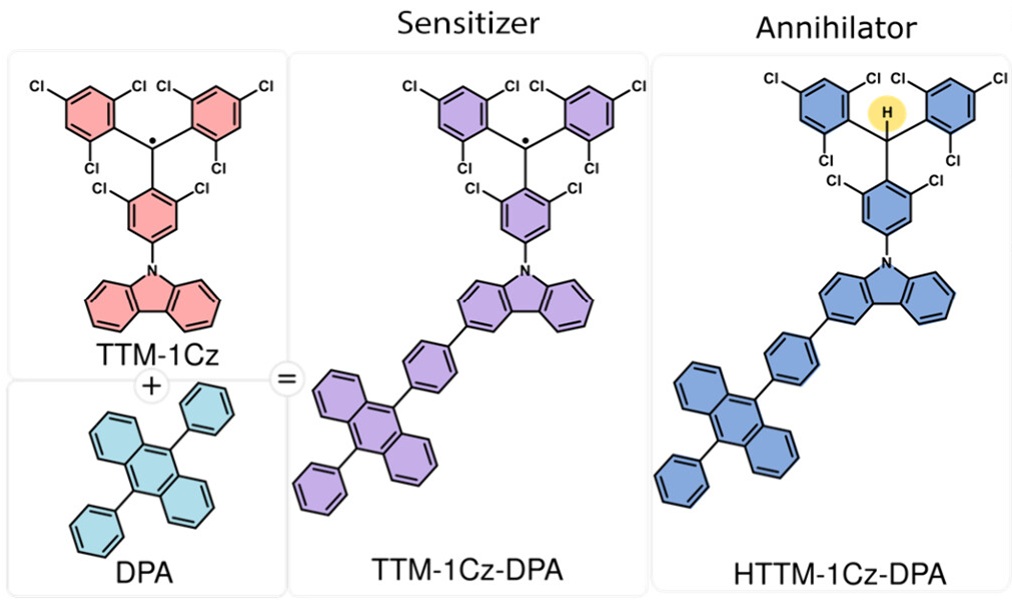
Chemical structures of open-shell TTM-1Cz [tris(2,4,6-trichlorophenyl)methyl – 1 carbazole] , DPA (9,10-diphenylanthracene), open-shell TTM-1Cz-DPA and closed-shell HTTM-1Cz-DPA.New research examined 1 a pair of molecules built on this idea, both based on a radical component linked directly to an anthracene unit, the same type of light-emitting building block used in classic annihilators. The two molecules are nearly identical, differing at a single carbon atom: in one, that carbon carries the unpaired electron of the radical; in the other, an ordinary hydrogen atom has been added, pairing up the electron and removing the radical character entirely. That single hydrogen atom turns out to control everything. The radical version behaves as an efficient sensitizer, while the hydrogen-added version behaves as an annihilator, even though the two molecules share almost the same overall structure.
To work out why, the investigation combined light-based spectroscopy, electron spin resonance (a technique that detects unpaired electrons), and quantum chemical calculations. After the radical absorbs red light, its excitation transfers within about ten picoseconds (ten trillionths of a second) to the attached anthracene unit, creating a long-lived excited state that still carries some radical character. This internal handoff stretches the effective excited-state lifetime to more than 250 nanoseconds, roughly ten times longer than the 27 nanoseconds measured for the radical unit on its own. A longer-lived excited state gives the sensitizer far more opportunity to encounter another molecule and hand off its energy before simply decaying back to the ground state. The calculations independently pointed to the same conclusion, showing that energy transfer to a nearby annihilator proceeds far more readily through this long-lived triplet-like state than directly from the radical’s first excited state.
A mix needed
The work also tested an idea proposed in earlier research, that a single radical-containing molecule of this kind might act as both sensitizer and annihilator on its own, a so-called single-component upconversion system. The new experiments argue against this. Solutions containing only the radical molecule, across a range of concentrations, showed no detectable upconverted light, consistent with the radical’s higher excited states relaxing away too quickly for the necessary emission to compete.
Efficient upconversion instead required mixing the radical sensitizer with its hydrogen-added counterpart, or with the well-established annihilator 9,10-diphenylanthracene. Because the two molecules share nearly the same molecular framework, this two-molecule mixture is described as a “pseudo-single-component” system. Shining red light at 658 nanometres onto the radical paired with its hydrogenated twin produced blue emission at 450 nanometres, an apparent energy gain of about 0.9 electronvolts, with 7 percent of absorbed photon pairs converted into upconverted light. Pairing the same radical sensitizer with 9,10-diphenylanthracene instead produced blue emission at 437 nanometres, a slightly larger energy gain of about 1.0 electronvolt, with 12 percent efficiency. Both figures mark a large improvement over earlier all-organic radical sensitizers, which had reached efficiencies of only a few tenths of a percent, and the upconverted emission remained stable over hours of continuous illumination.
A practical strategy for photon upconversion
Beyond these specific molecules, the study illustrates how a minimal change in molecular structure, adding or removing a single hydrogen atom, can completely redirect a molecule’s photochemical role, switching it from an energy donor to an energy acceptor. Combining optical measurements, spin resonance, and computation made it possible to trace exactly why this switch occurs at the level of electronic structure, rather than simply observing that it happens.
The findings offer a clearer picture of how organic radicals can be harnessed for photon upconversion and point toward a practical strategy for building more efficient materials from radicals and their closed-shell relatives together. Such materials could eventually help capture more of the solar spectrum, drive light-powered chemical synthesis, or improve the efficiency of light-emitting technologies, by putting to use photons that would otherwise be wasted.
Author: César Tomé López is a science writer and the editor of Mapping Ignorance
Disclaimer: Parts of this article may have been copied verbatim or almost verbatim from the referenced research paper/s.
References
Kieran D. Richards, Wenzhao Wang, Philipp Thielert, James D. Green, John M. Hudson, Claire Tonnelé, David Casanova, Yoann Olivier, Timothy J. H. Hele, Sabine Richert, Feng Li, and Emrys W. Evans (2026) Open- and Closed-Shell Roles of Sensitizer and Annihilator in Pseudo-Single Component Mixtures for Upconversion Journal of the American Chemical Society doi: 10.1021/jacs.6c04090↩
Inspired by interactive theatre and fuelled by the motion capture tech used by VTubers, the vampire spies in Red Kiss have personality in spades
‘You look at the news and you’re like, ‘Another pointless war, another pointless bloodshed, another pointless genocide.’ And that can make you a bit hopeless.”
Roy van der Schilden, narrative designer and business director at Wispfire, speaks of a very human feeling. But the protagonist of its upcoming game Red Kiss can relate – despite being a vampire.
Grande parte dos vídeos que consumimos hoje vai muito além do entretenimento. Tutoriais técnicos, palestras públicas, demonstrações de produtos, treinamentos corporativos, webinars, apresentações de eventos e materiais educativos fazem parte da rotina de estudantes, profissionais e empreendedores.
Em muitos momentos, ter acesso a esse conteúdo mesmo sem conexão com a internet pode fazer toda a diferença. Mas surge uma dúvida comum: vale mais a pena utilizar uma ferramenta que funciona diretamente no navegador ou um aplicativo dedicado?
A resposta depende principalmente da forma como cada pessoa utiliza seus dispositivos e organiza seu fluxo de trabalho.
Quando uma ferramenta baseada no navegador faz mais sentido
As soluções que funcionam diretamente no navegador conquistaram muitos usuários por eliminarem uma etapa importante: a instalação.
Em poucos segundos, é possível abrir a ferramenta, utilizar seus recursos e continuar trabalhando, independentemente do computador ou do dispositivo utilizado.
Essa praticidade costuma ser especialmente útil para quem precisa acessar conteúdos em diferentes dispositivos sem depender da instalação de programas.
Acompanhar palestras e conferências online;
Consultar tutoriais técnicos durante o trabalho;
Revisar treinamentos profissionais;
Utilizar computadores compartilhados;
Alternar frequentemente entre computador, tablet e smartphone.
Nesses casos, um baixador de vídeos do YouTube baseado no navegador permite abrir a ferramenta rapidamente e acessar conteúdos públicos de forma simples, independentemente do sistema operacional utilizado.
Outro benefício importante é a compatibilidade. Como o acesso acontece pelo navegador, a experiência permanece semelhante em diferentes sistemas operacionais, facilitando o uso em qualquer dispositivo.
Quando um aplicativo pode ser a melhor escolha
Embora as ferramentas baseadas no navegador sejam extremamente práticas, existem situações em que um aplicativo dedicado oferece uma experiência diferente.
Usuários que acessam frequentemente os mesmos materiais, organizam conteúdos por categorias ou preferem manter tudo disponível em um único ambiente costumam valorizar recursos adicionais de organização e gerenciamento.
Nesse contexto, soluções como a Muka representam uma alternativa interessante para quem prefere utilizar um aplicativo em vez do navegador. Dependendo da rotina de cada pessoa, esse tipo de abordagem pode tornar o acesso aos conteúdos mais conveniente.
Além disso, aplicativos costumam facilitar a organização de arquivos locais e oferecer acesso rápido aos materiais utilizados com maior frequência.
Não existe uma solução única
Na prática, o navegador e o aplicativo resolvem necessidades diferentes.
Imagine alguns exemplos:
Um estudante universitário utiliza o computador da biblioteca para revisar uma palestra antes de uma prova.
Um empresário salva uma apresentação sobre marketing digital para consultar durante uma viagem.
Um técnico acompanha demonstrações de equipamentos enquanto trabalha em locais onde a conexão nem sempre é estável.
Outro profissional prefere manter seus materiais organizados em um aplicativo para encontrá-los rapidamente sempre que necessário.
Todos possuem objetivos semelhantes, mas desenvolvem hábitos diferentes para acessar seus conteúdos de referência.
O fator mais importante é a praticidade
Ao escolher uma solução, muitas pessoas concentram a atenção apenas nas funcionalidades. Entretanto, a facilidade de acesso costuma ser igualmente importante.
Se o objetivo é consultar rapidamente um material de referência, quanto menos etapas existirem entre o usuário e o conteúdo, melhor será a experiência.
Por isso, ferramentas baseadas no navegador continuam sendo uma excelente opção para quem valoriza simplicidade e acesso imediato, enquanto aplicativos podem oferecer uma experiência mais organizada para quem consulta os mesmos conteúdos com frequência.
Conclusão
O crescimento dos conteúdos digitais mudou a forma como aprendemos, trabalhamos e compartilhamos conhecimento. Palestras, treinamentos, demonstrações técnicas, apresentações profissionais e outros materiais de referência tornaram-se recursos importantes para milhões de pessoas.
Escolher entre uma ferramenta baseada no navegador ou um aplicativo dedicado não significa decidir qual tecnologia é superior, mas identificar qual delas se adapta melhor ao seu dia a dia.
Quando a solução acompanha a maneira como utilizamos nossos dispositivos, acessar conteúdos importantes offline torna-se um processo mais simples, eficiente e conveniente.
PC, PS5, Xbox Series X/S, Nintendo Switch 2; Undercoders Colourful, counter-cultural and captivating – this rail riding game set in a dystopian Japan is as weird as it is exhilarating
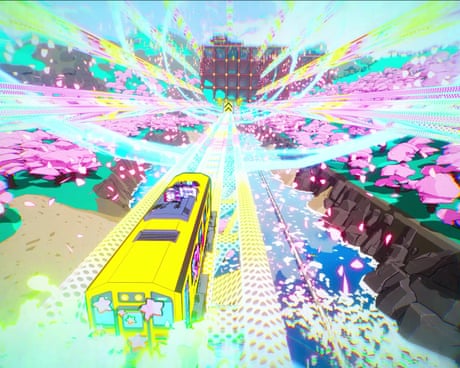
Every now and again a game appears with a premise so outrageous you stop in your tracks to take it all in. Denshattack!, a game about kickflipping trains across a dystopian future Japan, is the epitome of this feeling. Set in a post climate disaster world, people have retreated to corporate-owned domed cities to live out their days in air-conditioned, ignorant comfort. Save for a handful of outcasts, the rest of the country is a mess of broken infrastructure, where rival gangs battle it out on the ruins of Japan’s famously extensive rail network. Naive upstart Emi has one goal: become the best Denshattacker there is, one sick nosegrind at a time.
Taking the idea of an on-rails platforming game to its extreme conclusion, developers Undercoders have combined the best bits of the Tony Hawk’s Pro Skater series – grinding, flipping and spinning through an entire dictionary of tricks – with the anti-establishment message behind Jet Set Radio. The rivals Emi encounters showcase the history of Japanese misfits, pitting you against ageing rockabillies and violent girl gangs without a shred of judgment.
This week, Federico and John look at their experiences with Claude Fable 5 and how it differs from other models and break down the controversial changes made by OpenAI to its ChatGPT Mac app.
Then on AppStories+, John and Federico contrast their experiences with Fable 5 and OpenAI’s new family of GPT 5.6 models.
This week, Brendon and John go it alone with more bizarre news from AYANEO, a new tease and OS update from Anbernic, Valve’s e-ink Steam Machine faceplate, Armada bringing SteamOS to Android handhelds, and more.
On NPC XL, John and Brendon check on handheld gaming halfway through the year and look forward to what the rest of 2026 may have in store for the hobby.
On a special Saturday edition of MacStories Unwind, Federico and John talk live music, blockbuster movies, and their ongoing experiments with Markdown text editors.
AppStories, Episode 493, ‘Fable 5 and OpenAI’s Curious ChatGPT Update’ Show Notes
This episode is sponsored by:
Daylite: The only made-for-mac CRM solution. Start your free trial today.
NPC XL is a weekly members-only version of NPC with extra content, available exclusively through our new Patreon for $5/month. Each week on NPC XL, Federico, Brendon, and John record a special segment or deep dive about a particular topic that is released alongside the “regular” NPC episodes. You can subscribe here.
Comfort Zone, Episode 109, ‘You Can’t Kill Chrome’ Show Notes
For even more from the Comfort Zone crew, you can subscribe to Cozy Zone. Cozy Zone is a weekly bonus episode of Comfort Zone where Matt, Niléane, and Chris invite listeners to join them in the Cozy Zone where they’ll cover extra topics, invent wilder challenges and games, and share all their great (and not so great) takes on tech. You can subscribe to Cozy Zone for $5 per month here or $50 per year here.
MacStories Unwind, ‘Text Editor Experiments’ Show Notes
MacStories launched its first podcast in 2017 with AppStories. Since then, the lineup has expanded to include a family of weekly shows that also includes MacStories Unwind, Magic Rays of Light, Comfort Zone, NPC: Next Portable Console, and First, Last, Everything that collectively, cover a broad range of the modern media world from Apple’s streaming service and videogame hardware to apps for a growing audience that appreciates our thoughtful, in-depth approach to media.
If you’re interested in advertising on our shows, you can learn more here or by contacting our Managing Editor, John Voorhees.
This week, Federico and John talk about the 10+ email apps they’ve used over the years and how recent spikes in email volume have caused them to change their approaches.
On AppStories+, Federico and John update listeners on their summertime agentic coding projects.
This week, Steam Machine ordering follow-up and Sony’s many controversial announcements.
On NPC XL, what’s going on with AYANEO and the Pocket MICRO 2? Plus, the RG Rotate gets clock faces, and Apple brings PC gaming on the Mac closer to reality.
Chris explains how he’s using Parchment, Matt gets all in your face about calendars, and everyone competes to see who can handle using Snick for the longest.
On Cozy Zone, the gang shares their development tips and setups.
This week, John heads to the mountains while Federico cooks on a beach, the origin of “the boonies,” and narrow mountain roads, plus a TV and movie pick.
AppStories, Episode 492, ‘Email Survival Guide’ Show Notes
This episode is sponsored by:
Decagon: The AI concierge for every customer. Get a personalized demo.
NPC XL is a weekly members-only version of NPC with extra content, available exclusively through our new Patreon for $5/month. Each week on NPC XL, Federico, Brendon, and John record a special segment or deep dive about a particular topic that is released alongside the “regular” NPC episodes. You can subscribe here.
Comfort Zone, Episode 108, ‘My Magic Mouse Is Pregnant’ Show Notes
For even more from the Comfort Zone crew, you can subscribe to Cozy Zone. Cozy Zone is a weekly bonus episode of Comfort Zone where Matt, Niléane, and Chris invite listeners to join them in the Cozy Zone where they’ll cover extra topics, invent wilder challenges and games, and share all their great (and not so great) takes on tech. You can subscribe to Cozy Zone for $5 per month here or $50 per year here.
MacStories Unwind, ‘Out in the Boonies’ Show Notes
MacStories launched its first podcast in 2017 with AppStories. Since then, the lineup has expanded to include a family of weekly shows that also includes MacStories Unwind, Magic Rays of Light, Comfort Zone, NPC: Next Portable Console, and First, Last, Everything that collectively, cover a broad range of the modern media world from Apple’s streaming service and videogame hardware to apps for a growing audience that appreciates our thoughtful, in-depth approach to media.
If you’re interested in advertising on our shows, you can learn more here or by contacting our Managing Editor, John Voorhees.
This week, Federico and John talk about the state of AI aggregator apps and their future prospects before checking in on their current AI app setups for the AppStories+ post-show.
Niléane invested in a fast-appreciating asset (air conditioner), CHRIS MADE AN APP, and everyone surprises everyone else with their favorite challenges.
On Cozy Zone, we tier list the biggest iPhone features over the year.
This week on MacStories Unwind, Federico and John are burning up Claude Fable 5 tokens as fast as they can, while Federico finds the time to try a brand new Switch 2 game.
AppStories, Episode 491, ‘Are AI Aggregators Worth It?’ Show Notes
This episode is sponsored by:
Mercury Weather: Forecasts, beautifully done. Download now for free.
Claude: For problems worth solving — get started with Claude today.
NPC XL is a weekly members-only version of NPC with extra content, available exclusively through our new Patreon for $5/month. Each week on NPC XL, Federico, Brendon, and John record a special segment or deep dive about a particular topic that is released alongside the “regular” NPC episodes. You can subscribe here.
Comfort Zone, Episode 107, ‘The Year of Our Lord, Zork’ Show Notes
For even more from the Comfort Zone crew, you can subscribe to Cozy Zone. Cozy Zone is a weekly bonus episode of Comfort Zone where Matt, Niléane, and Chris invite listeners to join them in the Cozy Zone where they’ll cover extra topics, invent wilder challenges and games, and share all their great (and not so great) takes on tech. You can subscribe to Cozy Zone for $5 per month here or $50 per year here.
MacStories Unwind, ‘Burning Tokens Before the Clock Runs Out’ Show Notes
Fable 5
Anthropic’s Fable 5 is only available on Claude subscription plans for one week, so Federico and John are making the most of the time by tuning up ongoing projects.
MacStories launched its first podcast in 2017 with AppStories. Since then, the lineup has expanded to include a family of weekly shows that also includes MacStories Unwind, Magic Rays of Light, Comfort Zone, NPC: Next Portable Console, and First, Last, Everything that collectively, cover a broad range of the modern media world from Apple’s streaming service and videogame hardware to apps for a growing audience that appreciates our thoughtful, in-depth approach to media.
If you’re interested in advertising on our shows, you can learn more here or by contacting our Managing Editor, John Voorhees.
This week, John and Federico are back home and reflect on all the WWDC announcements, including Siri AI, Apple Intelligence, design changes, developer tools, and more.
On AppStories+, we check in on our research setups and how they fared at WWDC.
The gang’s back together! Niléane has a new window management system, Matt wonders if Thunderbolt is too fast, and everyone recovers from letting AI take the wheel for the week.
On Cozy Zone, Niléane has a new place, and it only seemed proper to roast her new setup.
NPC XL is a weekly members-only version of NPC with extra content, available exclusively through our new Patreon for $5/month. Each week on NPC XL, Federico, Brendon, and John record a special segment or deep dive about a particular topic that is released alongside the “regular” NPC episodes. You can subscribe here.
Comfort Zone, Episode 106, ‘Matt’s Big Chonker’ Show Notes
For even more from the Comfort Zone crew, you can subscribe to Cozy Zone. Cozy Zone is a weekly bonus episode of Comfort Zone where Matt, Niléane, and Chris invite listeners to join them in the Cozy Zone where they’ll cover extra topics, invent wilder challenges and games, and share all their great (and not so great) takes on tech. You can subscribe to Cozy Zone for $5 per month here or $50 per year here.
MacStories Unwind, ‘Prime Day Deal Hunters’ Show Notes
MacStories launched its first podcast in 2017 with AppStories. Since then, the lineup has expanded to include a family of weekly shows that also includes MacStories Unwind, Magic Rays of Light, Comfort Zone, NPC: Next Portable Console, and First, Last, Everything that collectively, cover a broad range of the modern media world from Apple’s streaming service and videogame hardware to apps for a growing audience that appreciates our thoughtful, in-depth approach to media.
If you’re interested in advertising on our shows, you can learn more here or by contacting our Managing Editor, John Voorhees.
PC, PS5, Xbox Series X/S, Nintendo Switch, Nintendo Switch 2; Marimittu Games A soft puzzle game makes a sharp point about the over-optimised future ahead
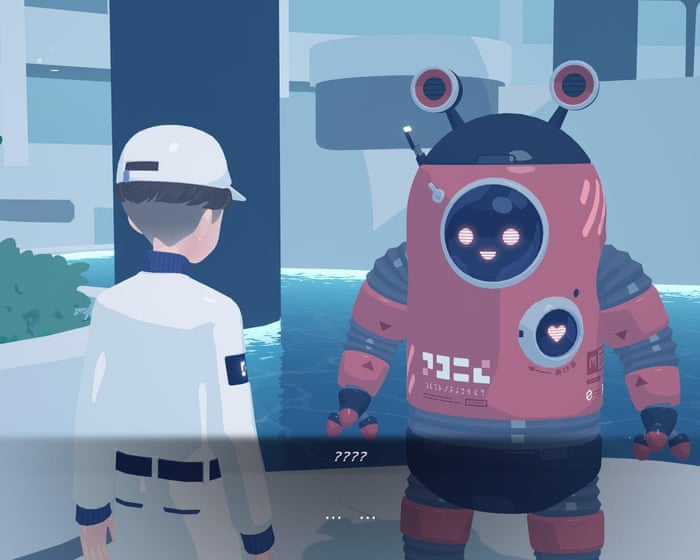
In the far future, on a planet that is not Earth, AI is in charge. This entity is no Skynet-esque killer robot but a machine that cares for humanity. Manifesting most visibly as cute droids, the technology is pervasive – embedded in everything from the design of the sleek architecture to the gorgeous, mostly sunny artificial weather. The so-called Optimization System has but one responsibility: ensuring the greatest happiness for the greatest number of people.
In less skilled hands this game might have felt like an undergraduate seminar on the limits of utilitarianism. But Japanese studio Marumittu Games elegantly marries its philosophical concerns with smart design choices. You play as a young, unnamed Facilitator tasked with tending to both the city’s bots and its human residents. Each morning you wake up, sleepily loping off to the bathroom before sitting down for an exquisitely rendered breakfast, and then embark on your day’s work. Like everything else in this near-future scenario, labour is designed to cause as little frustration as possible, amounting to simple maths brain teasers on a grid – nothing too taxing, but enough to keep you engaged.
Building electronic devices often requires stacking different crystalline materials on top of one another with atomic precision. This process, called heteroepitaxy, works best when the two crystals share similar atomic patterns. When their symmetries differ, the upper crystal tends to grow in several orientations at once instead of a single one, creating defects that degrade device performance. Engineers have long dealt with this problem by treating the surface of the lower crystal beforehand, for example by etching steps into it, exposing it to plasma, or adding a buffer layer, to help the two materials bond more effectively. Now, a team of researchers explores 1 a different route: rather than forcing the two crystals to fit together, it takes advantage of a crystal that is naturally flexible at the atomic scale.
Flexible by design
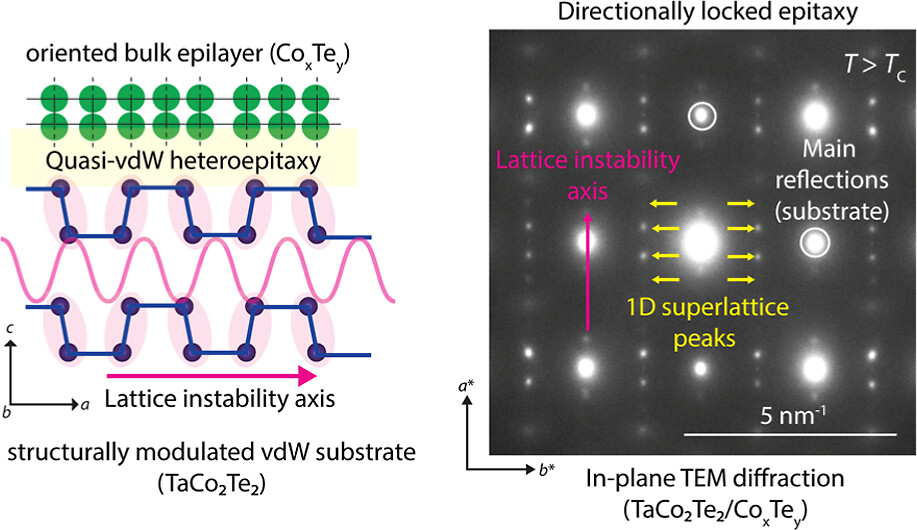
The material at the center of this approach is a layered compound called TaCo2Te2. Like graphite, its layers are held together by weak van der Waals forces, which makes it easy to combine with other materials without demanding a perfect chemical match. Unlike most layered crystals, though, its atoms are not arranged in a perfectly regular pattern. At room temperature they undergo a small, periodic shift known as a Peierls distortion, a phenomenon first described in the 1930s by the physicist Rudolf Peierls, who showed that in some materials the electrons and the surrounding lattice can lower their combined energy by nudging atoms slightly out of their ideal positions. When TaCo2Te2 is heated above about 523 kelvin, or 250 degrees Celsius, this distortion disappears and the crystal adopts a more symmetric structure, although traces of the original pattern linger as fleeting, temperature-driven fluctuations.
These fluctuations are not random. Calculations of how the crystal vibrates, backed up by Raman spectroscopy and electron diffraction experiments, show that the lattice is especially unstable along one crystallographic direction, meaning atoms can shift more easily there than in the perpendicular direction. This directional softness turns out to be the key ingredient that controls how a second material grows on the surface.
Heating TaCo2Te2 also sets its atoms in motion across the surface. Tantalum atoms drift away, while cobalt and tellurium reorganize into a thin crystalline layer whose composition resembles cobalt telluride. Rather than clumping into isolated islands, this new layer spreads sideways first and only then thickens, producing a smooth, continuous interface with the crystal beneath it, a layer-by-layer growth style that electron microscopy confirms is energetically favorable.
Directionally locked
The most striking result is that the new crystal does not settle into just any orientation. Even though its symmetry differs from that of the underlying TaCo2Te2, it becomes directionally locked. Along one in-plane direction, the atomic spacings of the two materials match closely, giving a tight, well-ordered registry. Along the perpendicular direction the mismatch is far larger, but this happens to be exactly the direction where TaCo2Te2 is most flexible, thanks to its lattice instability. Instead of rotating to relieve that mismatch, as symmetry-mismatched interfaces typically do, the interface absorbs it through a gentle, ongoing structural adjustment. The result is a crystal that stays aligned while only one direction bears most of the strain.
That flexible direction does not settle into a simple repeating pattern either. Instead, it forms what is called a one-dimensional incommensurate superlattice: the repeating atomic spacings of the two crystals never line up exactly, yet they stay locked together over long distances. Physicists have long recognized this kind of arrangement as an efficient way to accommodate mismatched lattice spacings without piling up large numbers of defects, since the strain is spread out through a slowly changing modulation rather than concentrated at sharp boundaries. Diffraction measurements and a geometric analysis of the two lattices both confirm that no perfectly repeating, shared lattice can account for what is observed, so the incommensurate description fits best.
Directional lattice instability is key
To check that the lattice instability is truly responsible for this behavior, the same experiment was repeated with a closely related compound, TaNi2Te2, which has nearly the same crystal structure but lacks the structural instability. Under similar heating, a surface layer still forms, but its orientation varies from spot to spot, and rotational disorder sets in. This comparison shows that matching crystal symmetry is not enough on its own to produce a locked, well-ordered interface. The directional lattice instability is the extra ingredient that guides the growth.
The local reconstruction effect
One more effect helps stabilize the interface. Even above the temperature where the bulk crystal should be fully symmetric, the atomic layers right beneath the interface partly slip back into the low-temperature distorted structure. This local reconstruction stays confined to the surface rather than spreading through the whole crystal, and it appears to strengthen the bond between the two materials, keeping the aligned structure stable even at high temperature.
As we have just seen, structural instabilities, usually considered as a liability because they signal that a crystal is on the verge of changing shape, can instead become useful design tools. A substrate whose atoms rearrange more easily in certain directions can guide the growth of otherwise incompatible materials, producing well-aligned interfaces without extensive surface treatment. This idea could widen the range of material combinations available for future electronic, optical, and quantum devices, where the atomic arrangement at an interface often determines how well the whole device performs.
Author: César Tomé López is a science writer and the editor of Mapping Ignorance
Disclaimer: Parts of this article may have been copied verbatim or almost verbatim from the referenced research paper/s.
References
Nitish Mathur, Guangming Cheng, Francesc Ballester, Gabrielle Carrel, Vincent M. Plisson, Fang Yuan, Jiangchang Zheng, Caiyun Chen, Scott B. Lee, Ratnadwip Singha, Sudipta Chatterjee, Kenji Watanabe, Takashi Taniguchi, Kenneth S. Burch, Berthold Jäck, Ion Errea, Maia G. Vergniory, Nan Yao, Sanfeng Wu, and Leslie M. Schoop (2026) Directionally Locked Heteroepitaxy with a Structurally Modulated van der Waals Material ACS Nano doi: 10.1021/acsnano.6c04146↩
Enzymes and other biomolecules are often anchored onto solid materials so they can be reused, purified more easily, and made more stable, a strategy biotechnology has relied on since industrial-scale immobilized enzymes first appeared in chemical manufacturing in the mid-twentieth century. Immobilized enzymes today drive processes from food and pharmaceutical production to biosensors and medical diagnostics. Fixing a biomolecule in place, however, is not as simple as gluing it down. The exact spot where it attaches, the direction it faces, and how much freedom it retains to move can all change how well it works. Testing every possible arrangement in the laboratory is slow and costly, which is why computer simulation has become such a valuable complement to experiments.
The Martini force field
One of the main tools for this kind of study is molecular dynamics simulation, which calculates how atoms move over time by applying the basic laws of physics. Simulating every single atom of a protein, its surrounding water, and a supporting material gives rich detail, but is extremely demanding on computing power, especially when many attachment geometries need comparing. A widely used shortcut is coarse-grained modeling, in which small clusters of atoms are grouped into single, simplified particles. This keeps the essential physical behavior of the system while making the calculations far cheaper. The most established coarse-grained approach for biological molecules is the Martini force field, first developed in 2004 to describe fatty, membrane-forming molecules and later extended to proteins and, more recently, to a more accurate third generation of the model. Martini has since become a standard tool for simulating large biological assemblies that would otherwise be out of reach.
Introducing MartiniSurf
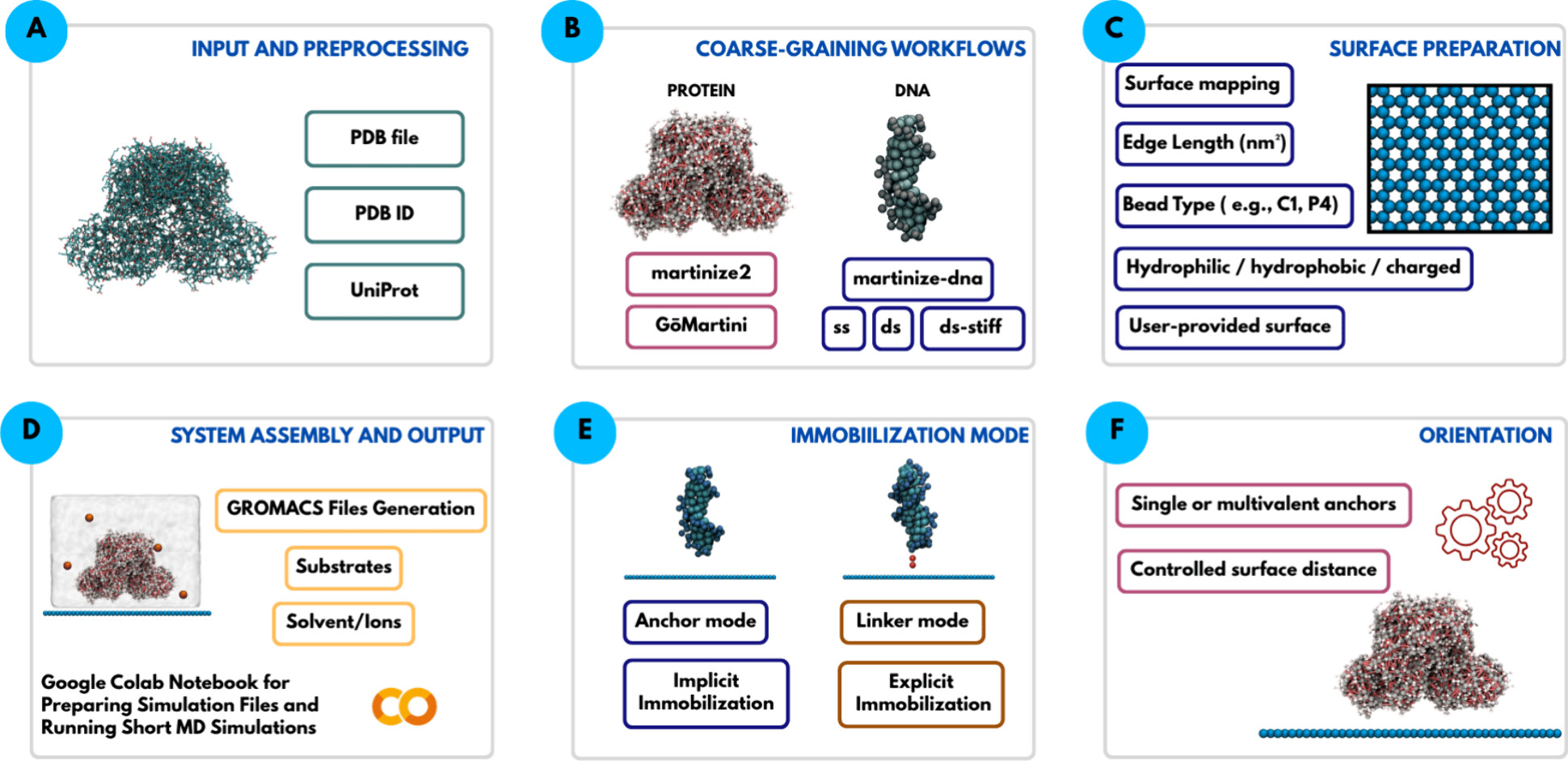
A team of researchers now introduces MartiniSurf 1, an open-source software package that automates the preparation of these coarse-grained simulations for biomolecules attached to surfaces. Building such a system by hand normally involves several separate programs and many manual steps, which makes it hard to reproduce results or compare different setups fairly. MartiniSurf instead combines the whole process into a single, streamlined workflow. Starting from the structure of a protein or a DNA strand, it converts the molecule into its coarse-grained form, builds a model of the supporting surface, positions the molecule in a chosen orientation, adds water and dissolved ions, and produces all the files needed to run the simulation with GROMACS, a molecular dynamics program that has been developed and refined for decades. Because every step is controlled by explicit settings rather than manual adjustments, two researchers using the same settings should obtain the same starting system, making comparisons across studies far more reliable.
Overview of the MartiniSurf workflow for constructing surface-immobilized biomolecular systems for coarse-grained molecular dynamics.
Restraining forces or linkers
A central feature of the software is its flexibility in representing how a biomolecule is attached. In one mode, selected regions of the molecule are held near the surface through simple restraining forces, without modeling the physical connector itself. In another mode, an explicit molecular linker is placed between the biomolecule and the surface, so that the linker’s own length and flexibility can influence the simulation. Because the properties of such linkers are known to affect how active and stable an attached enzyme remains, this second option offers a more realistic picture whenever the necessary coarse-grained description of the linker is available.
Variety of supporting surfaces
The supporting surfaces themselves can also be varied widely. The software can generate simple flat reference surfaces or draw on previously developed coarse-grained models of real materials such as graphene, graphite, carbon nanotubes, and agarose-like gels, the type of porous material commonly used to immobilize enzymes in the laboratory. Properties such as surface chemistry, electric charge, particle spacing, and added chemical groups can all be adjusted. Recent studies have shown that surfaces built without care can cause water molecules near the interface to line up in unrealistic, almost frozen patterns, an artifact rather than genuine physical behavior. The software includes options that let users introduce controlled irregularity into the surface to reduce this problem, while staying consistent with the wider Martini modeling framework.
In practice
To demonstrate how the approach works in practice, the study presents examples involving both proteins and DNA. For an enzyme attached to an agarose-like surface, the software reproduces several different attachment arrangements, including a complete system containing the enzyme together with its natural helper molecule and reaction substrate. These examples show how changing the attachment point or adding chemical groups to the surface can be explored systematically, without needing to reconstruct every model from scratch by hand.
The approach is also extended to DNA tethered to a graphene-like surface, comparing an electrically neutral surface with a positively charged one. The coarse-grained simulations reproduce the same general behavior previously reported in much more computationally demanding all-atom studies: the DNA strand remains mostly upright above the neutral surface but bends progressively toward the surface when it carries a positive charge, drawn in by electrostatic attraction. This comparison is not meant to reproduce exact experimental values, but rather to confirm that the automated setup captures the right physical trends, providing a check on the reliability of the workflow.
Reproducibility
Every simulation generated by the software automatically records the settings, software versions, and modeling choices used to build it, so that another researcher can repeat or directly compare a given calculation later. Importantly, the software does not introduce new physical models or new force-field parameters of its own. Instead, it draws on already validated Martini tools and organizes them into a consistent, automated pipeline.
Overall, MartiniSurf addresses a practical bottleneck in computational chemistry rather than proposing a new simulation method. By automating the construction of surface-bound protein and DNA systems, it makes coarse-grained molecular dynamics studies faster to set up, easier to reproduce, and simpler to scale across many attachment geometries. This kind of tool should make it easier to systematically study how surface properties, attachment geometry, and molecular flexibility shape the behavior of immobilized biomolecules, supporting the design of better catalysts, biosensors, and other biotechnology applications.
Author: César Tomé López is a science writer and the editor of Mapping Ignorance
Disclaimer: Parts of this article may have been copied verbatim or almost verbatim from the referenced research paper/s.
References
J. C. Jimenez-Garcia, F. Lopez-Gallego, X. Lopez, and D. De Sancho (2026) MartiniSurf: Automated simulations of surface-immobilized biomolecular systems with Martini J. Chem Inf. Model. doi:10.1021/acs.jcim.6c00953↩
One of the great unanswered questions in physics concerns the nature of neutrinos, the lightest known particles with mass. A process called neutrinoless double beta decay could provide the answer. In ordinary double beta decay, two neutrons inside a nucleus transform into two protons, emitting two electrons and two antineutrinos. In the neutrinoless version, only the electrons emerge. The idea has deep roots: in 1937 the Italian physicist Ettore Majorana proposed that some particles could be their own antiparticles, and two years later Wendell Furry realized that if neutrinos were such particles, double beta decay could occur without releasing any neutrinos at all. Observing this neutrinoless process today would confirm that neutrinos are indeed their own antiparticles and would show that a fundamental rule of particle physics, known as lepton number conservation, is not exact after all.
Chasing a decay that may never happen
The process, if it happens, must be extraordinarily rare. Current experiments are already sensitive to decays with half-lives greater than 10²⁶ years, far longer than the age of the Universe, and future detectors aim to probe even rarer events still.
One of the most promising technologies for this search uses xenon gas compressed to high pressure. When a charged particle moves through the gas, it ionizes xenon atoms and creates flashes of ultraviolet light. Electric fields then guide the liberated electrons toward sensors, allowing the event to be reconstructed in three dimensions. Xenon gas also allows exceptionally precise measurements of the energy deposited by the decay.
A neutrinoless double beta decay would release two electrons from a common point. As they travel through the gas, they follow winding paths and lose most of their energy at the ends of their trajectories, producing two small regions of concentrated energy deposition. This double-ended structure gives a characteristic signature that distinguishes the sought-after events from most background processes, which typically produce only a single electron track.
The main obstacle is that the drifting electrons spread out as they move through the gas. This diffusion blurs the image of the tracks, especially for events that occur far from the sensors. The amplification process used to make the faint electron signal detectable introduces further smearing. As a result, the distinctive two-electron pattern can become difficult to recognize, particularly deep inside large detectors.
ITACA (Ion Tracking with Ammonium Cations Apparatus)
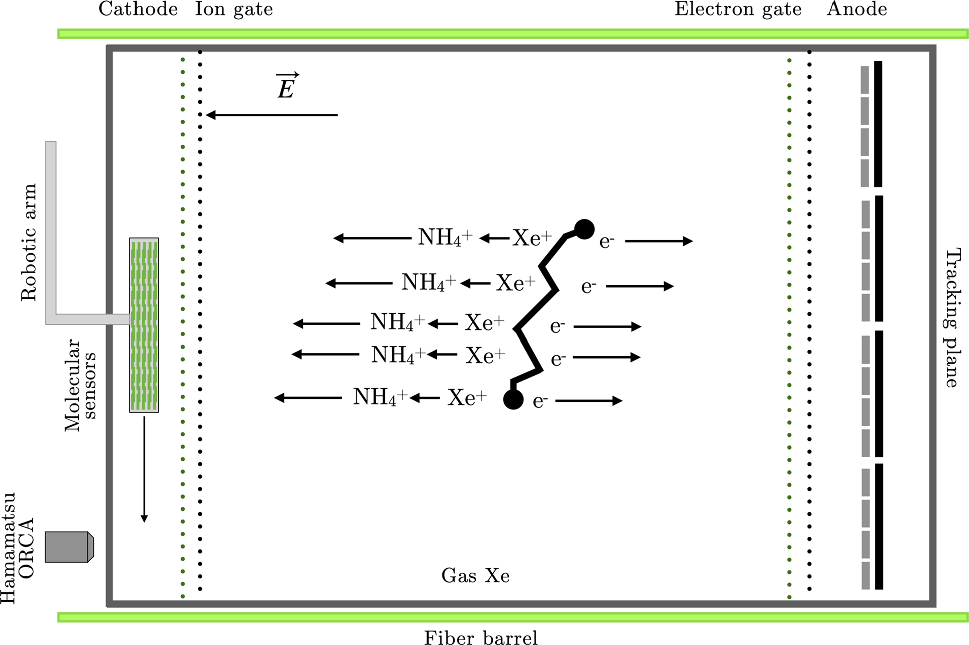
An alternative approach 1 is to image not only the electrons but also the positive ions left behind by the ionization process. Tiny amounts of ammonia (NH3), around one hundred parts per billion, can be added to the xenon gas. Rapid chemical reactions convert the positive xenon ions into ammonium ions (NH4+)almost as soon as they form, without significantly affecting the light signals or the transport of the electrons.
Principle of operation of ITACA. Source: J. J. Gomez-Cadenas et al. (2026) Eur. Phys. J. C doi: 10.1140/epjc/s10052-026-15501-wCC BY 4.0
These ammonium ions move far more slowly than electrons and diffuse much less along the way. Electrons cross the detector in a few milliseconds, whereas the ions can take anywhere from a fraction of a second to several seconds to reach their own collection point. Because the ion cloud stays comparatively compact, it can preserve fine details of the original interaction that may already be lost in the blurred electron image.
The two effects turn out to work against each other in a useful way. Wherever an electron happens to be born close to its collecting sensors, its own image stays sharp, while the corresponding ions still have most of their long journey ahead of them and their image comes out blurred. Deep in the gas, far from the electron sensors, the opposite happens: the electron image becomes badly smeared over its long drift, but the ions in that region have only a short remaining distance to travel and arrive with their picture largely intact. Because the two blurring effects are anti-correlated in this way, at least one of the two pictures, electron or ion, stays sharp no matter where in the detector a decay occurs, keeping the overall reconstruction quality close to uniform throughout the full detector volume.
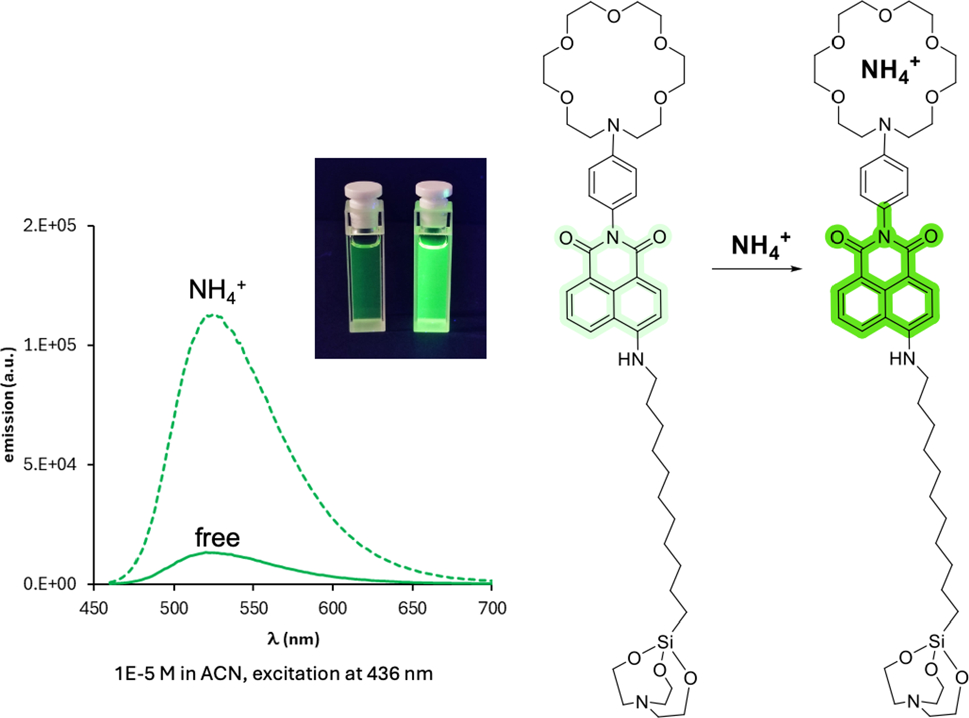
Emission spectra of the free and chelated species (with NH4+) of NAPH3 (Naphthalimide) sensors. Source: J. J. Gomez-Cadenas et al. (2026) Eur. Phys. J. C doi: 10.1140/epjc/s10052-026-15501-wCC BY 4.0
The ion image itself is recorded by letting the ions land on specially prepared molecular surfaces coated with fluorescent sensors that respond specifically to ammonium ions. When illuminated by a laser, only the molecules that have actually captured an ion light up. A microscope and camera system can then scan this surface and reconstruct the ion track with very high spatial resolution.
The researchers call this system ITACA, after Ion Tracking with Ammonium Cations Apparatus. The researchers themselves would be Penelope, waiting for a husband and king who may, or may not, appear.
Would ITACA be the final destination?
Simulations indicate that these ion images preserve the characteristic two-endpoint structure expected from neutrinoless double beta decay, even in the presence of background noise from unbound sensor molecules that occasionally glow on their own. The sharper topology this provides should make it substantially easier to reject events produced by natural radioactivity and other processes that can otherwise mimic the sought-after signal.
Taken together, the additional information carried by the ion tracks could reduce troublesome background events by roughly an order of magnitude beyond what current xenon-gas detectors achieve, and by close to a factor of twenty for some of the most problematic radioactive backgrounds, those whose energy lies dangerously close to the signal itself. Improvements of this size would substantially increase the chances of finally catching neutrinoless double beta decay in the act, and with it, the chance to learn whether the neutrino holds one of the most unusual properties in all of particle physics.
Author: César Tomé López is a science writer and the editor of Mapping Ignorance
Disclaimer: Parts of this article may have been copied verbatim or almost verbatim from the referenced research paper/s.
References
J. J. Gomez-Cadenas, L. Arazi, M. Elorza, Z. Freixa, F. Monrabal, A. Pazos, J. Renner, S. R. Soleti, and S. Torelli (2026) A journey to ITACA Eur. Phys. J. C doi: 10.1140/epjc/s10052-026-15501-w↩
My love of all things Zelda is no secret to my colleagues, friends, and family. In fact, when The Legend of Zelda: Ocarina of Time (OoT) remake was first announced, our Global Editor-in-Chief, Marc McLaren, immediately messaged me to ask if I intended to take time off to play it (I do).
When the 40th anniversary of the franchise rolled around earlier this year, I was a little blue to see little-to-no news of a new game or remake, but my long-read ode to the lasting impact of Link's adventures through Hyrule at least gave me a distraction. Now, however, with months to go until I finally make my grand return to the Kokiri forest, my hype has reached new heights.
To pass the time, I plan to spend my money on, you guessed it, even more Zelda merchandise and Switch 2 accessories to accommodate my upcoming increase in playtime. In the current Amazon Prime Day deals, there's a wide selection of cases, storage, merchandise, and more to shop; I've included some of the best below, as well as the essential gear my gaming station will be decked with come OoT's release later this year. Not everything I've linked below is on sale, so look for the percentage-off badge if you're only looking for good deals.
Switch 2 Essentials
Nintendo
Switch 2 Console
PowerA
Advantage Wireless Controller for Nintendo Switch 2
SanDisk
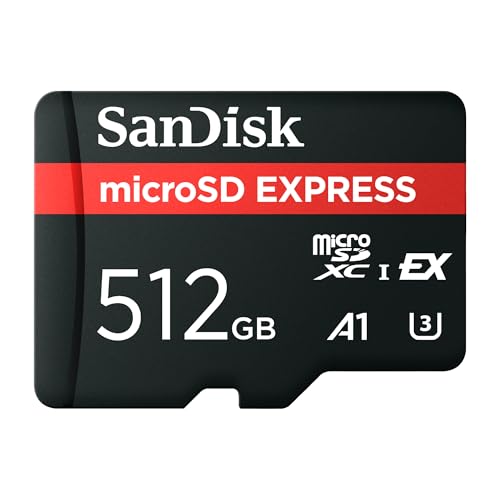
MicroSD Express Card
Nintendo
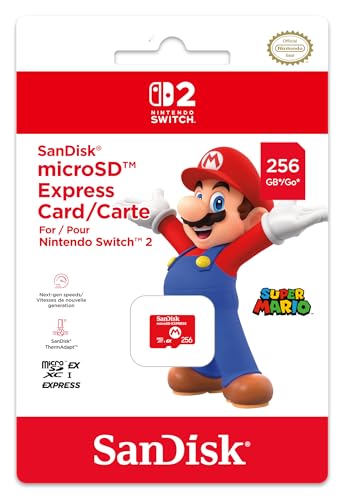
SanDisk MicroSD Express Card for Nintendo Switch 2
If you're not caught up on the latest and greatest Switch generation Zelda games, you've got plenty of time ahead of the Ocarina of Time's remake releasing to pour some hours into adventure.
Nintendo
The Legend of Zelda: Tears of the Kingdom
Nintendo
The Legend of Zelda: Breath of the Wild
Nintendo
The Legend of Zelda: Skyward Sword
Nintendo
The Legend of Zelda: Echoes of Wisdom
Nintendo
Hyrule Warriors: Age of Imprisonment
Nintendo
Hyrule Warriors: Age of Calamity
Nintendo
The Legend of Zelda Link's Awakening
Essential Zelda merch
From Lego sets to card games and novelty toys, there's a lot of great Zelda merch out there. I own a lot (really, an embarassing amount) of the below merchandise already; join me in my submission to capitalism's whim.
LEGO
The Legend of Zelda: Ocarina of Time – the Final Battle
LEGO
Great Deku Tree 2-In-1
LEGO
Super Mario Game Boy
Paladone
Bokoblin Chest Light
USAopoly
The Legend of Zelda Chess
TAMASHII NATIONS
The Legend of Zelda Réplique Proplica Master Sword 105 Cm Black
I know we're all buzzed about the imminent opening of pre-orders for GTA VI. But for me, that ties for most exciting gaming news this month, after Nintendo announced The Legend of Zelda: Ocarina of Time remake is also dropping later on this year. So if you're as into Zelda games as I am and have a decent chunk of cash spare, I'd absolutely recommend you pick up a Nintendo Switch 2 this Prime Day.
As an ardent fan, The Legend of Zelda series lives absolutely rent-free in my head. I cut my teeth on the sublime pixel art of A Link to the Past on the SNES, donned many mantles in Majora's Mask, and banished the gloom in Twilight Princess. But it's almost certainly Ocarina of Time that made the biggest impression on me at the time, thanks to its epic time-hopping story and, at the time, groundbreaking 3D visuals.
So even though I've played the game to completion an almost shameful number of times, you better believe that I'll be picking up the remake on day one of its release. If you're similarly set on reliving one of the greatest games of all time but don't yet have a Nintendo Switch 2, I have one piece of advice for you: grab your console now.
While epic Prime Day discounts are pretty thin on the ground, there's still a good reason to pick one up now. Thanks to the ongoing RAM crisis, Nintendo has already revealed that price rises are coming to the Switch 2. It's been confirmed that, come September, the price US buyers will pay is increasing from $449 to $499 — and while the exact price rise hitting the UK market is yet to be revealed, expectations are that it will be in roughly the same ballpark as in the US.
With its larger, gorgeously vivid 1080p display, silky smooth performance and more sturdy build, the Switch 2 feels every bit the upgrade over its predecessor. And while you can't currently get it for much of a discount, with the price increasing by $50 in September, this may well be the best deal you'll get for a long while.
Not only is its screen flat out gorgeous, packing plenty of brightness and vibrant colors, but it's silky smooth, hitting highs of 120Hz for compatible games. And performance is impressive — even a much more demanding title like the recent Indiana Jones and The Great Circle port feels great, despite being locked at 30fps rather than the 60fps (or above) hit by other platforms. That's an impressive feat for a handheld console this compact.
And the roster of games available for the Switch 2 has expanded massively since release. Donkey Kong Bananza feels like the exact breath of fresh air the series needed, adding a fun new gimmick in its landscape-smashing shenanigans, while I've genuinely been hoping to see a Metroid Prime 4 for almost two decades now. But it's Pokémon Pokopia that has most thoroughly hijacked my brain's dopamine system, allowing me to pour countless hours into building mansions and amusements for my 'mons.
However, if I hadn't already upgraded, there's no doubt that The Legend of Zelda: The Ocarina of Time remake would have pushed me over the top. Getting to relive my nostalgia-soaked memories of one of the greatest adventures of all time with a fresh new coat of paint is a compelling hook indeed. And for any fan dead set on experiencing it, I'd honestly recommend you getting your Switch 2 ordered now before you have to fork out for that extra markup.
With protagonist Fox McCloud appearing in a surprise cameo in the recent Super Mario Galaxy Movie, it’s clear that Nintendo wants to bring its niche on-rail space shooter series to a wider audience. To that end, this new Star Fox makes a lot of sense. It’s a remake of the 1997 title Star Fox 64, which is beloved by fans and a good starting point if you’ve never played one of the games before.
Review info
Platform reviewed: Nintendo Switch 2 Available on: Nintendo Switch 2 Release date: June 25, 2026
The problem for me is that this is far from the first time that Nintendo has brought Star Fox 64 back. I grew up with the Nintendo 3DS, and experienced it as Star Fox 64 3D. This was followed by some hands-on time with the Wii U reimagining Star Fox Zero,and then finally a playthrough of the original release when it came to Nintendo Switch via Nintendo Switch Online.
Every single mainline Star Fox game that’s come out since I was about eight years old has been a version of Star Fox 64, and now, as an adult, I’m getting yet another one in Star Fox for Nintendo Switch 2.
I really wish the gaming giant had been a little bolder with this release, adding even just a smidge of new gameplay to freshen up the old campaign. Still, Star Fox 64 is a cult classic for a reason, and thanks to its strong base, this remake is still plenty of fun to play through for what is, hopefully, one last time
Into the Lylat Wars
(Image credit: Nintendo)
The premise is simple, if a little unconventional. You’re a dashing fox in a universe populated by anthropomorphic animals where civilization has managed to crack space colonization despite an apparent lack of opposable thumbs.
Rather than rooting through sci-fi bins, you’re the leader of a mercenary squad (staffed by you, the bird-like Falco, the lagomorphic Peppy, and slimy Slippy toad) that lends its services to the highest bidder — in this case an intergalactic army that’s waging war against the evil scientist dictator Andross.
Fully voiced and animated cutscenes to convey all this information are one of this remake’s biggest new additions, and they feel like a natural inclusion. They’re not super long or expansive by any means, but all flow well and are decently acted throughout even if there are a few moments where the animation can look a bit cheap.
They provide some much-needed downtime in between each of the levels, which are hectic, high-score challenges that see you steering your ship, the Arwing, through intense battles. The action unfurls in a largely on-rails format, but that doesn't mean that this isn’t a degree of strategy to it.
(Image credit: Nintendo)
You can swerve all across the screen, hitting barrel rolls to deflect incoming fire and blasting your laser canons. Your craft very much exists in a 3D space, so enemies often come up behind you, requiring evasive maneuvers like somersaults or hitting the brakes.
There's a boost too, which, deployed at the right time, can see you zooming under falling debris or through closing gaps — often picking up a power-up or two in the process. It’s all remarkably smooth to control, and sections where you pilot other vehicles keep the stages feeling fresh.
Each campaign is extremely short, taking just over an hour to complete, and has you working your way through a map of the galaxy littered with 16 unique planets.
Best bit
(Image credit: Nintendo)
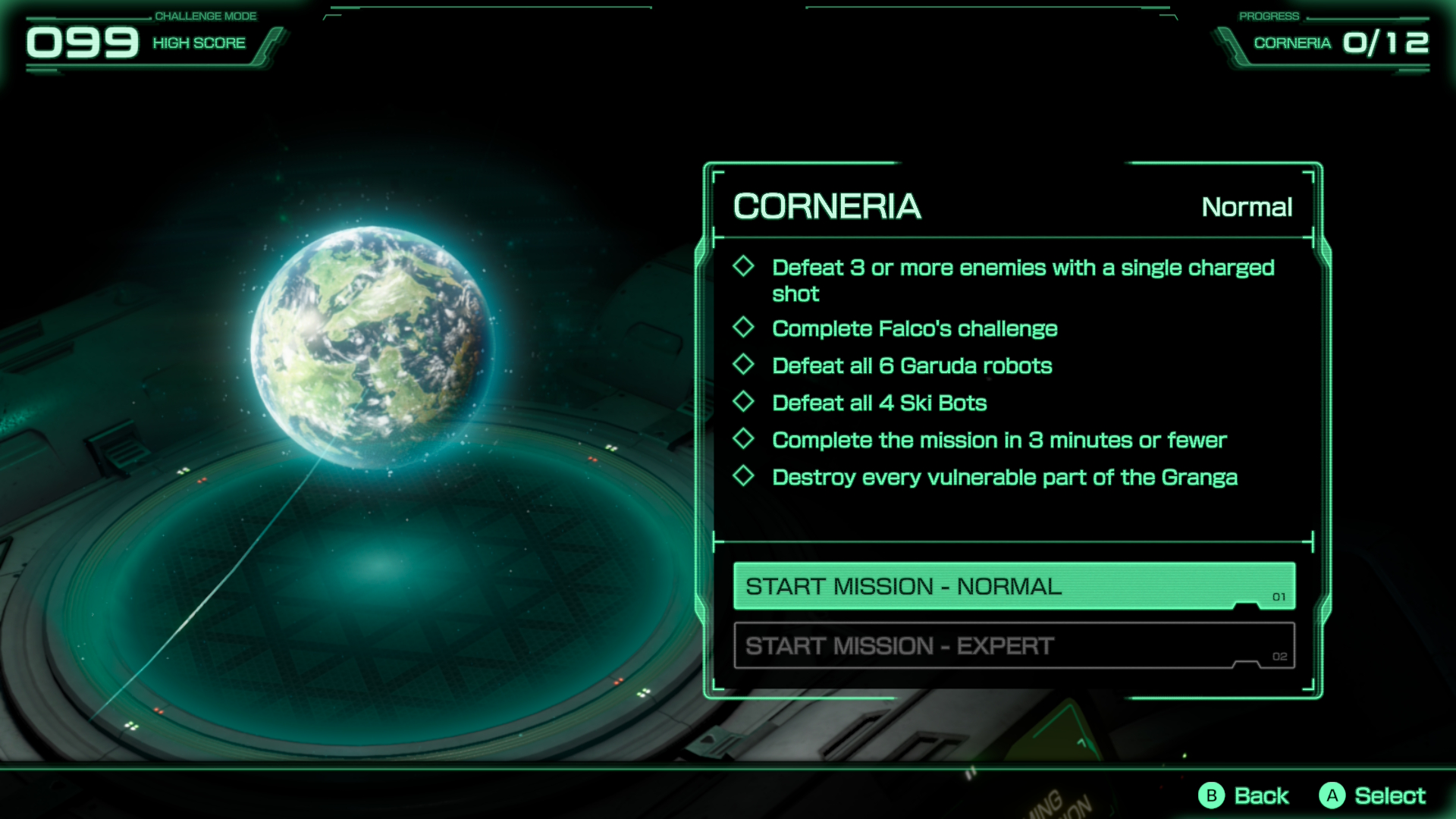
The challenge mode lets you replay all of the levels from the campaign but with some new tricky objectives. These reward you with unlocks like profile badges and lore to read, and I can already see it being a huge hit with completionists.
You can’t visit all of them in one playthrough, which, alongside the two main story paths, gives you plenty of reasons to replay it at least a couple of times. That said even when you bear that in mind, the experience is still pretty fleeting and doesn’t feel befitting of the $49.99 / £41.99 / AU$84.95 digital (or $59.99 / £44.99 / AU$99.95 physical) asking price.
This is especially true if you’ve played all the other versions of Star Fox 64, as you’re basically just paying for a new, admittedly quite pretty, coat of paint.
There is thankfully a new battle mode to try out, and it’s pretty good on the whole. It’s in an online 4v4 player versus player (PvP) format, with one team playing as the Star Fox squad and the other cast as their rivals Star Wolf. Each of the three maps has its own associated game mode, ranging from simple control point capture to fighting to drag limited space cargo back to base.
I’ve had a great time with it so far, though I can imagine that online populations will quickly dwindle given the small map pool. Hopefully a post-launch update will add some more.
Should I play Star Fox?
Play it if...
You’ve never tried Star Fox 64 If you’ve never experienced Star Fox 64 before, then Star Fox is the best version that’s readily available right now. The updated graphics are pleasant, and it feels fantastic to control.
You find it on sale My main issue with Star Fox is its high asking price. If you can find it heavily discounted, then it’s well worth picking up.
Don't play it if...
You’re sick of the Nintendo 64 game If you’ve played the previous Star Fox 64 remakes, then I would recommend skipping Star Fox. It looks pleasant, sure, but it really doesn't add much new beyond its cutscenes.
Accessibility features
As with most first-party Nintendo releases, the accessibility features here are thin. Subtitles are used throughout the game, though their appearance cannot be customized. You can invert the axis of the control scheme and disable features like controller rumble, but that’s basically it.
How I reviewed Star Fox
I played Star Fox on Nintendo Switch 2 for roughly eight hours, experiencing all of its major campaign routes, unlocking every planet, and trying out challenge mode.
I also dived into its multiplayer offering, using my earlier hands-on experience with other players when trying it at Nintendo HQ and testing matches against bots. I mainly played the game in handheld mode using the Joy-Con 2 controllers, though I did briefly test it in docked mode on a 4K Samsung TV to ensure the performance and Nintendo Switch 2 Pro Controller support is up to scratch.

 Login