❌

Reading view

LG Display Returns to Underlying Profit in Q2, Analysts See Annual Operating Profit in Mid-1 Trillion Won Range
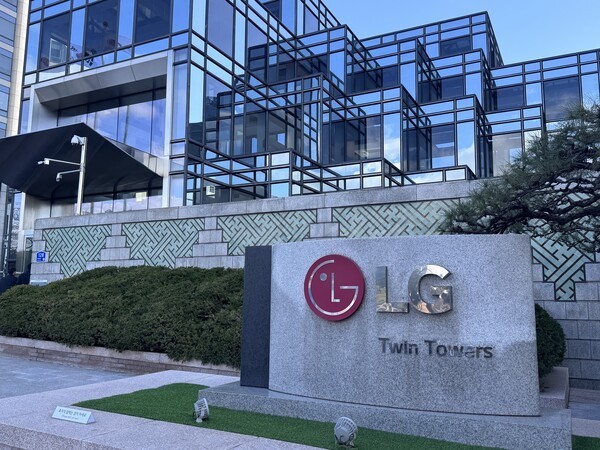
LG Twin Towers in Yeouido, Seoul. (Photo: THE ELEC)

LG Display returned to an underlying operating profit in the second quarter after excluding one-off voluntary retirement costs, reflecting the success of its OLED-focused business restructuring, yield improvements and technology-driven cost reductions. Securities analysts now expect the company to post an operating profit in the mid-1 trillion won range this year.

The company reported second-quarter revenue of 5.6121 trillion won and an operating loss of 108.0 billion won on July 22. Revenue increased 1% from the previous quarter and remained broadly unchanged from a year earlier, while the operating loss narrowed slightly from 116.0 billion won in the second quarter of 2025.

The reported operating loss included approximately 240 billion won in one-off expenses related to workforce optimization, including voluntary retirement programs. Excluding those costs, LG Display generated an operating profit from its core business.

"Over the past four to five years, we consistently recorded operating losses in the second quarter," Kim Sung-hyun, chief financial officer of LG Display, said during the earnings conference call. "The significance of this quarter is that, excluding one-time costs, we have broken out of that structural pattern of second-quarter losses."

For the first half of the year, LG Display posted cumulative revenue of 11.1461 trillion won and an operating profit of 38.7 billion won, compared with an operating loss of 82.9 billion won in the same period of 2025. It marked the company's first first-half operating profit since 2021. Although revenue declined from a year earlier, operating earnings improved by 121.6 billion won.

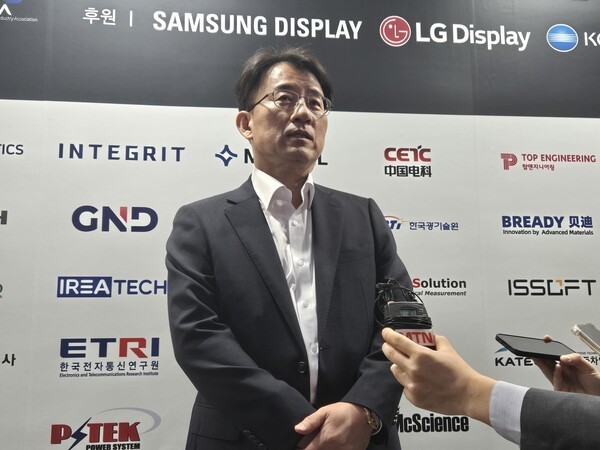
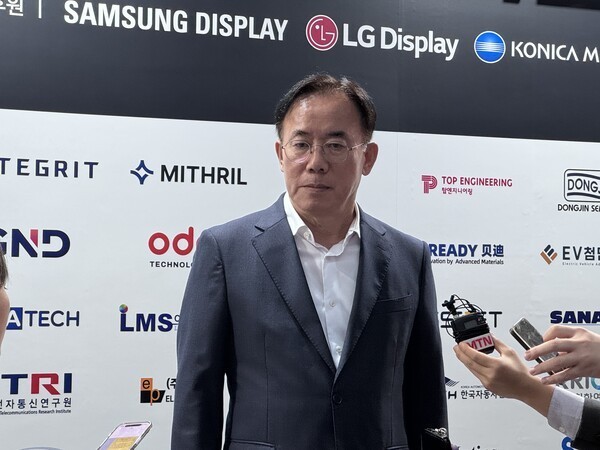
The results reflect the business transformation strategy championed by Jung Cheol-dong, president and chief executive officer of LG Display. Speaking to reporters after the VIP tour at K-Display 2026 on July 22, Jung said the company is strengthening its profitability by building a more resilient business structure. "We are moving toward establishing a stable earnings structure and improving profitability based on stronger business fundamentals," Jung said. "We expect to deliver solid results in the second half as well."

Jung also emphasized technology-driven cost innovation through new materials, manufacturing methods and production processes. Rather than relying solely on cost-cutting measures, the company aims to lower production costs by enhancing technological competitiveness while delivering differentiated value to customers.

Second-quarter shipment area reached 3.6 million square meters, up 12% from the previous quarter, driven by increased shipments of large-sized products, including TVs and monitors. Revenue per square meter declined 13% to $1,079, reflecting the seasonal slowdown in mobile OLED demand. OLED products accounted for 57% of total revenue.

LG Display expects shipment area to increase by the mid-single-digit percentage range in the third quarter as the mobile OLED business enters its seasonal peak. Revenue per square meter is projected to rise by the high-teens percentage range. Capital expenditures this year are expected to increase modestly to the mid-to-high 2 trillion won range.

The company said it will continue improving profitability in the second half through higher production yields, product portfolio optimization and technology-based cost innovation.
  •  

AP Systems Unveils Gen 8.6 IT OLED Manufacturing Equipment at K-Display 2026

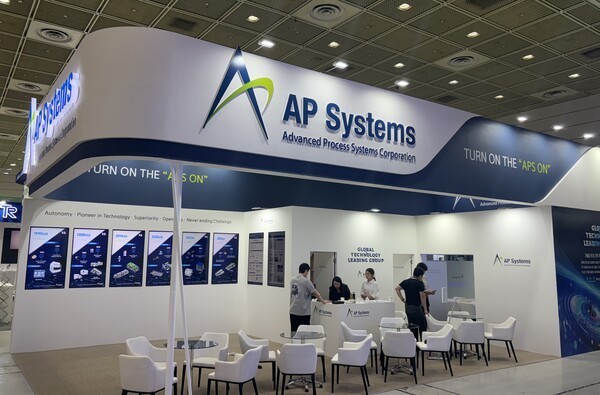
AP Systems' exhibition booth at K-Display 2026. (Photo: AP Systems)

AP Systems unveiled laser processing equipment designed for Gen 8.6 IT organic light-emitting diode (OLED) production, highlighting systems aimed at improving productivity and maintenance efficiency for large-area substrates.

The company said on July 22 that it is showcasing its Gen 8.6 Excimer Laser Annealing (ELA) system and Solid Laser Annealing (SLA) platform at K-Display 2026, which opened at COEX in Seoul.

ELA equipment uses laser technology to crystallize the semiconductor layer on display substrates. The Gen 8.6 ELA system on display has been designed to process large-area glass substrates and increase throughput, improving both panel production speed and manufacturing efficiency.

The SLA platform is a thermal processing system that utilizes solid-state lasers. AP Systems said the platform was developed to reduce maintenance requirements while improving equipment uptime. Gen 8.6 OLED production lines are primarily intended to manufacture larger display panels for tablets and notebook PCs rather than smartphones. AP Systems plans to expand shipments of related equipment as global panel makers accelerate investments in Gen 8.6 OLED production.

"We plan to support large-area IT OLED production for global panel manufacturers through our Gen 8.6 equipment," an AP Systems representative said.

  •  

LG Display CEO Expects Stronger Second Half as Earnings Recovery Continues

Jeong Cheol-dong, president and chief executive officer of LG Display. (Photo: THE ELEC)

LG Display President and Chief Executive Officer Jeong Cheol-dong said the company expects its performance to improve in the second half of the year, expressing confidence that its earnings recovery will continue after returning to profitability on a first-half basis despite a second-quarter loss.

Speaking to reporters at K-Display 2026 in Seoul on July 22, Jeong said, "Our second-quarter results did not meet market expectations due to one-time costs. However, we expect to achieve better results in the second half than we did in the first."

Earlier in the day, LG Display reported second-quarter revenue of 5.6121 trillion won and an operating loss of 107.7 billion won. Revenue rose 0.4% from 5.587 trillion won a year earlier, while the operating loss narrowed from 116.1 billion won in the second quarter of 2025.

Jeong said the company is focused less on short-term earnings and more on strengthening the long-term fundamentals needed to sustain its business. Employees across all business divisions are working toward the shared goals of enhancing technological competitiveness and delivering greater value to customers, he added.

LG Display is also preparing to expand its tandem OLED technology into smartphones. The company currently uses tandem OLED panels in TVs and IT products and is evaluating broader adoption in mobile devices. For Gen 8.6 OLED, Jeong said LG Display is reviewing multiple technology options and business feasibility but declined to provide specific investment plans or timelines, adding that further details will be disclosed once the technology and business plans are finalized.

The company is also developing next-generation OLED technologies. Asked about future innovations, Jeong said LG Display is preparing a range of OLED technologies, including one internally referred to as "Flip." He declined to elaborate, saying additional details will be announced when appropriate.

Jeong acknowledged that rising memory prices are increasing costs but said the impact remains manageable. He added that the company is addressing the pressure through ongoing cost-improvement initiatives.

LG Display will continue capital investment within the limits of its available financial resources, he said. Asked whether additional one-off costs related to workforce optimization could occur, Jeong said it was too early to provide a definitive answer.

"Everyone in the company is working together as one team, focusing our capabilities on technology and creating value for our customers," Jeong said. "We will continue delivering results that earn our customers' trust and recognition."

  •  

Samsung Display Moves to Resume 67 Trillion Won Asan Campus 2 Investment, Expand OLED Capacity

Lee Chung, president and chief executive officer of Samsung Display. (Photo: THE ELEC)

Samsung Display is preparing to resume investment in its Display City Campus 2 in Asan, South Chungcheong Province, reviving a 67 trillion won investment project that forms part of Samsung Group's 140 trillion won investment plan for the Chungcheong region.

Speaking to reporters after a VIP tour at K-Display 2026 at COEX in Seoul on July 22, Lee Chung, president and chief executive officer of Samsung Display, said preparations to restart the Campus 2 project are already underway.

"We are preparing now," Lee said. "It is something we committed to publicly, so we intend to move forward without delay."

Earlier this month, Samsung officially announced plans to invest 140 trillion won in the Chungcheong region. Under the initiative, Samsung Display will invest 67 trillion won in Asan to upgrade its existing manufacturing facilities and construct new organic light-emitting diode (OLED) production lines at Campus 2.

Campus 2 is a separate manufacturing site developed adjacent to Display City Campus 1, where Samsung Display's existing production lines are concentrated in Asan. The company began site development in 2017 but suspended construction in 2020, citing market uncertainty.

Lee also said market conditions for the display industry are expected to remain challenging in the second half of the year. Rising semiconductor prices have increased costs for smartphone and IT device manufacturers, reducing panel demand while intensifying pressure on component suppliers to lower prices.

"Demand for smartphone and IT OLED panels has declined significantly overall," Lee said. "As our customers face a difficult business environment, suppliers of components, including display panels, are also under substantial pricing pressure."

Lee expressed concern over continued investment and capacity expansion by Chinese display makers.

"Chinese companies continue to invest, and we expect their production capacity to keep increasing," he said. "That represents a major challenge for South Korea's display industry."

He added that the Korean display industry must continue leading with OLED technology while preparing next-generation technologies.

"We have maintained global leadership for more than 50 years, and we cannot afford to lose that position," Lee said.

Lee also expressed confidence in Samsung Display's technological leadership in foldable OLED panels.

"Excluding Chinese customers and Chinese panel makers, Samsung Display holds an overwhelming share of the foldable display market," he said. "We believe we remain well ahead in terms of quality, durability and overall display performance."

  •  

Samsung Display, LG Display Stay Profitable in Mobile OLED as Chinese Rivals Remain Deep in the Red

David Hsieh, senior research director at Omdia, speaks on
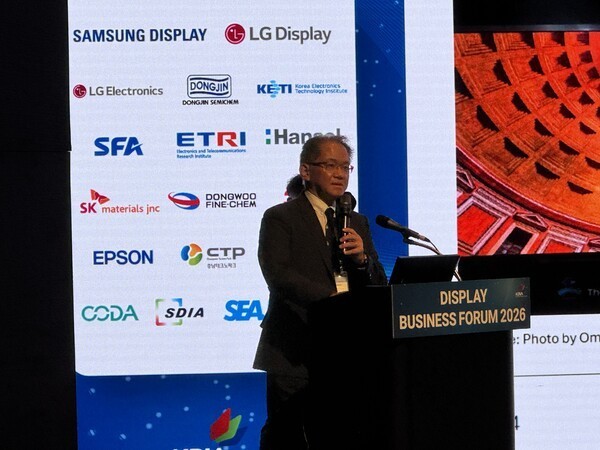
David Hsieh, senior research director at Omdia, speaks on "OLED Market and Technology Megatrends" at the Display Business Forum 2026 held at COEX in Seoul on July 21. (Photo: THE ELEC)
David Hsieh, senior research director at Omdia, speaks on
David Hsieh, senior research director at Omdia, speaks on "OLED Market and Technology Megatrends" at the Display Business Forum 2026 held at COEX in Seoul on July 21. (Photo: THE ELEC)

Samsung Display and LG Display were the only profitable suppliers in the mobile organic light-emitting diode (OLED) market during the first quarter of 2026, while their Chinese competitors remained heavily loss-making despite rapidly expanding shipments, according to market research firm Omdia.

Speaking at the Display Business Forum 2026 in Seoul on July 21, David Hsieh, senior research director at Omdia, said few companies are generating profits in the mobile OLED business as the industry faces rising investment requirements for next-generation manufacturing technologies.

"There are not many companies that are actually making money in mobile OLED," Hsieh said. "The industry will continue to require substantial investment in equipment, materials and manufacturing processes."

According to Omdia's estimates, Samsung Display posted a 10% operating margin in its mobile OLED business during the first quarter, while LG Display recorded an operating margin of 6%. They were the only profitable companies among the seven panel makers included in the analysis.

All five Chinese manufacturers remained in the red.

TCL CSOT posted an estimated operating margin of -7%, followed by BOE at -8%, Tianma at -15%, Visionox at -33%, and Everdisplay Optronics (EDO) at -43%. The average operating margin across the five Chinese suppliers was -21.2%, while the gap between Samsung Display and Everdisplay Optronics reached 53 percentage points.

In terms of shipments, South Korean and Chinese manufacturers each accounted for roughly half of the global market for small- and medium-sized OLED panels used in smartphones and other mobile devices.

The figures suggest that although Chinese manufacturers have largely caught up with their South Korean rivals in production volume, they continue to trail significantly in profitability.

Chinese panel makers are investing aggressively in advanced OLED technologies for foldable smartphones and other premium mobile devices while simultaneously expanding manufacturing capacity. Omdia said the combination of new capital expenditures and depreciation costs from recently built production lines has prevented higher shipment volumes from translating into stronger earnings.

The slowdown in the smartphone OLED market is adding further pressure.

Although OLED penetration in smartphone displays has already exceeded 50%, Omdia believes the market has begun to peak this year and is entering a period of gradual decline.

"Rising memory prices have contributed to slower market growth, but the bigger challenge is that consumers are replacing their smartphones less frequently," Hsieh said. "In the AI era, consumers may choose to upgrade software, applications or platforms instead of replacing their devices."

  •  

Toray Advanced Materials Korea, Hansol Homedeco Develop High-Flexibility PET Interior Film

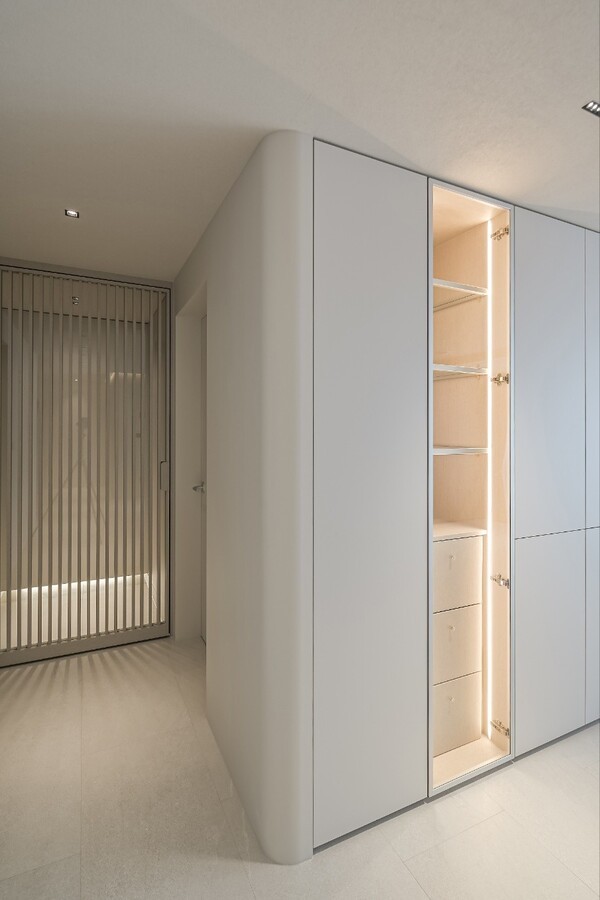
Interior design featuring Toray Advanced Materials Korea's high-performance PET interior film. (Photo: Toray Advanced Materials Korea)

Toray Advanced Materials Korea has jointly developed a high-performance polyethylene terephthalate (PET) interior film with Hansol Homedeco, expanding the use of PET materials in interior finishing applications.

The company announced on July 21 that it completed the development of the high-flexibility PET interior film after nearly two years of joint research with Hansol Homedeco.

PET films are widely used as decorative surface finishes for furniture doors because of their processability and appearance. However, the material's relatively high stiffness has limited its application on curved surfaces and sharp corners, where conventional films tend to lift or peel away.

Toray Advanced Materials Korea said it overcame those limitations by combining its film processing and manufacturing technologies with elastic materials, producing a PET film with approximately twice the flexibility of conventional polyvinyl chloride (PVC) films.

The enhanced flexibility allows the film to adhere more reliably to curved surfaces and edges while maintaining a high-quality finish.

The newly developed material will be incorporated into Hansol Story Film, Hansol Homedeco's interior film product lineup.

"We will continue developing high-performance interior materials while expanding our product portfolio, including flame-retardant PET films," a Toray Advanced Materials Korea official said.

  •  

LG Display Brings Tandem OLED to Smartphones, Cuts Display Power Use by 39%

Choi Young-seok, chief technology officer of LG Display, speaks on
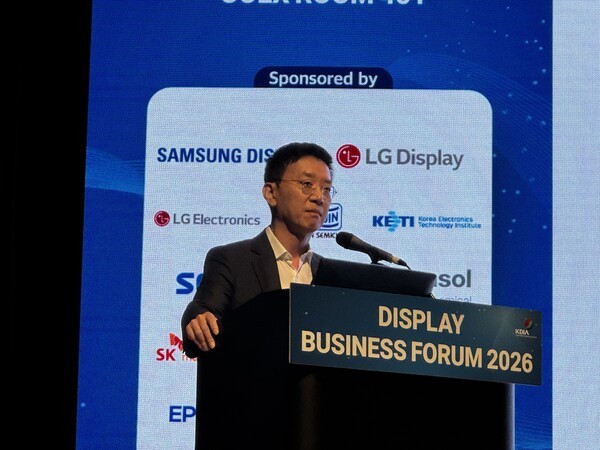
Choi Young-seok, chief technology officer of LG Display, speaks on "Tandem OLED Expansion and the Architecture Driving Growth in the AI Era" at the Display Business Forum 2026 held at COEX in Seoul on July 21. (Photo: THE ELEC)
Choi Young-seok, chief technology officer of LG Display, speaks on
Choi Young-seok, chief technology officer of LG Display, speaks on "Tandem OLED Expansion and the Architecture Driving Growth in the AI Era" at the Display Business Forum 2026 held at COEX in Seoul on July 21. (Photo: THE ELEC)

LG Display is extending its tandem OLED technology from TVs, automotive displays and IT products to smartphones, aiming to reduce power consumption as on-device artificial intelligence increases energy demands.

Speaking at the Display Business Forum 2026 in Seoul on July 21, Choi Young-seok, chief technology officer of LG Display, unveiled the company's Advanced Tandem OLED for smartphones.

Tandem OLED stacks multiple organic light-emitting layers to generate light, allowing the display to achieve the same brightness as a conventional single-stack OLED while using less current. The architecture reduces power consumption, extends smartphone battery life and improves panel longevity.

According to LG Display, tandem OLED panels offer more than twice the lifespan of conventional single-stack OLEDs while reducing power consumption by more than 30%. Depending on display usage, power savings can reach up to 60%.

In smartphone testing, display power consumption fell 39%, from 533 milliwatts (mW) to 315 mW. The test was conducted using a 6.7-inch-class display and a screen brightness of 100 nits. Under the same conditions, battery runtime increased from 2.6 hours to 3.9 hours.

LG Display said it developed the smartphone tandem OLED in response to rising power requirements driven by AI features. Running AI workloads directly on smartphones places heavier demands on application processors (APs), neural processing units (NPUs) and memory.

Because smartphone battery capacity is constrained by device size, reducing display power consumption allows more energy to be allocated to AI processing without sacrificing battery life.

LG Display first introduced tandem OLED technology in large OLED TVs in 2013. It later expanded the technology to automotive displays in 2019, followed by notebooks and tablets in 2024.

Its TV panels use multiple organic layers to generate white light, which passes through color filters to produce images. For automotive and IT applications, the company employs an RGB tandem OLED architecture that stacks red, green and blue emissive layers.

The smartphone panel marks LG Display's first application of tandem OLED technology in mobile devices. Commercialization would give the company a tandem OLED portfolio spanning TVs, automotive displays, notebooks, tablets and smartphones.

Competition in smartphone tandem OLED technology is also intensifying. At SID Display Week 2026 in the US in May, Chinese display makers BOE and TCL CSOT both showcased tandem OLED panels.

BOE unveiled a 6.5-inch tandem OLED for smartphones, while TCL CSOT introduced a foldable 18-inch tandem OLED display.

"We will expand tandem OLED technology across our entire product portfolio, from large-sized to small- and medium-sized displays, to meet growing demand for low-power displays in the AI era," Choi said.

  •  

Display Association to Hold K-Display 2026 Career Fair

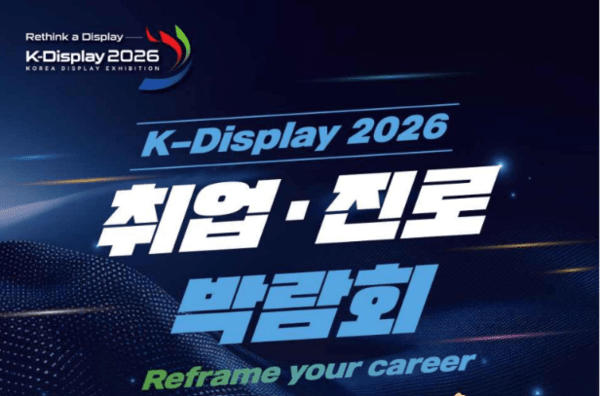
Korea Display Industry Association will hold the K-Display 2026 Career Fair at Hall C of COEX in Seoul from July 22 to 24. (Image: Korea Display Industry Association)

The Korea Display Industry Association (KDIA) announced on July 20 that it will hold the K-Display 2026 Career Fair from July 22 to 24 at Hall C of COEX in Seoul.

The event will bring together 23 display companies, including Samsung Display and LG Display, and provide recruitment consultations, job counseling and career support programs for approximately 900 students and young job seekers.

This year's event expands beyond its traditional recruitment focus by offering both employment and graduate school guidance. A newly established graduate school pavilion will feature 23 research laboratories from nine universities, providing undergraduate students with information on graduate study opportunities. Seven companies will participate in the event for the first time.

The recruitment pavilion will offer pre-arranged meetings between participating companies and job seekers for hiring and career consultations. A career development area will provide rΓ©sumΓ© reviews, job counseling, AI-powered mock interviews, mentoring sessions with industry professionals and professional headshot photography. A career talk concert featuring employees from five companies, including Samsung Display and LG Display, will also be held.

Participants will also be able to join guided tours of the K-Display exhibition and experience display manufacturing processes through extended reality (XR) demonstrations.

Following the event, participating companies will continue to post job openings and accept applications through an online recruitment platform that will remain available through December.

Lee Seung-woo, vice chairman of the Korea Display Industry Association, said he hopes the event will help companies recruit talented employees while providing students with opportunities to pursue both employment and graduate education.

  •  

Mithril to Showcase AI Solutions for Semiconductor and Display Equipment at K-Display 2026

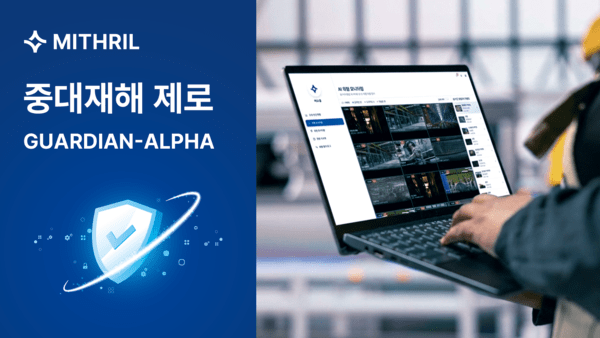
Mithril will showcase its Optima-Alpha embedded AI solution for manufacturing equipment and Guardian-Alpha industrial safety platform at K-Display 2026. (Image: Mithril)

Manufacturing artificial intelligence (AI) company Mithril will unveil AI solutions designed for the control systems of semiconductor and display manufacturing equipment at K-Display 2026.

The company announced on July 20 that it will exhibit Optima-Alpha, an embedded AI solution for manufacturing equipment, and Guardian-Alpha, an industrial safety platform, during the exhibition.

Optima-Alpha analyzes data generated by semiconductor and display manufacturing equipment to support equipment control, production efficiency and quality management. Mithril said it has completed a proof of concept (PoC) for semiconductor applications and is negotiating contracts to deploy the AI solution in commercial production equipment. The company is also conducting additional PoCs with a global factory automation (FA) supplier.

Recognizing that data structures and hardware control architectures differ across equipment platforms, Mithril said it establishes dedicated teams for each customer and provides customized system integration (SI) services. The company plans to develop AI functions tailored to individual equipment control environments while expanding into long-term maintenance and support services.

Guardian-Alpha analyzes data from factory CCTV systems and sensors to detect safety risks in industrial workplaces. The platform identifies hazards including workers not wearing protective equipment such as helmets, safety shoes and safety harnesses, as well as falls, collapses, potential forklift collisions, unauthorized entry into restricted areas, and incidents involving fire, smoke or gas leaks.

When hazardous situations are detected, the system can activate speakers, warning lights and equipment control systems while simultaneously sending alerts to management dashboards. It also records detection and response histories before and after incidents.

Both products are powered by Nenya sVLA, an AI model currently under development by Mithril. The platform combines a common AI core with lightweight industry-specific adapters that add specialized capabilities for different industrial applications. Mithril plans to launch the platform in 2027.

The company also plans to demonstrate the AI solutions at its exhibition booth using simulated semiconductor and display manufacturing environments.

  •  
❌