❌

Reading view

Stephen Hawking's famous 'leaky' black hole theory gets much-needed update

There may be an easier way to describe how black holes "leak" energy than the theory Stephen Hawking proposed — and the newly suggested process is similar to how we describe a boiling pot of water. This simple (well, relatively simple) description could be used to model black holes in many situations such as during their formation, mergers with other black holes, eventual evaporation and even explosive death.

In the 1970s, legendary theoretical physicist Stephen Hawking wrote a letter to the journal Nature entitled "Black hole explosions?" explaining how these objects may leak thermal radiation, evaporate and eventually implode at the end of their lives. This radiation eventually became known as Hawking radiation.

But in new research, scientists have suggested an alternative to Hawking radiation. It involves describing the increase in disorder, or entropy, of black holes. Boiling water, as an example, is also often described based on its increase in entropy. For black holes, this measure of entropy is connected to characteristics like spin and energy, which means it could be used to understand how these cosmic titans respond to different events.

"Hawking's laws of black hole mechanics provided a satisfying connection between extreme and ordinary physics and have been the paradigm for 50 years, but they have a serious limitation," team leader Abhay Ashtekar of the Eberly College of Science at Penn State University said in a statement. "They were formulated for black holes at equilibrium — or unchanging over time — but black holes are constantly changing; they form, merge, and eventually evaporate. We wanted to find a way to overcome this limitation and extend the laws to black holes that are out of equilibrium."

Black holes, Einstein and Hawking

To investigate the origins of black holes, one has to go back to history's most famous physicist (sorry Hawking, you're number two), Albert Einstein.

In 1915, Einstein revealed his theory of gravity, general relativity. One consequence of the equations underpinning that theory was the possibility of a singularity, a point at which the equations of general relativity go to infinity. This represents the heart of a black hole.

Another consequence of the general relativity equations is a region of space around this singularity at which gravity is so extreme that the escape velocity of the area increases to a value greater than the speed of light. That region is the light-trapping outer boundary of the black hole known as the event horizon, which prevents us from ever seeing the singularity at the heart of the black hole or receiving information from it. In fact, until Hawking's work in 1974, this is why it was proposed that nothing at all can escape a black hole.

"The laws of black hole mechanics came directly from Einstein's equations," team member Daniel E. Paraizo, a graduate student in physics at Penn State, said. "Because you cannot see into a black hole, it seemed that there could be an infinite number of ways to make a black hole, making their entropy infinite as well. They were also thought to only absorb energy and never radiate, so their temperature was zero."

However, the advent of Hawking radiation somewhat changed this paradigm. By suggesting that black holes actually radiate thermal energy, Hawking redefined them in such a way that suddenly the laws of thermodynamics could be applied to black holes.

"This changed the thinking about the thermodynamic properties of black holes from a sort of mathematical concept described by equations, to being more of a physical reality," Paraizo said. "This opened the door to finding analogies in black holes of entropy and temperature used in thermodynamics."
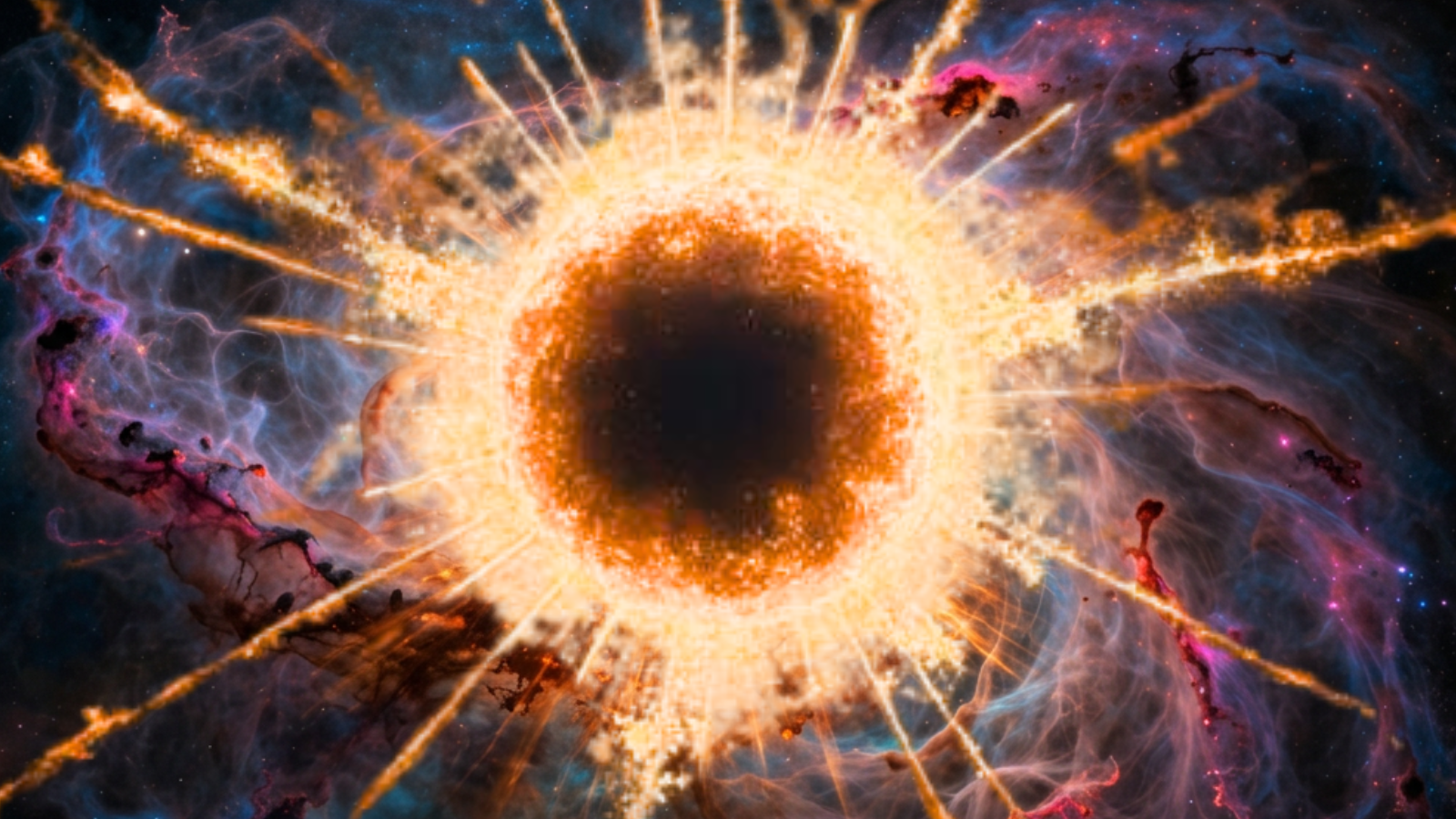
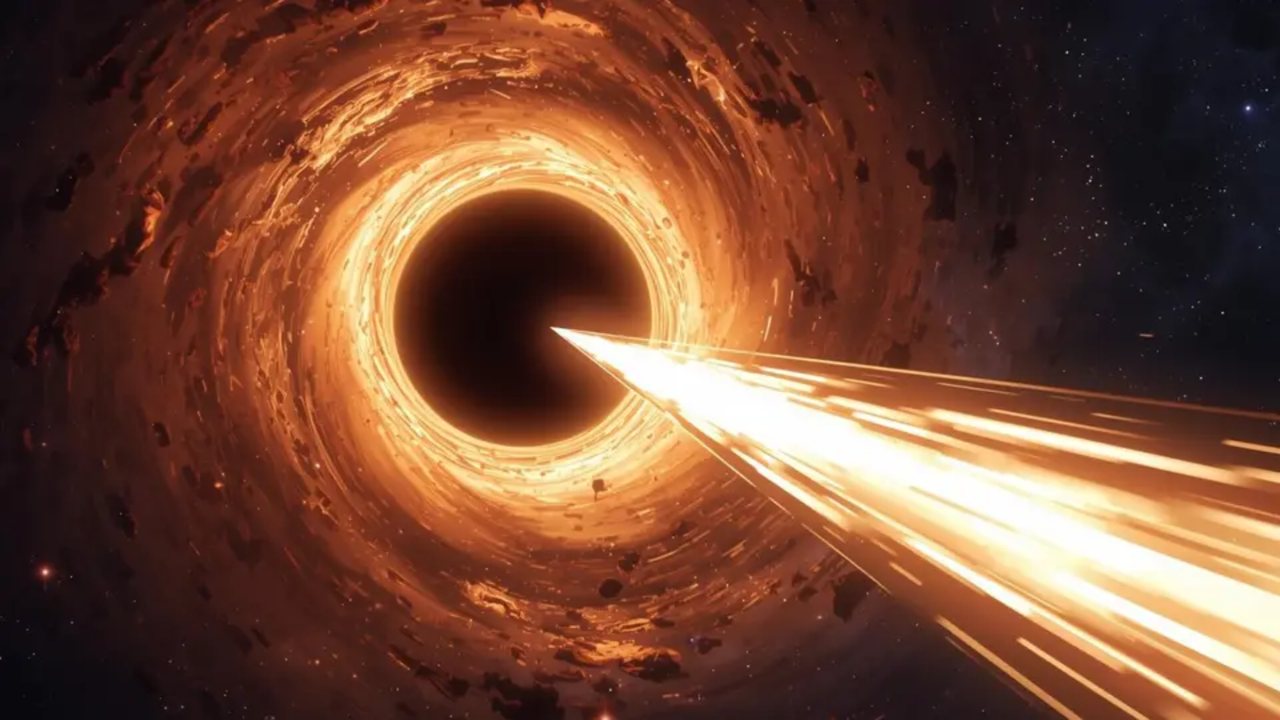
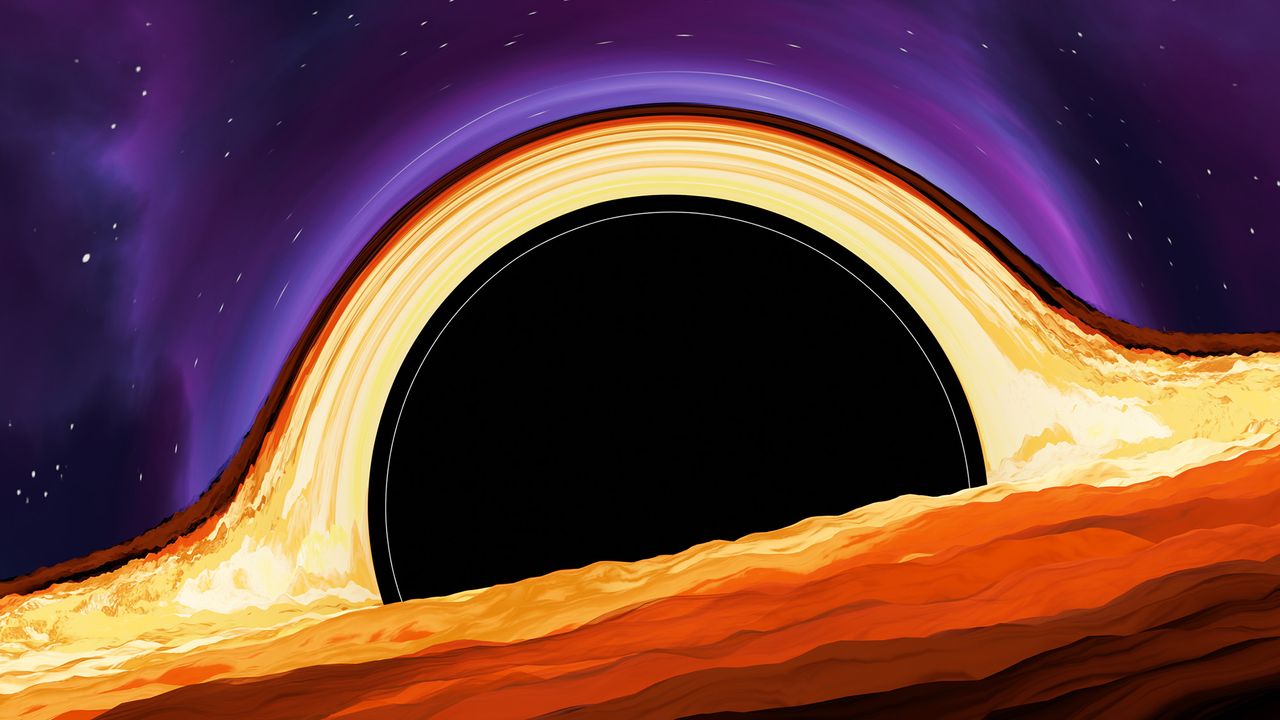
A dark center surrounded by exploding yellow patterns.

An illustration of an exploding black hole. (Image credit: Robert Lea (created with Canva))

In Hawking's recipe for black holes, the area of the event horizon is proportional to its temperature and entropy, and is inversely proportional to its mass and its spin.

"There is a problem, though," team member Jonathan Shu, also from Penn State, said in the statement. "These analogies only really work for a black hole that is at equilibrium. In dynamic situations, event horizons can form and grow in what we call flat regions of space-time, where nothing is happening."

Shu added that a consequence of this is the properties of black holes cannot be determined just by the local physics of the black hole. Instead, determining the properties of black holes relies on the prediction of events that may or may not happen in the future.

"Therefore, the area of event horizons cannot be a measure of the physical entropy of dynamical black holes," Shu argues. "If we want to understand black holes that are growing, evaporating and merging, we need a viable alternative."

For the team, this meant replacing the event horizon of a black hole with something they call a "dynamical horizon," already used when scientists simulate black holes. Now, the first law of thermodynamics — which states the energy of a closed system cannot be created or destroyed but rather can only change forms — can be applied to black holes even when they are involved in dynamic acts. It also means black holes are subject to the second law of thermodynamics, which says the total entropy of an isolated system will always increase over time, during their birth, merger and death.

"This allows us to extend the first and second laws of thermodynamics to black holes that are not at equilibrium, thereby overcoming the limitations of the paradigm that has been used for over half a century," Ashtekar said. "We can apply these generalized laws to better understand evaporating black holes in quantum theory and black hole mergers."

The team's research was published in June in the journal Physical Review Letters.
  •  

The 1st of 10,000 'missing' black holes in the Omega Centauri star cluster has been found by the Hubble and James Webb space telescopes

The first of 10,000 missing black holes in the Omega Centauri globular cluster has been found thanks to teamwork by the Hubble and James Webb space telescopes.

The two observatories discovered the black hole after watching a star orbiting around something massive but dark, and which therefore could not be seen. The Hubble data ran from 2003 to 2023, and the James Webb Space Telescope picked up after that to help refine the measurements.

Astronomers used the space telescopes to focus on a particular star in a binary system that appeared to be home to another, dark object called oMEGACat BH-2. Previous studies had suggested that the dark object was a neutron star. However, the new results are conclusive: the object has a mass 4.46 times that of the sun. This is too massive to be a neutron star, so it must therefore be a black hole.

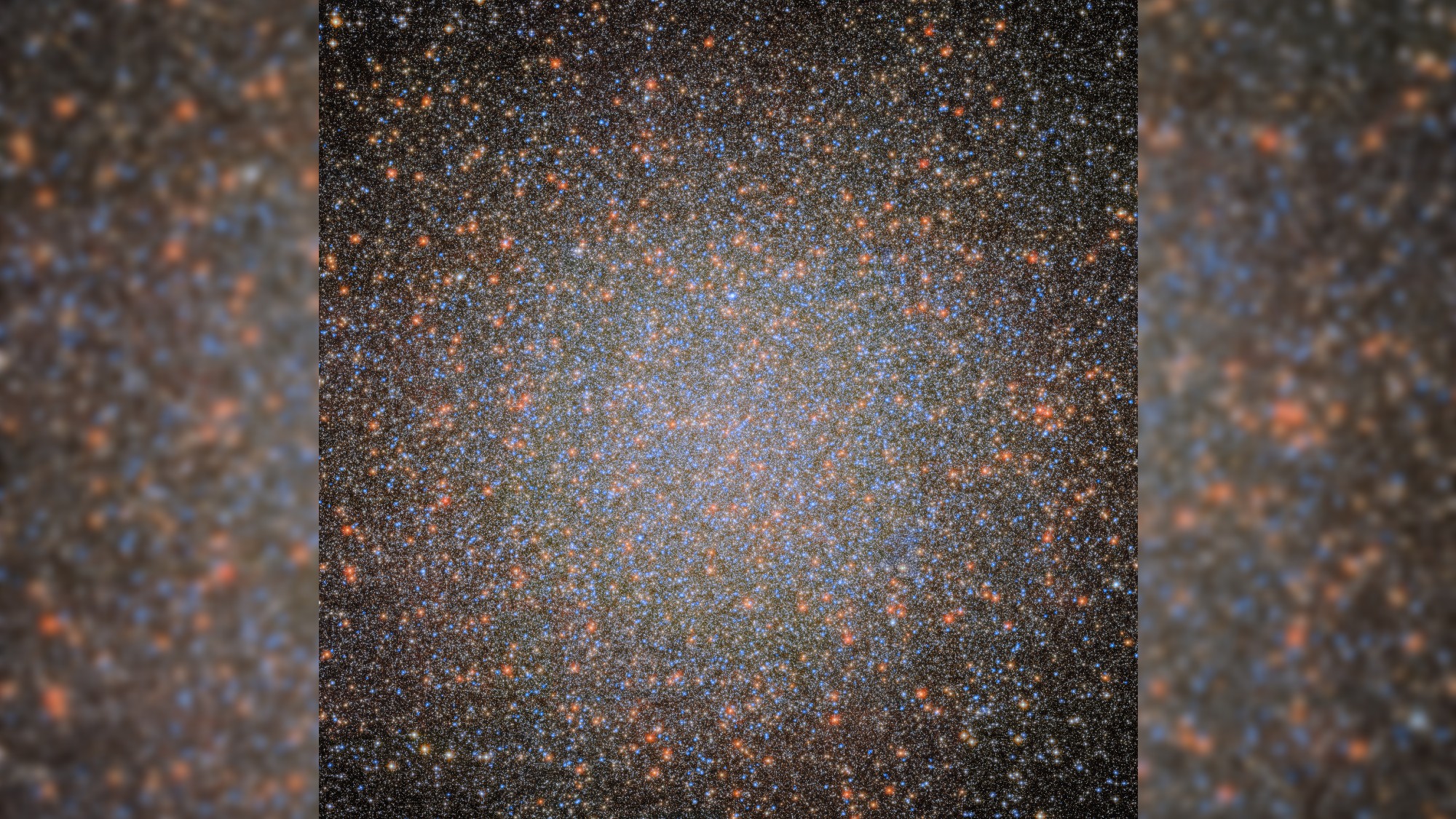
Omega Centauri is the most massive of our Milky Way galaxy's globular clusters. It is so massive that astronomers suspect that it is actually the core of a dwarf galaxy that has lost most of its stars to the Milky Way's gravitational cannibalism, which over the aeons has torn strips from Omega Centauri. Even so, Omega Centauri still contains about 10 million stars, collectively located 18,000 light-years from Earth.

In 2024, astronomers using the Hubble Space Telescope found clinching evidence that an intermediate-mass black hole – one that has a mass about 8,200 times that of our sun – lurks at the center of Omega Centauri, strengthening its claim of being the remnant of a dwarf galaxy, since galaxies harbor black holes at their center but star clusters typically do not.

However, alongside this intermediate-mass black hole should be about 10,000 other stellar-mass black holes born from the supernova explosions of massive stars. Searches have focused on binary systems where a star orbits a compact object, but until now astronomers had drawn a blank.

Now, a team led by Matthew Whitaker of the University of Utah in Salt Lake City have come along to save the day by diligently sifting through 20 years of Hubble observations, plus additional supporting views from the JWST, to uncover a stellar-mass black hole in Omega Centauri for the first time.

Whitaker's team used a technique called astrometry, which is the measurement of the changing positions of stars as they move through space. Although the black hole itself is dark, it is orbited by a normal star with a mass 78% that of our sun. Thanks to the unprecedented vision of Hubble and the JWST, Whitaker and his colleagues were able to track the motion of this star around the black hole.

It turns out that the star is on a 94-year-long orbit around the black hole, which is the widest separation of a binary composed of a stellar-mass black hole and star ever found. Over that 20-year-period, Hubble saw less than a quarter of the star's total orbit, but it coincided with the star's closest approach to the black hole, during which the star moved faster.

Based on this motion, Whitaker's team were able to measure the strength of the black hole's gravitational field acting on the star, and from that calculate the mass of the black hole.

a dense field of stars on a black background

An image of the globular cluster Omega Centauri. (Image credit: ESA, NASA, Maximilian Häberle (MPIA), Joseph DePasquale (STScI))

"The precision of these measurements is incredible, down to a fraction of a pixel on Hubble and Webb's detectors," said Whitaker in a statement. "It would not have been possible to find this black hole without these two space telescopes."

Given how wide the orbit of the star is around the black hole, the likelihood is that the black hole's gravity captured the star when it passed close. This is a state of affairs that will not last forever; within another billion years, encounters with other stars in the crowded environs of the cluster will probably pluck the black hole's companion away.

The mass of oMEGACat BH-2 does seem unusual, however, in the sense that it is lower than expected. The mass of oMEGACat BH-2 exists in a void that has only become apparent during the past eleven years of gravitational wave detections. These gravitational waves are produced by the mergers of stellar-mass black holes, but black holes with masses between 2.5 times the mass of our sun (the theoretical limit for neutron stars) and five solar masses are conspicuous by their absence in the gravitational-wave events. Yet here is oMEGACat BH-2, sitting within that mass gap.

"It's important to understand black hole populations in globular clusters because there's uncertainty about their physics and formation," said Anil Seth of the University of Utah.

"More specifically, understanding the process of forming black holes and then dynamically forming binaries is vital, because it affects our ability to interpret and understand gravitational-wave events. Environments like Omega Centauri are the primary places where we think binaries are merging and creating these waves."

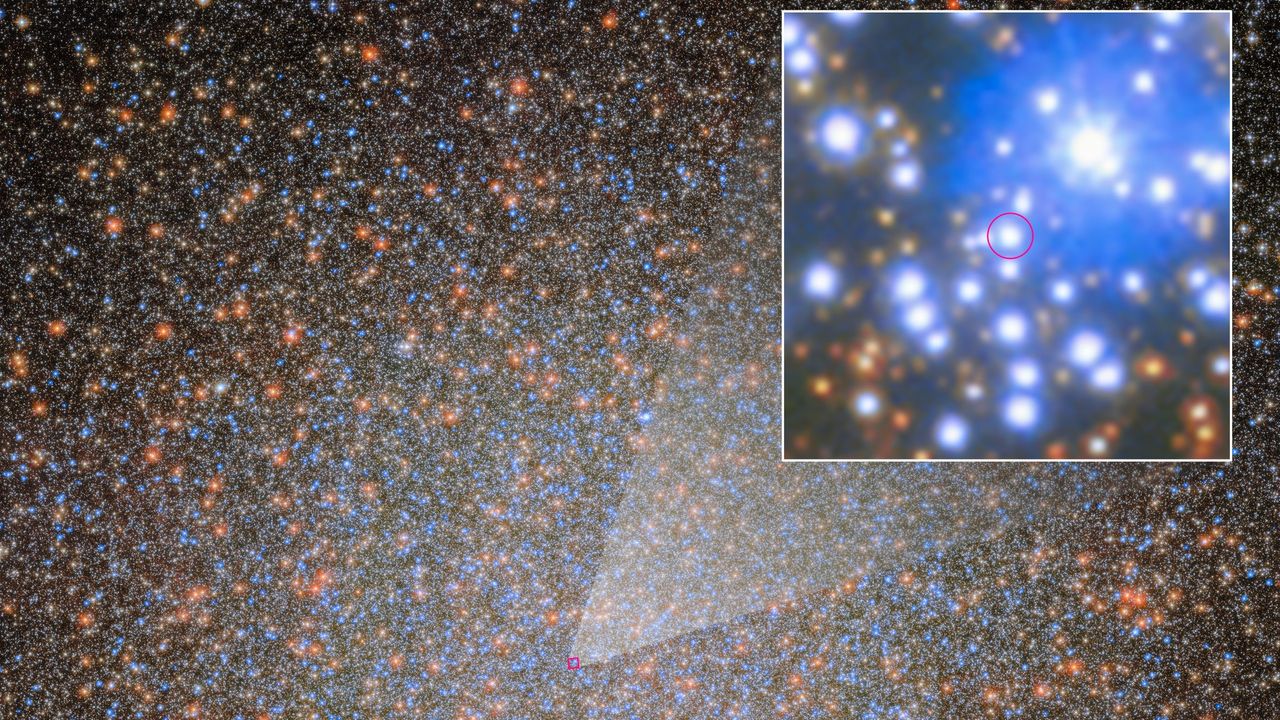
a dense field of multi-colored dots on a black background

A colorful collection of 100,000 stars are displayed in this small region inside the Omega Centauri globular cluster, a dense group of nearly 10 million stars. (Image credit: NASA, ESA, and the Hubble SM4 ERO Team)

In particular, the stars of Omega Centauri are more primitive than our sun, chemically speaking, with fewer elements heavier than hydrogen and helium. Which types of massive stars produce black holes when they explode as supernovas is still an area of active research, but oMEGACat BH-2 adds another complication to the mix in that its progenitor star contained few heavy elements.

"We need to figure out how that happens," said Seth.

So that's one down, and 9,999 or thereabouts to go. Whitaker's team continue to use Hubble and JWST data to find more stellar-mass black holes in Omega Centauri, but he also highlights the potential of NASA's Nancy Grace Roman Space Telescope to find black-hole binary systems in our Milky Way galaxy at least when the telescope launches later this year.

"Roman … will image the crowded galactic bulge, including the galactic center, very regularly with Hubble-like resolution and with a much wider field of view," said Whitaker. "We're hoping we'll be able to find black hole binary systems like this one because of the regular cadence of Roman's observations."

The details regarding oMEGACat BH-2 are described in a paper published on July 13 in The Astrophysical Journal Letters.

  •  

A ravenous black hole in our backyard could be our window into the ancient universe

A supermassive black hole at the heart of a nearby galaxy is behaving similarly to black holes that existed just after the Big Bang, voraciously feeding on copious amounts of matter. The relatively close cosmic titan could therefore provide insight into the much more distant universe.

Indeed, the intense accretion behavior demonstrated by the supermassive black hole, which sits at the center of the galaxy SDSS J110546.07+145202.4 located 1.8 billion light-years away, is something scientists have only ever seen in the earliest supermassive black holes.

SDSS J110546.07+145202.4 has been shining brightly in radio waves for many years, and these waves were the smoking gun that pointed to the feeding habits of the galaxy's central black hole.

"Such high-energy events can provide astronomers with a wealth of insights," Kovi Rose from the University of Sydney’s Sydney Institute for Astronomy said in the statement. "By observing these jets and outbursts, we can study the physical processes in some of the most extreme environments in the universe."

Even the hungriest black holes are messy eaters

All large galaxies have a supermassive black hole at their heart with masses of millions or even billions of times that of the sun. However, not all supermassive black holes accrete vast amounts of matter.

For example, the supermassive black hole at the heart of our galaxy, the Milky Way, Sagittarius A*, consumes so little gas and dust from its surroundings that, were it a human being, it would be existing on a diet of one grain of rice every million years. (That is one heck of a diet.)

When black holes are surrounded by copious amounts of gas and dust, their immense gravitational influence causes this material, in a flattened swirling cloud called an accretion disk, to glow brightly across the electromagnetic spectrum, from low-energy radio waves to high-energy X-rays.

Additionally, supermassive black holes are notoriously messy eaters, meaning some of the matter in accretion disks is channeled to the poles of the black hole, from where it is blasted out as jets of plasma traveling at speeds approaching the speed of light. These jets too are responsible for bright emissions of electromagnetic radiation.

Radio signals from the spiral galaxy SDSS J110546.07+145202.4 underwent a 20-fold increase in radio brightness over a short period, increasing to around 10 quadrillion times the intensity of the radio brightness of the sun. This happened around 8 years ago, and the galaxy has yet to show any sign of dimming.

"We are dealing with the prototype of a new class of galaxies that undergo rapid changes in radio emission," team member Phil Edwards from CSIRO, Australia’s national science agency, said.

Team leader Stefanie Komossa of the Max-Planck-Institute for Extraterrestrial Physics in Garching, Germany, added: "Luminous radio radiation from rapidly growing, lightweight black holes is rare to begin with. Their transition into a long-lasting, radio-bright state has never been observed before."

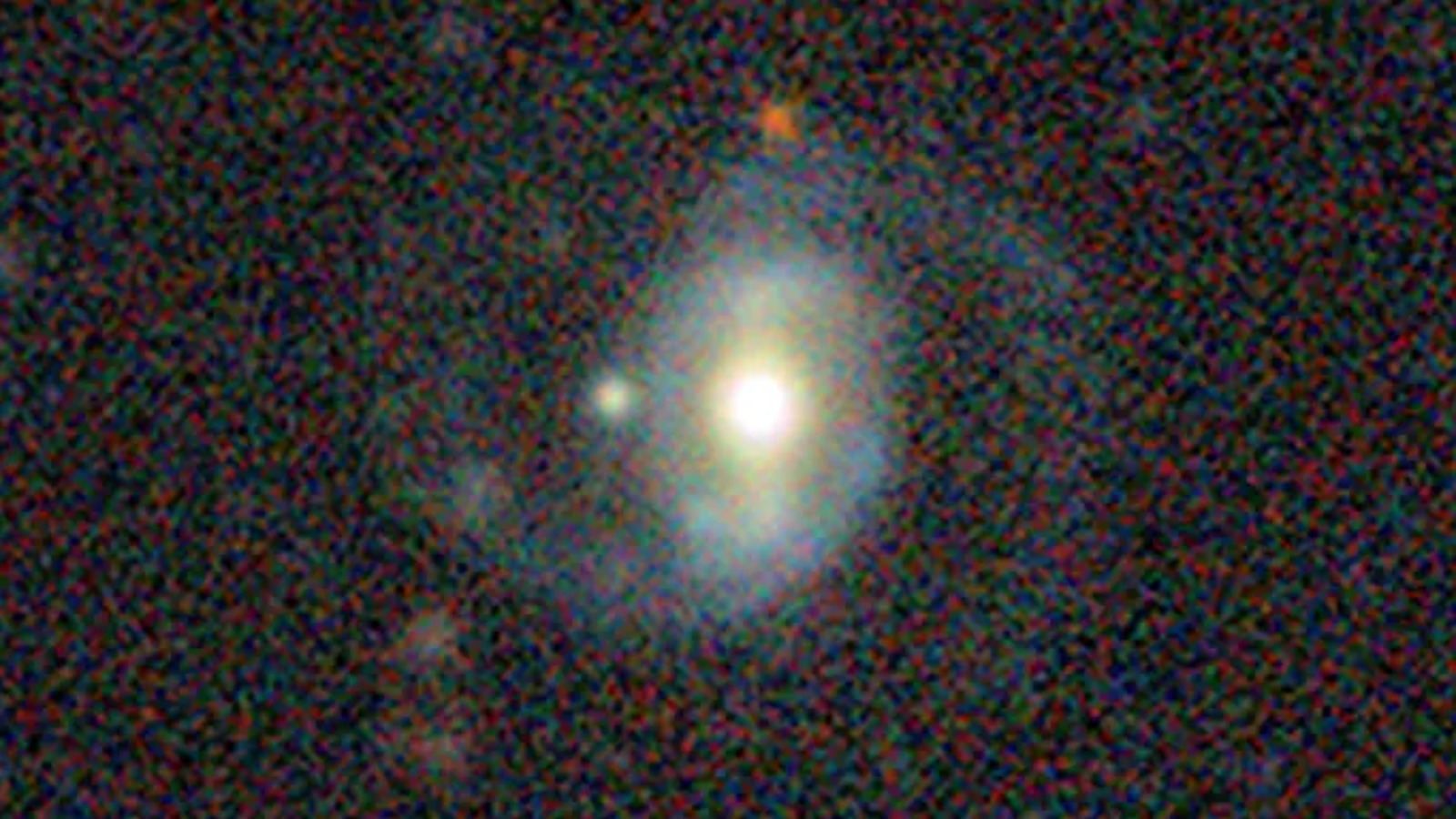
A blurry image of a blue blob on a black background.

The galaxy SDSS J110546.07+145202.4 is so close to Earth that its shape, with its two spiral arms, can be clearly seen in images. (Image credit: DESI Legacy Survey)

The source of this electromagnetic radiation is situated at the heart of SDSS J110546.07+145202.4, right by its central supermassive black hole. The team thinks the brightening of this galaxy began because the rate of matter falling into its supermassive black hole had increased, triggering the generation of plasma jets.

The increase in mass consumption of the supermassive black hole is leading to a level of growth that hasn't been seen in black holes outside of the early universe before. That means that SDSS J110546.07+145202.4 and its feasting supermassive black hole are set to be prime targets for astronomical investigations for some time to come, especially as proxies for ravenous black holes and rapidly growing early galaxies.

"With sensitive facilities like the incoming SKA telescopes, we'll be able to identify similar radio transients in future sky surveys," Komossa said. "This is crucial for filling the gaps in our understanding of the early universe."

The team's research was published in May in The Astrophysical Journal.

  •  

A Wandering Supermassive Black Hole Eating a Star

disk of hot gas swirling around a black hole

Editor’s Note: Astrobites is a graduate-student-run organization that digests astrophysical literature for undergraduate students. As part of the partnership between the AAS and astrobites, we occasionally repost astrobites content here at AAS Nova. We hope you enjoy this post from astrobites; the original can be viewed at astrobites.org.

Title: The Wandering Supermassive Black Hole Powering the Off-Nuclear Tidal Disruption Event AT2024tvd
Authors: M. Guolo et al.
First Author’s Institution: Johns Hopkins University
Status: Published in ApJL

A Star Gets Eaten in the Wrong Neighborhood

We find supermassive black holes at the centers of most large galaxies. They end up there because of how galaxies form: as matter collapses and merges over time, material sinks to the gravitational center, and the black hole settles in.

So, what happens when we catch a star being ripped apart by a supermassive black hole that is not at the center of its galaxy?

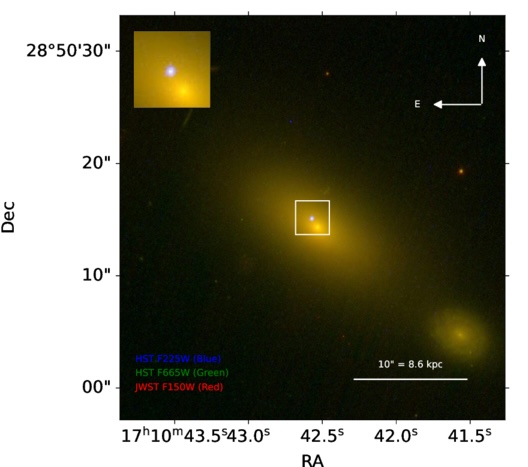
That is exactly the puzzle posed by AT2024tvd, a tidal disruption event (TDE) spotted roughly 2,600 light-years from the center of a massive galaxy located 600 million light-years away from us (see Figure 1).

AT2024tvd from Hubble and JWST

Figure 1: A color image of AT2024tvd from the Hubble Space Telescope and JWST. The yellow dot inside the square marks the galaxy’s center, while the TDE is the white dot, which is visibly offset to the upper left, about 2,600 light-years away. [Adapted from Guolo et al. 2026]

We see TDEs when a black hole tears apart a star that gets too close to it. It happens because the black hole’s gravity pulls harder on the near side of the star than the far side, stretching the star until it comes apart. The stellar debris then forms a hot accretion disk, a ring of material swirling around the black hole that spirals inward and releases a burst of electromagnetic energy across many wavelengths — from visible light to X-rays. These events are valuable to astronomers because they briefly light up black holes that would otherwise be invisible, giving us a rare window to measure their properties. Since supermassive black holes live at galactic centers, that is also where we expect TDEs to happen, which makes a TDE found away from a galactic center rare and puzzling. The galactic center is often called the nucleus of a galaxy, so astronomers refer to these displaced events as “off-nuclear” TDEs. AT2024tvd is only the third known off-nuclear TDE, and this research article makes a strong case that it is the most remarkable one yet.

Measuring Mass Using Light

To figure out the mass of the black hole responsible for AT2024tvd, the authors needed to get creative. You cannot weigh a black hole directly, so astronomers have to work backward from what they can see. The key idea is that a black hole’s mass controls how its accretion disk behaves. A more massive black hole produces a larger, cooler disk, while a less massive one produces a smaller, hotter disk. By measuring how bright the disk is at different wavelengths and how hot it gets, you can figure out how massive the black hole must be.

The authors did this by modeling the light the event produced across many wavelengths. They combined data from several telescopes: the Zwicky Transient Facility, the Neil Gehrels Swift Observatory, Pan-STARRS, and two rounds of high-quality X-ray data from XMM-Newton. TDE light curves go through different phases. The early flare in visible and ultraviolet light is bright but complicated, and the physical processes behind it are not fully understood. But after a few hundred days, TDEs settle into a quieter “plateau phase,” where the ultraviolet and visible light come directly from the accretion disk. At this stage, the emission follows well-understood physics, and astronomers can model it reliably.

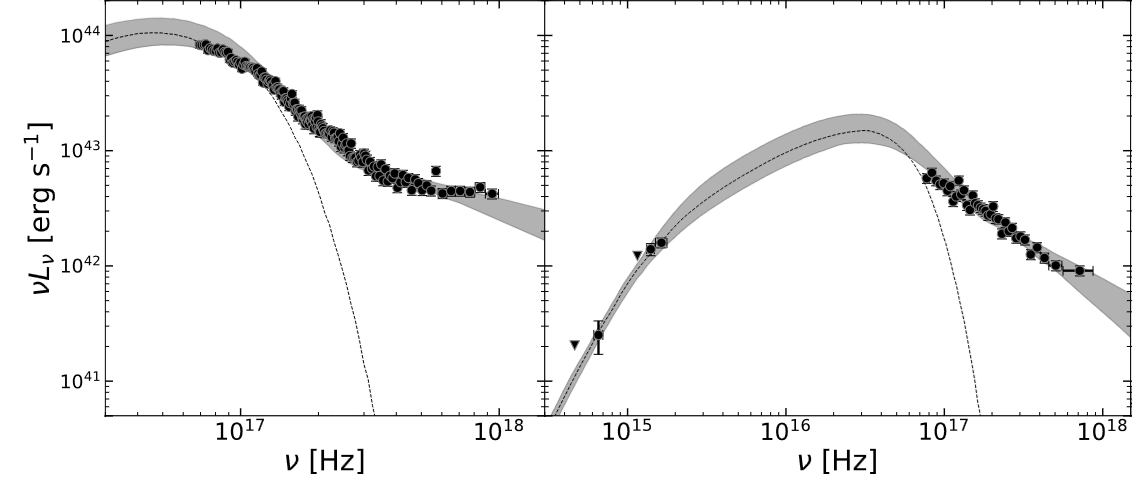
The authors used a model called kerrSED, which describes the spectral energy distribution (SED) of a spinning black hole’s accretion disk (kerr). It accounts for the disk’s temperature, its physical size, the black hole’s spin (how fast it rotates), and the angle at which we are viewing the system. It also accounts for a process called Comptonization, where hot electrons near the black hole boost lower-energy photons (particles of light) up to X-ray energies. By fitting this model to the observed light at multiple wavelengths simultaneously, the authors could pin down the disk properties and extract the black hole mass. The result was a clean fit: the disk model alone could explain all the observed light during the plateau phase, with nothing significant left over (see Figure 2).

brightness evolution of AT2024tvd

Figure 2: The brightness of AT2024tvd measured across a wide range of wavelengths, after correcting for absorption and the galaxy’s motion. The symbols show individual measurements from different telescopes, while the shaded contours represent the best-fit disk model and its uncertainty. Left: The early X-ray data, which is well explained by emission from the hot inner accretion disk. Right: The later data covering both visible/ultraviolet light and X-rays, all consistently explained by the same disk model. [Adapted from Guolo et al. 2026]

Not an Intermediate, but a Supermassive Black Hole

From their fit, the authors found a black hole mass of about one million solar masses. Black holes above about 100,000 solar masses are considered supermassive, while those below that threshold but above about 100 solar masses are called intermediate-mass black holes. So, this puts AT2024tvd in the supermassive category. This matters because the two previously known off-nuclear TDEs, called 3XMM J2150-05 and EP240222a, were both powered by intermediate-mass black holes. Those black holes were found inside small, dense collections of stars called ultra-compact dwarf galaxies that were orbiting larger host galaxies.

AT2024tvd is different. When the authors looked at deep images of the location where the TDE happened, they found no star cluster or small galaxy there. Whatever group of stars once surrounded this black hole has been almost entirely pulled apart by the gravity of the much larger parent galaxy. The ratio of the black hole’s mass to the mass of any remaining stars around it is extreme: greater than 3%, which is far above what we normally see. This is the signature of a “wandering” supermassive black hole, one that was brought in during a past galaxy merger and has been slowly sinking toward the center of its new host ever since, losing its surrounding stars along the way.

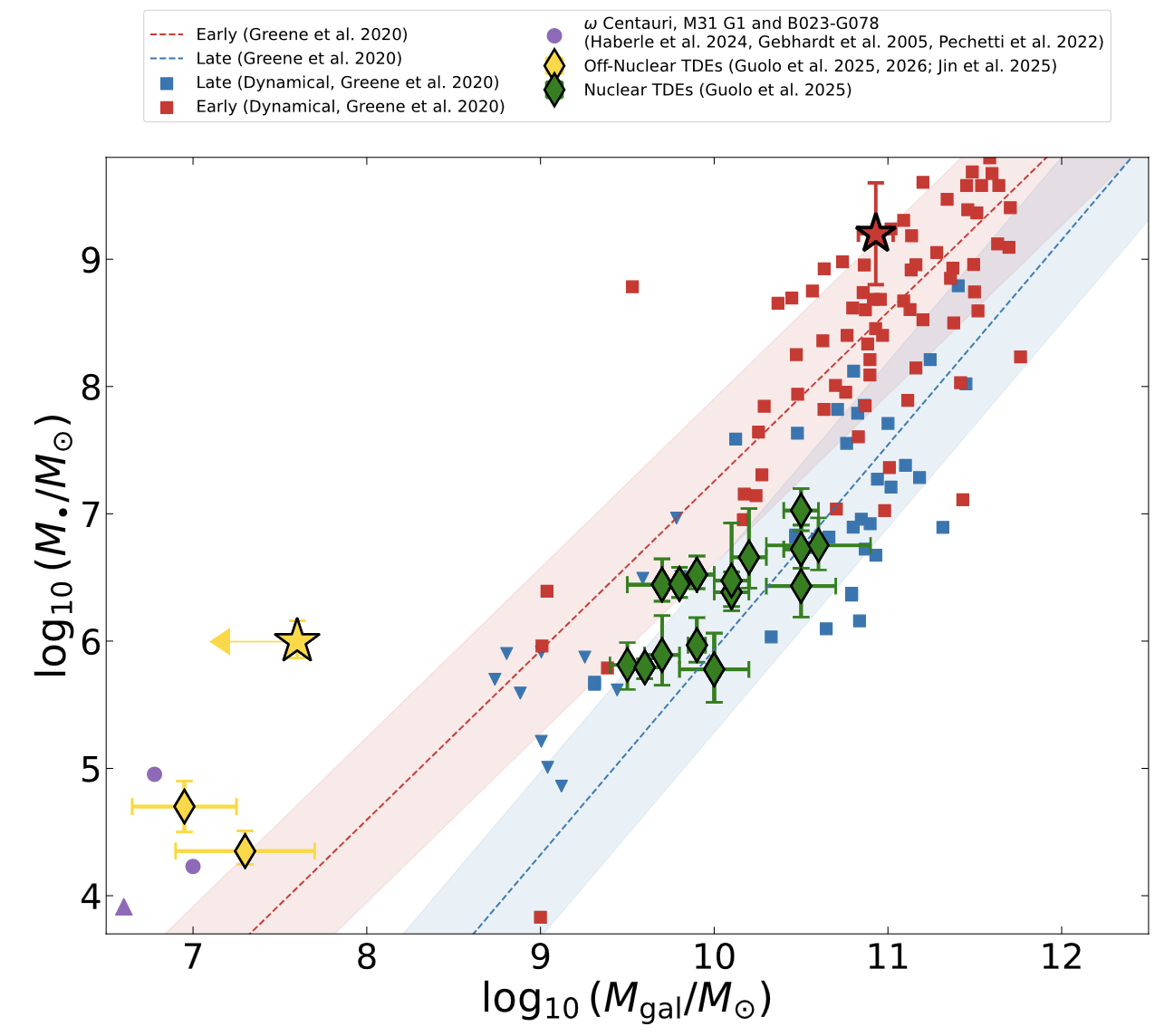
The authors compared AT2024tvd to other TDEs using established relationships between accretion disk properties and black hole mass (Figure 3). In terms of its disk temperature, luminosity, and inferred mass, AT2024tvd behaves like a typical nuclear TDE powered by a supermassive black hole. However, when placed on the black hole mass versus host stellar mass relation, it stands out as a strong outlier. The black hole mass is far too large for the small amount of surrounding stellar mass detected at its location.

plot of black hole mass versus host galaxy mass

Figure 3: AT2024tvd (yellow star) plotted on the relationship between black hole mass and host galaxy stellar mass. Red squares show nearby galaxies with dynamically measured black hole masses plotted against galaxy bulge stellar mass, while blue squares show the relation using total galaxy stellar mass. Purple points and green diamonds represent nuclear TDE host galaxies with black hole masses inferred from different TDE modeling techniques. Yellow diamonds mark the two previously known off-nuclear TDEs. AT2024tvd stands out as a clear outlier, with a very high black hole mass compared to the upper limit on any surrounding stellar mass. [Guolo et al. 2026]

The Big Picture

This discovery matters for several reasons. It shows that off-nuclear TDEs are not limited to intermediate-mass black holes sitting in small satellite galaxies. Some are powered by fully supermassive black holes that have been displaced from their original galactic centers. It also shows that TDE modeling, when done carefully during the plateau phase of the light curve (when the emission is dominated by well-understood accretion disk physics), can provide reliable black hole masses on its own, without assuming any relationship between the black hole and its host galaxy. This is particularly important for wandering black holes, where those relationships do not apply.

Looking ahead, upcoming surveys like Vera C. Rubin Observatory’s Legacy Survey of Space and Time are expected to find many more off-nuclear TDEs. Combined with X-ray follow-up from telescopes like XMM-Newton, these events could become our main tool for mapping out the population of displaced black holes in the nearby universe. One disrupted star at a time, we are starting to find black holes that theory told us should exist but that had, until now, stayed hidden.

Original astrobite edited by Kelsie Taylor and Veronika Dornan.

About the author, Serat Saad:

Serat is a first-year PhD student in astronomy at The Ohio State University. His research is on stellar and galactic dynamics, where he uses observational data to understand gravity. He also has interests in active galactic nuclei and tidal disruption events.

The post A Wandering Supermassive Black Hole Eating a Star appeared first on AAS Nova.

  •  

Euclid telescope discovers the 2 most ancient monster black holes in the universe ‪—‬ each brighter than a trillion suns

The European Space Agency's (ESA) Euclid space telescope has spotted 31 previously unknown quasars dating to the universe's earliest chapter, including the two oldest ever found.

The discoveries, described July 6 in the journal Astronomy & Astrophysics, more than double the number of known quasars from that primordial era and could help astronomers unravel one of cosmology's biggest mysteries: how supermassive black holes grew so enormous so quickly after the Big Bang.

"It's a big step towards understanding these fascinating objects on a more fundamental level," Antonio La Marca, an ESA research fellow on the Euclid team, said in a statement.

Quasars are among the brightest objects in the universe. They form when gas and dust spiral into a galaxy's central supermassive black hole, heating up and releasing enormous amounts of energy that can outshine the galaxy itself. Each of the two most ancient quasars detected in the new study shone with the light of a trillion suns, according to the researchers.

Euclid spotted the quasars while surveying the distant universe. Twelve of them have redshifts of 7 or higher, meaning their light has traveled for more than 13 billion years and dates to the universe's first 770 million years. Two of the objects, with redshifts of 7.77 and 7.69, are the most ancient quasars ever identified, shining just 670 million years after the Big Bang, when the universe was only about 5% of its current age.

"These early quasars date back to the Universe's infancy," Daming Yang, an astronomer at Leiden University in the Netherlands and first author of the new study, said in the statement. "By finding and studying them, we can better understand how these enormous systems formed and grew so quickly — one of the greatest mysteries in astrophysics."

Finding quasars from the early universe has long been difficult because they are rare and incredibly distant. Until now, astronomers had identified only the brightest examples, making it difficult to understand the broader population during this early era. Euclid's wide-field survey is changing that by detecting fainter quasars across huge swaths of the sky.

The latest discoveries represent only a fraction of what the telescope is expected to find during its six-year mission, which will cover more than one-third of the total sky once complete. Mounted with a pair of instruments that see in visible and near-infrared light, Euclid is currently assembling the largest-ever 3D map of the universe. Scientists expect the survey to uncover hundreds of similarly ancient quasars, providing an unprecedented look at how the universe's earliest galaxies and supermassive black holes evolved.

Euclid has also taken some time to study the nearby universe, revealing more than 60 million individual stars packed into the Milky Way's center in a sparkling image released in late June.

Black hole quiz: How supermassive is your knowledge of the universe?

  •  

'A new way to study the edge of a black hole': Physicists just got the closest-ever look at a black hole's event horizon

Scientists have found evidence that gravitational waves from a spectacular black hole collision carry signals from the very edge of the newly formed black hole. If confirmed by future observations, the discovery could provide an entirely new way to investigate what happens in the immediate vicinity of a black hole without ever observing it directly.

In a new study, the researchers analyzed an exceptionally strong gravitational wave event known as GW250114. They identified a "direct wave," a subtle feature of the total gravitational wave signal predicted by theory but never previously detected in real data. The signal appears to contain information from extremely close to the black hole's event horizon, the boundary beyond which nothing, not even light, can escape.

The findings, published June 24 in the journal Nature, suggest that gravitational wave observatories may eventually allow astronomers to probe regions that have remained inaccessible since black holes were first predicted by Albert Einstein's theory of general relativity.

Listening to the edge of a black hole

Although astronomers have photographed the glowing material surrounding some supermassive black holes and have detected dozens of black hole mergers through gravitational waves, the event horizon itself has remained frustratingly difficult to study.

Unlike ordinary light, gravitational waves are tiny ripples in space-time produced when massive objects accelerate. They pass almost undisturbed through the universe, carrying information about violent cosmic events that would otherwise remain hidden.

According to study co-author Sizheng Ma, a postdoctoral researcher at the Perimeter Institute for Theoretical Physics in Canada, the newly identified signal offers a rare glimpse of what happens immediately after two black holes collide.

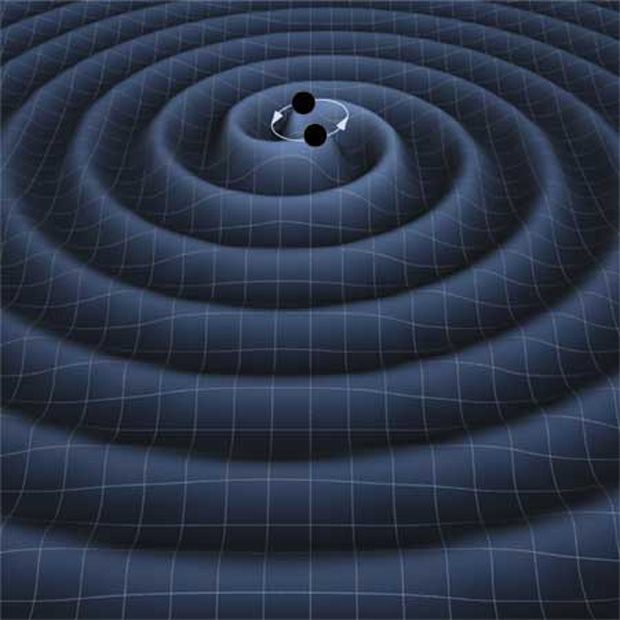
Two Black Holes Circling

When two black holes merge, they release gravitational waves — ripples in the fabric of space time — throughout the universe. Studying these waves can provide information about the newly formed black hole. (Image credit: K. Thorne (Caltech) and T. Carnahan (NASA GSFC))

"When two black holes merge, they violently shake space-time itself," Ma told Live Science. "For a brief moment, the region very close to the newly formed black hole's horizon is swept into a fast, fading swirl."

Ma explained that the direct wave is the portion of the gravitational wave signal produced near the horizon and carries the imprint of that motion outward through space.

"That is why it is so interesting," he said. "It may let us 'listen' to what happens near the horizon, a region we cannot see directly with light."

A remarkable black hole collision

The team focused on GW250114, a black hole merger detected on Jan. 14, 2025, by the two Laser Interferometer Gravitational-Wave Observatory (LIGO) detectors in Hanford, Washington, and Livingston, Louisiana.

"Our earlier theoretical work predicted that black hole mergers should produce a direct-wave signal from the near-horizon region," Ma said. "The big question was whether this effect could actually be seen in real data."

GW250114 turned out to provide exactly the conditions needed to test that prediction.

"It was strong enough, clean enough, and close enough to the theoretical situation where this signal should be visible," he said.

To search for the elusive feature, the researchers first removed the best-understood part of the gravitational wave signal, which comes from the newly formed black hole settling down after the merger. Then, they examined the remaining data to determine whether it consisted only of detector noise or contained another physical signal.

"What we found was striking," Ma said. "The remaining signal followed the expected rhythm and fading pattern of a wave shaped by the region very close to the final black hole's horizon."

The team concluded that the leftover signal matches the behavior expected for a direct wave predicted by previous theoretical studies.

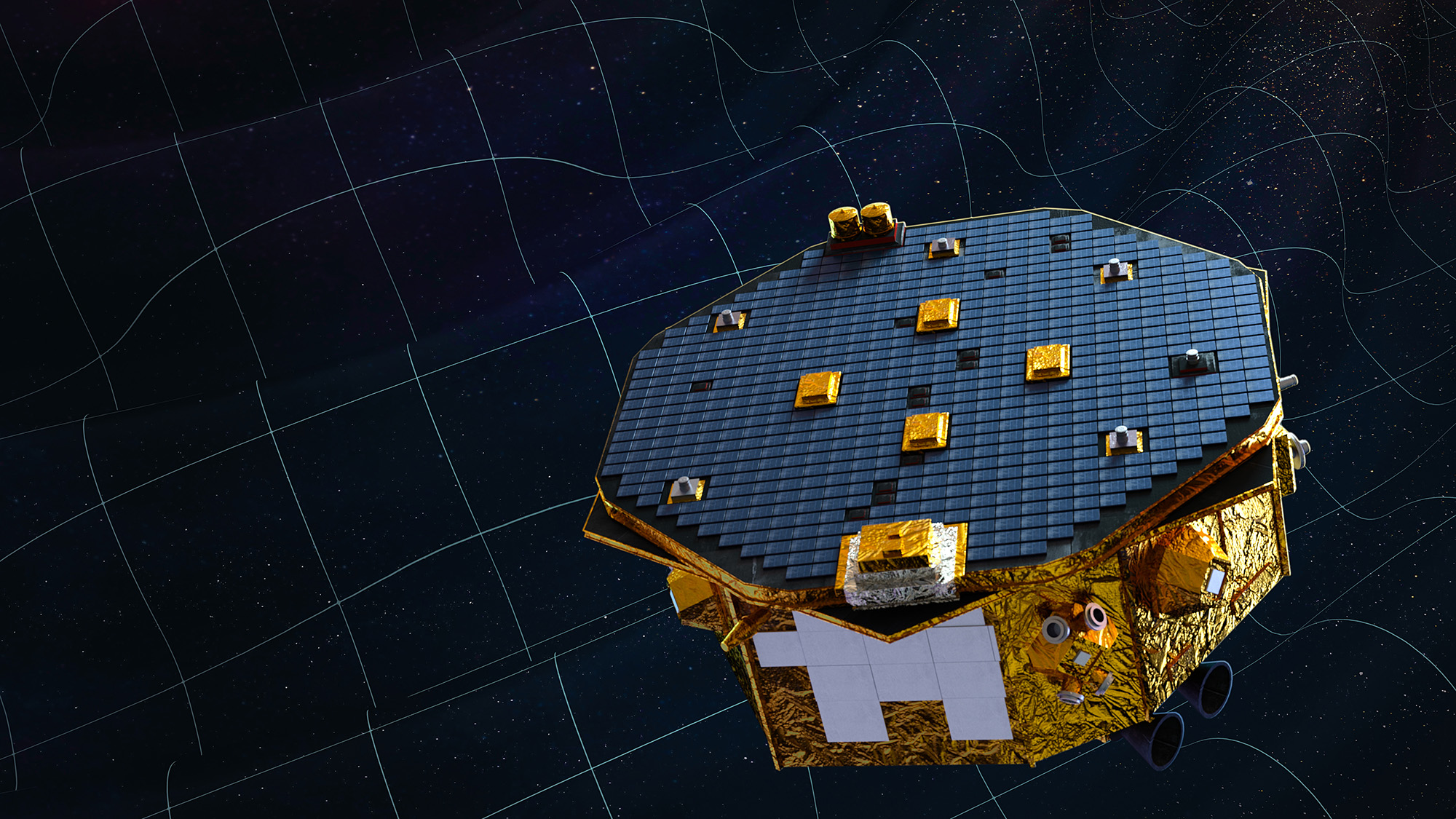
An illustration of a gold space probe with a flat top full of solar panels in front of wavy grid marks

ESA's upcoming LISA mission will detect gravitational waves from space, offering even more insights into the mysterious ripples than Earth-based detectors currently can. (Image credit: All About Space/Getty Images)

A new way to explore extreme gravity

The researchers stressed that their findings do not reveal what lies inside a black hole. Instead, they're providing a new observational tool for investigating the region immediately outside the event horizon.

"The gravitational wave data appear to carry an imprint from very close to the newly formed black hole's horizon — the famous point of no return," Ma said.

He explained that the measurements are consistent with space-time near the horizon being rapidly dragged around by the spinning black hole while the signal fades because of the intense gravitational field.

"For us, the exciting message is that gravitational waves may be giving us a new way to study the edge of a black hole using real observational data," Ma said.

Ma believes the method could eventually become useful for exploring ideas such as quantum gravity — which seeks to unite Einstein's theory of gravity with quantum mechanics — or the black hole information paradox, the longstanding puzzle of whether information that falls into a black hole is truly lost. However, it cannot test those questions directly yet.

"If quantum effects, or any deviations from the standard black-hole picture, leave a measurable imprint there, then direct waves could, in principle, help us search for them in the future," he said.

More observations will be needed

The researchers cautioned that the discovery is based on a single gravitational wave event. While GW250114 provided exceptionally favorable conditions, much stronger evidence will come only if similar signals are found in many additional black hole mergers.

"There are two main directions," Ma said. "The first is theory."

Current models capture the essential physics but remain simplified, and more realistic descriptions of black hole mergers will be needed.

"The second is observation," he added. "This result comes from one exceptionally loud and clean event, so the strongest confirmation would come from seeing the same kind of pattern in other black hole mergers."

As gravitational wave observatories continue to improve and detect increasing numbers of mergers, researchers hope to determine whether direct waves are a universal feature of black hole collisions.

"If the pattern appears repeatedly in the way general relativity predicts," Ma said, "direct waves could become a new way to study black hole horizons or the regions very close to them, and to test Einstein's theory in one of the most extreme environments in the universe."

If future observations confirm the team's results, scientists may have gained something they have sought for decades: a direct observational window into the very edge of a black hole.

See how much you know about black holes with our black hole quiz!

  •  

Black Holes Reveal Their Seeds

Illustration of an active galactic nucleus

Editor’s Note: Astrobites is a graduate-student-run organization that digests astrophysical literature for undergraduate students. As part of the partnership between the AAS and astrobites, we occasionally repost astrobites content here at AAS Nova. We hope you enjoy this post from astrobites; the original can be viewed at astrobites.org.

Title: A GLIMPSE of Intermediate Mass Black Holes in the Epoch of Reionization: Witnessing the Descendants of Direct Collapse?
Authors: Qinyue Fei et al.
First Author’s Institution: University of Toronto
Status: Published in ApJ

In the late 2010s, astronomers were getting hints of something strange going on in the early universe. Using the most powerful telescopes on the ground, we were able to find black holes in the centers of some of the most distant galaxies. The light from these active galactic nuclei (AGNs) was emitted over 12 billion years ago, revealing conditions close to the beginning of cosmic time.

To an astronomer, that’s the mundane part. I’m only half joking — thousands of AGNs had already been identified in the previous half century. However, the most distant of these sources were startling because their central black holes appeared much more massive than expected. To be specific, we know how much mass black holes can start with, and we can write down equations to predict how quickly they should grow. The AGNs we observed seemed to violate these predictions. This raised some serious questions and was highlighted as a major point of inquiry to focus on going into the 2020s.

Then JWST launched, and the mystery grew deeper. No matter where we looked, enormous black holes kept cropping up in astonishing numbers. Astronomers who model the universe with equations and computer simulations have tried to explain these results, but this has been a serious challenge. Some researchers have broken the emergency glass and reached for a highly theoretical tool: the direct-collapse black hole. Unlike the normal pathway for forming black holes (the deaths of massive stars), this model suggests that an enormous cloud of gas could directly collapse into a black hole without forming a star at all. The resulting black holes could have as much mass as a hundred thousand Suns put together — orders of magnitude more than a “normal” black hole. Although this pathway can explain the presence of huge black holes so early in the universe’s history, we’ve never directly seen this happen, so for now it remains just a theoretical possibility.

However, if direct-collapse black holes were widespread at early times, there is one indirect signature we might be able to detect: a large population of intermediate-mass black holes with masses between a hundred thousand and a million times that of the Sun. If we can find such a population, we’ll have strong evidence for the direct-collapse model. Let’s go looking!

Intermediate Mass, Impossible Difficulty

Identifying intermediate-mass black holes requires a tricky combination of spectral resolution and sensitivity. Light from an object must be examined very finely in order to detect the telltale features of an intermediate-mass black hole. However, these sources are already quite faint, so spreading their emission this thin means that any potential signal is very likely to get lost in the noise.

The authors of today’s article use an unprecedented set of observations to leap over this hurdle and directly probe intermediate-mass black holes. They not only use the most sensitive spectroscopic instrument (NIRSpec) on the most powerful space telescope (JWST), but they take advantage of a phenomenon known as gravitational lensing.

According to Einstein’s general theory of relativity, gravity is the result of matter curving spacetime. Areas with more concentrated matter will experience stronger curvature. When an object traveling in a completely straight line moves through curved space, its path appears bent. This same effect happens to light. Intriguingly, a large concentration of matter can redirect diverging rays of light to a focus, acting like an enormous magnifying glass.

Astronomers take advantage of gravitational lensing by pointing telescopes at massive clusters of galaxies. The intense gravity of these regions can magnify sources in the background by tens or even hundreds of times. Galaxies that would be impossibly faint to see under normal conditions can thus be observed if they are strongly lensed, making this a powerful technique to examine otherwise hidden objects.

Putting Faint AGNs Under a Lens

The Galactic Legacy Infrared Mid-Plane Survey Extraordinaire (GLIMPSE) program took extremely powerful observations of a galaxy cluster called Abell S1063 using JWST. The long exposure time, combined with the lensing power of the cluster, allows extremely faint sources in the background to be seen in unprecedented detail. The researchers scoured the data to search for signs of active black hole growth in the observed galaxies. Specifically, they carefully studied the emission lines in the spectrum of each object.

Normally, emission lines appear narrow. However, gas surrounding a massive black hole circulates at rapid speeds. A phenomenon known as the Doppler effect then comes into play. This is the same effect responsible for the characteristic rise and fall in the pitch of a siren from an emergency vehicle passing by. Emission from gas moving toward our line of sight appears bluer than it otherwise would, and gas moving away from us appears redshifted. The net effect is that a single emission line is widened, and we see characteristic “broad wings.” The width of the emission line can be used to estimate the mass of the central black hole, where broader wings imply a more massive black hole.

The researchers uncover 10 AGNs that display broadened Balmer series lines. Strikingly, they estimate that these galaxies have central black holes with masses as low as 400,000 times that of the Sun. While that might sound like a lot, it’s practically nothing compared to the monstrous 100-million-solar-mass black holes that JWST consistently turns up in other studies. Detecting such lightweight black holes, pushing into the realm of intermediate-mass black holes, is only possible due to the incredible sensitivity of these observations.

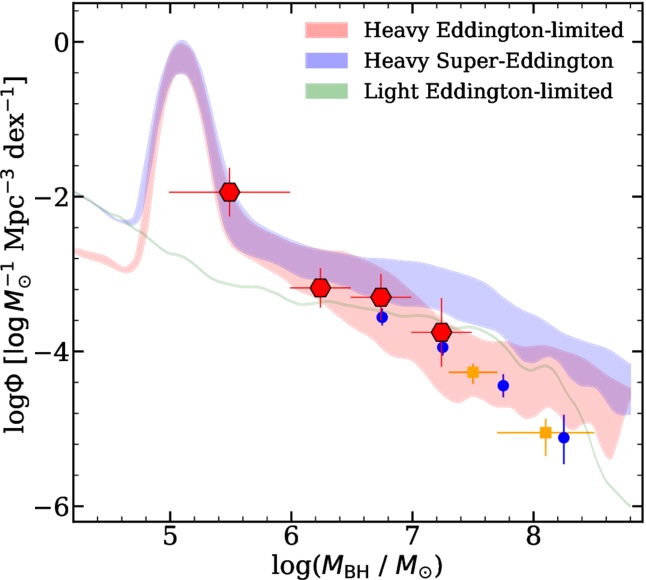
The researchers also compute what’s known as the black hole mass function. This is a measure of how many black holes exist at each mass. In other words, the black hole mass function measures how common lightweight black holes are compared to heavy ones. The mass function computed in this work and several other points of comparison are shown in Figure 1.

comparison of black hole mass functions

Figure 1: A comparison of black hole mass functions from various previous works and today’s article. The red hexagons are data points computed using the AGNs observed in this work, while blue circles and yellow squares are measurements computed using AGNs observed in previous articles. The red, green, and blue shaded areas represent the expected black hole mass function from various theoretical models. [Adapted from Fei et al. 2026]

Because the AGNs analyzed in today’s article host central black holes with much lower masses than any that have been observed in the past (at this early time in the universe), the authors are able to probe a completely new region of the black hole mass function. As seen in Figure 1, the leftmost red hexagon (lowest-mass data point) deviates from the roughly straight line traced by the other data points. This suggests that there are substantially more black holes with a few hundred thousand solar masses than previously expected.

Amazingly, this is exactly the measurement you would get if direct-collapse black holes (the hypothetical kind of massive black holes mentioned earlier in this article) were common in the early universe. If you scatter huge seeds across a large field, then you shouldn’t be surprised to see a sea of barely larger plants a few months later. Likewise, since these black holes start off so massive, they only need to grow a tiny bit to reach the threshold of that first red hexagon.

So is this proof that the early universe was filled with direct-collapse black holes, with this study probing the tip of an astonishing iceberg? It’s too early to tell for sure. While this is certainly an exciting result that sheds light on a previously unexplored population of objects, one can only do so much with a sample size of 10. More follow-up observations will be needed to measure the black hole mass function more precisely. Still, it’s amazing to think how much has changed in just a few years. JWST continues to provide unprecedented insight into some of the most breathtaking questions in all of astronomy.

Original astrobite edited by Tori Bonidie.

About the author, Ansh Gupta:

I’m an astronomy graduate student at the University of Texas at Austin working with Steven Finkelstein. I use data from JWST to study the formation and growth of the first galaxies and black holes in the universe. In my spare time, I enjoy playing piano, reading, and making YouTube videos.

The post Black Holes Reveal Their Seeds appeared first on AAS Nova.

  •  

Active black holes are more common than we thought

Astronomers have created a comprehensive census of active galactic nuclei (AGN) — galaxies powered by a feeding central black hole. The new census, led by data pipeline developer Mugdha Polimera at the Center for Astrophysics | Harvard & Smithsonian, began while she was a graduate student at the University of North Carolina at Chapel Hill,Continue reading "Active black holes are more common than we thought"

The post Active black holes are more common than we thought appeared first on Astronomy Magazine.

  •  

This is how supermassive black holes feed themselves

How supermassive black holes (SMBH) in the center of galaxies accrete material, how they feedback into the surrounding region, and how they regulate these to influence the evolution of their galaxies are all hot topics in astronomical/astrophysical research. Astronomers are nearly certain that all large galaxies like the Milky Way have a SMBH, and detailed […]

The post This is how supermassive black holes feed themselves appeared first on Knowridge Science Report.

  •  

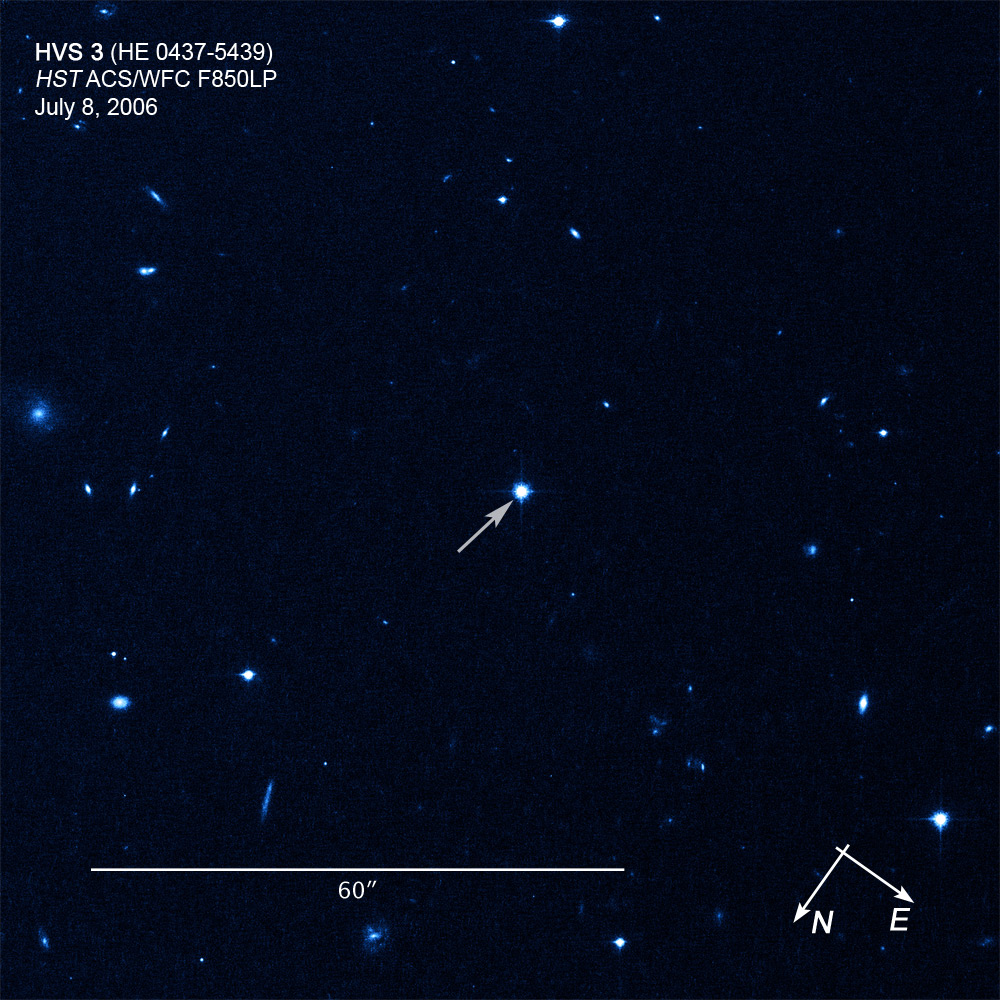
Shot from the Heart of the Milky Way: Discovery of an Old Hypervelocity Star

Hypervelocity stars in galaxy

Zooming through the galaxy faster than they should, hypervelocity stars are a curious population of stars whose origins are often difficult to determine. A recent study presents the first evidence of an old, low-mass hypervelocity star launched from the Milky Way’s center, providing clues into this elusive set of fast-moving stars.

Flinging Fast Stars

Astronomers have caught a number of hypervelocity stars zipping through the Milky Way since their first discovery in 2005. With speeds fast enough to escape the galaxy, hypervelocity stars were launched off course by some strong dynamical interaction. One such method, known as the Hills mechanism, predicts that when a binary star system approaches the Milky Way’s central supermassive black hole, one binary member is captured by the black hole and the other is flung away with high velocity.

However, constraining a hypervelocity star’s origin to the galactic center is limited by uncertainties in distances and proper motions, muddling how well researchers have been able to trace their orbits backward. Among a number of candidate galactic center–origin hypervelocity stars, only one has been confidently identified as having been kicked from the galaxy’s center. Intriguingly, this hypervelocity star and most galactic center–origin candidates are young, massive stars — old, low-mass hypervelocity stars from the galactic center have yet to be identified.

What does this dearth of old, low-mass zooming stars mean? Either stars in the galactic center are preferentially young and massive, with fewer than expected old and small stars, or low-mass hypervelocity stars are missed by selection effects, challenging to detect in current surveys. Searching for hypervelocity stars with higher precision and sensitivity may allow astronomers to tease out this missing population and trace back more zooming stars to a Hills mechanism origin.

Discovering An Old Hypervelocity Star

Leveraging high-quality spectra from the Dark Energy Spectroscopic Instrument (DESI) survey and precise astrometry from Gaia, Shunhong Deng (University of Chinese Academy of Sciences; China West Normal University) and collaborators reported the discovery of the hypervelocity star DESI-HVS1. From the spectroscopic and astrometric analyses, the authors determined that DESI-HSV1 is a ~14-billion-year-old low-metallicity star with a mass about 80% that of the Sun’s, moving through the galaxy at 523 km/s.

Backward orbit integration

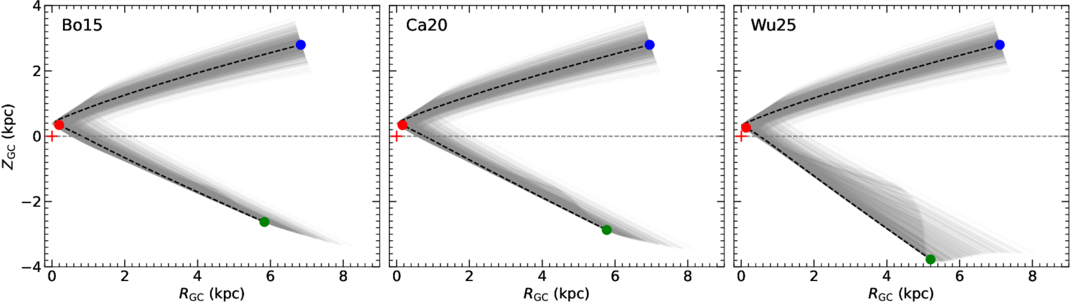
Backward-integrated orbits of DESI-HVS1 for three different galactic potential models. The blue, red, and green points show the star’s current position, closest approach to the galactic center, and position 50 million years ago, respectively. Click to enlarge. [Deng et al 2026]

Exploring the possible origins of this hypervelocity star, the authors integrated the star’s orbit backward in time for one billion years. The backward orbit integrations show the star approaching the galactic center where it then turns around, traveling away faster than the local escape velocity of the galaxy. Even when varying the galactic potential and constants, all orbit integrations suggest DESI-HVS1’s motion through the galaxy is most naturally explained by the Hills mechanism.

While more refined galaxy models and comparison to other candidate galactic center–origin hypervelocity stars are necessary to fully confirm its origins, DESI-HVS1 provides the first compelling evidence for an old, low-mass hypervelocity star candidate consistent with a galactic center launch. This suggests that the observed lack of such stars is likely not a reflection of the Milky Way’s central stellar population, but rather a consequence of observational constraints making such small hypervelocity stars particularly difficult to detect. As large spectroscopic and astrometric surveys continue to advance, the sample of galactic-center hypervelocity star candidates will grow, enabling further exploration of the stellar environment and dynamical processes at the Milky Way’s core.

Citation

“An Old, Low-mass, Metal-poor Hypervelocity Star Candidate Consistent with Galactic Center Origin,” Shunhong Deng et al 2026 ApJL 1003 L9. doi:10.3847/2041-8213/ae6505

The post Shot from the Heart of the Milky Way: Discovery of an Old Hypervelocity Star appeared first on AAS Nova.

  •  

NASA Webb Finds Strongest Evidence Yet for ‘Black Hole Stars’

 
7 Min Read

NASA Webb Finds Strongest Evidence Yet for ‘Black Hole Stars’

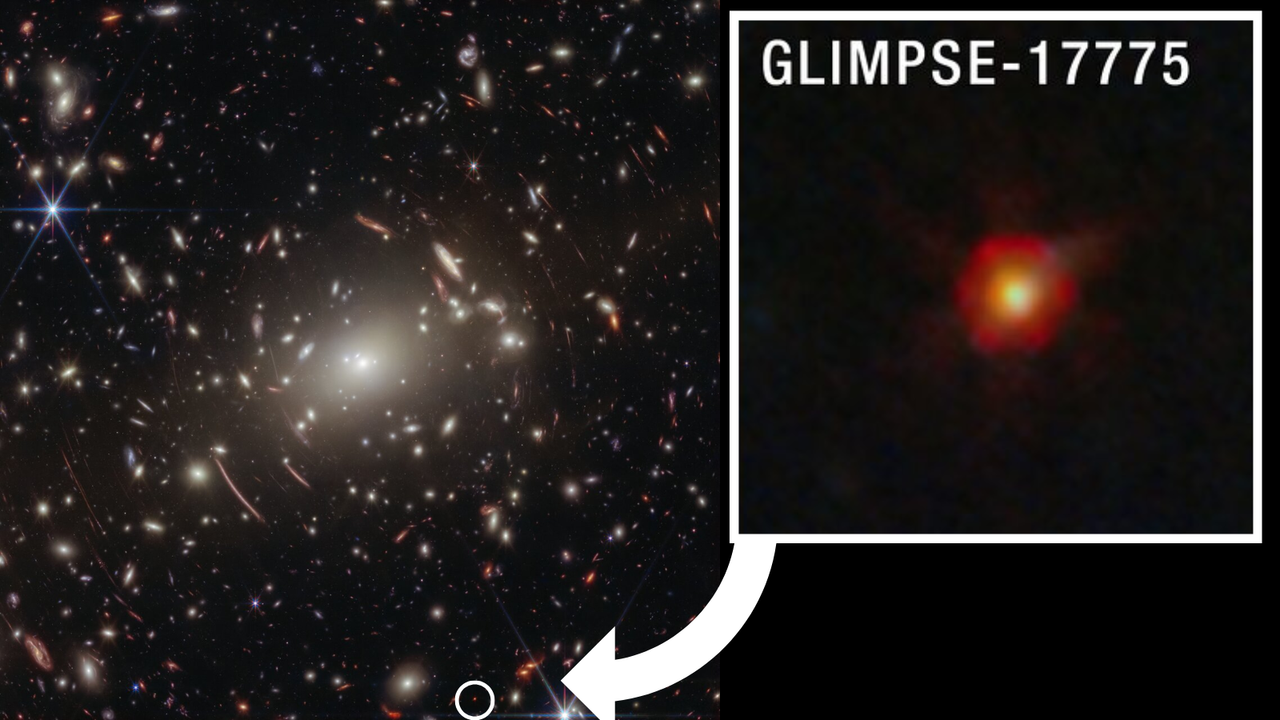
A field of galaxies against the black background of space. In the center is a bright-white elliptical galaxy that is the core of the Abell S1063 galaxy cluster. Around the core are short, curved red lines, which are distant background galaxies magnified and warped by gravitational lensing. A couple of foreground stars appear large and bright with Webb’s signature eight-point diffraction spike pattern. Toward the very bottom, slightly off center toward the right, is a small red dot that is highlighted by an orange square outline. A larger orange square in the top right corner shows the object in more detail. The object, labeled “GLIMPSE-17775” looks like a fuzzy red dot with a yellow core.
While the primary purpose of NASA’s James Webb Space Telescope’s observations of galaxy cluster Abell S1063 was to look for a certain population of stars, scientists obtained a detailed spectrum of GLIMPSE-17775 from the dataset. This little red dot is located behind Abell S1063.
Credits:
Image: NASA, ESA, CSA, Vasily Kokorev (UT Austin); Image Processing: Alyssa Pagan (STScI)

The complex puzzle known as little red dots has become more complete since their initial discovery by NASA’s James Webb Space Telescope in 2022. Now a particular little red dot’s spectrum is helping connect many of the pieces.

A team of astronomers led by Vasily Kokorev at the University of Texas at Austin identified the lucky dot in question: GLIMPSE-17775. By carefully analyzing the dot’s spectrum captured by Webb — the deepest spectrum to date of a little red dot — the research team has identified multiple lines of evidence, all of which support the interpretation that GLIMPSE-17775 is a supermassive black hole enveloped in a dense cocoon of partially ionized gas, a model referred to as the BH* (black hole star) scenario. A paper describing the results was published today in The Astrophysical Journal.

“I think part of the scientific community is converging on a singular picture — that little red dots can be explained by black hole star models. But none of the previous little red dots have all of the pieces of evidence in the same place,” said Kokorev, lead author of the study. “With GLIMPSE-17775 we can test these models because of how deep and amazing this source’s spectrum is.”

Image: Abell S1063 with Pullout of GLIMPSE-17775 (NIRCam Image)

A field of galaxies against the black background of space. In the center is a bright-white elliptical galaxy that is the core of the Abell S1063 galaxy cluster. Around the core are short, curved red lines, which are distant background galaxies magnified and warped by gravitational lensing. A couple of foreground stars appear large and bright with Webbu2019s signature eight-point diffraction spike pattern. Toward the very bottom, slightly off center toward the right, is a small red dot that is highlighted by an orange square outline. A larger orange square in the top right corner shows the object in more detail. The object, labeled u201cGLIMPSE-17775u201d looks like a fuzzy red dot with a yellow core.
While the primary purpose of NASA’s James Webb Space Telescope’s observations of galaxy cluster Abell S1063 was to look for a certain population of stars, scientists obtained a detailed spectrum of GLIMPSE-17775 from the dataset. This little red dot is located behind Abell S1063.
Image: NASA, ESA, CSA, Vasily Kokorev (UT Austin); Image Processing: Alyssa Pagan (STScI)

Connecting puzzle pieces

Soon after Webb first began science operations, it discovered a new, mysterious type of object in the very early universe – abundant red objects that emerged about 600 million years after the big bang. Scientists have explored multiple explanations for these little red dots, including the black hole star scenario.

A set of fortunate circumstances brought about this new, elaborate spectrum of a little red dot. The little red dot that would come to be known as GLIMPSE-17775 was fortunately included in Webb’s imaging and spectroscopy efforts for a project that sought to look for Population III stars and faint galaxies in galaxy cluster Abell S1063. This little red dot is more distant than the galaxy cluster and magnified by gravitational lensing. (GLIMPSE-17775 has a cosmological redshift of 3.5, meaning it existed about 1.8 billion years after the big bang.)

While Webb provided a 30-hour spectrum of the little red dot, the effect of gravitational lensing made it equivalent to 80 hours of telescope time. This combination of Webb’s infrared sensitivity and nature’s own “magnifying glass” amplified the amount of detail that could be gleaned from GLIMPSE-17775. The result was more than 40 spectral lines from this small, red source, which is the most detailed little red dot spectrum to date.

“When we saw the spectrum for the first time, it was like having all the pieces of a puzzle scattered on the floor,” said Kokorev. “We picked up each piece of the puzzle, measured the lines, and started combining the different pieces into a mosaic. Maybe a few pieces looked like nothing at first, but then a couple of them came together, and we realized that there was something there.”

The spectroscopic data collected by Webb contains multiple lines of evidence that support the interpretation that little red dot GLIMPSE-17775 is a black hole star: a rapidly accreting, or growing, black hole enveloped in a dense gas cocoon, which is reprocessing the light emitted from near the black hole and producing the features seen in the spectrum.

Image: Evidence of a ‘Black Hole Star’

Graphic titled “GLIMPSE-17775, Evidence of a ‘Black Hole Star, NIRSpec, Multi-Object Spectroscopy’” shows a graph of amount of light blocked on the y-axis versus wavelength of light, microns. The bottom of the y-axis is labeled “fainter,” and the top is labeled “brighter.” The x-axis starts with 2.80 microns at left and continues in increments of five, ending with 3.05 microns at right. A key at top left has a white line labeled “Data” and a small blue square labeled “Model of light scattered through hot dense gas.” The white data line is stepped with a large bell-like curve that peaks at 2.95 microns. It is labeled “hydrogen” and highlighted by a semi-transparent purple. The data also forms small peaks highlighted with different colors: around 2.84 microns, oxygen, green; 3.0 microns, helium, red; and 3.02 microns, sulfur, orange. The blue filling, representing the model, approximately fills the bell-like curve that marks hydrogen. A smaller peak of blue also approximately fills the data’s peak of helium.
NASA’s James Webb Space Telescope captured the deepest spectrum to date of a little red dot. More than 40 spectral lines have been discerned from the data, many of which independently support the theory that GLIMPSE-17775 is a black hole enshrouded by a hot, dense gas cocoon.
Illustration: NASA, ESA, CSA, Vasily Kokorev (UT Austin); Designer: Leah Hustak (STScI)

Lines of evidence

Among the 40-plus lines that the team detected in GLIMPSE-17775’s spectrum were various independent indicators that all align with the BH* scenario. For example, the team found that many of the spectral lines, such as hydrogen, oxygen, and helium, do not fit a simple model of a rotating gas cloud. Instead, the best fit model includes a broadening effect known as electron scattering, a telltale sign that a dense, layered gas cocoon is enshrouding this source. 

The strength and ratios of certain lines to each other, most notably the 16 iron lines that compose what the team has dubbed an “iron forest” and certain oxygen lines, require a high-energy source to produce them, like a rapidly accreting black hole. Additionally, astronomers noted the fluorescence and absorption of helium in the spectrum, both of which individually suggest that there is a dense medium enveloping a powerful source.

The BH* scenario not only fits GLIMPSE-17775; it also accounts for why most little red dots are faint in X-rays, since any such emission is likely absorbed by the dense gas cocoon.

One missing element of the GLIMPSE-17775 puzzle piece is the part of the spectrum that would reveal what’s known as a Balmer break, or a strong dip in the emitted light that’s a signature characteristic of little red dots. To build a more comprehensive understanding of this little red dot, the team incorporated ancillary data from two observing programs that used NASA’s Hubble Space Telescope: the Frontier Fields and BUFFALO (Beyond Ultra-deep Frontier Fields And Legacy Observations) programs.

The Webb and Hubble data together help explain why the Balmer break is weaker than what typically is found in other little red dots: A giant host galaxy is surrounding GLIMPSE-17775. Although a little red dot’s host galaxy is not something that has been usually seen at such scale before, it isn’t inconsistent with the dense gas cocoon model. The black hole star model of little red dots attributes excess blue light to stars in the host galaxy.

When Webb first discovered little red dots, some researchers thought these objects had “broken cosmology,” unsure how galaxies could have grown so big so quickly in the early universe to account for all this light coming from their stars. However, the team believes the GLIMPSE-17775 puzzle piece fits nicely in the existing framework of the universe’s evolutionary history, because black hole masses don’t need to be as high in order to explain the broad emission lines.

“Everything fits, nothing is broken, and I think that makes the puzzle that is our universe even better,” said Kokorev. “Looking ahead, I’m eager to dive deeper and learn about what is powering the central engines of little red dots. While we think it’s a black hole, there are some other interesting theories being proposed, which is exciting. Maybe in a year or two, we’ll have the final answer to what powers these sources.” 

The James Webb Space Telescope is the world’s premier space science observatory. Webb is solving mysteries in our solar system, looking beyond to distant worlds around other stars, and probing the mysterious structures and origins of our universe and our place in it. Webb is an international program led by NASA with its partners, ESA (European Space Agency) and CSA (Canadian Space Agency).

To learn more about Webb, visit:

https://science.nasa.gov/webb

Downloads & Related Information

The following sections contain links to download this article’s images and videos in all available resolutions followed by related information links, media contacts, and if available, research paper and Spanish translation links.

Related Images & Videos

A field of galaxies against the black background of space. In the center is a bright-white elliptical galaxy that is the core of the Abell S1063 galaxy cluster. Around the core are short, curved red lines, which are distant background galaxies magnified and warped by gravitational lensing. A couple of foreground stars appear large and bright with Webbu2019s signature eight-point diffraction spike pattern. Toward the very bottom, slightly off center toward the right, is a small red dot that is highlighted by an orange square outline. A larger orange square in the top right corner shows the object in more detail. The object, labeled u201cGLIMPSE-17775u201d looks like a fuzzy red dot with a yellow core.

Abell S1063 with Pullout of GLIMPSE-17775 (NIRCam Image)

While the primary purpose of NASA’s James Webb Space Telescope’s observations of galaxy cluster Abell S1063 was to look for a certain population of stars, scientists obtained a detailed spectrum of GLIMPSE-17775 from the dataset. This little red dot is located behind Abell S1063.

Graphic titled u201cGLIMPSE-17775, Evidence of a u2018Black Hole Star, NIRSpec, Multi-Object Spectroscopyu2019u201d shows a graph of amount of light blocked on the y-axis versus wavelength of light, microns. The bottom of the y-axis is labeled u201cfainter,u201d and the top is labeled u201cbrighter.u201d The x-axis starts with 2.80 microns at left and continues in increments of five, ending with 3.05 microns at right. A key at top left has a white line labeled u201cDatau201d and a small blue square labeled u201cModel of light scattered through hot dense gas.u201d The white data line is stepped with a large bell-like curve that peaks at 2.95 microns. It is labeled u201chydrogenu201d and highlighted by a semi-transparent purple. The data also forms small peaks highlighted with different colors: around 2.84 microns, oxygen, green; 3.0 microns, helium, red; and 3.02 microns, sulfur, orange. The blue filling, representing the model, approximately fills the bell-like curve that marks hydrogen. A smaller peak of blue also approximately fills the datau2019s peak of helium.

Evidence of a ‘Black Hole Star’

NASA’s James Webb Space Telescope captured the deepest spectrum to date of a little red dot. More than 40 spectral lines have been discerned from the data, many of which independently support the theory that GLIMPSE-17775 is a black hole enshrouded by a hot, dense gas cocoon.

Related Links

Read more: Black Hole Basics

Explore more: ViewSpace | Black Holes: Searching for the unseen

Watch: NASA Black Hole Visualization Takes Viewers Beyond the Brink

Watch: What Webb Learns from Light

Explore more: NASA’s Universe of Learning: Black Hole Resources

Read more: NASA Connects Little Red Dots with Chandra, Webb

More Webb News

More Webb Images

Webb Science Themes

Webb Mission Page


Share

Details

Last Updated
Jun 11, 2026

Contact
Media

Laura Betz
NASA’s Goddard Space Flight Center
Greenbelt, Maryland
laura.e.betz@nasa.gov

Abigail Major
Space Telescope Science Institute
Baltimore, Maryland

Christine Pulliam
Space Telescope Science Institute
Baltimore, Maryland

  •  
❌