❌

Reading view

Astronomers Uncover Hidden Structures Surrounding Orion Nebula

Extended Orion nebula shell sampled by HI emission from the combined VLA and FAST observations (shown in red), HΞ± emission from the European Southern Observatory Digitized Sky Survey (shown in green), and 3.4-ΞΌm emission registered by the Wide-field Infrared Survey Explorer (WISE) satellite (shown in blue). Image credit: Juan D. Soler, University of Vienna / NRAO / VLA / NASA / WISE.

Using the Karl G. Jansky Very Large Array (VLA) s and the Five-hundred-meter Aperture Spherical Radio Telescope (FAST), astronomers have created the sharpest-ever radio maps of neutral hydrogen around the Orion Nebula.

The post Astronomers Uncover Hidden Structures Surrounding Orion Nebula appeared first on Sci.News: Breaking Science News.


  •  

Tiny 15-atom iridium clusters could supercharge green hydrogen production

Scientists have developed an extremely small and highly efficient catalyst that could improve the production of green hydrogen, one of the cleanest fuels being explored for the future. The international research team, led by scientists from Tohoku University, Tokyo University of Science, Vanderbilt University and the University of Adelaide, created tiny clusters made from only […]

The post Tiny 15-atom iridium clusters could supercharge green hydrogen production appeared first on Knowridge Science Report.

  •  

Green Hydrogen | Mythology Meets Reality

Fortescue Metals Group is scaling back its green hydrogen ambitions due to high electricity prices, reflecting challenges faced by companies like Woodside and Origin Energy. Despite job cuts and economic feasibility concerns, chairman Andrew Forrest persists in promoting green hydrogen, advocating for ambitious production goals, in spite of the underlying physics.

  •  

Webb Spots Supermassive Black Hole Older Than Its Home Galaxy

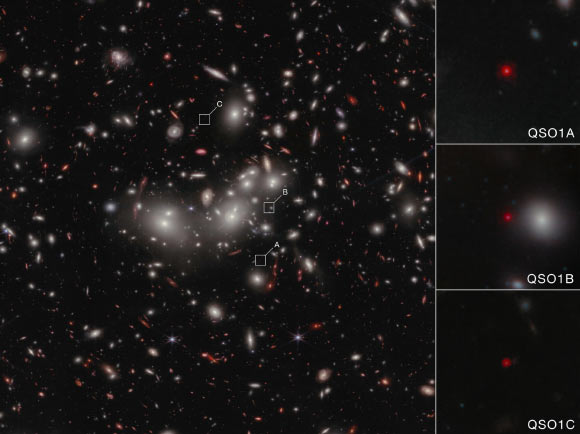
This Webb/NIRCam image shows the little red dot Abell2744-QSO1, magnified and triply imaged by galaxy cluster Abell 2744. Image credit: NASA / ESA / CSA / Lukas Furtak, Ben-Gurion University / Alyssa Pagan, STScI.

Astronomers using the NASA/ESA/CSA James Webb Space Telescope have found an enormous black hole in the early Universe that appears to predate its own host galaxy, raising fresh questions about how the cosmos’ first supermassive monsters were born.

The post Webb Spots Supermassive Black Hole Older Than Its Home Galaxy appeared first on Sci.News: Breaking Science News.

  •  
❌