❌

Reading view

July 16, 1850: Bond and Whipple photograph Vega

In 1839, the president of Harvard University invited William Bond to move into a house on campus and, by virtue of bringing along his own astronomical equipment, become the university’s first astronomer in residence. With public interest spurred by the 1835 passage of Halley’s Comet and the Comet of 1843, Harvard soon had enough moneyContinue reading "July 16, 1850: Bond and Whipple photograph Vega"

The post July 16, 1850: Bond and Whipple photograph Vega appeared first on Astronomy Magazine.

  •  

Scientists Achieve Most Precise Measurement Yet of Einstein’s Frame-Dragging Effect

In a major new confirmation of Einstein’s Theory of Relativity, the LARES-2 (Laser Relativity Satellite 2) has measured frame dragging around Earth with unprecedented precision.

Ignazio Ciufolini of China’s Wuhan Institute of Physics and Mathematics led the team behind a new paper published in Nature reporting the most precise measurement of the effect to date. The researchers reduced the uncertainty to just 0.2 percent, compared with several percent—and in some cases as much as 10 percent—in previous measurements.

Also known as the Lense-Thirring effect, named for the physicists who modeled it in 1918, frame dragging is the pull of a rotating mass on spacetime. The phenomenon was first predicted in Einstein’s Theory of Relativity.

Seeking Frame Dragging

Frame dragging becomes more pronounced around faster-spinning and more massive objects. For this reason, its effects are far stronger around black holes than around comparatively small bodies such as Earth. Some black holes possess millions or even billions of times the Sun’s mass, producing an immense distortion of the surrounding spacetime.

LARES-2, a satellite developed by the Italian Space Agency, made the new measurement possible. Its appearance has been compared to a golf ball or a disco ball, with its 303 corner-cube retroreflectors creating golf-ball-like divots on its surface, which is composed of a nickel-chromium alloy called Inconel 718.

The spacecraft is remarkably simple, with no thrusters, solar panels, or onboard electronics cluttering its compact, 16-inch-wide frame. Despite its small size, LARES-2 weighs roughly 650 pounds. This combination gives it the lowest area-to-mass ratio of any satellite in medium Earth orbit, minimizing the influence of nongravitational forces on its motion.

Measuring Frame Dragging

The effect of gravitation on the object was then measured by bombarding it with ground-based lasers, which the retroreflectors bounce back to the surface. Ciufolini’s team collected roughly 200,000 of these observations between July 2022 and June 2025, with one-millimeter precision, forming the dataset from which they calculated the frame-dragging effect.

The method presents a significant challenge, however. Earth is an oblate spheroid, with bulging sides created by centrifugal force, rather than a perfect sphere, which produces Newtonian forces that interfere with the frame-dragging signal. To mitigate this issue, the researchers used another satellite in a supplementary orbit, canceling out the effect of the opposing Newtonian forces.

That second satellite was NASA’s LAGEOS, launched in 1976. The orbital planes of LAGEOS and LARES-2 differ by 180.01 degrees—remarkably close to the ideal separation of 180 degrees.

A Final Challenge

One additional complication remained: the K1 lunisolar tide, a variation in Earth’s gravitational field produced by the combined influence of the Moon and Sun. Time provided the solution. Over the tide’s 1,050-day precession cycle, its effects average out and can be removed from the data.

After accounting for these sources of interference, the researchers measured a drift of 61.3 milliarcseconds per year in the satellites’ orbits caused by Earth’s frame dragging. The result closely matches the value predicted by general relativity, with only a narrow margin of uncertainty.

The researchers say the true value of their finding lies not just in confirming general relativity, but also in limiting the scope of the Chern-Simons theory, which seeks to reconcile general relativity with quantum mechanics for a Theory of Everything. Of more limited concern, the work also provided the most precise K1 tide measurement ever recorded, which could prove important to future Earth science research.

The paper, “LARES-2 Satellite Measures Frame-Dragging Effect Around the Earth,” appeared in Nature on July 8, 2026.

Ryan Whalen covers science and technology for The Debrief. He holds an MA in History and a Master of Library and Information Science with a certificate in Data Science. He can be contacted at ryan@thedebrief.org, and follow him on Twitter @mdntwvlf.

  •  

Is dark matter 'tuned in' to a hidden dimension?

Two major mysteries in science, the nature of dark matter and the possible existence of higher dimensions, could be linked, new research suggests. The team behind a new study proposes that dark matter may be so strange and ghost-like because it is in tune with a fifth dimension.

When scientists discuss "extra dimensions," they aren't talking about other universes in which another evil version of you exists (and with a beard). Instead, they refer to dimensions that could be "curled up" with reality alongside the standard four-dimensional spacetime, consisting of the three dimensions of space and one dimension of time.

While these extra dimensions remain highly speculative, they have become a hot topic, especially as string theory, the most popular extension to standard physics, relies upon the existence of at least 11 dimensions. Scientists are more sure that dark matter exists, but proving its existence still remains troubling because, despite its gravity literally holding galaxies together and outweighing ordinary matter by around five to one, it remains effectively invisible because it doesn't interact with light and it simply ghosts through ordinary matter.

"Understanding dark matter would represent a profound advance in humanity's knowledge of the cosmos and what it is made of," team member Yu-Dai Tsai of the University of Sheffield said in a statement.

"Our research gives physicists clear new targets in the search for dark matter, while connecting two of the biggest ideas in fundamental physics: the mystery of dark matter and the existence of hidden dimensions."

Dark photons play dark matter like a violin

Though the main idea is that dark matter may operate in the fifth dimension, this new research expands upon that concept with another theory. It suggests that dark matter exists with another inhabitant of the fifth dimension, a force-carrying particle called a "dark photon."

Standard photons are the constituent particles of electromagnetic radiation, or light; dark photons would be similar but for a hypothetical "dark force."

The team's new proposal would see the unique geometry of the fifth dimension causing the masses of dark matter particles to form an arrangement that gives rise to a "dark matter resonance." This is akin to the intense vibration of a musical instrument at certain notes.

"Dark matter resonance is already known to be a powerful idea, with the potential to change our understanding of how dark matter was produced in the early universe and how we search for it today," team member Yu-Dai Tsai of the University of Sheffield said in a statement. "But many previous resonant dark matter models have treated the resonance as an assumption. This work gives a possible deeper origin for it: the resonance may come directly from the geometry of hidden dimensions."

An illustration shows a cloud of dark matter slipping past a distant star

An illustration shows a cloud of dark matter slipping past a distant star (Image credit: Robert Lea (created with Canva))

Tsai explained that while dark matter resonance is a phenomenon that has been explored before, the research conducted by this team differs because it suggests dark matter resonance is not a coincidence. Instead, the possible deeper origin for the resonance sees it emerge directly from the geometry of hidden dimensions. This would allow dark matter to interact strongly shortly after the Big Bang while allowing it to settle into its ghost-like inert existence today.

"This resonance can make dark matter interactions much stronger at crucial epochs in cosmic history, such as in the early universe," Tsai added. "Crucially, the model allows for these strong interactions in the past while still explaining why dark matter appears so inert and hard to detect today."

Of course, it is very early days for the team's theory, but it excitingly offers a way toward solving two of the universe's greatest mysteries.

The team's research was published in the Physical Review D.

  •  

Twitter Turns 20: Two Decades of Memes, Movements and Hot Takes

The first tweets from the public appeared on July 15, 2006, several months after a soft launch. It was rebranded as X after being acquired by Elon Musk.
  •  

Astronomers Detect Gamma-Ray Burst’s Magnetic Fingerprint

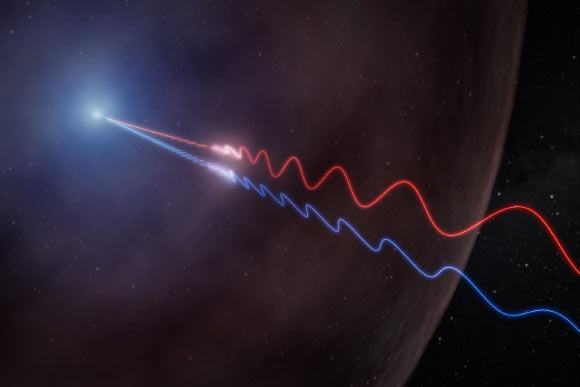
This illustration depicts Faraday rotation in the afterglow of a gamma-ray burst. A powerful jet (upper left) sends polarized radio waves outward through the thin wall of a surrounding bubble of magnetized gas called an HII region. As the light passes through this material, its polarization angle is twisted by the magnetic field. Because the effect is stronger at longer wavelengths, the red and blue waves, which represent different radio wavelengths, exit the bubble oscillating in different directions. By measuring this difference, astronomers were able to map the magnetic environment surrounding GRB 260310A for the first time. Image credit: NSF / AUI / NRAO / M. Weiss

Using NSF’s Very Large Array (VLA), astronomers made the first radio detection of polarized light and Faraday rotation from a gamma-ray burst afterglow, offering an unprecedented glimpse of the magnetic fields surrounding one of the Universe’s most powerful explosions.

The post Astronomers Detect Gamma-Ray Burst’s Magnetic Fingerprint appeared first on Sci.News: Breaking Science News.

  •  

Astronomers Discover and Directly Image Third Planet in Beta Pictoris System

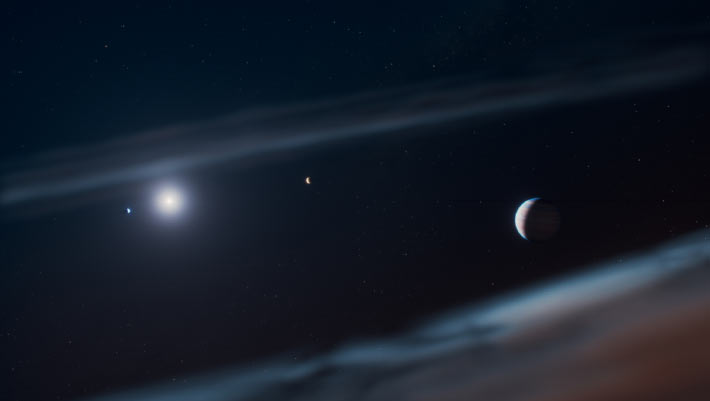
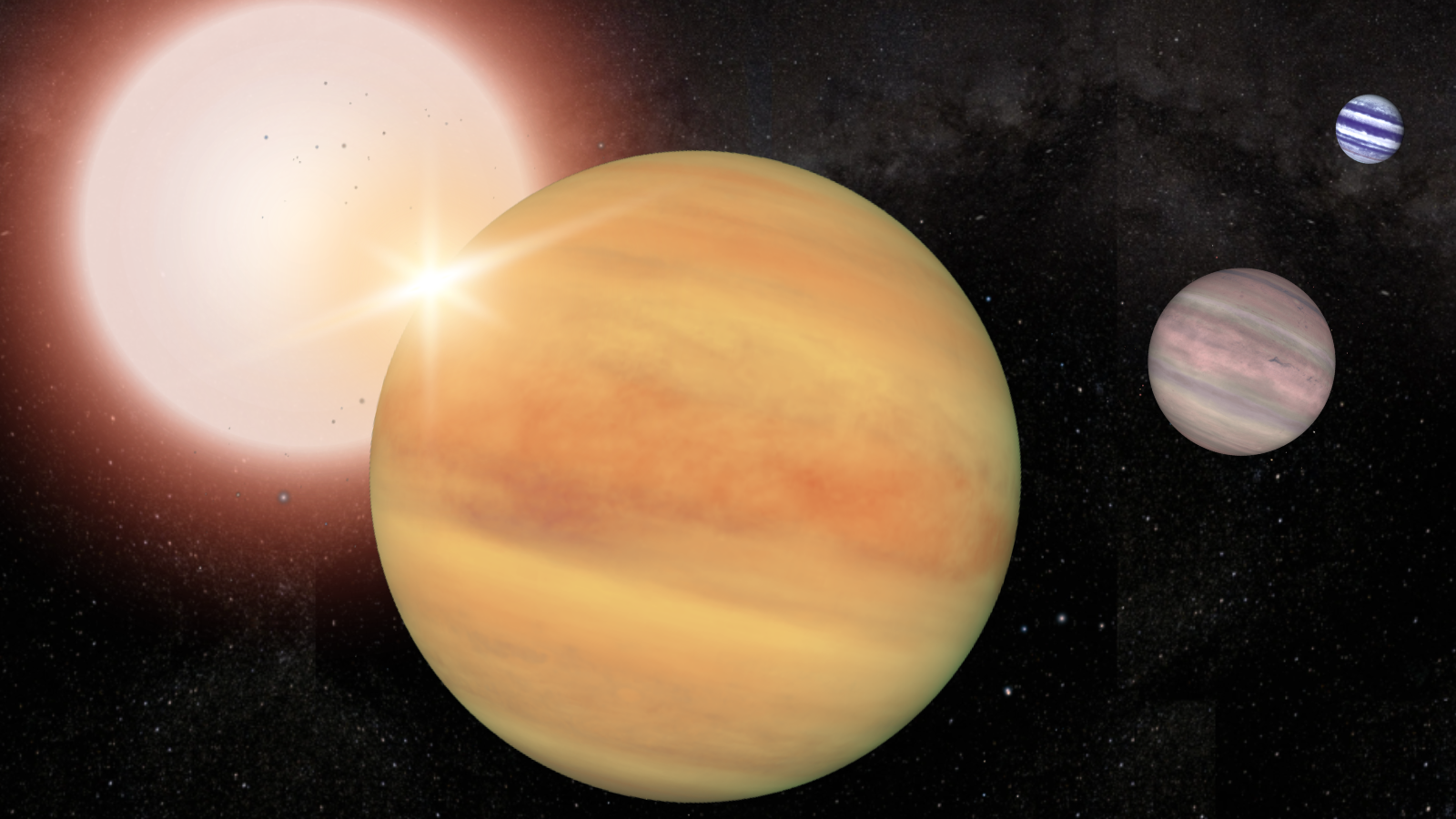
This artist’s concept shows the Beta Pictoris system with the discovered giant exoplanet Beta Pictoris d at the right. Image credit: NASA / ESA / CSA / STScI / Ralf Crawford, STScI.

Named Beta Pictoris d, the newly-discovered world is 100 times fainter than Beta Pictoris b -- the first planet discovered around the A5-type star Beta Pictoris -- and is among the lightest exoplanets ever to be imaged from the ground.

The post Astronomers Discover and Directly Image Third Planet in Beta Pictoris System appeared first on Sci.News: Breaking Science News.

  •  

Breakthrough Study Uncovers New Evidence Connecting “Hidden” Dimensions to Mystery of Dark Matter

New research is revealing possible links between one of the most enduring cosmic mysteries—dark matter—and the existence of a “hidden” fifth dimension.

Dark matter is widely believed to exist according to several leading cosmological theories, although this nonluminous material remains invisible through direct detection. However, its presence can be inferred through the gravitational influence this mysterious form of matter has on the surrounding universe.

Now, according to researchers at the University of Sheffield, one reason dark matter may have remained so elusive involves the possibility that it exists within a “hidden” dimension—a concept that has gained traction in past research.

The Sheffield team’s recent look at this possibility, detailed in a study published in Physical Review D, takes the concept one step further by introducing a new potential framework that could help reveal clues to the behavior of dark matter, as well as why astronomers have had such a hard time detecting it.

A Dark Secret Lurking in a Hidden Dimension?

In their new research, the Sheffield team says that dark matter may be lurking within a hidden dimension accompanied by dark photons, a variety of particles among those which physicists call “hidden sector particles,” and which are believed to represent potential force carriers for dark matter.

Due to the specific geometry present within this hidden dimension, a phenomenon known as dark matter resonance may occur, where dark photons align in specific arrangements.

“Dark matter resonance is already known to be a powerful idea,” according to Yu-Dai Tsai, Ph.D., a Royal Society Dorothy Hodgkin Senior Research Fellow at the University of Sheffield and one of the new paper’s coauthors.

Tsai adds that the concept has “the potential to change our understanding of how dark matter was produced in the early universe and how we search for it today,” although reconciling it with our current understanding of dark matter has presented issues for researchers in the past, which include questions about its specific origins.

“Many previous resonant dark matter models have treated the resonance as an assumption,” Tsai recently said in a statement. “[Our team’s] work gives a possible deeper origin for it: The resonance may come directly from the geometry of hidden dimensions.”

Unlocking Dark Matter Resonance

According to Tsai and his co-author, Taegyu Lee, understanding dark matter resonance more fully could hold significant implications for unlocking new clues about how matter behaved at early stages in our universe, and why that may differ significantly from what astrophysicists see occurring right now.

“This resonance can make dark matter interactions much stronger at crucial epochs in cosmic history,” Tsai says. “Crucially, the model allows for these strong interactions in the past while still explaining why dark matter appears so inert and hard to detect today.”

Although Tsai concedes that the concept of dark matter resonance has been explored in the past, unlike previous studies, the Sheffield duo’s new work suggests that dark matter may essentially be “in tune” with conditions in a hidden fifth dimension already, arising naturally from its innate mathematical structure.

Tsai says this approach toward understanding dark matter, if correct, “would represent a profound advance in humanity’s knowledge of the cosmos and what it is made of.”

A New Approach Toward Unraveling Dark Matter’s Mysteries 

Fundamentally, the team’s findings point to promising new ways physicists may be able to explore the underlying mysteries of both dark matter and the possibility of additional dimensions in which it may operate.

“Our research gives physicists clear new targets in the search for dark matter,” Tsai says, “while connecting two of the biggest ideas in fundamental physics: the mystery of dark matter and the existence of hidden dimensions.”

The recent study, “Naturally resonant dark matter from extra dimensions,” by Yu-Dai Tsai and Taegyu Lee, appeared in Physical Review D on July 8, 2026.

Micah Hanks is the Editor-in-Chief and Co-Founder of The Debrief. A longtime reporter on science, defense, and technology with a focus on space and astronomy, he can be reached at micah@thedebrief.org. Follow him on X @MicahHanks, and at micahhanks.com.

  •  

Meteorite that crashed through New Jersey house could hold the clues to life's origins

A space rock exploded through a bedroom ceiling in New Jersey, and scientists have now traced its origins to a strange, briny asteroid once visited by a NASA mission.

Two years ago on July 16, 2024 in the middle of the afternoon, a sonic boom shook New York City as a fireball streaked through the sky. The culprit? A rock the size of a heavy airline bag weighing roughly 110 pounds (50 kilograms). The meteorite hurtled over the east coast before crash-landing in a house in Hillsborough, New Jersey where the homeowner found it, reeking of sulfur. In studying this meteorite, scientists think that it could have come from the surface of an asteroid where liquid saltwater could have rested, possibly providing clues to life's origins on Earth.

"In a way, you can think of it as smelling the origins of life's atmosphere," lead author and meteor astronomer Peter Jenniskens of the SETI Institute and NASA’s Ames Research Center, told Space.com.

Despite its sulfuric stench, in a stroke of absolute luck, this meteorite crashed into the right house. After traveling through our atmosphere and heating up, searing through the sky and then crashing through a roof and then a bedroom ceiling, the meteorite broke apart into pieces. The homeowner not only sprung into action to collect these pieces of space rock into jars, they did so with gloves, protecting the rocks and keeping them remarkably well-preserved.

"He had the wherewithal to put on gloves and take out jars," Jenniskens said. "And for this type of meteorite, carbonaceous chondroits, it's very important because they just suck in every moisture you can think [of]." So if he would've handled the rocks with his bare hands, oils or moisture from his hands could have completely contaminated the rock, which is common in found meteorites. The homeowner also thought to call the American Meteor Society very quickly after recovering the rocks, making these samples unusually pristine.

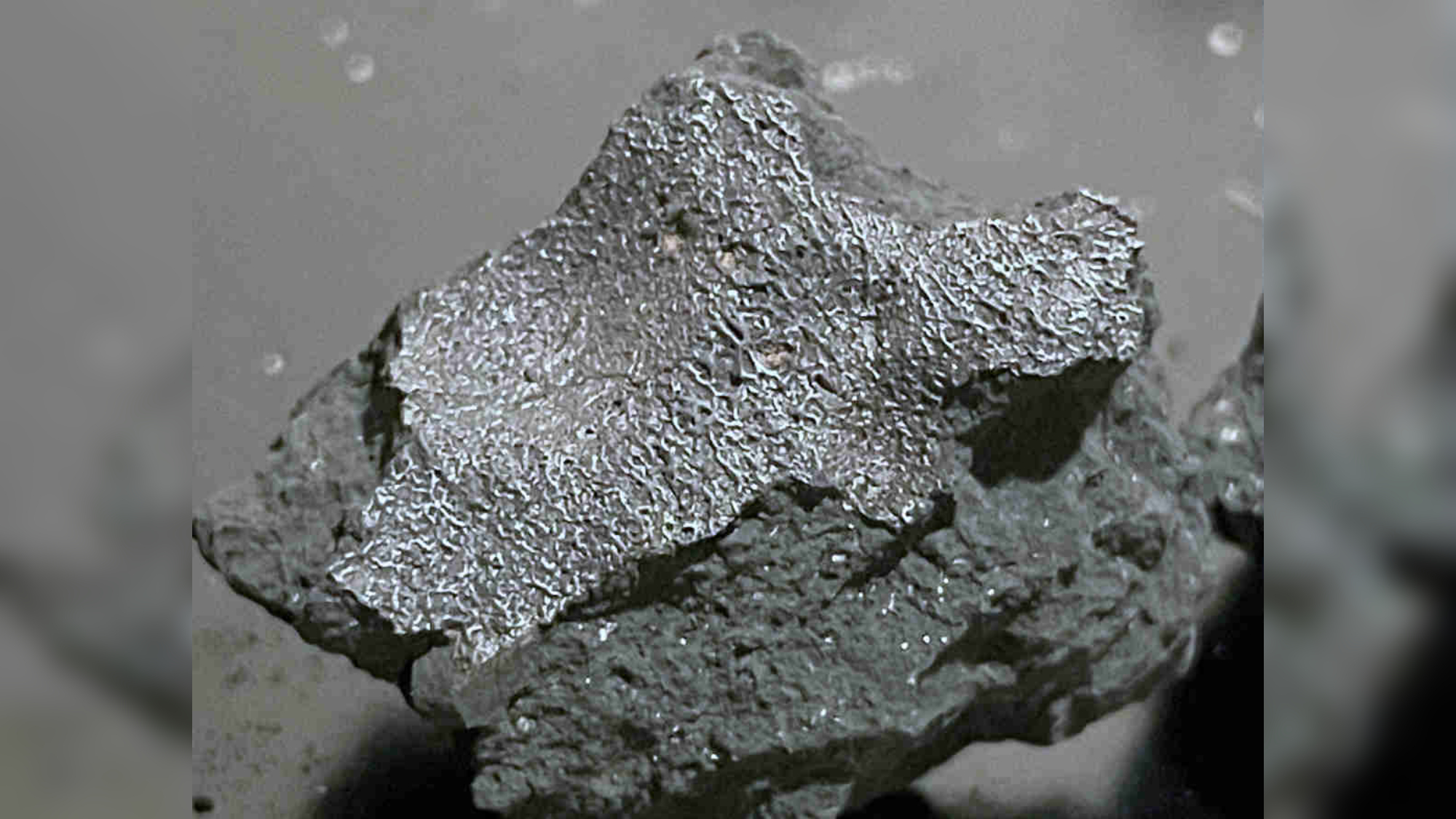
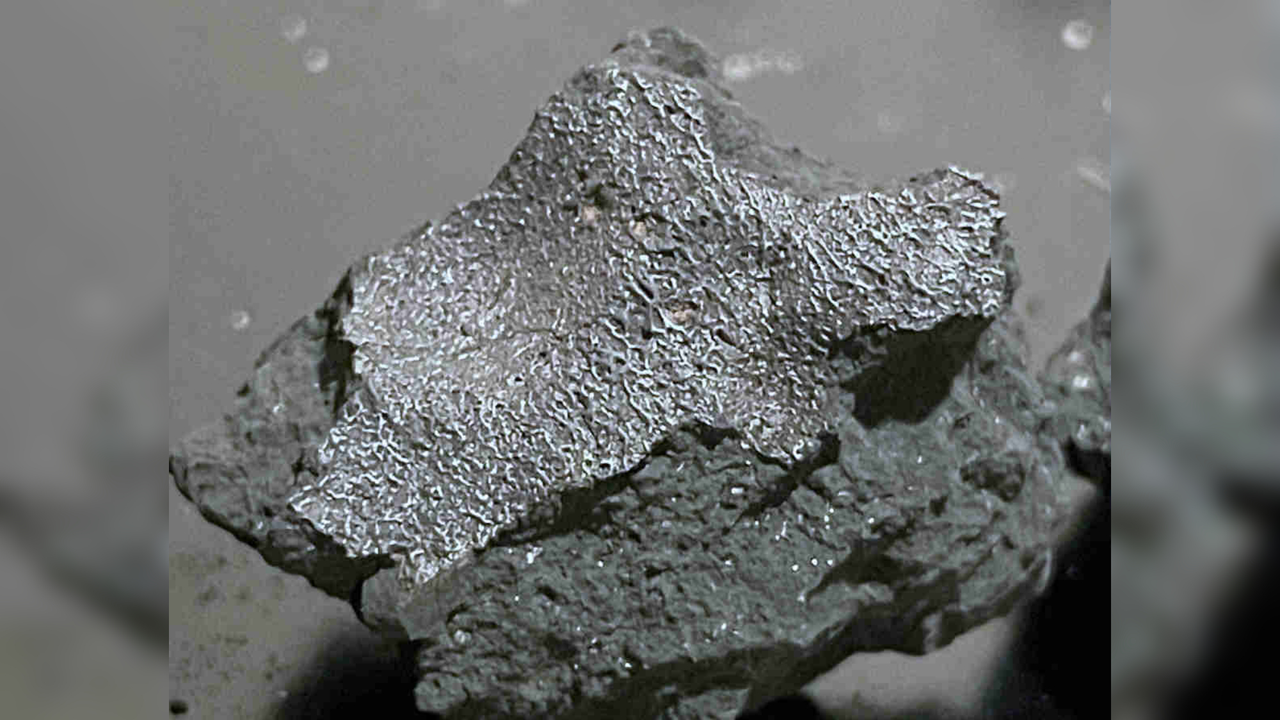
A fragment of the Hillsborough meteorite.

A fragment of the Hillsborough meteorite. (Image credit: SETI Institute)

Of course, some of the rocks were found to have some fiberglass and even carpet remnants on them after crashing through the roof of a house, Jenniskens said. But the integrity of the meteorites was still incredibly well-preserved for scientific investigation.

What did they find in these space rocks?

Once the rock fragments were collected, they were brought in for analysis led by co-author Mike Zolensky, a meteoriticist at NASA's Johnson Space Center. And they found the now-dubbed "Hillsborough meteorite" to be full of organic compounds created through chemical reactions with minerals also present in the rock as well as amino acids. They also found that some parts of the rocks were more altered by water than others.

They classified the meteorite as a CM1/2 carbonaceous chondrite, which are primitive meteorites that formed in the early solar system. CM2 meteorites typically come from parent asteroids that haven't been significantly altered by water while CM1 typically comes from asteroids with water. The Hillsborough meteorite doesn't fit neatly into either category, with some pieces of the rock altered by salty water.

This provided evidence that its parent asteroid must have had water, leading them to further classify this rock as a CM1/2, a category between 1 and 2. This is only the second meteorite of this type observed on Earth.

"Thanks to the homeowner’s quick reaction, these are the most pristine CM1/2 meteorites we know of," Jenniskens said in a statement.

They also found small, salty fragments inside the meteorite, leading the researchers to conclude that this rock may have come from a near-surface area of its parent asteroid, where liquid water evaporated and salt accumulated. A salty, briny asteroid.

This salty brine on the rock's parent asteroid could be an important piece to study, as researchers think that such a brine could ignite the chemical reactions between organic molecules and minerals that could create life. Some theories suggest that life on Earth began thanks to minerals and molecules deposited by crashing meteorites, and further study of such a well-preserved piece of a briny asteroid could help to put those pieces together.

And while the team doesn't know the full story behind the organic compounds and amino acids found in this rock, early analysis suggests that the amino acids present formed on the rock's parent asteroid with the help of chemical reactions in this briny environment.

Another major finding came from information from even before the crash. Thanks to reports from members of the public and footage from cameras (even doorbell cameras) across the eastern U.S., experts led by Jenniskens were able to piece together the trajectory of the object. Doppler weather radar at Newark Airport even helped to put the pieces together, detecting a long trail of pebbles stretching from Staten Island to New Jersey falling from the rock as it fell apart and out of the sky. This combined intel provided experts with the object's speed, and the direction from which it came.

In piecing together the rocks' trajectory, "we can say where they came from in the asteroid belt," Jenniskens said. "This one seemed to have come out of the inner asteroid belt."

In fact, he added that this meteorite's parent asteroid likely came from an area of the asteroid belt already observed in a flyby by NASA's Lucy mission, which is exploring the asteroids of the solar system. Could it be possible that Lucy observed the same bit of rock that ended up in a bedroom in New Jersey?

Jenniskens added that "If you hear about a meteorite fall in your area, please check your dash cams and video cameras and security ring [cameras], and even your cell phones." Who knows, you might have even accidentally captured footage that helps researchers to better understand a mysterious rock from space.

And if you live in the greater New York City area and want to get a closer look at this space rock, some of the meteorite fragments will be on display, curated at the American Museum of Natural History.

This work was described in a study published in the journal Science Advances.

  •  

Raspberry sugar spotted in interstellar space, a sweet discovery that could reveal clues about life's origins

Is space … sweet? As it turns out, interstellar space has sugar — and it's the same type of sugar that's found in raspberries (and self-tanners, surprisingly).

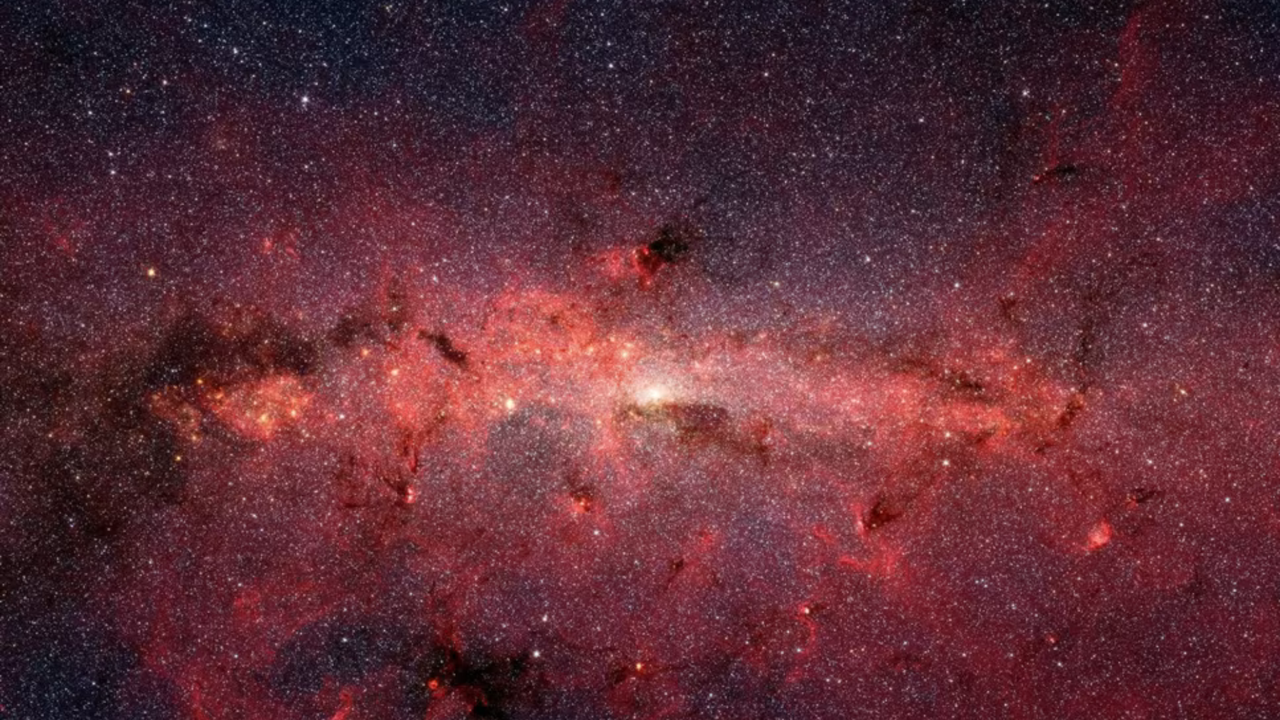
A sugar compound called erythrulose has been found near the center of our galaxy, swirling amongst the gas and dust like grains of sugar in a cotton candy machine. More specifically, this sugar was detected in a molecular cloud in the interstellar medium, or the space between star systems in a galaxy. And while we may not be able to use this sugar to make some kind of cosmic candy, scientists think that it could hold the clues to life's origins.

"The detection of erythrulose is very exciting because it opens up the possibility of discovering in space other sugars such as ribose, which is part of RNA, and other important molecules for the origin of life," Carlos Briones, co-author of the study, said in a statement.

Now, this isn't the first time sugar has been found in space. NASA's OSIRIS-REx mission visited the asteroid Bennu and returned samples of the space rock to Earth in 2023. An analysis of those samples revealed strange black grains of material that contained sugars, sugars have been detected in meteorite samples and a study from over 25 years ago even found sugar at the center of the Milky Way.

However, this is the first time sugar has been found in the interstellar medium, and it's also the first "true sugar" found in interstellar space. The difference is that while there have been some sugar-like compounds found in space, "true" sugars have a spine of at least three carbon atoms. Erythrulose has four.

"Our work shows that sugars can form naturally in space," lead author Izaskun Jiménez-Serra, an astronomer at the Center for Astrobiology in Madrid and the Spanish National Research Council, added in the statement.

This newly-spotted sugar is an exceptionally interesting find because erythrulose can change into the ingredients that create nucleic acids, and therefore life. Nucleic acids are essential to life as we know it, carrying information in cells — in fact, both DNA and RNA are types of nucleic acids.

Erythrulose could have "provided the feedstock for the first nucleic acids," Jiménez-Serra added. "That’s why the detection of erythrulose is so relevant for the origins of life."

In interstellar space, stars and planets are born in massive molecular clouds of dust and gas. If there is indeed sugar like erythrulose in these clouds, it could find its way onto asteroids and comets, or other small bodies that might crash into planets. If those objects were to crash into a young planet, that sugar could be left behind and go on to spark life.

In fact, some scientists think that life on Earth could've been sparked by asteroids delivering the materials for life via such collisions during an era where our planet was heavily bombarded by such objects around four billion years ago. Could those space rocks have held sugar from interstellar space and delivered it to Earth, supporting the earliest iterations of life as we know it?

This work was described in a study published July 13 in the journal Nature Astronomy.

  •  

Glaciers spotted flowing across the Himalayas from space | Space photo of the day for July 15, 2026

The Himalaya mountains from space.

Glaciers flow across the Himalaya, as seen from the International Space Station. (Image credit: NASA/Jessica Meir)

Towering glaciers flow down the Himalayas' northern slopes like icy giants cascading onto China's Tibetan Plateau.

What is it?

Back in May, from aboard the International Space Station 259 miles (417 kilometers) above Earth, NASA astronaut Jessica Meir peered out the station's windows with her camera and captured a breathtaking sight.

In that fleeting moment from space, she captured the northern slopes of the Himalaya mountains stretching into China. And atop the mountains, slow-moving rivers of glacial ice carve their way downhill.

This view shows the enormity of this mountain range, which separates Nepal from China's Tibetan Plateau. The Himalayas have the highest mountains in the world, including Mount Everest, with over 110 mountain peaks surpassing 24,000 feet (7,300 meters) of elevation above sea level. Ranging across five countries (Nepal, India, China, Bhutan and Pakistan) the mountain range is about 1,500 miles (2,400 kilometers) wide.

Why is it incredible?

With the range being so incredibly expansive, this view from space offers a unique vantage point from which we can see a large swath of the mountains in motion. Even in a helicopter, you would get a fairly localized view of individual mountains in the Himalayas. This view provides a striking scene that you cannot see from the surface of our planet.

This view is also a reminder of how important space is in our evolving understanding of climate change. As our planet continues to change and sea levels rise with warming temperatures, we can see glacial movement from space. This is an important resource to researchers fighting to better understand climate change so we can better fight it. With access to information about glaciers and how they melt, move and flow across the world, we can be better prepared to protect our planet and its inhabitants.

  •  

Astronomers Horrified by Enormous Mirror Satellite That Reflects Sunlight Back Down to Earth at Night

There’s light pollution — and then there are giant orbital space mirrors that blot out the night sky.

On July 9, the US Federal Communications Commission approved the construction and launch of a mirror satellite that would bend our star’s illuminating rays to our will from low Earth orbit. The company behind the ambitious venture, Reflect Orbital, claims that its prototype could be used to reflect sunlight down onto dark patches of the Earth, allowing huge solar panel installations to continue generating electricity after nightfall and provide illumination during emergencies.

“We’re trying to build something that could replace fossil fuels and really power everything,” CEO Ben Nowack told The New York Times in March as the company was still seeking approval.

The proposal has outraged astronomers, who feel their profession is already being threatened by massive satellite constellations from companies like SpaceX that interfere with deep space observations. While the FCC reviewed Reflect Orbital’s application, it received nearly 2,000 public comments criticizing the proposal, Wired reported, including from leading astronomical organizations.

Betty Kioko, institutional affairs officer for the European Southern Observatory, called it an “existential threat” for optical astronomy, per Wired. Robert Massey, deputy executive director at the Royal Astronomical Society, told Space.com last October that it would be “catastrophic.” Many are skeptical that even thousands of Reflect Orbital’s satellites working in tandem would be able to reflect a meaningful fraction of the midday Sun, let alone provide enough engilding rays to power solar plants.

Biologists were also concerned, warning that playing god with sunlight could disrupt the circadian rhythms of humans and wildlife, confuse migratory patterns, and even affect phytoplankton, the tiny aquatic organisms that are the planet’s most important photosynthesizers.

Their pleas, however, fell on deaf ears. With the FCC approval, Reflect Orbital plans to launch a prototype named Eärendil-1 later this year. With its 60 foot mirror, the company claims that it will be capable of reflecting as much light as a full Moon over a roughly nine square mile area, according to Time Magazine, for about five minutes at a time.

Those are just the beginning of its ambitions. Reflect Orbital envisions operating an epic constellation of 50,000 mirror satellites by 2035, with 1,000 launched by the end of 2028 — to researchers, a disaster in the making.

More on space: SpaceX Stock Plunges to All-Time Low After Competitor Makes Major Leap

The post Astronomers Horrified by Enormous Mirror Satellite That Reflects Sunlight Back Down to Earth at Night appeared first on Futurism.

  •  

'Found you!' Astronomers spot faintest exoplanet ever seen from Earth after a decade of hide-and-seek

It has taken over ten years, but astronomers have finally won a prolonged game of cosmic hide-and-seek with a planet hiding around the star Beta Pictoris. The extrasolar planet, or exoplanet, is known as Beta Pictoris d. It is found 63 light-years away and has two planetary siblings, which were caught some time ago.

This new exoplanet is 100 times fainter than its sibling Beta Pictoris b, which was the first planet discovered in the system. That makes Beta Pictoris d the faintest exoplanet ever seen from Earth.

Like its previously discovered sibling, Beta Pictoris d is a gas giant. However, unlike Beta Pictoris b and Beta Pictoris c, it is much further away from its parent star and is thus much cooler than its siblings. The newly discovered world is also smaller than the previously seen world around Beta Pictoris. While both Beta Pictoris b and Beta Pictoris c have around 10 times the mass of Jupiter each, Beta Pictoris d has only around 2.4 times the mass of the solar system's most massive world. That makes it one of the lightest exoplanets ever directly imaged by a ground-based telescope.

"Planet d, it seems, has been playing a game of hide-and-seek with us for over a decade, and only now can we say ‘found you!’" team member Jayne Birkby an astronomer at the University of Oxford in the UK, said in a statement.

The discovery of Beta Pictoris d helps clear up a puzzle regarding a disk of dust and debris in this planetary system, which is theorized to be made of the leftovers of planet formation. That is because this newly found world has exactly the right mass and location needed to explain both the odd shape of this debris disk and its location.

11 years of hide-and-seek

The team behind this discovery wasn't initially looking for a third planet around Beta Pictoris. Instead, they were simply attempting to learn more about the system's first planet.

"This was a serendipitous discovery," team co-leader Ben Sutlieff, an astronomer at the University of Edinburgh said. "We initially wanted to look more at a known planet in the system, Beta Pictoris b, to see how it changed over time."

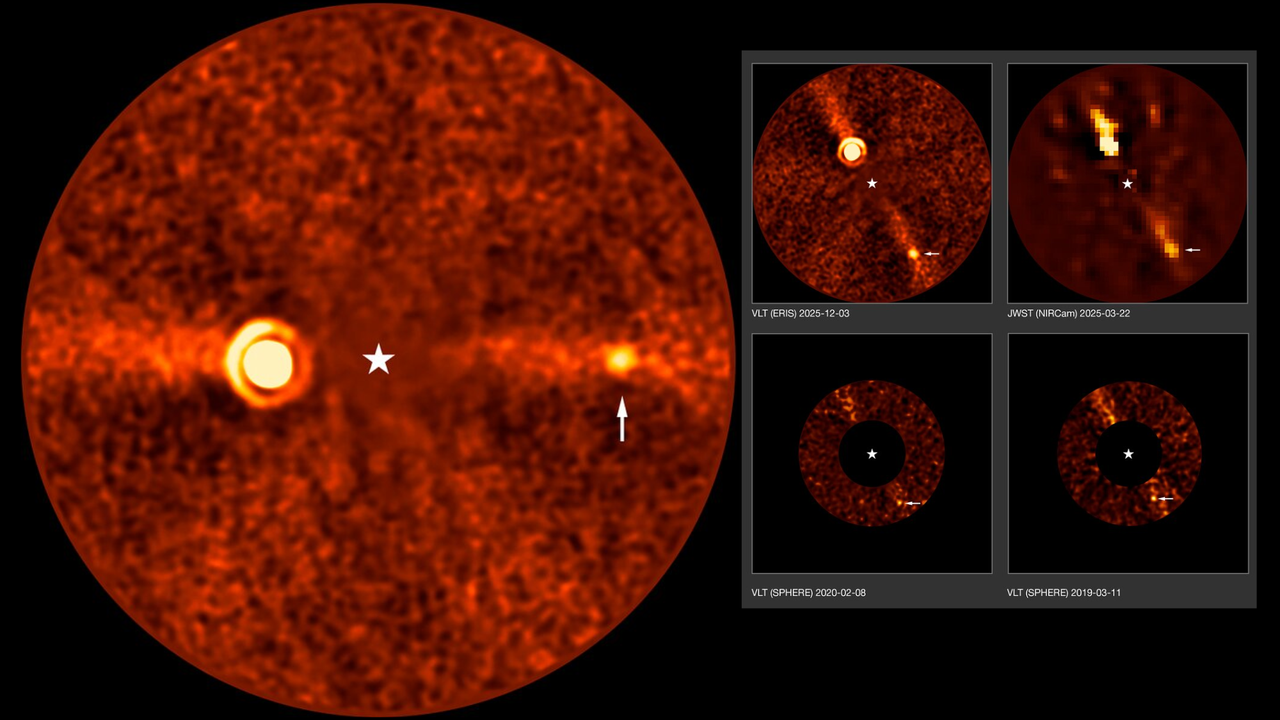
That was until they spotted telltale signs of another planet around the same star. Delving back into 11 years of archival data, the team found the third planet lurking in various images.

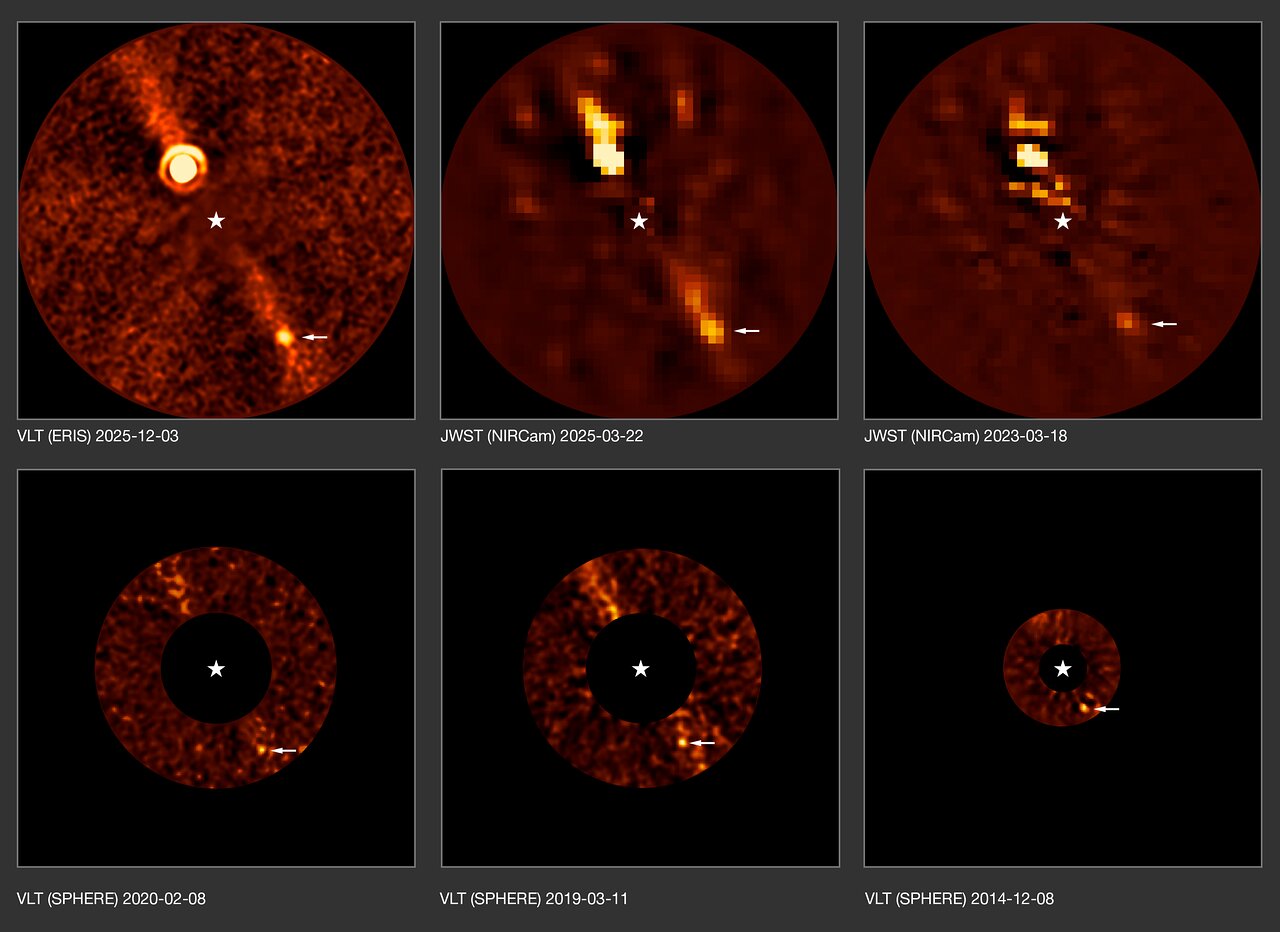
six circles showing a bright dot on a blurry, grainy red background

Marked with an arrow is Beta Pictoris d, the third planet discovered around the star Beta Pictoris. (Image credit: ESO/B. Sutlieff, M. Bonse et al.)

To consider how impressive it is to directly image a planet outside the solar system, consider that of the over 6,000 worlds in NASA's exoplanet catalog, less than 100 were discovered using direct imaging. Such detections are so tricky because they require picking out the thermal glow of a planet from the glare of its parent star.

Catching a direct image of an exoplanet as faint as Beta Pictoris d is a major step forward for this technique.

"The new planet is 100 times fainter than Beta Pictoris b, the famous planet in the same system, making it the faintest exoplanet ever imaged directly from Earth," team co-leader and European Southern Observatory researcher Markus Bonse said.

three striped planets next to a bright star, on a black starry background

An illustration of the three planets of Beta Pictoris. (Image credit: Robert Lea (created with Canva))

The discovery of Beta Pictoris d makes the Beta Pictoris system just the second in which more than two worlds have been directly imaged. The first was HR 8799, which is located around 133 light-years away.

"Systems with multiple directly imaged exoplanets are the 'holy grails' of discoveries, because they can teach us a lot about what different exoplanets are like in the same formation environment," Sutlieff said

Thus, the discovery of Beta Pictoris d via direct imaging should encourage further direct imaging of planetary systems which may also harbor faint planets. This is an investigation that could be picked up by the Extremely Large Telescope (ELT), currently under construction in the Atacama Desert of northern Chile.

"Planets seem to have friends," team member Beth Biller, of the University of Edinburgh in the UK, said. "Many of the famous directly imaged exoplanet systems seem to have multiple giant planets in the same system, and likely there are even more lower-mass planets hiding in these systems that might be revealed with instruments on the ELT."

The team's research was published on Wednesday (July 15) in The Astrophysical Journal Letters.

  •  

July 15, 1943: Birth of Jocelyn Bell Burnell

Born July 15, 1943, Jocelyn Bell Burnell is a British astrophysicist best known for her discovery of pulsars. In 1967, when she was a graduate student in radio astronomy at the University of Cambridge, Bell Burnell noticed “scruff” in the data she was reviewing from the Mullard Radio Astronomy Observatory. Bell Burnell jokingly called thisContinue reading "July 15, 1943: Birth of Jocelyn Bell Burnell"

The post July 15, 1943: Birth of Jocelyn Bell Burnell appeared first on Astronomy Magazine.

  •  

NASA’s James Webb Space Telescope May Have Just Unraveled a Longstanding Black Hole Mystery

James Webb Space Telescope (JWST) observations have astronomers on the brink of solving another long-standing astronomical mystery: how do supermassive black holes feed?

Astronomers from the Université de Montréal led an international team in the new research, reported in a recent paper in The Astrophysical Journal, which presents the clearest images ever recorded of gaseous filaments connecting a galaxy’s atmosphere to the rotating disk that the supermassive black hole feeds on.

The team’s analysis of the data paves the way toward understanding how black holes consume matter, a mystery that has stumped astronomers for decades.

Strange Black Hole Feeding

“JWST observations are offering us thousands of new facts and measurements, and I can report it’s a lot to absorb,” said co-author Megan Donahue, MSU University Distinguished Professor of physics and astronomy. “We are all working together to solve the astrophysics questions about how these black holes get their fuel and how they interact with their host galaxy.”

Supermassive black holes anchor most galaxies in the universe, with masses ranging from millions to billions of times that of the Sun. In active galactic nuclei (AGN), these central black holes both consume enormous amounts of surrounding material and unleash powerful jets that shape the galaxies around them.

This activity presents a longstanding puzzle. Because an AGN’s jets heat the surrounding gas, they should effectively cut off the black hole’s fuel supply, leaving astronomers to wonder how it continues to accrete matter.

Testing a Hypothesis

To investigate, the researchers tested the leading explanation: that heated gas eventually cools, condenses into long filaments, and falls back toward the galactic center, replenishing the black hole’s supply of material.

They turned JWST toward one of the best natural laboratories for studying AGN: the galaxy NGC 4696, located at the heart of the Centaurus Cluster, roughly 145 million light-years from Earth.

Using JWST’s NIRSpec instrument, the team collected eight hours of observations, mapping the motion of gas deep within the galaxy—where the black hole’s gravitational influence dominates—at a resolution of about 30 light-years.

Their observations revealed an 800-light-year-wide disk of gas orbiting the supermassive black hole at roughly 600 kilometers per second. Connected to this rapidly rotating disk was a large infalling filament, funneling gas inward to feed the AGN.

Feeding Cycle of the Black Hole

The discovery fills in a crucial missing piece of the puzzle surrounding how supermassive black holes sustain themselves. The researchers propose that after the black hole injects energy into the surrounding gas, heating it, that material eventually cools and collapses into thin filaments stretching hundreds of thousands of light-years. Guided by magnetic fields, these filaments then fall toward the galaxy’s center, where they accumulate in the rotating accretion disk.

The team also ran a series of computer simulations based on this model and found that the predicted behavior closely matched what JWST observed. While additional observations will be needed to confirm the results, the findings provide strong support for the filament-feeding hypothesis.

“It’s been really exciting to participate in this project,” co-author Mark Voit, an MSU Physics and Astronomy Professor, said in a statement.

“Calculations done by our Michigan State group predict that magnetic fields should help feed the universe’s biggest black holes by channeling cool gas toward them, and it’s amazing to see that happening in these JWST images,” he added.

The paper, “JWST Reveals How Lack Holes Are Fed: Kiloparsec-Scale Multiphase Filaments Feed Sub-Kiloparsec Circumnuclear Disks,” appeared in The Astrophysical Journal Letters on July 14, 2026.

Ryan Whalen covers science and technology for The Debrief. He holds an MA in History and a Master of Library and Information Science with a certificate in Data Science. He can be contacted at ryan@thedebrief.org, and follow him on Twitter @mdntwvlf.

  •  

Scientists Have Made a Sweet Discovery in Interstellar Space, Offering Clues to Mystery of Life’s Origins

Scientists have discovered an abundance of molecules in the cosmos, but for the first time ever, they were able to detect one in interstellar space very familiar to us here on Earth: sugar. 

The discovery, made in the vast clouds of gas and dust between stars, could help scientists better understand how some of the chemical ingredients necessary for life formed long before Earth existed.

Researchers at the Centro de Astrobiología, part of the Spanish National Research Council (CSIC), identified the sugar molecule erythrulose within the interstellar medium.

Sugars are considered fundamental building blocks of life. On Earth, they play vital biological roles, including forming the backbone of RNA and contributing to the chemistry that ultimately supports DNA, while also serving as an important source of energy. Scientists studying the origins of life have long sought to understand how the first sugars formed, since they are essential ingredients in the molecules associated with life’s earliest development.

“The detection of erythrulose is very exciting because it opens up the possibility of discovering in space other sugars such as ribose, which is part of RNA, and other important molecules for the origin of life,” says Carlos Briones, co-author of the study, in a statement. 

Even so, one major question remains: where did the first biologically important sugars originate?

Previous studies have identified sugars such as ribose and glucose in meteorites and asteroid samples, suggesting that some organic compounds may have been delivered to the early Earth from space. Until now, however, no sugar had been directly detected in the cold molecular clouds where stars and planets form.

The newly identified molecule, erythrulose, was found in the molecular cloud G+0.693−0.027 near the center of the Milky Way. On Earth, erythrulose is a naturally occurring four-carbon ketose sugar.

The discovery was made using highly sensitive radio astronomy observations from the Yebes Observatory’s 40-meter radio telescope and the 30-meter telescope operated by the Institute for Radio Astronomy in the Millimeter Range. Researchers analyzed the unique radio signatures, or spectral fingerprints, emitted by molecules in space.

The team identified 12 spectral lines matching laboratory measurements of erythrulose, confirming the molecule’s presence.

The findings also challenge some existing ideas about how complex molecules form in space. Scientists have generally proposed that interstellar chemistry builds larger molecules by gradually adding carbon atoms. Yet erythrulose proved to be more abundant than related three-carbon sugars that researchers expected would appear first.

“This finding was unexpected, as the prevailing view in astrochemistry is that interstellar molecules grow in size through the sequential addition of carbon atoms,” said Izaskun Jimenez Serra (CAB), the lead author of the recent study. 

Instead, the researchers found that erythrulose could form inside icy dust grains from simpler two-carbon alcohols and aldehydes. These frozen environments may function as natural chemical laboratories, allowing increasingly complex organic molecules to develop over time.

The team estimates that during the Late Heavy Bombardment—roughly 4.1 to 3.8 billion years ago, when Earth experienced intense asteroid and comet impacts—between 500,000 and 50 million tonnes of erythrulose may have been delivered to the planet’s surface.

The discovery adds another piece to the puzzle of life’s origins, suggesting that some of its essential ingredients may have arrived with something surprisingly sweet.

This paper was published in the journal Nature Astronomy.

Chrissy Newton is a PR professional and the founder of VOCAB Communications. She currently appears on The Discovery Channel and Max and hosts the Rebelliously Curious podcast, which can be found on YouTube and on all audio podcast streaming platforms. Follow her on X: @ChrissyNewton, Instagram: @BeingChrissyNewton, and chrissynewton.com. To contact Chrissy with a story, please email chrissy @ thedebrief.org.

  •  
❌