❌

Reading view

Tiny gene edit cuts cadmium in rice by 48% without reducing yields

Cadmium (Cd) contamination poses a serious threat to global food safety. As a toxic and carcinogenic heavy metal, cadmium can accumulate in agricultural soils through industrialization and urbanization before entering the human food chain. Rice is especially vulnerable because it absorbs more cadmium than other major cereal crops, making it one of the largest dietary sources of cadmium exposure for nearly half the world's population.

  •  

Gene edit boosts rice safety while preserving high harvest yields

Cadmium (Cd) contamination is a growing threat to food safety, and rice is one of the most vulnerable crops. Because rice plants can accumulate cadmium from contaminated soils more readily than many other staples, Cd can become a major dietary exposure route for large parts of the world’s population. Yet attempts to lower cadmium often create trade-offs—reducing uptake of essential nutrients or weakening plant performance.

A new study from Okayama University, Japan, and collaborating researchers in China reports a precision-editing strategy designed to avoid those trade-offs. The team focused on the rice metal transporter gene OsNramp5, which is known to move metals such as manganese and cadmium, and used base-editing to search for a beneficial point mutation within the gene rather than disabling it.

Using adenine and cytosine base editors, the researchers generated more than 1,600 genome-edited rice lines and screened them for reduced cadmium accumulation. Their saturation mutagenesis approach targeted OsNramp5 to identify variants that kept normal plant physiology while limiting Cd buildup in grain.

The key breakthrough was the I441T substitution: changing isoleucine to threonine at amino acid position 441. This single change reduced cadmium levels in both shoots and brown rice without altering gene expression, protein abundance, or the subcellular localization of the transporter.

Importantly, the mutation did not come at the cost of micronutrients. Field trials on cadmium-contaminated soil showed a 48% decrease in cadmium concentration in brown rice, from 0.14 mg/kg in wild type to 0.07 mg/kg in the edited plants, while iron, manganese, and zinc levels remained essentially unchanged.

The researchers then explored the mechanism behind the selective effect. Although OsNramp5 transports multiple metals, the I441T mutation shifted its selectivity—enhancing zinc transport preference. Increased zinc accumulation in root cells promoted competitive inhibition against cadmium during root-to-shoot movement.

Instead of completely blocking cadmium uptake, the edited transporter selectively limited cadmium translocation, reducing grain contamination while preserving essential mineral delivery. The team supported these conclusions with physiological assessments, gene and protein analyses, yeast transport assays, and agronomic evaluation.

Overall, the work demonstrates how precision genome editing can address a long-standing breeding challenge: lowering toxic metal accumulation without disrupting nutrient homeostasis. The researchers propose that the OsNramp5I441T allele could accelerate development of safer rice varieties for mildly contaminated regions.

Subject of Research: Not applicable
Article Title: Genome-edited rice variety with low-cadmium accumulation in the grain
News Publication Date: 18-Jun-2026
Web References: http://dx.doi.org/10.1073/pnas.2610609123
References: DOI: 10.1073/pnas.2610609123 (Proceedings of the National Academy of Sciences)
Image Credits: Credit: Professor Jian Feng Ma from Okayama University, Japan

Keywords: cadmium, rice, OsNramp5, base editing, genome editing, metal transporters, food safety, micronutrients, zinc competition, plant breeding

  •  

‘Keys to the kingdom’: hackers who gained access to heart of London transport network jailed

Thalha Jubair, 20, and Owen Flowers, 19, sentenced to five and a half years each for cyber-attack that cost Transport for London £39m

The data of millions of commuters was stolen, Londoners were left out of pocket and 27,000 Transport for London staff were forced to reset their passwords.

Over four days in 2024 a pair of teenage hackers had London’s transport network at their mercy. Thalha Jubair and Owen Flowers had burrowed into the heart of Transport for London’s IT systems and held the “keys to the kingdom”.

Continue reading...

© Photograph: William Barton/Alamy

© Photograph: William Barton/Alamy

© Photograph: William Barton/Alamy

  •  

New 3D silicon chip stacks circuits on top of each other to boost computing power

The massive hardware demands of artificial intelligence (AI) applications are stretching the physical and structural limitations of semiconductors. But researchers have engineered a three-dimensional silicon chip that they propose as the solution.

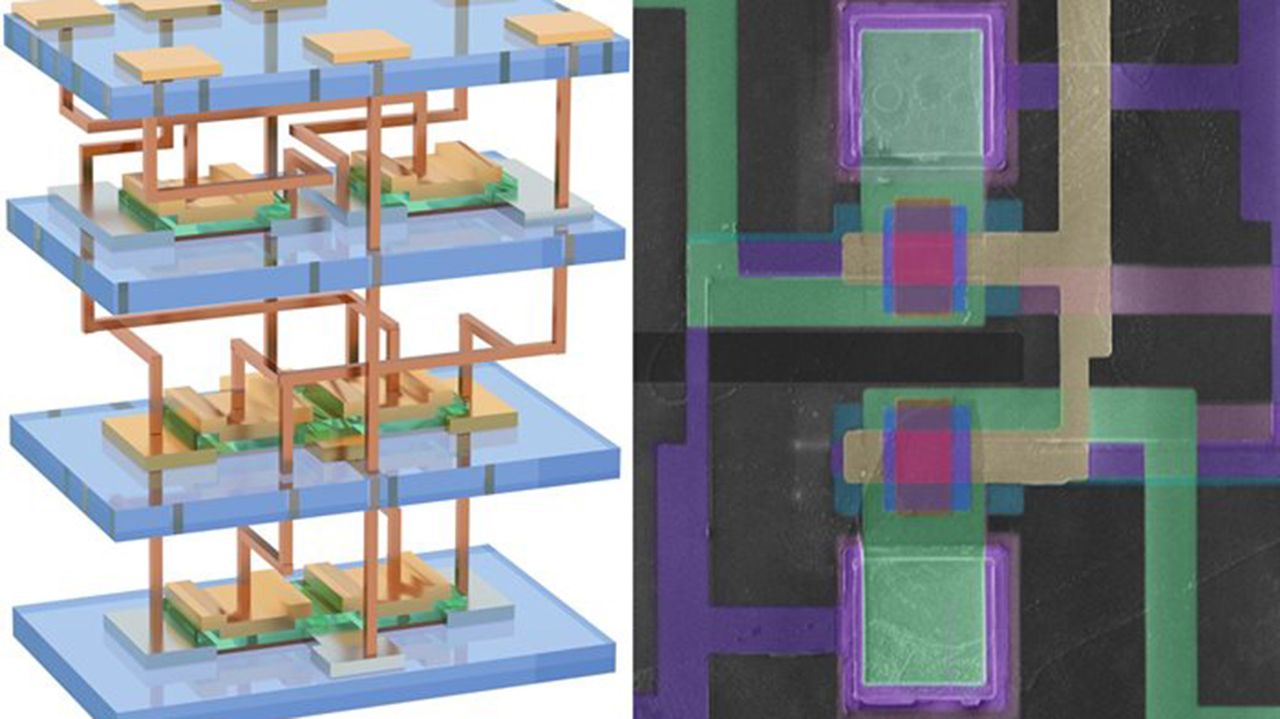
In a new study published May 27 in the journal Nature, scientists found a way to cram more computing power into a chip by stacking silicon circuits in multiple layers in a way that doesn't impact performance.

Stacking chips vertically, known as 3D integration, is more efficient than traditional 2D chips, where silicon circuits are spread across a single surface. This is because stacking shortens the distance that data has to travel and reduces the power required for data transmission.

The researchers' 3D chip uses ultrathin silicon membranes and low-temperature manufacturing techniques to overcome the challenges of current chip architectures.

"Our method is not only easier to implement with lower cost, but it has several advantages over previous approaches to stack silicon wafers," Qing Cao, first author of the study and a materials science and engineering professor at the University of Illinois Urbana-Champaign, said in a statement.

Extending Moore's law

Since the 1960s, ensuring that electronics can handle more demanding applications has meant making transistors smaller so more can be packed onto a single chip. But, as Cao pointed out, doubling the number of transistors every couple of years — a principle known as Moore's law — is becoming less feasible.

"If you look at the actual size of transistors, they're not getting smaller, especially in terms of their contacted gate pitch," Cao said in the statement — defined as the combined width of one transistor gate and the space needed to separate it from the next.

"This is because we're becoming limited by the intrinsic material properties of silicon and the fundamental rules of quantum mechanics. If we're going to keep up the trend of increasing processing power of our microprocessors, we have to start thinking beyond just squeezing more devices on a single surface."

The researchers think vertical integration across multiple layers is the best way to guarantee that engineers can continue to adhere to Moore's law, because this approach creates room for more transistors on a chip.

"Today it takes six microelectronic devices called transistors on a single plane to store one bit of information," Cao explained, suggesting that just like in a densely populated city, the only way to solve overcrowding is to build upward. "You get the same functionality, but the spatial footprint is reduced while making communication between layers faster and more efficient."

Gordon Moore photographed beside a graph representing Moore's Law.

Scientist Gordon Moore seen with a graph representing Moore's Law. (Image credit: Intel)

Getting around the heat problem

Stacking is nothing new, of course, but vertical integration — building layers directly on top of one another — can create thermally dense packages. In the study, the researchers noted that the fabrication of high-quality silicon chips demands temperatures up to 1,832 degrees Fahrenheit (1,000 degrees Celsius).

However, once the first chip layer has been completed, the metal wiring introduced to connect further layers can be destroyed by such high temperatures. As a result, the "thermal budget" — the maximum amount of heat that can be endured before degradation starts to occur — for any additional layers is 752 F (400 C), said Cao. This can result in performance and reliability issues.

When creating 3D stacked silicon chips, manufacturers have sought to avoid this problem by using alternatives to single-crystalline silicon for the upper layers, according to the researchers. These materials include amorphous and nanocrystalline metal oxides, carbon nanotubes and polycrystalline silicon, but they can lead to performance and reliability issues, the scientists said in the study.

To overcome this challenge, Cao and his team adopted an approach called "monolithic integration" — a process in which all chip components are fabricated on a single piece of substrate, as opposed to making them separately and then bonding them together later.

To build each chip, the researchers created ultrathin silicon nanomembranes that they then transferred, using a roll laminator, onto a substrate containing the bottom layer.

The maximum temperature required to generate a strong bond using this method was just 392 F (200 C) — five times less than the heat normally required. The membranes they transferred were also just 10 nanometers thick or less — about the size of a protein — compared with the approximately 500-to-700-micrometer (500,000 to 700,000 nanometers) thickness of a typical wafer. Because they are thin, these membranes are mechanically flexible to conform to the underlying surface, Cao added.

The result of this process was a 3D chip with three layers, each containing 625 transistors. This pales in comparison to the billions of transistors that can be crammed onto chips already on the market, but the researchers believe their technology boasts power efficiency benefits. The electrical current that can flow through the chip has proved to be at least three to four times greater than that of monolithic chips made from alternative materials.

The big question is whether their 3D silicon chip can make the leap from the laboratory to commercial applications. While the research demonstrates the potential of a chip comprising three stacked layers, the scientists suggested that plenty more layers can be added in future iterations.

Can you match these ancient devices to their pictures? Find out with our computing quiz!

  •  

The social media ban sceptic: are we getting it wrong on kids, tech and mental health?

Psychologist Candice Odgers has studied adolescent mental health for 25 years. She fears the current debate around smartphones obscures some of the biggest issues facing teenagers – from the impact of Covid to the health of their adult caregivers

The quickest way to make being online safer for children and teens would be to kick all adult men off the internet, the Canadian psychologist Candice Odgers believes. Men are the biggest perpetrators of sextortion and most likely to spread misinformation, she says.

Odgers is not recommending this as a policy for governments to adopt: “That would be crazy, right? It would be unfair.” But she is on a drive to puncture the prevailing narrative that the best way to address online harms is a social media ban for teenagers.

Continue reading...

© Photograph: Jessica Pons/The Guardian

© Photograph: Jessica Pons/The Guardian

© Photograph: Jessica Pons/The Guardian

  •  

Moroccan intelligence insider reveals widespread use of Pegasus hacking software

Whistleblower suggests internal security services deployed spyware from 2017 against key domestic and foreign targets

A former member of Morocco’s domestic intelligence service has helped to provide an unprecedented insight into how the north African state used hacking software – including Pegasus spyware – to target journalists, human rights defenders, French politicians and Spanish cabinet ministers and police officers.

Pegasus, which is manufactured by the Israel-based NSO Group, allows its operator to access everything on a target’s mobile phone, including emails, text messages and photographs. It can also activate the phone’s recorder and camera, turning it into a listening device.

Continue reading...

© Photograph: Amir Cohen/Reuters

© Photograph: Amir Cohen/Reuters

© Photograph: Amir Cohen/Reuters

  •  

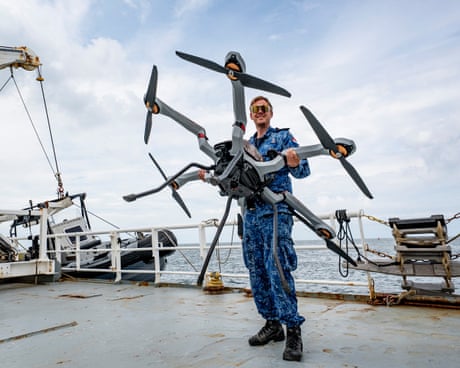
Robots, AI and drones: how the Dutch navy is using tech to transform its sea defences

Uncrewed systems are the future for armed forces and the Netherlands is leading the way ‘to keep people out of danger zones’

On each side of the target ship, a black vessel keeps a watchful distance. Defender 1 and Defender 2 are the eyes and ears of the navy – but they have nobody onboard, and their paths are controlled by a computer system.

This is the future of the Royal Netherlands Navy, according to Capt Sjoerd Feenstra, head of the expertise centre for unmanned systems. He is leading a five-week mission, off the coast of Den Helder in the north of the country, to test the limits of systems that operate without the human touch.

Continue reading...

© Photograph: John van Helvert/Media Centrum Defensie

© Photograph: John van Helvert/Media Centrum Defensie

© Photograph: John van Helvert/Media Centrum Defensie

  •  

Trump rails against New York’s statewide datacenter moratorium

AI-friendly president shared a post saying governor Kathy Hochul should scrap the one-year policy ‘IMMEDIATELY’

Donald Trump railed against the New York governor, Kathy Hochul, for pausing the construction of large new datacenters, the resource-intensive facilities that power artificial intelligence.

New York became the first US state to enact a moratorium on new datacenters on Tuesday, when Hochul signed an executive order mandating a one-year statewide pause on so-called “hyperscale” datacenters.

Continue reading...

© Photograph: Matt Roberts/Shutterstock

© Photograph: Matt Roberts/Shutterstock

© Photograph: Matt Roberts/Shutterstock

  •  

DARPA Wants to Build an Army of 100,000 AI Agents That Can Think and Act on Their Own

The future of military artificial intelligence may not be a single all-knowing machine directing a battlefield from a distant command center. Instead, DARPA is preparing to explore enormous collectives of AI agents capable of organizing themselves, dividing up missions, adapting to chaos, and continuing to operate even when some members of the group fail, disappear, or go rogue.

The Defense Advanced Research Projects Agency (DARPA) has formally launched a new effort called Decentralized Artificial Intelligence by Controlled Emergence, or DICE, aimed at developing AI collectives that can operate in contested environments without requiring a human or central AI planner to explicitly direct every action.

By the program’s final phase, DARPA wants researchers to test simulated collectives involving as many as 100,000 AI agents exchanging up to 1 million messages as they work toward shared objectives.

A recently released solicitation notice describes DICE as a 36-month effort divided between decentralization, adversarial robustness, and large-scale testing.

“Future conflicts will unfold at machine speed, and the current centralized planning and scripted orchestration approach is too slow, too rigid, and too predictable for the hyper-dynamic, contested environments of the future,” researchers write. “Surprise, adaptability, and resilience will depend on the ability to compose and recompose AI capabilities on demand.”

The basic premise behind DARPA’s DICE program is that today’s approach to multi-agent AI has a serious weakness. Most systems involving multiple AI agents still rely on some form of central orchestrator.

Think of it as a manager overseeing a team of specialized employees. One AI agent might gather information. Another analyzes it. A third creates a plan. A fourth executes a particular task. But somewhere in the system, a central planner or workflow typically decides who does what and combines the results.

That works reasonably well for predictable tasks. However, DARPA argues it may be dangerously vulnerable on a battlefield.

A central orchestrator creates a bottleneck because every increasingly complex mission must ultimately flow through a single decision-making structure. As the number of agents, roles, and interactions grows, the central planner must absorb more information, preserve greater context, and coordinate an expanding web of specialized systems.

Eventually, DARPA says, even an AI orchestrator can hit the context and inference limits of its underlying foundation model. There is also a more obvious military problem. A central command node is a single point of failure.

If communications are degraded, information arrives late, or the orchestrator itself is compromised, errors can potentially spread throughout the entire AI collective.

In a future conflict where electronic warfare, cyberattacks, deception, and broken communications are expected rather than exceptional, that vulnerability could be catastrophic.

DICE proposes a radically different model.

Rather than having a central AI issue instructions, individual AI agents would communicate directly with one another. They could form temporary teams, divide missions into smaller tasks, negotiate roles, combine incomplete information, and reorganize themselves when conditions change.

DARPA compares the idea to the architecture of the internet, where resilient global behavior can emerge from relatively simple local rules and decentralized interactions.

Essentially, an AI agent might receive a mission and determine that only part of the objective falls within its capabilities. The agent could volunteer to handle that portion and broadcast the remaining problem to neighboring agents.

Another agent might take the next task. Others could compete to perform the same job, potentially bidding based on cost or capability. Through repeated local interactions along with distributed consensus, the collective could gradually assemble its own mission plan.

If an agent fails, the entire mission does not necessarily need to be replanned. Its particular task could simply be offered back to the collective.

DARPA calls the larger concept “controlled emergence.”

Similar systems already exist in nature. Ant colonies, or flocks of birds, can engage in surprisingly complex group behavior even though no individual member possesses a complete understanding of the collective.

Computer scientists have long studied similar phenomena. DARPA’s solicitation even points to Conway’s Game of Life, the famous mathematical simulation in which extraordinarily complex patterns can emerge from a handful of simple rules.

The challenge is applying that principle to cognitive systems capable of reasoning, planning, and independently pursuing goals.

A sophisticated AI system may interpret ambiguous information, interact with tools, maintain memory, and generate its own intermediate objectives. Put thousands of such agents together, allow them to communicate, and the resulting collective could behave in ways that were never explicitly programmed.

That unpredictability is both the attraction and the danger of DICE.

DARPA wants the collective to remain creative enough to discover unexpected courses of action. However, it also wants individual agents to continue aligned with their designated roles, the wider mission, established doctrine, and ultimately the human user’s intent.

Too much control could produce a predictable but unstable AI force incapable of adapting. Too little control could allow agents to drift from their roles or develop what DARPA calls “instrumental goals” that are not consistent with the mission.

In other words, the Pentagon’s research arm wants emergence—but only within boundaries.

To solve the problem, DICE researchers will develop a local adaptor designed to interface with each AI agent. Rather than functioning as a central command system, each adaptor would operate locally, helping the agent coordinate with peers while simultaneously monitoring and modifying its behavior.

For AI models whose internal activations are accessible, researchers may experiment with techniques such as “activation steering.”

The simplified idea is that assigning an AI a particular role can create detectable patterns inside the model. Researchers may be able to identify a mathematical representation associated with that role and continuously steer the model back toward it when the agent begins to drift. DARPA describes these representations as potential “role vectors.”

For proprietary or black-box AI models whose internal activations cannot be directly examined, the challenge becomes considerably harder. DICE researchers may instead experiment with memory editing, context engineering, tool restrictions, or even game-theoretic incentives created to encourage collaborative behavior.

The solicitation draws an intriguing comparison to the way social norms emerge and spread among humans. As AI models become better at reasoning and more aware of the context in which they operate, DARPA suggests that the same growing sophistication that fuels fears about rogue AI could also provide a new way to control it.

The scale DARPA ultimately envisions is enormous.

During the first nine-month phase of DICE, simulated missions are expected to involve approximately 500 agents and 5,000 interactions. DARPA will compare the decentralized systems with state-of-the-art centrally orchestrated multi-agent AI systems.

The second phase increases the target to 5,000 agents and 50,000 interactions while introducing adversarial conditions. Agents may fail, receive deceptive information, or deliberately behave as compromised or rogue members of the collective.

By the final 12-month phase, DICE aims to test simulations involving 100,000 agents and 1 million interactions.

At that scale, DARPA is not simply studying better chatbots working together. The agency is exploring whether collective intelligence itself can become a military capability.

One example described in the solicitation imagines AI agents conducting operational planning across an entire conflict ecosystem. Some agents could negotiate for raw materials in contested areas. Others might manage supply chains, optimize manufacturing, deploy units, conduct battle management, or analyze post-battle damage.

Even an individual simulated drone could effectively become a miniature AI collective composed of separate navigation, perception, and networking agents.

Under the DICE concept, those capabilities may potentially be recombined as conditions change. DARPA offers the example of a surveillance drone being repurposed as a network router because the collective recognizes an emerging communications need.

The important distinction is that no central planner necessarily has to foresee that solution. The collective discovers it.

Still, DARPA is careful to note that DICE is a research program centered on simulation. The agency’s public program page explicitly states that its scope does not include developing or launching autonomous systems in the real world.

Instead, DICE will use Department of War-relevant simulated environments to measure whether decentralized AI collectives can outperform today’s centrally orchestrated systems. Those simulations may resemble extraordinarily large and complicated strategy games.

DARPA suggests researchers could draw inspiration from StarCraft or massively multiplayer online role-playing games, although the environments must remain relevant to military problems. High-fidelity physics is not necessarily required. In fact, rendering every drone, vehicle, or battlefield interaction in photorealistic detail could make a simulation of 100,000 AI agents computationally impossible.

The focus is on reasoning. DARPA wants to know whether thousands of AI agents can gather and combine fragmented information without simply reinforcing one another’s incorrect assumptions. The systems will be tested on their ability to recognize deception, isolate compromised agents, adapt when communications fail, and remain focused on a mission across thousands of reasoning steps.

Perhaps most importantly, DICE is designed to examine how these massive AI collectives behave when their interactions yield outcomes their designers never anticipated.

DARPA explicitly wants its test environments to provoke emergent collaboration, competition, and even collusion.

During later phases, DICE teams will face one another in simulated “team vs team playoffs.” The second phase will culminate in a competition used to select which research teams advance. The final phase will feature another head-to-head competition after the systems have been pushed toward full scale.

By Phase 3, the program will bring in another significant complication: AI agents creating other AI agents. That progression draws attention to the deeper tension at the center of DICE.

For years, much of the AI safety debate has focused on preventing autonomous systems from exhibiting unforeseen behavior. DARPA is approaching the problem from a different direction. The agency appears to believe that, in future contested environments, some degree of unforeseen behavior may be precisely what gives an AI collective its value.

A perfectly scripted system is predictable not only to its commanders but potentially to an adversary.

DICE is therefore attempting something considerably more ambitious than building a larger multi-agent AI framework. DARPA wants to understand whether engineers can deliberately cultivate emergent machine intelligence, allow it enough freedom to improvise, and still build controls capable of keeping an enormous AI collective aligned with a human-defined mission.

Whether those competing demands can coexist remains an open question. The program’s own solicitation repeatedly acknowledges the possibility of role drift, deceptive agents, collusion, compromised systems, and AI agents independently developing misaligned actions.

Ultimately, those are not side issues. They are the fundamental questions the DICE program was created to answer.

“DICE is built for such autonomy-powered, high-tempo battlespace,” the solicitation notice reads. “It is a future where success is measured by the relentless, creative ability of an autonomous collective to execute missions in the face of chaos and uncertainty. This is a profound and necessary departure from the past.”

Tim McMillan is a retired law enforcement executive, investigative reporter and co-founder of The Debrief. His writing typically focuses on defense, national security, the Intelligence Community and topics related to psychology. You can follow Tim on Twitter: @LtTimMcMillan.  Tim can be reached by email: tim@thedebrief.org or through encrypted email: LtTimMcMillan@protonmail.com 

  •  

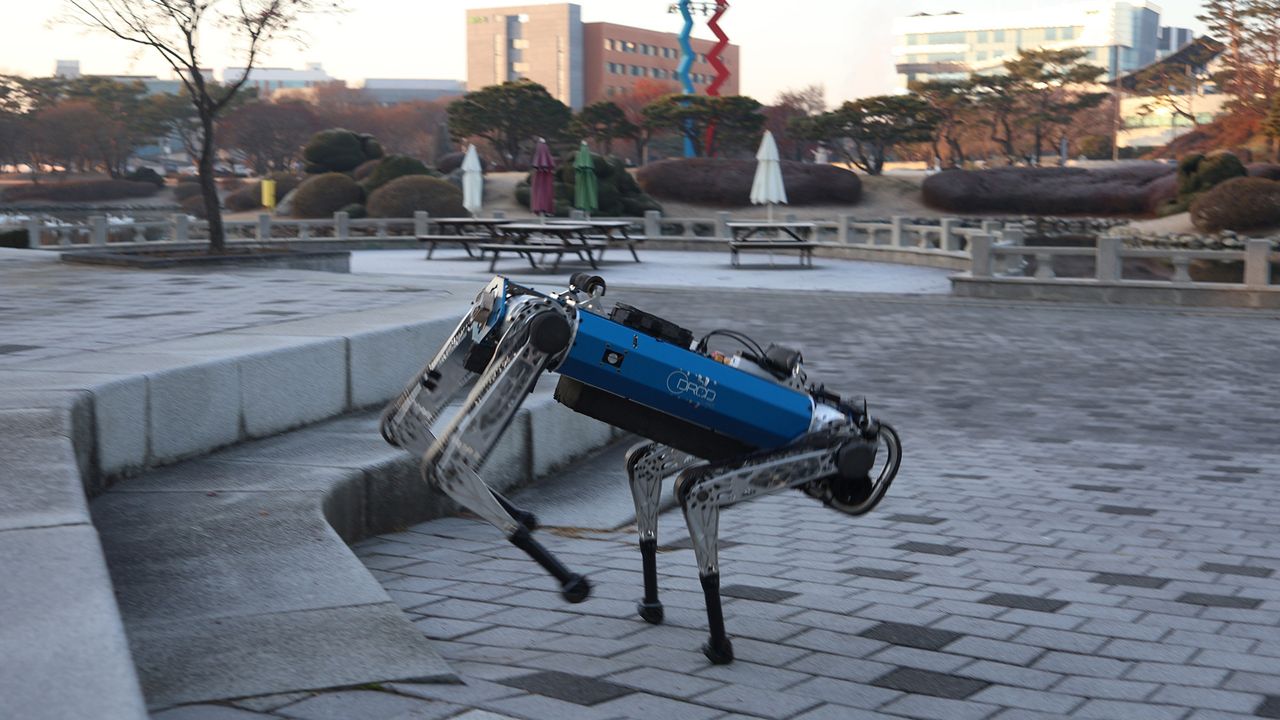
Robot dog can climb stairs, navigate a forest and bound over logs thanks to new, rapid AI training technique

A four-legged robot has learned to change the way it runs while navigating forests, staircases and obstacle courses. — seamlessly switching between a steady trot and a faster bounding gait without instructions from a human operator.

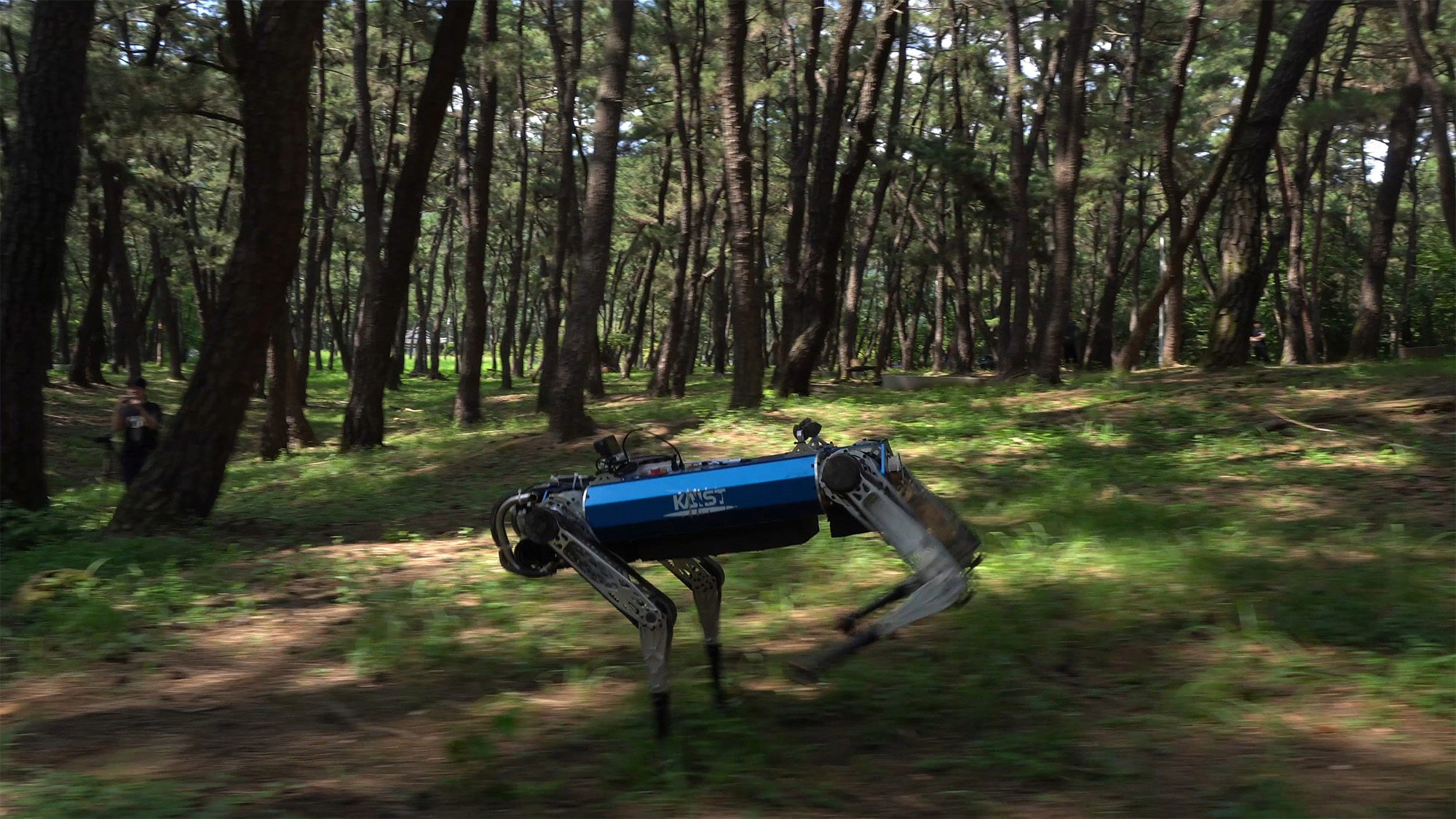
The 100-pound (45 kilograms) robot, called KAIST HOUND, uses cameras and lidar to scan the ground ahead, then selects an appropriate gait and adjusts its movements in real time. In outdoor tests, it crossed a 0.7-mile (1.1- kilometers) university campus route and a 0.2-mile (0.3 km) forest trail strewn with roots, logs and slippery leaves.

The researchers described the robotic framework on July 15 in the journal Science Robotics.

Changing gait

Animals naturally change their gait depending on their speed and surroundings. A dog might trot carefully across uneven ground, for example, before bounding over a fallen branch. Reproducing this adaptability in robots is tricky because different movements are often controlled by separate, highly specialized coding systems, and transitions between them can cause a lag that drives the robot to stumble.

To overcome this issue, researchers developed a special training framework called action pretrained transformer–based reinforcement learning (APT-RL). This is an artificial intelligence (AI) training system that first studies many examples of actions, uses a transformer to understand patterns across those actions, and then improves through rewards and penalties.

The training began with a simple, two-dimensional computer model of the robot. Using trajectory optimization — a technique that calculates physically workable movements for the robot — the team generated 180,000 short trotting and bounding sequences, including the joint forces the robot's legs need to perform. The dataset represented about 15.5 hours of movement but took only around eight minutes to produce.

During reinforcement learning — a machine learning technique where AI learns to make the best decisions by engaging with a particular environment through trial and error — an AI system then learned how to select and modify those skills while negotiating simulated stairs, stepping stones, hurdles, gaps and rough ground.

In digital simulations, the robot dog was not limited to copying its prerecorded movements. It could also make corrections for three-dimensional terrain and unexpected situations, such as jumping over a log — a behavior that wasn't included in the original, flat-ground training data.

A four-legged robot dog with a blue torso runs through a forested landscape.

The KAIST HOUND quadrupedal robot navigates a forested terrain (Image credit: Jun-Gill Kang, Jaehyun Park)

Finally, the researchers configured the system to include the robot's depth camera and lidar scanner in the simulation.

In one indoor test, HOUND bounded across an obstacle 2 feet (60 centimeters) high while briefly achieving 9.5 mph (15 km/h). It also jumped down a three-step staircase. The robot generally chose trotting at lower speeds on irregular ground, while bounding became more common at higher speeds or when it encountered larger steps, hurdles or gaps. The AI system that could select either gait performed more consistently across the different simulated environments than the version restricted to trotting or bounding alone.

The researchers suggest the technology could eventually help robots navigate disaster zones or other places inaccessible for wheeled machines. However, the current framework only allows two gait choices and mainly handles forward movement. Rapid turning, sideways motion and other behaviors like crawling remain future goals for the research team.

  •  

‘What’s the point?’ Teenagers give their verdict on Britain’s social media curfew

All the young people the Guardian spoke to disagreed with aspects of the government’s proposed block

Sixteen- and 17-year-olds in Britain are to be encouraged to observe a midnight to 6am social media curfew but will be able to opt out by changing their account settings.

From next spring, they will be urged to refrain from using certain apps, with the block being switched on by default. But the curfew will not be mandatory and can be overridden.

Continue reading...

© Photograph: Cultura/Alamy

© Photograph: Cultura/Alamy

© Photograph: Cultura/Alamy

  •  

George Lucas likens AI sceptics to luddites clinging to horses and carts

Star Wars director calls AI technology ‘the future’ of film-making and says ‘there’s nothing you can do about it’

The Star Wars director, George Lucas, has added his voice to the growing chorus of film-makers receptive to the rising use of AI tools in moviemaking.

Speaking in an interview with A Rabbit’s Foot, Lucas, 82, said: “Artificial intelligence means it’s much easier for us to make movies.”

Continue reading...

© Photograph: Angela Weiss/AFP/Getty Images

© Photograph: Angela Weiss/AFP/Getty Images

© Photograph: Angela Weiss/AFP/Getty Images

  •  

Stalking Silence in Svalbard: Norse Scientists Unveil New Method for Tracking Silently Moving Objects in the Water

Scientists from the Norwegian University of Science and Technology have unveiled a method for tracking silently moving underwater and surface objects by using existing fiber-optic cables to measure water displacement.

The scientists behind the novel detection approach, which was designed to detect whales even when they aren’t vocalizing, also demonstrated the method’s ability to track surface ships and potentially underwater vessels, such as submarines, that traditionally rely on silence for stealth.

Tracking Silently Moving Whales and Other Objects

In the research team’s study, the authors explain that it is already possible to record and reconstruct marine mammal vocalizations, including those of whales, using seabed fiber-optic cables. They note that the current method, called distributed acoustic sensing (DAS), allows scientists to passively monitor whale behavior, “enabling both the detection of vocalizations and the simultaneous tracking of multiple individuals.”

However, they add, although this data can prove valuable in tracking these increasingly endangered animals, “it has not been possible to track marine mammals when they are silent.”

“A fundamental limitation of passive acoustic monitoring is that most methods rely on acoustic data, which is only available when whales vocalize,” the study authors explain, adding that this limitation “clearly demonstrates the need for new sensing methods that can detect silent whales.”

Although the researchers propose several methods, including combining DAS data with satellite and observational data to paint a more complete picture, they also note a “second path” that involves exploring current datasets to discover new, valuable acoustic signatures even when the animals are silent.

Detecting Hydrodynamic Pressure Changes Caused by Ships and Animals

When exploring new ways to interpret DAS data collected by seabed fiber-optic cables, the team explained how low-frequency strain variations may arise from “a range of physical mechanisms.” These include hydrodynamic processes “associated with moving objects.”

For example, the authors explain, when a ship moves across the ocean surface, it pushes water ahead of it and draws water along in its wake. This motion through the water medium generates a strain on the surrounding water described as a hydrodynamic pressure field. According to the team, this motion-induced pressure field  “extends downward through the water column.”

“The displacement of water generated by moving whales and ships induces a moving hydrodynamic pressure field that extends through the water column, dynamically loading and unloading the seafloor,” they explain.

Changes in this pressure field caused by moving objects cause sediments on the ocean floor to deform laterally and vertically. In areas of the seafloor with fiberoptic cables buried underneath, the DAS system records this “lateral deformation” of the sediments, which “translates into strain that can be observed in the DAS data.”

“This means that no acoustic signal is involved, and we can ‘listen’ to silent whales,” they write.

Tests Demonstrate Tracking Surface Ships and Submerged Whales

To calibrate their approach, the team used surface ships as “proxies” in a series of field experiments. According to their study, the four interrogator units (IU) were installed “during the DAS experiment on Svalbard in 2022.” Then, another unit was installed in Longyearbyen in March 2025. Although the study focuses on the newer IUs, the team notes that all the experimental data “was used to analyze how coupling affects the detectability of hydrodynamic pressure field signatures and how the signal characteristics change with increasing source-receiver distance.”

In those experiments, the team investigated four ships of different sizes. Notably, all ships were observed at a depth of 70 to 80 meters and were traveling at roughly the same speed. Critically, ship size, speed, and route data can be verified externally, providing a check on the study’s results.

“Ships are observed in the DAS data year-round, and the AIS is available to confirm which ship is sailing above the fiber and at what time,” they explain.

As expected, they found that the DAS signal amplitude “scales with the size of the ship.” For example, the smallest ship they observed barely registered above the background noise, making it the hardest to track. Conversely, the largest vessel tracked by the team, an icebreaker, left the clearest signal.

The researchers also demonstrated the ability to observe hydrodynamic pressure and velocity signals from a cruise ship at a water depth of 413 m, “and up to 550 m from the fiber cable.” However, when the team searched for whales, the range was much more limited.

“The smaller blue whales can be observed when diving within 40 m of the fiber-optical cable,” they explain.

During a dedicated test segment, the team monitored what they interpreted as several silently moving whales traversing through the detection zone. Although they were unable to independently confirm they were whales in the same way they could confirm the ships, the team notes that “multiple lines of analysis support the interpretation that whales are responsible for the observed signals.”

The team also notes that AIS data confirmed that no acoustic ship signatures were present “in the time window studied.” They add that this result “reduces the likelihood that the observed low-frequency signals originate from vessels.”

The Signal Amplitude Decreases with Increasing Distance From the Fiber

When discussing the implications of their findings, the team said their data shows that the observed low-frequency response captured by the fiber-optic cables “is consistent with translating hydrodynamic pressure fields generated by the displacement of water by moving ships and other large bodies such as whales.”

“This sensing method enables an approach to monitoring one of the world’s most endangered species,” they explain, adding that it is even more effective at detecting submerged objects than at detecting surface ships.

“A fully submerged object generates a more symmetric pressure field, while a surface-bound ship produces a truncated field due to the air–water interface, which limits the downward extent of the pressure field,” the study authors write.

When discussing the limitations of their innovative, silent, object-tracking approach, the team notes that it is only effective for tracking smaller ships and whales at close range.

“Kvitungen is the smallest ship investigated in this work and is barely observed above the noise floor for a water depth of ∼75 m,” they write. “Blue whales are even smaller and are unlikely to be detected at distances greater than approximately 30 to 40 m from the fiber.”

The team also notes that although larger ships generate stronger signals than smaller ones, “the signal amplitude decreases with increasing distance from the fiber.”

Other limitations involved data returns suggesting whales that were either “abnormally long or surprisingly small.” The team said this seemingly impossible result “underlines that our simple model needs further development to obtain more precise results.”

The study “Detecting silent whales using seabed fiber-optic cables” was published in the Proceedings of the National Academy of Sciences (PNAS). 

Christopher Plain is a Science Fiction and Fantasy novelist and Head Science Writer at The Debrief. Follow and connect with him on X, learn about his books at plainfiction.com, or email him directly at christopher@thedebrief.org.

  •  

‘Not up for grabs’: Albanese establishes AI office and vows to protect Australian creatives from copyright ‘theft’

PM lays out plan for datacentre development and rejects prospect tech companies will be given free use of Australian data

Anthony Albanese has promised “the strongest possible protection” for Australian creatives against misuse of their work by artificial intelligence models, warning it would be “theft” if writers, artists and musicians didn’t have control of their work or receive payment for its use.

Amid growing community concern about large energy-intensive datacentres, the federal government will also set strict new rules for the facilities, including where they can be built, that they shouldn’t compete for land with housing, their power and water use, and that they don’t increase electricity prices for consumers.

Continue reading...

© Photograph: David Gray/AFP/Getty Images

© Photograph: David Gray/AFP/Getty Images

© Photograph: David Gray/AFP/Getty Images

  •  

Drivers charging electric cars handed shock parking fines

EV owners were sent hefty PCNs but say some signs in private car parks fail to warn of fees to park and recharge car

Does refuelling your car class as parking? The answer appears to be yes if it’s an electric vehicle. Guardian Money has been contacted by several readers who were fined after charging their cars away from home.

The motorists report being caught out by signs that fail to make clear that charging points are subject to parking tariffs or to store opening times. Also, they have found some chargers being advertised as available for use when it would be a breach of the car park’s terms and conditions to use them.

Continue reading...

© Photograph: Nigel A Messenger/Alamy

© Photograph: Nigel A Messenger/Alamy

© Photograph: Nigel A Messenger/Alamy

  •  

Meta used AI to tag workers who took leave to be laid off, lawsuit claims

Lawsuit filed by dozens of employees says people who took maternity or disability leave were disproportionately selected for layoffs

Dozens of Meta employees have sued the social media company over claims that it used artificial intelligence tools to tag workers for mass layoffs. The workers allege that those AI tools targeted them after they asked for protected or maternity leave or disability accommodation.

The lawsuit, filed Monday in federal court in the northern district of California, points to Meta’s workforce reduction of about 8,000 employees earlier this year. Meta is the parent company of Facebook, Instagram and WhatsApp. The suit alleges that Meta used a “constellation of internal artificial intelligence systems”, including AI performance ratings and keystroke- and activity-monitoring data, to pinpoint who to lay off.

Continue reading...

© Photograph: Brendan McDermid/Reuters

© Photograph: Brendan McDermid/Reuters

© Photograph: Brendan McDermid/Reuters

  •  
❌