If you're starting to plan for the upcoming school year and are finding your current laptop a little lacking, the good news is retailers have already launched some solid deals across a vast range of devices from the likes of Dell, Apple, Lenovo, HP, and more. So, I've taken a look and picked out what I think are eight of the best laptop deals if you're shopping for a new device for the year ahead.
I've taken a variety of budgets and needs into consideration: whether you want a cheap Chromebook for basic schoolwork and light use, or a powerful machine for more demanding needs.
One of the standouts has to be this Dell XPS 13 that drops to $599.99 with a student discount. That's a fantastic price for a brand-new version of one of our favorite laptops here at TechRadar, which boasts excellent all-around performance and a stylish design.
Apple fans will also want to check out the manufacturer's Education Store, which has just launched its college offer for the year. As well as special pricing on several devices, including the much-loved and impressive value MacBook Neo, you can also get gift cards of up to $150 on select Macs and iPads.
As someone who finds the best laptop deals regularly for TechRadar, you can browse all of my top picks below, and stick with TechRadar over the next few weeks for even more of our back-to-school coverage, featuring top tech recommendations and the best offers on must-have products.
If you want a cheap Windows laptop, then I think this Lenovo IdeaPad Slim 3i is a good value-for-money option for basic needs. I like it as a simple and effective device for school or college, with enough power for browsing, word processing, and other general admin tasks.View Deal
If storage is important to you, then I think this HP OmniBook 3 could be worth the price, as it features a 512GB SSD — something I don't regularly see at this price. Of course, that means some compromises have been made elsewhere, with a slightly weaker Ryzen 3 CPU and only 8GB of RAM. Still, that's perfectly fine for light use. Just be aware that the larger 17-inch form factor makes it a less portable option, too.View Deal
If you want a flexible device that's just as easy to use for work and admin jobs as well as casual web browsing and streaming media, then this Acer Chromebook Plus Spin 14 is an excellent buy. It mainly features entry-to-mid-level components, but there's enough power to keep up with light daily use. Plus, you get the added benefit of a versatile 14-inch touchscreen, effectively giving you a laptop and tablet in one.View Deal
Display: 13 inches Processor: A18 Pro RAM: 8GB Storage: 256GB
The MacBook Neo just got a price bump, but students can get it cheaper again thanks to Apple's education discount. The latest MacBook packs a 13-inch Liquid Retina display, an A18 Pro chip, 8GB of RAM, 256GB of storage, and up to 16 hours of battery life, all for under $600, which is fantastic value. Discounts have been better in the past, but I think these will be rarer to see over the coming months and this price likely won't be beaten over Black Friday.View Deal
This is a solid discount on a modern laptop powered by one of the efficient Snapdragon X CPUs. As well as excellent levels of all-around performance, this device boasts a huge all-day battery life, so you won't need to worry about being attached to a charger at all times. There's even 512GB of SSD storage, which you don't often see in combination with those other strong performance components at this price point. This is an all-around excellent laptop for everyday, college and business use.View Deal
The Dell XPS 13 has regularly been one of our favorite laptops here at TechRadar, and this brand-new version continues that trend. With an Intel Core 5 processor, 8GB of RAM and a 512GB SSD, it has everything you need for solid all-around performance at work or college. Students can also save an extra $100, bringing the price down to a ridiculously low $599.99.View Deal
Here's one of the best deals on a modern, all-purpose, and well-rated laptop in Dell's latest sale. You can now get $550 off this machine, which features a powerful Intel Core Ultra 5 processor, a healthy 16GB of RAM, and a decent 512GB SSD. With all of those components, you'll have no issues with all of your everyday computing and work needs. And at 14 inches, it's an easily portable device, too. Altogether, it's an excellent value all-around option and a laptop we scored 4.5/5 in our review.View Deal
One of Samsung's latest premium laptops just got its biggest discount yet at Best Buy. While similarly powered devices can be picked up for less, you do get a gorgeous 16-inch LED screen with smooth and responsive 120Hz support with this Galaxy Book6. It's powerful elsewhere, too, with an excellent battery life of up to 24 hours, making it a great pick for college, work, and productivity needs.View Deal
Palit has launched a new RTX 3060 model with 12GB of VRAM
This continues a recent theme of old GPUs being resurrected
These GPUs may pack 12GB of video RAM at a relatively affordable price, but they don't make sense compared to current-gen pricing
We might not have seen any new graphics cards so far from Nvidia this year — and no RTX 5000 Super refreshes are in sight (although there are rumors again) — but we're continuing to witness the resurrection of some old GeForce GPUs, with Palit officially revealing a new RTX 3060.
That popular workhorse of a gaming GPU has already made something of a comeback, returning to the shelves of retailers like Newegg as an alternative budget graphics card in a RAM-starved climate where prices of many of these current-gen boards are being hiked up (alongside other PC components, of course).
Although to be fair, even today, the RTX 3060 remains a very popular GPU, ranking second on the Steam hardware survey for June 2026 (behind only the RTX 4060 laptop GPU in a rather bizarre twist I won't get into here).
Palit observes: "Combining a massive 12GB GDDR6 memory capacity with a clean, all-black dual-fan shroud, the Infinity 2 delivers honest, dependable performance without the premium price tag."
Analysis: let's hope for a Palit-able price tag, but so far, RTX 3060 pricing has been out of whack
(Image credit: Palit)
The key selling point for these RTX 3060 models is that they're loaded with 12GB of video RAM (VRAM), as Palit emphasizes with this new Infinity 2 OC model. Where this is side-stepping the RAM crisis (to some extent) is that these past-gen Nvidia cards use GDDR6 VRAM, a different memory supply to tap than the GDDR7 used in RTX 5000 graphics cards (except the RTX 5050, which goes with GDDR6, but that's the outlier here).
This means Nvidia can get its partners to produce graphics cards that have 12GB of GDDR6 VRAM (a loadout a good few gamers put a priority on securing), but sit at the cheaper end of the market. Due to cost issues, these days it's a lot less tenable to sell lower-end GPUs which stack up the GDDR7 VRAM (like the RTX 5060 Ti with 16GB).
It's sad that the RAM crisis has forced us to this point, but that's the reality of the GPU world at the moment. What's also problematic for me here is that the RTX 3060 might have 12GB of VRAM at a relatively affordable price point, but looking at current pricing in the US as an example, it's not meaningfully cheaper than the RTX 5060 with 8GB.
Yes, you're getting a lean RAM configuration with the latter current-gen graphics card, but it's still a much faster GPU — one that benefits from DLSS 4, too — and only just over 5% more expensive (at the time of writing). At this kind of price differential, the RTX 3060 12GB doesn't make a lot of sense.
If these RTX 3060 models were a lot cheaper, then there might be more of an argument. To be fair to Palit, we don't have a price tag on this new offering yet, but pricing needs to be a lot more compelling than what I'm seeing right now (especially in the UK, where the RTX 5060 8GB is actually cheaper than the 3060 at some retailers, although there isn't much stock of the latter).
Nichirei Co confirms cyberattack disrupting refrigerated warehouse and frozen food logistics, impacting customers including KFC Japan
KFC warned of delivery delays leading to possible menu restrictions, shortened hours, or temporary suspension of online orders
No data leaks or attacker claims have surfaced; disruptions suggest ransomware, but both companies expect operations to normalize by week’s end
Nichirei Co, a large Japanese company which produces frozen and processed foods, and operates cold-chain logistics to distribute them across the country, has confirmed it suffered a cyberattack which affected some of its customers, including KFC.
The company confirmed the news in a notice stating, “Today, Nichirei Co experienced a system failure caused by unauthorized access."
Nichirei said that it is currently investigating the incident, but that there is no evidence of personal or customer data leaking outside the company. However, due to the nature of the incident (which hasn’t been explained in detail), multiple operations have been affected, including refrigerated warehouse inbound/outbound operations, and frozen food shipping services.
No claims yet
These disruptions affected, among others, KFC - one of the largest fast food chains in the world. In a separate announcement, KFC said that a system failure at Nichirei Logistics Group, which happened on July 13, affected the company’s logistics and delivery sites. “From Tuesday, July 14, 2026, food delivery to KFC stores is expected to be affected,” it said.
“As a result, each store may suspend operations depending on some products going out of stock, menu restrictions, shortened business hours, or ingredient stock availability. Additionally, online orders from the official app and website have also been temporarily suspended.”
The nature of the attack, or the identity of the attackers, were not disclosed. Since Nichirei had to shut down some of its services, it could mean this was a ransomware attack and that some company data was stolen after all. The Register reports that KFC Japan hasn’t posted information about store closures and continues to promote summer menu items.
At press time, no threat actors claimed responsibility for the attacks, and no Nichirei/KFC data surfaced on the dark web. The companies expect to resume normal operations by the end of the week.
For a decade, Kubernetes was the right answer. It organized containers, scaled services horizontally and gave platform teams a shared vocabulary for running software in production. It abstracted away enough of the underlying complexity that engineers could stop thinking about servers and start thinking about services. Most cloud-native infrastructure today is built on top of it, directly or in spirit, and EKS made that model the default for the majority of enterprise teams running workloads on AWS.
The workload that defined that era was the stateless HTTP request, fast in, fast out, disposable. A user action triggers a request, the request hits a service, the service returns a response and the container is done. Kubernetes was optimized for that pattern down to the scheduler internals: Bin-pack containers onto nodes, autoscale on CPU and memory, evict and reschedule when something goes wrong. The whole system is tuned around the assumption that individual units of work are short, stateless and interchangeable.
That assumption no longer holds for the workloads that matter most right now.
The agent workload is structurally different
Agents are long-running, stateful processes. They reason across time, call external tools, spawn subprocesses, write and execute code, and make decisions that depend on what happened five steps earlier in the same task. A single-agent workflow might run for minutes or hours, touching a dozen external systems and generating intermediate outputs that subsequent steps depend on. The compute layer for that kind of work needs to do things the old model was never asked to do. That is the new pattern: Execution infrastructure designed around agent semantics rather than request semantics.
The Kubernetes community itself has acknowledged this mismatch. In March 2026, Kubernetes SIG Apps published an introduction to Agent Sandbox, a new CRD-based abstraction designed specifically for singleton, stateful agent workloads. The framing is direct: The ecosystem is moving from short-lived, isolated tasks to deploying multiple, coordinated AI agents that run continuously, and mapping those workloads to traditional Kubernetes primitives requires an entirely new abstraction. The fact that the Kubernetes maintainers built a dedicated primitive for this, rather than recommending teams compose one from existing resources, is itself the clearest signal that agent execution does not fit the old model.
What agent execution actually requires
Concretely, it requires four things. First, isolated execution environments that provision in milliseconds, not minutes, so each agent task gets its own sandbox for code execution and tool calls without blocking the reasoning loop. The difference between a two-second environment and a two-minute environment is not a performance optimization; it determines whether the architecture is viable at all. Second, durable state management across the full task lifecycle, so an agent can pause, hand off or resume without re-initializing from scratch and burning tokens to reconstruct context it already built. Third, coordination primitives for multi-agent work: The ability to spawn subagents, pass structured outputs between them and track task dependencies across a graph of concurrent processes. Production agent systems are rarely single agents; they are pipelines of specialized agents with handoffs that need to be reliable and inspectable. Fourth, credentials and secrets management that travel with the execution context, so agents can authenticate to external services securely without exposing credentials in the task definition, logs or the environment variables of a shared container.
The mismatch shows up fast in production
Kubernetes and EKS expose the mismatch quickly in practice. Pod eviction terminates an agent mid-task with no clean recovery path. Autoscaling reads CPU utilization as the load signal, but an agent holding a long inference connection looks idle to the scheduler even when it is doing the most consequential work in the pipeline. Provisioning a new environment takes 45 seconds to two minutes on a well-tuned cluster; agent workloads need that in under two seconds or the reasoning loop stalls and the user experience degrades visibly. These are not edge cases or misconfigurations. They are the normal operating conditions for production agent workloads running on infrastructure that was not designed for them.
The utilization data makes the broader cost picture even starker. The 2026 State of Kubernetes Optimization Report from CAST AI, drawn from analysis of over 23,000 production clusters across AWS, Azure and GCP, found average CPU utilization at 8 percent, down from 10 percent the year prior. Memory utilization fell from 23 to 20 percent. CPU overprovisioning jumped from 40 to 69 percent year over year. These numbers reflect clusters running traditional workloads, and the pattern is worsening, not improving, as environments scale. Agent workloads compound this problem further. An agent holding an open inference connection or waiting on a tool call registers as idle to a scheduler that reads CPU and memory as the only meaningful load signals. The infrastructure responds to the wrong metric, overprovisioning capacity for demand it cannot measure, while the actual bottleneck, environment provisioning latency and state continuity, goes unaddressed.
Security is not the same problem it was before
Agent workloads change the threat model at the infrastructure level. A compromised stateless service exposes a narrow surface defined by its API contracts. A compromised agent exposes every system it can reach, every credential it holds and every action it is authorized to take on behalf of the user. Agents generate and execute their own code, make non-deterministic tool-call decisions and accumulate context across long-running sessions. Standard container namespacing does not contain that kind of risk. Kernel-level isolation, default-deny network egress, scoped credentials per session and agent-aware observability are not optional hardening steps. They are baseline requirements for running agents in production.
What teams that ship agents have already figured out
Some of the clearest evidence for this shift comes not from infrastructure vendors but from product engineering teams running agents at scale on their own code. In late 2025, Ramp’s engineering team published a detailed account of building Inspect, their internal background coding agent. Each Inspect session runs in a sandboxed VM with a full-stack development environment and deep integrations across their observability, CI, and deployment tooling. The architecture requirements map almost exactly to the four primitives above. Filesystem snapshots keep sessions starting in seconds rather than minutes. Sessions are isolated and stateful. The agent can run tests, review telemetry, query feature flags and visually verify frontend changes in a real browser. And the whole system supports unlimited concurrency, so engineers can spin up ten parallel sessions exploring different approaches to the same problem without contention.
The results speak for themselves. Within months of launch, roughly 30 percent of all pull requests merged to Ramp’s frontend and backend repositories were written by Inspect. That level of adoption was not mandated. It happened because the execution environment was fast enough, capable enough and well-integrated enough that the agent was strictly better than a local workflow for a meaningful share of tasks. The key insight from the Ramp case is not about the model. It is about the execution layer. As their team put it, session speed should only be limited by model-provider time-to-first-token; everything else, like cloning and installing, needs to be done before the session starts. That is a statement about infrastructure, not intelligence.
The ecosystem is catching up, but defaults are sticky
None of that is a criticism of the tools. Kubernetes solved exactly the problem it was designed for, and it solved it well. The issue is that infrastructure defaults are sticky. Teams inherit them, build on top of them and optimize within their constraints long after the underlying workload has changed. The Kubernetes community’s own response, the Agent Sandbox project under SIG Apps, validates the thesis that a new abstraction is necessary. The new primitives the community is building include warm pools for near-zero cold starts, lifecycle management for suspending and resuming idle agents without losing state, and pluggable kernel isolation for secure execution of untrusted code. These are not incremental improvements to existing resources. They are net-new abstractions that acknowledge the old model does not stretch to fit.
But adoption of purpose-built agent infrastructure remains early. Enterprises building agent pipelines today are largely running a request-oriented orchestration model against an execution-oriented workload, and the mismatch shows up in task failure rates, runaway costs and debugging cycles that have no good tooling because the observability layer was also designed for stateless services.
The structural advantage is available now
The infrastructure to close that gap exists now. The prerequisite is recognizing that agent execution is a first-class compute pattern with its own primitives and its own requirements, not a variant of the stateless service model that defined the last decade. Teams that make that shift early will have a meaningful structural advantage. The ones that do not will spend the next two years wondering why their agent systems are unreliable at a scale that should be tractable.
This article is published as part of the Foundry Expert Contributor Network. Want to join?
Psychologist Candice Odgers has studied adolescent mental health for 25 years. She fears the current debate around smartphones obscures some of the biggest issues facing teenagers – from the impact of Covid to the health of their adult caregivers
The quickest way to make being online safer for children and teens would be to kick all adult men off the internet, the Canadian psychologist Candice Odgers believes. Men are the biggest perpetrators of sextortion and most likely to spread misinformation, she says.
Odgers is not recommending this as a policy for governments to adopt: “That would be crazy, right? It would be unfair.” But she is on a drive to puncture the prevailing narrative that the best way to address online harms is a social media ban for teenagers.
Whistleblower suggests internal security services deployed spyware from 2017 against key domestic and foreign targets
A former member of Morocco’s domestic intelligence service has helped to provide an unprecedented insight into how the north African state used hacking software – including Pegasus spyware – to target journalists, human rights defenders, French politicians and Spanish cabinet ministers and police officers.
Pegasus, which is manufactured by the Israel-based NSO Group, allows its operator to access everything on a target’s mobile phone, including emails, text messages and photographs. It can also activate the phone’s recorder and camera, turning it into a listening device.
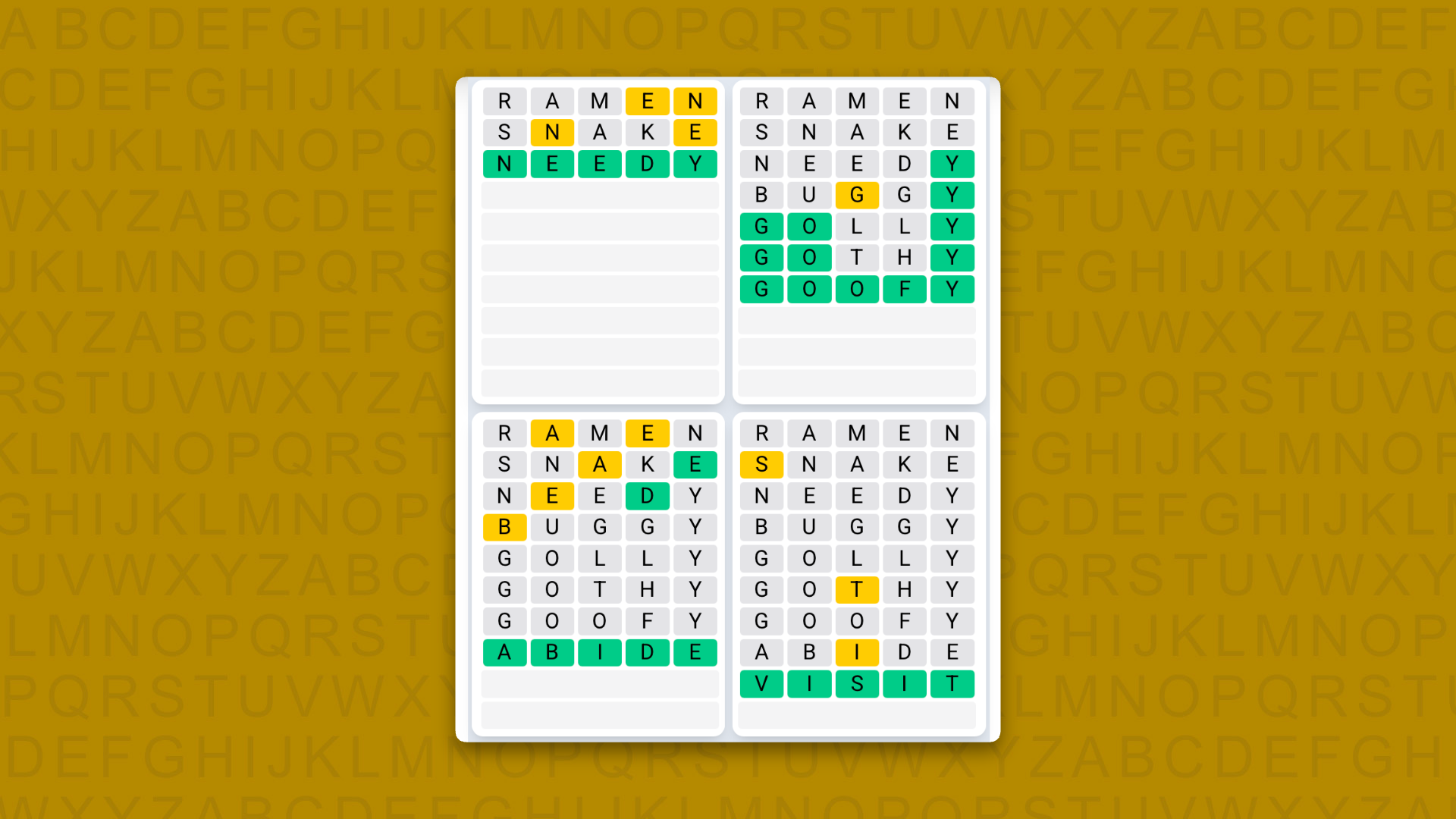
A new Quordle puzzle appears at midnight each day for your time zone – which means that some people are always playing 'today's game' while others are playing 'yesterday's'. If you're looking for Wednesday's puzzle instead then click here: Quordle hints and answers for Wednesday, July 15 (game #1633).
Quordle was one of the original Wordle alternatives and is still going strong now more than 1,500 games later. It offers a genuine challenge, though, so read on if you need some Quordle hints today — or scroll down further for the answers.
Enjoy playing word games? You can also check out my NYT Connections today and NYT Strands today pages for hints and answers for those puzzles, while Marc's Wordle today column covers the original viral word game.
SPOILER WARNING: Information about Quordle today is below, so don't read on if you don't want to know the answers.
Quordle today (game #1634) — hint #1 — Vowels
How many different vowels are in Quordle today?
• The number of different vowels in Quordle today is 4*.
* Note that by vowel we mean the five standard vowels (A, E, I, O, U), not Y (which is sometimes counted as a vowel too).
Quordle today (game #1634) — hint #2 — repeated letters
Do any of today's Quordle answers contain repeated letters?
• The number of Quordle answers containing a repeated letter today is 2.
Quordle today (game #1634) — hint #3 — uncommon letters
Do the letters Q, Z, X or J appear in Quordle today?
• No. None of Q, Z, X or J appear among today's Quordle answers.
A new NYT Strands puzzle appears at midnight each day for your time zone – which means that some people are always playing 'today's game' while others are playing 'yesterday's'. If you're looking for Wednesday's puzzle instead then click here: NYT Strands hints and answers for Wednesday, July 15 (game #864).
Strands is the NYT's latest word game after the likes of Wordle, Spelling Bee and Connections – and it's great fun. It can be difficult, though, so read on for my Strands hints.
Want more word-based fun? Then check out my NYT Connections today and Quordle today pages for hints and answers for those games, and Marc's Wordle today page for the original viral word game.
SPOILER WARNING: Information about NYT Strands today is below, so don't read on if you don't want to know the answers.
NYT Strands today (game #865) - hint #1 - today's theme
What is the theme of today's NYT Strands?
• Today's NYT Strands theme is… Rerouting…
NYT Strands today (game #865) - hint #2 - clue words
Play any of these words to unlock the in-game hints system.
NOISE
CHANCE
VERSE
TRUANT
GIVE
SKATE
NYT Strands today (game #865) - hint #3 - spangram letters
How many letters are in today's spangram?
• Spangram has 12 letters
NYT Strands today (game #865) - hint #4 - spangram position
What are two sides of the board that today's spangram touches?
• First side: left, 4th row
• Last side: left, 8th row
Right, the answers are below, so DO NOT SCROLL ANY FURTHER IF YOU DON'T WANT TO SEE THEM.
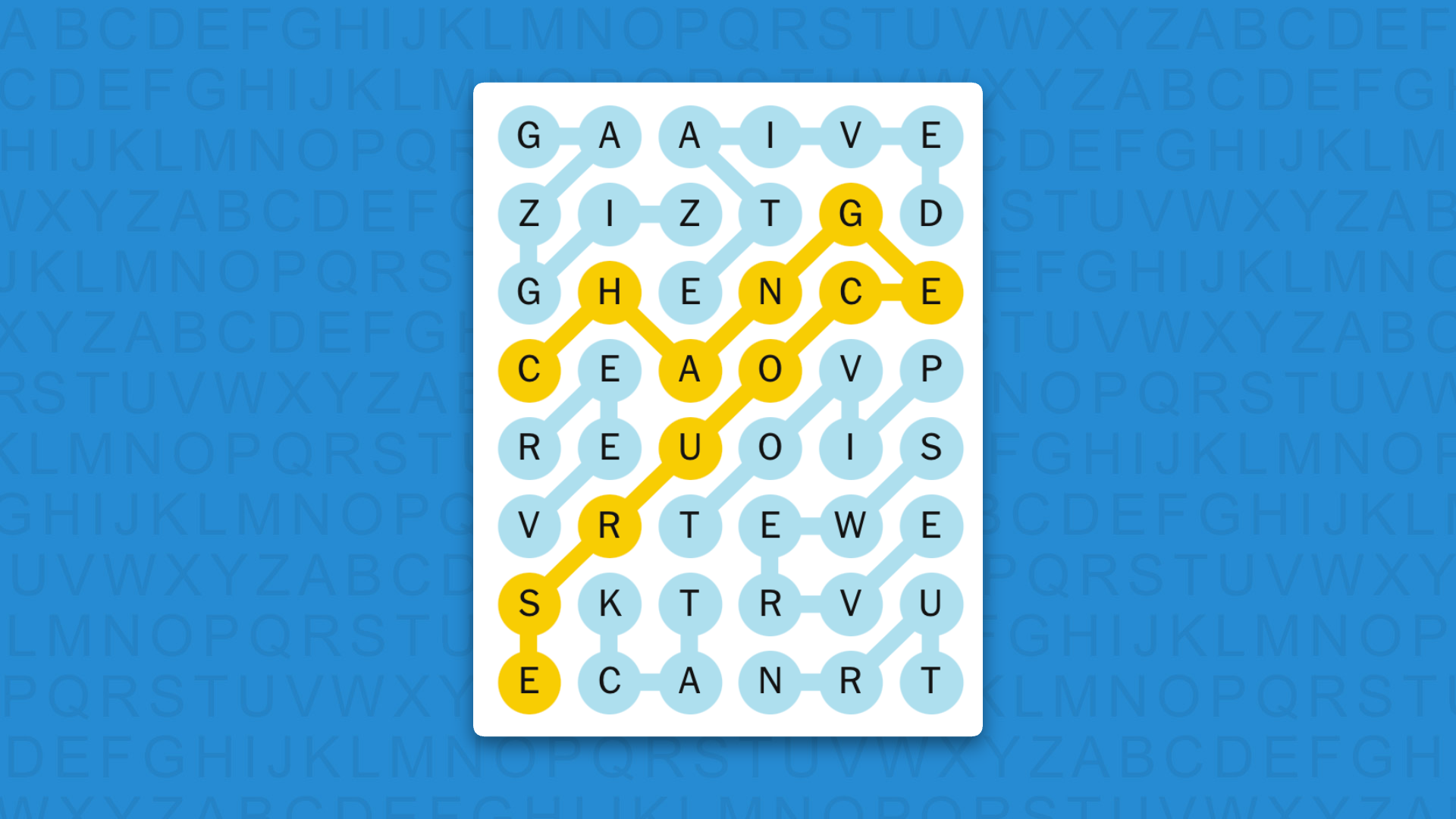
NYT Strands today (game #865) - the answers
(Image credit: New York Times)
The answers to today's Strands, game #865, are…
TACK
ZIGZAG
TURN
VEER
DEVIATE
PIVOT
SWERVE
SPANGRAM: CHANGECOURSE
My rating: Hard
My score: 1 hint
Rerouting… is a word I used to see a lot when I used a sat nav in my car, so this is exactly the theme I was expecting — but I still struggled over it.
It’s not until you play Strands that you realize how many different ways there are to say the same thing, in this case a change of direction.
I took a hint to get going, but TACK didn’t help much. Then, I connected the two Zs for ZIGZAG and finally got motoring.
Yesterday's NYT Strands answers (Wednesday, July 15, game #864)
QUIXOTIC
IDEALISTIC
ROMANTIC
IMPRACTICAL
SPANGRAM: PIEINTHESKY
What is NYT Strands?
Strands is the NYT's not-so-new-any-more word game, following Wordle and Connections. It's now a fully fledged member of the NYT's games stable that has been running for a year and which can be played on the NYT Games site on desktop or mobile.
I've got a full guide to how to play NYT Strands, complete with tips for solving it, so check that out if you're struggling to beat it each day.
Geopolitical tensions are mounting, and nation states are employing new types of strategies to gain intelligence. A recent Five Eyes warning, for example, accused Chinese military intelligence officers of using professional networking sites and online job platforms to target individuals of interest.
In this specific case, the agents pose as recruiters advertising seemingly legitimate work to build relationships and, ultimately, get their hands on non-public information. Popular sites like LinkedIn, Indeed and Upwork have all seen this new type of attack take place.
At the same time, a parallel threat sees operatives applying for jobs within trusted organizations with access to intelligence, creating insider threats that experts warn AI might be mostly responsible for.
Generative AI, for example, can create documents, write applications and even supply live answers during real-time remote interviews, meaning that a small group of fake applicants can extend their reach much more quickly.
Rather than attacking existing workers, nation states are creating their own job candidates
Once inside an organization and with access to company tools like PCs, emails and other internal systems, nation state spies can then move laterally to acquire the information they sought.
Security experts at Exabeam warn that, because this technique is still evolving, it might not always be so easy to spot. Additionally, motives can differ, with Chinese intelligence operations typically seeking military, political or economic information. North Korean agents, on the other hand, tend to be tied to stealing money, which could also come with the side effect of data and intelligence theft.
Exabeam even observed this type of attack first-hand, when a North Korean-affiliated applicant used a false identity to apply for a job at the company. After passing technical tests, a video interview and other standard checks, the suspect’s laptop was quickly flagged for unusual activity.
In the following Q&A with AI Strategy and Security Research VP Steve Povolny, I discuss these new types of attacks, who’s responsible for stamping them out and what we can do to prevent similar incidents from happening more commonly.
The Five Eyes alliance recently warned that foreign intelligence groups are using job platforms to recruit insiders. How significant is this threat, and what is driving its growth?
This is among the most serious access-driven threats facing cleared workers, and it keeps growing because the economics now favor the attacker.
Foreign intelligence services no longer need handlers and dead drops when they can post a job ad on LinkedIn or Upwork and let candidates self-select based on the access listed in their own resumes. Generative AI lets them run thousands of these conversations at once, drafting outreach and scoring which applicants sit closest to sensitive information without a trained officer.
The Five Eyes alert describes a scaled, automated funnel, and that scale is what makes it dangerous.
A parallel risk runs alongside that warning: adversaries who secure employment directly rather than recruiting an existing employee. Which scenario presents the greater defensive challenge, and why?
The infiltration model gives defenders less to work with, which makes it the harder problem. When an adversary recruits someone already on staff, most of the suspicious behavior happens outside the company on platforms the employer never sees, yet the insider remains a known person with a verified identity and a real history.
When the adversary becomes the employee, the company has onboarded a fabricated person and handed them a laptop and standing network access on day one. No behavioral baseline exists, since everything that account does counts as a first. The deception also clears the controls most organizations trust, so the failure lands before any security tool gets a vote.
Exabeam identified a North Korea-affiliated individual who gained employment at the company. How did the operative clear Exabeam's hiring process, and what first signaled that something was wrong?
He cleared it by performing well on the parts we test and forging the parts we verify. Applying under the alias Trevor Rothluebber, he aced the technical interview and take-home assessment, passed the video interview and cleared our standard pre-employment process including the background check and I-9 validation.
Our hiring team flagged a suspicion that he leaned on generative AI for live help during the video call, the first soft signal. The hard signal arrived the moment he logged into his corporate account. Our threat intelligence feed matched his username to activity previously associated with North Korean operatives and rated it high risk, and that single match reframed how the team read everything that followed.
Simultaneously, Exabeam’s platform detected a number of anomalies inconsistent with a brand new employee’s first day, and escalating in severity within hours. Incident response quietly isolated and reimaged his laptop before any real damage could be done.
The candidate completed applications, interviews and assigned work without raising alarm. In retrospect, what indicators were present, and why did standard screening miss them?
The indicators existed, but they lived in places our screening was never built to read. The driver's license he submitted was either AI-generated or very badly manually modified, and the tell was physical. The image had unique aberrations, such as the ears in the photo which had an unnatural and pixelated modification an artifact that image generators still produce, and a reviewer skims past.
The live AI assistance during the interview was another, since his answers carried a fluency that did not match the natural hesitation you expect when someone reasons through an unfamiliar problem. Standard screening missed all of it because background checks and identity validation confirm whether documents are internally consistent and whether a record exists, and they never ask whether the human attached to those documents is real.
Further fabrication of documents such as I-9 were missed by a 3rd party identity verification company, and validation of (fake) job references was not properly identified.
How did AI contribute to the deception? What did the fraudulent documentation involve, and what capabilities does AI introduce that traditional forgery methods lack?
AI showed up at nearly every stage. The fraudulent documentation centered on a forged driver's license we believe was generated rather than physically produced, paired with a stolen identity that gave the paperwork a real history to rest on.
During the interview the candidate appeared to have run an AI copilot feeding him answers in real time, and many of these tools now stay invisible to everyone else on the call even while the candidate shares a screen. What AI adds over traditional forgery is volume and believability together. A skilled forger could always produce one convincing passport, but the craft capped how many operations could run at once.
Generative tools remove that ceiling, so a single actor can fabricate convincing documents and coach themselves through a live technical interview across dozens of applications at once, and the forgery stopped being the bottleneck it used to be.
The Five Eyes warning focused on China, while the Exabeam case involved North Korea. Do these actors share tactics and objectives, or do they represent distinct operational models that overlap on method?
They overlap heavily on method while running on different motives, which defenders should sit with. The Chinese operation the Five Eyes described aims at intelligence collection, pulling government and military insight out of people who already hold access.
The North Korean program that hit us and so many others in this industry is funded differently, since much of its purpose is revenue for a sanctioned regime, with intrusion and theft riding alongside the paycheck. The objectives diverge, yet the tradecraft has converged on one toolkit of fabricated identities, AI-assisted documents, manufactured professional histories and the patient relationship-building that lets an operative stay quiet.
When two adversaries with separate goals reach the same playbook, that tells you the playbook works and other actors are already watching.
Conventional insider threat programs are built to detect employees who become compromised over time. How should organizations identify a candidate who was an adversary from the point of hire?
Our mindset must shift toward treating the moment of hire as the start of the highest-risk window rather than the end of vetting. Traditional insider programs watch for drift, the employee who gradually turns after a financial shock or a grievance, so they depend on a baseline built over months.
A candidate who was hostile from day one never produces that baseline, which forces you to scrutinize the earliest behavior most closely. In our case, the catch came from putting new accounts under enhanced monitoring and letting an AI agent correlate scattered signals that no single alert would have justified escalating.
The working principle is to give hiring workflows and new-hire activity the same suspicion you already apply to production access.
Where should accountability for this threat reside within an organization? Is it a security function, an HR function, or a gap that persists because ownership is unclear?
Accountability most often lives in the gap right now, and that gap is exactly why the threat works. Hiring sits with HR and talent acquisition, who are measured on filling roles quickly and are not equipped to run identity verification at an intelligence-grade level.
Detection sits with security, which usually gains no visibility into a candidate until that person already holds a badge and a laptop, and the adversary exploits the seam between the two.
The workable answer is shared ownership with a clean handoff, where security sets the identity and behavioral standards hiring must meet and stays involved through the first weeks of employment rather than inheriting the problem once onboarding closes.
Many mid-sized companies lack dedicated threat intelligence resources. What practical measures can such organizations implement to reduce their exposure?
Useful defense does not require a dedicated threat intelligence team. The interview itself is the cheapest control available, and small changes make it far more revealing.
Underspecifying a problem on purpose shows whether a candidate asks clarifying questions like a real engineer or simply produces a confident answer and switching the problem partway through tests whether they adapt or whether something is feeding them responses.
Asking for an external webcam that shows the workspace instead of a shared screen removes one of the easiest hiding spots for an interview copilot. Beyond hiring, the highest-leverage move is placing every new employee on a watchlist for closer monitoring through their first weeks, which costs configuration time rather than budget.
Even a basic, low-cost threat intelligence feed would have surfaced the username match that broke our case open.
What is the most contested prediction on this issue, one that many security leaders would currently dispute?
My contested prediction is that within a couple of years the verified human interview, run live and in person for any role with meaningful access, returns as a security requirement. Many security leaders will fight that because it breaks the remote-first hiring model they spent years optimizing.
The objection I expect is that it does not scale and shrinks the talent pool, and those concerns are legitimate. My counter is that the economics have already flipped for high-access roles, since the cost of onboarding a single fabricated adversary now dwarfs the friction of one in-person verification step.
The deeper claim underneath it is that remote identity verification as we practice it today is no longer reliable for sensitive positions, and AI is what made it unreliable. Most security leaders are not ready to say that out loud yet.
Group‑IB warns of scams exploiting Celine Dion’s concert comeback, with fraudsters selling duplicate Ticketmaster tickets and spoofing sites like AXS and Paris La Défense Arena
Scammers embed themselves in Facebook fan groups and marketplaces, even using voice messages to build trust and make fake offers seem legitimate
Fans are advised to only buy from official distributors, verify tickets in person if using resellers, and contact banks to dispute charges if scammed
Celine Dion is back, and hackers are already trying to exploit the fact for their own financial gain, experts have warned.
A report from security researchers Group-IB has claimed there are numerous scam campaigns all across the internet and social media, looking to exploit gullible fans and steal their money.
Its aptly named “The Scam Will Go On” report said it saw scammers lurking in Facebook Groups, Facebook Marketplace, and other fan-centric spaces, offering concert tickets for sale. The tickets themselves, hosted on Ticketmaster, are valid. However, the scammers only have a few tickets which can be redeemed by the first person who reaches the venue. Everyone else will be denied entry, since their tickets will already have been used.
How to avoid getting scammed
But that’s not the only scam. Some people don’t want to pay an unknown third person via wire, and would prefer to purchase the tickets directly from a service.
For those people, the scammers created entire websites, spoofing ticketing distributors such as AXS and Ticketmaster. Group-IB also saw fake websites spoofing Celine Dion and Paris La Défense Arena, the stadium where the concert will take place.
“We see that such an event generates excitement and provides scammers with another opportunity to make a fortune at the expense of unsuspecting fans,” Group-IB warned.
“Scammers are using increasingly sophisticated techniques, such as embedding themselves into social networking fan groups and speaking directly to their victims via voice messages to make the interaction more personal and gain their victims’ trust more easily. Furthermore, official ticketing platforms are being misused to make scams seem legitimate.”
The researchers recommend fans only visit official websites and those of official distributors, and if they absolutely must buy from a reseller, to make sure they’re purchasing a physical ticket, in person. Those that fell for the scam should call their bank and lodge an objection on their credit card.
Red Hat OpenShift 4.22, an update to the company’s hybrid cloud application platform, is now generally available. The release focuses on cutting cloud infrastructure costs, simplifying operations of virtualized workloads, and securing sensitive data.
Announced July 14, Red Hat OpenShift 4.22 continues to harden the platform foundation to meet growing security standards, helping reduce the manual effort of compliance and risk mitigation, Red Hat said. The introduction of a minimal Red Hat Universal Base Image (UBI) strips away non-essential packages to reduce the overall attack surface. With Red Hat OpenShift sandboxed containers 1.12, OpenShift 4.22 makes support for confidential containers on bare metal generally available.
The OpenShift 4.22 release also introduces confidential AI as a technology preview. With confidential AI, organizations can isolate and run highly sensitive workloads and proprietary AI algorithms inside a cryptographically isolated slice of memory and CPU, providing data privacy even during runtime execution, according to Red Hat.
OpenShift 4.22 also brings new Red Hat OpenShift Virtualization capabilities. A new Ethernet virtual private network integration with user-defined networks allows teams to connect containerized and virtualized workloads to external infrastructure. Volume groups now can be used to execute multi-volume snapshots for VMs, providing a crash-consistent backup mechanism that simplifies disaster recovery. And the introduction of two-node OpenShift with fencing provides a highly resilient and resource-efficient option for constrained edge environments, Red Hat said.
In addition, OpenShift 4.22 offers new platform capabilities designed to optimize resource usage and lower operational overhead. The Red Hat build of Karpenter, an open source auto-scaler that right-sizes compute instances for Kubernetes clusters, is now generally available for Red Hat OpenShift Service on AWS with hosted control planes. And customers running Red Hat OpenShift Service on AWS with hosted control planes now can integrate AWS EC2 Spot Instances for fault-tolerant workloads to save on costs.
Finally, Red Hat OpenShift 4.22 introduces the JobSet operator to streamline large-scale distributed training runs and LLM fine-tuning. This framework coordinates multiple related jobs as a single unit, maximizing the use of expensive GPU compute.
Governor Kathy Hochul issues executive order enacting a moratorium on the large, resource-intensive AI facilities
New York became the first US state to enact a moratorium on new datacenters on Tuesday.
Governor Kathy Hochul issued an executive order mandating a one-year statewide pause on the large facilities used to power artificial intelligence products, which she signed at a mid-morning press conference.
A combination of fact and fiction leaves the celebrated documentarian’s puzzling project about software training wanting for depth
Marc Isaacs’ new film is a curious, intriguing, semi-sincere affair that I couldn’t make friends with. It is an odd, shallow piece of work about artificial intelligence that is itself exasperatingly artificial, a self-aware docudrama hybrid. Isaacs is, or rather pretends to be, licensing the vivid characters from his previous, acclaimed documentaries to a fictional AI research lab called Synthetic Sincerity at the fictional University of Southern England, so that the lab’s software can be “trained” in the creation of AI human figures on screen.
The lab’s research staff are played by actors, or at any rate people acting; these include Lebanese independent film-maker Lynn El Safah. Isaacs has amusing scripted conversations about this project with a disapproving AI avatar on screen, like Max Headroom of old, whose face is digitally modelled on Romanian actor Ilinca Manolache, from Radu Jude’s Do Not Expect Too Much from the End of the World. The film, however, does not show the process by which Manolache was approached and her face transformed into an AI figure.
It’s been several years since generative AI and large language models (LLMs) took the world by storm. LLMs surpassed earlier natural-language systems at generating text, while diffusion models enabled generating images, music, and videos.
These generative AI models work well in the digital world, but on their own, they have limited capabilities to comprehend the three-dimensional physical world and other spaces. This includes the objects occupying an area, how they relate to each other, tracking movement, and answering complex questions requiring an understanding of dimensions, distances, motion, and collisions.
Spatial intelligence is an AI capability that allows models to reason about three-dimensional space. These models can generate 3D scenes of the world and other spaces. This content can then be displayed through traditional renderers, game engines, or AR/VR systems that use spatial computing techniques. But it’s the spatial intelligence model’s ability to connect natural language with 3D models that has the most applications in robotics, manufacturing, construction, and other physical environments.
Dr. Fei-Fei Li, often called the godmother of AI, published a manifesto on how spatial intelligence is AI’s next frontier, contrasting it with LLMs. “While current state-of-the-art AI can excel at reading, writing, research, and pattern recognition in data, these same models bear fundamental limitations when representing or interacting with the physical world,” wrote Dr. Li. “Our view of the world is holistic—not just what we’re looking at, but how everything relates spatially, what it means, and why it matters. Understanding this through imagination, reasoning, creation, and interaction—not just descriptions—is the power of spatial intelligence.”
The concept of spatial intelligence isn’t new and was described in Howard Gardner’s book, Frames of Mind, in 1983. Recent breakthroughs, including the launch of World Labs’ Marble and its $1 billion funding round, and competing approaches from Google’s Genie 3 and Nvidia Cosmos, should put spatial intelligence and world models on more R&D road maps.
What are spatial intelligence models?
It’s important to develop AI literacy and understand the terminology and concepts related to the physical world and 3D AI technologies:
Spatial intelligence encompasses specialized approaches such as geospatial models for mapping the physical world and building information modeling (BIM) for modeling physical structures. It also extends to generative 3D, robotics, and physical reasoning applications.
World models are a class of neural network architectures and are currently a prominent approach to building spatial intelligence.
Digital twins are live, virtual replicas of physical assets that combine 3D models with real-time sensor data. Spatial intelligence, an emerging capability of digital twins, adds natural-language prompting, generative scenario exploration, and physics-aware reasoning.
Spatial computing refers to digital content anchored in and interacting with physical space, sensed and rendered in three dimensions and delivered through AR/VR and mixed-reality systems.
“Spatial intelligence models go beyond pixels to understand the 3D structure of the world—how objects are positioned, how they move, and how they interact,” says David Fattal, founder and CTO at Leia. “This enables applications like more realistic video generation, spatial computing interfaces, and AI systems that can reason about physical environments. As real-world 3D data becomes more available, these models will become foundational to the next generation of visual AI.”
Monitoring the built environment
To better understand spatial intelligence, let’s consider physical infrastructure such as bridges and buildings. The American Society of Civil Engineers estimates a $9.1 trillion investment is needed from 2024 through 2033 to achieve a state of good repair. When maintenance and monitoring lag, it can lead to major failures such as the 2022 collapse of the Fern Hollow Bridge in Pittsburgh.
Spatial intelligence and the development of digital twins may help identify issues earlier and prioritize where investments are needed. “Spatial intelligence models serve as the 4D digital blueprints for our built environment, allowing us to visualize and predict the complex interactions between aging assets and the shifting ground beneath them,” says Patrick Cozzi, chief platform officer at Bentley Systems. “By synthesizing disparate geospatial data into a living digital twin, these models provide the foresight necessary to mitigate the hidden risks of structural fatigue and subsurface instability.”
There’s a significant challenge in bridge health monitoring and transitioning from manual, infrequent structural inspections to leveraging sensors, digital twins, and spatial intelligence. Cozzi adds, “This integration of continuous field data moves beyond static documentation, empowering agencies to evolve from reactive repairs to proactive, resilient asset management that safeguards the long-term integrity of our most critical public systems.”
Avoiding collisions
Bridges are largely static, but the real world is increasingly being occupied by autonomous systems such as self-driving cars, robots, and drones. And where there are moving systems, there is a risk of collisions.
“Spatial intelligence models are AI systems that reason about the physical world by combining vision, sensor data, and contextual cues to understand space, motion, and object relationships,” says Sudeep George, CTO at iMerit. “The value of spatial intelligence models lies not just in perceiving an environment, but in enabling machines to act within it safely and in real time. That is especially important in robotics and autonomous systems, where decisions must be made in complex, multimodal, fast-changing settings.”
To see one example, this tutorial for simulating robotic environments combines Nvidia Isaac Sim, an open source robotics reference framework, with spatial intelligence in Marble from World Labs.
Today’s collision detection systems, such as those used in autonomous vehicles, typically rely on modules for sensing, perception, planning, and control. Spatial intelligence models may offer improvements by assessing the collision risks of unidentified objects or by tracking objects that move out of sensor view. For example, Waymo’s World Model, built on Genie 3, is a simulator that generates complex weather conditions and other critical safety events.
For an out-of-this-world example, James Urquhart, field CTO and technology evangelist at Kamiwaza, has delivered several examples of spatial intelligence applications, including one for satellite collision detection and conflict analysis. Urquhart says, “Models that specialize in these types of data sets, as well as the physics and geography of the real world, enable faster and more accurate decision-making for tasks that depend on them.”
Applying spatial intelligence
Recent spatial intelligence announcements include creating 3D worlds from image or text prompts with Marble and simulating water physics, lighting, weather, and animal behavior with Genie 3. But difficulties remain in bringing spatial intelligence to physical-world use cases.
“Spatial intelligence and world models are laying the groundwork for future AI agents that will be able to interact in and with our physical world,” says Jason Corso, cofounder and chief scientist at Voxel51. “These models are significantly more challenging to develop and test, largely because the data underlying their development is complex, and it’s hard to handle all of the combinatorics involved in the physical world.”
In addition to learning the models and prototyping with them, development and data leaders need to review the data assets that will feed spatial intelligence models. “Spatial intelligence models translate location signals into a structured understanding of the real world, but they’re only as reliable as the data beneath them,” says Dan Adams, executive vice president and general manager of Enrich at Precisely. “The real unlock isn’t the model—it’s the reference layer with persistent identifiers, confidence metadata, and source lineage that lets AI reason about places, not just match strings.”
Even once applications are developed, there will be infrastructure challenges in deploying them at the edge. Ali Kayyam, principal research scientist at BrainChip, says, “The key to unlocking spatial intelligence at scale is having the low-power, event-driven hardware that can run it at the sensor in real time where it matters most.”
Where to get started
My suggestions for developers looking to get hands-on with spatial intelligence and world models:
The model of the forward deployed engineer is sweeping through enterprise IT like a gold rush, and I’m concerned that many companies don’t understand what they’re signing up for.
Let’s start with the headline numbers. AWS announced a $1 billion investment in a new Forward Deployed Engineering organization. Google Cloud committed $750 million to expand similar programs. Microsoft has been running Azure-focused embedded engineering teams for years, including partnerships with Accenture to scale forward deployed engineering practices. All three are pitching the same story: We’ll send engineers to work directly with your teams, help you deploy AI, and accelerate your digital transformation. You get top-tier technical talent for free, and we get to partner with you on your journey.
It sounds reasonable on the surface. It sounds collaborative, even generous. But I’ve been in this industry long enough to know that when a multi-billion-dollar company offers you something for free, they’re sure to get much more than they give.
What you actually get
The forward deployed engineer model isn’t new. The consulting industry has been doing some version of it for decades. What makes this different is the scale and the direct financial incentive behind it.
These engineers work for the cloud provider. They’re not your employees. They’re not independent consultants. They’re technically excellent professionals who are being paid to solve your immediate problems while simultaneously building relationships and architectures that favor their employer’s ecosystem. Think about it from their perspective. Those forward engineers are evaluated on whether customers succeed with their employer’s platform. They’re rewarded when enterprises adopt more services from that platform. Their career advancement depends on making AWS, Google Cloud, or Microsoft Azure the obvious choice for all of your technical decisions.
This isn’t a criticism of the individual engineers. Many of them are genuinely talented and genuinely want to help. But they’re operating within a system that rewards specific outcomes, and those outcomes align with the vendor’s financial interests, not necessarily yours.
The problem no one talks about
Here’s what I see happening at enterprises right now. A company decides they need help deploying AI. A cloud provider offers to embed engineers at no additional cost. Those engineers work alongside internal teams, make architectural recommendations, and help build out systems. Six months later, the company has a production AI system running on a single cloud platform, built by people with deep expertise in that specific platform.
The problem? Nobody evaluated whether that platform was actually the best choice for the business. Nobody looked at alternatives. Nobody asked whether a multicloud architecture or best-of-breed approach might deliver better results at lower cost.
The engineers embedded in these programs are not going to recommend that you split your workloads across providers. They’re not going to suggest you use open source tools where they make sense. They’re not going to point you toward a competitor when their employer’s solution will work well enough. That’s not how these programs are designed to function. What you’re getting is optimized architecture for a single cloud brand, not optimized architecture for your business.
The financial reality will hit
The bills are going to come due, and they’re going to be painful. I’ve watched this pattern play out before. When enterprises lock into a single cloud provider through these embedded engineering programs, they often discover two or three years later that they’re paying premiums that their more independent-thinking competitors avoided.
The reasons are straightforward. When you’re architecting systems around a single platform, you naturally fall into usage patterns that favor that platform’s pricing structures. You use their managed databases instead of portable alternatives. You adopt their AI services instead of evaluating third-party options. You build workflows that only work within their ecosystem. And when it comes time to renegotiate or benchmark against alternatives, you find that migrating would cost more than accepting whatever pricing they offer.
I’ve spent the past decade helping companies untangle from these situations. I’ve seen organizations with cloud bills 15 to 20 times higher than they should be, unable to migrate because their entire AI infrastructure is built on proprietary services that only work on one platform. The forward deployed engineer programs are accelerating this problem. They’re making it easier to get into these situations and harder to get out.
Think before you commit
Before you accept one of these programs, consider these three recommendations.
First, require independent architecture oversight from day one. Hire or engage architects who work for your company, not for your cloud provider. They should evaluate every recommendation made by embedded engineers against business requirements and compare options across providers. This isn’t about being suspicious of the engineers. It’s about ensuring that decisions are made with your interests in mind.
Second, demand a clear exit strategy before you begin. Ask the cloud provider to document which proprietary services you’re using, what migration paths exist, and what the cost would be to move to an alternative platform. If they can’t provide that information, or if the migration costs seem impossibly high, that’s a sign that you’re building technical debt that will be very expensive to service later.
Third, benchmark your costs continuously. Set up internal processes to compare your cloud spending against industry benchmarks and against what your competitors might be paying for similar workloads. Don’t wait until your contract renewal to discover that you’re paying premium prices. Monitor expenses from the beginning, and be willing to challenge your cloud provider if you’re not getting value that justifies the cost.
The bottom line
The forward deployed engineers are solving real problems. Enterprises genuinely struggle with AI deployment, and having experienced engineers available to help is valuable. I’m not suggesting these programs are fundamentally bad. However, they’re being marketed as neutral partnerships when they’re actually strategic sales programs designed to lock enterprises into specific platforms. The helpful engineers showing up at your office are building dependencies that will be very difficult to break. The “free” technical assistance is being funded by margins on services you’ll be buying for years.
Go in with your eyes open. Use these programs but add your own independent oversight. Build architectures that you could leave if you needed to. And don’t let the immediate satisfaction of having problems solved today blind you to the financial consequences that will arrive tomorrow.
The machine that could change the world will be housed in a room that looks like a data center crossed with an ice cream factory. Inside will be some 100 stainless-steel cabinets, each about six feet tall and connected to a supply of liquid helium that keeps them only a few degrees above absolute zero. Inside those cabinets will be hundreds of chips, and on those, thousands of particles of light flying through a maze of optical switches and beam splitters. Each photon must be accounted for, because precisely measuring where it ends up will help answer questions that current computers might take millions of years to solve.
This computer, as described, does not exist. It’s the brainchild of a company called PsiQuantum, founded in 2016 by four physicists from UK universities. In a crowded field of deep-pocketed competitors with similarly fantastical visions, the company aims to be first to fulfill its promise.
In the years since the physicist Richard Feynman first envisioned them in 1981, quantum computers have promised to speed up everything from medical research to AI by harnessing the qualities of quantum particles. Unlike normal computer bits, which can be either a 1 or 0, quantum bits can exist in multiple states at once. And combining enough of those quantum bits together could produce a computer capable of tasks well beyond the reach of today’s conventional machines. But even today’s best quantum prototypes are too small and error-prone to do anything useful.
That makes PsiQuantum’s promises for what its computers will ultimately do all the more bold. Consider the company’s hopes for predicting the effects of cytochrome P450 enzymes, which often break down drugs in the body. If pharma companies knew more precisely how they would work on a particular molecule, they could design more effective medications faster. Estimating this for a specific drug can take over 10 years with today’s methods, says Philipp Ernst, vice president of quantum applications for PsiQuantum, but “we aim to get it down to four minutes.”
The company’s chips will be contained in large cabinets. A quantum computer powerful enough to be commercially useful is expected to require roughly 100 of these cabinets connected together.
COURTESY OF PSIQUANTUM
In a field full of such claims, PsiQuantum has attracted unusual investment and scrutiny for two reasons: It is one of the few companies aiming directly at building a large and useful machine, and it is already working with a major chip manufacturer to build its systems using existing semiconductor fabs. Its vision has attracted momentum: Last year, PsiQuantum raised $1 billion in funding and broke ground in Chicago on a site it’s building in partnership with local governments. It also has a second site in the works in Australia, which it promises will be operational—meaning hardware-ready—in 2027. And it’s one of just two companies (along with Microsoft) to reach the third stage of an intensive government evaluation program to see which quantum companies might succeed.
Evaluating whether PsiQuantum will do what it says is harder than, say, judging a drugmaker by its clinical trial results: Advances in quantum computing are incremental, opaque, and tough to verify from the outside. But the company is now approaching its prove-it moment, when years of closed-door work and hundreds of millions in investment will either culminate in a useful quantum computer or fall short. We could start to know which as soon as next year.
A new kind of machine
Terry Rudolph, one of PsiQuantum’s four founders, is soft-spoken and shaggy-haired. He was born in Malawi and learned only after earning his first physics degree that he is a grandson of the famed physicist Erwin Schrödinger. He later self-published a 150-page book to explain quantum computing to teenagers (my PR contact gave me a signed copy with a wink that said “We never expect anyone to actually read this,” but I can report that it is a funny and helpful book).
Around 2014, Rudolph and his cofounders became increasingly convinced that the quantum breakthroughs they were finding to be possible in theory might also be possible in a real machine. They eventually left their academic positions and divided the tasks before them: Rudolph worked on theory, Mark Thompson on engineering, Pete Shadbolt on scaling the technology up, and Jeremy O’Brien on articulating the vision and finding investors (O’Brien served as CEO until February; he’s been replaced by Victor Peng, a veteran of the semiconductor industry).
To understand why the quantum computer the company is building would be a big deal, consider how imprecise much of modern science remains. We cannot reliably predict, for example, which lithium-ion battery will catch fire or how quickly a critical aircraft component will corrode.
This isn’t just because these systems are complex, though they are. It’s that, at their core, they are governed by quantum mechanics. Subatomic particles don’t have well-defined properties—this location and that velocity—but instead occupy quantum states spread across many possibilities. And that in turn influences a range of atomic and molecular behavior. Schrödinger (Rudolph’s grandfather, remember) showed how to describe this haziness mathematically a century ago this year, but precisely carrying out the calculations on real-world systems quickly becomes unfeasible even for the best computers. Scientists cope with this gap using approximations, imperfect simulations, or experiments on animals.
WINNI WINTERMEYER
WINNI WINTERMEYER
PsiQuantum co-founder and chief scientific officer Pete Shadbolt (left), and machinery the company has built to manufacture its own barium titanate, a material with the perfect qualities for routing light particles (right).
Feynman, David Deutsch, and other physicists in the 1980s wondered if we could do better. Maybe such complexity could instead be modeled using a new kind of machine. Rather than using transistors that are only ever on or off, this one would use particles held in quantum states, manipulate them to perform calculations, and then measure them at the end for an answer. Using quantum systems to simulate quantum systems would for the first time allow a simulation of physics and chemistry that directly reflected reality. It would be an invaluable tool for designing new drugs, materials, or really anything affected by quantum mechanics. Revolutionary, in other words.
Humankind’s leaps in understanding how nature works have often resulted in the invention of powerful new tools, Rudolph told me. “I don’t think it’s a coincidence that the Industrial Revolution coincided with our ability to calculate and simulate the laws of Newtonian mechanics, the laws of thermodynamics,…the laws of classical electromagnetism,” he says. “Whenever we have more power to calculate and simulate and understand things, we build incredible machines that come from it.” He sees something similar coming with quantum computers.
Chasing photons
One mystery has always been which quantum thing—ions, atoms, or something entirely new engineered with quantum properties—could be made stable and controllable enough to use as a qubit, the basic unit in the quantum computing world. Quantum systems are delicate, and observing any particular particle causes it to collapse into one state rather than a superposition of multiple states. If this happens during the computation rather than at the end, it produces an error that must be corrected for. Too many of these means the computer fails to produce a useful answer.
Just as engineers in the early days of aviation weren’t sure whether airplane wings would be fixed or flap like a bird’s, we’re not yet sure which of these quantum things will work best. Google and IBM are betting on superconducting qubits, superconducting circuits made of aluminum or other metals. Intel is using electrons. PsiQuantum is using photons, the particles that make up light.
“Photons have lots of nice things going for them,” Rudolph says. They can maintain quantum states for a long time; indeed, the photons in the universe’s cosmic microwave background may have done so for billions of years. But photons also move fast and scatter easily. More importantly, two photons are more likely to pass through one other than interact. That makes them a challenging candidate for quantum computation, in which qubits need ways to influence one another.
For a while, this last flaw seemed to doom the idea of quantum computing with light. But in 2001, researchers from the Los Alamos National Laboratory and the University of Queensland found a loophole. They discovered they could essentially fake interactions between photons by sending the light particles through a network of beam splitters and detectors. Their paper changed everything. PsiQuantum was created to make the theory a reality.
Size was the first problem; previous plans would have required a computer as large as California. Mercedes Gimeno-Segovia, who was a PhD student of Rudolph’s in the early 2010s (after almost becoming a professional violinist instead), thought of a way for the machine to be smaller.
The basic process since then has been this: First create photons with lasers and then “entangle” them, exploiting a quantum phenomenon in which the particles no longer have individual states but instead share one. Next, route them through a maze of gates that perform computations, and finally read out details of their quantum state at the end, all while tracking and correcting for the errors that occur. Succeeding at each of these steps millions of times is not so much an engineering hurdle as a brick wall. And building the supply chain—like manufacturing new materials with the qualities to route individual photons around—is arduous.
A sizable chunk of PsiQuantum’s funding is being spent on custom cooling machinery that uses tanks of liquid helium to cool the company’s chips. Shown here is part of the PsiQuantum’s cooling system at a facility in Milpitas, California.
COURTESY OF PSIQUANTUM
To get a sense of it all, last year I joined Shadbolt at the SLAC National Accelerator Laboratory, in Menlo Park, California. The center has helped produce several Nobel Prizes and played a role in the 1968 discovery of quarks, fundamental building blocks of matter that make up protons and neutrons. But PsiQuantum set up shop there essentially to siphon liquid helium from SLAC’s giant cryoplant. This is what the company uses to cool its computing cabinets down to deep-space temperatures.
Right now the cabinets operate at 2 K, or -456 °F, but the goal is to be able to run them slightly warmer—at a balmy -452 °F. Most quantum approaches require the whole machine to be cooled to superconducting temperatures, so that much of the expense in running it will actually be spent on refrigeration. But photonic computers require only one piece to be this cold—the detectors that measure single photons at the end of the computation. And the required temperature can be a bit higher. (PsiQuantum said in May that it will spend some of the $100 million award in CHIPS Act funding it’s slated to get on these detectors).
The siphoning setup was a temporary solution; PsiQuantum now has its own cooling system at its testing facility in Milpitas, California, and is setting up a larger one at its production site in Australia next year. These helium systems represent some of the biggest capital expenditures for any quantum company and will consume a significant chunk of PsiQuantum’s $1 billion funding round.
In the afternoon we drove to a lab in San Jose, where I donned a cleanroom suit—a head-to-toe covering that keeps dust at bay—to watch the manufacture of a blueish crystal called barium titanate.
It’s prized by PsiQuantum because it quickly and reliably routes light particles with very little electrical input, keeping the precious photons undisturbed as they move through the circuit. But for all barium titanate’s theoretical value to the company, its structure makes it a pain to manufacture, and the material wasn’t available at scale when PsiQuantum got its start. The company, in what Rudolph told me was an agonizing decision, opted to make it in-house, requiring a massive investment. I saw a technician—operating at what looked like a giant pressure cooker—adding the base elements to several hoppers; then I watched through a porthole as the elements got heated, vaporized, and finally crystallized into a thin layer on a wafer disc. At that time each disc took about 12 hours to make; the company now says several are produced each day. The discs then get shipped to the chipmaker GlobalFoundries in Malta, New York, where PsiQuantum’s chips are made.
WINNI WINTERMEYER
WINNI WINTERMEYER
The company has invested heavily in making its own barium titanate, a material whose delicate crystalline structure is tedious to manufacture.
PsiQuantum’s bet is that this entire supply chain, byzantine as it might sound, will make the company more efficient than its competitors. That’s because, if you squint, it looks like a souped-up and high-precision version of the existing supply chain for silicon photonic chips, another type of technology that transmits information with light—one that’s already used in data centers. If PsiQuantum produces its chips at scale, it can take advantage of tools and infrastructure that already exist.
But it’s not a given that one working chip can easily be wired up to thousands more. That’s why the company is testing in phases: Its Milpitas site has connected three cabinets together, with 250 chips in each, but the next step is to scale the systems up and see whether the company’s techniques for correcting errors can keep up. Once the cooling system arrives at the Australian site late next year, the company says, it aims to connect about 100 cabinets together. Then PsiQuantum will work up to running the world-changing algorithms it has promised.
The timeline for this, it’s worth noting, is up for debate. News articles have said that 2027 is the year that PsiQuantum aims to have its first full-scale quantum computer come online at its Australian site, but the company insists the deadline has been misread, and that it only intends for its facility to be “operational” by the end of next year. That means cooling systems in place and ready for hardware to be installed, but no promises about what size computer will be ready. In an industry where timelines are perpetually in flux yet central to how companies are judged, that distinction isn’t trivial.
Into the unknown
The outsider with perhaps the best guess of whether PsiQuantum will succeed is the Pentagon. The US Defense Advanced Research Projects Agency—the Pentagon’s research and development arm—has been running an initiative to determine which of the boastful quantum companies might actually deliver. In the last year and a half, the heads of the program have been sounding more confident. Joe Altepeter, who ran the program until last year and proudly described himself as a “quantum skeptic,” told me in March 2025: “I am more optimistic now than I have been at any point in the past 10 years.” And in a statement earlier this year, his successor, Micah Stoutimore, said “it now seems likely that someone will build a utility-scale quantum computer by 2033,” referring to a machine that generates more value from its calculations than it costs to build and operate.
The program has been scrutinizing PsiQuantum’s systems since 2023, and last year placed the company into the third stage of a benchmarking initiative meant to determine whether the technology will actually work. But to the rest of the industry, PsiQuantum is sort of a black box.
PsiQuantum has broken ground at the Illinois Quantum and Microelectronics Park outside Chicago, pictured here, and on another site in Moreton Bay, Australia. It aims to build large-scale quantum computers at each site.
COURTESY OF PSIQUANTUM
“It is very hard for an outsider to evaluate,” says Scott Aaronson, a theoretical computer scientist at the University of Texas at Austin who runs a popular blog that often covers the industry. Other companies, like Google and Quantinuum, have regularly published results over the years demonstrating chips and systems with incremental improvement, publicly laying the engineering groundwork needed to eventually build large machines.
PsiQuantum has instead focused squarely on a commercial goal—a computer with one million qubits, which is the scale that researchers expect to unlock research currently not possible on normal computers. PsiQuantum often differentiates itself with this industrial-scale goal, but IBM, which debuted a development road map in 2020, has been progressively building bigger and bigger systems. It initially targeted 2028 for a large-scale, error-corrected system, a deadline that now appears to have been pushed out to 2030.
Making it useful
On top of actually building the machine, a major focus for PsiQuantum is getting the rest of the world to develop a plan for how to use it. PsiQuantum has announced partnerships with customers including the defense giant Lockheed Martin, which intends to use it for materials design; the automaker Mercedes, which wants it for battery design; and the aerospace manufacturer Airbus.
That these companies don’t have a computer to experiment with is not a problem, according to Ernst at PsiQuantum. “There’s a PlayStation 6 probably coming up from Sony next year or the year after, and people are programming those games right now,” he says. “This is, in principle, very similar.” (It’s a glib analogy but not an entirely empty one; the quantum algorithms for solving a research problem can be cracked even if there is not yet hardware to run them on.)
The idea is that experts in quantum information from both PsiQuantum and its customers will be able to translate design problems—say, the requirements for a battery in a Mercedes electric vehicle—into algorithms the computer could solve. The company offers a software package called Construct, which companies can use to design their own algorithms that might one day run on the computer.
The future of quantum computing hinges on these algorithms. Quantum computers get painted as a speedup for everything, but in reality, they’re suited to a subset of problems, and answering a question with this sort of machine requires the question to be formulated with very specific types of algorithms. People spend entire careers working on such algorithms, even if the computers to run them don’t exist yet. At their core, they use the rules of quantum mechanics to manipulate probabilities in ways that ordinary computers can’t.
The most famous example, and a reason the government is so interested in quantum computers, is Shor’s algorithm. It was developed in 1994 by the theoretical computer scientist Peter Shor and could effectively break many forms of encryption used online, for everything from credit card numbers to military intelligence. The thing keeping the world together, for now, is that nobody has a computer to run the algorithm on (and security experts are already launching new encryption methods that could withstand attacks from a quantum computer). PsiQuantum is researching how long its systems might take to run Shor’s algorithm.
WINNI WINTERMEYER
WINNI WINTERMEYER
PsiQuantum’s chips are manufactured at GlobalFoundries in Malta, New York, and tested at company headquarters in California. Both PsiQuantum and GlobalFoundries have been awarded federal CHIPS Act funding.
The company also published a paper in December in collaboration with Airbus, essentially seeing if a new algorithm developed by the authors could beat a classical computer in modeling fluid dynamics, like the turbulence around an airplane wing. Andrew Childs, an expert in quantum simulation, told me PsiQuantum achieved only a moderate speed increase over what today’s computers can do. “It’s probably unlikely that speedups like this will have a significant practical impact until we have very large-scale quantum computers,” he said in an email. (When I asked Ernst, he agreed the improvement was modest.)
Some of the algorithms PsiQuantum is working on are not expected to be perfected or even used in the first applications of its computer. Instead, its initial tasks might be more along the lines that Feynman envisioned way back in 1981: simulating the smallest particles of our world.
The company’s most significant research in this realm is in modeling quantum chemistry. Take those pesky P450 enzymes. More precisely understanding how they operate, PsiQuantum says, would allow for faster drug development and testing.
Last year, PsiQuantum published methods for doing these sorts of chemistry calculations on a quantum computer, along with another paper demonstrating an algorithm that can simulate the collision of two molecules and estimate the likelihood of different outcomes femtosecond by femtosecond (there are one quadrillion femtoseconds in a second). It’s a remarkable amount of detail not currently possible with today’s technology, and it would allow drug and materials researchers to simulate new chemical interactions.
Dominic Berry, who developed some of the core techniques used in the collision paper but isn’t involved in PsiQuantum, says the company made impressive improvements, but to do the simulations scientists are most curious about would require the algorithm to be made even faster and PsiQuantum’s early computer to have fewer errors than currently expected.
Until PsiQuantum’s computers are up and running, the breakthroughs that these research papers tease remain in the realm of theory. It’s a space where Rudolph operates quite comfortably. He told me that Alan Turing created the theory of classical computing with pen and paper, imagining how the 1s and 0s would be represented in the machine, and how with the right approach to logic you could compute almost anything.
“But there is no way that by hand, with a pen and paper, Turing was ever going to produce—you know—Minecraft and Facebook,” he says. That took more than 70 years of tinkering (during which we fortunately created more useful things than Minecraft and Facebook).
For all the time Rudolph spends dreaming up things quantum computers might do, in other words, people working on those problems are still stuck with pen and paper for now: “Until you have the actual machine in hand, you don’t have the opportunity to really explore its potential.”
This story was updated on July 14 to clarify how long DARPA’s quantum program has been evaluating PsiQuantum.
Snappy performance, long battery life, great keyboard and excellent new haptic touchpad make the best of Windows 11
Microsoft’s Surface laptop for consumers is back, faster and with longer battery life and a hefty price increase because of the high cost of memory and chips.
The Surface Laptop 8 is a straight replacement for the seventh edition from 2024, which was the first of Microsoft’s new generation of ARM-based, Qualcomm-powered PCs designed to better rival Apple’s MacBook Air and other thin and light machines.
There are some obvious big picture issues that stand between us and useful quantum computing. Issues like whether we can make enough high-quality hardware qubits to connect into the error-corrected logical qubits we need, and how we generate the states needed to perform universal computation on those logical qubits. But there are also many less prominent challenges that will need to be solved before we can perform calculations.
One of those challenges, which only affects some types of hardware, is calibration. For devices we manufacture, like superconducting qubits, there are always subtle variations among individual qubits. (This is not true when we use something like an atom to hold the qubit, but the lasers that control them can drift.) As a result, this hardware is put through a process called calibration, where we test different frequencies and amplitudes of the microwave pulses that control them to find the combination that produces the lowest error rates, and then save those settings for use in calculations.
However, you can't perform the typical calibration process while you're doing calculations, which means drift becomes an issue for long and complicated algorithms. Google, though, has figured out that it's possible to do calibration using the same data that's used for error correction.
Schwarzman Centre, Oxford Headlong’s take on Karel Čapek’s 1920 tale of romance and robots is rife with timely debates about tech’s threat but at times the philosophical discussions drag on
If our world is currently thinking through the brave new future of generative AI and super intelligence, Karel Čapek’s 1920 play RUR: Rossum’s Universal Robots proves the notion of robot consciousness and rebellion is not a new anxiety. So does Mary Shelley’s Frankenstein, which Čapek’s drama resembles in its philosophical debates and moral warnings, despite its futurism.
Ella Road adapts Čapek’s play for our times in this Headlong and Schwarzman Centre co-production, its science apparently informed by research from Oxford University academics, which gives it a cutting-edge, real-world underpinning.

 Login