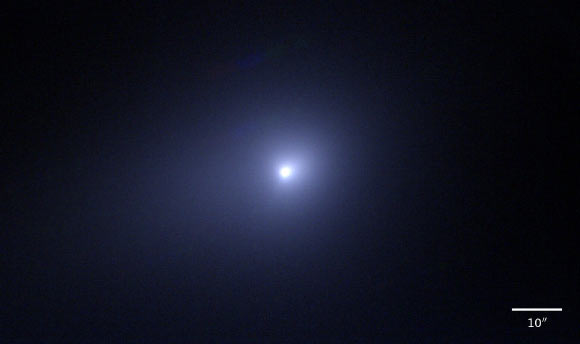
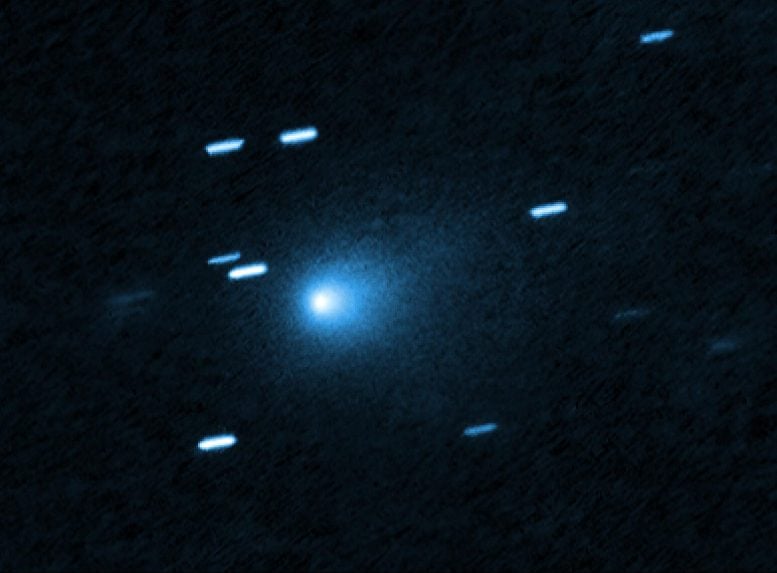
Astronomers have found that interstellar comet 3I/ATLAS contains an unusually large amount of methanol. Every interstellar object that passes through our solar system offers a rare chance to sample material forged around another star. Now, new observations of comet 3I/ATLAS using the Atacama Large Millimeter/submillimeter Array (ALMA) have revealed a chemical surprise: the comet is [...]
The interstellar comet 3I/ATLAS carries a chemical fingerprint unlike anything in our Solar System, and it may have formed 10 to 12 billion years ago, before our Sun even existed, according to two papers published in the journal Nature.
Early in the 11th century, a young Benedictine monk named Eilmer jumped from the 150-foot tower of his abbey in the small English town of Malmesbury, wearing a pair of crude wings he’d fashioned from willow wood and cloth. Eilmer managed to glide a good 600 feet, passing over the city wall before crash-landing in a small valley near the river Avon. The fall broke both his legs, crippling him. Malmesbury Abbey still boasts a stained-glass window in honor of Brother Eilmer.
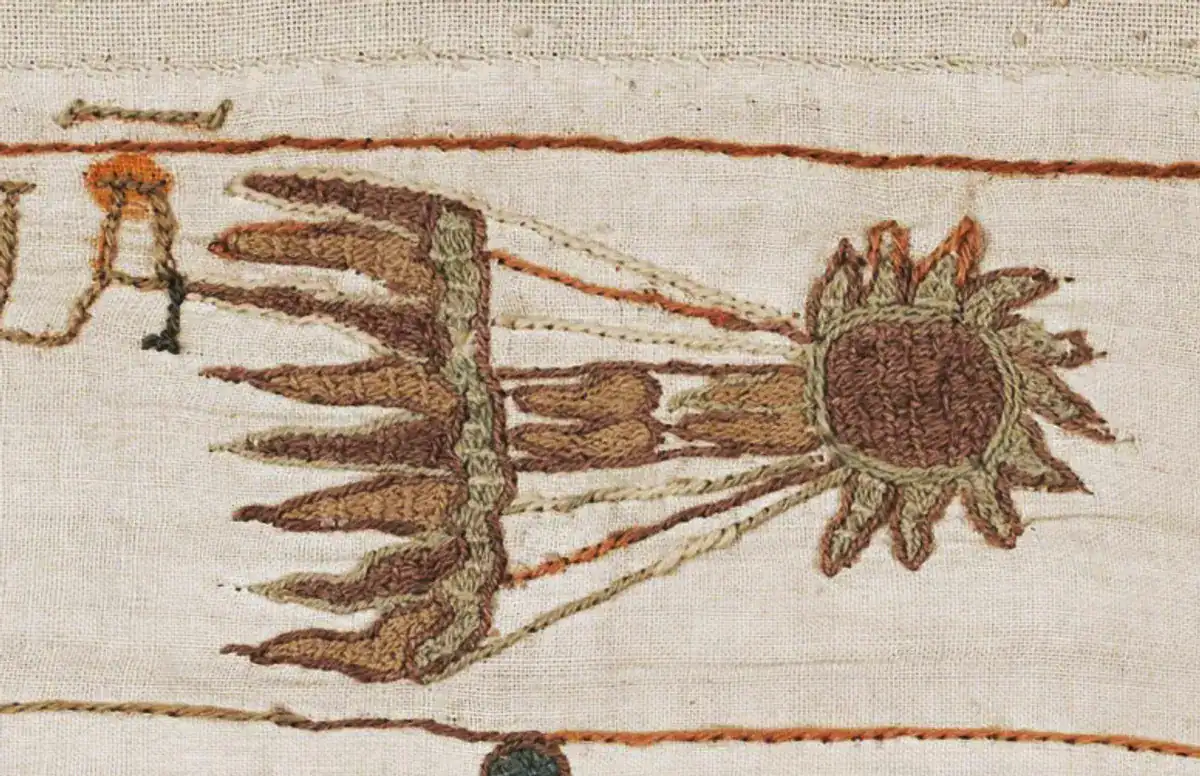
This legendary experiment in medieval aviation comes to us via 12th-century historian William of Malmesbury in an account written circa 1125, although William neglected to provide future historians with an exact date for the feat. But William does mention another key episode in Eilmer's life when the monk was "advanced in years": Eilmer witnessed Halley's comet in 1066, commenting, "It is long since I saw you." Some historians have interpreted this to mean that Eilmer saw Halley's comet on an earlier fly-by in 989, when he would have been a young boy.
Assuming Eilmer was at least 5 years old in 989, he would have been born no later than 984. This would make Eilmer in his 80s in 1066, with his attempt at flight—which occurred when he was "in his first youth"—likely falling between 1000 and 1010. However, it's an estimate that is based on a lot of assumptions, according to James Aitcheson of the University of Leicester, who argues in a paper published in the journal Notes and Queries that Eilmer may have seen a different comet altogether in his youth—the comet of 1018. If so, he would have been born much later, and the date of his flight would have occurred between the 1020s and 1040s.
Using the SETI Institute’s Allen Telescope Array, a 42-element radio interferometer at Hat Creek Radio Observatory in Hat Creek, California, astronomers probed 3I/ATLAS for artificial radio transmissions but found only human-made interference.
Astronomers from around the world were fascinated last year when 3I/ATLAS, the third interstellar object ever observed passing through our Solar System, was discovered.
The SETI Institute was one of the many organizations that examined the unusual interstellar object, conducting a comprehensive search for any signs that it might be producing technological signals.
Using the Allen Telescope Array (ATA) at the Hat Creek Radio Observatory in Northern California, SETI researchers scanned a broad range of radio frequencies in search of potential evidence of extraterrestrial technology associated with 3I/ATLAS. The data that came back was clear: no signs of artificial signals. As most astronomers expected, 3I/ATLAS is most likely a natural comet.
“We searched for narrowband signals across a broad range of spectrum: 1–10 GHz. We can do this efficiently due to the ATA’s ability to record and search billions of channels at a time,” says Dr. Sofia Sheik, lead author of a new paper describing the SETI Institute’s work, in an email to The Debrief.
The interstellar comet 3I/ATLAS (Image Credit: International Gemini Observatory/NOIRLab/NSF/AURA/Shadow the Scientist)
Observations of interstellar objects have become more common in recent years, due to advances in telescopic technologies available to astronomers. Discovered last July, 3I/ATLAS is only the third confirmed interstellar visitor to enter our Solar System, preceded by 1I/ʻOumuamua in 2017, and 2I/Borisov in 2019.
These rare discoveries help astronomers understand the materials in our cosmic backyard. By analyzing the composition of these objects, scientists can gain a deeper understanding of how planetary systems develop and evolve throughout the galaxy.
The Research
The majority of recent astronomical observations indicate that 3I/ATLAS is a natural object, albeit one that exhibited some unusual qualities. However, the possibility remains that we may one day find a technological artifact from an intelligent civilization; it is equally possible that at some point, aliens may also discover a spacecraft of Earthly origin.
“Eventually, our own Voyager spacecraft will be extraterrestrial artifacts in other stellar systems,” Sheik told The Debrief. “Given that, it is important that we understand the natural distribution of interstellar objects so that we will be able to identify any anomalies that could one day be signs of an artificial interstellar object.”
The SETI research team studied 3I/ATLAS for over seven hours using the ATA, searching radio frequencies from 1 to 9 gigahertz. This range is especially important because it can detect narrowband radio signals, which are rarely produced by natural space phenomena and are often considered possible signs of technological activity.
Researchers found 74 million narrowband signals, but after filtering out human interference and motion-matched sources, only about 200 remained. These were later confirmed to come entirely from Earth-based technology or satellites.
“To be clear, we did not detect any radio signals from 3I/ATLAS. We ruled out the presence of signals down to power levels comparable with everyday appliances: for example, we definitely would have picked up a cell tower or a radio station equivalent had it been on the surface of 3I/ATLAS,” Sheik said.
In other words, no technosignatures were detected. The SETI observation ruled out signals stronger than approximately 10 to 110 watts across the observed frequencies (comparable to the power consumption of a household appliance).
NASA diagram showing the trajectory of the interstellar object 3I/ATLAS (Image Credit: NASA).
The Origins of 3I/ATLAS
For a time, there was a considerable amount of speculation over whether 3I/ATLAS could represent something more than just a natural object. Among the proponents of such ideas, theoretical physicist Avi Loeb emerged as one of the most visible supporters of the possibility that the interstellar object displayed anomalous qualities that could point to technological origins.
Last July, shortly after the object’s discovery, Loeb predicted on his Medium page that 3I/ATLAS may be one of two things: a comet possessing a smaller core with a radius less than 400 meters, or “an object that favored a radial orbit into the inner solar system,” meaning that it may also be a larger object compared to its predecessors. Indeed, further observations of the object eventually suggested that 3I/ATLAS appears to be significantly larger than ‘Oumuamua or Borisov was.
Loeb also suggested in a podcast interview that 3I/ATLAS might not be following a random trajectory, but rather that its current motion could be understood as “directed” toward the inner solar system.
“That obviously opens the door for it being technological, because who would target the inner solar system?” said Loeb during an interview.
In an email to The Debrief, Loeb shared his thoughts on the recent SETI findings.
“Radio communication is an old technology, which was recently accompanied by optical laser communication in NASA’s Artemis II mission to the Moon,” Loeb said. “Lasers might replace radio communication in our future space missions, and there is no guarantee that they would operate at the frequencies scanned in this study.”
“To save power, a technological transmitter might beam its signal in the direction of the receiver (rather than Earth) and might only transmit sporadically,” Loeb added.
“Interestingly, the anomalous ‘Wow! Signal’ detected on August 15, 1977, came from a direction which is separated by only 9 degrees from the arrival direction of 3I/ATLAS into the inner Solar System, but a similar signal was never detected again,” Loeb told The Debrief.
The Search for Interstellar Objects
For Sheik and the team, while 3I/ATLAS did not display any obvious signatures that could be associated with technosignatures, it still provided a significant learning opportunity.
“The results from 3I/ATLAS show how realistic it is to detect a signal with the technology we have today,” said co-author Valeria Garcia Lopez. “That is why it is important to keep searching for technosignatures, even from objects we might not expect to have signals.”
Additionally, this project highlighted the ATA’s ability to respond quickly to new discoveries. Observations began less than 24 hours after the discovery of 3I/ATLAS was announced, showcasing the telescope’s flexibility and preparedness.
“One of the ATA’s advantages is being able to get quickly on-source to follow up on new and exciting discoveries, which was showcased in the 3I/ATLAS observations,” Sheik told The Debrief. “3I/ATLAS was announced on July 1st, and the ATA began observations on July 3rd.”
With ongoing advancements in technology, future observations of similar interstellar objects should become more frequent.
“For sources that might be changing quickly, this kind of rapid follow-up is essential to get early data and context for later observations with other observatories,” Sheik added.
Chrissy Newton is a PR professional and the founder of VOCAB Communications. She currently appears on The Discovery Channel and Max and hosts the Rebelliously Curious podcast, which can be found on YouTube and on all audio podcast streaming platforms. Follow her on X: @ChrissyNewton, Instagram: @BeingChrissyNewton, and chrissynewton.com. To contact Chrissy with a story, please email chrissy @ thedebrief.org.
An interstellar comet just revealed hidden methane and chemical clues from another star system. NASA’s James Webb Space Telescope has achieved another milestone by capturing the first mid-infrared chemical fingerprint of an interstellar object. The observations focused on comet 3I/ATLAS, a rare visitor from beyond our solar system, and the findings have been published in [...]
Using the spectral data from the Mid-Infrared Instrument (MIRI) onboard the NASA/ESA/CSA James Webb Space Telescope, astronomers have detected methane on 3I/ATLAS.
Although Halley’s Comet will not return to our vicinity for another 35 years, a new analysis has sparked media attention with the claim that this famous object is wrongly named. Professors Michael Lewis of the British Museum and Simon Zwart of Leiden University have presented evidence that the monk Eilmer of Malmesbury recognized the comet’s […]

 Login

 Astronomers have found that interstellar comet 3I/ATLAS contains an unusually large amount of methanol. Every interstellar object that passes through our solar system offers a rare chance to sample material forged around another star. Now, new observations of comet 3I/ATLAS using the Atacama Large Millimeter/submillimeter Array (ALMA) have revealed a chemical surprise: the comet is [...]