 Login

Norwegian First Grader Went Looking for Craft Rocks. He Found a Viking Sword Instead
 The rare blade may have belonged to a high-status warrior in Norway.
 The rare blade may have belonged to a high-status warrior in Norway.
Archaeologists say bones unearthed from an Iron Age burial in Scotland are revealing new insights into how human remains were interred in ancient Europe, in a region with scant evidence for mortuary practices in the archeological record.
Among the new findings, cuts within the skull of a woman’s 2,000-year-old Iron Age remains suggest the removal of her brain prior to burial, along with other evidence of mortuary processing.
“Manipulation of one skeleton, including the possible removal of the brain, fashioning of long bones into ‘tools’ and reassembly for burial, suggests complex mortuary processing,” write the authors of a new study published in the journal Antiquity.
The study’s authors report that the woman’s remains, and those believed to have belonged to a teenage boy buried nearby, both had distant origins, adding to the intrigue. Archaeologists discovered the pair buried in a cairn in Sutherland’s Loch Borralie in northwest Scotland, a rare find in such well-preserved condition.
Due to Britain’s acidic peat soil, few Iron Age human remains have been recovered, leaving many questions about the inhabitants’ funerary practices. This particular corner of Scotland is an exception, with an environment better suited to preserving bone, offering a rare window into this mysterious period.
“To find bodies of this age so well preserved is rare, but to discover evidence of a funeral ritual we previously knew nothing about was such a surprise and very exciting,” said lead author Dr. Laura Castells Navarro.
“The adult female displayed incisions on the inside of her cranium, suggesting her brain had been intentionally removed after death,” Castells Navarro continued. “We have no other comparison of this type of practice, but we know that the dead were curated and treated carefully in Iron Age Britain, so our understanding is that this bone modification is within that same tradition of care.”
The sharpened bones, which the archeologists suspected were used as tools, included humeri, ulna, and femur. Why Iron Age Britons would have engaged in such elaborate and unusual manipulation of skeletal remains eludes archaeologists, although they note that the care evident in reassembling her skeleton for burial suggests she commanded the respect and reverence of those who laid her to rest.
Analysis techniques used on the bones include isotope testing and DNA mapping, revealing a close kinship suspected to be that of maternal second cousins.
More intriguing than their relationship is the evidence of the distance they had traveled, as isotopic analysis revealed that the pair had grown up 50 miles to the southeast. Genetics pushed this even further, revealing family connections beyond the mainland, spreading out in opposite directions. To the northeast, they had relatives 108 miles away on the Orkney Islands, while to the southwest, they had kin 140 miles away at Applecross.
Archaeologists interpret this to mean that Iron Age Britons were extremely mobile, traversing water in family groups.
“Our research shows that prehistoric maritime communities periodically moved around the north coast and Northern Isles of Scotland, possibly in small groups,” Dr. Castells Navarro said. “This movement allowed for the spread and maintenance of cultural practices and traditions.”
With individuals of shared kinship spread so far, researchers suggest these complex mortuary practices were likely shared across Iron Age Britain, adding an intriguing new wrinkle to our assessment of these ancient people.
“I think we can assume that the Iron Age dead were not forgotten,” Dr. Castells Navarro concluded, “and still had meaning to the living, with a continued interaction between the living and the dead across time and distance.”
The paper, “Reconnecting the Dead in Iron Age Britain: Funerary Processing and Long-Distance Connectivity at Loch Borralie, Scotland,” appeared in Antiquity on June 10, 2026.
Ryan Whalen covers science and technology for The Debrief. He holds an MA in History and a Master of Library and Information Science with a certificate in Data Science. He can be contacted at ryan@thedebrief.org, and follow him on Twitter @mdntwvlf.
Very little is known about funerary practices in Iron Age Britain, since few human remains have survived. However, the environment in northwest Scotland is more conducive to preserving bone from that period. Archaeologists have previously noted evidence of postmortem manipulation of human remains, such as mummification, and of modifying human bones into tools or decorative artifacts. Now a new paper published in the journal Antiquity describes evidence of postmortem brain removal in remains from that region, as well as sharpened limb bones, possibly for use as tools.
The remains in question were found in 2000 at a burial cairn in Loch Borralie, near the most northwest tip of the Scottish mainland, after erosion revealed a human cranium. The excavated remains belonged to two individuals: one an adult female and the other a juvenile of (at the time) indeterminate sex; the cranium belonged to the latter. The authors of the new paper conducted a fresh osteoarchaeological analysis as well as multi-isotope and ancient DNA analysis. Radiocarbon dating of molar teeth from both sets of remains placed their deaths as occurring between 50 BCE and 70 CE.
In the case of the female individual, the authors noted an unusual break at the base of the cranium that likely occurred near the time of death. It's the kind of fracture that one gets from high-velocity impacts, including vehicular collisions, sporting accidents, falls, assaults, or even long-drop hanging. But the known forensic patterns observed in the aforementioned scenarios don't exactly match the pattern of the Iron Age cranium, leading the authors to conclude that it likely resulted from a targeted impact. They also noted perimortem fractures on both scapulae.
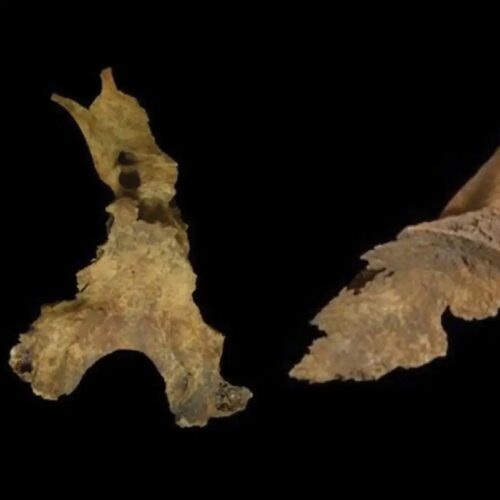
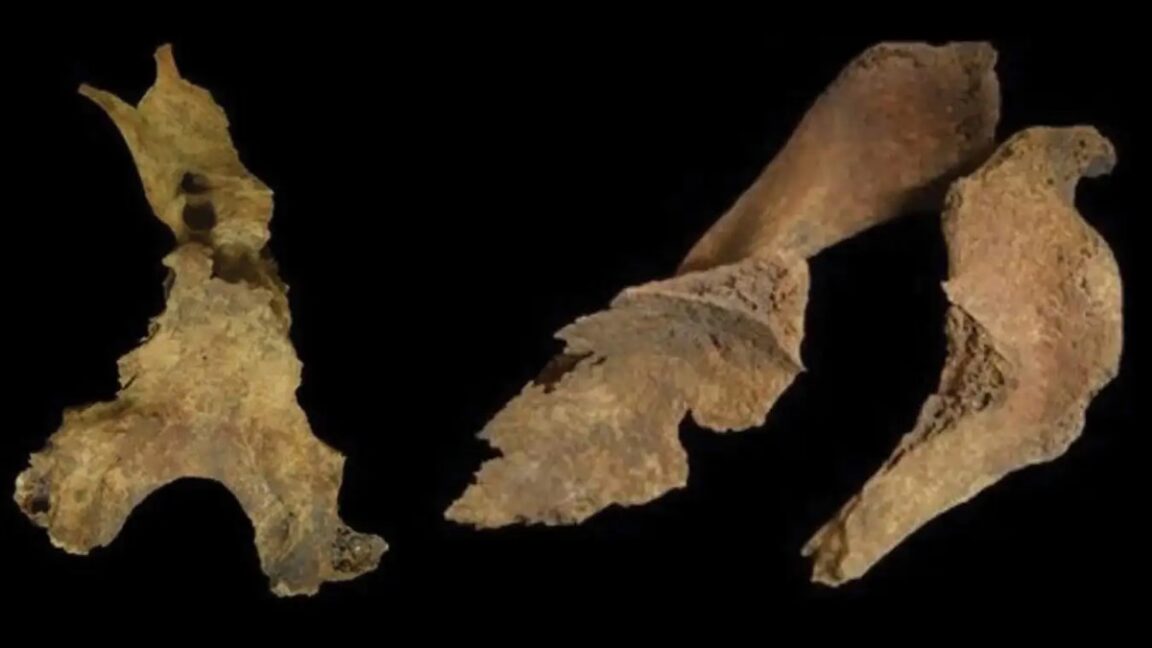
© Rebecca Ellis-Haken

New radiocarbon dates from Sala Keimada, a hard-to-reach chamber of Cueva Palomera in the province of Burgos, northern Spain, suggest that generations of people returned to the sacred space from the end of the Ice Age through the Iron Age, leaving behind art, structures and offerings.
The post Spanish Cave Sanctuary Reveals More Than 11,500 Years of Activity appeared first on Sci.News: Breaking Science News.
