❌

Reading view

James Webb Space Telescope Made a Salty Discovery in This Unusual Exoplanet’s Skies


James Webb Space Telescope (JWST) observations have revealed the colorful secret of the Pink Planet, the coldest object of its type ever directly observed.

A team of astronomers led by Northwestern University has revealed their findings in a recent paper published in The Astronomical Journal, finally describing the rose-colored haze covering the planetary-mass companion GJ504b, thanks to JWST data.

For over a decade, researchers have speculated that atmospheric salt clouds may create the pink planet’s strange hue, but this is the first concrete evidence for the hypothesis.

The Pink Planet

Since its discovery in 2013, GJ504b, commonly known as “The Pink Planet,” has been a bit of an astronomical mystery. Even the object’s description is imprecise: a “planetary-mass companion,” a nebulous category teetering between the size of a large planet and a brown dwarf, at roughly 25 times Jupiter’s mass. Residing 57 light-years from Earth, the object’s host star is similar to our Sun.

Faint due to extremely cold temperatures, astronomers cannot obtain clear enough observations with ground-based telescopes to perform spectroscopic analysis. However, from its vantage point beyond our atmosphere, the JWST’s advanced instruments have finally provided the necessary data to make sense of the object’s strange pink atmosphere.

The exoplanets most clearly observed are much hotter than our world, with temperatures between 1,000 and 2,000°F, creating a brilliance which can be seen across the gulf of space and through Earth’s atmosphere.

This giant planet is a mere 550°F, still hot by Earth standards, but far cooler than is normal for its type. According to the new study, GJ504b is an ancient world, some 2.5 to 4billion years old, with a slow cooling over time accounting for its decreased temperature.

Challenging JWST Observation

In addition to providing the first evidence for The Pink Planet’s elusive salt clouds, the team’s research has broader implications for studying cold objects, laying the groundwork for future JWST observations of such faint glows, too dim for ground-based telescopes.

“The Pink Planet is the coldest companion ever discovered using ground-based instruments,” according to Aneesh Baburaj, the study’s lead author. “Many teams all around the world performed follow-up observations to study its light, but it was too faint for ground-based instruments. That made it a perfect target for JWST. When we finally obtained its spectrum, it immediately looked interesting. But once we started digging deeper into the data, we realized it was not like anything we have analyzed before.”

To accurately analyze the light, Baburaj’s team used an advanced data-processing technique to remove considerable glare from the Pink Planet’s host star, improving the quality of the JWST data. Breaking light into separate colors through spectroscopic analysis allows scientists to determine the elemental composition of exoplanet atmospheres using JWST data.

“In the past, other astronomers observed the companion for an entire night with some of the biggest telescopes in the world to obtain a spectrum,” Baburaj said. “And they could not see the object. With JWST, our entire observation took around two hours, and we were successful.”

Analyzing the JWST Data

The team discovered water vapor, methane, carbon dioxide, ammonia, and other molecules in the object’s atmosphere, but these results conflicted with existing atmospheric models, which only made sense if the object had an extremely unlikely combination of physical features. However, once the team added clouds to the model, the effect of their salty formations on the light made the JWST data much easier to explain.

“We ran simulations with clouds, and the results aligned with what we know about cold planets,” Baburaj said. “We tried three different types of clouds, and salt clouds fit best. When we accounted for salt clouds, it subdued the signature of molecules hidden deeper in the companion’s atmosphere. Then, the results became physically possible.”

In addition to the salty clues, the researchers discovered an abundance of heavy metals. These may have something to do with The Pink Planet’s origins, as it may have originally formed as a star instead of a planet, but astronomers remain uncertain. In any case, the work process developed here will be essential to future JWST investigation of cold objects.

“This is the first time we’ve found that salt clouds are critical to explaining the spectrum of an object,” Baburaj concluded. “It’s a good reminder to account for clouds in our models.”

The paper, “JWST-TST High Contrast: First Direct Spectroscopy of GJ504b Reveals Clouds and Possible Metal Enrichment,” appeared in The Astronomical Journal on June 18, 2026.

Ryan Whalen covers science and technology for The Debrief. He holds an MA in History and a Master of Library and Information Science with a certificate in Data Science. He can be contacted at ryan@thedebrief.org, and follow him on Twitter @mdntwvlf.


  •  

Reframe recria os browsers dos anos 90 e 2000 numa experiência adaptada aos tempos modernos

Já imaginou navegar pela web moderna com o Internet Explorer ou com o Netscape? Com o Reframe é possível, num projeto Open Source que combina o visual dos browsers clássicos com tecnologia moderna.

The post Reframe recria os browsers dos anos 90 e 2000 numa experiência adaptada aos tempos modernos appeared first on Tek Notícias.

  •  

A viral doomsday scenario aims to shake Europe out of its AI complacency

Does a thought-experiment about US ascendancy in the technology say as much about AI jitters as it does about the reality?

It’s 2031 and the US and China are about to tear Europe into pieces.

The US ploughed vast sums into datacentres and the EU did not. China built robots and Europe did not. American companies “restructured” their workflows around AI and fired people, while EU workers went on long lunch breaks and handed over administrative tasks to the AI model Claude.

Continue reading...

© Photograph: Hannibal Hanschke/EPA

© Photograph: Hannibal Hanschke/EPA

© Photograph: Hannibal Hanschke/EPA

  •  

Can we electrify the world? Ambition moves from nerdish backwater to centre stage

Apart from effort to electrify, there were geopolitical tensions around climate science and the 1.5C goal at pre-Cop31 climate talks

Electrifying the world – with electric vehicles, electric heating and cooling, and modernised heavy industry – could be the next biggest step towards phasing out fossil fuels, replacing the 80% of global energy that still comes from hydrocarbons. As using electrical energy is much more efficient than combustion, the move would save billions of dollars for consumers and businesses – global energy demand could be halved, according to one estimate.

For decades, electrification has been a nerdish backwater of global climate action. But in the last two weeks, at preparatory talks in Bonn before the forthcoming UN Cop31 climate summit, the subject finally took centre stage.

Continue reading...

© Photograph: Filip Singer/EPA

© Photograph: Filip Singer/EPA

© Photograph: Filip Singer/EPA

  •  

The Friday File: Ericsson; Anthropic; UK

Mobile World Live (MWL) brings you our top three picks of the week as Ericsson CEO Borje Ekholm stepped down, Anthropic faced a US clampdown on its latest AI models and the UK outlined plans to ban under-16 users from social media.

Ericsson CEO Ekholm set for exit

What happened: Ericsson lined-up a changing of the guard, announcing Borje Ekholm will step down as CEO on 30 September after more than nine years at the helm and lining up current networks boss Per Narvinger to take over.

Why it matters: Ericsson chair Jan Carlson said the incoming CEO brings “deep technical knowledge of our industry as well as extensive commercial experience”, while crediting Ekholm with “extraordinary leadership and strategic advancements”. The chief joined as CEO in 2017 and inherited a business under pressure, steering it through payments scandals, which resulted in a 2019 US fine of more than $1 billion and a $206.7 million. Ekholm will remain at the company as an executive adviser until 15 June 2027.

Narvinger now takes over as 5G spending slows, 6G looms and AI reshapes network demand., He told the Financial Times (FT) the industry is at a “pivotal time”, adding users will “hopefully value your connectivity more” as AI dependence rises. David Hammarwall, currently head of Customer Unit T-Mobile in Market Area Americas, will be Narvinger’s successor as head of the Networks division.

US orders Anthropic to suspend Fable 5, Mythos 5 models

What happened: US President Donald Trump’s administration ordered Anthropic to immediately suspend access to its two most advanced AI models, Fable 5 and Mythos 5, over national security concerns.

Why it matters: The order applied to “any foreign national, whether inside or outside the United States”, prompting Anthropic to disable the models for all customers globally while it worked out how to comply. Anthropic said it believes officials were responding to a “potential narrow, non-universal jailbreak” affecting cybersecurity safeguards, but argued the issue involved a small number of known minor vulnerabilities which could be replicated on other publicly available models. The company pushed back on the recall, noting Fable 5 had been tested with the US government, the UK AI Safety Institute and private groups before launch. The Wall Street Journal (WSJ) reported Amazon CEO Andy Jassy was among tech executives who raised security concerns about the models with officials. Anthropic called the dispute a “misunderstanding” and is seeking to restore access, adding “if this standard was applied across the industry, we believe it would essentially halt all new model deployments for all frontier model providers”. Gina Neff, professor of responsible AI at Queen Mary University London, told the BBC the speed of AI development means and government and enterprises “need to be able to build up capabilities to keep our companies safe from cyberattacks”. She explained the restriction could limit safe AI testing and international cooperation, adding “we’re in uncharted territory at this point”. The latest development marks a sharp escalation in US scrutiny of Anthropic, which is already suing the Trump administration after the Department of War (DoW) blacklisted it as a “supply chain risk” earlier this year.

UK plots under-16 social media ban

What happened: The UK government laid out plans to ban under-16 users from social media and impose wider child-safety restrictions on gaming, live-streaming and AI platforms, with the landmark online safety measures slated for early 2027.

Why it matters: The proposed ban would apply to platforms including Snapchat, TikTok, Instagram, YouTube, Facebook and X, with messaging apps such as WhatsApp and Signal excluded from the scope. Prime Minister Keir Starmer said the move will “give kids their childhood back”, arguing “tech giants had their chance and failed”. However, Assembly Research analyst Megan Jenkins said the government appeared to choose “what feels like a punitive measure for children” over making platforms “safer by design”. The UK’s plan follows Australia, which became the first country in the world to ban social media for under-16s last year. However, the government added it will “learn the lessons from Australia’s experience” by introducing tougher age verification tools. Technology secretary Liz Kendall told the BBC the government plans to disclose further details in July on VPNs, a potential method for bypassing restrictions, as well as curfews, chatbots and other restrictions. Alex Brown, head of TMT at law firm Simmons and Simmons said the move signals “a clear hardening of approach to online safety”, but warned companies must now “grapple with the difficult task of age verification”.

The post The Friday File: Ericsson; Anthropic; UK appeared first on Mobile World Live.

  •  

SpaceX slams Europe satellite spectrum plan

SpaceX reportedly hit out at a European Commission (EC) plan for distributing satellite spectrum across the bloc, warning current proposals could directly impact connectivity with mobile devices.

Bloomberg reported it had seen a statement from Elon Musk’s rocket company which takes aim at an EC plan to offer only a third of its 2GHz frequency band to companies outside the European Union (EU), keeping the remaining amount for those based in the bloc.

The outlet said the proposal effectively excludes foreign companies, like SpaceX, from offering satellite services to governments and will directly impact the expansion of its Starlink connectivity play.

SpaceX has established a presence in Europe, striking partnerships with European operators including Deutsche Telekom and Orange to offer Starlink D2D services to customers.

However, SpaceX said the EC’s plans will split spectrum “in virtually unusable sub-divided parts”.

It apparently added intentions are inconsistent with international regulations and do not adhere to “Europe’s international obligations and economic reality”.

Ukraine concern
Another bone of contention is an EC aim to reserve airwaves for the Europe IRIS2 constellation, with SpaceX arguing this could risk poorer connectivity in Ukraine where Starlink has been used during the country’s war with Russia.

“The proposal creates a significant likelihood that Europeans will be left without direct-to-device satellite services or that new European operations will create global interference problems, including to emergency services like those in Ukraine,” read the statement.

When outlining the plans, EC EVP Henna Virkkunen said earmarking allocations to local operators would encourage diversification of suppliers and incentivise entry into the market.

She also said the 2GHz band was vital for boosting Europe’s competitiveness, security, and fits in with an ongoing drive around technology sovereignty.

The post SpaceX slams Europe satellite spectrum plan appeared first on Mobile World Live.

  •  

Austrian propulsion startup joins sovereign space funding surge

Austrian satellite propulsion startup Gate Space has won 6.3 million euros in funding from Europe’s government-backed accelerator program, joining a wave of European companies attracting capital for greater space sovereignty.

The post Austrian propulsion startup joins sovereign space funding surge appeared first on SpaceNews.

  •  

Have You Bought a Tesla Recently? We Want to Hear From You.

Tesla sales are rebounding in Europe even though many people have negative feelings about Elon Musk, the company’s chief executive. We want to know why.

© Nam Y. Huh/Associated Press

Tesla’s car sales took a big hit in Europe last year, in part because many people were turned off by the political views of the company’s chief executive, Elon Musk.
  •  

125-Million-Year-Old Crocodile Relative Reveals Its True Colors

The holotype specimen of Montsecosuchus depereti. Image credit: Castillo-Visa et al., doi: 10.1093/zoolinnean/zlag076.

Exceptionally preserved skin of Montsecosuchus depereti, an extinct crocodylomorph no larger than a house cat that prowled the tropical wetlands of Early Cretaceous Spain, has allowed paleontologists to reconstruct details of its scales, sensory organs and even possible banded markings along its tail.

The post 125-Million-Year-Old Crocodile Relative Reveals Its True Colors appeared first on Sci.News: Breaking Science News.

  •  

The Clash of Sexual Civilisations

With mass immigration we are witnessing a clash of sexual civilisations, says Bettina Arndt: two incompatible systems of rules about men, women and desire are colliding and the consequences are playing out in courtrooms.

The post The Clash of Sexual Civilisations appeared first on The Daily Sceptic.

  •  

Astronomers Observing a Supermassive Black Hole Just Had an Unexpected UFO Sighting

It’s not the kind of thing astronomers expect to see while observing the powerful effects of a distant supermassive black hole: an unprecedented UFO sighting.

However, that’s precisely what one group of scientists now reports in a preprint paper, who detail the successful detection of one of the strongest UFOs—a black hole phenomenon otherwise known as “ultra-fast outflows”—that astronomers may have ever seen.

The landmark detection was made possible with the XMM-Newton space observatory and NuSTAR X-ray telescope, which allowed the researchers behind the discovery to observe a luminous quasar with origins that date back to “cosmic noon,” revealing a pair of outflow wind components being blasted from the black hole in question.

Cosmic Monsters with Major Appetites

Black holes have more than just large appetites for cosmic material: they also produce significant gas-driven winds from around their accretion disk.

These winds become known as ultra-fast outflows (UFOs) when their strength propels them to greater than ten percent of light speed, and astronomers currently believe they are an important part of what helps black holes regulate their growth, which may also hold for their host galaxies.

One way this occurs is that UFOs help to heat galactic gases that give rise to star formation, a quenching process that most astronomers believe occurred during a period called “cosmic noon,” which occurred between 1.6 and 3.5 billion years after the birth of the universe.

Cosmic Fingerprints of Powerful UFOs

Astronomers can detect ultra-fast outflows based on the “dips” they create in their powerful gusts, which are caused by ionized iron present in their outflow gases. These gases also absorb X-rays along their path away from their black hole originators, which leave “fingerprints” in the form of absorption features that are detectable using X-ray telescopes.

Significantly, these “dips” manifest as a blueshift since they are shifted to higher energies as they move at such high speeds (again, roughly 10% of the speed of light). From the blueshifted energy signatures they comprise, astronomers can determine not only the presence of UFOs, but also the wind speed of their gusty outflows.

In the past, most detections of these high-powered cosmic phenomena have relied on gravitationally lensed quasars. These celestial objects occur when a galaxy or similar feature closer to Earth appears in front of them, magnifying the quasar’s light and significantly brightening its luminosity from our Earthly perspective.

However, lensing of this variety can also present problems, and so astronomers led by Giorgio Lanzuisi of INAF Bologna designed a special system to target more than a dozen hyper-luminous quasars at cosmic noon, as a means of getting a better feel for the dynamics of non-lensed quasars.

“WISSHFUL” Thinking

WISSHFUL is an XMM-Newton multi-year heritage program that Lanzuisi and his colleagues designed for this purpose, whose initial target became a quasar designated WISSH13, whose redshift at 3.294 marks the object’s existence as it appeared approximately 2 billion years after the Big Bang.

WISH13’s black hole also weighs in at close to 2 billion times that of our Sun, which causes it to shine far brighter than normally expected for an object of its estimated mass.

Their work began in the autumn of 2024 by combining observations from XMM-Newton and NuSTAR initially obtained in 2017. From these X-ray images of WISSH12, a pair of distinctive absorption features became evident, which the team determined to have been generated by two separate sources from within the same ultra-fast outflow.

These components were found to travel at different speeds: one moving at close to 30% of the speed of light, while the other at only about 10% of light speed. The slower of these two appears to have been an enduring component of the UFO, while the faster one showed signatures that indicated a more recent appearance. This could mean that it emanates from events that are shorter in duration.

By matching theoretical predictions of a layered wind structure surrounding the black hole, the researchers say their observations align with models that indicate a fast-moving inner “spine” launched from the accretion disk’s innermost regions. Meanwhile, a slower outer “sheath” is also believed to emanate farther from the black hole. The combined outflow components produce an estimated 21 to 24 solar masses of material annually.

The Most Massive UFO Ever Observed? 

Such figures, the team says, represent what is believed to be among the most massive and energetic ultrafast outflows ever observed, a discovery which also marks the highest-redshift ultrafast outflow yet detected in a non-lensed quasar.

Despite their remarkable energetic output, the team says these outflow winds seem to conform to the same essential relationships observed in active galaxies much closer to Earth, suggesting that the processes driving these outflows have remained remarkably consistent across cosmic time.

Going forward, the team says they hope to make additional observations of these powerful cosmic phenomena with help from the new Athena X-ray mission, which they say could help uncover similar winds in even more distant quasars.

The team’s discoveries were detailed in a recent paper, “The WISSHFUL program: the highest redshift UFO discovered in a non-lensed QSO,” which appeared at the preprint arXiv.org server.

Micah Hanks is the Editor-in-Chief and Co-Founder of The Debrief. A longtime reporter on science, defense, and technology with a focus on space and astronomy, he can be reached at micah@thedebrief.org. Follow him on X @MicahHanks, and at micahhanks.com.

  •  

Hubble Glimpses Merging Galaxy Clusters

2 min read

Hubble Glimpses Merging Galaxy Clusters

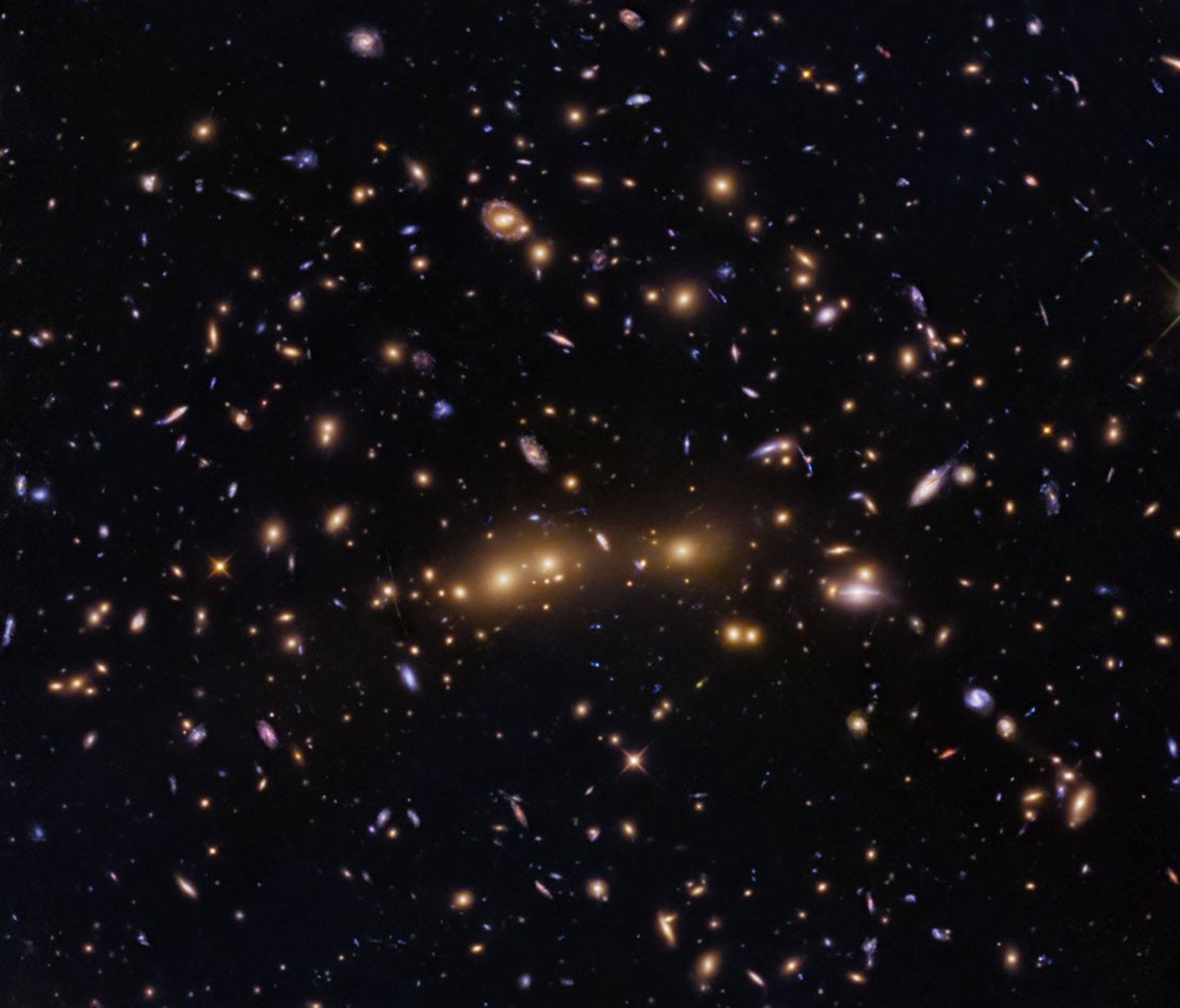
Several massive elliptical galaxies appear to sit in a nearly horizontal line across the center of the image. Numerous spiral, lenticular, and smaller elliptical galaxies dot the space surrounding the giant ellipticals.
This NASA Hubble Space Telescope image features a swarm of galaxies in the galaxy cluster called CL0016+1609 or MACS J0018.5+1626.
NASA, ESA, H. Ebeling (University of Hawaii), D. Coe (STScI, ESA, JWST); Image Processing: G. Kober (NASA/Catholic University of America)

This NASA Hubble Space Telescope image features a galaxy cluster, called CL0016+1609 or MACS J0018.5+1626, that is very bright at X-ray wavelengths and is one of the most extensively studied clusters at X-ray and radio wavelengths. The X-ray observations of this cluster revealed that it is two clusters merging along our line of sight.

Researchers requested time to observe CL0016+1609 with Hubble’s Advanced Camera for Surveys because that data would help them accurately measure the cluster’s dark-matter distribution, which helps them study the merger and the role of CL0016+1609 in the large-scale structure of the universe. Hubble can’t directly see dark matter, but its infrared and visible light observations can detect dark matter’s gravitational lensing effects on the normal matter Hubble observes.

The data in this image also includes observations with Hubble’s Wide Field Camera 3 taken as part of an observing program that obtained the first Hubble infrared images of 46 massive galaxy clusters and looked for distant galaxies gravitationally lensed by these clusters. Called RELICS (Reionization Lensing Cluster Survey), this survey found some 300 high-redshift candidate galaxies lensed by these clusters.

You can see the faint vertical arc of one of these distant galaxies in the image above. Look for it just to the left of the large elliptical galaxies in the center of the image. Another brighter, though shorter arc is visible just above and to the right of the large elliptical galaxies in the center of the image.

Media Contact:

Claire Andreoli
NASA’s Goddard Space Flight Center, Greenbelt, MD
claire.andreoli@nasa.gov

  •  

NASA’s Fermi Mission Uncovers Possible Sibling Supernova Remnants

6 min read

NASA’s Fermi Mission Uncovers Possible Sibling Supernova Remnants

A new study of two supernova remnants, the debris left behind after stars explode, suggests the explosions came from stellar siblings that once orbited each other. The first star’s detonation sent its binary companion hurtling through space, and then, after traveling for thousands of years, the surviving star blew up too.

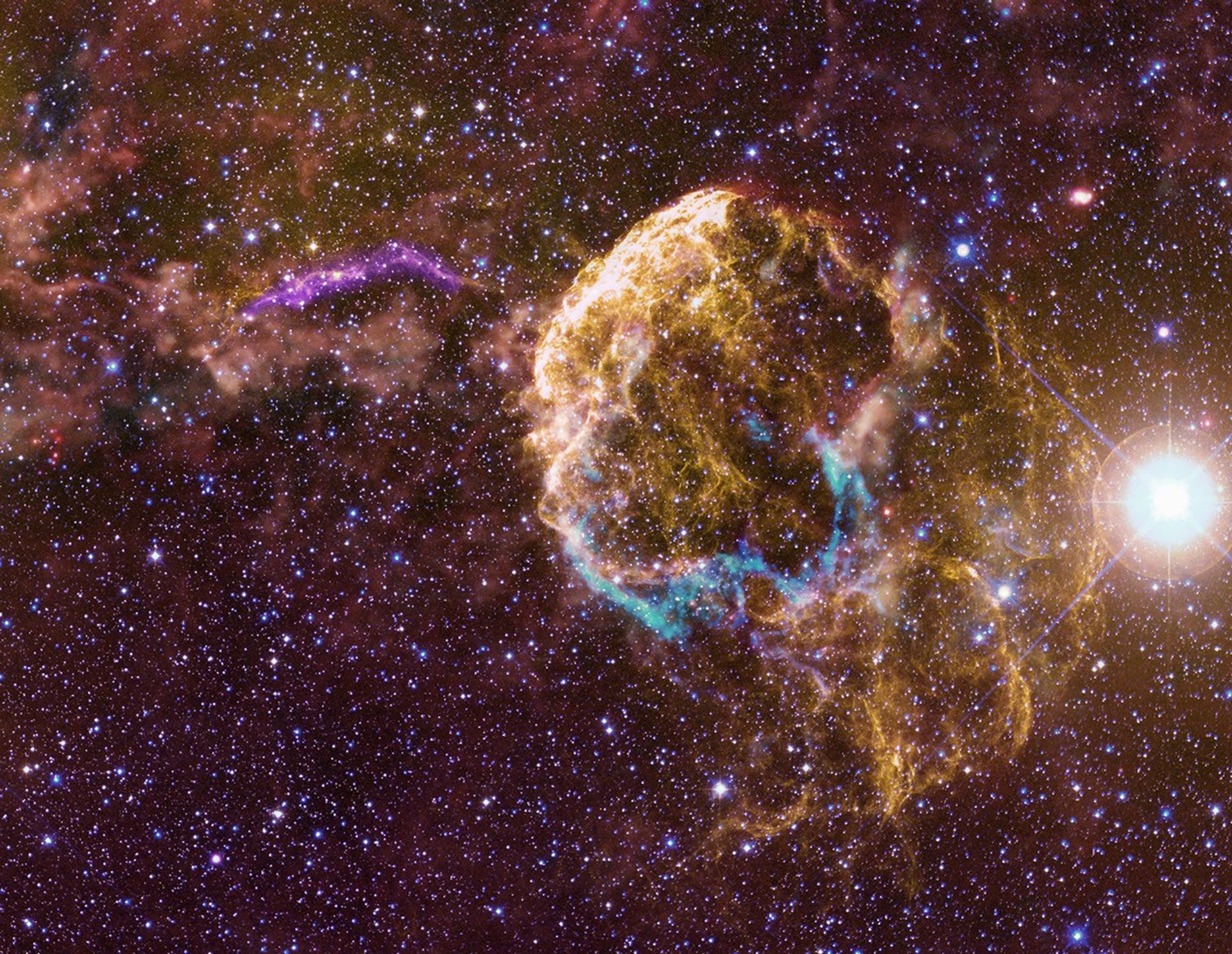
Infrared, visible, and ultraviolet image of the area around the Jellyfish Nebula
This multiwavelength scene shows the Jellyfish Nebula supernova remnant (right), the interstellar cloud it’s interacting with, and a distinctive curving filament to its upper left. The filament, which is shown here both in optical and ultraviolet (UV) light, is the visible part of an overlapping supernova remnant, G189.6+3.3, that is more prominent in radio and X-rays. Visible light is shown in yellow, UV from NASA’s Neil Gehrels Swift Observatory is shown in violet, and infrared light from NASA’s retired WISE (Wide-field Infrared Survey Explorer) mission appears in cyan, red, and orange. Both remnants are located about 6,000 light-years away in the constellation Gemini. The brilliant star at far right is Propus, also known as Eta Geminorum.
NASA Goddard Space Flight Center and M. Michailidis et al. 2026; optical: DSS; infrared: NASA/WISE/JPL-Caltech/UCLA; ultraviolet: NASA/Swift

“Using 16 years of data from NASA’s Fermi Gamma-ray Space Telescope, our analysis uncovered gamma rays associated with a supernova remnant that was hidden in the glare of its neighbor, the Jellyfish Nebula, one of the brightest gamma-ray-emitting supernova remnants known,” said Miltiadis Michailidis, a postdoctoral fellow in the physics department at Stanford University in California. “There are so many striking connections between the two remnants that we conclude they’re likely related, giving us the first known example of a binary system where both stars have undergone supernova explosions.”

Michailidis presented the findings Wednesday at the 248th meeting of the American Astronomical Society in Pasadena, California. A paper describing the results will appear in a future edition of Nature Communications.

The study focused on a faint supernova remnant called G189.6+3.3, which is mainly visible in X-rays. It is upstaged by its brighter and better-known neighbor, the Jellyfish Nebula (IC 443). The two star wrecks, both located in the constellation Gemini, appear to partially overlap as seen in X-rays. Recent X-ray evidence suggests that hot plasma likely associated with G189.6+3.3 may extend across the entire region, a hint that the overlap may be nearly total.

A massive star explodes when its energy-producing core runs out of fuel and collapses under its own weight, triggering an explosion that blows the star apart. The explosion’s shock wave encloses a hot cloud of debris that rapidly expands into space. So far, astronomers have cataloged about 300 supernova remnants in our galaxy.  

The Fermi mission is part of NASA’s fleet of observatories monitoring the changing cosmos to help humanity better understand how the universe works. More than a decade ago, observations from Fermi’s LAT (Large Area Telescope) showed that the shock waves of supernova remnants accelerated particles to within a fraction of the speed of light, a process first proposed by physicist Enrico Fermi — the mission’s namesake — in 1949.

These high-speed particles, called cosmic rays, interact with interstellar gas to produce gamma rays, the highest-energy form of light. Protons make up 99% of cosmic ray particles. To prove that accelerated protons are responsible for the glow, astronomers search for a specific gamma-ray feature. When cosmic-ray protons smash into interstellar gas, they produce a short-lived particle called a neutral pion, which almost immediately decays into a pair of gamma rays. This emission occurs within a specific band of energies associated with the neutral pion’s mass and lies within the range detected by Fermi’s LAT instrument.

In 2013, Fermi observations proved that the Jellyfish Nebula, which is interacting with part of a glowing cloud of hydrogen gas known as Sharpless 249, produced gamma rays through this mechanism. Its neighbor, G189.6+3.3, was discovered in 1994 as part of an X-ray survey by the German-led ROSAT (Roentgen Satellite) mission.

A bright filament of gas lies between the overlapping remnants. New observations of this feature reveal that the shock wave from G189.6+3.3 slammed into dense interstellar gas there and dramatically slowed, key evidence that both remnants are interacting with the same cloud system.

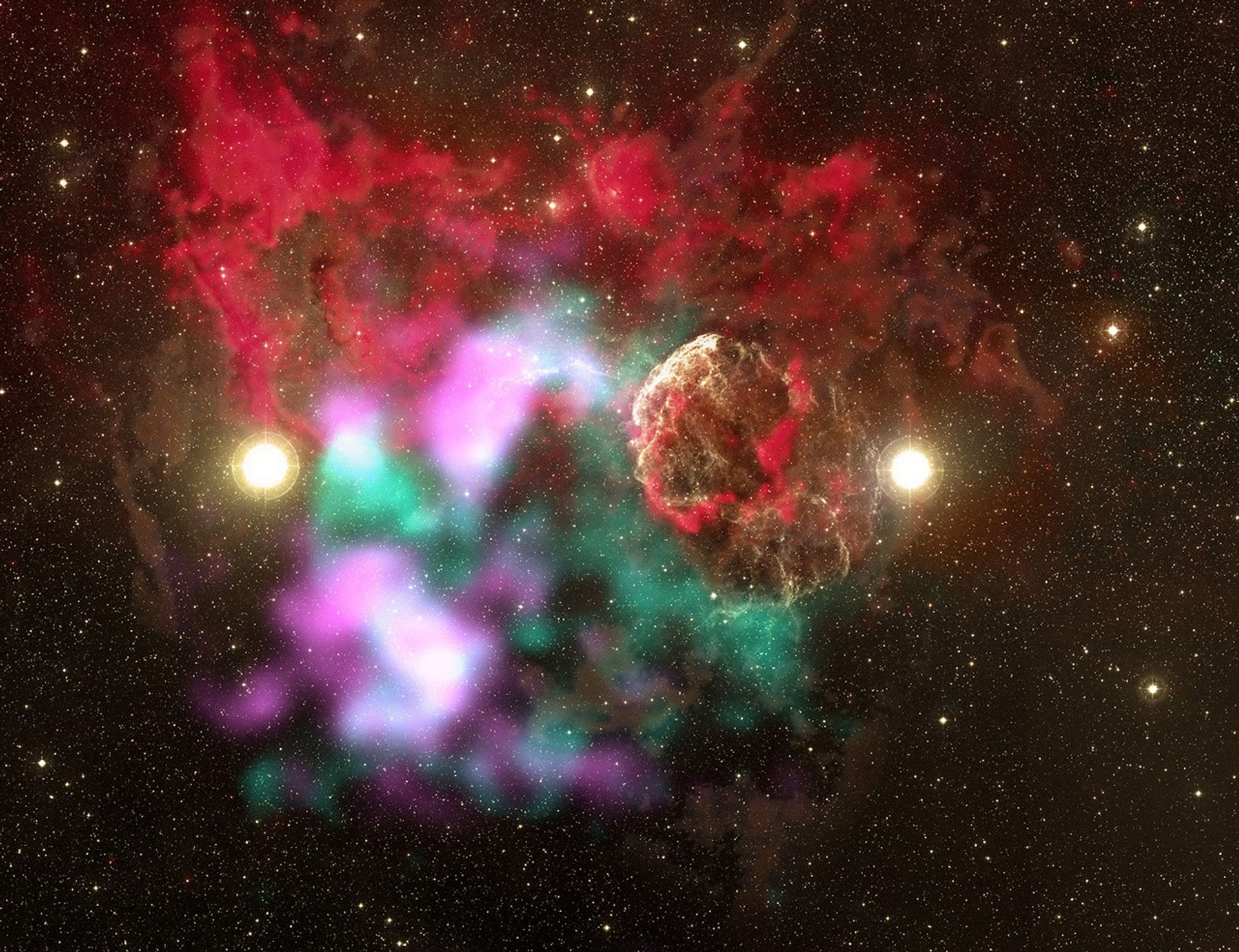
Multiwavelength composite showing high-energy light from the G189 supernova remnant
The well-known supernova remnant IC 443 (right) has an older, fainter neighbor (shown here in blue-green and magenta) called G189.6+3.3. A filament of gas between them, glowing in visible and ultraviolet light (violet arc at center), traces the neighbor’s shock wave and shows that both remnants are interacting with the same molecular cloud, shown in red, orange, brown for infrared and radio data and yellow for visible light. Blue-green shows X-rays from the fainter remnant, while magenta shows gamma rays with energies greater than 10 billion electron volts; for comparison, visible light has energies between about 2 and 3 electron volts. In this view, high-energy light from the much brighter IC 443 has been removed for clarity. Gamma-ray emission near the filament stems from protons accelerated in the supernova’s shock wave as it expands into the cloud.
NASA Goddard Space Flight Center and M. Michailidis et al. 2026; radio, MWISP and ESA/Planck; infrared: NASA/WISE/JPL-Caltech/UCLA; optical: DSS; ultraviolet: NASA/Swift; X-ray: SRG/eROSITA; gamma ray: NASA/DOE/Fermi LAT Collaboration

Astronomers think the Jellyfish Nebula is also a candidate PeVatron, a cosmic particle accelerator capable of boosting protons to energies so high they could nearly escape our galaxy. Such particles can produce gamma rays with trillions of times more energy than visible light. Finding a second particle accelerator near the Jellyfish Nebula could offer scientists new clues for how supernova remnants develop into PeVatrons.

“The overlapping remnants, a connecting gas filament, and the availability of data from Fermi and other facilities motivated us to delve into this complex but little-studied region,” said co-author Marianne Lemoine-Goumard, an astrophysicist at the French National Centre for Scientific Research (CNRS) based at the University of Bordeaux. “With Fermi’s LAT instrument, we found gamma-ray emission associated with accelerated protons in the northern part of the fainter remnant. If both remnants are interacting with the same structure, then they must share a common distance from us.”

The team concludes the remnants lie about 6,000 light-years away, their explosion centers are separated by roughly 40 light-years projected onto the plane of the sky, and the original stars may have been 20 or more times the Sun’s mass.

Estimates of the remnants’ ages vary widely, but the team concludes that the age of the Jellyfish Nebula is 8,000 to 9,000 years, while G189.6+3.3 is between 20,000 to 110,000 years old. This means the delay between the explosions could have extended for up to 100,000 years.

In addition, the team conducted computer simulations of a million massive binary systems. They show that systems where the stars orbit close enough to exchange matter and interact during their lives can readily produce dual supernova explosions with similar separations and time delays as those found for the remnants. The team also estimated that the chance of randomly encountering this combination of observed spatial alignment and compatible distances to be less than 1%, strongly supporting a physical association.

“The evidence we’ve compiled — including observations across the spectrum, the chemical and physical properties of the remnants, simulations, and more — paints a compelling picture of a dual supernova event,” said Michailidis.

This study identifies a unique possible example of a binary system where both stars exploded as supernovae and left behind separate, detectable supernova remnants. Astronomers think that most massive stars form in binary or multiple-star systems. The Jellyfish Nebula/G189.6+3.3 complex offers astronomers a rare opportunity to study how massive binary stars evolve, exchange matter, explode, and experience velocity changes — called kicks — induced by the supernova blast. It also provides a powerful new laboratory for understanding how coupled supernova remnants behave, including how they accelerate particles, generate gamma rays, and shape their surrounding environments.

“Fermi’s gamma-ray observations of supernova remnants continue to reveal the dynamic lives of stars,” said Elizabeth Hays, the Fermi project scientist at NASA’s Goddard Space Flight Center in Greenbelt, Maryland. “We can now connect the glowing remains of two massive stars to a powerful pair that evolved together over thousands of years.”

By Francis Reddy
NASA’s Goddard Space Flight Center, Greenbelt, Md.

Media Contact:
Claire Andreoli
301-286-1940
NASA’s Goddard Space Flight Center, Greenbelt, Md.

  •  

Hubble Glimpses Merging Galaxy Clusters

2 min read

Hubble Glimpses Merging Galaxy Clusters

Several massive elliptical galaxies appear to sit in a nearly horizontal line across the center of the image. Numerous spiral, lenticular, and smaller elliptical galaxies dot the space surrounding the giant ellipticals.
This NASA Hubble Space Telescope image features a swarm of galaxies in the galaxy cluster called CL0016+1609 or MACS J0018.5+1626.
NASA, ESA, H. Ebeling (University of Hawaii), D. Coe (STScI, ESA, JWST); Image Processing: G. Kober (NASA/Catholic University of America)

This NASA Hubble Space Telescope image features a galaxy cluster, called CL0016+1609 or MACS J0018.5+1626, that is very bright at X-ray wavelengths and is one of the most extensively studied clusters at X-ray and radio wavelengths. The X-ray observations of this cluster revealed that it is two clusters merging along our line of sight.

Researchers requested time to observe CL0016+1609 with Hubble’s Advanced Camera for Surveys because that data would help them accurately measure the cluster’s dark-matter distribution, which helps them study the merger and the role of CL0016+1609 in the large-scale structure of the universe. Hubble can’t directly see dark matter, but its infrared and visible light observations can detect dark matter’s gravitational lensing effects on the normal matter Hubble observes.

The data in this image also includes observations with Hubble’s Wide Field Camera 3 taken as part of an observing program that obtained the first Hubble infrared images of 46 massive galaxy clusters and looked for distant galaxies gravitationally lensed by these clusters. Called RELICS (Reionization Lensing Cluster Survey), this survey found some 300 high-redshift candidate galaxies lensed by these clusters.

You can see the faint vertical arc of one of these distant galaxies in the image above. Look for it just to the left of the large elliptical galaxies in the center of the image. Another brighter, though shorter arc is visible just above and to the right of the large elliptical galaxies in the center of the image.

Media Contact:

Claire Andreoli
NASA’s Goddard Space Flight Center, Greenbelt, MD
claire.andreoli@nasa.gov

The post Hubble Glimpses Merging Galaxy Clusters appeared first on NASA Science.

  •  

Tech bosses urge G7 to back US-led AI group

Anthropic CEO Dario Amodei and Google DeepMind’s Demis Hassabis reportedly lobbied for a US-led coalition to shape global AI rules, as Anthropic remained locked in negotiations with the Trump administration over export controls on its newest models.

CNBC reported that during a closed-door lunch at the G7 Summit attended by President Donald Trump and other world leaders, Amodei called for international cooperation to cover structured access to frontier models, a chip and critical components trade framework which excludes China and coordinated responses to AI risks in cybersecurity, bioterrorism and intelligence.

OpenAI CEO Sam Altman also called for a formal international forum to establish globally accepted testing standards, provide impartial analysis of AI capabilities and risks, and serve as a venue for cooperation among nations, according to an OpenAI briefing.

The outlet reported Canadian Prime Minister Mark Carney agreed the US could lead such a coalition, according to people familiar with the discussions.

In addition to Trump, Treasury Secretary Scott Bessent, Commerce Secretary Howard Lutnik and Secretary of State Marco Rubio were also in attendance.

Anthropic ban
The backdrop of the AI discussions was the export controls imposed by the Trump administration on Anthropic’s Fable 5 and Mythos 5 models, which went into effect on 12 June after the government cited national security concerns.

News sites have reported Anthropic is currently in negotiations with the Trump administration over the directive.

Financial Times (FT) reported the US decision alarmed European governments and Silicon Valley alike, while raising concerns even allied nations could be cut off from cutting-edge AI.

French President Emmanuel Macron stated the Anthropic dispute clarified what was at stake, warning if the US could “from one day to the next turn off the switch” it would ultimately damage the multitrillion-dollar US companies leading the global AI race.

Macron called for stronger AI regulation and a platform for democratic cooperation to establish common standards. Indian Prime Minister Narendra Modi stated democratic nations needed access to frontier models to protect critical infrastructure, according to people familiar with the discussions.

The post Tech bosses urge G7 to back US-led AI group appeared first on Mobile World Live.

  •  

Astronomers Trace Elusive High-Energy Neutrino to Star-Forming Galaxy in Early Universe

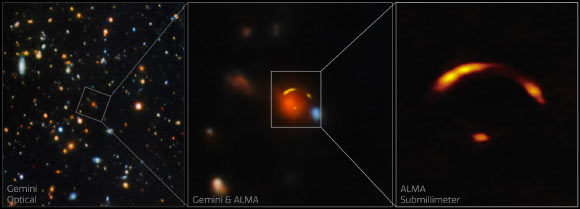
The origin of high-energy astrophysical neutrinos remains unresolved, and secure electromagnetic counterparts to individual events are rare despite rapid follow-up. Dusty star-forming galaxies at cosmic noon (redshift of z ≈ 1-4) are natural cosmic-ray calorimeters, yet observational links between these galaxies and neutrinos have remained unknown. Urata et al. report a compact-core, dusty star-forming galaxy within an IceCube localization, JCMT0402-0424, a quadruply lensed galaxy at z = 2.988 located inside the 90% containment region of the IceCube event IC 210922A. Image credit: International Gemini Observatory / NOIRLab / NSF / AURA / ALMA / ESO / NAOJ / NRAO / T.A. Rector, University of Alaska Anchorage & NSF’s NOIRLab / D. de Martin & M. Zamani, NSF’s NOIRLab / Yuji Urata. MITOS Science Co., LTD.

JCMT0402-0424, a dusty starburst galaxy around 11 billion light-years away, is the strongest candidate yet for the source of the high-energy neutrino event IC 210922A, according to a team of astronomer led by Yuji Urata of MITOS Science Co.

The post Astronomers Trace Elusive High-Energy Neutrino to Star-Forming Galaxy in Early Universe appeared first on Sci.News: Breaking Science News.

  •  

Radar Observations Reveal New Clues about Europa’s Hidden Interior

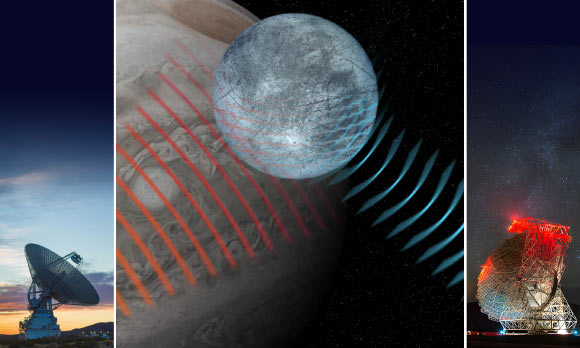
This artist’s impression shows radar waves from NASA’s Goldstone Solar System Radar pinging Europa; the radar waves penetrate Europa’s icy surface before bouncing back to be collected by NSF’s Green Bank Telescope on Earth. Image credit: NSF / AUI / NSF’s NRAO / P.Vosteen.

Using NASA’s Goldstone Solar System Radar and NSF’s Green Bank Telescope, astronomers from the University of California, Los Angeles, confirmed that the icy surface of Jupiter’s moon Europa scatters radio energy in an unusually strong and complex way not seen on rocky worlds.

The post Radar Observations Reveal New Clues about Europa’s Hidden Interior appeared first on Sci.News: Breaking Science News.

  •  
❌