❌

Reading view

Astronomers Find Four Separate Generations of Stars in ‘Globular Cluster’ Terzan 5

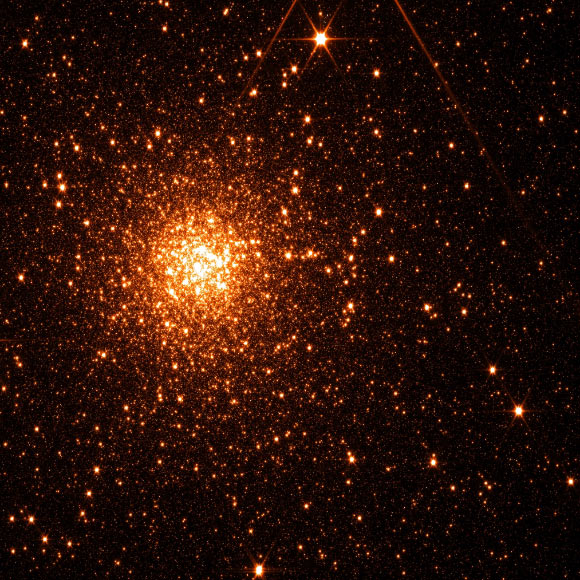
This Webb/NIRCam image shows the star cluster Terzan 5. Image credit: NASA / ESA / CSA / Webb.

New Webb and Hubble data not only confirm the existence of two distinct populations of stars in the ancient stellar system Terzan 5, once classified as a globular cluster, but also provides evidence for two more recent rounds of star formation.

The post Astronomers Find Four Separate Generations of Stars in ‘Globular Cluster’ Terzan 5 appeared first on Sci.News: Breaking Science News.

  •  

Voie lactée : un objet vieux de 12,5 milliards d’années révèle une surprise majeure

Une anomalie au cœur de la Voie lactée intrigue les astronomes depuis des décennies. Et les dernières observations du télescope spatial James-Webb viennent de transformer une curiosité en véritable casse-tête cosmique. De quoi changer notre vision de la formation des galaxies.

  •  

James Webb Space Telescope Reveals Two Completely Different Twilights on an Alien World


For the first time, astronomers have distinguished between the morning and evening atmospheres of a single planet, revealing two remarkably different environments at its edges. WASP-121 b is a gas giant that orbits extremely close to its star, resulting in one hemisphere exposed to temperatures approaching 2,500 degrees Celsius while the opposite side remains in constant darkness.

A research team from the Max Planck Institute for Astronomy used the James Webb Space Telescope to provide observational evidence for a phenomenon that models had previously predicted. The boundary regions between day and night on tidally locked planets can exhibit distinct temperatures and chemical compositions.

The recent findings appeared in a study published in Nature Astronomy.

A World Stuck in Time

WASP-121 b is part of a group of gas giants known as hot Jupiters. These massive planets orbit their stars in just a few days and eventually become locked in place by gravity. Tidal forces keep one side facing the star at all times, while the other side never sees daylight.

“WASP-121 b is particularly extreme,” said co-author Tom Evans-Soma of the University of Newcastle, Australia. “Average temperatures on the dayside hemisphere are around 2,770 Kelvin, while those on the nightside are closer to about 1,000 Kelvin.”

The difference in temperature between the two hemispheres, which is about 1,775 degrees Celsius, makes WASP-121 b one of the most thermally extreme exoplanets known. The regions at the boundary between day and night, called terminators, are where the planet experiences constant morning or evening conditions. Scientists expected these areas to have different atmospheric properties, but only with the precision of JWST could these differences be directly observed.

Mapping the Atmosphere

The researchers used a method based on the planet’s transit across its star to study these differences. As WASP-121 b passes in front of its star, it rotates by about 30 degrees, which means that different parts of its atmosphere can be observed during each transit. By tracking how infrared starlight filters through the atmosphere over time, the team reconstructed how temperature and chemical composition change across different longitudes.

“By measuring how starlight absorption changes as WASP-121 b rotates, we probe its atmosphere longitude by longitude,” said lead author Cyril Gapp of MPIA. The observations not only confirmed what models had predicted, but also showed that the differences between the two terminators are even greater than expected.

Two Different Skies

The evening side of the planet’s terminator absorbs more starlight than the morning side. Powerful eastward winds sweep heat from the scorching dayside toward the nightside, with the evening region getting the first blast of this warmth. This extra heat causes the atmosphere there to puff up, allowing it to absorb even more starlight, as the observations showed.

Chemical measurements backed up these findings. Carbon monoxide absorption increased as the hotter regions of the evening came into view near the end of the transit. Water showed a different pattern. Rather than simply decreasing with higher temperatures, the researchers interpret the result as evidence that water molecules in the upper atmosphere are breaking apart, likely due to the intense heat at the evening terminator. This points to a real chemical change, not just a shift in molecular location.

The Cloud Problem

The morning side shows a different environment. Although models predicted a difference between the two terminators, they did not fully explain why the morning side appears cooler and more opaque. The most likely explanation involves clouds that are unlike those on Earth.

At the morning terminator, air comes in from the cold nightside. Temperatures may be low enough for silicate and mineral compounds to turn into tiny particles, forming clouds that block infrared radiation from below. This makes the atmosphere appear cooler than it really is underneath.

When the team adjusted their models to account for these clouds, the results more closely aligned with their observations. Still, confirming exactly how these clouds form and behave will require more advanced modeling, as cloud formation and evaporation in such extreme environments remain a major puzzle in exoplanet science.

A Method Ready to Scale

WASP-121 b has been the subject of previous studies, but JWST now enables astronomers to examine its atmosphere in detail, section by section. This approach is now also available for use with other exoplanets.

The team has already found other ultra-hot gas giants with the right temperatures and orbits for similar analysis. Using this method on other planets will help astronomers compare atmospheric conditions and deepen our understanding of extreme planetary environments.

Austin Burgess is a writer and researcher with a background in sales, marketing, and data analytics. He holds an MBA, a Bachelor of Science in Business Administration, and a data analytics certification. His work focuses on breaking scientific developments, with an emphasis on emerging biology, cognitive neuroscience, and archaeological discoveries.

  •  

Le télescope James-Webb révèle comment une galaxie peut mourir en pleine jeunesse !

À peine un milliard d'années après le Big Bang, cette galaxie connaît une croissance fulgurante en formant des étoiles à un rythme exceptionnel. Pourtant, les astronomes ont découvert qu'elle expulse simultanément d'immenses quantités de gaz, le combustible indispensable à sa survie. Une...

  •  

« Tout s’emboîte » : les scientifiques pensent avoir trouvé ce qui se cache derrière les « points rouges » du télescope James-Webb

Depuis leur découverte par le télescope James-Webb, les « petits points rouges » défient les astronomes. Une nouvelle observation, presque par hasard, pourrait enfin lever le voile sur leur véritable nature.

  •  

Il telescopio spaziale James Webb sta offrendo una visione senza precedenti…

Il telescopio spaziale James Webb sta offrendo una visione senza precedenti dell’universo primordiale grazie alla sua capacità di osservare la luce infrarossa proveniente da oggetti estremamente lontani. Tra le sue scoperte più sorprendenti figurano galassie molto luminose e apparentemente mature esistite poche centinaia di milioni di anni dopo il Big Bang. Queste osservazioni hanno acceso un intenso dibattito scientifico, poiché suggeriscono che la crescita delle prime strutture cosmiche potrebbe essere avvenuta più rapidamente del previsto. Sebbene analisi successive abbiano ridimensionato alcune delle stime iniziali, Webb continua a fornire dati che stanno portando gli astronomi a perfezionare le teorie sulla formazione delle galassie, dei buchi neri supermassicci e dell’universo delle origini.
  •  

Le télescope James-Webb révèle la composition surprenante de la comète interstellaire 3I/Atlas !

Le télescope spatial James-Webb de la Nasa a recueilli sa première signature chimique infrarouge moyenne d'un objet interstellaire lors d'une récente observation de la comète 3I/Atlas. Les résultats concernant la composition chimique et le comportement de la comète sont étranges.

  •  

Webb Weighs Most Distant Inactive Black Hole Ever Found

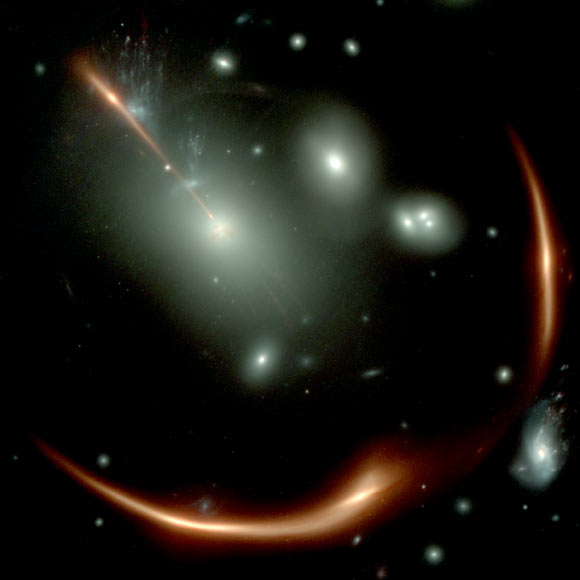
This Webb image shows the highly distorted red galaxy MRG-M0138 seen through a foreground cluster of galaxies (white sources). Image credit: NASA / ESA / CSA / Webb.

A supermassive black hole 6 billion times the mass of the Sun lurks in MRG-M0138, a gravitationally lensed quiescent galaxy seen when the Universe was just 3 billion years old, according to an analysis of data collected by the NIRSpec Integral Field Spectrograph onboard the NASA/ESA/CSA James Webb Space Telescope.

The post Webb Weighs Most Distant Inactive Black Hole Ever Found appeared first on Sci.News: Breaking Science News.

  •  

Digital ID | The World Economic Forum Plans to Control the World

The Digital ID, promoted by the World Economic Forum, aims to establish total control over society through cashless transactions and total surveillance. The global use of digital IDs coupled with CBDCs will mean the loss of all personal freedom. Resist totalitarianism! Resist all digital IDs! Do not conform!

  •  

The Great Taking: How Central Banks Could Seize Your Wealth

The Federal Reserve system underpins global currencies, serving as a private banking cartel that perpetuates debt. Critics view this as a scheme that risks public assets during financial crises while privatizing profits. David Rogers Webb’s work warns of potential financial collapses, suggesting banks may again seize deposits, reinforcing a cycle of economic control.

  •  

Webb Detects Methane on Interstellar Comet 3I/ATLAS

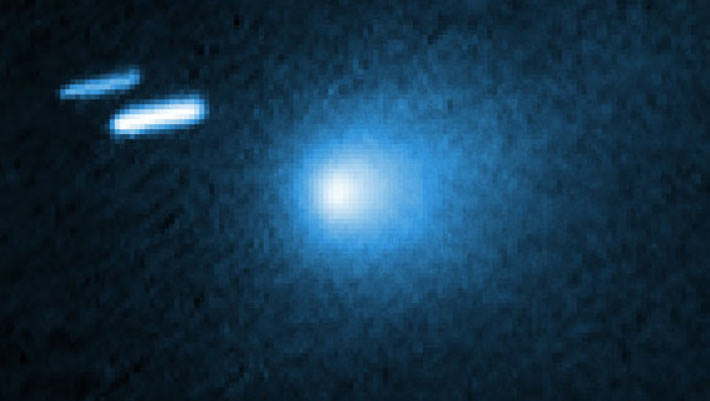
Hubble captured this image of 3I/ATLAS on July 21, 2025, when the comet was 446 million km (277 million miles) from Earth. Image credit: NASA / ESA / David Jewitt, UCLA / Joseph DePasquale, STScI.

Using the spectral data from the Mid-Infrared Instrument (MIRI) onboard the NASA/ESA/CSA James Webb Space Telescope, astronomers have detected methane on 3I/ATLAS.

The post Webb Detects Methane on Interstellar Comet 3I/ATLAS appeared first on Sci.News: Breaking Science News.

  •  

O que surgiu primeiro: o buraco negro ou a galáxia? James Webb pode ter a resposta

Pela primeira vez, há sinais reais de que o Universo terá evoluído de forma muito diferente do que se pensava. A hipótese de os buracos negros gigantes terem surgido antes das galáxias já não parece apenas ficção científica e pode obrigar a reescrever parte da história cósmica.

The post O que surgiu primeiro: o buraco negro ou a galáxia? James Webb pode ter a resposta appeared first on Tek Notícias.

  •  

Webb Spots Supermassive Black Hole Older Than Its Home Galaxy

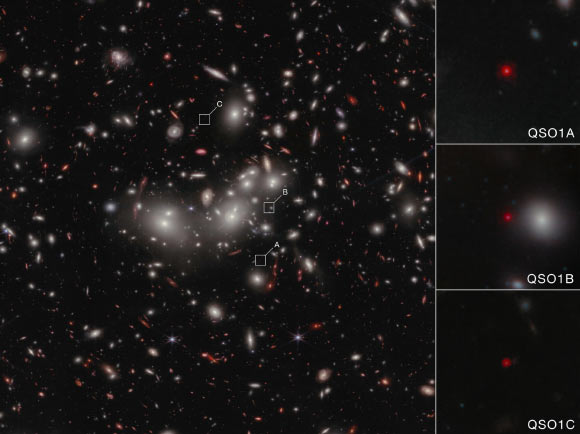
This Webb/NIRCam image shows the little red dot Abell2744-QSO1, magnified and triply imaged by galaxy cluster Abell 2744. Image credit: NASA / ESA / CSA / Lukas Furtak, Ben-Gurion University / Alyssa Pagan, STScI.

Astronomers using the NASA/ESA/CSA James Webb Space Telescope have found an enormous black hole in the early Universe that appears to predate its own host galaxy, raising fresh questions about how the cosmos’ first supermassive monsters were born.

The post Webb Spots Supermassive Black Hole Older Than Its Home Galaxy appeared first on Sci.News: Breaking Science News.

  •  

Webb Detects Methane in Atmosphere of Exo-Saturn TOI-199b

An artist’s rendition of the ultrahot Jupiter TOI-1518b and its parent star. Image credit: Sci-News.com.

Using spectral data from the Near-Infrared Spectrograph (NIRSpec) onboard the NASA/ESA/CSA James Webb Space Telescope, astronomers analyzed the atmosphere of TOI-199b, a distant Saturn-mass world that is neither frozen nor scorching hot.

The post Webb Detects Methane in Atmosphere of Exo-Saturn TOI-199b appeared first on Sci.News: Breaking Science News.

  •  
❌