❌

Reading view

AAS 248: Day 2

NGC 2210

Editor’s Note: This week we’re at the 248th AAS meeting in Pasadena, CA. Along with a team of authors from Astrobites, we will be writing updates on selected events at the meeting and posting each day. Follow along here or at astrobites.com for daily summaries, or follow @astrobites.bsky.social on Bluesky for more coverage. The usual posting schedule for AAS Nova will resume on 22 June.

Table of Contents:


Helen B. Warner Prize Lecture: Kyle Kremer, Globular Clusters: Astronomical Factories of Gravitational-Wave and Electromagnetic Transients (by Lucas Brown)

Kyler Kremer (University of California, San Diego) kicked off day two of AAS 248 with a “dynamic” talk on the complex interactions and environments that exist within globular clusters — the most massive category of stellar clusters, which can contain upwards of one billion stars. Because of the extreme stellar density of these environments, they are thought to be good factories of systems ranging from accreting white dwarfs to millisecond pulsars, which are often spun up to high speeds via accretion from companion stars. Such accretion, whether onto pulsars or other compact objects, can often generate bright X-rays, and as Kremer noted early on in his talk, it was in fact these X-ray sources that provided some of the earliest evidence of the abundance of exotic systems within globular clusters. By the early 2000s, hundreds of X-ray sources had been identified in globular clusters.

Along with these brightly emitting compact binary systems, we expect globular clusters to be home to a vast population of darker, more elusive objects — black holes. Kremer noted that because about one out of every thousand stars is thought to be massive enough to evolve into a black hole, older globular clusters are thought to produce tens or hundreds of thousands of black holes over time. These black holes are then expected to gradually sink towards the centers of the clusters through dynamical friction, where they will increasingly find themselves in the company of other black holes, or black hole binaries. As these massive objects swing by each other, they can occasionally merge or eject black holes out of clusters entirely. This leads to a complex evolutionary history, leaving many open questions in regards to how many black holes should persist in globular clusters today and with what properties.

Luckily, strong evidence for the presence of black holes in globular clusters began to come in around the early 2000s as a result of the direct measurements of stellar orbits around an invisible, at least 4-solar-mass object in NGC 3201. Since this discovery, multiple others have been made via similar techniques. The role of black holes in shaping our observation of globular clusters may go well beyond these isolated systems, however. Theoretical work has also shown that the presence of black hole binaries in the centers of globular clusters may contribute to dynamical heating of the overall cluster. This suggests that globular clusters that have not undergone core collapse, which represents over 80% of clusters, should retain significant black hole populations today.

While individual black holes can often be hard to spot, black hole binaries are becoming increasingly easy to hear, thanks to the advent of gravitational wave astronomy. At facilities like LIGO, Virgo, and KAGRA, merging black hole binaries are now regularly detected, creating a population-level catalog of black hole binary properties. While many of these systems can be well explained by black holes formed in the “isolated” channel, meaning originating from a preexisting binary star system, some mergers show signs of a “dynamical” formation history, which can arise in the sort of dense environments globular clusters provide. As one example, there seems to be more black holes in the 40-solar-mass and above range than many models predicted. At these high masses, more potential progenitor stars actually become too large to form black holes thanks to a phenomenon called pair instability. However, such massive black holes could be formed from the repeated mergers of smaller black holes — a hierarchical process that simulations have consistently shown can be highly efficient in globular clusters, especially the most massive ones. On top of this, Kremer noted that individual gravitational wave signals have recently shown other telltale signs of hierarchically formed binary black holes, such as asymmetric masses and spin–orbit misalignment.

Finally, Kremer turned to another class of exotic astrophysical objects to explore other ways globular clusters can generate interesting phenomena: pulsars. Pulsars, like black holes, form from the collapse of massive stars. This rapidly rotating sub-category of neutron stars beams radiation from their poles, which gradually slows them down and depletes the strength of their radio emission over millions or billions of years. Because of this, one would expect older globular clusters to have a slowly rotating and mostly invisible population of pulsars. Instead, we see many rapidly rotating millisecond pulsars in these environments, suggesting that the dense cluster environment allows for many of these systems to be spun back up through accretion from other stars. In contrast, we also see young globular clusters which contain slowly rotating pulsars — another puzzle, yet one that may again be explained by the dense environment. Some researchers believe that these pulsars are formed via the direct merger of multiple white dwarfs, rather than from the collapse of a massive star. Such systems may also be the source of some fast radio bursts; the first fast radio burst associated with a globular cluster was discovered in 2020. It seems like globular clusters may be the gift that just keeps on giving!

Return to Table of Contents.


Press Conference: Our Changing Galaxy and the Skies We See (Briefing video) (by Niloofar Sharei)

This press conference walked through four very different ways our view of the Milky Way and our skies are changing right now — from extreme gas physics at the Galactic Center, to the hidden stellar populations of a cluster, to the rapid flickers of dying stars, and finally, to a very practical question: what are dark night skies actually worth to the public?

Resolving the Supersonic-to-Subsonic Gas Transition in the Galactic Center for the First Time
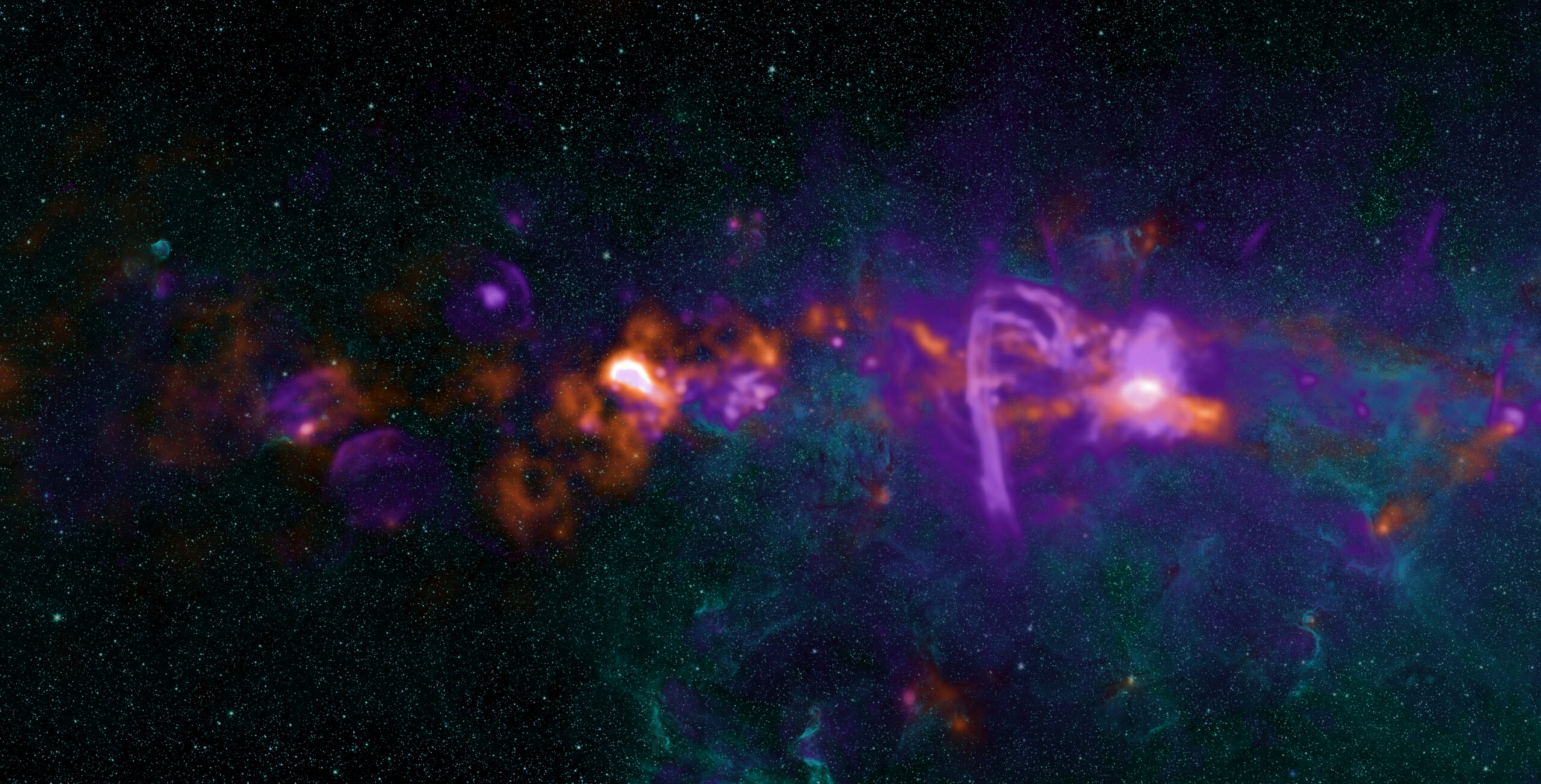
central molecular zone

The galactic center and the surrounding central molecular zone make up the most active star formation region in the Milky Way. [NRAO/AUI/NSF; CC BY 4.0]

Rojita Buddhacharya (Center for Astrophysics | Harvard & Smithsonian; Liverpool John Moores University) presented new results from the central molecular zone (CMZ), the dense gas reservoir at the center of our galaxy about 25,000 light-years from Earth. The CMZ is one of the most extreme environments we know of: gas there is roughly a hundred times denser, hotter, and more turbulent than what we see in nearby molecular clouds. Despite holding huge amounts of star-forming fuel, the CMZ forms stars at a surprisingly inefficient rate, and one of the puzzles is what conditions actually let any of that gas collapse into stars.

Buddhacharya mapped how gas transitions from highly turbulent, supersonic motion to calmer, subsonic motion across a region in the CMZ. This transition is well known in nearby clouds, where it usually precedes gravitational collapse, but it had never been clearly resolved in the CMZ before. Their team found a “calm island” of subsonic gas embedded in the otherwise turbulent sea. This is the first observation of its kind in the galactic center.

The Multi-Age Stellar Populations of Terzan 5 as Revealed by JWST

R. Michael Rich (University of California, Los Angeles) presented new JWST and Hubble Space Telescope observations of Terzan 5, an unusual stellar system near the center of the Milky Way that looks like a globular cluster but doesn’t act like one. Earlier work had already shown that Terzan 5 hosts at least two distinct stellar populations with very different ages and chemical abundances, which is unusual for a typical globular cluster.

Because Terzan 5 sits behind a thick screen of foreground stars and dust, separating real cluster members from contamination is one of the hardest parts of the analysis. The team combined JWST and Hubble imaging to measure stellar proper motions, then used a vector point diagram to isolate the stars that move together with the cluster. They identified two additional stellar populations beyond the two already known. Rich argued that Terzan 5 may be a “fossil fragment,” possibly the leftover core of a small galaxy or early bulge structure that was accreted long ago.

Sub-Day Periodic Variability of Two Central Stars of Planetary Nebulae

Gaoyang Du (Dalian University of Technology) reported the discovery of new short-period signals in the central stars of two planetary nebulae. These central stars are the hot, exposed cores left behind by Sun-like stars at the end of their lives, and finding rapid brightness variations in them tells us about their interior structure and pulsation physics.

Short-period signals well under a day are very hard to recover from the ground because Earth’s rotation introduces strong one-day aliasing, so the team turned to the Transiting Exoplanet Survey Satellite, which observes continuously from space. Using a neural-network pipeline designed to handle the crowded, contaminated backgrounds these stars sit in, they recovered the previously known variability in NGC 1501 and detected a new signal at roughly half an hour. Follow-up spectroscopy will be needed to pin down whether the signals come from pulsations, rotation, or something else, but the result opens a new window on the rapid variability of dying-star cores.

Artificial Light at Night Significantly Degrades the Value of Public Lands

Jordan Smith (Utah State University) closed the press conference with a very different kind of measurement: the economic value of dark night skies. While astronomers usually treat light pollution as an observing problem, Smith and his collaborators are asking what the public is actually losing and what people would pay to keep dark skies on public lands. The team surveyed 634 visitors across International Dark Sky-certified parks, asking detailed questions about visitation behavior, motivations, and willingness to pay. Combining those surveys with satellite-based sky-brightness data, they estimated how the actual darkness of a site translates into the value visitors place on a trip. Based on the survey results, they found that visitors were willing to pay $45 more per visit to go to a park with skies one level darker on the Bortle scale. That sounds small per visitor, but scaled across all visits to all dark-sky public lands, it represents a very large economic value tied to a public good that current policy frameworks rarely account for.
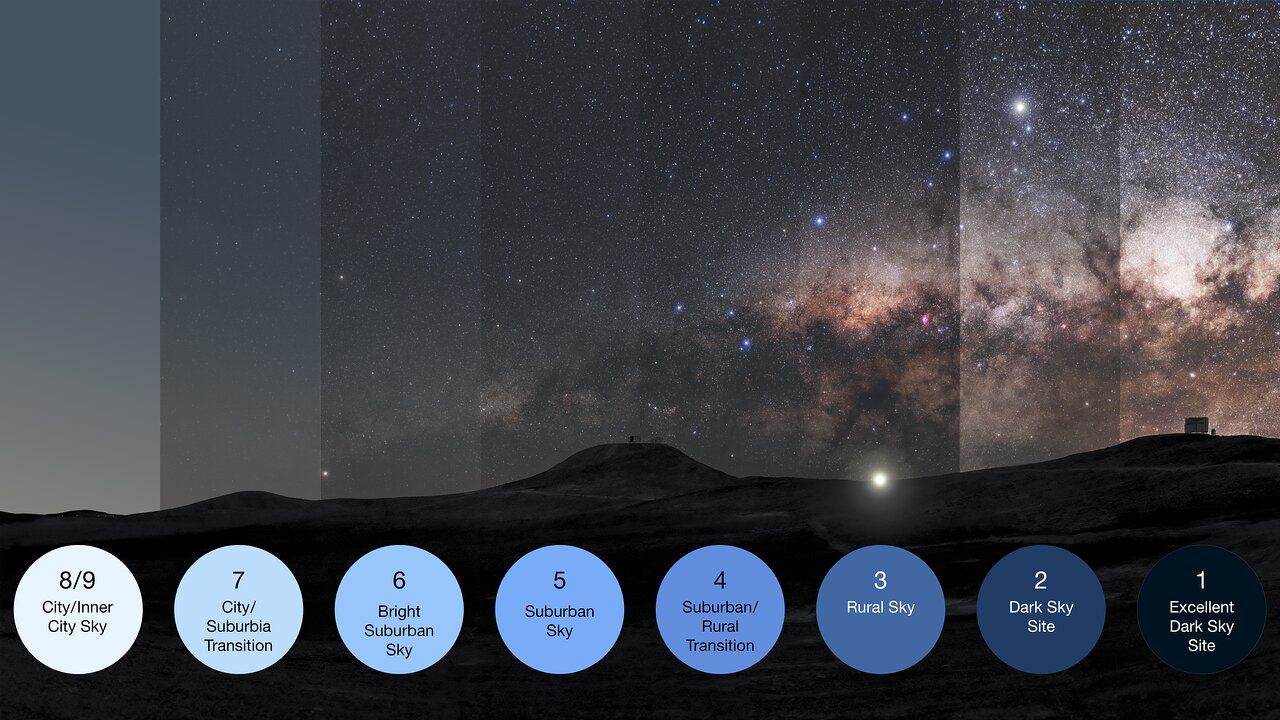
illustration of the Bortle scale

An illustration of the Bortle scale, which quantifies the degree of light pollution at a given location. [ESO/P. Horálek, M. Wallner; CC BY 4.0]

Return to Table of Contents.

High Energy Astrophysics Division Early Career Prize Lecture: Carolyn Kierans, Developing Next-Generation MeV Telescopes (by Niloofar Sharei)

Carolyn Kierans (NASA Goddard Space Flight Center) was awarded the AAS High Energy Astrophysics Division Early Career Prize for her work on developing the next generation of megaelectronvolt (MeV) gamma-ray telescopes. Her talk laid out why the MeV band is so valuable (it contains nuclear emission lines like the 511 keV positron-annihilation line that traces high-energy processes in our galaxy) and why it has been so technologically difficult to observe well, since photons at these energies do not focus easily and the dominant interaction in the detector is Compton scattering. She walked through her work using balloon-borne Compton telescopes to mature the technology, the tools her team has developed in recent years to improve event reconstruction, and the broader roadmap for the next generation of MeV instruments.

Read Astrobites’s interview with Carolyn Kierans.

Return to Table of Contents.


Press Conference: Fire and Ice in Planetary Systems Near and Far (Briefing video) (by Kerry Hensley)
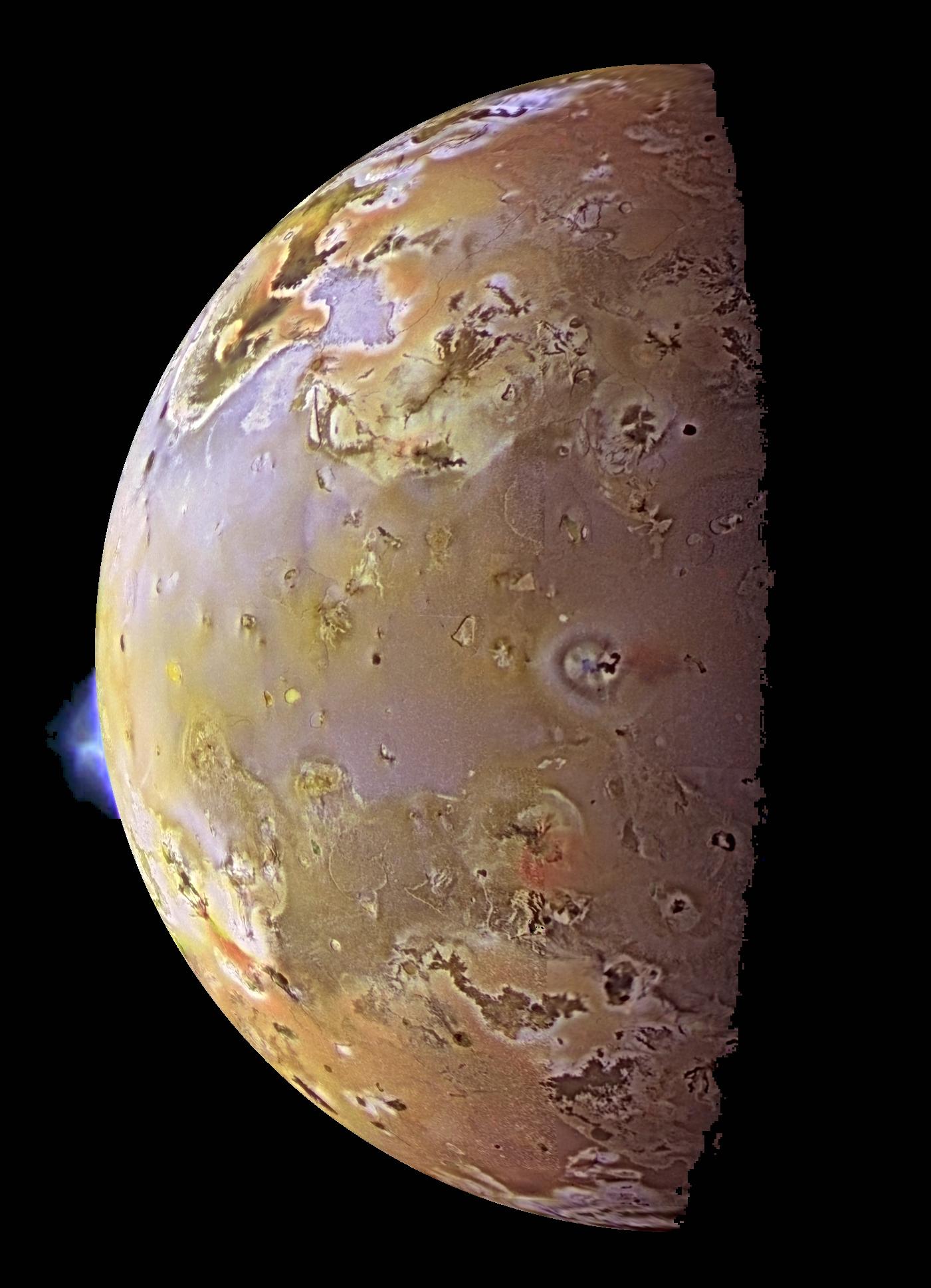
volcanic plume on Io

An image from the Galileo spacecraft of a volcanic plume on Jupiter’s moon Io. [NASA/JPL/University of Arizona]

The afternoon press conference was convened by Astrobites’s own Niloofar Sharei, this meeting’s Astrobites Media Intern. First up in the parade of planetary presentations was Neal Turner (NASA’s Jet Propulsion Laboratory/Caltech). Turner’s focus was Io, a moon of Jupiter and the most volcanically active body in the solar system. Turner’s team put forward a new claim: that the long-lived volcanoes that speckle Io’s surface spew out volcanic ash in their plumes, producing enough of this material to rapidly erase impact craters.

The team modeled Io’s plumes in order to explain the moon’s lack of impact craters, understand how certain plumes have persisted on Io for more than 45 years, and motivate a possible mission concept that includes a plume flythrough and sample return. They modeled the formation of ash as magma rises in a volcanic vent as well as the trajectory of the ash once it’s ejected into the plume, aiming to 1) match the plume observations from the Galileo spacecraft and 2) understand how an ash-filled plume might look different from one filled only with sulfur dioxide. While Turner found that Galileo data couldn’t discern between the two scenarios, ash makes a dramatic difference at the sub-millimeter wavelengths accessible to the Atacama Large Millimeter/submillimeter Array, which the team hopes to use to test this prediction. Finally, returning to the development of the mission concept, Turner proposed using a probe to first fly through the shadow of a plume to assess the particle size before sending the spacecraft through to collect a sample.

Up next, Tunhui Xie (University of California, Los Angeles) turned to Io’s neighbor, Europa. Europa and the other large icy moons of Jupiter are of interest to researchers because they might have subsurface oceans. Observations of Europa from ~30 years ago show that the moon has strange radar properties: its radar albedo is large, and the return signal retains the strong circular polarization of the outgoing signal.

To investigate the moon’s radar weirdness further, Xie’s team observed Europa from 2011 to 2024 and showed that the moon’s albedo (fraction of light reflected from its surface) is roughly constant with longitude. There is some evidence of differences between Europa’s hemispheres, which could be a sign of spiky ice structures called penitentes protruding from the frosty surface; Europa’s trailing hemisphere might be subjected to more particles from Jupiter’s magnetosphere, which could suppress the growth of penitentes in that region and cause a difference in the albedo. Xie also addressed the polarization behavior of the radar signal, showing that this is likely due to the coherent backscatter opposition effect. Finally, Xie showed how observations helped to place an upper bound of 32 meters for the penetration depth of X-band radar photons into Europa’s icy shell.
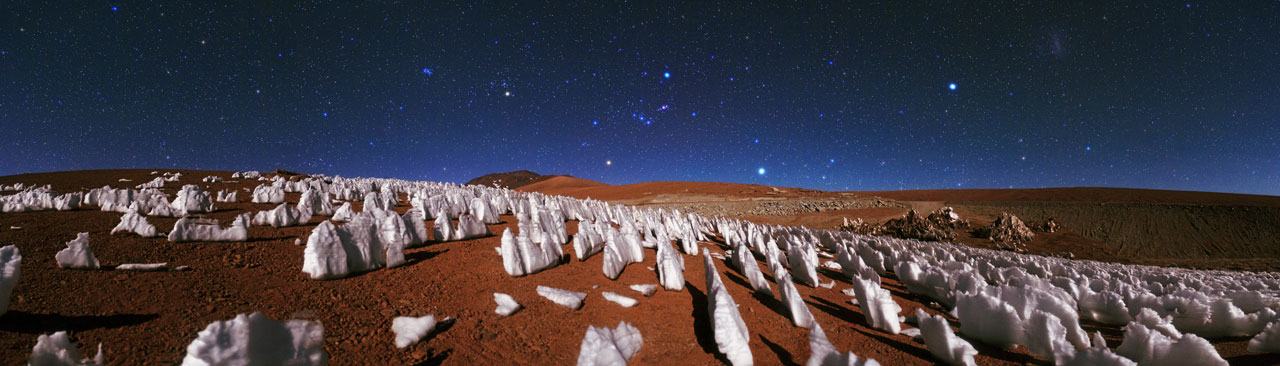
penitentes

Penitentes in the Atacama Desert. [ESO/B. Tafreshi (twanight.org); CC BY 4.0]

Bryce Bolin (Eureka Scientific) reported on the third known visitor from another star system: 3I/ATLAS. Using the Multi-Object Spectrograph for Infrared Exploration on the Keck I telescope, Bolin’s team obtained some of the first infrared images of the interstellar visitor and detected its fuzzy coma — the cloud of gas and dust that surrounds the solid body of the comet — shortly after its discovery in July 2025. In August, observations revealed that the comet had started to grow a tail. As the team monitored 3I/ATLAS during its journey through our solar system, they saw significant changes. The comet was initially very red, likely due to space weathering from the galactic environment, but it became greener as the comet became active and refreshed its surface.

In some of the earliest spectroscopy taken by a large-aperture telescope, Bolin’s team found cometary volatiles like CN, but not C2 or C3, which are common in comets, giving them a green color. These missing species emerged a couple of months later, which coincided with the comet taking on a greener appearance. As the comet retreated from its encounter with the Sun, these emission features faded. This presentation by Bolin showed how early and continuing monitoring of an interstellar object by a large-aperture telescope can reveal how these objects are affected by their journeys through our solar system.

Moving out of the solar system entirely, Tiffany Kataria (NASA JPL/Caltech) turned the discussion toward exoplanets. Kataria discussed HD 80606b, a 4.1-Jupiter-mass planet on an extremely eccentric (e = 0.93) orbit with a period of 111 days around a solar-type star. Kataria used JWST to observe HD 80606b’s phase curve, which revealed different parts of the planet as it travels along its orbit. Each time the planet makes its extremely close approach to its host star, it gets “flash roasted” and experiences a rapid increase in temperature. This rapid heating event is complex, depending on factors like the planet’s atmospheric chemistry and winds. The JWST data revealed that HD 80606b’s temperature skyrockets an incredible 1,100℉ over the course of its orbit. There’s still much more to learn from the rich spectroscopic dataset from JWST, so keep an eye out for more findings about this flash-roasted exoplanet in the future!

Finally, Aurora Kesseli (IPAC/Caltech) discussed another toasty exoplanet called CoRoT-2b, which is a hot Jupiter on a 1.7-day orbit around its star. Because hot Jupiters orbit their hosts so closely, astronomers expect all of these extreme exoplanets to be tidally locked, with one side of the planet perpetually facing the star and the other side in perpetual darkness. However, CoRoT-2b might be breaking that trend. In 2018, researchers reported that CoRoT-2b had winds that blew in the opposite direction from all other known hot Jupiters. They drew this conclusion from the location of the hottest point on CoRoT-2b, which appeared just after the planet ducked behind its star, rather than just before — unlike all other hot Jupiters studied so far. At the time, researchers hypothesized that the unusual location of the hotspot was due to clouds on one side of the planet, a magnetically induced westward wind, or a lack of tidal locking.

Using new data from the Very Large Telescope and Gemini South, Kesseli found that the planet’s strange properties can be explained best by a lack of tidal locking. CoRoT-2b appears to rotate at 2.24 km/s — far slower than the 4.37 km/s expected if the planet were tidally locked. There are no theories yet that explain why CoRoT-2b wouldn’t be tidally locked, so it remains a mystery for now!

Return to Table of Contents.


Solar Physics Division George Ellery Hale Prize Lecture: Yi-Ming Wang, The Sun as a Laboratory for Astrophysical Magnetic Fields (by Kerry Hensley)

Yi-Ming Wang (Naval Research Laboratory) gave the AAS Solar Physics Division’s George Ellery Hale Prize Lecture for “sustained, foundational contributions to understanding solar magnetism, the solar cycle, and the solar wind.” Wang is perhaps most known for the Wang–Sheeley–Arge solar wind model, which is widely used in space weather forecasting.

Wang began by musing on how his winding career path brought him to solar physics. Initially a theorist who modeled neutron stars, Wang was later hired to do radio astronomy but arrived for the position later than expected, so he was roped into working on solar physics instead — where he learned many things about magnetic fields that he wished he’d known when working on neutron stars!
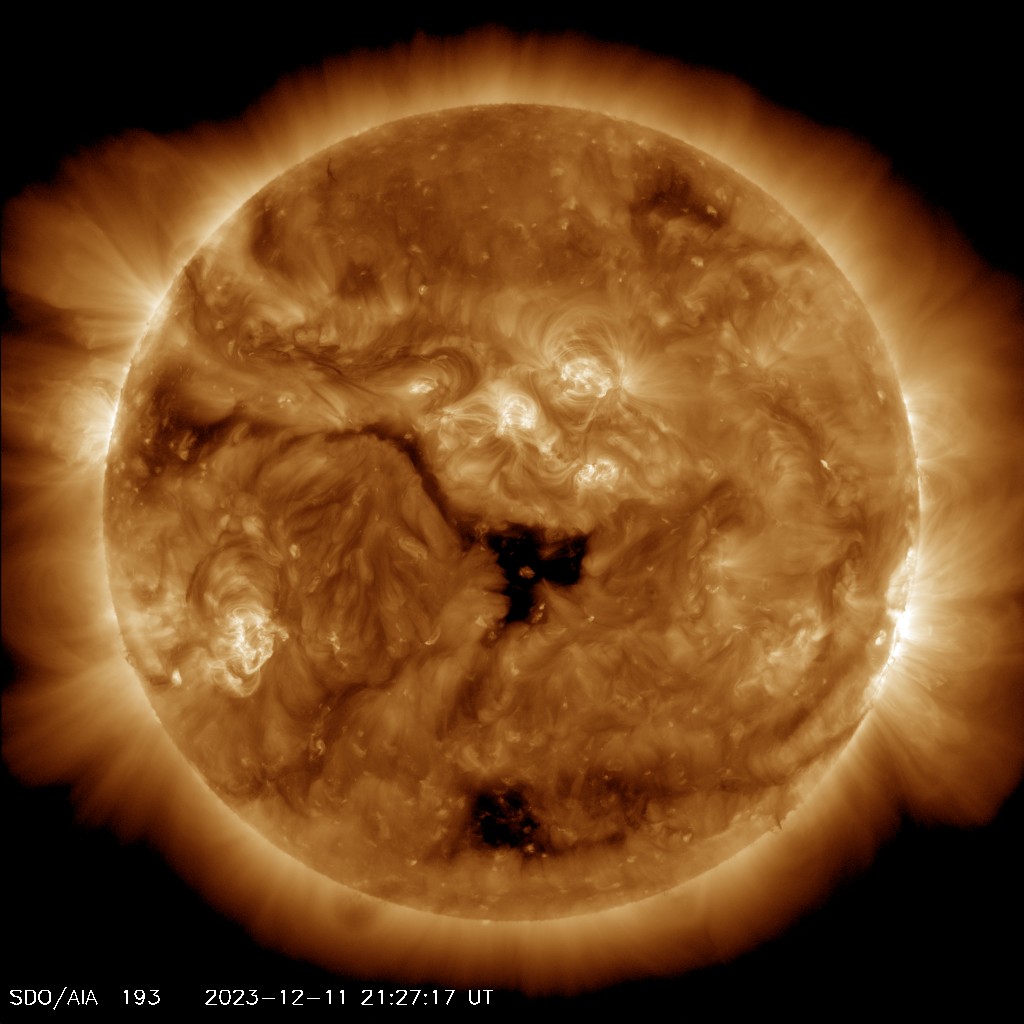
extreme-ultraviolet image of the Sun

This 19.3-nanometer image, taken by the Solar Dynamics Observatory on 11 December 2023, shows at the center of the Sun’s disk the remnant of a large coronal hole. [NASA/SDO and the AIA, EVE, and HMI science teams]

In this talk, Wang gave an overview of three aspects of the Sun related to its magnetic field: quasi-rigid rotation of coronal holes, the source of coronal heating, and the speed of the solar wind. First up, coronal holes: these are dark areas in the solar corona where magnetic field lines stream out into space, which solar physicists call “open” field lines. (“Closed” field lines curve back to the solar surface.) Wang described how we know that coronal holes are regions of open field lines by extrapolating the photospheric magnetic field. (The photosphere is the visible “surface” of the Sun.) Because coronal holes rotate quasi-rigidly (compared to the photosphere, which rotates differentially), magnetic field lines must be continually converted from closed to open and vice versa at the boundaries of these holes.

Next, Wang discussed the source of coronal heating. The solar corona is famously extremely hot, running at a few million degrees compared to the ~6000K solar photosphere. For decades, the Parker nanoflare model has been the leading explanation for how the corona gets so hot. In this model, the places where coronal loops touch down in the solar photosphere are continually wiggled around by random motions of the photosphere, which tangles up the magnetic field lines in the coronal loop. When the current sheets in this system dissipate, the corona is heated. Instead, Wang favors an observationally based model in which the heating comes from magnetic reconnection with underlying small-scale fields.

Finally, Wang briefly touched on the connection between the Sun’s magnetic field and the speed of the solar wind. The solar wind has been measured at Earth since the 1960s, and these measurements have shown that the mass and energy flux density of the solar wind scales with the strength of the footprint magnetic field strength, but the observed solar wind speed is independent of the footprint field strength. Instead, the speed scales inversely with the rate of magnetic flux-tube expansion in the corona. Thus, the solar wind speed at Earth can be calculated from the rate of flux-tube expansion along open magnetic field lines using maps of the photospheric magnetic field.

In the end, Wang’s work on the solar magnetic field did connect back to his earlier work in high-energy astrophysics, with relevance to period changes in binary pulsar systems and other areas. Magnetic fields really do connect all parts of astrophysics!

Read Astrobites’s interview with Yi-Ming Wang.

Return to Table of Contents.


Plenary Lecture: David Jewitt, The Interstellar Interlopers (by Niloofar Sharei)

David Jewitt focused his plenary talk on a rare kind of small body: the three confirmed interstellar objects that have passed through the solar system so far. He opened with the Oort cloud as a framing device. Comets in the Oort cloud did not form there — they formed near the giant planets and were scattered out by gravitational interactions. The same process leaks comets to interstellar space very efficiently: only about 1–10% are trapped into a star’s own Oort cloud. Across the galaxy, that implies a free-floating population on the order of 1024–1025 objects. Seeing some of them pass through our solar system is exactly what we should expect.
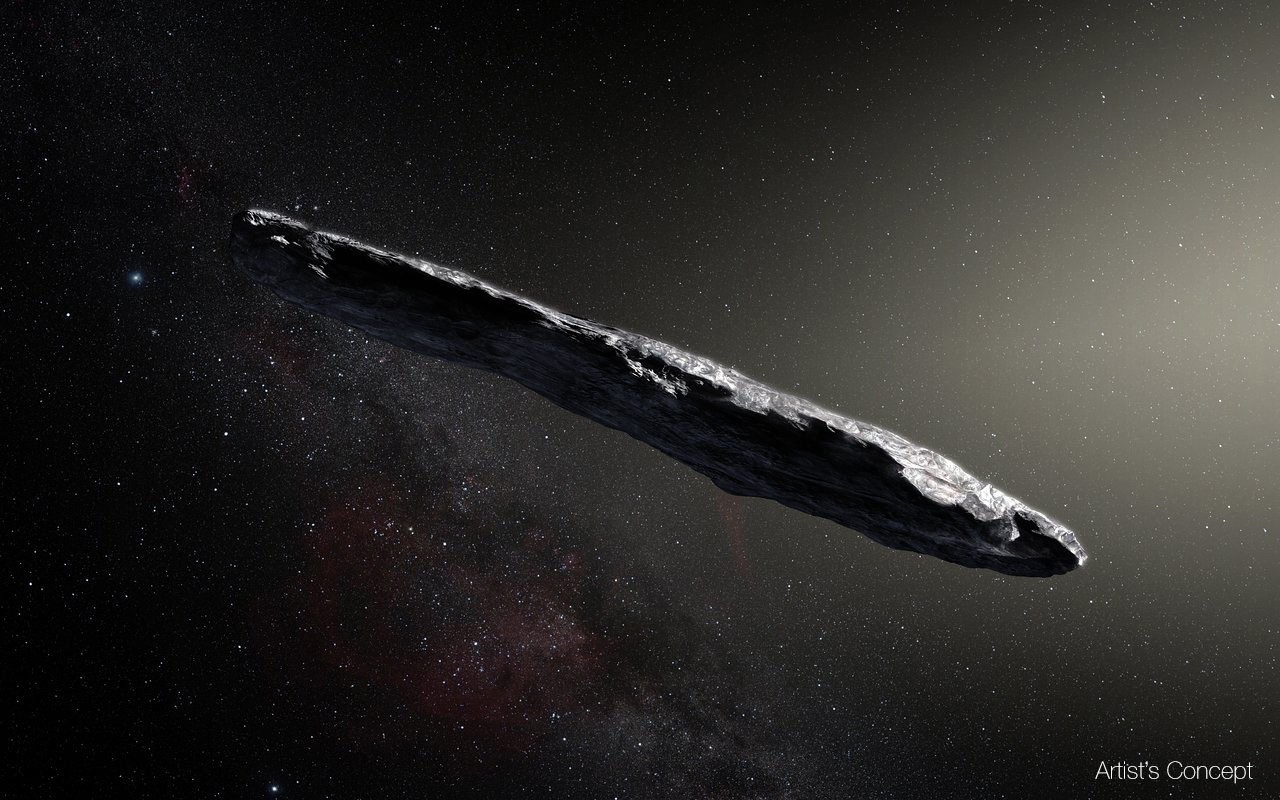
artist's impression of Oumuamua

Artist’s impression of the first known interstellar object to visit our solar system. ʻOumuamua. [ESO/M. Kornmesser; CC BY 4.0]

The bulk of the talk walked through the three known interlopers. ʻOumuamua (1I/2017 U1) is the strangest: a tiny inert body about 80 meters across, with an extreme light curve consistent with either a 6:1 elongated shape or a flattened disk, and a non-gravitational acceleration of about 0.1% of solar gravity despite no detectable outgassing. Jewitt walked through the proposed explanations: exotic ices, ultra-low-density fluffballs, and sail-like sheets, and showed why each runs into a physical problem. 2I/Borisov (2019), by contrast, looks like a perfectly normal comet, with a ~400–500-meter nucleus, a coma, a tail, and a solar-system-like composition. 3I/ATLAS is the largest at roughly a kilometer, and JWST infrared spectroscopy has revealed CO2 emission about an order of magnitude richer than typical solar system comets. This is the first detailed look at the volatile inventory of an interstellar visitor.

Jewitt then turned to what the three objects tell us as a population. The strongest constraint comes from ʻOumuamua, precisely because its discovery was such a near miss: catching one in that brief visibility window implies roughly 1,000 similar objects crossing the solar system per year. The three objects look very different in size, activity, and composition, which is consistent with sampling a broad galactic population, and their velocity dispersion lines up with the disk-heating picture, in which older galactic populations are kinematically hotter. The leading origin story is the same one he set up at the start: scattering from the protoplanetary disks of giant planets around other stars.

Read Astrobites’s interview with David Jewitt.

Return to Table of Contents.

The post AAS 248: Day 2 appeared first on AAS Nova.

  •  

Taxa das Blusinhas Pode Voltar em 2027? Entenda o Que Está Acontecendo #tecmundo #taxadasblusinhas

💾

A taxa das blusinhas pode estar com os dias contados. Apesar do fim do imposto de importação para compras internacionais de até US$ 50, a reforma tributária prevê a criação da CBS (Contribuição sobre Bens e Serviços), que pode voltar a taxar produtos comprados em plataformas como Shopee, Shein e AliExpress a partir de 2027.

Neste vídeo, explicamos o que muda, quais são as estimativas de cobrança e como isso pode impactar o bolso dos consumidores brasileiros.

#TaxaDasBlusinhas #Shopee #Shein #AliExpress #ComprasInternacionais #Importação #ReformaTributária #CBS #Economia #Brasil #TecMundo
  •  

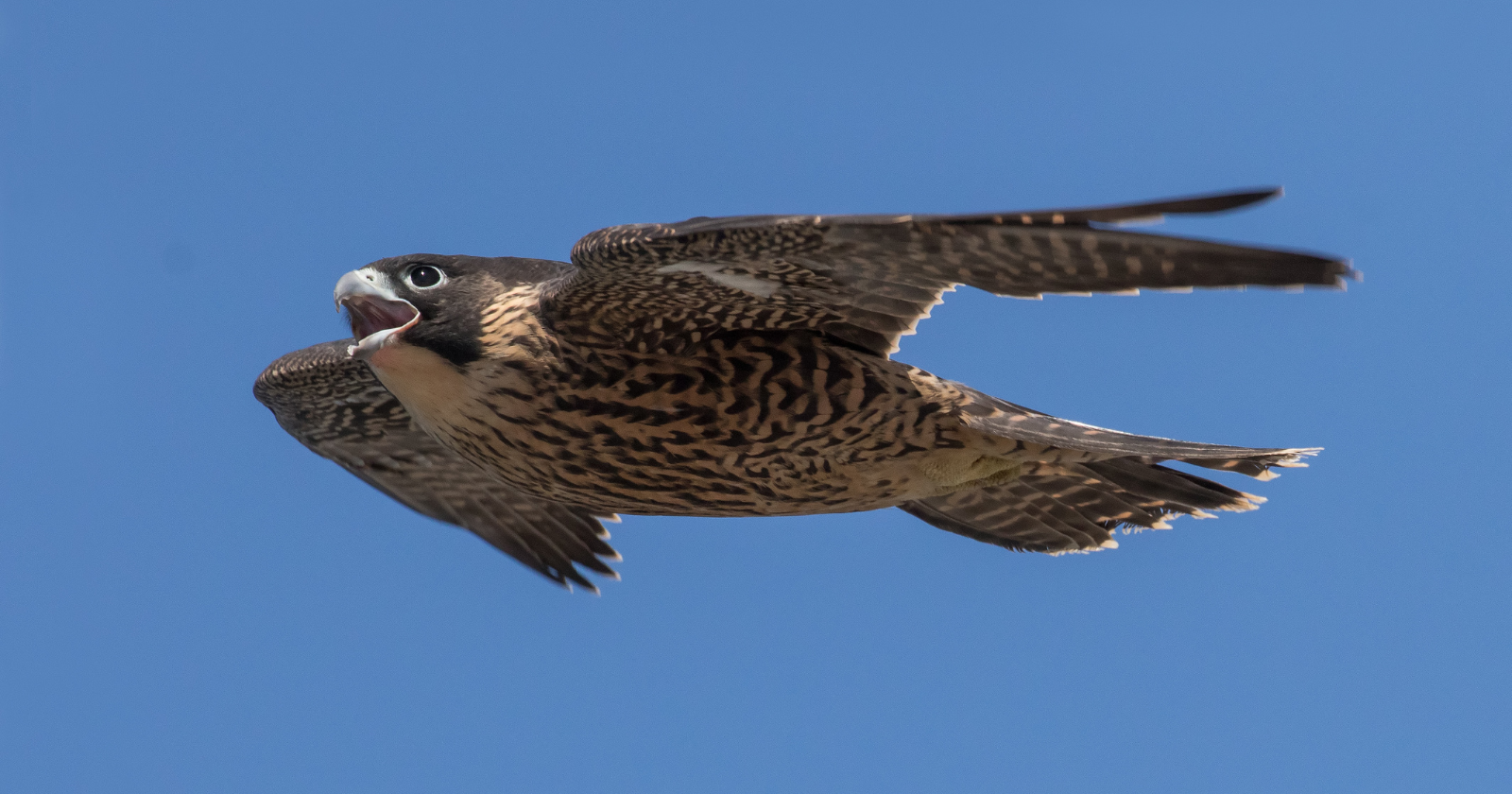
In a hunting dive, the peregrine falcon becomes the fastest animal alive, plunging at speeds of more than 320 km/h — before striking its prey in mid-air, a blow that can kill on impact

A peregrine falcon in a hunting dive reaches a terminal velocity of about 320 km/h (200 mph), which makes it the fastest animal alive.

That figure is not a guess from a single enthusiast with a stopwatch. A peer-reviewed aerodynamics study notes that peregrines exceed 320 km/h in a full stoop, though its own filmed dives took place past a 60 m dam — short enough that the falcons never reached terminal velocity, but long enough to capture the changing wing shape on high-speed cameras. The record claim sits higher still: a captive falcon named Frightful was reportedly clocked at 389 km/h (242 mph) in 1999 after release from a light aircraft.

For comparison, the Guinness World for the fastest speed in an Formula 1 car is 372.56 km/h (231.51mph). These cars need a long straight and lots of horsepower. The falcon gets there with body mass, gravity, and a folded silhouette, then has to land a precise strike at the end of it. The car only has to keep going straight.

The dive has a name: the stoop. The record speed belongs only to the dive, and the dive depends on shape. Robin Mills, a biologist who has modelled the manoeuvre, describes it this way: “Within the blink of an eye, it dives down – first flapping forcefully and then folding its wings to decrease drag. It basically appears to drop out of the sky.” All of this is in service of the strike at the bottom — the stoop is how the falcon turns altitude into a killing blow.

The peregrine delivers the blow with its feet, used as a blunt weapon rather than as the gripping talons most people picture. The popular image of a clenched fist is roughly right but not exact. The Birds of Stanford essays note that “High-speed cinematographic studies, however, have shown that they strike their prey from above with all four toes fully extended.” The foot may be open at the instant of contact, not closed, though the strike itself remains a percussive hit rather than a grab.

The impact does much of the killing. Peregrines and their close relatives carry only modest talons, so they cannot rely on the crushing grip that some larger raptors use. Instead, as Fowler and colleagues describe in their study of raptor anatomy, “For immobilisation, Falconini rely more strongly on strike impact and breaking the necks of their prey, having evolved a ‘tooth’ on the beak to aid in doing so.” The dive does the work, and the notched beak finishes what the blow starts.

The speed record hides something. A car at 320 km/h is being asked to follow a known line on a known surface. The falcon is being asked to intercept a small, frightened, swerving target in open air, and to do it while its own anatomy works against it. The peregrine’s sharpest vision sits off to the side of its eye, not straight ahead. Tucker and colleagues put the problem plainly: “When diving at prey straight ahead from great distances at high speeds, a peregrine has a conflict between vision and aerodynamics.”

To see the prey clearly, the bird “must turn its head approximately 40 ° to one side” to fix the target on the most acute part of its eye, but a turned head adds drag and slows the dive. Wild peregrines solve this not by turning the head but by curving the whole approach. Tucker’s team observed birds tracking distant prey along a curved path resembling a logarithmic spiral, which keeps the target pinned on that sideways high-acuity vision while the head stays streamlined. It is the aerial equivalent of taking the racing line rather than the shortest one.

The precision goes deeper than the path. A 2018 simulation by Mills and colleagues at Groningen and Oxford modelled the attack and found the diving falcon steers using the same proportional-navigation logic that guides missiles. The same work is careful about what high speed actually buys. The simulations suggest that when prey moves erratically, high-altitude stoops raise catch success compared with low-altitude attacks, but only if the falcon’s guidance law is finely tuned and its vision and control are precise. Speed without that control is just a fast miss. This is a modelling result rather than a field measurement, so it is best read as a clue to how the real birds manage it, not the last word.

The body comes equipped for the rest. Bony tubercles inside the nostrils are thought to limit the air rushing in at speed, and a translucent third eyelid sweeps across the eye to protect it while still letting the falcon see, a built-in visor for a pilot who cannot afford to blink at the wrong moment.

The post In a hunting dive, the peregrine falcon becomes the fastest animal alive, plunging at speeds of more than 320 km/h — before striking its prey in mid-air, a blow that can kill on impact appeared first on Space Daily.

  •  

Massive breach spills credentials for thousands of sensitive networks

Researchers have uncovered a massive breach of Fortinet firewalls that has given Russian-speaking attackers near-unrestricted access to some of the world’s largest and most powerful organizations, including Oracle, Chevron, Lenovo, Federal Express, a NATO defense contractor, and Fortinet itself.

Nearly 74,000 Fortinet devices from more than 21,000 IP addresses in 194 countries have been compromised and their plaintext credentials exposed online, Bob Diachenko, a security researcher and head of SecurityDiscovery.com, said online and in an interview. He said he found the data after gaining access to the attackers’ command-and-control server and other infrastructure. The exposed data also included the industry, revenue, and employee count for each compromised organization.

Exceptional scale, poor opsec

Independent researcher Kevin Beaumont reported that “almost all” of the compromised devices remained online as of Wednesday morning. He went on to say that he has confirmed with multiple organizations found in the attackers’ logs that the credentials are real and current. In many cases, once the threat actors compromised the devices, they went on to access affected organizations’ centralized authentication systems, such as Radius servers and Microsoft Active Directory. The number of compromised devices comprises roughly half of all Internet-facing Fortinet firewalls, based on polling from Shodan.

Read full article

Comments

© Getty Images

  •  

Tesco moving 40,000 server workloads off VMware amid Broadcom's “abusive conduct”

Tesco, a retail conglomerate headquartered in the United Kingdom, is moving 40,000 server workloads off of VMware amid "abusive conduct" from Broadcom, recent legal filings claim.

Tesco filed a lawsuit in the UK’s High Court against Broadcom alleging breach of contract last year. According to a September report from The Register, the lawsuit claimed that in January 2021, Tesco bought perpetual licenses for VMware’s vSphere Foundation and Cloud Foundation, a subscription to VMware Tanzu, plus support services until 2026, with the option to extend support for four additional years.

But when Broadcom took over VMware in November 2023, it would not honor the deal and instead tried to get Tesco to pay “excessive and inflated prices for virtualization software for which Tesco has already paid” and would not allow it to buy support services for its perpetually licensed software without buying “duplicative subscription-based licenses for those same Software products," the initial complaint read, The Register reported at the time.

Read full article

Comments

© Getty

  •  

AI coding agents taught robots how to install GPUs and cut zip ties

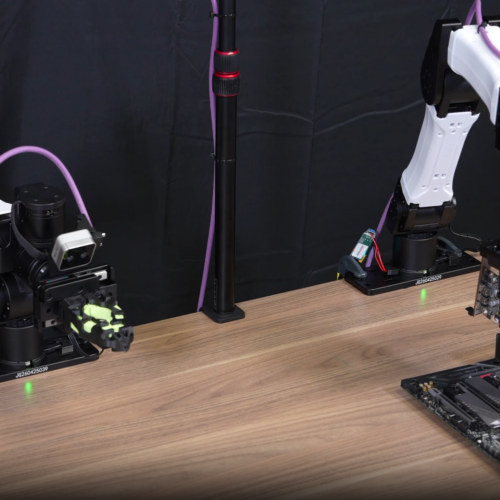
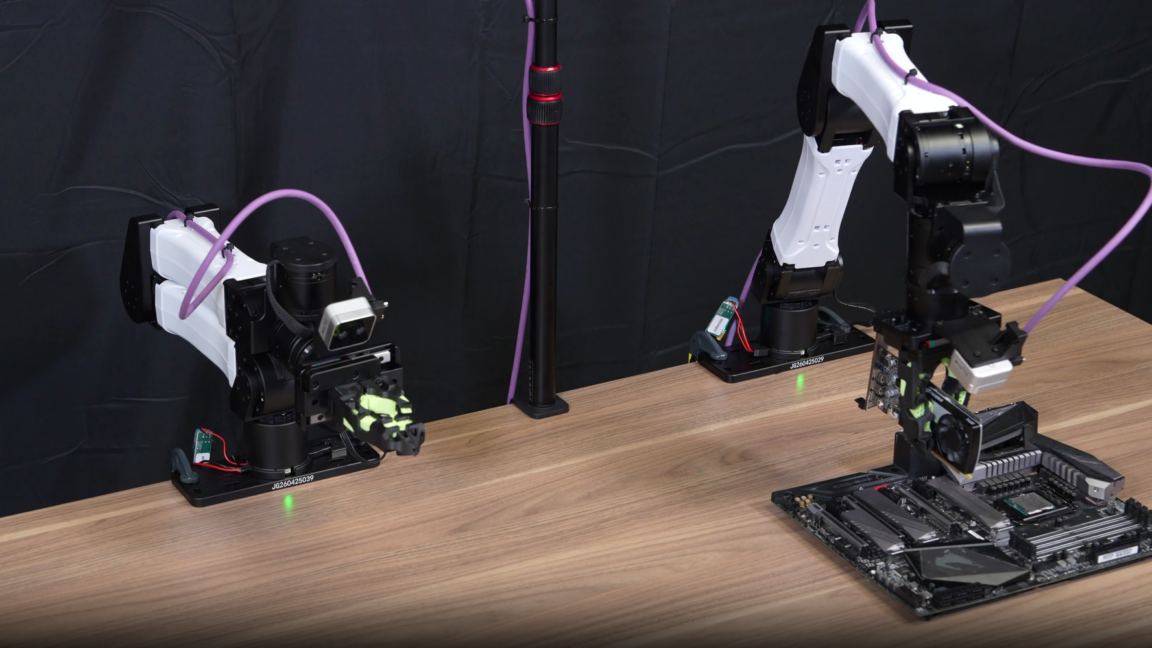
What happens when you give AI coding agents a lab full of robotic arms, some compute resources, and a “generous token budget” for teaching the robots various tasks? The agents can apparently figure out a training regimen that teaches the robots to successfully cut zip ties and even insert GPUs into thin sockets on motherboards.

That glimpse into how AI can act in a fully autonomous way to automate robot training was made possible by a new agent harness framework—software that wraps around AI models to enable their use of various tools while also providing capabilities such as memory, context, constraint, and feedback loops. That agentic harness, called ENPIRE, was developed by robotics researchers at the Nvidia GEAR (Generalist Embodied Agent Research) lab alongside collaborators from Carnegie Mellon University in Pittsburgh and the University of California, Berkeley.

“A part of our NVIDIA GEAR lab now self-improves tirelessly overnight,” wrote Jim Fan, director of AI at NVIDIA, in a LinkedIn post. “We just read the reports in the morning.”

Read full article

Comments

© NVIDIA

  •  

Advanced Health Research on Station Using Augmented, Virtual Reality Tools

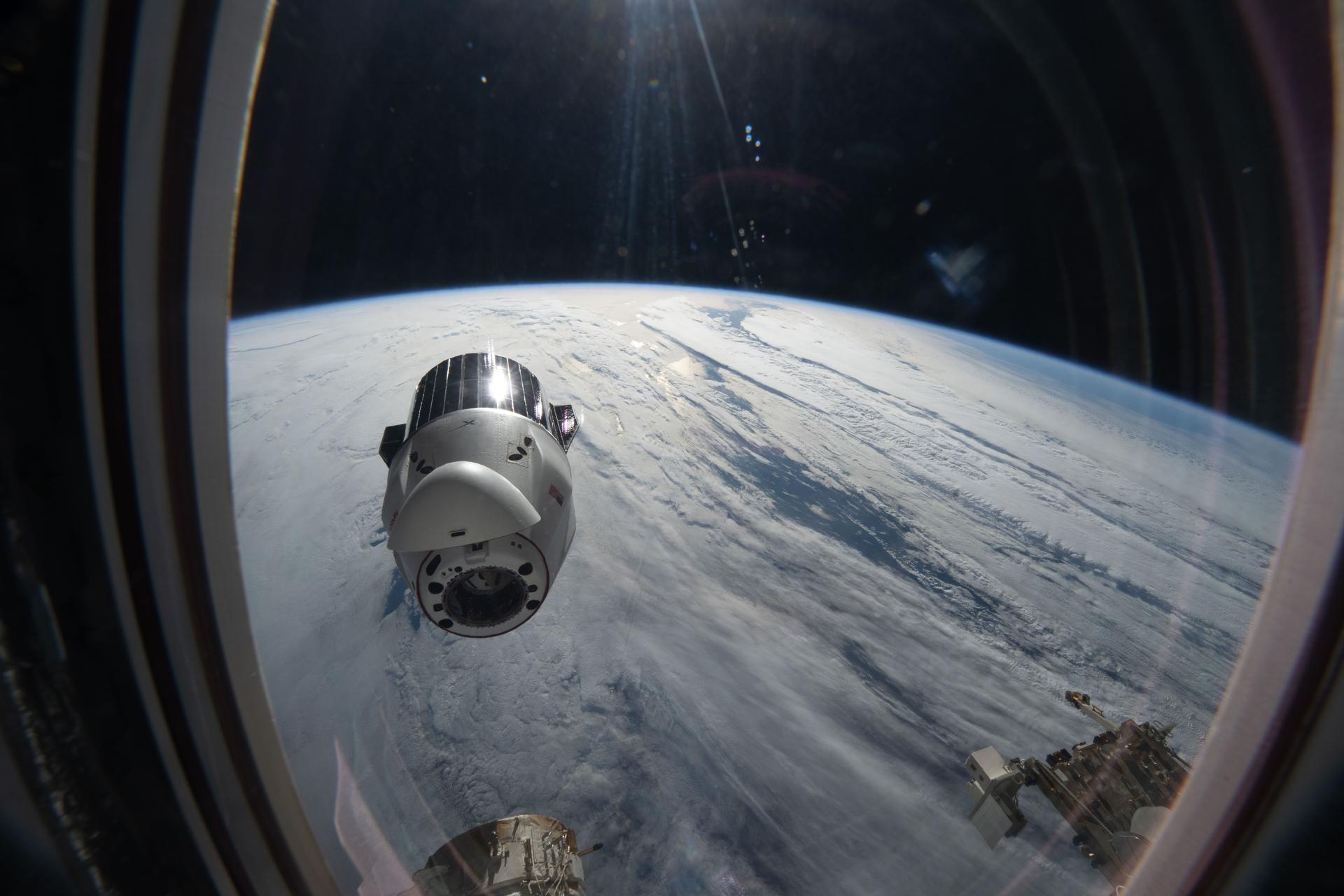
A SpaceX Dragon cargo spacecraft backs away from the International Space Station moments after undocking from the Harmony module's forward post while orbitng 265 miles above a cloudy North Pacific Ocean. Dragon, packed with completed science experiments and cargo for retrieval and analysis on Earth, parachuted to a splashdown off the coast of southern California the following day,
A SpaceX Dragon cargo spacecraft backs away from the International Space Station moments after undocking from the Harmony module’s forward port on June 16, 2026. Dragon, packed with completed science experiments and cargo for retrieval and analysis on Earth, parachuted to a splashdown off the coast of southern California the following day.
Credit: NASA/Jessica Meir

Biomedical tests using augmented and virtual reality tools to advance space health dominated the research schedule aboard the International Space Station on Wednesday. The Expedition 74 crew is also turning its attention to a spacewalk at the end of the month following the departure of a U.S. cargo spacecraft.

NASA flight engineers Jessica Meir and Jack Hathaway began their shift in the Columbus laboratory module conducting vein scans with guidance from doctors on the ground. The duo took turns scanning each other with the EchoFinder-2 ultrasound device that collects health data using augmented reality and artificial intelligence tools. The medical hardware provided by ESA (European Space Agency) provides a screen using augmented reality to guide the operator’s probe motion and artificial intelligence software to detect the subject’s organs. The lightweight, easy-to-use gear may enable independent crew health monitoring on spacecraft travelling to the Moon, Mars, and beyond.

Afterward, Hathaway moved to the Harmony module and loaded bacteria samples into a portable DNA sequencer to read their genetic code. Scientists will use the knowledge to understand bacterial resistance to antibiotics in the space environment potentially affecting an astronaut’s ability to fight an infection.  

Meir assisted NASA flight engineer Chris Williams who wore virtual reality goggles for a test measuring his ability to detect balance, movement, orientation in microgravity. The goggles recorded Williams’s eye movements as he responded to visual stimuli generated by computer software operated by Meir. The vestibular system investigation, just one part of the CIPHER suite of 14 human research experiments, is studying how astronauts neurologically adapt to weightlessness to improve crew training and safety.

ESA flight engineer Sophie Adenot helped her crewmates with the digital health science on Wednesday first setting up the EchoFinder-2 hardware, connecting it to a computer tablet, and installing a camera to track the vein study. Next, Adenot configured Harmony’s maintenance work area and retrieved a mini-cold bag to house the bacteria samples for the antibiotics study. Finally, she took pictures of the Moon to observe Earth’s light reflecting off the lunar surface.

All four astronauts gathered together at the end of their shift for a conference call with spacewalk experts on the ground. The quartet and the engineers discussed the tools and procedures necessary to repair a wrist joint on the Canadarm2 robotic arm during a spacewalk planned for June 30. NASA will soon announce the spacewalkers and provide a live televised briefing for more details before the end of the month.

Roscosmos flight engineer Andrey Fedyaev conducted another neurological study while wearing a virtual reality headset and responded to computerized stimuli as electrodes measured brain activity and tracked eye movement, testing his sense of direction, movement, and position. Station commander Sergey Kud-Sverchkov and flight engineer Sergei Mikaev, both from Roscosmos, started their shift in the Nauka science module checking the operation of components supporting the Elektron oxygen generator. Kud-Sverchkov then tested communications gear inside the Soyuz MS-28 crew spacecraft. Mikaev took a computer quiz documenting his mental state before terminating a 24-hour heart and blood pressure monitoring session.

A SpaceX Dragon cargo spacecraft is back on Earth following its undocking from the orbital outpost on Tuesday and splashdown in the Pacific Ocean at 5:11 a.m. PDT/8:11 a.m. EDT on Wednesday. Dragon returned sensitive scientific samples from investigations studying stem cell manufacturing, cartilage tissue printing, and more to treat a range of conditions from blood diseases, cancers, and cartilage injuries.

Learn more about station activities by following the space station blog, @space_stationon X, as well as the ISS Facebook and ISS Instagram accounts.

Get the latest from NASA delivered every week. Subscribe here.

The post Advanced Health Research on Station Using Augmented, Virtual Reality Tools appeared first on NASA Science.

  •  

"Dangerous" AI models are coming no matter what

Late last week, Anthropic took its new Claude Fable 5 and Mythos 5 AI models offline following a United States government export-control directive barring “any foreign national” from using the services. The company has been in talks with the White House since Friday but has yet to secure an agreement that would allow it to reinstate the offerings.

Since Mythos debuted in April, Anthropic has claimed—and warned—that the model has advanced capabilities for not only finding software vulnerabilities to help defenders patch them, but also figuring out ways to exploit them that could be used by bad actors. Anthropic itself noted this double-edged sword in its launch of Mythos 5 and Claude Fable 5. “A great deal of advanced usage of AI models is dual use: the same queries that are beneficial in the hands of cybersecurity professionals and biology researchers could be dangerous if available to malicious actors,” the company wrote in a blog post last week.

With this in mind, the company initially released a version called Mythos Preview to a select consortium as part of a working group known as Project Glasswing. Mythos 5 was also privately released to this group last week, while Claude Fable 5, which is a Mythos-grade model, was released to the general public with specific blocks on its ability to give responses to questions about biology and cybersecurity.

Read full article

Comments

© Samuel Axon

  •  

The Slate Truck's price may have leaked, starts at $24,950

One of the most hotly anticipated electric vehicles makes its formal debut next week. It's the Blank Slate, a refreshingly simple pickup truck EV designed by Slate Auto, which is trying to take some of the soaring cost out of a new car with a back-to-basics approach that means even electric windows are an optional extra. Of course, a crucial aspect of this pared-back approach is pricing.

Plenty of people are attracted to the idea of a truck with a compact footprint, no infotainment system or embedded modem, and the option to upconvert it later into an SUV or fastback. In the abstract, at least, people aren't going to jump at the prospect of a truck with 150 miles (241 km) of range if it costs too much.

When Slate broke cover in 2025, it was targeting a price of around $20,000, assuming the $7,500 IRS clean vehicle tax credit would remain in effect, but it was abolished later that year.

Read full article

Comments

© Slate Auto

  •  

"Dangerous" AI models are coming no matter what

Late last week, Anthropic took its new Claude Fable 5 and Mythos 5 AI models offline following a United States government export-control directive barring “any foreign national” from using the services. The company has been in talks with the White House since Friday but has yet to secure an agreement that would allow it to reinstate the offerings.

Since Mythos debuted in April, Anthropic has claimed—and warned—that the model has advanced capabilities for not only finding software vulnerabilities to help defenders patch them, but also figuring out ways to exploit them that could be used by bad actors. Anthropic itself noted this double-edged sword in its launch of Mythos 5 and Claude Fable 5. “A great deal of advanced usage of AI models is dual use: the same queries that are beneficial in the hands of cybersecurity professionals and biology researchers could be dangerous if available to malicious actors,” the company wrote in a blog post last week.

With this in mind, the company initially released a version called Mythos Preview to a select consortium as part of a working group known as Project Glasswing. Mythos 5 was also privately released to this group last week, while Claude Fable 5, which is a Mythos-grade model, was released to the general public with specific blocks on its ability to give responses to questions about biology and cybersecurity.

Read full article

Comments

© Samuel Axon

  •  

O SEM MANUAL AGORA TEM UM NOVO HORÁRIO - Anota aí! #SemManual #podcast

💾

O Sem Manual está com novo horário! A partir de agora, o nosso resumo semanal de notícias do mundo da tecnologia vai ao ar todas as quintas-feiras, às 18h, aqui no canal do TecMundo no YouTube.

Se você prefere ouvir, também pode acompanhar o programa pelo Spotify e Apple Podcasts. Não perca os principais destaques da semana em tecnologia, inovação, inteligência artificial, smartphones, redes sociais e muito mais.

Inscreva-se no canal e ative as notificações para não perder nenhum episódio.

#TecMundo #SemManual #Tecnologia
  •  

Air Quality D

Air Quality

Air pollution is a significant threat to human health and our environment. Instruments on NASA satellites, along with airborne and ground-based sensors, are constantly collecting data on major pollutants in our atmosphere.

Explore Air Quality with NASA

Where Does NASA Fit?

NASA instruments — on satellites, planes, and the ground — constantly collect data on air quality. NASA-funded scientists track the sources and concentrations of major pollutants and their movement through the atmosphere. They provide managers and policymakers with Earth observations that can inform decisions around air quality for economic and human benefit.
 

The basics

Air’s Ingredients

Watch to learn what air quality is and why it’s so important for NASA to study it.

Air Quality Essentials

Air is a stew of components—some natural, some introduced by human activity.

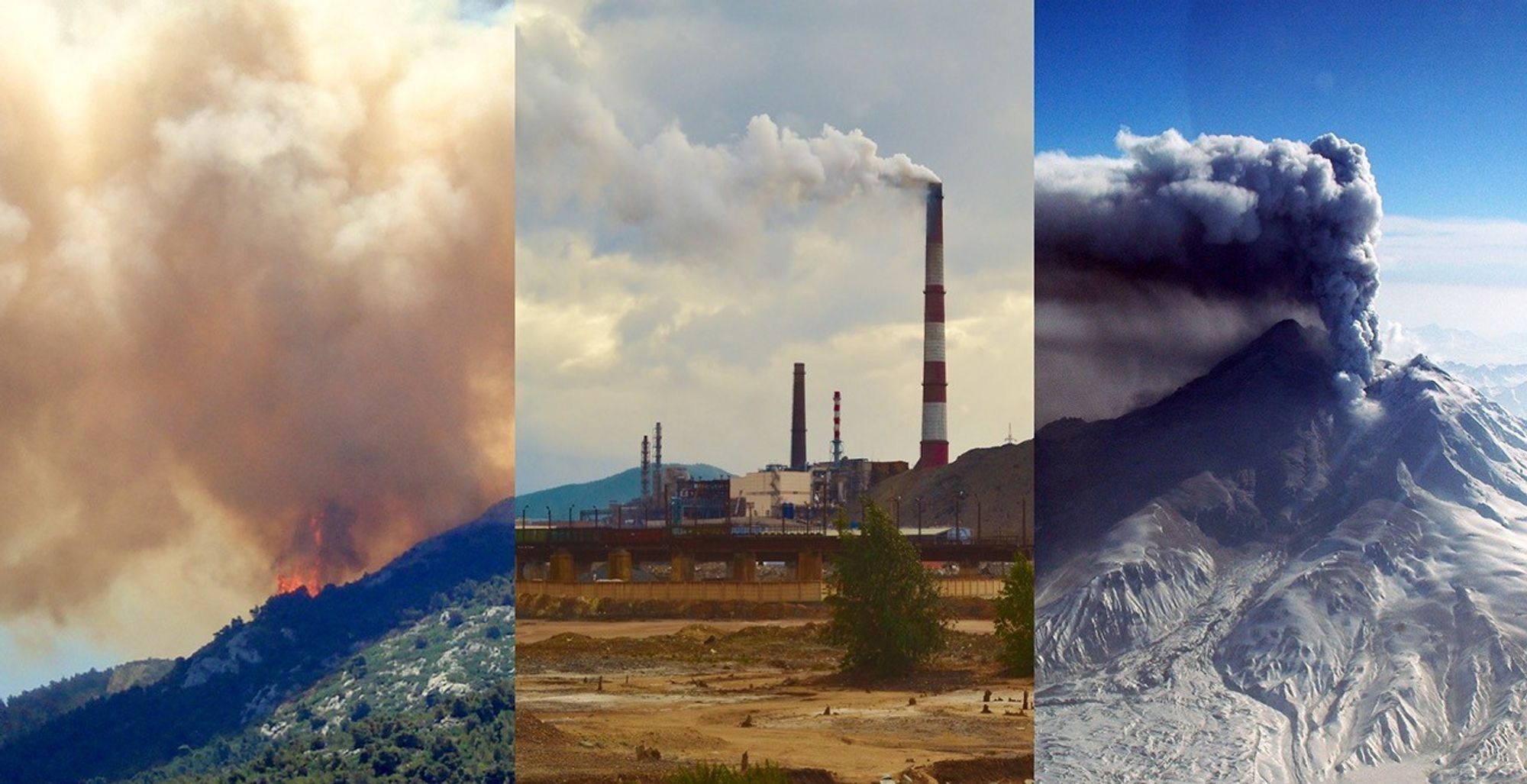
Aerosols are small particles or droplets that float in the air. They are emitted by both natural events and human activities. Some aerosols cool the climate, and others have a warming effect. Image credits, left to right: Saiho/Pixabay, olegkamenskij20120/Pixabay, USGS. Image design: NASA/JPL-Caltech

NASA Knows: The Ozone Hole

NASA fosters global effort and change to improve air.

Curious Universe Logo

Curious Universe Podcast: Tiny but Mighty

NASA scientists talk about what’s in the air.

2018-08-23 00:00:00

Just Another Day on Aerosol Earth

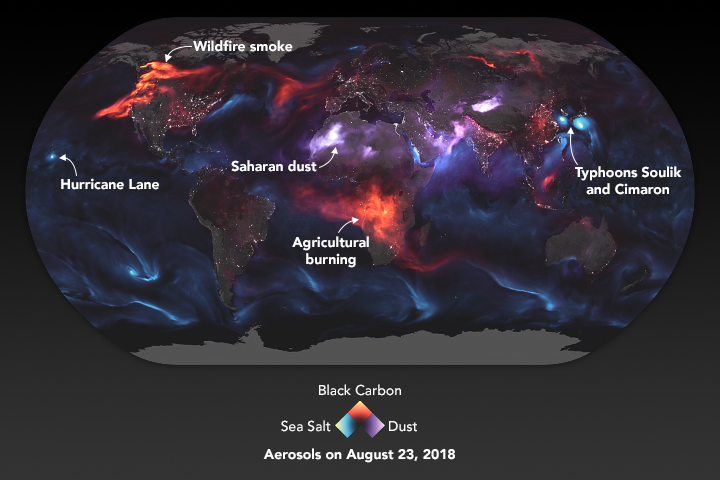
NASA satellites trace ingredients of air worldwide on one particularly representative day in the life of planet Earth.

Featured Video

Aerosols
in the Air

NASA merges satellite and ground-based observations, advanced models, and computing power to study aerosols in the atmosphere.

Air Quality News

Find stories based on NASA data, observations, and models.

Air Pollution’s Daily Pulse Over the Northeast
5 min read

The TEMPO mission helped scientists track morning nitrogen dioxide that contributed to afternoon ozone along the New York–Washington corridor in…

Jun 11, 2026
A Moonlit Earth as Seen From Artemis II
4 min read

An astronaut’s photo, taken en route to the Moon, reveals our planet and its place in space in a novel…

Jun 4, 2026
Gravity Waves From Super Typhoon Sinlaku
4 min read

Satellites observed striking upper-atmosphere phenomena generated by an intensifying tropical cyclone.

Jun 1, 2026
NASA MISSIONS HELP

How NASA Sees the Air We Breathe

NASA and NOAA, among other agencies, worked together this summer through the STAQS and AEROMMA missions to calibrate and validate NASA’s new TEMPO satellite. The satellite and missions combined aim to not only better measure air quality, and the major pollutants that impact it, but also to improve air quality, from street to stratosphere. This effort was documented during the August 2023 campaign leg, which took place over the Chicago region.

NASA’s Air Quality Missions

Show Me the Data

Shanghai at sunset, as seen from the observation deck of the Jin Mao tower. The sun has not actually dropped below the horizon yet, rather it has reached the smog line.

NASA EarthData: Air Quality

Find NASA’s data on air quality, including trainings, articles, webinars, additional related topics, and more.

The post Air Quality D appeared first on NASA Science.

  •  

In the 1990s, anthropologist Robin Dunbar argued there’s a natural ceiling on friendship set by the size of the human brain — around 150 people we can hold a real relationship with

Here is a number you may have run into without knowing where it came from: 150. It gets quoted in management books, on team-size pages, in articles about why your group chat feels too big. It traces back to Robin Dunbar, a British anthropologist and evolutionary psychologist, who proposed in the 1990s that humans can hold roughly that many stable relationships at once. He got there by an odd route, extrapolating from the correlation between neocortex size and group size in non-human primates, then doing the sum for us.

The headline number is the least interesting part. What actually lands, for me, is what sits inside it.

Quick note before we go further: I’m not a psychologist or a neuroscientist, and this piece is reading and reflection, not advice. Dunbar’s number is a contested theory, not a settled law, and the wellbeing findings here come from observational research about groups of people, which is not the same as a rule about you. Treat the layers as a useful lens, not a diagnosis.

The number everyone quotes, and what it actually means

150 is not a roster of close friends. It’s the outer edge, the most people you can keep a genuine, two-way relationship with at all. Dunbar’s framing is that “the key to the 150 and the layers within is that they’re reciprocated.” Both people know each other. Both keep the thread alive. A follower count is not a friend, and 1,500 names you’d recognise is probably not 150 people who’d recognise you back.

He also stresses that 150 is an average with a lot of slack around it. As Dunbar himself puts it, the number is “always about 150, although there is some individual variation” — driven by personality, sex, and circumstance. It’s a soft ceiling, not a hard cap.

The layers inside 150 are where it gets personal

Inside that 150 sit nested rings, each roughly three times larger than the one inside it: about 5, then 15, then 50, then 150. The really good friends number about five, with wider rings of roughly 15, then 50, then 150 meaningful contacts. The five are the shoulders to cry on. The fifteen are the ones you’d confide in. The fifty are the good friends you’d happily have round.

The lopsided bit is how much of you goes to the centre. Dubar reportedly note that around 60% of your social attention, your time and your emotional capital, goes to the innermost fifteen. That inner core, Dunbar argues, makes “a big difference to your sense of wellbeing” and your engagement with life in general.

The rebuttal: is Dunbar’s number even real?

It would be tidy to stop there, but the brain part of the theory has taken real fire. In 2021, a team at Stockholm University re-ran the primate data using modern statistical methods and updated brain data, and concluded that a cognitive limit on human group sizes cannot be derived this way.  Co-author Andreas Wartel said that “it is not possible to make an estimate for humans with any precision using available methods and data.”

His colleague Patrik Lindenfors put it more directly: “the theoretical foundation of Dunbar’s number is shaky.” A third co-author, Johan Lind, suggested that “our brain can be trained in having more social contacts.” That last point is an interpretive analogy rather than a demonstrated result, so hold it loosely. The methodological objection stands, though: deriving a precise cap on friendship from neocortex size is harder to justify than the clean number 150 makes it sound.

What the framework is actually useful for

Here’s where I’ve landed. The exact figure could be 150 or far lower or a wide smear in between, and the brain-size derivation may not survive the statisticians. None of that touches the part that’s useful, which is the shape rather than the number. Concentric rings, with most of your warmth going to a small centre, and that centre mattering more for how you feel than anything in the outer layers.

You can’t see your fifty thinning to five in real time. It happens at the speed of people quietly drifting, missed coffees, the friend who moved and the call you kept meaning to make. The framework’s gift is that it names the inner ring as the thing worth protecting, the ring that does the emotional work. 

If any of this is sitting closer to home than it is interesting, talking to a qualified counsellor or therapist is worth far more than any number on a page.

The post In the 1990s, anthropologist Robin Dunbar argued there’s a natural ceiling on friendship set by the size of the human brain — around 150 people we can hold a real relationship with appeared first on Space Daily.

  •  

A secretive Chinese probe has just arrived at one of Earth's 'quasi-moons' and will soon attempt a first-of-its-kind landing

A Chinese spacecraft has arrived at one of Earth's temporary "quasi-moons" and will soon attempt to land on the space rock to scoop up samples that will be returned to our planet next year. The ambitious mission could help researchers uncover secrets about Earth's main moon and provide clues that may benefit space exploration and planetary defense, experts say.

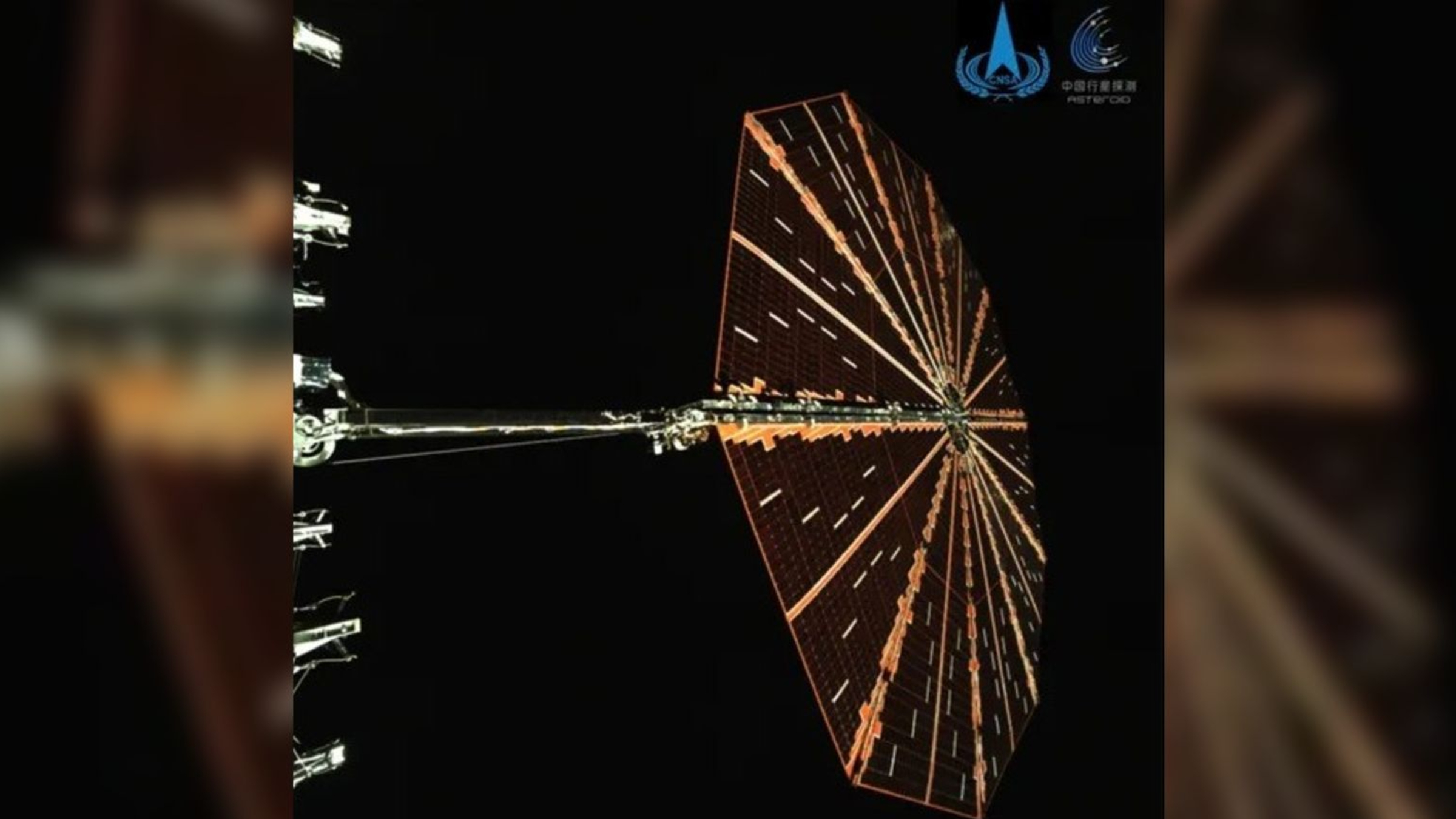
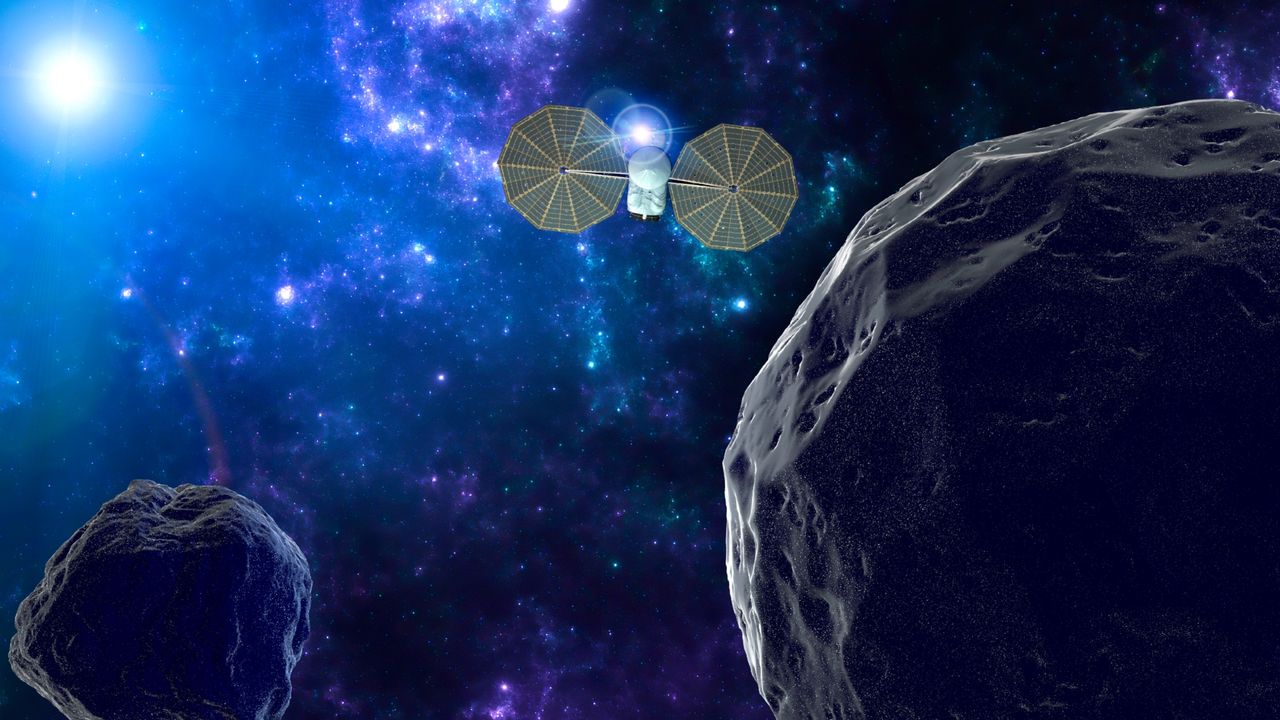
The Chinese National Space Agency (CNSA) probe, named Tianwen-2, launched from Xichang Satellite Launch Center in southern China on May 28, 2025, Live Science's sister site Space.com reported at the time. The car-sized spacecraft sent back its first images a few weeks later, giving us our first glimpse of its secretive design, followed by a selfie with Earth a few months later.

The mission's primary target is 469219 Kamo'oalewa — also known as 2016 HO3 or simply Kamo'oalewa — a near-Earth asteroid discovered in 2016 by astronomers at Hawaii's Haleakala Observatory. It likely spans somewhere between 130 and 330 feet (40 to 100 meters) across and is a "quasi-satellite" of our planet, meaning it's orbiting the sun right alongside Earth in a temporary partnership. (Kamo'oalewa means "oscillating celestial fragment" in Hawaiian.)

Tianwen-2 is predicted to have arrived at Kamo'oalewa on June 7 and inserted itself into an orbit alongside the asteroid, according to an unverified timeline shared by freelance journalist Andrew Jones, a leading expert on China's space program. Around a month later, on July 4, the probe is expected to descend upon the space rock to collect samples from its surface, potentially employing a never-before-seen drilling technique to do so. (The CNSA has not released an official timeline for the mission or shared any recent updates about its progress.)

If successful, the samples are expected to be returned to Earth on Nov. 29, 2027, according to the same timeline. At this point, Tianwen-2 will then slingshot around our planet and head farther out into the solar system for its secondary mission: to rendezvous with and study 311P/PanSTARRS — a peculiar object beyond Mars, which displays characteristics of both comets and asteroids — in 2035.

A photo of one of Tianwen-2's hexagonal solar panels taken in space

This photo of one of Tianwen-2's decagonal solar panels, captured in orbit, was the first image of the probe released by the CNSA. (Image credit: CNSA)

Samples from Kamo'oalewa could help answer many interesting questions, including the true origin of the object, which some experts believe may have broken off from the moon.

"What makes [this mission] extraordinary is that we don't yet know [the object's] composition or origin," Li Chunlai, a researcher with the Chinese Academy of Sciences' National Astronomical Observatories and chief commander of Tianwen-2's ground application system, said in a state-sanctioned video translated to English. "We'll only obtain definitive answers after completing our exploration."

What is Kamo'oalewa?

There are currently eight known quasi-moons orbiting the sun alongside Earth, following the most recent quasi-moon discovery in September 2025. Unlike the similarly named "minimoons," which are asteroids that are briefly captured by Earth's gravity for a few months or years at a time, quasi-moons are temporary satellites that slowly circle our planet but are never gravitationally bound to it.

This relationship can last decades, or even centuries. For example, experts think Kamo'oalewa has been accompanying our planet for at least 100 years and could remain alongside it for another 300 years before it starts to fall out of sync with our solar orbit.

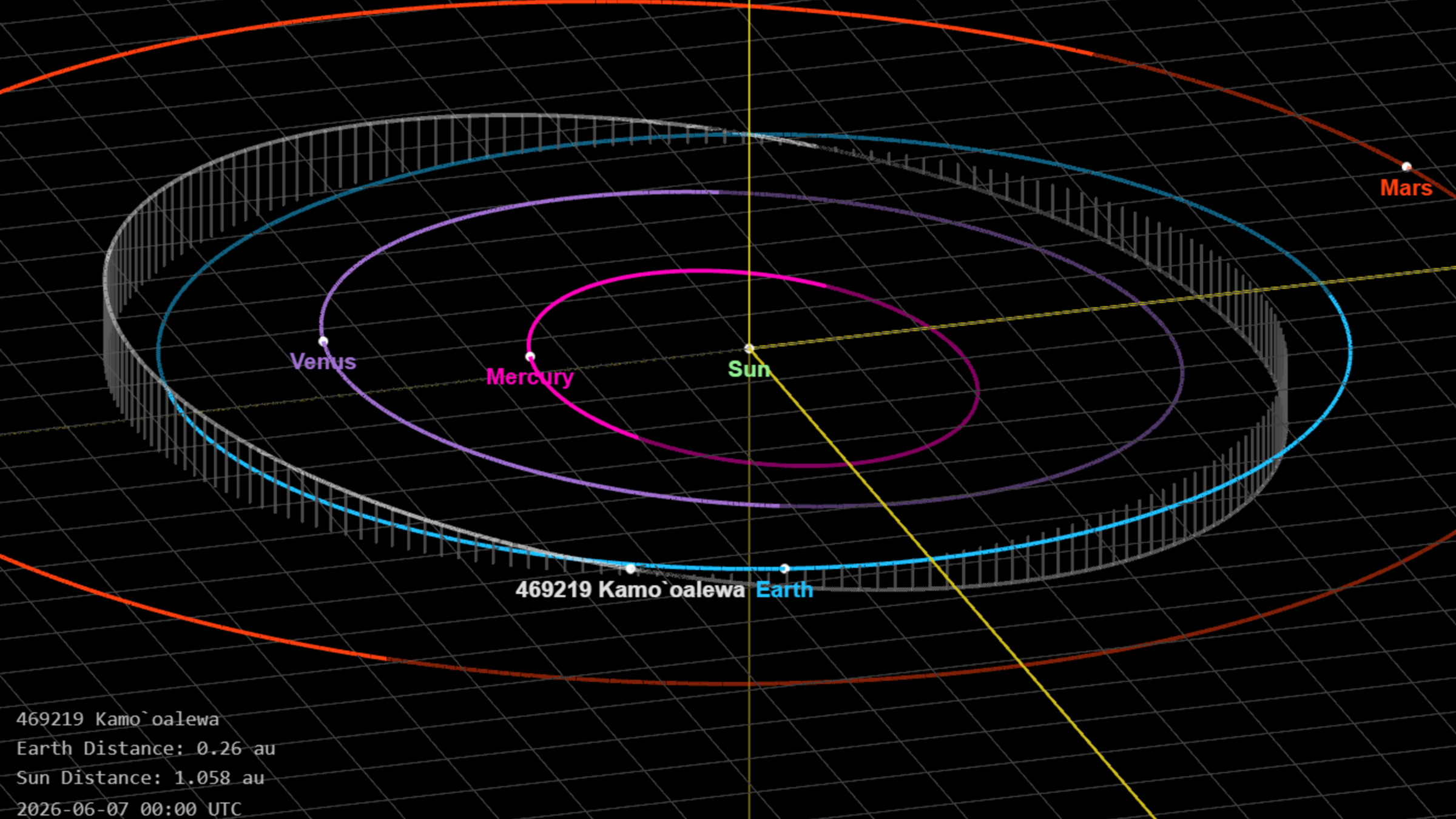
An orbital diagram showing where Kamo'oalewa is in comparison to Earth and the rest of the inner solar system

On June 7, when Tianwen-2 was expected to arrive at Kamo'oalewa, the space rock was around 24.2 million miles (39.1 million km) from Earth. (Image credit: NASA/JPL/Small-Body Database Lookup)

"The way Kamo'oalewa moves with Earth is kind of like a dog that might tag along with you for a while on a long walk through the woods, but it's not your dog," Richard Binzel, a planetary scientist and asteroid expert at MIT, told Live Science in an email.

The Ferris-wheel-size space rock is one of the closest quasi-moons to us, with a minimum distance of around 2.9 million miles (4.6 million kilometers) from Earth, or around 12 times farther away than our actual moon. It is also one of the fastest-spinning quasi-moons, rotating around its axis every 30 minutes. But unlike other quasi-moons, which likely originate from the solar system's main asteroid belt, between Mars and Jupiter, our current best guess is that Kamo'oalewa is actually a piece of the moon.

This hypothesis is based on observations from 2021 that showed Kamo'oalewa absorbs and reflects light similarly to the moon, hinting that the space rock may be a chunk of lunar material ejected by a long-ago meteor strike. More recently, in 2024, researchers narrowed down the most likely impact crater from which the asteroid originated: the 13.6-mile-wide (22 km) Giordano Bruno crater, located on the far side of the moon. However, there is still a chance that Kamo'oalewa is a main-belt asteroid that just happens to look an awful lot like lunar material.

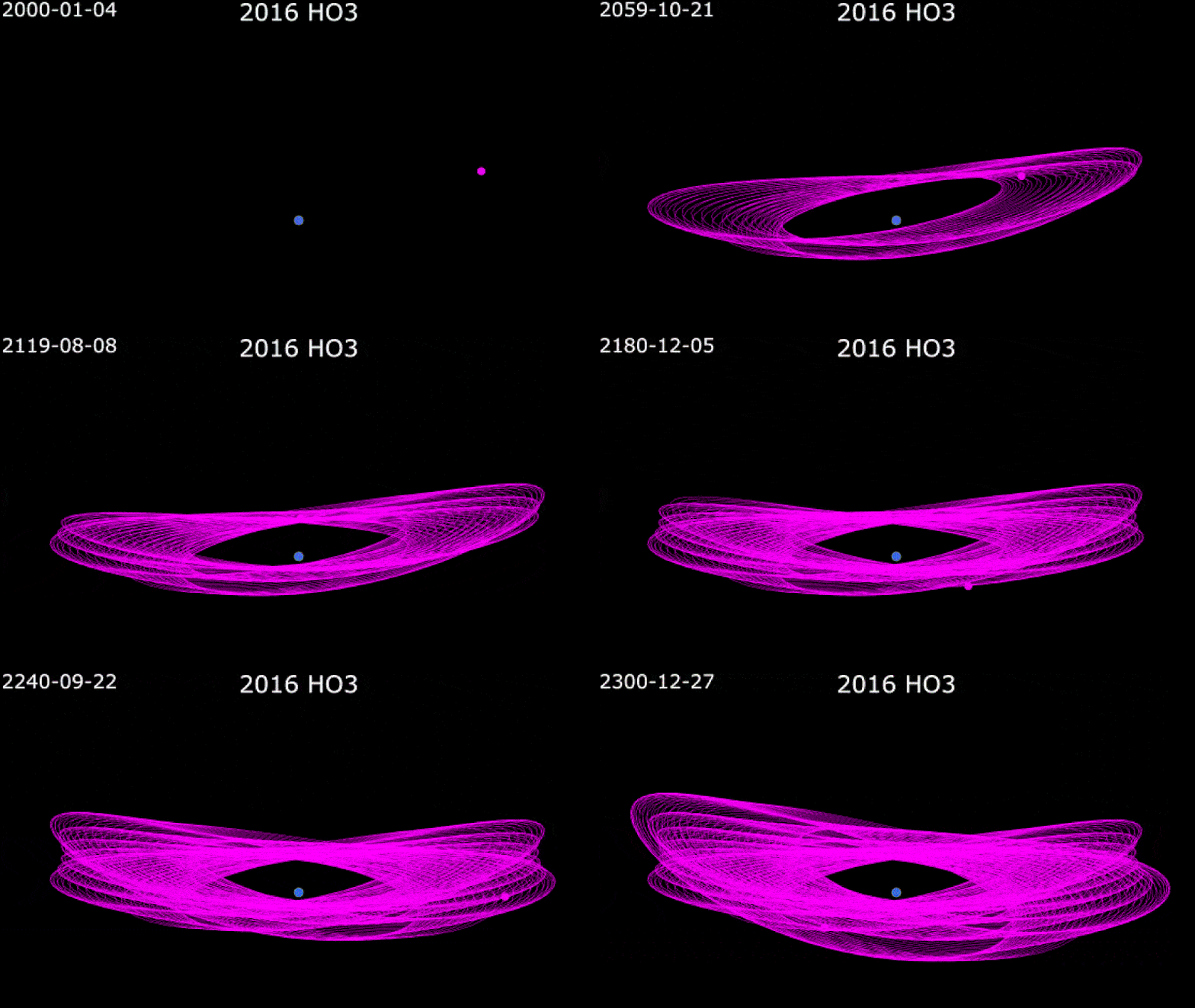
A GIF showing how the quasi-moon circles Earth

Kamo'oalewa (a.k.a. 2016 HO3) circles Earth but does not orbit our planet. This simulation shows its predicted movements relative to Earth over the next few centuries. (Image credit: NASA/Pheonix7777/Wikimedia)

"I am curious to find out the answer about its origin, since the debate on its [potential] lunar origin is still very open," Marco Fenucci, a mathematician at the European Space Agency's Near-Earth Objects Coordination Centre who has co-authored multiple studies on Kamo'oalewa, told Live Science. This mission should "definitely give us an answer to this matter," he added.

Scientists are also unsure whether Kamo'oalewa is a "solid monolithic rock," like the $100,000 quadrillion asteroid Psyche (the target of NASA's ongoing Psyche mission), or a "rubble-pile-like asteroid," such as Bennu or Ryugu, both of which have been explored by sample-return missions in recent years, Fenucci said.

Scooping up samples

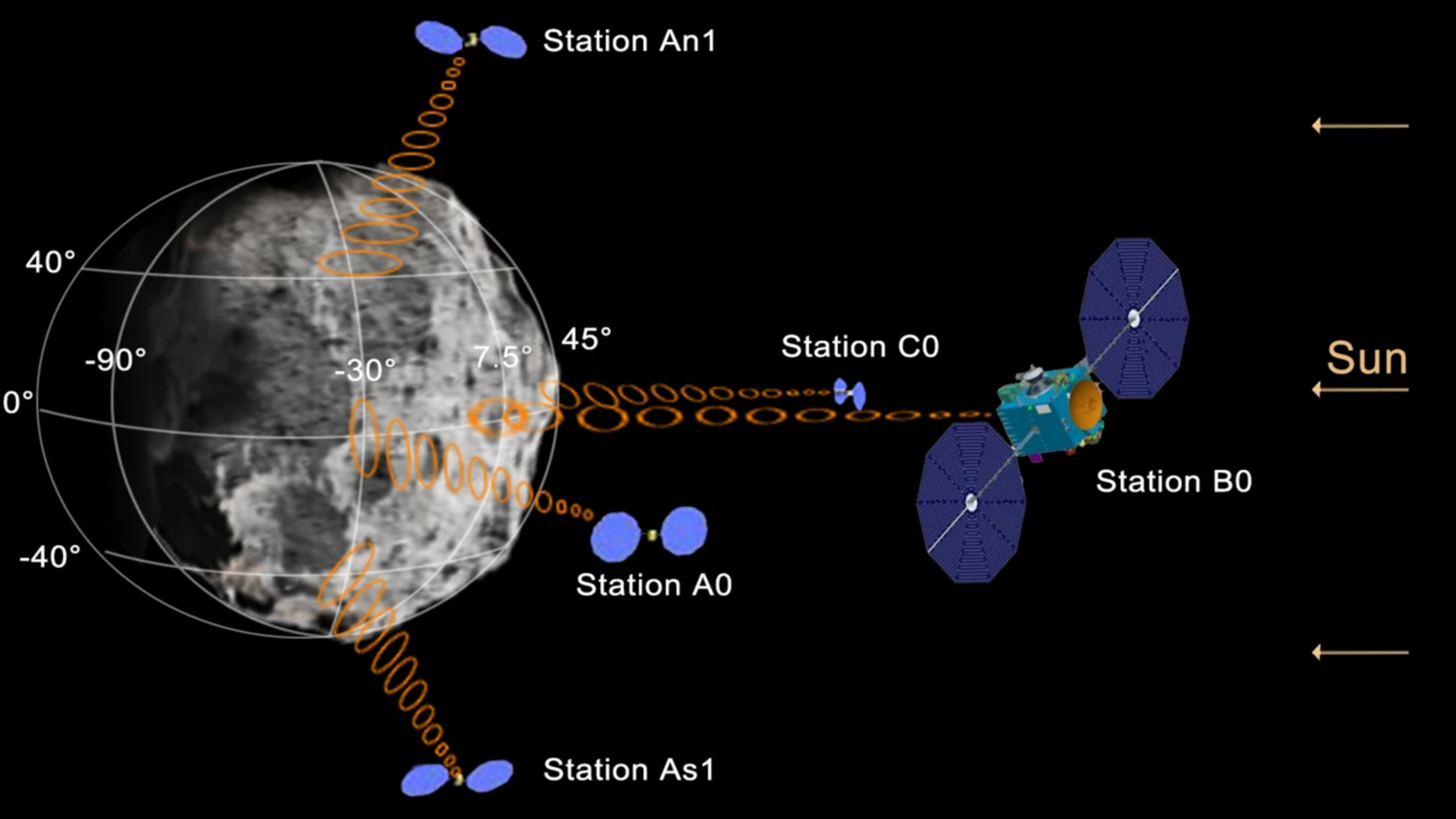
Having arrived at Kamo'oalewa, Tianwen-2 will spend the next few weeks mapping the asteroid's surface at altitudes between 1,000 feet and 12.5 miles (300 m to 20 km) above its surface, according to limited mission details revealed by Chinese scientists in a January study. The resulting map will allow researchers to estimate the asteroid's density and work out the best landing spot.

On July 4, the probe is expected to swoop down and scoop up around 3.5 ounces (100 grams) of surface material, or regolith, from the asteroid, which is slightly less than what NASA's OSIRIS-REx mission managed to grab from Bennu. However, there are multiple ways this sampling process could play out.

If the asteroid is a pile of rubble, the probe will utilize a touch-and-go approach, which involves hovering just above the surface and using a robotic arm to reach out and grab the sample. This method was also used by OSIRIS-REx for Bennu and by Japan's Hayabusa2 mission, which scooped up samples from Ryugu.

But if Kamo'oalewa has a more solid surface, Tianwen-2 will attempt to land directly on the space rock and anchor itself in place before drilling into the asteroid. This has never been attempted before and could allow for longer contact time and "more controlled sampling," according to The Planetary Society.

A diagram showing the various positions Tianwen-2 will scan the asteroid from

Tianwen-2 will circle Kamo'oalewa at various altitudes in order to scan the space rock and figure out its best possible landing spot. (Image credit: Zhang et al. 2026)

After collecting samples, the probe will remain alongside the asteroid and conduct further analysis of its size, shape and trajectory.

In late April 2027, Tianwen-2 will depart Kamo'oalewa and begin the six-month journey back to Earth, where it will dump its samples in a return capsule that will fall to our planet's surface as the probe begins its long journey to rendezvous with 311P/PanSTARRS.

The return capsule will reenter Earth's atmosphere at around 27,000 mph (43,500 km/h), researchers wrote in the January study. That's slightly faster than the Orion capsule carrying the Artemis II astronauts traveled as it fell back to Earth in April.

What could we learn from Tianwen-2?

In addition to ending the debate over Kamo'oalewa's origin, samples from Tianwen-2 could reveal more about the solar system and our place within it.

For example, previously returned asteroid samples have helped to "tell us where Earth's water came from, how complex organic molecules were distributed in the early solar system, and how surface processes like space weathering alter asteroid properties over time," Fenucci said. These samples can also be used to "establish a link to known meteorites found on Earth" and help us learn more about these space rocks, he added.

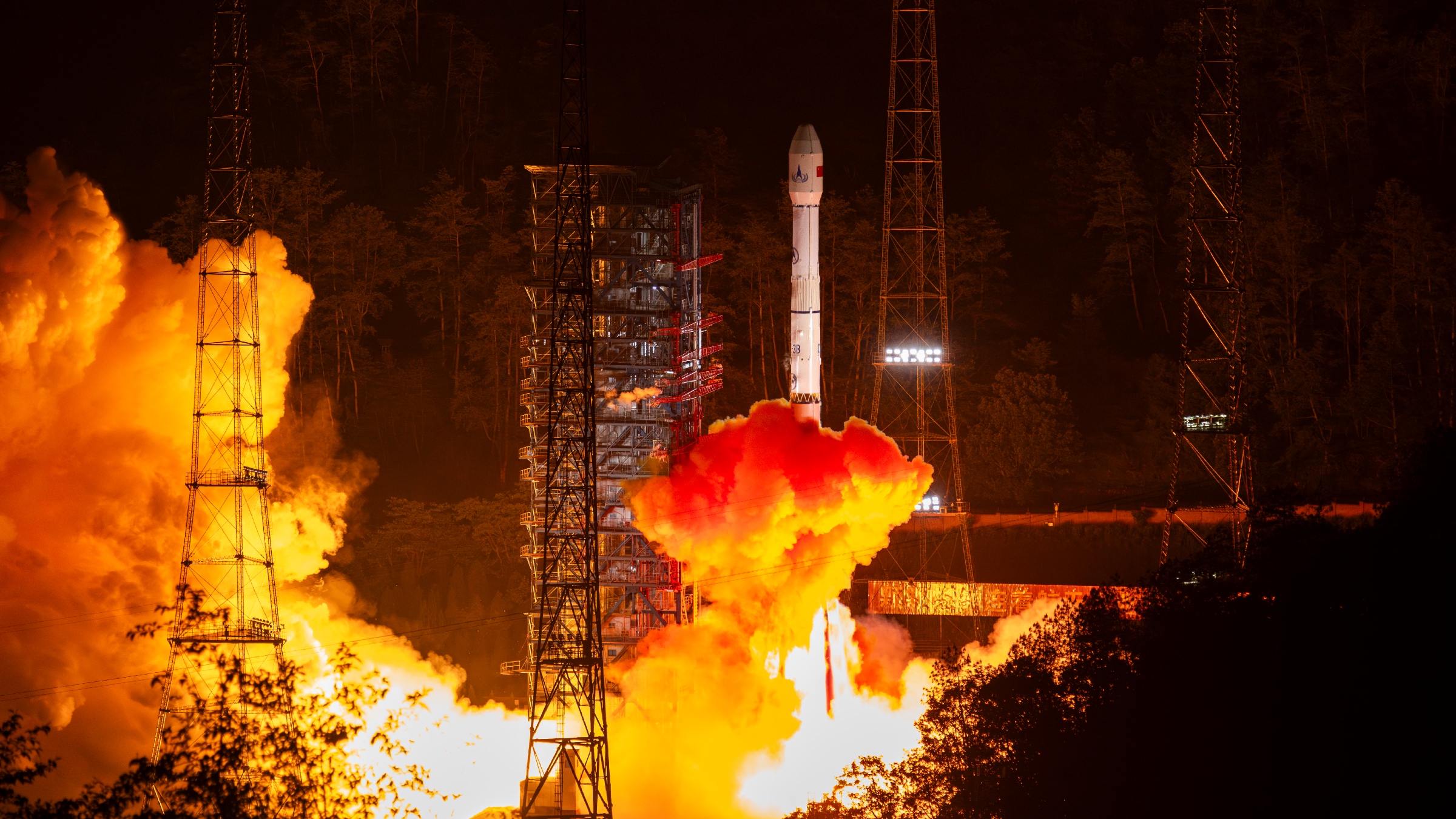
Photo of a Chinese rocket taking off at night

Tianwen-2 launched into space May 28 on board one of China's Long March 3B rockets. (Image credit: VCG/VCG via Getty Images)

The proximity of quasi-moons and minimoons to Earth also makes them valuable assets for future space exploration missions. Some researchers have proposed using them as temporary bases or refueling stations that could serve as stops on the way to Mars or other faraway destinations. These objects "could become literal stepping stones for human missions to practice what it is like to leave the Earth-moon cradle," Binzel said.

One particular idea that scientists want to explore is whether water can be extracted from these objects. And if Kamo'oalewa is a piece of the moon, that could have implications for NASA's planned moon base. "Someday, it might be possible to extract that water to provide resources for thirsty astronauts or even generate usable rocket fuel from the hydrogen," Binzel said.

Some near-Earth objects also pose a potential risk to our planet. And while Kamo'oalewa will likely never hit us (and would probably only cause localized damage if it did), there are much larger nearby space rocks that could trigger global catastrophes if they were to impact our planet.

"Over the time scale of centuries, these kinds of objects have a chance of striking the Earth," said Binzel, who invented the Torino scale used to measure the impact potential of near-Earth objects. Therefore, a better understanding of space rocks like Kamo'oalewa "can prepare us in how to deal with a threatening object if one were ever discovered," he added.

Finally, this mission will likely provide another opportunity to assess China's space exploration capabilities, which could hint at whether the country could overtake the U.S. as the top nation in space, as some experts predict.

  •  

Ten months later, the $100 Google Home Speaker is finally available for preorder

Good things take time, but not all things that take time are good. The jury is still out on the Google Home Speaker, but it certainly took a while to arrive. After announcing its new speaker last August, Google finally has a release date. The company's first new smart home speaker in years will launch on June 25, and you can preorder it today for $100.

The generically named Google Home Speaker is Google's first home audio device in almost six years. The last one was the Nest Audio, which debuted back in September 2020. The new device is small and round—an oblate spheroid, technically. It's covered in a partially recycled fabric available in four colors: hazel, porcelain, jade, and berry (jade and berry are limited to the US). Google says the device produces "360-degree sound" for a uniform listening experience anywhere in a room.

Google is into lighting effects again. Credit: Google

Previous Google speakers included Assistant-style illuminated lights, but the Google Home Speaker features a light ring around the bottom that glows when the device is listening, "thinking," or responding. This is becoming a trend with Google. The company will require a similar glowing lightbar embellishment on the upcoming Googlebook laptops. There are three far-field microphones distributed around the speaker that will pick up your speech, and there's a mute switch when you don't want it listening for the "OK Google" trigger.

Read full article

Comments

© Google

  •  

Towers once planned for California shuttle launches leveled for SpaceX rockets

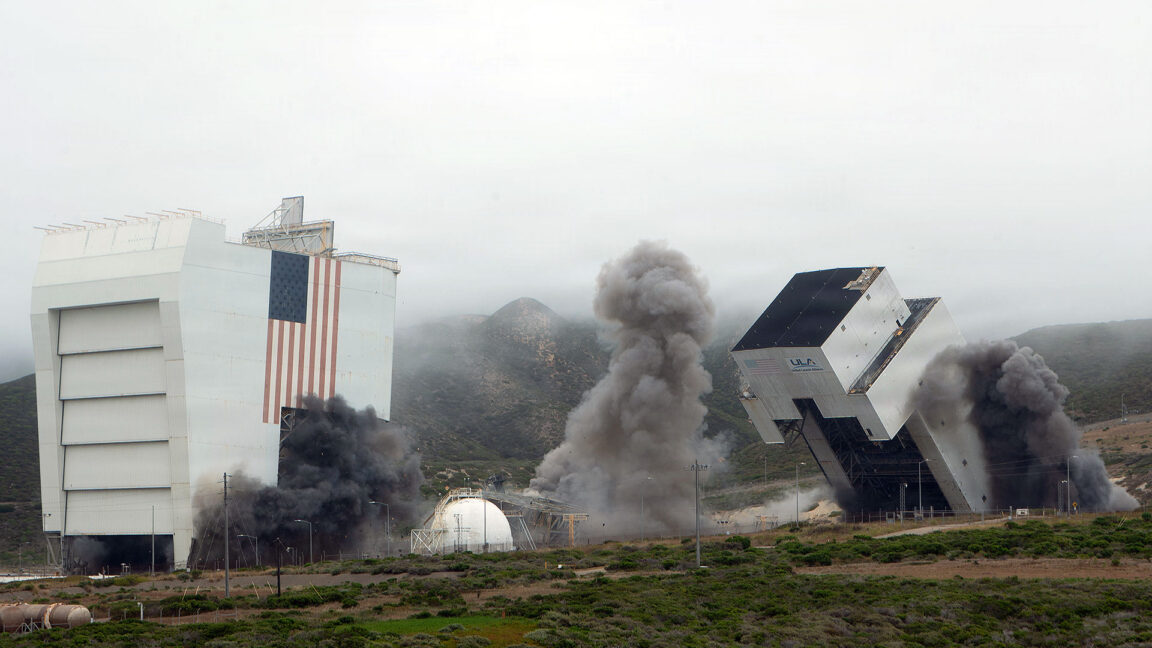
One of the United States' most storied space launch sites has been cleared of its decades-old support towers, making way for modern rockets to use the pad. Space Launch Complex-6 (SLC-6) at Vandenberg Space Force Station is arguably better known for what did not lift off from there than for what did.

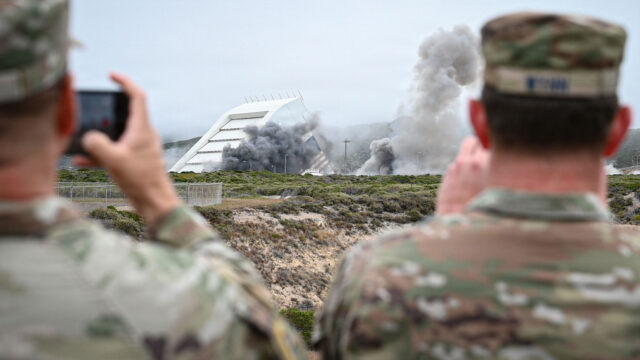
A series of demolition charges on Tuesday (June 16) brought down the access tower, mobile service tower, and what remained of the assembly building at SLC-6—pronounced "slick-six"—in Southern California. Once the location for the US Air Force's first effort to put humans into space and later, the West Coast launch site for the space shuttle, SLC-6 will next be used by SpaceX in support of Falcon 9 and Falcon Heavy missions.

Vandenberg Space Force Base personnel watch as the assembly building at Space Launch Complex-6 (SLC-6) is toppled on June 16, 2026, to make way for SpaceX's use of the site. Credit: Space Launch Delta 30/Tech. Sgt. Draeke Layman

"Space Launch Complex-6 represents six decades of American innovation and our unwavering commitment to securing space superiority," Col. James T. Horne III, commander of Space Launch Delta 30 at Vandenberg, said in a statement. "By modernizing this historic footprint in partnership with our defense industrial base, we are building directly upon the foundation of our pioneers."

Read full article

Comments

© Space Launch Delta 30/Staff Sgt. Daekwon Stith

  •  

Hidden in Plain Sight: Searching for Globular Clusters within JWST Observations of the PLCK G165.7+67.0 Galaxy Cluster

Tyler R. Hinrichs et al 2026 ApJ 1001 91
By subtracting the light from gas between the galaxies of a cluster roughly 4 billion light-years away, researchers uncovered more than 900 candidate globular clusters in data from JWST.

The post Hidden in Plain Sight: Searching for Globular Clusters within JWST Observations of the PLCK G165.7+67.0 Galaxy Cluster appeared first on AAS Nova.

  •  

Ten months later, the $100 Google Home Speaker is finally available for preorder

Good things take time, but not all things that take time are good. The jury is still out on the Google Home Speaker, but it certainly took a while to arrive. After announcing its new speaker last August, Google finally has a release date. The company's first new smart home speaker in years will launch on June 25, and you can preorder it today for $100.

The generically named Google Home Speaker is Google's first home audio device in almost six years. The last one was the Nest Audio, which debuted back in September 2020. The new device is small and round—an oblate spheroid, technically. It's covered in a partially recycled fabric available in four colors: hazel, porcelain, jade, and berry (jade and berry are limited to the US). Google says the device produces "360-degree sound" for a uniform listening experience anywhere in a room.

Google is into lighting effects again. Credit: Google

Previous Google speakers included Assistant-style illuminated lights, but the Google Home Speaker features a light ring around the bottom that glows when the device is listening, "thinking," or responding. This is becoming a trend with Google. The company will require a similar glowing lightbar embellishment on the upcoming Googlebook laptops. There are three far-field microphones distributed around the speaker that will pick up your speech, and there's a mute switch when you don't want it listening for the "OK Google" trigger.

Read full article

Comments

© Google

  •  

Towers once planned for California shuttle launches leveled for SpaceX rockets

One of the United States' most storied space launch sites has been cleared of its decades-old support towers, making way for modern rockets to use the pad. Space Launch Complex-6 (SLC-6) at Vandenberg Space Force Station is arguably better known for what did not lift off from there than for what did.

A series of demolition charges on Tuesday (June 16) brought down the access tower, mobile service tower, and what remained of the assembly building at SLC-6—pronounced "slick-six"—in Southern California. Once the location for the US Air Force's first effort to put humans into space and later, the West Coast launch site for the space shuttle, SLC-6 will next be used by SpaceX in support of Falcon 9 and Falcon Heavy missions.

Vandenberg Space Force Base personnel watch as the assembly building at Space Launch Complex-6 (SLC-6) is toppled on June 16, 2026, to make way for SpaceX's use of the site. Credit: Space Launch Delta 30/Tech. Sgt. Draeke Layman
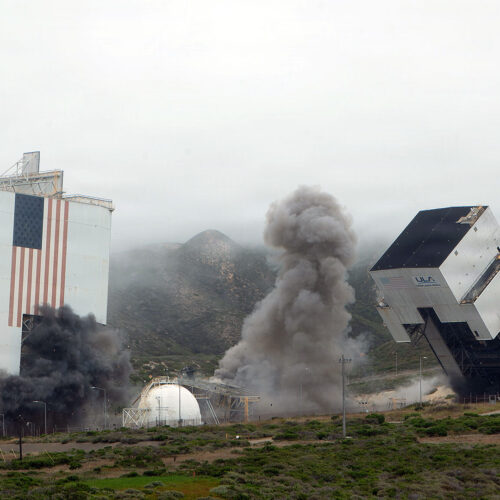
"Space Launch Complex-6 represents six decades of American innovation and our unwavering commitment to securing space superiority," Col. James T. Horne III, commander of Space Launch Delta 30 at Vandenberg, said in a statement. "By modernizing this historic footprint in partnership with our defense industrial base, we are building directly upon the foundation of our pioneers."

Read full article

Comments

© Space Launch Delta 30/Staff Sgt. Daekwon Stith

  •  

What makes the ideal digital icon? A psychologist explains

wavebreakmedia/Shutterstock

Digital icons are everywhere – and usually, we interpret these visual symbols in the blink of an eye. Who today doesn’t know that a wastebasket means “delete” and a magnifying glass means “search”?

Yet icons’ meanings can be deeply shaped by culture, experience and technological history. So what seems obvious to one person may be confusing to another.

They were originally designed to make computers look friendlier and less intimidating to the few people who had access to them. For example, the icons below first appeared in 1975 in the Pygmalion visual programming system.

Years later, they attained much wider visibility thanks to the Xerox Star 8010, a pioneering office computer that introduced many graphic interface concepts that are still used today.

Alt text
The Xerox 8010 Star’s icons. stardock.com

Research my colleagues and I conducted examines how people perceive, understand and evaluate digital icons – including which visual characteristics make icons easier to learn and use. Pygmalion’s pioneering icons worked because they relied on existing knowledge of the office world.

This meant they reduced cognitive effort by relying on recognition rather than recall. The icons looked like the physical objects they were representing – and critically, objects the computer’s users were already familiar with.

Five secrets of a good icon

The designer Susan Kare, creator of many of the original Macintosh icons, said a good icon should either be instantly recognisable or so easy to remember that a user only needs to learn it once.

To Kare, designing icons was about solving “the little puzzle of making an image fit a metaphor”. More than 40 years later, that challenge remains.

Research, including work by my colleagues and me, suggests the most successful icons tend to share key characteristics that guide us from seeing to understanding almost instantaneously. Here are five of them.

1. They depict things we already know

Early computer icons worked because they borrowed from the office world that people already knew: folders, bins, documents, calculators, floppy disks. Psychologists refer to those as “concrete” icons because people to use their knowledge of the everyday world to interpret them.

However, only a limited number of functions can be represented as identifiable objects, and getting a close fit between pictures and functions is not always easy. The more complex the meaning becomes, the harder it is to design concrete icons.

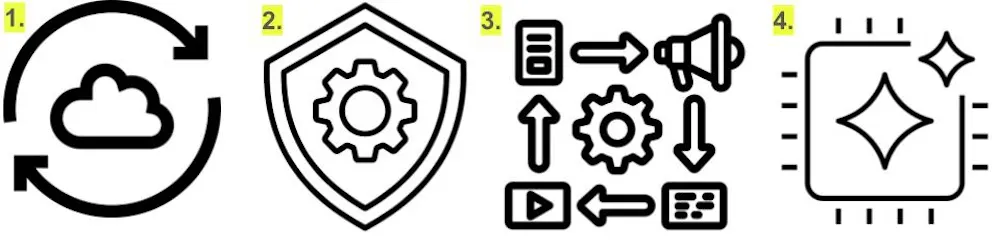
To test this, can you guess the meaning of these four icons? (Answers at the end of the article.)

Alt text
Icon credits: Freepik/Flaticon; Kartini 1/The Noun Project; Elzicon/Flaticon; IconPai/The Noun Project.

2. They mean what we think they mean

Psychologists talk about “semantic distance” – how closely an image matches its intended meaning. An abstract symbol for “privacy settings” or “cloud syncing” has a much larger semantic distance than using a bin to mean “delete”.

As digital functions become more complex, designing icons that communicate their meaning quickly becomes increasingly difficult.

3. They feel familiar

Another important feature of successful icons is consistency of use over time – which leads to familiarity. The icons shown below are widely used even though the objects depicted are no longer so widely in use. This highlights the point that icons are partly informative signs and partly shared learned conventions, whose success is based on collective familiarity.

Take the floppy disk “save” icon (below left). Younger users recognise the meaning without ever having seen the physical object that the icon originally represented. The same is true of traditional telephone handsets and perhaps even envelopes (now widely used to denote “email”). While the objects have been superseded, the icons remain.

Alt text
Icon credits: Yogi Aprelliyanto/Flaticon

4. They look good

A well-designed object can have a positive effect on our behaviour – and the digital world is no different. Well-designed icons are more likely to attract downloads, help us perform tasks more efficiently, and learn better and faster. They even make digital environments feel more pleasant to use.

Think of the difference between an app icon that feels cluttered and amateurish and one that looks clean, balanced and professional. Even before we know what the app does, the icon’s design can influence expectations of how well the app will work.

5. They are tested with real users

Although icons and symbols are on the rise as a global visual language, it’s important not simply to assume that icons work globally – and to understand what makes a good digital icon across languages, cultures, ages and digital experiences.

This is why the International Standards Organisation (ISO 9186) demands comprehensibility testing – because symbols should be understood without explanatory text whenever possible.

A bridge between perception and meaning

As we spend more of our lives in digitally mediated environments, icons do two jobs simultaneously. They help us interact with technology more efficiently, and shape how we feel about the experience.

A digital icon is not simply a small picture. It is a bridge between perception and meaning. The best icons make interfaces feel less intimidating, more intuitive and more approachable – creating a global visual language that crosses barriers of language and culture.

In other words, good icons do more than help us find our way around a digital world. They help make that world feel understandable, welcoming and human.

Icon quiz answers: 1. cloud syncing; 2. privacy settings; 3. algorithmic recommendations; 4. generative AI.

The Conversation

Irene Reppa does not work for, consult, own shares in or receive funding from any company or organisation that would benefit from this article, and has disclosed no relevant affiliations beyond their academic appointment.

  •  
❌