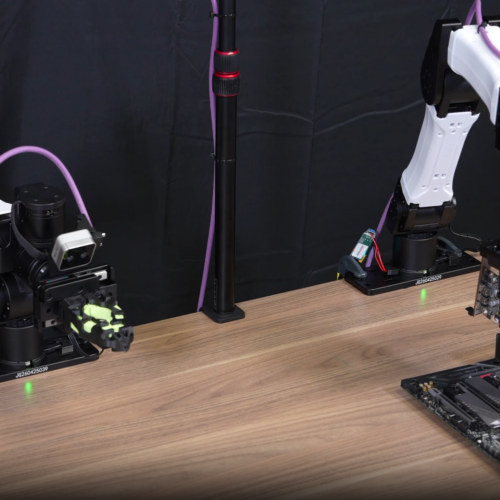
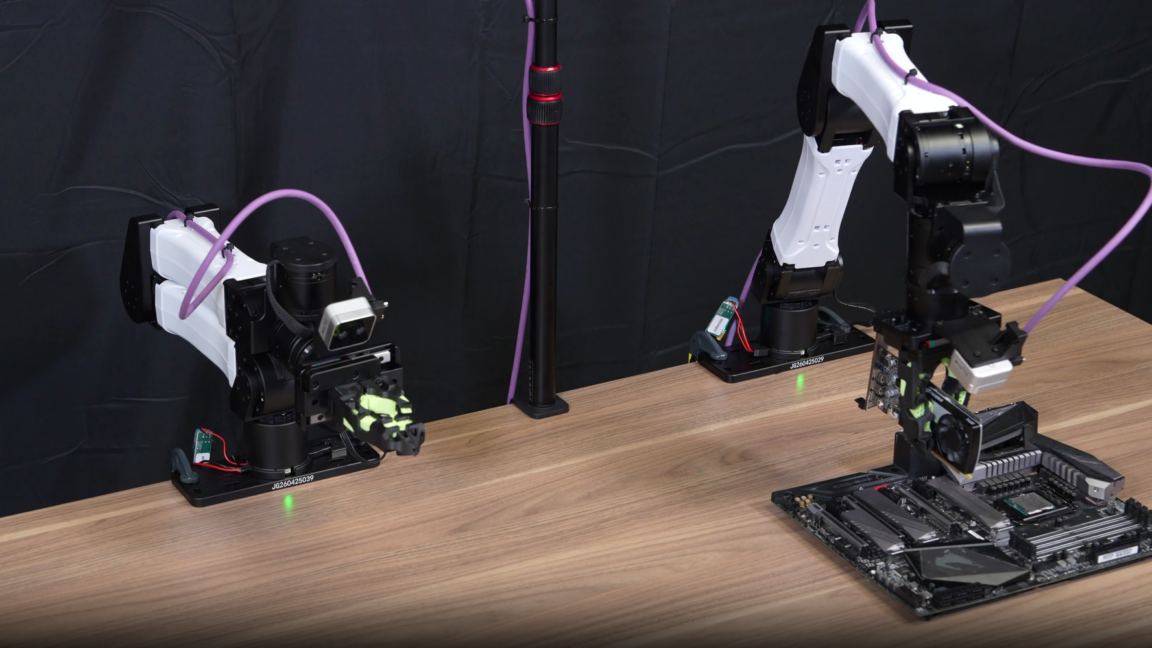
What happens when you give AI coding agents a lab full of robotic arms, some compute resources, and a “generous token budget” for teaching the robots various tasks? The agents can apparently figure out a training regimen that teaches the robots to successfully cut zip ties and even insert GPUs into thin sockets on motherboards.
That glimpse into how AI can act in a fully autonomous way to automate robot training was made possible by a new agent harness framework—software that wraps around AI models to enable their use of various tools while also providing capabilities such as memory, context, constraint, and feedback loops. That agentic harness, called ENPIRE, was developed by robotics researchers at the Nvidia GEAR (Generalist Embodied Agent Research) lab alongside collaborators from Carnegie Mellon University in Pittsburgh and the University of California, Berkeley.
“A part of our NVIDIA GEAR lab now self-improves tirelessly overnight,” wrote Jim Fan, director of AI at NVIDIA, in a LinkedIn post. “We just read the reports in the morning.”
A groundbreaking advancement in nanotechnology has emerged from the University of Basel, Switzerland, where a research team has engineered a sophisticated modular nanorobot exhibiting unparalleled versatility. This innovative system comprises two distinct, reusable components: a propulsion module and a payload capsule, which autonomously self-assemble through a DNA-based molecular Velcro mechanism. Their dynamic interplay offers promising applications across medicine, industry, and environmental science, heralding a transformative direction in nanorobotics research.
Nanorobotics has often been confined to the realm of science fiction, evoking images of minuscule machines navigating within the human body or cleaning up environmental pollutants. However, the rapid progress in this field reflects a new reality where these tiny constructs—differing fundamentally from conventional robots due to their biochemical and nanoscale nature—have started to fulfill tangible roles. Unlike traditional robots equipped with electronic circuits and software, these nanorobots utilize biomolecules and nanoparticles as their building blocks, innovatively combining bioengineering and materials science.
The design philosophy underlying the Basel team’s nanorobot addresses a critical limitation that has hampered previous efforts: specificity of function. Traditional nanorobots tend to be single-purpose entities, finely tuned for a particular task and lacking adaptability. In contrast, this modular system’s architecture allows for the independent development and exchange of functional units, rendering it highly customizable. Such adaptability is pivotal for extending the utility of nanorobots across diverse scenarios, from executing targeted drug delivery within the human body to catalyzing chemical reactions in industrial environments.
At the core of the nanorobot’s structure lies two integral modules. The first is a magnetic propulsion unit, which empowers the nanorobot with directed mobility under external magnetic fields. This enables precise navigation through complex environments—a critical capability for any targeted therapeutic or catalytic application. The second module serves as a payload capsule, designed to securely house and transport therapeutic agents, enzymes, or other functional molecules to desired locations. This segregation of propulsion and payload functions epitomizes engineering elegance at the nanoscale.
The payload capsule is particularly remarkable due to its internal composition. It encapsulates four enzyme-loaded polymer vesicles—nanoscale spherical structures synthesized from polymers that can safeguard and regulate the biochemical cargo within. These vesicles are equipped with nanoscaled pores, facilitating the ingress of substrate molecules and the egress of reaction products while protecting the encapsulated enzymes from premature degradation or deactivation. Moreover, depending on the specific configuration, these vesicles can be selectively triggered to release bioactive substances on demand, a feature critical for controlled therapeutic interventions.
Achieving a robust yet reversible connection between the propulsion module and payload capsule, the researchers employed a DNA-based “Velcro” assembly system. This approach utilizes complementary strands of DNA grafted on the surfaces of both modules, fostering specific and programmable binding through Watson-Crick base pairing. Such molecular precision guarantees that the modules self-assemble and remain stably coupled during operation, yet can be separated and recombined efficiently. This dynamic assembly-disassembly paradigm allows for easy reloading of the payload and recycling of the propulsion units, a major advantage for scalability and cost-efficiency.
Another notable feature enhancing the nanorobot’s functionality is the strategic modification of the payload capsule with biomolecular ligands that enable targeted docking onto specific cells or substrates. Using the human cancer cell line HeLa as a test model, the scientists demonstrated that these nanorobots, when loaded with fluorescent markers, preferentially accumulate on the cell surfaces. This active targeting capability is instrumental for precise delivery of therapeutic agents, ensuring minimal off-target effects and enhancing treatment efficacy.
In a striking demonstration of biomedical potential, the enzyme-laden nanorobots successfully synthesized an anticancer drug directly at the targeted site, reducing the viability of HeLa cells to a mere 16 percent within 72 hours. This localized drug production exemplifies an advanced therapeutic approach where site-specific synthesis and delivery converge, potentially overcoming challenges related to systemic side effects and suboptimal drug concentrations. According to Dr. Voichita Mihali, the lead author, this concentration of drug activity represents a promising strategy for future oncological applications.
Beyond the biomedical sphere, the modular nanorobot’s catalytic prowess, combined with its magnetic propulsion, opens compelling avenues in environmental and industrial contexts. For instance, nanoscale catalysts capable of performing complex chemical transformations can be transported magnetically to reaction sites, where they perform precise functions before being retrieved for reuse. This magnetically enabled recyclability addresses a critical sustainability challenge, aligning with growing demands for environmentally responsible and economically viable technologies.
The ability to dissociate the two modules after task completion and reload the payload capsules before reassembling them underscores the potential for repeated usability. This reusability is vital for practical implementations where cost limitations and material efficiency are paramount. Moreover, it facilitates adaptability, as different payloads can be swapped in according to the specific functional requirement, whether it be therapeutic commands or industrial chemical catalysis.
Importantly, the modular design philosophy extends the nanorobot’s versatility beyond its current framework. By altering the composition of the payload capsule, this platform could be customized for a plethora of applications without necessitating complete redesign. This adaptability accelerates translational research by leveraging a common technological foundation to address multiple challenges spanning healthcare, environmental remediation, and manufacturing.
The interdisciplinary nature of this project also highlights effective scientific collaboration, combining expertise from the National Center of Competence in Research – Molecular Systems Engineering, the Swiss Nanoscience Institute, and Heidelberg University. Such collaborative efforts are critical to tackling the complex engineering and biological challenges inherent in creating functional nanomachines capable of interacting reliably within diverse and dynamic environments.
While the modular nanorobot represents a significant leap forward, its ultimate deployment in human clinical settings remains a long-term objective, contingent on extensive biocompatibility and safety validation. Nonetheless, its current design and demonstrated functionalities establish a crucial foundation. The system’s adaptability and multifunctionality promise to catalyze new directions in nanomedicine and industrial nanotechnology, potentially revolutionizing how minute robots operate and impact their environments.
In conclusion, the University of Basel’s innovative modular nanorobot not only redefines the capabilities of nanoscale machines but also introduces an engineering paradigm centered on modularity, programmability, and reusability. Its ability to combine magnetic propulsion with a versatile, enzyme-loaded payload paves the way for localized therapies and catalysis with unprecedented precision and efficiency. This research marks a transformative milestone that will likely inspire continued exploration into modular nanorobotics, nurturing advancements that could one day address some of the most pressing challenges in medicine and technology.
Subject of Research: Modular Nanorobots with Enzyme-Based Catalytic Activity and Magnetic Propulsion
Article Title: Multiplex Modular Nanorobotic Systems with Catalytic Activity under Magnetic Navigation
Um robot-bicicleta desenvolvido por um estudante de doutoramento do Instituto de Tecnologia de Georgia, nos Estados Unidos, conseguiu realizar uma manobra acrobática de grande relevo e, agora, é uma "celebridade" na comunidade robótica.
Researchers in Austria have developed a four-legged robot that could make firefighting operations safer by entering dangerous areas and detecting hazardous substances before firefighters have to go in. The robot, developed under the leadership of researchers at Graz University of Technology (TU Graz), is designed to act as an advance scout during emergencies involving toxic […]
Cloudy underwater conditions can be a major problem for robotic vehicles exploring the ocean. When underwater robots land on the seafloor, inspect shipwrecks, or dig into sandy areas, they often stir up clouds of sediment that block their cameras. In many cases, operators have no choice but to wait for the water to clear before […]
Artificial intelligence is becoming increasingly skilled at understanding the world around it, but new research suggests it still has a major weakness: reading human facial expressions. Researchers at Cornell University have been exploring ways to give robots greater social intelligence so they can work more effectively alongside people. Social intelligence allows humans to read facial […]
Scientists in Italy have developed a remarkable robotic arm inspired by the octopus, one of the ocean’s most skilled and intelligent creatures. The new device can sense touch, understand how much force it is applying, and automatically adjust its grip when handling objects—even underwater. The research, led by scientists at the Italian Institute of Technology […]
Scientists from ETH Zurich in Switzerland have announced a series of successful experiments involving the repair of injured spinal cords in zebrafish and mice after being injected with magnetically controlled microrobots containing pluripotent stem cells.
According to a statement announcing the ETH team’s work, both the zebrafish and mice injected with the microrobots showed improved movement and normalized exploratory behavior within just a few days after treatment.
Although the initial studies were confined to lab animals, the team hopes their magnetically controlled microrobot approach to the precision delivery of pluripotent stem cells could eventually be adapted for humans with spinal cord injuries.
Spinal Cord Repair Microrobots Treat Nerve Cells That Resist Regeneration
Unlike some cells in the human body, nerve cells within the spinal cord rarely regenerate on their own. If the spinal cord is injured, scarring can further reduce the ability of the nerve fibers within the cord to regrow. For people living with spinal cord injuries, this scenario can offer a bleak prognosis for recovery.
In recent decades, scientists have turned to the natural regenerative properties of pluripotent stem cells. Although the use of stem cells was initially controversial due to the need to extract neonatal stem cells, scientists ultimately learned to convert ordinary stem cells into pluripotent stem cells capable of becoming any cell type in the human body.
The most promising approach involves implanting stem cells at the site of the injury and then using electrical stimulation to promote the growth of new cells. However, according to the ETH team behind the new approach, the current method has several drawbacks.
First, stimulating the cells requires the use of implanted electrodes. Second, the team notes that after transplantation, many of the stem cells “do not always survive or integrate properly into the existing tissue.”
To improve healing and increase the chance of restoring spinal cord nerve cell function, they said their new approach combines therapeutic stem cells with magnetoelectric nanoparticles and uses magnetic fields to guide them to the “precise site of an injury” and “stimulate the stem cells to accelerate repair.”
NPCbots Combine Stem Cells and Magnetically Controlled Nanoparticles
To construct their magnetically guided spinal cord repairing robot, the team built what they termed a “biohybrid microrobot.”
First, the team creates pluripotent stem cells from adult cells by genetically manipulating them in the lab. The result is what researchers call an “induced” pluripotent stem cell (iPS). According to the study authors, these newly pluripotent iPS cells are used to derive living neural progenitor cells (NPCs), meaning “they have the potential to differentiate into various types of nervous system cells.”
Next, the team creates customized magnetic nanoparticles consisting of two layers. The inner layer responds to the “commands” from the magnetic fields used to control them, and an outer layer that converts this response into an electrical signal.
According to Professor Salvador Pané i Vidal of the Multi-Scale Robotics Lab at ETH Zurich, each tiny robot has a reservoir near the center “where we trap the cells.” The professor said the best way to accomplish this is to inject the nanoparticles into a solution with the NPC, “and wait for the two components to bind.”
After 30 minutes, the process is complete, and the team is left with a batch of nanobots, each around 6 micrometers in size. Since the new robots combine a magnetic bot and a reservoir of NPCs, the team named them ‘NPCbots.’
In preparatory cellular experiments, the researchers used hundreds of thousands of NPCbots. However, several million were required for animal trials.
Zebrafish and Mice Regain Movement After Injections
To test the efficacy of their new NPCbots, the ETH team injected millions of them into the spinal cord of zebrafish larvae with spinal cord injuries. To improve the chances of nerve regeneration, the NPCbots were injected directly into the site of the injury.
After injecting the microrobots, the injury site was subjected to electromagnetic fields. Although the repair was not immediately evident, the team noted that after three days, the zebrafish with the injured spinal cords “exhibited nearly normal swimming and exploratory behaviour.”
At the start and after three days: the top images show the uninjured spinal cord of a zebrafish; those in the middle show the injured spinal cord; and those at the bottom illustrate how the nerve cells grow thanks to the microrobots. Image Credit: ETH Zurich.
Next, the team injected millions of NPCbots into mice with completely separated spinal cords. According to the team, the results were “very promising.”
“After 28 days, the animals’ nerve cells had reconnected at the site of the injury,” they explained.
The team said further observation of the treated mice revealed “increasingly normal movement patterns,” including improvements in gait, stride length, and coordination. The ETH team also noted that the mice’s exploratory behavior “improved significantly.”
Schematic illustration of nerve cell recovery in zebrafish and mice. Image Credit: ETH Zurich.
When discussing the mouse experiments, the team described the result as “particularly significant” because zebrafish spinal cords regenerate, whereas mouse spinal cords do not. They also noted that the treatment was “well tolerated by the animals,” with no reported immune reactions or adverse effects.
Minimally Invasive and More Precise Treatments with Microbots
Unlike science fiction movies, where tiny robots repair tissue mechanically, the research team said that the stem cells carried by the NPCbots are exposed to electrical stimulation, “greatly enhancing their differentiation after transplantation.” This means the nanoparticles convert the electric signals from the EM field into electrical impulses, stimulating healing.
Unlike more complicated stem cell procedures that use implanted electrodes and cables, the team said they only needed to apply external magnetic fields around the spinal cord injury site. The team said this simplification was “crucial,” since the spinal cord is considered extremely sensitive. They also note that the ability to manipulate the frequency and field strength of magnetic fields, combined with their ability to penetrate deeply into tissue, makes the entire process safe and easy to control.
“Microrobotic guidance makes the treatment more precise and minimally invasive,” Hao explained.
After the NPC bots have delivered and stimulated the stem cells, the team said they “essentially dissolve” within the tissue. Because the bots contain a barium titanate coating, the researchers also believe that they will be “stable and minimally reactive” with surrounding tissue. Still, they concede that “further studies will determine whether and how the particles are degraded or excreted over the long term.”
Expanding NPCbot Therapies to Increase the Effectiveness of Other Targeted Therapies
Although the team described the animal trials of their NPCbots as “promising,” they noted that further research is needed before the process can be attempted on human patients with spinal cord injuries. For example, Hao noted that in addition to ‘clinical aspects’ that require more exploration, the team needs to start by determining which magnetic fields “work best in humans” and determining the “optimal stimulation duration” for human NPCs. Nevertheless, the team noted, they are “already considering further applications.”
“The reproducible and scalable production of microrobots using our lab-on-a-chip system demonstrates that the platform’s application potential extends beyond basic research,” Professor Vidal explained.
Some potential biomedical applications mentioned by the RETH team include cardiology, oncology, wound healing, “and other targeted therapies,” adding that their process could make such treatments “safer, more controllable and more effective.”
Christopher Plain is a Science Fiction and Fantasy novelist and Head Science Writer at The Debrief. Follow and connect with him on X, learn about his books at plainfiction.com, or email him directly at christopher@thedebrief.org.
Os cães-robot podem ser a próxima aposta das forças armadas em Taiwan para reforçar a vigilância e a defesa do território, juntando-se aos esforços de modernização militar face às crescentes tensões com Pequim.
The US military invasion of Venezuela and kidnapping of its president is just one more step in WAR - BOOM - BUST. The collapsing world economies are being engineered by satanic globalist banksters and megacorporation elites, and are using the ensuing chaos to force you into digital prison, and ultimately more enslavement.
Entre proezas acrobáticas e demonstrações de força em preparação para o trabalho em fábricas, o robot Atlas da Boston Dynamics também tem tempo para dar uns toques na bola e para aprender a ser um craque no futebol.

 Login