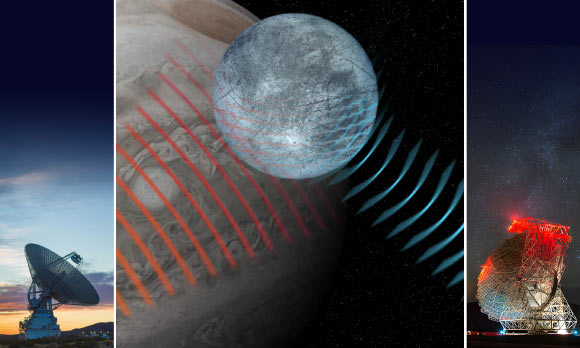
Using NASA’s Goldstone Solar System Radar and NSF’s Green Bank Telescope, astronomers from the University of California, Los Angeles, confirmed that the icy surface of Jupiter’s moon Europa scatters radio energy in an unusually strong and complex way not seen on rocky worlds.
La start-up française HyLight a fait voler son drone dirigeable HyLighter au-dessus des Champs-Élysées le 14 juin 2026, à l'occasion des 10 ans du salon VivaTech. Un coup d'éclat médiatique pour une technologie « Made in France », qui entend remplacer les hélicoptères et drones thermiques dans...
An ancient Mayasettlement, lost to the forest for centuries, was unexpectedly discovered by a Ph.D. student who fell down an internet rabbit hole.
Tulane University Ph.D. candidate Luke Auld-Thomas was more than a dozen pages into Google search results when he came across a laser survey conducted in Mexico by CartoData for environmental monitoring purposes.
Published in the journal Antiquity, Auld-Thomas and his colleagues reported the discovery of an ancient Maya site hidden within neglected LiDAR data, buried at the bottom of a Google search query.
LIDAR Discovery
While advances in remote sensing technology have transformed archaeology over the last two decades, Maya archaeology is often imagined as the result of laborious expeditions through dense jungle terrain in search of long-lost ruins. Instead, Auld-Thomas made a major discovery from the comfort of home.
LiDAR creates a 3D map by firing laser pulses at a landscape from above using drones, aircraft, or other aerial platforms. In this case, the original survey data showed only a dense forest canopy, making the site indistinguishable from the surrounding terrain. However, once that upper layer was digitally removed, a sophisticated settlement came into view.
Located in Mexico’s southeastern state of Campeche, the lost city contains plazas, causeways, ball courts, and pyramids that had remained unseen for centuries. Although the LiDAR operators were focused on environmental monitoring and did not investigate the data at this level, Auld-Thomas and a colleague recognized the archaeological significance of what they were seeing and identified the site, naming it Valeriana.
The Maya site Valeriana contains a dense mixture of buildings, many of which have been identified by the researchers. Credit: Luke Auld-Thomas/Antiquity
Valeriana
During their classic period, between 250 and 900 AD, the Maya developed the rugged Campeche landscape into complex urban environments.
The city of Valeriana, which the team found in the data, turned out to be the second-largest Maya site in North America, eclipsing Calakmul, some 100 kilometers distant. According to the researchers’ estimate, 30,000 to 50,000 people resided in the city between 750 and 850 AD, and it possibly served as a regional capital.
The site’s tropical setting has been a subject of debate among archaeologists, who question whether the population density of typical tropical settlements is skewed by the overrepresentation of large, dense settlements in the data. The team’s discovery of a dense and sophisticated urban environment comprised of nearly 7,000 buildings suggests that such dense sites are not unusual.
While the site contains many features typical of Maya cities, one unusual element particularly intrigued the researchers, consisting a sinkhole leading to a partially collapsed cave system, surrounded by a narrow quatrefoil-shaped ditch—a form frequently used in Mesoamerican art to symbolize caves and sinkholes.
Because the feature lacks substantial embankments and is relatively small in scale, the team does not believe it served a defensive purpose. However, its unusual design may warrant further investigation.
LiDAR Discoveries
Remote-sensing technologies such as LiDAR have transformed archaeology in recent decades, allowing researchers to identify hidden sites across vast and inaccessible landscapes without setting foot on the ground.
In 2013, LiDAR surveys revealed extensive urban networks surrounding Cambodia’s Angkor region, once the heart of the Khmer Empire. Researchers later used the technology to digitally strip away the Guatemalan rainforest canopy, uncovering more than 60,000 previously unknown structures. Using traditional survey methods, discoveries on that scale would likely have taken generations to achieve.
Remarkably, Valeriana itself has yet to be surveyed in person. At present, LiDAR imagery remains the only detailed view of the site. The researchers note that field investigations in Mesoamerica rarely result in fewer structures being identified than LiDAR suggests. In many cases, apparent false positives are offset by previously overlooked features discovered during ground surveys.
For now, Valeriana remains concealed beneath the forest canopy much as it has been for centuries. The researchers hope these remote sensing technologies will reveal more such hidden sites in the coming decades; if funding is sufficient to cover more area with drone-based LiDAR systems, they are almost certain that more discoveries similar to Valeriana could await discovery.
Ryan Whalen covers science and technology for The Debrief. He holds an MA in History and a Master of Library and Information Science with a certificate in Data Science. He can be contacted at ryan@thedebrief.org, and follow him on Twitter @mdntwvlf.
A copper-based drug helped the brain flush out Alzheimer’s toxins, cutting plaque buildup and improving memory in a promising new study. Scientists at Monash University have identified a promising new approach to tackling Alzheimer’s disease. In laboratory studies, a copper-delivering drug significantly lowered levels of toxic proteins linked to the disease while also improving long-term [...]
Semaglutide delivered dramatic weight loss and health benefits in adults over 65, offering new hope for healthier aging. A new analysis of data from the STEP clinical trial program suggests that semaglutide remains both effective and generally safe for older adults living with obesity. The research, conducted by Prof. Luca Busetto of the University of [...]
Though Toy Story 5is a continuation of Woody and Buzz's adventures in humanland, it is also a poignant exploration of what it's like for kids to grow up in a world where they're often encouraged to ex …
Smart mowers are an expensive alternative to old-fashioned yard work, but they’re finally good enough to consider if you’d rather sip an iced tea and watch a robot tame your lawn.
Bird flocks, bacterial swarms, and even crowds move according to interaction rules that appear to break one of physics’ most fundamental principles: Newton’s law of action and reaction. Birds can see much of what is happening around them, but when flying in a flock, they respond only to birds beside them or ahead of them. [...]
Unlock significant savings on hotels, resorts, and getaways with our verified Hotels.com promo codes and gift card discounts. Plan your perfect trip today!
We've gathered all the top Valvoline coupons and promo codes for September 2026, including deals on full synthetic oil changes and other essential maintenance.

 Login