❌

Reading view

Apple 2027 rumors: AirPods with cameras for AI and the second folding iPhone

AirPods Pro 3 shown with an iPhone and live translation features. | Photo by Amelia Holowaty Krales / The Verge

Now that we're clear of WWDC and all of the new AI-powered features coming to Apple's platforms, Bloomberg reporter Mark Gurman has more details about rumored new hardware, like the camera-equipped AirPods he'd previously written about. He says they are currently on schedule for a late 2027 launch, and that while we're checking out beta releases for this fall's iOS 27 update, the new earbuds are internally being tested with next year's update, iOS 28.

With cameras mounted in their stems and lights to indicate when data is being uploaded to the cloud, they could give the upgraded version of Siri "visual context" about your surroundings, be …

Read the full story at The Verge.

  •  

Apple’s smart home camera service is starting to impress me

New features are coming to cameras connected to Apple’s HomeKit Secure Video. | Image: The Verge, Getty Images

Apple's HomeKit Secure Video service is getting in on the Apple Intelligence party to bring more descriptive alerts from your connected cameras and let you search footage using natural language. The Apple Home app is also getting better notifications powered by AI and is finally adding support for energy reporting.

These improvements were announced at WWDC last week and will be publicly available this fall. I've been playing with some of the features in the developer betas for iOS 27 and tvOS 27 for a few days, and based on my first impressions, Apple's HomeKit Secure Video is much improved - enough to put it back in contention for me as a …

Read the full story at The Verge.

  •  

Apple’s weird anti-nausea dots cured my car sickness

Hand holding a phone covered in anti-nausea dots.

I'll just work from the car, I thought. But after a few minutes of staring at my screen on quick mountain switchbacks I could feel the first signs of cold, coagulated nausea bubbling up from that sweaty place in my gut. I looked to the horizon for relief, but nothing helped… until I remembered Apple's magic dots.

Introduced in 2024, Apple's Vehicle Motion Cues promise to tap into your device's accelerometer and gyroscope to reduce or, in my case, even eliminate the motion sickness felt when trying to use an iPhone, iPad, or MacBook inside a moving vehicle.

According to big-S Science, this type of vehicle motion sickness is caused by the e …

Read the full story at The Verge.

  •  

Italy launches Apple cloud probe under DMA

Italy’s antitrust regulator opened an investigation into Apple over alleged violations of the European Commission’s Digital Markets Act (DMA), centred around third-party interoperability policies with its operating systems and iCloud service.

The competition watchdog stated under DMA rules Apple must ensure third-party cloud providers are granted free and effective interoperability with iOS and iPadOS, as well as access under equal conditions to the same hardware and software features as those available to Apple iCloud.

The authority stated it had indications third-party providers “may not be placed on an equal footing” as Apple’s iCloud, pointing to the fact they appear to lack access to the same features used or made available to the in-house service.

For example, Italy’s regulator stated it appears Apple does not allow alternative cloud storage services to use iOS and iPad features enabling end users to fully backup data.

It will now conduct a deeper investigation into potential violations, before sending findings to the European Commission.

It is the first time the Italian authority has launched a probe under the DMA, which allows national authorities to launch initial investigations.

Apple has been a vocal critic of the EC regulation, which came into force in 2022 with the goal of curbing big tech dominance in favour of smaller players.

In September 2025, the iPhone giant demanded the European Union abandon the legislation, arguing it was making it harder for technology companies to do business, reduced consumer choice and created an unfair competitive landscape.

The post Italy launches Apple cloud probe under DMA appeared first on Mobile World Live.

  •  

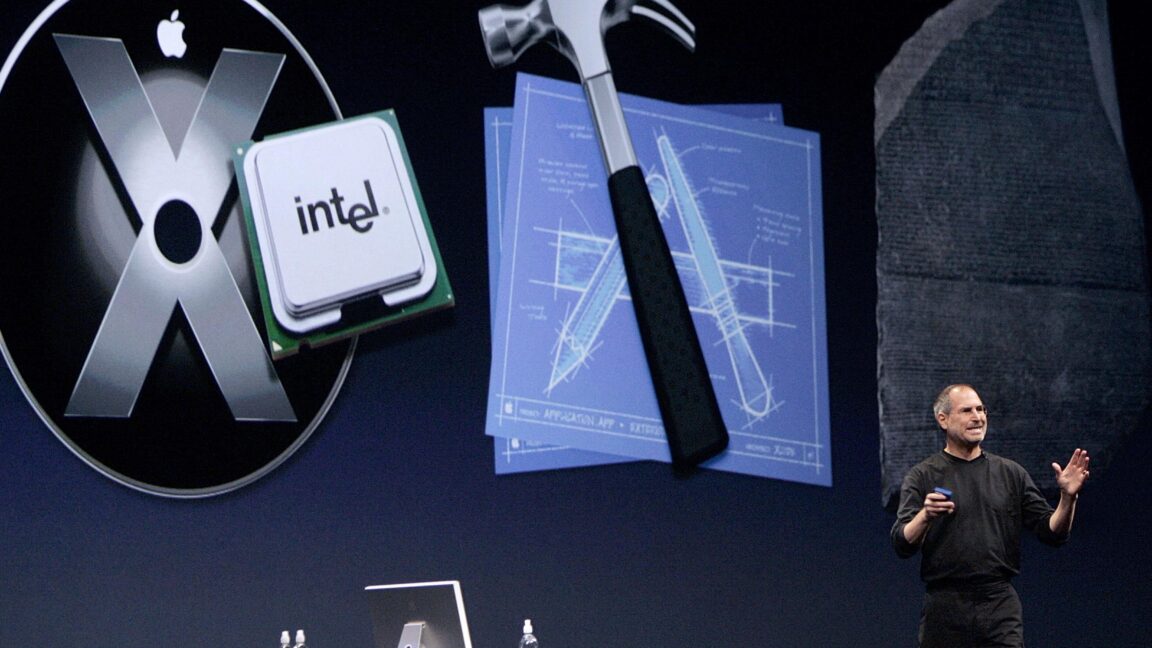
20 years of Intel Macs: Why Apple switched, and why it switched again

The release of macOS 27 later this fall won't quite close the book on the Intel Mac. The last handful of models that could run macOS 26 Tahoe will be eligible for security and Safari updates for two more years, and elements of the Rosetta compatibility layer for running Intel code on Apple Silicon Macs will be with us in some form for some indeterminate amount of time after that.

But macOS 26 is definitely the last chapter of the Intel Mac story. Anything that happens after this is a coda or an epilogue.

Most of our WWDC coverage has been forward-looking, so indulge us if you will in a look backward at the full history of the Intel Mac, a partnership between two companies that made Macs dramatically better, until it started making them worse.

Read full article

Comments

© David Paul Morris/Getty Images

  •  

Why Europe’s demands on Apple AI put your data at risk

Europe’s evangelistic approach to insisting Apple open up personal data to competing AI services is hurting Apple users in the region. More than that, it also places its entire business sector at risk, and a newly-published Jamf survey suggests why.

Announced at WWDC 2026, Apple Intelligence/Siri AI relies on personal, contextual data to run. Europe wants that same information to be made available to third-party services for competing apps, but has not worked with Apple to protect user confidentiality. It’s an approach that places your data at risk of exfiltration using those apps because Europe is insisting Apple share personal information with the developers of other apps.

The desire to protect that data is why Apple won’t distribute Siri AI in the EU for a while.

Jamf survey exposes the IT risks of AI

It’s not as if Europe doesn’t understand the risk of data leaks in an era of AI. Just look at the bloc’s focus on things that do matter, such as sovereign AI or managed AI services like Orange Live Intelligence. These locally-produced AI services, alongside Europe’s attitude toward them, tell me the confederation understands the risks.

How real are these risks? Very. Jamf on Monday published survey results confirming the scale of that risk, telling us that one-in-five IT and security leaders in the enterprise sector has already experienced an AI-related incident involving unexpected costs, a security issue, or both.  The survey also found that:

  • 72.9% of organizations have already deployed AI in some form.
  • 59.7% see an AI-related incident as a near-term risk.
  • Organizations with deeply integrated AI are 40% more likely to report an AI-related incident than organizations still in the exploratory stage. 

The implication is that AI governance is becoming an operational requirement and — as Apple has told us umpteen times in the past — the best way to maintain operational confidentiality is not to collect or share any data at all. That’s the whole point of its approach: the data doesn’t need to be shared, it just needs to be turned into another signal that promotes utility while protecting confidentiality. 

Crafting trust in a crowded market

There’s another challenge to emerge. There are now multiple brands of AI, with more coming on stream all the time. That’s great in terms of finding a model that suits your needs, but challenging when it comes to ensuring all the services you or your employees use of are equally secure. You don’t want your business to become deeply reliant on any service only for that vendor to subsequently get bought out and/or shut down, nor do you want a service to be hacked or otherwise exploited to your detriment.

“AI isn’t arriving as a single application that IT can approve and move on from,” said Jamf CEO Beth Tschida. “It’s showing up in developer tools, productivity apps, autonomous agents, and other software they already run. The challenge is maintaining visibility and control as that footprint expands.” 

The survey described the challenges IT faces with AI deployment: shadow IT, vendor sprawl, and the need to grapple with highly unpredictable use-based pricing models. And that’s even before considering the governance challenges of agentic and developer AI.

AI and the emerging governance nightmare

“What our survey shows is that governance must keep pace with adoption,” Tschida said. “For organizations built on Apple, the foundation is already an advantage. Apple’s privacy model and the management controls built into the platform give IT teams a strong foundation to build on and … that advantage depends on using tools built for Apple from the start.”

That’s the point of the curated, private and secured service offered by Siri AI, of course. It’s also part of what Apple is building toward with its wider ambitions toward AI on its platform. Bloomberg’s Mark Gurman discussed elements of this in his weekend newsletter, in which he suggested Apple might introduce some subscription services using AI, and that it is building an App Store for Siri Extensions, which would allow third-party chatbots to work with Siri. 

There is a need for curation and management in AI

What makes that model work is the curation with which Apple surrounds it, and its determination to extend Private Cloud Compute so it can protect your data even when using third-party servers (in this case, Google’s server clusters). It makes sense to think Apple intends to use that system to protect all approved third-parry AI interactions provided across its platforms by its own routes. That’s true, even if users access services free of those safeguards using a web browser, which they currently can.

But the key thing is that if Apple can get this right, offering up a managed, curated, and controllable ecosystem for AI agents and services, it will be going a long way toward building the kind of managed AI ecosystem the Jamf survey shows our modern digital enterprises increasingly need. 

You can follow me on social media! Join me on BlueSky,  LinkedIn, Mastodon and subscribe to The Core.

  •  

My first 24 hours with Siri AI on the Mac

A MacBook Pro resting on a couch with Siri AI running on the macOS 27 Golden Gate developer beta.

I turned off Siri on the Mac years ago and never looked back. Similarly, I found Apple Intelligence so fruitless I never engage with it. But the new Siri AI coming to macOS 27 Golden Gate has at least got me slightly rethinking things.

I'm still early in testing Siri AI, as I've only had access to it in the macOS 27 developer beta for little more than 24 hours. It's also in an early preview state on the dev beta, so there should be lots of runway for improvements before it releases later this year. I don't even know if it's done indexing my files and folders on our review unit M5 MacBook Air and M5 Max MacBook Pro. Unlike on the iOS 27 dev …

Read the full story at The Verge.

  •  

Apple’s new AI photo editing tools mostly work, for better and worse

iPhone on a tray showing editing UI in Apple Photos
iPhone owners are getting real, native AI photo editing for the first time.

The most popular camera in the world just got its first set of serious AI photo editing features, and I don't think any of us are ready.

As far as AI photo editing goes, the new features in iOS 27 are pretty tame compared to what you can do on, say, Google's Pixel phones. But for the iPhone, they represent a tipping point in what the native photos app allows you to do to your photos. I mean memories. I mean, I don't know anymore.

These new features are part of the iOS 27 developer beta right now, so bear in mind that Apple may continue making tweaks to them before they're released to the general public. There are three, or maybe two and a …

Read the full story at The Verge.

  •  

Siri is good now??

You'd be forgiven for thinking this day would never come. Siri has spent a decade and half somewhere between "sort of useful at a few things" and "utterly disastrous, why did I even try, can it honestly not even set a timer." But the wildest thing just happened: Apple put out a new version of Siri, and it actually seems to be pretty good.

On this episode of The Vergecast, David and Nilay talk about their early experiences with Siri AI, and what it means for users, and the rest of the AI industry, for the iPhone's built-in assistant to be good enough at most things. There's very little about Siri AI that feels bleeding edge or brand new, but …

Read the full story at The Verge.

  •  

iOS 27: Há 31 modelos de iPhone compatíveis com o novo sistema operativo da Apple. Veja se o seu está na lista

A Apple confirmou na WWDC 2026 todos os modelos compatíveis com o iOS 27, e a boa notícia é que nenhum iPhone ficou para trás face à versão anterior. Já a nova Siri com IA só chega aos modelos mais recentes, mas apresenta uma justificação para tal.

The post iOS 27: Há 31 modelos de iPhone compatíveis com o novo sistema operativo da Apple. Veja se o seu está na lista appeared first on Tek Notícias.

  •  

iPad Pro M4 en promo : plus de 600 € de remise sur la tablette la plus avancée d’Apple

Donnez vie à vos projets, échangez, jouez ou profitez de vos contenus multimédias dans d’excellentes conditions grâce à la puissance de l’Apple iPad Pro M4. Lancée en 2024, cette tablette fine et facile à transporter bénéficie actuellement d’une baisse de prix importante chez Rakuten, avec plus...

  •  

Siri AI is all Apple; it just needed Google to get there

Apple’s executives have been taking questions, hosting seminars, seemingly working around the clock to stress one very important thing: Apple is not using a white label version of Google Gemini to make Siri AI happen. They just pooled resources to get there. 

The new Siri AI is faster, more accurate, offers powerful contextual capabilities and shows how Apple has leap-frogged into a good peer position in an AI race critics felt it had already lost. Its market scale — even without the EU — is huge. For most consumers, Apple Intelligence and Siri will continue to be their primary/first engagement with artificial intelligence on a device.

Getting there took a lot of work, and Apple needed Google to get it done. Though there is still some confusion about what that means, Apple’s software chief tried to explain it this week. “We use none of the models that Google deploys to their customers, nor do we use the infrastructure and means by which they employ models to their customers,” Craig Federighi said in a presentation at WWDC.

Apple is not even using Google Search as the foundation of its system, he said. “This is the amount of Google Assistant we use,” Federighi said, pointing at an empty chart. “Nothing.”

Apple not Gemini, Siri AI is not Google’s

What makes this hard to understand is that we all know Apple partnered with Google to build Siri AI; back in January, we were told the next generation of Apple Foundation Models would be based on Gemini models and cloud technology. So, how can we have moved from partnership hero to usage zero?

The answer is, we didn’t. What happened is that Apple built its new Apple Frontier Models (AFMs) (the AI inside Siri AI) by training them using proprietary Apple data and reinforcement learning and then refined those models using “outputs from Google’s Gemini Frontier models.”

In other words, Apple used Google Gemini to help improve its own models, which means the models themselves, the AI in Siri AI, are Apple’s — but they were trained with help from Gemini. They are not white label iterations of those Google models. 

Apple also hit a second snag. Its very best model (AFM 3 Cloud Pro) requires more processor power to run than Apple could deliver using its own cloud-hosted Private Cloud Compute servers. Now, we know Apple doesn’t like using other people’s stuff. But it’s a realistic company that understands it sometimes must, and just as it uses AWS to support some of its services, it moved to adopt Google cloud services and Nvidia processors to drive the most demanding requests.

A question of trust

Apple also developed a technological solution that means it can claim the interaction remains just as private as if it were run on your device. Apple has made it possible for independent security experts to confirm this and says it is the only company that can deploy software on those servers, with strong security to ensure your device only interacts with those servers when you want it to. So far, no one has broken this protection. 

I came across an interesting report in which Tekonyx Founder and Chief Research Officer Sid Nag explained the significance of Apple finding a way to expand its Private cloud Compute infrastructure beyond its own data centers.

“Apple is effectively arguing that trust in AI systems should come from cryptographic and architectural guarantees rather than trust in the cloud provider itself,” he told Fierce. Where enterprises have faced a choice between access to powerful AI or privacy, Apple has introduced a new solution he called “portable trust.” This could conceivably become a new IaaS offering from the companies involved over time.

Working together for the benefit of all

So, while Apple’s models were built with Google’s help, and while its most advanced models run with support from Google and Nvidia, the models are Apple’s alone. 

It’s good for Google, of course. Apple is paying for this use, which helps the search giant claw back some of the value of its massive, muti-billion-dollar AI infrastructure investment. It’s not clear how much Apple is paying; earlier this year, the $1 billion figure was bandied around. But Apple’s decision to tie usage to iCloud subscriptions in some hitherto undisclosed way hints that the deal may also see some token-based usage charges on top of the basic Apple fee. I’ve not come across any details, but that’s what I surmise based on the size of Apple’s ecosystem and the growing realization of how quickly users can consume AI capacity.

What AI models is Apple running?

AFM 3 Cloud Pro is one of five Apple Frontier Models driving Siri AI.  Here’s how Apple describes those five models:

On-device models

  • AFM 3 Core, the next generation of Apple’s 3-billion-parameter dense model. You’ll use this for basic text generation, summaries, conversational replies, all the standard uses. It can also handle indexing, search, App Intents, basic dictation and contextual awareness.
  • AFM 3 Core Advanced, the most powerful on-device model. This is what makes Siri’s voice match mood or context, does all the high-accuracy dictation, and can process various data to handle tasks across different apps. It’s the AI driving your more involved Siri conversations. 

AFM Core Advanced is impressive in its own right, because Apple has managed to cram a 20-billion-parameter model onto a smartphone. It has done this by using a sparse architecture, which means it activates just 1 to 4 billion parameters at a time depending on the request. It is, however, only available to Apple’s most powerful systems — iPhone 17 Pro, iPhone 17 Pro Max, iPhone Air, M4 or later iPad, M3 or later Mac with 12GB+ memory.

Server-based models

  • AFM 3 Cloud, which Apple calls its server-side workhorse, optimized for speed, efficiency, and performance.
  • ADM 3 Cloud (Image), for image generation and editing, which unlocks advanced photo-editing tools, the all-new Image Playground, and more.
  • AFM 3 Cloud Pro, the most capable server-based model, which powers the most demanding use cases, like agentic tool use and complex reasoning.

All five were built using the same common foundation, which was then specialized to reflect the proposed use of that model. It’s interesting to look at the human evaluation tests Apple ran to test how well these models performed; they demonstrate impressive improvement on the company’s original models, effectively justifying the decision to work with Gemini.

You can follow me on social media! Join me on BlueSky,  LinkedIn, Mastodon and subscribe to The Core.

  •  

The Friday File: Apple; OpenAI; SFR

Mobile World Live brings you our top three picks of the week as Apple reset its AI ambitions at WWDC, OpenAI edged closer to a stock market debut and French operators agreed a €20.4 billion deal to carve-up SFR.

Apple lands Siri AI at WWDC as Cook takes a bow

What happened: During its annual WWDC event, Apple reset its AI strategy, unveiled a revamped AI-powered Siri and spotlighted new child-safety controls as Tim Cook delivered his final keynote as CEO.

Why it matters: Apple SVP of software Craig Federighi said, “truly helpful AI must be centred around you and your needs”, positioning privacy, personal context and deeper app integration as core pillars of the AI-enhanced Siri. The launch gives Apple a chance to overwrite a damaging run of Siri AI delays described internally as “ugly and embarrassing”. Ben Wood, chief analyst at CCS Insight, said “Apple had to address its shortcomings in AI, and WWDC provided some answers”, but added the company must deliver “a meaningfully better everyday experience, not just parity with rivals”. He noted many features will already be familiar to Android and third-party AI app users, adding iPhone users are “more likely to upgrade for better battery life, an improved camera or a bigger screen rather than to get AI”. However, challenges have already emerged. The AI-upgraded Siri and Apple Intelligence features have already been delayed indefinitely in the European Union (EU) over competition laws and blocked in China over local AI regulations.

On child safety, Wood called Apple’s push “a welcome and timely move” as concerns about online harm grow among regulators but said “stronger cross-industry safeguards need to be built into operating systems at a deeper platform level”. Cook’s farewell added weight to the event as he declared the iPhone will “continue to be the centre of people’s digital lives”, adding, “the best is still ahead”.

OpenAI lines up stock market debut

What happened: OpenAI confidentially filed paperwork for a US IPO, becoming the latest AI company to move towards a listing as the sector’s biggest players race to raise fresh funds.

Why it matters: The ChatGPT-maker stated it had submitted a draft registration statement to the US Securities and Exchange Commission (SEC), adding, “we expect it to leak so we’re just announcing it”. It did not disclose the size, price or timing of the listing and cautioned a debut may not be imminent “because there are things we want to do that are likely easier as a private company”. OpenAI explained the decision involves “a complicated set of trade-offs”, but the filing gives it “the option to go public sooner if that ends up being best”. Reuters reported the company is targeting a valuation of up to $1 trillion, with a debut possible as early as September. The filing puts OpenAI into a crowded and expensive AI listings race; rival Anthropic confidentially filed for its own US IPO last week, while SpaceX launched a blockbuster listing. Aviva Investors’ head of multi-asset Sunil Krishnan told the BBC all firms all have a “vast need for cash” as “no one wants to be last” in a space where access to capital could prove crucial as companies fund AI chips, infrastructure and model training. Harrison Rolfes, senior research analyst at PitchBook, argued OpenAI’s $1 trillion listing is “a bet on a company that has never been profitable, in a market it is currently losing, with a cost structure it cannot change for at least another year”. He added this is “all while racing a direct competitor through the same SEC process in the same quarter.” Rolfes concluded: “There is no scenario where OpenAI pricing after a profitable Anthropic favours OpenAI.”

Bouygues, Orange, Free agree €20B SFR carve up

What happened: Bouygues Telecom, Free-Iliad Group and Orange signed a memorandum of understanding with Altice France to acquire and carve up SFR in a deal valuing the operator at €20.4 billion, setting the stage for a major reset of France’s telecoms market.

Why it matters: Under terms outlined in April, Bouygues will take 42% of SFR’s assets, Free-Iliad 31% and Orange 27%. SFR’s consumer mobile and fixed broadband operations will be divided between the three operators, while Bouygues will take control of the B2B unit. Completion is targeted for H2 2027, subject to regulatory clearance. Kester Mann, director, consumer and connectivity at CCS Insight, noted the move marks the biggest potential shake-up in French telecoms since Iliad entered the mobile market in 2012, cutting the number of major operators from four to three and reshaping competition. He said the agreement appears “a successful outcome for all parties” as Bouygues, Orange and Iliad all gain “important new assets in their pursuit of greater scale”, while removing a key rival will “reduce the competitive intensity of the market”. However, the biggest challenge will be to regulators show the deal will deliver “positive outcomes to the French market”. He noted that while that would once have been “a herculean task”, recent approvals in the UK and Spain suggest Europe’s stance on consolidation is softening.

The post The Friday File: Apple; OpenAI; SFR appeared first on Mobile World Live.

  •  

Siri won’t be your AI girlfriend

‘Listen, that's not what I'm here for.' | Image: Apple

Our early testing has already shown that Siri AI knows when to shut up, and that's very much by design. In an interview with Mostly Human spotted by MacRumors, Craig Federighi said Apple's new Siri won't act all sycophantic like chatbots made by OpenAI, Google, and others.

"As you may know, if you use many of the existing chatbots, they're really focused on engagement to a large degree," said Federighi, who is responsible for software at Apple. "And sycophancy, right? They kind of want to pull you in. They might encourage you to reveal things about yourself, and then use that as a basis to establish a connection."

Apple purposely took a di …

Read the full story at The Verge.

  •  
❌