In an internal memo seen by WIRED, Bosworth promised employees more stability, better communication, and the return of workplace perks as the company seeks to improve morale.
Time seems like one of the most basic parts of everyday life. We use clocks to measure it, plan our days around it, and experience it as a steady flow from the past into the future. But according to some of the deepest theories in physics, time may not actually exist in the way we […]
The main focus of this argument is the idea of the “block universe.” In this view, also known as eternalism, space-time is a fixed, four-dimensional structure. All past, present, and future events are equally real within this block, according to this interpretation. Time does not flow, and there is no single present moment. The block contains everything that has ever occurred.
Janzen does not object to the geometry itself. His concern lies with the way the word “exists” is used in this context.
Janzen distinguishes between existence and occurrence. Objects exist because they endure through time. Events occur at a specific place and moment, and then they are over. For example, an elephant standing in a room exists. A cross-sectional snapshot of that elephant, representing a single instant removed from its timeline and frozen in place, does not exist in the same way; it only occurs.
In the block universe model, space-time holds every moment of the elephant’s existence as a four-dimensional world line. This world line shows the animal’s full path through space and time. A single cross-section, or one slice of that path, is not the elephant itself; it is only a record of what the elephant was doing at a certain moment. Janzen says the block is better understood as a representational framework rather than a physical object in the usual sense.
A Problem of When
This confusion leads to a fundamental problem. The entire block universe is said to exist, but it is unclear when it exists. A timeless structure that never unfolds cannot endure as the elephant endures from moment to moment. Meanwhile, if the whole block occurs at once, like a single flash, there is no internal experience of time that could be considered an illusion.
To keep the sense of time passing in a block universe, the four-dimensional structure would need to endure in some sense. This would mean adding a fifth dimension, a second time axis outside the block, for the block itself to exist within; however, this extra axis is not part of Einstein’s original theory.
Janzen uses a simpler analogy. He compares the situation to describing a song that exists all at once, complete but unperformed. A song only becomes a song when it unfolds over time.
Austrian-British philosopher Ludwig Wittgenstein warned that philosophical problems arise when “language goes on holiday.” Janzen argues that physics has been in this situation for decades, reusing words such as “timeless,” “exist,” and “become” in technical senses without considering their everyday connotations.
Implications for Physics and Philosophy
One of the biggest unsolved problems in physics is how to bring together general relativity, which explains gravity and the large-scale universe, with quantum mechanics, which describes matter at the smallest scales. These two frameworks do not fit together, and every real attempt to unify them demands a clear definition of what space-time actually is.
If the language physicists use to describe space-time has been internally inconsistent for more than a century, Janzen suggests the resulting confusion may extend beyond philosophy. Clarifying what physicists mean when they talk about space-time could influence how researchers think about attempts to reconcile general relativity and quantum mechanics.
Janzen does not propose a replacement for the current framework but instead suggests that the fundamental question is not how space-time curves, but how to properly define them in the first place.
Austin Burgess is a writer and researcher with a background in sales, marketing, and data analytics. He holds an MBA, a Bachelor of Science in Business Administration, and a data analytics certification. His work focuses on breaking scientific developments, with an emphasis on emerging biology, cognitive neuroscience, and archaeological discoveries.
A new detector-based method clarifies how gravitational waves should be measured in an evolving universe. Imagine trying to measure a ripple on the surface of a pond while the pond itself is slowly changing shape. That is the challenge scientists face when they study gravitational waves not as isolated signals from colliding black holes, but [...]
The nature of time has long puzzled scientists, and now one researcher at the University of Birmingham has constructed a mini-universe in a laboratory to get to the bottom of this and other fundamental questions about gravity and quantum mechanics.
Revealed in a recent paper published in Physical Review Research, Professor Giovanni Barontini created a universe in a sealed quantum system to answer the lingering questions of “what is time?” with a laboratory model. His work creates an intriguing new testbed for exploring the nature of our universe from beginning to end, and all the phenomena in between.
Creating a Universe
Physicists have long puzzled over how a sequence of events could be understood in a universe without an external clock. The new work demonstrates how to move purely theoretical work into a practical laboratory environment, allowing exploration of deep questions about time and quantum physics.
In the new paper, Professor Barontini describes creating a miniature universe from 24,000 atoms held at just several degrees above absolute zero. Such temperatures are essential to many quantum explorations, including quantum computing technologies.
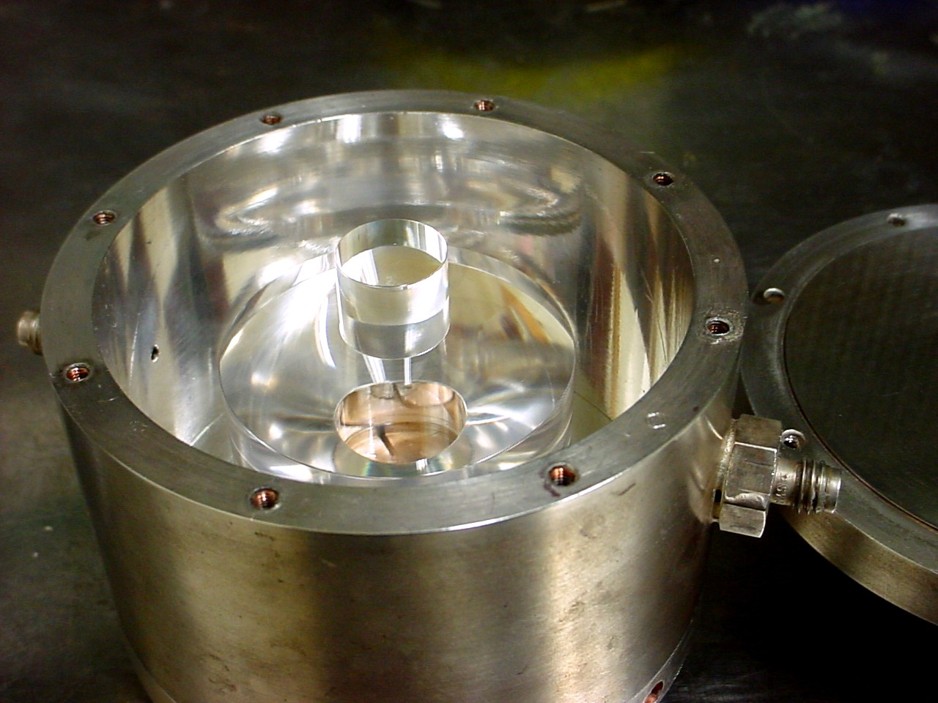
In this quantum system, the hermetically sealed cloud of ultracold atoms acts like a miniature universe. A thin barrier divides this tiny universe in half, while two lasers set to different frequencies bombarded it to create an observed bright region and an unobserved dark region.
For his research, Professor Barontini created simulations of a “miniature universe” from 24,000 atoms held at just several degrees above absolute zero (Image Credit: University of Birmingham).
Internal Time
Crucial to the experiment, Barontini did not measure time externally but instead waited for the internal relationship between the particles to generate time within this new universe. This idea comes from theoretical physics concepts such as the Wheeler-DeWitt equation, which posits that the universe exists in an ever-steady quantum state exhibiting both wave- and particle-like behavior, without an external time.
Barontini observed the bright side behaving similarly to our universe, albeit on “fast-forward,” repeating a cycle of Big Bangs and Big Crunches, continually expanding and collapsing back in on itself. Since the sequence of events could be reconstructed entirely within the quantum system without reference to a laboratory clock, this shows that time emerges from the system itself, created by the disorder of spreading atoms, rather than being an external function.
Investigating Quantum Time
Time moved forward in a single direction, with the increase or decrease in particles in the bright sector as they moved into the dark sector and back again, indicating an arrow of time. Yet, when the atomic distribution remained steady, Barontini observed a halt in time, leading him to describe what he witnessed as “entropic time.”
While this version of time corrects the order of events, it is not steady; it varies with the system’s entropy level. Notably, Schrödinger’s equation, the linchpin of quantum theory, still works in entropic time.
“In some theories of the universe, especially quantum gravity, time doesn’t appear as a built‑in feature,” Barontini said. “Yet in everyday life, time flows from past to future – why is this so, when most basic laws of physics work the same way forwards and backwards?”
“This study provides the first controlled experimental evidence that ‘time’ can be defined by changes within a system rather than as the external ‘ticking clock’ we think of as time,” Barontini concluded. “It offers new insight into the nature of time in quantum gravity that could be used to describe dynamics just as effectively as conventional time.”
Moving forward, such artificial universes could be used to probe the mysteries of our own universe, including its earliest moments, the emergence of time, and even black holes.
Ryan Whalen covers science and technology for The Debrief. He holds an MA in History and a Master of Library and Information Science with a certificate in Data Science. He can be contacted at ryan@thedebrief.org, and follow him on Twitter @mdntwvlf.
Does the fact that we see light from very distant galaxies prove that the one-way speed of light is finite? Dr. Jason Lisle responds to this question. The conventionality thesis plays a critical role in understanding the issue, suggesting that measurements usually assume an isotropic light speed.
Imagine a technology that can generate electricity while cleaning wastewater at the same time. According to a recent review published in the International Journal of Environment and Waste Management, microbial fuel cells (MFCs) could help make that idea a reality. Microbial fuel cells are a unique type of energy system that use naturally occurring microorganisms […]
A new mathematical breakthrough sheds light on how tiny black holes could emerge from critical states of spacetime. Black holes are often portrayed as cosmic giants, swallowing stars and shaping entire galaxies. But some of the most intriguing black holes predicted by physics could be far smaller than an atom. For decades, scientists have known [...]
O PRESENTIS, projeto liderado pela GMV, recorre ao sistema de navegação europeu Galileo para garantir segurança e resiliência às infraestruturas críticas europeias para possíveis ataques realizados durante aplicações críticas de sincronização do tempo.
The big bang has causality issues, particularly the "horizon problem." I critique suggested solutions like cosmic inflation and negentropy, arguing that they require unproven concepts. The Creator, as described in the Bible, provides a coherent explanation without causality violations, in contrast with those scientific storytelling fairy tales for adults.
When we look out into space, even with the most powerful telescopes, are we seeing the universe in real time? Are we observing events as they happen, that is, at the time measured on our local clocks?
Due to medical conditions, my postings on Bible Science Forum will be greatly reduced. I need to limit screen time to prevent blurry eyesight. I apologize for the fewer, and briefer posts.
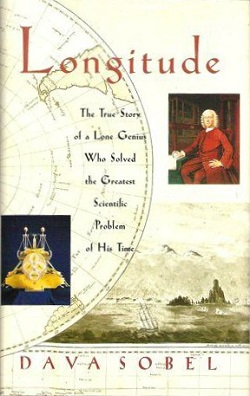
The exploration of time measurement emphasizes the Earth's rotation as a historical clock, defining the 24-hour day. The development of mechanical clocks, notably John Harrison's marine chronometers, advanced navigation. Time's definition evolved from an Earth-centric model to atomic standards, although fundamental concepts of time remain abstract and intrinsic to the universe's creation.
Day 4 of creation, God made the Sun, Moon, planets, and stars, establishing them as luminaries in the heavens. The language of the Bible uses an Earth-observer perspective, meaning that light from celestial bodies was instantly visible. Additionally, I confront naturalistic explanations for celestial origins, proposing a creationist model.
Mathematicians from University College London and the University of California, Davis, have published a mathematical proof that the Universe’s accelerating expansion can be explained without dark energy, dealing a serious blow to the Lambda-cold dark matter model.
Kinematics: The Velocity-Time Function Author’s Preface: A Collaborative Approach to Lesson Development The intention behind what I hope will be a series of articles on Kinematics (this one being the first) is to begin an open, collaborative process of lesson development on Physics Forums. In order to expedite this workflow, I am making deliberate use...
Direct answer: Cosmologists classify the universe as open, flat, or closed based on spatial curvature. Current cosmic microwave background (CMB) measurements indicate the universe is very close to flat, but small curvature remains observationally allowed. Whether the universe is ultimately finite or infinite cannot be settled by theory alone, since all three curvature types are...
 Login




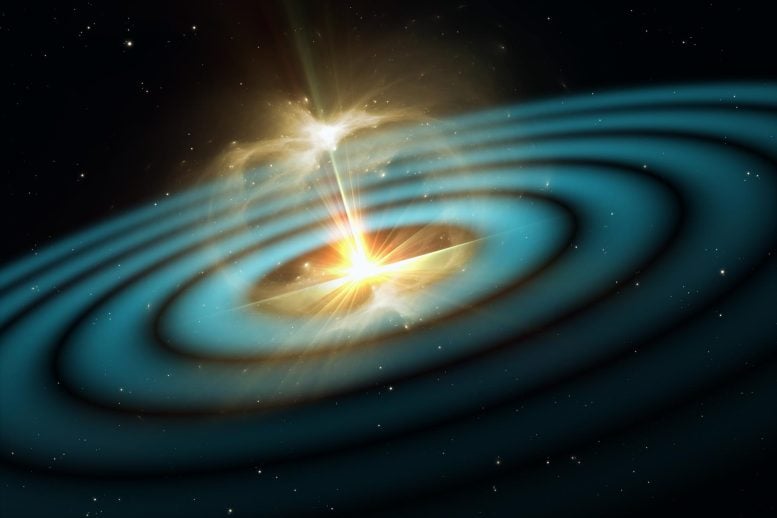 A new detector-based method clarifies how gravitational waves should be measured in an evolving universe. Imagine trying to measure a ripple on the surface of a pond while the pond itself is slowly changing shape. That is the challenge scientists face when they study gravitational waves not as isolated signals from colliding black holes, but [...]

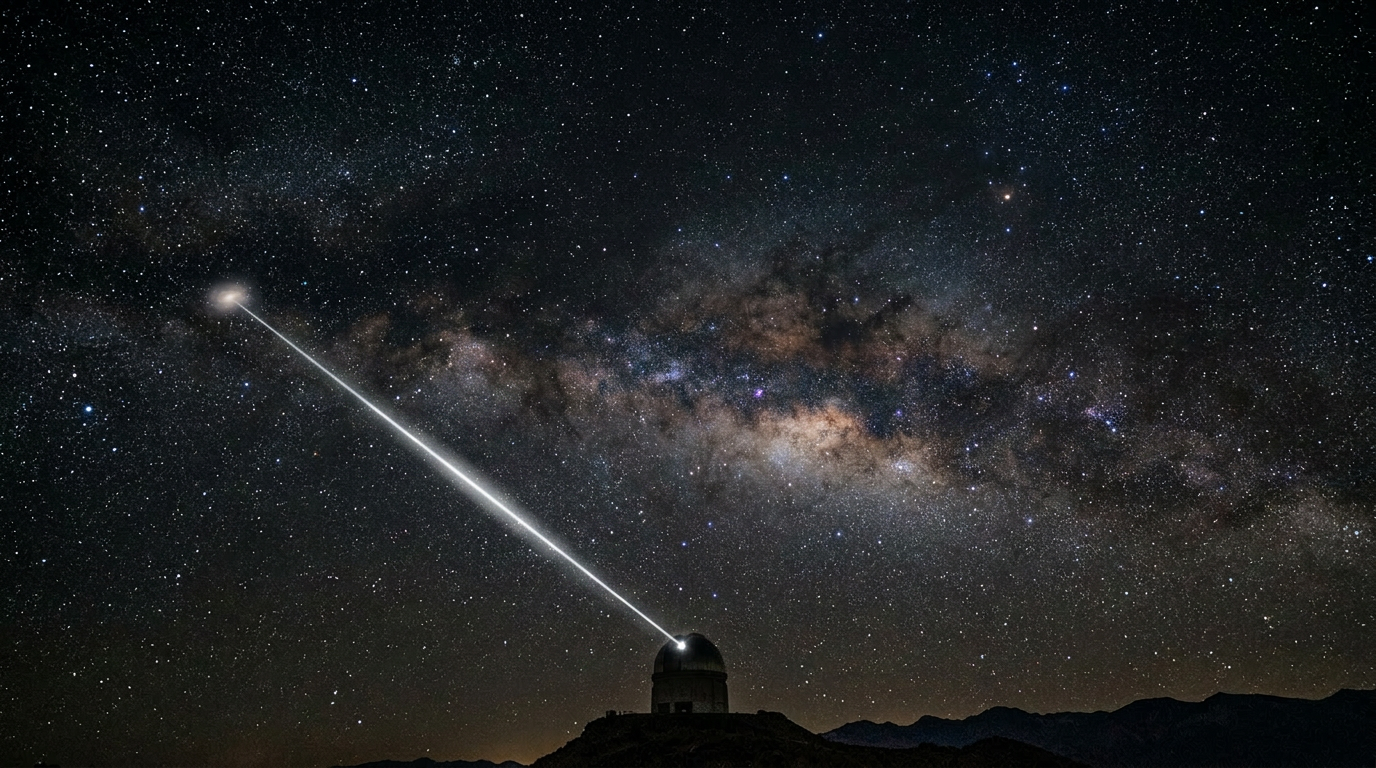


 A new mathematical breakthrough sheds light on how tiny black holes could emerge from critical states of spacetime. Black holes are often portrayed as cosmic giants, swallowing stars and shaping entire galaxies. But some of the most intriguing black holes predicted by physics could be far smaller than an atom. For decades, scientists have known [...]
 Quantum particles are sometimes truly stunning.