❌

Reading view

Lunar Meteorite Preserves Evidence of Colossal Asteroid Strike

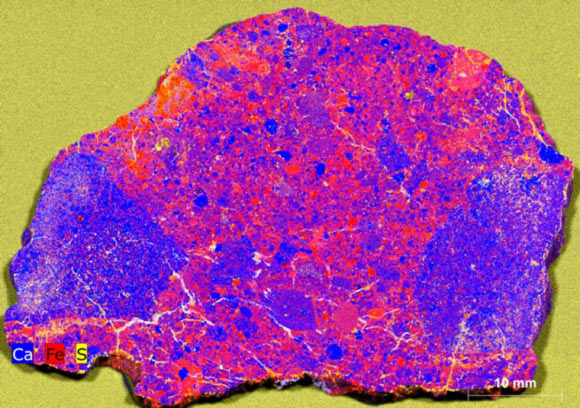
XRF map of 7.53 g slice of NWA 12593: calcium (Ca) and iron (Fe) illustrate the location and diversity of clasts; sulfur (S) highlights the location of cracks and terrestrial weathering. Image credit: Crow et al., doi: 10.1130/G54386.1.

Planetary scientists analyzing a lunar meteorite known as Northwest Africa (NWA) 12593 have uncovered evidence of an asteroid impact that occurred 3.5 billion years ago on the Moon, helping to reconstruct a period of intense bombardment that left lasting marks across the inner Solar System.

The post Lunar Meteorite Preserves Evidence of Colossal Asteroid Strike appeared first on Sci.News: Breaking Science News.

  •  

Geoscientists Find Vast Fan-Shaped Structure beneath Antarctica’s Ice

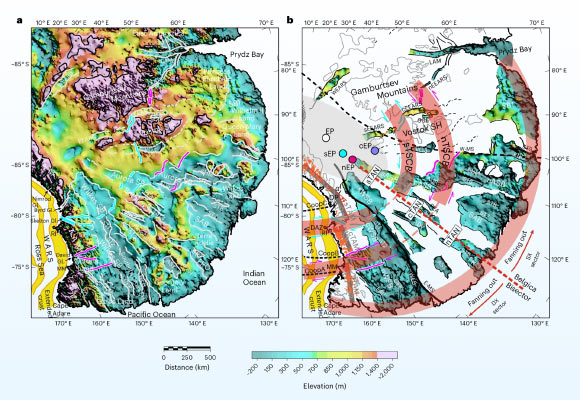
Fault-controlled basins and interpreted structural frame in the newly-identified East Antarctic Fan-Shaped Basin Province. Image credit: Armadillo et al., doi: 10.1038/s41561-026-01991-6.

By combining seismic, gravity and topographic data, a team of researchers from Italy, Switzerland, Germany and the United Kingdom found that several well-known subglacial basins in East Antarctica are part of a single fan-shaped province whose origins trace back to ancient continental stretching.

The post Geoscientists Find Vast Fan-Shaped Structure beneath Antarctica’s Ice appeared first on Sci.News: Breaking Science News.

  •  

This Rare Meteorite Could Be Evidence of a “Massive World” Once Hidden Deep in Our Solar System


A meteorite discovered in Africa could be evidence of a lost protoplanet that once orbited our Sun, according to researchers at the University of Colorado at Boulder.

In a recent paper published in Earth and Planetary Science Letters, the team revealed evidence of an ancient protoplanet that may have been as large as Mars based on simulations of how the meteorite sample may have formed.

The four-and-a-half-billion-year-old world carried an unexpected geological makeup, which the researchers say casts doubt on common assumptions regarding planetary evolution.

Protoplanetary Demise

According to the UC Boulder team, the massive protoplanetary body collided with another object four and a half billion years ago, shattering it completely. This is the first definitive evidence of a lost protoplanet in our solar system, based on analysis of the angrite meteorite NWA 12774, a shard of that planetary embryo recovered from the Sahara Desert.

“It’s incredible to think there was once a world this large,” said lead author Aaron Bell, an assistant research professor in the Department of Earth Science at CU Boulder. “We only know it existed because a few fragments of it happened to land on Earth. These meteorites preserved evidence of a completely different pathway through which early planets developed.”

A Rare Meteorite Sample

Angrites, a rare type of volcanic rock, serve as a record of our solar system’s distant past. These rocks began forming only a few million years after the solar system’s birth, making them valuable evidence of this early era. However, they are extremely rare and difficult to find.

NWA 12774 is one of only 68 angrite samples identified among more than 80,000 meteorites cataloged by scientists. Given its rarity, the discovery could potentially reshape how researchers understand these ancient rocks.

Until now, scientists had assumed that angrites originated from relatively small asteroids less than 124 miles (200 kilometers) wide, based largely on their chemical composition. Large rocky planets such as Earth and Mars contain significant amounts of silicon dioxide, while angrites contain very little of the compound.

Unexpected Meteorite Discovery

Researchers began to reconsider those assumptions when they identified clinopyroxene in the meteorite sample. This mineral, commonly found in Earth’s crust and mantle, appeared unusually rich in aluminum, suggesting that it formed under significant pressure deep within a planetary body.

To investigate this unusual characteristic of NWA 12774, the University of Colorado Boulder team recreated the conditions under which the sample could have formed. Their analysis revealed that pressures of at least 17.5 kilobars were required to produce the aluminum-rich clinopyroxene found in the meteorite. For comparison, one kilobar is roughly equivalent to the pressure at the deepest part of Earth’s oceans, near the bottom of the Mariana Trench.

Rethinking Meteorite Origins

The researchers’ discovery proved that at least this particular angrite sample could not have formed inside a small meteorite, as a body with a radius of at least 621 miles would be required to generate the pressure needed to produce the crystals. 

Additional evidence suggested the parent body may have been even larger. The crystals’ sharp edges and delicate internal structures indicate they likely formed at relatively shallow depths beneath the surface. Reconciling both the high-pressure conditions and the shallow formation depth suggests that the parent body may have ranged in size from the Moon to Mars.

“There are many meteorites sitting in drawers that haven’t been thoroughly studied, so there were likely more of these protoplanets we don’t know about,” Bell said.

Exactly what happened to this ancient world remains uncertain, but researchers believe it was likely destroyed in a massive collision early in the solar system’s history. Fragments of that lost protoplanet may have later contributed material to other bodies, potentially including Earth itself.

“The materials that formed the angrite parent body are fundamentally different from the ingredients of Earth and Mars,” Bell concluded. “It points to a distinct and separate evolutionary path in planetary formation in the early history of our solar system.”

The paper, “High-Pressure Clinopyroxene in Northwest Africa 12774 and New Geobarometric Evidence for a Planetary Embryo-Sized Angrite Parent Body,” appeared in Earth and Planetary Science Letters on July 1, 2026.

Ryan Whalen covers science and technology for The Debrief. He holds an MA in History and a Master of Library and Information Science with a certificate in Data Science. He can be contacted at ryan@thedebrief.org, and follow him on Twitter @mdntwvlf.

  •  

Jupiter Accelerates Electrons to Near-Light Speed, Offering Clues to Cosmic Ray Origins

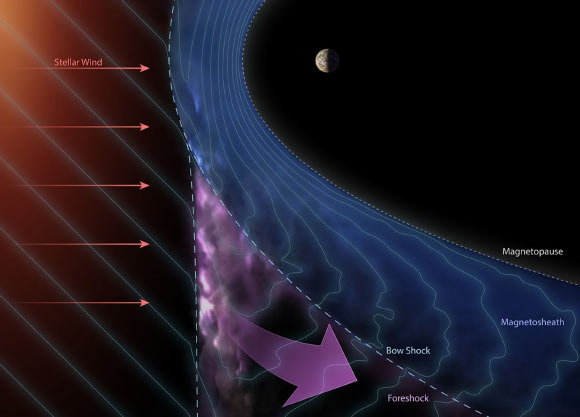
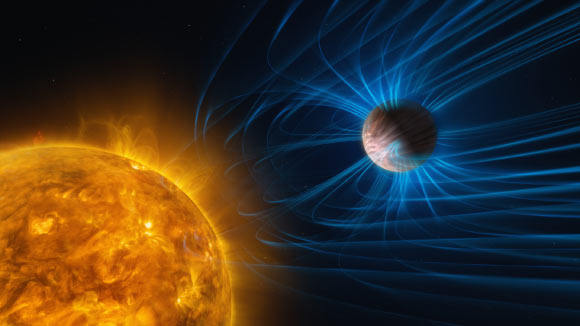
As planets and stars travel through the streams of charged particles flowing across space, their magnetic fields act like obstacles; incoming particles are slowed and deflected, forming a boundary called the bow shock; just ahead of this boundary lies the foreshock, a variable region where magnetic conditions can accelerate some particles to nearly the speed of light. Image credit: Ben C. Smith, Johns Hopkins Applied Physics Laboratory.

The giant planet’s bow shock isn’t just deflecting the solar wind, it’s acting as a powerful particle accelerator, firing electrons to relativistic energies of at least 1 MeV, according to a new analysis of data from NASA’s Juno spacecraft.

The post Jupiter Accelerates Electrons to Near-Light Speed, Offering Clues to Cosmic Ray Origins appeared first on Sci.News: Breaking Science News.

  •  

Researchers Measured Alien Planet Spins and Discovered a Surprising Pattern

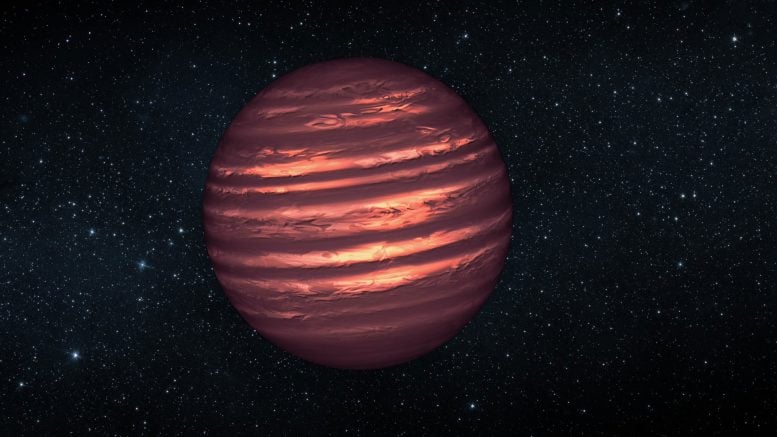
Relationship Between Mass and Spin for Giant Planets and Brown DwarfsA new Keck Observatory study indicates that giant planets can spin faster than more massive brown dwarfs, revealing important clues about how planetary systems form and evolve. Astronomers have long suspected that a planet’s mass may be linked to how quickly it spins. In our solar system, Jupiter and Saturn rotate especially fast, each completing [...]
  •  

Meteorite Found in Africa Preserves Evidence of Long-Lost Massive Protoplanet

This is an artist impression of the protoplanetary disk around HD 107146. Image credit: A. Angelich / NRAO / AUI / NSF.

The Northwest Africa (NWA) 12774, an angrite meteorite discovered in the Sahara Desert, likely in Mauritania, appears to be a fragment of a vanished protoplanet, offering the strongest evidence yet that a large planetary body formed and was later destroyed during the Solar System’s chaotic infancy.

The post Meteorite Found in Africa Preserves Evidence of Long-Lost Massive Protoplanet appeared first on Sci.News: Breaking Science News.

  •  

Astronomers Detect Clearest Signs Yet of Magnetic Fields on Extrasolar Planets

This illustration shows magnetic activity in an ultra-hot Jupiter. Image credit: ESO / M. Kornmesser / L. Calçada.

By tracking fierce winds racing through the atmospheres of seven ultra-hot Jupiters, astronomers have uncovered the strongest evidence yet that magnetic fields shape weather on worlds beyond our Solar System.

The post Astronomers Detect Clearest Signs Yet of Magnetic Fields on Extrasolar Planets appeared first on Sci.News: Breaking Science News.

  •  

Geopolitics of the Sphere and God’s Love for All Nations

The Earth's sphericity negates any privileged location and signifies equality among all people. A divine pathway through Jesus Christ offers salvation to all nations, regardless of birthplace. This revelation, previously hinted at in prophets' teachings, is now openly accessible to the world.

  •  

Pigeons May Sense Earth’s Magnetic Field Using Superparamagnetic Immune Cells in Their Livers

Lisowski et al. used physical, morphological, functional, and genomic assays to identify the presence of superparamagnetic macrophages in the liver of homing pigeons (Columba livia domestica). Image credit: Spanishguitar101 / CC BY-SA 4.0.

Scientists have identified supermagnetic macrophages in the livers of homing pigeons (Columba livia domestica) that appear essential for navigation when the Sun is not visible, pointing to an entirely new mechanism for animal magnetoreception.

The post Pigeons May Sense Earth’s Magnetic Field Using Superparamagnetic Immune Cells in Their Livers appeared first on Sci.News: Breaking Science News.

  •  

Webb Detects Methane in Atmosphere of Exo-Saturn TOI-199b

An artist’s rendition of the ultrahot Jupiter TOI-1518b and its parent star. Image credit: Sci-News.com.

Using spectral data from the Near-Infrared Spectrograph (NIRSpec) onboard the NASA/ESA/CSA James Webb Space Telescope, astronomers analyzed the atmosphere of TOI-199b, a distant Saturn-mass world that is neither frozen nor scorching hot.

The post Webb Detects Methane in Atmosphere of Exo-Saturn TOI-199b appeared first on Sci.News: Breaking Science News.

  •  
❌