❌

Reading view

A Universe Without Dark Energy? Mathematicians Challenge Standard Cosmology

Dark Matter Particles Astrophysics ConceptNew mathematical research suggests dark energy may not be needed to explain the accelerating expansion of the universe, challenging the foundations of the standard cosmological model. Mathematicians are questioning whether dark energy is actually responsible for the universe’s accelerating expansion. In a new study published in Proceedings of the Royal Society A, researchers at the [...]
  •  

Mysterious Cosmic Signal Could Be First Real Evidence of Primordial Black Holes

Illustration of Black Holes Orbiting Around One AnotherScientists believe an unusual LIGO detection may be evidence of a primordial black hole, potentially linking these long-theorized objects to the mystery of dark matter. Scientists at the University of Miami believe they may be closing in on evidence for one of the most elusive objects in the universe: primordial black holes. While definitive proof [...]
  •  

Little Red Dots | Primordial Black Holes or Big Bang Failures?

Recent findings from the James Webb Space Telescope (JWST) indicate that Little Red Dots (LRD) could be primordial black holes, challenging the big bang theory. The data suggests these objects formed too soon for typical galaxy evolution, raising questions about cosmological interpretations and the nature of observational evidence.

  •  

Il telescopio spaziale James Webb sta offrendo una visione senza precedenti…

Il telescopio spaziale James Webb sta offrendo una visione senza precedenti dell’universo primordiale grazie alla sua capacitΓ  di osservare la luce infrarossa proveniente da oggetti estremamente lontani. Tra le sue scoperte piΓΉ sorprendenti figurano galassie molto luminose e apparentemente mature esistite poche centinaia di milioni di anni dopo il Big Bang. Queste osservazioni hanno acceso un intenso dibattito scientifico, poichΓ© suggeriscono che la crescita delle prime strutture cosmiche potrebbe essere avvenuta piΓΉ rapidamente del previsto. Sebbene analisi successive abbiano ridimensionato alcune delle stime iniziali, Webb continua a fornire dati che stanno portando gli astronomi a perfezionare le teorie sulla formazione delle galassie, dei buchi neri supermassicci e dell’universo delle origini.
  •  

La fin de l’univers pourrait arriver bien plus tΓ΄t que prΓ©vu, selon cette nouvelle Γ©tude cosmologique

Et si l'univers avait une date d'expiration bien plus proche que prΓ©vu ? Une Γ©tude rΓ©cente bouleverse les certitudes cosmologiques les mieux Γ©tablies. Le compte Γ  rebours serait lancΓ© : 33 milliards d'annΓ©es, pas une de plus.

  •  

Causality and the Arrow of Time Are Big Bang Problems for Cosmic Story-Telling

The big bang has causality issues, particularly the "horizon problem." I critique suggested solutions like cosmic inflation and negentropy, arguing that they require unproven concepts. The Creator, as described in the Bible, provides a coherent explanation without causality violations, in contrast with those scientific storytelling fairy tales for adults.

  •  
  •  

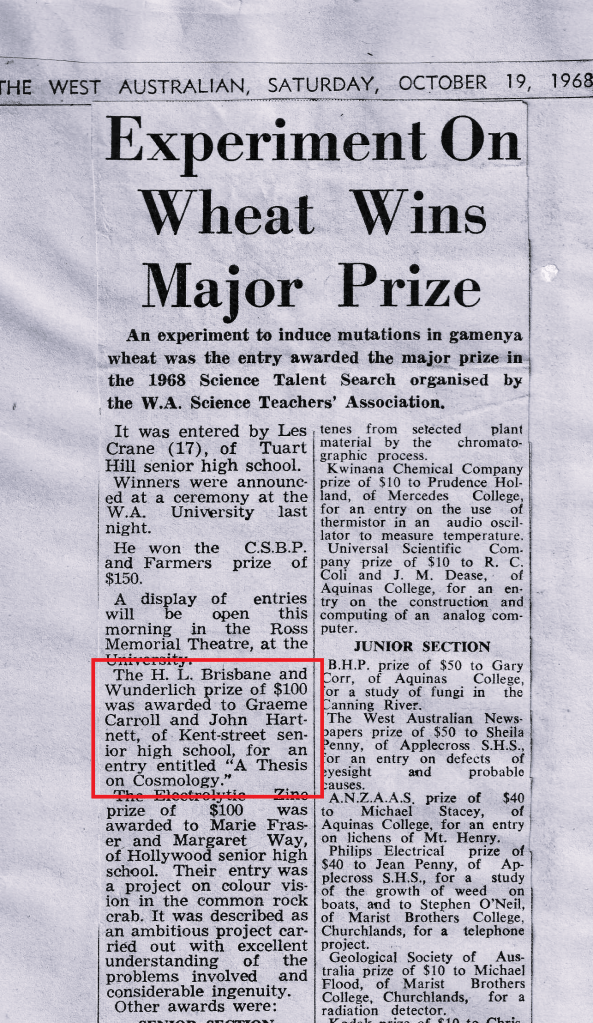
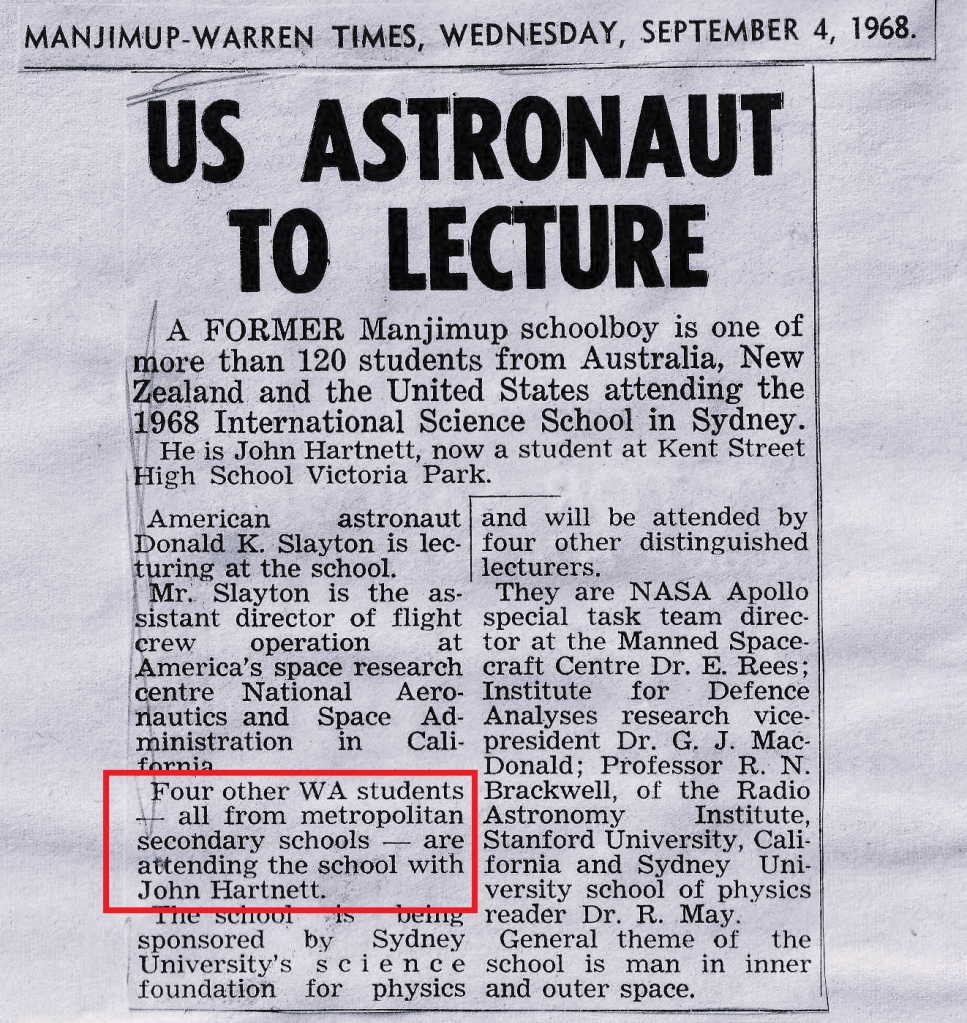
How I Survived the Godless Australian Education System

I reflect on my educational journey, highlighting challenges such as family separation and multiple school changes. I excelled in science and mathematics yet was indoctrinated on Godless cosmology and rejected the Creator. Later Jesus Christ saved me from atheism and renewed my mind to His truth.

  •  

Are We Really Observing the Universe in Real Time?

When we look out into space, even with the most powerful telescopes, are we seeing the universe in real time? Are we observing events as they happen, that is, at the time measured on our local clocks?

  •  

The Laws of Physics Point to the Creator

The biblical creation narrative is foundational to understanding reality. It highlights the role of God as the creator and sustainer of both physical laws and spiritual renewal through Jesus Christ.

  •  

True Science and Science Falsely So-Called

I discuss the distinction between operational science, which relies on repeatable experiments, and historical science, particularly cosmology. While acknowledging the contributions of renowned scientists, I argue that cosmology lacks the capacity for experimental verification and is thus not true science, but science falsely so-called.

  •  

Dark Photons and the Illusion of Dark Matter

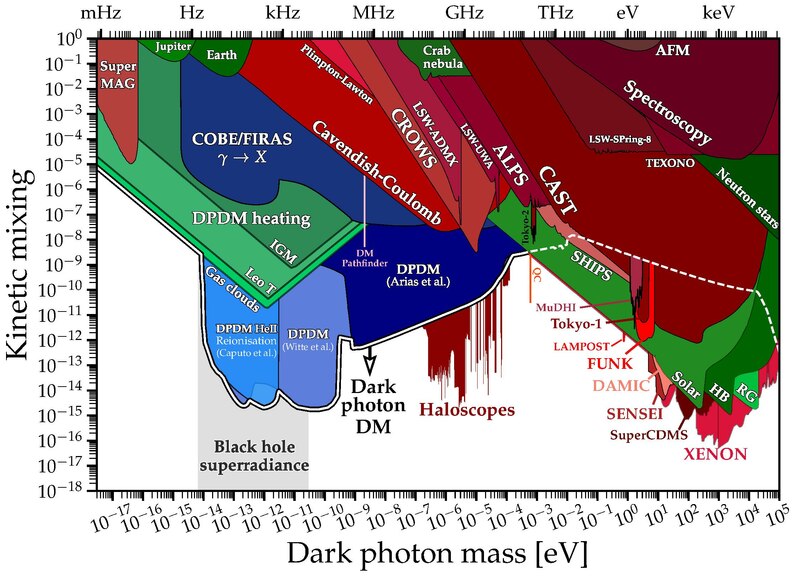
Dark matter is equated to the metaphor of the Emperor's new clothes. Dark photons and other hypothetical particles are fictitious constructs used to explain phenomena without concrete evidence, underlining that current astrophysical models are flawed and nonsensical.

  •  

Should Biblical Creationists Believe in Dark Matter and Dark Energy?

I question the acceptance of Dark Matter and Dark Energy by biblical creationists, suggesting they are problematic placeholders for undiscovered physics. The arguments for their existence are challenged by alternative cosmological models and criticisms of observational methodologies, calling for a re-evaluation of accepted astrophysical tenets.

  •  

More Than 50% US Evangelical Christians Do Not Believe in the Genesis History of Creation

I contrast two views on the origin of the universe: the big bang theory and the Genesis creation account. I highlight how many evangelicals now support the big bang, reflecting a shift in beliefs rejecting the historical Genesis narrative on concepts like original sin and redemption.

  •  

The Physics of Creation | Day 1

God created all space, time, and energy over six ordinary days less than 8,000 years ago. I discuss the physics of the Day 1 of that, with the earth formed from a sphere of water and the creation of all light, including the thermal radiation called the cosmic microwave background.

  •  

Thermodynamics and Creation: A Scientific Perspective

The four universal laws of thermodynamics are a part of God’s creation, and testify to His continuing work of creation. These fundamental physical laws argue against the big bang origin of the universe and spontaneous complexity arising in nature, attributing creation solely to a divine intelligence.

  •  

What Do We Really Know About the Cosmos?

The universe is filled with trillions of galaxies, and cosmology explores questions about its nature and structure. Many theories exist, influenced by philosophical worldviews, challenging the notion of a unique cosmological model.

  •  

Is Dark Energy Unnecessary? Mathematicians Challenge Standard Cosmological Model of Universe

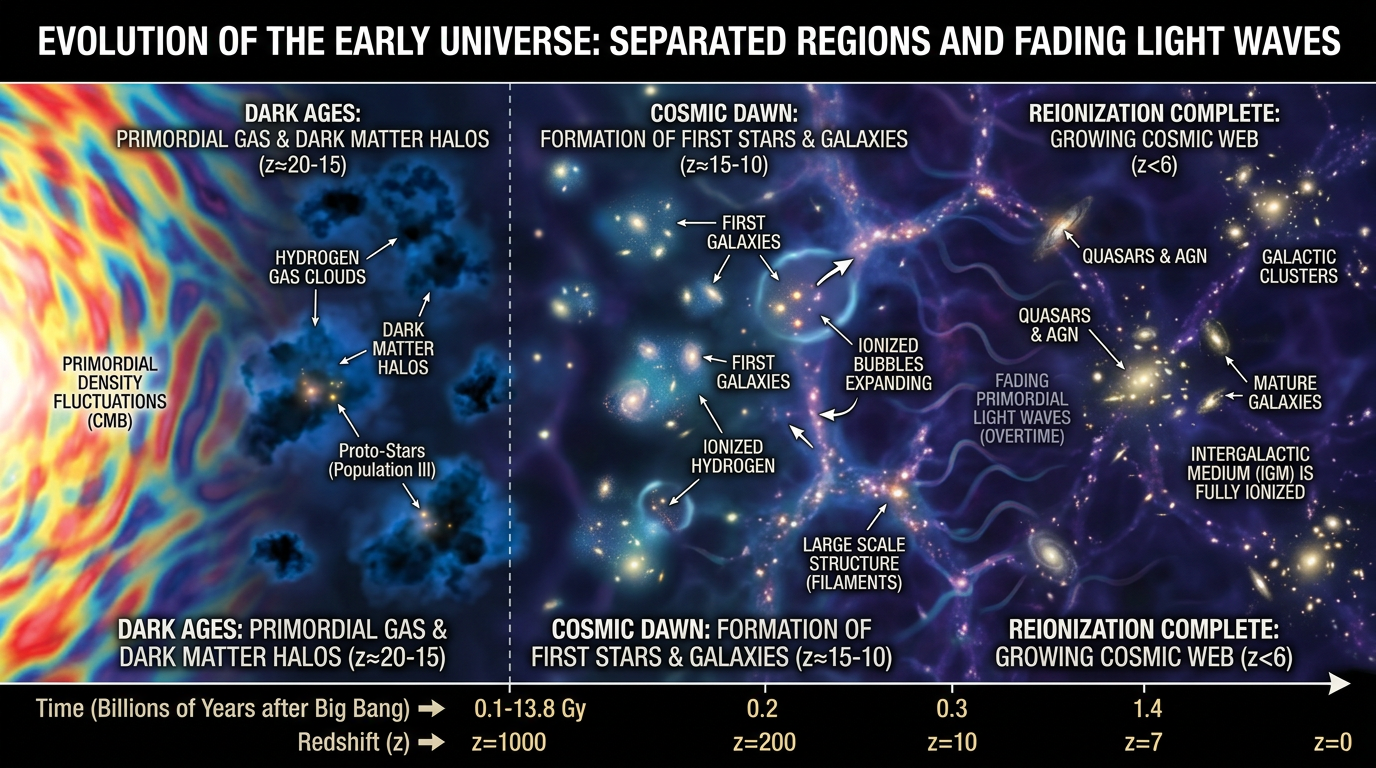
This artist’s impression shows the evolution of the Universe beginning with the Big Bang on the left followed by the appearance of the Cosmic Microwave Background. The formation of the first stars ends the cosmic dark ages, followed by the formation of galaxies. Image credit: M. Weiss / Harvard-Smithsonian Center for Astrophysics.

Mathematicians from University College London and the University of California, Davis, have published a mathematical proof that the Universe’s accelerating expansion can be explained without dark energy, dealing a serious blow to the Lambda-cold dark matter model.

The post Is Dark Energy Unnecessary? Mathematicians Challenge Standard Cosmological Model of Universe appeared first on Sci.News: Breaking Science News.

  •  

Characterizing galaxies at β€œcosmic noon”

The universe is around 14 billion years old, but scientists theorize that no stars formed for the first several hundred million years, during an era known as the cosmic dark ages. They refer to the first billion years or so after this, when stars formed, as the cosmic dawn. At that time, the very oldest galaxies first assembled from collections of gas and plasma.Β 

As these galaxies assembled and more material became available, the number of stars formed each year increased. Around 2 to 3 billion years after the Big Bang, galaxies grew faster than they ever would, producing stars at the highest rate in the universe’s history. This era is called cosmic noon.

Researchers from the Netherlands recently investigated 3 distant galaxies whose light began its journey to Earth during cosmic noon. They selected targets from a set of ancient star-forming galaxies identified in the ALMA – Archival Large Program to Advance Kinematic Analysis or ALMA-ALPAKA project. Of these, they chose to study 3 galaxies labeled ID1, ID3, and ID13.

They combined 2 different types of data to produce a detailed description of these galaxies. First, they collected data from an enormous telescope comprising 66 antennas in Chile, known as the Atacama Large Millimeter/submillimeter Array or ALMA. They used ALMA to detect radio-wave emissions from carbon monoxide and elemental carbon in these galaxies. The researchers stated that studying these chemicals in distant galaxies could reveal how their free-floating gas clouds move. They also used publicly available data from JWST’s Near Infrared Camera, or NIRCam, to determine how much light the galaxies’ stars emitted. By analyzing cosmic noon galaxies in multiple different ways, the team aimed to measure their masses and the relative contributions of regular matter and dark matter.

They used a computer program developed by other astronomers to interpret the JWST data as a series of maps showing the distribution of stars across each galaxy. They used this light-emission data to estimate the total mass of all the stars in these galaxies. Then they developed an original computer program to map the distribution of gas through each galaxy using the ALMA data. The team used these maps to create plots, known as rotation curves, which show how fast particles orbit each galaxy’s center as a function of their distance from it.Β 

The astronomers used these rotation curves to estimate the amount of dark matter in each galaxy. They explained that this method works because dark matter is totally invisible, but it still exerts a gravitational pull. Its gravitational pull causes visible material like stars and gas closer to the edges of these galaxies to move faster than they would in galaxies without dark matter.Β 

The team found that these galaxies had between 39 and 80 billion times the mass of our sun, or solar masses, in stars. They had between 4 billion and nearly 16 billion solar masses worth of free-floating gas. And they had from 1 trillion to 31 trillion solar masses of dark matter.

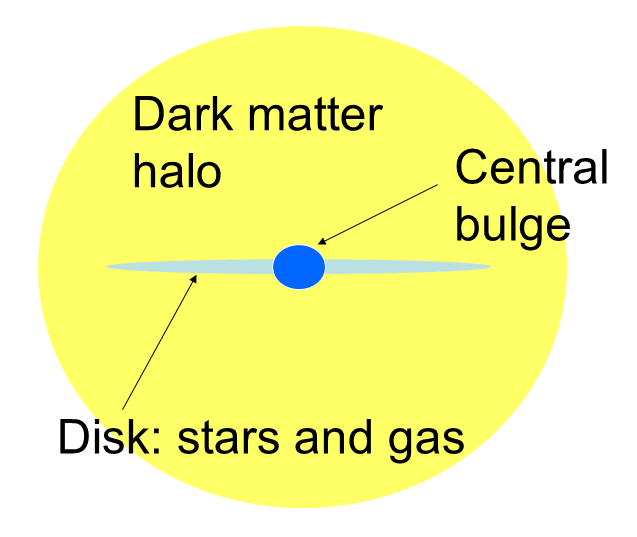
However, when the team compared the light-emission data with the rotation curves, they found a discrepancy. Typically, dark matter resides in a shell or halo surrounding a galaxy, meaning it should mostly affect material near the galaxy’s outer edge. Since astronomers don’t usually have to account for dark matter near a galaxy’s center, they can calculate the total mass of center material based on the amount of gas and stars they see there. But near the centers of these galaxies, the team found that the masses they derived from the light emissions were less than what they calculated from the rotation curves.Β 

They proposed multiple potential explanations for this discrepancy. First, they suggested that the halo shape might not be a good model for the dark matter distribution in all galaxies, meaning that cosmic noon galaxies could contain dark matter near their centers. Second, they suggested that stars could be packed tightly in the center of these galaxies, blocking each other’s light emissions. Third, they suggested that galaxy ID1 could have a supermassive black hole as big as 1.5% its total stellar mass at its center.

The team concluded that they now have a detailed picture of the mass distribution in these cosmic noon galaxies, but the reason for their center mass discrepancies remains elusive. They suggested that a complex relationship exists between the dark matter halos and the rest of the material within these galaxies. They indicated that future astronomers could adapt their methods to study the distribution of material in other distant galaxies studied by ALMA-ALPAKA and forthcoming galactic surveys.

The post Characterizing galaxies at β€œcosmic noon” appeared first on Sciworthy.

  •  
❌