❌

Reading view

Il settore aerospaziale sta vivendo una transizione radicale: i vecchi sate…

Il settore aerospaziale sta vivendo una transizione radicale: i vecchi satelliti monumentali vengono affiancati da sciami di nanosatelliti e CubeSat, dispositivi modulari ed economici grandi quanto una scatola di scarpe. Nati originariamente come progetti didattici universitari, questi strumenti hanno beneficiato della stessa miniaturizzazione elettronica degli smartphone, diventando laboratori orbitali completi capaci di monitorare il clima, tracciare rotte e persino tentare missioni interplanetarie. I dati aggiornati al 2026 registrano oltre 3.200 unità lanciate, un boom guidato dagli Stati Uniti e favorito dai voli in "carpooling" sui vettori riutilizzabili. Questa democratizzazione dello spazio comporta però un serio problema di sostenibilità ambientale: i dispositivi hanno cicli di vita inferiori ai cinque anni e, una volta spenti, alimentano in modo critico l'accumulo di spazzatura spaziale nell'orbita bassa terrestre.
  •  

Fraunhofer Portugal Challenge desafia jovens universitários a criar soluções tecnológicas inovadoras

Promovido pelo Fraunhofer Portugal AICOS, o concurso quer incentivar jovens talentos das universidades portuguesas a criar soluções inovadoras com impacto económico e social, respondendo a desafios reais através da tecnologia.

The post Fraunhofer Portugal Challenge desafia jovens universitários a criar soluções tecnológicas inovadoras appeared first on Tek Notícias.

  •  

Friggere è una delle tecniche di cottura più diffuse nelle cucine di tutto…

Friggere è una delle tecniche di cottura più diffuse nelle cucine di tutto il mondo, ma pochi sanno che il calore elevato può trasformare l’olio in una fonte di composti chimici potenzialmente dannosi per la salute. Quando un olio viene sottoposto a temperature troppo alte o viene riutilizzato più volte, infatti, inizia un processo di […]
  •  

Révélation : 15 cadres de la grande distribution balancent pourquoi le frais, le bio et le durable coûtent si cher

Derrière les slogans promettant de défendre le pouvoir d'achat, une autre réalité se dessine. Dans un rapport explosif, des cadres de l'agroalimentaire et de la grande distribution dénoncent les dérives d'une course effrénée aux prix bas : produits sains artificiellement renchéris, qualité...

  •  

Il telescopio spaziale James Webb sta offrendo una visione senza precedenti…

Il telescopio spaziale James Webb sta offrendo una visione senza precedenti dell’universo primordiale grazie alla sua capacità di osservare la luce infrarossa proveniente da oggetti estremamente lontani. Tra le sue scoperte più sorprendenti figurano galassie molto luminose e apparentemente mature esistite poche centinaia di milioni di anni dopo il Big Bang. Queste osservazioni hanno acceso un intenso dibattito scientifico, poiché suggeriscono che la crescita delle prime strutture cosmiche potrebbe essere avvenuta più rapidamente del previsto. Sebbene analisi successive abbiano ridimensionato alcune delle stime iniziali, Webb continua a fornire dati che stanno portando gli astronomi a perfezionare le teorie sulla formazione delle galassie, dei buchi neri supermassicci e dell’universo delle origini.
  •  

Artemis III Crew Announced

From left to right, NASA astronaut Andre Douglas, ESA (European Space Agency) astronaut Luca Parmitano, and NASA astronauts Randy Bresnik and Frank Rubio take a photo together. Their arms are linked around each other's shoulders. Behind them are the flags of the United States, Texas, NASA, and ESA.
NASA/Robert Markowitz

NASA astronaut Andre Douglas, ESA (European Space Agency) astronaut Luca Parmitano, and NASA astronauts Randy Bresnik and Frank Rubio take a photo together on June 9, 2026. The four were announced as the Artemis III crew.

NASA’s Artemis III mission in low Earth orbit will test integrated operations between the Orion spacecraft and one or both commercial landers from SpaceX and Blue Origin respectively.

Learn more about the next Artemis mission and the crew.

Image credit: NASA/Robert Markowitz

The post Artemis III Crew Announced appeared first on NASA Science.

  •  

Artemis III Crew Announced

From left to right, NASA astronaut Andre Douglas, ESA (European Space Agency) astronaut Luca Parmitano, and NASA astronauts Randy Bresnik and Frank Rubio take a photo together. Their arms are linked around each other's shoulders. Behind them are the flags of the United States, Texas, NASA, and ESA.
NASA/Robert Markowitz

NASA astronaut Andre Douglas, ESA (European Space Agency) astronaut Luca Parmitano, and NASA astronauts Randy Bresnik and Frank Rubio take a photo together on June 9, 2026. The four were announced as the Artemis III crew.

NASA’s Artemis III mission in low Earth orbit will test integrated operations between the Orion spacecraft and one or both commercial landers from SpaceX and Blue Origin respectively.

Learn more about the next Artemis mission and the crew.

Image credit: NASA/Robert Markowitz

  •  

Meet the NASA Astronauts in the Artemis III 4-Person Crew

NASA’s next mission in its effort to return humans to the moon will be led by an all-male crew. Three of them have extensive experience in space, while the other was a backup on Artemis II.
  •  

Web Summit Rio: 27 startups portuguesas rumam ao Brasil para explorar novas oportunidades de negócio

Selecionadas pela Startup Portugal e pela Unicorn Factory Lisboa, as 27 empresas vêm de sectores como IA, Machine Learning ou Tecnologia da Saúde, empregando mais de 200 pessoas e com investimentos captados superiores a 20 milhões de euros.

The post Web Summit Rio: 27 startups portuguesas rumam ao Brasil para explorar novas oportunidades de negócio appeared first on Tek Notícias.

  •  

Ces aliments pourraient davantage vous protéger du cancer du sein si vous les choisissez bio

Une nouvelle étude française menée auprès de plus de 30 000 personnes suggère qu’un simple changement dans vos habitudes alimentaires pourrait être associé à une réduction significative du risque de cancer du sein après la ménopause. Voici ce que les chercheurs ont découvert.

  •  

Stacking Up the Discovery of Six Millisecond Pulsars

Millisecond pulsar and companion artist's impression

The fastest spinning pulsars in the universe are often quite difficult to detect. Leveraging multiple observations from the largest single-dish telescope in the world, researchers have discovered six previously undetected pulsars.

Millisecond Pulsars in Globular Clusters

Globular clusters, compact collections of tens of thousands to millions of stars, are highly dense and rife with dynamical interactions. These active environments are ideal factories for the formation of millisecond pulsars — the extremely fast-spinning cores of once-massive stars, shining beams of radio emission from their poles. One way millisecond pulsars are thought to form is when a pulsar in a binary system steals mass from its companion star, transferring angular momentum and causing the pulsar to spin up. The densely packed environment in a globular cluster provides ample opportunity for a pulsar to acquire a companion to siphon.

However, millisecond pulsars in distant globular clusters are notoriously difficult to detect. Traditional pulsar searches that rely on a single observation tend to miss millisecond pulsars, many of which have signals too faint to be distinguished from noise or radio interference. Instead, researchers must rely on a different method to find these fast-spinning pulsars.

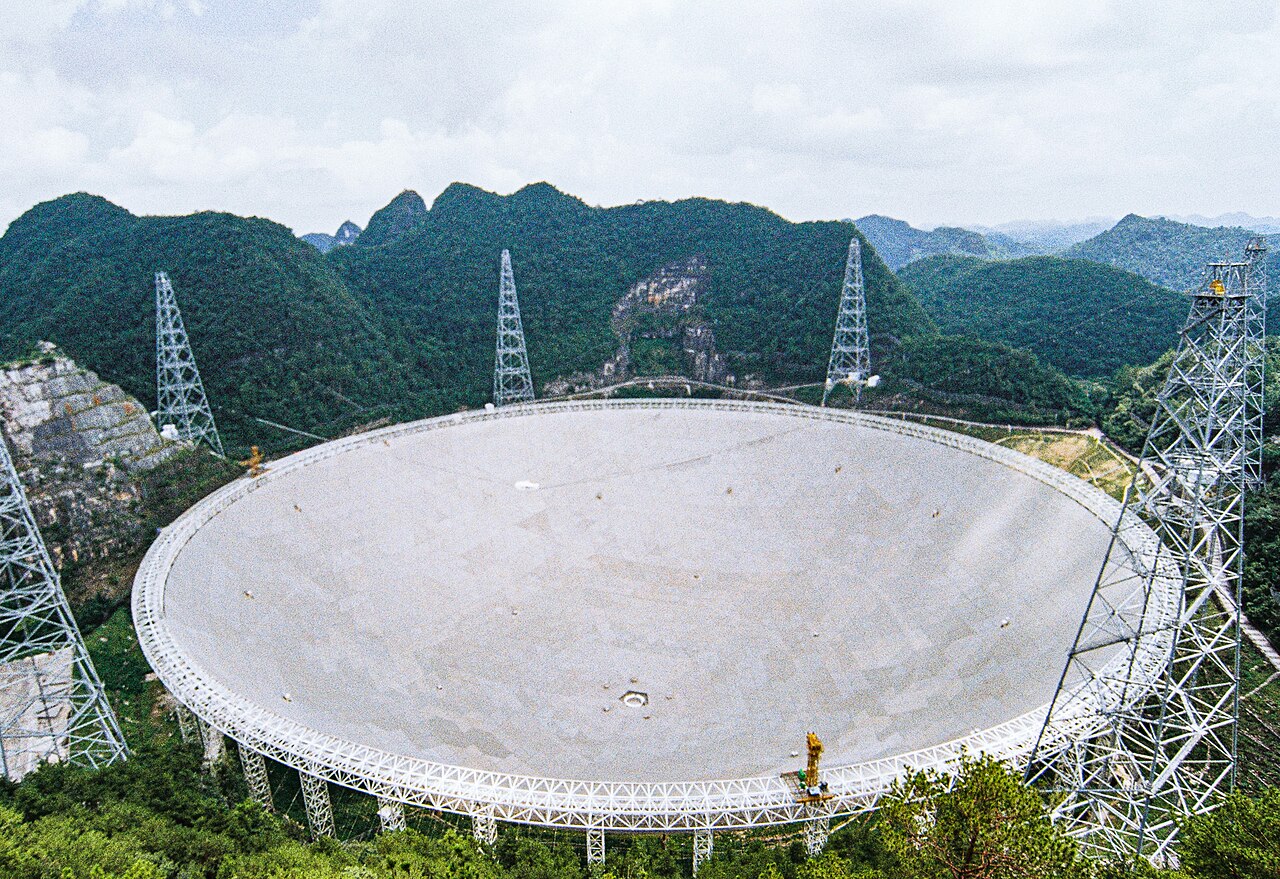
FAST

FAST, the 500-meter single-dish radio telescope located in southwestern China. [Wikipedia user SCJiang; CC BY 4.0]

Stack Search Success

To find faint millisecond pulsars, researchers have developed the stack search method, in which multiple radio observations are combined to tease out faint signals and decrease noise. Reliably stacking observations across epochs requires stability; isolated millisecond pulsars, now no longer spinning up after losing their companion, have very stable rotation periods, making them ideal targets for the stack search method. To date, the stack search method has successfully identified nine isolated globular cluster millisecond pulsars using data from the Arecibo, Parkes, and Green Bank radio telescopes.

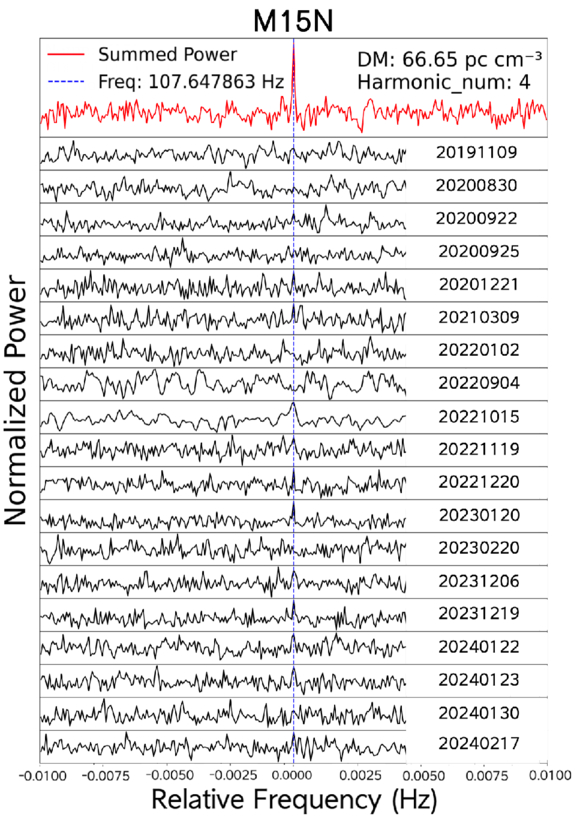
Stack Spectra

Power spectra from a discovered millisecond pulsar M15N. The black solid lines show the 19 individual observations of the pulsar, and the red solid line in the top panel shows the stacked spectrum. The stack search method pulls out a clear pulsar signal. [Dai et al. 2026]

In hopes of recovering more of these faint fast-spinning pulsars, Yinfeng Dai (Beijing Normal University) and collaborators used archival data obtained with the Five-hundred-meter Aperture Spherical radio Telescope (FAST), the world’s largest single-dish telescope. Targeting two specific globular clusters, NGC 6517 and M15, the team applied the stack search method to 23 and 19 observations of the globular clusters, respectively. From their search, the authors discovered six previously unidentified isolated millisecond pulsars: four in NGC 6517 and two in M15.

While previous studies identified brighter pulsars in the targeted globular clusters, the authors confirmed that all six newly discovered pulsars are too weak to be reliably recovered from single-epoch searches, underscoring the importance of the stack search method. In particular, this search increased the known pulsar populations of NGC 6517 and M15 by 27% and 18%, respectively, suggesting that a meaningful fraction of globular cluster pulsars are easily missed in traditional pulsar searches. Future studies employing this stack search method will continue to detect faint millisecond pulsars, unlocking this elusive population for further exploration.

Citation

“The Stack Search Tests on FAST Data: Discovery of Six Faint Isolated Millisecond Pulsars in NGC 6517 and NGC 7078 (M15),” Yinfeng Dai et al 2026 ApJL 1002 L31. doi:10.3847/2041-8213/ae5dbb

The post Stacking Up the Discovery of Six Millisecond Pulsars appeared first on AAS Nova.

  •  

Mapping a Molecular Building Block in a Pre-Stellar Core

Taurus Molecular Cloud

To probe the chemistry of cold pre-stellar cores, researchers investigated Lynds 1544 and made the first-ever spatially resolved map of methanimine — a simple molecule that may be involved in the formation of amino acids in space — in this environment.

Astrochemistry at Work

chemical structure of methanimine

The chemical structure of methanimine, CH2NH. [Ben Mills]

Peering across the galaxy, astronomers have discovered a broad and growing array of molecules, revealing the rich chemistry taking place everywhere from molecular clouds to protoplanetary disks. A central question in astrochemistry is where, when, and how molecules form in space, and how molecules might survive the various phases of star formation and be incorporated into newborn planetary systems, where they could play a role in the construction of complex organic molecules necessary for life.

Today’s research article, led by Yuxin Lin (Max Planck Institute for Extraterrestrial Physics), focuses on a molecule called methanimine (CH2NH). CH2NH is the simplest molecule in a class of nitrogen-containing compounds called imines, and it’s thought to be an important stepping-stone in the creation of amino acids.

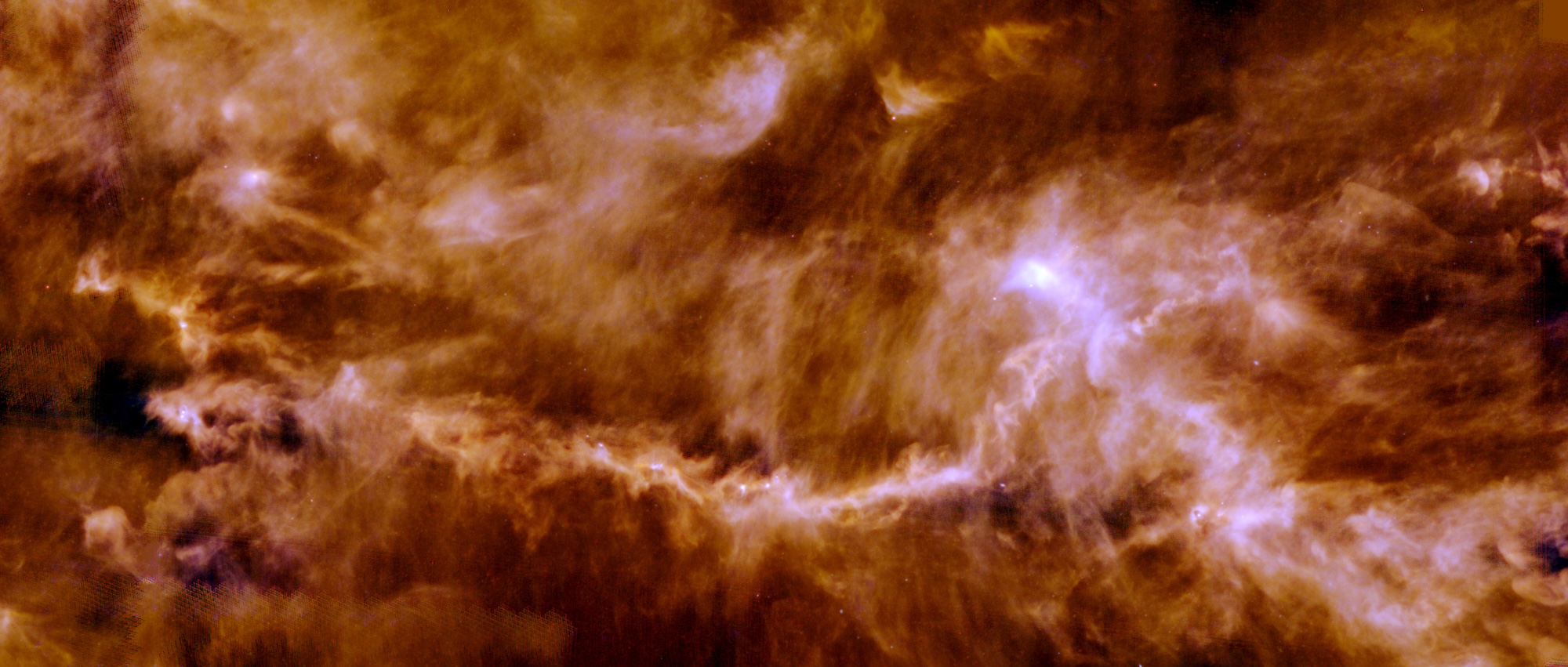
Taurus Molecular Cloud

A Herschel Space Observatory view of the Taurus Molecular Cloud, where L1544 resides. This star-forming region is about 450 light-years away. [ESA/Herschel/PACS, SPIRE/Gould Belt survey Key Programme/Palmeirim et al. 2013]

First Spatially Resolved Map

Lin and collaborators searched for CH2NH within Lynds 1544 (L1544), a pre-stellar core in the nearby Taurus Molecular Cloud. Pre-stellar cores — condensed, gravitationally bound clumps of cold gas within a molecular cloud — represent an early stage in the process of star formation, just before the gas collapses to form a protostar.

L1544 has been the subject of many astrochemical investigations, and previous studies have revealed that it contains a complex, chemically differentiated envelope surrounding a dense core in which many chemical species have frozen out onto dust grains, leaving the gas depleted of these species.

Using the Institute for Radio Astronomy in the Millimetre Range 30-meter radio telescope, Lin’s team mapped the distribution of CH2NH across L1544. This isn’t the first time that CH2NH has been detected in a cold pre-stellar core, but it’s the first time that the molecule has been mapped in a spatially resolved way in such an environment. This allows researchers to compare the distribution of CH2NH to other molecules in the core and build an understanding of the chemistry behind its formation.

The Chemistry of CH2NH

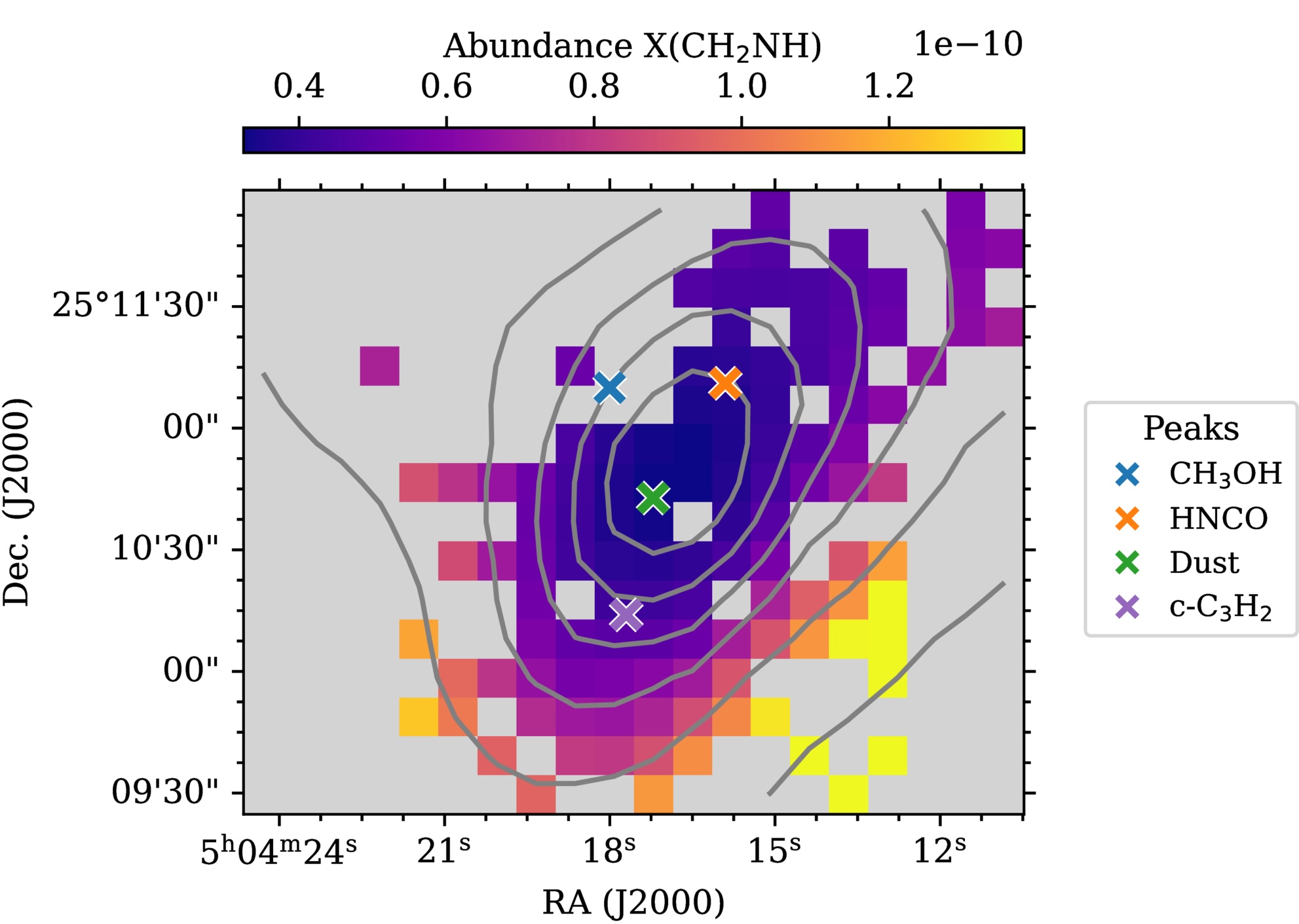
abundance of methanimine in L1544

Abundance of CH2NH in L1544. The contours indicate the column density of molecular hydrogen. The crosses show where the emission from other chemical species is at its peak. Click to enlarge. [Adapted from Lin et al. 2026]

The new observations show that CH2NH can be found throughout L1544, with clear spatial trends in the molecule’s abundance: higher near the outer layers of the core, lower near the center. Using chemical models to aid their analysis, Lin’s team showed that the observed distribution suggests formation pathways driven by moderate amounts of ultraviolet radiation.

In the outer layers of the core, where the gas is less dense, ultraviolet light creates reactive chemical species called radicals that can spur the formation of CH2NH. In the interior of the core, dense gas prevents the incursion of ultraviolet light. This means that few radicals are created that can help form CH2NH molecules, and the molecules that do form tend to freeze out onto dust grains, disappearing from the gas.

The discovery of CH2NH throughout L1544 suggests that the precursors to complex organic molecules can form during the cold, calm pre-stellar core phase of star formation, allowing these molecules to be inherited by nascent planetary systems.

Citation

“First Mapping of Prebiotic Molecule CH2NH in a Prestellar Core,” Yuxin Lin et al 2026 ApJL 996 L32. doi:10.3847/2041-8213/ae2c76

The post Mapping a Molecular Building Block in a Pre-Stellar Core appeared first on AAS Nova.

  •  

Selections from 2025: Could Earth Detect Earth?

Earth

Editor’s Note: For the remainder of 2025, we’ll be looking at a few selections that we haven’t yet discussed on AAS Nova from among the most-downloaded articles published in AAS journals this year. The usual posting schedule will resume January 2nd.

Earth Detecting Earth: At What Distance Could Earth’s Constellation of Technosignatures Be Detected with Present-day Technology?

Published February 2025

Main takeaway:

In a collaborative effort between the Search for Extraterrestrial Intelligence (SETI) Institute and the Penn State Extraterrestrial Intelligence Center, Sofia Sheikh (SETI Institute) and team turned inward to expand the search for intelligent life in the universe. Right here on Earth, humans have created a laboratory of technological signatures that can be detected from space — if another Earth-like civilization is out there, could they detect us? Using theoretical modeling, the authors determined the reaches of various human technosignatures such as radio transmissions, optical and infrared emission, satellites, and other probes sent into space. They found humanity’s strongest signals, radio transmissions, could be detected as far as 12,000 light-years away.

Why it’s interesting:

Scientists search for intelligent civilizations by hunting for signs of technology — signals or patterns that natural phenomena cannot explain. While we cannot expect other intelligent life to look exactly like Earth’s, many SETI projects have surveyed the skies for hypothetical signals far exceeding humanity’s own technological advancements. Taking a step back, Sheikh and collaborators considered where human technology is currently and what present-day instrumentation could pick up on if we were to search for ourselves. This “Earth detecting Earth” paradigm recenters the search for intelligent life and provides a multiwavelength framework for understanding the detectability of technology on far-away worlds.

Maximum detectability of Earth's technosignatures.

Maximum distances that Earth’s technosignatures could be detected by current technology. Click to enlarge. [Sheikh et al 2025]

Earth’s constellation of technosignatures:

What exactly are Earth’s many technosignatures, and how far could our current technology detect them? The most prominent and farthest detectable signal comes from radio transmissions. As the authors noted, these signals come from multiple sources: targeted radar transmissions used to characterize planets and asteroids, radio transmissions used to communicate between space probes and ground stations (e.g., space telescopes, Mars rovers, etc.), and radio leakage from Earth’s communication systems like cell towers and broadcasting stations. Additionally, there are atmospheric technosignatures from air-polluting compounds, optical and infrared emission from cities, targeted lasers from telescopes, and interplanetary and interstellar probes sent into space. All of these combined create a constellation of technosignatures detectable across a range of distances from Earth. This study underscores the importance of assessing Earth’s technology and detection capabilities, and repeating this type of study as technological advancements continue will enhance the search for intelligent life.

Citation

Sofia Z. Sheikh et al 2025 AJ 169 118. doi:10.3847/1538-3881/ada3c7

The post Selections from 2025: Could Earth Detect Earth? appeared first on AAS Nova.

  •  

Selections from 2025: A Repeating Fast Radio Burst in a Quiescent Galaxy

CHIME radio telescope

Editor’s Note: For the remainder of 2025, we’ll be looking at a few selections that we haven’t yet discussed on AAS Nova from among the most-downloaded articles published in AAS journals this year. The usual posting schedule will resume January 2nd.

A Repeating Fast Radio Burst Source in the Outskirts of a Quiescent Galaxy

Published January 2025

Main takeaway:

FRB 20240209A localization region and likely host galaxy

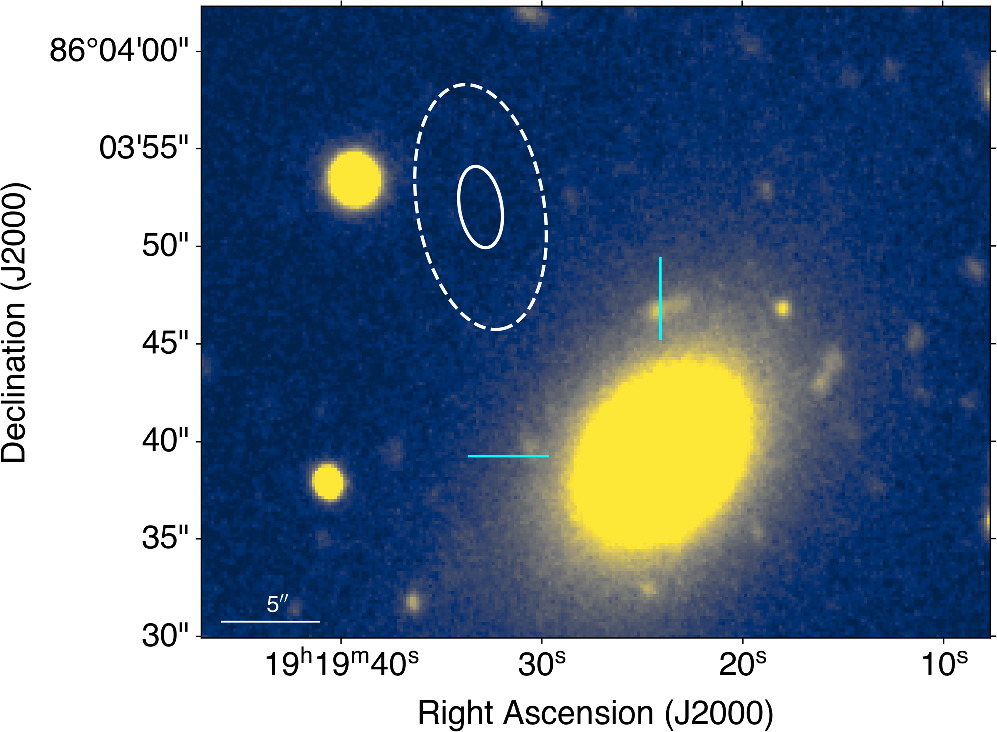
Gemini-North image of the FRB 20240209A localization region (white lines) and the source’s likely host galaxy (cyan crosshairs). [Shah et al. 2025]

Using the Canadian Hydrogen Intensity Mapping Experiment (CHIME), Vishwangi Shah (McGill University) and collaborators discovered the repeating fast radio burst source FRB 20240209A. The team localized the source to roughly 130,000 light-years from the center of a quiescent elliptical galaxy about 1.8 billion light-years away. This suggests that the bursts originated from a globular cluster on the outskirts of the galaxy, pointing to a delayed formation pathway for the source.

Why it’s interesting:

Fast radio bursts are brief, intense flashes of radio waves from sources across the universe. Aside from one fast radio burst that has been associated with a magnetar within our own Milky Way, the source of these outbursts remains mysterious, and precise localization of these bursts is key to pinning down their origins; fast radio bursts that come from galaxies with active star formation may be linked to “prompt” formation channels like core-collapse supernovae or young magnetars, while bursts that arise in quiescent galaxies might be due to “delayed” formation pathways such as neutron stars that are born from merging white dwarfs.

How FRB 20240209A compares to other fast radio bursts, and what may have caused it:

FRB 20240209A is similar to other repeating fast radio bursts in terms of the shape of its individual bursts as well as its tendency to undergo periods of high and low bursting activity. Its location makes it quite unusual, though: it’s the only repeating fast radio burst known to come from a quiescent galaxy, and it’s the only burst — repeating or not — that has been found in an elliptical galaxy. If confirmed to originate from a globular cluster, FRB 20240209A would also be only the second known fast radio burst source to come from this type of environment. Shah’s team explored multiple possible origin stories for FRB 20240209A, including the possibility that the source was ejected from its host galaxy. The team favors an origin involving a magnetar formed through the collapse or merger of a compact object.

Citation

Vishwangi Shah et al 2025 ApJL 979 L21. doi:10.3847/2041-8213/ad9ddc

The post Selections from 2025: A Repeating Fast Radio Burst in a Quiescent Galaxy appeared first on AAS Nova.

  •  

Featured Image: Studying the Space Weather of Young Suns

radio antennae in front of a mountain background

This image shows the Owens Valley Radio Observatory Long Wavelength Array (OVRO-LWA), a recently upgraded collection of 352 antennas spanning 2.4 kilometers east of the Sierra Nevada mountain range in California. A research team led by Ivey Davis (California Institute of Technology) recently outlined their survey that uses OVRO-LWA to study space weather on young Sun-like stars. The Study of Space Weather Around Young Suns (SWAYS) uses both OVRO-LWA and a 0.5-meter optical telescope to observe white-light stellar flares and any accompanying low-frequency radio emission from five stars with temperatures of 5000–6000K and ages of 100–800 million years. Though detections of stellar flares are common, the bursts of radio emission associated with flares and coronal mass ejections have yet to be identified conclusively on other stars. Previous studies have focused on M-dwarf stars, whose strong magnetic fields and plasma environments might limit the production of radio bursts, and have lacked the dedicated monitoring needed to detect transient bursts — problems that SWAYS has solved. To learn more about the instrumentation and design behind SWAYS, be sure to check out the research article linked below.

Citation

“A Dedicated System for Coordinated Radio and Optical Monitoring of the Space Weather of Young, Solar-Type Stars,” Ivey Davis et al 2025 ApJ 993 82. doi:10.3847/1538-4357/adfbe9

The post Featured Image: Studying the Space Weather of Young Suns appeared first on AAS Nova.

  •  

Investigating the Most Luminous Known Fast Blue Optical Transient

luminous fast blue optical transient

Fast blue optical transients are a rare class of emerging transients, the source of which is not yet known. A recent study of the most luminous known object in this class, AT2024wpp, reveals clues about their identity.

A New Class of Transients

In 2018, a network of robotic survey telescopes spotted a new transient source toward a galaxy 200 million light-years away. It was bright and getting brighter rapidly, rising in just a few days to become 10–100 times brighter than the brightest supernovae.

That transient, AT2018cow, was the first of now tens of known sources like it that are too blue, too rapidly evolving, and too luminous to be ordinary supernovae. Despite the growing number of luminous fast blue optical transients (FBOTs) discovered, exactly what causes them is still up for debate.

Brightest of the Bright

Enter AT2024wpp: the most luminous known fast blue optical transient to date. In about a month and a half, this record-breaking event radiated away more than 1044 Joules — which is roughly equivalent to the Sun’s radiative output over 8 billion years. Nayana A. J. (University of California, Berkeley) and collaborators carried out an extensive multi-wavelength observing campaign to track the behavior of AT2024wpp from 2 to 280 days after it was first discovered, making it only the second FBOT to undergo such detailed study. This research article describes the team’s findings at radio and X-ray wavelengths.
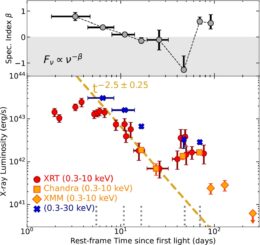
X-ray behavior of AT2024wpp

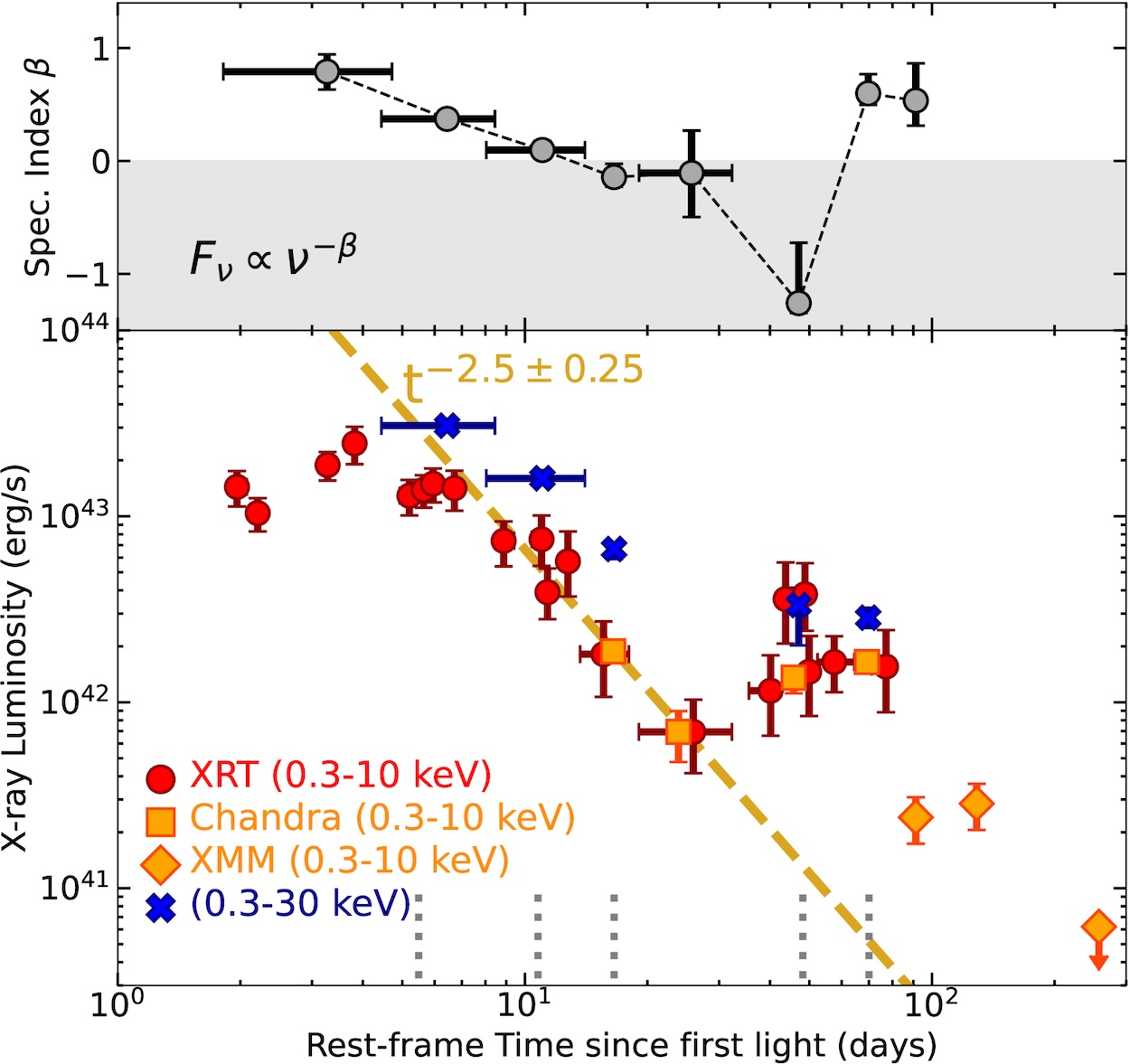
X-ray behavior of AT2024wpp. The top plot demonstrates the hardening of the spectral index (i.e., shifting toward higher energies) around the peak at 50 days. Click to enlarge. [Nayana A. J. et al. 2025]

The team enlisted the Atacama Large Millimeter/submillimeter Array, the Australian Telescope Compact Array, the Allen Telescope Array, the MeerKAT array, and the Giant Metrewave Radio Telescope to survey the source from 0.25 to 203 GHz. On the opposite end of the spectrum, they collected observations from the Neil Gehrels Swift Observatory, the Chandra X-ray Observatory, XMM-Newton, and NuSTAR to probe AT2024wpp’s X-ray emission from 0.2 to 79 keV.

These observations revealed that AT2024wpp’s X-ray emission remained bright and constant for 7 days before plummeting until day 30. The emission then rocketed up again, peaking at day 50, and shifted toward higher energies. Finally, things settled down to a lower brightness around day 75. In the radio, AT2024wpp’s behavior was complex, showing a never-before-seen meteoric rise at millimeter wavelengths around 17–32 days.
Comparison of the density of the material surrounding AT2024wpp and other FBOTs

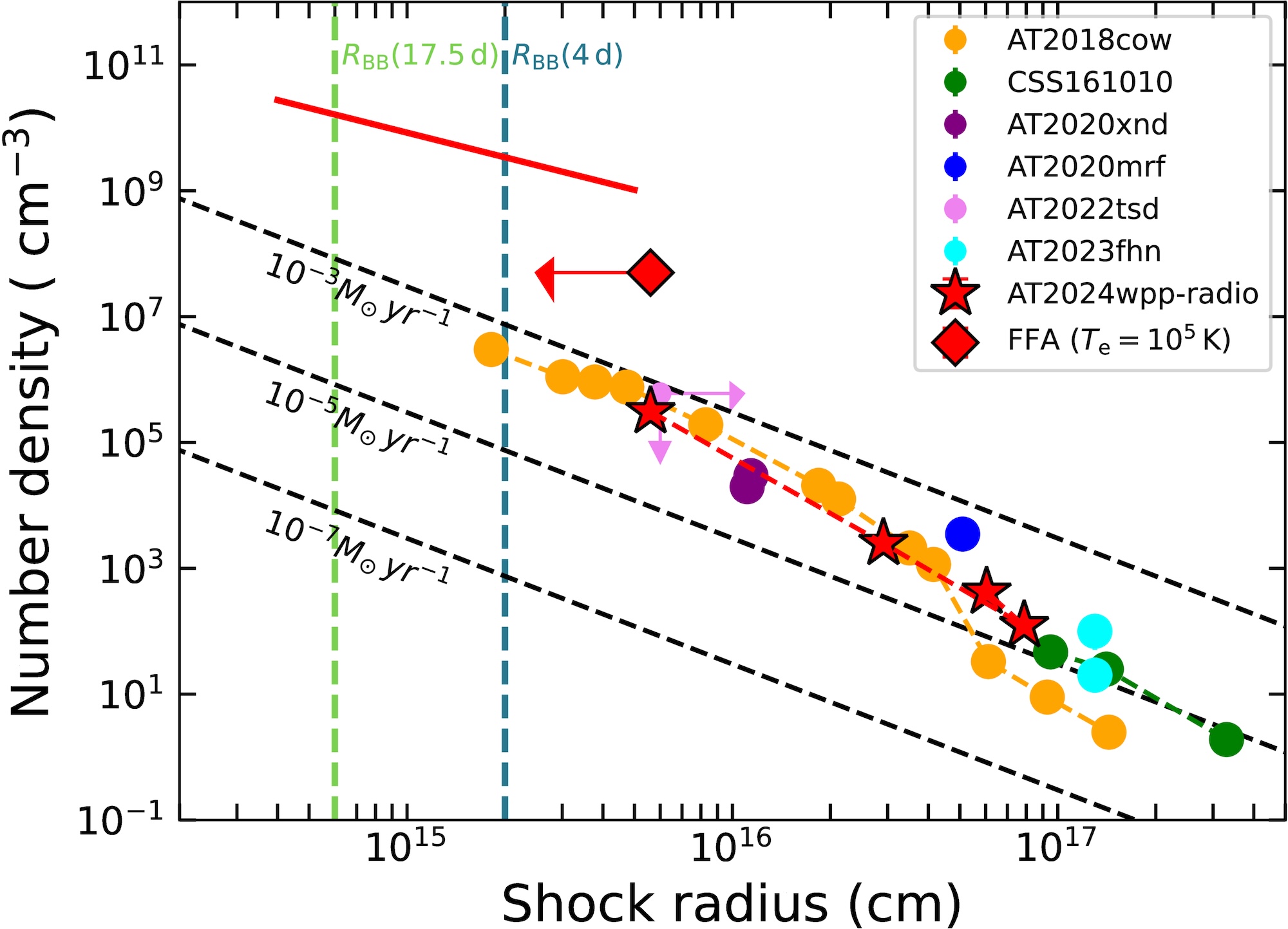
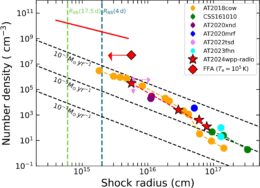
Comparison of the density of the material surrounding AT2024wpp (red stars) and other FBOTs. Click to enlarge. [Nayana A. J. et al. 2025]

Possible Scenarios

Based on these observations, the team favors a scenario involving a central compact object — a black hole or a neutron star — that is rapidly accreting matter from its surroundings. This accretion powers outflows that accelerate to more than 40% the speed of light and send a shock through dense material around the system. Notably, the team found that the density of the surrounding material is similar among FBOTs that have bright radio emission, including AT2024wpp. This suggests that similar processes are responsible for setting up these events.

The team pointed to two scenarios from the literature that are compatible with their data. In the first, a newborn neutron star or black hole collides with a stellar companion, ripping the star apart and accreting its remains. In the second, a Wolf–Rayet star (a massive star that has shed much of its atmosphere and is nearing its eventual end as a supernova) is tidally disrupted by a neutron star or a black hole. Though it’s not possible to narrow the possibilities further, the immense energies involved tilt things in favor of a black hole rather than a neutron star.

Though FBOTs remain mysterious, additional multi-wavelength studies like this one can help to illuminate their origins. And with the Ultraviolet Transient Astronomy Satellite (ULTRASAT) and UltraViolet EXplorer (UVEX) missions slated to launch within the next five years, we can expect many more FBOT discoveries in the near future.

Citation

“The Most Luminous Known Fast Blue Optical Transient AT 2024wpp: Unprecedented Evolution and Properties in the X-Rays and Radio,” Nayana A. J. et al 2025 ApJL 993 L6. doi:10.3847/2041-8213/ae0b4d

The post Investigating the Most Luminous Known Fast Blue Optical Transient appeared first on AAS Nova.

  •  

Investigation of the First Radio-Bright Off-Nuclear Tidal Disruption Event

Illustration of a tidal disruption event

Catastrophic encounters between stars and massive black holes usually take place in the nuclei of galaxies, but not always. Researchers recently reported on the brightest-ever radio emission from an off-nuclear tidal disruption event caused by a wandering or recoiling black hole.

Signature of a Roaming Black Hole

Tidal disruption events occur when a star ventures too close to a massive black hole. The tidal forces of the black hole stretch the star until it’s partially or entirely disrupted, sometimes causing jets or outflows to spray from the shredded star. One thing that often distinguishes a tidal disruption event from the sea of other possible transients is the location, close to the nucleus of a galaxy.

But not all tidal disruption events happen in the center of a galaxy. In rare cases, a massive black hole roaming elsewhere in a galaxy may encounter a star, sending out a tell-tale signal in an unexpected location.

radio images of AT 2025tvd

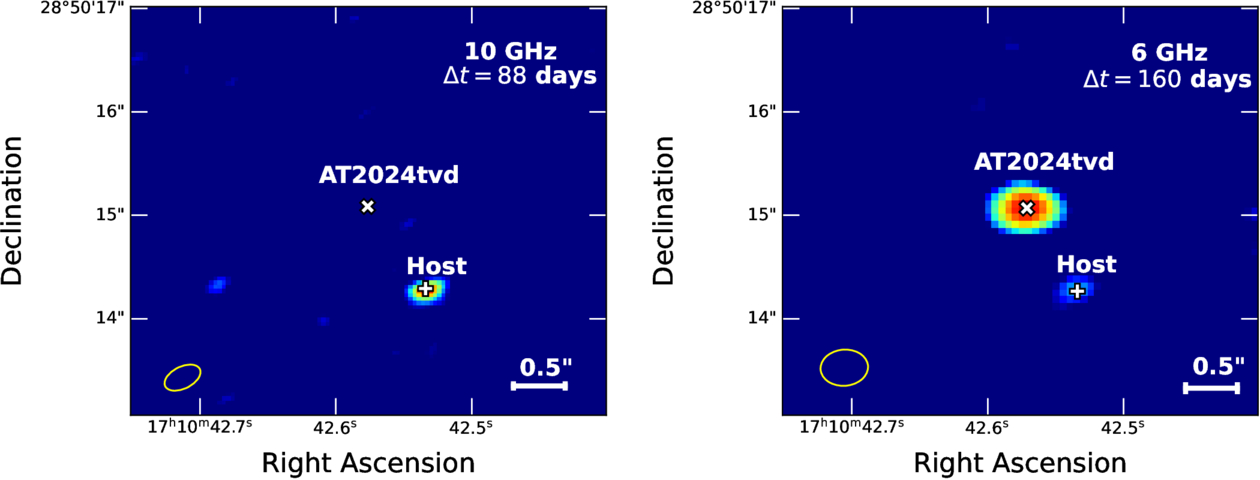
Radio observations of AT 2024tvd on two dates after its optical discovery. The tidal disruption event was not detected at 88 days post-discovery (left) and outshone the center of its host galaxy on 160 days post-discovery (right). Click to enlarge. [Sfaradi et al. 2025]

One such event is AT 2024tvd, which was discovered at optical wavelengths by the Zwicky Transient Facility. Though the initial identification placed it at the center of its host galaxy, follow-up observations suggested that it was in fact 2,600 light years from the center. What can radio observations tell us about this rare off-center event?

Radio Reconnaissance

Less than three months after AT 2024tvd was discovered, Itai Sfaradi (University of California, Berkeley) and collaborators launched a months-long radio-wavelength observing campaign using the Very Large Array, the Atacama Large Millimeter/submillimeter Array, the Arcminute Microkelvin Imager Large Array, the Allen Telescope Array, and the Submillimeter Array. Radio observations are critical for investigating jets and outflows from tidal disruption events.

The observations, which spanned centimeter and millimeter wavelengths, revealed two emission peaks from the tidal disruption event. The first peak occurred roughly 131 days after the event was discovered, and the second followed at day 194.

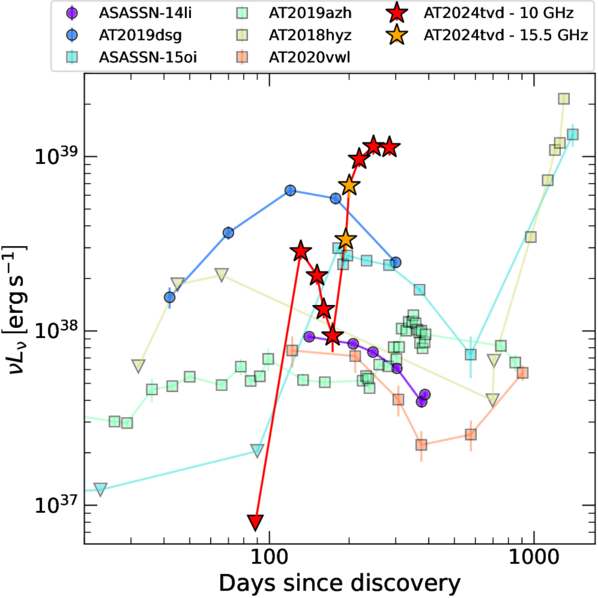
Radio emission from AT 2024tvd compared to other radio-bright tidal disruption events

Demonstration of the fast evolution of AT 2024tvd’s radio emission (red and orange stars) compared to other radio-bright tidal disruption events (other symbols). [Sfaradi et al. 2025]

About 40% of the tidal disruption events that have been identified at optical wavelengths show this kind of delayed brightening at radio wavelengths, but AT 2024tvd stands out as having the fastest radio evolution ever seen. Even among fairly fast-evolving flares, AT 2024tvd is unusual, having a brighter second peak than peer events.

Prompt or Delayed, Outflow or Jet?

To understand the origin of the fast-evolving, extremely bright radio emission from AT 2024tvd, Sfaradi’s team modeled the emission that would arise from outflows and jets. For both wide-angle outflows and narrow jets, the team considered both prompt — arising simultaneously with the event’s optical detection — and delayed sources.

The team’s modeling highlighted several possible scenarios. In the first, both bright radio peaks arose from a single outflow that was launched about 84 days after the star met its doom. The double-peaked behavior is due to the outflow interacting with a complex distribution of material surrounding the black hole. It’s also possible for the two peaks to arise from separate outflows or jets, one launched around 84 days and the other around either 170 or 190 days, depending on whether the second source is a mildly relativistic outflow or a relativistic jet.

Sfaradi and collaborators posited that AT 2024tvd’s unusual radio behavior could be due to its off-nuclear location, but they acknowledged that this event might simply occupy a region of tidal disruption event parameter space that had yet to be explored. Sensitive interferometric or polarimetric observations may reveal more about how AT 2024tvd interacts with its environment, helping to illuminate the nature of this rare event.

Citation

“The First Radio-Bright Off-Nuclear TDE 2024tvd Reveals the Fastest-Evolving Double-Peaked Radio Emission,” Itai Sfaradi et al 2025 ApJL 992 L18. doi:10.3847/2041-8213/ae0a26

The post Investigation of the First Radio-Bright Off-Nuclear Tidal Disruption Event appeared first on AAS Nova.

  •  

Kicking Neutron Stars from the Nest

A blue/white star with lines representing magnetic fields sprouting from the poles against a black background.

Neutron stars don’t stick around for long after they’re born. Recent research has now uncovered just how fast they flee.

They Grow Up So Fast

Human beings require many years of care and support from their parents before they’re able to venture forth into the world. This is an embarrassingly long process compared to the standard for animals like deer and horses, whose offspring are ready to walk mere minutes after birth. However, baby neutron stars, some of the densest objects in the known universe, put all life on Earth to shame with their immediate self-reliance: after a fiery birth from a supernova explosion, these stars flee the site of their creation at hundreds of kilometers per second.

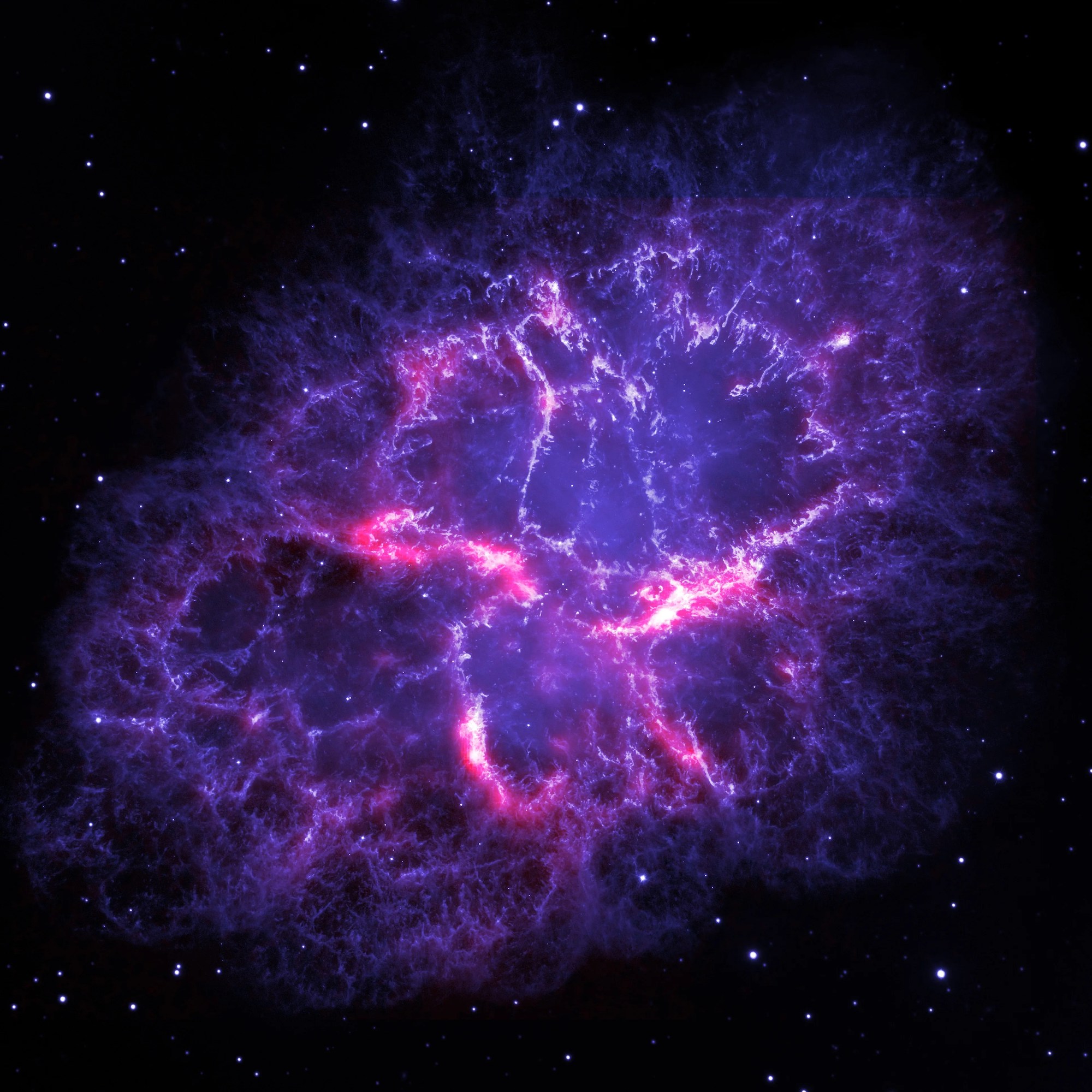
Crab Nebula supernova remnant

Hubble Space Telescope and Herschel Space Observatory image of the Crab Nebula, which is the remnant of a supernova explosion. [ESA/Herschel/PACS/MESS Key Programme Supernova Remnant Team; NASA, ESA and Allison Loll/Jeff Hester (Arizona State University)]

These “natal kicks,” as they’re called in research literature and in recent work by Paul Disberg and Ilya Mandel (Monash University and OzGrav) are a natural consequence of neutron star formation. When a massive star burns through the last of its fuel and surrenders to its own gravity, it collapses inward and compresses its core into a neutron star before rebounding in an explosion. This collapse is never perfectly symmetric, however, and the slight imbalance gives the resulting neutron star a shove.

By measuring the characteristic speeds of these “kicks,” astronomers can deduce how asymmetric the preceding collapse must have been, along with other information about the earliest moments of the supernova. Though measuring the speed of something so small from the other side of the galaxy is no easy task, Disberg and Mandel’s recent publication in The Astrophysical Journal Letters takes on the challenge.

Quantifying the Kicks

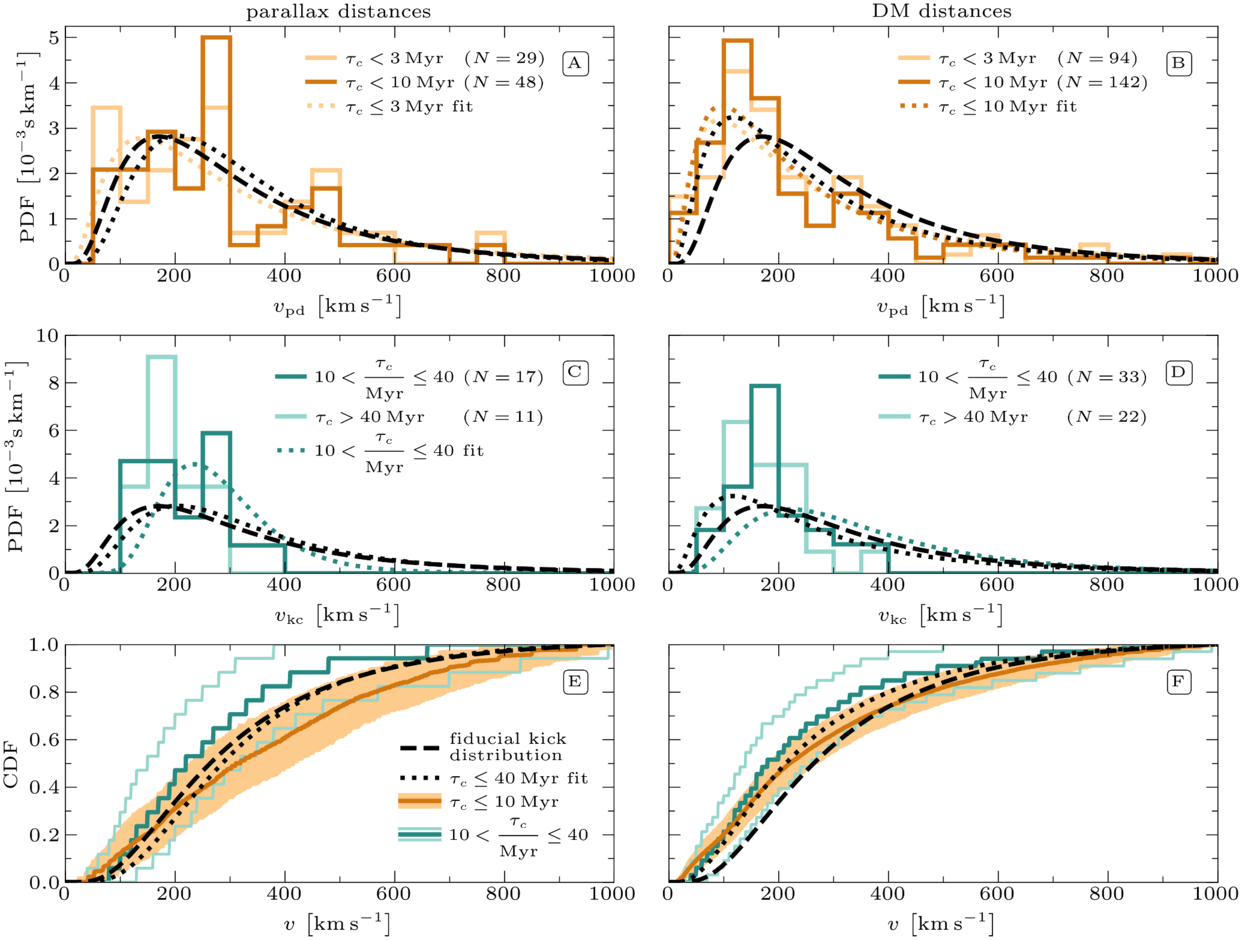
The pair first began by examining measurements of neutron stars known to be less than 10 million years old, which is extremely young in an astronomical context. Since these objects haven’t had time to be slowed down or altered from their course by passing stars or the galactic tide, their present-day speeds should be the same as their natal kicks. The researchers found that while every neutron star had its own unique kick velocity, the distribution of all the velocities followed a log-normal pattern with a peak near 150–200 km/s.

Measured kick velocities and fit distributions

Measured kick velocities (histograms) and fit distributions (curves) for different subsamples. Click to enlarge. [Disberg & Mandel 2025]

Next, Disberg and Mandel examined the distribution of velocities from older neutron stars. These, which had to be measured via a different method, turned out to be very similar to the distribution assigned to the younger stars. Finally, they re-examined previous studies that attempted their own models of the kick distribution. Though several of these studies conflicted with one another, the team found that these discrepancies could be explained by different sample sizes and mistaken statistical interpretations. On the whole, the team’s distribution fit all the available data well and the most succinctly of any alternative framework.

Going forward, other astronomers focused on modeling supernovae, orbits within the galaxy, and binary-star evolution can use this distribution either to sanity check their models or as inputs to other simulations. Through slow accumulation of studies like this, each with its own quantified measurement of some property in the galaxy, we come to understand our universe more fully and unlock our ability to make ever more models and predictions.

Citation

“The Kick Velocity Distribution of Isolated Neutron Stars,” Paul Disberg and Ilya Mandel 2025 ApJL 989 L8. doi:10.3847/2041-8213/adf286

The post Kicking Neutron Stars from the Nest appeared first on AAS Nova.

  •  
❌