 Login

Meta A.I. Bug Allowed Hackers to Take Over Instagram Accounts
The flaw, which Meta said it had fixed, allowed anyone to take over accounts using a bug in the company’s new artificial intelligence software.

MUNICH — Nextcloud has integrated Euro-Office into its workplace application suite, one of several updates to Nextcloud Hub unveiled on Tuesday that include a new compliance app for large organizations and a program to support developers building for its platform.
The announcements came during the company’s Nextcloud Summit 2026 here.
Euro-Office, announced in March, is billed as an open source, sovereign alternative to Microsoft Office for European organizations keen to reduce their reliance on US tech providers. It consists of four browser-based applications: a document editor, spreadsheet program, presentation tool, and a PDF editor — each enabling collaborative editing. Euro-Office documents can also be opened directly from the Nextcloud Files mobile app.
Nextcloud is one of several European companies that support Euro-Office, which is built on the open-source code base of OnlyOffice and distributed under the GNU Affero General Public License v3 (AGPL v3).
The integraton means Nextcloud users can now choose between two options in Nextcloud Office: Euro-Office and the existing Collabora integration.
“Euro-Office uses a different architectural approach that can result in a better performance in the browser, a different user experience…, so it’s important that this option is available,” Jos Poortvliet, Nextcloud co-founder and vice president of communications, said at the Tuesday event.
Other changes in the Nextcloud Hub 26 Spring release include updates to Nextcloud‘s Talk video and voice meeting app, including AI noise suppression and the ability to start a call from any Nextcloud Hub app – an addition that will make collaborative editing easier, said Poortvliet.
For Nextcloud Assistant, there are new AI agent capabilities. In addition to existing capabilities such as managing calendars and tasks, AI agents can now create cards in Nextcloud’s Deck task management app and update information in the Forms app.
There are also improvements to the AI assistant’s interface, which can be moved around to avoid blocking other applications and allow users to copy and paste text more easily without opening another tab. To meet EU AI Act requirements, Nextcloud will make it easier to see which provider supplies the large language model (LLM) the Assistant runs on.
Nextcloud will also integrate the AI assistant directly into its Nextcloud Office suites via a sidebar chat interface, allowing users to address problems such as errors in the spreadsheet app.
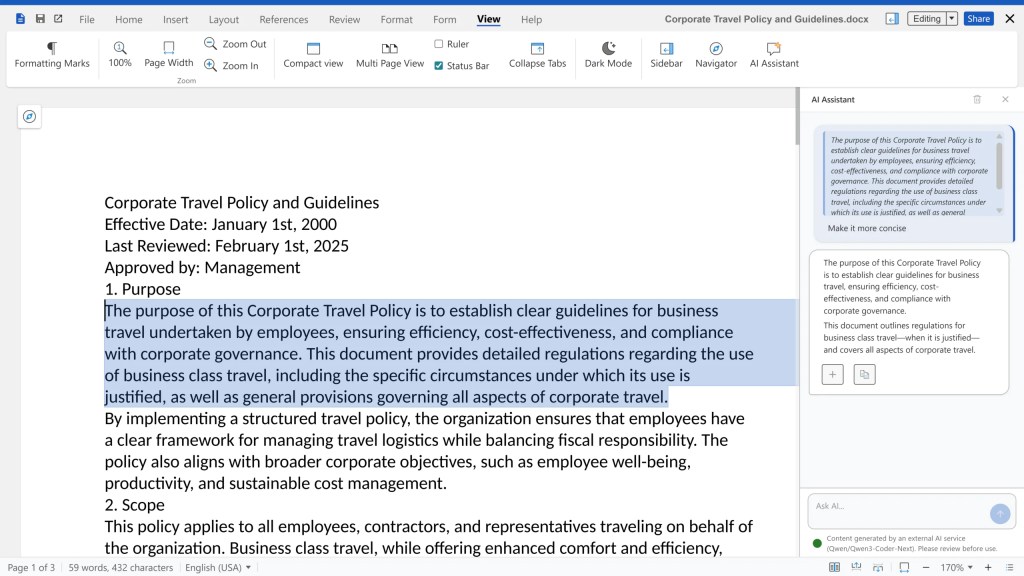
NextCloud’s AI chat assistant is integrated into the company’s Office suites.
NextCloud
There’s also a new Governance app that helps large organizations — particularly governments and highly regulated industries — meet regulatory requirements with compliance tools to manage data held in Nextcloud Hub. It contains several features, including sensitivity labels to control access rights; data retention and archive capabilities; and a legal hold option that preserves documents for legal purposes such as a court case.
The Governance app includes a Compliance Manager that provides a compliance score based on an organization’s regulatory requirements, and measures progress towards certain targets. Admins can also search and review documents shared by employees and generate audit reports for compliance. The Governance app is available to Nextcloud Enterprise customers.
Nextcloud also launched a program to support independent software providers interested in building apps on its platform.
With AI making it easier for developers to build software that integrates with its platform, Nextcloud expects a 10-fold increase in the number of available apps — from 600 now to 6,000 over the next 12 months, according to Nextcloud CEO Frank Karlitschek.
Nextcloud promised to promote apps developed by partners in its App Store and sell subscriptions as part of the ISV program, as well as provide documentation and technical help to customers. In return, developers would provide guarantees to customers around security processes and long-term support.
“We can strengthen our ecosystem, the developers also make some money — because obviously we do a revenue share here — and we leverage the dynamics that we expect from AI coming very soon,” said Karlitschek.
Editor’s note: NextCloud paid for Matthew Finnegan’s travel and hotel costs for NextCloud Summit 2026, but had no editorial role in the creation of this story.

WWDC26 felt like a defining platform moment. Apple is no longer simply promising that AI will arrive eventually; it is arguing that Apple Intelligence and Siri AI should become central to the future of its ecosystem. If that works, the company will have turned AI from a perceived weakness into a new reason to stay inside Apple’s world.
Still, the bigger question is execution. Apple did not present AI as a lab experiment; it presented a polished, consumer-ready experience. That raises expectations.
Users will not judge Apple Intelligence by model architecture or parameter counts. They will judge it by whether Siri understands them, whether actions work reliably, whether personal context feels useful rather than intrusive, and whether the experience is consistent across devices.
Since Monday’s announcements, we’ve learned that some features will not work on all devices — and there’s speculation Siri AI may not fully escape beta until 2027. “Until Apple puts a stake in the ground and says when the new Siri features will be available, the debate remains: Does Apple actually have the chops in personalized AI? The demo suggests yes. The lack of timing suggests maybe,” wrote analyst Gene Munster.
Optimists argue that Apple has regained momentum by presenting a coherent AI story, one built around privacy, integration and everyday utility rather than spectacle. Skeptics counter that many of the features resemble capabilities already available elsewhere, and say the company still needs to prove it can ship them at scale and make them a meaningful reason for consumers to upgrade.
That balance is visible in analyst reaction. In a client note seen by Computerworld, Erik Woodring of Morgan Stanley described the keynote as clear progress on Apple’s AI roadmap and said it suggested monetization opportunities could arrive earlier than expected — even if the overall journey will be “a marathon, not a sprint.”
UBS, in contrast, said the privacy-focused AI additions are useful but unlikely to be a material driver of iPhone demand in the near term, while Barclays called the changes interesting but incremental, and not enough to drive an upgrade cycle.
Ben Wood, chief analyst at CCS Insight, argued that Apple had to answer concerns about its AI shortcomings and now has to prove that its privacy-led, integration-first approach translates into a meaningfully better everyday experience. “Consumers will not judge Apple Intelligence by model sizes, partnerships or technical architecture,” Wood told me. “They will judge it by whether Siri understands them, whether actions work, whether personal context feels useful rather than intrusive, and whether the experience is consistent across devices.”
Dipanjan Chatterjee, vice president principal analyst at Forrester, said Apple’s strength lies in shifting the focus from the underlying technology to outcomes such as usefulness, simplicity and trust, while warning that the company still has skeptics to win over after its stop-start AI rollout. “The lesson for brands is clear: market the value, not the ingredients,” said Chatterjee. “After stumbling with the Apple Intelligence roll-out, Apple’s success will hinge on delivering the new Siri experience quickly, and ensuring it works as promised for iPhone users at scale.”
While many are infuriated about Europe’s inability to build compromise, Apple’s developer army otherwise seems positive about what the company has accomplished.
“On the AI front, it never made sense to me for Apple to develop their own LLM, so focusing on powerful, fast and private for implementation of Apple Intelligence seems to be an effort that is progressing rather nicely. In all, a pretty good Keynote, I’d say,” Rich Siegel, founder and CEO of Bare Bones Software, said in an interview.
“It’s great to see Apple continue to pursue a vision of AI that leverages local systems, preserves privacy, and integrates with third party tools,” said Ken Case, CEO of the Omni Group. “A lot of our work around the Apple Foundation Models and automation, App Intents, and adopting Swift look to be fruitful investments, but it’s clear there’s more to do starting this summer. It’s also welcome to see them refine Liquid Glass, giving customers more control and listening to feedback they’ve heard over the past year.”
“I expected that this year’s Siri revamp would be the biggest personal assistant update Apple has ever done, and that’s exactly what we got,” said Sergii Kryvoblotskyi, director of AI and research at MacPaw. “Since Apple acquired Siri back in 2010, it has lacked one thing: real intelligence. Behind the great speech recognition service it provided, the tech was not ready to provide real value to users.”
“Most notable for me was Siri AI and the push towards on-device and more capable models that can do more with user context,” Matt Vlasach, Jamf senior vice president, enterprise products and solutions engineering,” said in an interview. “While obvious for consumer use cases, as illustrated in the keynote, the opportunity to evolve this to the work context using a more advanced Apple Intelligence framework is an exciting evolution.”
“OS 27 feels like a deliberate reset, less about new features and more about polish and quality-of-life improvements, which most users will welcome,” said John Richards, general manager, IT products, at Iru. “The new capabilities are focused entirely on Apple Intelligence and Siri AI, and what’s encouraging is how much Apple leaned into privacy with the Gemini partnership. That combination of capability and privacy-first design is the right instinct.”
“The single biggest request I made at Apple’s Foundation Models workshop in Madrid was opening Private Cloud Compute to third-party developers,” said Serhii Popov, senior software Eengineer at CleanMyMac. “It’s here and free for apps under 2 million users. That’s a real breakthrough and a huge opportunity for a lot of great apps.”
Joel Rennich, senior vice president for product management at JumpCloud, looked ay how on-device AI will transform other paradigms. For starters, it shifts identity from simple authentication to governing what actions an AI agent is allowed to take.v“Enterprises will need identity frameworks that govern both human and non-human actors consistently,” he said.
“iOS 27 and Apple Intelligence point toward an operating system that does not just launch apps, it executes intent,” Rennich said. “Instead of users navigating between tools, the OS increasingly mediates outcomes directly through AI. This changes how work is initiated and completed on devices.
“With Apple Intelligence integrated across core experiences like Siri, Safari, and system services, AI is no longer an overlay but infrastructure. The separation between where data lives and where it is used becomes increasingly invisible to the user. Intent becomes the primary input, not app selection.”
I also spoke with Hexnode CEO Apu Pavithran, who pointed to some of the concerns enterprise users might have following WWDC: “The keynote didn’t speak much to admins,” he said. “The features that matter most at the management layer, such as how Apple exposes Siri AI through MDM APIs, whether IT gets granular per-app controls for Apple Intelligence, how shared device deployments handle the new assistant — these will be answered in the developer documentation. This week, that’s where IT teams should be looking.”
“Admins should dig in immediately and see what’s changed. Watch the developer docs, audit how Apple Intelligence interacts with existing device policies, and remember that the keynote is only a part of the story for enterprises,” he said.
“Rebuilt from the ground up, Apple is trying to make AI feel native, useful and invisible across the devices people already use every day,” Francisco Jeronimo, vice president for client devices at IDC, said in an interview. “This matters, because the winning AI experience for consumers will not be the loudest or most technically complex. It will be the one that understands context, respects privacy, works reliably across apps, and reduces friction without forcing users to change behavior.”
“[Apple] is also clearly seeking to differentiate through its privacy promises,” said CCS Insight’s Wood. “This looks like a step in the right direction, but there is no room for complacency, and Apple still has a long AI journey ahead.”
Pavithran reflected on something more. “Overall, it’s hard not to think of this year as a deliberately measured keynote, one that’s intentionally playing it safe and seeking to rewrite the AI narrative,” he said. “I won’t be surprised if this ends up setting the stage for a much bigger installment next year with incoming CEO John Ternus hitting the ground running with some ‘wow’ features like new hardware or agentic AI at scale.”
That we can now seriously consider that possibility shows the extent to which Apple has regained momentum in AI on its platforms.
You can follow me on social media! Join me on BlueSky, LinkedIn, Mastodon and The Core.

A new proposed Senate bill aims to establish clear guardrails for the U.S. military’s use of artificial intelligence (AI), drawing a definitive line on one of the most consequential questions in modern warfare: who has the final say when lethal force is used?
On June 8, Senator Adam Schiff (D-Calif.) introduced the proposed Human Authority in Lethal Operations Act of 2026, or “HALO Act,” which would impose sweeping requirements on the Department of War (DoW) to ensure that autonomous and semi-autonomous weapon systems remain under meaningful human control.
The legislation would establish new design standards, testing requirements, oversight procedures, and legal safeguards for military systems that use artificial intelligence to identify, recommend, prioritize, or engage targets.
The bill aims to ensure that responsibility for battlefield decisions remains with human commanders, rather than shifting to algorithms. The legislation would require the Pentagon to designate accountable commanders for any engagement involving AI-enabled autonomous or semi-autonomous weapons and mandates that those commanders retain “ultimate discretion, judgment, and control over the use of force.”
“The past few months have shown us that there is an urgent need for commonsense guardrails to ensure the Defense Department’s use of AI is in line with Americans’ national security and privacy priorities,” Sen. Schiff said in a press release. “There are good reasons to use AI technology to advance our national security,” although he emphasized that, like with any tool, AI should not be allowed solely to guide human enterprises, “particularly when the risks of harm can be fatal.”
The proposal arrives amid growing concern among policymakers, military planners, and technology experts about the increasing role of artificial intelligence in combat operations.
Significantly, these concerns are no longer theoretical. As The Debrief previously reported, Israel’s reported use of the AI targeting system “Lavender” in Gaza triggered renewed debate over how much trust militaries should place in algorithmic target selection, particularly when civilian lives may be at risk.
Other recent examples have added to the concern, including studies showing that AI models can escalate dangerously in simulated war games, as well as the Pentagon’s continued push toward autonomous drones, AI-controlled aircraft, and robotic battlefield systems.
Even Pope Leo XIV recently weighed in on the issue in Magnifica Humanitas, his first encyclical, or formal papal teaching letter, warning that autonomous weapons could make war more feasible and less subject to human control, and arguing that lethal decisions must not be delegated to opaque or automated processes.
While the Pentagon has repeatedly stressed its commitment to responsible AI development, the HALO Act would codify many of those principles into law and create new statutory requirements governing how military AI systems are designed, tested, approved, and monitored.
Among the bill’s most significant provisions are requirements that autonomous weapon systems operate within predefined geographic areas, target sets, and timeframes. If a system cannot complete an engagement within those authorized parameters, it would be required to terminate the engagement until additional human operator and commander review is completed.
The legislation also calls for extensive record-keeping, cybersecurity protections, and continuous oversight to guard against unintended engagements and hostile manipulation.
The bill would also require senior Pentagon officials to conduct formal reviews before AI-enabled weapons enter development and again before they are fielded. Those reviews would assess legal compliance, operational safety, reliability, cybersecurity, and risks to civilians and protected infrastructure under the Law of Armed Conflict.
Beyond battlefield autonomy, the legislation targets several controversial uses of artificial intelligence in national security. It would prohibit covered Defense Department AI capabilities from inferring a person’s religion, race, political identity, sexual orientation, or emotional state. It would also restrict the purchase or receipt of Americans’ personal data from data brokers or other third-party sources when that data was obtained in a manner that would violate the bill’s rules.
Perhaps most notably, the proposed HALO Act explicitly forbids removing humans from decision-making processes involving presidential actions related to nuclear weapons.
“No covered artificial intelligence capability may be used with the intent, purpose, or outcome of… removing a human from the chain of decisionmaking for actions critical to informing and executing decisions by the President, including initiating or terminating nuclear weapons employment,” the proposed bill reads.
The measure also includes whistleblower protections for personnel working on military AI systems, mandates regular reporting to Congress, and requires the Pentagon to identify and remediate any fielded systems that fail to meet the law’s requirements.
Existing autonomous systems would undergo a comprehensive review, and any system found to be noncompliant could face retirement, modification, or suspension pending corrective action.
While the bill includes exemptions for certain defensive systems, cyber capabilities, mines, and other categories of military technology, its wider message is that as artificial intelligence becomes more deeply integrated into national defense, Congress wants humans, not machines, to remain responsible for high-stakes decisions.
The HALO Act is not the only effort underway on Capitol Hill to establish guardrails around military AI.
In March, Senator Elissa Slotkin (D-MI) introduced the AI Guardrails Act. Last week, Senator Kirsten Gillibrand (D-N.Y.) introduced separate legislation that would similarly prohibit the Pentagon from using artificial intelligence to launch nuclear weapons, conduct warrantless surveillance of Americans, or deploy fully autonomous weapons.
“Right now, the Pentagon is moving toward deploying incredibly powerful AI technology without commonsense guardrails in place, which could have catastrophic consequences that make all of us less safe,” Sen. Gillibrand said in a statement. “We must act now – not to stifle technological progress, but to establish clear rules of the road that keep humans in charge and keep AI’s use in warfare smart and safe.”
The competing proposals could set the stage for a broader congressional debate over the role of artificial intelligence in future military operations, particularly if lawmakers seek to incorporate them into the Fiscal Year 2027 National Defense Authorization Act (NDAA).
Before that can happen, however, the HALO Act and similar proposals must navigate the legislative process. The bills will first be considered by the relevant Senate committee, where lawmakers may hold hearings, debate their provisions, amend the text, or decline to advance them. If approved, it would then need to pass both the Senate and the House before being sent to the president for signature, either as a standalone measure or as part of a larger NDAA.
“My legislation would protect Americans from unlawful domestic surveillance, ensure that humans in the chain of command exercise responsibility for the use of any lethal technology, and maintain strong ethical protections in the deployment of autonomous and semi-autonomous weapons,” Sen. Schiff said in a statement.
Tim McMillan is a retired law enforcement executive, investigative reporter and co-founder of The Debrief. His writing typically focuses on defense, national security, the Intelligence Community and topics related to psychology. You can follow Tim on Twitter: @LtTimMcMillan. Tim can be reached by email: tim@thedebrief.org or through encrypted email: LtTimMcMillan@protonmail.com
We’re seeing an interesting infrastructure tug of war today where GPU clouds are being pulled in two directions. For the economics of AI to work, the enterprise market needs to carve expensive hardware into smaller, shareable units and hand it to customers on demand, similar to how CPUs are doled in public cloud infrastructure. But the more the providers push GPUs to behave like elastic cloud infrastructure, the more they run into the reality that this GPU hardware was never built for safe multitenant use, fast fault recovery, or clean isolation between workloads. That tension is becoming one of the defining operational problems of the AI infrastructure market.
When a gamer launches Steam or the Epic Games Store on their laptop, they don’t have to worry about which GPU is being scheduled, how memory is going to be divided, or really any of the security boundaries or hardware assignment issues on their PC. For consumer PCs, these issues are not just hidden from view, they are irrelevant.
But for today’s IT teams managing GPU-driven AI workloads across distributed systems, those types of allocations and partitions need to be managed manually and carefully. This includes deciding which GPU to assign to each workload, how to divide memory, how to isolate tasks, and how to maximize utilization of this very expensive hardware. That’s why you heard so much about “Day 2” AI infrastructure themes around Nvidia’s GTC event this year.
GPUs were originally developed to speed up graphic rendering and to perform local compute via shaders in service of graphical rendering. Their design assumes a trusted computing environment in which a single application controls the device. When a user runs an application on a GPU, it accelerates that particular workload.
But while GPUs are optimized for throughput, and therefore have thousands of simple cores designed to execute the same instruction over large datasets, this design paradigm creates several major technical limitations regarding context switching and memory isolation. GPUs were designed to produce pixels, not to run sensitive AI applications from multiple tenants using the same hardware.
As a result, GPU infrastructure today behaves less like elastic cloud infrastructure and more like carefully managed hardware appliances.
Today’s AI infrastructure requires GPUs to behave like shared, elastic cloud resources. As inference workloads begin to outstrip large-scale training runs, the ability to slice and share expensive hardware among multiple tenants in real time while maintaining acceptable fault tolerance is no longer optional.
Hardware vendors have introduced new approaches to dividing GPUs into multiple isolated compute slices. Other frameworks approach partitioning through schedulers and container runtimes. But resource partitioning is just one slice of the overall GPU operations pie.
There is currently no widely adopted, cross-vendor operating model for achieving this safely at scale. Most providers are faced with either dedicating a single customer to a physical machine (thus wasting available capacity), or accepting the multi-tenancy security risks currently without a known solution. The current engineering challenge has moved from beneath the model layer and into the infrastructure layer. Success now relies on the ability to quickly launch new workloads and to rapidly contain hardware faults so that a single GPU failure does not bring down all workloads running on the server.
The vast majority of current GPU programming models rely on the idea that the driver has complete control over memory protection and that no user will act maliciously. Unfortunately, that assumption completely falls apart in a cloud environment where one VM or container can leave behind data remnants in memory that another VM or container may access. Especially considering that how GPUs execute code is often completely opaque.
A single faulty workload or a single faulty driver failure in a shared GPU environment can also take down every workload (job) that was being run on the same server, increasing the amount of damage caused by an operational failure.
Currently, there are immature options for runtime inspection or behavioral auditing, limiting both visibility and control for security teams. GPU drivers provide a large attack surface and generally limited telemetry from the hardware. In these shared environments, embeddings, weights, prompts, and tokens are now all sensitive data points, creating significant blind spots for those attempting to protect intellectual property.
The real constraint in many GPU clouds is not model performance but operational efficiency. Right now GPU operations looks like 30 minute tenant spin-up times, 70% idle rates, and engineers continuously debugging infrastructure stacks. Today’s GPU clouds are stalled not due to inferior models, but because the infrastructure layer underpinning these clouds was never designed to support such a high degree of scale.
A 30 minute cold start is a fundamental limitation on the modern AI business model. Those GPU clouds that can spin up workloads in seconds will ultimately win against those that do not. Multitenancy is the only viable means of producing sufficient unit economics to make this very expensive hardware viable for the long term.
Platform teams are beginning to recognize that GPUs require a specialized operating layer between the hardware and workloads. Operators need a unified operating model that supports multiple hardware vendors and GPU models. Cloud providers need a method to safely slice and share servers among tenants, and to prevent cascading failures, while rapidly launching new workloads.
Enterprises are increasingly seeking to run sensitive AI applications with stronger isolation guarantees, and thus are turning to newer categories of software designed specifically to manage the “dirty work” of hardware orchestration.
Prior to Kubernetes standardizing container orchestration, the industry was constantly debating the efficiency of container scheduling and bin packing across clusters. Those operational concerns were eventually automated and incorporated into infrastructure layers that made the complexities invisible to the end user.
A similar evolution is occurring around GPUs today. While platform teams continue to argue over placement strategies and memory tuning, these decisions will likely be automated within five to 10 years. As AI infrastructure evolves, the most valuable layer may not be the GPUs themselves but the operating layers that make them secure, elastic, and efficiently sharable. So the winners in the AI race won’t necessarily be just those with the most silicon, but those who have the best operating models for making that silicon secure and elastic.
—
New Tech Forum provides a venue for technology leaders—including vendors and other outside contributors—to explore and discuss emerging enterprise technology in unprecedented depth and breadth. The selection is subjective, based on our pick of the technologies we believe to be important and of greatest interest to InfoWorld readers. InfoWorld does not accept marketing collateral for publication and reserves the right to edit all contributed content. Send all inquiries to doug_dineley@foundryco.com.

Enterprises are moving aggressively into generative AI. On the surface, that seems like the right call. The technology is powerful, accessible, and increasingly embedded in how businesses build applications, automate processes, and support decision-making. A development team can connect an application to a large language model in days. A product team can add AI features in weeks. Business leaders see quick wins, faster innovation, and a path to modernizing nearly every part of the company.
These are the upsides everyone is talking about. The part we don’t discuss enough is the economic trap forming underneath all this convenience.
Most enterprises think of tokens as a technical billing detail. They are not. Tokens are the unit of economic dependency in generative AI. Every prompt, response, summarization, retrieval step, workflow action, and agent decision is measured and monetized through tokens. Tokens are not just part of the plumbing. They are the tollbooth between your enterprise and a provider’s intelligence platform. The more AI becomes central to your operations, the more power that tollbooth holds over your future costs.
A token is usually described as a chunk of text processed by a model. That is accurate enough for developers, but it misses the bigger issue for CIOs, architects, and corporate boards. In the enterprise, tokens are the mechanism by which AI capabilities are rented. They are the meter attached to the intelligence itself.
That distinction matters because token usage grows faster than most companies anticipate. A simple user prompt rarely remains simple in production systems. It can trigger retrieval from internal knowledge stores, multiple model calls, tool use, post-processing, policy checks, and agent loops. What appears to be a single transaction to the user may involve several layers of token consumption behind the scenes. As a result, enterprises often underestimate the true operating cost of AI-enabled systems, especially as those systems mature and spread across departments.
Today, those costs still feel manageable. In many cases, they feel surprisingly low. That is exactly why the trap is so dangerous.
Current token pricing is giving enterprises a false sense of comfort. Many remote LLM providers are aggressively competing for market share. They want developers building on their APIs. They want enterprise applications tightly coupled to their platforms. They want AI agents, copilots, workflows, and customer experiences to depend on their models. To make that happen, pricing remains highly attractive relative to the value delivered.
That does not mean the economics of generative AI are stable. It means the market is still being shaped by investor capital, strategic pricing, and growth expectations. Providers are racing to establish position, and enterprises are benefiting from that race. But no market stays in that phase forever. At some point, investors will expect durable profitability. At some point, weaker providers will disappear, consolidate, or retreat. At some point, the survivors will have more leverage and much less reason to price primarily for adoption.
That’s when the token trap closes.
Enterprises that build deep dependence on remote models during the subsidy phase may find that what seemed inexpensive at pilot scale becomes punishing at enterprise scale. The application that costs $1,000 per month today may cost 10 or 20 times that amount a few years from now, not only because usage has increased, but also because the market has repriced the dependency.
Cloud computing followed a similar path, with many enterprises mistaking short-term convenience for long-term economics. In the early years, the case was compelling and largely accurate. Move faster, reduce friction, avoid capital spending, and scale with ease. Those benefits were real. Many organizations made architectural decisions that prioritized speed over leverage. They became dependent on managed services, provider-specific tools, and operating models that were easy to adopt but expensive to unwind.
Years later, many enterprises discovered that their cloud bills were much higher than expected and their exit options much narrower than advertised. That was not because the cloud failed. Architectural dependency eventually became financial dependency.
Generative AI is repeating that pattern, only faster. The integration barrier is lower, the pressure to adopt is higher, and the pace of enterprise experimentation is far greater. As a result, companies are wiring remote LLMs into applications, workflows, and agentic systems with very little thought about how these costs will behave in the next five to 10 years.
The more enterprises move from simple prompt-response systems to agentic architectures, the more dangerous the token trap becomes. Agents are not single-call systems. They plan, deliberate, retrieve information, invoke tools, evaluate results, retry steps, and often coordinate with other agents. Each of those actions consumes tokens. Costs no longer rise in a neat linear fashion. They compound.
This matters because agentic AI is increasingly being presented as the future of enterprise automation. It’s true in many cases. But if an enterprise builds agentic systems primarily on remotely hosted intelligence, it is also building future business processes on top of someone else’s pricing model. That is a major strategic risk. The more successful those systems become, the harder they are to replace. The harder they are to replace, the more pricing power shifts to the provider.
This is how businesses end up operationally dependent on a cost structure they do not control.
The answer is not to reject public models or pretend that external providers play no role. They clearly do. There will always be cases where renting frontier AI capabilities makes sense. But enterprises need to stop assuming that renting is the default for every workload.
AI sovereignty is the alternative that deserves much more attention. That means building, tuning, deploying, and governing models inside the enterprise for use cases where long-term control matters more than access to the absolute frontier. Enterprises need to recognize that most business applications do not need a world-class general-purpose model. They need a model that is good enough for a specific purpose, aligned to the enterprise’s data, governed by the enterprise’s rules, and operated at a predictable cost.
It’s a very different way of thinking.
A self-hosted or enterprise-controlled model may not match the rich feature set of the largest public offerings. It may lack the same breadth, polish, or marketing appeal. But for many internal business tasks, those factors do not matter.
Here’s the most critical question to guide your architectural direction: Can a sovereign AI model solve the problem reliably, securely, and economically over time? If the answer is yes, owning that capability may be far more strategic than forever renting something with more power than you need. In effect, the enterprise becomes its own provider for the workloads that matter most.
Too many companies still treat generative AI architecture as a tactical IT issue. It is not. These decisions directly affect cost structure, operating flexibility, data control, and long-term competitiveness. If AI becomes a force multiplier across the business, the economics of AI become strategic to the business itself.
The companies that get this right will not necessarily be the fastest adopters. They will understand the difference between experimentation and dependency. They will use external models when it makes sense, but they will also invest in sovereign capabilities where ownership matters. They will think like architects, not consumers.
Here’s the takeaway: Cheap tokens come with strings. They are a gateway to a dependency model that will typically look very different once providers stop pricing for growth and start pricing for leverage. Enterprises cannot keep mistaking today’s bargain for tomorrow’s reality. Boards and executive teams need to act now to get ahead of this issue. The key question is not whether generative AI creates value. It clearly does. The real question is whether the enterprise can still afford and control the value it creates once the market matures.

Years ago, right-wingers coined the phrase “Trump Derangement Syndrome” (TDS) to describe people who hate US President Donald J. Trump. (I think it better describes the president’s outlandish, truth-challenged statements and the followers who think he can do no wrong.) What’s really deranged is his recent AI executive order.
First, a little history. As you may recall, Trump often (and loudly) trashed his predecessor’s Executive Order 14110, which had demanded “safe, secure, and trustworthy” AI. That Biden Administration order was replaced last year by Trump’s own “Removing Barriers to American Leadership in Artificial Intelligence” directive; it basically let US AI companies do whatever they wanted in the name of innovation.
Then, a little thing called Anthropic Mythos came along — and scared the pants off even AI’s biggest fans. Seemingly in response, someone in the federal government decided that letting AI companies do whatever they want might not be the brightest policy.
Or, did they?
True, the new order creates a process under which AI companies can give US government access to “covered frontier models” for up to 30 days before public release so experts can probe for vulnerabilities and test how the systems could be abused. It also directs agencies to set evaluation standards, establish an “AI cybersecurity clearinghouse,” and harden federal networks against rapidly advancing AI‑enabled attacks.
Some people, like Graham Brookie, vice president for technology programs and strategy at the Atlantic Council, think the order is great. “The administration’s executive order on Advanced AI Innovation and Security is a serious policy with support from necessary stakeholders across party lines and industry to ensure the government is evaluating the cybersecurity risks posed by frontier AI models. It’s a policy that can be built on.”
Really? I’m not sure Brookie read the same document I did — if, indeed, he read it at all.
I quote:
“Nothing in this section shall be construed to authorize the creation of a mandatory governmental licensing, preclearance, or permitting requirement for the development, publication, release, or distribution of new AI models, including frontier models.
“In addition, ‘This order is not intended to, and does not, create any right or benefit, substantive or procedural, enforceable at law or in equity by any party against the United States, its departments, agencies, or entities, its officers, employees, or agents, or any other person.’”
In other words, AI companies won’t be required to do much of anything. And if they do submit a project for review, get the government’s blessing for it, and something goes badly wrong, it’s not the government’s fault.
So, exactly why would AI companies even mess with this performative AI security theater?
Beyond those concerns, who exactly will be judging AI projects in 30 days? In theory, it would be a cybersecurity clearinghouse made up of people from the National Security Agency, the US Treasury Department, and the Cybersecurity and Infrastructure Security Agency (CISA). Most likely, CISA would do the bulk of the heavy-lifting — it’s their job, after all. But there’s this wee problem; Trump’s so-called Department of Government Efficiency (DOGE) last year gutted CISA. There’s virtually no one left to do the work, and certainly not in 30 days.
There’s also the question of funding for the new initiative. According to the order, “The Director of OMB, in coordination with the National Cyber Director and the Director of CISA, shall determine whether any Federal grant programs have available and relevant funding that can be directed toward applicants developing advanced AI vulnerability detection.”
Spoiler: There’s no money set aside for this purpose.
Leaving aside whether the Executive Order has any teeth at all — the Brennan Center for Justice argued that under the Constitution, it doesn’t; the closer you look at the document, the less substance you’ll find.
Besides, in an industry where success is all about releasing the latest Large Language Model (LLM) as fast as possible to garner attention and investor dollars, who exactly would want to put their AI models on ice for even 30 days? (Short answer: No one.) These companies are always going to be focused first on getting the word out about their latest model as fast as humanly — Uh, AI-ly — possible.
Still, some people seem to think this executive order really will make a difference. For example, Paul Benda, the American Bankers Association executive vice president for risk, fraud, and cybersecurity, sees it “as a constructive step toward strengthening the nation’s approach to managing the cybersecurity risks and opportunities associated with advanced artificial intelligence [because it ] can help better protect critical infrastructure, including the financial sector.”
Oh, please. I’m so tired of people who skim the titles of Trump’s executive orders and then assume there’s anything real about them.
This AI order is meaningless garbage, and anyone telling you otherwise is either lying or wants to be on the Trump regime’s good (?) side. Or, both — it could always be both.

There were several key components to emerge from Apple’s developer conference Monday as the company sought to reassure users (and investors) that it has met the existential challenge represented by AI. Aside from a serious focus on Siri AI and embedded Apple Intelligence across its varied platforms, officials also hailed a slew of performance/usability tweaks, described new child safety tools, gave macOS 27 a real name, “Golden Gate” — and offered a standing ovation in farewell to outgoing CEO Tim Cook.
Before the Worldwide Developer Conference (WWDC), analysts seemed optimistic about the company’s plans, most of which had already leaked. Analysts didn’t expect Apple to announce anything that would transform the AI industry (it didn’t), but they did hope the company would introduce tools to keep it competitive with rivals (it did). That’s assuming all the demos at the event were live, actual feature demos, rather than faked set-ups as seen before.
Apple’s teams have evidently worked incredibly hard to come this far, and execs did introduce truly impressive new AI features focused on what customers and developers actually need. The company also played to its strengths, particularly around vision intelligence; private-by-design (large language models) LLMs; highly useful contextual awareness; and Siri AI, which works as an app and lets you carry on conversational quests securely across all your Apple devices.
As anticipated, Apple also introduced APIs developers will be able to use to provide new AI features in their apps.
Among the many individual tools most of us can expect to use this fall, are:
Apple did not seek to introduce AI features for their own sake; instead, it remains deeply focused on how to make its devices more useful to customers. As Craig Federighi, Apple’s senior vice president of software engineering, said:
“Truly helpful AI must be centered on our users’ needs, deeply integrated into the products they rely on every day, grounded in personal context, and built with privacy at every step. That is our vision for Apple Intelligence. With useful features for browsing the web, expressing creativity, editing photos, and so much more, today marks a big step forward on our journey to integrate powerful AI into the core of our platforms and make our products even more personal and useful.”
Apple confirmed that it worked with Google Gemini to create some of the AI models highlighted today. This led some analysts before the event to say: “For Apple, the bull case is that a working Siri reframes it as an AI winner; the bear case is that paying a rival for core intelligence caps the premium investors assign to the stock.”
Perhaps they need not worry, as what we now seem to have is a far more solid base from which to continue to develop AI services and tools that compete against others in the space. Not only that, but Apple is not using rebranded Gemini — it simply worked with Google to build its own models, as Federighi insisted. In meetings at the show, Apple explained the full extent of the work it did with Google, stressing that none of the new features should be considered white label versions of Google’s LLMs.
(Even Apple’s new search tools are based on its own search database, rather than anybody else’s. And when advanced searches are shared with Google-hosted Nvidia processors, Apple puts privacy protection in place.)
In the end, the most important consideration — for customers and developers — is that Apple seems to have succeeded in bringing dozens and dozens of powerful new on-device AI tools to its customers, giving it a firmer, more impressive peer position in the business. (It’s also true that investors were disappointed that the new AI features won’t be made available in Europe or China due to regulatory challenges, putting developers in both nations at a disadvantage.) Developers elsewhere will be able to explore Apple’s Foundation Models and its new Core AI APIs to their heart’s content.
While Apple’s stock value dipped as investors sold on the news and invested into the speculation, I do think Apple successfully turned this corner — though it will need to continue to invest heavily in AI across its platforms. The work is far from over.
“It is great to see Apple continue to pursue a vision of AI that leverages local systems, preserves privacy, and integrates with third party tools,” Ken Case, CEO of the Omni Group, told me. “A lot of our work around the Apple Foundation Models and automation, App Intents, and adopting Swift look to be fruitful investments, but it’s clear there’s more to do starting this summer.”
Creative Strategies President and Principal Analyst Carolina Milanesi explained why it matters Apple is deploying these capabilities across its ecosystem, as it gives the company a unique market position. “Where Apple Intelligence is today is different than what Claude or ChatGPT are because is it really embedded in the devices, and we need to remember that Apple sells devices,” she said.
Apple did also note that the new Siri AI will be available in beta this year. “Investors wanted it in September. That means the real version is likely early to mid 2027,” said Gene Munster at Deepwater Asset Management. “Funny that the stock actually ticked up 0.5% on the “beta later this year” update given [that] while it’s later than what they wanted, it is at least a date that investors can focus on.”
It is also true that what Apple did achieve this year at WWDC is to offer up a set of new AI features that investors already see as having significant value.
You can follow me on social media! Join me on BlueSky, LinkedIn, Mastodon and The Core.

Everybody is watching to see what comes from Apple at its annual Worldwide Developer Conference (WWDC) today. There’s a great deal at stake, as when it comes to artificial intelligence (AI) today’s event represents an existentially important moment for the company.
Apple execs absolutely must convince developers, industry watchers, users — all of us — that it has learned from its well-publicized mistakes of the past two years and put together a serious proposition for AI across its platforms.
Right now, we think Apple intends to offer a hybrid of its own self-developed AI tools and services combined with others made with Google Gemini — all supported by an open approach to using AI services from third-party providers such as Anthropic or OpenAI.
When it comes to implementation, this should mean a contextually sensitive Siri that can respond to what you have on the screen of your device, or in the viewfinder of your camera app. The idea here is that you’ll be able to do contextual tasks like book restaurants or send a message to your granny, translate a sign, or even navigate around a room. More than this, you should also be able to combine tasks giving Siri complex — agentic AI — tasks it can then transact on your behalf.
Many of these functions will take place on device. Some will rely on Apple’s own fleet of Private Cloud Compute servers, supported by additional capacity from Google and Nvidia. When Apple Intelligence/Google Gemini can’t accomplish a task, you’ll be able to request that another service handle it on your behalf outside Apple’s managed garden. Siri itself will also gain a brand new interface.
As discussed here, developers expect Apple will make access to many of its new Apple Intelligence APIs available to them. This will let them deploy useful functionality in their apps at no charge, in part because the intelligence takes place on the device.
It will also be possible for developers to permit their apps to run without being opened, which means a user should be able to ask Siri to do complex tasks that also include functionality from their apps. During this past weekend, we were warned that some or all of the new Siri functionality might be introduced on a staggered basis using a waiting list.
Apple has come a long way since that tense meeting in early 2025 when the company’s senior leadership established a new approach to AI. With Apple CEO Tim Cook taking an uncharacteristic interest in driving his teams to pull their act together, Apple developed a new, partnership-based approach to try to recapture lost ground.
Has Apple finally regained the initiative?
To a great extent, that will be the big focus across the industry once the company tells us what it’s done. Cook’s final WWDC as CEO sees a company at the absolute top of its game in so many ways, including soaring Mac sales. But to some extent he will be judged on how successfully Apple’s AI pivot comes across.
Weekend analyst notes summed it up, with bears and bulls tossing insights along. In one camp, you’ll find the true believers who argue that if Apple does come to us with something convincing, it has a chance to absolutely dominate consumer AI. “Siri/Apple Intelligence 2.0 has the potential to become the ultimate AI resource offload and deliver a form of Agentic AI to the consumer at a lower cost than incumbents,” said Morgan Stanley analyst Eric Woodring.
Cynics, however, warn that Apple really must demonstrate the kind of contextual, agentic AI it first announced (and failed to ship) two years ago; they want a chatbot with muscle, and will see right through any attempt to place a PR veneer over something weaker than what others already provide. If Apple fails to deliver on this, it can expect its stock to be utterly savaged over the next few days, though some analysts believe that Apple’s previous missteps mean the damage is already priced in.
Ultimately, of course, in addition to convincing industry watchers, Apple will need to find a way to deliver the kind of AI power consumers have been told to expect — while also protecting privacy. If it does get that right, particularly if it truly exploits its powerful hardware to ensure the most common tasks take place directly on the device, it has a major opportunity to deliver a form of Agentic AI at a lower cost than incumbents can. And it can do so while leaving the core AI bubble to burst as and when it will.
Will Apple succeed? We’ll know in a few hours, when you should check back for first takeaways on what Apple has to share. Join me on the Core for the headline summaries.
You can follow me on social media! Join me on BlueSky, LinkedIn, Mastodon and The Core.

Model Context Protocol (MCP) has gained considerable momentum as a standard connector between LLM-powered tools and local systems, internal and external APIs, and data sources. From major clouds to devops tools, MCP servers are enabling powerful, AI-powered development and operations capabilities through natural language commands.
Nowhere is this more true than in the world of databases. Most major database platforms now support agentic access through MCP servers. Using an MCP server for databases, you and your AI agent proxies can perform lookups, create and update data, and perform administrative tasks without you having to write SQL by hand.
The MCP server could also guide your LLMs to write new code or build automations that align with your database schema, like its tables, structure, and fields, as well as embeddings, indexes, and metadata. It could also aid debugging by enabling faster queries to surface data issues or misconfigurations, along with plenty of other possible use cases.
Below, we’ll cover official MCP servers from some of the top platform options across major database styles. Though maturity varies, the MCP servers discussed below represent some of the best vendor-backed offerings available today across relational SQL, NoSQL, graph, vector, and data warehouse systems.
These servers can be used by any MCP-compatible tool, IDE, or agent, whether it’s Claude Code, Codex, Cursor, Gemini CLI, Google Antigravity, VS Code, Windsurf, or something else. Adding them is typically simple, often involving a lightweight JSON addition to your MCP configuration file.
MySQL and PostgreSQL are the world’s most widely-used open source databases. However, in both cases, there is no canonical MCP server—what we see are different MCP servers emerging across vendors. One of these vendors is Amazon Web Services (AWS), which offers official MCP servers for Amazon Aurora, its managed relational database service compatible with both MySQL and PostgreSQL.
According to the documentation on GitHub, the Amazon Aurora MySQL MCP Server can be used to convert natural language commands into MySQL-compatible SQL queries, which can then be executed against Aurora MySQL databases. Similarly, the Aurora Postgres MCP Server provides MCP tools for working on PostgreSQL databases. The Aurora DSQL MCP Server does the same for distributed Postgres databases.
AWS provides a growing portfolio of official MCP servers across its product line, including MCP servers for other Amazon database platforms like DynamoDB, ElastiCache, and Redshift. If you’re a heavy AWS shop and you want to enable LLM interactions with your data, these are sensible choices.
BigQuery is Google’s cloud-based data analytics platform, and a popular data source for AI applications. BigQuery users with API access configured can also utilize the BigQuery MCP Server to interact with the platform using MCP-compatible AI clients.
Using the remote BigQuery MCP Server, engineers can generate and execute queries on data sources, or return metadata on datasets, tables, and schema. This can be done with a simple natural language prompt like “List the datasets in project PROJECT_ID.” Results are filterable by region, data set ID, column name, and more.
As part of Google’s fully-managed, remote-hosted MCP portfolio, the BigQuery MCP Server provides some peace of mind regarding security, maintenance, and ease of use for distributed teams. The MCP tools are subject to some limitations, however, in terms of query result size, processing time, and other factors. If you’re using BigQuery and you want more agentic control, you’ll want to check this one out.
Another important database category includes platforms designed for keyword and semantic search. In this space, Elasticsearch is commonly deployed. Instead of providing a single MCP server, Elasticsearch provides the Elastic Agent Builder, which is a more comprehensive framework aimed at agentic workflows.
Using Elastic Agent Builder, you can chat with an agent to retrieve data context from Elasticsearch data and extend it into various environments. The Agent Builder itself includes an MCP server endpoint for programmability and exposing the agent to other clients.
Unlike others on this list, this is not a direct MCP interface to raw Elasticsearch APIs. Instead, it’s an interface that exposes skills from the agent platform. This should also not be confused with the Elasticsearch MCP Server, released in mid-2025, which has since been deprecated.
A possible downside of using this utility is that it includes an additional layer between your IDE or agent and the data you’re searching. The agent setup requires a higher subscription and takes additional steps to configure compared to other MCP servers.
That said, if you want an extensible common layer to interact with both Elasticsearch and external MCP servers, while centralizing responsibilities like permissions, this is an interesting proposition.
Graph databases are another key NoSQL database type these days, specializing in using nodes and edges to accelerate queries of highly interconnected data. Of these, Neo4j is a popular graph database option.
The Official MCP Server for Neo4j works with all kinds of Neo4j deployment (desktop, sandbox, self-managed, and the managed Neo4j Aura cloud service), and allows LLM-based clients to retrieve graph schema, execute read and write statements, execute graph algorithms, and more.
In addition, several other MCP servers for Neo4j are available from Neo4j Labs. These have specialized uses, such as generating Cypher queries from natural language, maintaining an in-memory graph database, modeling and visualizing graph, and interacting with the Neo4j Aura API.
The first MCP server for Neo4j was developed in December 2024. If you’re an avid Neo4j user and want to experiment with interacting with your graph databases in a chat-infused way, these stand as an interesting platform of servers.
Google’s MCP Toolbox for Databases is a notable MCP server because it’s a popular catch-all for various database types. Unlike the other entries on this list, this server connects LLMs not to a single managed database, but unifies LLM access to multiple systems. The open source utility ships with pre-built configurations for nearly 30 databases including PostgreSQL, MySQL, SQL Server, Oracle Database, MongoDB, Redis, Neo4j, and Snowflake, as well as the databases in Google Cloud.
Once you define data sources in a tools.yaml file, you can use MCP Toolbox to perform structured queries or semantic searches against databases directly from within an IDE or agentic client using plain English. MCP tools translate commands into actions like list_tables and execute_sql.
MCP Toolbox for Databases is mature, originally built as a generative AI utility and later re-worked for MCP-style workflows. It offers numerous download, configuration, and interaction methods.
If you’re using a variety of databases on Google Cloud and elsewhere and you want an “all-in-one” MCP server, MCP Toolbox for Databases is a great place to start.
MongoDB is the popular NoSQL document-oriented database. The creators of MongoDB have released an official MCP server that works with the open-source database as well as the company’s cloud-hosted MongoDB Atlas database platform.
The MongoDB MCP Server provides a number of tools to interact with MongoDB. You can query the database, return information on collections, create or remove collections or indexes, gather statistics on database usage, and more. Other tools enable MongoDB Atlas operations, like creating users or clusters, returning cluster data, and other functions.
The server’s tools are read-only by default but can be switched to allow write capabilities. It can be used locally, but also supports Streamable HTTP transport for remote servers, although that comes with greater security concerns.
For those using MongoDB and wanting to hook their AI-enabled IDE or CLI up with more automated powers, the official MongoDB MCP Server is worth checking out.
Among vector-native databases, Pinecone stands as a strong, widely used option with a well-designed API and comprehensive SDKs. The Pinecone MCP server extends this experience, allowing users to query its documentation and execute functionality via AI agents and AI-enabled IDEs.
To date, the Pinecone MCP server consists of nine MCP tools. These cover read-only actions, like knowledge gathering via the Pinecone official documentation and querying vector records, index metadata, configurations, and statistics. It also allows for write operations like updating records and creating new indexes.
Released in mid-2025, the Pinecone MCP server is one of the more complete early implementations, with easy configuration and installation.
For those using Pinecone who want to test new LLM-assisted workflows for creating indexes with embeddings, performing reranking, or testing results using natural language commands, the Pinecone MCP server is worth trying out.
An ultra-fast in-memory database, Redis is commonly used for caching, real-time analytics, and other latency-sensitive use cases. And as you might have guessed, the company behind the Redis database provides an official MCP server. The server allows read, query, and write capabilities.
Developers can use Redis MCP from an LLM client to perform high-level actions to analyze, reference, or embed Redis data and interact with the Redis server within their prompts. The documentation suggests some example prompts for common use cases, such as “Cache this item,” “How many keys does my database have?,” and “What is user:1’s email?”
Unlike other MCP servers, which only allow a slice of platform capabilities, Redis MCP offers full Redis support. This enables working with Redis constructs such as hashes, lists, sets, sorted sets, streams, and more, according to the GitHub repository.
One possible drawback is that Redis MCP has yet to support Streamable HTTP transport. Until this is developed, the server is constrained to local deployment. But for those seeking a local MCP server to work with Redis data, this is the best choice.
Snowflake is a cloud-hosted, AI-enabled data platform widely used in enterprise contexts for data warehousing, data analytics, and data engineering purposes. Compared to other data storage systems, Snowflake is unique in that it’s more fully managed and combines structured and non-structured data types.
The Snowflake MCP Server, available on GitHub, can be used to perform many of the standard Snowflake platform operations. This includes a “fuzzy” search of all records via Snowflake’s Cortex Search and structured data semantic lookups using Cortex Analyst.
Other abilities include object management operations like creating, updating, and deleting records. The server also can invoke other agentic-designed capabilities, like the ability to generate and execute SQL statements against back-end databases.
Snowflake MCP Server is well-thought-out and well-documented, with walkthroughs for various agent and deployment patterns. Those already building with Snowflake should find it complements the mechanics they already employ.
A longtime open-source favorite, PostgreSQL is one of the most popular and trusted object-relational SQL-based database systems. With an active open source community, Postgres has been maturing for decades. Given its open source nature, there isn’t a single “official” MCP server for the platform. Anthropic built an original reference implementation, but it’s now archived.
Instead, database platforms built on PostgreSQL provide different flavors of MCP servers, with a range of vendor neutrality and specificity. One notable option is the Supabase MCP Server, provided by Supabase, a cloud-based “back end as a service” and Postgres development platform.
Supabase MCP Server connects AI agents with Supabase projects, allowing engineers to issue natural language commands to manage tables, query data, get logs, fetch configuration information, and more. The Supabase MCP Server is pre-1.0 release and some features are still experimental.
If you’re an engineer using Supabase and looking for an MCP server to connect your AI assistant with your Postgres databases, this is a good tool to test out.
So far, we’ve reviewed official, vendor-backed MCP servers from some of the most-adopted managed databases. However, numerous MCP servers exist across other database platforms and types.
One MCP server that aggregates LLM access across various database types is DBHub, which works with MySQL, PostgreSQL, SQL Server, MariaDB, and SQLite. Developed by Bytebase, DBHub is described as a zero-dependency, token-efficient MCP server.
For SQL, the options are nearly endless. Official servers exist for Microsoft Azure SQL and DuckDB. PulseMCP catalogs more than 100 MCP servers for MySQL, although most are unofficial, solo-creator open source projects. Of these, one of the most starred is MCP Server for MySQL, developed by full-stack developer Ben Borla and optimized for Claude Code.
For Postgres, notable alternatives to Supabase include pgEdge Postgres MCP, Neon MCP server, and Postgres MCP Pro. For vector databases, others beyond Pinecone have been quick to adopt MCP as well, including Weaviate and Milvus.
Before diving into MCP servers for enterprise databases, it’s important to understand the security risks. For instance, prompt injection remains an unsolved problem, so it’s recommended to limit permissions for SQL statements.
To mitigate this, Supabase recommends enabling AI client settings that require manual approval for each tool call before execution. Experts also recommend assigning only the minimum permissions required and avoiding exposure of sensitive data like API credentials. Due diligence around authentication and authorization is especially important when hosting remote servers.
Lastly, to avoid shadow IT, it’s becoming common practice to catalog the internal MCP servers you use, even for experimental projects. For this, experts recommend an MCP registry that documents approved servers. An MCP registry improves both MCP server discovery and security awareness.

Anyone can build an app now. But nobody seems to care.
Well, not nobody. VCs keep funding startups that add AI to, well, everything. But users aren’t buying the massive influx of new apps. In a chart shared by Jen Zhu Scott based on the new National Bureau of Economic Research’s working paper “Writing Code vs. Shipping Code,” iOS app releases have exploded since the advent of agentic AI. That would perhaps be cause for celebration had app reviews not declined during this same period, and apps with significant usage have stayed essentially flat.
In other words, more apps but almost nobody new showing up to use them.
For those of us that grew up in open source, it’s a familiar problem. The greater the abundance of code, the greater the need to help would-be customers navigate it through marketing (including branding), sales, etc. AI is creating so much noise, in terms of new code, new products, etc., that the real work has shifted to taste-making.
I’ve been saying for a while that developer productivity isn’t about producing more code faster. Or at least it shouldn’t be. Productivity is about producing well-architected, secure, maintainable code that solves a problem someone actually has.
That’s a very different thing. It’s not something AI can fix; at least, not yet.
Charity Majors put it more bluntly in a post I wrote in 2024: “Writing code is the easiest part of software engineering,” she said. The harder parts are figuring out what to build, integrating it into a larger system, validating that it works, maintaining it over time, and getting humans to trust it enough to use it.
Turns out the harder parts are really hard. Mert Demirer, Leon Musolff, and Liyuan Yang tracked more than 100,000 GitHub developers alongside their AI usage telemetry. Autocomplete, interactive agents, and autonomous agents each ramped raw coding activity, with cumulative effects on commits of 40%, 140%, and 180%. That sounds great until you look how the gains attenuate the closer you get to actual users. For example, that 180% jump in commits became roughly 50% more projects and just 30% more actual releases. The report’s authors call this the weak-link problem: The strong link (writing code) got much stronger, while the weak links (everything else humans have to do) didn’t. The estimated elasticity of substitution between AI and human effort is 0.25, which is economist for “these complement each other, but they don’t replace each other.”
When the authors checked four major app marketplaces, they found a bump in new apps but no increase in total usage. In other words, we’re getting better at creating things with AI’s help; apparently we’re not good at turning that into user interest. User attention (and budget) is finite. The hard part is to figure out how to get users to care enough to pay (with their time or their money).
So what’s actually scarce in a world of near-infinite software? Not code, for sure. No, what’s scarce is attention, trust, and a reason to switch.
That means the durable advantages in software increasingly live in the parts of the business developers often undervalue, like a recognizable brand (something that Red Hat figured out early on in open source) or a channel they already use. Or it could be in areas that developers appreciate but don’t pay for, like good documentation or a welcoming community.
This isn’t a new idea; it’s just newly unavoidable. We’re watching something similar inside enterprises, where AI adoption is wildly uneven, not because the technology has no value, but because the organizational plumbing around it often hasn’t been built. This is why a new kind of speed is important. I once argued that speed was the killer app, and that was mostly true. Today the more interesting speed is how quickly you can earn trust, fit into a workflow, answer objections, and get adopted.
Years ago I wrote that RethinkDB was dead and MongoDB wasn’t what killed it. RethinkDB was at the time, by many technical measures, a better database, built around “correctness, simplicity, and consistency.” It still lost—and badly. Its founder’s own postmortem was unsparing: They had picked a brutal market and tuned the product to the wrong definition of good. Being technically right turned out to have almost nothing to do with getting adopted.
With AI we’re generating a thousand smaller “RethinkDBs,” only faster and with nicer landing pages generated by the same model that wrote the code. These aren’t going to win, any more than RethinkDB was able to unseat MongoDB. It’s not just about the tech, but rather about making that tech fit within a user’s or enterprise’s world and making it easy to adopt. AI makes this harder, not easier.
It’s a cliché that developers don’t like marketing. It’s also false in my inexperience. What developers don’t like is traditional marketing. During my time at MongoDB and now at Oracle, my developer relations teams have focused on offering developers deep, hands-on enablement, and the response has been fantastic. Is a technical tutorial marketing? Of course it is. So is a forward-deployed engineer working side by side with an enterprise’s engineers to help them effectively use your tech. Just because it’s not a 30-second Super Bowl ad doesn’t mean it’s not marketing.
Years ago the Dilbert cartoon captured developers’ disdain for marketing. It was funny then, and it’s funny now, but it has never been true.
Years ago Matt Klein, creator of the open source Envoy project, once talked me through all the non-development work that goes into making an open source project thrive. As he reflected, “If you look at what I did in 2016 and early 2017 to [introduce] and grow the project, it was not technical.” So what was it, if not core engineering? “It was all leadership, public relations, marketing, documentation, etc., and I did it all myself and I nearly killed myself [doing it].” As he summed it up for me, it was a “f—ing lot of work,” and much (most?) of it wasn’t about code. It was about helping users appreciate the value of that code.
TL;DR? The boring but essential go-to-market grind has always been the real job. It’s what will separate winners from losers in AI.
None of this is an argument against AI coding tools. Developers should absolutely use them. I use them constantly.
But AI can’t compensate for the hard work that goes into making a product successful in the market. In a world drowning in AI-generated sameness, taste becomes a competitive advantage. For me, “taste” translates into knowing what not to build, or what not to publish. It’s also all about knowing how to market one’s product, which might include ads but definitely needs to incorporate technical training that helps developers make sense of your code.
In short, there’s no Field of Dreams “build it and they will come.” There’s just a lot of hard, human work to help real people find and use your code.

