❌

Reading view

Cancer’s “Undruggable” Protein Has a Dangerous New Superpower

Malignant Cancer CellCancer’s most notorious growth protein may also be helping tumors survive chemotherapy. A protein already known for fueling cancer growth may have another troubling ability: helping damaged tumor cells repair their DNA and survive treatments designed to destroy them. Researchers at Oregon Health & Science University (OHSU) report that MYC, a protein that is overactive [...]
  •  

“SpiderCam, SpiderCam, Does Whatever a Spider Can?” 3D Camera Inspired by Jumping Spider is First to Operate Below One Watt


Northwestern University engineers have unveiled an extremely energy-efficient 3D camera, called SpiderCam, inspired by how jumping spiders judge depth before making a calculated leap.

The research team behind the novel device said their technology could help engineers build wearable technologies, assistive devices, robots, drones, and other futuristic technologies that benefit from quickly and efficiently gauging their surroundings.

How Jumping Spiders Inspired Energy-Efficient SpiderCam

According to a statement announcing SpiderCam, 3D cameras typically estimate image depth in two ways. The first approach involves captured images from multiple viewpoints and comparing them, and the second involves projecting a light source, often an infrared (IR) laser, and then measuring the reflection.

Although both methods can produce realistic three-dimensional images, they can require significant computing power, additional operational energy, and often expensive hardware such as lasers.

Fortunately, millions of years of evolution have resulted in a creature that possesses a hyper-efficient way of estimating depth: the jumping spider.

“Jumping spiders jump to catch prey, to avoid predators and to get around, and that requires excellent vision,” said Northwestern’s Emma Alexander, the study’s corresponding author and an expert in bio-inspired computer vision. However, the researcher notes that their brains are extremely small, requiring the ability to calculate distances in an energy- and computationally efficient way.

According to Alexander, jumping spider eyes have multiple layers of retinas in each eye, rather than just one as in human eyes. When measuring distance, each retina focuses on an image at a slightly different distance, resulting in some images being blurrier than others.

“They see multiple levels of focus at all times,” Alexander explained. “So, they are always collecting pairs of images.”

After collecting these images in real time, the fly’s poppyseed-sized brain compares their sharpness, yielding a surprisingly accurate depth estimate, as evidenced by the creature’s ability to jump with precision.

Prototype Captures Images at Two Distances and Compares Their Blurriness

Inspired by nature’s hyper-efficient, extremely accurate depth estimation method, Alexander’s team decided to build a 3D camera using the same basic approach.

“We wanted to understand whether we could borrow some of the same principles to create an extremely energy-efficient depth sensor that could be used in resource-constrained situations where users don’t have unlimited access to power,” Alexander explained.

SpiderCam camera jumping spiders
Called SpiderCam, the new device senses depth the same way that jumping spiders judge distances before making a high-precision hop. The camera produces real-time 3D maps while consuming less than a watt of power. That’s less energy than used by a standard nightlight. Image Credit: Emma Alexander/Northwestern University.

Instead of capturing images at multiple distances, as the jumping spider’s eye does, the Northwestern team’s initial design captures two images of the same scene at different focal lengths. Next, the system uses a custom algorithm to analyze the sharpness of the edges and textures captured in each image. The team said this analysis acts as a “translator between blur and distance” in the fly’s brain, resulting in “depth measurements in real time.”

To best approximate the naturally evolved energy efficiency of a jumping spider’s eye, Alexander’s team built the algorithm directly into a customizable computer chip specifically optimized for energy efficiency called a field-programmable gate array (FPGA).

The final prototype integrating the team’s dual-lens system generates depth maps at 32.5 frames per second. Critically, it generates this level of accurate 3D maps while consuming 624 milliwatts of power. For comparison, the team notes that 624 milliwatts is “less energy than used by a standard nightlight.”

Future Versions Could be Even More Energy Efficient

Although the team said that the current version of the SpiderCam is the “first passive FPGA-based 3D camera system to operate below one watt,” they hope to improve its optics and expand its field of view. Once they have a commercial-grade version, the team hopes to integrate SpiderCam into wearable devices and small robots.

Beyond proposed applications, the Northwestern team said that they “envision” a future, ultra-energy-efficient version  of the chip capable of “bringing 3D vision to applications where conventional depth sensors are impractical.”

“I’m very interested in settings where you’re very resource constrained and can’t just plug a camera into a wall,” Alexander explained. “For example, it could be deployed in field settings with limited power.”

“Separately, I also think it’s particularly exciting for applications like augmented reality where you’re interfacing with the physical world and need to know the locations of objects around you,” the researcher added.

The study’s co-first authors, Marcos Ferreira and Tianao Li, presented this work at the Computer Vision Foundation’s Conference on Computer Vision and Pattern Recognition (CVPR) in Denver. Complimentary registration is available for members of the media.

Christopher Plain is a Science Fiction and Fantasy novelist and Head Science Writer at The Debrief. Follow and connect with him on X, learn about his books at plainfiction.com, or email him directly at christopher@thedebrief.org.

  •  

Ancient Europeans Ate Some Pretty Gross Things, but The Ickiest One Was Probably by Accident


An analysis of dental tartar containing traces of human diets dating back over 33,000 years has revealed that ancient Europeans and many early Asian populations likely only ate insects by accident, perhaps as larvae in the carcasses of dead animals.

Conversely, the new study found that intentional insect consumption, called entomophagy, was more common in tropical regions and among Neanderthal populations.

Although the difference has some cultural and religious roots, the team found evidence that the abundance of insects in the tropics and the decreasing ability of humans migrating away from the tropics to digest insects likely led to the modern-day separation over thousands of years.

The Institute of Evolutionary Biology (IBE), a joint center of the Spanish National Research Council (CSIC) and Pompeu Fabra University (UPF), research team behind the new findings suggests their research could help explain why some modern populations still consume insects as food while other parts of the world consider it gross or taboo, especially given the increasing food demands of a rising world population.

Insect Consumption in Ancient Northern Europeans Likely Accidental

According to a statement announcing the new research, hundreds of millions of people currently include insects in their diet. However, they also note that most of the Western world continues to “show an aversion” to including any of the more than 1,611 insect species designated as edible by the Food and Agriculture Organization of the United Nations (FAO) in theirs. Although some theories suggest the difference is almost purely cultural, the team concedes that “its origin remains unknown.”

To explore the origins of human entomophagy, the IBE analyzed 745 samples of ancient human dental tartar dating back to 33,000 before present. According to the team’s results published in the journal Science Advances, dental tartar (sometimes called dental ‘calculus’) is a critical archaeological tool because it preserves the DNA of the species these human ancestors consumed during their lifetimes.

Although the analysis found evidence for entomophagy amongst virtually all ancient populations sampled in the study, the levels varied dramatically. Notably, the evidence suggested that ancient humans in northern Eurasia did not routinely eat insects in measurable quantities. Instead, any consumption was likely incidental, including consumption of insect larvae in rotting food.

Curious whether the lack of entomophagy in ancient European and Central and Northern Asian populations was purely cultural or whether genetic and geographic factors were involved, the team studied human genes involved in chitin digestion. Chitin, which can be found in some marine animal shells, is also part of an insect’s hard exoskeleton.

According to the study authors, the analysis revealed that the ‘chitinase’ genes in North Eurasian human populations “carry mutations that confer a reduced capacity to digest insect exoskeletons.” Their analysis revealed that this reduced capacity to digest insect exoskeletons has persisted in the genomes of modern Eurasian populations “for the last 9,000 years,” which would coincide with the widely accepted date for the origin of agriculture.

Pablo Librado, study leader and a principal investigator at the IBE, said the “scarce presence of insects in the diet of northern Eurasians” suggests that the cause may not lie solely in more recent cultural factors but also in ecological and evolutionary components dating back several millennia. 

Neanderthals and Denisovans Probably Ate Insect Larvae in Rotting Meat

When the team compared data from ancient human tartar with that of ancient Neanderthals, they found that Neanderthals engaged in much higher levels of entomophagy than humans living in the same regions. According to the study authors, Neanderthal insect consumption levels were similar to those found in western chimpanzee populations, which the researchers note “rely on entomophagy to supplement their diet on the savanna, especially during periods of drought.”

Further analysis of the extracted insect DNA showed that the group most commonly consumed by the Neanderthal specimens included flies and mosquitoes. Although the team only analyzed the DNA, they noted that a recent hypothesis suggests Neanderthals ate carcasses laden with mosquito larvae.

“The abundance of mosquito remains reinforces the possibility that the carcasses of their prey were kept in ponds and marshy areas, where mosquitoes lay their eggs,” the team’s statement explained.

An analysis of the Neanderthal DNA and the DNA from the lone Denisovan study subject revealed that both ancient hominid populations could digest chitin. This result reinforced the genetic basis for increased or reduced entomophagy beyond cultural factors. 

Humans Ate Fewer Bugs When They Moved Away from Tropical Regions

One geographic component identified by the chitinase DNA analysis showed higher levels of digestive enzyme expression among humans living in or near the tropics. However, the expression of these enzymes gradually decreased as populations moved away from tropical regions. The team said this variation, which has been maintained for at least the last 9,000 years, “reflects the abandonment of entomophagy in European populations.”

Manuel Piñero, a predoctoral researcher at the IBE and first author of the study, noted that large numbers of insects must be consumed to offset the “high caloric cost” of collecting them, which might explain the higher levels of entomophagy in this region.

“In the tropics, there is a greater availability of social insects, such as termites and locusts,”  Piñero  explained, adding that the biomass and diversity of tropical edible insects enable “sustainable exploitation throughout the year.” The researcher also noted that insect consumption “adds to pest control.”

When discussing the implications of their findings, Librado highlighted the DNA and geographic factors the IBE team uncovered.

“Beyond cultural or religious factors, our results suggest that the reduced availability of insects in non-tropical areas may have been a key factor in the abandonment of entomophagy, leading to a reduced capacity to digest insect exoskeletons,” the researcher explained.

Christopher Plain is a Science Fiction and Fantasy novelist and Head Science Writer at The Debrief. Follow and connect with him on X, learn about his books at plainfiction.com, or email him directly at christopher@thedebrief.org.

  •  

Tiny Genetic Change Turns Female Mice Into Males, Scientists Discover

X Chromosome DNA StrandA new study reveals that an extremely small change in a non-coding region of DNA can dramatically alter how sex develops in mice. How much can a single letter of DNA matter? According to new research from Bar-Ilan University, one misplaced genetic “letter” can completely change the course of sexual development. In a study published [...]
  •  

This Simple Drink Could Help Calm the Inflammation Behind Many Diseases

Fresh Tomato Juice With Basil GlassesScientists found that a tomato-soy juice rich in plant-derived compounds altered inflammation-related signals in healthy adults with obesity. A new study found that drinking tomato-soy juice rich in health-promoting plant compounds reduced levels of inflammatory proteins in healthy adults with obesity after four weeks. The results suggest the beverage could serve as a functional food [...]
  •  

According to Scientists, This Simple Dietary Change Is Linked to Lower Depression Scores

Young Happy Woman Drinking Orange JuiceResearchers found that a simple addition to a 5-a-day diet was associated with improved mental well-being in adults with low fruit and vegetable intake. New research from Newcastle University suggests that drinking a daily glass of 100% fruit juice or a smoothie as part of the country’s 5-a-day nutrition recommendation may help improve mental well-being. [...]
  •  

Researchers Discover a Hidden Vitamin D Problem That Persists Year-Round

Holding Vitamin D SunlightA new study suggests that some groups may not experience the expected seasonal boost in vitamin D levels, even during the sunniest months of the year. Many people assume that spending more time outdoors during summer naturally restores vitamin D levels after the darker winter months. But new research suggests that for some groups, that [...]
  •  

Record-Breaking Black Hole Wind Blasts Through Space at 30% the Speed of Light

Quasar Black HoleA distant quasar has revealed one of the most extreme ultraviolet outflows ever observed, providing new clues about the powerful interactions between supermassive black holes and their host galaxies. A supermassive black hole more than a billion times the mass of the Sun is blasting gas through space at such extraordinary speeds that astronomers are [...]
  •  

A Newly Found Cellular Shift May Explain Why Aging Leads to Disease

ER PhagyScientists found that aging may begin with a hidden cellular remodel that could help drive disease later in life. Thanks to advances in public health, people are living longer than ever before. However, many of those extra years are accompanied by chronic illnesses rather than good health. Aging is a normal part of life, but [...]
  •  

Constantly Tired? Scientists Say These Vitamin Deficiencies May Be Why

Exhausted Businesswoman Tired FatiguedScientists have uncovered a potential nutritional link to chronic fatigue. Healthy adults with signs of vitamin B12 and folate deficiencies were more likely to experience fatigue or lower motivation. Chronic fatigue has become a common part of modern life. Many people struggle with long work hours, packed schedules, and persistent exhaustion that never seems to [...]
  •  

Chemists Capture a Bizarre Molecular Structure Never Seen Before

Crystalline Metallocene DerivativesScientists caught a famous “sandwich” molecule in a rare hidden state, uncovering a long-missing step in its formation. For more than 70 years, metallocenes have been among the most important molecules in organometallic chemistry. These compounds feature a metal atom positioned between two carbon-based rings, creating a structure often described as a molecular sandwich. They [...]
  •  

Mass Spectrometry Breakthrough Detects Billions of Molecules at Once

MultiQ-IT PrototypeA new prototype takes mass spectrometry from analyzing a few molecules at a time to handling billions at once. Mass spectrometry is already a cornerstone technology for identifying what molecules are present in a sample and how much of each is there. However, most current instruments still examine molecules one at a time or in [...]
  •  

Researchers Solve the Mystery Behind a Billion-Dollar Dental Implant Disease

Dental Tooth ImplantResearchers have uncovered why a common and costly dental implant infection often resists antibiotics. Dental implants have helped tens of millions of people regain a full set of stable, functional teeth, something traditional dentures cannot provide. However, between 10% and 20% of implant recipients eventually develop peri-implantitis, a serious infection that damages the jawbone around [...]
  •  

Mystery Solved: The Decades-Old Secret Lurking Beneath North Carolina’s Blueberry Farms

Prionus imbricornisA newly identified pest is raising concerns for North Carolina’s blueberry industry. What began as a mystery beneath North Carolina’s blueberry fields has now been traced to a surprising culprit: a giant root-feeding beetle never before confirmed attacking blueberries anywhere else in the United States. Researchers at North Carolina State University have identified the insect [...]
  •  

Surprising New Study Challenges a Century-Old Theory of Habit Formation

Habit Human BrainA new study challenges the long-held idea that habits form only through slow, gradual repetition. What if your habits don’t form through countless repetitions over months or years? What if the brain can decide, almost instantly, that a behavior is no longer worth thinking about? That possibility is at the center of a new Johns [...]
  •  

Scientists Discover Alzheimer’s-Linked Proteion’s Surprising Role in Making Memories Last

Tau Tangles Amyloid Beta Neuron Cells Brain Alzheimers DementiaA new study shows that tau helps organize and preserve long-term memories, while abnormal tau may contribute to memory problems in Alzheimer’s disease by disrupting memory formation and recall. New research has revealed that tau, a protein closely linked to Alzheimer’s disease, is also essential for creating long-lasting memories. The findings could point to new [...]
  •  

New Crocodile Cousin Discovered After 210 Million Years Hidden in Stone

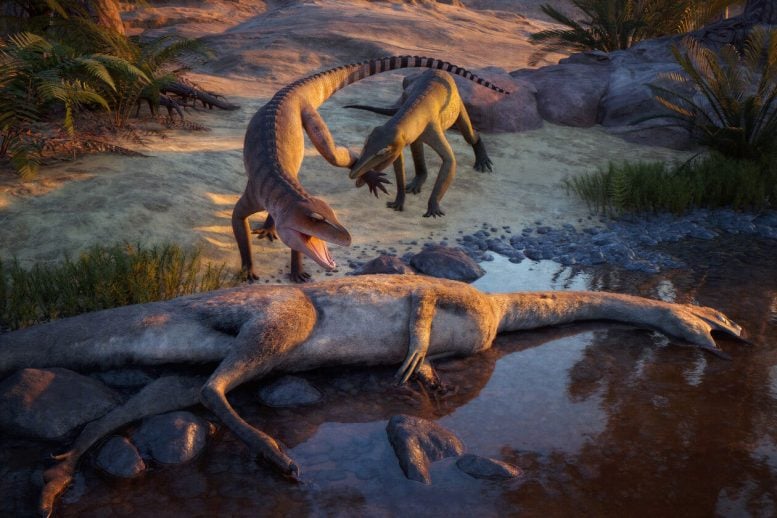
Eosphorosuchus Lacrimos Is Disturbed by Hesperosuchus AgilisA newly identified prehistoric crocodile relative, Eosphorosuchus lacrimosa, was discovered alongside another croc species in New Mexico fossils dating back 210 million years. Around 210 million years ago, two crocodile relatives about the size of modern jackals stood together along a humid riverbank in what is now northern New Mexico. One of them, Hesperosuchus agilis, [...]
  •  
❌