Les menaces numériques ne prennent plus forcément la forme d’attaques visibles. Elles s’installent parfois silencieusement, via un lien frauduleux, un fichier piégé ou une connexion détournée. Dans ce paysage où les risques évoluent constamment, Bitdefender adopte une approche différente :...
Les Français sont de vrais « jardinophiles » ! Et vous ? Avec cette chronique, (re)découvrez une plante, un fruit, un légume. Dans la famille des légumes oubliés, on demande la poire de terre. Discrète, celle qui se nomme aussi yacon mériterait pourtant d’être un peu plus présente dans nos...
Aux États-Unis, un homme est mort de la rage quelques semaines après avoir reçu une greffe de rein. Il s’avère que son donneur avait été contaminé par un animal, mais n’avait pas été diagnostiqué.
Sur Internet, les menaces ne se présentent plus toujours sous la forme d’alertes évidentes. Elles s’invitent discrètement, parfois avant même qu’un site ne semble suspect ou qu’un fichier ne paraisse dangereux. Phishing, arnaques en ligne, liens frauduleux ou logiciels malveillants circulent...
Sound wave scattering can be increased in one frequency range only by reducing scattering in another range, according to experiments—a discovery relevant for acoustic engineering.
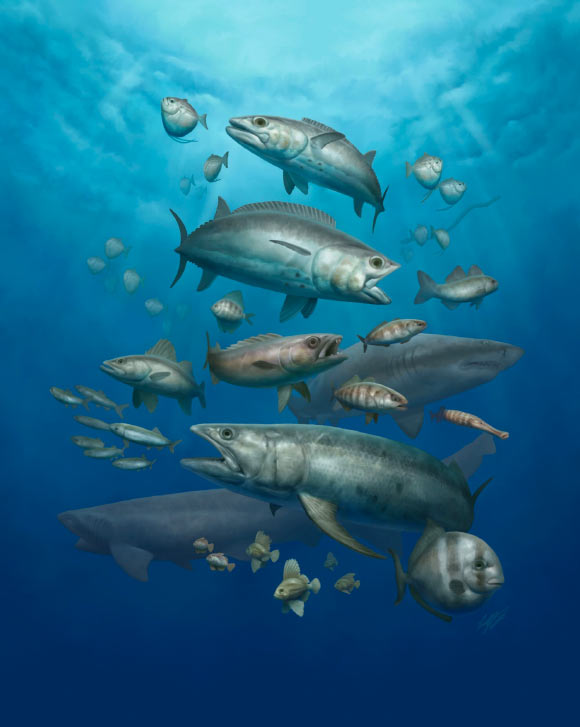
Paleontologists have described an assemblage of marine fish fossils from the 62.2-million-year-old site of Qreiya 3 in the Eastern Desert of Egypt, providing a window into this transition.
Days after successfully flying its Quarterhorse unmanned aircraft at supersonic speeds, an industry-first defense aviation company, Hermeus, has received the largest-ever contract awarded by the Defense Innovation Unit (DIU) to demonstrate high-Mach flight combined with high-Mach payload release.
The new $ 159 million award, which increases the original contract to a total of $219 million, will allow Hermeus’ engineers to expand on previous high-Mach test flight milestones in direct partnership with the U.S. Air Force and the U.S. Navy, with the goal of providing the American warfighter with the most advanced arsenal capable of delivering munitions and payloads around the world at record-setting speeds.
“By delivering flight-ready aircraft and demonstrating payload release at speed, we will prove this technology can create a decisive military advantage on a timeline that matters,” explained Hermeus CEO and co-founder, AJ Piplica. “Our focus is on providing the Air Force and Navy with the validated data they need to transition these platforms into the future force.”
High Mach Payload Release: “A Game Changing Warfighting Capability”
When announcing the new DIU award, Hermeus executives noted that the program will include a series of “intensive flight tests.” The first is expected later this year, while the final flights are expected sometime in 2027.
Although few specifics were provided, the company said the flights will “prove the aircraft can maintain high speeds and expand its performance limits” while also demonstrating the successful carry and release of payloads at high velocity. The company also noted that all flight data gathered during the development and testing phases “will directly inform service experimentation and future acquisition decisions.”
In May, Hermeus’ Quarterhorse Mk 2.1 unmanned aircraft successfully completed its first supersonic flight, reaching a top speed of Mach 1.21. Image Credit: Hermeus.
Although the U.S. Military has several aircraft capable of exceeding the speed of sound, and several more hypersonic (exceeding five times the speed of sound) aircraft and missile prototypes, delivering payloads from high-Mach aircraft has remained a challenge. However, some military experts argue that the U.S. would benefit greatly from the capability.
When discussing the need for high-speed payload release, DIU Military Deputy Major General Joe “Solo” Kunkel said that the largest problems the military is facing in the future are “generally around time and distance,” and the associated challenges with getting to distant locations “in a timeframe that matters.”
“I care about the warfighting capability, providing advantage to our partners and us in the fight, and making sure that we can walk into every fight with swagger,” General Kunkel said, adding that mass producing the technology developed by Hermeus could move it from a test platform to a “game-changing warfighting capability.”
“I think we found a significant number of use cases where it can be used as a weapon,” the General added.
Moving High-Mach Capability Out of the Lab
When discussing the company’s approach that convinced the DIU to offer its largest award in the organization’s history, including what they describe as “reclaiming the lost art of rapid iterative prototyping to build the fastest aircraft in the world today,” Hermeus noted that directly partnering with the USAF and USN allows their engineers to align tests with future mission needs and shorten the path from testing to deployment.
“By prioritizing relentless hardware iteration, we deliver high-speed systems at the pace of the modern battlefield,” the company’s statement explained. “We work with the Department of War to provide the high-speed capabilities our nation and its allies need to maintain a durable, asymmetric advantage.”
Image Credit: Hermeus.
When discussing the significance of the upcoming tests and the overall need for high-Mach flight payload deployment, including the benefit of the performance data, the company CEO heralded the DIU’s award, noting that the financing will help them move their successful demonstrations into real-world high-Mach platforms.
“This program is about moving high-Mach capability out of the lab and into an operationally relevant environment,” Piplica said.
Christopher Plain is a Science Fiction and Fantasy novelist and Head Science Writer at The Debrief. Follow and connect with him on X, learn about his books at plainfiction.com, or email him directly at christopher@thedebrief.org.
No evento "Delivering the Future" em Londres, a Amazon revelou a nova geração do robot Proteus, um investimento de mais de dez mil milhões de euros na Europa, entregas ultra-rápidas a expandir para mais cidades e um programa de formação global sem precedentes.
Real-world testing of an aircraft designed for ultra-long-haul operations has begun in France. Airbus has completed the maiden flight of the A350-1000ULR, a variant selected by Australian carrier Qantas for its Project Sunrise initiative. The aircraft features a modified fuel tank configuration, extended range capabilities, and the ability to remain airborne for close to 24 […]
A disappearing Venus, a planet parade, and the start of summer make June a must-see month for skywatchers. June brings several notable skywatching events, including a close meeting between Venus and Jupiter, a rare occasion when the Moon moves in front of Venus, the arrival of astronomical summer, and the return of favorite deep-sky sights. [...]
Nate Snow, diretor da unidade de negócio da Asus, diz que empresas procuram cada vez mais soluções combinadas entre hardware e software que permitam implementar inteligência artificial de forma prática e segura, reduzindo custos de utilização de tokens e com facilidade para escalar o negócio.
T-Mobile US unveiled an AI-enhanced network optimisation capability aimed at keeping customers connected during high-density events including at packed stadiums, festival grounds and in post-concert taxi queues.
The mobile operator’s Dynamic CX is built on its self-organising network (SON) platform, which is also used to allocate network resources during natural disasters.
Operators have been using centralised self-organising network (C-SON) tools since 2010. In 2015, machine learning algorithms were introduced and blended with SON algorithms, which led to the first iteration of AI-for-RAN.
It is another feature built on the operator’s nationwide 5G-Advanced network which sits on its standalone 5G architecture.
Dynamic CX’s AI-driven automation adapts to network conditions in near real time, marking a meaningful step beyond traditional SON optimisation, which has historically been more reactive in nature.
The AI-enabled network optimisation capability continuously monitors and tunes network performance.
Dynamic CX scans publicly available event information, schedules and online activity to identify upcoming mass gatherings before they happen, allowing the network to begin preparing capacity adjustments in advance rather than scrambling to react once congestion hits.
Once an event is underway, Dynamic CX shifts into continuous monitoring mode, tracking how demand evolves as crowds move, stream and share throughout venues and surrounding areas.
T-Mobile is positioning the launch ahead of the FIFA World Cup, which starts this month and uses 11 US host cities. It is expected to draw millions of international visitors over several weeks.
CTO John Saw framed Dynamic CX as part of a longer arc of event-readiness investment to improve customer experience.
T-Mobile pointed to broader World Cup operational preparations including coordination with public safety agencies, staged deployable network assets and heightened cybersecurity posture across event-related infrastructure.
On today’s time-traveling episode of Quick Charge, Tesla might be trying to erase evidence of FSD fraud, Caterpillar keeps trying to electrify the construction space, and time is rapidly running out on what’s left of the 30% home solar tax credit.
Paleontologists have confirmed that Praearcturus gigas, a creature that prowled shallow waters during the Devonian period, 415 million years ago, is the largest scorpion ever found.
PFDA, a PFAS “forever chemical,” can cause craniofacial birth defects by disrupting retinoic acid regulation during fetal development, revealing the first clear molecular mechanism behind the link. Researchers have long linked perfluoroalkyl and polyfluoroalkyl substances (PFAS), often called “forever chemicals,” to serious birth defects. However, scientists have struggled to explain exactly how these pollutants affect [...]
T-Mobile US officially opened a global capability centre (GCC) in Hyderabad, India, with plans to hire around 1,000 staff by 2027, its first such facility outside of its home market.
The Indian government stated T-Mobile, through its TMUS Global Solutions Technology subsidiary, opened a site spanning 250,000 square feet in the city, which is situated in the state of Telangana.
It will operate as a strategic innovation hub within its global network, focusing on software engineering, DevOps, product development, cloud technologies, AI, data analytics, cybersecurity and next-generation digital solutions.
Posting on X, minister for IT Sridhar Duddilla said T-Mobile’s GCC represented another significant milestone in Telangana’s growth as a technology and innovation destination.
“The decision by T-Mobile to expand its presence here reflects the confidence that global companies have in Telangana’s talent, business-friendly environment, and strong digital infrastructure.”
Chandra Gupta, VP IT operations at TMUS Global Solutions, added the company decided to locate the facility in Hyderabad as it offers “a combination of technology talent and an established innovation ecosystem aligned with the company’s long-term goals”.
The Economic Times of India reported the company has already onboarded more than 500 people at the facility,
According to Reuters, India’s GCCs have evolved from low-cost outsourcing hubs to offices for global companies, supporting parent companies in several functions.
Brown rot is a common fungal disease in the Southeastern United States that affects stone fruits like peaches, cherries, and plums. Monilinia fructicola is a tan, fuzzy fungus that grows on tree flowers, twigs, and fruit, and is the most common cause of brown rot. Once brown rot infects a tree, the damage is irreversible, causing significant crop losses in commercial orchards. Farmers try to control the spread of M. fructicola by applying chemical sprays, called fungicides, to fruit trees in the spring.
In M. fructicola, a biosynthesis gene named MfCYP51 encodes a major protein critical to the fungi’s survival. Certain fungicides, called demethylation inhibitor (DMI) fungicides, stop M. fructicola from growing by targeting this protein. Over the last 20 years, DMI fungicides have become less effective against brown rot as M. fructicola becomes more resistant.
Living microorganisms and their metabolites can control fungal diseases as an alternative to chemical fungicides, known as biofungicides. Many bacteria produce compounds like hydrogen cyanide and pyrrolnitrin that damage fungal cells. However, scientists have not found a biofungicide suitable for commercial production. A group of researchers at Clemson University in the USA and Huazhong Agricultural University in China set out to test whether the soil bacteria Pseudomonas chlororaphis and Bacillus subtilis could be effective biofungicides against brown rot.
The researchers performed an incubation experiment to analyze how the fungal cells make their critical protein from the MfCYP51gene, a process called gene expression, under different fungicide treatments. They used 3 M. fructicola strains sensitive to traditional DMI fungicides and 3 resistant strains. They tested these with 5 different fungicide treatments: a DMI fungicide, a mixture of P. chlororaphis metabolites, a mixture of living B. subtilis cells, a DMI fungicide + P. chlororaphis metabolites, and a DMI fungicide + B. subtilis cells. They also set up a control treatment with sterile water instead of fungicide.
After 6 hours, the researchers extracted the molecule that measures gene expression, called RNA, from the fungi. They found that both the P. chlororaphis treatment and the DMI fungicide + P. chlororaphis treatment substantially reduced MfCYP51 expression in both the sensitive and resistant isolates compared to the controls. In contrast, the DMI fungicide, B. subtilis, and DMI fungicide + B. subtilis treatments increased MfCYP51 expression in the resistant isolates. The researchers concluded that P. chlororaphis has a unique ability to reduce gene expression, unlike other biofungicides.
To further investigate how the biofungicide treatments work, the team tested whether P. chlororaphis and B. subtilis produced the anti-fungal metabolite pyrrolnitrin. They added 1 milliliter of each treatment to a machine that separates and identifies liquid compounds using high pressure, called a high-performance liquid chromatograph. They found that the P. chlororaphis treatment contained pyrrolnitrin, so they hypothesized that it was responsible for reducing gene expression.
Additionally, the researchers tested their 5 treatments on brown rot in fruit. For each treatment, they took 10 Gala apples, washed and sterilized their surfaces, and sprayed them with the fungicides. After 24 hours, they poked holes in the apples with toothpicks and added 20 microliters of liquid containing M. fructicola cells to the poked holes. They placed the apples in a humid chamber for 5 days and measured the number and size of brown rot spots that developed on their surfaces.
Despite decreasing MfCYP51 expression, the researchers found that P. chlororaphis treatment alone didn’t reduce brown rot disease compared to the control, but the DMI fungicide and B. subtilis treatments did. The mixed treatments of DMI fungicide + P. chlororaphis and DMI fungicide + B. subtilis both reduced brown rot disease compared to the control, but only the DMI fungicide + P. chlororaphis treatment prevented it.
The researchers concluded that although biofungicides may not be fully effective on their own, commercializing them could allow farmers to use less DMI fungicide. They explained that scaling back the use of DMI fungicides would slow M. fructicola resistance. Finally, they proposed that future researchers test biofungicide mixtures containing pyrrolnitrin in the field to observe real-world effects on stone fruit trees.

 Login