❌

Reading view

June 7, 1992: The Extreme Ultraviolet Explorer launches

NASA launched the Extreme Ultraviolet Explorer satellite, or EUVE, on June 7, 1992, to conduct an all-sky survey at wavelengths inaccessible from the ground. The first satellite designed to operate in the short-wave ultraviolet range, its “objectives included discovering and studying UV sources radiating in this spectral region, and analyzing effects of the interstellar mediumContinue reading "June 7, 1992: The Extreme Ultraviolet Explorer launches"

The post June 7, 1992: The Extreme Ultraviolet Explorer launches appeared first on Astronomy Magazine.
  •  

Jupiter Accelerates Electrons to Near-Light Speed, Offering Clues to Cosmic Ray Origins

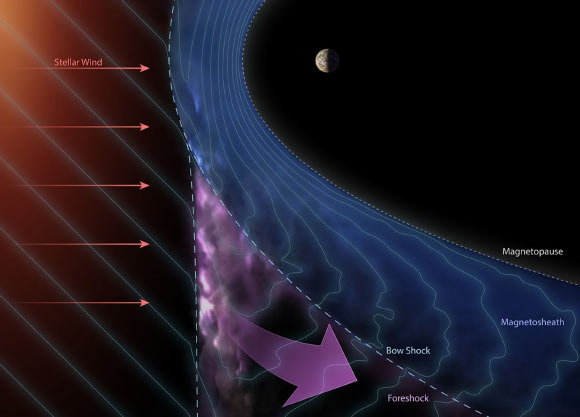
As planets and stars travel through the streams of charged particles flowing across space, their magnetic fields act like obstacles; incoming particles are slowed and deflected, forming a boundary called the bow shock; just ahead of this boundary lies the foreshock, a variable region where magnetic conditions can accelerate some particles to nearly the speed of light. Image credit: Ben C. Smith, Johns Hopkins Applied Physics Laboratory.

The giant planet’s bow shock isn’t just deflecting the solar wind, it’s acting as a powerful particle accelerator, firing electrons to relativistic energies of at least 1 MeV, according to a new analysis of data from NASA’s Juno spacecraft.

The post Jupiter Accelerates Electrons to Near-Light Speed, Offering Clues to Cosmic Ray Origins appeared first on Sci.News: Breaking Science News.

  •  

How One Company Plans to Mine the Bottom of the Sea

A look at the quest to mine the bottom of the ocean for valuable minerals, the connection between light pollution and allergies and more climate news.

© The New York Times

  •  

Meteorite Found in Africa Preserves Evidence of Long-Lost Massive Protoplanet

This is an artist impression of the protoplanetary disk around HD 107146. Image credit: A. Angelich / NRAO / AUI / NSF.

The Northwest Africa (NWA) 12774, an angrite meteorite discovered in the Sahara Desert, likely in Mauritania, appears to be a fragment of a vanished protoplanet, offering the strongest evidence yet that a large planetary body formed and was later destroyed during the Solar System’s chaotic infancy.

The post Meteorite Found in Africa Preserves Evidence of Long-Lost Massive Protoplanet appeared first on Sci.News: Breaking Science News.

  •  
❌