❌

Reading view

Jupiter Accelerates Electrons to Near-Light Speed, Offering Clues to Cosmic Ray Origins
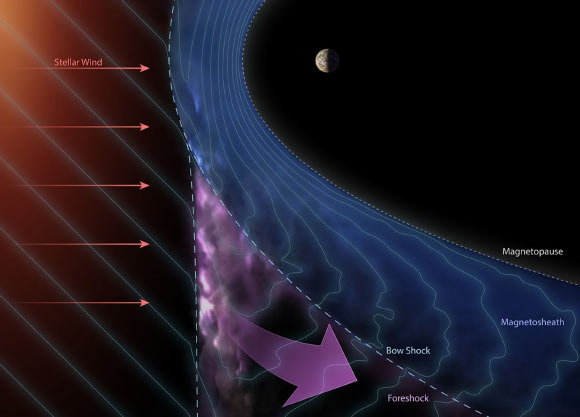
As planets and stars travel through the streams of charged particles flowing across space, their magnetic fields act like obstacles; incoming particles are slowed and deflected, forming a boundary called the bow shock; just ahead of this boundary lies the foreshock, a variable region where magnetic conditions can accelerate some particles to nearly the speed of light. Image credit: Ben C. Smith, Johns Hopkins Applied Physics Laboratory.

The giant planet’s bow shock isn’t just deflecting the solar wind, it’s acting as a powerful particle accelerator, firing electrons to relativistic energies of at least 1 MeV, according to a new analysis of data from NASA’s Juno spacecraft.

The post Jupiter Accelerates Electrons to Near-Light Speed, Offering Clues to Cosmic Ray Origins appeared first on Sci.News: Breaking Science News.

  •  

Fusão nuclear, IA e conectividade: Três forças que moldam a indústria do futuro

Ivo Ivanov aborda algumas das áreas que acredita irem marcar as tendências de futuro, destacando a inovação na fusão nuclear, inteligência artificial e na conetividade.

The post Fusão nuclear, IA e conectividade: Três forças que moldam a indústria do futuro appeared first on Tek Notícias.

  •  

Cinco projetos portugueses querem impulsionar investigação nas áreas do Espaço, fusão nuclear e física de partículas

Os projetos foram aprovados no contexto de um aviso ligado aos Roteiros Tecnológicos Big Science, que corresponde a uma das medidas do programa “Acelerar a Economia”, reforçando a presença da indústria nacional em grandes projetos internacionais de Big Science, avança a ANI.

The post Cinco projetos portugueses querem impulsionar investigação nas áreas do Espaço, fusão nuclear e física de partículas appeared first on Tek Notícias.

  •  

Webb Weighs Most Distant Inactive Black Hole Ever Found

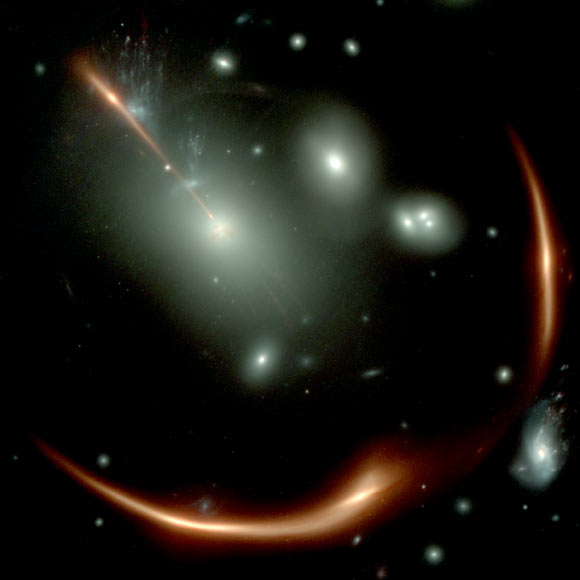
This Webb image shows the highly distorted red galaxy MRG-M0138 seen through a foreground cluster of galaxies (white sources). Image credit: NASA / ESA / CSA / Webb.

A supermassive black hole 6 billion times the mass of the Sun lurks in MRG-M0138, a gravitationally lensed quiescent galaxy seen when the Universe was just 3 billion years old, according to an analysis of data collected by the NIRSpec Integral Field Spectrograph onboard the NASA/ESA/CSA James Webb Space Telescope.

The post Webb Weighs Most Distant Inactive Black Hole Ever Found appeared first on Sci.News: Breaking Science News.

  •  

Alarme na Estação Espacial ultrapassado: NASA cancela evacuação de astronautas devido a fuga de oxigénio

Os quatro astronautas da missão Crew-12 foram instruídos pela NASA a vestir os fatos espaciais e a refugiarem-se na cápsula Dragon, enquanto cosmonautas russos tentam uma reparação mais extensa no módulo Zvezda.

The post Alarme na Estação Espacial ultrapassado: NASA cancela evacuação de astronautas devido a fuga de oxigénio appeared first on Tek Notícias.

  •  
❌