❌

Reading view

Apple to open its first developer center in Europe

Apple in recent years has opened Apple Developer Centers in Cupertino, CA, Shanghai, Singapore, and Bengaluru to allow developers to meet, exchange ideas or get help from trained staffers.

It is now clear a new developer center will open in Europe, specifically in the German capital of Berlin, later this year. “Europe is home to an extraordinary community of developers who build apps that connect people, encourage creativity, and drive innovation,” says Susan Prescott, Apple’s vice president of Worldwide Developer Relations, said in a statement.

Developers will be able to receive support for their apps, regardless of whether they are built for iOS, iPadOS, macOS, tvOS, macOS, or watchOS.

The announcement comes just a few days before the company’s big Worldwide Developer Conference (WWDC) gets under way.

  •  

What Safari reveals about Apple’s AI strategy ahead of WWDC

Apple’s latest Safari privacy campaign is more than pre-WWDC marketing. It is an early signal of how the company plans to frame artificial intelligence (AI): as something that only works if users trust the platform behind it.

The week before WWDC is often significant, as Apple tends to make announcements it simply can’t fit into the keynote itself. This year’s first pre-show reveal is a new campaign focused on privacy that shows how much more private Safari is than rival browsers; there’s even a highly entertaining video that makes the point.

Privacy on Safari

Apple has been building privacy protections into Safari for years. The browser protects you from malicious scripts that might attempt to access passwords or credit card information. Safari also tells you what data an extension wants to access and can restrict access to match your settings. It blocks third-party cookies by default, detects and removes trackers, and has measures in place to prevent data companies from identifying — and following — you through device characteristics. 

That’s even before Apple’s powerful Private Browsing mode, which includes meaningful protections. The company has put together a page packed with resources to explain the privacy protections it has in place across its platforms.

Privacy is critical to Apple — not only because the company regards it as a human right, but because it correctly recognizes that to make new generations of sensor-laden technologies it must ensure privacy is protected. Without privacy and trust, people won’t use the technology.

Trust is the product, not you

The truth is that people are becoming increasingly concerned about how the digital devices we depend on for convenience are now being used for different kinds of surveillance, and we need to be convinced that our personal data is protected. We do not want every aspect of our life to become fodder to feed a digital dystopia, even as we still want the positive solutions technology promises.

Think about the Apple Watch. Consider the data it gathers: distance walked, calories burned, and more — it’s a rich trove of personally identifiable data that no one really wants to share with others without consent. Apple Watch is not the only Apple device that is gathering information, even your web browser captures a great deal of it. Hence, the focus on Safari in Apple’s new campaign.

Privacy will become an even greater concern as AI spreads. Data brokering services already make extensive use of AI to analyze and identify patterns in the online data they harvest. AI deployed without strong privacy protections poses serious risks to the way we live, while the consolidation of AI ownership in the hands of a few companies risks creating dangerous imbalances of power. That’s the context in which private data needs to be protected, making privacy an essential component of a positive tech-augmented future. 

Why the AI era raises the stakes

Apple’s focus on privacy is far from new; it has been consistent in this work for many years. Competitors often accuse Apple of hypocrisy, but the company has been arguing for privacy’s importance for more than a decade. Others have adopted some of the same principles, though not all of them — and while Apple may sometimes use privacy as a moat for its own products and services, that does not diminish its value.

It’s with all this in mind that I consider Apple’s latest privacy ad campaign and its rollout just before WWDC, where it is expected to introduce new AI services. That Apple’s new privacy campaign seems not to have made the final cut for the show tells me the company has much more to discuss on the topic, particularly around Apple Intelligence.

What Safari’s signals suggest

When Apple introduces its new AI features at WWDC it will do so while celebrating the privacy built into them. The current privacy ad campaign will be part of an overall push as the company explains that its ecosystem can run third-party AI services while also offering its own bespoke Apple Intelligence AI to do really useful things in complete privacy.

This isn’t just a competitive moat, it’s a realistic assessment in practice. It shows that Apple understands that in the age of AI, privacy matters more than ever. As AI becomes central to everyday digital experiences, privacy is no longer optional — and Apple is prepared to make the case to support it.

You can follow me on social media! Join me on BlueSky,  LinkedIn, Mastodon, and follow The Core.

  •  
  •  
  •  

Apple poised to open first European developer centre

Apple unveiled plans to open a facility for developers in Berlin, Germany, a site intended to help European companies in creating and improving apps for the iPhone-maker’s devices.

The developer centre will be Apple’s first of its type in Europe. It runs similar facilities in Singapore, Shanghai, Cupertino and Bengaluru.

It is set to host workshops for app developers, one-on-one appointments and other in-person sessions in an attempt to help companies elevate the design and performance of applications for iPhones, iPads, macs and other devices using its operating systems.

Apple added dedicated labs will also offer hands-on support across multiple languages.

The company’s VP worldwide developer relations Susan Prescott said Europe was “home to an extraordinary community of developers who are building apps that create connections, encourage creativity, and drive innovation”.

“We have always believed that when developers have the right tools and resources to do their best work, incredible things follow. That belief is what this centre is built on, and we look forward to seeing what the community continues to develop.”

The site, located in the Mitte district of the German capital, is due to open later this year.

The post Apple poised to open first European developer centre appeared first on Mobile World Live.

  •  

AST SpaceMobile sees New Glenn setback delaying initial commercial service into 2027

AST SpaceMobile expects Blue Origin’s recent launchpad explosion will delay its direct-to-smartphone constellation by three to six months, investment bank William Blair said in an equity research note, pushing initial commercial services into the first half of 2027.

The post AST SpaceMobile sees New Glenn setback delaying initial commercial service into 2027 appeared first on SpaceNews.

  •  

Il rover sovietico Lunokhod 1, sbarcato sulla Luna nel 1970 e ritenuto disp…

Il rover sovietico Lunokhod 1, sbarcato sulla Luna nel 1970 e ritenuto disperso dal 1971, è stato localizzato grazie alle immagini della sonda LRO della NASA. Sfruttando le nuove coordinate, un team guidato da Tom Murphy ha puntato un raggio laser verso il veicolo dall'osservatorio Apache Point, ricevendo un fortissimo segnale di ritorno dal catadiottro di bordo. Lo specchio passivo, conservatosi in condizioni migliori rispetto a quello del gemello Lunokhod 2, non richiede elettricità e permetterà di misurare la distanza Terra-Luna con precisione millimetrica, aprendo la strada a nuovi test sulla relatività di Einstein e sullo studio del nucleo lunare.
  •  

After cooperation on SMILE mission, ESA and China chart parallel but separate paths

ESA and China recently launched the joint SMILE magnetosphere mission after a decade of cooperation, but despite similar goals, another collaboration appears distant.

The post After cooperation on SMILE mission, ESA and China chart parallel but separate paths appeared first on SpaceNews.

  •  

After a quick 1.1M sales, MacBook Neo set to reshape the PC industry

Apple’s MacBook Neo appears to be a triumph of strategic disruption that has already cast shock waves across the industry — and that energy is still playing out.

Approximately 55,000 MacBook Neo computers have been sold every day since it was introduced in March, according to IDC data (as first noted by TechCrunch). In fact, it looks as if Apple sold 1.1 million of these Macs in the first 20 days of sale, the analysts said.

There’s no real reason to imagine that level of demand has declined very much.

MacBook Neo: Millions sold

After all, not only do these Macs continue to dominate Amazon’s US laptop charts, but supply chain rumors claim Apple has doubled its manufacturing orders. “MacBook Neo shipments have come in better than expected, with the 2026 shipment forecast raised from 5 million to 10 million units,” Apple analyst Ming-Chi Kuo said recently. 

IDC’s March data may not capture the larger extent of the demand, as IDC analyst Navkendar Singh pointed out that MacBook Neo shipments “began to spike from early April”, which suggests demand has accelerated since then.

MacBook Neo demand exceeded expectations across multiple nations, including in India, where the company shifted 18,000 of them in the opening weeks.

Doing the business

Apple has also instructed processor maker TSMC to manufacture additional A18 processors specifically for its affordable laptop, while earlier speculation has claimed the company has been using ongoing memory price increases as a strategic competitive tool.  (The Neo starts at $599, with a pricier model set at $699.)

By expanding the potential customer base for Macs with a lower cost Neo, Apple is aiming a claim at the biggest-selling part of the PC market. And it is doing so even as rapidly increasing component prices force others to choose between higher product prices and profitability, or much-reduced margins in to compete at the same price. levels

That’s a losing battle; competitors for the most part can’t hope to match Apple’s bargaining position when it comes to the cost of components like memory because they don’t have the same scale. That means that even when component costs increase for everybody, Apple pays less, because it orders more. 

That scale means that for many component suppliers, it’s Apple’s business that keeps the meat on the table while other customers merely contribute the gravy. So, suppliers are happy to make deals with Apple to secure that main course — to continue the analogy — but are less likely to match those deals for dessert. As such, Apple is expected to be the only laptop vendor to see growth this year.

Apple’s great game

IDC’s figures confirm Apple’s strategy is working, with strong demand for the Neo, and, indeed, all Apple’s new laptops. At the same time, the researcher predicts overall global PC shipments will decline 11.3% this year, with a painful 20% sales drop envisioned for Q4. 

“We’re not seeing any relief to the memory shortage situation before the end of 2027, which means prices will continue to rise and PC manufacturers will struggle to maintain full product portfolios for the foreseeable future,” Jean Philippe Bouchard, vice president of devices and consumers at IDC said in a statement.

“The introduction of the MacBook Neo is putting real pressure on the entire PC ecosystem,” added Jitesh Ubrani, research manager for IDC’s Consumer Devices Trackers. 

Competitors are already responding with new devices equipped with ARM-based processors and aggressive promotional pricing. But none truly match what Apple has with MacBook Neo, and all must reach profitable scale to compete long-term. 

None have yet done so.

The strategy makes sense

“The MacBook Neo launch stands out as one of Apple’s most strategically important recent Mac releases,” Counterpoint analyst David Naranjo said. 

Apple is directly targeting customers that previously saw its products as too expensive. That allows it is also to aggressively build business in parts of the market such as education that tend to be more resilient to economic headwinds. MacBook Neo is also enjoying strong demand across the enterprise.

Both these parts of the market give Apple’s competitors their lunch. “The competitive pressure from the Neo is providing a partial offset to broader price increases, keeping some low-cost notebook options alive,” Ubrani said. “But the overall trajectory for average selling prices (ASPs) is firmly upward. IDC forecasts ASP growth of 17% in 2026, and even as memory capacity expands over the next two years, pricing is unlikely to return to 2025 levels.” 

Apple’s control over its processors, along with its strategic approach to component purchasing, means it should be able to maintain its existing Mac price points for a while. “Apple’s vertical integration (own silicon, own OS) gives it more levers than competitors reliant on third-party chips and Microsoft licensing,” Hexnode CEO Apu Pavithran told me recently.

So, while PC makers either exit the market or raise prices in pursuit of profits, MacBook Neo will continue racing off the shelves, particularly to large enterprise and education customers. 

The endgame? 

The Neo is more than a lower-cost Apple notebook. It’s a hugely disruptive product that is already driving noteworthy change across the PC industry; it’s forcing competitors to make difficult choices between cost and price — even as they grapple with the existential challenges of memory shortages, component price hikes, and raw materials costs. 

That’s not bad for a product that costs your local school just $499.

Just a reminder: the original $399 iPod cost only slightly less when it was first introduced, before subsequently disrupting the music industry.

You can follow me on social media! Join me on BlueSky,  LinkedIn, Mastodon, and follow The Core.

  •  

Astronomers Detect a Close Pair of Supermassive Black Holes for the First Time

Center of the Galaxy Markarian 501Researchers discovered a closely orbiting pair of supermassive black holes in Markarian 501 by tracking two jets of particles. The binary system could merge within 100 years and may produce detectable gravitational waves. Current evidence indicates that nearly every large galaxy contains a supermassive black hole at its center, with a mass ranging from millions [...]
  •  

A retro-geeky Android home screen remix

One of the best parts about using Android is the good old-fashioned geeky fun that comes with finding new ways to improve your digital environment — and improve your day-to-day efficiency.

That capability manifests itself in all sorts of interesting freedoms that (cough, cough) other mobile platforms don’t trust their users enough to allow — from added on-screen elements to custom air gestures, advanced multitasking additions, and all sorts of other shape-shifting enhancements that can completely change the way you interact with your device.

Perhaps the most classic example of advanced Android customization, though, is a splendid little somethin’ called the home screen launcher — a fancy way of saying the system that controls how your home screen and app drawer look and work. Your phone has a built-in process that handles that by default, but here in the land o’ Googley matters, you can always replace that with something completely different and make your device adapt to the way you like to work instead of the other way around.

We’ve got no shortage of interesting Android launcher options, too, ranging from versatile blank slates for complete customization to carefully crafted frameworks for ergonomic efficiency and even throwbacks to mobile operating systems past.

The real beauty of this ecosystem, though, is how much power it gives to Android developers — and subsequently to us, as Android-appreciating animals who embrace these creations! — to experiment and try out all sorts of new concepts. Sometimes, an Android launcher approach speaks to you for its practicality. Other times, it’s just a refreshingly interesting take on how you can get around your phone and get stuff done.

Today, I’ve got a perfect example to share with you. It’s a whole new approach to the Android home screen that’s both unlike anything else I’ve ever seen in this arena and delightfully familiar, in a retro-tech sense.

Lemme show ya what it’s all about.

[Get fresh Googley goodness in your inbox with my free Android Intelligence newsletter — three new things to try every Friday.]

The T9 Android launcher — with a modern twist

My friend and fellow enlightened Android phone owner, allow me to introduce you to a creative little concoction called Key Launcher.

Key Launcher has only been out and available on the Play Store for a matter of weeks now, but it’s impressively polished — and, even more important, impressively original while also having some fantastic geek-tech throwback vibes.

To that end, the core distinctive element of Key Launcher is the T9-style dialpad that sits front and center on the lower third of its primary panel. It is quite literally the same set of letter-packin’ numbers and characters you’d see on an old-school phone — or in the dialer of your favorite Android phone app.

width="1024" height="1022" sizes="auto, (max-width: 1024px) 100vw, 1024px">
The T9 keypad is the centerpiece of the Key Launcher Android home screen experience.

JR Raphael, Foundry

And in this context, it serves some pretty interesting purposes:

  • In true T9 style, you can find and access any app or contact on your phone simply by tapping the letter that corresponds with its name — and if you want to narrow down the list even further, you can keep typing letters to refine the results.
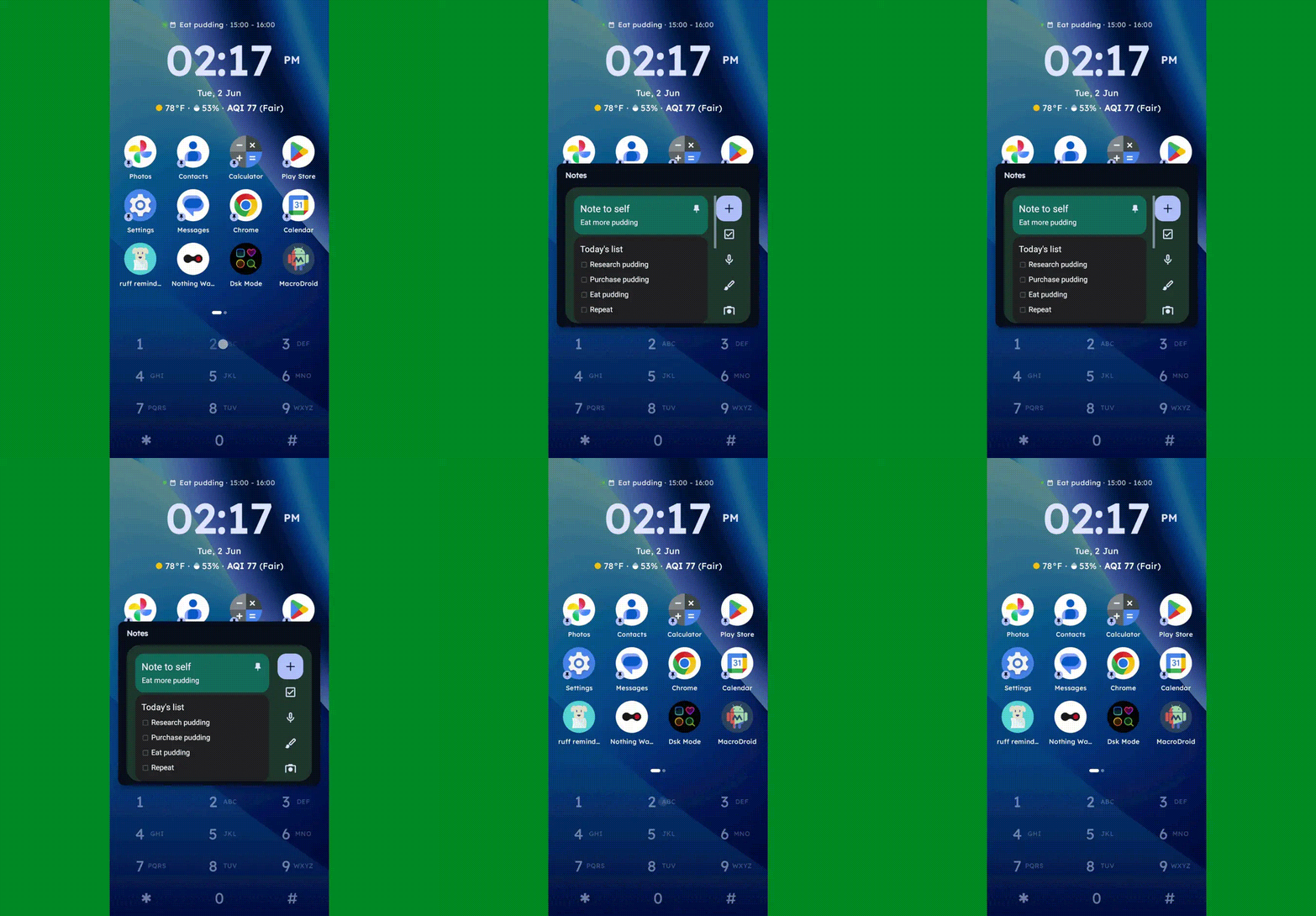
  • You can long-press any number to create and then access a custom “super shortcut” — anything from a single specific action (opening a particular app or calling or texting a certain contact) to launching a group or category of apps or contacts, launching an on-demand pop-up widget or swipeable stack of widgets, or even launching a pre-filled search query.
Key Launcher Android home screen widget pop-up
One press, and poof: Any widget you want — or series of swipeable widgets, even — is right there and ready.

JR Raphael, Foundry

  • If you tap the # key (known as “pound” in this context — not “hashtag” — for any non-olds among us), you can set up and then access a special “vault” area, where apps are hidden and only visible and accessible with authentication.
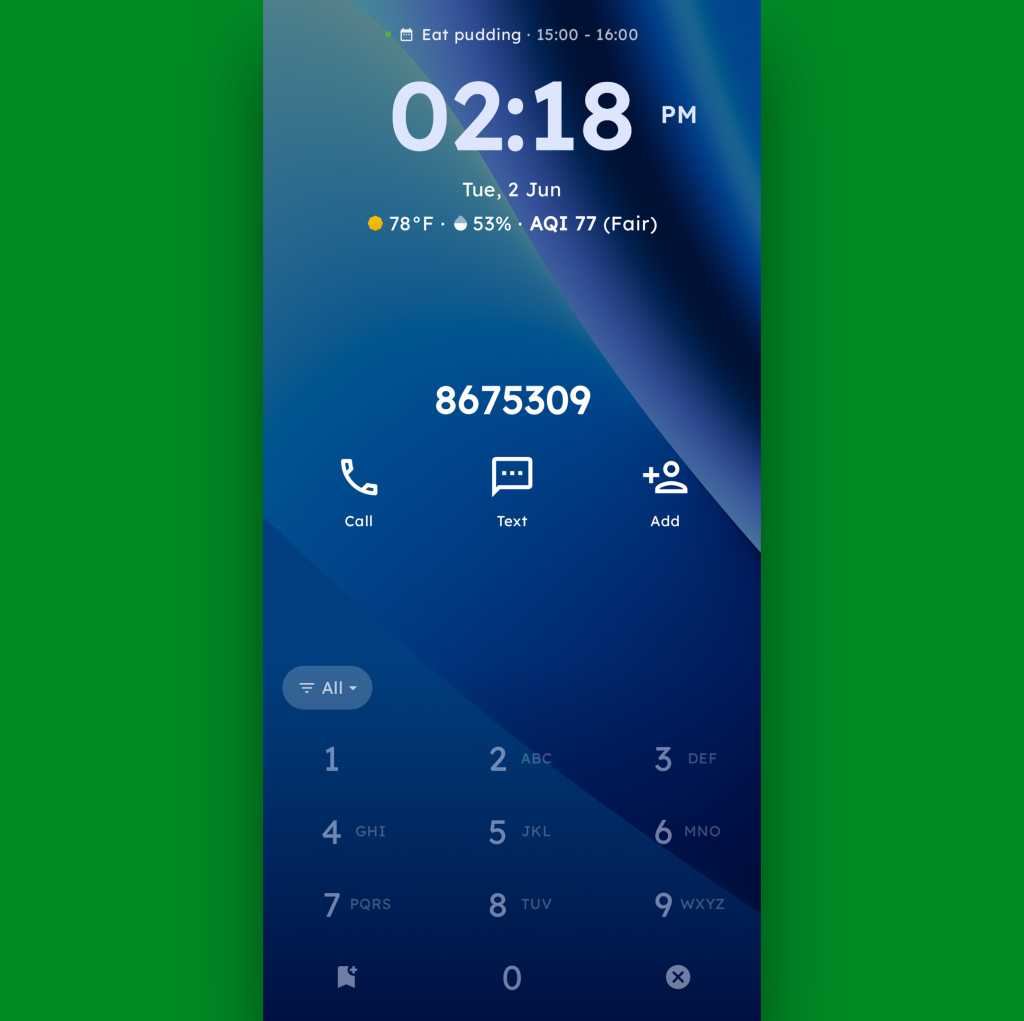
  • And, in an especially nifty touch, you can also just use the dialpad as an actual dialpad — to punch in any number you want to text or call, even if it isn’t already in your contacts.
Key Launcher Android home screen dialpad
Your phone dialer is always right in front of you with Key Launcher as your home screen.

JR Raphael, Foundry

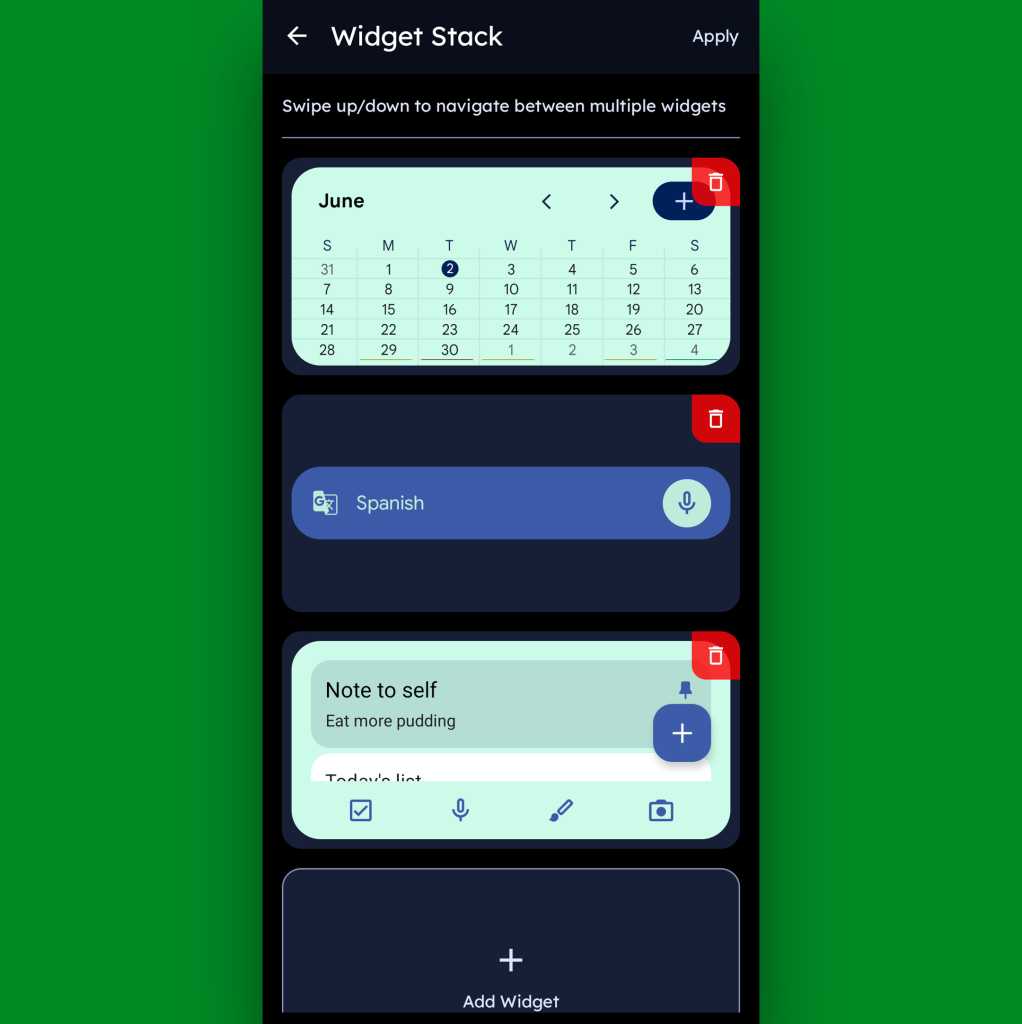
Function-packed as all of that may be, that dialpad is still just one piece of the Key Launcher puzzle. Above it sits a grid of app shortcuts that includes both your own pinned favorites and a dynamic selection of recently opened items. And above that is a handy built-in widget that shows a rotating array of upcoming calendar events from your agenda along with the local time and weather — and, in an especially neat twist, can also be customized to act as an interactive stack that lets you flip through your own set of standard Android widgets right then and there as well.

Key Launcher Android home screen widget stack
Key Launcher’s primary widget spot can be configured to hold numerous widgets in a swipeable stack.

JR Raphael, Foundry

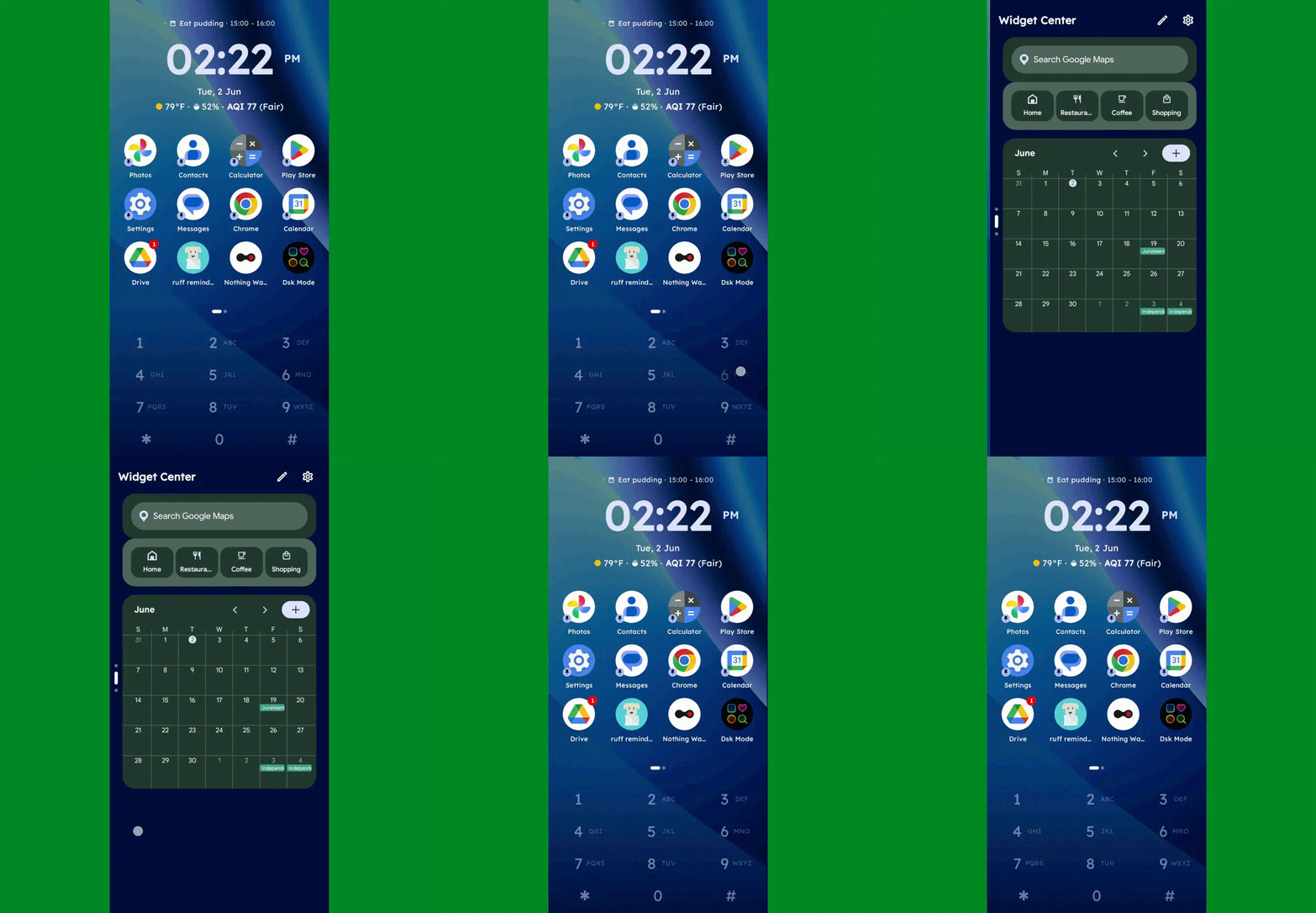
Speaking of widgets, if you swipe toward the left on Key Launcher’s dialpad, you’ll reveal the launcher’s built-in “Widget Center” panel — which is an entire screen dedicated to holding however many widgets you want, in any configuration you like, for easy ongoing access.

Key Launcher Android home screen widget center
The Widget Center is another interesting way to access widgets within Key Launcher.

JR Raphael, Foundry

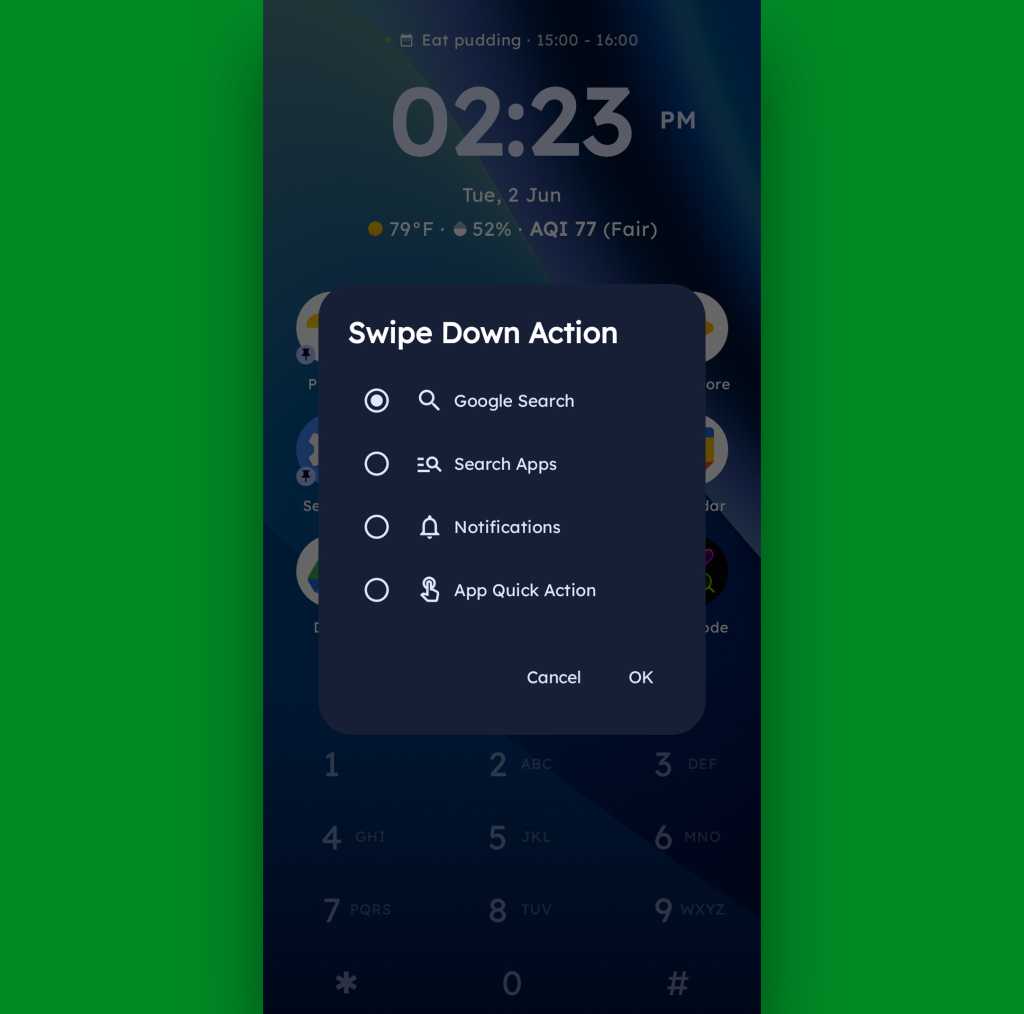
A swipe in the other direction will take you to an enlarged view of your active notifications, meanwhile, while a swipe downward can be set to launch either a quick search (of Google or whatever provider you prefer), a search of your apps, or a direct Android app shortcut within any app on your device.

Key Launcher Android home screen swipe action
Swiping down on your home screen can trigger a shortcut of your choice.

JR Raphael, Foundry

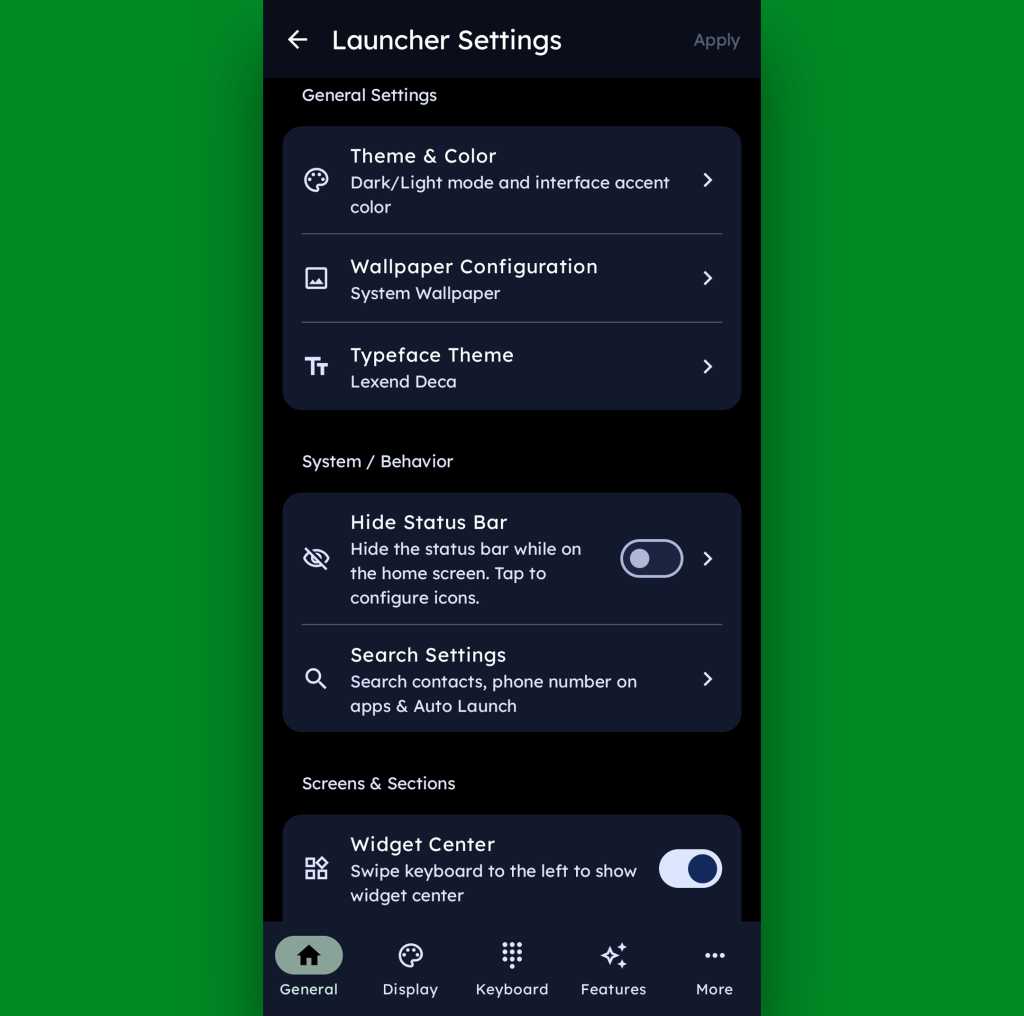
And if all of that seems like a lot of productivity-boosting possibilities, just wait ’til you get into this thing’s settings. Key Launcher is overflowing with options to customize and control practically every facet of its operation, ranging from basic visuals to the specifics of how the dialpad works and even a toggle for optimizing the interface for left- or right-handed use.

Key Launcher Android home screen settings
Key Launcher is no slouch when it comes to settings.

JR Raphael, Foundry

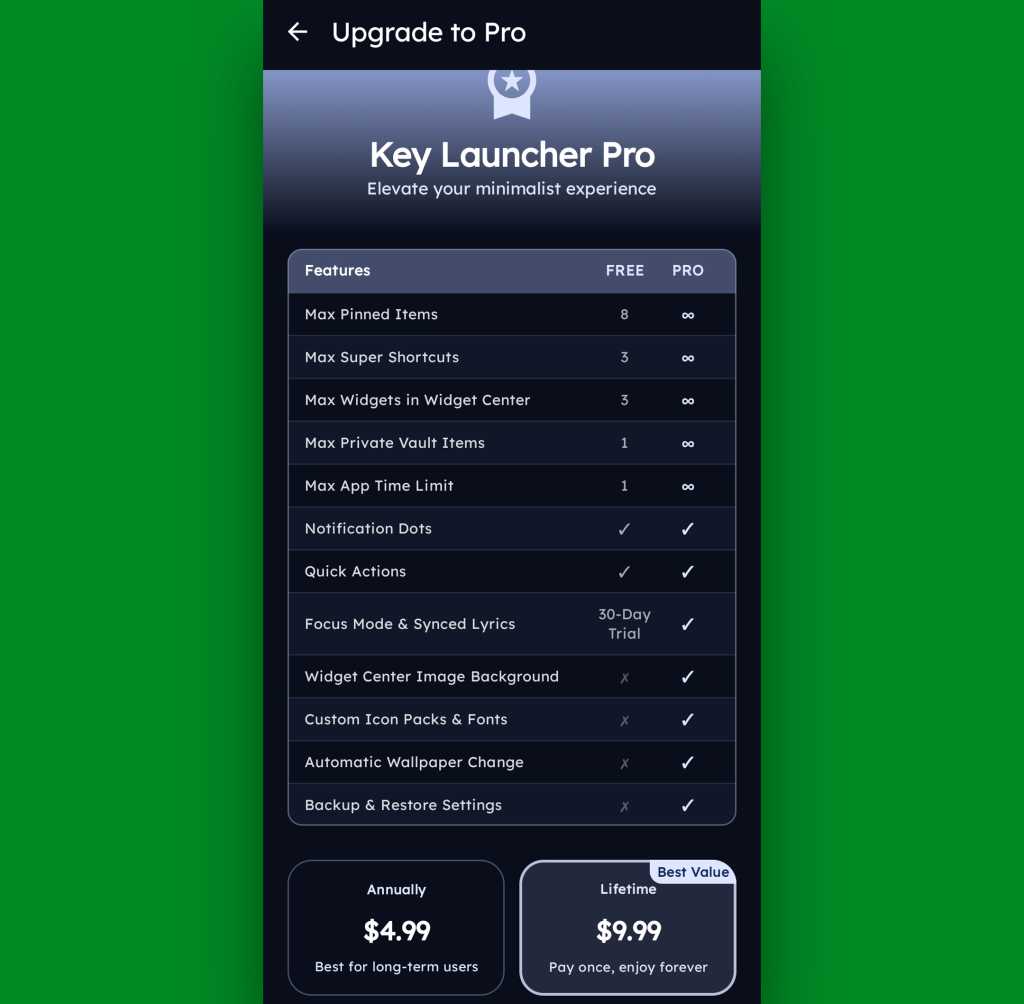
Key Launcher is free on its base level with an optional Pro upgrade that unlocks certain limitations and more advanced features. That path is available for five bucks a year or $10 as a single lifetime purchase, and you get a month-long trial the first time you install the app so you can check it out in its full form.

Key Launcher Pro Upgrade
The Pro path adds in lots of extras, but even Key Launcher’s free version is quite pleasant and functional.

JR Raphael, Foundry

Even if you just stick to the free version, though, this thing has an awful lot to offer — and it really is unlike anything else out there, with so many clever and potentially useful touches.

It’s that kind of creativity and constant discovery that keeps Android so interesting and advantageous, even after all this time — and that’s true whether you end up sticking with Key Launcher for the long haul or just giving it a go for a few hours and appreciating the deliciously original thinking it offers.

Keep the geeky goodies coming with my free Android Intelligence newsletter — three new things to try every Friday, straight from me to you.

  •  
❌