The 2026 Nobel Prize for Physics has gone to Francis Halzen for his “decisive contributions to the IceCube Neutrino Observatory and the discovery of high-energy neutrinos of astrophysical origin”.
In this episode of the Physics World Weekly podcast I am joined by the University of Oxford neutrino physicist Kirsty Duffy and Physics World’s Matin Durrani to talk about this year’s prize. This is the fifth time a Nobel prize has been awarded for work on neutrinos, and we explore why physicists are so enamoured with these elusive particles.
In this podcast we refer to my video conversation with Francis Halzen and his colleague James Roth and to Halzen’s book Quarks & Leptons. Kirsty Duffy presents the Even Bananas series of videos about neutrinos.
This podcast is supported by American Elements, the world’s leading manufacturer of engineered and advanced materials. The company’s ability to scale laboratory breakthroughs to industrial production has contributed to many of the most significant technological advancements since 1990 – including LED lighting, smartphones, and electric vehicles.
Francis Halzen wins the 2026 Nobel Prize in Physics “for decisive contributions to the IceCube Neutrino Observatory and the discovery of high-energy neutrinos of astrophysical origin”.
The prize will be awarded in Stockholm, Sweden on 10 December and is worth SEK 12 million (about $1.2 million).
Born in Belgium, Halzen is based at the University of Wisconsin–Madison in the US. Nearly four decades ago Halzen realized that the ice at the South Pole could be used to detect cosmic neutrinos. The first attempt was called AMANDA, which was completed in 2000 but not large enough to be up to the task. It was expanded to create IceCube by the end of 2010.
IceCube comprises thousands of light detectors in a cubic kilometre of Antarctic ice. Occasionally a neutrino will interact with the ice and create particles that generate light as they travel through the ice. By tracking these particles, Halzen and colleagues can determine where in the sky the neutrino came from.
Speaking on the telephone shortly after the announcement Halzen said, “It was a great surprise and I didn’t expect it. It’s a great pleasure to hear about this prize.”
“This was an adventure”
He added, “When I reflect on this moment, I have to say how lucky I am. This was an adventure where success was not guaranteed, but we overcame many challenges. It was a long journey. I want to emphasize again how lucky I was to take contributions from collaborators. It feels strange. I hope it reflects on the courageous people who joined me on this project. Many talented people joined me on this journey.”
He was also thankful for the support of his university, “I was lucky to be in the right place [Wisconsin] when this idea [to build IceCube] came up.”
Commenting on whether neutrinos could be used to communicate with extra-terrestrial beings, Halzen quipped, “This has already been proposed by several friends of mine. It has been speculated that this would be an ideal way to communicate with aliens but I don’t think I will go there. I think we have enough realistic problems to deal with right now to make neutrino astronomy a reality.”
When asked what he will do for the rest of today, Halzen replied “I’m working on a proposal. I hope this prize will help get it approved.”
“Halzen had the idea together with a colleague in 1988 to use the ice at the South Pole as a medium to detect neutrinos,” said Mark Pearce, chair of the Nobel Committee for Physics, who is also an astroparticle physicist at KTH Royal Institute of Technology in Stockholm.
International collaboration
Pearce adds, “Halzen has spearheaded an international collaboration of more than 450 people from 58 institutions in 14 countries around the world to realize this enormous neutrino detector.”
Halzen is the first sole winner of the Nobel Prize in Physics since Georges Charpak won it in 1992, with Pierre-Gilles de Gennes being the previous lone laureate in 1991.
This is the fifth Nobel prize related to neutrinos. The first went to the discovery of the muon neutrino, which was recognized by the Nobel committee in 1988. It was followed by the first observation of the neutrino itself (1995), the detection of cosmic neutrinos (2002), and the discovery of neutrino oscillations – the fact that neutrinos can switch from one type to another – in 2015.
Pearce explains why physicists are so fascinated by the elusive subatomic particle: “The neutrino has such peculiar properties, the fact it interacts so infrequently in material, and in this case it’s a way of bringing information about distant cosmic sources that we are unable to acquire in other ways.”
Halzen was born in Tienen, Belgium, in 1944. He graduated with an MSc in physics from the University of Louvain in 1966 and then a PhD from the same university in 1969.
After a stint at the CERN particle-physics lab, he moved to the University of Wisconsin–Madison in 1972, where he also became the principal investigator on the AMANDA neutrino observatory in Antarctica and the IceCube project.
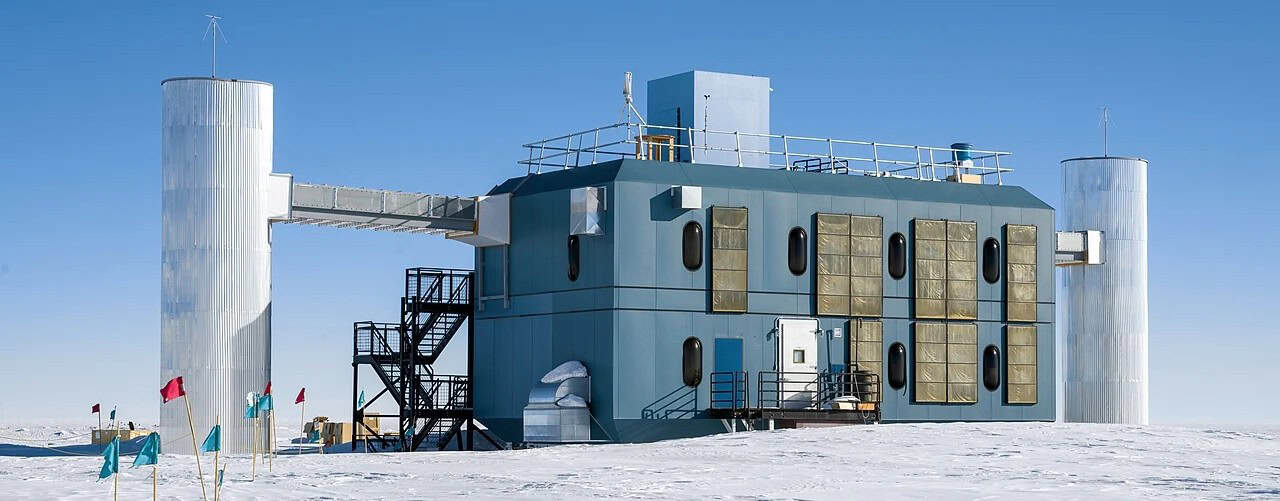
Tip of the iceberg A cubic-kilometre-sized neutrino detector lurks deep within the ice below the IceCube Laboratory building at the South Pole. (Courtesy: Christopher Michel/CC BY-SA 4.0)
IceCube was completed in late 2010. Then, it comprised 5160 digital optical modules suspended along 86 strings, each up to 2.5 km long and embedded under the ice at the Amundsen-Scott South Pole Station. The strings are spaced to create a total detector volume of a cubic kilometre. Neutrinos interact with matter only extremely weakly, so the array instead detects the tiny flashes of Cherenkov light produced when the neutrinos collide with hydrogen or oxygen nuclei inside the ice and create secondary particles. Under ideal circumstances, the detector signal can be used to work out where in the sky the neutrino came from.
In 2013 the IceCube Collaboration published details of its observation of 28 extremely high-energy particle events, created by neutrinos with energies of at least 30 TeV. The findings represented the first evidence for high-energy cosmic neutrinos, which originate from outside the solar system.
Two years later, IceCube confirmed the cosmic origin of high-energy neutrinos with an independent search in the Northern Hemisphere. This study examined muon neutrinos reaching IceCube through the Earth, using the planet to filter out the large background of atmospheric muons. Data analysis suggested that more than half of the 21 neutrinos detected above 100 TeV were of cosmic origin.
In 2018 IceCube, along with astronomers working on two gamma-ray telescopes, found compelling evidence that a known blazar – called TXS 0506+056a and located about 4 billion light-years from Earth – was a source of high-energy neutrinos detected by IceCube. This was an important milestone in multimessenger astronomy, whereby astronomical objects are studied by observing several different types of radiation.
Another breakthrough came in 2021 when IceCube was the first to spot an interaction called a Glashow resonance. This interaction was first predicted in 1960 and involves the collision of high-energy antineutrino with an electron to create a W boson. In 2022 the galaxy NGC 1068 was identified as a source of high-energy neutrinos and in 2023 IceCube showed that the Milky Way is also a source of high-energy neutrinos.
Earlier this year an upgrade of IceCube added more than 600 new light sensors in five new holes drilled in the ice near the centre of the detector.
In 2013 Halzen and his IceCube colleagues won the Physics World Breakthrough of the Year award. Hamish Johnston spoke to him about the experiment in this video:
Physics World is brought to you by IOP Publishing, which has a portfolio of more than 100 journals, around half of which are published jointly with or on behalf of partner societies and research organizations. Francis Halzen has published more than 150 papers with IOP Publishing and you can explore them here.
SmarAct proudly supports Physics World‘s Nobel Prize coverage, advancing breakthroughs in science and technology through high-precision positioning, metrology and automation. Discover how SmarAct shapes the future of innovation at smaract.com.
Next Tuesday the winner(s) of the Nobel Prize in Physics will be announced. To celebrate that most famous of prizes this episode of the Physics World Weekly podcast looks at a few fun aspects of past awards.
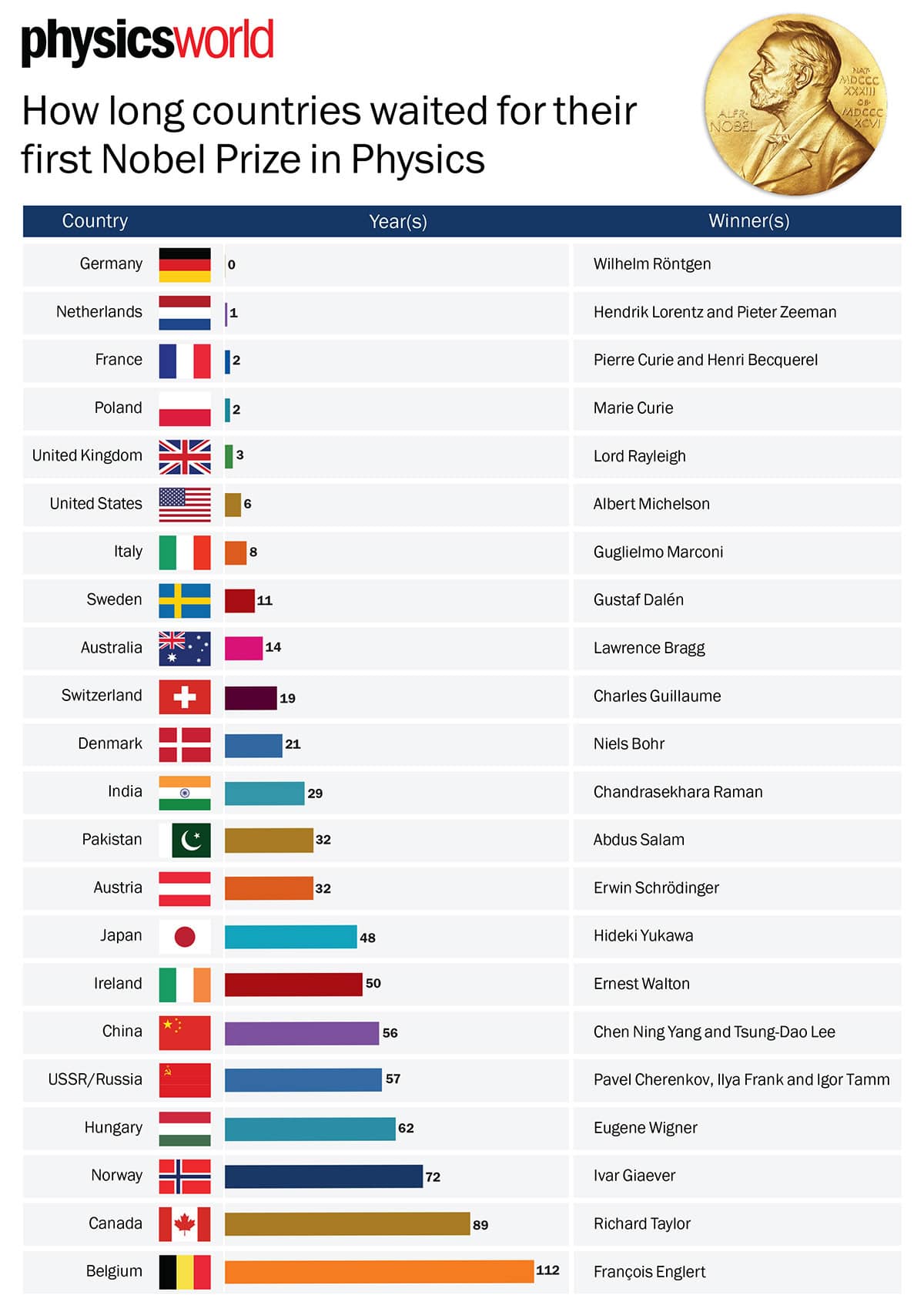
I’m joined by my Physics World colleague Matin Durrani to make a few predictions for next week. We also talk about our latest Nobel infographic – which looks at the time it took for countries to claim their first Nobel laureate.
Then I am joined by the Indian engineer Preetish Kakoty to talk about CV Raman, who was India’s first physics laureate. We chat about two ocean voyages that Raman took – journeys that reveal much about his devotion to science and his strong self-belief.
This podcast is supported by American Elements, the world’s leading manufacturer of engineered and advanced materials. The company’s ability to scale laboratory breakthroughs to industrial production has contributed to many of the most significant technological advancements since 1990 – including LED lighting, smartphones, and electric vehicles.
Waiting game Germany was the first nation to win a Nobel Prize in Physics, with Belgium the most recent. Click the image to expand. (Courtesy: Alison Tovey/IOPP)
How long did it take for your country to claim a physics Nobel laureate? Or perhaps you live in one of the 170 or so countries that has yet to produce a Nobel prize winner?
The aim of our latest infographic (see figure) is to answer that question by exploring the geographical evolution of laureates. Creating it, however, quickly became an exercise in the history of the past two centuries.
Map-changing wars in Europe, the demise of colonialism, and immigration made it surprising difficult to ascribe some laureates to specific countries and led to at least one debate amongst Physics World colleagues. I will get into some of these idiosyncrasies after I take a general look at the infographic.
What is obvious is the early Nobel physics laureates come from what many call the west. Germany is considered by many to be the birthplace of modern physics, so it is not surprising that the country had the shortest wait – with Wilhelm Röntgen bagging the first prize (in 1901) for his discovery of X-rays.
Until 1930, when the Indian physicist CV Raman won the prize for his eponymous scattering effect, the prize was only awarded to people from western countries. Indeed, of the 22 countries that can claim laureates (by our measures), only five are not in the west. These are India, Pakistan, Japan, Soviet Union/Russia and China. So far, there have been no laureates from Africa, Latin America or much of Asia and Oceania.
While much of this is down to better access to education and research resources in the west, increasing global mobility means that students and researchers from all over the world are working in the west – and wealthy countries like China, South Korea and Japan. So why aren’t they bagging Nobel firsts for their home countries?
Indeed, only three laureates in the infographic who took that route are China’s Chen Ning Yang and Tsung-Dao Lee – who did their prize-winning work in the US – and Abdus Salam, who did much of his prize-winning work in the UK and Italy. Hopefully, this year’s crop of winners will include someone who is not from one of those 22 countries. While it’s likely that they will be working in the west, wouldn’t it be great if they won for work done in their home country.
Established nations
So how did we decide where a laureate is from? To work this out we considered where that person was born, where that place is today and – in some cases – what we know about a laureate’s view on their own nationality.
A case in point is Ernest Walton, who we consider to be the first Irish laureate. He was born in 1903 in Dungarvan, which is on the south-east coast of the Republic of Ireland. At the time of his birth, however, his birthplace was in the United Kingdom of Great Britain and Ireland – as all of Ireland was then a constituent nation of the UK. So Walton was born a British subject.
However, we consider him Irish for several reasons. First, although Ireland was not a sovereign country in 1903, it was a well-established national entity that was on the road to independence before Walton reached adulthood. Second, although Walton did his award-winning research in England, he spent most of his life in Ireland. Third, there is no evidence that he was a unionist – someone who opposes Irish independence and considers themselves British.
The above might upset readers in Scotland and Wales because both of those nations have spawned physics laureates who don’t appear in our infographic. But unlike in international football, rugby and cricket, Scotland and Wales will have to wait for independence from the UK before they get their own laureate teams in our infographic.
Similarly, Marie Curie was born in Poland when it was a part of the Russian Empire. But Poland was identifiable as a country in 1867 and it gained independence during Curie’s lifetime. Indeed, Curie was clearly a proud Pole, because she named the element polonium after her homeland in the hope that Poland would become unified and independent.
We have included Lawrence Bragg as the first Australian to win a Nobel prize. He was born in Adelaide in 1890, when the Australian colonies began the journey to independence from the UK. While Bragg is often considered British, we have decided he is Australian because he left the country for the UK in 1908 – seven years after Federation created the Commonwealth of Australia, which was independent from the UK for domestic issues.
Dealing with decolonization
I mentioned that there are no laureates from Africa in our infographic, but three physics Nobel prize winners were born on the continent. These are Claude Cohen-Tannoudji (born in Algeria), Serge Haroche (born in Morocco) and Pierre Agostini (born in Tunisia). However, all were born when these countries were French colonies and they all left for France when they gained independence.
Some readers might be scratching their heads over how we have dealt with the time Pakistan had to wait for its first Nobel prize. Salam bagged that prize in 1979 – so a 78-year wait from 1901, when the first prize was awarded. So why have we calculated the wait as just 32 years?
The reason is that unlike Ireland, Poland or Australia, the concept of Pakistan didn’t exist when Salam was born in Lahore in the British Raj in 1926. The word Pakistan is thought to have originated in 1933 and the call for a Muslim homeland crystalized in 1940 with the Lahore Resolution. So, we have decided to start the clock for Salam in 1947.
Other laureates who merited scrutiny include Albert Michelson, who was born in Poland but arrived in the US age two. As a result, we consider him to be the first American laureate. Indeed, Michelson wouldn’t appear in the infographic if we considered him a Pole because he was pipped at the post by Marie Curie.
Similarly, Gabriel Lippmann was born Luxembourg to French parents and moved to France age three, so we consider him French and not the first laureate from Luxembourg. However, we are a big fan of Lippmann here at Physics World because of the nature of his award – which was for a still-obscure colour-photography technique.
Indeed, my colleague Margaret Harris bagged an award of her own from Association of British Science Writers for her feature article that explores Lippmann’s prize, and that of Gustaf Dalén – the first Swede to win a physics Nobel prize. That article is called “The physics Nobel prizes you’ve never heard of”.
SmarAct proudly supports Physics World‘s Nobel Prize coverage, advancing breakthroughs in science and technology through high-precision positioning, metrology and automation. Discover how SmarAct shapes the future of innovation at smaract.com.
Here at Physics World we have had some luck with predicting who is going to win a Nobel Prize in Physics. One successful strategy is to identify top physicists and just keep predicting that they will win – and eventually they do!
For example, we picked Anton Zeilinger for the 2009, 2013, 2014, 2015 and 2019 prizes – and he won in 2022. Clearly, it was a mistake to give up on him in 2020.
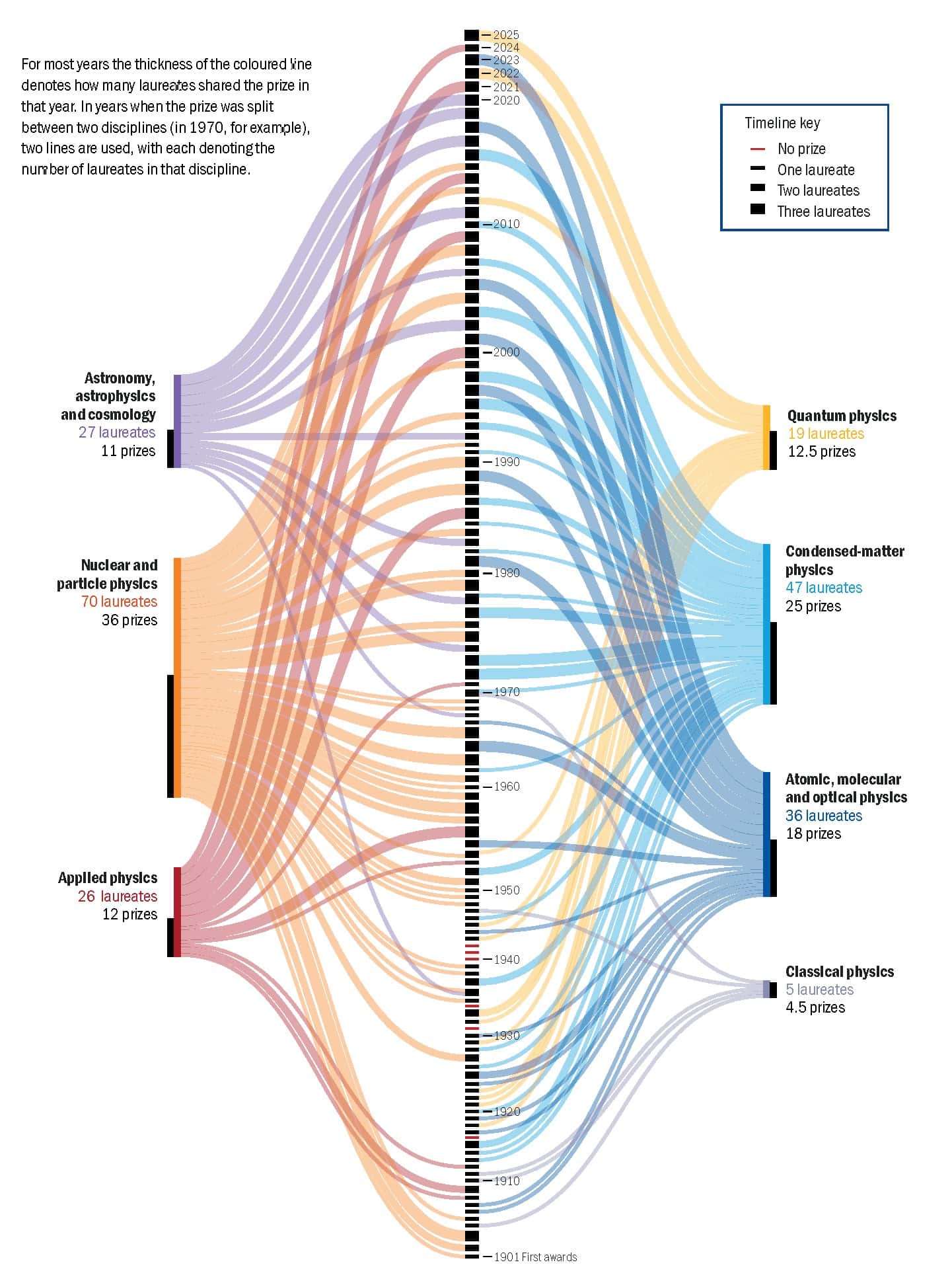
In making our predictions we sometimes rely on an infographic that we have been updating for a decade or so. It shows the chronological progression of Nobel prizes in terms of fields of endeavour – such as condensed matter, particle and nuclear, quantum and more (see figure).
By staring at the infographic for far too long, we have convinced ourselves that there is a regular pattern of gaps between prizes in specific fields. Looking at the latest version of the infographic it appears that both condensed-matter physics, and particle and nuclear physics are due a prize.
I have really struggled to think of a particle and nuclear breakthrough that could bag the 2026 Nobel – but I believe I have come up with one or two contenders. One is a prize for physicists working on CERN’s ATHENA and ALPHA collaborations, who were the first to trap cold antihydrogen atoms and then study them in detail. One laureate would surely be the Denmark-based American physicist Jeffrey Hangst, who is a founder of both collaborations. Making extremely precise comparisons of the properties of antihydrogen and hydrogen could reveal why there appears to be much more matter than antimatter in the universe – an important mystery in physics.
But alas, these and other antimatter experiments have yet to find any significant deviations from the Standard Model description of antihydrogen, so that might preclude a Nobel prize for Hansgt and one or two of his colleagues. And another caveat is one could easily argue that many of the innovations at ATHENA and ALPHA are in the field of atomic and molecular physics, not particle and nuclear physics – so there would be much debate here at Physics World if we had to update our infographic with an antihydrogen prize.
Another potential prize in particle and nuclear physics is for the the creation of the quark–gluon plasma (QGP). This is a state of matter that occurs very briefly when large nuclei (such as lead or gold) are collided at high energies. The result is a soup of quarks and gluons that is thought to resemble the early universe shortly after the Big Bang. Studying the QGP is a fascinating and important area of physics, but because the experimental work has been done by large collaborations at both CERN in Switzerland and at Brookhaven National Laboratory in the US it would be difficult to select just three people as Nobel winners. The fact that scientific breakthroughs in particle and nuclear physics are often made by large collaborations has led some to call for the three-person limit on prize winners to be lifted.
The field of condensed matter is much more fruitful when it comes to potential Nobel prizes. The analytics company Clarivate has released its “Citation laureates 2026 in physics”, which predicts Nobel winners based on the citation impact of their published research. Clarivate (and its predecessor Thomson Reuters) has a reasonably good record of picking winners and this year all three of its predictions are in condensed matter physics.
Organic LEDs
One prediction is a prize to Chihaya Adachi, Stephen Forrest and Mark Thompson for work leading to the development of ultrahigh-efficiency organic light-emitting diodes. The second is to Nicola Spaldin for her theoretical work on room-temperature magnetoelectric multiferroics, which Clarivate says are enabling new energy-efficient device paradigms. The third prediction is to Qikun Xue “for experimental observation of the quantum anomalous Hall Effect”. What all three of these awards have in common is a relatively immediate connection of the development of new technologies.
Spaldin was profiled in Physics World back in 2023 and she talks about the joy that she gets from her research, which combines blue-sky research with the design of real materials.
Other prestigious awards are also a good place to look for potential Nobel winners. The 2026 Kavli Prize in Nanoscience went to the physicists Eva Andrei, Pablo Jarillo-Herrero and Allan MacDonald for their pioneering work on twistronics. This is a burgeoning field that involves rotating the relative angle between two sheets of 2D material such as graphene. Rotations create moiré superlattices with a wide range of electronic properties including superconductivity.
I am also keen on an award for the applied physicist Federico Capasso. As well as developing a wide range of semiconductor technologies – including the quantum cascade laser – Capasso has done seminal work on optical metamaterials. An award for such metamaterials could be shared with John Pendry (a 2024 Kavli nanoscience laureate), who has developed a mathematical framework for designing optical metamaterials. These days prizes are usually awarded to trios, so potential partners for Capasso and Pendry are David Smith – a pioneer in creating metamaterials that operate at microwave frequencies – and Andrea Alù who is a prolific researcher in photonic metamaterials. Other possible winners in this field are Ulf Leohardt, Nader Engheta, George Eleftheriades and Vladimir Shalaev.
Wavelet theory
Finally, a potential prize that I find intriguing is inspired by “Clarivate’s Citation laureates 2025 in physics”. This proposes Ingrid Daubechies, Stéphane Mallat and Yves Meyer “for advancing wavelet theory, a revolution in mathematics and physics with practical applications including image processing”. Such an award would be difficult to shoehorn into a category in our infographic. I think applied physics would be the best fit.
The 2026 Nobel Prize in Physics will be announced on Tuesday 6 October at 10:45 a.m. BST at the earliest.
SmarAct proudly supports Physics World‘s Nobel Prize coverage, advancing breakthroughs in science and technology through high-precision positioning, metrology and automation. Discover how SmarAct shapes the future of innovation at smaract.com.
This episode of the Physics World Weekly podcast features Lin Ma, who is at the University of North Carolina at Chapel Hill. His research group tackles energy and environmental challenges using sustainable materials and electrochemical techniques.
In this episode I chat with Ma about the growing importance of energy storage in electricity grids. Much of this is driven by the growth of wind and solar generation, which can both be intermittent in nature.
Ma talks about the batteries that are currently used in grids and explains what improvements are needed as more renewable energy comes on line. We chat about the different battery technologies that can be used for grid storage and Lin explains why sodium-ion batteries offer advantages over lithium-based devices when it comes to large-scale deployment. Lin also talks about some of the safety issues surrounding large battery facilities and how artificial intelligence can be used to improve many aspects of battery technology.
This podcast is presented in partnership with the Electrochemical Society. The mission of the ECS is to advance theory and practice at the forefront of electrochemical and solid state science and technology, and allied subjects.
Could radioactive atoms in a Bose–Einstein condensate (BEC) form a “superradiant neutrino laser”? According to a paper published last year by Benjamin Jones of the University of Manchester and Joseph Formaggio of the Massachusetts Institute of Technology the answer is “yes”. We were intrigued by this proposal and commissioned the freelance physics writer Tim Wogan to write an article for us.
As part of his reporting, Wogan sought the opinion of a BEC expert – James Thompson of NIST, JILA and the University of Colorado in Boulder. Thompson told us that he was sceptical of the viability of such a device – in particular, he pointed out that the de Broglie wavelength of the emitted neutrinos is much too short for superradiance to occur.
Now, another physicist (Wolfgang Ketterle, who shared a Nobel prize for his pioneering work on BECs) has published two papers that cast doubt on Jones and Formaggio’s proposal. All three papers are published in a very prestigious journal, so this is a scientific debate of note.
So what is superradiance, and how could it be used to create a source of coherent neutrinos?
Coherent burst
Superradiance was originally envisioned in an ensemble of excited atoms, each of which can decay by emitting a photon. Normally, the rate at which photons are emitted from such an ensemble is simply proportional to the number of atoms present. Double the number of atoms, and the rate of emission will double. However, if the ensemble is dense enough that the wavelength of the emitted photons is much longer than the separation between neighbouring atoms, the emission of a single photon will involve all of the atoms. What is more, the superradiant emission rate is proportional to square of the number of atoms. The result is short, intense burst of coherent radiation. It is this coherence that has caused some to refer to superradiant lasers – although the physics of lasers is different.
Jones and Formaggio’s proposal involves radioactive atoms that decay with the emission of a neutrino, rather than a photon. Their idea is to cool an ensemble of these atoms to near absolute zero so that it forms a BEC. This is a unique form of matter that can be described as a macroscopic quantum state. Under this condition, the duo argued that neutrinos would be emitted rapidly from a superradiant state.
Now, Ketterle, Yu-Kun Lu and Hanzhen Lin at the Massachusetts Institute of Technology argue in two papers that such a superradiant neutrino laser is an impossibility. As well as backing up Thompson’s concerns about the short wavelength of the neutrinos, they point out that the atoms produced by the neutrino decays are fermions, and this precludes superradiance. They also showed that the recoil of atoms after neutrino emission would not allow the coherent emission of neutrinos to occur.
I think this is a fascinating subject and I hope that Jones and Formaggio can revive their proposal, because a BEC-based neutrino laser would be very cool!
You can read more about the debate in an article in Physics by Thompson and colleagues.
My guest in this episode of the Physics World Weekly podcast is Marco Caffio, who is co-founder of iGii. The UK-based company has developed a porous 3D carbon nanomaterial called Gii, which it manufactures for a range of customers and applications.
Caffio describes Gii as a 3D version of graphene that delivers many of the useful electronic, structural and chemical properties of that 2D wonder material. Unlike graphene, which can be difficult to manufacture and integrate into devices, Caffio explains that Gii can be customized for use in practical technologies such as chemical sensors, batteries and heaters.
We also chat about the genesis of the company and Caffio offers career advice to physicists who are keen on working in the materials-technology sector.
This episode of the Physics World Weekly podcast explores how the innate curiosity of children can help make quantum mechanics more accessible to the public. My guest is Katia Moskvitch, who co-hosts The Quantum Kid video channel with her 10-year-old son Kai.
As well as interviewing leading lights in quantum science and technology – including Nobel laureates – the duo has toured science labs including CERN. Moskvitch explains how the programme’s child-led approach puts guests at ease and helps them explain difficult concepts to a general audience.
Moskvitch believes that children can be more receptive to counterintuitive quantum concepts than adults and argues that an early familiarity with quantum physics could inspire young people to study science. This, she believes, will provide a foundation for success in the burgeoning quantum sector.
This podcast is supported by American Elements, the world’s leading manufacturer of engineered and advanced materials. The company’s ability to scale laboratory breakthroughs to industrial production has contributed to many of the most significant technological advancements since 1990 – including LED lighting, smartphones, and electric vehicles.
Credibility is a cornerstone of modern science and concepts such as reproducibility and peer review have evolved to ensure that the knowledge produced by scientists is high quality. However, for science to thrive and benefit everyone, scientists themselves must be seen as credible to the general public.
This episode of the Physics World Weekly podcast features Shumaila Bhatti and Dara Wald who are social scientists at Virginia Tech in the US. They have done a comprehensive study that reveals that the perceived motivation of a scientist plays an important role in how credible they appear to the public.
The study involved nearly 1000 subjects in the US and a key result is the identification of five audience classes that differ in terms of their perceptions of scientific credibility. Wald and Bhatti talk about their motivation for doing the study and its interpretation. One of their findings is that people in all classes don’t tend to doubt the expertise of scientists, but they would prefer scientists to honest and motivated by the public good.
One of my favourite books about physics is The Second Kind of Impossible: the Extraordinary Quest for a New Form of Matter by Paul Steinhardt. It chronicles how the physicist and his colleagues established the extra-terrestrial provenance of a mysterious quasicrystal sample and then trekked to its likely place of origin in the Siberian wilderness.
That sample was first identified by the Italian geologist Luca Bindi, who features throughout the book and specializes in the discovery of new minerals. I was delighted to see that Bindi has a new paper out that identifies a hitherto unknown material. That excitement was tempered by the fact that the alloy was created by the catastrophic nuclear explosion over the Japanese city of Hiroshima.
On this day in 1945, an atomic bomb was detonated at 580 m over the city, creating a fireball where temperatures exceeded 7000 °C. As many as 140,000 people were killed by the bomb, which destroyed about 70% of the city’s buildings.
Rapid condensation
The fireball was a turbulent plasma of vapourized material from the city. This included building materials, metals, soil, water and, we mustn’t forget, some of the city’s residents. The plasma condensed rapidly creating glassy particles of micron–millimetre size that rained down on the Hiroshima area. These “hiroshimaite” particles mostly comprise of calcium, aluminium and silicon and can be found in the sandy beaches of Hiroshima Bay.
“The fireball left behind materials that never existed before,” says Bindi – who is based at the University of Florence. He adds that these hiroshimaites are helping scientists understand how matter behaves under extreme conditions – describing the fireball as a “giant accidental material-science laboratory”.
Unusual structure
In this latest study, Bindi and colleagues in Italy, the US and Switzerland have identified a new metal alloy in a piece of hiroshimaite. The metallic grain is about one micron in size and is a homogenous mixture of six metals and silicon. X-ray diffraction shows that the alloy has an unusual crystal structure. This, along with the alloy’s high silicon content, make it a special material that has never been seen before.
According to Bindi, the alloy was formed by the condensation of a complex metallic vapour that was created by a range of materials that were caught up in the nuclear fireball. As the fireball cooled rapidy, a tiny droplet of metals and silicon condensed from the plasma. Then as the temperature dropped at an extraordinary rate, the droplet solidified and its metastable crystal structure was frozen in. This violent quenching prevented the alloy from evolving to a more common crystal structure.
This is not the first time that Bindi has found a new material in the debris of a nuclear explosion. A few years ago his was part of a team that discovered a quasicrystal in a piece of trinitite – glassy material that was created in July 1945 by the Trinity nuclear bomb test in New Mexico.
This episode of the Physics World Weekly podcast features Yonatan Cohen, who is co-founder and chief technology officer of Quantum Machines.
The company was started in 2018 by three physicists from Israel’s Weizmann Institute. It develops control systems for quantum computers and has about 300 employees and 500 customers worldwide.
Cohen explains why hybrid quantum–classical control systems are increasing in importance as quantum computers scale-up to include more and more qubits. He also talks about Quantum Machines’ strategy to support a wide range of qubit types – including superconducting circuits, trapped ions, neutral atoms, spins and NV centres.
We chat about some of the company’s products and its collaborations with quantum-technology companies including Rigetti Computing and Diraq. Cohen also gives career advice for physicists who want to work in the quantum sector.
This episode of the Physics World Weekly podcast features Antonia Seymour, who is chief executive of IOP Publishing.
Seymour has more than 30 years’ experience in a publishing industry that has evolved significantly from the days of paper journals to today’s sophisticated digital technologies.
In this interview we explore how scholarly publishers are responding to the rapid growth in research output, the rise of artificial intelligence and the increase in threats to research integrity.
A wholly owned subsidiary of the Institute of Physics, IOP Publishing produces more than 100 scholarly journals as well as Physics World.
Researchers in China have cross-calibrated radiation detectors on 25 navigation satellites. Data from two decades of measurements have been combined to create a record of the flux of relativistic electrons that impinges on Earth’s atmosphere. The technique can be applied to other satellite data, and could boost our understanding of the threat that this radiation poses to satellites and shed light on the solar processes that generate the electron flux.
The Global Positioning System (GPS) uses signals from a constellation of satellites to locate the position of receivers on the Earth’s surface to within several metres. There are currently 32 GPS satellites orbiting about 20,000 km above the Earth and each of them carries a radiation detector. These detectors allow scientists to observe changes in radiation levels in space. Much of this radiation comes in the form of high-energy electrons from the Sun, which can disrupt the operation of satellites and even damage them.
The electron flux rises and falls with the solar cycle. This has a period of about 11 years and involves the waxing and waning of sunspots, solar flares and coronal mass ejections.
For those who design and operate satellites, it is crucial to understand this electron flux. However, it has proven difficult to make full use of the data generated by these detectors because the instruments had not been cross calibrated. Indeed, measurement values of high-energy electrons can vary between satellites by several orders of magnitude when the flux is low. One important issue is that not all satellites use the same detectors – with two different instruments having been deployed.
Cross calibration
Now, researchers in China have done a cross-calibration of the particle detectors on 25 GPS satellites. The result is a calibrated dataset of relativistic-electron flux that spans two complete solar cycles (2000–2020).
To do this, the team looked at two different measurements made by the detectors. One is the differential electron flux at 2 MeV arriving from one specific direction. The other is the integral electron flux electrons arriving from all directions at energies greater than 2 MeV.
Because electron flux is affected by Earth’s magnetic field, the team had to consider its effect on measurements. This was done using a concept called magnetic local time, which accounts for the fact that Earth’s magnetic poles are offset from our planet’s axis of rotation.
The team used a satellite called NS59 as the reference for their study because its detector has produced a consistent set of data from 2004 – overlapping in time all other satellites in the study. By doing several statistical analyses, the team was able incorporate data from 24 of the 25 satellites. One detector, however, remained problematic and the researchers recommend that data from this satellite not be used.
The team says that their technique can now be used to cross-calibrate the detectors at other energies – there are 14 differential and 29 integral channels that can be also be analysed. They have already used the same techniques to cross-calibrate the GPS data with measurements made by satellites in China’s BeiDou positioning system and observations made by NASA’s two Van Allen Probes.
Simulating quantum systems is something that classical computers struggle with. Not surprisingly, quantum computers are expected to do a much better job – particularly when a quantum-computer’s architecture is designed to solve a specific type of physics problem.
My guest in this episode of the Physics World Weekly podcast is Ross Jenkinson of the UK’s University of Manchester. He talks about the challenges and rewards of using quantum computers in particle physics – a field where classical supercomputers can struggle to simulate simple systems.
We also explore how quantum information theory is being combined with Einstein’s general theory of relativity to shed light on the nature of space and time.
This podcast is supported by American Elements, the world’s leading manufacturer of engineered and advanced materials. The company’s ability to scale laboratory breakthroughs to industrial production has contributed to many of the most significant technological advancements since 1990 – including LED lighting, smartphones, and electric vehicles.
This episode of the Physics World Weekly podcast explores how artificial intelligence can be used to improve the aerodynamics of passenger cars and other vehicles. My guest is David Wheater, who is vice president automotive at UK and US-based PhysicsX.
An aeronautical engineer by training, Wheater spent much of his career using aerodynamics to improve the performance of Formula 1 racing cars for several F1 constructors.
Now, his focus is on using AI-based “large physics models” to improve the performance of mass-produced vehicles. This involves combining computational fluid dynamics simulations with wind-tunnel experiments and real-world testing. In this wide-ranging conversation, Wheater explains the need for high-quality training data and we also explore career opportunities for physicists in this multidisciplinary industry.
One topic covered in the briefing is the world of quantum sensors. Over the years, physicists have developed some amazing quantum sensors, but many of the technologies have stayed in the lab because of the challenges of miniaturizing key components. With ultrahigh vacuum (UHV) playing an important role in quantum sensors based on cold atoms, Florence Concepcion of the UK-based firm Aquark talks about her mission to reduce the size and energy consumption of UHV systems.
Elsewhere in the issue, we look at how manipulating individual living cells plays an important role in biology and medicine. Trouble is, cells tend to stick together when grown in vitro and separating them often involves using harsh chemicals that can damage cells or modify their properties. In a special interview, Luke Cox, who co-founded the UK-based firm Impulsonics, discusses its system that uses ultrasound to gently separate living cells.
Another entrepreneur featured in this briefing is Brian Pogue, co-founder of DoseOptics. The US-based company has developed a system that detects the extremely faint Cherenkov light that is emitted when a radiotherapy beam strikes a patient’s skin. This allows the radiotherapy to be monitored in real time, ensuring that the beam passes through the target tissue and avoids healthy areas of the body.
Finally, you can explore some of the curiosities of the International System of Units (SI), which is the bedrock of metrology. Although SI and its predecessors have been honed and re-defined over the centuries, it still has some surprising quirks. Ben Stein from the US National Institute of Standards and Technology explores some of these oddities including how the candela was derived from the brightness of a candle made from whale fat and beeswax – and the ongoing debate about using the dimensionless radian as the SI derived unit for planar angle.
Congratulations to Margaret Harris for winning the “Feature of the Year – specialist audience” award from the Association of British Science Writers (ABSW). The Physics World online editor was cited for her article “The physics Nobel prizes you’ve never heard of”. The ABSW describes the article as: “A refreshing angle to Nobel prize reporting. It was an eye-opener, told a great story and gave some deep historical context to the murky world of who wins the Nobels and why.”
In the run-up to each year’s Nobel prize announcements, Physics World editors explore aspects of the award that have often been neglected. As well as her award-winning article from 2025, Harris has argued the case that Lise Meitner should have won a Nobel for her work on nuclear fission (“Overlooked for the Nobel: Lise Meitner”). On a lighter note, Harris has described an e-mail exchange with physics laureate Brian Josephson about his tongue-in-cheek “paper” on mattress rotation (“How to rotate your mattress like a physics Nobel prizewinner”).
In this episode of the Physics World Weekly podcast, Woosley and Nomoto talk about the astrophysics of supernovae – exploding stars – and what these spectacular events tell us about the elemental composition of the universe and how it has expanded since the Big Bang.
Nomoto is emeritus professor and visiting senior scientist at the Kavli Institute for the Physics and Mathematics of the Universe, at Japan’s University of Tokyo. Woosley is professor of astronomy and astrophysics at the University of California, Santa Cruz in the US.
This podcast is sponsored by the Shaw Prize Foundation.
The Shaw Prize is an international prize based in Hong Kong. Currently, it consists of three annual awards. The Shaw Prize in Astronomy; The Shaw Prize in Life Science & Medicine; and The Shaw Prize in Mathematical Sciences. In 2027 a fourth prize will be awarded for work in computer science. Each prize carries a monetary award of $1.2m. The prize was established by Runrun Shaw, a media mogul and philanthropist. It was first awarded in 2004 and since then 121 prizes have been given individuals from across the world.
Belokurov is at the UK’s University of Cambridge; Helmi is at the Kapteyn Astronomical Institute at the Netherlands’ University of Groningen; and Ibata is at France’s University of Strasbourg.
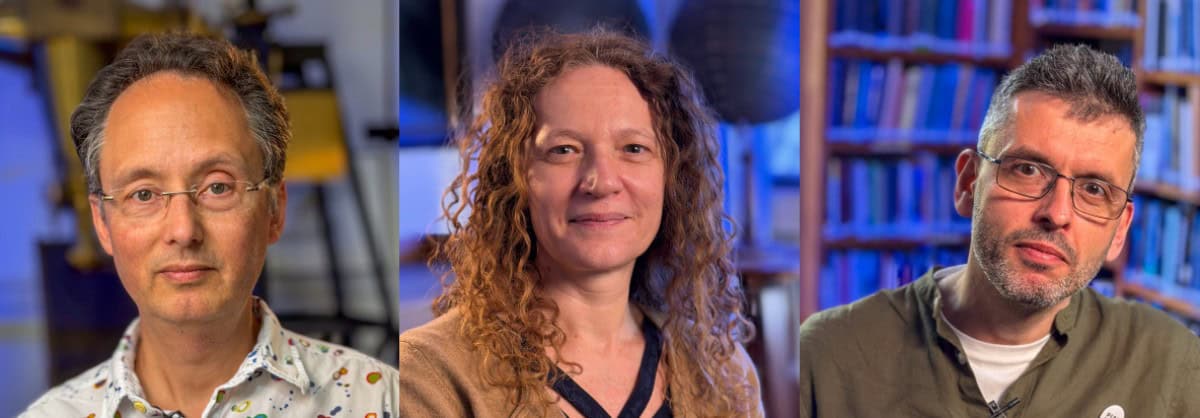
Fossil hunters Left to right are Rodrigo Ibata, Amina Helmi and Vasily Belokurov. (Courtesy: The Kavli Prize)
This episode of the Physics World Weekly podcast features an interview with Helmi and Per Barth Lilje, who is chair of the Kavli Astrophysics Prize committee and is based at Norway’s University of Oslo.
In a wide-ranging conversation, we explore the history of the Milky Way and why the work of the Kavli laureates provides crucial evidence that our galaxy was formed by the merger of smaller dwarf galaxies. We talk about what hierarchical accretion tells us about dark matter and the Standard Model of cosmology – and we look forward to the future of the Milky Way.
Belokurov, Helmi and Ibata share the $1m prize money equally. The prize will be awarded in Oslo in September

 Login

 This podcast is supported by American Elements, the world’s leading manufacturer of engineered and advanced materials. The company’s ability to scale laboratory breakthroughs to industrial production has contributed to many of the most significant technological advancements since 1990 – including LED lighting, smartphones, and electric vehicles.

 This podcast is supported by