Gli astronomi hanno scoperto 84 misteriose sorgenti di raggi X in sei galassie vicine. Chiamate “hypersoft X-ray sources”, potrebbero essere sistemi binari contenenti nane bianche, stelle di neutroni o buchi neri e aiutare a risolvere due importanti enigmi dell'astrofisica.
A new class of cosmic object observed by NASA’s Chandra X-ray Observatory could hold the key to unraveling two long-standing mysteries, astronomers say.
In a recent paper published in Nature Astronomy, researchers described these new cosmic objects as having high levels of ultraviolet radiation but low-intensity X-rays.
In the NASA Chandra data, the team identified 84 of these strange objects, which they dubbed “hypersoft X-ray sources,” across six galaxies. The unexpected discovery could finally help answer puzzling questions related to star formation and the expansion of the universe.
Chandra Sees Something New
“We’ve never encountered a group of objects that act like this,” said lead author Mustafa Muhibullah of the University of Alabama. “Of course, the next step was to try to figure out what these things are.”
The new research used data from a publicly accessible Chandra archive provided by NASA, including the spiral Andromeda and Pinwheel galaxies and an additional four elliptical galaxies. Intriguingly, both older regions and active star-forming regions contained the new objects.
The team discovered the objects by comparing Chandra’s high- and low-energy X-ray images to identify sources that were disappearing. Their departure from high-energy X-ray images indicated the objects were producing only low-energy X-rays, which border ultraviolet light on the spectrum. This led the researchers to then identify the high-energy ultraviolet radiation coming from the objects.
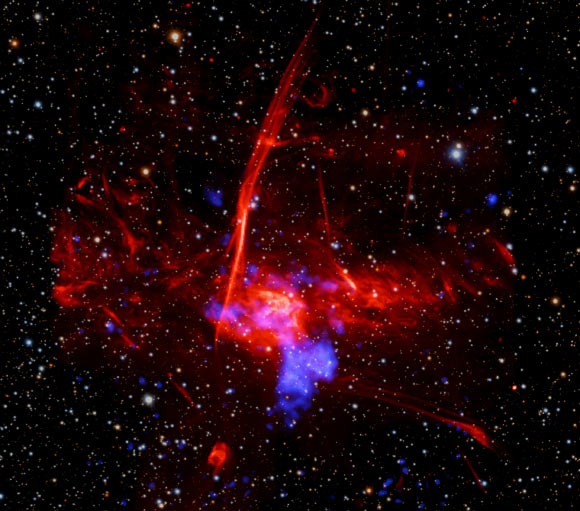
The Pinwheel galaxy hosts seven of the strange objects. Credit: X-ray: NASA/CXC/Univ. of Alabama/M. Muhibullah et al.; Optical: NASA/ESA/STScI; Image Processing: NASA/CXC/SAO/N. Wolk
Mystery Objects
Currently, the team cannot effectively determine what these objects are, but they do have some suspects, including black holes, neutron stars, or white dwarves pulling material from a companion. Such material would heat as it fell into one of the three suggested objects, theoretically producing the observed X-rays. While these types of binary systems have all been observed previously, this combination of ultraviolet radiation and low-energy X-rays hasn’t been associated with them.
Because the researchers found so many of these objects in just six galaxies, they suggest many more of these likely binary systems remain undiscovered across the universe.
These objects were not previously identified for two reasons. The more obvious is how faint their X-ray signature is, which requires extremely sensitive equipment to detect. The other is that helium and hydrogen gas between stars absorbs the stronger ultraviolet radiation, obscuring these otherwise brilliant signals.
“By combing through the Chandra archive, we were able to eliminate what used to be a blind spot for telescopes,” said co-author Rosanne Di Stefano, Senior Astrophysicist with the Center for Astrophysics, Harvard & Smithsonian. “That’s how we found what appears to be a new class of cosmic objects with remarkable qualities.”
What Did Chandra See?
“These clandestine X-ray sources are actually among the most energetic objects in galaxies, and they could be solving two cosmic mysteries at once,” said Muhibullah.
One of the mysteries this may solve ties to the rate of universal expansion itself. Type Ia supernova observations have provided astrophysicists with essential data indicating that the universal expansion is accelerating. Although they suggest these supernovae likely come from white dwarf binary systems, astronomers have never observed a star turning into one to confirm the hypothesis.
“If we could find a way to spot these Type Ia supernova explosions before they go off, that would be really important,” said co-author Jimmy Irwin, also of the University of Alabama. “Right now, we study them after they’ve exploded, and astronomers have struggled to understand what is actually ignited.”
The other mystery is what removes electrons from the free-floating gas between some stars, which could have major ramifications for star formation and galactic life cycles. Hot, massive stars were previously identified as likely partially responsible, but they couldn’t account for the full extent by themselves. The research team says hyper-soft X-rays and intense ultraviolet radiation could be the missing culprit.
Only continued observation and research can provide a definitive answer on the mystery objects that Chandra observed.
Ryan Whalen covers science and technology for The Debrief. He holds an MA in History and a Master of Library and Information Science with a certificate in Data Science. He can be contacted at ryan@thedebrief.org, and follow him on Twitter @mdntwvlf.
Astronomers have combined 2,884 Type Ia supernovae -- which are used to measure cosmic distances -- with cosmic microwave background and galaxy-mapping data, deepening cracks in the standard ‘cosmological constant’ model.
Il risveglio dopo la polvere: A un quarto di secolo dall'eruzione del 2000, la cortina di polveri attorno al sistema binario V445 Puppis si è diradata. Un team guidato da John Mills (Università di Warwick) ha analizzato i dati combinati di VLT, Hubble, SALT e TESS, osservando per la prima volta la coppia di stelle al centro del residuo.
Une anomalie au cœur de la Voie lactée intrigue les astronomes depuis des décennies. Et les dernières observations du télescope spatial James-Webb viennent de transformer une curiosité en véritable casse-tête cosmique. De quoi changer notre vision de la formation des galaxies.
Using NASA’s Chandra X-ray Observatory and ESA’s XMM-Newton satellite, astronomers identified a possible remnant of ancient stellar explosion just a few dozen light-years from Sagittarius A*, a supermassive black hole at the center of our Milky Way Galaxy.
The giant planet’s bow shock isn’t just deflecting the solar wind, it’s acting as a powerful particle accelerator, firing electrons to relativistic energies of at least 1 MeV, according to a new analysis of data from NASA’s Juno spacecraft.
NASA’s Fermi telescope may have finally uncovered the magnetic powerhouse behind the universe’s brightest supernovae. An international team of astronomers analyzing observations from NASA’s Fermi Gamma-ray Space Telescope has found what appears to be the first convincing detection of gamma rays from a rare type of extraordinarily bright stellar explosion known as a superluminous supernova. [...]
The Curse resulted in decay, disease, and death affecting the entire creation, meaning the whole universe. The effects are seen in the cosmos and in living organisms. However a future restoration of creation is promised by God, reversing the effects of the Curse.
A new method could improve cosmology research by analyzing supernovae together with the galaxies that host them. An international collaboration led by scientists at the Institute of Cosmos Sciences of the University of Barcelona (ICCUB) has created a new approach that may sharpen what researchers can learn about how the Universe expands and what dark [...]

 Login