❌

Reading view

Shot from the Heart of the Milky Way: Discovery of an Old Hypervelocity Star

Hypervelocity stars in galaxy

Zooming through the galaxy faster than they should, hypervelocity stars are a curious population of stars whose origins are often difficult to determine. A recent study presents the first evidence of an old, low-mass hypervelocity star launched from the Milky Way’s center, providing clues into this elusive set of fast-moving stars.

Flinging Fast Stars

Astronomers have caught a number of hypervelocity stars zipping through the Milky Way since their first discovery in 2005. With speeds fast enough to escape the galaxy, hypervelocity stars were launched off course by some strong dynamical interaction. One such method, known as the Hills mechanism, predicts that when a binary star system approaches the Milky Way’s central supermassive black hole, one binary member is captured by the black hole and the other is flung away with high velocity.

However, constraining a hypervelocity star’s origin to the galactic center is limited by uncertainties in distances and proper motions, muddling how well researchers have been able to trace their orbits backward. Among a number of candidate galactic center–origin hypervelocity stars, only one has been confidently identified as having been kicked from the galaxy’s center. Intriguingly, this hypervelocity star and most galactic center–origin candidates are young, massive stars — old, low-mass hypervelocity stars from the galactic center have yet to be identified.

What does this dearth of old, low-mass zooming stars mean? Either stars in the galactic center are preferentially young and massive, with fewer than expected old and small stars, or low-mass hypervelocity stars are missed by selection effects, challenging to detect in current surveys. Searching for hypervelocity stars with higher precision and sensitivity may allow astronomers to tease out this missing population and trace back more zooming stars to a Hills mechanism origin.

Discovering An Old Hypervelocity Star

Leveraging high-quality spectra from the Dark Energy Spectroscopic Instrument (DESI) survey and precise astrometry from Gaia, Shunhong Deng (University of Chinese Academy of Sciences; China West Normal University) and collaborators reported the discovery of the hypervelocity star DESI-HVS1. From the spectroscopic and astrometric analyses, the authors determined that DESI-HSV1 is a ~14-billion-year-old low-metallicity star with a mass about 80% that of the Sun’s, moving through the galaxy at 523 km/s.

Backward orbit integration

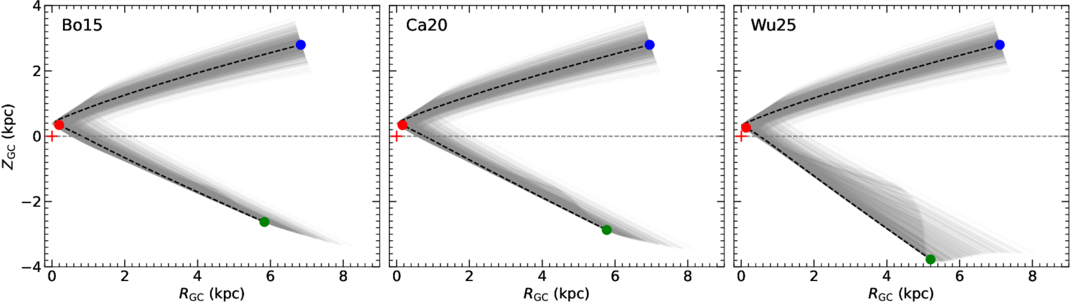
Backward-integrated orbits of DESI-HVS1 for three different galactic potential models. The blue, red, and green points show the star’s current position, closest approach to the galactic center, and position 50 million years ago, respectively. Click to enlarge. [Deng et al 2026]

Exploring the possible origins of this hypervelocity star, the authors integrated the star’s orbit backward in time for one billion years. The backward orbit integrations show the star approaching the galactic center where it then turns around, traveling away faster than the local escape velocity of the galaxy. Even when varying the galactic potential and constants, all orbit integrations suggest DESI-HVS1’s motion through the galaxy is most naturally explained by the Hills mechanism.

While more refined galaxy models and comparison to other candidate galactic center–origin hypervelocity stars are necessary to fully confirm its origins, DESI-HVS1 provides the first compelling evidence for an old, low-mass hypervelocity star candidate consistent with a galactic center launch. This suggests that the observed lack of such stars is likely not a reflection of the Milky Way’s central stellar population, but rather a consequence of observational constraints making such small hypervelocity stars particularly difficult to detect. As large spectroscopic and astrometric surveys continue to advance, the sample of galactic-center hypervelocity star candidates will grow, enabling further exploration of the stellar environment and dynamical processes at the Milky Way’s core.

Citation

“An Old, Low-mass, Metal-poor Hypervelocity Star Candidate Consistent with Galactic Center Origin,” Shunhong Deng et al 2026 ApJL 1003 L9. doi:10.3847/2041-8213/ae6505

The post Shot from the Heart of the Milky Way: Discovery of an Old Hypervelocity Star appeared first on AAS Nova.

  •  

I Survived a Type Ia Supernova, and All I Got Was This Kick Velocity

G272.2-3.2

Editor’s Note: Astrobites is a graduate-student-run organization that digests astrophysical literature for undergraduate students. As part of the partnership between the AAS and astrobites, we occasionally repost astrobites content here at AAS Nova. We hope you enjoy this post from astrobites; the original can be viewed at astrobites.org.

Title: Supernova Ia Remnants with M-Dwarf Surviving Companions
Authors: Kuo-Chuan Pan (潘國全), Pilar Ruiz-Lapuente, and Jonay I. González Hernández
First Author’s Institution: National Tsing Hua University
Status: Published in ApJ

Type Ia supernovae are important tools astronomers use to measure distances in space. Despite their important role as “standardizable candles,” their origins remain hotly debated. It’s long been theorized that a Type Ia supernova can develop from one of two pathways: the single-degenerate channel or the double-degenerate channel. In the single-degenerate channel, a white dwarf and a non-degenerate star (such as a red giant or main-sequence star like our Sun) orbit each other in a close binary system. The white dwarf accretes material from the outer surface of the non-degenerate star until it reaches a critical mass and explodes. The double-degenerate channel begins instead with two white dwarfs orbiting each other. Most explosion mechanisms from this channel result in the complete obliteration of the secondary, less-massive white dwarf. However, one theoretical explosion mechanism, called the dynamically driven double-degenerate double-detonation (D6) channel, might allow the secondary companion star to survive an explosion from a double-degenerate Type Ia supernova.

Generally, due to the immense energy from a supernova explosion, we expect these surviving companion stars to be “kicked” away from the blasts at high velocities. Fortunately, astronomers have found evidence of these surviving companion stars. As covered in a previous Astrobite, three hypervelocity white dwarfs have been found in Gaia data and traced back to the locations of double-degenerate Type Ia supernovae. Given the prevalence of Type Ia supernovae, however, astronomers are led to question why we haven’t seen many more of these candidates. It’s additionally important to wonder what similar “runaway” companions might look like for the single-degenerate channel.

Recent observations by the Gaia spacecraft near the supernova remnant G272.2-3.2 show an M-dwarf star, MV-G272, with an unusually high velocity around 240 km/s and a trajectory tracing back to the center of the supernova remnant. Is it possible for this M dwarf to be the runaway companion to the remnant’s original supernova? The authors of today’s article look at simulations of potential companion stars from single-degenerate Type Ia supernovae and compare their results to this observed potential companion candidate.

Because this work focuses on the potential for M-dwarf companions, the authors explored a range of simulated companion-star masses and radii characteristic of M dwarfs: 0.5, 0.6, and 0.7 solar mass and 0.396, 0.454, and 0.483 solar radius, respectively. To make these models, they used the stellar evolution code Modules for Experiments in Stellar Astrophysics (MESA) to construct and evolve a number of simulated stars with these specifications.

After setting up the models in MESA, they used the magnetohydrodynamics code FLASH to perform 2D and 3D simulations of the supernova explosion and the subsequent impact of the exploding star’s ejecta (or hot material) on its M-dwarf companion. After the explosion and impact were modeled, the companion star’s evolution was further followed in MESA.

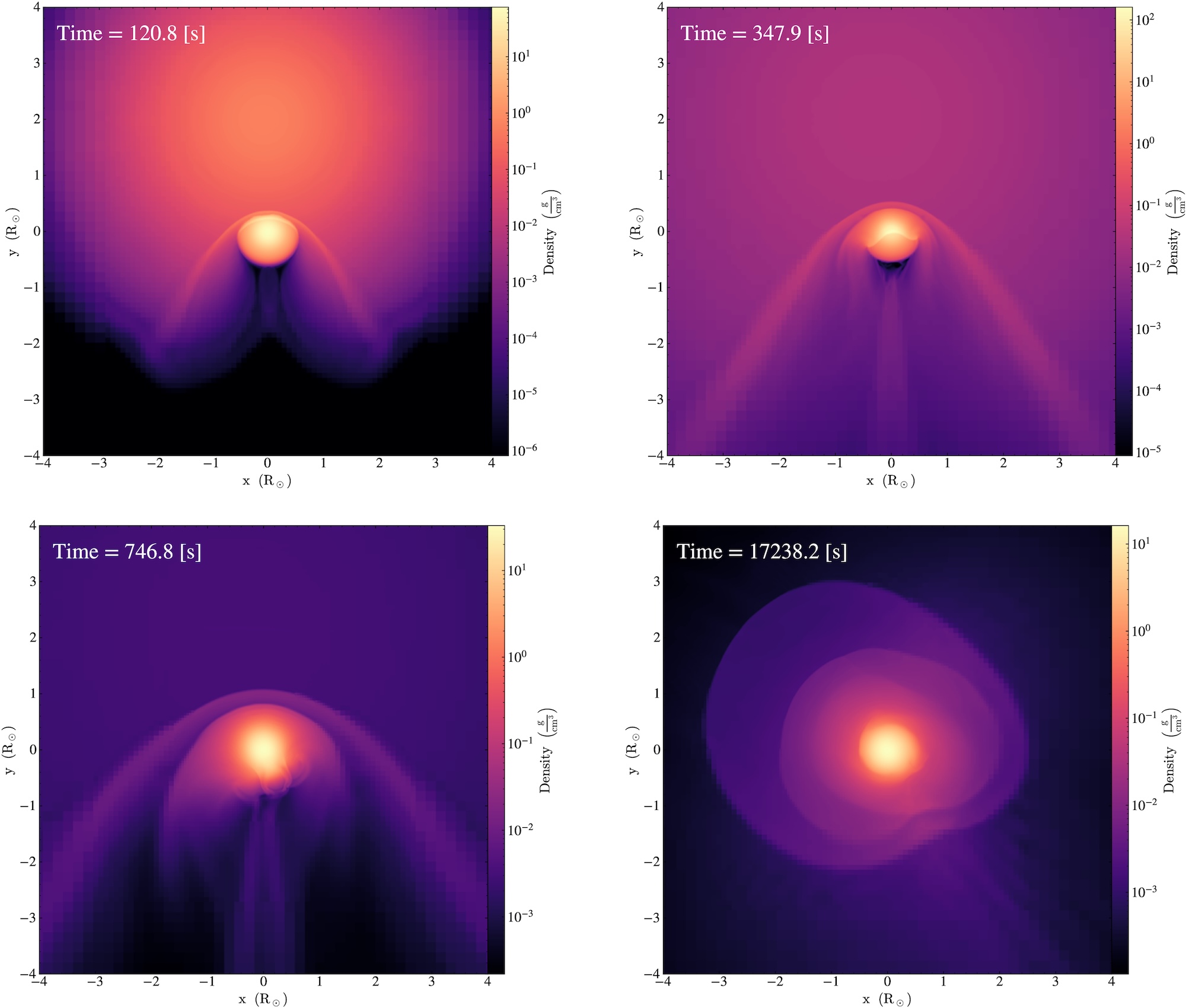
Figure 1 shows the density of the supernova’s ejecta, or exploding material, as it impacts the companion star. (You can think of this figure as if you were looking at the companion star out in space.) After roughly 100 seconds, you can see a bow shock develop around the top of the companion (or the “front” of the star) as it wraps around the companion. This impact causes significant compression of the companion star and rips away upwards of 50% the companion’s mass. The impact of this shock is what gives the companion star its “kick,” sending it hurtling through space.

simulations of supernova ejecta colliding with a star

Figure 1: Visual of the density of the companion star (center of each plot) and the supernova ejecta over time. In the top row of plots and the bottom-left plot, you can see the higher-density bow shock bent around the top (or front) of the companion star. In the bottom-right plot, you can see some of the supernova ejecta and unbound mass from the companion star settling around the companion star. [Pan et al. 2025]

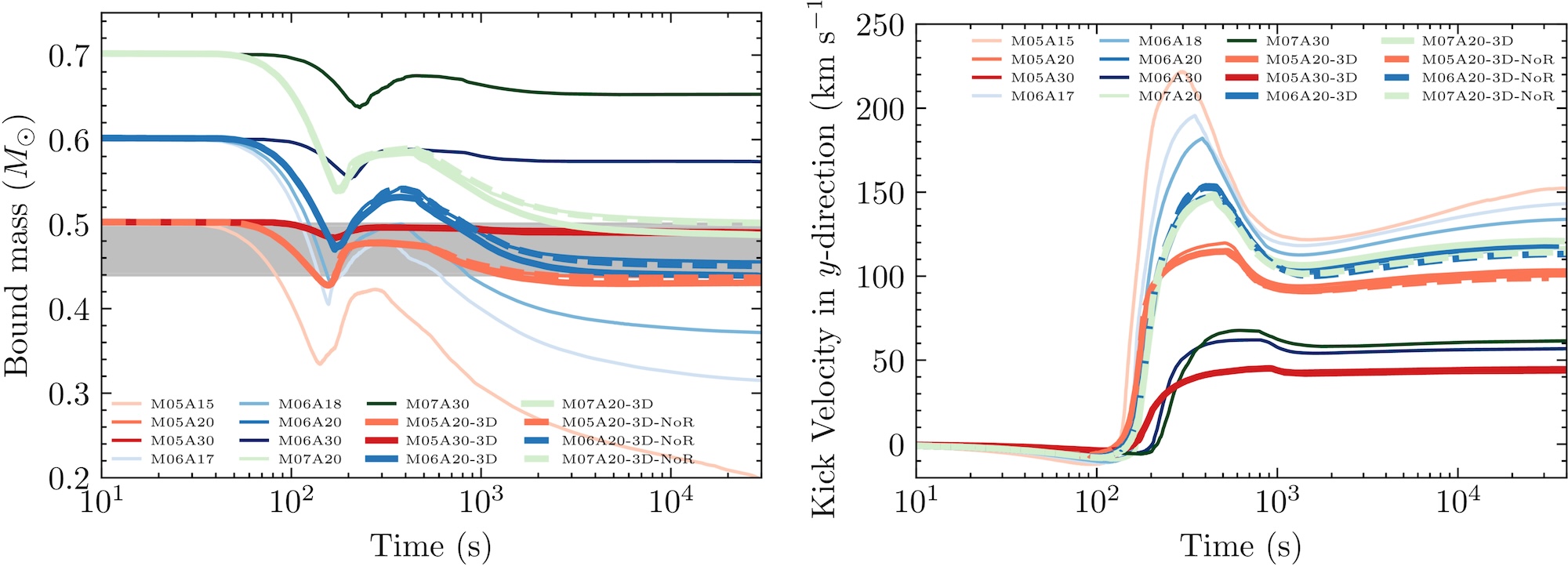
Because the authors explored a range of initial companion masses and distances between the primary and companion star, their results show some range. Figure 2 shows two important results: the evolution of the companion’s mass before and after the explosion (left plot), and the evolution of the companion’s kick velocity (right plot). The dip in mass around 100 seconds (102 s) indicates the impact of the bow shock. Even though the simulations model companions with a relatively narrow mass range (0.3–0.7 solar mass), there is considerable variation in the final masses after explosion. For example, the initial 0.5-solar-mass model ends up with anywhere between 0.07 solar mass (just 14% of its initial mass) and almost its full initial mass of 0.5 solar mass, depending on the distance between the companion and its exploding star.
plots of bound mass and kick velocity as a function of time

Figure 2: The different models shown in both plots indicate different initial masses and separation distances between the companion and the exploding star. Left: how the companion’s gravitationally bound mass evolves over time. The plot can be read left to right. The dip around 102 seconds indicates the impact of the supernova shock, which unbinds layers of the companion’s mass. Some of that mass becomes bound again to the companion after the shock passes. Right: how the companion star’s kick velocity changes based on initial mass and separation distance between companion and exploding star. The peak in values between 102 and 103 seconds indicates the impact, or “kick,” from the supernova. [Pan et al. 2025]

The results from this work generally show, predictably, that a companion closer to its primary star gets a bigger kick in velocity. These “kicks” range from about 50 km/s to 150 km/s. When added to the system’s initial velocity in space, it brings the total velocity of these companions into the 150–200 km/s range. This result is generally well aligned with the observed velocity of MV-G272, which was roughly 240 km/s.

Notably, runaway companion stars of these Type Ia supernovae seem to retain information from the initial explosion. Given the final velocities of these companions, astronomers might be able to figure out the companion’s initial mass and trace back its trajectory to the system it originated from. Overall, the fact that MV-G272 has a trajectory that tracks back to the center of a supernova remnant makes it a good companion candidate. These results support the feasibility of M-dwarf runaway companions from single-degenerate Type Ia supernova systems. Now that we know what these companions might look like — and how fast they can be going — astronomers can hopefully better search for these high-velocity stars in the future.

Original astrobite edited by Catherine Slaughter.

About the author, Mckenzie Ferrari:

I’m currently a PhD student in the geophysical sciences program at the University of Chicago. While I now study the atmosphere and oceans of Earth, most of my previous research focused on simulations of Type Ia supernovae and galaxy formation and evolution. In my free time, I foster cats for a local organization, enjoy cooking, and can often be found running along Lake Michigan.

The post I Survived a Type Ia Supernova, and All I Got Was This Kick Velocity appeared first on AAS Nova.

  •  

JWST Spies a Potential Microlensed Massive Binary Star System

galaxy cluster MACS J0416.1-2403

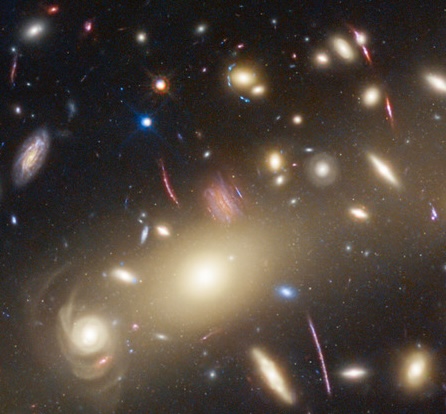
JWST images of galaxy clusters are rich with gravitationally lensed galaxies. Recent work examines a source in a lensed galaxy that may offer a glimpse into the lives of massive stars billions of years ago.

Cosmic Gems arc

JWST image of the gravitationally lensed Cosmic Gems arc, in which multiple individual star clusters are visible. [ESA/Webb, NASA & CSA, L. Bradley (STScI), A. Adamo (Stockholm University) and the Cosmic Spring collaboration; CC BY 4.0]

Glimpses of Single Stars

Galaxy clusters, the largest gravitationally bound structures in the universe, create the conditions necessary for astronomers to perform an extraordinary feat: examine individual massive stars and star clusters at far greater distances than our telescopes can typically achieve. This is possible thanks to gravitational lensing, the bending of spacetime by an immense mass, which warps and magnifies the light from more distant objects.

These glimpses of single stars and star clusters offer a rare chance to study massive stars in our universe’s distant past directly. In particular, these observations allow us to probe whether factors like the multiplicity fraction — how many massive stars are in binary or multiple systems — have changed over cosmic time.

Peering Through a Gravitational Lens

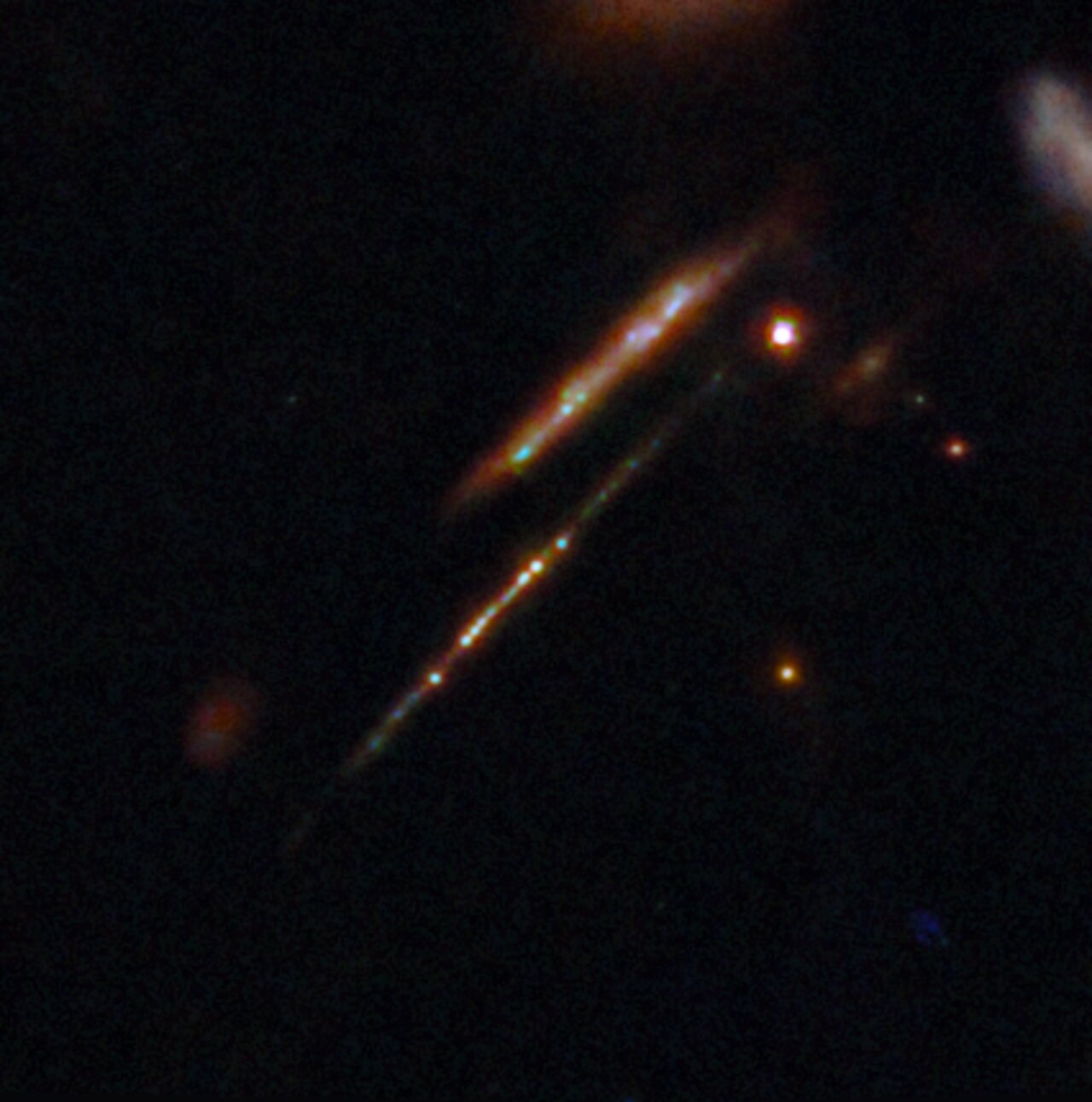
In a recent research article, a team led by Hayley Williams (University of Minnesota) reported on their examination of an intriguing source in a gravitationally lensed galaxy called the “Warhol arc.” This galaxy, located at a redshift of z = 0.94 (when the universe was roughly 6 billion years old), is gravitationally lensed by the massive galaxy cluster MACS J0416.1−2403. The cluster is located at a redshift of z = 0.396, corresponding to when the universe was about 9.4 billion years old.

Using data from the JWST Prime Extragalactic Areas for Reionization and Lensing Science (PEARLS) program and the Canadian NIRISS Unbiased Cluster Survey (CANUCS), Williams’s team analyzed a source in the Warhol arc called W2, which previous work suggests is either a binary star system or a small star cluster.

Multiplicity and Microlensing

Warhol arc

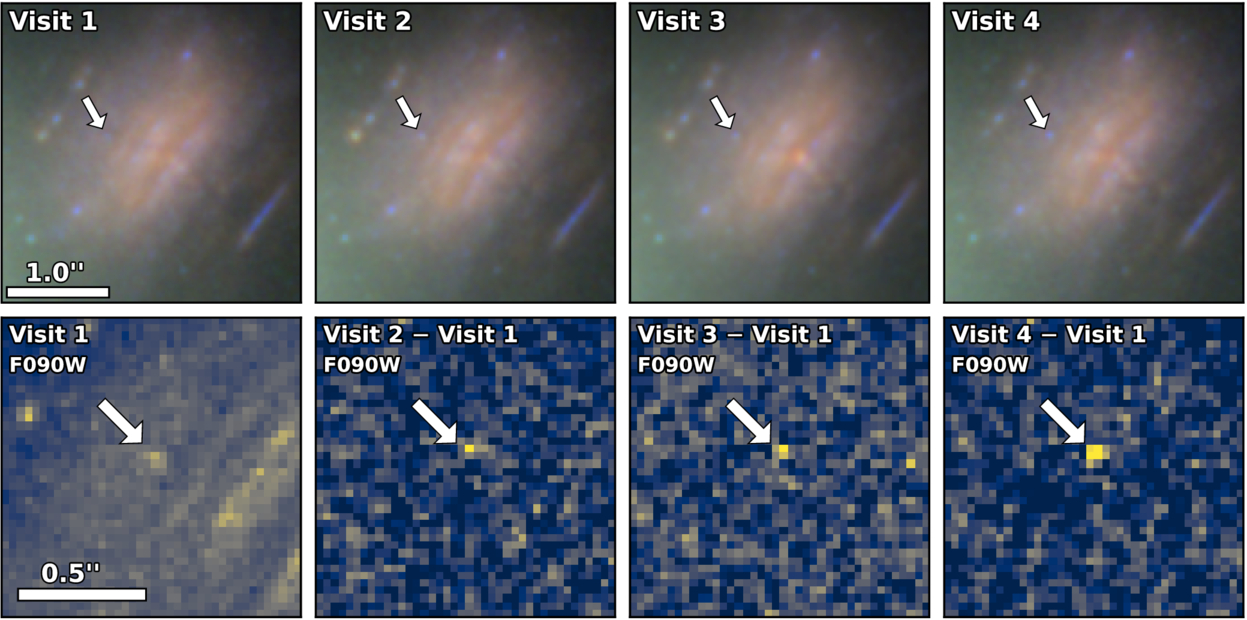
Top row: The Warhol arc during four epochs of JWST observations. Bottom row: On the left, a magnified image of W2 during the first epoch. The remaining images show the difference in brightness between subsequent epochs and the first epoch. Click to enlarge. [Williams et al. 2026]

Across four epochs spanning 126 days, the JWST observations show the source W2 within the Warhol arc. Williams and collaborators performed spectral fitting of the JWST light curves to investigate the multiplicity of the source. They found that the data are best matched by a binary system containing stars with temperatures of 3500K and 12600K.

W2 varies between observations in both brightness and color, a fact that the authors suggested is due to microlensing by a star within the lensing galaxy cluster, rather than variability within the binary system itself. Under this hypothesis, the orbital motions of the binary bring the stars across the microlensing caustic — a region in which the magnification is exceptionally high — and the brightness and color of W2 vary as the components of the binary approach and recede from the caustic.

Williams and collaborators also performed stellar population modeling to explore the binary configurations that could match the observations. They found that the stars likely have masses of 21–24 solar masses, with one being a cool red supergiant and the other a hot, main-sequence companion. Depending on the precise evolutionary stage of the binary, it’s possible that one of the stars is nearing a supernova explosion. Lending more support to the binary system hypothesis, the microlensing measurements constrain W2 to be no larger than 90 au — too small for even a compact star cluster.

The team closed by proposing further observations of W2’s position to rule out the possibility that the microlensing rate there is unusually high, an outcome that may suggest that microlensing of two unrelated stars, rather than a binary system, is responsible for these observations.

Citation

“JWST’s PEARLS: A Candidate Massive Binary Star System in a Lensed Galaxy at Redshift 0.94,” Hayley Williams et al 2026 ApJ 997 292. doi:10.3847/1538-4357/ae2003

The post JWST Spies a Potential Microlensed Massive Binary Star System appeared first on AAS Nova.

  •  

A Unified Explanation for Fast Radio Bursts

artist's impression of a magnetar in a binary system

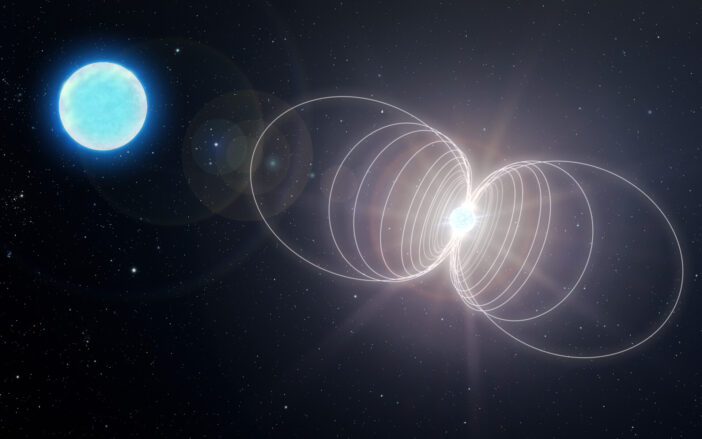
A discovery that linked a fast radio burst to a magnetar in the Milky Way showed that certain fast radio bursts come from magnetars. A new study explores whether all fast radio bursts could have magnetar origins.

Varied Bursts

magnetar SGR 1935+2154

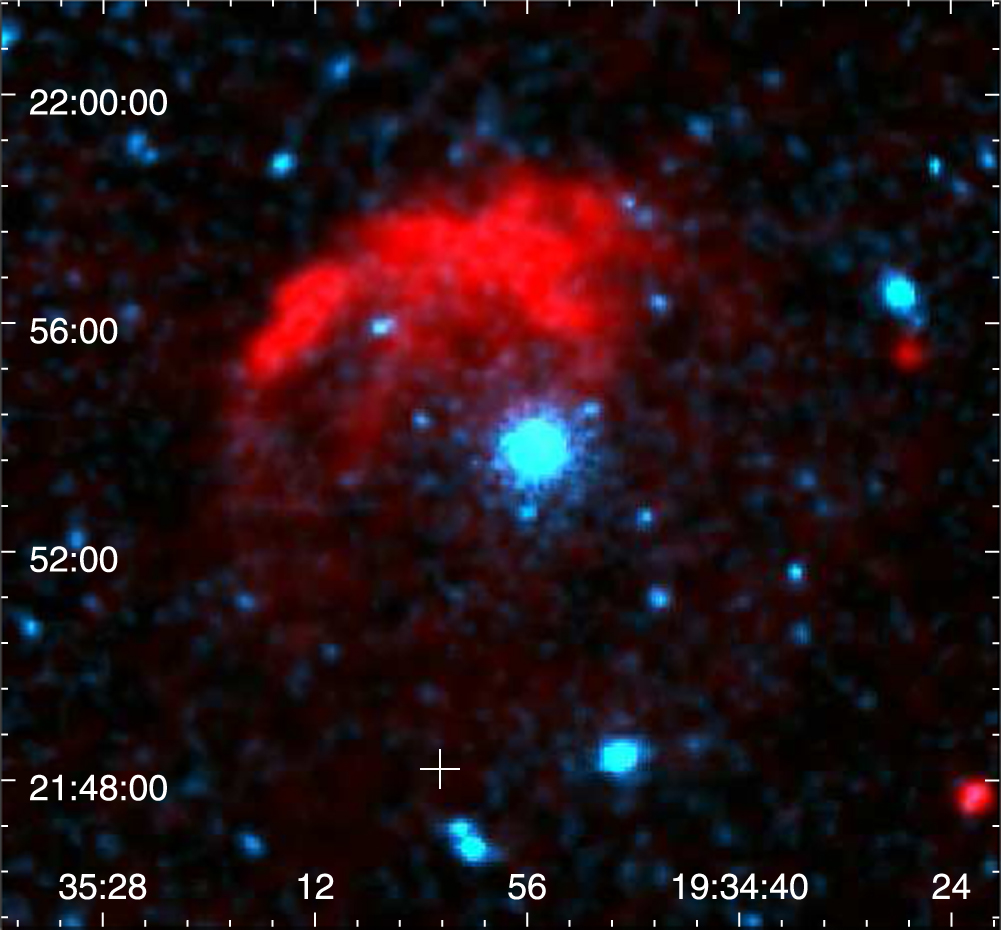
The bright blue source at the center of this X-ray image is SGR 1935+2154, the first magnetar to be associated with a fast radio burst. [Zhou et al. 2020]

Fast radio bursts — extremely bright radio blips lasting anywhere from a fraction of a millisecond to a few seconds — have provided researchers with one of the best recent astronomical mysteries. What causes these brilliant radio flashes, and why are they so varied? Most fast radio bursts seem to happen just once, while others repeat frequently or infrequently on irregular or regular timescales.

In July 2020, astronomers reported the discovery of a fast radio burst likely associated with a magnetar in the Milky Way. This discovery suggested that at least some fast radio bursts come from magnetars, the rapidly spinning, intensely magnetized remnants of certain massive stars. However, it’s still not known whether all fast radio bursts share this origin, or if their varied behaviors can be traced to equally varied origins.

Mystery Solved by Magnetars?

In a recent research article, Bing Zhang (University of Hong Kong; University of Nevada) and Rui-Chong Hu (University of Nevada) set out to explore the possibility that all fast radio bursts have magnetar origins.

illustration of magnetar origins

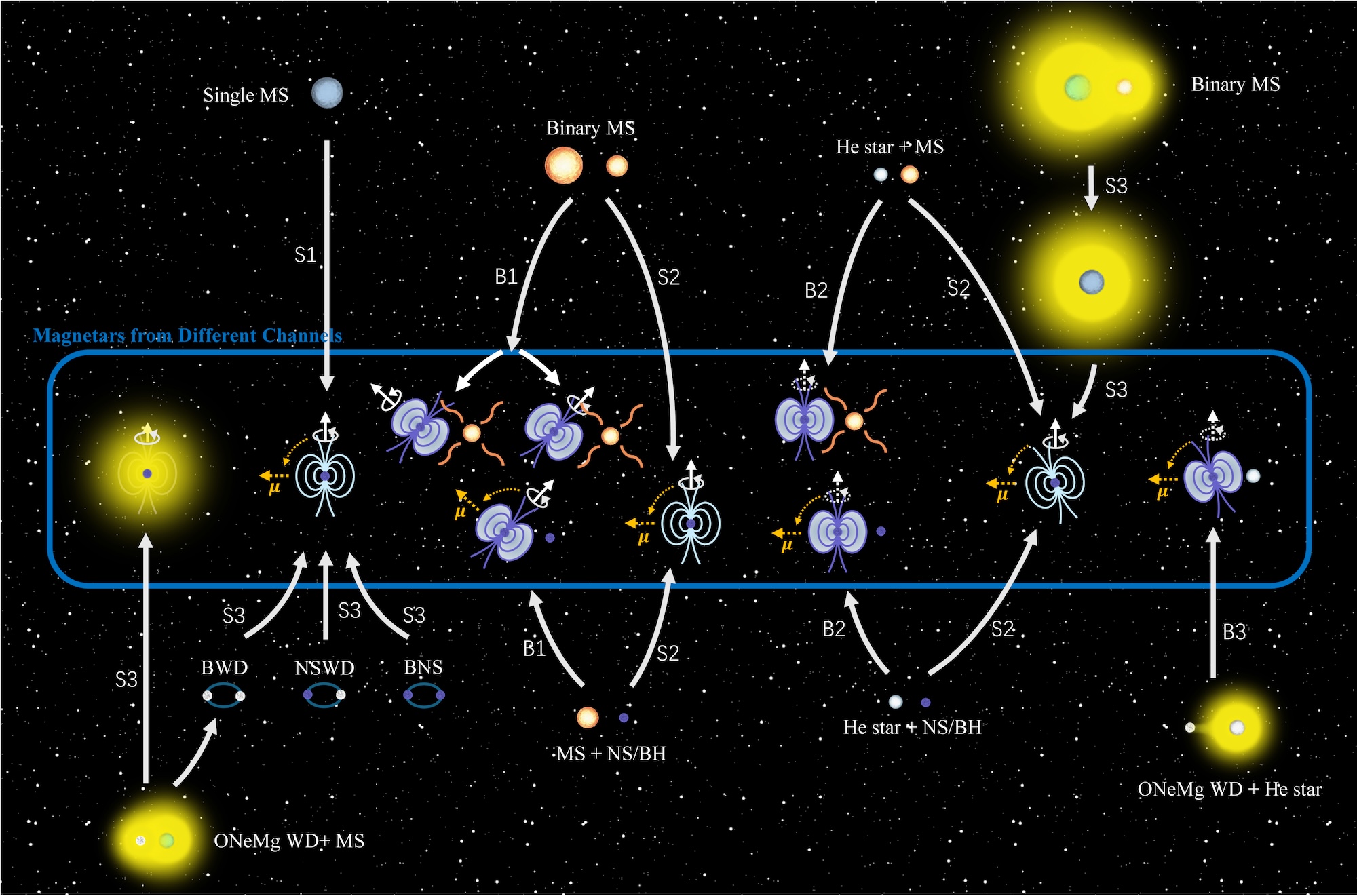
Magnetar formation pathways. The magnetic field lines of isolated magnetars have a black background, while the field lines of magnetars in binary systems have a white background. Click to enlarge. [Zhang & Hu 2025]

Zhang and Hu examined the different pathways through which magnetars form, as well as what properties they tend to have in each of these scenarios. This analysis suggested that the vast majority of magnetars in our universe are singletons, having formed from isolated stars, disrupted binary systems, or stellar mergers. This aligns with observations of magnetars in the Milky Way, none of which appear to have companions.

The remaining few percent of magnetars reside in binary systems. These coupled-up magnetars largely have companions more than twice as massive as the Sun, though some are paired with helium stars or compact objects.

Multiple Possible Arrangements

illustration of a magnetar in a binary system

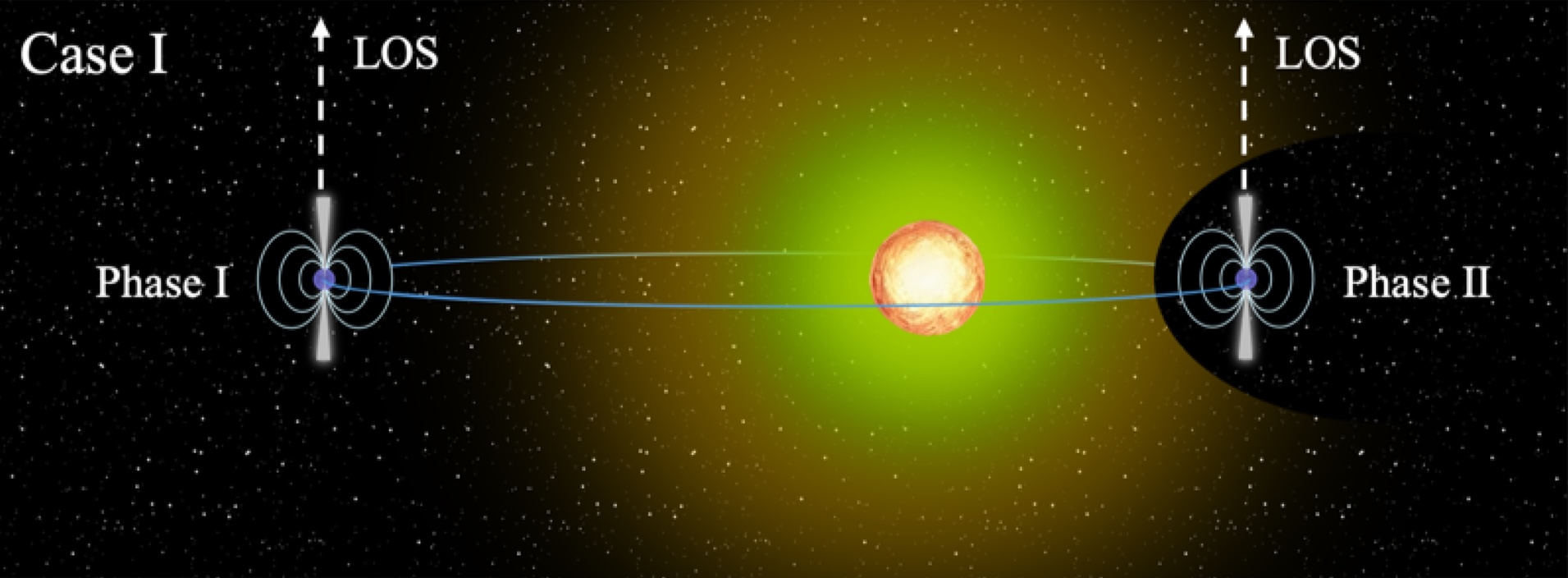
Illustration of a magnetar in a binary system with a star with a stellar wind. As the magnetar moves along its orbit, it encounters differing amounts of stellar wind. This affects the polarization angle of the bursts. Click to enlarge. [Adapted from Zhang & Hu 2025]

Zhang and Hu found that both isolated and paired-up magnetars tend to form with their spin and magnetic axes in close alignment — a setup that likely enables the production of rapid-fire fast radio bursts. For isolated magnetars, these axes may become misaligned over time, sapping their ability to produce repeated bursts. In binary systems, magnetars that accrete mass from the stellar winds of a companion likely retain their alignment, creating a long-lasting engine of repeating fast radio bursts. The presence of winds from a stellar companion may also explain several curious traits of some fast radio bursts, such as rapid changes in polarization angle.

In this framework, actively repeating fast radio bursts arise from aligned magnetars in binary systems, while one-off or infrequently repeating bursts come from isolated magnetars or misaligned magnetars in binary systems. Isolated magnetars could also be responsible for some actively repeating bursts, though this ability is likely short lived.

Though this work demonstrates that magnetars could be the source of all fast radio bursts, it doesn’t rule out the possibility that fast radio bursts have diverse origins instead. Further work is needed to explore other pathways and make even more headway on the mystery of fast radio bursts.

Citation

“Magnetars in Binaries as the Engine of Actively Repeating Fast Radio Bursts,” Bing Zhang and Rui-Chong Hu 2025 ApJL 994 L20. doi:10.3847/2041-8213/ae1023

The post A Unified Explanation for Fast Radio Bursts appeared first on AAS Nova.

  •  

Bumpy Road Ahead: Can Binary Interactions Make Supernovae Periodically Brighter?

Hubble image of a supernova in the galaxy NGC 2525

Editor’s Note: Astrobites is a graduate-student-run organization that digests astrophysical literature for undergraduate students. As part of the partnership between the AAS and astrobites, we occasionally repost astrobites content here at AAS Nova. We hope you enjoy this post from astrobites; the original can be viewed at astrobites.org.

Title: Supernova-Induced Binary-Interaction-Powered Supernovae: A Model for SN2022jli
Authors: Ryosuke Hirai (平井遼介) et al.
First Author’s Institution: RIKEN Pioneering Research Institute, Monash University, OzGrav: The ARC Centre of Excellence for Gravitational Wave Discovery
Status: Published in ApJ

There are thousands of dying stars that go bang in the night. These explosions are known as supernovae, and they are classified primarily on what spectral lines they show in the days and weeks following their initial explosion. Most broadly, they are separated into Type I (spectra that show little or no evidence of hydrogen) and Type II (spectra that show hydrogen). The physics leading to each type of supernova is different, and astronomers use all of the information at their disposal to learn about these cosmic fireworks.

One of the most useful tools for monitoring and learning about a supernovae is its light curve — the plot of the explosion’s brightness over time. This light curve usually appears as a steep incline up to a peak in brightness several days after the initial detonation, and then a shallow decline in brightness over the following weeks. There are, however, a few examples of supernovae that break this mould.

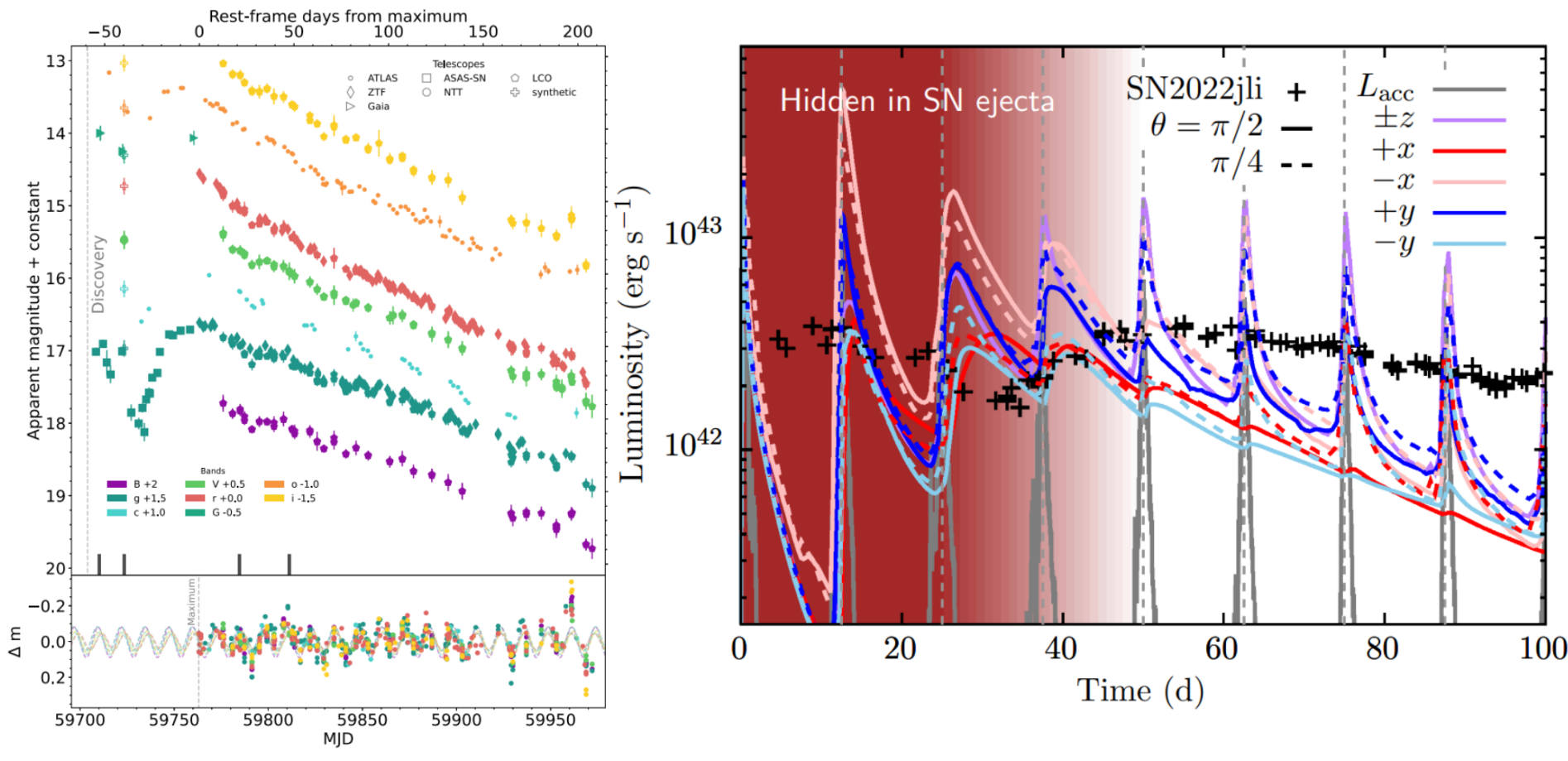
Today’s article seeks to understand the curious case of supernova SN2022jli. Unlike the typical gradual fade in brightness, the light curve of this supernova shows a periodic bump of brightness every 12.5 days (see Figure 1). The proposed mechanisms to explain this include the blown-apart supernova material interacting with concentric and regularly spaced shells of circumstellar matter, or a binary companion that interacts with the supernova remnant each orbital period. The authors of today’s article investigate the latter scenario by running 3D hydrodynamical simulations of an interacting, post-supernova binary to try to recover SN2022jli’s periodic light curve and constrain the orbital characteristics of the system.

light curve of SN2022jli

Figure 1: The light curve of SN2022jli shows periodic oscillations in the brightness, superimposed on top of the typical fading luminosity of a supernova. The left plot shows the light curve across various colours, and the associated bottom panel shows the oscillations with the typical fading supernova signal subtracted. The right plot shows the light curve of the authors’ proposed mechanism, where the different coloured lines are for different viewing angles on the system at the heart of the supernova. [Moore et al 2023 (left) and Hirai et al. 2025 (right)]

The authors only have the supernova’s light curve to go off of, so they explore a range of orbital scenarios to explain SN2022jli. They run a series of models evolving a neutron star — the degenerate core left over after a low-mass supernova — together with a main-sequence stellar companion, varying the orbital eccentricity and companion mass, while fixing the orbital period (at the observed 12.5-day oscillatory period) and neutron star mass to 1.4 solar masses — a typical mass for a newborn neutron star.

Why a neutron star? SN2022jli is a sub-class of Type I supernovae involving a “stripped” massive star which has lost its hydrogen — most likely through interactions with a close companion. These interactions typically circularise the pre-supernova orbit, and the subsequent explosion most commonly yields neutron stars. To explain the necessarily highly eccentric post-supernova orbit that may cause the periodic oscillation in SN2022jli, there was most likely a “natal kick” — a sudden and asymmetric burst during the supernova that rockets the neutron star in a random direction — which widened the orbit and de-circularised it, giving further evidence for a neutron star remnant.

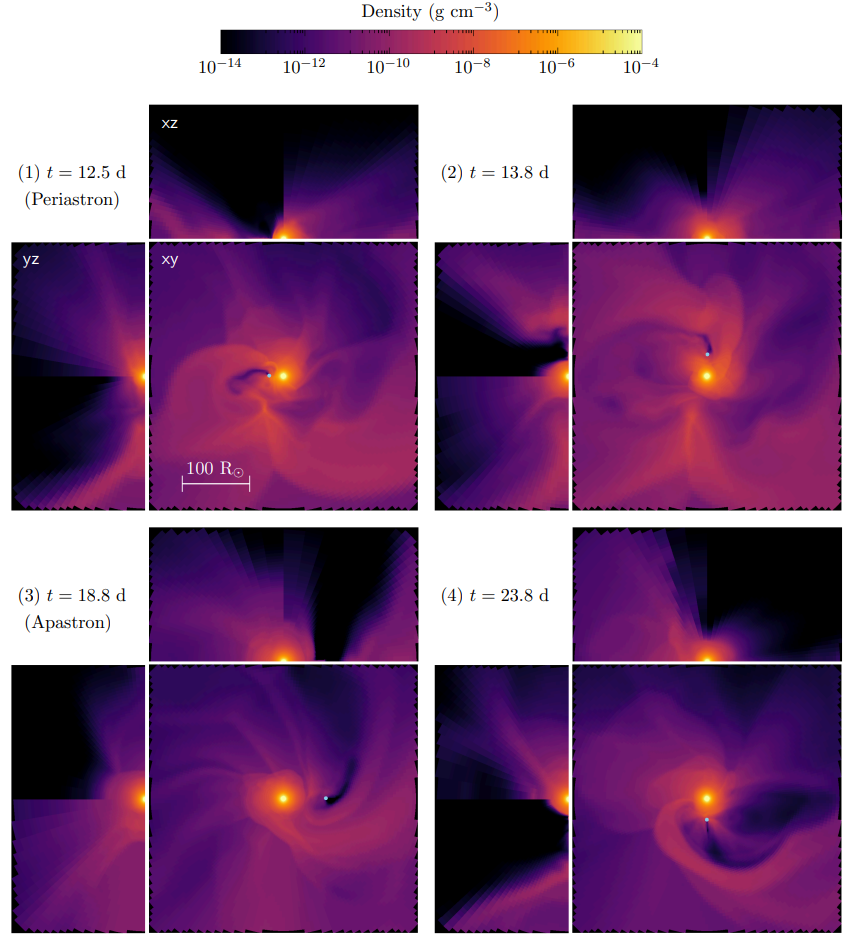
Immediately following the supernova explosion, ejecta interacting with the main-sequence companion star would heat the star and cause it to swell up. This inflated companion then feeds matter to the orbiting dense neutron star, and the accretion is most intense when the stars are closest in their orbit (called the periastron). During accretion, however, mass is not perfectly absorbed onto the neutron star, and there is some feedback onto the surrounding gas due to the complex thermal and magnetic physics around the neutron star. In this study, the authors model cases where there is no feedback, feedback from thermal radiation due to accretion, or feedback from bipolar outflows via jets or disk winds. Snapshots from the simulation involving a 5-solar-mass companion on an orbit with eccentricity of 0.5 and bipolar feedback is shown in Figure 2.

simulations of a neutron star with an inflated main-sequence companion

Figure 2: Several density snapshots of the 3D hydrodynamic simulations show how the neutron star (blue point) in the binary accretes and sculpts matter from the inflated main-sequence companion star (bright diffuse blob in the centre of each panel). The xy panels are a top-down look onto the orbital plane, while the xz and yz panels show a cross section through the plane. [Hirai et al. 2025]

The authors evolve the simulation for several orbits and show that periodic bursts of accretion onto the neutron star are capable of producing the oscillatory behaviour seen in SN2022jli’s light curve. The scale of the brightness oscillations are best recreated if the plane of the binary’s orbit is aligned with our line of sight (shown with the +x red line on the right side of Figure 1). Still, the profile of the undulations is not exactly reproduced by the model, and the outcome is very sensitive to our viewing angle of the binary orbit.

SN2022jli is just one of an emerging class of oscillatory supernovae, with more and more being discovered with highly sensitive modern all-sky surveys. Today’s authors rigorously modelled one proposed scenario to explain this periodic oscillation in brightness and showed that it is viable. More modelling using this interacting-binary mechanism on other oscillating supernova light curves — those with longer periods and different supernova classifications — will show whether this explanation is ubiquitous, or if the population of dancing supernova light curves is due to some other process!

Original astrobite edited by Anavi Uppal.

About the author, Ryan White:

I am a masters student at Macquarie University in Australia, working mainly on binary/multiple systems with massive stars (Wolf–Rayets in particular!). Outside of study, I’m a novice film buff, baking sourdough all the time, probably drinking coffee, and trying to get more into reading and frisbee/squash. You can also find me procrastinating on Bluesky @astroryan.bsky.social.

The post Bumpy Road Ahead: Can Binary Interactions Make Supernovae Periodically Brighter? appeared first on AAS Nova.

  •  

Hubble on the Hunt: A Spectroscopic Search for Betelbuddy

constellation Orion

Multiple research teams have turned to the famous red supergiant Betelgeuse in search of a possible companion star hiding in its glare. A carefully designed spectroscopic search has placed new constraints on the identity of Betelgeuse’s stellar buddy.

Betelgeuse and its companion star

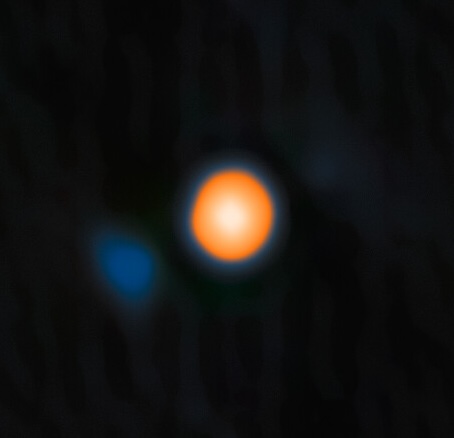
An image of Betelgeuse and its probable companion star from the ‘Alopeke instrument on the Gemini North telescope. [International Gemini Observatory/NOIRLab/NSF/AURA; Image Processing: M. Zamani (NSF NOIRLab); CC BY 4.0]

Betelgeuse and Its Buddy

Betelgeuse, a nearby red supergiant, is a variable star with a 400-day primary pulsation period and a 2,100-day secondary variation period. Recent studies have speculated that this secondary period is due to the presence of an 0.5–2.0-solar-mass companion star (often nicknamed “Betelbuddy”), and researchers using a speckle imaging technique likely spotted this companion earlier this year.

As is often the case when there’s an intriguing astronomical possibility, multiple research teams have sought out Betelgeuse’s purported stellar companion in different ways. One avenue recently described in a published paper was spectroscopic, searching for signs of ultraviolet emission lines from a growing young star.

Spectroscopic Search

In just 10 million years, Betelgeuse has sped through its main-sequence lifetime and taken on a new starring role as a red supergiant. In contrast, a 0.5–2.0-solar-mass companion star would not have even reached the main sequence in the same span of time. How is it possible to spot a tiny young stellar object next to a much brighter supergiant?

Hubble's observing pattern of Betelgeuse

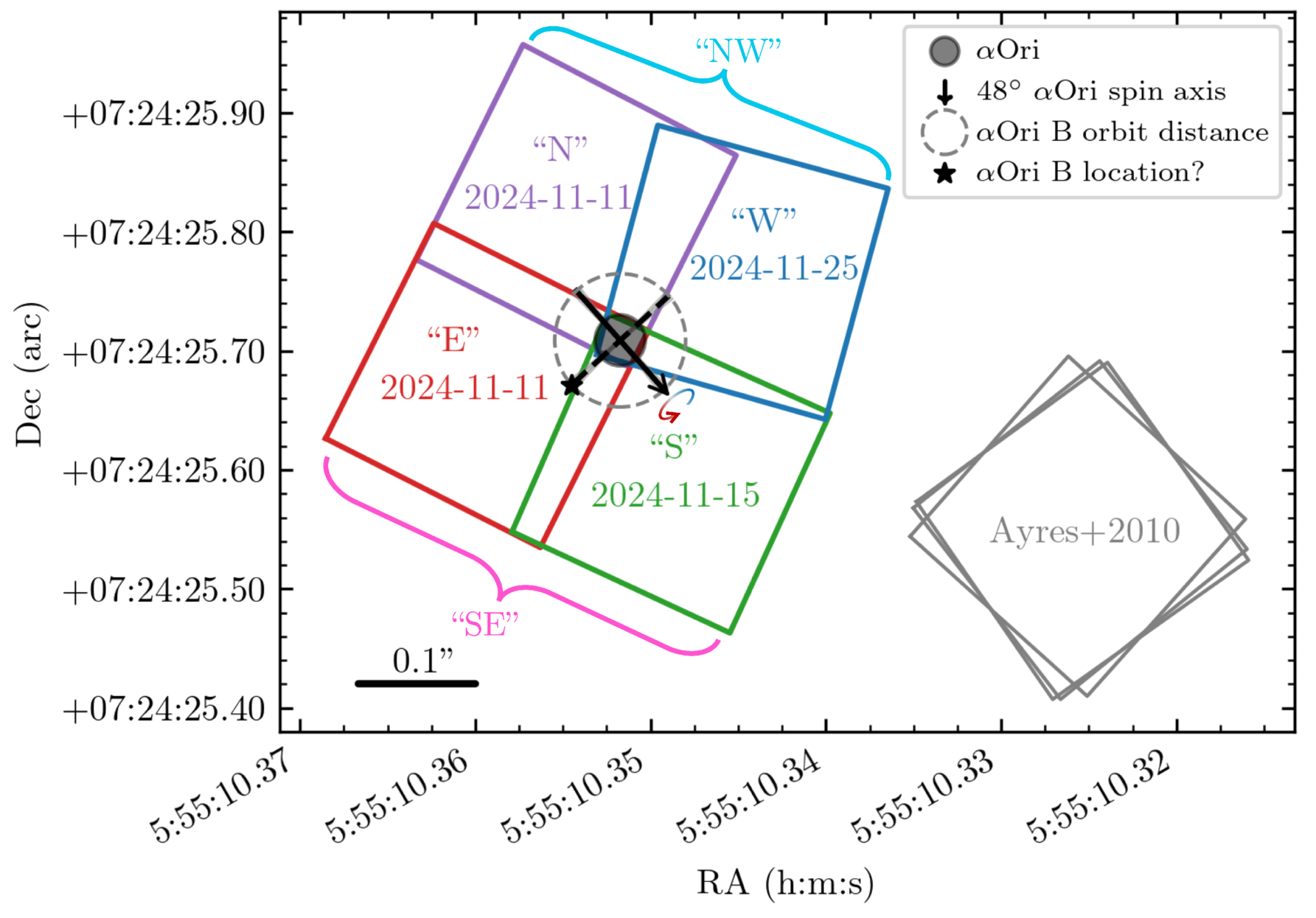
Hubble observing pattern, showing how the quadrants are arrayed around Betelgeuse. Click to enlarge. [Goldberg et al. 2025]

A team led by Jared Goldberg (Flatiron Institute) found a possible way forward in the far-ultraviolet, where young stellar objects and red supergiants both display prominent emission lines. Though Betelgeuse would greatly outshine its stellar buddy, the companion’s orbital motion should shift its emission lines relative to those of Betelgeuse, bringing them into view. To guide their search, the team consulted spectra of known young stellar objects, finding a dozen ultraviolet spectral lines that either rival the strength of those from Betelgeuse or aren’t present in Betelgeuse’s spectrum at all.

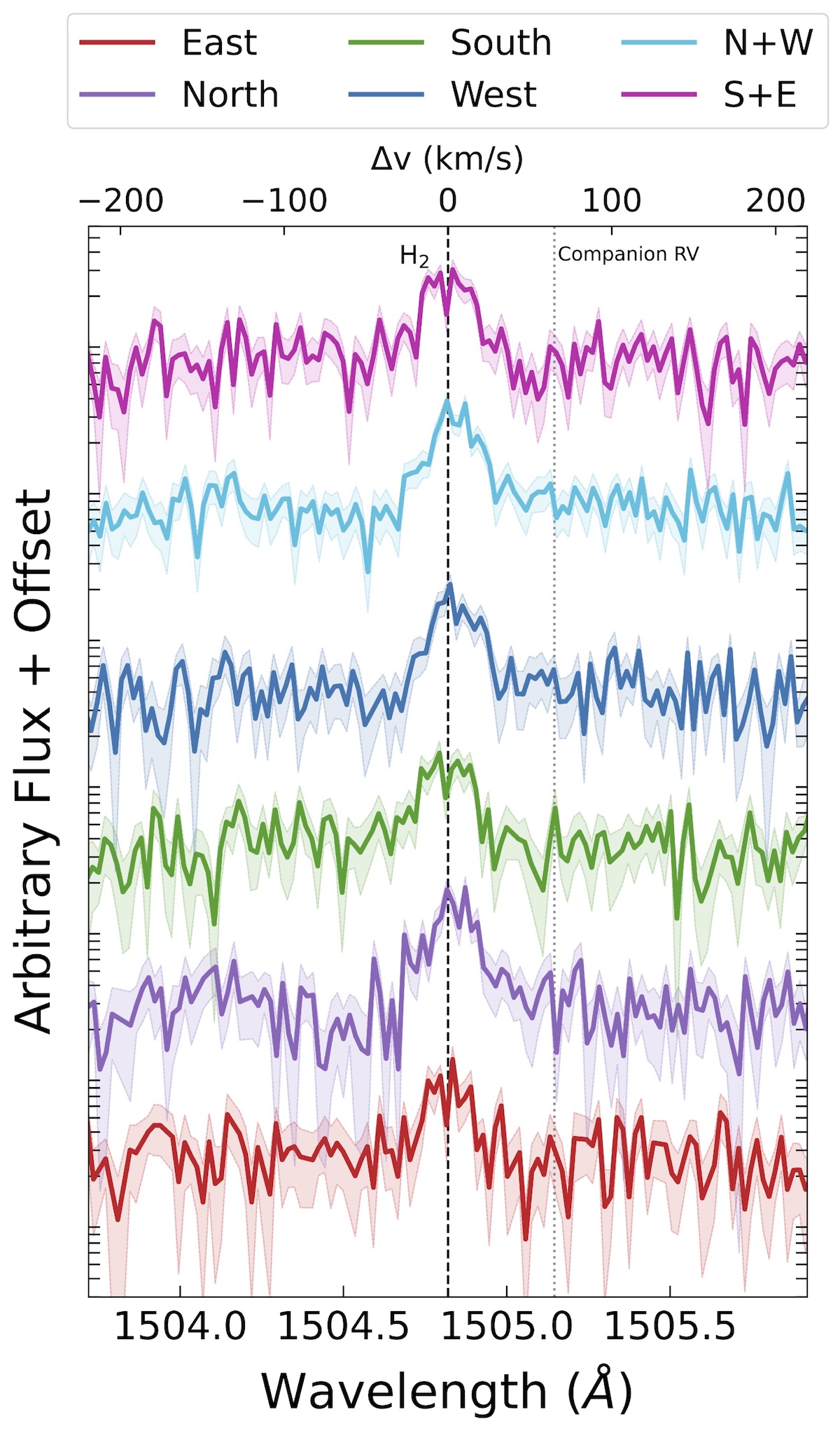
The search is on: Goldberg and collaborators observed Betelgeuse with the Hubble Space Telescope in November 2024, timed to when the companion star’s emission lines would be shifted relative to Betelgeuse. The observations split Betelgeuse’s disk into quadrants, only one or two of which should contain the companion, helping the team tease out the signal from the smaller star, if present. Ultimately, though, no statistically significant signals were found.

spectra of Betelgeuse

Emission around Betelgeuse’s 1504.82 Angstrom H2 line from each of the four observed quadrants as well as combinations of two quadrants. No significant signals were detected at the expected radial velocity of the companion star. [Goldberg et al. 2025]

When Finding Nothing Tells You Something

A lack of a significant detection doesn’t mean that the companion isn’t there, but it does place constraints on its identity. The data confidently rule out a companion star twice as massive as the Sun, marginally permit a star in the 1.1–1.5-solar-mass range, and favor a star lower than 1.1 solar masses.

Researchers assigned a likely mass of about 1.5 solar masses to the probable companion star imaged earlier this year. Though this is at the limit of what’s permitted by the ultraviolet observations, Goldberg and coauthors note that the companion star’s ultraviolet output could be suppressed due to tidal coupling with Betelgeuse or other processes. If the star’s ultraviolet emission is lower than expected, a 1.5-solar-mass companion remains consistent with Hubble’s non-detection of the star.

This is a fantastic example of how multiple lines of inquiry can converge on similar solutions. With the companion star expected to swing around to a favorable observing position again in 2027, this is certainly not the last chapter in the tale of Betelgeuse and Betelbuddy.

Citation

“Betelgeuse, Betelgeuse, Betelgeuse, Betel-buddy? Constraints on the Dynamical Companion to α Orionis from HST,” Jared A. Goldberg et al 2025 ApJ 994 101. doi:10.3847/1538-4357/ae0c0c

The post Hubble on the Hunt: A Spectroscopic Search for Betelbuddy appeared first on AAS Nova.

  •  

A Black Hole Family Tree

A rendering of two dark spheres surrounded by bright, misaligned disks drawing near to one another.

Black holes can have messy family histories, and a recent massive merger challenged astronomers to sort out just how many generations of black holes were involved in the event. Recent research, however, may have untangled the lineages of the two progenitors.

A Massive Collision

Earlier this year, the Laser Interferometer Gravitational-Wave Observatory (LIGO) detected the ripples in spacetime caused by the merger of two black holes somewhere in the distant universe. Though these detections have become increasingly common, this one in particular stood out among the more than 200 reported over the last decade. Named GW231123, this event must have caused more of a splash than a ripple since the two black holes that slammed together were unusually massive; both likely weighed more than 100 times the mass of the Sun. Not only that, each was also spinning unusually rapidly prior to the collision.

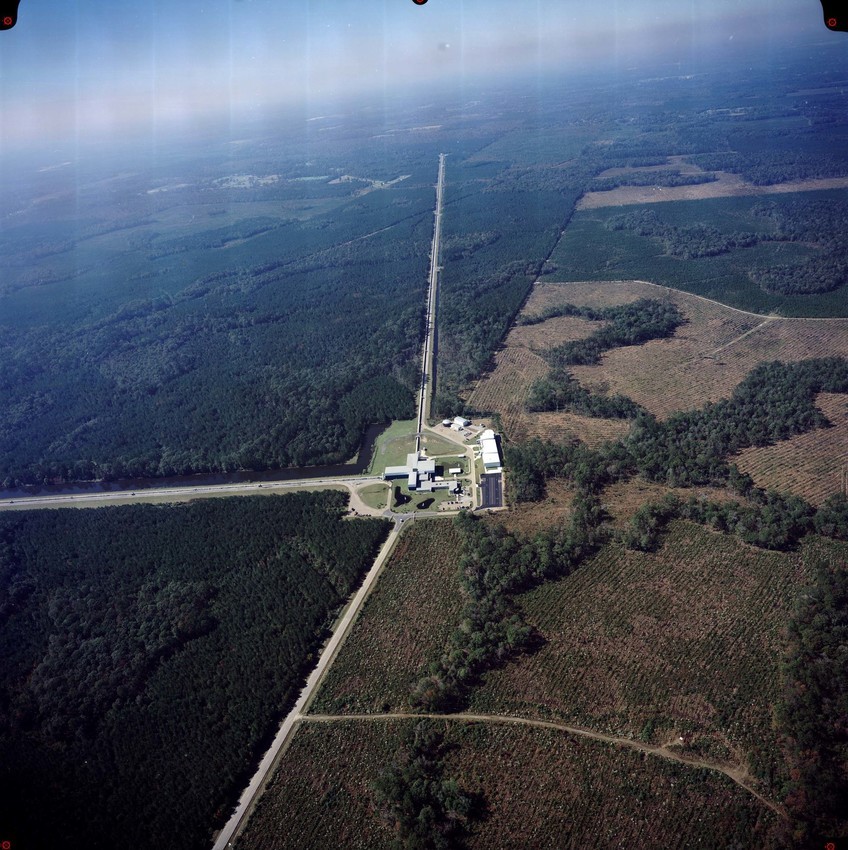
A photograph of two perpendicular straight lines that cut through a forest and meet at a complex of buildings in a clearing.

LIGO Livingston, one of the two LIGO detectors. [Caltech/MIT/LIGO Lab]

According to theory, black holes this large are not supposed to form on their own. When massive stars die, they can collapse into a black hole; but, when really massive stars die, the collapse is so violent that no material is left over to form the black hole. So, when researchers first measured the masses of the black holes involved in GW231123, they knew that the black holes involved couldn’t have formed directly from collapsed stars. Instead, they were likely second-generation black holes, meaning that they themselves formed from previous black hole–black hole mergers.

Merger Mystery

This result was celebrated as evidence of so-called “hierarchical formation,” in which black holes formed in dense environments swarm throughout their star clusters, merging with other black holes they encounter and growing ever larger.

However, there were a couple of complications with this picture. For one, theory predicts that it is challenging to form such rapidly spinning black holes from randomly oriented progenitors, since usually the spins wash out and leave the remnant rotating slowly. For another, the merging process tends to give the final black hole a “kick” that sends it flying rapidly away from the site of the impact, occasionally fast enough to leave the star cluster altogether, meaning second-generation black holes might not be able to merge into subsequent generations.

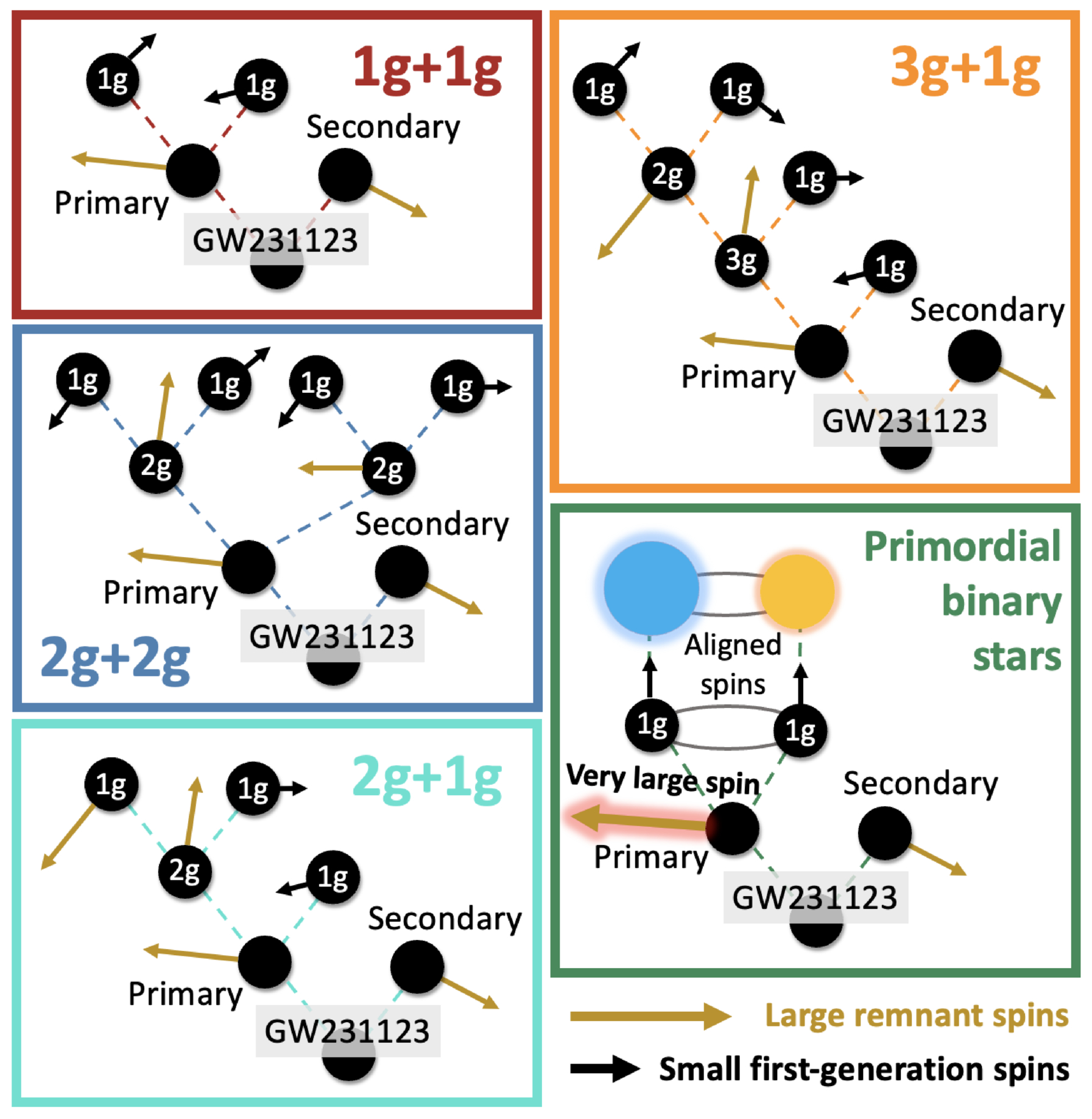
A multi-panel cartoon showing black holes merging through various combinations of 1st, 2nd, and 3rd generation black holes.

A schematic of various potential black hole family trees. The binary-star origin scenario is shown in the green box. Click to enlarge. [Stegmann et al. 2025]

Born as a Pair

New research led by Jakob Stegmann, Max Planck Institute for Astrophysics, suggests a way around each of these problems. In the team’s model, the two black holes involved in the GW231123 merger didn’t form from isolated black holes in a cluster, but rather from binary stars embedded within that cluster. In this picture, two massive stars were born bound together, orbiting one another within a larger cluster of stars. Crucially for this scenario, the massive primordial stars have aligned spins — an expected outcome of massive binary star evolution.

After both stars in the binary collapsed into black holes, these black holes merged to form a rapidly spinning second-generation black hole. This second-generation black hole eventually encountered another black hole within the cluster and merged to produce the ripples in spacetime we observed as GW231123.

Since black holes born within binary systems are expected to have smaller kicks and faster spins, this scenario neatly explains the properties observed in GW231123. As LIGO keeps listening for more black hole mergers, hopefully similar events will provide more chances to untangle their complex family trees.

Citation

“Resolving Black Hole Family Issues Among the Massive Ancestors of Very High-Spin Gravitational-Wave Events like GW231123,” Jakob Stegmann et al 2025 ApJL 992 L226. doi:10.3847/2041-8213/ae0e5f

The post A Black Hole Family Tree appeared first on AAS Nova.

  •  

Betelgeuse’s Companion Star May Have Been Seen at Last

Betelgeuse and its companion star

Astronomers may have directly imaged a companion star to the famous red supergiant Betelgeuse at last. Though the tentative detection only loosely constrains the star’s physical properties, it appears to be a 1.6-solar-mass pre-main-sequence star. The discoverers suggest the name Siwarha, Arabic for “Her Bracelet,” given that the star circles Betelgeuse, “Hand of the Giant.”

Betelgeuse in the Spotlight

constellation Orion

A photograph of the constellation Orion. Betelgeuse is the bright yellow star located left of center. [E. Slawik/NOIRLab/NSF/AURA/M. Zamani; CC BY 4.0]

Situated at the shoulder of the constellation Orion, the red supergiant Betelgeuse is one of the most recognizable stars in the night sky. It’s also the subject of countless scientific studies and amateur observations that stretch back for centuries.

Betelgeuse is a variable star. On top of its well-constrained 400-day pulsation period, the star has exhibited two behaviors that have drawn interest in recent years: a deep, prolonged dimming episode in 2019–2022 that is thought to be due to an immense ejection of mass from the star’s surface, and a 6-year variation in the star’s photometry, astrometry, and radial velocity.

Multiple studies have attributed the 6-year variability to one or more companion stars. In general, these studies predict that the companion star circles Betelgeuse on a tight, 6-year, nearly edge-on orbit. As reported in a new article published in the Astrophysical Journal Letters, observations have likely proved these predictions correct.

Speckle Detection

Steve Howell (NASA Ames Research Center) and collaborators searched for Betelgeuse’s predicted companion star using the 8.1-meter Gemini North telescope. The team used the ‘Alopeke instrument in speckle imaging mode, which involves taking thousands of milliseconds-long snapshots to avoid smearing due to atmospheric fluctuations.

Betelgeuse and its companion star in observations

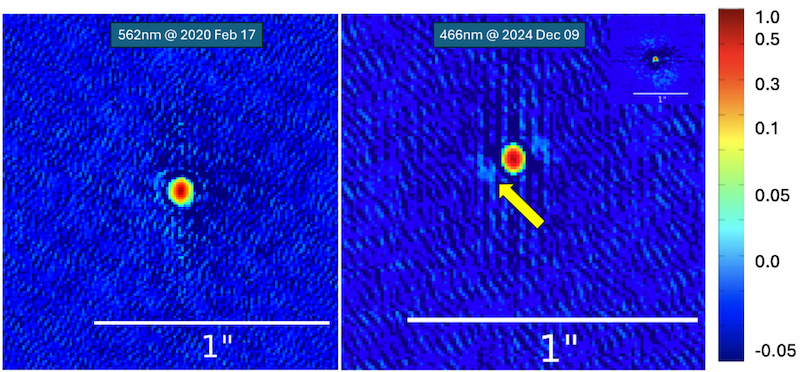
Observations of Betelgeuse from 2020 (left) and 2024 (right). An arrow points to the companion. Note that the image processing introduces a 180º ambiguity in the location of the companion, which is resolved by analyzing phase information. [Howell et al. 2025]

The team imaged Betelgeuse in 2020 and 2024. The 2020 observations coincided with when the companion star was predicted to lie behind Betelgeuse from our vantage point, and no companion appears in these images. The 2024 observations were taken just a few days after the companion’s predicted greatest angular separation from the star — and show evidence for a star just beside Betelgeuse.

More to Learn

Howell and coauthors performed additional analyses to rule out interference from hot pixels, cosmic rays, or atmospheric diffraction. They also considered that the star could lie in the background or foreground, but they found both possibilities unlikely. After further calculations, the team estimated that the companion is six magnitudes fainter than Betelgeuse and separated by just 52 milliarcseconds at an angle of 115º. These quantities agree well with predictions for the companion’s position.

location of Betelgeuse in 2020 and 2024

The on-sky proper motion of Betelgeuse from 2020 to 20204. The companion is shown as the small black circle. This shows that if the companion star were actually a background star, it would have been plainly visible in the 2020 observations. [Howell et al. 2025]

Given the tentative detection — at the level of 1.5σ — it’s difficult to pin down the properties of the companion star. The team placed the star’s mass between 1.4 and 2.0 solar masses, with the likeliest value being 1.6 solar masses. If the companion has the same age as Betelgeuse, this star would be on the cusp of joining the main sequence. However, it may never reach that stage of life; Betelgeuse’s demise in a core-collapse supernova is imminent, in the astronomical sense, and the companion may spiral in to merge with Betelgeuse even before then. (It currently orbits at just 4 au — closer than the distance between the Sun and Jupiter.)

The team closed with a call to the community to turn their instruments toward Betelgeuse on 26 November 2027, when the companion will once again be at its greatest angular separation. Our exploration of this long-sought-after star has just begun!

Citation

“Probable Direct Imaging Discovery of the Stellar Companion to Betelgeuse,” Steve B. Howell et al 2025 ApJL 988 L47. doi:10.3847/2041-8213/adeaaf

The post Betelgeuse’s Companion Star May Have Been Seen at Last appeared first on AAS Nova.

  •  

Double-Star Discovery Suggests There’s a New Nearby Supernova Progenitor

DEM L 190 supernova remnant

New data suggest that the second-brightest star in the constellation Sagittarius is not one star but two. The two stars will someday merge to form a single star with a mass of 12 solar masses, and at just 228 light-years away, the resulting star will be the nearest core-collapse supernova progenitor to Earth.

One Star of Two?

The star Sigma Sagittarii, formally named Nunki by the International Astronomical Union, has been under scrutiny for decades. Various studies published in the last half-century have found Nunki to be either two stars in a tight binary system or a single star, depending on the methods and instruments used.

Paranal Observatory

Three of the Very Large Telescope Interferometer’s 1.8-meter Auxiliary Telescopes, which can be maneuvered into different positions. [Y. Beletsky (LCO)/ESO; CC BY 4.0]

Now, a team led by independent researcher Idel Waisberg has performed an interferometric investigation of the star, aiming to discern its single or binary status. The team used the GRAVITY instrument on the Very Large Telescope Interferometer (VLTI) at Paranal Observatory in Chile.

The VLTI encompasses eight telescopes, including four 8.2-meter telescopes that are fixed in place and four 1.8-meter telescopes that can travel between different stations, changing the resolving power of the interferometer. For this search, Waisberg and collaborators positioned the smaller telescopes so that the greatest distance between them was 130 meters, achieving a resolution of just 3.5 milliarcseconds.

Future Site of a Supernova

The VLTI data clearly show that Nunki is a close binary star system. The two stars have nearly the same mass — 6.5 and 6.3 solar masses — and are separated by just 0.60 au, orbiting one another every 50 days. Stellar isochrone modeling suggests that the stars are roughly 30 million years old.

illustration of a star filling its Roche lobe

Diagram of a binary star system in which one star has filled its Roche lobe. The blue shaded areas indicate the stars, while the black lines outline the two stars’ Roche lobes. [Philip D. Hall; CC BY 4.0]

Though the new data have shown that Nunki is in fact two stars, further analysis showed that this configuration is only temporary. As the two stars evolve, the more massive of the two will be the first to expand into a red giant. In 20 million years, the growing star will spill out of its Roche lobe — the volume in which gas is gravitationally bound to that star — and donate gas to its smaller companion. Unstable mass transfer will eventually lead the stars to merge, forming a single star of about 12 solar masses.

At 12 solar masses, Nunki will be massive enough to undergo core collapse, and at just 228 light-years away, it is the nearest core-collapse supernova progenitor system to Earth. Be sure to mark your calendar for tens of millions of years in the future — such a close supernova promises to be spectacular!

Citation

“Hidden Companions to Intermediate-Mass Stars. XXVI. Uncovering Nunki = Sigma Sagittarii as a 6.5 M⊙ + 6.3 M⊙, 0.60 au Binary,” Idel Waisberg et al 2025 Res. Notes AAS 9 71. doi:10.3847/2515-5172/adc739

The post Double-Star Discovery Suggests There’s a New Nearby Supernova Progenitor appeared first on AAS Nova.

  •  
❌