❌

Reading view

Apple Music’s New Identity Turns Sound Into Moving Images

Apple Music unveiled a new brand identity on October 21, combining a revised wordmark, a sonic signature, and moving visuals shaped through physical experiments with sound. The project brings together Apple Music and TBWA\Media Arts Lab, with an original composition by British producer Fred again.. and NEST Acoustics providing the musical foundation.

The concept is described as “made by sound.” Rather than treating music as a soundtrack added after the visuals were finished, the creative process used audio to generate movement that could be filmed and incorporated into the identity.

The reveal explains how Apple Music intends to connect its visual and audio branding across different settings. The wordmark, musical-note symbol, filmed sequences, and short composition each contribute to that identity, while the rollout determines where audiences will encounter them.

Sound Becomes Part of the Image

According to Wallpaper’s account of the project, the team played musical notes through a transducer, which converts audio signals into physical vibrations. Those vibrations moved a shallow bath of mineral oil, producing ripples and shifting refractions.

The resulting patterns were captured on camera and became material for the visual design. Fred again.. and NEST Acoustics also developed a short composition that serves as the identity’s sonic signature.

The experimentation also influenced the composition. Fast Company reports that too many notes, or notes pitched too high, created excessive movement and made the image difficult to read. Those tests helped establish constraints for the musicians as they developed the sonic signature.

The result came from adjusting sound and image together. The team could observe how a musical choice changed the liquid’s movement, then refine the composition with the visual response in mind.

A Heavier Wordmark Joins the Moving Visuals

The refresh also changes the service’s typography. Wallpaper describes a customized version of Apple’s SF Pro typeface, with bold, lowercase lettering accompanying the Apple symbol.

The musical-note icon is another component of the system. Together, the lettering, symbol, motion, and sound create several ways to identify Apple Music, depending on the setting.

Those distinctions help explain why a single screenshot cannot represent the whole project. An app icon must remain recognizable at a small size. A video sequence can use time, movement, lighting, and audio to establish a different impression.

The new identity therefore needs to be considered both as a collection of individual elements and as a coordinated presentation. Someone may prefer the animated treatment while responding differently to the static lettering; those reactions concern different parts of the same design.

Introducing a new identity for Apple Music, physically shaped by an original composition from @fredagainagain1 and NEST Acoustics. https://t.co/LFXLIfexPL

— Apple Music (@AppleMusic) October 21, 2026

The Film Shows the Physical Production Process

A companion film documents the work behind the identity. iClarified’s coverage describes a 78-second sequence moving between the practical setup and the finished visuals.

The team submerged acrylic versions of the musical-note symbol and wordmark in mineral oil. Fast Company reports that the oil was selected for its viscosity, helping create the appearance of glass rippling under sound. Filming the moving liquid and refracted light produced the distortions seen in the finished sequences.

The behind-the-scenes approach makes the production method visible. It gives viewers something specific to examine: the relationship between a musical composition, a physical response, and the image recorded by the camera.

It also provides a useful distinction between inspiration and execution. Saying that a design is inspired by music is broad. Showing sound physically influencing the material being filmed explains how that idea entered the finished work.

The Rollout Extends Beyond the App Icon

Fast Company’s reporting identifies Apple Music, TBWA\Media Arts Lab, Fred again.., and NEST Acoustics as collaborators. It says the identity will begin appearing across original content and event programming this week, with marketing, product, and other experiences following later.

That describes a staged introduction rather than a single moment when every Apple Music surface changes. Viewers may encounter the new presentation in promotional or editorial material before seeing it consistently elsewhere.

The announcement is about branding. It does not, by itself, establish changes to subscription plans, playback quality, recommendations, or the music catalog. Those product details require separate announcements.

A stylized white musical note icon with a chromatic glow on a black background.
Image Credit: Apple Inc.

A Musical Idea Gives the Refresh Its Focus

The strongest part of the project is the clear relationship between its subject and its method. A service built around listening has used a composition to influence its visual identity, giving the sound and moving image a shared origin.

How successfully the elements work across everyday settings will become clearer as the rollout progresses. For now, the reveal offers a concrete account of creative collaboration—and a reason to look beyond the icon when assessing Apple Music’s new appearance.

The post Apple Music’s New Identity Turns Sound Into Moving Images appeared first on AppleMagazine.


💾

Enjoy the videos and music you love, upload original content, and share it all with friends, family, and the world on YouTube.
  •  

What did the Liberty Bell sound like? Science is on the case.

The Liberty Bell, with its famous crack, hasn't been rung in 180 years, but that hasn't stopped scientists from pondering what the bell might have sounded like when tolling. In honor of the nation's 250th anniversary, researchers at Penn State University have modeled its acoustic properties, drawing on data collected from one of the bell's replicas. The work was first presented at a meeting of the Acoustical Society of America in Philadelphia earlier this year, followed by an article in Physics Today.

Historians aren't sure exactly when the Liberty Bell acquired its distinctive crack, just that it occurred sometime between 1817 and 1846. An 1846 account in the Public Ledger described the ringing of the bell on February 23 that year and mentioned that the bell had developed a crack, which someone had attempted to fix by filing the sides down. But it didn't work: The February 23 ringing extended the crack even more, so much so that "the old Independence Bell ... now hangs in the great steeple irreparably cracked and forever dumb." Nobody has heard it ring since.

This wasn't the first time the bell had cracked; the rim cracked shortly after it arrived in Philadelphia in 1752, the first time the clapper struck while testing the sound. It was recast by two local foundry workers, John Pass and John Stow, not once but twice, because the first recast produced a sound that one bystander likened to coal scuttles banging together.

Read full article

Comments

© William Zhang/CC BY 2.0

  •  

Apple Music anuncia rebranding e divulga novos logotipos

Depois de ter dado as caras nas versões beta dos sistemas da Maçã, a nova identidade visual do Apple Music já está entre nós!

Anunciada há pouco pela fabricante do iPhone, ela abre mão de cores sólidas para apostar em efeitos visuais inspirados por ondas sonoras — e que lembram bastante a linguagem de design Liquid Glass.

Introducing a new identity for Apple Music, physically shaped by an original composition from @fredagainagain1 and NEST Acoustics. pic.twitter.com/LFXLIfexPL

— Apple Music (@AppleMusic) October 21, 2026
Apresentando uma nova identidade para o Apple Music, fisicamente moldada por uma composição original de @fredagainagain1 e NEST Acoustics.

Por enquanto, a Apple divulgou apenas o novo logotipo do seu serviço de streaming, criado pela NEST Acoustics.

Para chegar ao resultado acima, eles colocaram o logo do Apple Music no fundo de um tanque preenchido com óleo mineral e o cobriram depois com uma placa transparente no formato de um ícone de app. O efeito de ondas sonoras, por sua vez, foi gerado por uma composição (criada pelo DJ e produtor musical Fred Again…), cuja frequência se moveu pelo tanque.

Foram criadas duas versões do logo: uma apenas com a nota dupla e outra com a wordmark. É possível que as vejamos em uso pelo Apple Music no início de vídeos promocionais e em produções como gravações de shows.

Como tem sido o costume, a Apple publicou um vídeo de bastidores que mostra como se deu o processo de criação desses logos:

A nova identidade visual do Apple Music deverá pintar para todos nas versões 27.2 dos sistemas da Maçã, cujo lançamento é esperado para a semana que vem.

O Apple Music conta com um catálogo de mais de 100 milhões de músicas e 30 mil playlists — muitas delas com suporte a Áudio Espacial (Dolby Atmos) e em altíssima definição, com áudio Lossless. Para quem ama música clássica, há um app dedicado com mais de 5 milhões de faixas, tudo em uma interface simplificada! No Brasil, são três tipos de assinatura: Universitária (R$12,90/mês), Individual (R$23,90/mês) e Familiar (R$40,90/mês). Caso você não seja um assinante, pode testar o serviço de forma gratuita por um mês. Ele também faz parte do pacote de assinaturas da empresa, o Apple One.

NOTA DE TRANSPARÊNCIA: O MacMagazine recebe uma pequena comissão sobre vendas concluídas por meio de links deste post, mas você, como consumidor, não paga nada a mais pelos produtos/serviços ao usar os nossos links de afiliado.

  •  

Research roundup: 7 cool science stories we almost missed

It’s a regrettable reality that there is never enough time to cover all the interesting scientific stories we come across. So every month, we highlight a handful of the best stories that nearly slipped through the cracks. August’s list includes the discovery of a new celestial object astronomers have dubbed a "black hole star"; breaking down plastics with microbes and turning them into edible cookies; how whale calls are connected to Einstein's special theory of relativity; and how avocado tree flowers switch sex during the day, among other highlights.

Discovery of a "black hole star"

Credit: Rohan Naidu (University of Hawai'i)

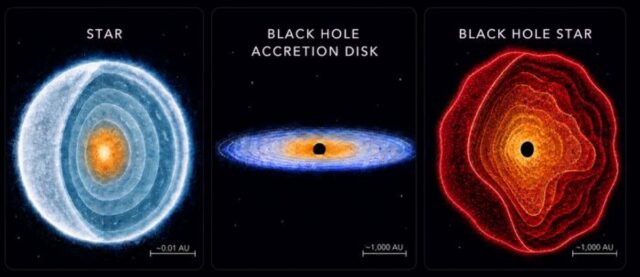
In 2024, astronomers combing through datasets taken by the James Webb Space Telescope noticed hundreds of mysterious little red dots lurking therein, believed to be baby quasars. They existed when the Universe was just a few hundred million years old. One such object in particular captured scientists' interest: a red dot that was extremely red and very bright, but whose properties didn't fit with any known astrophysical object. Astronomers have now concluded that the little red dot is a "black hole star," so named because it is the size of a large star but produces far more energy than would be possible via nuclear fusion—energy comparable to what an active black hole would produce.

Read full article

Comments

© ose-Luis Olivares, MIT

  •  
  •  

New Tungsten-Silicone Contact Lens Technology Restores Vision for Underwater Drone Operators

Beneath the crushing depths of the ocean, autonomous underwater vehicles (AUVs) are our eyes and ears, tirelessly exploring, mapping, and surveying the mysterious realm beneath the waves. Yet, despite their advanced capabilities, these drones face an age-old paradox: the very domes designed to protect their sensitive sonar systems simultaneously distort the sound waves essential for their operation. This distortion, caused by the curved, hydrodynamic enclosures, acts like a warped funhouse mirror that scatters and blurs sonar pulses, severely limiting the drones’ ability to detect distant objects and underwater features with precision. Until recently, addressing this longstanding challenge required complex solutions that were either power-hungry or computationally intense, hampering the mission duration and efficiency of these critical underwater explorers.

Profound innovation has emerged from the laboratories of Shanghai Jiao Tong University, where Prof. Yu Zhang and his research team have invented a groundbreaking solution: a soft, acoustic “contact lens” engineered to counteract the dome-induced aberrations before the sound waves even exit the AUV’s protective shell. This lens is not just a passive accessory but an active sculptor of acoustic waves, reshaping them to restore their integrity and focus. Published in the International Journal of Extreme Manufacturing, their work leverages physics principles rooted in time-reversal acoustics to design a lens that physically corrects the sound wavefront, bypassing the limitations of traditional electronic or algorithmic interventions.

The hydrodynamic domes encasing underwater vehicles are essential for minimizing drag and shielding delicate sonar electronics from relentless exposure to saltwater and pressure. However, these domes distort sonar pulses due to their curved shape, causing sound waves to bend unpredictably and scatter. The scattered returns weaken sonar resolution and increase background noise, transforming once-clear echoes into a confusing murmur. Attempts to solve this typically involve complex signal processing algorithms that aim to reconstruct the lost information or powerful electronic arrays that attempt to reshape the outgoing wavefronts. Yet, these methods either cannot recover lost acoustic energy or demand heavy power consumption, which is incompatible with the constraints of small, battery-operated underwater drones.

Prof. Zhang’s approach is fundamentally different. Instead of relying on electronics or computation after the fact, his team designed a physical lens that preemptively corrects acoustic wave distortions as they propagate through the dome. Utilizing the concept of time-reversal, the researchers measured how the dome distorts acoustic waves and inverted this knowledge to engineer a lens capable of compensating for those distortions. Their solution mixes tungsten particles — known for their high density — into flexible silicone rubber, producing a composite material with precisely tunable acoustic properties. Because sound velocity depends on both density and elastic moduli, adjusting the tungsten concentration allows the lens material to slow or speed up sound locally, much like prescription lenses manipulate light.

This acoustic gradient-index lens (GRIN) is molded into concentric rings, each engineered to delay or advance portions of the sonar pulse. As the sonar sound passes through these rings, its wavefront is transformed from a warped, distorted shape into a perfectly flat and focused beam just as it clears the hydrodynamic dome. This physical reshaping enables the sonar to transmit a tight, highly directive beam instead of a scattered flood, enhancing detection specificity and signal strength. The research team demonstrated that their lens concentrates a broad 65-degree sonar wave into a spotlight ranging between 16 to 30 degrees, significantly sharpening the sonar’s “vision” underwater.

Quantitatively, the acoustic lens boosts the main sonar signal by over 10 decibels across a wide frequency range of 20 to 45 kHz while simultaneously suppressing background reverberation by more than 10 decibels. These figures translate to clearer, sharper echoes that extend the effective detection range and improve resolution. Crucially, this leap in sonar performance comes without drawing any extra power or requiring complex onboard signal processing, preserving the drone’s battery life and reducing system complexity — a true game changer for long-term or remote underwater missions.

Beyond performance, the lens material exhibits remarkable durability in extreme underwater conditions. The silicone-tungsten composite withstands temperature fluctuations and prolonged exposure to saltwater without degradation. This robustness ensures that the acoustic lens can endure the harsh environments characteristic of deep-sea exploration, making it suitable for real-world deployment rather than laboratory proof-of-concept. Moreover, its soft, flexible nature allows it to be custom-molded to varying dome shapes, opening avenues for broad adoption across different AUV platforms.

This discovery signals a paradigm shift in underwater vehicle design. By integrating acoustic correction directly into the vehicle’s protective shell through a low-cost, easily manufactured material, the need for bulky, energy-intensive sonar systems diminishes. As a result, smaller, more affordable underwater drones can achieve sonar performance nearing that of larger, costlier submarines. The implications extend to diverse fields including marine biology, underwater archaeology, and subsea infrastructure inspection, where precise, long-range echo detection is vital.

Looking ahead, the next stage for Prof. Zhang’s team focuses on testing the lens’s performance in open ocean environments to assess its resistance to marine biofouling — the accumulation of microorganisms, plants, algae, or small animals on underwater surfaces — which can compromise acoustic properties over time. Additionally, they are advancing manufacturing techniques towards advanced 3D printing methods that will allow seamless gradient acoustic lenses to be produced with even greater precision, complexity, and scalability.

This technology’s potential impact surpasses marine exploration. The principles underlying this holographic gradient-index lens could revolutionize ultrasound imaging in medicine by refining ultrasonic wave propagation for clearer diagnostic images, or enhance non-destructive testing in industries like aerospace and civil infrastructure through improved ultrasonic signal control. As such, this innovation stands at the intersection of physics, materials science, and engineering, showcasing how fundamental scientific insight can spark transformative technological advances.

The story of the holographic GRIN lens exemplifies how embracing physical wave manipulation offers elegant, energy-efficient alternatives to purely electronic or algorithmic solutions. By rewiring the propagation path of acoustic waves with tailored materials, this breakthrough lays the foundation for smarter, sleeker underwater drones capable of revealing the ocean’s secrets with unprecedented clarity. Through meticulous design, material innovation, and acoustic expertise, Prof. Zhang’s lens turns the dome from an obstacle into an asset — finally granting underwater vehicles the sharp acoustic “vision” they need to navigate and explore the deep blue frontier.


Subject of Research: Acoustic wave correction for underwater vehicle sonar systems using gradient-index lens technology.

Article Title: A holographic GRIN lens for broadband, highly directive, and aberration-free echo detection

News Publication Date: 8-Jun-2026

Web References:

Image Credits: By Jinhu Zhang, Sheng Liu, Chen Yang, Nana Zhou, Erqian Dong, Zhenxuan Bu, Wei Zheng, Fei Zhang, Zhongchang Song, and Yu Zhang

Keywords

Underwater acoustics, autonomous underwater vehicles, sonar enhancement, gradient-index (GRIN) lens, acoustic aberration correction, time-reversal acoustics, silicone-tungsten composite, broadband sonar, marine exploration technology, acoustic metamaterials, biofouling resistance, advanced manufacturing

  •  

Scientists May Have Finally Solved the Mystery of the Strange Hum Heard Around the World

Blurry Hearing The HumA mysterious low-frequency sound known as The Hum has been reported around the world for decades, leaving researchers searching for its source. Imagine lying in bed late at night and hearing a faint engine-like drone that seems to come from somewhere outside. You check the windows, listen for traffic, and search for a nearby machine. [...]
  •  
❌