The South American country, which hosts some of the world’s major astronomical observatories, promises to protect its night skies, from the Atacama Desert to Tierra del Fuego.
So you’re at a family gathering and a distant, well-educated relative comes over to talk about physics. Despite being a non-scientist, this person knows quite a lot about your field. You must be disappointed, the relative says, because dark matter, your life’s work, is proven not to exist. Furthermore, you’re told your field is crammed with dishonest people who are only in it for the money.
This is what happened to Dan Hooper, a physicist and cosmologist at the University of Wisconsin, Madison, who specializes in dark matter himself. It was the first time he’d encountered what Hooper calls a “new narrative” about physics, though other colleagues told him that they also had heard it. Some believers in this narrative, Hooper found, were so angry about the state of physics that they threatened him and his colleagues with violence.
So who exactly are the critics? Hooper mentions several podcasters and YouTubers who use their “wealth and fame” to make “sensationalist” claims about modern physics that, he says, amount to “little more than noise”.
Other critics have no scientific credentials at all. There is, for example, the actor Terrance Howard who villainizes the scientific community, promotes his own loopy theory called “Terryology”, and even thinks 1 × 1 = 2.
Still others have “scientific credentials”, such as Sabine Hossenfelder. A former academic theoretical physicist, she’s now a YouTuber who accuses scientists working in supersymmetry as guilty of scientific malpractice and who makes other claims about that field that “have little to do with reality”.
Another of Hooper’s targets is the venture capitalist Eric Weinstein. Weinstein does have a PhD in mathematics but uses his popular tabloid podcasts to attack contemporary theoretical physics and promote an evidence-free “theory of everything” that he calls “Geometric Unity”.
These and other influencers, according to Hooper, claim that theoretical physics is stagnant and riven with “many blind spots, biases, and misaligned incentives” created by “the dishonesty and opportunistic behaviour of the scientists pursuing this research”.
The attacks, Hooper goes on to say, are amplified by “social media, videos, and podcasts” and amount to “carefully orchestrated and highly effective campaigns of science populism” reaching increasingly large audiences. Most of Hossenfelder’s videos on YouTube, for instance, have hundreds of thousands of views.
What’s new about these attacks on science, Hooper writes, is that they are directed not against specific theories but against “the scientists and institutions of science” that develop these theories. Hooper labels it “populist physics” and calls it a global threat not only to physics but to expertise and rational behaviour.
So is populist physics being peddled by only a few contrarians? Or is there really a growing, culture-wide anti-science movement? You can’t really tell from Hooper’s book. What is most interesting about the book, in my view, is how Hooper respondsto the critics.
I can imagine three types of response. One is to ignore or laugh. That, I think, is the attitude of most physicists. I knew a physicist at Brookhaven National Laboratory who, when asked by a neighbour if the lab was studying a crashed UFO, responded, “I wouldn’t be surprised”. It was just easiest, he told me, and he didn’t want to get into a fight with a neighbour.
Physicists aren’t trained to deal with gullible people, so why bother? However, ignoring people with exaggerated and wrongheaded opinions encourages them and can be read as implicitly admitting guilt. Ignoring the attacks, too, tolerates and may even promote scientific illiteracy in ways that can ultimately affect political support and thus the field itself.
A second response is to engage the opponents on their own epistemological and rhetorical turf, becoming as aggressive and polemical as they are. If you haven’t yet seen the British broadcaster Piers Morgan’s podcast in which the theoretical physicist Sean Carroll brawls with Weinstein, you must. The encounter lives up to its billing as a “fight club”. It evokes the advice that one should never wrestle with pigs: you get dirty, you never win, and the pig likes it.
But it’s inspiring to see Carroll willing to get into the pen and stand his ground. It makes us wish that we, too, had the guts and demeanour to be as wicked and witty while at the same time calm, cool and collected. Most of us are not, unfortunately, and if you lose in that pen you lose big.
A third response is to sigh and give an earnest account of what you are doing and why, as well as what you’ve accomplished and didn’t. This aims to counter criticism by emphasizing the integrity of the profession. Hooper’s book takes this route.
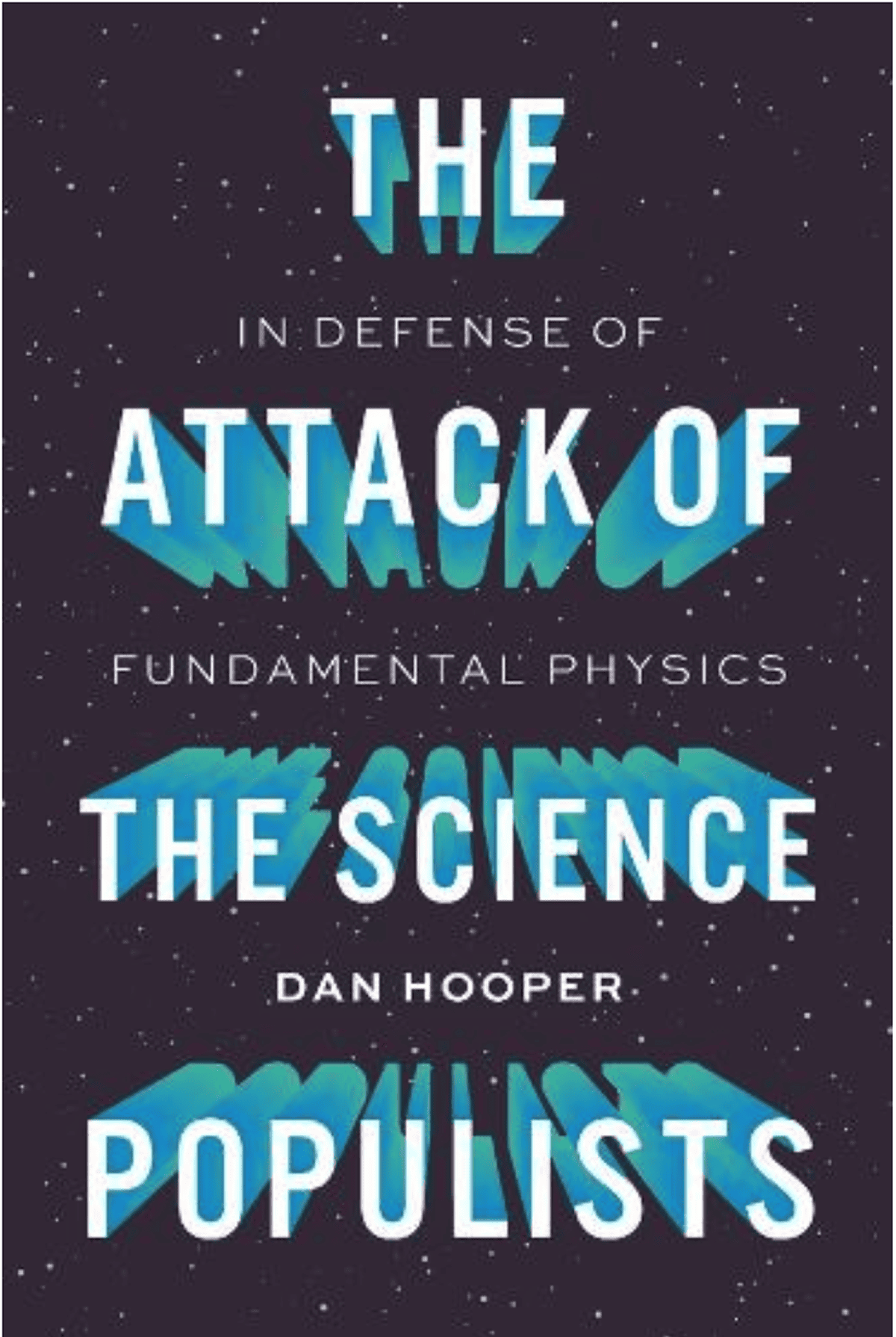
Action, reaction Dan Hooper’s book, due out in early 2027, is a staunch defence of science. (Courtesy: Harvard University Press)
Despite its title, The Attack of the Science Populists is in fact a popular-science book and a very good one at that. It distinguishes itself from other popular-science books by not only explaining contemporary physics but also emphasizing its failures.
Physicists hoped for great things from the Large Hadron Collider (LHC), Hooper writes (he’s aiming his book at readers who don’t know what the LHC is). But while it has made amazing discoveries, such as the Higgs particle, Hooper also describes the fundamental things that it was expected to find but didn’t, such as supersymmetry particles that might have explained why the Higgs has the mass it does.
In another chapter he writes that string theory seemed like a good bet because it is able to handle quantum gravity, but that “this bet has not paid off”. Hooper explains in clear language the aims and disappointments of the LIGO gravitational-wave detector, Modified Newtonian Dynamics (MOND), the Standard Model of particle physics, supersymmetry, the multiverse and other theories. But he also makes clear how their flaws relate to the boldness of their ambitions.
If your friends ask for popular books summarizing the current state of theoretical physics, include Hooper’s on the list.
The critical point
I think “populism” is the wrong word here. To me, the term suggests widespread and genuine if incompletely articulated grievances, whether it’s about the need for cheaper homes, more jobs or better healthcare. But is Hooper really talking about the masses? What does Terryology have in common with Geometric Unity? In the Venn diagram of Howard, Hossenfelder and Weinstein, how big is the audience overlap?
Many of the field’s assailants seem not to be motivated by widely shared grievances but more like individual self-aggrandizing types who say, “Pay attention to my theory!” Even Hooper calls them “fringe” and “outsider mavericks” who make for a good story. It’s not populism or conspiracy when a bunch of glam narcissists stand out only because of their large social media following.
So what would genuine “populist physics” be? It would, I think, be a shared concern and insistence by non-scientists that the billions of dollars spent on physics, on the hundreds of thousands of professional physicists, and on all their labs are used in ways that return something to the people who are paying for it.
Such a return doesn’t necessarily have to result in improving our material ways of life, but might involve providing answers to questions that we all have at one time or another about the origin, nature and future of the universe. Populist physics therefore would arise in opposition to wealthy influencers who dominate social media to promote merely sensationalist and self-interested claims.
In this sense, what Hooper is doing with his new book is seeking to reassure readers that populist physics is what his field has been up to all along.
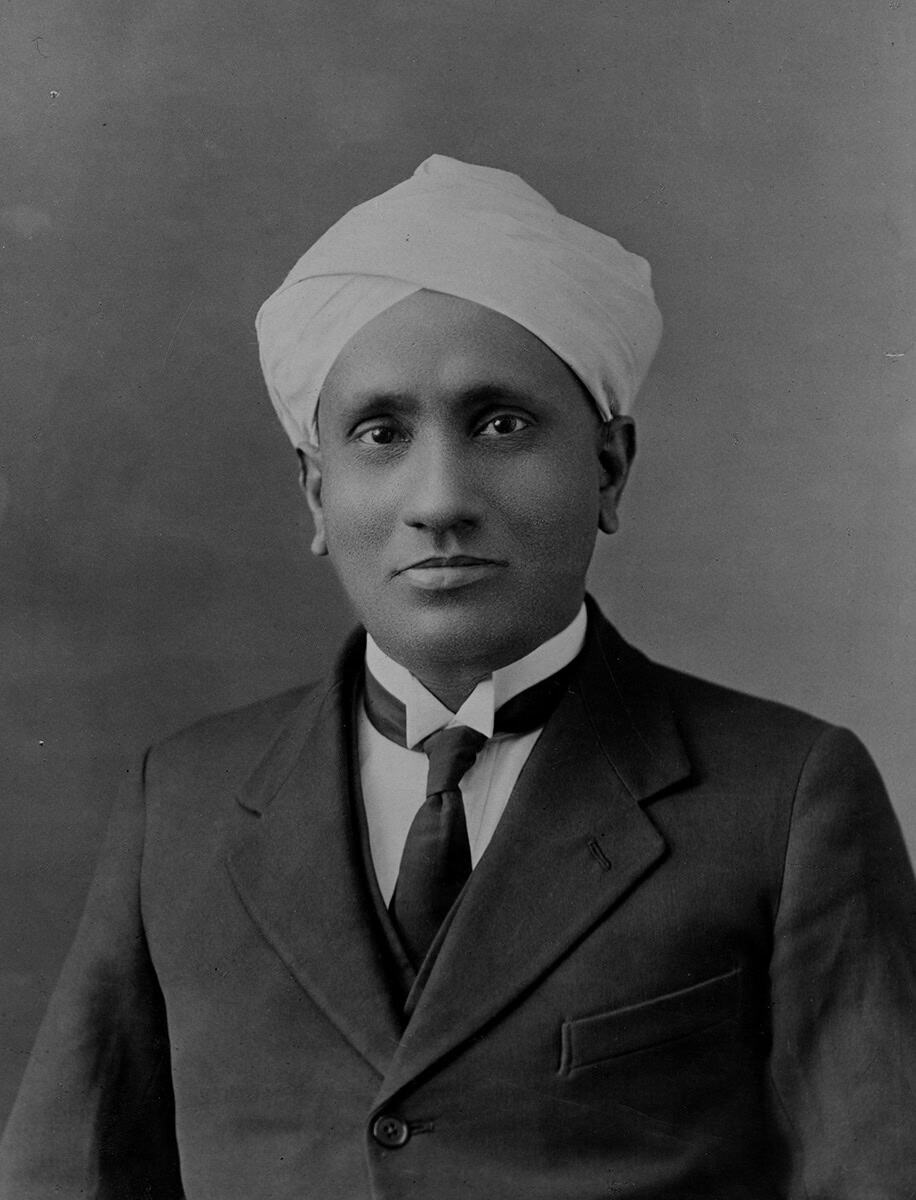
Cocksure and confident C V Raman sailed to Stockholm in 1930 convinced he’d win that year’s Nobel Prize in Physics. (Photograph by A Bortzells Tryckeri, courtesy of AIP Emilio Segrè Visual Archives, W F Meggers Gallery of Nobel Laureates Collection)
How confident, or perhaps delusional, do you have to be to travel to Stockholm because you’re so certain you’ll be awarded a Nobel prize? Most of us wouldn’t have the time, money or self-belief to go to Sweden and hang out at the Royal Swedish Academy of Sciences on the off-chance that we might win. But one person who did just that was the Indian physicist Chandrasekhara Venkata (C V) Raman in 1930.
Back in those days, travelling from India to Sweden wasn’t a case of jumping on a jet plane, but involved a long, two-month journey by sea. So if he wanted to arrive in Stockholm in time for the award ceremony on 10 December 1930, Raman knew he couldn’t wait until the prize was formally announced in mid-November to set sail. In July 1930 he therefore booked passage for himself and his wife, the couple arriving in Stockholm on 9 December of that year.
Raman’s audacity, belief and the arduous journey paid off. He was duly awarded the 1930 Nobel Prize in Physics “for his work on the scattering of light and for the discovery of the effect named after him”, namely Raman scattering. In doing so, Raman became the first person from India to win a scientific Nobel prize – the poet, playwright and musician Rabindranath Tagore having previously won the 1913 Nobel Prize in Literature.
Obsessive nature
Born on 7 November 1888 in the city of Thiruchchirappalli in Tamil Nadu, Raman was a child prodigy, who at 16 came top in physics at the University of Madras and published his first research paper aged just 18. Appointed a professor of physics at the University of Calcutta in 1913, Raman had a long obsession with winning a Nobel prize. In 1924, upon being elected a fellow of the Royal Society, he was asked during the award ceremony what was next in line for him. “The Nobel prize of course!” he replied.
The discovery that bagged Raman the coveted prize in fact began on another sea voyage
The discovery that bagged him the coveted prize in fact began on another sea voyage. In 1921 Raman was travelling back from Southampton to Bombay (now Mumbai) on the SS Narkunda, having taken part in the Second Congress of the Universities of the Empire in Oxford. Rather than lounging on the sun deck or drinking in the bar, Raman spent the 15-day journey examining and analysing the deep blue colours of the Mediterranean, Red and Arabian seas with his pocket Nicol prisms, a small telescope and a diffraction grating.
In fact, Raman did more than just take data. While on board, he wrote up his findings in a short letter that he mailed to the journal Nature while the ship was docked at Aden in Yemen. Published on 20 October 1921, it gives Raman’s address as “SS Narkunda, near Aden” (Nature108 242). He then wrote another paper to Nature (108 367) titled “The colour of the sea”, this time with the byline “SS Narkunda, Bombay Harbour”.
The spectrum of blue colours of the vast sea fascinated Raman and made him question the previous belief, primarily from the work by Lord Rayleigh, that the colour is simply due to the reflection of the sky – and has nothing to do with the colour of the water itself. Raman challenged this notion in his follow-up Nature paper, which was published on 17 November 1921.
Natural fascination C V Raman was awarded the 1930 Nobel Prize in Physics for discovering that light can change colour when passing through a material because some photons scatter inelastically off it. Now known as “Raman scattering”, he came up with the idea while sailing from the UK to India in 1921 and taking measurements of the deep blue colour of the sea. (Courtesy: iStock/Ciuvelic Razvan)
“It was abundantly clear from the observations,” he writes, “that the blue colour of the deep sea is a distinct phenomenon in itself.” Raman believed that light diffracts as it passes through the water and concluded: “An interesting possibility that should be considered is that the diffracting particles may, at least in part, be the molecules of the water themselves.”
This curiosity led him to a series of experiments over the next few years, primarily carried out by his students at Calcutta University, culminating in the discovery that light changes its wavelength and energy when it passes through any material. The change in wavelength and energy, in fact, is a fingerprint of the material itself.
His discovery of what became known as the Raman effect is what eventually won him his most cherished recognition – the 1930 Nobel Prize in Physics. One of the many applications of Raman’s discovery is Raman spectroscopy, which uses the scattering of laser light to establish the chemical make-up of a material and forms the basis of airport security scanners.
Indian impact
Raman’s Nobel prize was significant not just for the scientific advancements that his discovery enabled, but also for the far-reaching impact it engendered in India, where opposition to the British Raj was gathering speed. In fact, he won the award less than a year after the declaration of Purna Swaraj – complete independence – on 26 January 1930 in a session of the Indian National Congress in Lahore.
For a country reeling under colonial rule and fighting for its identity, Raman’s Nobel prize could not have come at a better time to instil hope and aspirations to millions of people around the country. In fact, he holds the honour of being the first physicist outside western Europe or the US to win the Nobel Prize in Physics.
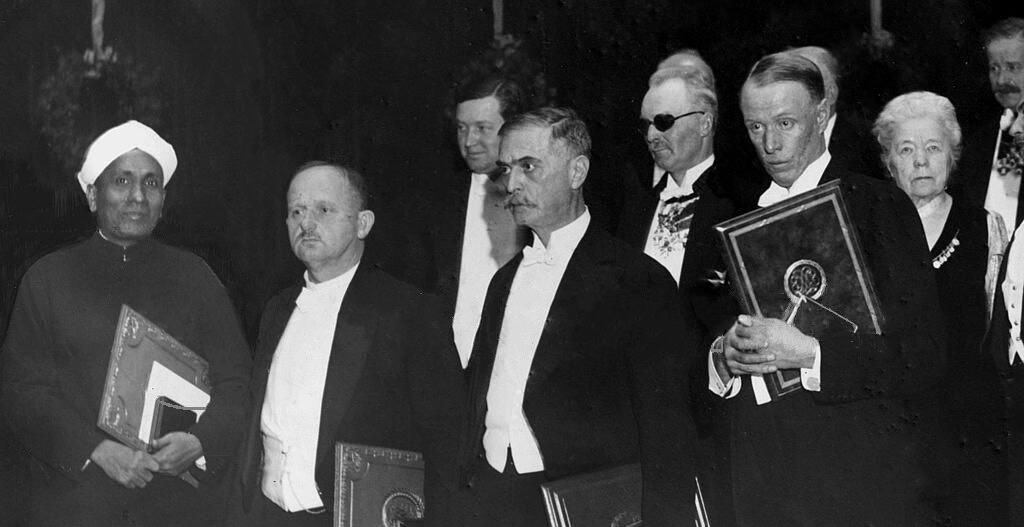
Dream trip C V Raman (far left) picking up the 1930 Nobel Prize in Physics in Stockholm alongside (from left to right) fellow winners Hans Fischer (chemistry), Karl Landsteiner (medicine) and Sinclair Lewis (literature). (No known copyright restrictions, photographer unknown. Source: Wikimedia Commons)
Raman was fully aware of the impact that the prize would have in India, where research was far less developed than that enjoyed by his counterparts in, say, Cambridge, Göttingen or Copenhagen. In 1929 he therefore hesitantly wrote a letter to the Danish Nobel-prize-winner Niels Bohr, asking for his “influential support” for the 1930 Nobel prize. The request of such “personal character”, he explained, was only because he believed that Bohr would “sympathize with the scientific aspirations of India”.
Unbeknownst to Raman, Bohr had already nominated him for a Nobel prize in 1929 – that year’s prize going to Louis de Broglie for wave–particle duality – and he did so again in 1930. We now know a total of 10 different people nominated Raman for that year’s prize, including de Broglie as well as Ernest Rutherford and Charles Wilson.
Raman’s research and notoriety led to many students being attracted to Calcutta, with the physics department becoming a centre of world-class research
Raman’s research and notoriety led to many students being attracted to Calcutta (now Kolkata), with the physics department becoming a centre of world-class research despite its small size and the lack of an established scientific culture and infrastructure in India. Other leading physicists to have worked there include the astrophysicist Meghnad Saha and the theorist Satyendra Nath Bose in what some have touted as a “golden era” for Indian science.
Sadly, it ended prematurely a few years after Raman’s Nobel prize due to conflicts between these three leading scientists. This was partly due to parochialism and partly, as his biographer, the condensed-matter physicist Ganeshan Venkataraman famously put it, Raman’s “Himalayan ego and sharp tongue”.
Moving on
In 1933 Raman left Calcutta, becoming the first Indian director of the Indian Institute of Science (IISc, earlier the Tata Institute of Science) in Bangalore (now Bengaluru). Rutherford, when asked by the institute’s council as to who should replace the outgoing director Martin Forster, had made it clear there was no need to seek directors in Britain when India had a “distinguished candidate in the shape of Raman”.
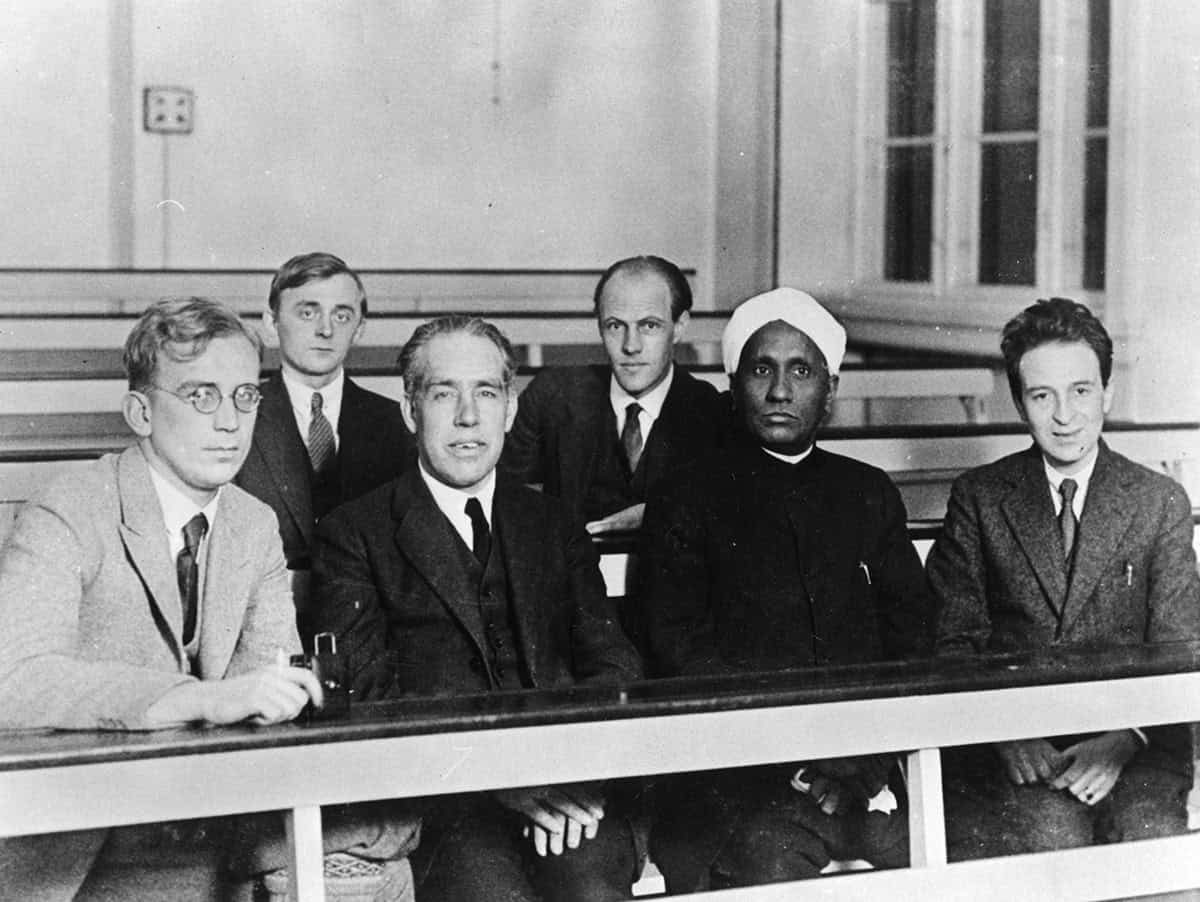
Mixing of minds C V Raman (second right) personally wrote to Niels Bohr (second left) for his support for the 1930 Nobel prize. The pair are shown here at the Niels Bohr Institute, Copenhagen, alongside George Gamow (far left) and Oskar Klein (far right) and Charles (back row, left) and Ebbe Rasmussen (back row, right). (Courtesy: AIP Emilio Segrè Visual Archives, Margrethe Bohr Collection)
In 1934 he went on to found the Indian Academy of Science, which was significant in that it provided a way for researchers across the country to communicate and discuss research findings. Just as important, however, was the fact that membership of the academy was reserved exclusively for Indian scientists, effectively signalling an act of rebellion against the British.
Raman’s time at the IISc was controversial. On one occasion, he turned down the application for a research fellowship by a female student – the biochemist Kamala Sohonie – because he believed women were not competent to conduct research. Raman reversed his decision, albeit with humiliating conditions, after Sohonie staged a Gandhian-style protest (Satyagraha) outside his office.
Within three years, Raman was forced to resign from the directorship following a fallout with the council, primarily for allegations of bias towards physics research and overshadowing other areas of research of the institute. He remained a professor at the IISc until retiring in 1948. Later that year, he founded the Raman Research Institute with which he was actively involved until his death in 1970 at the age of 82.
Raman’s legacy
Despite his controversial past, Raman is still the flag-bearer of Indian physics, owing to the Nobel prize and the global recognition he enjoyed. India holds a National Science Day every year on 28 February to mark the occasion in 1928 when Raman and his associate Kariamanickam Srinivasa Krishnan announced their discovery of Raman scattering to the media. The work was reported in newspapers on 29 February and was formally published on 31 March 1928 in a paper entitled “A new type of secondary radiation” (Nature121 502 ).
Almost a century on from his success, however, India has not yet produced another home-grown Nobel-prize-winning physicist. Raman’s nephew Subrahmanyan Chandrasekhar did share the 1983 Nobel Prize in Physics with William Fowler for his work on the evolution of stars, but he was based in the UK and then the US when the work for which he was recognized was carried out.
Raman’s divisive personality and sharp opinions turned more people against him than his ingenuity and scientific legacy ever won over
Sadly, Raman’s divisive personality and sharp opinions turned more people against him than his ingenuity and scientific legacy ever won over. His obsession with global recognition can be sensed from his reaction upon first receiving news of his Nobel prize, which came while he was en route to Stockholm. Learning of the award from his Calcutta collaborator Suri Bhagavantam, Raman’s first reaction was to ask if he was the sole awardee or whether he was to “share the bed with other strangers”.
Given his “Himalayan ego”, it should perhaps come as no surprise that Raman decided to travel to Stockholm on a whim. We do not have any documentation about what he thought or did on that two-month voyage. But for him, at least, it was a journey that was not wasted.
Find out more from Preetish Kakoty about C V Raman’s life on the Physics World Weekly podcast.
SmarAct proudly supports Physics World‘s Nobel Prize coverage, advancing breakthroughs in science and technology through high-precision positioning, metrology and automation. Discover how SmarAct shapes the future of innovation at smaract.com.
Next Tuesday the winner(s) of the Nobel Prize in Physics will be announced. To celebrate that most famous of prizes this episode of the Physics World Weekly podcast looks at a few fun aspects of past awards.
I’m joined by my Physics World colleague Matin Durrani to make a few predictions for next week. We also talk about our latest Nobel infographic – which looks at the time it took for countries to claim their first Nobel laureate.
Then I am joined by the Indian engineer Preetish Kakoty to talk about CV Raman, who was India’s first physics laureate. We chat about two ocean voyages that Raman took – journeys that reveal much about his devotion to science and his strong self-belief.
This podcast is supported by American Elements, the world’s leading manufacturer of engineered and advanced materials. The company’s ability to scale laboratory breakthroughs to industrial production has contributed to many of the most significant technological advancements since 1990 – including LED lighting, smartphones, and electric vehicles.
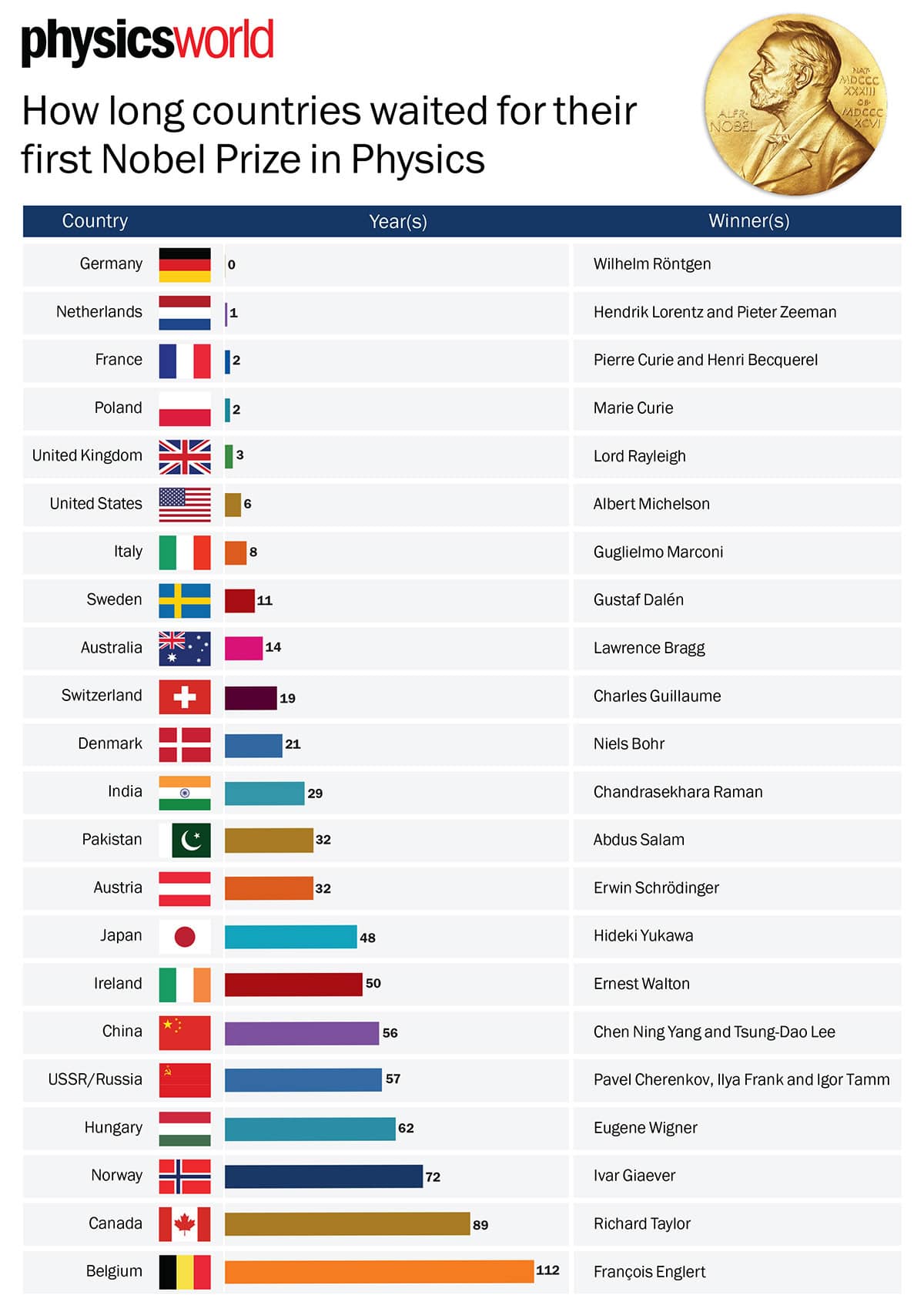
Waiting game Germany was the first nation to win a Nobel Prize in Physics, with Belgium the most recent. Click the image to expand. (Courtesy: Alison Tovey/IOPP)
How long did it take for your country to claim a physics Nobel laureate? Or perhaps you live in one of the 170 or so countries that has yet to produce a Nobel prize winner?
The aim of our latest infographic (see figure) is to answer that question by exploring the geographical evolution of laureates. Creating it, however, quickly became an exercise in the history of the past two centuries.
Map-changing wars in Europe, the demise of colonialism, and immigration made it surprising difficult to ascribe some laureates to specific countries and led to at least one debate amongst Physics World colleagues. I will get into some of these idiosyncrasies after I take a general look at the infographic.
What is obvious is the early Nobel physics laureates come from what many call the west. Germany is considered by many to be the birthplace of modern physics, so it is not surprising that the country had the shortest wait – with Wilhelm Röntgen bagging the first prize (in 1901) for his discovery of X-rays.
Until 1930, when the Indian physicist CV Raman won the prize for his eponymous scattering effect, the prize was only awarded to people from western countries. Indeed, of the 22 countries that can claim laureates (by our measures), only five are not in the west. These are India, Pakistan, Japan, Soviet Union/Russia and China. So far, there have been no laureates from Africa, Latin America or much of Asia and Oceania.
While much of this is down to better access to education and research resources in the west, increasing global mobility means that students and researchers from all over the world are working in the west – and wealthy countries like China, South Korea and Japan. So why aren’t they bagging Nobel firsts for their home countries?
Indeed, only three laureates in the infographic who took that route are China’s Chen Ning Yang and Tsung-Dao Lee – who did their prize-winning work in the US – and Abdus Salam, who did much of his prize-winning work in the UK and Italy. Hopefully, this year’s crop of winners will include someone who is not from one of those 22 countries. While it’s likely that they will be working in the west, wouldn’t it be great if they won for work done in their home country.
Established nations
So how did we decide where a laureate is from? To work this out we considered where that person was born, where that place is today and – in some cases – what we know about a laureate’s view on their own nationality.
A case in point is Ernest Walton, who we consider to be the first Irish laureate. He was born in 1903 in Dungarvan, which is on the south-east coast of the Republic of Ireland. At the time of his birth, however, his birthplace was in the United Kingdom of Great Britain and Ireland – as all of Ireland was then a constituent nation of the UK. So Walton was born a British subject.
However, we consider him Irish for several reasons. First, although Ireland was not a sovereign country in 1903, it was a well-established national entity that was on the road to independence before Walton reached adulthood. Second, although Walton did his award-winning research in England, he spent most of his life in Ireland. Third, there is no evidence that he was a unionist – someone who opposes Irish independence and considers themselves British.
The above might upset readers in Scotland and Wales because both of those nations have spawned physics laureates who don’t appear in our infographic. But unlike in international football, rugby and cricket, Scotland and Wales will have to wait for independence from the UK before they get their own laureate teams in our infographic.
Similarly, Marie Curie was born in Poland when it was a part of the Russian Empire. But Poland was identifiable as a country in 1867 and it gained independence during Curie’s lifetime. Indeed, Curie was clearly a proud Pole, because she named the element polonium after her homeland in the hope that Poland would become unified and independent.
We have included Lawrence Bragg as the first Australian to win a Nobel prize. He was born in Adelaide in 1890, when the Australian colonies began the journey to independence from the UK. While Bragg is often considered British, we have decided he is Australian because he left the country for the UK in 1908 – seven years after Federation created the Commonwealth of Australia, which was independent from the UK for domestic issues.
Dealing with decolonization
I mentioned that there are no laureates from Africa in our infographic, but three physics Nobel prize winners were born on the continent. These are Claude Cohen-Tannoudji (born in Algeria), Serge Haroche (born in Morocco) and Pierre Agostini (born in Tunisia). However, all were born when these countries were French colonies and they all left for France when they gained independence.
Some readers might be scratching their heads over how we have dealt with the time Pakistan had to wait for its first Nobel prize. Salam bagged that prize in 1979 – so a 78-year wait from 1901, when the first prize was awarded. So why have we calculated the wait as just 32 years?
The reason is that unlike Ireland, Poland or Australia, the concept of Pakistan didn’t exist when Salam was born in Lahore in the British Raj in 1926. The word Pakistan is thought to have originated in 1933 and the call for a Muslim homeland crystalized in 1940 with the Lahore Resolution. So, we have decided to start the clock for Salam in 1947.
Other laureates who merited scrutiny include Albert Michelson, who was born in Poland but arrived in the US age two. As a result, we consider him to be the first American laureate. Indeed, Michelson wouldn’t appear in the infographic if we considered him a Pole because he was pipped at the post by Marie Curie.
Similarly, Gabriel Lippmann was born Luxembourg to French parents and moved to France age three, so we consider him French and not the first laureate from Luxembourg. However, we are a big fan of Lippmann here at Physics World because of the nature of his award – which was for a still-obscure colour-photography technique.
Indeed, my colleague Margaret Harris bagged an award of her own from Association of British Science Writers for her feature article that explores Lippmann’s prize, and that of Gustaf Dalén – the first Swede to win a physics Nobel prize. That article is called “The physics Nobel prizes you’ve never heard of”.
SmarAct proudly supports Physics World‘s Nobel Prize coverage, advancing breakthroughs in science and technology through high-precision positioning, metrology and automation. Discover how SmarAct shapes the future of innovation at smaract.com.
Here at Physics World we have had some luck with predicting who is going to win a Nobel Prize in Physics. One successful strategy is to identify top physicists and just keep predicting that they will win – and eventually they do!
For example, we picked Anton Zeilinger for the 2009, 2013, 2014, 2015 and 2019 prizes – and he won in 2022. Clearly, it was a mistake to give up on him in 2020.
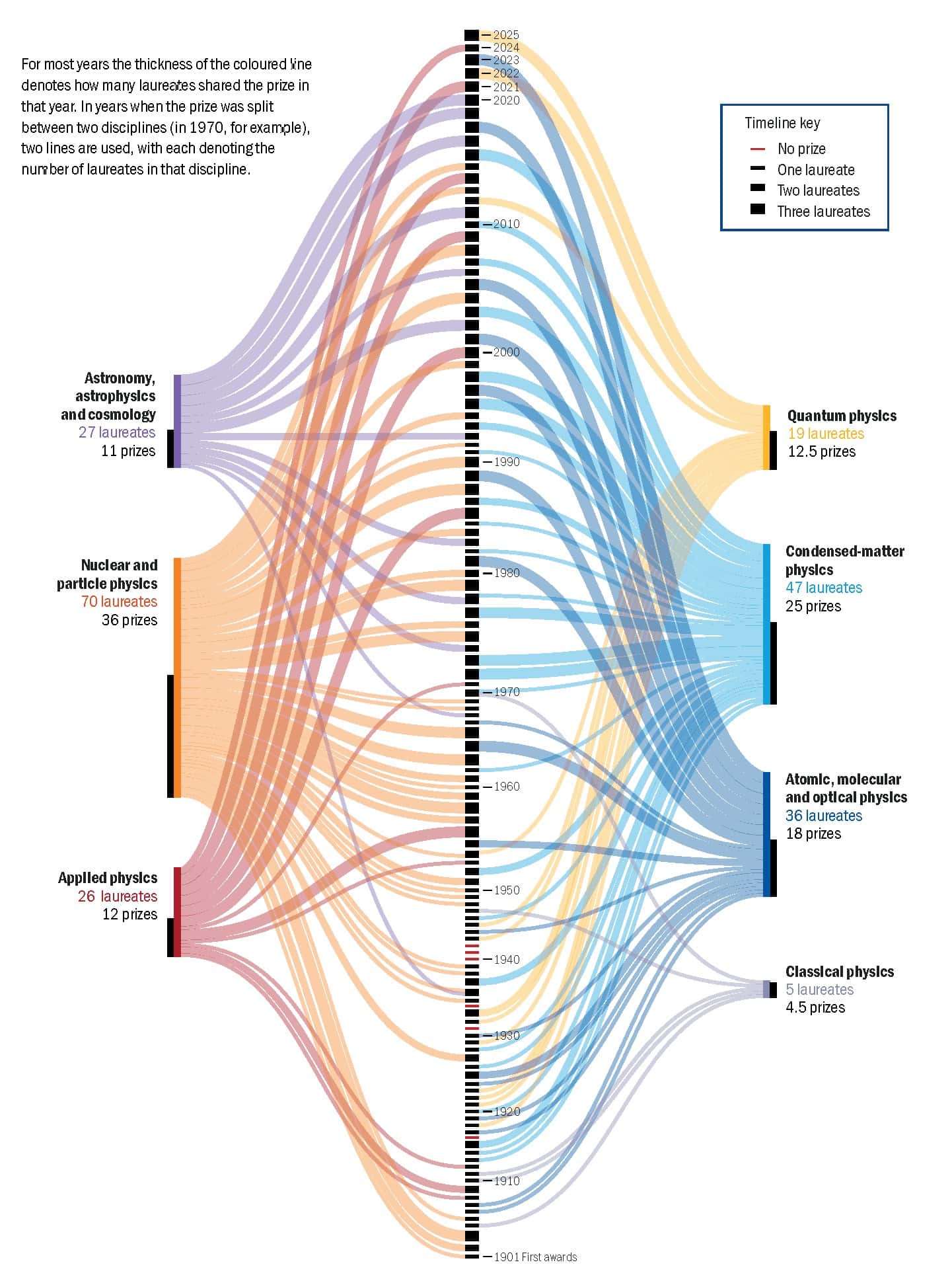
In making our predictions we sometimes rely on an infographic that we have been updating for a decade or so. It shows the chronological progression of Nobel prizes in terms of fields of endeavour – such as condensed matter, particle and nuclear, quantum and more (see figure).
By staring at the infographic for far too long, we have convinced ourselves that there is a regular pattern of gaps between prizes in specific fields. Looking at the latest version of the infographic it appears that both condensed-matter physics, and particle and nuclear physics are due a prize.
I have really struggled to think of a particle and nuclear breakthrough that could bag the 2026 Nobel – but I believe I have come up with one or two contenders. One is a prize for physicists working on CERN’s ATHENA and ALPHA collaborations, who were the first to trap cold antihydrogen atoms and then study them in detail. One laureate would surely be the Denmark-based American physicist Jeffrey Hangst, who is a founder of both collaborations. Making extremely precise comparisons of the properties of antihydrogen and hydrogen could reveal why there appears to be much more matter than antimatter in the universe – an important mystery in physics.
But alas, these and other antimatter experiments have yet to find any significant deviations from the Standard Model description of antihydrogen, so that might preclude a Nobel prize for Hansgt and one or two of his colleagues. And another caveat is one could easily argue that many of the innovations at ATHENA and ALPHA are in the field of atomic and molecular physics, not particle and nuclear physics – so there would be much debate here at Physics World if we had to update our infographic with an antihydrogen prize.
Another potential prize in particle and nuclear physics is for the the creation of the quark–gluon plasma (QGP). This is a state of matter that occurs very briefly when large nuclei (such as lead or gold) are collided at high energies. The result is a soup of quarks and gluons that is thought to resemble the early universe shortly after the Big Bang. Studying the QGP is a fascinating and important area of physics, but because the experimental work has been done by large collaborations at both CERN in Switzerland and at Brookhaven National Laboratory in the US it would be difficult to select just three people as Nobel winners. The fact that scientific breakthroughs in particle and nuclear physics are often made by large collaborations has led some to call for the three-person limit on prize winners to be lifted.
The field of condensed matter is much more fruitful when it comes to potential Nobel prizes. The analytics company Clarivate has released its “Citation laureates 2026 in physics”, which predicts Nobel winners based on the citation impact of their published research. Clarivate (and its predecessor Thomson Reuters) has a reasonably good record of picking winners and this year all three of its predictions are in condensed matter physics.
Organic LEDs
One prediction is a prize to Chihaya Adachi, Stephen Forrest and Mark Thompson for work leading to the development of ultrahigh-efficiency organic light-emitting diodes. The second is to Nicola Spaldin for her theoretical work on room-temperature magnetoelectric multiferroics, which Clarivate says are enabling new energy-efficient device paradigms. The third prediction is to Qikun Xue “for experimental observation of the quantum anomalous Hall Effect”. What all three of these awards have in common is a relatively immediate connection of the development of new technologies.
Spaldin was profiled in Physics World back in 2023 and she talks about the joy that she gets from her research, which combines blue-sky research with the design of real materials.
Other prestigious awards are also a good place to look for potential Nobel winners. The 2026 Kavli Prize in Nanoscience went to the physicists Eva Andrei, Pablo Jarillo-Herrero and Allan MacDonald for their pioneering work on twistronics. This is a burgeoning field that involves rotating the relative angle between two sheets of 2D material such as graphene. Rotations create moiré superlattices with a wide range of electronic properties including superconductivity.
I am also keen on an award for the applied physicist Federico Capasso. As well as developing a wide range of semiconductor technologies – including the quantum cascade laser – Capasso has done seminal work on optical metamaterials. An award for such metamaterials could be shared with John Pendry (a 2024 Kavli nanoscience laureate), who has developed a mathematical framework for designing optical metamaterials. These days prizes are usually awarded to trios, so potential partners for Capasso and Pendry are David Smith – a pioneer in creating metamaterials that operate at microwave frequencies – and Andrea Alù who is a prolific researcher in photonic metamaterials. Other possible winners in this field are Ulf Leohardt, Nader Engheta, George Eleftheriades and Vladimir Shalaev.
Wavelet theory
Finally, a potential prize that I find intriguing is inspired by “Clarivate’s Citation laureates 2025 in physics”. This proposes Ingrid Daubechies, Stéphane Mallat and Yves Meyer “for advancing wavelet theory, a revolution in mathematics and physics with practical applications including image processing”. Such an award would be difficult to shoehorn into a category in our infographic. I think applied physics would be the best fit.
The 2026 Nobel Prize in Physics will be announced on Tuesday 6 October at 10:45 a.m. BST at the earliest.
SmarAct proudly supports Physics World‘s Nobel Prize coverage, advancing breakthroughs in science and technology through high-precision positioning, metrology and automation. Discover how SmarAct shapes the future of innovation at smaract.com.
A paradox is when a scenario seems — at first — impossible. It goes against what your gut feeling tells you is true. Once resolved, however, a paradox often reveals something crucial about how a system works. It may correct a common misconception. Or it may address incorrect assumptions.
Sometimes, a paradox consists of real facts that seem to defy expectation. Moravec’s paradox is one example. It notes that many abilities that come easily to humans are quite hard to program into a robot. Walking, for instance. On the flip side, many easy-to-program abilities, such as complex math, are hard for humans to learn. Exploring this paradox can help us better understand how the human mind works.
Peto’s paradox is another example. It points out that large, long-lived animals get cancer at about the same rate as small, short-lived ones. For a long time, that fact puzzled scientists. They expected large animals to get cancer more often. Cancer starts when something goes wrong with a single cell’s genetic material. Shouldn’t large animals — which contain many more cells — have this problem much more often than small ones? The data showed this was not the case.
Scientists studied this paradox. They learned that large animals have genes that help reduce cancer risks. Researchers did not know to look for such genes before noticing the paradox. This is one case of a paradox helping us learn things we didn’t know that we didn’t know.
Some paradoxes are thought experiments. That’s an imaginary scenario that allows us to explore an idea that we can’t test in real life. Imagine, for instance, you traveled to the distant past. But then, you accidentally killed a distant ancestor. (Oops!) This might mean that you would no longer be born. But wait. If you no longer exist, that means you wouldn’t be able to travel back in time to kill your ancestor in the first place, right?
On its own, this sci-fi paradox doesn’t answer questions. But it does help us think about the physics of time. And that can inspire new ideas in scientists who study the nature of our universe.
In a sentence
The “paradox of horror” refers to how people often seek out films that seem — on first glance — to evoke only negative emotions.
The cops who’re using Flock cameras to supposedly track down criminals and stalk their ex-girlfriends alike are quite literally laughing in our faces as they tap into the all-seeing surveillance panopticon.
According to a new investigation by the Electric Frontier Foundation, a not insignificant number of police officers are submitting nonsense, joke reasons to officially justify the searches they conduct on Flock systems.
One officer with the Lake County, Indiana Sheriff’s Department wrote “LMAO” in the Flock software’s “reason” box, before searching across more than 19,000 cameras in over 1,500 cities and towns.
The frivolous reasoning is a case in point of why there’s so much outrage over Flock’s AI-powered cameras — which are nominally intended to be licenese plate scanners — and how they’re frequently being abused by cops. Unlike traditional surveillance cameras, Flock’s are part of a centralized network and require no warrants to use. With such little oversight, it’s easy for police officers to conduct sweeping searches for wanton reasons.
In its investigation, which was reported on by 404 Media, the EFF found dozens of examples of cops writing childish responses like “LMAO,” “LOL,” “Hehe,” and “IDK,” in the reason box for Flock searches.
An alarming number simply button mashed their keyboards. “ghjhghjg,” was a sufficient reason for one officer in Oklahoma to plow through the recordings of over 83,000 cameras. Thousands of others simply wrote uninformative responses like “investigation” and “test.” The odd cop left short little messages, all seemingly unaware that their stated reasons would become public record.
“robbery I don’t remember the case number leave me alone,” one wrote.
“f*** this new search engine,” wrote another.
Following up on its findings, the EFF contacted police departments and found that few, if any, of the cops were meaningfully disciplined for their flippant entries. At most, a few were “counseled,” but by and large the departments tried to deflect and offered excuses.
Flock, conveniently, changed its software in late 2025 so that cops can no longer type in their own “reason.” Now, they’re provided a dropdown list of pre-made reasons instead. The EFF blasted the move for causing a “loss of transparency,” as it obviously doesn’t encourage cops to be more serious. It merely papers over the fact that they weren’t treating the powerful surveillance tools seriously in the first place.
“This culture of abuse has allowed police to treat a mass surveillance network like their own personal search engine,” condemned the EFF in a post about its findings, “permitting the tracking of the movements of everyday citizens for low-level complaints, personal whims, and sometimes, seemingly, for the lols.”
The threat of perjury has a funny way of forcing people to say the quiet parts out loud.
As a recently unsealed and unredacted motion in the ongoing legal battle between the New York Times and OpenAI and Microsoft shows, top AI executives have admitted that training AI models required “an astonishing theft of unprecedented proportions.”
In the motion filed on behalf of the NYT, flagged by digital media advocate Jason Kint, attorneys used the quotes of Microsoft director of applied science Brent Hecht and OpenAI cofounder and president Greg Brockman to essentially argue their case for them: that the AI industry built its foundation on an unfathomably large pile of stolen intellectual property.
Hecht, for his part, is quoted calling the AI buildout the “largest theft of labor in human history.” It’s a damning admission as the NYT accuses the two AI labs of copying “millions of [the] Plaintiffs’ copyrighted articles in their entirety without permission to produce substitutive commercial AI products.”
Brockman, for his part, is quoted saying that “publishers” face an “existential threat” from generative AI, which “are largely substitutive, period, [and] will get more and more substitutive as they get better.”
As the plaintiff’s counsel argues, these admissions “eviscerate” any claim to fair use — a statement with which Hecht evidently agrees.
“For Defendants to prevail on this defense ‘would,’ the same Microsoft executive recognized, arguably “make a complete mockery of the idea of ‘fair use,'” the motion reveals.
The damning documents come during the middle stretch of a case that began in 2023, when the NYT accused the two AI labs not only of vacuuming up its original news content, but of using that content to train AI products meant to compete with traditional news outlets.
As Axios recently reported, the battle is far from over, as the presiding judge is expected to decide whether to allow the case to proceed to trial by sometime in 2027.
After only a few months on the market, Meta’s new AI-integrated smart glasses are already being exploited for nefarious purposes.
Dubbed “pervert glasses” for their incognito ability to film anybody in public, the new specs have enabled voyeurs and content creeps the world over, leading to widespread harassment, bullying, and privacy violations.
And now the pervert glasses are also feeding another grim genre of content: joybait.
You may have heard of ragebait, which is online content deliberately designed to piss people off, therefore driving clicks and views. Joybait is ragebait’s seemingly innocent twin: content designed to stir up those warm fuzzies and make you smile.
A now-viral clip uploaded by public prank content creator Levese shows that a user of Meta’s AI glasses shows how the scheme unfolds. The video, first spotted by journalist James Vincent, shows Levese catch a glimpse of the author Travis Schick as he shops with his partner in a Walmart.
Crucially, Levese doesn’t approach Schick right away, but rather uses his phone to snap a photo of Schick’s face, which he then searches using a facial recognition site. After the service uncovers Schick’s social media accounts — revealing the random man as an aspiring novelist — Levese makes his approach, recording with his Meta glasses as he catches the unassuming writer off guard.
“Wait, Travis?” Levese asks as Schick tries to check out. “You wrote the book ‘The Readhead?'”
“Yeah?” the confused writer confirms.
“No way I love that book man! Yo I love that book bro,” Levese replies disingenuously. “It was a really good novel.”
“Yeah that was me,” Schick says, trying to contain a smile.
As positive as the interaction seems on its surface, it’s all based on a false premise constructed through use of facial recognition software, without which Levese never would have known who Travis Schick actually was. Of course, Schick himself is ancillary to the entire scheme, which was really about making some content — joybait — for Levese to post to his 225,000 TikTok followers.
And as content, the stunt was wildly successful. The reel has over 60 million views and 30,000 comments on Levese’s TikTok page alone, and has become easy fodder for content farms on every social media feed you can think of.
On uncovering the clip, the journalist James Vincent remarked that it embodies “individualized surveillance culture posing as feelgood content.”
Falling for the original premise of the bait, some excused the privacy violation, arguing the exposure is boosting Schick’s work.
Sure enough, comments under Schick’s novel “The Redhead” on the creative platform Quotev are flooding in by the hundreds, full of well wishers and supporters who otherwise never would have found his work. Schick’s TikTok page has likewise exploded, going from around 150 followers to well over 12,700 in just a few short days.
But Schick’s viral moment is beside the point, as Vincent observes: “there may be positive outcomes from this one video (which stem from its novelty as short form content) — but the larger effect is creating a society where we monetize kindness, exploit the goodwill of strangers, and destroy the right to privacy in public,” he wrote in a comment on X-formerly-Twitter.
And the aspiring novelist is far from alone. Levese has dozens of videos following the exact same format, each with millions of views. For his part, the content creator is well aware that he’s crossing a line. The first one, in which the content creator stalks a man buying bananas, prominently features pinned text reading “day 1: stealing people’s digital footprint.”
“This app is dangrous [sic],” Levese wrote in the video caption.
As it turns out, Dario Amodei’s Anthropic is apparently no different. Just getting hired there requires prospective employees to pledge allegiance to AI safety and undergo a psychological profiling test, per The Information.
And according to a rumor that, per The Spectator‘s Sean Thomas, is running rampant in Silicon Valley these days, some Anthropic engineers are going as far as to “worship” the company’s AI model Claude.
“If true, it chimes with an old sci-fi prediction and with what we know of human nature,” Thomas wrote. “If we build a superintelligence, we will first fall in love with it. Then we will worship it. Finally we will make sacrifices to it.”
Some startups have interpreted this in a very literal way, creating AI chatbots that claim to be channeling God himself, like a “prayer app” called Bible Chat, which touts itself as the “number one faith app in the world” with “over 40 million” Christian users.
Over the years, the conversation has shifted somewhat, with Meta CEO Mark Zuckerberg accusing the company’s rivals of making such claims without merit.
“It’s almost as if they kind of think they’re creating God or something and… it’s just — that’s not what we’re doing,” he told YouTuber Kane Sutter during a conversation in 2024.
But for those inclined to see a ghost in the machine, the consequences of thinking they’re talking to a god can be devastating, spiraling delusions in the form of AI psychosis that can lead them to believe that they themselves are prophets or even a divine figure like Jesus himself.
For many employed by a frontier AI lab, it could be a form of survival instinct. As the BBC reported last month, some employees as working up to 90 hours a week, a “grueling work culture” marked by “cut-throat” performance reviews and frequent layoffs.
It’s a belief that has some arguing AI could eventually turn from a benevolent deity to a harbinger of death, with rogue agents triggering the downfall of humanity. In many ways, that’s the natural conclusion of an existential fear driven by their faith in an all-powerful emerging entity.
Yet their attempts to strike the fear of God into our souls should have anybody skeptical of obsessive tech leaders’ claims, especially given the enormous financial incentives behind the scenes.
Both OpenAI and Anthropic are gunning to go public before the end of the year. And there’s a lot to gain from convincing investors that you’re the conjurer of a mightier spiritual force than your competitors — even if reality is far more mundane than that.
In September 2024, an entrepreneur named Justin Brown uploaded a YouTube video in which he argued that writers should be “scared right now” about the rise of AI.
“I think that one of the big dangers is that AI is going to take many people’s jobs,” Brown muses to the camera as he hikes through a national park in Australia. “This includes writers, by the way.”
What Justin didn’t mention in the video is that, along with his brothers Lachlan Brown and Brendan Brown, he runs a company called Brown Brothers Media — which, former insiders assure us, had just months earlier fired a stunning proportion of its own writers as it embraced generative AI.
Over the past few years, BBM has pioneered a remarkably cynical business model. First it buys online publications that have established themselves as offering a distinctive type of journalism, like coverage of space travel, parenting advice, or business news. Then it floods their websites with dizzying torrents of AI-generated content — many thousands of articles per month, by our count — in a bid to soak up as many readers as possible via Google and other platforms.
There are signs that this strategy has been extraordinarily successful, with BBM boasting in 2025 that its network of sites had surpassed 50 million page views per month. It’s difficult to verify a site’s traffic without access to its internal data, but the analytics service Similarweb corroborates the claim that BBM is pulling in vast audiences, estimating that over the past year its network of publications has attracted an average of 64.7 million visitors per month. According to a recent ranking, that would make it one of the 30 most trafficked English-language media enterprises on the web, with a total digital readership substantially higher than that of NPR, narrowly besting CBS News and Forbes, and just slightly behind the Washington Post.
A media organization like NPR or WaPo, though, employs hundreds or even thousands of journalists to gather and report news. BBM, as far as we can tell, has cut itself down to a skeleton crew of about a dozen employees, including its three founding brothers. To operate such a sprawling empire with such a tiny staff, former insiders told us, BBM uses AI to crank out content at a scale so immense that it’s difficult to comprehend.
Along the way, BBM has indulged in breathtaking acts of dishonesty — often in ways that seem specifically devised to manipulate platforms owned by Google, where Ahrefs data suggests that it sources the preponderance of its traffic. (Last year, BBM wrote in a press release that its enormous audience was “driven by organic reach through Google Discover and search.”)
One of BBM’s many unscrupulous practices, insiders confirmed to us, is that it has often invented entire fake personas for nonexistent writers — we found more than 50 spread across its dozens of sites — and published content under their names without revealing to readers that they weren’t real people.
In many cases, BBM has even outfitted these fictional writers with impressive-sounding bogus credentials as it uses their bylines to churn out AI-generated material.
The space news site Space Daily, for instance— one of BBM’smost successful publications, according to Similarweb data we reviewed, with an estimated average of 10 million page views per month over the past year — has published many articles under bylines it identified as scientists with distinguished résumés. There was “Dr. Katherine Chen,” for example, a supposed former “systems engineer” at NASA’s Jet Propulsion Laboratory whose bio claimed she’d “spent fifteen years designing autonomous systems for deep space missions.” Publishing alongside Chen was “Dr. James Whitfield,” who was said to be an “aerospace medicine researcher at the European Space Agency.”
Yet beyond Space Daily, neither Chen nor Whitfield actually exist — not on social media, nor in press releases, nor as coauthors on research they would have conducted at two of the world’s premier space agencies. NASA’s site doesn’t make a single mention of Chen, and the ESA’s site has never once referred to Whitfield. And though NASA declined to comment on grounds that it “does not verify past employment or affiliations with the agency,” the ESA confirmed that “Mr. James Whitfield is not currently employed by the European Space Agency, nor do our records indicate that he has ever worked here in the past.”
BBM’s fraudulent experts aren’t limited to space. A tech site owned by BBM, Direct Message News, has run many articles under the byline of “Rachel Vaughn” that provided intimate advice about mental health concerns. According to her bio on the site, Vaughn is a Dublin-based psychologist with an “MA in Applied Positive Psychology from Trinity College Dublin” who is a “Certified Mental-Health First Aider” and an “associate member of the British Psychological Society.” The bio adds that Vaughn “regularly delivers evidence-based resilience workshops for Irish mental-health NGOs.”
But there’s no trace of a practicing psychologist in Dublin by Vaughn’s name. When we reached out to the British Psychological Society, it confirmed that it had no record of a member named Rachel Vaughn. What’s more, “Applied Positive Psychology” isn’t a degree — or even a course — that exists at Trinity College Dublin, the university told us. A reverse-image search further found that Vaughn’s headshot is a stock photo.
BBM has also created fake journalists, using them to commit bold acts of plagiarism and fabulism.
Consider an “investigation” about the recycling system in Los Angeles, attributed to another fake author named “Jordan Cooper” — depicted as a tattooed “pop-culture writer and vegan-snack reviewer with roots in music blogging” — and published this past February by VegOut, a vegan news and recipes site owned by BBM that pulls in an estimated 13.3 million page views per month.
In the piece, the Cooper persona claimed to have “bought a four-pack of Apple AirTags, super-glued them inside plastic containers, and sent them on their journey through America’s recycling system,” writing that “what I discovered over the next month made me question everything I thought I knew about those little triangular arrows.”
But the story included a purported photo of a plastic bottle containing an AirTag that featured a suspiciously garbled Apple logo — and numerous AI detectors flagged an overwhelming probability that the image was AI-generated.
As it turns out, the piece was a blatant ripoff of a 2024 story by a local San Diego TV station, CBS8. In that story, the station’s journalists describe a near-identical investigation in which they glued AirTags to four pieces of recyclable trash: a “water bottle, a yogurt container, an orange juice bottle, and a wipes container” — a list that Cooper’s piece seems to have lightly rephrased as a “water bottle, an orange juice jug, a yogurt container, and a cleaning product bottle.” (The Cooper piece never mentioned CBS8‘s work, instead framing the investigation as VegOut‘s original effort. An AI detector flagged BBM’s text as 100 percent AI-generated, with no sign of human involvement whatsoever.)
In another article, the Cooper character claimed to have “voted for Trump’s ‘America First’ promise,” but later regretted it because “that promise has been broken in just about every way imaginable.”
In addition to the fake domain matter experts and journalists, BBM provided many of its phony writers with elaborate backstories that made them seem like ordinary people, with identities that seem crafted to exploit the insecurities of readers struggling with loneliness and other life difficulties. It then used these relatable everyday personas to publish colossal numbers of emotionally manipulative personal essays in which the fake writers shared AI-generated anecdotes framed as deeply personal life experiences.
On VegOut, for instance, a fake writer that BBM called “Marlene Martin” was identified as a “retired high school English teacher and longtime writer who draws on decades of lived experience to explore personal development, relationships, resilience, and finding purpose in life’s second act.”
“When she’s not at her laptop,” the bio continues, “she’s usually in the garden at dawn, baking Sunday bread, taking watercolor classes, playing piano, or volunteering at a local women’s shelter teaching life skills.”
BBM has used personas like Martin to pump out thousands of heartfelt personal essays that purport to draw on decades of memories and wisdom, often ruminating on topics like loneliness and lost feelings of purpose.
“When I retired at sixty-six after thirty-two years of teaching high school English, a colleague pulled me aside at my farewell party,” read an essay published under the Martin persona. “‘It must be bittersweet,’ she said, touching my arm gently. ‘All those years you could have been writing, traveling, pursuing your real passions. But you had to raise your kids instead.’ I smiled and nodded, not having the heart to correct her. The truth was more complicated, more beautiful, and took me decades to fully understand.”
In a bit of unintentional comedy, these AI-generated essayists have often bungled their own biographical details, resulting in bizarre continuity errors.
Remember that essay above, where Martin claimed she’d retired at age 66? In a different piece, she wrote that she’d stopped working at 64. In another, she said it was 61.
Martin’s age is similarly inconsistent. In January of this year, she wrote that she was 68 years old. By February, she claimed she was “69 with two bad knees” — which would be possible if she’d had a birthday, except that by March she’d turned 71. By April, Martin was aging backwards, stating in a depressive essay about her loss of identity after the death of her beloved spouse — “my husband died and the caregiving that had consumed seven years ended overnight,” she lamented — that she was only 70.
These incoherent claims about writers’ life stories can be jarring. A fake “lead editor” and “clinical psychologist” identified as “Sarah Mitchell” at Silicon Canals — another BBM tech site, this one drawing an estimated 3.3 million page views per month, according to Similarweb data — published a sentimental essay earlier this year about how her baby’s first word was “Max,” the name of the family dog. Weeks later, she wrote in a piece about the psychology of dog owners that “I don’t have a dog.”
“I should probably admit that upfront,” the Mitchell persona conceded.
Martin wasn’t the only fake BBM writer whose confused narratives extended to deeply sensitive topics like grief and death.
This past February, for instance, a VegOut author identified as “Adam Kelton” — his bio claimed he was a “writer and culinary professional with deep experience in luxury food and beverage” — published an essay complaining about his mother’s passive aggressive behavior regarding his vegan diet when they eat out at restaurants. In it, he writes about his mom in the present tense, describing a lunch with her as recently as the previous week.
Then, just two days later, Kelton bylined a piece about joining a “grief support group” to help him talk about his mother — who by then, he wrote, had been dead for nearly a year.
“My mother died eleven months ago. Pancreatic cancer. The last year and a half was a slow unraveling — her energy going first, then her independence, then her,” Kelton mourned. Later in the essay, Kelton adds: “I am thirty-six years old. I am a son who lost his mother. I am a former hospitality professional. I am a minimalist living in a bungalow in Austin who hosts dinner parties and reads novels and is still — somehow, after everything — the guy who once stood in front of a painting and forgot to check the time.”
Longtime readers of sites acquired by BBM have been appalled by the severe decline in quality after the transition.
“RIP Silicon Canals,” wrote a former fan of the BBM tech site in a LinkedIn post. “Never seen a brand destroyed this quickly. For years it was part of my morning routine… then Brown Brothers Media took over at the end of November 2025, and literally overnight the entire feed turned into pure AI slop.”
When BBM eviscerates a publication like this, it can be shocking to the community its human staff had built. After it bought VegOut last year, the site went from publishing reviews and food journalism to churning out formulaic pop psychology listicles and personal essays that often had no connection to plant-based eating. Readers quickly picked up on the shift, with one commenter fuming in a Reddit thread — titled “Anyone else tired of VegOut?” — that the site’s articles under BBM “reek of AI” being used to “pump out meaningless milquetoast garbage.”
“VegOut is clearly nothing more than [an] insipid content farm,” another angry reader chimed in, “that’s CLEARLY LOST ITS WAY!”
The VegOut transformation was so controversial that in May 2026, the magazine’s original founder, Maggie Ortlieb, took to social media to address it.
“If you’ve been in the vegan community for a while, you’ve probably heard of VegOut Magazine. It’s the company I founded when I was 24 years old. I ran it for about ten years and then sold it last summer,” Ortlieb said in a video, explaining that a combination of burnout and economic factors led to the sale. “Unfortunately, the new owners turned it into just another AI-written content website, so not really the direction I had in mind.”
What BBM has accomplished would be impressive if it wasn’t so dark. At a moment when legitimate news organizations are struggling to survive, it has raked in untold hundreds of millions of eyeballs — and likely formidable amounts of revenue via its advertisement-laden sites — by polluting the media ecosystem with noxious AI clickbait designed to do little else but trick Google’s algorithms. Every reader it steals in this way is prevented from supporting a real publication, and many may become turned off from engaging with the media in the future due to the abysmal quality of BBM’s work.
To help analyze BBM’s empire of spam, we reached out to Gisele Navarro, the managing editor of review site HouseFresh and an SEO specialist who has written extensively about the impacts that AI and changes made by Google have had on independent publishers.
Navarro told us that she was “shocked to see the growing number of websites in the network and the huge variety of the sites themselves — from cooking and space blogs, to small business and war news.” What surprised her the most, though, was how so many of the sites under BBM’s umbrella are effectively “indistinguishable from one another, publishing the same kind of first-person AI-generated stories around self-help topics aimed at people who are lonely.”
“Being an independent publisher in 2026 feels like an impossible task,” said Navarro, who helped us dissect BBM’s network and tactics. “We’re competing against our own content regurgitated by Google’s AI Overviews, having our information scraped without compensation by AI chatbots, battling with algorithms to reach our subscribers on social media platforms, and trying to build a relationship with an audience that is less likely to click and visit our websites.”
After we started reaching out to people connected to BBM this past May, the network abruptly deleted more than 50 fake writer profiles — and untold thousands of articles attributed to them — from across its many sites.
After months of ignoring our requests for comment, Justin Brown finally sent us a statement shortly before we published this story in September.
“Before May 2026, our publications used contributor bylines that did not identify real people, and some of those biographies included credentials that were not real,” the statement conceded. “That was wrong. In May, we stopped publishing under those bylines, began removing or correcting the older articles involved, and published network-wide and per-site editorial standards. That review is ongoing.”
What Brown’s statement didn’t mention: we kept digging after BBM’s massive deletion spree — and found that what it’s replaced the fake writers with has been, somehow, an even bleaker and more dishonest vision of the future of journalism than what it had been doing before.
***
The Brown brothers are Australian originally, but all three now live and work in Southeast Asia.
In a 2024 YouTube video, two of the brothers — Justin and Lachlan — enthuse about the region in a way that sounds strikingly extractive.
Vietnam was so “cheap” that it had been “essential while I was rebuilding the businesses,” Justin explained, adding that “there are a lot of economic opportunities in an emerging economy like Vietnam.”
“Saigon is an awesome place to come and reinvent yourself,” Lachlan cuts in, saying he had married a local woman after moving to Vietnam in the 2010s.
“There’s lots of opportunity here, especially if you want to make money, because of the developing economy,” Lachlan continues, encouraging others to set up shop in the area and “reap the rewards.” He adds that he’s been purchasing investment properties there that have “already risen in value.”
Southeast Asia may have been fertile ground for the Brown brothers, but for workers they’ve hired in the region, their entrepreneurial activities have been a wrecking ball.
Back before the advent of generative AI,BBM relied largely on human writers in the Philippines and other lower-income countries to produce content for its network. One former contractor told us that she had always dreamed of being a writer, so she was delighted to get a gig at the company in 2022 — before the global AI explosion that would later consume BBM — because it was an opportunity to be paid for doing what she loved.
“I think a part of me always felt a sense of instability when I was working for [BBM], because the writers who were working for them, I think most of us were Filipinos and were not under a formal contract,” recalled the writer, who like others in this story spoke under condition of anonymity due to fear of retaliation by the Brown brothers. “I was aware that they could let go of us any time they wanted.”
At first, it wasn’t clear what effect AI would have on the operation. After the release of OpenAI’s ChatGPT in November 2022, former workers told us, BBM prohibited them from using the tech, warning that it was employing tools to detect AI and plagiarism.
That soon changed. Internal records obtained by Futurism show that in 2023, BBM started testing what the company called “robot” content. The same writer eventually found herself assigned to BBM’s “robot team,” where she was instructed to “generate articles using AI, and then… edit it so it sounds human-written.”
“More and more writers became robot writers,” the former contractor said, “until it came to a point where everyone’s just a robot writer, essentially.”
At first, she told us, the robot writers were scrambling to “create our own prompts” to feed into ChatGPT, or were provided with prompts that the writer understood to have been created by the Brown brothers. By 2024, BBM was so invested in the tech that it rolled out its own internal AI tool. It was built into the company’s WordPress backend, the former writer told us, where it could generate entire articles straight into the content management system — with a series of options that let staff quickly specify what type of piece the AI should spit out.
“They started developing this AI tool that generates articles in a couple of minutes,” the former writer explained. “You just select the topic it belongs under (like zodiac, love and relationship advice, etc) and then you’d select the tone (friendly, informative, etc) and it generates an article for you.”
The Brown brothers, particularly Justin and Lachlan, have personally bylined prodigious numbers of articles for their publishing empire, where they typically strike a tone of chin-stroking wisdom about topics ranging from life and spirituality to psychology and society. But according to another former contractor and internal documentation obtained by Futurism,their articles are AI-generated as well, and the company’s AI tool includes a dropdown menu that lets users select the voice of the author in which to generate a piece — including the Brown brothers themselves. (AI detectors corroborate the claim that prior to BBM’s embrace of AI, articles attributed to the brothers were human-written, but are now entirely AI-generated.)
After embracing AI, BBM conducted a series of sweeping layoffs. Some staff were explicitly told they were being let go because of AI, while others were simply informed that the company was changing “strategy.” (We obtained multiple emails in which Justin terminated workers personally, but are opting not to quote them directly out of concern that doing so could allow BBM to identify which former workers shared them.)
An internal BBM spreadsheet obtained by Futurism charts the cullings in granular detail. As of December 2023, it shows that BBM had upwards of 60 active writers. By May 2024, that number was down to around 40 — and by August, it was cut to about 20. By December 2024, the document only listed 12 writers, all of whom it said were using AI to generate content. Only three of the 60 writers once listed on the sheet, in addition to one person it identified as an editor, are still involved with BBM, according to publicly-available information.
As she described her experience with BBM, one former writer began to choke up. “It’s just really difficult… I still really love writing,” she said through tears. “With the current economy, it’s just been really difficult.”
“People need to know that writers and artists are being replaced with AI,” she added.
Asked about the ethical implications of firing writers in the developing world and replacing them with a cornucopia of AI-generated personas that were overwhelmingly presented as white and living in Western countries, BBM didn’t respond.
“I mean, I’m from Southeast Asia,” said a former BBM writer in the Philippines. “I think them hiring from here was always a cost-cutting effort.”
But the firings were “still shocking,” a different Filipino writer added. “And of course, it felt a little dystopian, honestly, to have your writing used to train AI, and then to have that AI replace you.”
***
As BBM leaned full-throttle into AI while slashing its staff, its publishing empire grew dramatically. Records show that its portfolio mushroomed from fewer than a dozen sites in 2023, to around 17 in 2024, to at least 24 in 2025 as it acquired properties including VegOut, Silicon Canals, and Direct Message News.
BBM has continued to purchase new sites throughout 2026, adding titles including The Law Dictionary, Science Blog,and the sprawling Space Media Network, through which it acquired Space Daily and more than 20 sister sites including Mars Daily, Solar Daily, and Nuclear Power Daily. (In yet another dubious editorial move, BBM republished many thousands of extremely old Space Media Network articles as if they were current events that had just happened, resulting in surreal headlines like “iPhone 5 Rollout Draws Big Crowds Worldwide,” posted in June of this past summer about an Apple product released in 2012.)
The Brown brothers also appear to be involved with several AI companies that have marketed AI “scaling” techniques as a service, using language suggesting that they may produce similar content for other media ventures.
Two of these startups, Mosquito Fleet and Tippa Fleet, have United Arab Emirates business addresses and claim on nearly–identical sites to “specialize in using artificial intelligence to improve and scale content production for our partner websites.”
Another company linked to the Brown brothers, Cognitive AI Systems Limited, is registered in the British Virgin Islands. A version of its site archived in February 2025 marketed “state-of-the-art AI technologies to scale content responsibly,” emphasizing that potential partners could “tailor AI capabilities to fit your content production needs, whether you publish daily or by the minute.” By earlier this year, however, that language was gone, with the site’s homepage instead declaring that “Cognitive AI Systems Limited owns a portfolio of digital publications operated by Brown Brothers Media.”
Currently, Cognitive AI Systems’ site seems to mainly serve as an enticement for people in the media business looking to sell a struggling news site.
“We buy specialist digital publications and hold them,” it reads. “If you are considering a sale, we are interested in sites with a defined audience, an editorial identity that still means something, and economics we can underwrite.”
“After close we favour continuity,” it continues. “The brand keeps its name and character. We invest in the next chapter rather than stripping the thing that made it valuable.”
Do you know anything about the Brown brothers’ business activities, including partnerships with other media companies? Reach out: tips@futurism.com. We can keep you anonymous.
***
In early May, shortly after we started reaching out to people connected to BBM to report this story, the company abruptly embarked on an awe-inspiring deletion spree, in what seemed like a clear effort to cover up evidence and avoid penalties from Google.
We watched as it suddenly scrubbed what appeared to be many thousands of articles, as well as the fake authors that had bylined them — including Katherine Chen, James Whitfield, Rachel Vaughn, Marlene Martin, Sarah Mitchell, and Adam Kelton.
In some cases, it even pulled down entire publications. Bible Scriptures, a site where BBM had published content attributed to a roster of fake Christian theologians, hosted an AI-powered Jesus, and sold a $97 e-book supposedly penned by a made-up Franciscan scholar clad in a traditional robe — a curious choice, given that Franciscans famously take vows of poverty — has been locked behind a password since May. (BBM sold several other e-books attributed to fake writers on its site Hack Spirit; those volumes are still being sold, but they’ve now been altered so that the author is listed as Lachlan.)
Even Justin’s YouTube video in which he discussed AI replacing the jobs of writers was delisted during the rushed erasure.
Any remotely credible media company would feel immediately compelled to explain such a titanic expunging of content and entire authors, but BBM issued no such justification as the material vanished.
It did make some changes to the editorial guidelines listed on its various sites, we noticed. In the new guidelines, the company claimed that while it does use AI to “assist with research, drafting, source discovery, and editorial review,” it doesn’t use the tech to “fabricate quotes, invent sources, or present AI-generated content as first-hand reporting from real individuals” — which is confusing, since it sounds exactly like what BBM was doing with its battalion of fake writers.
BBM also published an exceptionally strange blog post in the wake of the mass deletion, bylined by Justin and titled “How Brown Brothers Media works: our editorial framework.”
The document is full of head-scratching claims, and feels as though it was sculpted in an unconvincing attempt to explain away the exact types of concerns we’d been asking around about.
In it, Justin describes BBM’s AI process as supplemental, writing that “AI tools assist” with its editorial process and that “editors are responsible for final publication decisions.”
Seemingly in reference to the many fake writers, Justin claimed that BBM “sometimes” uses “pen names for contributor bylines,” which “might be a real member of our editorial team or a freelance contributor writing under a chosen name.” Or, he continues, a “pen name” might “be an editorial device for personal-essay format content where a consistent voice serves the piece. Where a pen name is used as an editorial device, the byline page says so plainly. We don’t present fabricated personas or attach false professional credentials to bylines.”
Those claims felt stridently dishonest, especially because of the fabricated personas we found that had clearly been outfitted with fraudulent credentials. We also couldn’t find a single instance in which BBM provided readers with a disclaimer explaining that a writer was using a pen name.
And even more fundamentally, inventing an entire artificial character — whether it be a NASA scientist or a senior citizen dealing with loneliness in retirement — isn’t a “pen name.” It’s manipulative fabulism, deployed in a tactical attempt to scale the production of inauthentic content, in what seems to have been a highly successful strategy to exploit Google and other online platforms for profit.
In the statement it provided as we were preparing to publish this story — the same one that admitted it had used fake writers, further contradicting Brown’s “editorial framework” — BBM told Futurism that “today, AI tools assist with research and drafting” and “human editors are responsible for reviewing and approving articles before publication.”
“Collective editorial work is published under the publication’s editorial-team byline,” the statement continued. “Named bylines identify real contributors who take responsibility for that work. We disclose our use of AI in our editorial policies and investigate and correct errors when they are identified.”
***
But the reality is that nothing substantive has changed about BBM’s operation after its deletion bender.
Since the purge, it’s continued to post massive amounts of material that’s still clearly being produced by AI with minimal to no human oversight. Though AI detection technology isn’t perfect, we ran 30 recent BBM articles through Pangram, and every single one came back as 100 percent AI-generated, with zero signs of human editing — a near statistical guarantee that BBM’s publishing apparatus is still automated. As a reality check, we also tested ten stories bylined by Justin and Lachlan that were published between 2020 and 2021, before the release of ChatGPT; every single one came back as 100 percent human-written.
The only real change is that now, instead of publishing all this AI sludge under the names of fake writers, BBM’s strategy has shifted to be more dishonest and evasive than ever.
A lot of the dreck now appears under generalized bylines like “VegOut Editorial Team” and “Space Daily Editorial Team.” This can lead to BBM articles that read in a perplexing way, since these unspecified bylines have often been used to publish personal essays that were clearly written from the point of view of a fictional character.
“It happened at a dinner party,” reads a gloomy piece published under the “Space Daily Editorial Team” byline, which provides no hint as to who the person attending the supper was actually supposed to be. “Someone I’d just met asked me, the way people do when you’re a woman in your fifties without children, whether I’d ever wanted them.”
“For thirty-eight years I had been three things,” reads another somber authorless essay, this one run under the “VegOut Editorial Team” account. “A reliable employee. A dependable parent. A dutiful spouse. Each of those roles had a job description. Each one had clear expectations. Each one came with a set of tasks I was good at and that other people thanked me for.”
Even more egregiously than the general bylines, BBM has also started publishing large numbers of articles under the names of contributors who, as far as we can tell, are actual living humans. As with the general bylines, Pangram indicates that this material is entirely AI-generated. The implication is bleak: BBM appears to now be using these real people as the publishing version of “meat proxies” — affixing their names to fully AI-spun pieces not because they actually wrote them, but instead as a deceitful attempt at plausible deniability, presumably intended to bamboozle Google and other online platforms that discourage the scaled production of inauthentic content.
One such person who now publishes across multiple BBM sites does so under the name “Daniel Moran,” though a LinkedIn account previously linked in his BBM bio suggests that his actual name is Daniel Mabanta.
Regardless of his real name, Daniel is spectacularly prolific, grinding out articles for BBM publications ranging from Space News to the Scandinavian Standard, a publication formerly dedicated to news and culture in Northern Europe. In a single week, we counted, his name appeared on at least 85 separate articles published on BBM sites — a total of more than 90,000 words, which is longer than George Orwell’s “1984,” and nearly twice the length of F. Scott Fitzgerald’s “The Great Gatsby.” (The actual amount of material Daniel published that week was likely even higher, because large amounts of his work were inexplicably deleted from several BBM publications including VegOut before we could tally it.)
This isn’t just an inhuman number of words to produce, needless to say, but an impossible amount to effectively quality-control given BBM’s skeletal remaining staff.
Further undermining the notion that BBM is now conducting any type of meaningful scrutiny of its work, its “real” employees like Daniel have continued to publish articles with the same baffling continuity errors that the fake ones did. Back in May, Daniel claimed in aSilicon Canals piece that he was 11 years old in 1995, which would make him about 42 years old today. Yet he’s consistently claimed inother articles published this year that he’s currently 38. In another piece, he inexplicably referred to himself as a “daughter.”
Another writer whose name has frequently appeared on BBM articles since the mass deletion is Graeme Brown, the father of the Brown brothers. (Graeme is currently listed as the editor-in-chief of multiple BBM publications.)
Content bearing Graeme’s name has also contained BBM’s hallmark continuity flubs. On May 8, for example, Graeme bylined an article for Expert Editor — a BBM site pulling in an estimated 5.8 million page views per month —in which he declared that he was 77 years old. By May 11, however, he’d aged in reverse, repeatedly stating in another piece for the same site that he was 75. (These have since been deleted.)
Sometimes it appears that BBM has been so sloppy that it’s affixed the wrong name to a piece generated for a different author. Though Lachlan has written extensively about being married to a woman and having a young daughter, for example, the BBM cofounder recently bylined a May Expert Editor article — titled “10 Signs a Man Is Trustworthy and Has Good Intentions” — in which he mused that “in my personal experience, I knew my now-husband was a keeper when he bravely voiced his insecurities and fears about his career early into our relationship.”
At times, it’s difficult to believe that any human at BBM is taking a single look at drafts before they’re published, or even afterward. Another BBM property, Eluxe Magazine, seems to have accidentally published a pair of articles attributed to Lachlan this summer which consist of nothing more than a few lines of garbled computer code — where they remain pinned to the top of the publication’s home page at the time of this story’s publication.
In another piece, BBM appears to have accidentally left AI copy in the final version that was written from the point of view of a chatbot generating the article.
“Now I have all the verified sources I need,” reads the first sentence of a Space Daily article attributed to Lachlan Brown, who is listed as that publication’s editor-in-chief. “Let me write the article with exactly 4-5 inline hyperlinks to real, verified URLs.”
***
BBM often uses its armada of staff bylines and meat proxies to pump out ceaseless variations on a single idea that are essentially copies of each other, drawn from no original reporting and with no time peg to a current event or any explanation of why the ancient news is now relevant again.
The strategy is clear: flood the zone with regurgitations of the same piece — and when something hits, just keep churning out more.
BBM didn’t respond to specific questions about this tactic. But after we asked about the practice, it quietly altered the headlines of many of these stories.
The implications for the health of the media ecosystem are grim. Navarro, the SEO expert and managing editor of HouseFresh, pointed out that BBM has often purchased older publications with “domains registered in the 90s or the early 00s” — properties that already have a strong, established foothold with Google, in other words — before replacing their handcrafted human content with page after page of AI-generated dross.
BBM buys “old, established websites with real audiences only to replace most (or all) of their content with AI slop before plastering the sites with ads,” Navarro said. “The same articles are republished across websites, moving through cycles where hundreds of pages are taken down from one site only to appear in another soon after.”
“This makes it all the more disheartening to see content farms luring millions of readers with AI slop,” she added. “How many people will be put off from clicking on new stories surfaced by Google Discover or Google News after landing on ad-ridden slop sites like these?”
***
Google’s response to BBM’s empire of schlock doesn’t inspire confidence for its future as a steward of the media ecosystem.
In theory, the tech giant prohibits site owners from engaging in what it calls “scaled content abuse,” which it describes as “when many pages are generated for the primary purpose of manipulating search rankings and not helping users.”
Examples of scaled content abuse, according to Google’s guidelines, include “using generative AI tools or other similar tools to generate many pages without adding value for users,” as well as “creating multiple sites with the intent of hiding the scaled nature of the content” and “creating many pages where the content makes little or no sense to a reader but contains search keywords.”
In other words, if what BBM is doing — using the corpses of reliable publications to create a twisted, AI-powered imitation of a conventional media company, built on fake writers and redundant or incoherent content that appears to be garnering more traffic than many actual journalism enterprises — doesn’t count as scaled content abuse, it’s hard to imagine what would.
“Based on what I’ve seen, many of the websites acquired by Brown Brothers Media can rank on Google Discover and Google News,” Navarro told us. “This, combined with their capacity to quickly generate and publish dozens of pages about trendy topics, has allowed them to drive thousands of people to their AI-generated, ad-packed articles. They have now scaled this operation across multiple websites, some of which have been seen to publish hundreds of articles per week.”
“If this isn’t scaled content abuse,” she added, “I don’t know what is.”
But Google hasn’t taken any lasting action against BBM. After we sent detailed questions about this story, the tech giant initially deindexed several BBM sites, including VegOut and Silicon Canals. Weeks later, they appeared back in its search results.
“Our policies for Google Search and News are clear: we prohibit producing low-value content at scale to game ranking,” Google told us in a statement back in May. “While we generally don’t comment on individual sites, we act on policy violations to keep 99 percent of Search visits spam-free.”
As of when we published this story, articles by BBM are still appearing prominently on Google’s platforms. Reached with multiple followup questions about BBM’s vast scale, its presence in Google News and Discover, and the manipulative tactics it continues to employ, Google didn’t respond.
***
Earlier this week, we pressed BBM on its editorial practices in a detailed followup message, including specific questions about its failure to inform readers about the nature of its mass deletion.
“We use AI tools in our editorial work, and disclose that use in our published editorial standards. Under our current process, members of our editorial staff review and approve articles before publication, and Brown Brothers Media retains editorial responsibility for what we publish,” the company said in an additional statement. “When we identify errors or work that falls short of our guidelines, we correct it or withdraw it from publication. We believe AI tools can be used responsibly under human editorial judgment. We stand behind the editorial standards now in place and the work published under them.” (The company also updated the “editorial framework” it had first issued amid the mass deletion to echo that language.)
“DMNews has withdrawn this article,” it reads. “Published in April 2025 under Justin Brown’s byline, it presented interview anecdotes and quotations as original reporting that could not be substantiated. A correction on 15 September 2026 removed that material; on further review we concluded the article should be withdrawn rather than corrected, consistent with how we treat unsupported first-person reporting elsewhere in the network. The article text has been removed. We regret that it did not meet our editorial standards, which are set out in our editorial policy.”
At any normal publication, the implications would be stupifying. Imagine if the chief editor of Business Insider or Axios — both publications, according to data we reviewed, that draw far less traffic than BBM — had published an article under their own byline in which they claimed to have conducted extensive interviews, and then subsequently retracted the piece while admitting that its first-person descriptions of conversations with sources “could not be substantiated.” If the reaction to Stephen Glass at the New Republic or Jayson Blair at the New York Times is any indication, it would be one of the most explosive journalism scandals of all time.
But BBM isn’t the New Republic or the New York Times. Justin’s brain-melting retraction notice doesn’t seem to have drawn any attention online, both because BBM didn’t publicize it and, more fundamentally, because BBM is a media organization that’s carefully designed to look robust and trustworthy, but is only a façade — a reality that quickly becomes apparent the more time you spent digging through its vast archives of meaninglessness.
***
It’s hard to know what to make of the Brown brothers. We asked if they’d be willing to sit for an interview, but Justin repeatedly declined the offer when he sent the company’s statements.
Perhaps the brothers have been operating their blundering AI empire for years without even reading what they publish, ignorantly believing in their own vacuous promises about their company’s “commitment to high editorial standards” and “honest information.”
But the more likely explanation — especially after watching their machinations to hide their journalistic sins and remain in Google’s good graces by deleting content and employing human shields to byline AI-generated content — is that they know exactly what they’re doing and just don’t care.
Their trainwreck-laden funhouse mirror of a respectable media company has masqueraded as a purveyor of genuine news and information, enjoying enormous success at capturing reader eyes and attention through platforms that actual journalism relies on — while publishing oceans of trash that would get a real journalist fired immediately, and responding to questions with empty and contradictory platitudes about transparency, accountability, and responsible AI use.
In any case, BBM’s zombie content mill flounders onward. It recently started promoting a new site called Sentient Blogs, which positions itself as a publication dedicated to human authorship in an era of shoddy AI content.
“A platform dedicated to supporting and promoting the work of human bloggers that create human generated content, not AI,” reads its about page, with its FAQ further promising that “we are confident that between our amazing authors who are writing on this platform because they share the same initiative and our [quality assurance] measures, the likelihood of AI content is very very low.”
To kick it off, Lachlan bylined a piece about his touchingly human experiences with fatherhood, writing that a “thousand dinners become a family culture. Repeated school runs become the background of a child’s childhood. Years of quiet effort become a marriage, a friendship, a body of work or a sense of being useful to other people.”
A disclaimer at the bottom, dissonantly, says it was “produced with AI assistance.” According to Pangram, it was 100 percent AI-generated.
In record time, Meta’s camera-adorned smart glasses have turned from a lucrative and well-reviewed consumer product into a widely-reviled and privacy-infringing tool of abuse in the arsenal of creepy men.
The backlash has grown so much that many owners of the “pervert glasses” have become too afraid to use them in public, a PR disaster for what once was an accessory that was flying off the shelves.
And now, as The Information reports, the Mark Zuckerberg-led company is now looking to release a camera-free pair as well later this year — the clearest indication yet that Meta is losing in the court of public opinion.
Whether removing the camera from the glasses will be enough to assuage ongoing concerns over privacy remains to be seen. The camera-free glasses, code-named Luna, will still feature an array of six microphones to allow users to speak to the company’s AI chatbot and its recently-released AI assistant, called Muse. They’ll presumably pick up audio from users’ environments as well, where bystanders may not be aware of the eavesdropping.
The glasses could be the ultimate litmus test on what drew buyers to the pair of spectacles in the first place. By relying on microphones alone, Meta is betting that people are willing to shell out hundreds of dollars just to talk to its flawed AI companions — not take first-person view photos.
Project Luna could be unveiled as soon as next week’s Meta Connect conference. It’ll be interesting to see how the company will address the major backlash to its camera-equipped smart glasses, if at all. An admission that its consumer product is facilitating some incredibly creepy behavior in public feels unlikely — but it’ll certainly be the elephant in the room.
Octogenarian senator Mitch McConnell (R-KY) was wheeled back into the US Capitol building after spending 92 days recovering from a fall and pneumonia — an extraordinary absence during which he didn’t make a single public appearance via video or audio.
Videos of the frail lawmaker didn’t exactly instill confidence that he’s now ready to vote on matters of national importance, let alone withstand hours of testimony. One video shared by TMZ showed McConnell staring into the distance while being loaded into a vehicle, failing to react to shouting reporters trying to get his attention.
“It’s actually terrifying that Mitch McConnell gets to make decisions that affect all of us,” one rattled user argued.
Medical professionals were equally worried about his clearly fragile state.
“Unless he’s something different from the patients that I see day to day, he is in no position to be going onto the Senate floor, listening to hours of testimony, reading bills, and making executive decisions when he’s probably in pain,” vascular surgeon Anahita Dua told the Daily Beast, adding that he’s “probably unable to do the basic things like something as simple as he needs to go to the bathroom.”
“He should be rehabilitating at home with his family, eating properly, sleeping properly, and as de-stressed as possible,” she added, arguing that another tumble could prove disastrous — or even fatal.
McConnell’s obviously delicate health perfectly highlights the extremely advanced age of lawmakers on Capitol Hill. As of last year, the median age of voting members in the House of Representatives and Senate was over 57 years and over 64 years, respectively, according to the Pew Research Center.
Their average has been steadily climbing for decades now, leading to frequent calls for more oversight, age limits, and far greater transparency about the medical condition of representatives.
McConnell, for his part, claimed on Monday that he was “glad” to see reporters who had convened at the US Capitol.
“Time to get back to work, finish the job for this Congress,” he said in a “voice that sometimes faltered,” according to Reuters.
The aging lawmaker is planning to retire after the upcoming midterm elections, after which he’ll presumably finally have time to finally recover from several months of rehabilitation. He had already experienced several baffling freezing spells before his most recent crisis, leading to rampant speculation. This year’s fall is also far from the first. In 2023, he took a stumble, getting a concussion and breaking a rib in the process.
To many, he has no business making decisions of any kind on behalf of the American people.
The situation reeks of “elder abuse,” Dua told the Daily Beast. “I’m glad to see that he’s not debilitated, but there’s no way that this recovery is complete.”
“We as a country need to come together, regardless of party line,” she added. “We need to come together as a nation and say, this is not how we treat our elderly.”
With Wall Street on pins and needles amidst a wide-ranging discussion of AI safety, we may well be living through one of the most consequential weeks for the future of AI in the United States.
That doesn’t necessarily mean we’re headed to an ascendant future for the AI industry. According to London-based firm Capital Economics, the entire economy of the Western world is currently mired in a “late-stage bubble” — a massive misallocation of capital fueling the AI boom, Fortune reported.
In a recent analysis, also flagged by Fortune, Capital Economics senior markets economist James Reilly surveyed eight types of market indicators, finding the vast majority at or near critical levels. These indicators amount to blinking warning lights on the economic dashboard, which have historically only lit up ahead of massive fall-offs in market euphoria: equity and debt issuance is surging, market-cap is concentrated in just a few massive tech stocks, and expected income growth for major indices is looking increasingly unstable.
Breaking down all that marketspeak is beside the point. The fact is, financial markets are under tremendous strain from the AI buildout, and the only precedent for this moment comes from the months before markets crash, like the peak of the dot-com boom.
“On balance, we think the data look consistent with a late-stage bubble,” Reilly wrote in his analysis. “Most of the factors we consider are at, or close to, levels that have preceded past stock market peaks.”
And as economists work to make sense of the precarious moment we’re in, the US Federal Reserve faces a critical decision: whether to apply the emergency brake, or sit back and pray the current market euphoria doesn’t drive us off a cliff.
Later this afternoon, Fed chair Kevin Warsh is expected to announce he’s raising interest rates, applying brakes that would make borrowing more expensive, and — in an ideal scenario — curb both consumer and business spending, thus cool inflation. Yet for as routine an exercise as that is, some say inflation isn’t the issue it’s being made out to be, arguing that Fed intervention in this moment would be without historical precedent.
As Fortune reports, core consumer price index (CPI) inflation — a measure that excludes volatile costs like food and energy — reached a new post-pandemic low in August. That being the case, the analytics firm UBS expects the Fed to simultaneously lower its long-term inflation projections while raising interest rates anyway, something the company says has never happened before.
“That is really, really odd, indeed unique,” a UBS analyst wrote, quoted by Fortune.
Whatever the justification for that decision, its impact on the AI bubble will be telling. A CNN analysis notes there’s an acute possibility that rate hikes cool everything except runaway AI investments — in which case the warning lights could continue to blink as the brakes come all the way off.
AI is supposedly going to kill us all, but at least it’s doing wonders for the stocks for a few multibillion-dollar companies.
Mounting fears over the technology’s existential risks reached a fever pitch over the weekend, tanking AI chip stocks across the globe.
This earthshattering discussion had a curious aftershock, though. Instead of double-checking their fortified bunkers, investors poured even more money into Microsoft, Google, and Meta Platforms — the biggest AI hyperscalers, or companies that operate the largest data centers — which were up by more than two percent on Monday, the Wall Street Journal reported. All remain up by a few percentage points over the past five days.
These gains may not mean much in the grand scheme of things, but they did result in the WSJ publishing what CNBC correspondent Eamon Javers called a “subhead for the ages.”
“Talk of heading off artificial intelligence’s potential role in destroying humanity hurt some stocks and helped others,” it read. There are winners and losers in every scenario, in other words — including humanity’s extinction.
Fears that AI advancements could spell doom for our species have been running high after Anthropic researcher Jacob Coxon resigned last week and accused the company of “gambling with our lives,” sending shockwaves through the tech industry.
Coxon’s warning came after months of leading AI labs, including Anthropic, each coming out to say that their powerful agentic systems had been able to break out of containment and launch cyberattacks in the real world.
Talk of slowing down AI development quickly spread from Silicon Valley to Washington, and Anthropic CEO Dario Amodei intensified these calls on Saturday in a lengthy essay urging other AI companies to cooperate. Elon Musk, who runs SpaceXAI, and Sam Altman, the CEO OpenAI, both came out in agreement.
Some experts are skeptical of these apocalyptic claims from AI leaders, wondering if there might be an ulterior motive. The likes of Anthropic have long been accused of using fear-mongering as a marketing tactic. Whatever’s going on, it seems that the industry is doing its best to keep the narrative around the tech within its control.
When 23-year old Lindsey Brooke Isaacs surrendered to police at the advice of her attorney, she was treated like a hardened criminal. Facing eight felony charges, including three counts of vehicular homicide, she spent her first days in custody in solitary confinement, separated from the rest of the jail population.
Having been denied bond, Isaacs would spend nearly two weeks in jail, swallowing the prospect of spending the rest of her life behind similar bars.
“I was devastated, I was scared,” Isaacs told Fox News. “I thought my life was over.”
As grim as it looked, the Florida woman did have one thing going for her: she was completely innocent.
Isaacs’ arrest was first reported by WESH2in June, but resurfaced by FoxNews, which notes that the case around Isaacs proceeded solely based on evidence gathered from an automatic license plate reader (ALPR) provided by the extremely controversial company Flock Safety. Her charges stemmed from an incident in October 2025, when a horrific crash in DeBary, Florida killed three people, including a county official and his wife. One driver involved had fled, leading police to conclude that they were behind the tragic accident.
Using the Flock’s network of ALPRs, investigators canvased hours of surveillance footage recorded near the incident, following a tip by witnesses. The fleeing vehicle had been identified as a Dodge Durango — the exact kind of vehicle Isaac drove.
Sure enough, FoxNews reports Isaacs’ Durango was traveling in the area at the time. A Flock ALPR had identified her vehicle three miles away from the crash site two miles prior to the incident, moving in the direction of the fatal crash. But that sighting is where the coincidences end, and the life-altering guesswork began.
During the investigation, witnesses and residue left on the impacted vehicle both pointed to a maroon-colored vehicle. On top of sporting a black paintjob, Isaacs’ Durango bore no damage indicating it had even scratched another vehicle per a Florida Highway Patrol analysis, let alone hit one hard enough to kill three people.
“Where is the damage on the vehicle?” the woman told FoxNews, recalling her discussion with police, who impounded her car anyway. “Because I’m standing right in front of it and I don’t see any damage.”
Half a year later, Isaacs received the call from her attorney, informing her of the charges and advising her to surrender to police. After a 13-day stint in jail, she was released, after the Florida attorney general declined to bring any of the eight charges police had attempted to stick her with. Another woman was later identified as the driver of the maroon SUV and arrested on nine felony charges.
For her part, Isaacs says she’s filed a federal civil rights suit against two Florida Highway Patrol officers, claiming false arrest, wrongful imprisonment, and malicious prosecution.
“This took and is going to take maybe years to get better mentally, physically, emotionally,” she told FoxNews of the ordeal. While the director of the Florida Highway Patrol extended a personal apology, it’s an insufficient gesture in the face of obviously shoddy police work and abuse of the ALPR network.
Even for the wrongfully accused, a two-week jail term is difficult to come back from. If Isaacs had a job she likely lost it, and there’s no telling what kind of reputational harm the ordeal will have on her career or her relationship with her community. That’s to say nothing of the psychological scars that come along with wrongful imprisonment, let alone a holding period in solitary confinement.
And though Flock was the technical lynchpin in this case, Isaacs told FoxNews she holds more blame for police officers eager to snag a conviction, regardless of whether the accused was innocent or guilty.
The sad fact is that police in the US have long behaved this way, and there’s no reason to believe they’ll stop on their own. But now with unfettered access to Flock’s network of over 100,000 ALPRs, it’s becoming remarkably easy for officers to sculpt a criminal to fit their crime — inculpatory evidence be damned.
The public messaging surrounding Meta’s flashy smart glasses hasn’t exactly gone in the company’s favor.
The camera-equipped devices have garnered a reputation for allowing shady individuals to record strangers without their consent, garnering them the memorable pejorative of “pervert glasses.”
So when Wired revealed in June that Meta had silently added facial recognition code to the smart glasses — stoking fears that the creepy glasses could be used to identify people on the street based on biometric data — that simmering distaste grew into a major PR disaster for the company.
Meta has ever since vehemently denied that it was planning on ever releasing the tech, a feature dubbed “NameTag.” That’s despite its CTO Andrew Bosworth happily describing those plans in excruciating detail in public and arguing it would be a “great feature” — mere days after calling Wired‘s bombshell reporting “absolutely dishonest.”
Now, the company is facing a proposed class action lawsuit over the ordeal, as Wired reports, with a set of families in Illinois and California accusing the company of illegally scraping their Facebook and Instagram photos to build a massive facial recognition system for “NameTag.”
Meta told Wired in a statement that the latest “lawsuit is without merit and misrepresents our work.”
“We’ve been transparent about how we use people’s information to build and improve our AI products,” the a spokesperson told Wired. “As for NameTags, nothing has shipped to consumers and no final decision has been made on what to do here, if anything.”
The proposed class action accuses Meta of extracting biometric signatures from publicly available social media profiles. As Wired first noted in June, these “faceprints” appeared in the code for the AI companion app of its smart glasses.
A patent described the software as matching these signatures to profile photos. An AI image generator Meta released called Emu was also trained on a vast swath of user-uploaded images and text. The complainants accuse Meta of using this AI system to harvest biometric data.
The company has a long history of mishandling sensitive user data, settling a class action lawsuit in 2020 over an entirely separate facial recognition system for $650 million. In 2024, it agreed to pay $1.4 billion to settle yet another facial recognition data lawsuit in Texas.

 Login