NASA’s Freedom 250 F-5 team, including NASA Administrator Jared Isaacman, performs a flyover during the national anthem at an NFL game between the Cleveland Browns and the Carolina Panthers at Huntington Bank Field, Sept. 27, 2026, in Cleveland.
Credit: NASA/Jordan Cochran
As part of the agency’s Inspiration Tour flyover, NASA Administrator Jared Isaacman will pilot one of three F-5 fighter jets to kick off the New York Jets vs. Cleveland Browns game in East Rutherford, New Jersey, on Sunday, Oct. 11.
NASA team members will engage with fans at the agency’s Experience Zone, located at the Jets Tailgate Zone outside the stadium, from 10 a.m. to 1 p.m. EDT before the game. Fans can learn more about NASA’s return to the Moon under the agency’s Artemis dome, enjoy interactive games, and capture photos with a large, inflatable SLS (Space Launch System) rocket.
Isaacman will be available for limited media interviews during the game. To arrange interviews, please contact Camille Gallo at: camille.m.gallo@nasa.gov or 202-531-8057.
With stops across the nation, NASA’s Inspiration Tour convenes academic, industry, and public sector stakeholders to connect the agency with the people, technologies, and organizations that drive American leadership in space.
The tour will culminate in MAX POWER, a public exposition of American air and space innovation, Saturday, Nov. 7, and Sunday, Nov. 8, on and near the agency’s Kennedy Space Center in Florida. Held in honor of America’s historic 250th anniversary, the multi-day, family-friendly event will showcase the next-generation aircraft, spacecraft, autonomous vehicles, and technologies that will help define the future of transportation in air and space.
For more information about MAX POWER and the agency’s missions, visit:
Dr. Delia Santiago-Materese wants things to get complex
From terrestrial animals to experiments in microgravity and Martian clouds, this NASA program scientist’s career path links diverse challenges. Today, she supports a mission to Saturn’s moon Titan, a world teeming with organic molecules that could hold valuable clues about the origin of life.
When novelty is your hobby, you already have a large part of the recipe for a career full of challenges. That is why Dr. Delia Santiago-Materese describes her path within NASA as “meandering.” Her diverse roles have taken her to low Earth orbit, to the clouds of Mars, and to the surroundings of Jupiter. Now, they are also bringing her closer to the surface of Titan, an intriguing moon of Saturn. Woven together by her exploring spirit and a perennial curiosity, all these experiences have one point in common: life.
Today, Santiago-Materese is part of the Planetary Science Division at NASA Headquarters in Washington. The main decoration in her office is a model of Jupiter, larger than a basketball, resting next to a scale model of the spacecraft exploring it, Juno. Small black and red pins with the inscription “Dragonfly” rest in the center of a round table. Several framed diplomas cover a wall. From here, Santiago-Materese does “a little bit of everything” on any given workday as a program scientist for the Juno and Dragonfly missions, and for the Discovery program, which features a portfolio of several missions in our cosmic neighborhood.
This medley of roles is no coincidence. Santiago-Materese describes herself as someone who does not pursue a single goal, but rather diverse interests that she discovers along the way. “I am always looking for something new to add to my experiences,” she says, “because I think I also get bored easily.”
Santiago-Materese holds her model of Jupiter, just outside her office. As a program scientist for Juno—a mission studying this planet—for Dragonfly, and for the Discovery program, she guides these projects by promoting leadership based on kindness and respect: “Every person brings something unique.”
NASA/Noelia González
The daughter of a military family, Santiago-Materese was born in Spain by coincidence. Her roots are actually on another continent: her mother is Mexican-American and her father is Puerto Rican. From her time in Spain, she only keeps some baby photos; she lived part of her life in Texas and then in California, which she considers her home—despite having spent her childhood summers in San Sebastián, Puerto Rico. It was in the Golden State where she first imagined herself as a veterinarian and decided to study Biological Sciences. And it was during her studies at Stanford University, “just around the corner” from NASA’s Ames Research Center in California’s Silicon Valley, that Santiago-Materese discovered astrobiology.
This elective course brought her closer to a discipline that, to some extent, was in its infancy. Today, NASA’s Astrobiology Program investigates life in the universe on many levels: how it began, how it evolved here on Earth, and where it might exist elsewhere. And that was how Santiago-Materese realized that biology and space were not two isolated things, she recounts.
Rodents, Insects, and Martian Clouds
After finishing her studies, Santiago-Materese completed a one-year internship at the San Francisco Zoo. But the unknown that astrobiology presents continued to intrigue her, so she went back to one of her professors to inquire more about it. She asked around and found someone at Lockheed Martin, a company that often contracts with NASA on space projects. They were looking for people for a new project studying the nutrition of the food bars for rodents traveling to space aboard the space shuttle.
Santiago-Materese has applied that formula ever since: identifying what truly interests her and finding the right person to ask questions. If people “don’t know what you’re interested in, they can’t help you,” she explains. After experience with the Space Shuttle Program, including managing databases for science payloads aboard the space shuttle, she went on to work with the International Space Station, which was then beginning its legacy of over 25 years in Earth orbit. She supported the development of biological experiments in microgravity, this time with fruit flies. But Santiago-Materese wanted to keep moving farther from Earth and investigate future space destinations.
This curiosity led her to the Martian sky. As part of her graduate studies at the University of California, Santa Cruz, Santiago-Materese investigated the Martian atmosphere, focusing on ice in the clouds and the development of climate models for the Red Planet. She earned her master’s degree and would later return to complete her doctorate under the NASA Pathways program, which is one of the agency’s primary early-career hiring pathways. She would defend her thesis six months after giving birth to her first daughter (one of the achievements she is most proud of, she says). That is why, although she loves the “weird” planets of the outer solar system, she is “more of a Mars person,” by training.
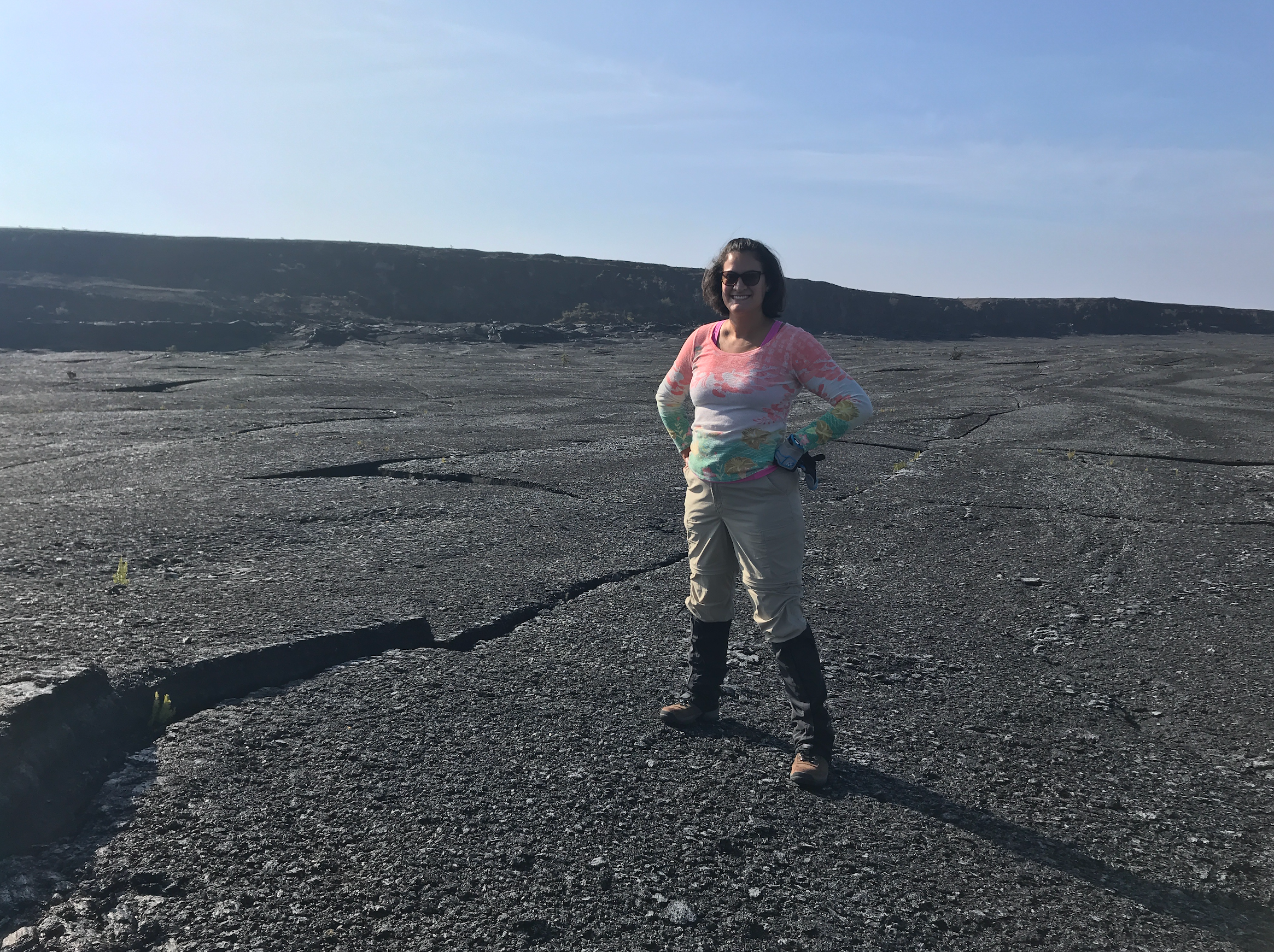
During her NASA career, Santiago-Materese traveled to Hawaii to investigate a planetary analog, a type of terrestrial environment that has very similar characteristics to those we might find on other worlds.
Image credit: Delia Santiago-Materese
At NASA Ames, Santiago-Materese held various roles, ranging from social media and open science to lunar sciences. She then became a program officer for the Solar System Workings program in the Planetary Science Division at NASA Headquarters as part of a detail, or temporary assignment. And then, she took off for Maryland along with her family.
Enabling Science
Santiago-Materese sums up her current role as a program scientist as the “science liaison” between NASA Headquarters and a mission. “When you do program scientist work, you might not be specialized or an expert in the exact science, but you need to be able to understand it and talk about it, to understand its importance,” she explains. “In general, we are supporting other people so they can do science.” In this endeavor, being someone who “gets more energy from working with people” is useful… and necessary: “You are having conversations all day long” with colleagues from different disciplines— from science and engineering to finance.
The Juno mission, in orbit around Jupiter since 2016, and Dragonfly, which is scheduled to launch no earlier than July 2028, are part of NASA’s New Frontiers program. Santiago-Materese also oversees the array of missions in the Discovery program, which includes ongoing science missions like Psyche and Lucy—heading to different asteroids—and future missions to Venus.
For Santiago-Materese, sharing her unconventional path can be valuable for students and youth in general, especially those who are unsure of what they want to do. “Your dream job,” she says, “you might not know it exists, or maybe it doesn’t exist today.” Beyond that, this zigzagging path has led her to accumulate experiences and relationships with different people, which she treasures even as she sets off for her next destination.
An Alien World
About two years out from Dragonfly’s launch, it is no surprise that this robotic mission takes up much of Santiago-Materese’s time. “Dragonfly feels like a combination of all my different experiences over time,” she reflects. And it signifies, to some extent, a return to her roots: it is an astrobiology mission. Although not designed to detect life, Dragonfly will investigate prebiotic chemistry: the chemical processes that could have led to the emergence of life on Earth.
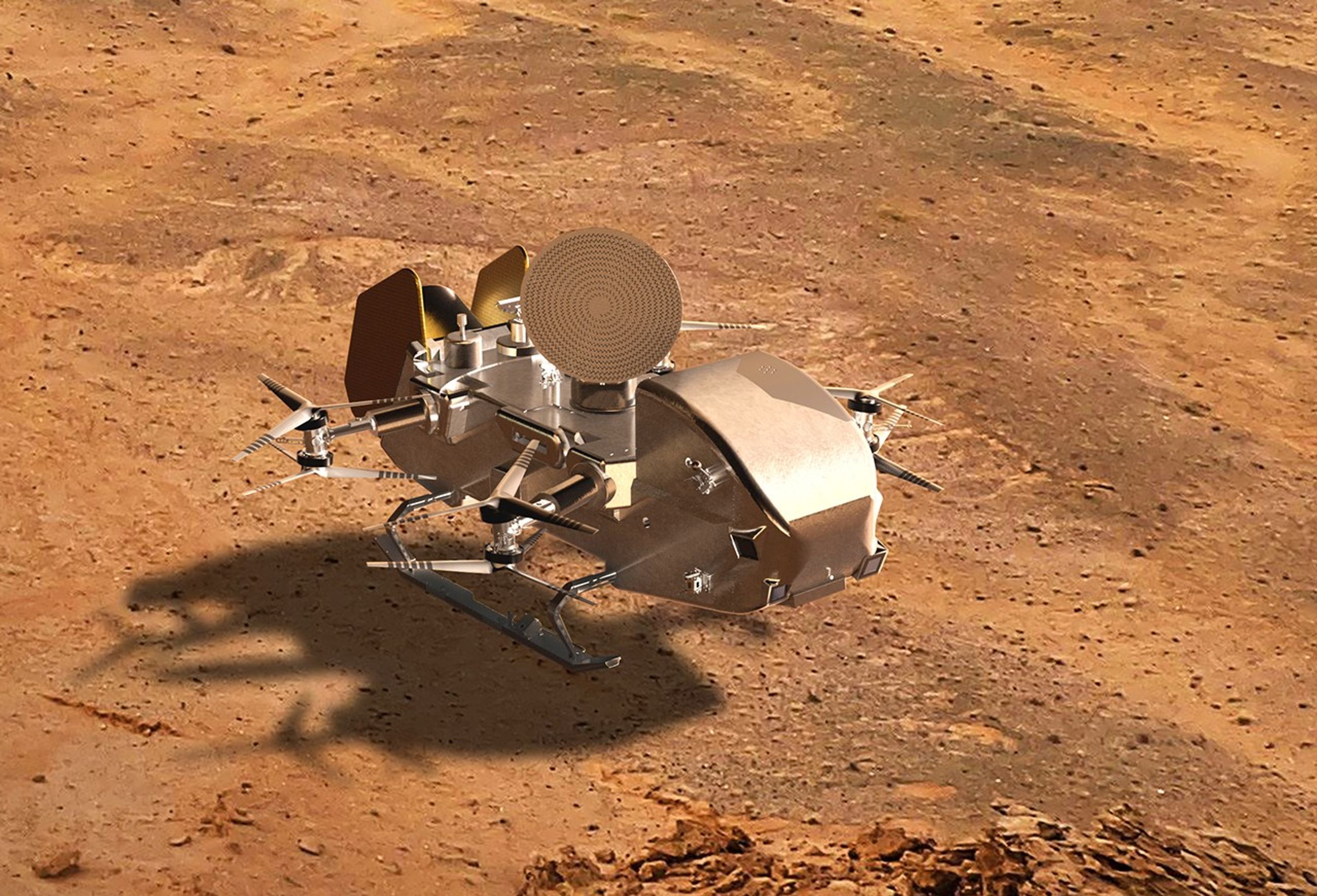
Digital concept of NASA’s Dragonfly lander on the surface of Saturn’s moon Titan.
NASA/Johns Hopkins APL/Steve Gribben
Dragonfly will embark on a journey of about six years to the surface of Titan. The spacecraft will carry an array of science instruments and will be the first NASA science mission to explore another world by flying from location to location. This car-sized rotorcraft will touch down at various geological sites of interest to analyze the moon’s composition and its habitability potential.
When it arrives at Titan, it will encounter a landscape that is strange and familiar at the same time: it could be a window into Earth’s remote past. This frozen world has a thick atmosphere and clouds drifting across the sky; dunes, lakes, rivers, canyons and mountains. Titan even has a process equivalent to our water cycle. However, on Titan, it is not water that flows but hydrocarbons, primarily methane and ethane. “It’s a more methane-based chemistry, so it is very alien, and that is what I really love about Titan,” says Santiago-Materese. And on this moon, organic molecules abound.
These molecules contain carbon and are used by all known forms of life. They are fundamental to understanding the origin of life, as they can be produced by both biological and non-biological processes. On Titan, these organic molecules fall to the surface and form dense deposits over its bedrock of water ice. Scientists believe that the complex chemistry precursor to life could be triggered there if provided with a little liquid water, such as that generated by an asteroid impact.
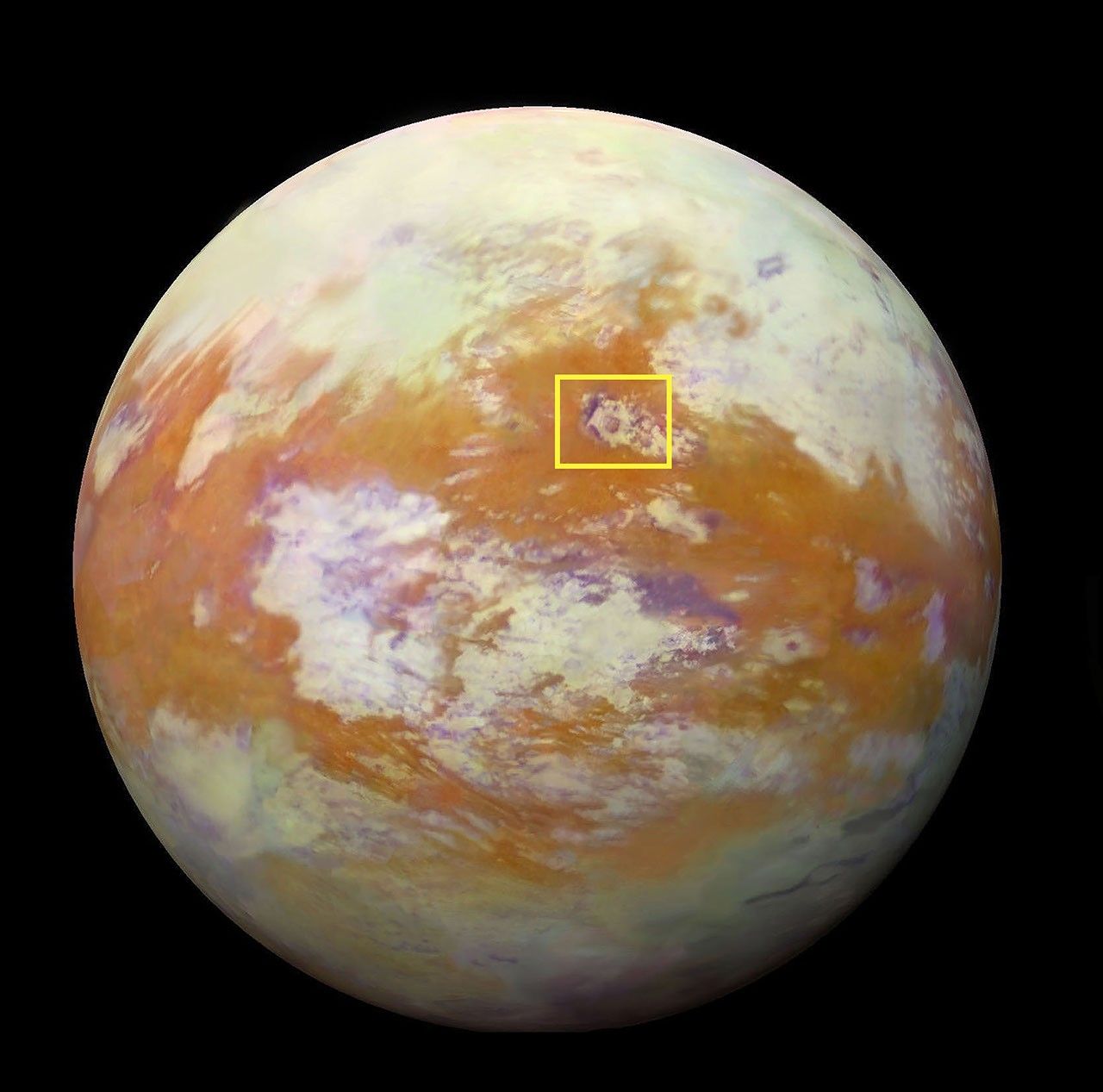
Selk Crater, an 80-kilometer (50-mile) diameter impact site highlighted in this infrared image of Titan, is a key destination for Dragonfly. The rotorcraft will touch down near Selk and explore various sites, analyzing the surface chemistry to investigate the frozen remains of what could have been prebiotic chemistry in development.
NASA/JPL-Caltech/University of Nantes/University of Arizona
Santiago-Materese is especially excited about what the Dragonfly Mass Spectrometer (DraMS) instrument will help discover. DraMS, designed and built at NASA’s Goddard Space Flight Center in Greenbelt, Maryland, will analyze samples from Titan’s surface. “The more complex things get, the more interesting things happen,” she says. “So I’m curious: just how complex do the molecules get? Will we find any interesting patterns?”
But in science, every time you ask a question, a new one arises. Dragonfly will try to answer several of them. “When you have a planet with complex chemistry but not life, what happens? What is there before life?” the program scientist wonders.
Titan, a valuable natural laboratory, “is going to completely change our understanding of what another world can be like,” she anticipates. In addition to what the scientific community expects to discover thanks to Dragonfly, Santiago-Materese is interested in the potential unexpected findings. “There are very defined science goals, but a lot of it is exploratory work,” she explains. “It is kind of nice to know that there is a big range [of possibilities], that we could be very surprised.”
By Noelia González, NASA’s Goddard Space Flight Center, Greenbelt, Maryland
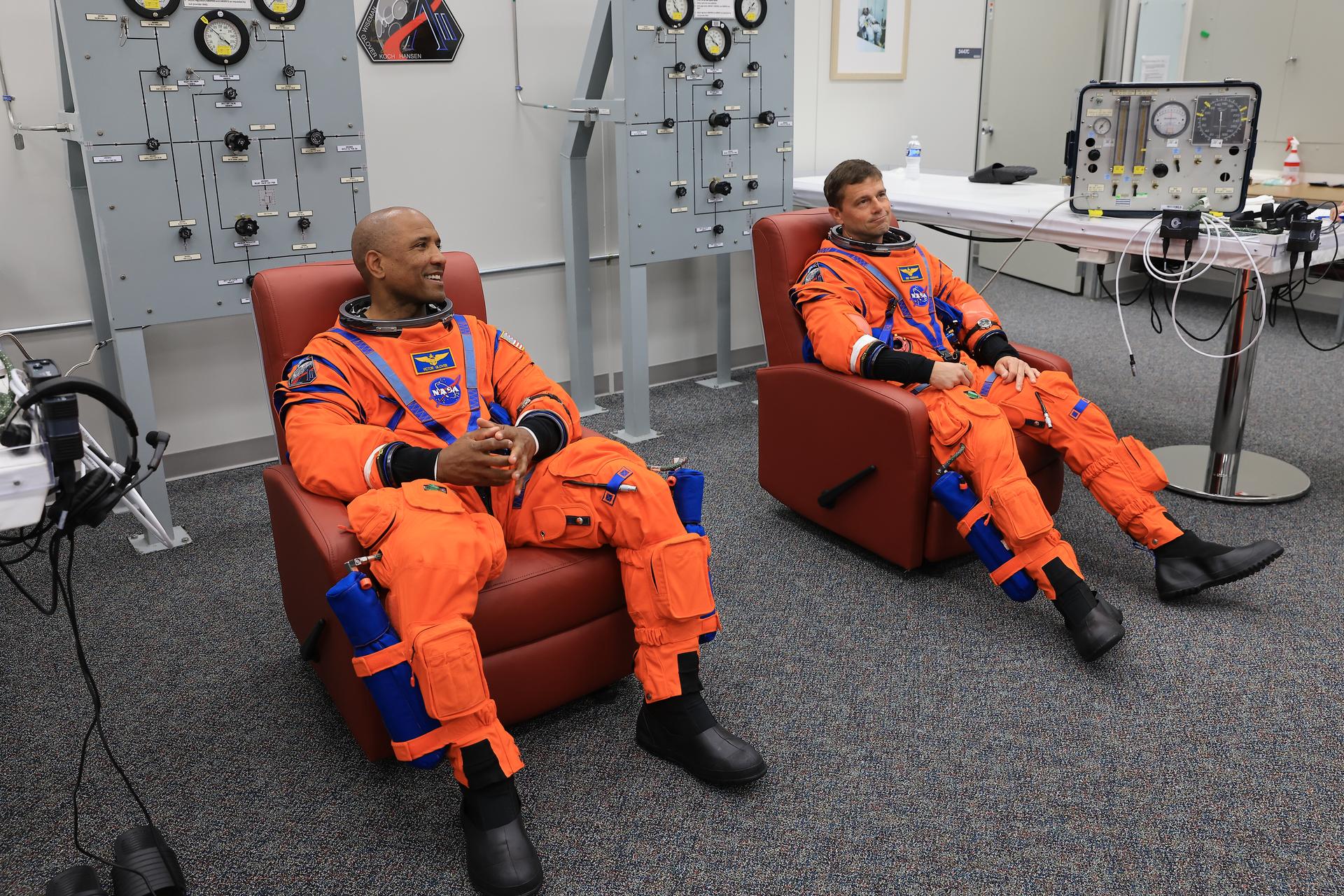
From left, NASA astronauts Victor Glover, Artemis II pilot, and Reid Wiseman, Artemis II commander, conduct leak checks on their spacesuits inside the crew suit-up room in the Neil A. Armstrong Operations and Checkout Building at the agency’s Kennedy Space Center in Florida on Wednesday, April 1, 2026, ahead of the Artemis II test flight.
Credit: NASA/Kim Shiflett
Following their landmark Artemis II mission earlier this year, distinguished NASA astronauts Victor Glover and Reid Wiseman are transitioning in September to emeritus status at the agency’s Johnson Space Center in Houston.
In an emeritus role, individuals with a high degree of technical and professional knowledge can continue to support the agency by donating their time to train and mentor the current workforce. This allows the agency to maintain access to top talent in a specialized consultant role, while simultaneously providing the individual with the flexibility to pursue other opportunities.
“I’ve had the privilege of knowing Reid and Victor for years, and both exemplify the leadership, character, and commitment that define NASA at its best.” said NASA Administrator Jared Isaacman. “Reid commanded Artemis II after previously spending 165 days aboard the International Space Station, while Victor brought his experience as a naval aviator, test pilot, and Crew-1 astronaut to his role as pilot. Together, they took on one of the most challenging missions in human spaceflight and helped return America to the lunar environment. As Reid and Victor transition to emeritus status, I’m grateful they will continue sharing what they learned with our astronauts, flight controllers, and engineers as we prepare for Artemis III in 2027 and the missions that follow.”
Glover will support aerospace, leadership, and public service efforts as he transitions within and outside of NASA. He’s committed to transferring his knowledge of Orion and its spacecraft systems, among other expertise, to future Artemis missions.
“As I grow into this new role, NASA and spaceflight remain a meaningful part of my journey of service,” said Glover. “I’m excited to keep uplifting my friends and cheering them on as they reach for the Moon. Together, we’ll keep pushing boundaries and inspiring the next giant leap.”
Wiseman is set to share his spaceflight experience with colleagues ahead of the agency’s Artemis III mission in low Earth orbit to test rendezvous and docking capabilities between Orion and commercial human landing systems.
“There is no better place to work, and there are no better people to work with, than those in this agency,” said Wiseman. “NASA gave me tremendous responsibility, supported me through two space missions, and my time as chief astronaut, and was always there for my family when we needed it most. I’m thrilled to continue serving future missions and programs through the emeritus program.”
“Reid and Victor’s commitment to exploration, steady leadership, and service to our astronaut corps and our nation have made a lasting impact,” said Vanessa Wyche, director of NASA’s Johnson Space Center in Houston. “Throughout their careers, they have each brought excellence, humility, and purpose to every role they have held at NASA. Their contributions have helped advance our mission and inspire those around them, leaving a legacy that will continue to shape the future of human spaceflight. We are immeasurably grateful for all they have given to NASA and are glad that this is not the end of their journey with the agency.”
“Reid and Victor are trusted teammates whose professionalism, calm leadership, and unwavering commitment to NASA have strengthened our office and inspired everyone around them,” said Scott Tingle, chief of the Astronaut Office at Johnson. “As they transition into their emeritus roles, they leave a legacy of operational excellence that will continue shaping the astronaut corps for years to come. We’re grateful that they will still be part of our community, sharing their experience and insight as they begin this next chapter.”
Among their many accomplishments at NASA, as Artemis II crew members, Glover and Wiseman were two of the four astronauts to first launch on top NASA’s SLS (Space Launch System) rocket aboard the Orion spacecraft for a mission around the Moon. Following a 10-day mission with crewmates NASA astronaut Christina Koch and CSA (Canadian Space Agency) astronaut Jeremy Hansen, they safely splashed down on April 10 as the first humans to travel to lunar orbit in more than 50 years, ultimately flying farther in space than anyone had before.
Support and knowledge transfer from both Glover and Wiseman is critical for the upcoming Artemis III mission as NASA prepares to return American astronauts to the lunar surface on the Artemis IV mission in 2028.
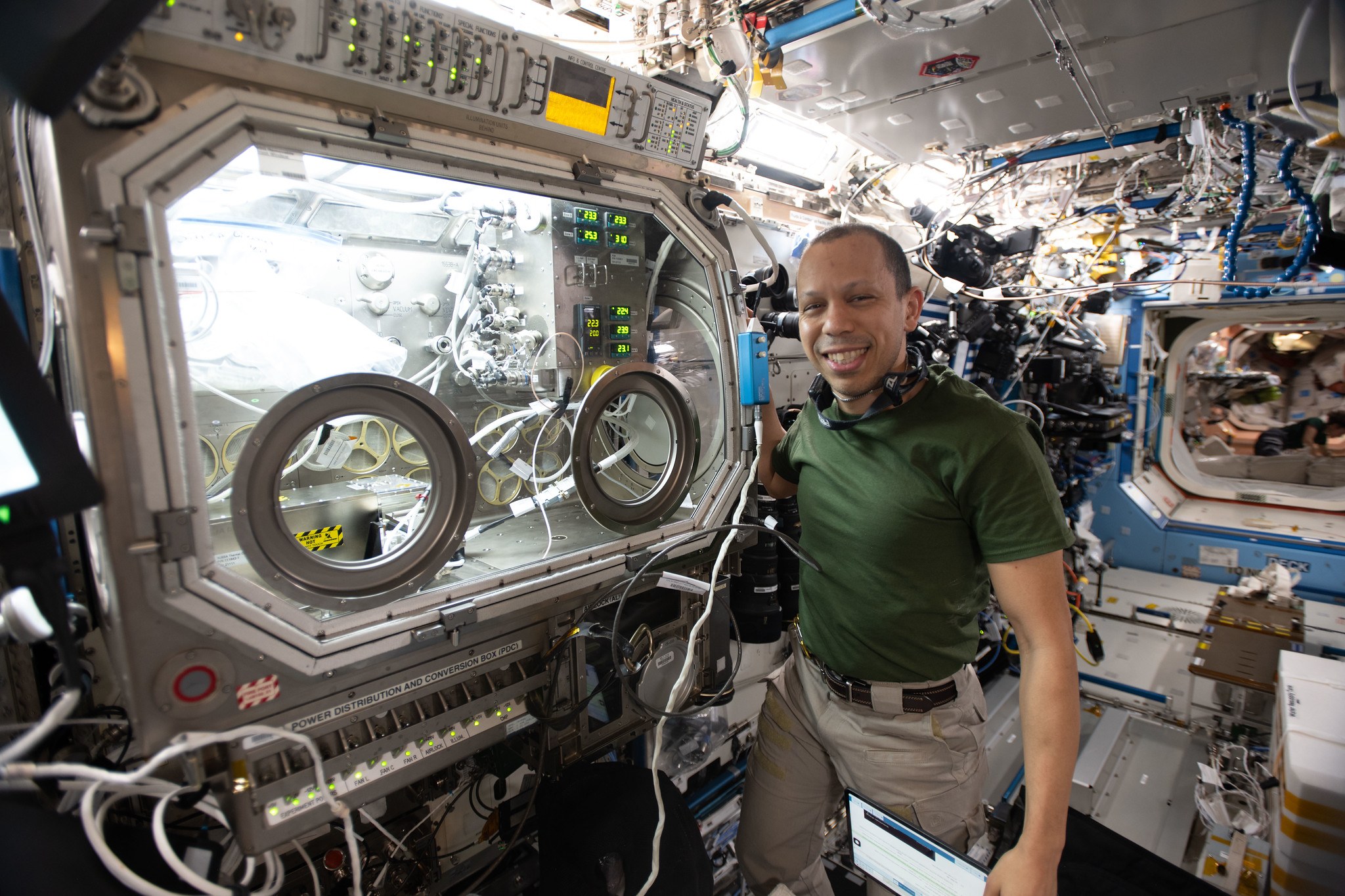
NASA astronaut and Expedition 74 flight engineer Chris Williams shows off the Destiny laboratory module’s Microgravity Science Glovebox aboard the International Space Station. Williams was supporting semiconductor crystal research to help advance the commercial space economy and promote Earth-based industries.
NASA/Chris Williams
NASA astronaut Chris Williams will recap his recent eight-month mission aboard the International Space Station during a news conference at 2:45 p.m. EDT Tuesday, Aug. 4, from the agency’s Johnson Space Center in Houston.
NASA will stream this event live through a variety of platforms. Learn where to watch online:
United States-based media interested in attending in person must contact the NASA Johnson newsroom no later than 5 p.m., Friday, July 31, at jsccommu@mail.nasa.gov.
Media wishing to participate by phone must contact the Johnson newsroom no later than two hours before the start of the event. To ask a question by phone, media must dial into the news conference no later than 15 minutes prior to the start of the call. NASA’s media accreditation policy is available online.
Williams returned to Earth on July 26, after logging 241 days as an Expedition 73/74 flight engineer during his first spaceflight. He returned along with Roscosmos cosmonauts Sergey Kud-Sverchkov and Sergei Mikaev, completing 3,856 orbits of the Earth over the course of their more than 102-million-mile journey. They also saw the arrival of six visiting spacecraft and the departure of eight.
During his mission, Williams supported a wide range of scientific investigations and technology demonstrations. He helped advance research for new cancer treatments and improved in-space manufacturing of materials used in high-performance computers and electronics. Williams also completed two spacewalks to prep for space station power system upgrades and to replace a faulty joint on the Canadarm2 robotic arm. The crew’s work aboard the space station helps improve life on Earth and prepare for future human missions to the Moon and Mars.
To learn more about International Space Station research, operations, and its crews, visit:
NASA has selected Sean Gallagher as the agency’s chief information officer (CIO). In this role, he is responsible for the agency’s entire portfolio of Information Technology products and services. Gallagher has been serving in an acting capacity since January and his permanent role is effective immediately.
“Sean Gallagher’s leadership has been instrumental in strengthening NASA’s IT foundation and ensuring our workforce has the secure, modern tools needed to enable groundbreaking missions every day,” said NASA Deputy Administrator Matt Anderson. “As CIO, Sean will continue advancing the agency’s technology capabilities to support discovery, innovation, and mission success across NASA.”
Most recently, Gallagher also has served as the deputy chief information officer for Operations in the Office of the Chief Information Officer at NASA Headquarters in Washington, as well as a senior advisor for Transformation. This team provides services to tens of thousands of end users located in the U.S. and abroad in support of NASA missions, enabling discoveries, faster data sharing, increased workforce productivity, and more. Gallagher has worked with all NASA centers to implement efficient and effective IT operating models.
Previously, Gallagher was the CIO of NASA’s Glenn Research Center in Cleveland, leading IT initiatives for aeronautics, space, research and engineering, and test missions. He joined NASA in 2012 as Glenn’s deputy CIO and previously worked at Booz Allen Hamilton as a senior associate supporting a variety of federal, defense, and commercial customers.
Gallagher developed his leadership and management experience as a Signal Corps officer in the United States Army. He also served as a platoon leader managing the combat service support readiness of a tactical communications unit, a human resource manager for the 40th Signal Battalion, and as a network engineer for the 11th Signal Brigade. He has a bachelor’s degree in physics from John Carroll University and a master’s degree in computer information systems from the University of Phoenix.
For more information about NASA’s missions, visit:

 Login