❌

Reading view

iPhone Duo review roundup: A little weird, a lot of fun, and a breath of fresh air

Macworld

The first wave of iPhone Duo reviews has landed, and the overall response is very positive. Reviewers have uncovered numerous issues with Apple’s first-ever foldable, but have proved surprisingly forgiving. Let’s get into the details.

Late to the party

Apple, not for the first time, is arriving late to the party. “The iPhone Duo arrives seven years after Samsung’s first Galaxy Fold,” pointed out Wired. But this is classic Apple strategy, and there are good reasons why the company bided its time. “In Apple tradition,” the site continued, “its first entry into an existing category feels fully mature; the Duo has significantly less jank than the first few generations of its Android counterparts.”

“The iPhone Duo took its time getting here,” CNET agreed, “but it’s made quite an entrance.”

And Gizmodo was impressed by Apple’s ability to play catch-up. “I think we can all agree that the iPhone Duo has already achieved what competing foldables have not been able to in seven years: generate considerable buzz for foldable phones,” the site argues.

Design: Something new

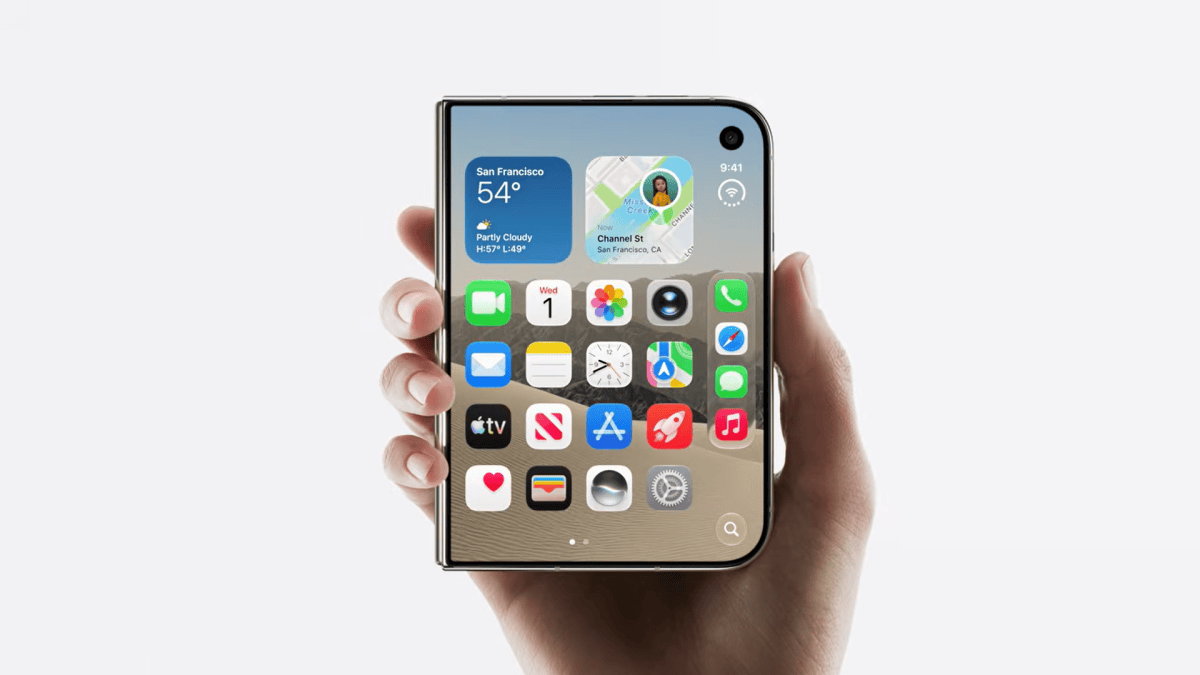
Considering it’s Apple’s first foldable, the Duo appears to offer a more polished design than one might expect. “Apple’s first foldable phone doesn’t look or feel like a first attempt,” wrote Tom’s Guide, “because of the sheer attention to detail. The way the friction hinge holds nearly any angle. The seamless switching between the cover and main display with the same aspect ratio. And the nano-texture coating, which minimizes glare and the dreaded crease.”

PC Mag was impressed, too. “Apple knows hardware, designing high-end devices that look good, feel great to use, and work seamlessly,” the site observed. “And that’s largely true with the Duo… The matte white rear panel of my review unit looks and feels fantastic. I also like how Apple polishes its logo into the glass, making it reflective in contrast to the smooth matte finish surrounding it… The hinge feels utterly fantastic.”

“Despite its added thickness and weight, I’ve found the iPhone Duo surprisingly comfortable to carry in my pockets,” reported 9to5Mac. “Its shorter, wider footprint makes a bigger difference than I expected… it’s hard to overstate just how impressive the whole thing feels in practice.”

Gizmodo did raise one concern. “I was a little irked that the iPhone Duo caused my front pants pocket to sag. I’ve been so spoiled by the iPhone Air’s lightness that the only solution was to wear a belt again to cinch my pants tighter around my waist.” The site conceded, however, that the Duo “is a beautifully engineered device.”
iPhone Duo held in a right hand

Apple

How easy is it to use?

The problem with new things is that they are unfamiliar. Some reviewers were concerned that buyers would find the Duo difficult to use, particularly at first.

“I’ve been using iPhones since June 2007,” wrote PC Mag, ominously. “I know how to use an iPhone. And since Face ID arrived on the iPhone X back in 2017, I’ve gotten into a good rhythm for swiftly unlocking the phone. You can toss all that muscle memory out the window.”

Gizmodo agreed. “I’ve gotten so used to using Face ID since the iPhone X that going back to Touch ID required a little muscle memory retraining,” the site complained.

The Verge argued that it is “wild to have iPhone apps with controls in all kinds of different places; reaching for the back button in Apple’s Mail app and realizing it’s moved from the top left to the right is kind of disorienting. A lot of using the Duo is just figuring out how to use an iPhone again, which hasn’t happened in a long time.”

But not everyone found the user experience a trial. CNET reported that switching from the iPhone 18 Pro Max to the iPhone Duo “has been seamless, and not only because of the synchronization baked into Apple’s operating system. I haven’t experienced any hiccups while using iOS 27 on both Duo screens. Instead, the implementation feels intentional.”

Screen quality and the crease question

The great challenge when creating a foldable is to avoid the appearance of a crease in the screen. Reviewers felt that Apple did a good job in this department.

“The infamous crease—where the phone folds—is hardly visible thanks to Apple’s display stack and clever use of a matte-finish nanotexture screen,” Wired reported.

PC Mag was a little more conservative in its praise. “Apple has done well at minimizing the crease’s appearance,” the site noted, “but it’s still there. You can see it when the display is off, and you can feel it if you run your finger across the screen.”

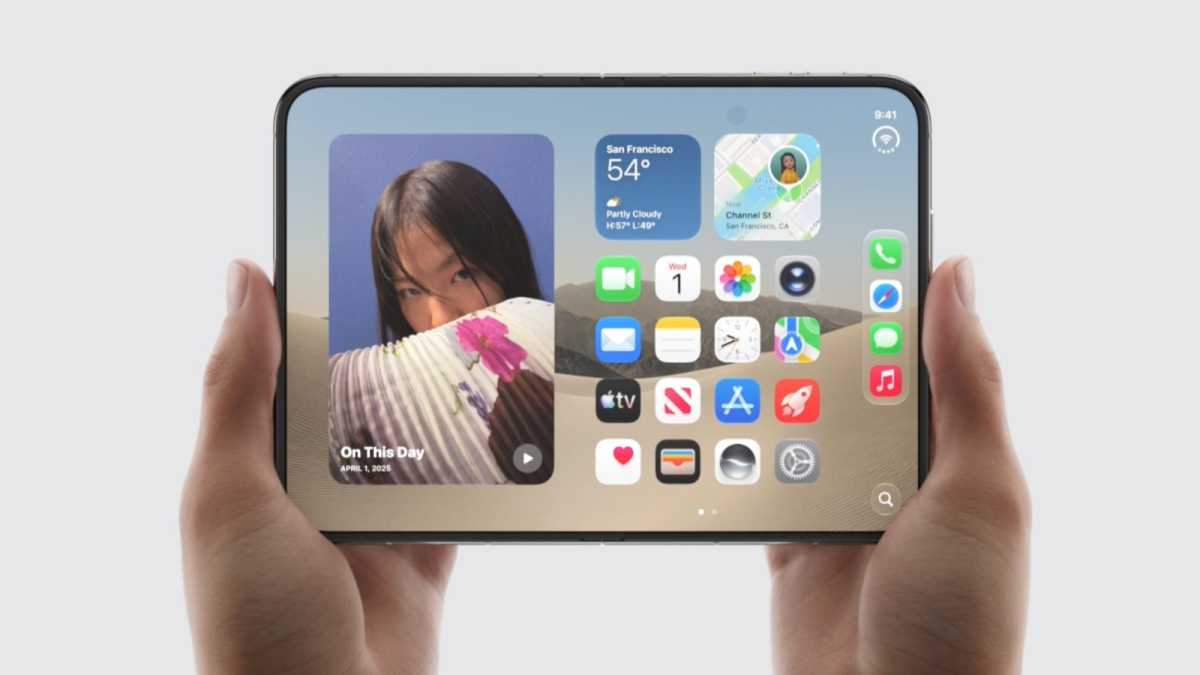
In other respects the screens on the Duo were positively received. CNET said the 5.4-inch cover screen “doesn’t feel cramped. I can comfortably do just about anything I would on a bar-style phone, just on a smaller scale. The keyboard is roomy, taking up around half the cover screen, so typing feels seamless and easy. I haven’t grappled with any more typos than usual.” And The Verge was similarly complimentary about the 7.6-inch inner display. “Apple’s very proud of this inner matte display, and for good reason,” the site said. “It looks and feels incredibly solid, a big step up from foldables with glossy, seemingly soft screens with glaringly obvious creases.”
Apple iPhone Duo

??????????

Apple

How well do third-party apps work?

Apple’s own apps have naturally been tweaked and redesigned to work perfectly on the Duo’s unfamiliar screen arrangement, but the big question is how much effort and skill will third-party developers be prepared to put into optimizing their apps? The answer is: it depends.

“I was intrigued to try third-party apps optimized for the iPhone Duo,” wrote Tom’s Guide, “and there are plenty of standouts so far. [But] non-optimized apps can range from looking a bit off to horrible. Keeping in mind that many top apps will be updated by the Duo’s release date, I noticed that certain apps had huge black bars on the left and right side of the display, like Disney Plus and The Weather Channel. Unoptimized games look pretty terrible, too, filling up only three quarters of the screen. I just hope developers update their wares. Quickly. And I expect they will out of fear of sheer embarrassment.”

Wired was also struck by the disparity between optimized and non-optimized apps, but was more sanguine about the prospects of developers falling into line. “Several apps I’ve tried to open on the sprawling 7.6-inch screen look awful,” the site wrote. “Thick, black bars on the sides, with a phone-sized app in the middle of this tablet-like display. But you likely won’t encounter this problem once the Duo is in your hands… Developers need to target the iOS 27.1 software development kit for full Duo compatibility. That will take some time. But it is a little maddening that some app developers, who for years have never seemed to care about optimizing their app for Android folding phones, are so quick to embrace Apple’s fold.”

Performance: Fast, but occasionally hot

The Duo is a powerful phone with excellent specs, but for the very best performance you may wish to look elsewhere.

“Despite sharing the same processor, memory, and storage options, the Duo’s speeds and performance don’t quite reach the same heights as the [iPhone] Pro models, but it outmatches the [Samsung Galaxy] Z Fold 8,” reported PC Mag. In real life, however, such distinctions are unlikely to make much difference. “In terms of using the phone naturally over the course of a week,” the site added, “I experienced no problems or hiccups. The Duo smoothly transitions from the front screen to the inner screen, apps open swiftly, and multitasking isn’t a challenge at all.”

CNET wrote that Geekbench 7 CPU benchmark tests “place the iPhone Duo well above the Galaxy Z Fold 8, Z Fold 8 Ultra and Pixel 11 Pro Fold. In a graphics test using 3DMark’s Wild Life Extreme, the iPhone Duo again exceeded the performance of the Z Fold 8 and Fold 8 Ultra, and far outpaced the Pixel 11 Pro Fold.”

Impressive. But there are slight concerns about overheating. “For most things it’s plenty fast,” wrote The Verge. “But the reality is that it’s also a thin phone driving two big displays, and it definitely gets warm, and sometimes hot.”

iPhone Duo facetime

Apple

Cameras: Not pro, but plenty good

As was the case with the iPhone Air last year, the Duo packs slightly less impressive cameras than one might expect given the price. But this may or may not be a problem, depending on your photographic needs.

“I was nervous about whether the iPhone Duo’s cameras would pull their weight,” admitted CNET. “Thankfully, I’ve been pleasantly surprised… The photos I’ve taken in a variety of conditions have turned out sharp and vibrant–though you won’t find more advanced, pro-oriented formats like ProRAW capture and ProRes video.”

PC Mag was also happy with the device’s performance in photo tests. “The Duo takes superb photos in most scenes,” the site wrote. “Outdoor daytime shots look fantastic, with accurate color, sharp focus, and plenty of contrast.”

But Tom’s Guide felt it is “a big deal that the iPhone Duo doesn’t have a telephoto lens. You get just a 48MP main and 48MP Ultrawide, which take great shots. But if you’re zooming in, you’re going to miss the level of detail a dedicated optical can provide.” And The Verge complained that the Duo “relies on heavier sharpening to make up for its weaker [camera] hardware, so fine details look a little crunchier than they do on the 18 Pro. The Duo retains a bit less color detail in low light too, though Night Mode kind of evens out the playing field between them.”

Battery life: Mixed messages

Some sites were happy with the Duo’s battery performance, while others were frustrated.

On the positive side, CNET reported that “even with my excessively high screen time over the past few days, the battery has consistently held up well. One day, I started with a full battery at 8:15 a.m., and after a full day of scrolling through social media, working in Google Docs, sending emails, texting, taking pictures, watching YouTube videos, and placing a couple of phone calls and a video call, I ended the day with 29% at 11 p.m.”

And PC Mag wrote: “I ran our usual battery test overnight and came away impressed. I streamed a YouTube video via Wi-Fi on the inner display with the screen’s brightness set all the way up. It ran for 18 hours and 15 minutes. It bested the Motorola Razr Fold (18 hours), Galaxy Z Fold 8 (16 hours, 30 minutes), Z Fold 8 Ultra (16 hours, 29 minutes), and the Pixel 11 Pro Fold (14 hours, 21 minutes).”

But The Verge was less happy. “The Duo,” it wrote, “doesn’t seem ready to last a full day of heavy use.”

Price: High but justified

Perhaps the most surprising aspect of the early reviews was how comfortable the reviewers were with the iPhone Duo’s price tag.

“The iPhone Duo costs $1,999 for 256GB, rising to $3,199 for 2TB of storage,” noted CNET. “While that starting point is high, it’s in line with most foldable phones.” It added that these prices “sure didn’t stop [the Duo] from selling out almost instantly when preorders opened.”

“Do I think the iPhone Duo is worth two grand?” asked Tom’s Guide. “Yes, as it’s only $100 more than the Galaxy Z Fold 8. And you get a more durable design, faster performance, longer battery life, and smarter software.”

“[On price,] the Duo is surprisingly on par with its competitors (though still expensive),” concluded Wired.

Verdict: Flawed but fun

The iPhone Duo clearly isn’t perfect. But reviewers enjoyed themselves and had plenty of qualified praise for the device.

“It is expensive, it’s full of compromises, and it can be incredibly frustrating to use,” said The Verge. “But all of the risk and weirdness of the Duo is also fun, in the way the best early adopter devices are fun. It’s incomplete as a product, but complete enough as an idea that you can see where things are going.”

“Aside from some minor shortcomings, Apple appears to have stuck the landing with its long-awaited foldable,” said CNET. “Foldable phones offer a breath of fresh air in a stagnant industry, and the iPhone Duo is no exception.” The site did stress, however, that the Duo is not for everyone.

PC Mag was very complimentary in its summing up. “The iPhone Duo overcomes Apple’s late start by delivering the best hardware, performance, and battery life of any foldable phone on the market,” the site enthused. Tom’s Guide described the Duo as “the best designed foldable yet with the most polished, intuitive and fun software experience.” Gizmodo added that “phone hardware and software are genuinely exciting again, which is something to celebrate.”

We’ll end with a note of caution from Wired. “This is often the case with first-generation products,” the site wrote, “but it may be prudent to wait for the Duo 2.”

  •  

If you want an iPhone Duo, Apple will have ‘limited’ stock in stores

Macworld

If you’re hoping to wait in line at an Apple Store on Friday in the hopes of scoring an iPhone Duo, you might want to reconsider. Some stores will have some units to sell to those who didn’t preorder, but not many, and they’re going to be gone in a flash.

In a statement to Reuters and other news outlets, Apple said:

On Friday morning, our teams look forward ​to welcoming customers at Apple Stores to experience iPhone Duo ​and the incredible iPhone line-up for themselves,” Apple said in a statement. “Apple Stores will ‌have ⁠limited iPhone Duo available for walk-in customers, and we’re working hard to get this revolutionary new product into customers’ hands as quickly as possible.

Despite the eye-watering starting price of $1,999, preorders for the iPhone Duo at the Apple Store are now listing a date of January 25 for nearly every configuration, pushing delivery of the first folding iPhone far beyond the holiday season. Apple may send a small portion of new iPhone Duo shipments for walk-in purchases at Apple Stores, but between Apple preorders and carrier stores, it’s safe to say that it’s going to be really hard to get one if you haven’t already preordered.

In the past, stores have gotten daily shipments of small numbers of phones, so if you’re not lucky on Friday, you should be able to check back.

New iPhones are always a hot item and often slightly backordered in specific configurations or colors, but the folding iPhone is reportedly very difficult to manufacture, leading to smaller volumes and a lower production rate than something like the iPhone 18 Pro.

  •  

New Apple job listing hints at path to 6G devices

Macworld

When Apple launched the iPhone 12 in 2020, one of the headline upgrades across the range was support for 5G. This then-new networking standard enabled the devices to access claimed mobile speeds roughly 50-100 percent higher than 4G LTE… provided coverage was available in the user’s area. This caveat meant improvements were difficult to notice in the short term, but it was an important upgrade for the long term. (Some skeptics disputed its value, admittedly.)

Six years on, Apple is making plans for the next version of the technology, unimaginatively called 6G, and the quality-of-life improvements this will deliver to iPhone owners.

In a new job listing, spotted by MacRumors, the company this week set out to find a “6G Cellular Modem Systems Engineer,” based in either San Diego or Sunnyvale, California. The role carries a brief to “Define & architect system-level features and requirements for next-generation cellular modems, with a focus on 6G evolution and advanced PHY/L1 capabilities.” Base pay is in the range $175,000-$308,500, so get your applications in soon.

Apple is well aware that its job listings are scrutinised eagerly for evidence of upcoming product development, so this posting is significant in what it tells us about the company’s progress and how willing it is for this to be publicised. But it’s been planning for the launch of 6G for some time. A similar, albeit slightly more subtle, listing was spotted way back in 2021, only a year after the iPhone gained support for 5G. That post sought “wireless system research engineers for current and next-generation networks” and then mentioned lower down that the next-generation networks in question were, obviously, 6G.

The progression from research engineers to a systems engineer (the new listing mentions the word research only once, in the context of past experience) may reflect the 6G project’s changing priorities and increasing focus on practical applications. But 6G remains a long way from launch; 6G networks are currently expected to appear in the early 2030s. In other words, the first Apple device to support 6G is likely to be at least the iPhone 22 Pro… or maybe the iPhone Duo 5.

  •  

Best iPhone Duo cases: Slim, protective and kickstand options

Macworld

Apple’s new iPhone Duo is both big and small, and it’s more susceptible to knocks and drops than a standard iPhone with its folding function maybe taking a while to get used to. It’s the first iPhone that needs a case built around moving parts—namely the hinge. A case for a foldable can be made from one or two shells, with the additional question of covering the hinge or leaving it bare. The phone goes on sale October 23, and cases are already arriving.

We’ve assessed these cases using a dummy iPhone Duo, comparing their design, materials, fit, and features. This gives us an initial impression, but we haven’t yet verified their performance on a working phone, including wireless charging, Touch ID access, and how they accommodate the hinge during everyday use. We’ll update our recommendations after testing with the iPhone Duo itself.

iPhone Duo test criteria

Until we get our hands on the actual iPhone Duo to test each case with, we’ve used an incredibly accurate test-surrogate iPhone Duo to fit in the cases we’ve tested ourselves. We look for eight key criteria in each case.

Apple iPhone Duo in hand in Benks case
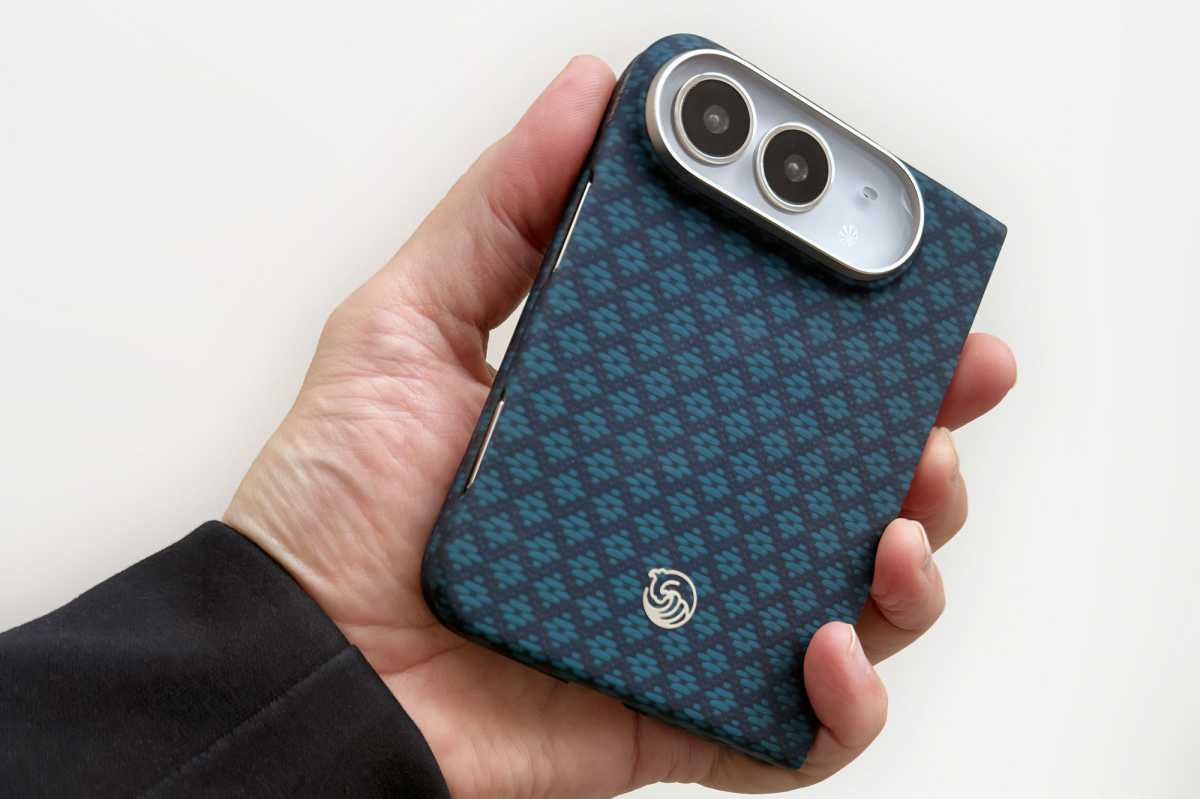
Our test surrogate Duo in the Benks ArmorGrid Air (Beyond Blue)

Simon Jary

Protection: We checked corner reinforcement, camera and screen-edge protection, hinge coverage, and how much of the handset each shell covers. We did not run our own drop tests, so protection assessments are based on construction and coverage, and we note manufacturer claims as claims. Some case makers specify the exact measurements of their raised screen and camera edges, other do not.

Materials and grip: We assess surface texture, grip, finish, and visible fingerprint marks during handling. Common case materials include TPU (thermoplastic polyurethane, a flexible, durable plastic) and aramid fiber (a lightweight, high-strength synthetic fiber, best known through the Kevlar brand). The material alone does not establish how well a case protects the phone; construction and coverage also matter. Long-term wear, discoloration, and adhesive durability cannot be established during these initial checks.

Hinge protection and operation: Cases take different approaches to the Duo’s hinge: some include a protective cover, while others leave it exposed. We opened and closed each case on the dummy handset, checking for stiffness, rattling, gaps, and smooth movement of any hinge cover. We also checked whether both shells stayed firmly attached during opening and closing. These checks provide an initial assessment of the case’s construction and movement. We will assess the effect on the actual phone’s hinge movement or opening angle will require further testing with a working iPhone Duo.

Fit and installation: We used the dummy iPhone Duo to assess how securely each section fits the handset, the alignment of cutouts, and the ease of installation. We also checked the positioning and accessibility of button covers and port openings. Final fit and tolerances, button response, Touch ID operation, and cable fit will need confirmation with a retail iPhone Duo.

Slimness: The Duo’s thin profile is part of its appeal but this must be weighed against the backplate’s coverage and reinforcement. We penalize cases that add bulk without a clear benefit, but not where the protective benefits are worthwhile.

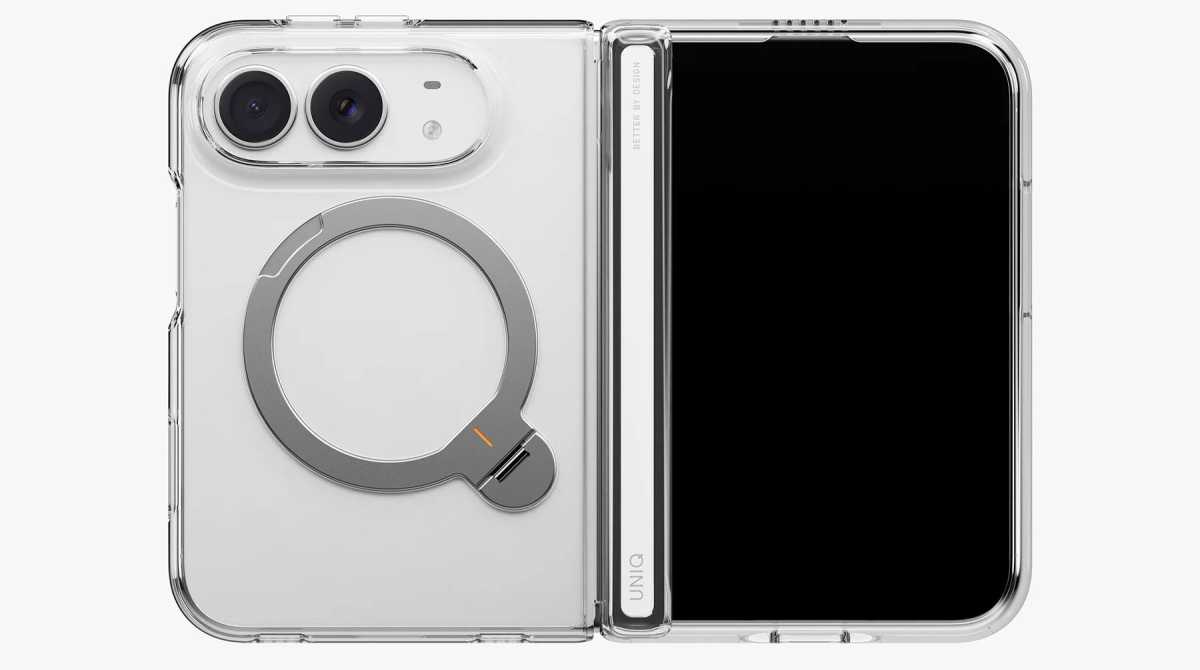
Extra functions: Some iPhone Duo cases include a kickstand for easier viewing. We assessed adjustability and how much bulk the stand adds. ESR’s Flex Stand, for example, rotates 180° and forms a protective guard around the camera bar when not in use. Other stands, such as those on the Torras Ostand and UAG Mouve XTE, rotate 360° and fold flat against the case backplate. The Moft Dynamic Folio uses an origami-like folding stand. Stability with a working iPhone Duo, both folded and unfolded, will require further testing because its weight and balance may differ from those of the dummy handset.

Colors and style: We assessed the range of colors and the quality of the finishes provided. Most of the color and pattern will be seen on the case’s backplate, but it should also be noticed on the front frame and hinge protector where present.

Magnetic accessory compatibility: We checked how securely magnetic chargers, power banks, wallets, and other accessories attached, and whether the case’s camera surround, hinge protection, or kickstand obstructed their fit. Because we used a dummy handset for our initial testing, these checks assess attachment and clearance only. We will test charging performance—including speed, heat, and reliability—once we have a working iPhone Duo.

Getting a new iPhone 18 Pro, read our round up of the best iPhone 18 Pro cases.

Apple iPhone Duo Case: Simple two-piece Apple case

Apple iPhone Duo Case: Simple two-piece Apple case

Pros

  • Made by Apple

Cons

  • Hinge unprotected
Best Prices Today:
Retailer
Price
Price comparison from over 24,000 stores worldwide

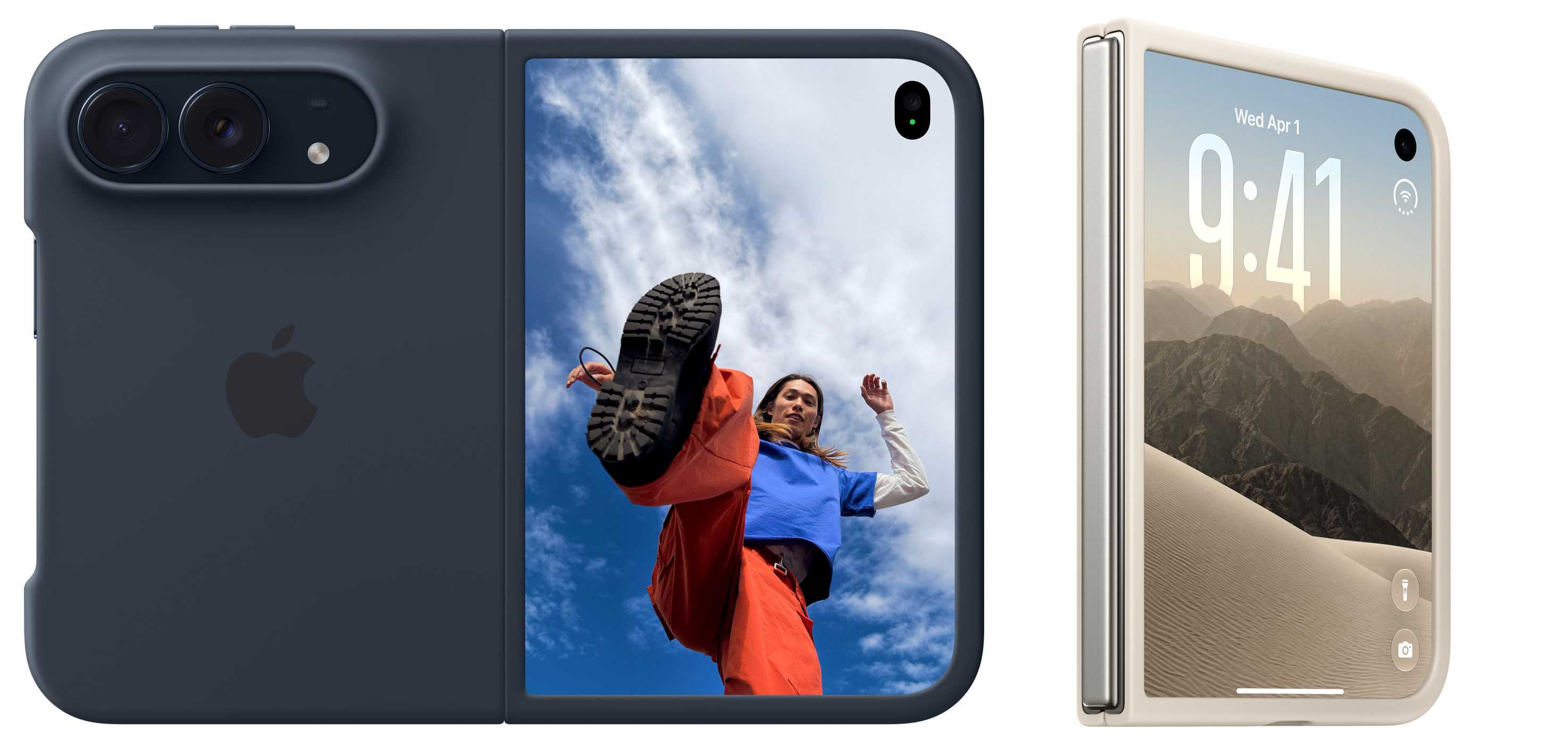
There are two Apple-branded cases for the iPhone Duo. The basic version is called simply the Apple iPhone Duo Case. If you want everything to have an Apple logo on it, this is a solid choice you can’t go wrong with.

It’s a two-part design, with each side having its own thin cover and a protective frame around the edges. This leaves the phone’s hinge area “unobstructed” (which the pessimistic among us could also describe as “exposed”) so the device can fold and close completely flat without interference. Like most two-part cases without a hinge cover, it requires adhesive strips to ensure a secure fit, and so is not as easy to remove and reattach as magnetic cases such as Apple’s own Duo Folio case.

Made from polycarbonate with a matte coating, the case is available in two colors—Navy Blue and Sand—that match the Duo’s own Night Sky and Star White colors.

  • MagSafe: Yes
  • Hinge protected: No

Apple iPhone Duo Folio with Kickstand: Magnetic folio with a built-in stand

Apple iPhone Duo Folio with Kickstand: Magnetic folio with a built-in stand

Pros

  • Made by Apple
  • Sturdy kickstand
  • Hinge protected
Best Prices Today:
Retailer
Price
Price comparison from over 24,000 stores worldwide

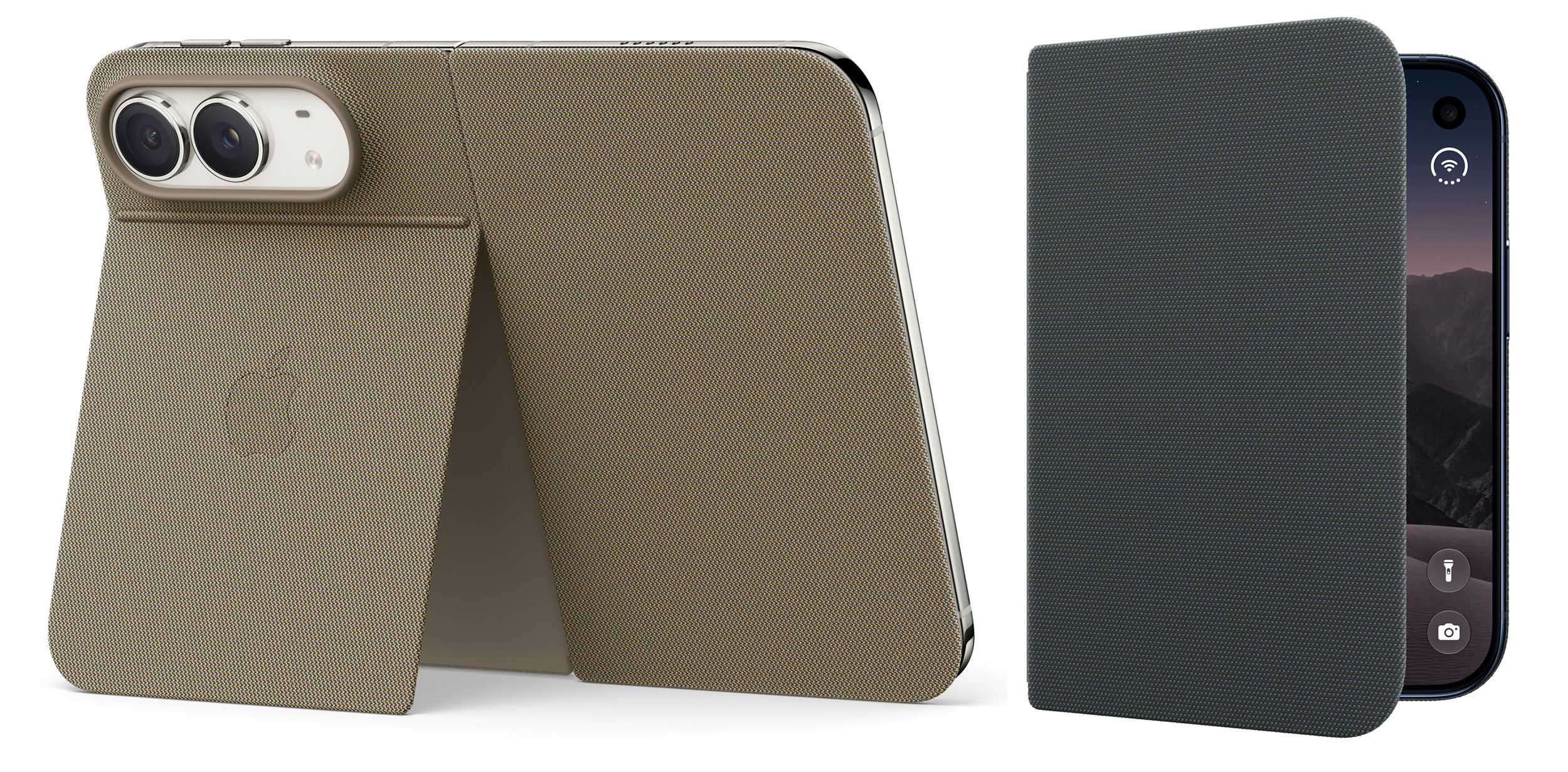
The second Apple-branded iPhone Duo case is the Folio with Kickstand, a thin one-piece multi-function case that attaches magnetically, and both protects and offers stable viewing through a sturdy kickstand at the back. While it does protect the exterior display and the hinge, unlike the basic Apple Duo Case it doesn’t feature a protective frame for the phone’s edges. Somewhat remarkably, the MagSafe connection remains even when the stand cover is closed and will also work when it’s open. The Duo can wirelessly charge at up to 25W.

Again, the Navy Blue and Taupe case colors are suited to each of the two Duo appearances. It’s made with Apple’s leather-alternative TechWoven fabric, found on its standard iPhone cases. Unlike the basic Apple iPhone Duo Case, the Folio has a fabric hinge cover so that’s better protected. This neatly retracts when the Duo is unfolded open so doesn’t affect the outer screen when the device is unfolded.

  • MagSafe: Yes
  • Hinge protected: Yes

Benks ArmorGrid Air Grand Combo: Best lightweight case

Benks ArmorGrid Air Grand Combo: Best lightweight case

Pros

  • Tough Aramid Fiber case
  • Includes screen protector

Cons

  • Hinge unprotected
Best Prices Today:
Retailer
Price
Benks
$109.99
Price comparison from over 24,000 stores worldwide

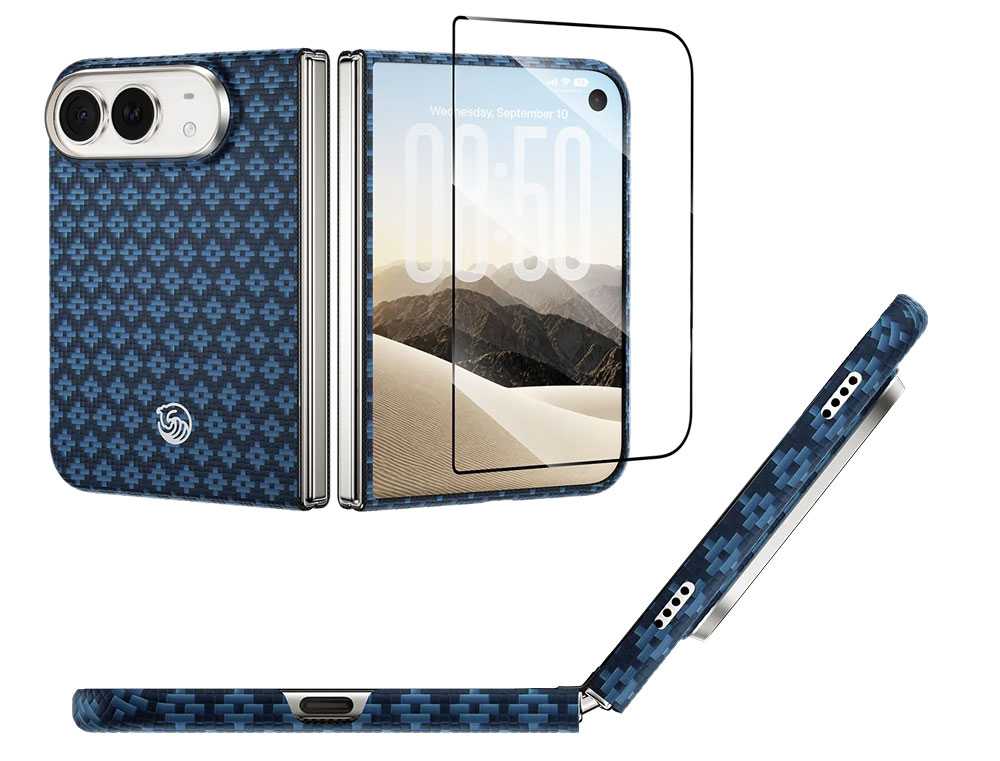
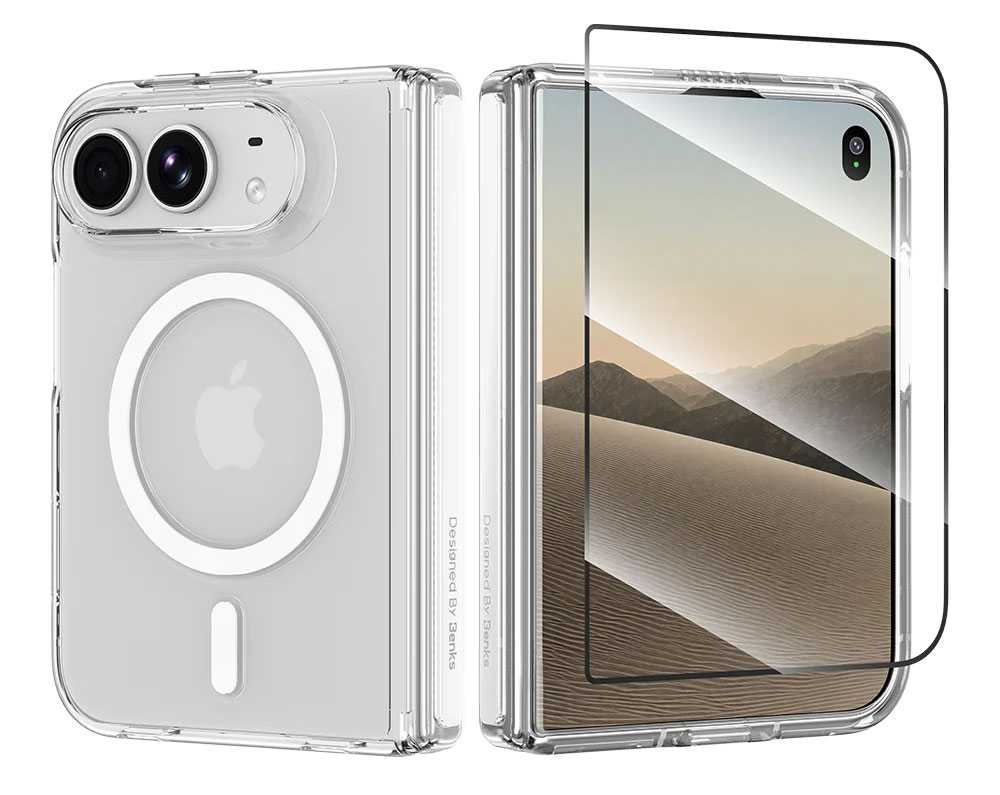
Benks makes some of our favorite standard iPhone cases, and its ArmorGrid Air Grand Combo for iPhone Duo matches the ArmorGrid case for iPhone 18 Pro and Pro Max. It’s a protection set that combines a front frame shielding the display perimeter and 1.3mm-thin back case made from super-tough Kevlar, and a screen protector for the front (not unfolded middle) screen. The whole package weighs a slight 23.5g.

There’s no hinge protection, which keeps the Duo’s folding mechanism unencumbered and reduces the possible points of failure but also leaves this area of the Duo bare.

The Kevlar back case features a diamond-pattern weave to create a structured, geometric texture that adds a little extra grip but nothing you really notice in hand. It’s available in either Beyond Blue or Obsidian Black. This can be paired with the $29 Benks ArmorPop Grip Stand for balanced, stability viewing angles.

  • MagSafe: Yes
  • Camera edge: 2mm
  • Screen edge: 1.5mm
  • Backplate: 1.3mm
  • Hinge protected: No
  • Drop protection: Yes, height not claimed
  • Weight: 23.5g
Benks Grand Combo Crystal Phone Case for iPhone_Duo

Benks

If you prefer to keep Apple’s original Duo coloring Benks also offers its clear Crystal Case for iPhone Duo with transparent polycarbonate front frame and back with corner airbag cushions, plus the front screen protector.  Unlike the ArmorGrid Case, there is hinge protection that reduces the force of daily impacts and scratches. An anti-yellowing surface treatment helps resist discoloration from UV exposure.

  • MagSafe: Yes
  • Camera edge: 2mm
  • Screen edge: 1.5mm
  • Backplate: 1.3mm
  • Hinge protected: Yes
  • Drop protection: Yes, height not claimed
  • Weight: 23.5g

ESR Atelier Case with Flex Stand for iPhone Duo: Best soft-touch case

ESR Atelier Case with Flex Stand for iPhone Duo: Best soft-touch case

Pros

  • Leather-like silicone
  • Flexible kickstand
  • Hinge protected
Best Prices Today:
Retailer
Price
Price comparison from over 24,000 stores worldwide

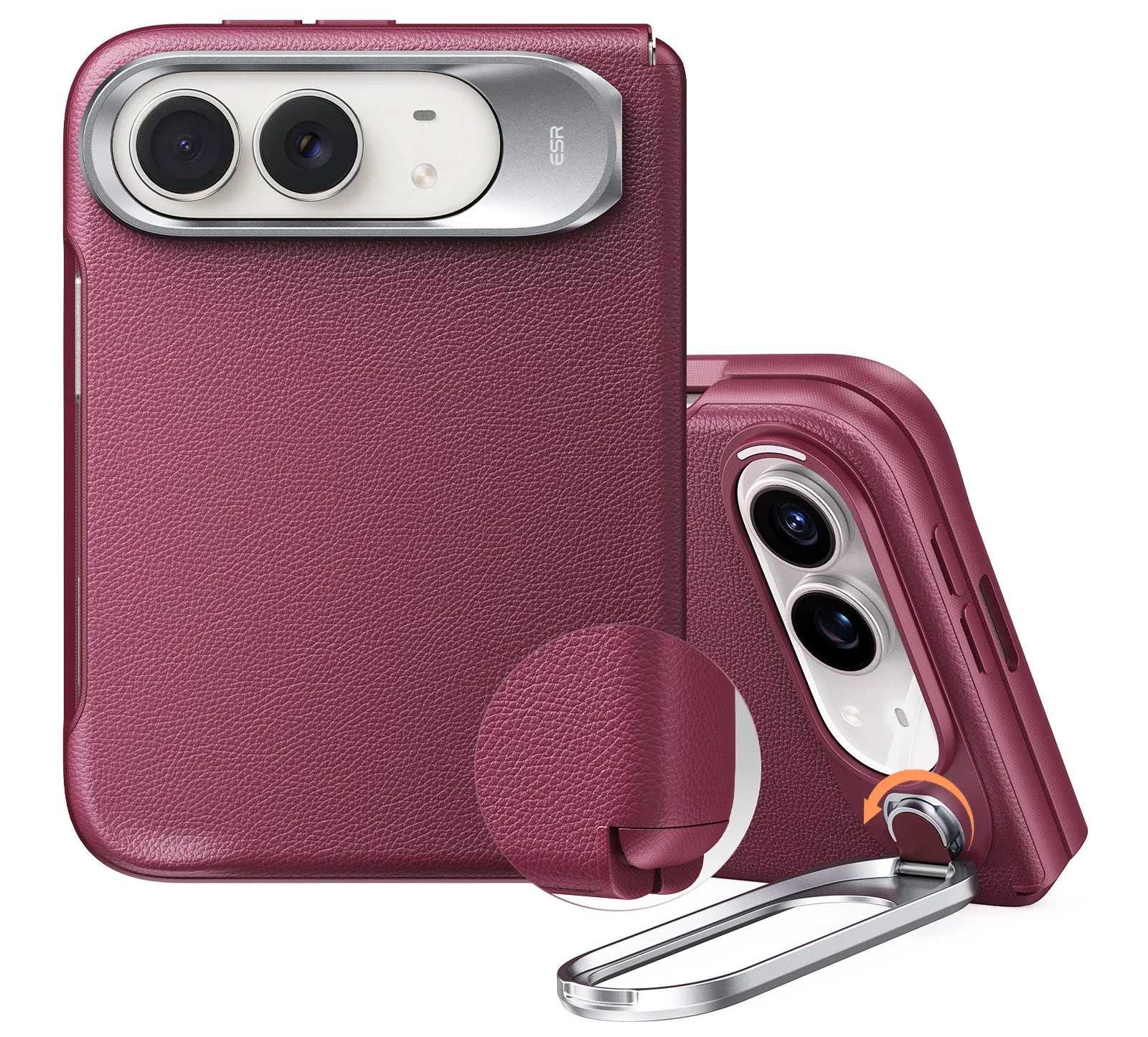
ESR’s Atelier Case ($59.99) is made from a soft, smooth silicone material that wraps around front and back including the iPhone Duo’s hinge. ESR claims it can withstand drops of up to 3.6 feet, with a strong TPU frame. Its metal 180° Flex stand doubles as a camera lens protector when not in use, and can be placed in a variety of portrait and landscape positions (adjustable viewing from 15°–69°), whether the Duo is folded or unfolded. The same handy stand is available on ESR’s other Duo cases reviewed below.

  • MagSafe: Yes
  • Camera edge: 1.6mm
  • Screen edge: 2.3mm
  • Backplate: 2.3mm
  • Hinge protected: Yes
  • Drop protection: 3.6 feet
  • Weight: 59g
ESR iPhone Duo Cyber Tough Case with Flex Stand Night Sky

ESR

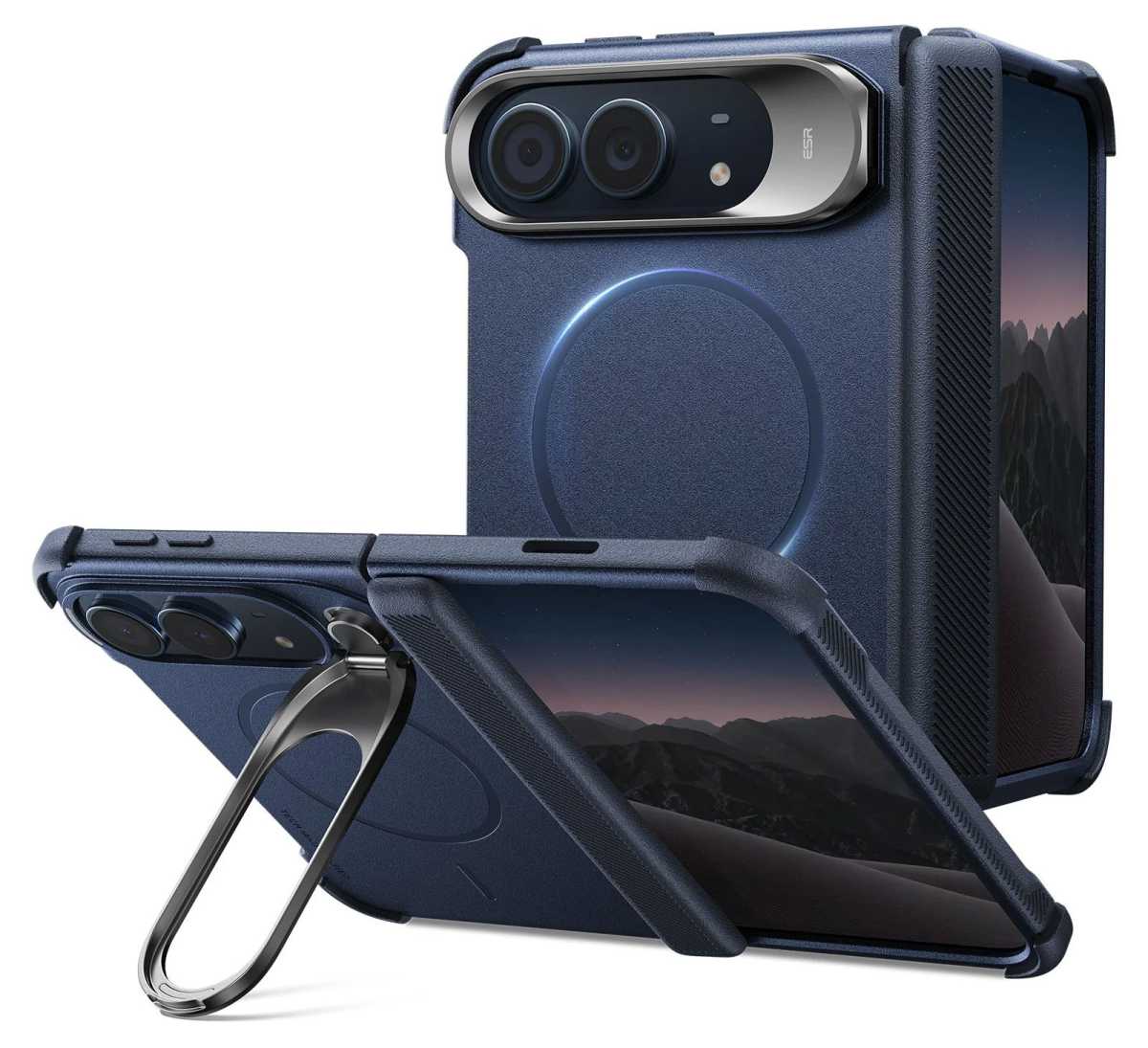
The Cyber Tough Case ($42.99) is ESR’s most protective case for iPhone Duo, offering what ESR claims is 16-foot drop, 4x military-grade protection. It features reinforced hinge coverage, zinc-alloy camera protection, and Air Guard corners. The textured sides add some grip to make dropping the Duo less likely in the first place. The Cyber Tough’s Flex Stand folds 180° and rotates 270° for stable hands-free. As with the Atelier Case, the Flex tucks back to form the camera lends protection when not in use as a stand. Also available on Amazon.

  • MagSafe: Yes
  • Camera edge: 1.8mm
  • Screen edge: 2.6mm
  • Backplate: 2.5mm
  • Hinge protected: Yes
  • Drop protection: 16 feet
  • Weight: 65g
ESR iPhone Duo Classic Hybrid Case with Flex Stand Frosted Misty Blue

ESR

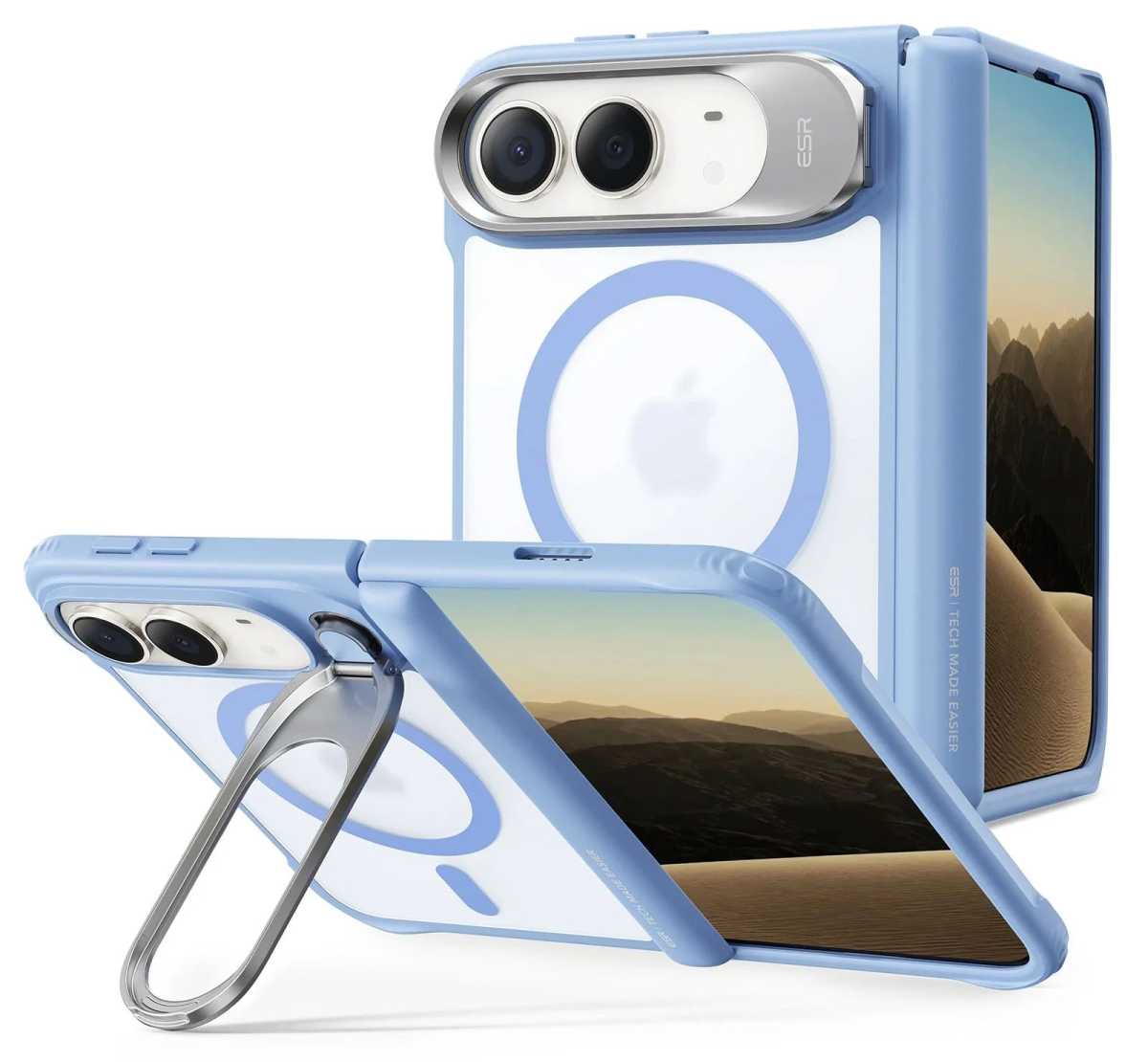
Somewhere between the Atelier and Cyber Tough is ESR’s Classic Hybrid Case ($42.99), with a 1.5mm back and the same 180° Flex Stand and reinforced hinge protection. The Frosted cases show more of the original Duo colors. Also available on Amazon.

  • MagSafe: Yes
  • Camera edge: 0.8mm
  • Screen edge: 2.1mm
  • Backplate: 1.5mm
  • Hinge protected: Yes
  • Drop protection: 8 feet
  • Weight: 55g

Torras Ostand Q3 VegSkin Case for iPhone Duo: Best rotating stand case

Torras Ostand Q3 VegSkin Case for iPhone Duo: Best rotating stand case

Pros

  • Leather-like silicone
  • Rotating kickstand
  • Hinge protected
Best Prices Today:
Retailer
Price
Price comparison from over 24,000 stores worldwide

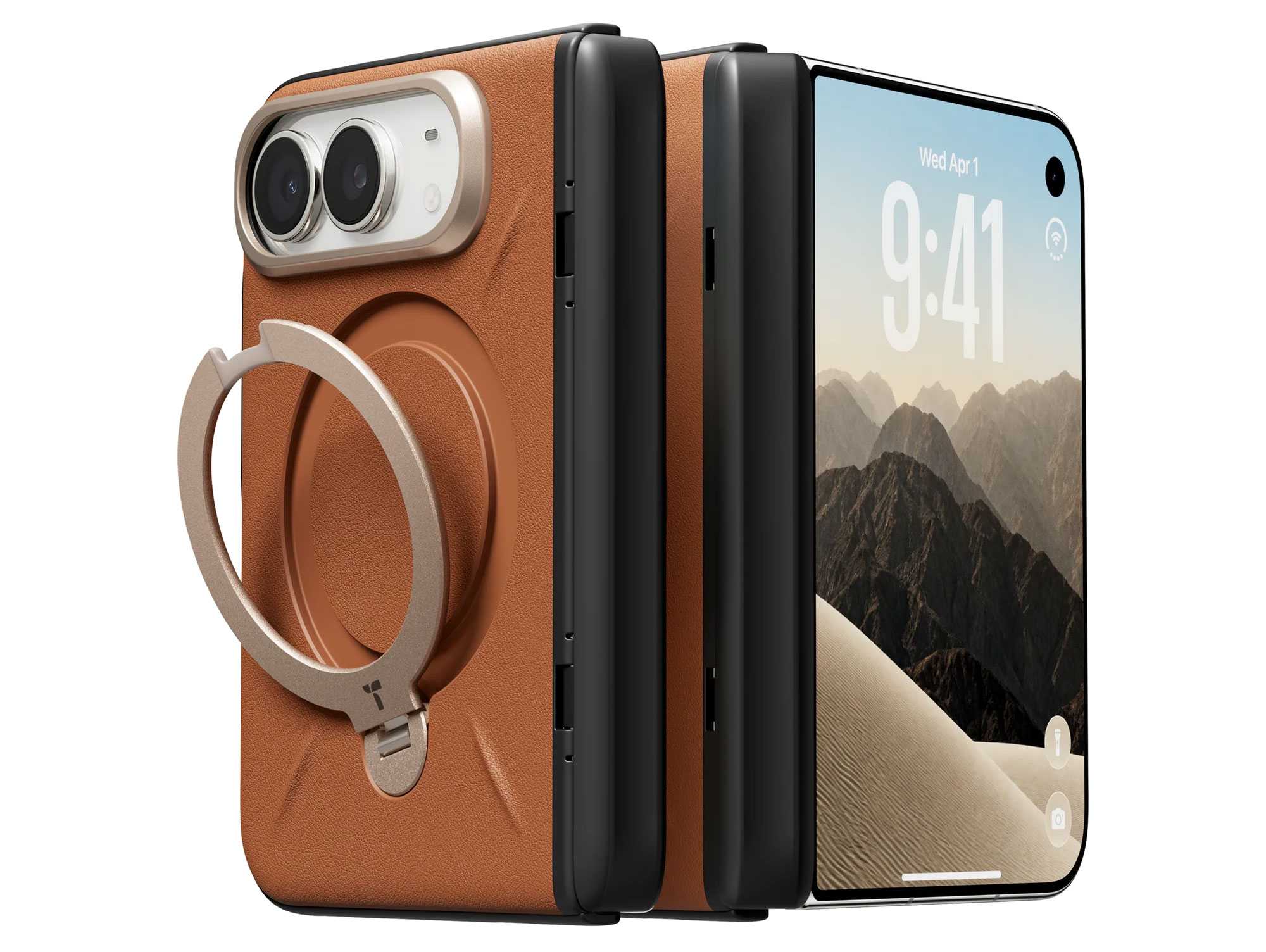
Made from a premium leather-like silicone material, the Ostand Q3 VegSkin Case offers a 3.35mm thick back protection that Torras claims 8-foot drop protection, plus 1.2mm bezels around the camera lenses and front screen.

The aluminum alloy Ostand can pivot 360° and folds flat back into the MagSafe back cover when not in use. It’s a great stand that we’ve previously enjoyed with the standard iPhone.

The VegSkin Case is available in three colors: Deep Blue, Amber Brown, and Pearl Grey. There’s a version without the leather-like appearance in Purple, Black, and Deep Blue.

  • MagSafe: Yes
  • Camera edge: 1.2mm
  • Screen edge: 1.2mm
  • Backplate: 3.35mm
  • Hinge protected: Yes
  • Drop protection: 8 feet
  • Weight: 46g

MOFT Dynamic Folio for iPhone Duo: Best case with a stand and grip

MOFT Dynamic Folio for iPhone Duo: Best case with a stand and grip

Pros

  • Unique stand and grip
  • Hinge protected
Best Prices Today:
Retailer
Price
Price comparison from over 24,000 stores worldwide

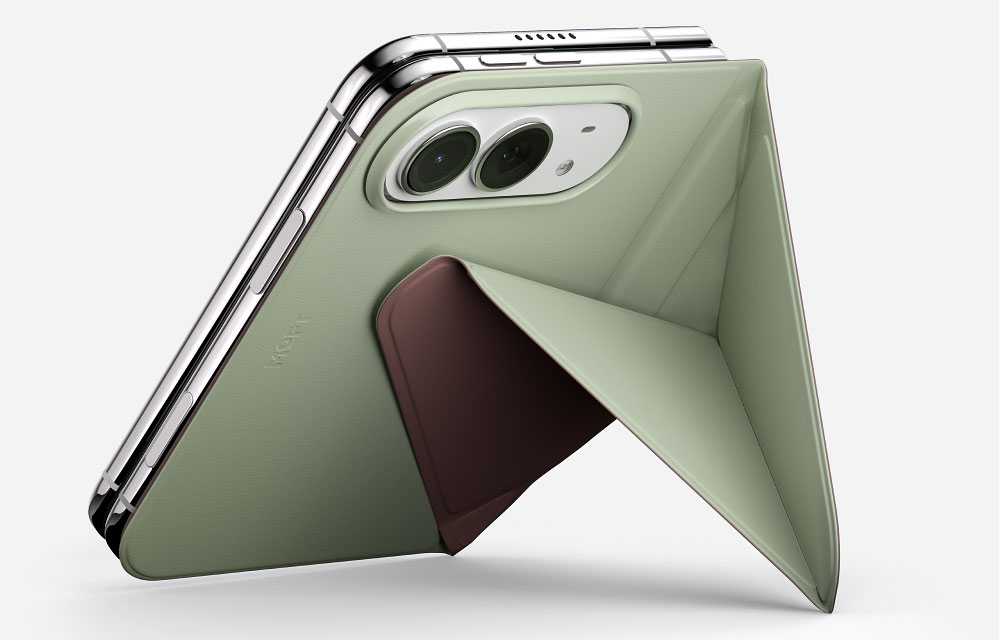
MOFT stands out, quite literally, with its origami-inspired case/stand designs for iPhone and iPad. Its Dynamic Folio for iPhone Duo applies the same ingenious folding logic to protection, grip and viewing. The centrally positioned structure balances the Duo’s weight, supporting four portrait and landscape positions. As with most iPhone Duo cases the front frame has a removable adhesive to secure it, while the hinge and backplate are joined magnetically.

  • MagSafe: Yes
  • Camera edge: Yes, no size given
  • Screen edge: Yes, no size given
  • Backplate: 1.9mm
  • Hinge protected: Yes
  • Drop protection: Yes, height not claimed
  • Weight: 73g
MOFT MOVAS Modular Case for iPhone Duo

Moft

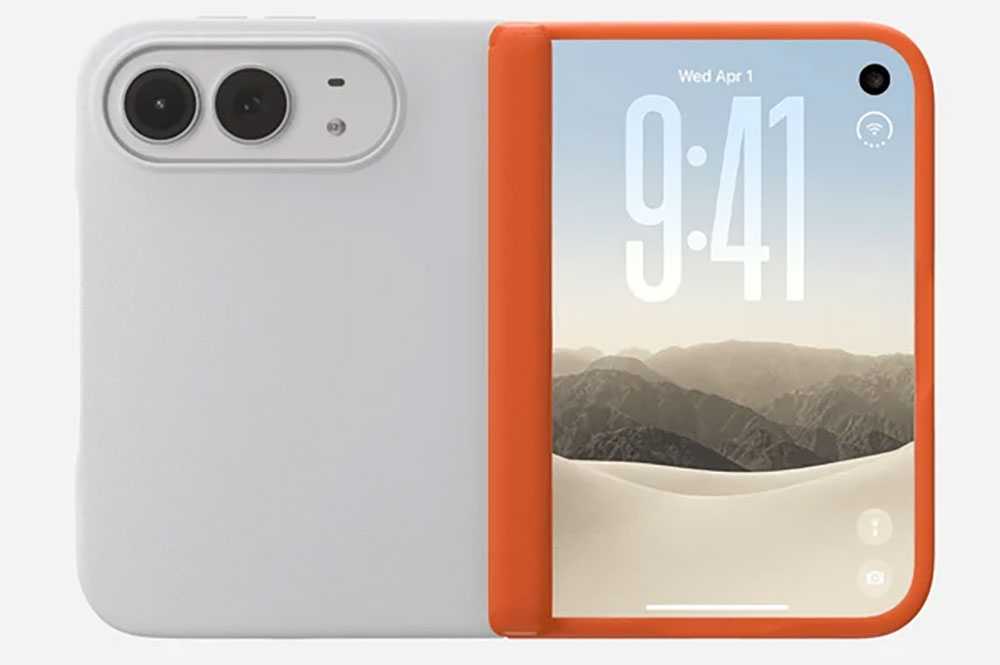
The MOFT MOVAS Modular Case for iPhone Duo is a more traditional case even though it comes in three parts: front frame, hinge, and backplate. It still has a wow-factor over other cases as you can mod your design with an extra hinge/frame in a different color at the point of purchase. Shown above is the Misty Cove backplate with a Terracotta hinge/frame, but you could choose the same backplate with a Khaki Green front, or Navy Blue with either.

Nomad Traditional Leather Folio for iPhone Duo: Best leather wallet case

Nomad Traditional Leather Folio for iPhone Duo: Best leather wallet case

Pros

  • Horween leather
  • Hinge protected
  • Card slots
Best Prices Today:
Retailer
Price
Price comparison from over 24,000 stores worldwide

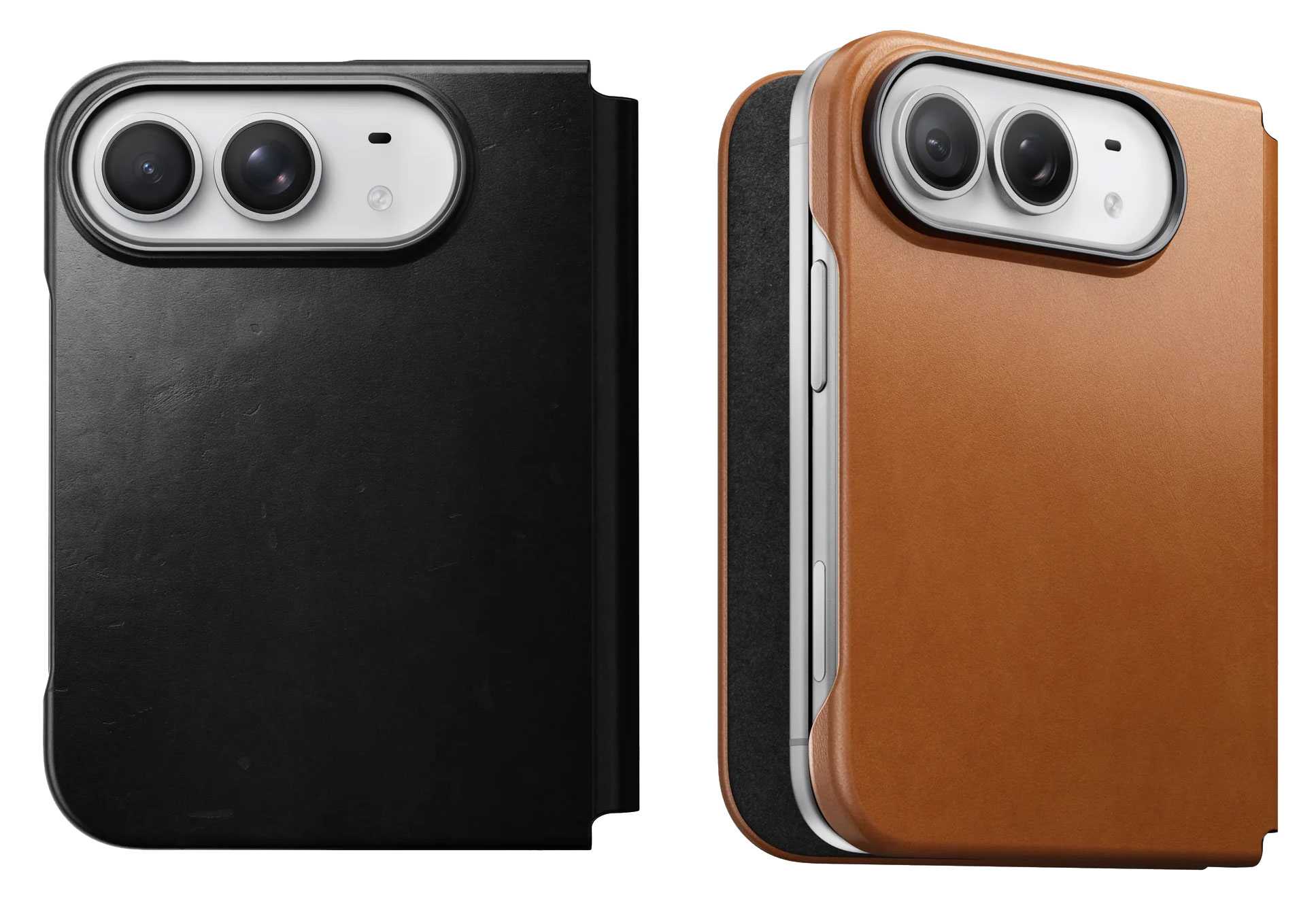
The Nomad Traditional Leather Folio wraps the Duo in full-grain, premium vegetable-tanned Horween leather that gains its own patina over time.

The backplate is 2.7mm thick with full Folio thickness of 3.8mm. The hinge is protected, and there’s a 1.15mm lip protecting the screens. You can fit a couple of cards inside the front section of the case.

  • MagSafe: Yes
  • Camera edge: 0.5mm
  • Screen edge: 1.15mm
  • Backplate: 2.7mm
  • Hinge protected: Yes
  • Drop protection: Yes, height not claimed
  • Weight: 64g

If you don’t need the full folio coverage and desire as thin a Duo as possible but with some back protection, Nomad offers just the magnetic Leather Back (2.2mm thick), also in Horween leather at $59, which features microsuction pads to double-up on the magnetic application.

  • MagSafe: Yes
  • Camera edge: 0.5mm
  • Screen edge: n/a
  • Backplate: 2.2mm
  • Hinge protected: No
  • Drop protection: Drop protection: No—back and camera protection against everyday
  • Weight: 64g

Pitaka iPhone Duo Edge Case: Slim patterned aramid case

Pitaka iPhone Duo Edge Case: Slim patterned aramid case

Pros

  • Tough Aramid Fiber case
  • Anti-smudge coating

Cons

  • Hinge unprotected
Best Prices Today:
Retailer
Price
Pitaka
$99.99
Price comparison from over 24,000 stores worldwide

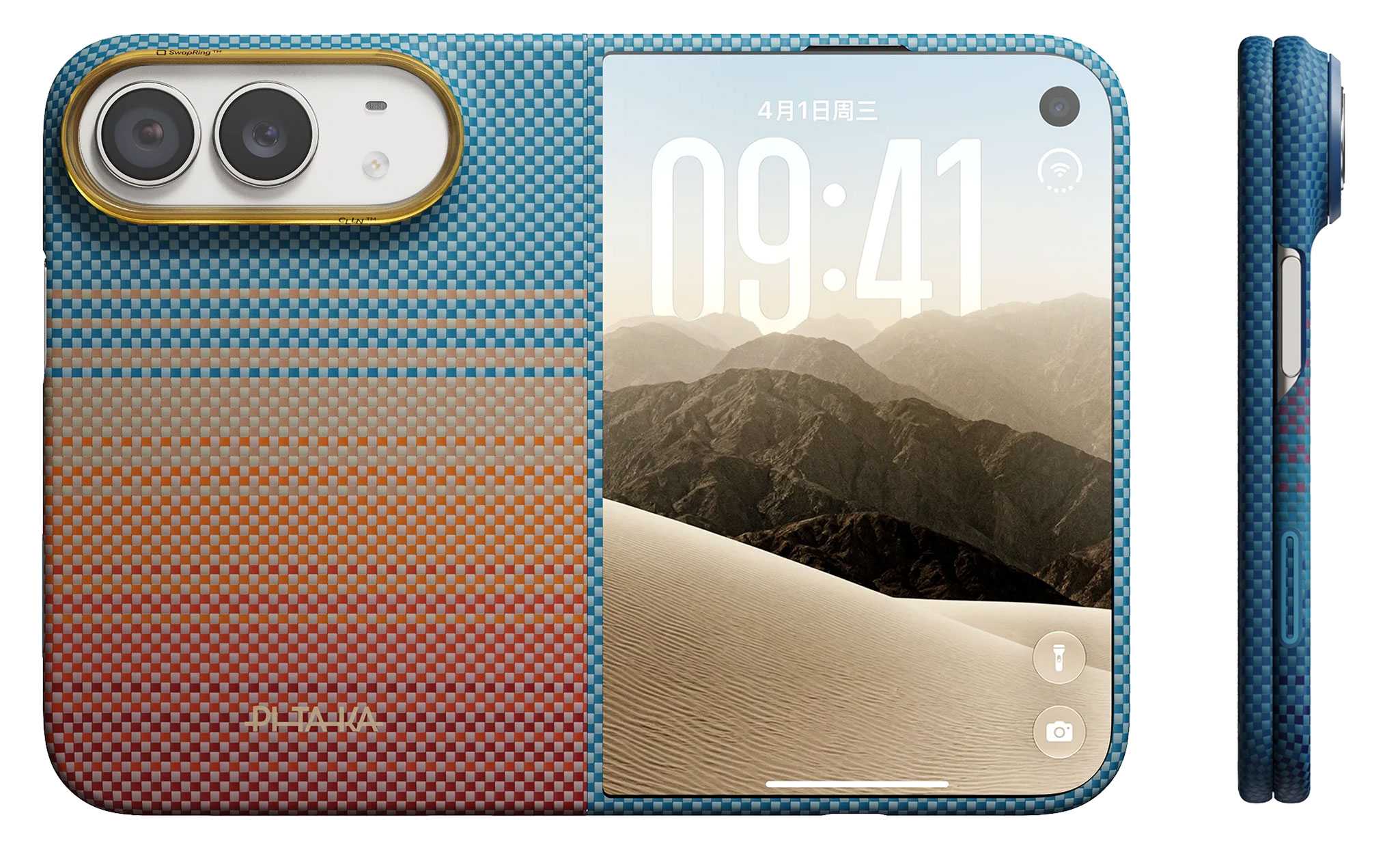
Available in Pitaka’s distinctive California Dream, Black/Grey Twill, Midnight, and Sunset patterns, the Duo Edge Case has no hinge protection keeping it slim but does boast a two-part aramid fiber front frame and 1.3mm back cover with pre-installed anti-slip adhesive strips. Pitaka claims its Mammoth Resin reinforces structural integrity to enhance impact resistance.

The front cover is fitted with HD anti-reflective tempered glass to minimize glare and fingerprint smudges.

  • MagSafe: Yes
  • Camera edge: 0.5mm
  • Screen edge: 0.5mm
  • Backplate: 1.3mm
  • Hinge protected: No
  • Drop protection: 8 feet
  • Weight: 36g

Casetify Impact Case for iPhone Duo: Best for colorful designs

Casetify Impact Case for iPhone Duo: Best for colorful designs

Pros

  • Fun pattern choices
  • Hinge protected
Best Prices Today:
Retailer
Price
Price comparison from over 24,000 stores worldwide

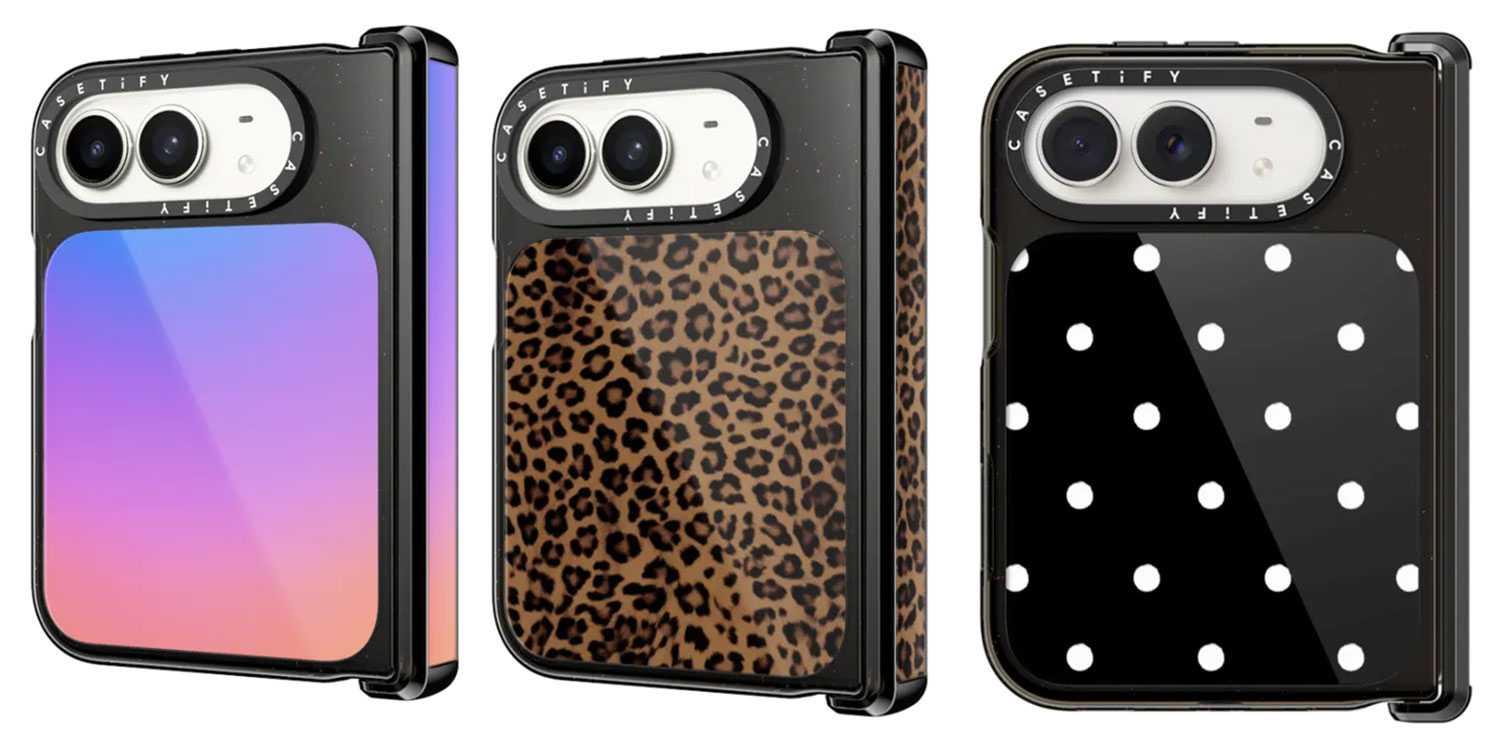
Casetify is a case maker that rejoices in its range of colors and pattern designs, and it has a bunch for the iPhone Duo, including Gradient, Leopard, and Dottie shown above, among others such as Dark Cherry Jelly, Black Kingsnake, Gingham, and Jelly Bears.

You can match it with the company’s many accessories such as the Snappy Grip Stand, Ring Holder and Loop Grip.

  • MagSafe: Yes
  • Hinge protected: Yes

Zagg Crystal Palace Snap KS Case for iPhone Duo: Best clear case with a stand

Zagg Crystal Palace Snap KS Case for iPhone Duo: Best clear case with a stand

Pros

  • Sturdy kickstand
  • Hinge protected
  • Textured edges
Best Prices Today:
Retailer
Price
Price comparison from over 24,000 stores worldwide

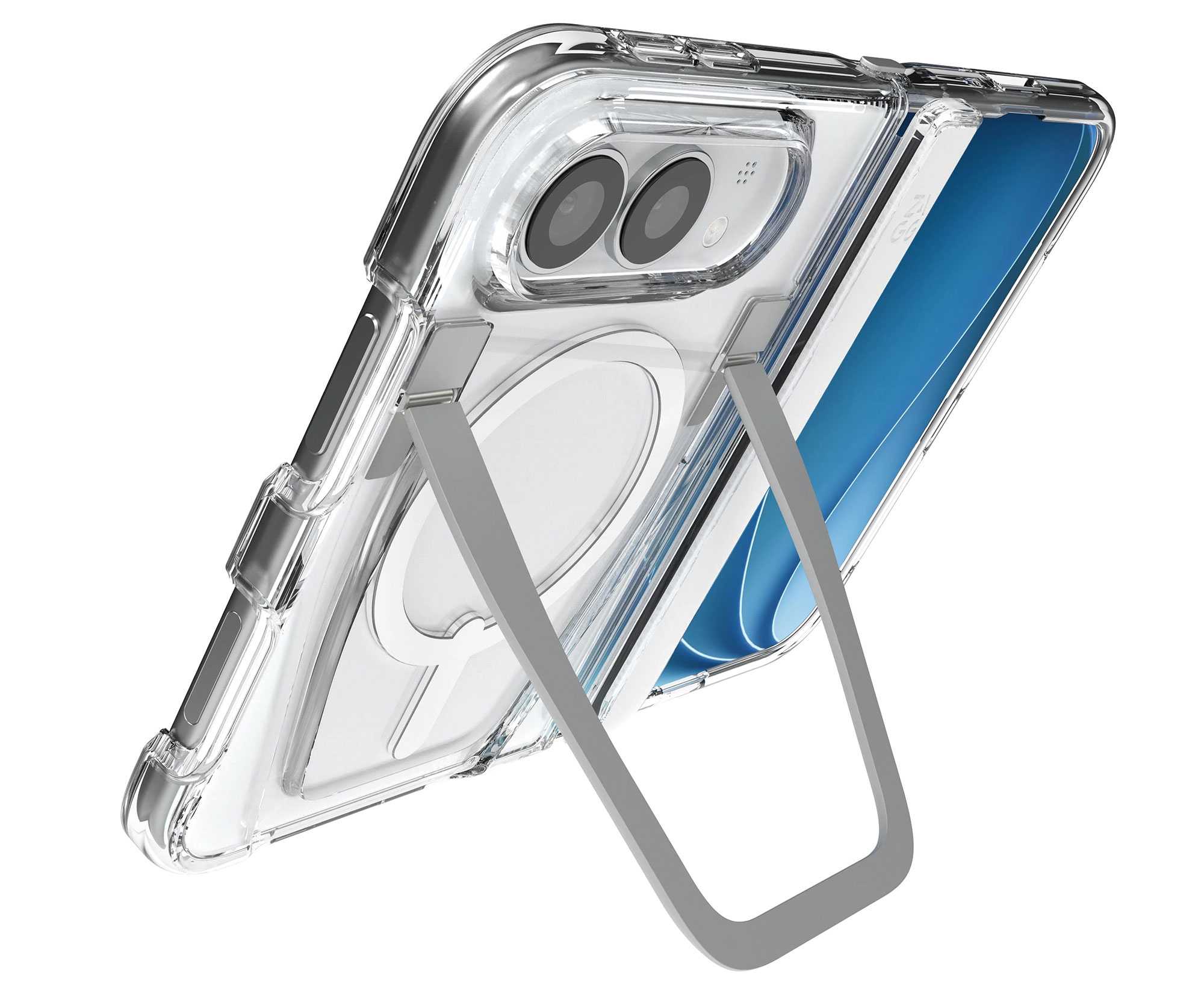
This sleek, clear iPhone Duo case features one of the most robust kickstands available, and it wisely keeps out of the way of magnetic wireless charging connection. It might look less protective because of its transparency, but Zagg claim the Crystal Palace offers 13 feet (4m) of drop protection for the case is reinforced with resilient Graphene without adding bulk. Textured edges provide a more secure grip to save the phone from jumping out as you pull it from your pocket.

  • MagSafe: Yes
  • Camera edge: 1.5mm
  • Screen edge: 2mm
  • Backplate: 3.5mm
  • Hinge protected: Yes
  • Drop protection: 13 feet
  • Weight: 69g

A Crystal Palace Snap Lite Case ($69.99) is thinner and lacks the kickstand, but still offers a claimed 10-foot (3m) drop protection.

  • MagSafe: Yes
  • Camera edge: 1.5mm
  • Screen edge: 2mm
  • Backplate: No size given
  • Drop protection: 10 feet
  • Weight: 33g

Mous Limitless Case for iPhone Duo: One-piece case with hinge coverage

Mous Limitless Case for iPhone Duo: One-piece case with hinge coverage

Pros

  • Tough Aramid Fiber case
  • Hinge protected
Best Prices Today:
Retailer
Price
Price comparison from over 24,000 stores worldwide

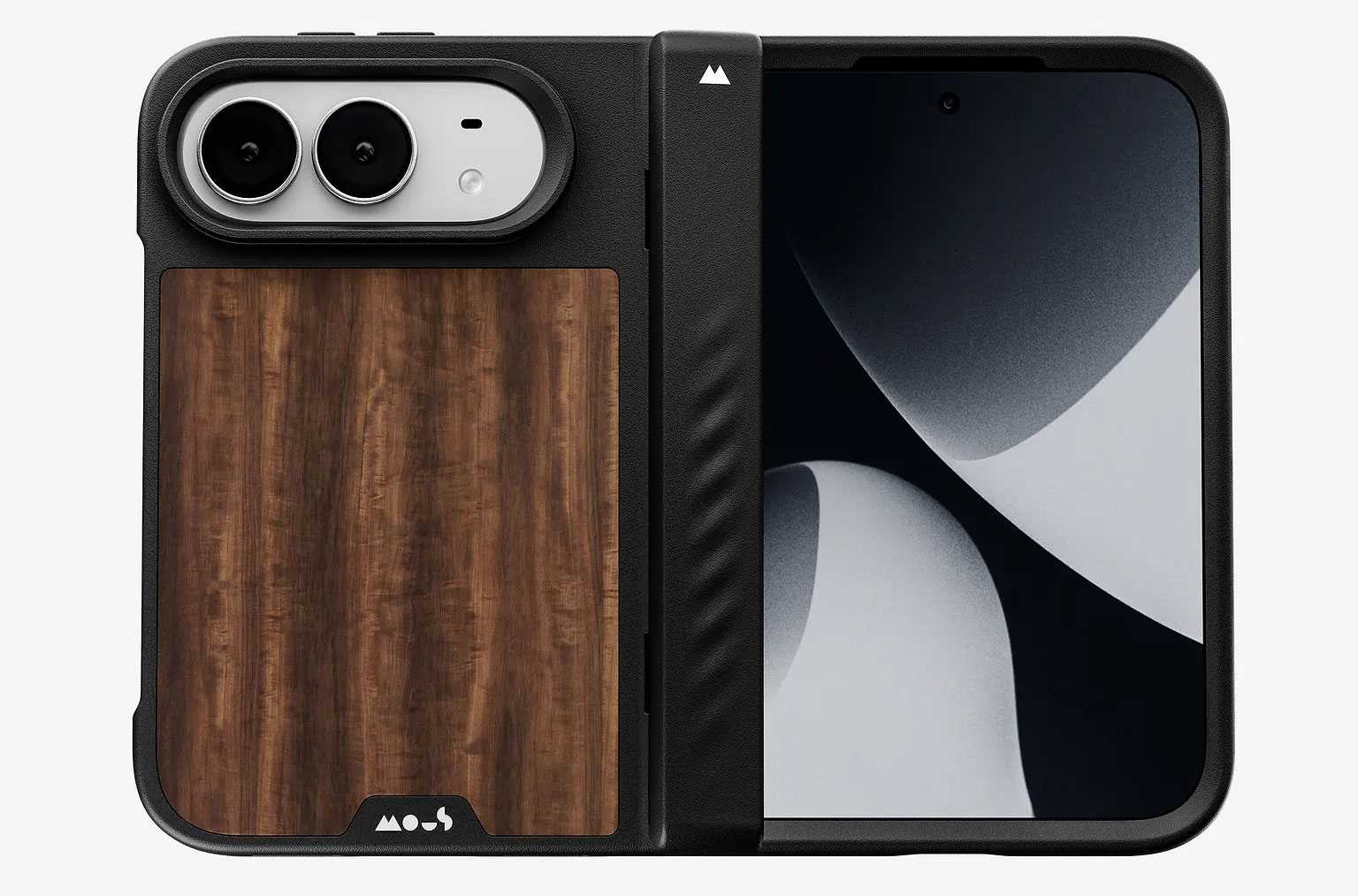
Mous’s tough one-piece Limitless case features an interlocking TPU and polycarbonate shell, impact-absorbing AiroShock TPE corners, and an aramid-fiber-reinforced front frame and backplate for extra rigidity. The one-part design aids the fit strength, with the TPU bridge flexing when open. One version of the case is locked across the hinge, offering all-round protection, while another is hinge-free.

It’s available in Mous’s signature Walnut plus Speckled designs as well as Black and a striped aramid fiber.

  • MagSafe: Yes
  • Camera edge: 0.5mm
  • Screen edge: 2mm
  • Backplate: 1.65mm
  • Hinge protected: Yes
  • Drop protection: Yes, height not claimed
  • Weight: 42g

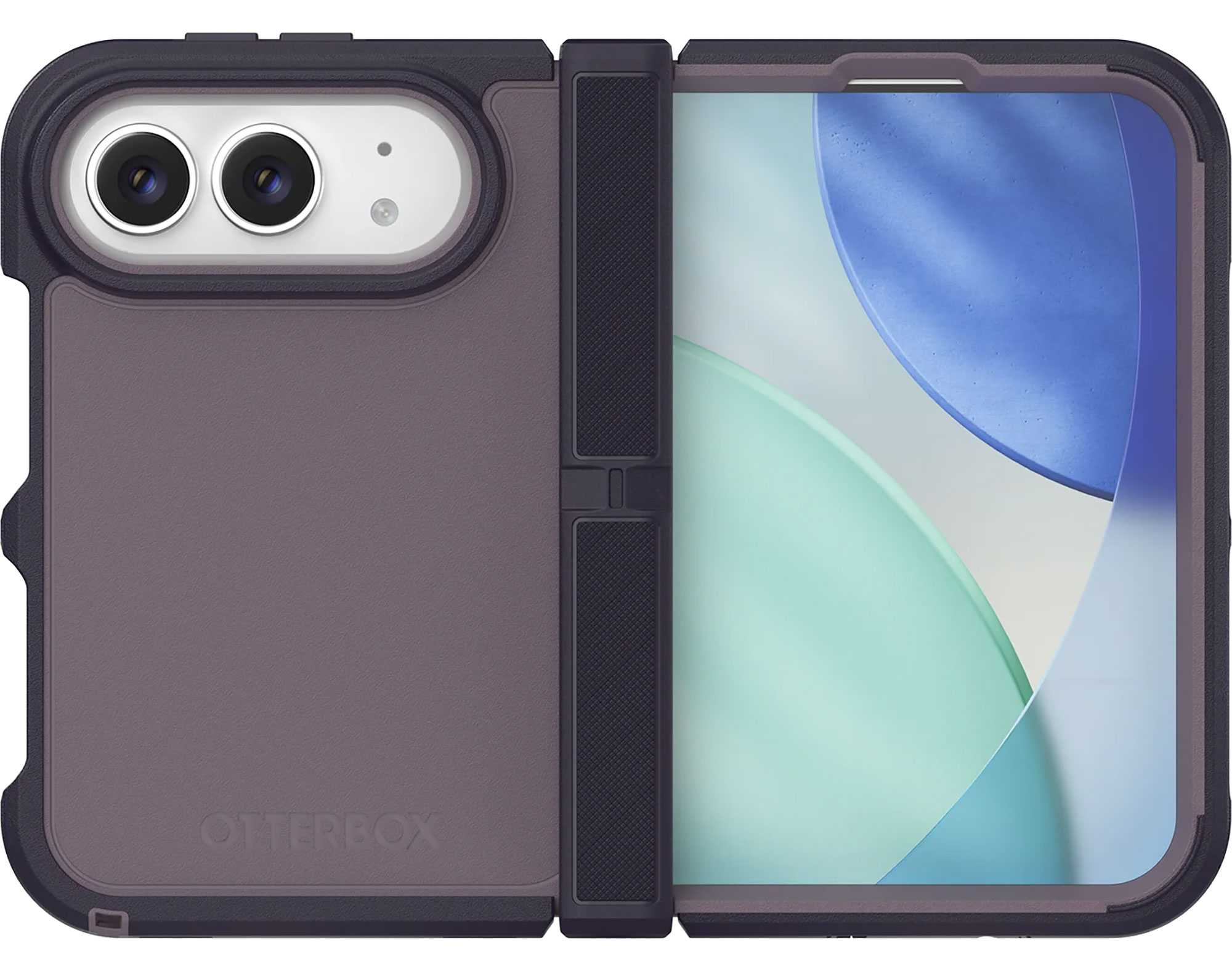
OtterBox Defender Series Pro XT for iPhone Duo: Best for port coverage

OtterBox Defender Series Pro XT for iPhone Duo: Best for port coverage

Pros

  • Port covers
  • Grippy edges
  • Hinge protected
Best Prices Today:
Retailer
Price
Price comparison from over 24,000 stores worldwide

OtterBox is well known for its Defender Pro series of phone cases, and the iPhone Duo doesn’t miss out. Available in three colors—Black, Witherwill Blue, and Adomania Purple—it features grippy rubber edges to help you keep it in your hand, and a protected hinge. It’s the one iPhone Duo case we’ve seen with covers for the ports to help keep dust and other debris out.

  • MagSafe: Yes
  • Camera edge: Yes, no size given
  • Screen edge: Yes, no size given
  • Backplate: No size given
  • Hinge protected: Yes
  • Drop protection: Yes, height not claimed
  • Weight: 74.4g
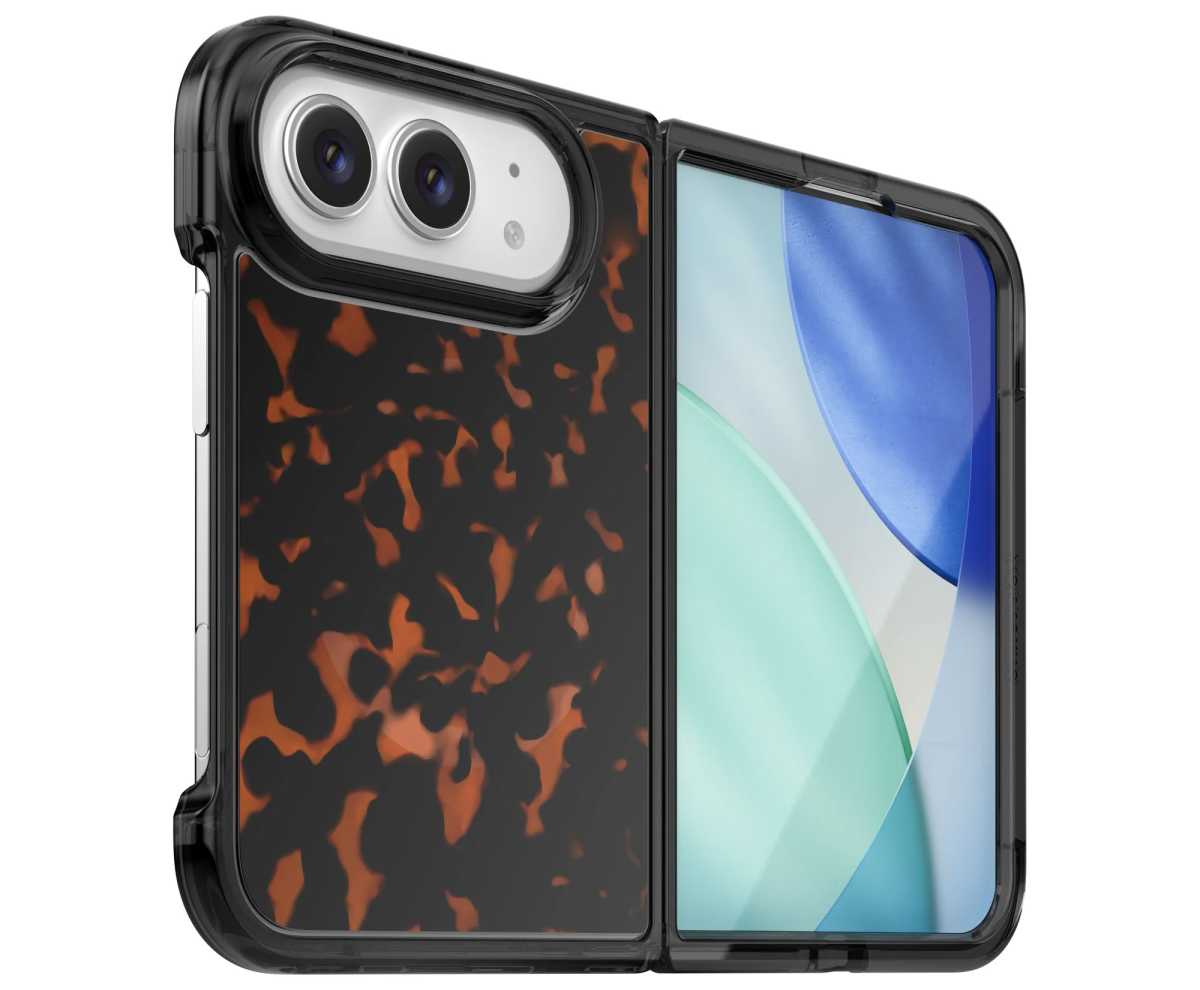
OtterBox Lumen Case for iPhone Duo

OtterBox

If you want a lower-profile case, the OtterBox Lumen still offers protection but not on the scale of the Defender Pro. The hinge is open, as are the ports, with cutouts for all buttons bar the Camera Control. You can indulge your Tortoise shell desires as well as buy the Lumen in Black Mist and also a Clear case.

  • MagSafe: Yes
  • Camera edge: Yes, no size given
  • Screen edge: Yes, no size given
  • Backplate: No size given
  • Hinge protected: No
  • Drop protection: Yes, height not claimed
  • Weight: 58.26g

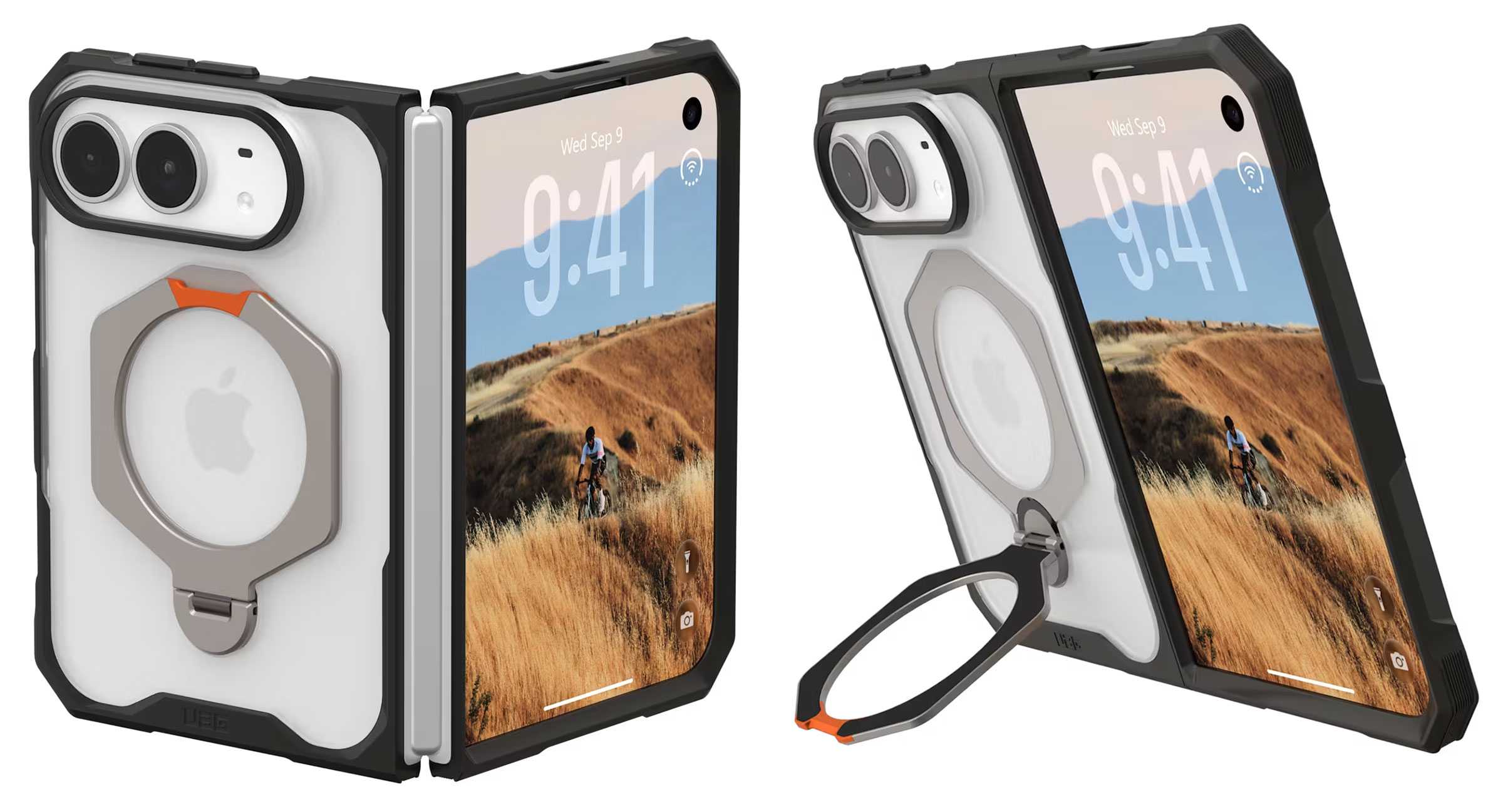
UAG Mouve XTE Case for iPhone Duo: Translucent case with a rotating stand

UAG Mouve XTE Case for iPhone Duo: Translucent case with a rotating stand

Pros

  • Rotating kickstand
  • Air-Soft corners

Cons

  • Hinge unprotected
Best Prices Today:
Retailer
Price
Price comparison from over 24,000 stores worldwide

UAG is famous for its hexagonal patterned phone cases, and the Mouve cases for the iPhone Duo feature the shape on its smooth 360° rotatable metal kickstand.

There are two models, the Mouve XTE ($84.95) with kickstand and standard Mouve ($64.95) without it. Both are two-part designs that feature translucent shells in either opaque Ice or darker Ash colors. Air-soft corners help cushion impact, and the soft-touch TPU backplate adds further protection.

  • MagSafe: Yes
  • Camera edge: 0.9mm
  • Screen edge: 2.2mm, 2.75 (XTE)
  • Hinge protected: No
  • Drop protection: 4 feet
  • Weight: 34g, 46g (XTE)

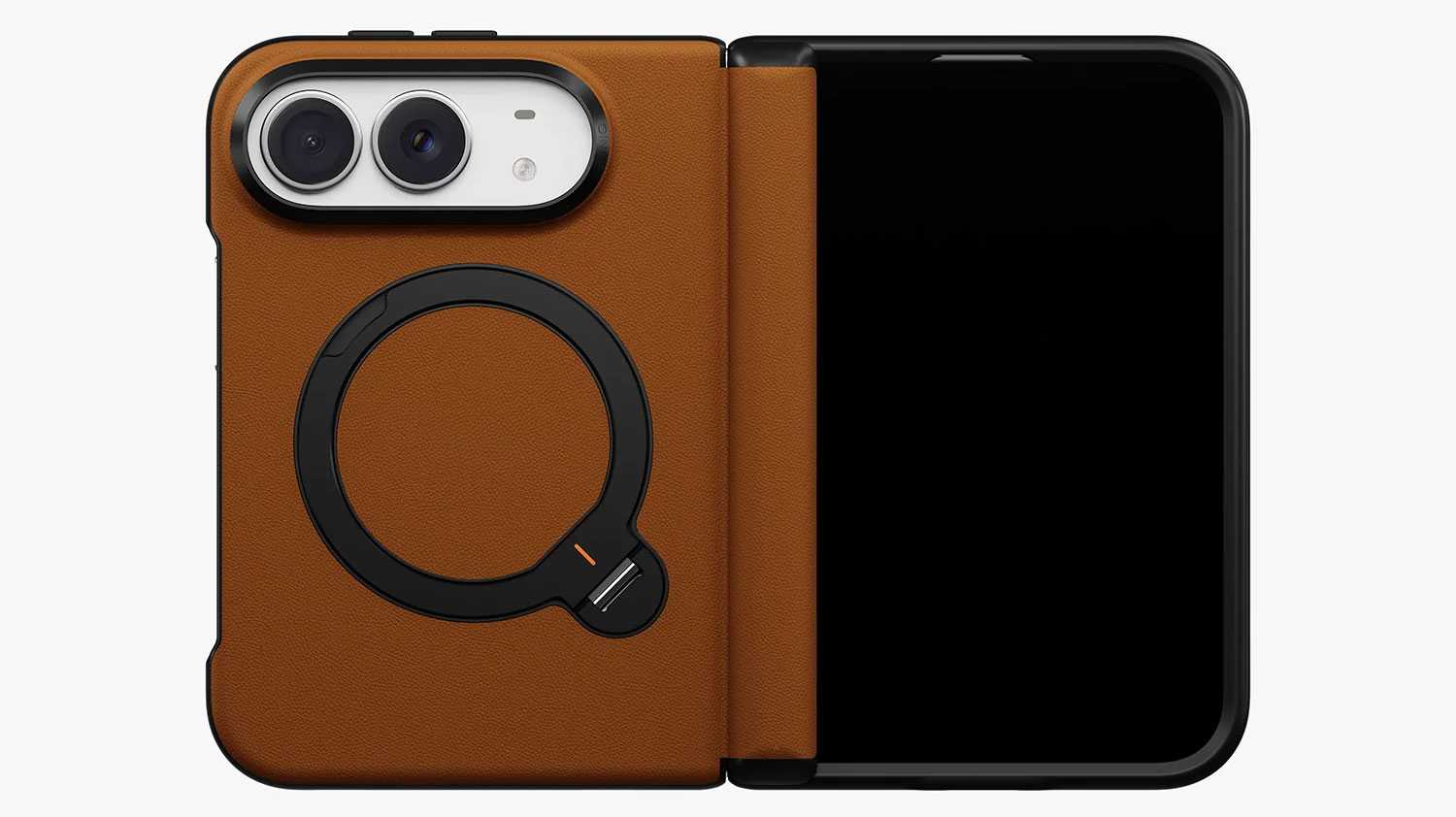
UNIQ Elix Q-Fold 360 Leather Case: Soft-touch case with adjustable rotating stand

UNIQ Elix Q-Fold 360 Leather Case: Soft-touch case with adjustable rotating stand

Pros

  • Rotating kickstand
  • Hinge protected
Best Prices Today:
Retailer
Price
UNIQ
$52.90
Price comparison from over 24,000 stores worldwide

This case wraps the iPhone Duo in a soft silicone VeluxeSkin that will protect the Duo’s back. A dedicated magnetic hinge add further protection to the foldable section of the new iPhone. The Q-Fold Kickstand offers a smooth 360° rotation plus stable 180° multi-angle adjustment.

  • MagSafe: Yes
  • Hinge protected: Yes
UNIQ Velix Duo Clear Case

UNIQ

The clear UNIQ Velix Q-Fold™ 360 Kickstand Case ($46.90) shows off the Duo’s original color but still offers protection via reinforced AirLite corners, and a dedicated magnetic cover protects the hinge. As with the UNIQ Elix silicone leather case the Q-Fold kickstand rotates and adjusts to your preferred viewing angle.

  • MagSafe: Yes
  • Hinge protected: Yes
UNIQ KevaEdge iPhone Duo Case

UNIQ

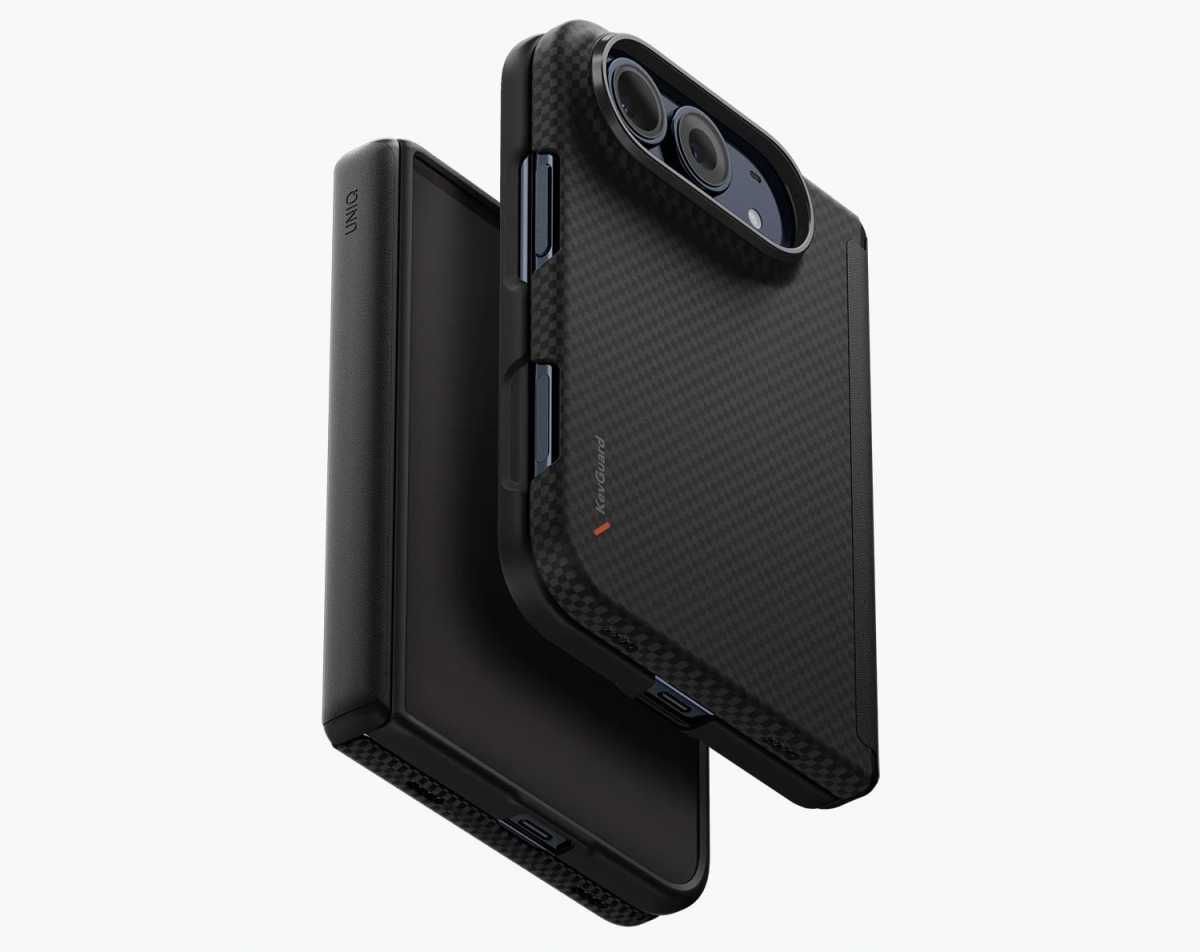
While its backplate is slim at just 1.5mm the UNIQ Keva Edge Slimline Aramid Case ($89.90) makes up for its slim design with a super-tough aramid fiber material with a textured grip panel, plus the dedicated magnetic hinge protection, but lacks the stand found on the other UNIQ iPhone Duo cases.

  • MagSafe: Yes
  • Hinge protected: Yes

FAQ

Does the iPhone Duo need a case?

No phone needs a protective case until you drop or knock it. A case isn’t essential for the iPhone Duo, but it’s a sensible investment for a $1,999 foldable. Apple’s Ceramic Shield glass helps protect the displays, but the titanium edges and hinge remain vulnerable to accidental drops, scratches and dents. Unlike conventional iPhone cases, Duo designs must accommodate two halves and a slim cover-screen frame, often using adhesive to stay securely attached.

What to consider when choosing an iPhone Duo case?

Prioritize a precise fit, shock-absorbing corners and the level of coverage you think you need. Raised lips help protect the exterior display and camera, while a dedicated hinge guard covers the folding spine. Check that the case allows easy access to Touch ID and Camera Control without obstructing the inner display or folding mechanism. Since the Duo already weighs 8.9oz (254g), consider whether extra bulk from a kickstand or hinge protector is worthwhile. Choose a slim two-piece case for everyday protection or a hinge-cover design for additional coverage.

Will a case interfere with the iPhone Duo’s hinge or folding action?

A properly fitted iPhone Duo case shouldn’t interfere with folding, but poorly designed hinge covers can add bulk or restrict movement. Some two-piece cases leave the hinge exposed; others include a separate hinge cover, while dedicated covers provide an additional barrier against knocks and grit. However, hinge coverage doesn’t necessarily mean dust protection. Debris can collect between the case and phone, so remove the case periodically and gently clean both surfaces according to Apple’s care guidance. For cases secured with adhesive strips, follow the manufacturer’s removal and cleaning instructions, and check whether replacement strips are required before refitting.

Can I remove and reuse an iPhone Duo case?

That depends on how the case attaches. Some iPhone Duo cases use adhesive strips to secure the front frame or other components. Don’t assume those strips will retain their grip after removal: check whether the manufacturer allows reuse, supplies spare strips, or sells replacements.

A removable component isn’t necessarily reusable with the same adhesive. Before taking off an adhesive-mounted case for cleaning or swapping cases, follow its removal instructions and check what you’ll need to refit it securely.

Is a kickstand case necessary for the iPhone Duo?

If you regularly watch videos, make FaceTime calls or use your iPhone Duo for work, a kickstand case is a useful upgrade. It props up the larger inner display for hands-free viewing, video calls, recipes, and reading. Paired with a Bluetooth keyboard, it can also support light productivity. Some stands double as finger grips for safer handling. The main drawback is added thickness and weight, so look for a stable, well-integrated design that folds flat to the backplate or doubles as a camera bar.

Will MagSafe chargers, wallets, and power banks fit with these cases?

MagSafe uses magnets to align and attach compatible wireless chargers, power banks, wallets, and other accessories. The cases listed here are described as MagSafe compatible, but that doesn’t guarantee every accessory will fit.

Because the iPhone Duo is shorter than a conventional iPhone, larger magnetic wireless power banks and wallets may extend beyond its edges or overlap the camera bar. A case’s kickstand or hinge cover may also prevent an accessory from sitting flat or interfere with unfolding the phone.

Before buying, check the accessory’s dimensions and the case maker’s compatibility guidance. With the accessory attached, make sure it clears the cameras and allows the Duo to open fully. Some wallets and power banks may need to be removed before unfolding.

Our initial case assessments used a dummy handset, allowing us to assess physical clearance and attachment, but not wireless charging performance. We’ll add charging results and recommendations for specific accessories after testing them on a working iPhone Duo.

Would I do better getting AppleCare+ instead of a case?

A combination of slim case and AppleCare+ can offer a good balance between preserving the Duo’s design and protecting against costly accidents. A case helps prevent everyday scratches and knocks, while AppleCare+ covers eligible damage under the plan’s terms, subject to service fees. Theft and loss protection may also be available with a suitable plan. Check Apple’s current pricing and conditions before buying. For maximum peace of mind, use both: prevention for everyday mishaps and coverage for expensive repairs.

  •  

The iPhone Duo reviews are in: expensive, late, and winning

The embargo for iPhone Duo reviews has broken, which means dozens of reviews have appeared all at once. It’s like sitting in an empty office with all the phones ringing at the same time. No one can answer all of them.

So, what are reviewers saying about Apple’s new $2,000 product? What’s hot? What’s not? And what’s next?

Let’s begin with the criticisms. 

Almost every review I read is critical about the same things: the lack of a telephoto lens on the camera, the decision to use Touch ID, and lagging third-party software support for the device, with some criticism of the FaceTime camera. 

To be fair, one of those criticisms will change as developers build iPhone Duo support for their applications, while others will change in future versions of the device.

A convincing case for foldables

Reviewers seem to agree that Apple has plucked all the best ideas introduced in foldables so far and wrapped them in a highly designed, well-executed, luxurious product they think sets the scene for the next generation of foldable smartphones. As the history of most Apple product introductions shows, first-generation compromises will be overcome.

The iPhone Duo form factor itself, however, seems to be a success.

“For an iPhone user who has never experienced a foldable, I suspect they will be surprised by how quickly the larger display starts to feel useful,” wrote Francisco Jeronimo, IDC vice president, worldwide devices, in a note seen by Computerworld. “Apple has made a convincing case for this form factor. Now comes the next test: turning excitement into availability, adoption and a lasting new chapter for the smartphone market.”

Here’s what the first reviewers have to say

“Masterfully-designed”

“The iPhone Duo is a masterfully designed product that earns its two grand price tag. By borrowing the same aspect ratio as a notepad, it feels compact when folded and expansive when opened up to double in size. It’s crazy thin — just 5.2mm when folded flat — and littered with small design choices that add up to an overwhelming sense of luxury,” wrote Robert Leedham at GQ.

“Hype is justified”

“After a week of testing, I can say that hype is justified. Its polished design and thoughtful craftsmanship, headlined by a unique inner display and hinge design, set a new platinum standard for folding phones, and serve as a shot in the arm of the entire smartphone ecosystem. Needless to say, the Duo is the best foldable phone I’ve tested to date, and the freshest, flashiest phone I’ve used in years,” wrote Stefan Vazharov at Popular Mechanics. 

You may not need it

“If you want the convenience of a larger screen without carrying two devices, the Duo could be a compelling proposition. But if you prefer to use your phone and tablet separately, you’re paying a premium for a folding design you may not need,” wrote Shivali Best at the Daily Mail.

“An incredible piece of engineering”

“It’s hard to overstate just how impressive the whole thing feels in practice. The hinge feels fantastic, the smaller footprint makes it surprisingly easy to carry, and you can unfold it into a 7.6-inch display. It’s an incredible piece of engineering, and even after a week, I’m still impressed by how well the entire package comes together,” wrote Chance Miller at 9to5Mac.

“Satisfying“

“’Satisfying’ is the best way to describe the feeling of repeatedly opening and closing the iPhone Duo. It’s as if Apple inadvertently created a digital fidget spinner — the more I carried around the iPhone Duo, the more I found myself absentmindedly folding and unfolding the phone,” wrote Lance Ulanoff at TechRadar.

Cohesive. Intuitive. Useful

“Thoughtful software integrations … give the Duo’s unique design a practical purpose beyond the novelty. The result is a foldable experience that feels cohesive, intuitive and genuinely useful, which could help win over more people to foldables in general. But I think that broader appeal is still a ways off,” wrote CNET’s Abrar Al-Heeti.

“A little bit like magic”

“If you care about having the fanciest phone, this is the one. It’s a neat little book-like iPhone when folded. But that inner display, once you open it, is the nicest phone display I’ve ever seen. It’s matte and has a 120Hz refresh rate, so when you lay the unfolded Duo on a table, a still image on the display appears solid, like a painting… The transition effect Apple’s designers have conjured for opening and closing the phone does look a little bit like magic,” wrote Mashable’s Stan Schroeder.

“Strong and smooth”

“Early folding phones had creaky hinges that felt grindy and didn’t always open fully. Those pioneering devices led the way, to be sure, and they deserve credit for being first to market with those designs. But none of the four competing folding devices on my desk (all from 2026) have a hinge that feels this strong and smooth,” wrote PC Mag‘s Eric Zeman.

“Worth the wait”

“While the Duo is heavy, expensive and late to the market compared to its Android rivals, it encompasses some of the best tech used by its competitors while also redeeming features that other manufacturers have seemingly left for dead. And even though many apps still need to be optimized to fully take advantage of the Duo’s design, the release of Apple’s first foldable has been worth the wait,” said Engadget’s Sam Rutherford.

“Something magical”

“At the risk of sounding cliche, there’s something magical about using the iPhone Duo. The way it seamlessly transitions from phone to tablet and back again. The fact that you can’t even feel the crease — though it is visible. And the way the software reacts based on the angle of the device,” writes Mark Spoonauer at Tom’s Guide.

My take

Having read these reviews, I don’t think any of them will quell enthusiasm for Apple’s $2,000 device. I also think its introduction will help Apple create a mind shift among consumers, some of whom may recall when the $499 entry-level price Apple charged for the original iPhone was seen as too expensive. 

In this case, by combining premium hardware design with smart software decisions, Apple seems to have created an experience many consumers will value. Even those who don’t will probably spend time snapping the fold on the display units at their local Apple Store, if only to find out if doing so really is “satisfying” enough to spend two thousand bucks on a machine for doom scrolling and taking pictures of the family cat.

I believe Apple has reset the industry and will sell as many of these things as it is able to create. I also look forward to seeing what it comes up with next year. There’s only eleven months — and the many stages of new Apple product rumor — until we find out. That suggests the first well-timed Bloomberg rumor will slip just before Christmastime…

Now please subscribe to my daily, human-curated Apple-related news headline feed at The Core, or follow me on BlueSky, LinkedIn, or Mastodon.

  •  

Halide Mark III vs. iPhone 18 Pro Camera app: Apple shoots its shot

Macworld

For years, the iPhone’s built-in Camera app lacked a manual shooting mode, pushing many professional mobile photographers to Halide and other third-party apps. With the iPhone 18 Pro, Apple finally listened to power users and introduced more advanced camera controls. These include a variable aperture, the ability to tweak the shutter speed and white balance, and upgraded Photographic Styles that simulate film texture.

Halide Mark III provides a similar feature set for $9.99 per month, $19.99 per year, or $69.99 as a one-time purchase. Its implementation differs from Apple’s, giving users more granular control over certain elements while sacrificing other perks. To find out whether iPhone 18 Pro users can achieve Halide-like results using Apple’s Camera app, I thoroughly inspected what each app has to offer.

Aperture: The paradox of choice

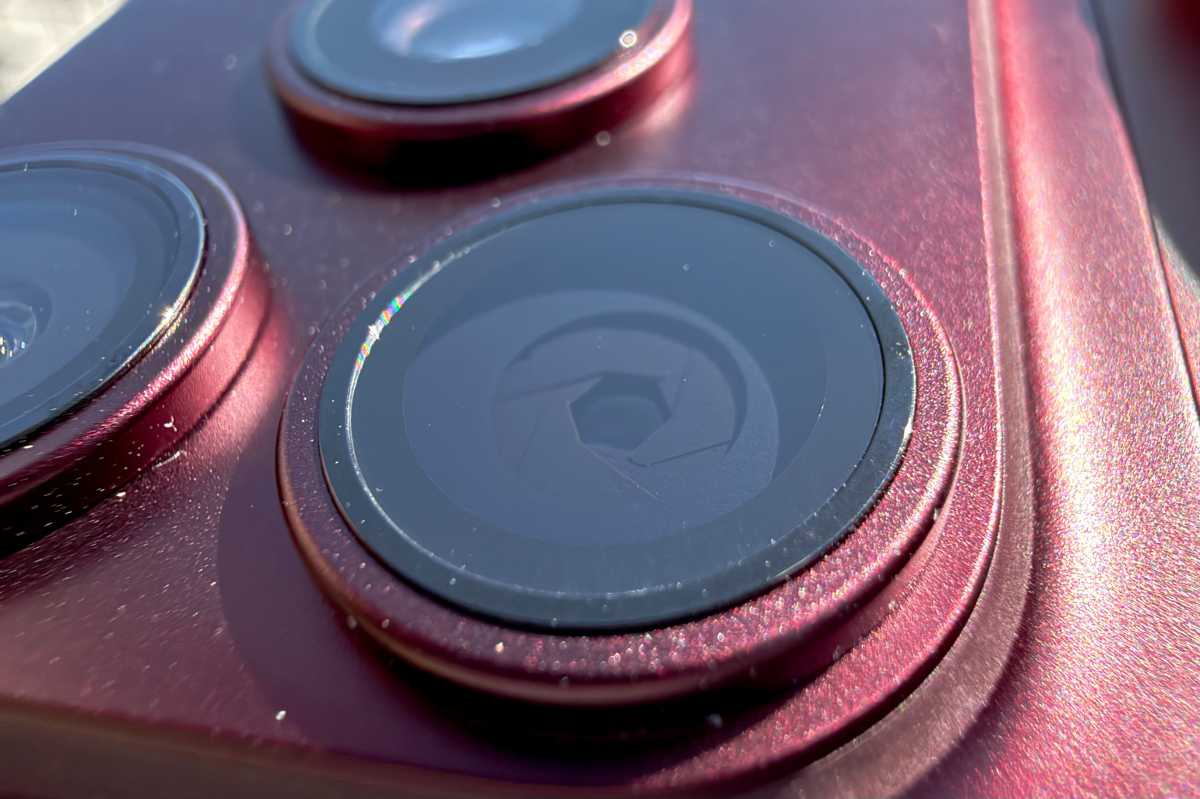
Variable aperture is the iPhone 18 Pro’s most iconic feature, letting you physically control how much light reaches the camera sensor. A wide aperture allows more light in and creates a natural bokeh effect, with a shallow depth of field. Conversely, a narrow aperture expands the depth of field to keep background elements sharp, making it ideal for well-lit group shots and landscapes. Both Apple Camera and Halide support controlling the aperture on the iPhone 18 Pro, but their approaches vary.

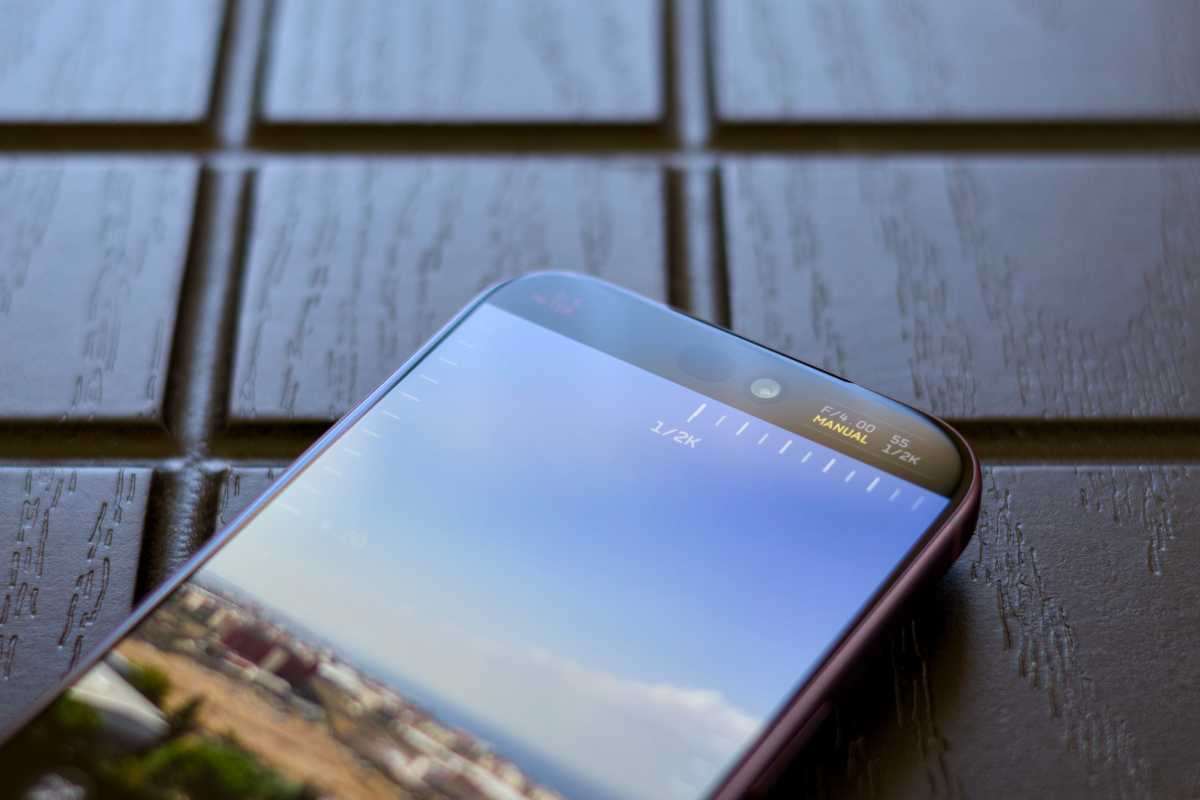
The iPhone’s built-in Camera app lets you manually choose between four fixed values: f/1.48, f/1.8, f/2.8, and f/4.0. Or you can opt for the automatic mode, which dynamically selects any value between f/1.48 and f/4.0—depending on what the algorithm deems best for the particular scene.

iPhone 18 Pro Aperture
A mechanical variable aperture on the Main camera is a defining feature of the iPhone 18 Pro.

Foundry

Halide, on the other hand, gives you full control over the aperture. So you can fine-tune it and manually pick any value in the same f/1.48-4.0 range, like f/3.33, or switch to auto. As such, Halide technically provides photographers with more options than Apple’s Camera app. But more importantly, does this sort of flexibility actually impact iPhone photography?

The short answer is no. The iPhone 18 Pro’s main camera sensor is too small for such minor aperture adjustments to matter. In fact, some critics questioned Apple’s decision to bring a mechanical aperture to the device in the first place. Many Apple Camera users will barely be able to tell the difference when jumping between adjacent preset f-stops, such as f/1.48 and f/1.8. Offering users a slider with over 250 precision micro-steps in Halide is arguably overkill.

That’s not to say that Halide’s execution is completely pointless. Pro photographers working in full manual mode may lock the shutter speed and ISO (both of which impact the final exposure) at fitting values to achieve a desired look. Having complete control over the aperture can allow the exact amount of light in and perfect the overall image. Nevertheless, considering the iPhone has a small sensor, it’s not as influential as having it on a professional camera, and most users will probably be overwhelmed by its numerous options.

ISO-lated testing

Beyond the variable aperture, the iPhone 18 Pro introduces native support for advanced camera controls, like shutter speed and white balance. A slow shutter speed can create motion blur, while a fast one can help capture ultra-fast subjects as they move. Meanwhile, white balance lets you control the temperature of the light, making it cooler or warmer as needed. Halide has long supported these adjustment types, but the number of options differs.

With Apple Camera, you can push the shutter speed as fast as 1/16,000th of a second, while Halide seemingly limits you to 1/2,000th of a second (according to my tests on an iPhone 18 Pro). Similarly, disregarding the automatic mode, Apple lets you pick between five white balance options, while Halide is limited to four. These minor technicalities won’t matter to most users, but we’re laying them out for the comparison’s sake.

iphone 18 Pro halide

Foundry

A more impactful Apple Camera exclusive is the new Focus Tracking feature, which locks onto a selected subject even if you move or it does. Otherwise, both camera apps support focus peaking, which helps you identify the sharpest areas in the frame.

Perhaps the biggest difference between the two apps in the Pro control department is manual ISO support. ISO dictates the sensor’s signal amplification, and, by default, you cannot manually adjust it on iOS. Apple’s implementation automatically adjusts its value in the background depending on the lighting conditions and other factors—acting as a manual mode with auto ISO (or shutter & aperture priority mode). With Halide, you get a dedicated ISO slider, which generally matters to enthusiast photographers seeking a true manual mode. It also offers more advanced framing guidance, like a golden ratio overlay and a finer grid.

It’s worth mentioning that, unlike Apple Camera, Halide does not allow layout customization. Personally, I find the built-in app more intuitive to use, especially since I’ve pinned the toggles I actually use to the top. Halide’s interface looks a bit dated and its user experience doesn’t feel as natural to me—but that’s subjective.

Filtering through the options

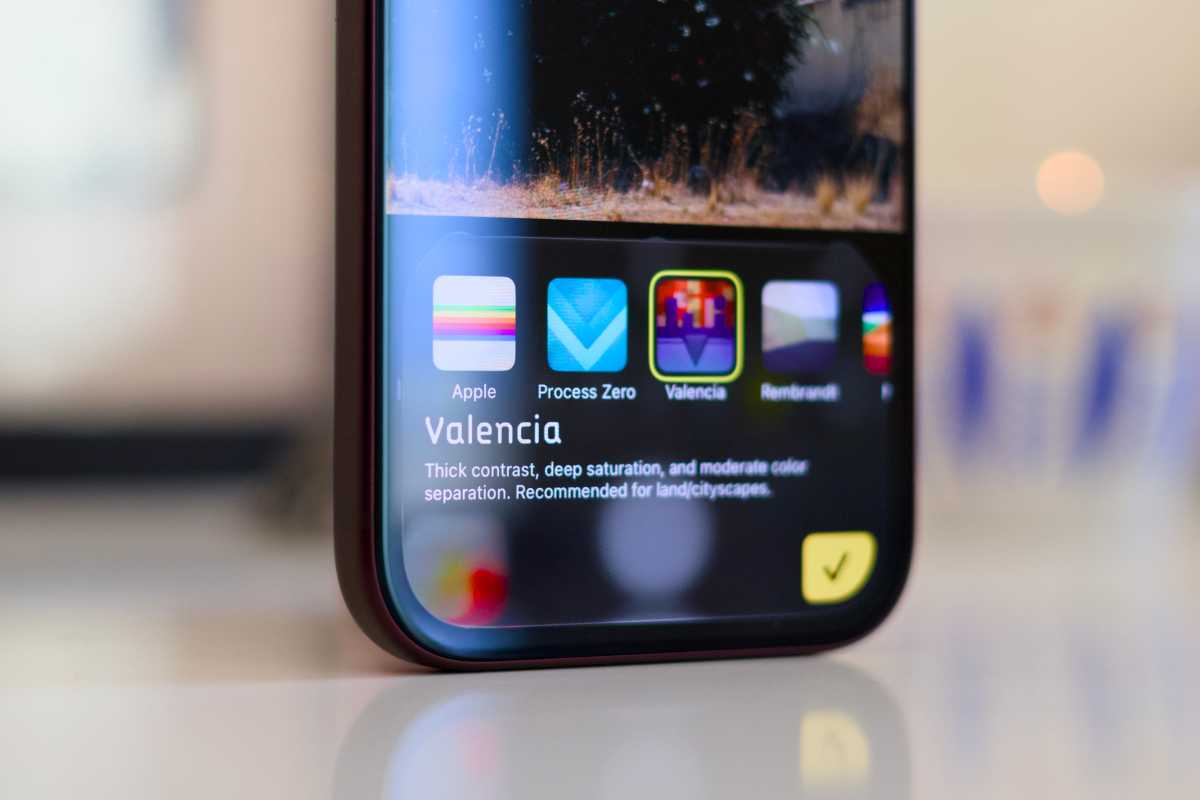
Next, we’ve got the advanced filters that each of the two camera apps provides. The iPhone 18 Pro offers Photographic Styles 3, which include 15 palettes (excluding the standard one). You can apply a soft skin, glow, or film texture to any of the palettes, plus an independent grain effect if you so wish. Notably, you can control the intensity of the palettes, tones, and colors using an advanced slider, and you can freely shuffle between looks after shooting, as they’re nondestructive.

Halide, on the other hand, offers 9 distinct looks that permanently alter your output—unless you’re shooting in RAW. So, everyday shots will be locked to the chosen look with no way to revert or apply a new look after shooting. You also miss out on the slider that controls the undertones and intensity of the filters, not to mention the omission of Live Photos—which Apple’s Photographic Styles support. However, Halide uniquely allows you to control the grain effect’s strength, assuming you’ve shot in RAW.

Halide filters

Foundry

Other Halide perks include the famous Process Zero look, which minimizes AI/computational processing and provides more natural-looking output. You also get to apply its various color filters on compatible RAW photos captured using other apps or devices, while Apple limits its Photographic Styles to iPhone Camera app output.

Given that RAW shots can consume 10x more storage than regular ones and do not support the Live Photos feature, most users will want to stick to Apple’s compressed HEIF format for daily captures. This will limit them to Photographic Styles 3, unless they’re willing to permanently bake Halide’s filters into their output.

Should you give Halide a shot?

For most iPhone 18 Pro users, the answer is a hard no. Apple’s built-in Pro camera tools and Photographic Styles 3 provide enough control over the shooting process to produce creative, dramatic, or precise output that is on par with Halide’s. While manual ISO support is nice to have, Apple’s automatic ISO adjustments and manual exposure tweaks work reliably in most setups, and it’s not worth Halide’s relatively high fee.

Apple Camera on the iPhone 18 Pro marks the very beginning of Halide Mark III’s end. Nonetheless, the third-party app will stay relevant for years to come. After all, Apple’s Photographic Styles 3 and Pro camera controls are restricted to the iPhone 18 Pro, unlike Halide, which offers its powerful features on older iPhone models. Arguably, Halide is still the best manual camera app for anyone with an unsupported iPhone, and that will likely remain the case for years to come. If you’re still unsure, you can claim a free one-week trial of Halide when signing up for the annual plan and proceed accordingly.

  •  

Save $300 on the Apple Watch Ultra 3 in this rare blowout deal

Macworld

Apple Watch Ultra 3

Update: This deal is no longer available.

When you want the best of the best, especially when you’re out on a hike, the Apple Watch Ultra is the way to go. If you want a watch that’s as fashionable as it is functional, you’ll want the Black Titanium Milanese Loop. That usually costs $900, but if you don’t want to spend nearly a thousand bucks on the newest model, you can grab a Series 3 for $600 right now, an impressive 33 percent discount on its MSRP.

The Apple Watch Ultra 3 seeks to mix it all together — keeping you connected, keeping track of your training, keeping you on track when you’re hiking, telling you when to go to bed so you get more rest, telling you when you’re having heart issues by running ECGs, and so on. It’s such a versatile thing to have on your wrist that it justifies the high price tag. If you take a hard fall or get in a severe car crash, it can connect you to emergency services and notify your emergency contacts. The battery lasts up to 42 hours of normal use, or up to 72 hours in Low Power Mode, so a weekend trip won’t send you hunting for a charger. With cellular and 5G, you can take calls and stream music without your phone.

This model has the luxurious Black Titanium Milanese Loop band, so it’s stylish too. Crafted from aerospace-grade titanium mesh, it features a secure parachute-style buckle and is inspired by the same design historically used by divers. Apple usually sells this band for $199 on its own, so you’re saving money there, too.

Since this is an Ultra 3, you’ll still get watchOS 27 with the new Siri AI and Dynamic App Grid. Unfortunately, you won’t get the new Readiness app, or Live Rewind and Siri Recap, but otherwise it delivers on everything you could possibly need from a smartwatch. So, grab this gorgeous Apple Watch Ultra 3 for $300 off while it’s still on sale. It’s the best price we’ve ever seen for this model!

  •  

Apple’s ‘major mistake’ with the iPhone Duo isn’t actually a mistake at all

Macworld

Is there any other company in the world whose followers obsess over how many units the company sells more than Apple? Maybe the Macalope’s wrong and somewhere out there are fans of the Hidden Valley Ranch company poring over rumors about the relative sales of Spicy Hot Honey versus Sizzlin’ Nashville Hot, or fret over rumors of devastating production cuts to the Creamy Jalapeño line, but he doubts it.

First of all, who doesn’t like Creamy Jalapeño? Why would there ever be production cuts to that line? It makes no sense.

iPhones, however, are different. Every year they get production cut rumors. And this year is no different: Apple cuts iPhone 18 Pro orders due to soft demand.

Nobody likes maroon. The Macalope could have told you that. It’s just a bad color.

This “news” comes from none other than Nikkei, purveyors of bombastic iPhone production cut rumors since 1973, a full three years before Apple was formed. No one had any idea what they were talking about for 34 years. Nikkei’s most garment-rending rendition was the 2017 iPhone X production cuts, which the outfit said were of such magnitude that Apple was producing negative iPhones, actually pulling already manufactured iPhones apart and putting the aluminum back into the ground.

Okay, not really, but it was wildly off, so take these reports with a salt-lick-sized grain of salt. It’s probably true that the price increase on the iPhone Pro line has not helped its attractiveness. Or maybe people were drawn to another, even more expensive option, because Apple apparently can’t make iPhone Duos fast enough.

Certainly not fast enough for Bloomberg’s Mark Gurman, who said Apple made a “major mistake” with the iPhone Duo. What is this “major mistake’,” you may ask? Were credit cards charged twice? Thrice? Did every iPhone Duo ship with a dirty hypodermic needle in the box, just waiting to stab unsuspecting customers? Did some of the profits from each Duo go to a ridiculous vanity project, the real goal of which was to force companies to curry favor with a kleptocratic regime?

[Turns and stares unblinking into camera for 45 minutes]

Macalope

If you’d like to receive regular news and updates to your inbox, sign up for our newsletters, including The Macalope and Apple Breakfast, David Price’s weekly, bite-sized roundup of all the latest Apple news and rumors.

Foundry

Well, according to Gurman, the “major mistake” was selling them before it had enough inventory to meet demand. Definitely an unprecedented event–or not: “iPhone 4 pre-orders from Apple now pushed back to July 14”.

Indeed, the Macalope himself vaguely recalls having to wait two months to get an iPhone 4 back in the day when the kids still said “back in the day.” Two months, of course, is not quite the three months would-be Duo owners have to wait now, but the iPhone 4 didn’t have an entirely new conceptual form factor, featuring a hinge and a foldable screen. All it had was a slightly janky antenna.

Was Gurman not able to get an iPhone Duo delivery date in 2026? Is that what this is about? Because as far as “major mistakes” go, selling as many as you can make seems a pretty great mistake to make.

Anyway, fear not, because Apple is on it: “Apple increases iPhone Duo orders by 30%“.

It is extremely unclear whether the current shortage is because of the unexpected popularity of the Duo or the relatively low number of units Apple was able to get built. Most likely a combination of both.

Apple sure picked a good year to move the base iPhone line to a spring release schedule, though: “IDC: Apple closes in on Samsung as global smartphone shipments see record decline in Q3”

Apple shipped fewer phones because it moved a whole line to spring. What’s your excuse?

The Macalope has always maintained that profit share is better than market share, but hey, if you can get both, so much the better.

Speaking of spring, get ready for a big one, at least sales-wise: “The standard version of the iPhone 18 is scheduled for production at the end of November, and the stock size seems quite large,” according to Fixed-Focus Digital, who has correctly reported Apple-related leaks in the past.

Year-over-year comparisons are going to be wack as the kids who used to say “back in the day” back in the day also used to say.

The Macalope realizes he’s putting a lot on these fictional kids of 2010, and he apologizes for any stress they may have incurred, temporal mechanically speaking.

The next year may make both Apple and its customers a little uneasy as the iPhone lineup gets rejiggered, but the Macalope suspects it’ll all work out in the end.

  •  

Follow the money: Who benefits from the UK’s Apple Pay crackdown?

The UK wants to take a chunk out of Apple Pay, as the Competition and Markets Authority (CMA) moves to force Apple to open access to its 12-year-old contactless payment system to rivals.

The regulator has published a consultation document that proposes requiring Apple to allow competitors to use the near-field communication (NFC) chip on its devices to enable alternative payment systems on iOS  on “fair, reasonable, transparent and non-discriminatory terms.”

The regulator says action is required because UK businesses have complained that Apple’s existing NFC access arrangements are not commercially viable.

30% of UK adults use Apple Pay?

The regulator also revealed some interesting statistics concerning use of contactless tech in the UK:

  • Contactless payments represent 39% of all payments, compared to just 3% of transactions a decade ago.
  • 62% of adults currently use a digital wallet.
  • 50% of those use Apple Wallet — which implies that around 30% of UK adults use Apple Pay.

“These proposals open the door to more innovation, more choice and economic growth, including in the UK’s important fintech sector,” said Sarah Cardell, chief executive of the CMA.

It’s not clear if those companies will take advantage of this forced liberalization. The CMA tells us that the only services that have done so in the EU, where Apple has already been forced to open up NFC, have all been transnational entities, including Vipps, PayPal, Klarna, Curve, and BBVA. Are consumers flocking to these services to rejoice in this new market liberalization? While this open NFC has only been in place a few months, I don’t think so.

Who will really benefit from this?

Cardell also said, “By removing barriers to entry, we can help create the conditions for brilliant British businesses with great ideas to develop new products and services here — from payment apps and digital IDs to travel passes and digital keys.”

That seems highly speculative to me, but I can see UK banks offering up digital payments directly via Apple’s NFC as the most likely outcome of the new rule. In a statement, David Geale, executive director for consumers, payments and competition at the Financial Conduct Authority, said, “Opening up this technology will also support the expansion of open banking, enabling more people to make payments directly from their bank accounts.”

I imagine the banks will turn out to be the real motivation here. To my mind, it suggests the sector wants to use regulation to muscle in on the ecosystem Apple has made and wants to make direct use of NFC on iPhones to cut Apple out of the revenue generated by these payments as much as possible. 

The CMA admits, after all, that part of the reason it began this work was because it had complaints from competitors. Lenders and fintech businesses have challenged the 0.15% fee Apple takes on credit card transactions carried out via Apple Pay. The inference isn’t hard to see. With 39% of all payments made by adults in the UK being contactless, those tiny payment processing fees look like profit to banking shareholders, and they want it back. 

Apple responds

They won’t get it all back. Even the CMA concedes that Apple deserves a “fair reward” for providing access via its platforms and ecosystem, but I doubt it will hang onto as much as it makes now.

In a statement, Apple said, “We do ⁠not believe the CMA should require Apple to adopt an approach with lower privacy and security protections. We will continue to engage constructively to reach an outcome that is in the best interest of our users.”

Privacy or profits?

Digging a little deeper, the proposals will demand technical changes from Apple. The two main globally used contactless technology standards are secure element (SE), which stores information on-device, and host-based card emulation (HCE), which stores data off-device. 

Neither technology was developed by Apple, and both are used across other mobile ecosystems. While Apple now supports HCE and SE in the EU to meet Digital Markets Act regulation, it has historically avoided supporting HCE to protect the privacy and security of customers. That is almost certainly because it sees risks in storing highly confidential payment data off the device. 

Payments on Apple’s devices are instead protected by secure element. European developers wanting to use NFC with HCE systems must apply for a specific Apple NFC/HCE entitlement and meet technical, security, and regulatory standards, which will likely be the approach Apple takes in the UK if the CMA gets its way.

Will consumers really benefit from this? 

I doubt it, but the move will almost certainly prise some money out of Apple’s grasp, which will then be shared among other corporate entities, some — though probably not all — of whom may even value customer privacy as much as Apple does. In the end, it’s all about the money, and someone will take a slice of it. Does it really matter who that is?

Now please subscribe to my daily, human-curated Apple-related news headline feed at The Core, or follow me on BlueSky, LinkedIn, or Mastodon.

  •  

Former Boingo exec boards AST as CTO of Enterprise & Platforms

Long time Boingo Wireless executive Derek Peterson (pictured) revealed on LinkedIn he has joined AST SpaceMobile as CTO, Enterprise & Platforms while also leading the satellite player’s CIO and CSO functions.

Peterson was at Boingo Wireless for 15 years, most recently as CTO Emeritus and strategic advisor after serving as CTO, CIO, COO, CSO and CPO at the wireless company for over 14 years.

In his new role at AST, he will lead enterprise IT, platforms, infrastructure, corporate networks and cybersecurity, including the CIO and CSO functions, and building the US software team while driving Wi-Fi and OpenRoaming integration.

“Connecting a regular phone straight to a satellite is the piece that completes the convergence picture,” he stated on LinkedIn. “I’ve spent my career chasing seamless connectivity, and I’m excited to join an innovative team that’s building it from space

AST SpaceMobile previously projected 45 to 60 of its next-generation satellites would launch this year for its direct-to-device service but is now targeting having approximately 45 in orbit by early 2027.

The delay was revealed in a Securities and Exchange Commission regulatory filing tied to a $1 billion notes offering and followed a serious setback to one of its two main launch partners.

The post Former Boingo exec boards AST as CTO of Enterprise & Platforms appeared first on Mobile World Live.

  •  

Apple is gaining as the industry shrinks

It’s all relative, but if you want to scope out the likely shape of the tech device industry in five years’ time, you have to think of the likely shape of the replacement cycle, and right now it seems to be shifting toward Apple. 

That’s going to become more important to tech purchasing as the years roll by and is also likely why you’ll see other manufacturers become even more competitive as they try to stop the tide. It is open to question if they will be able to do so, given that even five years ago Apple still seemed far less dominant, which is no longer the case.

Shrink when you’re winning

If you look at the devices that are being sold, you’ll see one key thing: In the face of memory and component cost-driven price hikes, sales of PCs and smartphones are falling fast. Apple isn’t immune to this macroeconomic trend, so it is also seeing decline, but the relative rate of this decline is less steep, meaning the company is growing its market share even as the industry shrinks.

Gartner says the Mac share of the PC market rose to 10.5% in Q3, up from 8.8% a year earlier, even as Mac sales fell 7.1%. The figures vary by analyst (IDC has Mac share at 9.5%, Omdia at 11.7%), but all three show a gain. 

In smartphones we’re seeing something similar, with Counterpoint Research giving Apple a new record 22% of global smartphone sales in Q3. While it’s true that Apple is achieving lower unit sales in both categories, its decline is far beneath the industry average.

When everyone’s prices rise

Apple has had to raise prices across all its devices but has been able to lean into the sheer scale of its market to help dilute the impact. Lacking Apple’s scale, smaller vendors have been unable to follow suit. This has led to PC and smartphone manufacturers raising prices on their devices to such an extent that Apple now seems to be a good value option. 

Counterpoint Research Director Tarun Pathak caught the mood: “Apple is still gaining new users across categories, and it will become increasingly difficult for competitors to make an Apple user switch to their operating system,” he said.

Shoppers who can still afford to buy can’t help but see that while Apple’s products cost more, everybody else has raised prices to similar levels. It means Apple is being judged differently. When everything costs roughly the same, the value it offers looks different. 

That thousand-dollar smartphone you always wanted but couldn’t justify purchasing seems more viable now that the brand you opted for instead just raised prices to the same level.

Today’s buyers, tomorrow’s upgraders

Now think about what this means 3-5 years from now. It means a growing chunk of PC or smartphone owners will be looking to upgrade their Mac or iPhone. 

So far at least, people tend to stick with Apple once they arrive there. Consumer Intelligence Research Partners puts iPhone loyalty at 87% among recent purchasers, a three-year high, which suggests that this year’s buyers are likely to stick with it once they need to upgrade. Satisfaction points the same way: Apple ties Samsung for the top spot in the American Customer Satisfaction Index’s 2026 personal computer satisfaction ranking, with a score of 81, even as industry-wide satisfaction fell 4%. 

The longer the PC and smartphone market decline continues, the greater the impact of this trend will become. If Apple manages to keep declining at a slower rate in comparison to other ecosystems, its relative market share will continue to grow. 

That share is likely to sustain itself into subsequent purchasing cycles. Apple also benefits from the first generation of M1 Mac owners, who are only now reaching the point when an upgrade seems necessary. (Don’t forget that between 2020 and 2022, the success of Apple silicon drove Apple’s PC market share from 6.6% in 2020 to 10.8% in 2022, setting a new trend line.)

Why IT should pay attention

That’s more than a curious observation for Apple fans. It’s also something that should matter more to enterprise tech, as it suggests that the need for investment in device management and Apple hardware is going to accelerate through the downturn. It hints that support for these platforms will become a business necessity; that if your teams continue refusing to support Apple platforms and aren’t prepared to change that, then you may soon be searching for different IT teams.

Now please subscribe to my daily, human-curated Apple-related news headline feed at The Core, or follow me on BlueSky, LinkedIn, or Mastodon.

  •  

iPhone Air 1 year later: Why I’m waiting for iPhone Air 2

With the new iPhone Duo available on the 22nd and the iPhone 18 Pro / Pro Max midway last month, it breaks from the pattern of recent iPhone events where the entire year’s lineup is announced all at once. The iPhone Air and 17 are awaiting a refresh, rumored to arrive sometime in Spring 2027 […]

The post iPhone Air 1 year later: Why I’m waiting for iPhone Air 2 appeared first on Low End Mac.

  •  

MacVoices #26268: Live! – Ecamm Creator Camp Report, iPhone Duo for Lefties, and AT&T’s Handoff Decision

Two MacVoices Live! panel members provide a  look inside the most recent  Ecamm Creator Cam. They highlight  its focus on creators, entrepreneurship, community, and upcoming features such as live transcription and translation. The panel also examines how many apps can be removed from iPhone as compared to other smart phones, and slower storage in base […]

💾

  •  

iPhone Handoff

Apple:

iPhone Handoff lets you use one phone number between two devices, so you can switch between them whenever you want. It makes it easy to move back and forth between devices optimized for the moment — like weekday business or weekend adventures.

[…]

After iPhone Handoff is set up, one iPhone becomes the main iPhone and the other iPhone becomes the secondary iPhone that shares the number. Your main iPhone should be the one you use most often. Some carrier services, like Call Forwarding and Caller ID, and carrier account management can only be managed on your main iPhone. Contact your carrier for more details.

To move between your main iPhone and secondary iPhone, simply unlock the device that you want to start using — your phone number will automatically become active on that device.

[…]

iPhone Handoff works with Dual SIM as long as both eSIMs are from carriers that support iPhone Handoff. Once set up, both eSIMs switch together simultaneously when you unlock your iPhone.

They say you need to have Messages in iCloud enabled.

Joe Rossignol:

In addition to needing two iPhones running iOS 27, “iPhone Handoff” will seemingly require carrier support. The forum post mentions that T-Mobile in the U.S. and Deutsche Telekom in Germany might be among the first carriers to offer the feature.

T-Mobile:

T‑Mobile is introducing the feature at $5/month.

John Gruber:

This seems like a ridiculous thing to charge for. It’s not adding a separate device to your plan, like adding a cellular iPad or even an Apple Watch. It’s just switching your active eSIM between two iPhones. You can do this for free, now, on any carrier via Settings → Cellular — but it takes a bunch of taps, confirmation on both iPhones, and a few minutes for the carrier to register the eSIM transfer. iPhone Handoff just eliminates all the annoying friction and waiting.

Chance Miller:

As reported by CNET, AT&T seemingly has no plans to support iPhone Handoff.

Previously:

  •  

Unboxings do iPhone Duo vazam antes da hora; veja os primeiros reviews

Se você rolou pelos feeds das principais redes sociais na manhã de hoje, percebeu que já começaram a pintar os primeiros reviews do iPhone Duo, cujo lançamento ocorrerá nesta sexta-feira (23/10).

Horas antes de o embargo cair, contudo, uma série de vídeos de unboxing e hands-on começaram a pipocar internet afora, nos dando uma chance de conferir o mais novo smartphone da Apple um pouco mais de perto.

Um dos veículos a divulgar vídeos do iPhone Duo foi o canal do YouTube Kingmi Mobile, que publicou não só um, mas dois vídeos de unboxing — um para o modelo na cor branco-estrela (star white) e outro para a versão na cor céu noturno (night sky):

Em um terceiro vídeo, o canal mostra elementos como o vinco e a câmera interna sob a tela do iPhone Duo com mais detalhes:

O dobrável também aparece em outros vídeos publicados em redes sociais como o X:

someone unboxed the iPhone Duo on TikTok 😭 pic.twitter.com/fxZTZbJS49

— Holly – I like tech (@AnxiousHolly) October 21, 2026

iPhone Duo saying hello 👋 pic.twitter.com/OClfIESbQO

— Maywrld (@maywrld01) October 20, 2026

Okay, someone from Russia has also got their hands on the iPhone Duo, and they’ve already unboxed and set-up the Phone! 😬

We can even see them using a UV torch on box to verify its originality…

Also, some games are still not optimised for the full-screen display yet 😭 pic.twitter.com/mVVWZwhWEQ

— Sunny (@sunnny1583) October 21, 2026

Can’t believe, someone already unboxed iPhone Duo before embargo lifts!! 😭 pic.twitter.com/NMPyEScGiu

— Ahmed (@itz_ahmedx) October 20, 2026

Primeiros reviews

Como dito, o embargo estabelecido pela Apple para a publicação de vídeos a respeito do iPhone Duo caiu às 9h da manhã, e as primeiras impressões acerca do dobrável já estão pipocando na internet.

Entre os criadores de conteúdo que puderam colocar as mãos no dobrável antecipadamente, estão os YouTubers Marques “MKBHD” Brownlee e Matti Haapoja, bem como a jornalista Joanna Stern (ex-Wall Street Journal) e o site The Verge:

Como era de se esperar em se tratando de um smartphone de primeira geração, as opiniões sobre o aparelho até agora têm sido um tanto mistas, embora elas tendam a pender para um lado mais favorável — o que indica que a Apple acertou na execução, ainda que haja espaço para melhorias.

Um dos aspectos mais elogiados do iPhone Duo até agora é, sem dúvida, a sua tela interna com o acabamento nano-texture, que torna a utilização do aparelho em ambientes externos muito mais confortável se comparado a outros dobráveis no mercado, os quais costumam vir com displays mais reflexivos. Essa vantagem, porém, tem como custo um pouco menos de definição na imagem, mas nada que atrapalhe a experiência.

Esse acabamento também ajuda a esconder o vinco, que ainda é perceptível a olho nu, mas raramente atrapalha o usuário ao realizar uma tarefa — inclusive ao digitar, já que o iOS divide o teclado em dois para afastar as teclas do vinco caso o usuário resolva escrever algo com o dobrável entreaberto.

A área maior da tela interna também abre espaço para outro recurso muito elogiado do iPhone Duo: o modo de tela dividida (Split View), que expande consideravelmente as possibilidades em matéria de multitarefa. A impossibilidade de abrir um terceiro app lado a lado, no entanto, tem sido citada como um ponto negativo do software.

O formato de passaporte do aparelho também contribui para essa experiência, além de facilitar o consumo de mídias como vídeos e filmes. Ele, no entanto, pode tornar difícil alcançar certos elementos da interface na tela externa com apenas uma mão, além de favorecer o uso com a mão direita no modo fechado.

Em termos de câmera, as opiniões têm sido bastante mornas — algo que era esperado, considerando o espaço limitado para as lentes. Sem controles profissionais, a câmera principal do iPhone Duo lembra bastante a única lente do iPhone 17e, que, apesar de não ser um smartphone topo-de-linha, já é capaz de capturar imagens muito competentes.

Talvez a área mais controversa do iPhone Duo seja o seu software, mas não por culpa da Apple, que parece ter feito um ótimo trabalho para tornar tudo suave e extremamente intuitivo, sendo a já clássica animação de abertura/fechamento do aparelho um símbolo disso. Apps de terceiros, no entanto, ainda sofrem com os vários formatos de tela do aparelho, o que tem resultado, na maioria dos casos, em bordas pretas e imagens esticadas — problemas que provavelmente serão consertados com o tempo, via atualizações de software.

Outro aspecto do iPhone Duo que virou alvo de muita especulação nos últimos meses foi a sua dobradiça, que parece já ter assumido o seu posto como uma das mais robustas do mercado. Stern, por exemplo, colocou o aparelho para abrir e fechar mais de 32.000 vezes com a ajuda de um robô; mesmo assim, ela não conseguiu notar uma diferença significativa na resistência da dobradiça.


Em pré-venda desde a última sexta-feira (16/10), o iPhone Duo já aparece com prazos de entrega extremamente elásticos em vários países, incluindo o Brasil, como comentamos aqui.

Vendido por US$2.000 nos Estados Unidos, o dobrável sai pela bagatela de R$22.000 no mercado nacional — isso em sua versão de entrada, com 256GB de capacidade.

iPhone Duo

iPhone Duo

Cores: branco-estrela ou céu noturno
Armazenamento: 256GB, 512GB, 1TB ou 2TB
R$ 21.999,00

NOTA DE TRANSPARÊNCIA: O MacMagazine recebe uma pequena comissão sobre vendas concluídas por meio de links deste post, mas você, como consumidor, não paga nada a mais pelos produtos/serviços ao usar os nossos links de afiliado.

  •  

Apple busca engenheiro para produção de modems 6G

Em mais um indício dos esforços da Apple rumo ao 6G, a Apple abriu uma vaga para engenheiro de sistemas de modems celulares focado na tecnologia, com salário-base anual entre US$175 mil e US$308,5 mil (sem contar os benefícios e a participação acionária).

Quanto à descrição da vaga, a empresa menciona que o profissional contratado terá uma “oportunidade rara de moldar o futuro da comunicação sem fio” e de participar da transição “rumo ao 6G”:

Nós estamos procurando por um engenheiro de sistemas de modems celulares para se juntar ao nosso time de engenharia de sistemas celulares enquanto definimos e elaboramos a próxima geração da tecnologia celular. Isso é uma oportunidade rara de moldar o futuro da comunicação sem fio em uma empresa que vende em escala global enquanto realizamos a transição rumo ao 6G.

Esse papel trará uma visão de ponta a ponta dos sistemas sem fio — englobando padrões 3GPP, a definição e o planejamento de recursos, design, arquitetura de hardware e software e a divisão de responsabilidades dos componentes — para entregar recursos e otimizações de desempenho e consumo de energia de última geração, que melhorem diretamente a experiência em todos os produtos da Apple. 

Para se candidatar ao cargo — disponível no site de carreiras da Apple —, é necessário ter formação em engenharia elétrica, engenharia da computação ou áreas correlatas, bem como ter ao menos dez anos de experiência profissional com tecnologias celulares e domínio de MATLAB, C/C++ ou Python.

Como pontuado pelo 9to5Mac, a Apple se soma a empresas como Qualcomm, Nokia, Samsung e Ericsson na Next G Alliance, grupo criado pela Alliance for Telecommunications Industry Solutions (ATIS) para realizar pesquisas e desenvolver o 6G na América do Norte.

As faixas de espectro que serão utilizadas no 6G ainda não foram definidas, mas se espera que as especificações técnicas estejam finalizadas até o fim de 2028, enquanto aplicações comerciais e dispositivos compatíveis só deverão chegar em 2030.

via MacRumors

  •  

Mais franquias de consoles e PCs estão chegando ao mobile, diz chefe da App Store

Em entrevista ao Polygon, o vice-presidente da App Store, Carson Oliver, comentou o Apple Arcade e a relação da Maçã com os desenvolvedores de jogos independentes.

As declarações ocorreram em meio à Indie Games Week, evento que deu destaque a alguns títulos de sucesso disponíveis para os dispositivos da Apple, como Sifu, Vampire Crawlers e No Man’s Sky.

A matéria avalia que a investida da Apple no mercado de videogames ao longo da última década foi consistente o suficiente para conquistar de fato o público gamer. Oliver, vale lembrar, assumiu a liderança da loja de aplicativos do ecossistema da Apple, após Phil Schiller deixar o posto em agosto.

O executivo falou sobre os esforços da empresa no segmento, que, segundo ele, vão além da distribuição, e ressaltou a chegada de títulos AAA ao ecossistema:

O que está acelerando esse movimento hoje é a tecnologia que impulsiona esse ecossistema. Apoiamos os desenvolvedores na App Store com muito mais do que distribuição. Continuamos investindo pesadamente em gaming: de novas tecnologias de hardware que entregam o mais alto desempenho sustentado, como o ray tracing acelerado por hardware do A20 Pro e a câmara de vapor de última geração no iPhone 18 Pro; a ferramentas de desenvolvimento, como o Game Porting Toolkit 4, o Metal e os nossos plugins de código aberto da Unity.

Temos observado o crescimento no número de jogos que chegam à App Store, em geral, com mais títulos premium este ano do que no anterior. […] Enquanto muitos são indies, nós estamos vendo mais franquias de consoles e PC chegando ao mobile, já que é um público em expansão para esses jogos.

O executivo também falou sobre a relação da Apple com os desenvolvedores independentes, além de destacar as diferentes formas de levar os jogos a Macs, iPhones e iPads:

Desde o primeiro dia, a App Store foi pensada para equilibrar as condições de descoberta e distribuição, de modo que um título indie possa se equiparar às maiores franquias do entretenimento. […]

Nós queremos dar aos desenvolvedores um ambiente confiável para alcançar usuários ao redor do mundo, dar-lhes suporte em cada passo e ajudá-los a construir negócios bem-sucedidos. […] Para atingir esses objetivos, nós oferecemos modelos de negócio flexíveis. Isso significa que um fenômeno inovador como Balatro pode prosperar como um jogo premium, e também pode encontrar um espaço no serviço Apple Arcade. O importante é que damos aos desenvolvedores a flexibilidade para fazer a melhor escolha e, a todos os jogos e jogadores, a liberdade de jogar como quiserem.

O Apple Arcade conta com mais de 200 títulos no acervo (livres de propagandas ou compras internas), os quais podem ser acessados por até cinco membros de um Compartilhamento Familiar em iPhones, iPads, Macs, Apple TVs e/ou Apple Vision Pros. O serviço de jogos custa R$14,90 por mês e também faz parte do pacote de assinaturas da empresa, o Apple One.

NOTA DE TRANSPARÊNCIA: O MacMagazine recebe uma pequena comissão sobre vendas concluídas por meio de links deste post, mas você, como consumidor, não paga nada a mais pelos produtos/serviços ao usar os nossos links de afiliado.

  •  

MacVoices #26260: AppleCare One Family Plan Calculus and Demand for CarPlay Wins

The MacVoices Live! panel  explores some of the useful new macOS Golden Gate features, including AI-assisted Shortcuts and improved iPhone Mirroring. They debate the emerging iPhone Duo and foldable-phone market and why one would prefer to give the new foldable a try. The value of AppleCare’s new family coverage plan is also reviewed for with households with many devices, and as an option for an individual. T-Mobile’s fee for iPhone Handoff, and GM’s decision to retain CarPlay in gas-powered vehicles wrap up this session. 

💾

  •  
❌