❌

Reading view

  •  

UK research agency backs drone-based internet service experiment with lasers, microwaves, and gravity waves used for wireless power — Britain invests $94 million into Starlink alternative

While China and Russia rush to build a SpaceX competitor, the UK is taking another route by developing an alternative to satellite internet that relies mostly on aircraft. Its Advanced Research and Invention Agency (ARIA) is funding 18 projects aimed at building aircraft that will deliver wireless communications to areas in the UK and the rest of the world that are not served by terrestrial networks. According to The Register, the program, called Enduring Atmospheric Platforms, aims to have a unit with a 300-watt communications payload aloft and holding station for a week.

These units are called high-altitude pseudo-satellites (HAPS), with ARIA allocating $94 million over three and a half years for these projects. There are three technical areas in focus at the moment: TA1, which aims to develop the underlying technologies; TA2, which looks into the integration and testing of the developed systems; and TA3, which will concentrate on actual deployment.

Two startups have proposed multiple drone systems that will cover the entire United Kingdom — Carousel, by Menapia, wants to build a constellation that can hover at altitudes of up to 12 miles, while Enduring Drone Networks, by VFP Aerospace, proposes a relay of units that automatically fly back to their ground station for charging and servicing, with a cost of about $67,000 per drone.

Two other proposals suggest wireless power — one is Scalable Laser Ltd, which is working on a laser-based technology that pairs high-power laser diodes on the ground with advanced photovoltaic receivers in the air. On the other hand, Space Solar Engineering Ltd wants to use radio frequencies, like microwave, to deliver power to airborne units. There’s also a more novel approach from the University of Bath, which plans to use atmospheric gravity waves — using the upward movement of air caused by weather fronts and geographical features and the subsequent pull of gravity that brings it back down — to extend the range and endurance of HAPS aircraft.

"This research expands the UK's leadership in high-altitude platforms to become the place where this industry is designed, built, and scaled," says ARIA program director Rico Chandra. "Getting there means backing bold ideas, from fixed-wing solar aircraft to designs nobody predicted, including aircraft that fly on spinning wings instead of propellers."

  •  

LinkedIn fights for the right to tell customers when the feds want their data

Microsoft’s top lawyer argued Tuesday that legislators “must make secrecy [orders] the exception” in government subpoenas demanding information about LinkedIn users.

LinkedIn, which is owned by Microsoft, is fighting what it calls overly broad subpoena demands from the US government, which sometimes come with secrecy orders that prevent LinkedIn from alerting customers whose information is being requested.

The company is asking federal courts “to enforce meaningful limits on both the scope of government demands and the secrecy that can accompany them,” wrote Jon Palmer, Microsoft’s chief legal officer, in a Tuesday blog post. “We recognize law enforcement’s important role in protecting public safety and investigating crime, and sometimes that does need to be done covertly. At the same time, customers and users deserve meaningful limits and independent oversight through an adversarial process.”

He pointed out: “People and organizations increasingly entrust their most sensitive information to online services. If providers cannot challenge demands they know are overbroad—or if courts may silence them without a rigorous, adversarial review—the safeguards the law requires will be weakened precisely when they are most needed.”

A tricky issue

The issue is a tricky one. Law enforcement often use this type of subpoena as an investigative tool, seeking those who are engaged in illegal activities. The theoretical justification for secrecy is to avoid alerting the investigative target to make it less likely the suspect will try to destroy evidence or flee the jurisdiction.

Government lawyers are supposed to only make secrecy requests when absolutely essential. Microsoft is suggesting that courts and congress need to step in to curtail blanket government efforts. 

“The Fourth Amendment protects the right to be free from unreasonable searches and seizures. That right applies to papers kept in a desk and it also applies when personal and business records are stored online,” Palmer wrote. “Online service providers, like LinkedIn and Microsoft, also have a First Amendment right to speak to their customers when the government obtains an order to search their private information. Secrecy may sometimes be justified, but it should be tailored to demonstrated needs and subject to meaningful review.”

He added: “The government must seek only relevant information, justify secrecy with specific evidence and infringe on speech to the least extent possible.” In his post, he pointed to a recent legislative effort in the US House of Representatives that might mitigate the issue if it ends up becoming law. 

“On August 31, the House passed legislation to rein in secret surveillance and strengthen notice protections when the government seeks data held by technology providers,” he wrote. “The reforms would place clearer limits on secrecy orders, require greater accountability, and help ensure that secrecy is the exception – not the rule. The Senate should act promptly to send these historic reforms to the President.”

LinkedIn privacy battles

LinkedIn itself is currently fighting litigation that accuses it of directly violating the privacy rights of its customers, and a federal judge this month dismissed another similar case, but gave plaintiffs permission to refile, with a caveat.

“Given LinkedIn’s further arguments that users voluntarily download browser extensions, which by their nature intentionally expose data to websites, it seems unlikely that the plaintiffs will ever be able to allege a privacy violation, much less prevail at the end of the day,” US District Court Judge Vince Chhabria wrote. “But in an abundance of caution, dismissal is with leave to amend.”

But, he added, if the amended complaint isn’t filed within 14 days, “dismissal will be with prejudice.”

Privacy now a ‘data stewardship obligation’

Jeff Valdes, a director at Acceligence, noted, “there is definitely some irony here.”

“If Microsoft wants customers to view it as a steward of their privacy when the government comes asking for their information, customers are naturally going to apply that same standard to how Microsoft and LinkedIn collect, use, protect, and disclose information themselves,” he said. “Privacy is difficult to compartmentalize. You cannot have one philosophy of customer privacy for government access, another for product design, and another for your own commercial data practices without eventually creating a credibility problem.”

Mike Wilkes, enterprise CISO at Aikido Security, agreed, pointing out, “without meaningful limits, judicial scrutiny, and an expiration mechanism, a temporary investigative necessity starts looking a lot like a permanent architecture for invisible surveillance. The individual may never have an opportunity to challenge the scope of the request, because they may never even know the request existed until prosecutors show up with an indictment.”

That, he said, “is why Microsoft’s argument matters, despite the obvious irony of LinkedIn simultaneously defending itself against privacy claims from its own users.”

But Ryan O’Leary, an IDC research director, offered a different perspective.

“Microsoft makes no bones about using the data contained within its own systems for its own purposes. Both things can be true: Microsoft can fight for the privacy of its platform while still not necessarily respecting the privacy rights of its end users,” O’Leary noted. “This seems to come down to protecting its own proprietary data sets, not some altruistic privacy crusade.”

 At the same time, Valdes pointed out, Palmer’s post highlights how deeply privacy has become a top-tier enterprise IT priority.

“Privacy is rapidly becoming a much broader data stewardship obligation,” he said. “Companies holding sensitive information increasingly have to think simultaneously about government requests, third-party access, their own collection practices, AI use, data retention and what they tell customers about all of it. If you want to be trusted as the custodian of the world’s data, customers are going to judge how you protect that data in every direction.”

However, Wilkes noted, “Microsoft does not need to be a perfect privacy saint to be right about this particular problem.”

This article originally appeared on CSOonline.

  •  

PC Gaming Show Tokyo Direct is back later this month — here's how to watch it

  • The PC Gaming Show Tokyo Direct airs this Sunday, September 20, at 9am PT / 12 noon ET / 5pm BST
  • You can catch the show live on PC Gamer, YouTube, Twitch, Steam, and many more places
  • It's going to be a 90-minute show with more than 10 world premieres and will feature more than 35 games

The PC Gaming show Tokyo Direct returns later this week and will feature a whole host of gaming announcements, reveals, and developer interviews.

Airing on Sunday, September 20, at 9am PT / 12 noon ET / 5pm BST / 1am JST (Monday), it will be presented by Frankie Ward.

There's a plethora of different places that you can watch the show online, with all of PC Gamer YouTube, Twitch, X, GamesRadar+, Steam, Bilibili, eCLUTCH, Ginx, ESR Network, Kuaishou, plus many more streaming the Tokyo Direct show.

You can use the YouTube link below to set a reminder — as well as bookmark it for later, of course.

In terms of what we can expect to see in the show, we already know that we'll see more than 35 games from the likes of Devolver Digital, Firefly Studios, The Game Bakers, Total Mayhem Games, Veewo Games, and WuselFaktory, and many more.

There's also going to be more than 10 world premieres, a new trailer for Firefly Studios' real-time strategy game Stronghold 4, a release date reveal of Virtue and a Sledgehammer from Devolver Digital, and a deep dive into New Blood Interactive's retro survival horror game Tenebris Somnia.

You can watch the trailer below if you want a visual teaser for the show, too!

  •  

Piecemakers bets edge AI devices will diverge from reliance on HBM — custom-designed memory fuses DRAM stack directly to the processor using hybrid bonding

PieceMakers, a Nanya-backed DRAM designer, began trading on Taiwan’s Emerging Stock Board on September 16 at a NT$740 reference price, Cnyes reported ahead of the debut. PieceMakers is not an HBM company. Instead, it bets that inference memory diverges from training memory, President Lee Hsiao-wen told Cnyes, and that DRAM stacked directly on the processor with hybrid bonding can sit between Nvidia’s SRAM-only Groq LPU and HBM. As it stands, design fees, not chips, carry the company's profit, with AI custom-design work accounting for around 40% of the company's revenue in the first half of 2026. Piecemakers Chairman Joseph Ting told TechNews that its first volume customer program will not contribute to the company's financials until 2027 at the earliest.

At roughly 60.4 million shares outstanding, that price values the company at around NT$44.7 billion (around $1.4 billion). Taiwan's Emerging Board is the Taipei Exchange's pre-listing market, not a main-board IPO, so shares trade through market makers ahead of any formal listing application. The stock ended its first session at NT$915, 23.6% above the NT$740 reference price, after opening at NT$1,035 and trading as high as NT$1,205.

Nanya Technology is the largest holder of Piecemakers, at 33.96%, after selling 715,000 shares at NT$740 to seed the float, a disposal it disclosed in a Sept. 9 exchange filing reported by Knews.

What PieceMakers sells

PieceMakers was founded in January 2006 in Hsinchu, Taiwan, led by chairman Joseph Ting and president Lee Hsiao-wen. Historically, the company has designed standard SDR/DDR DRAM and known-good-die (KGD) parts through representatives in China, Japan, France, Turkey, and Israel. Now, the company seeks to shift from direct product sales to custom design services, paid as non-recurring engineering (NRE) fees, and then to IP licensing, royalties, and turnkey production from 2027, the company said at its Sept. 7 briefing, UDN reported.

Revenue from the AI custom design unit has risen from around 4% in 2024 to almost 40% in the first half of 2026. The products behind that increase are HBLL (High Bandwidth, Low Latency RAM), a 2D die rated at 144 GB/s that was taped out in 2016 for Intel’s HPC line and published at ISSCC in 2017, and HiBaLL, the 3D-stacked version rated at more than 1 TB/s, the company claims.

The company described its customers to Cnyes as developers of cloud AI inference accelerators, international semiconductor players, and North American customers, with some programs in design and verification, and none named. Qualcomm CEO Cristiano Amon’s Computex keynote backdrop in June listed PieceMakers among Taiwan ecosystem partners, although neither company has defined the relationship. The takeaway is that the profit is in design fees and not chips. The margin curve matches a pre-royalty Non-Recurring Engineering (NRE) business, rather than a traditional memory vendor.

Why Nanya is chasing this instead of HBM

Nanya’s AI-memory strategy is custom and edge rather than HBM3E. PieceMakers is the first half of a strategy laid out in 2024. On Aug. 7, 2025, Nanya announced a joint venture with Etron Technology, a Hsinchu-based chip designer, capitalized at NT$500 million, with 80/20 ownership. The venture was envisioned to design custom high-bandwidth memory for edge AI devices rather than for data center accelerators. Nanya president Pei-Ing Lee said earlier in 2025 that the company would not compete in HBM3 or HBM3E, TrendForce reported.

Both halves of the strategy rely on Formosa Advanced Technologies, the Formosa Plastics Group’s test and assembly affiliate, for packaging. It is building the through-silicon-via (TSV) and die-stacking processes that both need. The surge in DRAM pricing has made commodity memory Nanya’s real business, which leaves PieceMakers a cheap side bet that has become a windfall. Nanya took advantage of this by selling around 3% of its stake in a move that suggests it is acting more as an investor than a parent building a memory stack.

The inference gap

Groq is an AI inference startup that Nvidia struck a $20 billion licensing-and-talent deal for on Dec. 24, 2025. Nvidia announced its first chip built from that, the Groq 3 LPU (language processing unit), Nvidia’s SRAM-based inference chip, at GTC, its annual developer conference, in San Jose earlier this year.

There is no HBM or DRAM on the Groq 3 LPU. Instead, it uses 512MB of SRAM on the die to deliver 150 TB/s of bandwidth against 22 TB/s from the 288GB of HBM4 on each Rubin GPU. It’s a decode-only co-processor with Rubin handling the prompt prefill, displacing Nvidia’s Rubin CPX from the roadmap.

At Hot Chips 2026, Nvidia’s Igor Arsovski, Groq’s former chief architect, said the rack is in production and published the first third-party benchmark: 3,431 tokens per second on a 100K-context, 31B-parameter model, at about four times the next-fastest public endpoint, in a single-request test that we noted isn’t directly comparable to the shared endpoints it was measured against. The cost is capacity: at 512MB per chip, a 256-LPU rack holds 128GB, with the model needing 62 chips at FP8 just to hold the benchmark weights. Nvidia accepted that trade for decode speed, which supports Lee’s point that the market leader’s newest inference product contains no HBM.

At Hot Chips, Samsung’s Sangwook Han laid out a three-phase HBM roadmap that ends in zHBM, which is DRAM stacked directly on top of the processor rather than beside it on an interposer. Samsung projects about 70% less I/O power usage than HBM5 with roughly 2.3x the bandwidth of a four-stack HBM4E system, with zHBM’s stacks limited to about four-high due to heat, at around 100W less. This would require wafer-on-wafer hybrid copper bonding and tight co-design between DRAM and SoC teams. SK hynix’s Jaesik Lee, VP of package engineering, said on Aug. 23 that hybrid bonding won’t be ready for HBM4E, leaving HBM5 as the earliest point. Counterpoint Research expects full-scale HBM production with the technique around 2029–2030.

PieceMakers offers a different version. Instead of the GPU-plus-HBM 2.5D layout, it bonds the DRAM stack directly onto the processor, wafer-on-wafer, with hybrid bonding instead of microbumps. This fits far more connections with the finer pitch, improving bandwidth, and the shorter path reduces both latency and power consumption. The company puts its wafer-on-wafer product at more than 2 TB/s per layer with latency under 20ns, the company figures, but the target is more capacity than SRAM at a lower cost and power than HBM. PieceMakers is not doing the TSV or hybrid bonding itself, as this is handled by the customer’s logic wafer foundry, Ting added. This custom service promises a 2027 date against Samsung's undated roadmap end and SK hynix's HBM5-at-the-earliest timing. Nvidia and Samsung have each, in their own way, settled the architecture question, with the open question being the customer.

Yield is the product

Lee also said that yield is the biggest hurdle to wafer-on-wafer mass production. The repair architecture has to be designed in, with testing before bonding, after bonding, and then after logic integration. Lee’s own example was 80% yield per layer, at which four layers come out at about 41% and eight at 17%. Our recently-published hybrid bonding state of play covers the process side in more detail.

This better puts into perspective why the company sells repair and known-good-die IP as much as it does bandwidth. It’s also why an IP-and-royalty model fits the strategy — yield IP is portable across customers while a bandwidth number is not.

What to watch

For PieceMakers, AI revenue remains primarily NRE until there is a first named customer, with the first volume program expected in 2027 at the earliest. Ting said that Nanya’s Q3 2026 results, which come in late October, will gauge the PieceMakers gain and reveal further financial information. SK hynix’s hybrid-bonding timing, which targets HBM5 at the earliest, is the current benchmark, although its 16- and 20-layer memory stacks are a separate problem from a few DRAM layers on a logic wafer. Qualcomm may also describe its relationship with PieceMakers more formally.

PieceMakers is likely to end up as an IP licensor with a small number of accelerator customers and turnkey volume through Nanya and Formosa Advanced Technologies. The technology risk is the foundry’s and the customer’s, which is why PieceMakers’ design-fee model works. PieceMakers is expected to benefit from a 2027–2028 ramp, later than Ting’s 2027. If the largest HBM maker won’t bond its own memory this way before HBM5, PieceMakers’ own 2027 date is the one it must meet.

  •  

Chinese state media counters Anthropic's call to put brakes on AI development — paper says move is ‘a response to Chinese competition’

China's state-run newspaper has downplayed the call of Anthropic founder Dario Amodei to “pace the frontier.” China Daily, the official English mouthpiece of the Communist Party of China, questioned the move, which was supported by OpenAI CEO Sam Altman and SpaceXAI’s Elon Musk, asking if they were doing it out of concern for humanity or if they’re afraid of competition from China.

“The report, and the corporate ‘alliance’ that followed it, amounted in essence to a coordinated play — a response to Chinese competition and to the regulatory pressure coming from Washington. Its aims were threefold: to blunt China's AI advance, to win a favorable policy environment at home and to keep investors' enthusiasm for US AI alight,” the publication wrote. It further criticized the move thusly: “The proposed coordination among the three companies sounds rather like a club whose membership rules have been drafted before the guest list is announced. A global AI-safety framework that excludes China is not quite global.”

The paper also called out the U.S. efforts in blocking Chinese AI advancement, both through hardware, by blocking Beijing’s access to the latest Nvidia chips, and software, with Amodei’s multiple accusations of illegal distillation of Claude by Chinese AI labs. China Daily said that these efforts have apparently failed, and cited the success of the DeepSeek and Kimi K3 models, which turned out to perform well enough but at a much lower cost.

The availability of those models has resulted in many AI users shifting demand to cheaper tokens, like Kimi K3 (low) and DeepSeek V4 Pro, over the expensive frontier models like Fable 5.1, GPT 5.6 Sol, Grok 4.6, and Kimi K3 (max).

China Daily also took issue with Amodei’s focus on excluding China from his proposal. It suggests that the move is meant to widen the technological gap between the two rivals when it comes to AI technology and give American AI labs breathing room to “pace the frontier,” and that it reveals how Washington sees Chinese AI as an existential threat.

Nevertheless, Chinese policy acknowledges some of the risks that Amodei raised. The Standardization Administration of China, in cooperation with the Cyberspace Administration of China, says that the development of AI technology must be monitored as it may go beyond human control.

“Treating the AI race as a zero-sum game makes the cooperation needed to manage those risks more difficult. China and the US should cooperate where neither can manage the consequences alone,” says the state media outfit. “The planned AI-safety dialogue between the two sides and future high-level exchanges offer opportunities for practical engagement. The promise of AI lies in serving humanity's common good, not in being weaponized for geopolitical gain or instrumentalized for personal profit.”

  •  

Jensen Huang thinks China will develop its own advanced lithography chipmaking tools by 2030 — Nvidia CEO says achievement of that capability 'is just a matter of time'

China's progress toward technological self-sufficiency in recent years is undeniable, but there is one thing that the country has so far failed to develop: lithography tools that are on par with those offered by ASML. That shortcoming has greatly hampered its domestic semiconductor industry. But Nvidia CEO Jensen Huang believes China will develop its own advanced lithography systems in just three or four years.

"They are going to get there by 2030," Huang said in an interview with The All-In Podcast (at 43:43). "2030 is just around the corner. The way to think about China is that it is really good at high-volume production. It is just a matter of time[...] so two or three years is just a click; it is nothing. So as far as they are concerned, they are already there."

Huang tends to look optimistically at China's technological development. Specifically, he is known for calling China's AI industry as being 'right behind' American frontier labs, which may well be correct, given how much capital China is investing in AI. But when it comes to the Chinese semiconductor industry in general and its lithography sector in particular, Huang may be too optimistic.

At present, China's leading producer of lithography tools — Shanghai Micro Electronics Equipment — can mass-produce a 193-nm ArF dry scanner that can be used to build chips on 90nm-class process technology. While the company has reportedly developed a 28nm-capable ArF immersion scanner, there is no public evidence that such systems are produced in volume and are used for high-volume chip production.

Although there are reports that Shanghai Aishengna Electronic Technology Group (a unit, or an affiliate of SMEE) has delivered its first immersion scanner that may be capable of printing chips using 28nm-class process technology, these tools will require extensive qualification before they can be used for high-volume manufacturing of semiconductors, so if deployment follows standard timelines, it will take years before this unit will be used for mass producing chips.

Even assuming that the first scanners are delivered to Chinese chipmakers in 2026, widespread production use before 2028–2029 appears unlikely. Furthermore, matching the capabilities of an early-generation ASML immersion scanner would still leave Chinese lithography suppliers considerably behind ASML's contemporary systems, which makes technological parity in ArF immersion lithography by 2030 highly unlikely.

China is considerably further behind in extreme ultraviolet (EUV) lithography. While there are reports that Chinese scientists have managed to develop a laser-produced plasma source that can generate the 13.5-nanometer wavelength light required for the technology, it does not look like China is close to assembling even a prototype EUV scanner itself.

Even if China can assemble an EUV experimental exposure platform without having mastered production-quality immersion DUV, it is hard to imagine a Chinese company producing EUV scanners without solving the hardest problems common to both DUV and EUV technologies. A production lithography scanner requires extraordinary capabilities in wafer and reticle stages, alignment, overlay, projection optics, and metrology, just to name a few.

If China is still struggling to industrialize these capabilities for immersion DUV, there is little reason to assume it has somehow solved them at the substantially more demanding EUV level. But given the potentially existential stakes of the AI race, and the determination of the Chinese government to achieve technological self-sufficiency, it may just indeed be a matter of time.

  •  

SK hynix reportedly discussing US memory chip manufacturing with Intel — options include leasing Ohio plant or forming joint venture with other AI hyperscalers

South Korean memory chip manufacturer SK hynix is in talks with Intel to start manufacturing inside the U.S., according to Reuters. The company is reportedly considering multiple options, including leasing space at the under-construction Intel Ohio One site and forming a joint venture with Intel and other AI hyperscalers desperate for HBM.

This move could help alleviate the memory shortage. It would also complement the company’s expansion in Indiana, where it recently broke ground on an HBM packaging plant a few weeks after its historic $26.5-billion Nasdaq listing. It’s unclear yet if these talks are part of the results of the South Korean president’s visit to Silicon Valley in an effort to expedite negotiations between its top tech companies and their U.S. counterparts, but SK Group chairperson Chey Tae-won told reporters in July, “I think we need to build a factory in the United States. If possible, I believe we should build it.”

However, there are also concerns that Seoul might object to such investment. The South Korean government just unveiled a $520 billion investment plan to increase chipmaking capacity within its shores and keep the country competitive in the AI race; at the same time, it’s also in talks with the U.S. to finalize its $350 billion investment commitment to Washington to reduce tariffs on South Korean goods, $200 billion of which is still undecided on which projects it will be deployed on. Meanwhile, the Commerce Department has threatened to impose more tariffs on South Korean and Taiwanese tech companies if they fail to invest in U.S. manufacturing. This potentially puts SK hynix at a precarious position, especially as it balances the demands from the White House and the Blue House.

Neither company has confirmed these rumors, though. SK hynix told Reuters that it’s “reviewing various measures, including establishing additional production bases, to strengthen the competitiveness of its memory business,” but “no matters have been determined at this stage.” On the other hand, Intel called them speculation and declined to comment on the matter, only saying that it was continuing to invest in the Ohio project, which is expected to come online between 2030 and 2031.

  •  

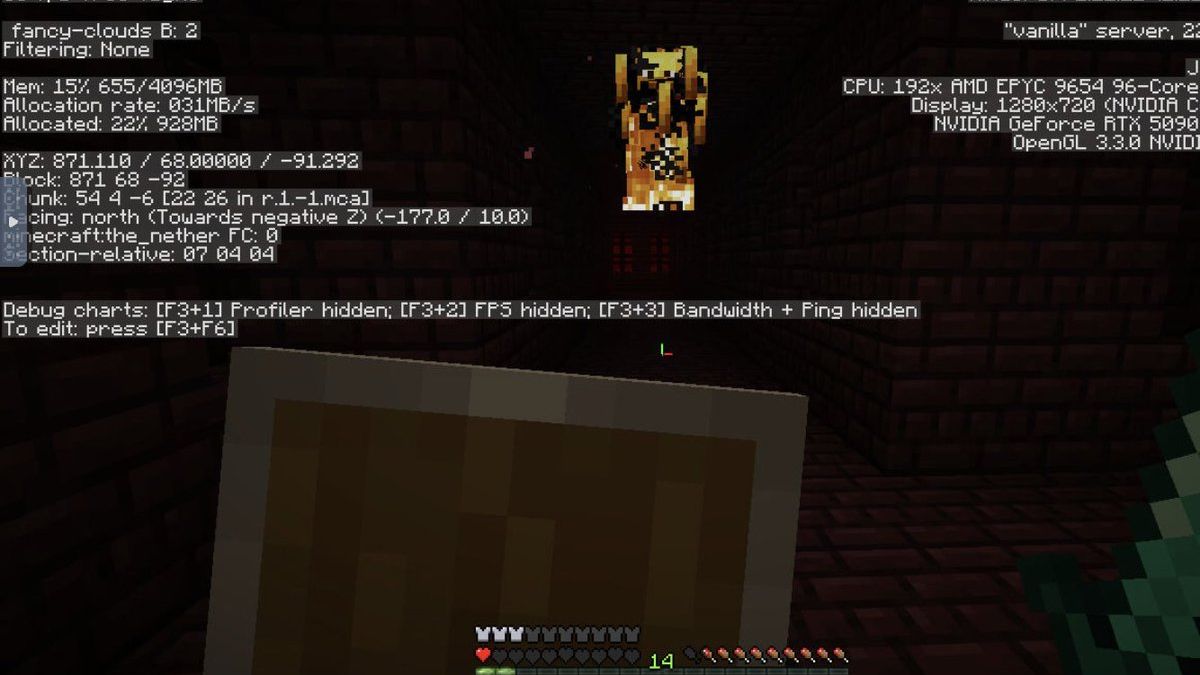
'Defeated' GPT-6 Astra model spent several hours just farming potatoes after being blown up by a Creeper in Minecraft — OpenAI offering gets further than any other AI system in 141-hour test

An apparently sad and defeated GPT-6 Astra spent several hours doing nothing but farming potatoes during a 141-hour Minecraft benchmark test, after dying and losing all of its gear to an exploding Creeper. Vals AI records that while GPT-6 Astra, OpenAI's latest frontier model, got further than any AI system had in its 141-hour test, the experiment did reveal a distinctly human lapse in motivation after all of its progress was wiped out by the destructive mob.

While the model outclassed rivals in how much it was able to achieve, the test has gone viral for a different reason. After Astra put all of its valuable end-game items in a chest, a Creeper appeared and blew up both the chest and Astra's bed — a calamity any Minecraft player will tell you is the worst thing that can happen. Not only did Astra lose all of the items to the explosion, but the bed destruction wiped the spawn point out, effectively resetting your game progress to zero. "Here, the most expensive creeper explosion occurred. Later, on a coincidentally rainy day, Astra discovers it lost everything. It all went downhill from here," Vals records.

GPT-6 Astra had gotten further than any AI system had ever gone in Minecraft.It was able to set up a semi-automatic blaze farm, allowing it to collect 6 blaze rods. It then located a warped forest, where it killed 6+ endermen and collected 3 pearls. As thousands of viewers… pic.twitter.com/qsgDsJEpd8September 15, 2026

"The model appeared defeated, spending the next several hours doing essentially nothing but farming potatoes," Vals observed. In fact, it got so bad that viewers on Twitch watching the experiment live started to agitate for the model to pick up the pace. Like all good Minecraft players, Astra reportedly became "paranoid about creepers," logging "GREEN tall thing ahead was SUGARCANE, NOT creeper!"

The AI was also recorded berating itself for dropping things, and even warned itself, "do NOT waste another night chasing dark pink pixels," i.e., pigs.

Astra has made waves as OpenAI's latest frontier model, which is notably adept thanks to its computer use and browsing, letting it navigate, click, and type like a human using a computer. The company has claimed it's an ethereal 'Alien Mind' with AGI-like qualities. Last week, the model was recorded autonomously completing Portal in just 24 hours at a cost of just $571 in tokens.

  •  

AWS tells clients to quit Middle East data centers six months after Iranian drone strikes — Amazon offers no recovery timeline as UAE mulls underground data centers [Updated]

More than six months after Amazon Web Services (AWS) data centers in Abu Dhabi and Bahrain were attacked by drones, the company has now had to tell customers to move their data to facilities in other regions. The Wall Street Journal reports that AWS has admitted that it's time for customers to jump ship to data centers located elsewhere in the world. In its AWS dashboard update, AWS confirmed "most customers have been able to re-establish their operations in other Regions by restoring backups or copying data that remained accessible. AWS Support remains available to help customers who need assistance moving their applications to alternate Regions."

The move comes as AWS continues repairs on the damaged data centers, but it stopped short of offering a timeline as to when customers can expect either location to be back online. AWS says that it remains committed to supporting its customers in Bahrain, but only said it would provide a further update early next year. It did not offer any specific recovery time frame for the restoration of services. Regarding the UAE, AWS says that it is working to replace affected infrastructure, but again only said it would provide an update on the restoration of services in the coming months.

Both affected data centers became targets for the Islamic Republic of Iran after the United States and Israel launched strikes on that country in February of this year. Months later, the Bahraini data center was struck by cruise missiles, and Iranian state media claimed it had been "destroyed."

The move is bad news for the United Arab Emirates. The U.A.E. has spent years trying to become a world leader in data processing, a pitch that led it to lobby U.S. officials to allow it to buy AI chips for its data centers.

Having made plenty of noise about OpenAI's decision to take a spot in a 5-gigawatt data center complex in May 2025, U.A.E. officials have since seen those plans stall. The WSJ points out that no lease has been signed well over a year later. OpenAI was expected to take 20% of the data center's total capacity, the kind of loss that is sure to sting officials if plans don't get back on track.

For its part, the U.A.E. is clearly well aware of the threat that the ongoing regional instability poses to its ambitions, and it's looking for ways to address the fears of potential partners. Officials have already hinted at the potential for underground data centers. While the move would make an already costly endeavor even more expensive, it could help defend new data centers from drone attacks. Building drone defense systems near data centers is another option.

Drone attacks can be catastrophic for any building, and data centers are no different. The data centers operated by AWS suffered fires and damaged infrastructure as a result of the strikes. In their efforts to fight the fires caused by drone strikes, emergency workers used water, causing further damage.

The Abu Dhabi and Bahrain data centers are relied upon by a variety of businesses in the banking and financial sectors. Those businesses cannot tolerate downtime, especially of the protracted variety. There's little sign of data centers slipping from the crosshairs of drone operators any time soon, either, and AWS is far from unique in finding its data centers under attack.

Iran's Islamic Revolutionary Guard Corps (IRGC) claimed in April that it had hit a data center linked to Oracle in Dubai. That unit further threatened American tech companies, including Microsoft, Oracle, Alphabet, and Nvidia, this spring. It accused the companies of contributing to attacks on Iran. With that in mind, and with tensions in the Middle East looking unlikely to ease any time soon, it's perhaps unsurprising that AWS has asked customers to move data to safer data centers around the world.

Google Preferred Source

  •  

China's open-weight AI models are now just 4 months behind frontier US offerings, Mozilla report claims — models still lag in some benchmarks but are drastically cheaper to use

Mozilla has published version 1.1 of its State of Open Source AI report on Sept. 15 using data current to Sept. 1, revealing that many of the best Chinese open-weight AI models are closing the gap with U.S. frontier offerings. The best open model trailed the closed leader on the Artificial Analysis Intelligence Index by three points at 60% of the price and two points behind Claude Fable 5 at 30%. Mozilla’s fit on METR task-horizon data puts the open-closed gap at around 4.4 months, in line with Epoch AI’s four-month estimate.

Mozilla is the nonprofit behind the Firefox web browser, and its report is a recurring assessment first published on July 14 on the Mozilla blog. It’s built on a Mozilla/SlashData survey of roughly 1,400 developers along with OpenRouter traffic data and third-party benchmark indices. Mozilla is an advocate for open models, and TIME reported on July 14 that Raffi Krikorian, Mozilla’s chief technology officer, described the report as partly advocacy. “Open weights” in this context means downloadable weights rather than training data or code. The report counts 16 notable open releases, but none delivers the data recipe required by the Open Source Initiative’s definition.

The four-month figure rests on METR, which is a research nonprofit that scores models by the length of task, in human working time, they complete half the time. By Mozilla’s fitted estimate, closed models handle tasks that take human experts 8 to 12 hours. Open models reach that about four months later, with open capability doubling every 3.9 months versus 5.5 for closed, by Mozilla’s computation. Mozilla also charted vals.ai’s Terminal-Bench 2.1 results, which run every model through the same harness, or software layer that offers a model its tools. On that board, Z.ai’s GLM-5.2 scored within a point of Claude Opus 4.7 and about four points behind Opus 4.8, at less than one-fifth the cost per test. On OpenRouter, a marketplace that routes developer traffic to hundreds of models, Mozilla counted eight of the top ten models by August token volume as open weights, seven of them Chinese-built. Nevertheless, closed providers took 96% of model-layer revenue on OpenRouter from May–September 2025, the Linux Foundation reported. “We see the decision to pay for closed [models] as workload-specific rather than organization-specific,” Krikorian told Ars Technica in an email.

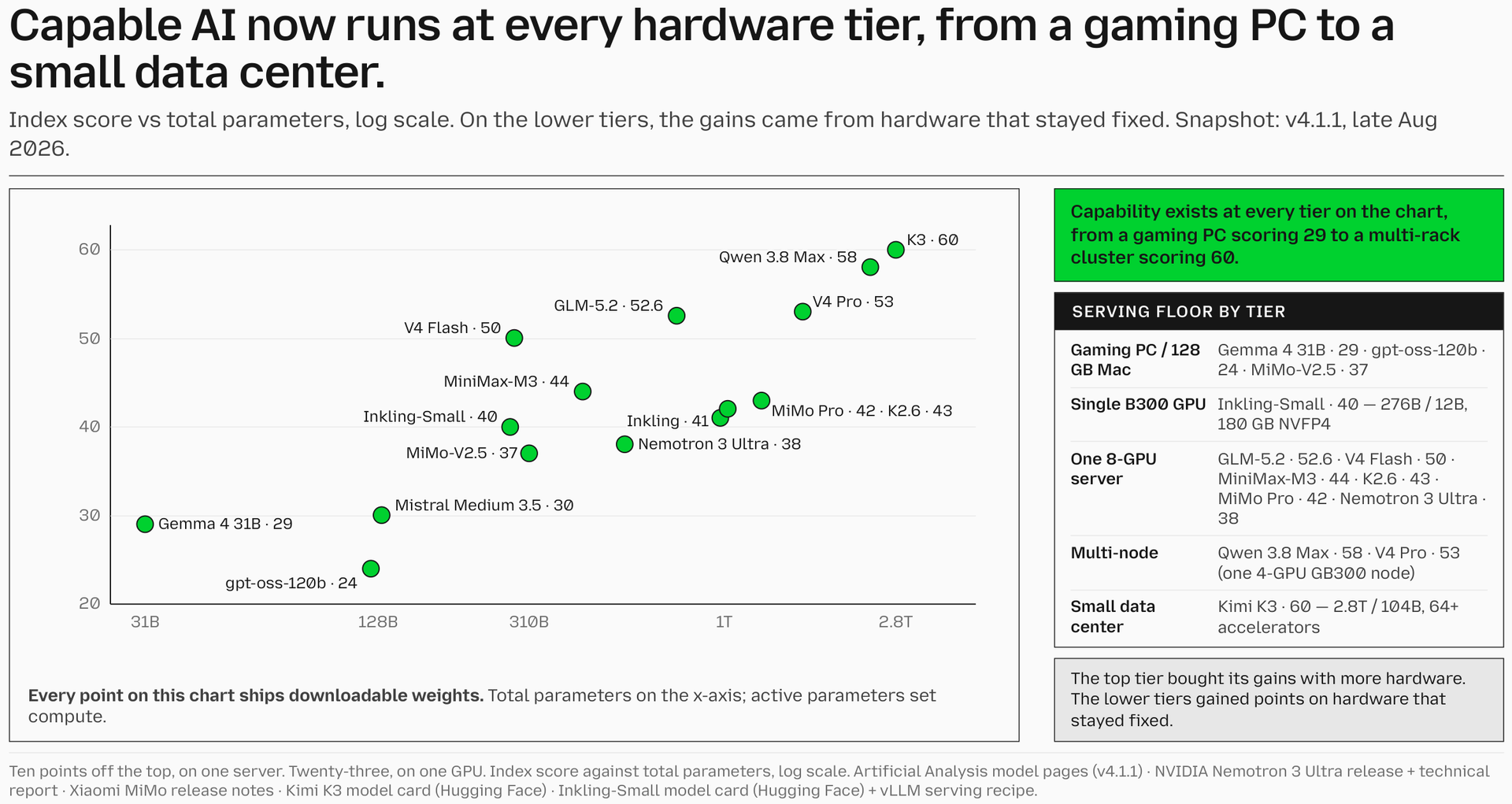
Mozilla chart of the best open-weight model score at each hardware tier.

(Image credit: Mozilla)

One caveat is that the four-month gap and the 30% token price figure are measured API to API on hosted endpoints and at list price. The report’s own hardware chart puts the best open model that fits one server at 52.6 and the best on one GPU at 40. The drop from the top is 10 and 23 points, respectively, a larger gap than the reported four months. Kimi K3’s native MXFP4 checkpoint runs about 1.56TB across 96 shards, and Mozilla’s serving configuration lists 64 or more accelerators, while vLLM calls for at least eight GB300 GPUs, with multiple nodes for production traffic. The report describes this as open but not runnable by most who hold it, and Tom’s Hardware put the memory need near 1.5TB in July. One example exception is Thinking Machines’ Inkling-Small model, under the Apache 2.0 license, whose NVFP4 version fits one B300 at a 180GB floor.

The report’s data stops at Sept. 1. Since then, Artificial Analysis has moved its index to v4.3 with a different evaluation set. The live board has Claude Fable 5.1 at 53 on its highest effort setting with Kimi K3 at 44, not comparable to the v4.1.1 numbers Mozilla plotted. vals.ai’s Terminal-Bench 2.1 board, updated Sept. 11, is now led by GPT-6 Astra at 87.27% with Fable 5.1 at 85.02%. Mozilla’s own chart caption reads: “the gap resets every release cycle.” K3 also carries an allegation detailed in the Sept. 8 NSA/CISA/FBI joint advisory (AA26-251A). The claim, which Mozilla’s report states as “asserted, and unshown,” is that Moonshot extracted Claude Fable 5 data to train K3 through distillation, the practice of training one model on another model’s outputs. On July 17, Artificial Analysis had K3 at 57 versus Fable 5’s 60, while on Sept. 1, Mozilla had it two points back.

  •  

AI enthusiast builds GPT-6 Astra-powered bot to take on Balatro's Gold Stake Black Deck — bot leverages Python for numerical tools, beats hardest difficulty repeatedly

A Reddit user has shared details of a new bot that has beaten the devilishly difficult Gold Stake Black Deck in Balatro, a poker-like video game. The Redditor, who works in the AI industry, says that they have been testing the bot and "obtaining some crazy results" — and they've even shared a YouTube video highlighting how they went about creating the card shark of a bot.

In a post in the /balatro subreddit, user Atol8 (real name Jacopo Attolini) initially claimed the bot was the first of its kind to reliably beat Balatro. They subsequently admitted that "reliably might be a strong word," adding that the bot has "repeatedly beaten Balatro."

My Balatro Bot just won at Gold Stake Black Deck
 from r/balatro

Beating Balatro in this instance meant beating the Gold Stake Black Deck, a combination that is widely considered to be the most difficult in the game. On its own, the Black Deck includes +1 Joker slot, but reduces the player's available hands by one per round. The Gold Stake effect introduces cumulative difficulty modifiers from all prior stakes, plus reduced hand sizes and stricter economic penalties.

Combining these two together makes for a brutal economy and more than a little luck, with players relying on strong early-game RNG.

In a post in the /balatro subreddit, user Atol8 (real name Jacopo Attolini) initially claimed the bot was the first of its kind to reliably beat Balatro. They subsequently admitted that "reliably might be a strong word," adding that the bot has "repeatedly beaten Balatro."

Beating Balatro in this instance meant beating the Gold Stake Black Deck, a combination that is widely considered to be the most difficult in the game. On its own, the Black Deck includes a +1 Joker slot, but reduces the player's available hands by one per round. The Gold Stake effect introduces cumulative difficulty modifiers from all prior stakes, plus reduced hand sizes and stricter economic penalties.

Combining these two together makes for a brutal economy and more than a little luck, with players relying on strong early-game RNG.

The bot itself is based on OpenAI's Astra models, which were released earlier this month. GPT-6 Astra has already grabbed headlines, having completed Valve's iconic Portal in 24 hours.

In a GitHub post detailing the ins and outs of the bot, Attolini says that GPT-6 Astra takes care of making strategic decisions based on the deck it has built. But the bot also relies on good old Python for its numerical tools. The legality of each move is assessed by BalatroBot, a separate tool that exposes Balatro game states and controls for external programs to interact with.

As impressive as this is, don't be fooled into thinking this bot played the perfect game. Reddit commenters have been quick to point out that it made some "interesting blunders" throughout its playthrough. Despite that, GPT-Astra is OpenAI's latest flagship model, with the company claiming it offers “a new generation of intelligence,” and “is state-of-the-art on computer use, browsing, software engineering, cybersecurity, science, and professional work.”

Not all bots are great at playing games, though. Just last year, OpenAI's ChatGPT "got absolutely wrecked on the beginner level” while playing Atari Chess. Elsewhere, Google's Gemini didn't even get as far as starting its own chess battle with the Atari 2600 — it ditched the game after deciding that it would "struggle immensely" against the iconic home console. It seems that, sometimes at least, even modern tech can't compete with a 1979 Atari 2600 game.

Google Preferred Source

  •  

Company behind failed Surrey oilfield project sells site at massive loss

New owners apply for permission to extract oil in Horse Hill despite landmark ruling from supreme court in 2024

After years of trying to dig for oil in Surrey, the company behind the drilling project that was turned down in a landmark supreme court ruling has sold off the site for a fraction of the money it spent on it, and rebranded as a clean energy company.

Meanwhile, the new owners, who picked up the site for £1m, are applying, once again, for permission to dig.

Continue reading...

© Photograph: Carl Court/Getty Images

© Photograph: Carl Court/Getty Images

© Photograph: Carl Court/Getty Images

  •  
❌