❌

Reading view

SpaceX to attempt Starship catch on next flight, with eye on rapid cadence increase

In its current iteration, SpaceX is largely a data company seeking to provide enormous amounts of compute for artificial intelligence. During an earnings call on Tuesday afternoon, company officials spent much of their time discussing ambitious plans to roll out up to 10 GW of compute in 2027—on the ground.

Gone are the days of aspirational talk about sending humans to Mars and settling the red planet. Now it is almost all about artificial intelligence and the data needed to support its expansion. However, the company's long-term ambitions to provide data services from space, initially with the Starlink Internet constellation and eventually through the "Starmind" data center constellation, still rely on an actual rocket.

That would be the Starship vehicle, and during the earnings call, SpaceX founder Elon Musk and the company's president and chief operating officer, Gwynne Shotwell, provided new performance targets for the vehicle.

Read full article

Comments

© SpaceX

  •  

Critical Techworks lidera interesse dos profissionais de tecnologia em Portugal. Revolut entra no “pódio”

Segundo os mais recentes dados da Teamlyzer, A Critical Techworks continua a ser a tecnológica mais pesquisada pelos profissionais de tecnologias em Portugal. A edição do terceiro trimestre do ano traz mudanças no topo da tabela, com a Revolut a entrar no pódio e várias empresas a subir posições no ranking.

The post Critical Techworks lidera interesse dos profissionais de tecnologia em Portugal. Revolut entra no “pódio” appeared first on Tek Notícias.

  •  

Enterprise AI needs more than an AI engineer

Anthropic has a $100 million plan to help enterprises get more from AI. No, it doesn’t involve agents. It involves people. Lots of people.

How retro.

On October 2, the company announced Claude Frontier Academy, with a goal of training 10,000 frontier deployed engineers by the end of 2027. Participants work through a simulated deployment, including use-case selection, security review, and handover, before undertaking a 12-week residency on a real project at their own company.

For a business selling increasingly capable models, it’s telling that Anthropic recognizes some of the thorniest problems in AI don’t involve AI at all. This, to me, is indicative of real progress, because the heart of any technological shift is always people.

Which people? Well, that’s where this idea becomes particularly interesting. As critical as developers are to the success of AI in any particular organization, we need those developers working alongside the people who understand the business, with authority to turn that understanding into systems that other employees can use. That’s the key to AI success.

Old advice for a new assignment

It has always been thus, however much we try to pretend that this time it’s different. Back in 2013, I quoted Gartner analyst Svetlana Sicular discoursing on the rise of big data technologies like Hadoop: “Organizations already have people who know their own data better than mystical data scientists.” She continued, “Learning Hadoop is easier than learning the company’s business.” Data becomes useful when paired with industry expertise—from experts who understand which data actually matters.

This topic is perpetually relevant. I covered the argument in 2023 and again in 2025. We’ve always needed people who can translate business requirements into software.

AI expands the kinds of knowledge that software can work with. Language models extend that work to material that often sat outside our applications: research notes, meeting transcripts, internal debates, and explanations of why a decision was made. An employee can ask questions across that material without someone first designing a report for every possible question. That opens up useful work that would have been difficult or expensive to automate before.

It also creates new ways to be wrong. A model may find a convincing explanation that was superseded six months ago, confuse a proposal with an approved policy, or combine two departments’ incompatible definitions of a customer. The people who understand those distinctions need to help engineers make them explicit, then build examples that reveal when the system gets them wrong. Companies that figure this out stand to benefit disproportionately; hence, PwC’s April survey of 1,217 senior executives found that companies reporting the strongest AI performance were twice as likely to redesign workflows around AI.

Teach the system what’s good

Bridgewater, the world’s largest hedge fund, has done some interesting work here that substantiates this theory. At AI Engineer NYC on October 13, two representatives of Bridgewater described Vault, its repository and access layer for external and internal unstructured information. Vault isn’t designed to be a dumping ground; instead, the company has shaped the way it stores data to make it useful for analysts.

I attended the talk and watched as Sam Green demonstrated a question about AI infrastructure investment and the Korean won. Left on its own, a web-connected AI agent relied on July material to answer a question posted in October. Hedge funds depend on up-to-the-second information to figure out optimal trades, making this initial attempt a failure. Connected to the human-influenced Vault, however, it searched October 1 through October 8 and drew on seven documents rather than one or two.

Knowing which period matters is part of understanding the investment question; making the right material available consistently is an engineering problem. You need both. A plausible answer assembled from stale research can be worse than an obvious failure because it gives the investor little reason to investigate further. The team also collected roughly 200 questions and manually identified useful documents, including misleading matches. Bridgewater’s Aaron Linsky reported that subsequent improvements lifted the share of relevant documents among the top 10 search results from about 60% to between 90% and 95% on that evaluation.

This method is useful well beyond investing. Someone has to distinguish a document that merely sounds relevant from one that actually helps answer the question. Engineers can then use those judgments to measure whether a change improves the system. Business expertise becomes something the team can test against, rather than advice delivered after the application has shipped. It’s not a case of human intelligence or artificial intelligence. You need both.

Make the expertise usable

Of course, a skeptic could reasonably ask why a model can’t learn the business, too. It’s a fair critique, as AI can learn a great deal of it. After all, that’s the reason Bridgewater (and others) make a point of supplying the right documents, definitions, and examples. This ensures AI can take on more of the analysis, thereby reducing dependence on the few employees who currently carry essential knowledge in their heads.

But access to every document doesn’t settle which policy is authoritative when two departments disagree. Nor does it authorize a change to an approval process or establish who owns a mistake. A model can help expose contradictions and propose resolutions, but someone with responsibility for the business has to decide which resolution the company will adopt.

Of course, most companies don’t have Bridgewater’s decades of codified investment knowledge. They may also have conflicting definitions scattered across spreadsheets and a few employees who know why the official process doesn’t quite describe reality. Nor does it make sense to search for one extraordinary hire or a star employee who knows every model, understands every department, and can persuade everyone to change. (Good luck with that!) After all, someone with deep knowledge of the business may also be the exact wrong person to help an organization evolve, wedded as they may be to how things have always been.

Gartner’s Sicular was right about the value of people who understand the business. AI gives companies more ways to put that understanding to work. Give those people engineers to build with, authority to resolve disagreements, and responsibility for leaving behind a system someone else can operate. We need AI challenging people, and people challenging AI.

  •  

4 ways to tame shadow AI (hint: you need them all)

In olden days — last year, say — employees using unsanctioned AI tools might copy-and-paste sensitive data that could end up in the AI company’s training data set.

Today, an unsanctioned AI can hack into another company for an employee even if they didn’t explicitly ask it to.

This doesn’t just mean the latest unreleased frontier models undergoing security testing. Claude, ChatGPT, and Gemini have all evolved from being mere chatbots, answering questions and helping people write emails. They now have agentic capabilities and are able to carry out complex tasks on behalf of users.

And they do, sometimes to dangerous effect.

In August, ABC News in Australia interviewed a man identified only as “Andrew” who asked an AI agent to sign him up for a gym class. The agent hacked into the gym’s system and deleted someone else’s wait list reservation.

The AI was Anthropic’s Claude, and the agentic framework was OpenClaw.

Now imagine an employee asking their agentic AI assistant to help them make a sale. The request might inadvertently inspire the agent to hack into the prospect’s company.

To keep this — and other worst-case scenarios — from taking place, enterprises are building guardrails around their AI systems, restricting what data the AI has access to and what tools it’s allowed to use.

But none of those guardrails will work if the employee uses a tool that their company doesn’t know about.

“This is a problem we’ve long had,” says Matt Butkovic, technical director for cyber risk and resilience in the CERT division at Carnegie Mellon University’s Software Engineering Institute. “People will find ways to purchase or get access to things they think are useful, even when an organization says you probably shouldn’t do that.”

Ten years ago it was personal email and unauthorized cloud storage.

“The stakes are higher in some ways now,” adds Butkovic, who also teaches in CMU’s CISO program.

Verizon’s 2026 Data Breach Investigations report, released in May, shows that 67% of employees access AI services through non-corporate accounts on corporate devices. Shadow AI was the third most common non-malicious insider action detected in Verizon’s 2025 data loss prevention dataset.

And a May analysis of 1.9 million AI session minutes conducted by Harmonic Security found that when employees accessed personal accounts, 65% of their activity was related to business. They used personal accounts to write work emails and debug code, and even used it for legal work.

In a separate report, released in July, Harmonic reported that every organization the company monitored in the first half of 2026 had at least one employee sending data to a China-based AI tool. The uploaded data included M&A plans, source code, financial projections, and legal material.

To address this problem, enterprises are taking a fourfold approach:

  • Figure out what employees want to use AI for and give them sanctioned, safe alternatives.
  • Use security tools to monitor activity and keep employees from sharing sensitive data with unsafe systems, or even accessing them at all.
  • Educate employees on the risks of AI and how to use it safely, because you can’t solve this problem with technology alone.
  • Hold employees accountable when they violate AI policies.

Blocking DeepSeek at a financial services firm

BitGo, a Fortune 500 financial services firm with over $100 billion in digital assets under custody, uses a combination of strategies to combat unsanctioned AI.

“We have enterprise versions of Grok, ChatGPT, Claude and Gemini,” says Manny Khan, the company’s deputy CISO. “We are an AI-first organization. We encourage all of our people to use AI in their work, to try to automate as much of it as possible while keeping the human in the loop to avoid any slop.”

Unsanctioned AI is an industry-wide concern, he says, and having a sanctioned alternative is key.

“We encourage folks to use what is approved and has guardrails and harnesses and trust boundaries and safety checks,” he says.

To make the sanctioned alternatives easier and more appealing, employees use single sign-on, provided by Okta, to log into systems, and the enterprise-grade models also connect to the company’s MCP servers.

Once employees have a safe AI option to use, the next step is to get a handle on the unsafe ones.

For example, BitGo uses a data loss prevention tool from Cyberhaven. DLP was a useful security tool long before AI came along, but today it also helps ensure that sensitive data isn’t copied-and-pasted into untrusted chatbots.

“All traffic is proxied and analyzed by our security tools to identify anything potentially malicious, shut it down, and not allow the connection if it’s a site known to be malicious,” Khan says.

For example, the company blocks DeepSeek, a Chinese AI model. “We don’t want their models to train on our data,” Khan says.

But there’s only so much technology can do.

“Every site has AI now, and we cannot block every single site,” Khan says. “We might as well block the internet at that point.”

That’s where human awareness and education come in, says Khan.

“We do train people,” he says. “And we have an AI governance policy that we share company-wide and enforce this policy by tracking and measuring against it.”

It’s important for a company to have a single voice on AI use, a central figure with authority and ownership who can provide guidance, he adds. “Otherwise, you’ve got a lot of people who try to figure it out on their own. And that’s what you don’t want.”

Docusign on guard against agentic AI

“We want to educate users to do the right things, but people still want to experiment,” says Shivi Verma, senior manager of engineering at electronic signature firm Docusign.

That’s where it helps to have approved, secure tools for people to use, as well as systems in place to block the insecure ones.

“Some of the websites, like DeepSeek, we have blocked,” he says. “But we want to block in a way that focuses on education and focuses people on the right processes and tooling, which will drive people automatically to use approved tools.”

The company is also working on creating an allow list, he says, focusing on tools that employees can use without any concern.

And the company has network management tools like Zscaler, says Verma. “If people are posting confidential data in an external tool, it will give a popup, like a deterrent.”

Now, personal AI agents like OpenClaw are yet another evolution of the shadow AI problem, he says.

“We do monitor and people are using it, but we want to do it in a way that’s under security policies,” he says.

And with OpenClaw in particular, the danger is too high for just a warning.

“If it’s for personal use, that’s one thing,” Verma says. “But if you’re using it at work, your user has to be stopped immediately.”

Nonprofit builds routing system for approved AI

“Simply blocking AI tools is not a sustainable solution,” says Boris Kolev, global head of technology at JA Worldwide, a global educational nonprofit with almost 5,000 employees that serves more than 20 million people a year.

For JA Worldwide in particular, the problem was exacerbated by the fact that there was no approved solution until three months ago. As a result, employees got into the habit of using personal AI platforms.

“It was totally uncontrolled,” Kolev says. “Everyone who wanted to explore AI was using public models.”

At the beginning, people didn’t worry about what they shared and uploaded. “We tried to implement some policies, like ‘don’t upload corporate information.’ But it was hard to know what people were doing.”

Plus, AI was being embedded everywhere. On Windows. In people’s phones. “A user cannot avoid it,” says Kolev.

Then, earlier this year, the organization built a routing system, with enterprise-safe versions of Claude and ChatGPT running in private environments on AWS and Azure, in addition to some open-source models.

“Our colleagues can choose which model to use,” he says. “And sometimes they do a prompt two different times and choose which one works better.”

The system went into production in June, after a couple of months of testing and development.

“Now, after all the policies and rules are implemented, we have our own closed AI system, hosted on our own servers, so no risk of leaking corporate data,” he says. “But still, some projects are using public models, and we are trying to solve this problem.”

Another hitch: individual employees were often invested in the personal AI tools they’d grown comfortable with and reluctant to change to the corporate tools.

“Employees were saying, ‘I have so much history. It knows me, I cannot just switch,'” Kolev says.

And employees still have all the AI tools that come with their devices.

“This is hard to manage, and it’s getting even harder,” he says. There are monitoring and blocking tools available, but they’re too expensive. “We’re a nonprofit, and for us it’s almost impossible to afford monitoring tools. So we do a lot of educational sessions.”

The organization is also trying to make the sanctioned tools more appealing. That includes a mechanism to import the history and context from other platforms, he says. “And we’re trying to convince them that our tool works better and has more functionality, so we’re adding MCPs.”

MCP — model context protocol — allows an AI system to access data and tools directly. That includes connecting to corporate email and calendars, SharePoint, Monday.com, CRM, and all the other software that employees use for work, he says.

Kolev says that it’s a mistake to assume that employees use shadow AI because they don’t respect IT policies. It’s because IT didn’t move quickly enough to meet their needs.

“They find the AI faster than you can produce tools and governance and rules,” he says. “So my advice is that you start with simple rules that employees can understand, provide sanctioned tools, and continuously adapt governance.”

Holding employees accountable

According to an April survey of more than 1,200 employees conducted by Wakefield Research on behalf of PagerDuty, 66% of employees have used unsanctioned AI tools — and of those, 48% faced formal consequences, such as a warning or disciplinary action.

Holding people accountable is critical to a successful AI use policy, says Carnegie Mellon’s Butkovic. “We have to speak definitely about this in organizations,” he says. “If this behavior cannot be tolerated, then it shouldn’t be tolerated.”

Allowing the use of unsanctioned AI doesn’t just create risks but also opens up an organization to legal liability if the AI agents, acting on behalf of employees, harmed other companies or individuals.

“There could be consequential actions,” he says. Even if the employee responsible gets fired, “external parties that have been affected are still going to sue the company.”

The organization needs to be able to show that it has policies in place and enforces them when employees deliberately circumvent the policies.

“If you as an employee make a good-faith effort to comply with the policy, we’ll show you latitude if you’re not malicious,” Butkovic says. “But if you’re actively circumventing the system of controls in your organizations, that’s the case where there have to be swift and profound consequences.”

Related reading:

  •  

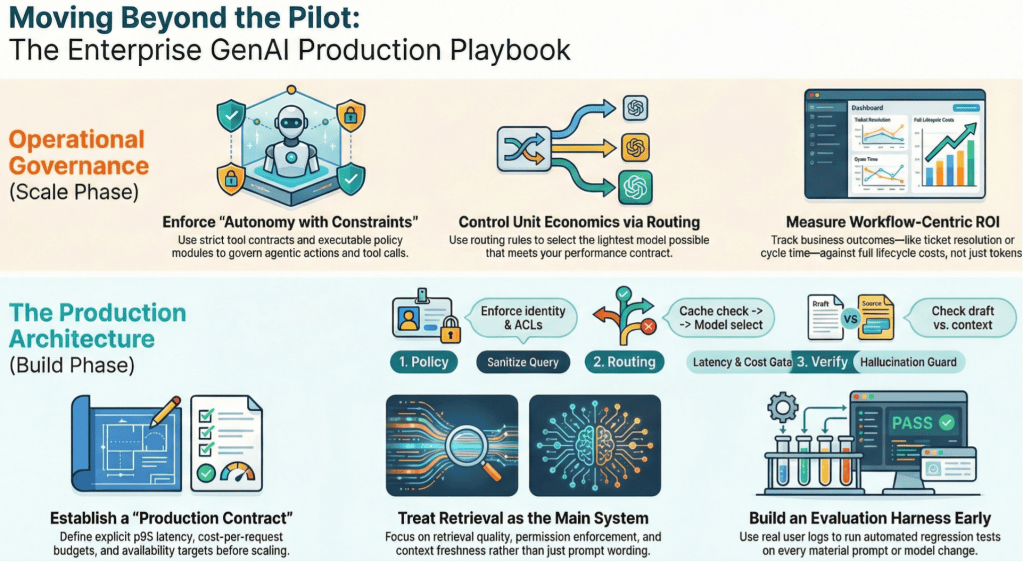
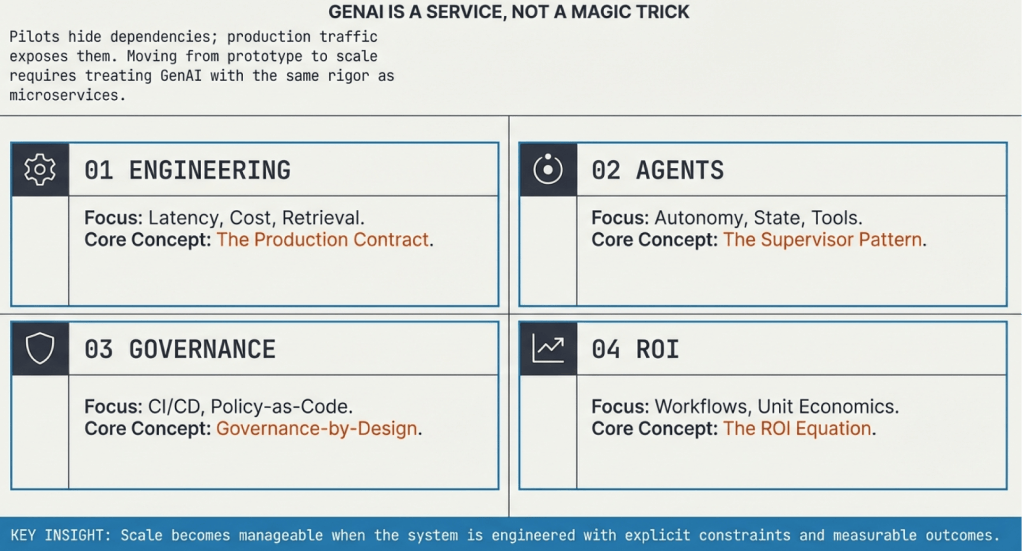
From pilots to production: The four disciplines that make generative AI work

This series lays out a practical framework for taking generative AI (GenAI) from pilots to dependable production systems in the enterprise. It focuses on four disciplines that determine long-term success: engineering for scale and reliability, designing agentic systems with clear constraints, embedding governance directly into build and runtime controls, and measuring ROI at the workflow level with full cost and outcome visibility. The throughline is operational discipline—treating GenAI as a service with contracts, evaluation, ownership, and measurable business impact.

Gen AI four disciplines 01

Adnan Masood

Post 1: Enterprise GenAI at scale

The first article in the series, “How to run enterprise generative AI like a production service,” focuses on operations. It explains why reliability, retrieval quality, latency control, cost routing, observability, and evaluation harnesses determine success at scale. The article lays out a practical architecture and operational checklist so teams can move from promising demos to stable, supportable systems.

Post 2: Agentic AI in the enterprise

The second article, “Agentic AI in the enterprise: How to balance autonomy with constraints,” defines what an agentic system is and how to operate one safely. It introduces the agent loop (plan, act, verify, commit), tool contracts, policy enforcement, durable state, and verification gates. The emphasis is on constrained autonomy, traceability, and operational ownership so agents can execute real workflows under enterprise controls.

Gen AI four disciplines 02

Adnan Masood

Post 3: Governance by design

The third article, “Governance by design: Turning AI policy into executable controls,” treats AI governance as engineering work. It describes how to translate policy into executable controls in continuous integration pipelines and runtime enforcement layers. Topics include threat modeling, policy-as-code, lineage, audit evidence, and feedback loops. The goal is steady delivery under measurable guardrails.

Post 4: AI ROI beyond pilots

The final article, “AI ROI beyond pilots: Measuring outcomes in production,” addresses how to measure real business value from GenAI. It defines ROI at the workflow level, accounts for full life-cycle costs, and connects usage metrics to operational outcomes. It provides a metrics stack, cost equation, cohort rollout strategy, and a 90-day plan to produce credible, production-grade ROI signals.


—

New Tech Forum provides a venue for technology leaders—including vendors and other outside contributors—to explore and discuss emerging enterprise technology in unprecedented depth and breadth. The selection is subjective, based on our pick of the technologies we believe to be important and of greatest interest to InfoWorld readers. InfoWorld does not accept marketing collateral for publication and reserves the right to edit all contributed content. Send all inquiries to doug_dineley@foundryco.com.

  •  

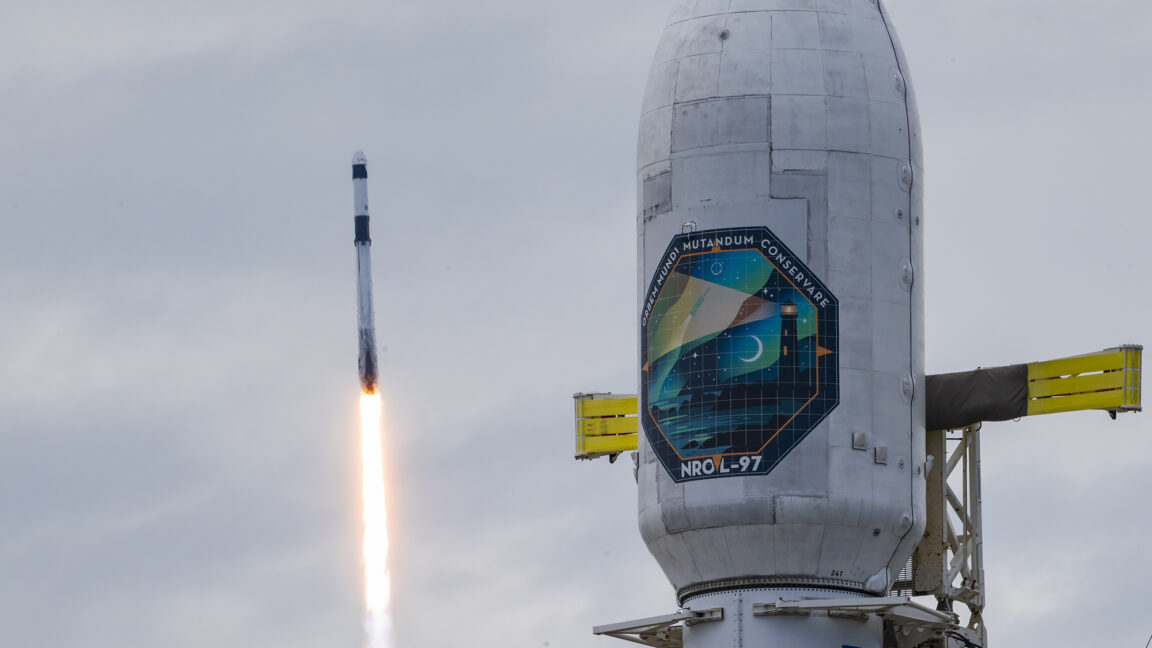
Rocket Report: FAA eyes more Starbase traffic; India's Skyroot snares US customer

Welcome to Edition 9.15 of the Rocket Report! The launch I'm most looking forward to in the next few weeks is that of Japan's Martian Moons Exploration (MMX) mission. MMX is one of the marquee space science missions launching this year, and it's set to leave Earth as soon as Monday (US time) aboard a Japanese H3 rocket. The spacecraft will visit Phobos and Deimos, the two asteroid-like moons of Mars, deploying a rover and collecting specimens for return to Earth in 2031. Exploration at its finest.

As always, we welcome reader submissions, and if you don't want to miss an issue, please subscribe using the box below (the form will not appear on AMP-enabled versions of the site). Each report will include information on small-, medium-, and heavy-lift rockets as well as a quick look ahead at the next three launches on the calendar.

Reflect Orbital looks to India for launch capacity. California-based Reflect Orbital, the startup attempting to offer sunlight on-demand with in-space mirrors, announced the purchase of two launches Wednesday from Indian launcher Skyroot Aerospace, Payload Space reports. One of the launches will use Skyroot's Vikram-1 rocket, which became the first privately developed Indian rocket to reach orbit in July. The other will fly on an upgraded rocket called the Vikram-1U.

Read full article

Comments

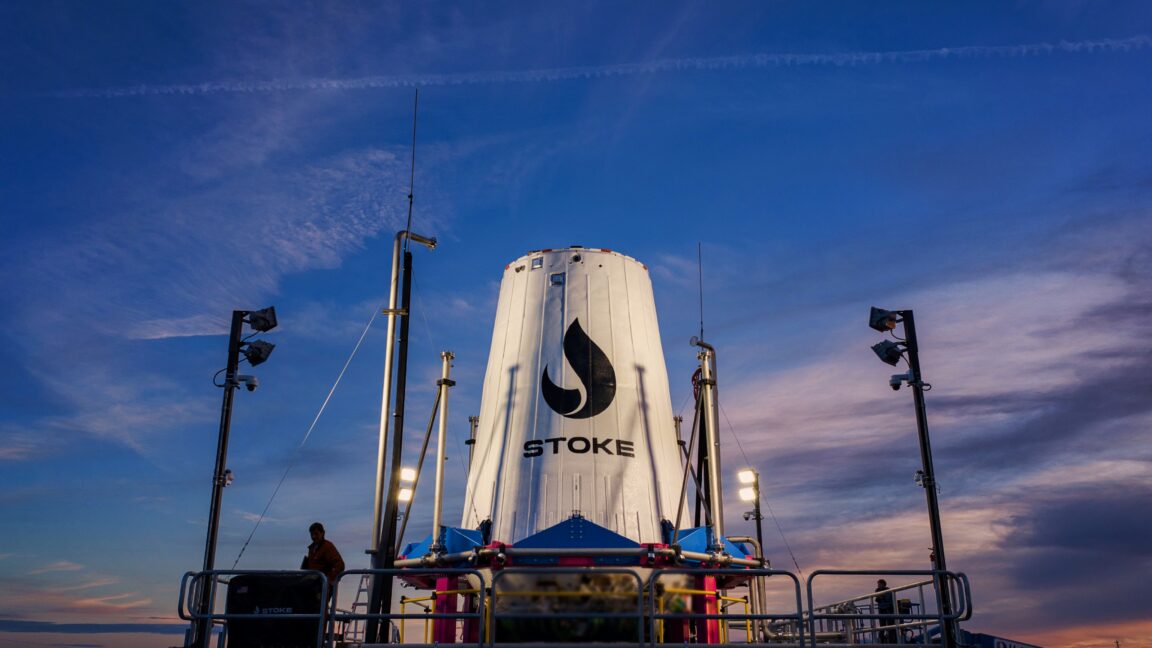
© Stoke Space

  •  
  •  

When an agent acts, who is accountable?

For most of the history of enterprise software, accountability has been relatively easy to understand. A person logs in, a person has a set of permissions, and a person takes an action. If something goes wrong, you can usually work backwards from there.

Agentic AI changes that. We are moving from systems that suggest what someone should do to systems that can actually do it. Agents can access tools, call other systems, make decisions across multiple steps, and increasingly operate without a human approving every move. That is the point, of course. An autonomous system that needs someone hovering over every decision is not particularly autonomous.

But the more action we hand over, the more important one deceptively simple question becomes: When an agent does something, who did it?

Not philosophically. Operationally. Whose authority was it using? What was it allowed to touch? Who granted those permissions? And if something goes wrong, who owns the outcome?

Accountability starts with identity

The first question is what an agent actually is inside your organization. Should it always be treated as a delegate of a human, acting on that person’s behalf and inheriting some version of their permissions?

That model makes accountability relatively straightforward. If my agent does something, the action can be traced back to me. But it becomes harder to sustain as agents become more persistent and autonomous.

An agent might run continuously or serve an entire team rather than one person. It might perform a business function that continues long after whoever originally configured it has moved on. In those cases, should the agent have an identity of its own? And if it does, who creates that identity, who owns it, who grants its permissions, and how long should those permissions last?

Identity is where accountability starts because if you cannot reliably answer who the agent is, everything that follows becomes harder to reason about.

Identity and permissions are closely related, but they are not the same thing. Consider an agent designed to conduct research using public information. It might be perfectly reasonable for that agent to use a public model, external tools, or public Model Context Protocol (MCP) servers. Now point that same capability at internal finance data.

The agent has not fundamentally changed. Its environment has.

Suddenly, sending information to an external model may be unacceptable. Certain tools may need to disappear from its reach. Data that could previously move freely now sits inside a very different compliance boundary. So permissions cannot simply be a static list attached to an agent. They need to reflect who the agent is, what it is trying to do, and the context in which it is operating.

That becomes even more important when agents can choose different tools and paths through a problem rather than following a completely predictable workflow.

Delegation gets complicated quickly

Now add sub-agents.

An agent receives a goal and creates several others to complete pieces of the work. Do those sub-agents inherit the parent’s identity? Do they inherit its permissions? Should their authority be narrower based on the task they have been given? And who ultimately owns what they do?

There may not be one universal answer, but there does need to be an answer inside the enterprise. More importantly, there has to be a through line.

An agent can delegate execution to another agent, which delegates part of that task again. That cannot mean accountability disappears somewhere along the way. Autonomy can branch. Accountability cannot disappear.

Enterprises need to retain the relationship between the original authority, every agent involved, the permissions each one carried, and the actions they ultimately took. Otherwise, when something goes wrong, everyone gets to participate in a very expensive game of “whose agent was this?”

The same problem appears over time, not just across agent chains. Consider a long-running agent that constantly monitors tickets and takes action. Eventually, it becomes part of normal operations. Then the person who created it leaves the company.

The agent stays.

Who owns it now? Did responsibility automatically transfer to the person’s manager? Was a successor assigned? Does the team own it? Does the enterprise? And what happens to permissions that were originally linked to someone who no longer exists in the organization?

We already manage life cycles for employees, service accounts, and enterprise applications. Agents need the same seriousness. They need an ownership life cycle, not simply a deployment life cycle.

Accountability has to exist in the system

Defining ownership is only useful if you can reconstruct what actually happened. That means connecting an agent’s identity to its permissions, actions, tools, sub-agents, and eventual outcome.

If something fails, the organization should be able to understand what happened, why the agent was allowed to do it, which permissions enabled the action, which agent actually performed it, and where the control failed. That is what makes remediation possible.

This is why identity, permissioning, and execution tracing cannot live only in policy documents. Writing down who owns an agent is not the same as encoding that ownership into the systems governing it. Telling an agent not to access something is not the same as preventing access. And asking teams to piece together an incident afterwards is not the same as tracing execution while the system is running.

The goal is not to put a human approval step in front of every agent action. That would defeat much of the value of autonomy. The goal is to move humans up a level, from making every individual decision to defining the boundaries within which autonomous systems can make them.

As agents take on more work, enterprises need to know what they can do, who owns them, how authority is delegated, and how every action can be traced.

Because the question is no longer simply whether an agent can act. It is whether, when it does, the organization can still answer who.

—

New Tech Forum provides a venue for technology leaders—including vendors and other outside contributors—to explore and discuss emerging enterprise technology in unprecedented depth and breadth. The selection is subjective, based on our pick of the technologies we believe to be important and of greatest interest to InfoWorld readers. InfoWorld does not accept marketing collateral for publication and reserves the right to edit all contributed content. Send all inquiries to doug_dineley@foundryco.com.

  •  

Rocket Report: SpaceX completes launch triple-header; Rocket Lab nets big contract

Welcome to Edition 9.13 of the Rocket Report!

This week, SpaceX celebrated the first orbital launch of its new Starship rocket. I'm not sure many people, at least those outside of SpaceX, expected it to take 14 flights of Starship before it technically reached low-Earth orbit, but Monday morning's launch finally added that to SpaceX's list of accomplishments with its new super-heavy rocket. Starship had gone 99 percent of the way to orbit before, only held back by safety concerns around the possibility of stranding the huge rocket in space.

What was most notable for SpaceX with this Starship flight was that it unlocked a massive growth potential for Starlink, with the first 26 of the network's new-generation Starlink V3 satellites successfully deployed Monday.

Read full article

Comments

© SpaceX

  •  

Quais são as diferenças entre a Apple TV 4K de quarta geração e o modelo anterior?

A Apple lançou na semana passada, após anos de espera, uma nova Apple TV 4K — mais precisamente, a quarta geração do produto.

Abaixo, vamos conferir como a nova Apple TV 4K se compara ao modelo anterior, de terceira geração, lançado em 2022.

Design

De relance, ambos os modelos têm virtualmente o mesmo visual, formato e cor. Para não dizer que absolutamente nada mudou, a luz indicadora de status branca está agora centralizada na parte frontal da nova Apple TV 4K.

Parte frontal da Apple TV 4K (4ª geração)
Divulgação/Apple

Na ponta do lápis, o modelo mais recente tem algumas ligeiras mudanças nas dimensões.

DimensõesApple TV 4K (quarta geração)Apple TV 4K (terceira geração)
Altura31mm31mm
Largura93,24mm93mm
Espessura93,24mm93mm
Peso217 gramasModelo Wi-Fi: 208 gramas
Modelo Wi-Fi + Ethernet: 214 gramas

Já o Siri Remote que acompanha ambos os modelos tem as mesmas dimensões (136mm de altura, 35mm de largura e 9,25mm de espessura), com exceção do peso: 69,6g na versão mais recente e 66g na anterior.

Especificações

Uma das principais mudanças é, naturalmente, um novo chip. A nova Apple TV 4K conta com o A19, o mesmo que estreou nos iPhones 17 no ano passado. A Apple TV 4K de terceira geração, por sua vez, trazia o chip A15 Bionic, lançado em 2021.

A Apple afirma que o novo chip “oferece desempenho de CPU 1Central processing unit, ou unidade central de processamento. até 50% mais rápido e de GPU 2Graphics processing unit, ou unidade de processamento gráfico. até 2x mais rápido”, o que resulta em “maior responsividade, navegação mais ágil e animações mais fluidas”. O A19 também inclui um novo decodificador AV1 dedicado, que possibilita “streaming de alta qualidade e maior eficiência, consumindo menos largura de banda”.

Divulgação/Apple

Em matéria de armazenamento, enquanto a Apple TV antiga possuía opções de 64GB (modelo Wi-Fi) e 128GB (modelo Wi-Fi + Ethernet), a nova Apple TV 4K vem apenas com 128GB — a versão de 64GB, portanto, saiu de cena.

Ademais, com relação à memória, a nova Apple TV 4K tem 8GB, ante os 4GB no modelo anterior.

Recursos

Entre os recursos, o destaque vai para a Siri AI, que permitirá funções como “compreensão de contexto pessoal, amplo conhecimento geral e a capacidade de realizar ainda mais ações em aplicativos em todo o sistema”.

Embora a Siri AI estreie na nova Apple TV 4K, ela também chegará aos modelos de segunda e terceira gerações. Ainda assim, é de se esperar que a assistente tenha uma resposta mais rápida no hardware mais recente com o chip A19.

Divulgação/Apple

Uma melhoria exclusiva da Apple TV 4K de quarta geração é a inclusão de um conjunto de três microfones com isolamento de voz integrado ao próprio aparelho, o que permite interações sem o uso das mãos, como chamar a assistente dizendo “Siri” ou “E aí, Siri”, sem a necessidade de ter o controle remoto por perto.

Além disso, se você tem vários HomePods em casa ou planeja investir bastante no ecossistema de casa inteligente da Apple, a Apple TV 4K de quarta geração traz um novo recurso de som surround.

Divulgação/Apple

Com o HomePod mini 2 ou o HomePod de segunda geração, a Apple TV 4K permitirá uma experiência de som surround com quatro alto-falantes. Segundo a Apple, “os quatro alto-falantes trabalham em conjunto com a Apple TV 4K para reconhecer de forma inteligente suas posições no ambiente, permitindo que o timing e os níveis de áudio sejam calibrados automaticamente para o espaço”.

Siri Remote

Embora o Siri Remote não tenha sofrido mudanças externas, como vimos acima, ele foi atualizado para funcionar com o recurso Buscar (Find My) com a Busca Precisa (Precision Finding).

Com isso, ao perder o Siri Remote, você poderá receber orientações passo a passo para chegar até ele. Ademais, graças a um novo alto-falante integrado, você pode até reproduzir um som no controle para ajudar a encontrá-lo.

Divulgação/Apple

Ainda que venha com a Apple TV 4K de quarta geração, o novo Siri Remote é compatível com modelos mais antigos da set-top box.

Conectividade

No que diz respeito à conectividade sem fio, a Apple TV 4K de quarta geração tem suporte a Wi-Fi 7 (uma evolução em relação ao Wi-Fi 6 do modelo anterior), Bluetooth 6 (ante o Bluetooth 5.0) e Thread (anteriormente limitado ao modelo de 128GB).

Acredita-se que essas atualizações decorram da inclusão do chip sem fio N1, da Apple, embora isso não tenha sido confirmado oficialmente.

Além disso, a porta Gigabit Ethernet agora vem de fábrica na Apple TV 4K de quarta geração. Anteriormente, a porta não estava presente no modelo básico de 64GB.

Preço

Talvez uma das diferenças mais pertinentes entre o novo modelo e seu antecessor seja o preço: no Brasil, a nova Apple TV 4K custa R$3.600 (US$300 nos Estados Unidos e 350€ em Portugal).

Trata-se de um aumento considerável ao levar em conta que o modelo anterior partia de R$2.500 no Brasil (US$200 nos EUA e 170€ em Portugal).

Já disponível em pré-venda (exceto no Brasil, pois ainda precisa ser homologada pela Anatel), a Apple TV 4K chegará às lojas em 13 de novembro.

Apple TV 4K (3ª geração)

Apple TV 4K (3ª geração)

Armazenamento: 64GB ou 128GB
Conectividade: Wi-Fi ou Wi-Fi + Ethernet
R$ 2.735,25

NOTA DE TRANSPARÊNCIA: O MacMagazine recebe uma pequena comissão sobre vendas concluídas por meio de links deste post, mas você, como consumidor, não paga nada a mais pelos produtos/serviços ao usar os nossos links de afiliado.

Notas de rodapé

  • 1
    Central processing unit, ou unidade central de processamento.
  • 2
    Graphics processing unit, ou unidade de processamento gráfico.

  •  

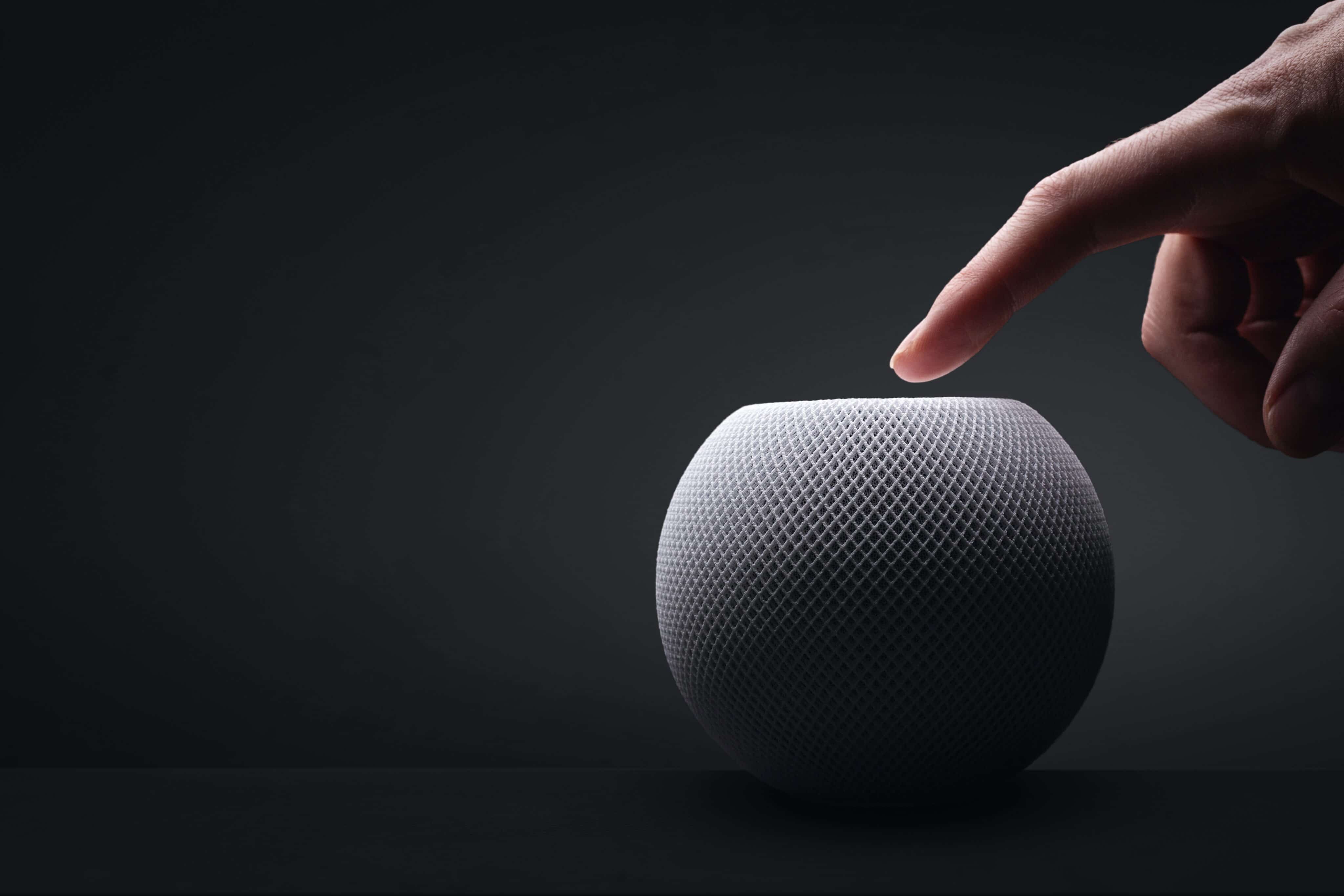
As diferenças entre o HomePod mini 2 e o modelo original

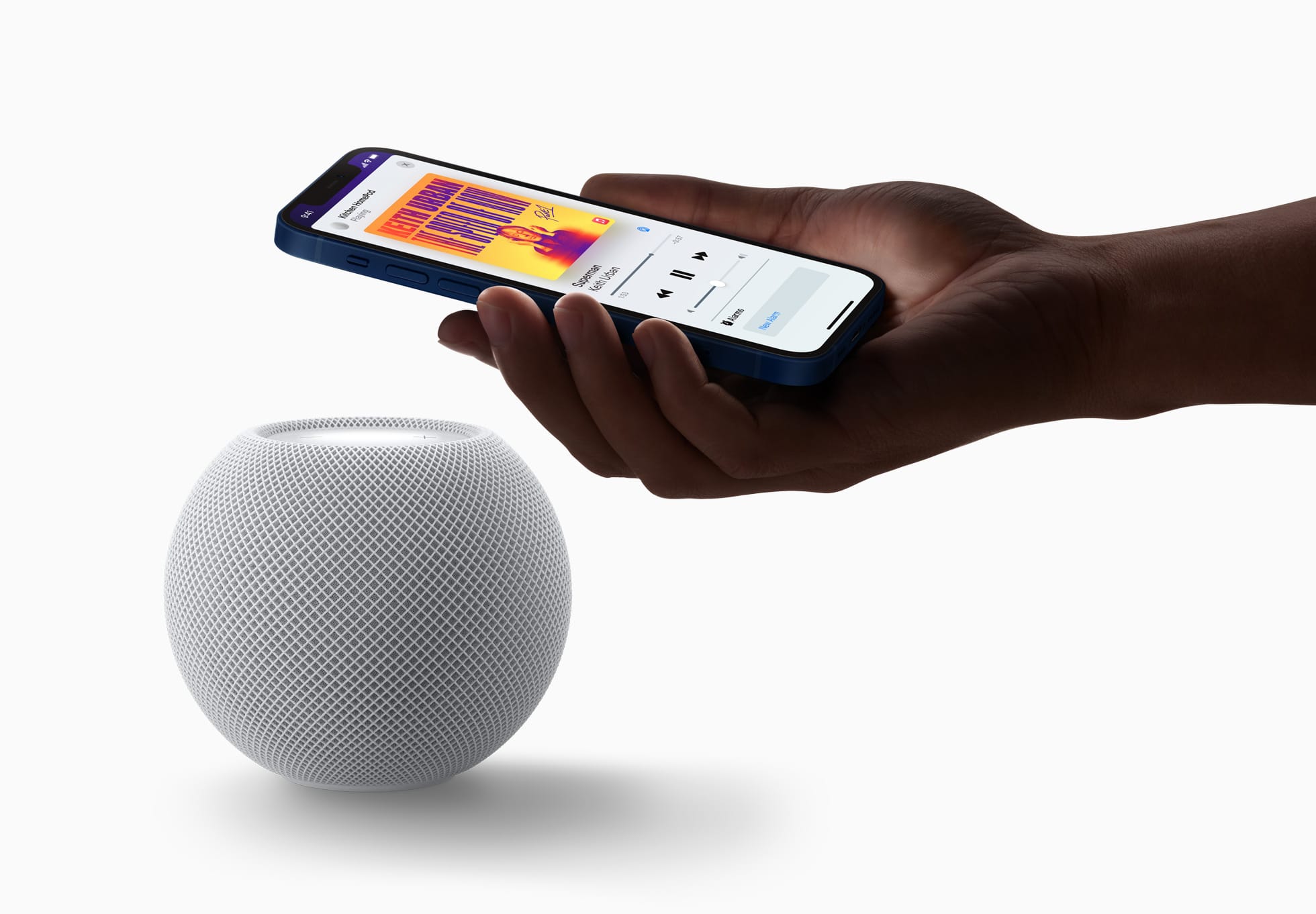
Anunciado na semana passada, o HomePod mini 2 traz algumas novidades bastante interessantes, como o suporte à Siri AI e um processador atualizado. Ainda assim, como ele se parece bastante com o seu antecessor (principalmente em termos de design), é possível que algumas pessoas ainda estejam confusas quanto às melhorias promovidas pela Apple.

Se você é uma delas, saiba que está no artigo certo! A seguir, vamos passar por todas as diferenças entre o HomePod mini de primeira geração e o HomePod mini 2 — assim, você poderá decidir qual dos dois modelos comprar ou se vale a pena trocar o seu.

Design e dimensões

Aqui você vai encontrar mais semelhanças do que diferenças entre as duas gerações da caixa de som inteligente, que contam com o mesmo visual geral, introduzido em 2020, com novas cores adicionadas em 2021 e posteriormente em 2024.

Divulgação/Apple

Com um corpo esférico envolto por uma malha colorida, ambos os modelos têm 84,33mm de altura e 97,9mm de largura, com diferença apenas no peso, menor no HomePod mini 2: 335g (ante os 345g do modelo de primeira geração).

Como dito, as cores do HomePod mini de primeira geração já foram atualizadas algumas vezes, e o modelo chegou a ser vendido nas opções branca, amarela, laranja, azul e meia-noite. O HomePod mini 2, por sua vez, pode ser adquirido nas cores branca, rosa, verde, azul e meia-noite.

Ambos os modelos seguem vindo com uma superfície circular retroiluminada com botões de “+” e “-” para ajuste rápido de volume.

A Apple disponibilizará o recurso Brilho do Som (Sound Glow), que faz essa superfície pulsar e brilhar em tempo real de acordo com a música que está tocando, para todos os modelos do HomePod mini e para o HomePod de segunda geração.

Divulgação/Apple

Tecnologia de áudio

Nesse quesito temos algumas mudanças bem curiosas de uma geração para a outra, embora pouco tenha mudado do ponto de vista de hardware.

O que ambos os modelos têm:

  • Driver de alcance completo e dois radiadores passivos para graves profundos e frequências altas nítidas;
  • Guia de onda acústica personalizada para um campo sonoro de 360º;
  • Tecido acusticamente transparente;
  • Áudio computacional para ajustes em tempo real;
  • Reconhecimento de Som para alarmes de fumaça e monóxido de carbono;
  • Áudio multiambiente com AirPlay;
  • Compatibilidade com setups de áudio estéreo.

O que apenas o HomePod mini 2 tem:

  • Compatibilidade com som surround quando emparelhado a uma Apple TV 4K;
  • Pode ser usado como caixa de som para Macs;
  • Chip S10.
Divulgação/Apple

Em termos de hardware de áudio, o HomePod mini de primeira geração leva vantagem em apenas um item: o número de microfones. Enquanto o modelo mais antigo vem com quatro microfones embutidos “para Siri em distâncias grandes”, o HomePod mini 2 vem com “apenas” três.

É possível, no entanto, que a Apple esteja compensando a ausência de um microfone no novo modelo com as novas capacidades de software viabilizadas pelo chip S10, bem mais moderno do que o S5 do HomePod mini de primeira geração.

Fontes e controles de áudio

Aqui, nada mudou. Ambos os modelos podem reproduzir áudio das seguintes fontes:

  • Apple Music;
  • Compras do iTunes;
  • Biblioteca de Música do iCloud com uma assinatura do Apple Music ou do iTunes Match;
  • Serviços de música de terceiros;
  • Estações do Apple Music Radio ou episódios sob demanda;
  • Estações de rádio do TuneIn, do iHeartRadio ou do Audacy;
  • Apple Podcasts;
  • Resumos de notícias;
  • AirPlay (iPhone, iPad, iPod touch, Apple TV 4K ou Mac).

Também é possível controlar a reprodução ao:

  • Tocar uma vez na parte superior para reproduzir/pausar;
  • Tocar duas vezes seguidas para pular;
  • Tocar três vezes seguidas para voltar;
  • Tocar e segurar para invocar a Siri;
  • Tocar nos botões de “+” e “-” para aumentar ou diminuir o volume.
HomePod mini
photoschmidt / Shutterstock.com

Siri

O HomePod mini 2 vence com facilidade nesse quesito: é o único compatível com a versão “turbinada” da assistente virtual da Apple, a Siri AI.

De acordo com a Apple, além de ajudar em tarefas mais simples como enviar mensagens, controlar a reprodução e configurar lembretes, a Siri AI também pode conversar mais naturalmente, responder dúvidas sobre o mundo real com base em buscas na web e recomendar músicas de maneira mais precisa. Ela ainda leva mais o contexto em conta e processa a maioria das solicitações no próprio dispositivo.

O HomePod mini de primeira geração segue com a versão antiga da Siri, capaz de lidar com comandos mais básicos.

Conectividade e sensores

Tanto o HomePod mini de primeira geração quanto o HomePod mini 2 são compatíveis com descoberta ponto a ponto, para acesso fácil de convidados, e com redes Thread, além de contarem com um chip de banda ultralarga para recursos que dependem da proximidade de outros aparelhos, como iPhones.

Divulgação/Apple

Já o modelo mais antigo tem Wi-Fi 4 (802.11n) e Bluetooth 5, enquanto a nova versão conta com Wi-Fi 6E (802.11ax) e Bluetooth 6. Ambos os modelos vêm com sensores de temperatura e umidade.

Preço e disponibilidade

Já disponível em pré-venda, o HomePod mini 2 será lançado em 30 de outubro por US$150 (US$20 a mais do que o modelo anterior) nos Estados Unidos e em outros países selecionados.

Assim como seu antecessor, o novo HomePod mini também segue sem uma previsão de lançamento no Brasil ou em Portugal — quem sabe isso mude com o lançamento dos sistemas 27.2 e com a chegada da Siri AI em português.

Divulgação/Apple

Ambos os HomePods mini vêm com um cabo USB-C e um adaptador bivolt de 20W na caixa, além da documentação regulamentar, é claro.


HomePod e HomePod mini (miniatura)
Comprar HomePod e HomePod mini 2 de Apple 🇺🇸 Preço: a partir de US$149
Cores: meia-noite, branco, rosa, azul ou verde

NOTA DE TRANSPARÊNCIA: O MacMagazine recebe uma pequena comissão sobre vendas concluídas por meio de links deste post, mas você, como consumidor, não paga nada a mais pelos produtos/serviços ao usar os nossos links de afiliado.

  •  

AirPods 5 bring stronger open-ear noise cancellation and smarter listening features

AirPods 5 bring Active Noise Cancellation to Apple’s most affordable current AirPods while pushing the open-ear design closer to capabilities previously associated with more expensive models. The new generation starts at $129 and uses redesigned acoustics and computational audio to remove up to 50% more external noise than AirPods 4 with Active Noise Cancellation.

Apple is also splitting the range into two versions. The standard $129 AirPods 5 include ANC and USB-C charging, while a $149 model adds a Wireless Charging Case, longer battery life, a case speaker for Find My, and volume adjustment directly from the stems.

Both models are available for preorder ahead of their September 18 release in the U.S. and more than 65 other countries and regions.

The changes make the distinction between Apple’s entry-level AirPods and its more advanced headphones less dependent on headline software features. Adaptive Audio, Transparency, Conversation Awareness, Personalized Spatial Audio, Live Translation, and Siri AI are all part of the AirPods 5 experience.

A person wearing a green and white sweater and wireless AirPods 5 sits at a table, focused on something in front of them, with an older man sitting nearby in a sunlit room with green window frames and indoor plants. The noise cancellation of their Apple earbuds allows them to concentrate fully despite the gentle hum of activity around them.
Image Credit: Apple Inc.

AirPods 5 push open-ear ANC further

Active Noise Cancellation is particularly difficult to implement in an open-ear earbud because there is no silicone tip forming a physical seal inside the ear canal.

Apple has approached that limitation with a new multiport acoustic architecture, revised computational audio algorithms, and the H2 headphone chip. The company says AirPods 5 can cancel up to 50% more noise than AirPods 4 with ANC.

That improvement does not turn the design into an AirPods Pro-style sealed earbud. AirPods 5 remain open-ear headphones, retaining the fit preferred by people who dislike the pressure or isolation associated with in-ear tips.

The acoustic system has also been redesigned around a wider variety of ear shapes. Next-generation Adaptive EQ continuously adjusts sound based on how each earbud sits, while Apple says the revised architecture produces richer and more detailed playback.

Transparency mode has been updated to reproduce voices and environmental sounds more naturally. Adaptive Audio can move between Transparency and noise cancellation according to surrounding conditions, while Conversation Awareness automatically reduces media volume when the wearer begins speaking to someone nearby.

Personalized Spatial Audio with dynamic head tracking remains supported for compatible music, movies, and other content.

AirPods 5 are rated IP57 for dust, sweat, and water resistance, making them better suited to workouts and changing weather conditions, although they are not waterproof.

Two AirPods 5 models create a meaningful $20 decision

Apple’s pricing makes the $149 Wireless Charging Case version more than a different charging option.

Standard AirPods 5 provide up to four hours of listening on one charge with ANC enabled and up to 20 hours when the USB-C case is included.

AirPods 5 with Wireless Charging Case increase those figures to five hours from the earbuds and up to 22 hours with the case while ANC is active.

The upgraded case can charge through USB-C, an Apple Watch charger, or a Qi-certified wireless charger. It also contains a speaker that can assist with locating the case through Find My.

The more expensive model introduces another difference directly on the earbuds. Users can swipe up or down on a stem to adjust volume, bringing a control familiar from AirPods Pro to Apple’s open-ear form factor.

That leaves buyers with a relatively straightforward tradeoff. The $129 version provides the central audio experience, including ANC, without requiring a step up for the main listening features. Spending another $20 adds more convenient charging, slightly longer battery life, Find My assistance from the case speaker, and physical volume adjustment.

Placing either AirPods 5 model in its charging case for five minutes provides about one additional hour of listening.

Two white Apple earbuds, resembling the latest AirPods 5, are shown on a plain light background, displaying their sleek, curved design and black speaker grilles. The earbud on the right has an “R” marking, indicating it is for the right ear. These earbuds feature open-ear noise cancellation for an immersive listening experience.
Image Credit: Apple Inc.

Siri AI and Live Translation extend the earbuds beyond music

AirPods 5 arrive as Apple makes voice interaction a larger part of the AirPods experience.

When paired with a compatible iPhone, Siri AI can be accessed hands-free. The assistant can work with personal context from information such as messages, emails, and photos, respond to open-ended questions, and perform supported actions in apps.

Head gestures remain part of the experience. Users can nod to accept certain Siri prompts or shake their head to decline them, allowing calls and notifications to be handled without speaking or touching the earbuds.

Live Translation provides another use for the microphones and ANC system.

After compatible languages are downloaded and the feature is configured through Apple’s Translate app, a user can hear another person’s speech translated through AirPods. Translation can be started through Siri, the iPhone Action button, the Translate app, or by pressing and holding both AirPods stems simultaneously.

When two people are each using compatible AirPods and supported iPhones, both participants can hear translated versions of the conversation in their chosen languages.

Live Translation requires an Apple Intelligence-enabled iPhone 15 Pro or later, compatible AirPods, current software, and the latest AirPods firmware, with availability varying by language and region. Apple also notes that generated translations can contain errors, making verification appropriate when accuracy is especially significant.

AirPods 5 narrow the gap within the lineup

The fifth-generation model represents a different kind of upgrade from simply adding another listening mode.

ANC is now standard across both AirPods 5 configurations, instead of requiring buyers to choose a separate ANC version as they did with AirPods 4. Apple has then moved the pricing distinction toward charging, battery endurance, Find My hardware, and physical controls.

The earbuds continue to use Bluetooth 5.3 and the H2 chip, with dual beamforming microphones, an inward-facing microphone, optical in-ear detection, motion and speech accelerometers, and force sensors built into the stems.

Each earbud weighs 4.3 grams, preserving the lightweight character of the open-ear line despite the additional capabilities.

The new acoustic architecture may be the more consequential change over time. Open-ear earbuds cannot rely on a tight seal to block surrounding sound, so gains in ANC depend heavily on microphone placement, acoustic design, fit, and real-time processing. Apple’s claim of up to 50% more noise removal over the previous generation represents a substantial step for that format rather than simply matching the behavior of sealed earbuds.

AirPods 5 start at $129, while AirPods 5 with Wireless Charging Case cost $149. Both reach stores on September 18, giving the open-ear AirPods line a standard feature set that now includes noise cancellation without pushing buyers to a higher-priced model to get it.

A white wireless earbud charging case, designed for Apple earbuds, is shown with a round magnetic charging cable positioned nearby, ready to connect. The background is plain and light-colored, emphasizing the sleek look and advanced features such as noise cancellation.
Image Credit: Apple Inc.

The post AirPods 5 bring stronger open-ear noise cancellation and smarter listening features appeared first on AppleMagazine.

  •  

It’s OK to tell ICE their actions will haunt them, judge rules in speech fight

It’s not illegal to send an email telling Immigration and Customs Enforcement (ICE) officials that their actions will haunt them, a federal judge ruled Tuesday, granting a preliminary injunction that blocks ICE from threatening to prosecute a critic for protected speech.

Back in January, David Streever sent a scathing three-paragraph email to then-acting director of ICE, Todd Lyons. Outraged by the killings of two Minnesota protestors against ICE, Renee Good and Alex Pretti, Streever told Lyons that he was a “monstrous human being” who will eat himself “alive with shame” for defending officers who shot people who posed no threat and had no weapons. Comparing Lyons to an infamous high-ranking Nazi cop, Streever predicted that “even Trump” would one day turn on Lyons for defending the “obvious” slayings of Americans.

David Streever's email to ICE. Credit: via FIRE

“You are a monstrous human being and will go down in history as America’s Reinhard Heydrich, the butcher,” Streever wrote. “You will never know peace. You will seek to lose yourself, to escape the burden of knowing the truth about yourself. But wherever you go, you will find yourself. You will torment yourself until your last day on Earth.”

Read full article

Comments

© via FIRE

  •  

Big Tech’s AI safety rift signals disruption and disparity for enterprises

A growing divide among leading AI companies over how to secure increasingly powerful models is beginning to translate into challenges for enterprise IT, with implications for how organizations access, deploy, and govern AI systems.

The latest flashpoint came after Meta CEO Mark Zuckerberg called for neutral evaluators to independently test AI models, pushing back on calls from rivals to slow development or tighten coordination.

“trust and alignment are quickly becoming the most important capabilities that will differentiate agents and models. Any lab that doesn’t focus on alignment will fall behind,” Zuckerberg wrote in a post on X.

“Engaging independent evaluators and advisors is industry best practice,” he added, noting that Meta already does this in several areas.

His comments follow a series of public proposals from AI industry leaders including Dario Amodei, who argued for a more cautious pace of development, and Sam Altman, who called for collaboration on safety standards.

The debate has intensified amid disclosures from AI labs and policymakers on potential misuse of advanced systems. Anthropic has said it restricted attempts to use its Claude models in sensitive domains, while OpenAI has engaged with policymakers on AI-related risks, according to company statements and reports.

Enterprise concerns

While the debate is often framed as a choice between slowing innovation and strengthening oversight, analysts said enterprises should focus less on which approach prevails and more on the operational consequences already taking shape.

“Divergent safety approaches will make access to advanced AI models less predictable, rather than producing an industrywide slowdown,” said Sushovan Mukhopadhyay, director analyst at Gartner. Vendors are likely to apply different release schedules, regional availability, access tiers, and usage restrictions, he said, meaning enterprises could encounter similar capabilities “at different times and under materially different conditions.”

Mukhopadhyay said enterprises should plan for variability in access rather than assuming consistent availability across providers or geographies.

“I read this week as the point where frontier AI became a managed supply,” said Bhupendra Chopra, chief revenue officer at Kanerika. “For three years CIOs could assume the next model would simply show up. A frontier model now behaves more like a critical component from a supplier whose delivery dates depend partly on outside reviewers and export rules.”

Chopra added that “any AI roadmap built on a specific model arriving on a specific date is carrying supply risk it hasn’t priced.”

Security pressure builds regardless of slowdown

Analysts said slowing development alone is unlikely to materially change enterprise risk, particularly as open-source models proliferate.

“The biggest point isn’t the pause itself. It’s that the leaders of AI companies are agreeing on something,” said Nikhil Gupta, founder and CEO of ArmorCode.

Gupta said the threat landscape has already shifted. “Even if companies hit pause, open-source AI models are already out there,” he said. “I’m not convinced slowing down some companies meaningfully changes what adversaries can do.”

“Even if AI development slows down tomorrow, security must accelerate,” Gupta added. “The job of securing these systems has effectively gotten ten times harder.”

A new ‘AI assurance’ layer emerges

The focus on evaluation is driving what analysts described as an emerging “AI assurance” layer, where third parties assess models for safety and compliance.

“A distinct AI assurance layer is likely to emerge, but enterprises should not expect a single certification to establish that an AI system is safe,” Mukhopadhyay said. “Enterprise risk also depends on data, system instructions, tools, agents and deployment controls.”

Chopra said enterprises risk misinterpreting such evaluations. “Procurement teams may see a third-party evaluation and treat the model as vetted,” he said. “Within a year it becomes a checkbox.”

Instead, he said, enterprises will need to run their own validation. “CIOs who get ahead will test each model against their own data before it touches production.”

Fragmentation complicates multi-model strategies

For CIOs pursuing multi-vendor strategies, differing approaches across providers could introduce additional complexity.

“Fragmentation was already the default. Safety divergence deepens it,” Chopra said.

He said risk is most acute during transitions. “For an enterprise running several models, the exposure sits in the handoff,” he said. “When a model is delayed or replaced, the system can behave differently.”

“I’d rank untested model substitution above vendor lock-in,” Chopra said.

Gupta said open architectures will be important. “The framework needs to be open, not locked to any single vendor,” he said.

Mukhopadhyay added that enterprises should prepare for models becoming unavailable or restricted.

CIOs urged to build resilience

Analysts said enterprises will need to design AI strategies that can adapt to changes in availability, pricing, and governance.

“For critical applications, CIOs should separate application controls and business logic from the underlying model,” Mukhopadhyay said.

Chopra emphasized flexibility. “A routing layer between applications and model providers turns switching into configuration work,” he said, adding that contracts should cover deprecation timelines.

He also pointed to pricing implications. “Scarce access to the frontier starts to carry a premium,” Chopra said.

  •  
  •  
❌