❌

Reading view

Scientists Have Uncovered Large Quantities of Hidden Hydrogen Beneath Australia—and It Could Lead to a Clean Energy Breakthrough

Researchers say an untapped source of clean energy has been hiding beneath Western Australian soil, where some of the world’s largest iron deposits could harbor an unexpected secret.

These deposits, according to researchers at Edith Cowan University (ECU), are also rich in magnetite capable of producing hydrogen when it interacts with hot water, under conditions that mirror those which occur naturally deep underground.

Such processes, the researchers say, could be stimulated in magnetite-rich locations like Western Australia’s naturally reddish Pilbara region, stimulating hydrogen production and potentially unleashing a valuable, untapped clean energy source.

An Unexpected Source of Energy  

Magnetite is abundant within the Pilbara’s vast banded iron formations, and when subsurface temperatures rise, the naturally occurring interactions between this iron-rich mineral and water lead to chemical reactions—the same kind which can produce molecular hydrogen.

“Australia could be sitting on a massive, untapped energy reserve,” said ECU Associate Professor Alireza Keshavarz of the team’s recent discovery, “and the potential is enormous.”

To better understand the processes that may hold the key to unlocking Australia’s untapped subsurface energy reserves, the ECU team began by placing samples of magnetite in water heated to 200 degrees Celsius and under extreme pressure. The experiments continued for close to two months, during which time the researchers were able to recreate some of the same conditions that occur naturally deep within the Earth.

Doing so allowed the team to look at how hydrogen naturally forms, as well as what geological conditions help to sustain its production.

“Western Australia has some of the world’s largest banded iron formations,” said Kaveh Moghanirahimi, the lead author of a recent study detailing the team’s findings.

“If we can unlock this resource at scale, it could be transformative for our energy future,” he adds.

Water May Hold the Key

Significantly, the team says they found that just having large amounts of magnetite in subsurface deposits may not be all that is required for significant hydrogen production. Another key component is having enough water present to be able to reach fresh mineral surfaces for the hydrogen-producing reactions to continue.

Importantly, the researchers found that simply having large quantities of magnetite underground may not be enough. Water must also be able to reach fresh mineral surfaces for the hydrogen-producing reactions to continue.

“Our findings show that hydrogen production depends not only on the amount of magnetite present, but also on how easily water can access fresh mineral surfaces through fractures, pores, and permeable pathways,” said Professor Stefan Iglauer, a researcher with ECU’s School of Engineering.

Hydrogen through Injection?

The researchers also say they have identified a potential method for stimulating hydrogen generation by injecting a solution into banded iron formations. This, they say, points to a novel possibility: that geological deposits of the right specific kind may also one day function as sites for engineered production of naturally generated hydrogen.

That possibility, the researchers argue, could prove to be significant as governments and industries seek lower-emission alternatives to hydrogen currently produced mainly using fossil fuels. Also, unlike conventional methods of hydrogen manufacturing, tapping geological hydrogen only requires leveraging natural reactions that occur underground.

A Step Toward the Future of Clean Energy

Presently, the research remains an early step toward determining whether the process can be translated from lab experiments into a commercially viable method of producing clean energy with the resources present in natural geological formations.

However, if researchers can continue to capitalize on methods that allow hydrogen to be generated and recovered at economical scales, there are already remarkable possibilities in terms of what Western Australia’s enormous iron formations could one day help provide.

“This work helps bridge the gap between laboratory experiments and real geological systems,” Iglauer said.

The team recently reported its findings in the paper, “Geometry-driven controls on hydrothermal natural hydrogen generation from magnetite mineral,” published in the International Journal of Hydrogen Energy.

Micah Hanks is the Editor-in-Chief and Co-Founder of The Debrief. A longtime reporter on science, defense, and technology with a focus on space and astronomy, he can be reached at micah@thedebrief.org. Follow him on X @MicahHanks, and at micahhanks.com.

  •  

Driver Sets Record for Hydrogen-Powered Vehicle at More Than 406 M.P.H.

Andy Green, a 64-year-old retired Royal Air Force pilot from Britain, was already the only person to break the sound barrier on land. “The ground comes at you very, very quickly,” he said.
  •  

Scientists Turn Plastic Waste Into Clean Hydrogen Fuel

Thermal Treatment Process IllustrationThe advance could provide a scalable route to clean energy while making plastic recycling more effective. A discarded bottle, shopping bag or car part can remain in the waste stream long after its useful life ends. Although plastic is everywhere in modern society, recycling it remains difficult because most systems require different types to be [...]
  •  

Astronomers Uncovered a Hidden Bubble Inside the Orion Nebula

A key component of the Orion Nebula had escaped detection by astronomers until now, according to a new study in Astronomy & Astrophysics.

An international team led by Juan Diego Soler at the University of Vienna used two of the world’s most advanced radio telescopes to map neutral atomic hydrogen gas across the nebula’s outer shell at unprecedented resolution. The new maps provide a clearer view of the celestial feature, and reveal a previously uncatalogued second bubble—a shell with much less mass than earlier estimates—and a four-light-year filament of gas extending from the structure.

The Orion Nebula’s Miscalculated Bubble

Neutral hydrogen emits a faint radio signal at a wavelength of 21 centimeters, making it possible to trace otherwise invisible gas between the stars. Soler’s team solved this by combining data from the Karl G. Jansky Very Large Array in New Mexico and the FAST telescope in China. The VLA provided high resolution, while FAST picked up faint, widespread signals. Together, they produced the first detailed hydrogen map of the extended Orion Nebula, at the same scale as earlier ionized carbon maps.

Earlier calculations based on ionized carbon estimated that the front half of the shell was about 1,100 times the mass of our Sun. The hydrogen observations paint a different picture, suggesting the shell actually weighs in at closer to 100 solar masses. “Measuring mass is fundamental,” Soler said, “because it tells us about the efficiency of these newly formed stars shaping their environment with wind and radiation.”

A shell with only a tenth of the previously assumed mass significantly alters calculations of how efficiently newly formed stars shape their environment. The researchers note that molecular hydrogen, which is not detected in either the hydrogen or carbon data, may account for some of the missing mass.

A Second Bubble

The hydrogen maps also revealed an uneven distribution of gas, indicating a second, smaller cavity within the main shell. The team searched catalogs of known stars and young stellar objects in the region but found no candidate at the bubble’s center. The source responsible for creating the cavity may not be the type of object included in current catalogs.

Daniel Seifried at the University of Cologne, a co-author on the study, pointed to what that means for the models astronomers build to explain regions like this one. “These stunning observations serve as a reference for many modern astrophysical simulations investigating the evolution of gas and stars in the Milky Way. These are the kind of images that challenge the theoretical models and numerical simulations that we use to understand how massive stars affect their immediate surroundings.”

Previous models generally treated Orion’s shell as the product of a single expanding bubble. The discovery of a second cavity, with no obvious source at its center, instead suggests the nebula was shaped by multiple episodes of stellar feedback.

An Unexpected Filament

The new maps also uncovered a filament of hydrogen extending about four light-years from the shell’s western edge. Previous carbon-based observations saw only the base of this structure. The filament contains about 80 solar masses of hydrogen and does not appear to be associated with any known group of young stars. Its origin is unclear; it could be gas leaking through a weak spot in the shell or a leftover from the original cloud that existed before the bubble formed.

Claire Murray of the Space Telescope Science Institute, another co-author, framed the discovery within the broader push behind the observations. “This study is an exciting demonstration of the power of the latest-generation radio telescopes to uncover new pieces to the star formation puzzle.” Despite being one of the galaxy’s most extensively studied star-forming regions, the Orion Nebula continues to reveal discoveries.

This survey is the first scientific result from the NeAtHood project, which aims to map atomic hydrogen across nearby star-forming regions accessible to the VLA and FAST telescopes. Soler and his colleagues now plan to apply the same approach to additional targets. “Orion is only the beginning. Our newly developed methods show how future interferometers will reveal the hidden structure and dynamics of the interstellar medium—even in regions that astronomers already believed they understood well,” Soler explained.

If one of the sky’s best-studied star-forming regions still contains hidden structures, other nearby nebulae may prove equally surprising as the NeAtHood survey expands.

Austin Burgess is a writer and researcher with a background in sales, marketing, and data analytics. He holds an MBA, a Bachelor of Science in Business Administration, and a data analytics certification. His work focuses on breaking scientific developments, with an emphasis on emerging biology, cognitive neuroscience, and archaeological discoveries.

  •  

Astronomers Uncover Hidden Structures Surrounding Orion Nebula

Extended Orion nebula shell sampled by HI emission from the combined VLA and FAST observations (shown in red), Hα emission from the European Southern Observatory Digitized Sky Survey (shown in green), and 3.4-μm emission registered by the Wide-field Infrared Survey Explorer (WISE) satellite (shown in blue). Image credit: Juan D. Soler, University of Vienna / NRAO / VLA / NASA / WISE.

Using the Karl G. Jansky Very Large Array (VLA) s and the Five-hundred-meter Aperture Spherical Radio Telescope (FAST), astronomers have created the sharpest-ever radio maps of neutral hydrogen around the Orion Nebula.

The post Astronomers Uncover Hidden Structures Surrounding Orion Nebula appeared first on Sci.News: Breaking Science News.

  •  

Tiny 15-atom iridium clusters could supercharge green hydrogen production

Scientists have developed an extremely small and highly efficient catalyst that could improve the production of green hydrogen, one of the cleanest fuels being explored for the future. The international research team, led by scientists from Tohoku University, Tokyo University of Science, Vanderbilt University and the University of Adelaide, created tiny clusters made from only […]

The post Tiny 15-atom iridium clusters could supercharge green hydrogen production appeared first on Knowridge Science Report.

  •  

Green Hydrogen | Mythology Meets Reality

Fortescue Metals Group is scaling back its green hydrogen ambitions due to high electricity prices, reflecting challenges faced by companies like Woodside and Origin Energy. Despite job cuts and economic feasibility concerns, chairman Andrew Forrest persists in promoting green hydrogen, advocating for ambitious production goals, in spite of the underlying physics.

  •  

Webb Spots Supermassive Black Hole Older Than Its Home Galaxy

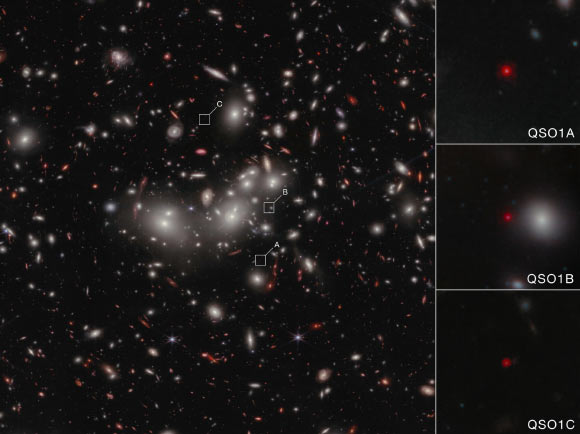
This Webb/NIRCam image shows the little red dot Abell2744-QSO1, magnified and triply imaged by galaxy cluster Abell 2744. Image credit: NASA / ESA / CSA / Lukas Furtak, Ben-Gurion University / Alyssa Pagan, STScI.

Astronomers using the NASA/ESA/CSA James Webb Space Telescope have found an enormous black hole in the early Universe that appears to predate its own host galaxy, raising fresh questions about how the cosmos’ first supermassive monsters were born.

The post Webb Spots Supermassive Black Hole Older Than Its Home Galaxy appeared first on Sci.News: Breaking Science News.

  •  
❌