
❌

Reading view

Astronomers Trace Elusive High-Energy Neutrino to Star-Forming Galaxy in Early Universe
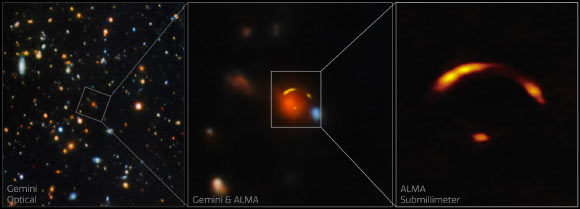
The origin of high-energy astrophysical neutrinos remains unresolved, and secure electromagnetic counterparts to individual events are rare despite rapid follow-up. Dusty star-forming galaxies at cosmic noon (redshift of z β‰ˆ 1-4) are natural cosmic-ray calorimeters, yet observational links between these galaxies and neutrinos have remained unknown. Urata et al. report a compact-core, dusty star-forming galaxy within an IceCube localization, JCMT0402-0424, a quadruply lensed galaxy at z = 2.988 located inside the 90% containment region of the IceCube event IC 210922A. Image credit: International Gemini Observatory / NOIRLab / NSF / AURA / ALMA / ESO / NAOJ / NRAO / T.A. Rector, University of Alaska Anchorage & NSF’s NOIRLab / D. de Martin & M. Zamani, NSF’s NOIRLab / Yuji Urata. MITOS Science Co., LTD.

JCMT0402-0424, a dusty starburst galaxy around 11 billion light-years away, is the strongest candidate yet for the source of the high-energy neutrino event IC 210922A, according to a team of astronomer led by Yuji Urata of MITOS Science Co.

The post Astronomers Trace Elusive High-Energy Neutrino to Star-Forming Galaxy in Early Universe appeared first on Sci.News: Breaking Science News.

  •  

Webb Weighs Most Distant Inactive Black Hole Ever Found

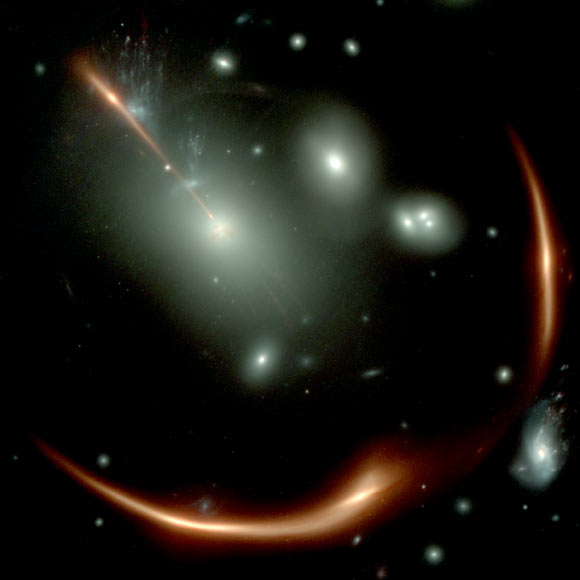
This Webb image shows the highly distorted red galaxy MRG-M0138 seen through a foreground cluster of galaxies (white sources). Image credit: NASA / ESA / CSA / Webb.

A supermassive black hole 6 billion times the mass of the Sun lurks in MRG-M0138, a gravitationally lensed quiescent galaxy seen when the Universe was just 3 billion years old, according to an analysis of data collected by the NIRSpec Integral Field Spectrograph onboard the NASA/ESA/CSA James Webb Space Telescope.

The post Webb Weighs Most Distant Inactive Black Hole Ever Found appeared first on Sci.News: Breaking Science News.
  •  

Webb Spots Supermassive Black Hole Older Than Its Home Galaxy

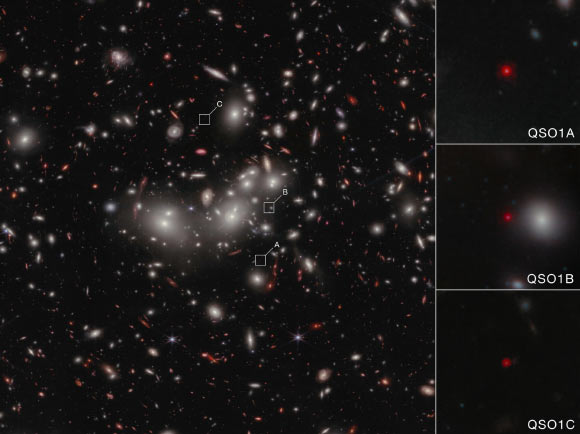
This Webb/NIRCam image shows the little red dot Abell2744-QSO1, magnified and triply imaged by galaxy cluster Abell 2744. Image credit: NASA / ESA / CSA / Lukas Furtak, Ben-Gurion University / Alyssa Pagan, STScI.

Astronomers using the NASA/ESA/CSA James Webb Space Telescope have found an enormous black hole in the early Universe that appears to predate its own host galaxy, raising fresh questions about how the cosmos’ first supermassive monsters were born.

The post Webb Spots Supermassive Black Hole Older Than Its Home Galaxy appeared first on Sci.News: Breaking Science News.

  •  
❌