❌

Reading view

New quantum chip taps into weird quasiparticles to get qubits to communicate over long distances

Researchers have developed a new type of interconnected architecture for quantum computing chips, and it could pave the way for machines capable of large-scale processing, including those with over a million qubits.

In a study published June 15 in the journal APL Quantum, scientists aimed to resolve a huge problem with the leading quantum processing units (QPUs): Qubits struggle to communicate and share quantum information with each other if they aren't immediate neighbors.

That's why the scientists pioneered Quantum Phononic Links (QPLs) — an approach for long-range coupling between qubits that leans on phonons — quasiparticles that carry vibration energy — to convey information. By contrast, conventional methods, like surface acoustic waves — high-frequency sound vibrations — demand complex designs and extra hardware.

"One of the key challenges in quantum computing is long-range qubit connectivity," Maksym Myronov, an associate professor of semiconductor materials and devices at the University of Warwick in the U.K. and first author of the study, said in a statement. "Our work introduces a new concept in which phonons act as a quantum bus, enabling distant qubits to exchange quantum information while remaining fully compatible with semiconductor technology."

In the study, the scientists said the most promising way to achieve a quantum computer that's capable of large-scale processing and takes advantage of QPLs would be a qubit modality known as "semiconductor hole spin qubits."

A "hole" here refers to the absence of an electron in a material, but it can act like a particle and have a spin state — a property used to encode quantum information — where the 1s and 0s of data would be represented by the direction of the particle's spin state.

To demonstrate this technology, they created a prototype QPU consisting of silicon with a thin germanium crystal layer, a specialized material they called compressively strained germanium on silicon (cs-GoS). Germanium is an especially useful material for quantum computing, the scientists said, as it has natural properties that reduce decoherence — the loss of quantum information due to external interference.

Hole spin qubits combine long quantum coherence times — how long they can retain quantum information — with the ability to communicate using electron impulses in control systems. But they struggle to form bonds and share quantum information with qubits they don't directly neighbor. In any large-scale system, for instance, enabling this "quantum coupling" between distant qubits is essential for quantum error correction techniques to work effectively across the breadth of a massive system, the scientists said.

Other proposed long-range communications approaches, such as "charge shunting" — redirecting capacitors to reduce sensitivity to charge noise, or surface acoustic waves — have fundamental limitations regarding scalability, both in terms of their size and in maintaining coherence. That's where QPLs come in.

QPLs are engineered phononic waveguides and cavities that both confine and guide acoustic modes within a compressively strained germanium "quantum well," where a quantum well is an ultrathin layer that acts as a guide.

In the study, the researchers focused on qubits using valence-band holes — the absence of electrons at absolute zero — hosted using cs-GoS. With QPLs, the scientists sent sound-like vibrations through the specialized material to carry quantum information between the distant qubits.

Spin states in this material are highly sensitive to lattice deformations, which enable precise control and the coupling of spin states with vibrational energy. Essentially, this allows the spin state to be distinguishable from its electron counterpart, enabling the phononic coupling strategies. The technique they adopted permitted direct coupling between the phonons and the hole spins.

By using a slow wave velocity (the speed of a quantum particle) and a short wavelength for acoustic excitations, the scientists used QPLs to link qubits separated by less than a micrometer (one-thousandth of a millimeter) and those up to 300 mm (11.8 inches) apart.

QPLs are not only promising for quantum computing, the scientists pointed out in the study. By utilizing phonons as the connections, this technique offers a versatile interface for hybrid quantum systems — conventional computers with quantum computing functionality. This could enable coherent interconnection of semiconductor spin qubits with other quantum platforms, such as cloud-based quantum computing.

The combination of phononic engineering and hole-spin physics makes cs-GoS a promising platform for next-generation quantum architectures, they added, since it could achieve both long-range coherent coupling and large-scale integration.

Can you match these ancient devices to their pictures? Find out with our computing quiz!

  •  

OpenAI reveals cases of ‘concerning’ AI behaviour as it announces new disclosure system

Model adopting ‘jailbreak-like instructions’ among cases as firm says it is introducing new way of tracking AI misalignment

OpenAI has disclosed six more examples of “unexpected or concerning” behaviour by its technology, as it warned the pace of development could not continue at “maximum speed for much longer”.

In one of the new cases reported by OpenAI, an unreleased research model inserted “jailbreak-like instructions” into its own notes to disregard its normal constraints and told itself to be “freed from the roles and identities that bind other chatbots”.

Continue reading...

© Photograph: Dado Ruvić/Reuters

© Photograph: Dado Ruvić/Reuters

© Photograph: Dado Ruvić/Reuters

  •  

Salesforce’s massive outage exposes the hidden risks of cloud dependencies

While its flagship Dreamforce event was in full swing on Wednesday, Salesforce was triaging a roughly seven and a half hour-long service outage that disrupted user access and caused “severe delays” and intermittent errors. Some customers were also unable to submit new support cases.

The service outage hit at 3:50 a.m. EDT, impacting “multiple instances across all regions,” Salesforce reported. It was marked resolved right around 3 p.m. EDT, after several hours of monitoring to determine that fixes had been successful.

Salesforce initially pegged the issue to an “external dependency failure” impacting the legacy login server. A core system component experienced increased load, limiting its capacity to process requests. The company confirmed that there were no issues with third-party infrastructure.

Beyond the obvious embarrassment from the outage occurring during Dreamforce, an analyst said the incident highlights a cloud resilience problem, rather than purely a legacy one.

“Cloud does not eliminate architectural dependencies,” said Abbas Jaffery, a principal advisory director at Info-Tech Research Group. “It can sometimes make them less visible. And when the platform is your system of record, those hidden dependencies become an enterprise risk rather than simply a technology risk.”

Rolling restarts, persistent issues throughout the day

Salesforce began experiencing service issues at 3:50 a.m. EDT on September 16, and initial investigation determined that requests were stalling while waiting on responses from an internal login service that was using up available server resources.

Initially, Salesforce blocked application programming interface (API) endpoints and attempted rolling restarts to revive the service, then pushed out fixes region-by-region. At 7:20 a.m., some customers were seeing service return to normal, and Salesforce was working on a “code-level permanent fix.”

However, the rollout did not complete for a number of instances, and some automated fixes didn’t fully resolve the issue. For example, customers reported that scheduled jobs were not running as expected, even after service was restored. Salesforce manually restarted those ‌instances.

Salesforce later reported that the impact radius was “narrower than initially understood” and saw signs of recovery by around 11 a.m. EDT, with most customers coming back online.

A sub-set of Hyperforce instances were the last to be restored. Mitigations were in place across all instances by 11:39 a.m. EDT, and Salesforce continued to monitor the issue until marking the incident resolved at 2:59 p.m. EDT.

“We apologize for how this incident affected you and your business,” Salesforce posted on its incident blog. “We will undertake a full investigation of the incident, establishing the technical trigger, the underlying cause, and preventive action to avoid a repeat in the future.”

Creating a ‘temporal’ data problem


For customers for whom Salesforce is a system of record, several hours of authentication and service disruption can create a “temporal data problem,” Info-Tech’s Jaffery explained. “Events that should have happened at different points in time may occur later, fail altogether, or arrive out of sequence,” he said.

For instance, a customer interaction may occur through another channel while Salesforce is unavailable, but an integration, workflow, or scheduled process that normally records or propagates that event is unable to run.

This has several potential consequences, Jaffery said. Transactions and customer service processes are delayed; APIs and middleware may accumulate retries, timeouts, and queues. Records can become temporarily inconsistent, and scheduled jobs and workflows may be missed. Employees could lose visibility into customer history or case status, even when the underlying data has not been lost, creating a “data divergence.”

The first mistake would be to assume that just because users can log in, the incident is over, he noted. “Enterprises should move immediately into a reconciliation and integrity phase,” Jaffery advised. This means not only verifying interactive access, but APIs, integrations, scheduled jobs, queues, workflows, automation, authentication flows, and downstream systems.

Enterprises should ask what transactions failed, partially completed, or were duplicated during the outage? Which scheduled or asynchronous processes did not execute? Did integrations retry successfully, or did they create a backlog or retry storm? Are downstream systems now consistent with Salesforce?

Security teams should also validate authentication and session behavior, privileged access, integration credentials, and any emergency changes made during recovery, Jaffery explained. “The most important question is not simply ‘Is Salesforce back?’, but ‘What did the business expect to happen during the outage, and can we prove that it actually happened?,’” he said.

What to look for in post-incident reports

A credible post-incident review from Salesforce should establish a causal chain: The trigger, dependency failure, technical propagation, customer impact, detection, mitigation, recovery, and permanent corrective action, Jaffery said.

The company should be able to answer these questions, he said:

  • What was the actual initiating failure and why did the failure propagate into the login path?
  • Why could the affected dependency consume sufficient capacity to affect core services?
  • Why didn’t isolation or failover prevent the impact?
  • Why did initial remediation attempts fail and why did the subsequent rollout require additional intervention?
  • What safeguards are being added to prevent recurrence?
  • How will Salesforce demonstrate that the corrective action actually works under failure conditions?

Service restoration simply tells customers: “We got it working again,” he noted. But root cause analysis tells customers: “We understand why it failed, why our controls didn’t prevent it, and what has changed so that the same failure mode is less likely to recur.”

It’s not just about ‘legacy’ pieces in the stack

One architectural lesson is that a legacy component does not have to be large to be critical, Jaffery pointed out. An older authentication service can remain part of a modern stack, and therefore become a dependency for newer services.

“The component’s age matters less than its position in the dependency graph, its blast radius, and the quality of its isolation and failure handling,” he said, pointing to this incident’s progression: Requests stalled waiting on an internal login service due to increased resource consumption led to investigation into an external dependency failure, which in turn revealed impact on a legacy login server. Finally, Salesforce said, “core system components experienced increased load, which limited its capacity to process request”.

That is a classic resilience question, Jaffery pointed out: Can a failure in one dependency remain in that one dependency, or does it become a platform-wide failure?

Modernization should not be identified simply by how much old technology has been replaced, he noted, it should also measure dependency concentration, isolation, “graceful degradation,” recovery paths, and failure blast radius.

“For enterprise architects, that is the real takeaway,” he said.

Maybe driven by agentic AI, exacerbated by layoffs

At this point, there are no obvious signs that this was a security incident, noted David Shipley, CEO of Beauceron Security. “Right now, this bears all the hallmarks of an update gone horribly wrong.”

He pointed to an incident in December 2025 when Amazon’s internal AI coding agent, Kiro, caused a 13-hour AWS outage in a mainland China region, noting, “I’m not going to be shocked if we don’t see some kind of agent role in this kind of scale disaster.”

Significant Salesforce layoffs over the last few years could also have had a negative impact on the outage and recovery, he added. “Having it happen during Dreamforce had to be all kinds of hell, though, for their sales and customer support teams,” he said. “Pour one out for them as they work on rebuilding relationships, face-to-face.”

This article originally appeared on CIO.com.

  •  

US Treasury wants banks to be better at filing cyber scam reports after noting nearly $13 billion in losses since 2023

  • The US Treasury's FinCEN arm asks financial institutions to file scam center suspicious activity reports under a new keyword
  • FinCEN says that it flagged financial moves across 33,904 different filings, but actual losses might differ significantly, as the approach is prone to double-counting transactions
  • Only 1,300 institutions filed reports, with 10,082 (29.7%) of them centering around exploitation of the elderly by scammers

The US Treasury's Financial Crimes Enforcement Network has issuespublished an alert and a companion data analysis telling banks, credit unions, digital asset exchanges, and securities firms that it needs sharper reporting on the overseas scam centers that it says target Americans at an industrial scale.

FinCEN puts total damages, per its reporting mechanism, at roughly $12.7 billion linked to suspected digital asset investment scams between September 2023 and the end of 2025.

The number comes from adding up the dollar values of 33,904 Bank Secrecy Act filings that referenced the keyword from its 2023 "pig butchering" alert, which may be overstated, as it includes both attempted and successful transactions as well as both inbound and outbound reports, often of the same transactions, causing significant overlap.

FinCEN's new requirement is a keyword

While the $12.7 billion is a measure of what institutions have flagged and is prone to double-counting and errors, victim losses, a significant chunk of which go unreported, may be considerably higher.

This has prompted Gene Lange, who effectively works as the Under Secretary for Terrorism and Financial Intelligence, to call these scams "one of the most significant fraud threats facing Americans today."

It has also prompted a new suspicious activity report keyword: "FIN-2026-SCAMCENTERS," which institutions are expected to use to indicate that a scam center is potentially involved.

FinCEN also wants chat logs, scammer phone numbers, social media handles, wallet addresses, transaction hashes, and the URLs victims were told to deposit into, filed in the structured cyber indicator fields rather than left out.

Institutions to volunteer more information to stop scams

The move is part of its push to have institutions volunteer more information under the US Patriot Act, as it aims to confront what is a growing intelligence problem: scammers tend to route victims through several institutions in sequence; most filers see only one slice of a scam's lifecycle and often have difficulty tracing it all the way.

For example, a crypto exchange might see a customer buying USDT and sending it off-platform, a bank might see a wire to that exchange, and a brokerage might see a retirement account liquidated. None of them would have the bigger picture of what essentially happened or what triggered the transaction.

Combined, with properly linked information, it makes it much easier to identify a potential scam; separately, these incidents can inflate the number of reports, which often aren't linked, and investigations can lack insight into the origin or final destination of the funds.

FinCEN's Rapid Response Program has interdicted $1.8 billion and recovered just over $1 billion for 5,790 US victims since 2015, which, against the flagged totals, is a very limited recovery at best compared with the actual funds at stake. This highlights a larger fundamental problem: institutions mostly detect these schemes after the money is gone, and reporting them correctly and thoroughly may yield limited dividends at best against an industry that has morphed, relatively unchecked, into a multi-billion-dollar juggernaut.

  •  

How the mighty have fallen — the notorious Stuxnet malware source code has been replicated and posted on GitHub for all to see

  • A pseudonymous GitHub account has published what it calls a reconstruction of Stuxnet malware that purportedly took out a fifth of Iran's centrifuges before being discovered
  • The original source has never surfaced, and the 'Stuxnet' moniker that the account uses comes from Symantec's coining of the name weeks after it was discovered
  • The code remains unverified and untested, with some users indicating that it is likely an AI-generated replication of the original binaries' behavior, which has been widely documented

A GitHub account has published what it describes as a faithful reconstruction of Stuxnet, the worm that sabotaged Iranian uranium-enrichment centrifuges.

It also became the first piece of software widely accepted as having caused physical destruction in the real world, highlighting how malicious software can often do much more harm to people and hardware than just stealing or manipulating data.

The repository surfaced via a Show HN submission, which mainstream media outlets then picked up, highlighting the as-yet-unknown researcher's reverse-engineered code.

Not the first or last Stuxnet repository

The original Stuxnet source, written by whoever built it, has never been leaked and did not leak last week. The repository's README explicitly states that it is a reconstruction assembled from decompiled binaries, and those binaries have been in public circulation since Belarusian firm VirusBlokAda pulled samples from an Iranian customer's machines in June 2010.

Everything that followed, including Symantec's W32.Stuxnet Dossier and Ralph Langner's To Kill a Centrifuge, was built on those samples and how they reacted in test environments.

This is also not the first time readable C-language code aiming to replicate Stuxnet has been published online. Malware researcher Amr Thabet published a decompilation of the MRxNet rootkit carrying a 2010 to 2011 copyright notice. Christian Roggia followed with a dropper decompilation called open-myrtus, copyrighted 2012 to 2014, which has since been forked into a long chain of repositories.

The irony is that if such code were a faithful replication of the infamous malware, it would not have mentioned "Stuxnet" in multiple places, including registry keys. This is because the moniker is not one the developers likely used, but one Symantec switched to from its original 'W32.Temphid' identifier.

The thread where it was first brought to attention by a user called Sadpainy also has mixed views from developers, many of whom have branded it 'AI slop' or a 'fake' that relies on a mixture of already existing repositories, even as the about page on its GitHub repo states that it was reproduced by the researcher for educational purposes and is designed to only work on Windows XP and Windows 7.

For those looking to test it, a virtual machine might be their best bet, especially given Stuxnet's ability to physically damage hardware, but it is also a stark reminder of what a rogue AI agent could do if left unchecked without specific instructions or safeguards.

  •  

Quordle hints and answers for Thursday, September 17 (game #1697)

Looking for a different day?

A new Quordle puzzle appears at midnight each day for your time zone – which means that some people are always playing 'today's game' while others are playing 'yesterday's'. If you're looking for Wednesday's puzzle instead then click here: Quordle hints and answers for Wednesday, September 16 (game #1696).

Quordle was one of the original Wordle alternatives and is still going strong now more than 1,500 games later. It offers a genuine challenge, though, so read on if you need some Quordle hints today — or scroll down further for the answers.

Enjoy playing word games? You can also check out my NYT Connections today and NYT Strands today pages for hints and answers for those puzzles, while Marc's Wordle today column covers the original viral word game.

SPOILER WARNING: Information about Quordle today is below, so don't read on if you don't want to know the answers.

Quordle today (game #1697) — hint #1 — Vowels

How many different vowels are in Quordle today?

• The number of different vowels in Quordle today is 2*.

* Note that by vowel we mean the five standard vowels (A, E, I, O, U), not Y (which is sometimes counted as a vowel too).

Quordle today (game #1697) — hint #2 — repeated letters

Do any of today's Quordle answers contain repeated letters?

• The number of Quordle answers containing a repeated letter today is 2.

Quordle today (game #1697) — hint #3 — uncommon letters

Do the letters Q, Z, X or J appear in Quordle today?

• No. None of Q, Z, X or J appear among today's Quordle answers.

Quordle today (game #1697) — hint #4 — starting letters (1)

Do any of today's Quordle puzzles start with the same letter?

• The number of today's Quordle answers starting with the same letter is 2.

If you just want to know the answers at this stage, simply scroll down. If you're not ready yet then here's one more clue to make things a lot easier:

Quordle today (game #1697) — hint #5 — starting letters (2)

What letters do today's Quordle answers start with?

• C

• C

• N

• F

Right, the answers are below, so DO NOT SCROLL ANY FURTHER IF YOU DON'T WANT TO SEE THEM.

Quordle today (game #1697) — the answers

Quordle answers for game 1697 on a yellow background

(Image credit: Merriam-Webster)

The answers to today's Quordle, game #1697, are…

  • CRIER
  • CHIRP
  • NEIGH
  • FREER

A very taxing game despite its heavy use of the letter R and lack of vowels.

NEIGH was the hardest to get to, but once I entered N-E-I onto the tiles I realized there was no other possibility.

Daily Sequence today (game #1697) — the answers

Quordle Daily Sequence answers for game 1697 on a yellow background

(Image credit: Merriam-Webster)

The answers to today's Quordle Daily Sequence, game #1697, are…

  • SOBER
  • STONY
  • IDYLL
  • QUARK

Quordle answers: The past 20

  • Quordle #1696, Wednesday, 16 September: SPEAR, PRICE, BLUNT, FISHY
  • Quordle #1695, Tuesday, 15 September: SHUSH, LITHE, DELTA, BUGLE
  • Quordle #1694, Monday, 14 September: ZEBRA, LEGAL, RATIO, TROLL
  • Quordle #1693, Sunday, 13 September: LUCID, SPRAY, MANGE, EMAIL
  • Quordle #1692, Saturday, 12 September: SUPER, BRUSH, RESET, SOWER
  • Quordle #1691, Friday, 11 September: PLUSH, PAINT, RIVAL, AFOUL
  • Quordle #1690, Thursday, 10 September: AGENT, EXILE, TITAN, PUREE
  • Quordle #1689, Wednesday, 9 September: HAPPY, GONER, SMACK, MOTIF
  • Quordle #1688, Tuesday, 8 September: FLUNG, DIARY, HALVE, BERTH
  • Quordle #1687, Monday, 7 September: VISIT, CLANK, FEVER, OCEAN
  • Quordle #1686, Sunday, 6 September: PILOT, HONOR, BOWEL, TAUNT
  • Quordle #1685, Saturday, 5 September: GNASH, GEEKY, WHELP, PUTTY
  • Quordle #1684, Friday, 4 September: QUICK, BEEFY, TRUCK, SNAIL
  • Quordle #1683, Thursday, 3 September: SIGMA, ESSAY, MERRY, LLAMA
  • Quordle #1682, Wednesday, 2 September: INCUR, FELLA, TITAN, FROZE
  • Quordle #1681, Tuesday, 1 September: NASAL, ROUTE, ANKLE, MIGHT
  • Quordle #1680, Monday, 31 August: ALIVE, LOUSE, ABOVE, MOSSY
  • Quordle #1679, Sunday, 30 August: USING, SORRY, FILET, PIPER
  • Quordle #1678, Saturday, 29 August: OVINE, ALLOY, VOICE, CARVE
  • Quordle #1677, Friday, 28 August: WAIST, EDICT, BONUS, DEUCE

  •  

NYT Strands hints and answers for Thursday, September 17 (game #928)

Looking for a different day?

A new NYT Strands puzzle appears at midnight each day for your time zone – which means that some people are always playing 'today's game' while others are playing 'yesterday's'. If you're looking for Wednesday's puzzle instead then click here: NYT Strands hints and answers for Wednesday, September 16 (game #927).

Strands is the NYT's latest word game after the likes of Wordle, Spelling Bee and Connections – and it's great fun. It can be difficult, though, so read on for my Strands hints.

Want more word-based fun? Then check out my NYT Connections today and Quordle today pages for hints and answers for those games, and Marc's Wordle today page for the original viral word game.

SPOILER WARNING: Information about NYT Strands today is below, so don't read on if you don't want to know the answers.

NYT Strands today (game #928) - hint #1 - today's theme

What is the theme of today's NYT Strands?

• Today's NYT Strands theme is… A little comic relief

NYT Strands today (game #928) - hint #2 - clue words

Play any of these words to unlock the in-game hints system.

  • MUST
  • TUNE
  • NECK
  • STICK
  • PUPPY
  • BLOCK

NYT Strands today (game #928) - hint #3 - spangram letters

How many letters are in today's spangram?

• Spangram has 13 letters

NYT Strands today (game #928) - hint #4 - spangram position

What are two sides of the board that today's spangram touches?

• First side: top, 1st column

• Last side: bottom, 6th column

Right, the answers are below, so DO NOT SCROLL ANY FURTHER IF YOU DON'T WANT TO SEE THEM.

NYT Strands today (game #928) - the answers

NYT Strands answers for game 928 on a blue background

(Image credit: New York Times)

The answers to today's Strands, game #928, are…

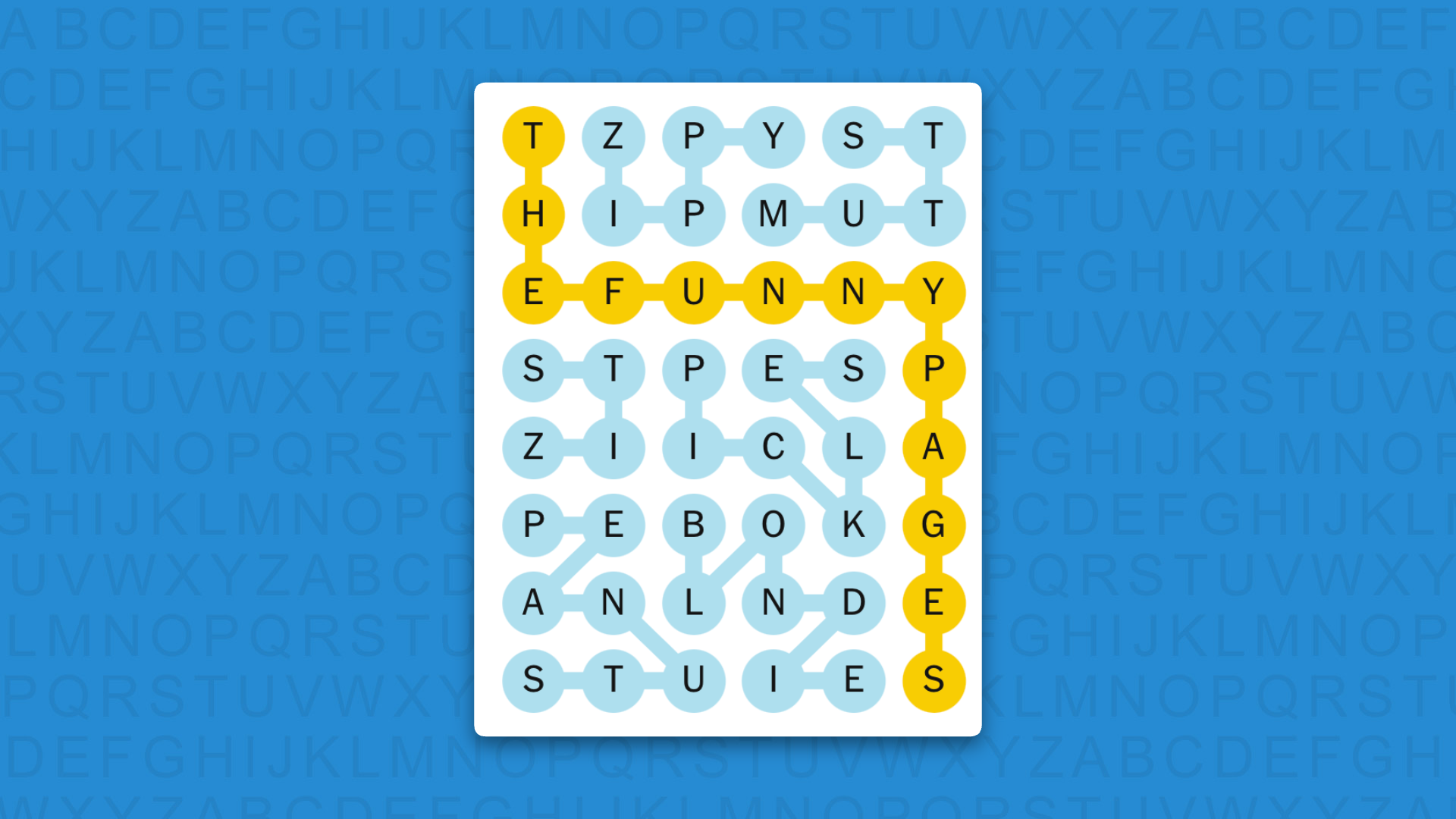
  • PEANUTS
  • ZIPPY
  • MUTTS
  • PICKLES
  • ZITS
  • BLONDIE
  • SPANGRAM: THEFUNNYPAGES
  • My rating: Hard
  • My score: 3 hints

After missing out on getting an easy Spangram-first yesterday I was on a mission to spot it today and it ended up being far easier than I thought.

I was unsure exactly what the theme meant, but seeing the word 'funny' in the middle of the board and then the word 'the' in the top-left-hand corner helped me connect THEFUNNYPAGES.

This, though, was where my good fortune ended, as I needed three hints to find all of the comic strip names, being familiar with only Peanuts.

Comic strips were less of a big deal in the UK, where I grew up, although the cartoon strips on the back page along with the TV listings section were the only parts of the newspaper I read as a kid. Ours, though, were the adventures of a world-weary viking called Hägar.

Yesterday's NYT Strands answers (Wednesday, September 16, game #927)

  • JAZZY
  • VIVID
  • BRIGHT
  • FLASHY
  • STRIKING
  • VIBRANT
  • SPANGRAM: EYECATCHING

What is NYT Strands?

Strands is the NYT's not-so-new-any-more word game, following Wordle and Connections. It's now a fully fledged member of the NYT's games stable that has been running for a year and which can be played on the NYT Games site on desktop or mobile.

I've got a full guide to how to play NYT Strands, complete with tips for solving it, so check that out if you're struggling to beat it each day.

  •  

AMD could be working on an Nvidia DLSS 5 rival, but it'll be for next-gen RDNA 5 GPUs — and I've a feeling that may be too late

  • AMD is rumored to be working on its own version of DLSS 5
  • A leaker says that the neural rendering tech will be launched with next-gen RDNA 5 GPUs
  • That means we could be waiting until late 2027 or 2028 to see this debut, which might leave AMD lagging behind Nvidia considerably

AMD could be working on its own take on Nvidia's DLSS 5, and apparently this alternative attempt at neural rendering will be for its next-gen RDNA 5 graphics cards.

VideoCardz spotted that a known leaker in the GPU field, Kepler L2, posted on the Anandtech forum in a discussion around RDNA 5 speculation to say that: "AMD will have their own version of 'Neural Lighting' like DLSS5 next-gen."

Kepler then clarified that he didn't mean a version of Ray Reconstruction, but a take on DLSS 5 (neural rendering), and that next-gen RDNA 5 GPUs would be required because "this stuff is pretty heavy" (as in resource-intensive).

In a further post, Kepler elaborated: "There's a lot of issues with Nvidia's approach [with DLSS 5], but it's possible to have a version of this with minimal hallucinations and 'AI slop' look."

He then suggests a way that AMD could work its version to improve on DLSS 5, including giving the AI "direct access to 3D game data such as geometry, ray data, depth buffers, materials, etc so it doesn't have to guess and can accurately know how each object in a scene should interact with light."

Kepler's outline of a proposed alternative for AMD would have a separate model (AI) for lighting improvements, and another different model solely for the shading of complex surfaces. DLSS 5 bundles these together with its neural rendering system, and adds color-grading on top — to adopt what the AI judges as more natural colors — which Kepler advises that AMD should dispense with entirely.

Analysis: a race against time – or a chance to get it right?

GIGABYTE Radeon RX 9070 GRE GPU

(Image credit: Gigabyte)

I won't pretend to be able to critique what Kepler is suggesting as an alternative for AMD and the technical nuances therein, except to say that the idea is clearly to achieve a result that looks less like it's been 'messed' about with by AI and minimizes any 'slopification' therein — preserving more of the original artistic intent.

And that seems a laudable goal, of course, and it also brings up how AMD is in an interesting position here in lagging behind Nvidia with its graphics tech (which has, of course, been the case from the start, with FSR following DLSS — version 2.0 of Nvidia's upscaling tech was already in play, in fact, when FSR 1.0 arrived). Team Red can sit back for now and see how DLSS 5 plays out, as more games emerge that use it, and gauge the reaction of gamers, and forge its own neural rendering tech to tackle any perceived weaknesses.

The performance hit will be an obvious area to target, and if AMD can bring that down — it's substantial with DLSS 5 as it is now — that will obviously be a big win. That said, I'd expect Nvidia will be working with some haste to make DLSS 5 more performant, and as with DLSS 1, the tech will be improved considerably by the time Team Red has its own version out.

This is the other side of the equation here, where Nvidia could win out. With RDNA 5 GPUs not expected to arrive for at least a year, and quite possibly longer (the RAM crisis isn't helping), there's quite a lengthy timeframe on any AMD rival to DLSS 5. By the time it arrives, DLSS 5.5 may be in town with considerable improvements in tow. There's already been a notable turnaround in the perception of DLSS 5 with its official launch (compared to Nvidia's sneak preview earlier this year).

This is, of course, assuming AMD is indeed working on its own neural rendering technology, but I'd be surprised if this wasn't the case. For now, though, the word of a single leaker needs to be thoroughly seasoned, as ever, even though it's believable enough that Team Red would be aiming to use this on RDNA 5 graphics cards.

  •  

Iran snoops on enemies of the state with Chosen Brick malware controlled using messaging apps

  • UK NCSC, FBI, and Dutch AIVD warn Iran is using Chosen Brick malware against dissidents and journalists
  • Malware steals files, captures audio, grabs WhatsApp/Telegram data, and can wipe systems entirely
  • Operatives rely on social engineering; agencies urge awareness, MFA, updates, and endpoint monitoring

Iranian hackers are targeting “enemies of the state”, both local and foreign, with advanced malware capable of spying on the victims and stealing their sensitive files, experts have warned.

This is according to a new security advisory, published jointly by the UK National Cyber Security Centre, the FBI, and the Netherlands’ General Intelligence and Security Service (AIVD), which noted how Iranian operatives would first do extensive research into their victims - dissidents, activists, and journalists - deemed a risk to the regime.

After learning as much about their targets as possible, they reach out via social media, either as someone the victims know, or as technical support for the platform they’re currently using, engaging in extended conversation until the victim lowers their guard. At one point, the attackers will try to share a piece of malware with the victims, tracked as Chosen Brick.

A thousand victims

This malware, designed primarily for the Windows platform, has a long list of capabilities, including enumerating running processes and system information, capturing screen content, enabling the microphone to capture audio content, capturing a copy of Telegram and WhatsApp data from web browsers, downloading additional files and malware, deleting files, stealing email content, and ultimately - wiping the entire computer system. The operatives communicate with the malware using Telegram, it was said.

“Iran almost certainly uses cyber activity to support the repression of individuals who are seen as a threat to the regime, such as dissidents, activists and journalists,” the three agencies said in the report. “In some cases, the Iranian intelligence services have plotted to kidnap or conduct lethal operations against individuals internationally, who they perceive as enemies of the regime.”

In the advisory, the three agencies said the best defense is to simply be more aware of social engineering. However, there are also a few technical mitigations that can help, including following NCSC advice on staying safe online, keeping all devices up-to-date (ideally through automatic updates), using antivirus software, and not disabling smart screen warnings on file downloads.

Finally, it would be wise to enable phishing-resistant MFA, make sure devices are managed with appropriate controls, turn on email scanning, deploy endpoint and network monitoring, and conduct a search for the IoCs.

Via The Register

  •  

CenterPoint Energy confirms hackers compromised networks and stole data, and the hackers claim theft of 7.5 million files

  • CenterPoint Energy confirmed a cyberattack via exposed API, with customer data stolen
  • Threat actor claims 7.49M files including IDs, SSNs, billing data, and transaction records
  • Operations unaffected; investigation ongoing, regulators notified, customers to be informed

CenterPoint Energy has confirmed suffering a cyberattack and data theft, days after a criminal advertised the stolen files on an underground hacking forum.

CenterPoint Energy is a large US energy utility company that delivers electricity and natural gas to homes and businesses. It employs roughly 8,800 people and operates around $48.3 billion in assets, as of June 2026.

Recently, a threat actor posted a new thread on a dark web forum, saying they stole 7.49 million CenterPoint files from a poorly secured API, The Register reports. They said that the data included customer names and contact details, billing data, move-in dates, driver’s license information, and the last four digits of Social Security numbers (SSN).

Incurring expenses

No independent investigators have confirmed these claims just yet, and the company said it was investigating the matter. In a new 8-K document filed with the US Securities and Exchange Commission (SEC) on September 14, the company said that it “became aware of an online post by a third party claiming to have obtained a data set containing certain of the company’s customer information.”

It activated its incident response protocols and kicked off an investigation with the help of third-party cybersecurity experts.

“While the investigation remains ongoing, the company has determined that an unauthorized third party obtained personal information relating to a portion of the company’s customers through one of the company’s external facing systems,” the filing reads. “The company is continuing to work with third-party experts to determine the scope of customers and personal information affected by the incident and intends to notify affected customers and regulatory authorities as required by applicable law.” The police and regulatory agencies have been notified.

While the attack did not impact CenterPoint’s operations, which continue as usual, it did incur certain expenses, the company concluded. It stressed that it will likely incur even more expenses as the investigation continues.

Via The Register

  •  

AWS bets that AI agents need an inbox, not another chat window

AWS is betting that AI agents need a different interface as they move beyond answering prompts and start working autonomously in the background.

The company has open-sourced Pizza Bot, a self-hosted application that gives users an inbox for managing work delegated to AI agents, with separate threads for ongoing tasks and a queue for work that is completed or needs human input, rather than keeping the management of agents restricted inside a conventional chat window.

The rationale, according to AWS, is that background agents do not always need a user’s attention while they work, and an inbox model will let users hand off longer-running tasks, return to them later, and see which jobs are complete or require intervention.

Under the hood

That approach is reflected in how the inbox organizes work with the help of an “All” tab that contains the history of each task or conversation, including the agent’s messages and work performed, the “Unread” tab that flags completed work that users have yet to review, and an “Action” tab that surfaces tasks paused while waiting for user input or approval.

The inbox interface also has a panel named Activity that shows users how an agent handled a particular task along with the transcript, AWS wrote in a blog post introducing Pizza Bot.

AWS’ inbox-oriented rationale also extends to Pizza Bot’s architecture.

It uses LangChain’s Deep Agents as the harness and LangGraph as the stateful runtime, with a combination of the two allowing an agent to checkpoint its progress as it works, preserving its messages, tool activity and current state so a task can be paused and resumed rather than being tied to a live chat session, the hyperscaler wrote.

Pizza Bot’s server sits on top of that stack, connecting the agent runtime with the user interface, skills, MCP servers and the model provider, with developers able to choose from Anthropic, OpenAI, Google Gemini and Amazon Bedrock, as well as local models through Ollama, it added.

As for its out-of-the-box capabilities, the application comes with skills for working with files, browsing the web and delegating tasks to specialist agents. Developers can also add existing Agent Skills and MCP servers to give the agents access to other tools and services, the hyperscaler wrote.

Enterprise integration could remain a hurdle

However, analysts were not too convinced that Pizza Bot’s out-of-the-box skills and support for existing tools will make its implementation easier for enterprises.

While the out-of-the-box capabilities and added support for existing skills saves enterprise teams the time to build the application, it leaves out the integration work required to make it work, said Bhupendra Chopra, chief revenue officer at IT consulting firm Kanerika.

“Integration is where most of the money in an enterprise agent deployment goes. A sales or finance team gets value from an agent when it can read and update CRM, email and ERP, and each of those systems needs a connector someone has to build, secure and maintain,” Chopra pointed out.

Pizza Bot’s integration could be further complicated by the application’s lack of support or any SLA, according to Manoj Chandra Jha, principal analyst at Nord-IQ Research. That means the integration and operational burden ultimately falls on enterprises, who would be responsible for running, securing and maintaining the open source software themselves, Jha said.

Rise in enterprise productivity likely

But for enterprises willing to take on that integration work, the inbox-oriented approach could improve productivity.

“It’s a meaningful shift because it changes the economics of delegating work to agents. A chat interface requires a person’s attention throughout the task, while an inbox brings them in only when their judgment is needed, much like how executives delegate work to their teams,” Chopra said.

“Coding agents have already demonstrated this model, where an engineer assigns an issue and reviews the resulting pull request. Pizza Bot extends that approach to tasks such as meeting preparation and follow-ups,” Chopra added.

Further, the analyst pointed out that the inbox-oriented approach could give enterprise teams a clearer window into how scheduled tasks perform.

“For scheduled tasks, having the results delivered as threads gives users a way to track what happened in the background and spot failures that might otherwise go unnoticed,” Chopra said.

Out of sight, out of mind

There are risks with this approach, however: “The inbox model can make bad work less visible. When somebody is watching an agent in a chat window, they can see it going off the rails,” said Phil Fersht, CEO of HFS Research.

In contrast, when hundreds of tasks are running quietly in the background, users may not see an agent making mistakes until the task is complete or an exception requires their attention, potentially making problems harder to catch early, Fersht said.

That reduced visibility can also create approval fatigue, according to Chopra.

“An agent sending back dozens of threads with multiple approval requests can condition users to approve them without reading them closely,” Chopra said.

There is also a risk in the delay between an agent preparing an action and a user approving it: “Information that was current when the agent paused may no longer be valid hours later, potentially resulting in an outdated CRM update or a meeting invite for a slot that is no longer available,” he said. “An assumption that might be caught in a live chat can go unchallenged as the agent continues building on it and consuming model resources. Scheduled runs can also add costs without anyone watching them in real time.”

Those disadvantages can be countered by designing processes with fewer, better-timed approval points, and verifying that the underlying data is still current before allowing an action to execute, he said.

Adoption likely to start with technical teams

Such tradeoffs are likely to shape where Pizza Bot gains traction.

“Adoption will likely be bottom-up, with individual technologists and small platform teams drawn to Pizza Bot’s control and standards-based design,” Jha said. “Risk-averse industries, especially ones in the regulated sectors, and business users with limited technical expertise, however, are likely to approach the application more cautiously,” he added.

That could leave Pizza Bot occupying a more targeted role in the enterprise, as a way for technical teams to experiment with asynchronous agents and new ways of delegating work, rather than an immediate replacement for the governed interfaces and managed services enterprises typically use for business-critical processes, he said.

This article first appeared on InfoWorld.

  •  

Vote now in the TechRadar Readers' Choice Awards 2026 — Computing & Gaming categories!

It's time for TechRadar's annual tech awards, and this year we're doing it differently. For the first time, we have a complete set of categories where the winners are chosen 100% by you, the TechRadar readers.

The TechRadar Readers' Choice Awards 2026 comprises nearly 100 categories, but we know that not everyone is interested in voting in every one, so on this page you can vote in just our Computing and Gaming categories.

These include laptops, PC gaming peripherals, console accessories, monitors, gaming services and more. You can vote in the survey just below — or follow the links to see other specific categories, or to vote on the full list instead.

The shortlists were chosen by TechRadar's editors based on the best products we've tested or the most popular products of the year. You'll need to vote before 00:01am PST / 03:01am EST / 08:01am BST on Wednesday October 7th 2026 for it to be counted.

Once the deadline has passed at 00:01am PST / 03:01am EST / 08:01am BST on Wednesday October 7th 2026, we'll tally your votes to find the winners in each category.

We'll announce the winners in our big TechRadar Awards 2026 Week, starting Monday October 19th. We'll reveal the winners of the Reader's Choice Awards, as well as the winners of our TechRadar Product of the Year Awards, which are chosen solely by our expert judges.

How many products will do the double? We'll be curious to see — but right now, all you can do is vote for what you think should win, so vote away!

  •  

‘Godfather of AI’ says tech regulation is nearing Covid-style pivot moment

Safety crisis makes it more likely that governments will be spurred into action, says Yoshua Bengio

Concerns over AI safety are reaching a point where governments realise they must act to protect the public, similarly to in the Covid pandemic, according to one of the “godfathers” of the technology.

Yoshua Bengio said recent events, including a “swarm” of OpenAI agents hacking a startup and tech insider warnings of an existential threat, were cutting through – making government action more likely.

Continue reading...

© Photograph: Atlantic Studios

© Photograph: Atlantic Studios

© Photograph: Atlantic Studios

  •  

Canon cameras just got a free update that unleashes immersive 3D photo capabilities — here's how

  • Canon announced its 3D image generation 'Dual Pixel 3D' tech
  • It uses depth data from a single shot via Dual Pixel CMOS AF, through a free Windows-only app coming in October
  • The EOS R10 and most models up to the EOS R5 series are compatible

Canon introduced a new Dual Pixel CMOS-type sensor and autofocus system in the EOS R5 back in 2020, and a string of cameras have since inherited this tech, most recently the EOS R8 Mark II announced today. And it's these cameras that just got a free upgrade that can add another dimension to photos: Dual Pixel 3D.

The new software leverages "depth and phase-detection data captured in a single shot via Dual Pixel CMOS AF", says Canon, using "an exclusive algorithm to convert your photos into highly realistic 3D imagery", plus 3D models in OBJ or GLB formats, or as an MP4 video, "complete with rich photographic textures."

This depth-adding tech will come in the (free) Dual Pixel 3D Converter software, which will be available for Windows only (Windows 11 64-bit 24H2 or later), from October 3.

So what exactly can users expect from the software, and which cameras are compatible? Let's take a look.

An extra dimension

Billed as 'simple 3D image generation technology', Dual Pixel 3D enables users to create immersive three-dimensional images and models from a single RAW photo, without needing specialized equipment or viewing devices. Canon also says the technology works with JPEGs captured by the new EOS R8 Mark II.

These files contain depth information from slightly different views, captured by each pixel's two photodiodes, which are then converted into 3D shape data.

Users will be able to fine-tune the degree of depth in the new software, for a more pronounced 3D effect or a subtler appearance. The depth information in Dual Pixel CMOS-captured photos also simplifies background removal, should users want to output a subject onto a plain background as a 3D model, or as a stereographic photo.

Can has shared tips for how to take photos designed to be converted for 3D on its YouTube channel (see below).

Photographers working in product and still life photography stand to benefit from the creative possibilities in particular. We'll be sure to try out the new software when it's released on October 3, and share our experience of making 3D imagery with it.

Compatible Canon cameras and lenses

Here's every Canon mirrorless camera that features Dual Pixel CMOS AF and can, therefore, enjoy the new Dual Pixel 3D feature, provided images are captured with a compatible lens:

And you'll need to be using one of these lenses;

RF24-70mm F2.8 L IS USM

RF24-50mm F4.5-6.3 IS STM

RF24-105mm F4 L IS USM

RF24-105mm F4-7.1 IS STM

RF35mm F1.8 MACRO IS STM

RF50mm F1.8 STM

RF70-200mm F2.8 L IS USM

RF70-200mm F4 L IS USM

RF85mm F2 MACRO IS STM

RF100mm F2.8 L MACRO IS USM

RF-S18-45mm F4.5-6.3 IS STM

RF-S18-150mm F3.5-6.3 IS STM

  •  

DDR5 RAM pricing appears to be spiralling out of control even more — it's 5.5x pricier than before the memory crisis, and 2027 could get worse

  • DDR5 RAM has hit a new pricing high in the German market
  • It's now 544% up on the price it was before the RAM crisis began
  • This inflation backs up predictions of the memory shortage worsening, and Dell has just hiked the price of one of its popular laptops, too

If you wanted a telling example of how bad the cost of RAM is getting, the latest report on DDR5 pricing makes it crystal clear – and it reaches us as Dell moves to hike the price of its affordable XPS 13 laptop (in a roundabout way).

I'll come back to the ins-and-outs of what's happening with Dell, but first the DDR5 price jump, which has happened over in Germany.

3D Center keeps tabs on the monthly pricing of DDR5 memory in the German retail market – some 20 products are covered in this largest market in Europe – and as Wccftech flagged, the report for September shows this RAM is now 544% up on the price it was in July 2025 (the baseline level before the crisis began).

This is a big leap from 486% where the DDR5 price index sat in August, and since June, when it was at 419% having remained flat for much of the year. This obviously represents a depressingly hefty additional toll on the wallets of PC buyers or those upgrading their memory.

Meanwhile, as Mashable noticed, Dell has effectively upped the price of its XPS 13 laptop in the US, without actually increasing the baseline cost – instead of doing that, the laptop maker has introduced a new entry-level model with less storage.

So, previously the XPS 13 started from $699 in the US for the model with 8GB of RAM and 512GB of storage. What Dell has done is brought in a new model with 256GB of storage at that $699 level, so while technically the cheapest XPS 13 is still at that price, you're getting a lower spec for the money.

The old baseline model with 8GB RAM and a 512GB SSD is now $799, so it's been hiked by $100 – a pretty nasty bump in cost that moves this notebook into a distinctly less affordable price bracket.

If you want the XPS 13 with 16GB of system memory (and 512GB of storage), that's also gone up $100 so it's now at $999. Do note that these are student-targeted laptops, and students get a $100 discount on the XPS 13, so you will pay less in that case. However, while $599 (with $100 off) remains a tempting price in this climate, 256GB storage is cutting it thin.

Analysis: as predicted, 2026 is turning much nastier with RAM

RAM sticks stacked on top of each other

(Image credit: Shutterstock)

The DDR5 price spike is truly worrying in my opinion, simply because it's an acceleration of an already worsening picture. Yes, it's only one retail market and a snapshot of the overall landscape as such, but the same pattern is seen elsewhere. Just look at Tom's Hardware's price tracker that shows 32GB of DDR5-5600 RAM in the US is now $409 (at the time of writing) compared to $72, which was the lowest price seen before the memory crisis.

That's over a 5.5x price increase in the US market (mirroring the German level of RAM inflation in this particular case). The end result is that what used to be a no-brainer of future-proofing any desktop PC – particularly a gaming rig – with 32GB of RAM is now a difficult choice to make, as sticking with 16GB is saving you $200 (or the regional equivalent). Bearing in mind that you're battling all sorts of other component inflation if you're building a new PC, too (most notably with the likes of SSDs and increasingly GPUs).

We were told that the second half of 2026 would see more RAM price misery, and these German market figures illustrate exactly that. Since June, buyers in the country have witnessed an effective 30% increase in the cost of DDR5 (when it was already hugely overinflated). It's worse than I imagined it could get, frankly, and I fear that the most pessimistic predictions – which also forecast a very rough 2027 – are very much on the money.

All these RAM price hikes are eventually reflected in the cost of laptops, of course, and the Dell XPS 13 provides an apt illustration here. Interestingly enough, I recently wrote about Dell's revelation of its new 14S laptop – which was shown off at IFA, but without any price tag being attached – saying that this made me nervous about how much the notebook might cost.

Given this XPS 13 hike, it's easy to see why Dell was hesitant, and to be fair to the company, it isn't the only manufacturer that's reticent to pin launch prices on incoming devices. This is becoming a trend because the memory shortage, and its knock-on effects, are making life difficult for all device makers.

  •  

Meta leak suggests camera-free smart glasses are on the way — as thousands download the 'Zuckoff' anti-smart glasses app

  • New camera-free smart glasses from Meta are rumored
  • The wearable could be unveiled as early as next week
  • A new glasses-detecting app is proving popular with users

It's fair to say that the various iterations of Meta's smart glasses had been quite well received by users — as you'll see from our own reviews — but over time, the general public has become less and less comfortable with the idea of being secretly spied on through the cameras embedded in these wearables.

That might explain Meta's plans to release some spectacles with cameras on board, as reported by The Information. According to the outlet's sources, the glasses have the codename Luna, and will be available in two styles called Clubmaster and Burbank.

With no camera, the focus will be on the audio capabilities of the glasses, which will let you have conversations with Meta's own AI chatbot. The report says we could get a grand unveiling at the Meta Connect event next week, on September 23 and 24.

While Meta's smart specs have always been fitted with LED lights that show when they're recording, modders were finding ways around this, enabling more covert video and photo capture. While those mods have since been disabled and prevented by software updates, it's still left people with a general sense of unease.

The backlash continues

ZuckOff

The ZuckOff app on iOS (Image credit: ZuckOff)

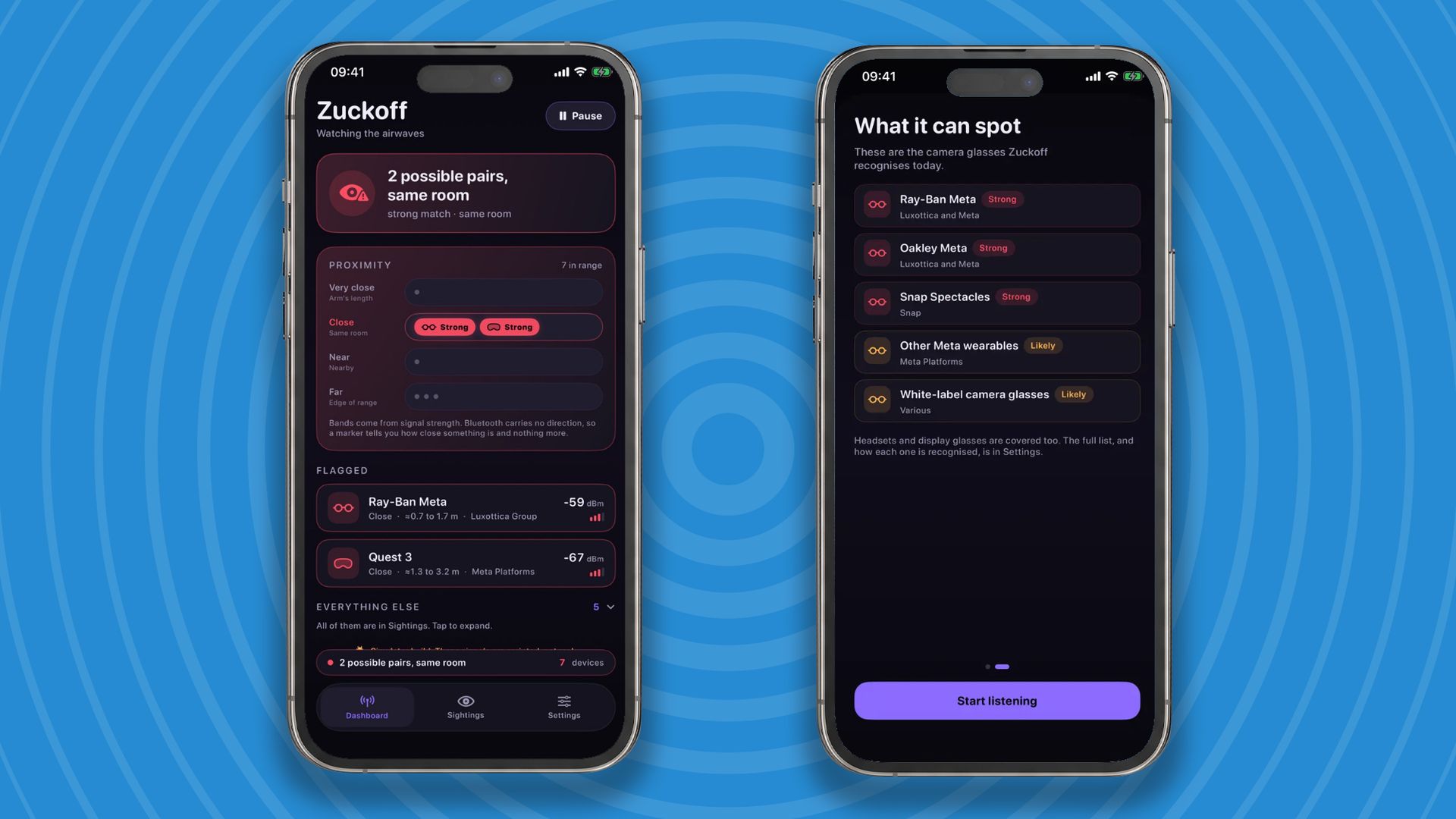
As Meta apparently preps its next pair of smart glasses, Wired reports on the ZuckOff app that takes a swing at the Meta CEO in its name, and alerts users when they might be in the presence of someone wearing Meta glasses. The app uses Bluetooth to scan the surrounding area for these wearables.

With several thousand downloads on both Android and iOS, the app is clearly proving popular. It's free to download and use in its basic form, with a pro version available for $9.99 / £9.99 / AU$14.99 a year that scans continuously and gives you scan histories.

It's not your only option either: if you're on Android, Nearby Glasses is open source and free to use, and does a similar sort of job as ZuckOff without the provocative name. That app has now racked up more than 100,000 downloads.

There's definitely been a shift in perception when it comes to glasses that can record, warning light or no warning light — even though these specs have been around for years. There's even talk of bans and government regulation coming in at some point, which Meta might be trying to get ahead of with its next pair of glasses.

  •  

Planning permission for new Scottish AI datacentres suspended for up to a year

MSPs vote for strict environmental impact assessments and will delay decisions until national strategy is developed

Holyrood has voted to pause planning applications for all new AI datacentres for up to a year until the Scottish government has developed a national strategy.

On Wednesday, MSPs backed a Scottish Labour motion to halt new schemes for up to 12 months while rules on hyperscale datacentres are developed in what could be a blow to the British government’s AI strategy.

Continue reading...

© Photograph: Murdo MacLeod/The Guardian

© Photograph: Murdo MacLeod/The Guardian

© Photograph: Murdo MacLeod/The Guardian

  •  

Third-party WooCommerce plugin hits WordPress sites with PHP backdoor abusing recently patched vulnerability

  • Defiant warned of active exploitation of WooCommerce Wholesale Lead Capture Plugin flaw (CVE‑2026‑27540)
  • Critical unauthenticated file‑upload bug lets attackers deploy PHP webshells for site takeover
  • Patch released in Feb 2026 (v2.0.3.2); Wordfence blocked 100,000+ attacks, users urged to update and check uploads

A critical vulnerability in a popular WooCommerce plugin is being actively exploited to upload malware and possibly take over entire websites, security experts have warned.

The plugin in question is called Wholesale Lead Capture Plugin for WooCommerce. It adds a dedicated registration and onboarding system for wholesale and B2B customers, letting businesses collect company and other custom information, review applications, assign wholesale user roles, and automate registration and onboarding emails.

It is a premium plugin that costs between $99 and $600 and which, according to the Wordpress store page, has more than 20,000 active installations.

A thousand victims

The plugin was vulnerable to an unauthenticated arbitrary file-upload flaw which, as the name suggests, allows unauthenticated parties to upload arbitrary files, including PHP webshells and executable code that can result in full site takeover. It is tracked as CVE-2026-27540 and carries a severity score of 9.0/10 (critical).

Versions 2.0.3.1 and older were said to be affected. Version 2.0.3.2, released on February 20, was said to have addressed the bug, meaning the patch has been available for almost half a year. However, WordPress security outfit Defiant said its Wordfence web application firewall blocked more than 100,000 attacks, and Wordfence added that it observed two attack spikes - one between June 4 and 17, and another one between July 1 and August 30.

In these incidents, the attackers were mostly uploading reconnaissance webshells, possibly mapping out the landscape before deploying more serious malware.

“The uploaded shell.php is a PHP webshell that reports host details and provides a browser-based upload form for writing additional malicious files to the site,” the researchers said.

If you are running the plugin, it is advised you update it to the newest version as soon as possible, and check upload directories for unexpected, or recently created, PHP files.

Via BleepingComputer

  •  

‘If you’re building Frankenstein, stop’: JD Vance dismisses calls for AI regulation

US vice-president’s comments come as former Anthropic researcher revisits recent claim AI could destroy humanity

The US vice-president has dismissed calls for global regulation of AI safety risks, telling companies creating the most advanced models: “If you’re building Frankenstein, stop.”

In remarks addressed towards Dario Amodei, the co-founder of Anthropic who has called on Washington DC to coordinate control of AI systems, including with China, JD Vance said: “If you’re gonna create Frankenstein, don’t come to the government and say we need regulation.”

Continue reading...

© Photograph: Mark Schiefelbein/Reuters

© Photograph: Mark Schiefelbein/Reuters

© Photograph: Mark Schiefelbein/Reuters

  •  
❌